 夜雨聆风
夜雨聆风事务源码分析
<!-- 启用事务注解 -->
<tx:annotation-driven transaction-manager="transactionManager"/>
与AOP的标签解析相同,tx:annotation-driven标签也是自定义标签,http://www.springframework.org/schema/tx找到对应的handler是TxNamespaceHandler
http\://www.springframework.org/schema/tx=org.springframework.transaction.config.TxNamespaceHandler
TxNamespaceHandler
执行init方法
public void init() {
   registerBeanDefinitionParser("advice", new TxAdviceBeanDefinitionParser());
  registerBeanDefinitionParser("annotation-driven", new AnnotationDrivenBeanDefinitionParser());
  registerBeanDefinitionParser("jta-transaction-manager", new JtaTransactionManagerBeanDefinitionParser());
}
在解析tx:annotation-driven标签时使用AnnotationDrivenBeanDefinitionParser来进行解析
public BeanDefinition parse(Element element, ParserContext parserContext) {
   registerTransactionalEventListenerFactory(parserContext);
   String mode = element.getAttribute("mode");
   if ("aspectj".equals(mode)) {
      // mode="aspectj"
      registerTransactionAspect(element, parserContext);
   }
   else {
      // mode="proxy"
      // 创建aop代理  AopAutoProxyConfigurer是内部静态类
     AopAutoProxyConfigurer.configureAutoProxyCreator(element, parserContext);
   }
   return null;
}
configureAutoProxyCreator方法
public static void configureAutoProxyCreator(Element element, ParserContext parserContext) {
  // 注册了InfrastructureAdvisorAutoProxyCreator的bean
   AopNamespaceUtils.registerAutoProxyCreatorIfNecessary(parserContext, element);
 // org.springframework.transaction.config.internalTransactionAdvisor
   String txAdvisorBeanName = TransactionManagementConfigUtils.TRANSACTION_ADVISOR_BEAN_NAME;
   if (!parserContext.getRegistry().containsBeanDefinition(txAdvisorBeanName)) {
      Object eleSource = parserContext.extractSource(element);

      // Create the TransactionAttributeSource definition.
     // 创建TransactionAttributeSource的bean
      RootBeanDefinition sourceDef = new RootBeanDefinition(
            "org.springframework.transaction.annotation.AnnotationTransactionAttributeSource");
      sourceDef.setSource(eleSource);
      sourceDef.setRole(BeanDefinition.ROLE_INFRASTRUCTURE);
     // 注册TransactionAttributeSource的bean
      String sourceName = parserContext.getReaderContext().registerWithGeneratedName(sourceDef);

      // Create the TransactionInterceptor definition.
     // 创建TransactionInterceptor的bean
      RootBeanDefinition interceptorDef = new RootBeanDefinition(TransactionInterceptor.class);
      interceptorDef.setSource(eleSource);
      interceptorDef.setRole(BeanDefinition.ROLE_INFRASTRUCTURE);
      registerTransactionManager(element, interceptorDef);
      interceptorDef.getPropertyValues().add("transactionAttributeSource", new RuntimeBeanReference(sourceName));
     // 注册TransactionInterceptor的bean
      String interceptorName = parserContext.getReaderContext().registerWithGeneratedName(interceptorDef);

      // Create the TransactionAttributeSourceAdvisor definition.
     // 创建TransactionAttributeSourceAdvisor的bean
      RootBeanDefinition advisorDef = new RootBeanDefinition(BeanFactoryTransactionAttributeSourceAdvisor.class);
      advisorDef.setSource(eleSource);
      advisorDef.setRole(BeanDefinition.ROLE_INFRASTRUCTURE);
     // 将TransactionAttributeSource的bean注入到transactionAttributeSource属性中
      advisorDef.getPropertyValues().add("transactionAttributeSource", new RuntimeBeanReference(sourceName));
     // // 将TransactionInterceptor的bean注入到adviceBeanName属性中
      advisorDef.getPropertyValues().add("adviceBeanName", interceptorName);
      if (element.hasAttribute("order")) {
         advisorDef.getPropertyValues().add("order", element.getAttribute("order"));
      }
     // 注册的bean的名称是org.springframework.transaction.config.internalTransactionAdvisor
      parserContext.getRegistry().registerBeanDefinition(txAdvisorBeanName, advisorDef);

      CompositeComponentDefinition compositeDef = new CompositeComponentDefinition(element.getTagName(), eleSource);
      compositeDef.addNestedComponent(new BeanComponentDefinition(sourceDef, sourceName));
      compositeDef.addNestedComponent(new BeanComponentDefinition(interceptorDef, interceptorName));
      compositeDef.addNestedComponent(new BeanComponentDefinition(advisorDef, txAdvisorBeanName));
      parserContext.registerComponent(compositeDef);
   }
}
InfrastructureAdvisorAutoProxyCreator
来先看一下InfrastructureAdvisorAutoProxyCreator的结构,发现和之前解析AOP时的AnnotationAwareAspectJAutoProxyCreator很像
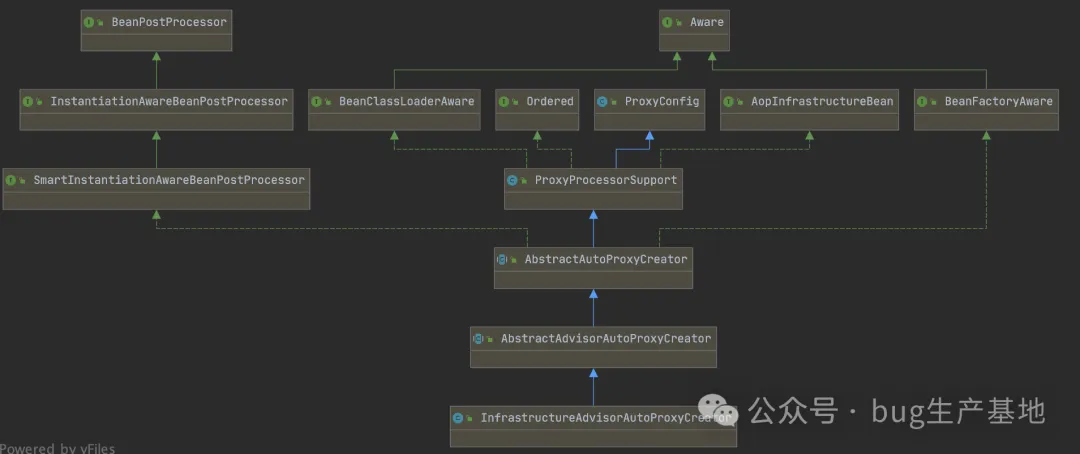
而且继承的类也是一样的,都是AbstractAdvisorAutoProxyCreator,之后的逻辑就与AOP的很是相似了,找Advisor类的bean,是有一个的,注册BeanFactoryTransactionAttributeSourceAdvisor
public class BeanFactoryTransactionAttributeSourceAdvisor extends AbstractBeanFactoryPointcutAdvisor {

 private TransactionAttributeSource transactionAttributeSource;

 private final TransactionAttributeSourcePointcut pointcut = new TransactionAttributeSourcePointcut() {
  @Override
  protected TransactionAttributeSource getTransactionAttributeSource() {
   return transactionAttributeSource;
  }
 };


 /**
  * Set the transaction attribute source which is used to find transaction
  * attributes. This should usually be identical to the source reference
  * set on the transaction interceptor itself.
  * @see TransactionInterceptor#setTransactionAttributeSource
  */
 public void setTransactionAttributeSource(TransactionAttributeSource transactionAttributeSource) {
  this.transactionAttributeSource = transactionAttributeSource;
 }

 /**
  * Set the {@link ClassFilter} to use for this pointcut.
  * Default is {@link ClassFilter#TRUE}.
  */
 public void setClassFilter(ClassFilter classFilter) {
  this.pointcut.setClassFilter(classFilter);
 }

 @Override
 public Pointcut getPointcut() {
  return this.pointcut;
 }

}
判断pointcut是TransactionAttributeSourcePointcut
public boolean matches(Method method, Class<?> targetClass) {
   if (targetClass != null && TransactionalProxy.class.isAssignableFrom(targetClass)) {
      return false;
   }
  // TransactionAttributeSource是上面进行创建的AnnotationTransactionAttributeSource
   TransactionAttributeSource tas = getTransactionAttributeSource();
   return (tas == null || tas.getTransactionAttribute(method, targetClass) != null);
}

// 获取事务属性
public TransactionAttribute getTransactionAttribute(Method method, Class<?> targetClass) {
  if (method.getDeclaringClass() == Object.class) {
   return null;
  }

  // First, see if we have a cached value.
  Object cacheKey = getCacheKey(method, targetClass);
  TransactionAttribute cached = this.attributeCache.get(cacheKey);
  if (cached != null) {
   // Value will either be canonical value indicating there is no transaction attribute,
   // or an actual transaction attribute.
   if (cached == NULL_TRANSACTION_ATTRIBUTE) {
    return null;
   }
   else {
    return cached;
   }
  }
  else {
   // We need to work it out.
   TransactionAttribute txAttr = computeTransactionAttribute(method, targetClass);
   // Put it in the cache.
   if (txAttr == null) {
    this.attributeCache.put(cacheKey, NULL_TRANSACTION_ATTRIBUTE);
   }
   else {
    String methodIdentification = ClassUtils.getQualifiedMethodName(method, targetClass);
    if (txAttr instanceof DefaultTransactionAttribute) {
     ((DefaultTransactionAttribute) txAttr).setDescriptor(methodIdentification);
    }

    this.attributeCache.put(cacheKey, txAttr);
   }
   return txAttr;
  }
 }

// 解析@Transactional注解 TransactionAttribute
protected TransactionAttribute computeTransactionAttribute(Method method, Class<?> targetClass) {
  // Don't allow no-public methods as required.
  if (allowPublicMethodsOnly() && !Modifier.isPublic(method.getModifiers())) {
   return null;
  }

  // Ignore CGLIB subclasses - introspect the actual user class.
  Class<?> userClass = ClassUtils.getUserClass(targetClass);
  // The method may be on an interface, but we need attributes from the target class.
  // If the target class is null, the method will be unchanged.
  Method specificMethod = ClassUtils.getMostSpecificMethod(method, userClass);
  // If we are dealing with method with generic parameters, find the original method.
  specificMethod = BridgeMethodResolver.findBridgedMethod(specificMethod);

  // First try is the method in the target class.
  // 先尝试解析方法上有没有@Transactional注解
  TransactionAttribute txAttr = findTransactionAttribute(specificMethod);
  if (txAttr != null) {
   return txAttr;
  }

  // Second try is the transaction attribute on the target class.
  // 如果方法上没有,则解析类上的
  txAttr = findTransactionAttribute(specificMethod.getDeclaringClass());
  if (txAttr != null && ClassUtils.isUserLevelMethod(method)) {
   return txAttr;
  }

  if (specificMethod != method) {
   // Fallback is to look at the original method.
   txAttr = findTransactionAttribute(method);
   if (txAttr != null) {
    return txAttr;
   }
   // Last fallback is the class of the original method.
   txAttr = findTransactionAttribute(method.getDeclaringClass());
   if (txAttr != null && ClassUtils.isUserLevelMethod(method)) {
    return txAttr;
   }
  }

  return null;
 }
方法增强
如果匹配到@Transactional注解就会使用上述注册的TransactionInterceptor来进行方法增强
TransactionInterceptor#invoke方法
对于事务方法的调用,最终会调用TransactionInterceptor#invoke方法,会根据不同的事务处理器以及事务配置情况来进行事务操作
public Object invoke(final MethodInvocation invocation) throws Throwable {
  // 获取代理的目标对象
   Class<?> targetClass = (invocation.getThis() != null ? AopUtils.getTargetClass(invocation.getThis()) : null);

   // Adapt to TransactionAspectSupport's invokeWithinTransaction...
   return invokeWithinTransaction(invocation.getMethod(), targetClass, new InvocationCallback() {
      @Override
      public Object proceedWithInvocation() throws Throwable {
         return invocation.proceed();
      }
   });
}


protected Object invokeWithinTransaction(Method method, Class<?> targetClass, final InvocationCallback invocation)
   throws Throwable {

  // If the transaction attribute is null, the method is non-transactional.
  // 获取事务属性
  final TransactionAttribute txAttr = getTransactionAttributeSource().getTransactionAttribute(method, targetClass);
  // 事务管理器
  final PlatformTransactionManager tm = determineTransactionManager(txAttr);
  // 方法的唯一标识
  final String joinpointIdentification = methodIdentification(method, targetClass, txAttr);
// 区分不同的事务管理器
  // 对于CallbackPreferringPlatformTransactionManager类型的事务管理器,需要回调函数来实现事务的创建和提交,即声明式事务
  // 对于非CallbackPreferringPlatformTransactionManager类型的,不需要通过回调函数来实现事务的创建和提交,即编程式事务
  if (txAttr == null || !(tm instanceof CallbackPreferringPlatformTransactionManager)) {
   // Standard transaction demarcation with getTransaction and commit/rollback calls.
      // 创建事务,同时把创建事务过程中得到的信息放到TransactionInfo中,保存当前事务状态
   TransactionInfo txInfo = createTransactionIfNecessary(tm, txAttr, joinpointIdentification);

   Object retVal;
   try {
    // This is an around advice: Invoke the next interceptor in the chain.
    // This will normally result in a target object being invoked.
        // 沿着处理器链进行调用,执行被增强方法
    retVal = invocation.proceedWithInvocation();
   }
   catch (Throwable ex) {
    // target invocation exception
        // 事务处理方法调用中出现异常,事务处理需要根据具体情况进行回滚或者提交
    completeTransactionAfterThrowing(txInfo, ex);
    throw ex;
   }
   finally {
        // 重置掉ThreadLocal中的信息transactionInfoHolder.set(this.oldTransactionInfo)
    cleanupTransactionInfo(txInfo);
   }
      // 事务提交
   commitTransactionAfterReturning(txInfo);
   return retVal;
  }

  else { // 需要通过回调方法操作事务
   Object result;
   final ThrowableHolder throwableHolder = new ThrowableHolder();

   // It's a CallbackPreferringPlatformTransactionManager: pass a TransactionCallback in.
   try {
    result = ((CallbackPreferringPlatformTransactionManager) tm).execute(txAttr,
      new TransactionCallback<Object>() {
       @Override
       public Object doInTransaction(TransactionStatus status) {
        TransactionInfo txInfo = prepareTransactionInfo(tm, txAttr, joinpointIdentification, status);
        try {
         return invocation.proceedWithInvocation();
        }
        catch (Throwable ex) {
         if (txAttr.rollbackOn(ex)) {
          // A RuntimeException: will lead to a rollback.
          if (ex instanceof RuntimeException) {
           throw (RuntimeException) ex;
          }
          else {
           throw new ThrowableHolderException(ex);
          }
         }
         else {
          // A normal return value: will lead to a commit.
          throwableHolder.throwable = ex;
          return null;
         }
        }
        finally {
         cleanupTransactionInfo(txInfo);
        }
       }
      });
   }
   catch (ThrowableHolderException ex) {
    throw ex.getCause();
   }
   catch (TransactionSystemException ex2) {
    if (throwableHolder.throwable != null) {
     logger.error("Application exception overridden by commit exception", throwableHolder.throwable);
     ex2.initApplicationException(throwableHolder.throwable);
    }
    throw ex2;
   }
   catch (Throwable ex2) {
    if (throwableHolder.throwable != null) {
     logger.error("Application exception overridden by commit exception", throwableHolder.throwable);
    }
    throw ex2;
   }

   // Check result state: It might indicate a Throwable to rethrow.
   if (throwableHolder.throwable != null) {
    throw throwableHolder.throwable;
   }
   return result;
  }
 }
事务创建方法createTransactionIfNecessary
protected TransactionInfo createTransactionIfNecessary(
      PlatformTransactionManager tm, TransactionAttribute txAttr, final String joinpointIdentification) {

   // If no name specified, apply method identification as transaction name.
  // 如果没有指定名字,则使用方法唯一标识来作为事务名
   if (txAttr != null && txAttr.getName() == null) {
      txAttr = new DelegatingTransactionAttribute(txAttr) {
         @Override
         public String getName() {
            return joinpointIdentification;
         }
      };
   }

   TransactionStatus status = null;
   if (txAttr != null) {
      if (tm != null) {
        // 获取TransactionStatus
         status = tm.getTransaction(txAttr);
      }
      else {

      }
   }
  // 根据指定的属性和status准备一个TransactionInfo
   return prepareTransactionInfo(tm, txAttr, joinpointIdentification, status);
}


protected TransactionInfo prepareTransactionInfo(PlatformTransactionManager tm,
   TransactionAttribute txAttr, String joinpointIdentification, TransactionStatus status) {

  TransactionInfo txInfo = new TransactionInfo(tm, txAttr, joinpointIdentification);
  if (txAttr != null) {
   // We need a transaction for this method...

   // The transaction manager will flag an error if an incompatible tx already exists.
   txInfo.newTransactionStatus(status);
  }
  else {
   // The TransactionInfo.hasTransaction() method will return false. We created it only
   // to preserve the integrity of the ThreadLocal stack maintained in this class.

  }

  // We always bind the TransactionInfo to the thread, even if we didn't create
  // a new transaction here. This guarantees that the TransactionInfo stack
  // will be managed correctly even if no transaction was created by this aspect.
  // 将当前的TransactionInfo和线程进行绑定,同时TransactionInfo中由一个变量来保存以前的TransactionInfo,在请求事务时会创建TransactionInfo
  txInfo.bindToThread();
  return txInfo;
 }
getTransaction获取事务
// 1、获取事务
public final TransactionStatus getTransaction(TransactionDefinition definition) throws TransactionException {
  // 从ConnectionHolder中进行获取,如果有则使用原本的连接,如果没有则进行创建
  Object transaction = doGetTransaction();

  // Cache debug flag to avoid repeated checks.
  boolean debugEnabled = logger.isDebugEnabled();

  if (definition == null) {
   // Use defaults if no transaction definition given.
   definition = new DefaultTransactionDefinition();
  }
// 判断当前线程是否存在事务
  if (isExistingTransaction(transaction)) {
   // Existing transaction found -> check propagation behavior to find out how to behave.
      // 如果已经存在事务
   return handleExistingTransaction(definition, transaction, debugEnabled);
  }

  // Check definition settings for new transaction.
  // 事务超时
  if (definition.getTimeout() < TransactionDefinition.TIMEOUT_DEFAULT) {
   throw new InvalidTimeoutException("Invalid transaction timeout", definition.getTimeout());
  }

  // No existing transaction found -> check propagation behavior to find out how to proceed.
  // 当前线程不存在事务,但是TransactionDefinition被声明为PROPAGATION_MANDATORY,则抛出异常
  if (definition.getPropagationBehavior() == TransactionDefinition.PROPAGATION_MANDATORY) {
   throw new IllegalTransactionStateException(
     "No existing transaction found for transaction marked with propagation 'mandatory'");
  }
  // 当前线程不存在事务,但是TransactionDefinition被声明为PROPAGATION_REQUIRED或者PROPAGATION_REQUIRES_NEW或者PROPAGATION_NESTED,则新建事务
  else if (definition.getPropagationBehavior() == TransactionDefinition.PROPAGATION_REQUIRED ||
    definition.getPropagationBehavior() == TransactionDefinition.PROPAGATION_REQUIRES_NEW ||
    definition.getPropagationBehavior() == TransactionDefinition.PROPAGATION_NESTED) {
      // 空挂起
   SuspendedResourcesHolder suspendedResources = suspend(null);

   try {
    boolean newSynchronization = (getTransactionSynchronization() != SYNCHRONIZATION_NEVER);
    DefaultTransactionStatus status = newTransactionStatus(
      definition, transaction, true, newSynchronization, debugEnabled, suspendedResources);
        // 开始创建事务,包括设置ConnectionHolder、隔离级别、timeout,如果是新连接,则绑定到当前线程
    doBegin(transaction, definition);
        // 同步事务的设置
    prepareSynchronization(status, definition);
    return status;
   }
   catch (RuntimeException ex) {
    resume(null, suspendedResources);
    throw ex;
   }
   catch (Error err) {
    resume(null, suspendedResources);
    throw err;
   }
  }
  else {
   // Create "empty" transaction: no actual transaction, but potentially synchronization.

   boolean newSynchronization = (getTransactionSynchronization() == SYNCHRONIZATION_ALWAYS);
   return prepareTransactionStatus(definition, null, true, newSynchronization, debugEnabled, null);
  }
 }
以DataSourceTransactionManager为例
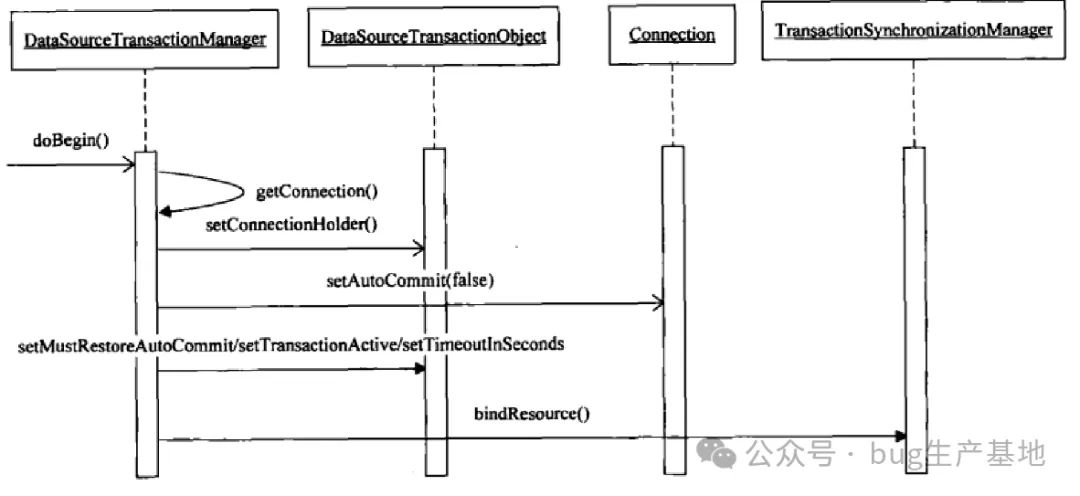
public class DataSourceTransactionManager extends AbstractPlatformTransactionManager
      implements ResourceTransactionManager, InitializingBean {
// 注入的数据源
   private DataSource dataSource;

   private boolean enforceReadOnly = false;


   public DataSourceTransactionManager() {
      setNestedTransactionAllowed(true);
   }


   public DataSourceTransactionManager(DataSource dataSource) {
      this();
      setDataSource(dataSource);
      afterPropertiesSet();
   }


   public void setDataSource(DataSource dataSource) {
      if (dataSource instanceof TransactionAwareDataSourceProxy) {

         this.dataSource = ((TransactionAwareDataSourceProxy) dataSource).getTargetDataSource();
      }
      else {
         this.dataSource = dataSource;
      }
   }

   /**
    * Return the JDBC DataSource that this instance manages transactions for.
    */
   public DataSource getDataSource() {
      return this.dataSource;
   }


   public void setEnforceReadOnly(boolean enforceReadOnly) {
      this.enforceReadOnly = enforceReadOnly;
   }


   public boolean isEnforceReadOnly() {
      return this.enforceReadOnly;
   }

   @Override
   public void afterPropertiesSet() {
      if (getDataSource() == null) {
         throw new IllegalArgumentException("Property 'dataSource' is required");
      }
   }


   @Override
   public Object getResourceFactory() {
      return getDataSource();
   }

   @Override
   protected Object doGetTransaction() {
      DataSourceTransactionObject txObject = new DataSourceTransactionObject();
      txObject.setSavepointAllowed(isNestedTransactionAllowed());
     // 事务工作是由Connection来完成的,把数据库的Connection放入到ConnectionHolder中,然后封装到DataSourceTransactionObject对象中
      ConnectionHolder conHolder =
            (ConnectionHolder) TransactionSynchronizationManager.getResource(this.dataSource);
      txObject.setConnectionHolder(conHolder, false);
      return txObject;
   }
// 判断是否存在事务,由ConnectionHolder的isTransactionActive来决定
   @Override
   protected boolean isExistingTransaction(Object transaction) {
      DataSourceTransactionObject txObject = (DataSourceTransactionObject) transaction;
      return (txObject.hasConnectionHolder() && txObject.getConnectionHolder().isTransactionActive());
   }
// 事务开始
   @Override
   protected void doBegin(Object transaction, TransactionDefinition definition) {
      DataSourceTransactionObject txObject = (DataSourceTransactionObject) transaction;
      Connection con = null;

      try {
         if (!txObject.hasConnectionHolder() ||
               txObject.getConnectionHolder().isSynchronizedWithTransaction()) {
            Connection newCon = this.dataSource.getConnection();

           // 设置ConnectionHolder
            txObject.setConnectionHolder(new ConnectionHolder(newCon), true);
         }

         txObject.getConnectionHolder().setSynchronizedWithTransaction(true);
         con = txObject.getConnectionHolder().getConnection();
     // 设置隔离级别
         Integer previousIsolationLevel = DataSourceUtils.prepareConnectionForTransaction(con, definition);
         txObject.setPreviousIsolationLevel(previousIsolationLevel);

         // Switch to manual commit if necessary. This is very expensive in some JDBC drivers,
         // so we don't want to do it unnecessarily (for example if we've explicitly
         // configured the connection pool to set it already).
        // 需要把自动提交事务关闭,由spring控制提交
         if (con.getAutoCommit()) {
            txObject.setMustRestoreAutoCommit(true);

            con.setAutoCommit(false);
         }

         prepareTransactionalConnection(con, definition);
        // 判断当前线程是否存在事务的依据
         txObject.getConnectionHolder().setTransactionActive(true);

         int timeout = determineTimeout(definition);
         if (timeout != TransactionDefinition.TIMEOUT_DEFAULT) {
            txObject.getConnectionHolder().setTimeoutInSeconds(timeout);
         }

         // Bind the connection holder to the thread.
        // 如果是新开的连接,需要把Connection和线程绑定
         if (txObject.isNewConnectionHolder()) {
            TransactionSynchronizationManager.bindResource(getDataSource(), txObject.getConnectionHolder());
         }
      }

      catch (Throwable ex) {
         if (txObject.isNewConnectionHolder()) {
            DataSourceUtils.releaseConnection(con, this.dataSource);
            txObject.setConnectionHolder(null, false);
         }
         throw new CannotCreateTransactionException("Could not open JDBC Connection for transaction", ex);
      }
   }

   @Override
   protected Object doSuspend(Object transaction) {
      DataSourceTransactionObject txObject = (DataSourceTransactionObject) transaction;
      txObject.setConnectionHolder(null);
      return TransactionSynchronizationManager.unbindResource(this.dataSource);
   }

   @Override
   protected void doResume(Object transaction, Object suspendedResources) {
      TransactionSynchronizationManager.bindResource(this.dataSource, suspendedResources);
   }
// 事务提交
   @Override
   protected void doCommit(DefaultTransactionStatus status) {
      DataSourceTransactionObject txObject = (DataSourceTransactionObject) status.getTransaction();
      Connection con = txObject.getConnectionHolder().getConnection();

      try {
         con.commit();
      }
      catch (SQLException ex) {
         throw new TransactionSystemException("Could not commit JDBC transaction", ex);
      }
   }
// 事务回滚
   @Override
   protected void doRollback(DefaultTransactionStatus status) {
      DataSourceTransactionObject txObject = (DataSourceTransactionObject) status.getTransaction();
      Connection con = txObject.getConnectionHolder().getConnection();

      try {
         con.rollback();
      }
      catch (SQLException ex) {
         throw new TransactionSystemException("Could not roll back JDBC transaction", ex);
      }
   }

   @Override
   protected void doSetRollbackOnly(DefaultTransactionStatus status) {
      DataSourceTransactionObject txObject = (DataSourceTransactionObject) status.getTransaction();

      txObject.setRollbackOnly();
   }

   @Override
   protected void doCleanupAfterCompletion(Object transaction) {
      DataSourceTransactionObject txObject = (DataSourceTransactionObject) transaction;

      // Remove the connection holder from the thread, if exposed.
      if (txObject.isNewConnectionHolder()) {
         TransactionSynchronizationManager.unbindResource(this.dataSource);
      }

      // Reset connection.
      Connection con = txObject.getConnectionHolder().getConnection();
      try {
         if (txObject.isMustRestoreAutoCommit()) {
            con.setAutoCommit(true);
         }
         DataSourceUtils.resetConnectionAfterTransaction(con, txObject.getPreviousIsolationLevel());
      }
      catch (Throwable ex) {

      }

      if (txObject.isNewConnectionHolder()) {

         DataSourceUtils.releaseConnection(con, this.dataSource);
      }

      txObject.getConnectionHolder().clear();
   }


   /**
    * Prepare the transactional {@code Connection} right after transaction begin.
    * <p>The default implementation executes a "SET TRANSACTION READ ONLY" statement
    * if the {@link #setEnforceReadOnly "enforceReadOnly"} flag is set to {@code true}
    * and the transaction definition indicates a read-only transaction.
    * <p>The "SET TRANSACTION READ ONLY" is understood by Oracle, MySQL and Postgres
    * and may work with other databases as well. If you'd like to adapt this treatment,
    * override this method accordingly.
    * @param con the transactional JDBC Connection
    * @param definition the current transaction definition
    * @throws SQLException if thrown by JDBC API
    * @since 4.3.7
    * @see #setEnforceReadOnly
    */
   protected void prepareTransactionalConnection(Connection con, TransactionDefinition definition)
         throws SQLException {

      if (isEnforceReadOnly() && definition.isReadOnly()) {
         Statement stmt = con.createStatement();
         try {
            stmt.executeUpdate("SET TRANSACTION READ ONLY");
         }
         finally {
            stmt.close();
         }
      }
   }


   /**
    * DataSource transaction object, representing a ConnectionHolder.
    * Used as transaction object by DataSourceTransactionManager.
    */
   private static class DataSourceTransactionObject extends JdbcTransactionObjectSupport {

      private boolean newConnectionHolder;

      private boolean mustRestoreAutoCommit;

      public void setConnectionHolder(ConnectionHolder connectionHolder, boolean newConnectionHolder) {
         super.setConnectionHolder(connectionHolder);
         this.newConnectionHolder = newConnectionHolder;
      }

      public boolean isNewConnectionHolder() {
         return this.newConnectionHolder;
      }

      public void setMustRestoreAutoCommit(boolean mustRestoreAutoCommit) {
         this.mustRestoreAutoCommit = mustRestoreAutoCommit;
      }

      public boolean isMustRestoreAutoCommit() {
         return this.mustRestoreAutoCommit;
      }

      public void setRollbackOnly() {
         getConnectionHolder().setRollbackOnly();
      }

      @Override
      public boolean isRollbackOnly() {
         return getConnectionHolder().isRollbackOnly();
      }

      @Override
      public void flush() {
         if (TransactionSynchronizationManager.isSynchronizationActive()) {
            TransactionSynchronizationUtils.triggerFlush();
         }
      }
   }

}
https://zhhll.icu/2022/框架/spring/进阶/8.事务源码分析/