1997年全国攻读硕士学位研究生入学考试英语试题
Part ⅠCloze Test
Directions:
For each numbered blank in the following passage, there are four choices marked [A],[ B],[ C] and[ D].
Choose the best one and mark your answer on ANSWER SHEET 1 by blackening the corresponding letter in
the brackets. (10 points)
Manpower Inc., with 560 000 workers, is the world’s largest temporary employment agency. Every morning, its
people 1 into the offices and factories of America, seeking a day’s work for a day’s pay.
One day at a time. 2 industrial giants like General Motors and IBM struggle to survive 3 reducing the number of
employees, Manpower, based in Milwaukee, Wisconsin, is booming.
4 its economy continues to recover, the US is increasingly becoming a nation of part- timers and temporary
workers. This “ 5 ” work force is the most important 6 in American business today, and it is 7 changing the
relationship between people and their jobs. The phenomenon provides a way for companies to remain globally
competitive 8 avoiding market cycles and the growing burdens 9 by employment rules, health care costs and
pension plans. For workers it can mean an end to the security, benefits and sense of 10 that came from being a
loyal employee.
1[. A] swarm [B] stride [C] separate [D] slip
2.[A] For [B] Because[C] As [D] Since
3.[A] from [B] in [C] on [D] by
4.[A] Even though [B] Now that [C] If only [D] Provided that
5.[A] durable [B] disposable[C] available [D] transferable
6.[A] approach [B] flow [C] fashion [D] trend
7.[A] instantly [B] reversely[C] fundamentally [D] sufficiently
8.[A] but [B] while [C] and [D] whereas
9.[A] imposed [B] restricted [C] illustrated [D] confined
10.[A] excitement [B] conviction [C] enthusiasm [D] importance
Part ⅡReading Comprehension
Directions:
Each of the passages below is followed by some questions. For each question there are four answers marked
[A], [B], [C] and [D]. Read the passages carefully and choose the best answer to each of the questions.
Then mark your answer on ANSWER SHEET 1 by blackening the corresponding letter in the brackets. (40
points)
Passage 1
It was 3: 45 in the morning when the vote was finally taken. After six months of arguing and final 16 hours of
hot parliamentary debates, Australia’s Northern Territory became the first legal authority in the world to allow doctors
to take the lives of incurably ill patients who wish to die. The measure passed by the convincing vote of 15 to 10.
Almost immediately word flashed on the Internet and was picked up, half a world away, by John Hofsess, executive
director of the Right to Die Society of Canada. He sent it on via the group’s on-line service, Death NET. Says
Hofsess: “We posted bulletins all day long, because of course this isn’t just something that happened in Australia. It’s
world history.”
The full import may take a while to sink in. The NT Rights of the Terminally Ill law has left physicians and
citizens alike trying to deal with its moral and practical implications. Some have breathed sighs of relief, others,
including churches, right-to-life groups and the Australian Medical Association, bitterly attacked the bill and the haste
of its passage. But the tide is unlikely to turn back. In Australia—where an aging population, life-extending
technology and changing community attitudes have all played their part—other states are going to consider making a
similar law to deal with euthanasia. In the US and Canada, where the right-to-die movement is gathering strength,
observers are waiting for the dominoes to start falling.
1Under the new Northern Territory law, an adult patient can request death—probably by a deadly injection or pill
—to put an end to suffering. The patient must be diagnosed as terminally ill by two doctors. After a “cooling off”
period of seven days, the patient can sign a certificate of request. After 48 hours the wish for death can be met. For
Lloyd Nickson, a 54-year-old Darwin resident suffering from lung cancer, the NT Rights of Terminally Ill law means
he can get on with living without the haunting fear of his suffering: a terrifying death from his breathing condition.
“I’m not afraid of dying from a spiritual point of view, but what I was afraid of was how I’d go, because I’ve watched
people die in the hospital fighting for oxygen and clawing at their masks, ” he says.
11. From the second paragraph we learn that .
[A] the objection to euthanasia is slow to come in other countries
[B] physicians and citizens share the same view on euthanasia
[C] changing technology is chiefly responsible for the hasty passage of the law
[D] it takes time to realize the significance of the law’s passage
12. When the author says that observers are waiting for the dominoes to start falling, he means .
[A] observers are taking a wait-and-see attitude towards the future of euthanasia
[B] similar bills are likely to be passed in the US, Canada and other countries
[C] observers are waiting to see the result of the game of dominoes
[D] the effect-taking process of the passed bill may finally come to a stop
13. When Lloyd Nickson dies, he will .
[A] face his death with calm characteristic of euthanasia
[B] experience the suffering of a lung cancer patient
[C] have an intense fear of terrible suffering
[D] undergo a cooling off period of seven days
14. The author’s attitude towards euthanasia seems to be that of .
[A] opposition [B] suspicion [C] approval [D] indifference
Passage 2
A report consistently brought back by visitors to the US is how friendly, courteous, and helpful most Americans
were to them. To be fair, this observation is also frequently made of Canada and Canadians, and should best be
considered North American. There are, of course, exceptions. Small-minded officials, rude waiters, and ill-mannered
taxi drivers are hardly unknown in the US. Yet it is an observation made so frequently that it deserves comment.
For a long period of time and in many parts of the country, a traveler was a welcome break in an otherwise dull
existence. Dullness and loneliness were common problems of the families who generally lived distant from one
another. Strangers and travelers were welcome sources of diversion, and brought news of the outside world.
The harsh realities of the frontier also shaped this tradition of hospitality. Someone traveling alone, if hungry,
injured, or ill, often had nowhere to turn except to the nearest cabin or settlement. It was not a matter of choice for the
traveler or merely a charitable impulse on the part of the settlers. It reflected the harshness of daily life: if you didn’t
take in the stranger and take care of him, there was no one else who would. And someday, remember, you might be in
the same situation.
Today there are many charitable organizations which specialize in helping the weary traveler. Yet, the old
tradition of hospitality to strangers is still very strong in the US, especially in the smaller cities and towns away from
the busy tourist trails. “I was just traveling through, got talking with this American, and pretty soon he invited me
home for dinner—amazing.” Such observations reported by visitors to the US are not uncommon, but are not always
understood properly. The casual friendliness of many Americans should be interpreted neither as superficial nor as
artificial, but as the result of a historically developed cultural tradition.
As is true of any developed society, in America a complex set of cultural signals, assumptions, and conventions
underlies all social interrelationships. And, of course, speaking a language does not necessarily mean that someone
understands social and cultural patterns. Visitors who fail to “translate” cultural meanings properly often draw wrong
conclusions. For example, when an American uses the word “friend”, the cultural implications of the word may be
quite different from those it has in the visitor’s language and culture. It takes more than a brief encounter on a bus to
distinguish between courteous convention and individual interest. Yet, being friendly is a virtue that many Americans
2value highly and expect from both neighbors and strangers.
15. In the eyes of visitors from the outside world ,.
[A] rude taxi drivers are rarely seen in the US
[B] small-minded officials deserve a serious comment
[C] Canadians are not so friendly as their neighbors
[D] most Americans are ready to offer help
16. It could be inferred from the last paragraph that .
[A] culture exercises an influence over social interrelationship
[B] courteous convention and individual interest are interrelated
[C] various virtues manifest themselves exclusively among friends
[D] social interrelationships equal the complex set of cultural conventions
17. Families in frontier settlements used to entertain strangers .
[A] to improve their hard life [B] in view of their long-distance travel
[C] to add some flavor to their own daily life [D] out of a charitable impulse
18. The tradition of hospitality to strangers .
[A] tends to be superficial and artificial
[B] is generally well kept up in the United States
[C] is always understood properly
[D] has something to do with the busy tourist trails
Passage 3
Technically, any substance other than food that alters our bodily or mental functioning is a drug. Many people
mistakenly believe the term drug refers only to some sort of medicine or an illegal chemical taken by drug addicts.
They don’t realize that familiar substances such as alcohol and tobacco are also drugs. This is why the more neutral
term substance is now used by many physicians and psychologists. The phrase “substance abuse” is often used
instead of “drug abuse” to make clear that substances such as alcohol and tobacco can be just as harmfully misused as
heroin and cocaine.
We live in a society in which the medical and social use of substances (drugs) is pervasive: an aspirin to quiet a
headache, some wine to be sociable, coffee to get going in the morning, a cigarette for the nerves. When do these
socially acceptable and apparently constructive uses of a substance become misuses? First of all, most substances
taken in excess will produce negative effects such as poisoning or intense perceptual distortions. Repeated use of a
substance can also lead to physical addiction or substance dependence. Dependence is marked first by an increased
tolerance, with more and more of the substance required to produce the desired effect, and then by the appearance of
unpleasant withdrawal symptoms when the substance is discontinued.
Drugs (substances) that affect the central nervous system and alter perception, mood, and behavior are known as
psychoactive substances. Psychoactive substances are commonly grouped according to whether they are stimulants,
depressants, or hallucinogens. Stimulants initially speed up or activate the central nervous system, whereas
depressants slow it down. Hallucinogens have their primary effect on perception, distorting and altering it in a variety
of ways including producing hallucinations. These are the substances often called psychedelic (from the Greek word
meaning “mind-manifestation”) because they seemed to radically alter one’s state of consciousness.
19. “Substance abuse”(Line 5, Paragraph 1) is preferable to “drug abuse” in that .
[A] substances can alter our bodily or mental functioning if illegally used
[B] “drug abuse” is only related to a limited number of drugtakers
[C] alcohol and tobacco are as fatal as heroin and cocaine
[D] many substances other than heroin or cocaine can also be poisonous
20. The word “pervasive” (Line 1, Paragraph 2) might mean .
[A] widespread [B] overwhelming
[C] piercing [D] fashionable
21. Physical dependence on certain substances results from .
3[A] uncontrolled consumption of them over long periods of time
[B] exclusive use of them for social purposes
[C] quantitative application of them to the treatment of diseases
[D] careless employment of them for unpleasant symptoms
22. From the last paragraph we can infer that .
[A] stimulants function positively on the mind
[B] hallucinogens are in themselves harmful to health
[C] depressants are the worst type of psychoactive substances
[D] the three types of psychoactive substances were commonly used in groups
Passage 4
No company likes to be told it is contributing to the moral decline of a nation. “Is this what you intended to
accomplish with your careers?” Senator Robert Dole asked Time Warner executives last week. “You have sold your
souls, but must you corrupt our nation and threaten our children as well?” At Time Warner, however, such questions
are simply the latest manifestation of the soul-searching that has involved the company ever since the company was
born in 1990. It’s a self-examination that has, at various times, involved issues of responsibility, creative freedom and
the corporate bottom line.
At the core of this debate is chairman Gerald Levin, 56, who took over for the late Steve Ross in 1992. On the
financial front, Levin is under pressure to raise the stock price and reduce the company’s mountainous debt, which
will increase to $ 17.3 billion after two new cable deals close. He has promised to sell off some of the property and
restructure the company, but investors are waiting impatiently.
The flap over rap is not making life any easier for him. Levin has consistently defended the company’s rap
music on the grounds of expression. In 1992, when Time Warner was under fire for releasing Ice-T’s violent rap song
Cop Killer, Levin described rap as a lawful expression of street culture, which deserves an outlet. “The test of any
democratic society, ”he wrote in a Wall Street Journal column, “lies not in how well it can control expression but in
whether it gives freedom of thought and expression the widest possible latitude, however disputable or irritating the
results may sometimes be. We won’t retreat in the face of any threats.”
Levin would not comment on the debate last week, but there were signs that the chairman was backing off his
hard-line stand, at least to some extent. During the discussion of rock singing verses at last month’s stockholders’
meeting, Levin asserted that “music is not the cause of society’s ills” and even cited his son, a teacher in the Bronx,
New York, who uses rap to communicate with students. But he talked as well about the “balanced struggle” between
creative freedom and social responsibility, and he announced that the company would launch a drive to develop
standards for distribution and labeling of potentially objectionable music.
The 15-member Time Warner board is generally supportive of Levin and his corporate strategy. But insiders say
several of them have shown their concerns in this matter. “Some of us have known for many, many years that the
freedoms under the First Amendment are not totally unlimited, ” says Luce. “I think it is perhaps the case that some
people associated with the company have only recently come to realize this.”
23. Senator Robert Dole criticized Time Warner for .
[A] its raising of the corporate stock price [B] its self-examination of soul
[C] its neglect of social responsibility [D] its emphasis on creative freedom
24. According to the passage, which of the following is TRUE?
[A] Luce is a spokesman of Time Warner. [B] Gerald Levin is liable to compromise.
[C] Time Warner is united as one in the face of the debate.[D] Steve Ross is no longer alive
25. In face of the recent attacks on the company, the chairman .
[A] stuck to a strong stand to defend freedom of expression
[B] softened his tone and adopted some new policy
[C] changed his attitude and yielded to objection
[D] received more support from the 15-member board
26. The best title for this passage might be .
[A] A Company under Fire [B] A Debate on Moral Decline
4[C] A Lawful Outlet of Street Culture [D] A Form of Creative Freedom
Passage 5
Much of the language used to describe monetary policy, such as “steering the economy to a soft landing” or “a
touch on the brakes”, makes it sound like a precise science. Nothing could be further from the truth. The link between
interest rates and inflation is uncertain. And there are long, variable lags before policy changes have any effect on the
economy. Hence the analogy that likens the conduct of monetary policy to driving a car with a blackened windscreen,
a cracked rear-view mirror and a faulty steering wheel.
Given all these disadvantages, central bankers seem to have had much to boast about of late. Average inflation in
the big seven industrial economies fell to a mere 2.3% last year, close to its lowest level in 30 years, before rising
slightly to 2.5% this July. This is a long way below the double-digit rates which many countries experienced in the
1970s and early 1980s.
It is also less than most forecasters had predicted. In late 1994 the panel of economists which The Economist
polls each month said that America’s inflation rate would average 3.5% in 1995. In fact, it fell to 2.6% in August, and
is expected to average only about 3% for the year as a whole. In Britain and Japan inflation is running half a
percentage point below the rate predicted at the end of last year. This is no flash in the pan; over the past couple of
years, inflation has been consistently lower than expected in Britain and America.
Economists have been particularly surprised by favourable inflation figures in Britain and the United States,
since conventional measures suggest that both economies, and especially America’s, have little productive slack.
America’s capacity utilisation, for example, hit historically high levels earlier this year, and its jobless rate (5.6% in
August) has fallen below most estimates of the natural rate of unemployment—the rate below which inflation has
taken off in the past.
Why has inflation proved so mild? The most thrilling explanation is, unfortunately, a little defective. Some
economists argue that powerful structural changes in the world have up-ended the old economic models that were
based upon the historical link between growth and inflation.
27. From the passage we learn that .
[A] there is a definite relationship between inflation and interest rates
[B] economy will always follow certain models
[C] the economic situation is better than expected
[D] economists had foreseen the present economic situation
28. According to the passage, which of the following is TRUE?
[A] Making monetary policies is comparable to driving a car.
[B] An extremely low jobless rate will lead to inflation.
[C] A high unemployment rate will result from inflation.
[D] Interest rates have an immediate effect on the economy.
29. The sentence “This is no flash in the pan” (Line 5, Paragraph 3) means that .
[A] the low inflation rate will last for some time [B] the inflation rate will soon rise
[C] the inflation will disappear quickly [D] there is no inflation at present
30. The passage shows that the author isthe present situation .
[A] critical of [B] puzzled by
[C] disappointed at [D] amazed at
Part Ⅲ English-Chinese Translation
Directions:
Read the following passage carefully and then translate the underlined segments into Chinese. Your translation
must be written clearly on ANSWER SHEET 2. (15 points)
Do animals have rights? This is how the question is usually put. It sounds like a useful, ground-clearing way to
start. 31)Actually, it isn’t, because it assumes that there is an agreed account of human rights, which is something the
world does not have.
On one view of rights, to be sure, it necessarily follows that animals have none.32)Some philosophers argue that
5rights exist only within a social contract, as part of an exchange of duties and entitlements. Therefore animals cannot
have rights. The idea of punishing a tiger that kills somebody is absurd, for exactly the same reason, so is the idea that
tigers have rights. However, this is only one account, and by no means an uncontested one. It denies rights not only to
animals but also to some people—for instance, to infants, the mentally incapable and future generations. In addition,
it is unclear what force a contract can have for people who never consented to it: how do you reply to somebody who
says “ I don’t like this contract”?
The point is this: without agreement on the rights of people, arguing about the rights of animals is fruitless.33)It
leads the discussion to extremes at the outset: it invites you to think that animals should be treated either with the
consideration humans extend to other humans, or with no consideration at all. This is a false choice. Better to start
with another, more fundamental, question: is the way we treat animals a moral issue at all?
Many deny it.34)Arguing from the view that humans are different from animals in every relevant respect,
extremists of this kind think that animals lie outside the area of moral choice. Any regard for the suffering of animals
is seen as a mistake—a sentimental displacement of feeling that should properly be directed to other humans.
This view, which holds that torturing a monkey is morally equivalent to chopping wood, may seem bravely
“logical”. In fact it is simply shallow: the confused centre is right to reject it. The most elementary form of moral
reasoning—the ethical equivalent of learning to crawl—is to weigh other’s interests against one’s own. This in turn
requires sympathy and imagination: without which there is no capacity for moral thought. To see an animal in pain is
enough, for most, to engage sympathy.35)When that happens, it is not a mistake: it is mankind’s instinct for moral
reasoning in action, an instinct that should be encouraged rather than laughed at.
Section ⅣWriting(15 points)
36. Directions:
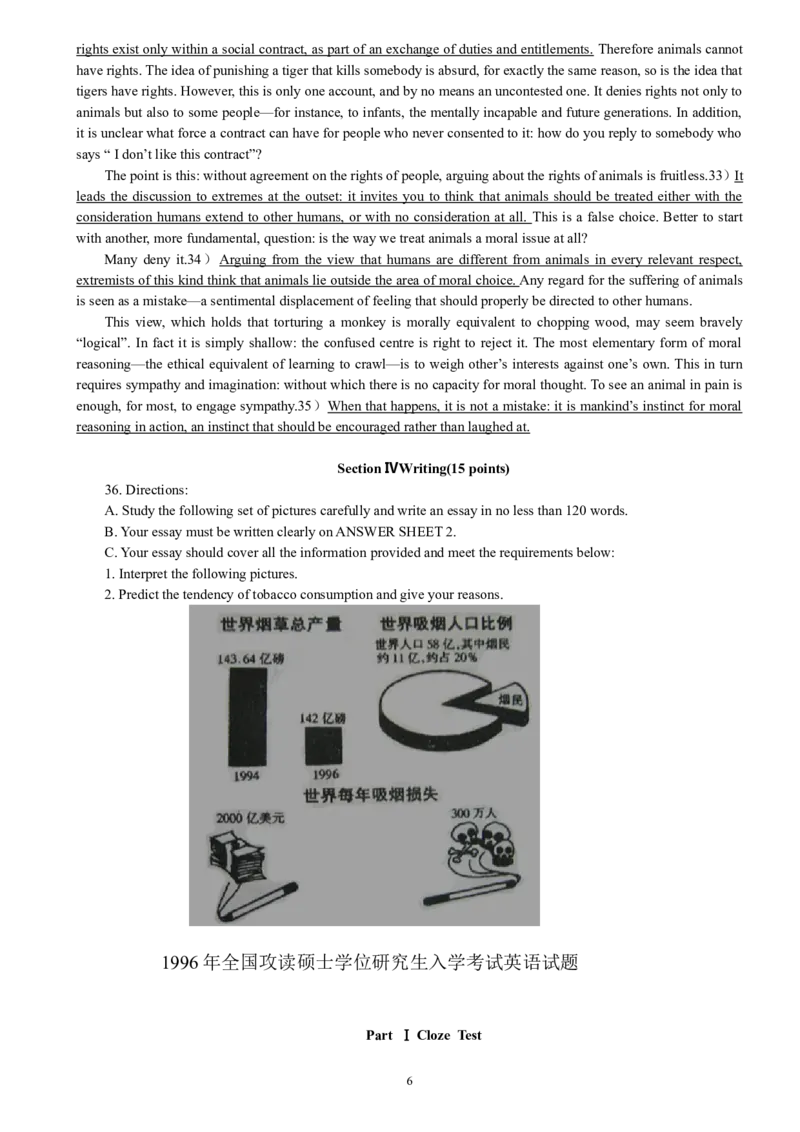
A. Study the following set of pictures carefully and write an essay in no less than 120 words.
B. Your essay must be written clearly on ANSWER SHEET 2.
C. Your essay should cover all the information provided and meet the requirements below:
1. Interpret the following pictures.
2. Predict the tendency of tobacco consumption and give your reasons.
1996年全国攻读硕士学位研究生入学考试英语试题
Part ⅠCloze Test
6Directions:
For each numbered blank in the following passage, there are four choices marked[ A],[ B],[ C] and [D]. Choose
the best one and mark your answer on ANSWER SHEET 1 by blackening the corresponding letter in the brackets.
(10 points)
Vitamins are organic compounds necessary in small amounts in the diet for the normal growth and maintenance
of life of animals, including man.
They do not provide energy, 1 do they construct or build any part of the body. They are needed for 2 foods
into energy and body maintenance. There are thirteen or more of them, and if 3 is missing a deficiency disease
becomes 4 .
Vitamins are similar because they are made of the same elements—usually carbon, hydrogen, oxygen, and 5
nitrogen. They are different 6 their elements are arranged differently, and each vitamin 7 one or more specific
functions in the body.
8 enough vitamins is essential to life, although the body has no nutritional use for 9 vitamins. Many people,
10 , believe in being on the “safe side” and thus take extra vitamins. However, a wellbalanced diet will usually
meet all the body’s vitamin needs.
1.[A]either [B]so [C]nor [D]never
2[. A]shifting [B]transferring [C]altering [D]transforming
3.[A]any [B]some [C]anything [D]something
4[. A]serious [B]apparent [C]severe [D]fatal
5.[A]mostly [B]partially [C]sometimes [D]rarely
6[. A]in that [B]so that [C]such that [D]except that
7.[A]undertakes [B]holds [C]plays [D]performs
8.[A]Supplying [B]Getting [C]Providing[D]Furnishing
9.[A]exceptional[B]exceeding [C]excess [D]external
10.[A]nevertheless [B]therefore [C]moreover [D]meanwhile
Part ⅡReading Comprehension
Directions:
Each of the passages below is followed by some questions. For each questions there are four answers marked [A],
[B], [C] and [D]. Read the passages carefully and choose the best answer to each of the questions. Then mark
your answer on ANSWER SHEET 1 by blackening the corresponding letter in the brackets with a pencil. (40 points)
Passage 1
Tightlipped elders used to say, “It’s not what you want in this world, but what you get.”
Psychology teaches that you do get what you want if you know what you want and want the right things.
You can make a mental blueprint of a desire as you would make a blueprint of a house, and each of us is
continually making these blueprints in the general routine of everyday living. If we intend to have friends to dinner,
we plan the menu, make a shopping list, decide which food to cook first, and such planning is an essential for any
type of meal to be served.
Likewise, if you want to find a job, take a sheet of paper, and write a brief account of yourself. In making a
blueprint for a job, begin with yourself, for when you know exactly what you have to offer, you can intelligently plan
where to sell your services.
This account of yourself is actually a sketch of your working life and should include education, experience and
references. Such an account is valuable. It can be referred to in filling out standard application blanks and is
extremely helpful in personal interviews. While talking to you, your could be employer is deciding whether your
7education, your experience, and other qualifications will pay him to employ you and your “wares” and abilities must
be displayed in an orderly and reasonably connected manner.
When you have carefully prepared a blueprint of your abilities and desires, you have something tangible to sell.
Then you are ready to hunt for a job. Get all the possible information about your could be job. Make inquiries as to
the details regarding the job and the firm. Keep your eyes and ears open, and use your own judgment. Spend a certain
amount of time each day seeking the employment you wish for, and keep in mind: Securing a job is your job now.
11. What do the elders mean when they say, “It’s not what you want in this world, but what you get.”?
[A] You’ll certainly get what you want.
[B] It’s no use dreaming.
[C] You should be dissatisfied with what you have.
[D] It’s essential to set a goal for yourself.
12. A blueprint made before inviting a friend to dinner is used in this passage as .
[A] an illustration of how to write an application for a job
[B] an indication of how to secure a good job
[C] a guideline for job description
[D] a principle for job evaluation
13. According to the passage, one must write an account of himself before starting to find a job because .
[A] that is the first step to please the employer
[B] that is the requirement of the employer
[C] it enables him to know when to sell his services
[D] it forces him to become clearly aware of himself
14. When you have carefully prepared a blueprint of your abilities and desires, you have something .
[A] definite to offer [B] imaginary to provide
[C] practical to supply [D] desirable to present
Passage 2
With the start of BBC World Service Television, millions of viewers in Asia and America can now watch the
Corporation’s news coverage, as well as listen to it.
And of course in Britain listeners and viewers can tune in to two BBC television channels, five BBC national
radio services and dozens of local radio stations. They are brought sport, comedy, drama, music, news and current
affairs, education, religion, parliamentary coverage, children’s programmes and films for an annual licence fee of
£83 per household.
It is a remarkable record, stretching back over 70 years — yet the BBC’s future is now in doubt. The
Corporation will survive as a publiclyfunded broadcasting organization, at least for the time being, but its role, its
size and its programmes are now the subject of a nationwide debate in Britain.
The debate was launched by the Government, which invited anyone with an opinion of the BBC — including
ordinary listeners and viewers — to say what was good or bad about the Corporation, and even whether they thought
it was worth keeping. The reason for its inquiry is that the BBC’s royal charter runs out in 1996 and it must decide
whether to keep the organization as it is, or to make changes.
Defenders of the Corporation — of whom there are many — are fond of quoting the American slogan “If it ain’t
broke, don’t fix it.” The BBC “ain’t broke”, they say, by which they mean it is not broken (as distinct from the word
‘broke’, meaning having no money), so why bother to change it?
Yet the BBC will have to change, because the broadcasting world around it is changing. The commercial TV
channels —— ITV and Channel 4 —— were required by the Thatcher Government’s Broadcasting Act to become
more commercial, competing with each other for advertisers, and cutting costs and jobs. But it is the arrival of new
satellite channels — funded partly by advertising and partly by viewers’subscriptions — which will bring about the
biggest changes in the long term.
815. The world famous BBC now faces .
[A] the problem of news coverage [B] an uncertain prospect
[C] inquiries by the general public [D] shrinkage of audience
16. In the passage, which of the following about the BBC is not mentioned as the key issue?
[A] Extension of its TV service to Far East.
[B] Programmes as the subject of a nation-wide debate.
[C] Potentials for further international co-operations.
[D] Its existence as a broadcasting organization.
17. The BBC’s “royal charter” (Line 4, Paragraph 4) stands for .
[A] the financial support from the royal family.
[B] the privileges granted by the Queen.
[C] a contract with the Queen.
[D] a unique relationship with the royal family.
18. The foremost reason why the BBC has to readjust itself is no other than .
[A] the emergence of commercial TV channels.
[B] the enforcement of Broadcasting Act by the government.
[C] the urgent necessity to reduce costs and jobs.
[D] the challenge of new satellite channels.
Passage 3
In the last half of the nineteenth century “capital” and “labour” were enlarging and perfecting their rival
organizations on modern lines. Many an old firm was replaced by a limited liability company with a bureaucracy of
salaried managers. The change met the technical requirements of the new age by engaging a large professional
element and prevented the decline in efficiency that so commonly spoiled the fortunes of family firms in the second
and third generation after the energetic founders. It was moreover a step away from individual initiative, towards
collectivism and municipal and state-owned business. The railway companies, though still private business managed
for the benefit of shareholders, were very unlike old family business. At the same time the great municipalities went
into business to supply lighting, trams and other services to the taxpayers.
The growth of the limited liability company and municipal business had important consequences. Such large,
impersonal manipulation of capital and industry greatly increased the numbers and importance of shareholders as a
class, an element in national life representing irresponsible wealth detached from the land and the duties of the
landowners; and almost equally detached from the responsible management of business. All through the nineteenth
century, America, Africa, India, Australia and parts of Europe were being developed by British capital, and British
shareholders were thus enriched by the world’s movement towards industrialization. Towns like Bournemouth and
Eastbourne sprang up to house large “comfortable” classes who had retired on their incomes, and who had no relation
to the rest of the community except that of drawing dividends and occasionally attending a shareholders’ meeting to
dictate their orders to the management. On the other hand “shareholding” meant leisure and freedom which was used
by many of the later Victorians for the highest purpose of a great civilization.
The “shareholders” as such had no knowledge of the lives, thoughts or needs of the workmen employed by the
company in which he held shares, and his influence on the relations of capital and labor was not good. The paid
manager acting for the company was in more direct relation with the men and their demands, but even he had seldom
that familiar personal knowledge of the workmen which the employer had often had under the more patriarchal
system of the old family business now passing away. Indeed the mere size of operations and the numbers of workmen
involved rendered such personal relations impossible. Fortunately, however, the increasing power and organization of
the trade unions, at least in all skilled trades, enabled the workmen to meet on equal terms the managers of the
companies who employed them. The cruel discipline of the strike and lockout taught the two parties to respect each
other’s strength and understand the value of fair negotiation.
19. It’s true of the old family firms that .
9[A] they were spoiled by the younger generations
[B] they failed for lack of individual initiative
[C] they lacked efficiency compared with modern companies
[D] they could supply adequate services to the taxpayers
20. The growth of limited liability companies resulted in .
[A] the separation of capital from management
[B] the ownership of capital by managers
[C] the emergence of capital and labour as two classes
[D] the participation of shareholders in municipal business
21. According to the passage, all of the following are true except that .
[A] the shareholders were unaware of the needs of the workers
[B] the old firm owners had a better understanding of their workers
[C] the limited liability companies were too large to run smoothly
[D] the trade unions seemed to play a positive role
22. The author is most critical of .
[A] family firm owners [B] landowners
[C] managers [D] shareholders
Passage 4
What accounts for the great outburst of major inventions in early America— breakthroughs such as the
telegraph, the steamboat and the weaving machine?
Among the many shaping factors, I would single out the country’s excellent elementary schools; a labor force
that welcomed the new technology; the practice of giving premiums to inventors; and above all the American genius
for nonverbal, “spatial” thinking about things technological.
Why mention the elementary schools? Because thanks to these schools our early mechanics, especially in the
New England and Middle Atlantic states, were generally literate and at home in arithmetic and in some aspects of
geometry and trigonometry.
Acute foreign observers related American adaptiveness and inventiveness to this educational advantage. As a
member of a British commission visiting here in 1853 reported, “With a mind prepared by thorough school discipline,
the American boy develops rapidly into the skilled workman.”
A further stimulus to invention came from the “premium” system, which preceded our patent system and for
years ran parallel with it. This approach, originated abroad, offered inventors medals, cash prizes and other
incentives.
In the United States, multitudes of premiums for new devices were awarded at country fairs and at the industrial
fairs in major cities. Americans flocked to these fairs to admire the new machines and thus to renew their faith in the
beneficence of technological advance.
Given this optimistic approach to technological innovation, the American worker took readily to that special
kind of nonverbal thinking required in mechanical technology. As Eugene Ferguson has pointed out, “A technologist
thinks about objects that cannot be reduced to unambiguous verbal descriptions; they are dealt with in his mind by a
visual, nonverbal process … The designer and the inventor … are able to assemble and manipulate in their minds
devices that as yet do not exist.”
This nonverbal “spatial” thinking can be just as creative as painting and writing. Robert Fulton once wrote, “The
mechanic should sit down among levers, screws, wedges, wheels, etc, like a poet among the letters of the alphabet,
considering them as an exhibition of his thoughts, in which a new arrangement transmits a new idea.”
When all these shaping forces—schools, open attitudes, the premium system, a genius for spatial thinking —
interacted with one another on the rich U.S. mainland, they produced that American characteristic emulation. Today
that word implies mere imitation. But in earlier times it meant a friendly but competitive striving for fame and
excellence.
1023. According to the author, the great outburst of major inventions in early America was in a large part due
to .
[A] elementary schools [B] enthusiastic workers
[C] the attractive premium system [D] a special way of thinking
24. It is implied that adaptiveness and inventiveness of the early American mechanics .
[A] benefited a lot from their mathematical knowledge.
[B] shed light on disciplined school management.
[C] was brought about by privileged home training.
[D] owed a lot to the technological development.
25. A technologist can be compared to an artist because .
[A] they are both winners of awards. [B] they are both experts in spatial thinking.
[C] they both abandon verbal description [D] they both use various instruments
26. The best title for this passage might be .
[A] Inventive Mind [B] Effective Schooling
[C] Ways of Thinking [D] Outpouring of Inventions
Passage 5
Rumor has it that more than 20 books on creationism/evolution are in the publisher’s pipelines. A few have
already appeared. The goal of all will be to try to explain to a confused and often unenlightened citizenry that there
are not two equally valid scientific theories for the origin and evolution of universe and life. Cosmology, geology, and
biology have provided a consistent, unified, and constantly improving account of what happened. “Scientific”
creationism, which is being pushed by some for “equal time” in the classrooms whenever the scientific accounts of
evolution are given, is based on religion, not science. Virtually all scientists and the majority of nonfundamentalist
religious leaders have come to regard “scientific” creationism as bad science and bad religion.
The first four chapters of Kitcher’s book give a very brief introduction to evolution. At appropriate places, he
introduces the criticisms of the creationists and provides answers. In the last three chapters, he takes off his gloves
and gives the creationists a good beating. He describes their programmes and tactics, and, for those unfamiliar with
the ways of creationists, the extent of their deception and distortion may come as an unpleasant surprise. When their
basic motivation is religious, one might have expected more Christian behavior.
Kitcher is a philosopher, and this may account, in part, for the clarity and effectiveness of his arguments. The
non-specialist will be able to obtain at least a notion of the sorts of data and argument that support evolutionary
theory. The final chapters on the creationists will be extremely clear to all. On the dust jacket of this fine book,
Stephen Jay Gould says: “This book stands for reason itself.” And so it does - and all would be well were reason the
only judge in the creationism/evolution debate.
27. “Creationism” in the passage refers to .
[A] evolution in its true sense as to the origin of the universe
[B] a notion of the creation of religion
[C] the scientific explanation of the earth formation
[D] the deceptive theory about the origin of the universe
28. Kitcher’s book is intended to .
[A] recommend the views of the evolutionists [B] expose the true features of creationists
[C] curse bitterly at his opponents [D] launch a surprise attack on creationists
29. From the passage we can infer that .
[A] reasoning has played a decisive role in the debate
[B] creationists do not base their argument on reasoning
[C] evolutionary theory is too difficult for non-specialists
[D] creationism is supported by scientific findings
30. This passage appears to be a digest of .
[A] a book review [B] a scientific paper
11[C] a magazine feature [D] a newspaper editorial
Part ⅢEnglish—Chinese Translation
Directions:
Read the following text carefully and then translate the underlined segments into Chinese. Your translation
should be written clearly on ANSWER SHEET 2. (15 points)
The differences in relative growth of various areas of scientific research have several causes. 31)Some of these
causes are completely reasonable results of social needs. Others are reasonable consequences of particular advances
in science being to some extent self-accelerating. Some, however, are less reasonable processes of different growth in
which preconceptions of the form scientific theory ought to take, by persons in authority, act to alter the growth
pattern of different areas. This is a new problem probably not yet unavoidable; but it is a frightening trend. 32)This
trend began during the Second World War, when several governments came to the conclusion that the specific
demands that a government wants to make of its scientific establishment cannot generally be foreseen in detail. It can
be predicted, however, that from time to time questions will arise which will require specific scientific answers. It is
therefore generally valuable to treat the scientific establishment as a resource or machine to be kept in functional
order. 33)This seems mostly effectively done by supporting a certain amount of research not related to immediate
goals but of possible consequence in the future.
This kind of support, like all government support, requires decisions about the appropriate recipients of funds.
Decisions based on utility as opposed to lack of utility are straightforward. But a decision among projects none of
which has immediate utility is more difficult. The goal of the supporting agencies is the praisable one of supporting
“good” as opposed to “bad” science, but a valid determination is difficult to make. Generally, the idea of good science
tends to become confused with the capacity of the field in question to generate an elegant theory. 34)However, the
world is so made that elegant systems are in principle unable to deal with some of the world’s more fascinating and
delightful aspects. 35)New forms of thought as well as new subjects for thought must arise in the future as they have
in the past, giving rise to new standards of elegance.
Section Ⅳ Writing
36. Directions:
A. Title: GOOD HEALTH
B. Time limit: 40minutes
C. Word limit: 120—150 words (not including the given opening sentence)
D. Your composition should be based on the “OUTLINE” below and should start with the given opening
sentence: “The desire for good health is universal”.
E. Your composition must be written clearly on the ANSWER SHEET.
Outline:
1. Importance of good health.
2. Ways to keep fit.
3. My own practices.
121995年全国硕士研究生入学统一考试英语试题
Section ⅠUse of English
Sleep is divided into periods of so-called REM sleep, characterized by rapid eye movements and dreaming, and
longer periods of non-REM sleep. 1 kind of sleep is at all well-understood, but REM sleep is 2 to serve some
restorative function of the brain. The purpose of non-REM sleep is even more 3 . The new experiments, such as
these 4 for the first time at a recent meeting of the Society for Sleep Research in Minneapolis, suggest fascinating
explanations 5 of non-REM sleep.
For example, it has long been known that total sleep 6 is 100 percent fatal to rats, yet, 7 _examinations of the
dead bodies, the animals look completely normal. A researcher has now
8 the mystery of why the animals die. The rats 9 bacterial infections of the blood, 10 their immune systems—
the self-protecting mechanisrn against disease—had crashed.
1. [A] Either [B] Neither [C] Each [D] Any
2. [A] intended [B] required [C] assumed [D] inferred
3. [A] subtle [B] obvious [C] mysterious [D] doubtful
4. [A] maintained [B] described [C] settled [D] afforded
5. [A] in the light [B] by virtue [C] with the exception [D] for the purpose
6. [A] reduction [B] destruction [C] deprivation [D] restriction
7. [A] upon [B] by [C] through [D] with
8. [A] paid attention to [B] caught sight of [C] laid emphasis on [D] cast light on
9. [A] develop [B] produce [C] stimulate [D] induce
10. [A] if [B] as if [C] only if [D] if only
Section ⅡReading Comprehension
Passage l
Money spent on advertising is money spent as well as any I know of. It serves directly to assist a rapid
distribution of goods at reasonable price, thereby establishing a firm home market and so making it possible to
provide for export at competitive prices. By drawing attention to new ideas it helps enormously to raise standards of
living. By helping to increase demand it ensures an increased need for labor, and is therefore an effective way to fight
unemployment. It lowers the costs of many services: without advertisements your daily newspaper would cost four
times as much, the price of your television licence would need to be doubled, and travel by bus or tube would cost 20
per cent more.
And perhaps most important of all, advertising provides a guarantee of reasonable value in the products and
services you buy. Apart from the fact that twenty-seven Acts of Parliament govern the terms of advertising, no regular
advertiser dare promote a product that fails to live up to the promise of his advertisements. He might fool some
people for a little while through misleading advertising. He will not do so for long, for mercifully the public has the
good sense not to buy the inferior article more than once. If you see an article consistently advertised, it is the surest
proof I know that the article does what is claimed for it, and that it represents good value.
Advertising does more for the material benefit of the community than any other force I can think of.
There is one more point I feel I ought to touch on. Recently I heard a well-known television personality declare
that he was against advertising because it persuades rather than informs. He was drawing excessively fine
distinctions. Of course advertising seeks to persuade.
If its message were confined merely to information—and that in itself would be difficult if not impossible to
achieve, for even a detail such as the choice of the colour of a shirt is subtly persuasive—advertising would be so
boring that no one would pay any attention. But perhaps that is what the well-known television personality wants.
11. By the first sentence of the passage the author means that__.
13[A] he is fairly familiar with the cost of advertising
[B] everybody knows well that advertising is money consuming
[C] advertising costs money like everything else
[D] it is worthwhile to spend money on advertising
12. In the passage, which of the following is NOT included in the advantages of advertising?
[A] Securing greater fame. [B] Providing more jobs.
[C] Enhancing living standards. [D] Reducing newspaper cost.
13. The author deems that the well-known TV personality is_.
[A] very precise in passing his judgment on advertising
[B] interested in nothing but the buyers' attention
[C] correct in telling the difference between persuasion and information
[D] obviously partial in his views on advertising
14. In the author's opinion,__.
[A] advertising can seldom bring material benefit to man by providing information
[B] advertising informs people of new ideas rather than wins them over
[C] there is nothing wrong with advertising in persuading the buyer
[D] the buyer is not interested in getting information from an advertisement
Passage 2
There are two basic ways to see growth: one as a product, the other as a process. People have generally viewed
personal growth as an external result or product that can easily be identified and measured. The worker who gets a
promotion, the student whose grades improve, the foreigner who learns a new language—all these are examples of
people who have measurable results to show for their efforts.
By contrast, the process of personal growth is much more difficult to determine, since by definition it is a
journey and not the specific signposts or landmarks along the way. The process is not the road itself, but rather the
attitudes and feelings people have, their caution or courage, as they encounter new experiences and unexpected
obstacles. In this process, the journey never really ends; there are always new ways to experience the world, new
ideas to try, new challenges to accept.
In order to grow, to travel new roads, people need to have a willingness to take risks, to confront the unknown,
and to accept the possibility that they may “fail” at first. How we see ourselves as we try a new way of being is
essential to our ability to grow. Do we perceive ourselves as quick and curious? If so, then we tend to take more
chances and to be more open to unfamiliar experiences. Do we think we're shy and indecisive? Then our sense of
timidity can cause us to hesitate, to move slowly, and not to take a step until we know the ground is safe. Do we think
we’re slow to adapt to change or that we’re not smart enough to cope with a new challenge? Then we are likely to
take a more passive role or not try at all.
These feelings of insecurity and self-doubt are both unavoidable and necessary if we are to change and grow. If
we do not confront and overcome these internal fears and doubts, if we protect ourselves too much, then we cease to
grow. We become trapped inside a shell of our own making.
15 . A person is generally believed to achieve personal growth when____.
[A] he has given up his smoking habit
[B] he has made great efforts in his work
[C] he is keen on learning anything new
[D] he has tried to determine where he is on his journey
16. In the author’s eyes, one who views personal growth as a process would____.
[A] succeed in climbing up the social ladder
[B] judge his ability to grow from his own achievements
[C] face difficulties and take up challenges
14[D] aim high and reach his goal each time
17. When the author says "a new way of being" (line 3, Para. 3) he is referring to__.
[A] a new approach to experiencing the world [B] a new way of taking risks
[C] a new method of perceiving ourselves [D] a new system of adaptation to change
18. For personal growth, the author advocates all of the following except_____.
[A] curiosity about more chances [B] promptness in self-adaptation
[C] open-mindedness to new experiences [D] avoidance of internal fears and doubts
Passage 3
In such a changing, complex society formerly simple solutions to informational needs become complicated.
Many of life’s problems which were solved by asking family members, friends or colleagues are beyond the
capability of the extended family to resolve. Where to turn for expert information and how to determine which expert
advice to accept are questions facing many people today.
In addition to this, there is the growing mobility of people since World War Ⅱ. As families move away from
their stable community, their friends of many years, their extended family relationships, the informal flow of
information is cut off, and with it the confidence that information will be available when needed and will be
trustworthy and reliable. The almost unconscious flow of information about the simplest aspects of living can be cut
off. Thus, things once learned subconsciously through the casual communications of the extended family must be
consciously learned.
Adding to societal changes today is an enormous stockpile of information. The individual now has more
information available than any generation, and the task of finding that one piece of information relevant to his or her
specific problem is complicated, time-consuming and sometimes even overwhelming .
Coupled with the growing quantity of information is the development of technologies which enable the storage
and delivery of more information with greater speed to more locations than has ever been possible before. Computer
technology makes it possible to store vast amounts of data in machine-readable files, and to program computers to
locate specific information. Telecommunications developments enable the sending of messages via television, radio,
and very shortly, electronic mail to bombard people with multitudes of messages. Satellites have extended the power
of communications to report events at the instant of occurrence. Expertise can be shared world wide through
teleconferencing, and problems in dispute can be settled without the participants leaving their homes and/or jobs to
travel to a distant conference site. Technology has facilitated the sharing of information and the storage and delivery
of information, thus making more information available to more people.
In this world of change and complexity, the need for information is of greatest importance. Those people who
have accurate, reliable up-to-date information to solve the day-to-day problems, the critical problems of their
business, social and family life, will survive and succeed. “Knowledge is power” may well be the truest saying and
access to information may be the most critical requirement of all people.
19. The word "it" (line 3, Para. 2) most probably refers to__.
[A] the lack of stable communities [B] the breakdown of informal information channels
[C] the increased mobility of families [D] the growing number of people moving from place to place
20. The main problem people may encounter today arises form the fact that__.
[A] they have to learn new things consciously
[B] they lack the confidence of securing reliable and trustworthy information
[C] they have difficulty obtaining the needed information readily
[D] they can hardly carry out casual communications with an extended family.
21 . From the passage we can infer that__.
[A] electronic mail will soon play a dominant role in transmitting messages
[B] it will become more difficult for people to keep secrets in an information era
15[C] people will spend less time holding meetings or conferences
[D] events will be reported on the spot mainly through satellites
22. We can learn from the last paragraph that __.
[A] it is necessary to obtain as much
[B] people should make the best use of the information
[C] we should realize the importance of accumulating information .
[D] it is of vital importance to acquire needed information efficiently
Passage 4
Personality is to a large extent inherent—A-type parents usually bring about A-type offspring. But the
environment must also have a profound effect, since if competition is important to the parents; it is likely to become a
major factor in the lives of their children.
One place where children soak up A-characteristics is school, which is, by its very nature, a highly competitive
institution. Too many schools adopt the 'win at all costs' moral standard and measure their success by sporting
achievements. The current passion for making children compete against their classmates or against the clock
produces a two-layer system , in which competitive A types seem in some way better than their B-type fellows. Being
too keen to win can have dangerous consequences: remember that Pheidippides, the first marathon runner, dropped
dead seconds after saying: “Rejoice, we conquer!”
By far the worst form of competition in schools is the disproportionate emphasis on examinations. It is a rare
school that allows pupils to concentrate on those things they do well. The merits of competition by examination are
somewhat questionable, but competition in the certain knowledge of failure is positively harmful.
Obviously, it is neither practical nor desirable that all A youngsters change into B’s. The world needs types, and
schools have an important duty to try to fit a child’s personality to his possible future employment. It is top
management.
If the preoccupation of schools with academic work was lessened, more time might be spent teaching children
surer values. Perhaps selection for the caring professions, especially medicine, could be made less by good grades in
chemistry and more by such considerations as sensitivity and sympathy. It is surely a mistake to choose our doctors
exclusively from A type stock. B’s are important and should be encouraged.
23. According to the passage, A-type individuals are usually__.
[A] impatient [B] considerate [C] aggressive [D] agreeable
24. The author is strongly opposed to the practice of examinations at schools because__.
[A] the pressure is too great on the students [B] some students are bound to fail
[C] failure rates are too high [D] the results of exanimations are doubtful
25. The selection of medical professionals are currently based on__.
[A] candidates’ sensitivity [B] academic achievements
[C] competitive spirit [D] surer values
26. From the passage we can draw the conclusion that__.
[A] the personality of a child is well established at birth
[B] family influence dominates the shaping of one' s characteristics .
[C] the development of one' s personality is due to multiple factors
[D] B-type characteristics can find no place in competitive society
Passage 5
That experiences influence subsequent behaviour is evidence of an obvious but nevertheless remarkable activity
called remembering. Learning could not occur without the function popularly named memory. Constant practice has
such as effect on memory as to lead to skillful performance on the piano, to recitation of a poem, and even to reading
16and understanding these words. So-called intelligent behaviour demands memory, remembering being a primary
requirement for reasoning. The ability to solve any problem or even to recognize that a problem exists depends on
memory. Typically, the decision to cross a street is based on remembering many earlier experiences.
Practice (or review) tends to build and maintain memory for a task or for any learned material. Over a period of
no practice what has been learned tends to be forgotten; and the adaptive consequences may not seem obvious. Yet,
dramatic instances of sudden forgetting can seem to be adaptive. In this sense, the ability to forget can be interpreted
to have survived through a process of natural selection in animals. Indeed, when one’s memory of an emotionally
painful experience leads to serious anxiety, forgetting may produce relief. Nevertheless, an evolutionary interpretation
might make it difficult to understand how the commonly gradual process of forgetting survived natural selection.
In thinking about the evolution of memory together with all its possible aspects, it is helpful to consider what
would happen if memories failed to fade. Forgetting clearly aids orientation in time, since old memories weaken and
the new tend to stand out, providing clues for inferring duration. Without forgetting, adaptive ability would suffer; for
example, learned behaviour that might have been correct a decade ago may no longer be. Cases are recorded of
people who (by ordinary standards) forgot so little that their everyday activities were full of confusion. This
forgetting seems to serve that survival of the individual and the species.
Another line of thought assumes a memory storage system of limited capacity that provides adaptive flexibility
specifically through forgetting. In this view, continual adjustments are made between learning or memory storage
(input) and forgetting (output). Indeed, there is evidence that the rate at which individuals forget is directly related to
how much they have learned. Such data offers gross support of contemporary models of memory that assume an
input-output balance.
27. From the evolutionary point of view, __.
[A] forgetting for lack of practice tends to be obviously inadaptive.
[B] if a person gets very forgetful all of a sudden he must be very adaptive
[C] the gradual process of forgetting is an indication of an individual' s adaptability
[D] sudden forgetting may bring about adaptive consequences
28. According to the passage, if a person never forgot __.
[A] he would survive best [B] he would have a lot of trouble
[C] his ability to learn would be enhanced [D] the evolution of memory would stop
29. From the last paragraph we know that__.
[A] forgetfulness is a response to learning
[B] the memory storage system is an exactly balanced input-output system
[C] memory is a compensation for forgetting
[D] the capacity of a memory storage system is limited because forgetting occurs
30. In this article, the author tries to interpret the function of__.
[A] remembering [B] forgetting [C] adapting [D] experiencing
Part Ⅲ English-Chinese Translation
The standardized educational or psychological test that are widely used to aid in selecting, classifying, assigning,
or promoting students, employees, and military personnel have been the target of recent attacks in books, magazines,
the daily press, and even in congress. (31) The target is wrong, for in attacking the tests, critics divert attention form
the fault that lies with ill-informed or incompetent users. The tests themselves are merely tools, with characteristics
that can be measured with reasonable precision under specified conditions. Whether the results will be valuable,
meaningless, or even misleading depends partly upon the tool itself but largely upon the user.
All informed predictions of future performance are based upon some knowledge of relevant past performance:
school grades, research productivity, sales records, or whatever is appropriate. (32 )How well the predictions will be
validated by later performance depends upon the amount , reliability , and appropriateness of the information used
and on the skill and wisdom with which it is interpreted. Anyone who keeps careful score knows that the information
17available is always incomplete and that the predictions are always subject to error.
Standardized tests should be considered in this context. They provide a quick, objective method of getting some
kinds of information about what a person learned, the skills he has developed, or the kind of person he is. The
information so obtained has, qualitatively, the same advantages and shortcomings as other kinds of information. (33)
Whether to use tests. other kinds of information, or both in a particular situation depends, therefore, upon the
evidence from experience concerning comparative validity and upon such factors as cost and availability.
(34) In general, the tests work most effectively when the qualities to be measured can be most precisely defined
and least effectively when what is to be measured or predicted cannot be well defined. Properly used, they provide a
rapid means of getting comparable information about many people. Sometimes they identify students whose high
potential has not been previously recognized, but there are many things they do not do. (35) For example, they do not
compensate for gross social inequality, and thus do not tell how able an underprivileged youngster might have been
had he grown up under more favorable circumstances.
Part Ⅳ Writing (15 points)
DIRECTIONS:
A. Title: THE "PROJECT HOPE"
B. Time limit: 40 minutes
C. Word limit: 120 - 150 words (not including the given opening sentence)
D. Your composition should be based on the OUTLINE below and should start with the given opening sentence:
“Education plays a very important role in the modernization of our country”.
E. Your composition must be written neatly on the ANSWER SHEET.
OUTLINE:
1. Present situation
2. Necessity of the project
3. My suggestion
1994年全国硕士研究生入学统一考试英语试题
Section ⅠUse of English
The first and smallest unit that can be discussed in relation to language is the word. In speaking, the choice of
words is 1 the utmost importance. Proper selection will eliminate one source of 2 breakdown is in the
communication cycle. Too often, careless use of words __3 a meeting of the minds of the speaker and listener. The
words used by the speaker may ___4 unfavorable reactions in the listener 5 interfere with his comprehension;
18hence, the transmission-reception system breaks down. 6__, inaccurate or indefinite words may make ___7
difficult for the listener to understand the 8 which is being transmitted to him. The speaker who does not have
specific words in his working vocabulary may be 9 to explain or describe in a 10 that can be understood by his
listeners.
1. [A] of [B] at [C] for [D] on
2. [A] inaccessible [B] timely [C] likely [D] invalid
3. [A] encourages [B] prevents [C] destroys [D] offers
4. [A] pass out [B] take away [C] back up [D] stir up
5. [A] who [B] as [C] which [D] what
6. [A] Moreover [B] However [C] Preliminarily [D] Unexpectedly
7. [A] that [B] it [C] so [D] this
8. [A] speech [B] sense [C] message [D] meaning
9. [A] obscure [B] difficult [C] impossible [D] unable
10. [A] case [B] means [C] method [D] way
Section ⅡReading Comprehension
Passage 1
The American economic system is organized around a basically private-enterprise, market- oriented economy in
which consumers largely determine what shall be produced by spending their money in the marketplace for those
goods and services that they want most. Private businessmen, striving to make profits, produce these goods and
services in competition with other businessmen; and the profit motive, operating under competitive pressures, largely
determines how these goods and services are produced. Thus, in the American economic system it is the demand of
individual consumers, coupled with the desire of businessmen to maximize profits and the desire of individuals to
maximize their incomes, that together determine what shall be produced and how resources are used to produce it.
An important factor in a market-oriented economy is the mechanism by which consumer demands can be
expressed and responded to by producers. In the American economy, this mechanism is provided by a price system, a
process in which prices rise and fall in response to relative demands of consumers and supplies offered by seller-
producers. If the product is in short supply relative to the demand, the price will be bid up and some consumers will
be eliminated from the market. If, on the other hand, producing more of a commodity results in reducing its cost, this
will tend to increase the supply offered by seller-producers, which in turn will lower the price and permit more
consumers to buy the product. Thus, price is the regulating mechanism in the American economic system.
The important factor in a private enterprise economy is that individuals are allowed to own productive resources
(private property) , and they are permitted to hire labor, gain control over natural resources, and produce goods and
services for sale at a profit. In the American economy, the concept of private property embraces not only the
ownership of productive resources but also certain rights, including the right to determine the price of a product or to
make a free contract with another private individual.
11. In Line 11, Para 1, “the desire of individuals to maximize their incomes” means__.
[A] Americans are never satisfied with their incomes
[B] Americans tend to overstate their incomes
[C] Americans want to have their incomes increased
[D] Americans want to increase the purchasing power of their incomes
12. The first two sentences in the second paragraph tell us that__.
[A] producers can satisfy the consumers by mechanized production
[B] consumers can express their demands through producers
[C] producers decide the prices of products
[D] supply and demand regulate prices
13. According to the passage, a private-enterprise economy is characterized by__.
[A] private property and rights concerned [B] manpower and natural resources control
[C] ownership of productive resources [D] free contracts and prices
1914. The passage is mainly about__.
[A] how American goods are produced [B] how American consumers buy their goods
[C] how American economic system works [D] how American businessmen make their profits
Passage 2
One hundred and thirteen million Americans have at least one bank-issued credit card. They give their owners
automatic credit in stores, restaurants, and hotels, at home, across the country, and even abroad, and they make many
banking services available as well. More and more of these credit cards can be read automatically, making it possible
to withdraw or deposit money in scattered locations, whether or not the local branch bank is open. For many of us the
“cashless society” is not on the horizon—it’s already here.
While computers offer these conveniences to consumers, they have many advantages for sellers too. Electronic
cash registers can do much more than simply ring up sales. They can keep a wide range of records, including who
sold what, when, and to whom. This information allows businessmen to keep track of their list of goods by showing
which items are being sold and how fast they are moving. Decisions to reorder or return goods to suppliers can then
be made. At the same time these computers record which hours are busiest and which employees are the most
efficient, allowing personnel and staffing assignments to be made accordingly. And they also identify preferred
customers for promotional. Computers are relied on by manufacturers for similar reasons. Computer-analyzed
marketing reports can help to decide which products to emphasize now, which to develop for the future, and which to
drop. Computers keep track of goods in stock, of raw materials on hand, and even of the production process itself.
Numerous other commercial enterprises, from theaters to magazine publishers, from gas and electric utilities to
milk processors, bring better and more efficient services to consumers through the use of computers.
15. According to the passage, the credit card enables its owner to__.
[A] withdraw as much money from the bank as he wishes
[B] obtain more convenient services than other people do
[C] enjoy greater trust from the storekeeper
[D] cash money wherever he wishes to
16. From the last sentence of the first paragraph we learn that __.
[A] in the future all the Americans will use credit cards
[B] credit cards are mainly used in the United States today
[C] nowadays many Americans do not pay in cash
[D] it is now more convenient to use credit cards than before
17. The phrase "ring up sales" (Line 3, Para. 2) most probably means “___”.
[A] make an order of goods [B] record sales on a cash register
[C] call the sales manager [D] keep track of the goods in stock
18. What is this passage mainly about?
[A] Approaches to the commercial use of computers.
[B] Conveniences brought about by computers in business.
[C] Significance of automation in commercial enterprises.
[D] Advantages of credit cards in business.
Passage 3
Exceptional children are different in some significant way from others of the same age. For these children to
develop to their full adult potential, their education must be adapted to those differences.
Although we focus on the needs of exceptional children, we find ourselves describing their environment as well.
While the leading actor on the stage captures our attention, we are aware of the importance of the supporting players
and the scenery of the play itself. Both the family and the society in which exceptional children live are often the key
to their growth and development. And it is in the public schools that we find the full expression of society’ s
understanding—the knowledge, hopes, and fears that are passed on to the next generation.
Education in any society is a mirror of that society. In that minor we can see the strengths, the weaknesses, the
hopes, the prejudices, and the central values of the culture itself. The great interest in exceptional children shown in
public education over the past three decades indicates the strong feeling in our society that all citizens, whatever their
20special conditions, deserve the opportunity to fully develop their capabilities.
“All men are created equal.” We’ve heard it many times, but it still has important meaning for education in a
democratic society. Although the phrase was used by this country’s founders to denote equality before the law, it has
also been interpreted to mean equality of opportunity. That concept implies educational opportunity for all children—
the right of each child to receive help in learning to the limits of his or her capacity, whether that capacity be small or
great. Recent court decisions have confirmed the right of all children—disabled or not—to an appropriate education,
and have ordered that public schools take the necessary steps to provide that education. In response, schools are
modifying their programs, adapting instruction to children who are exceptional, to those who cannot profit
substantially from regular programs.
19. In Paragraph 2, the author cites the example of the leading actor on the stage to show that _____.
[A] the growth of exceptional children has much to do with their family and the society
[B] exceptional children are more influenced by their families than normal children are
[C] exceptional children are the key interest of the family and society
[D] the needs of the society weigh much heavier than the needs of the exceptional children
20. The reason that the exceptional children receive so much concern in education is that__.
[A] they are expected to be leaders of the society [B] they might become a burden of the society
[C] they should fully develop their potentials [D] disabled children deserve special consideration
21. This passage mainly deals with__.
[A] the differences of children in their learning capabilities
[B] the definition of exceptional children in modern society
[C] the special educational programs for exceptional children
[D] the necessity of adapting education to exceptional children
22. From this passage we learn that the educational concern for exceptional children ___.
[A] is now enjoying legal support [B] disagrees with the tradition of the country
[C] was clearly stated by the country’ s founders [D] will exert great influence over court decisions
Passage 4
“I have great confidence that by the end of the decade we’ll know in vast detail how cancer cells arise,” says
microbiologist Robert Weinberg, an expert on cancer. “But,” he cautions, “Some people have the idea that once one
understands the causes, the cure will rapidly follow. Consider Pasteur. He discovered the causes of many kinds of
infections, but it was fifty or sixty years before cures were available. ”
This year, 50 percent of the 910,000 people who suffer from cancer will survive at least five years. In the year
2000, the National Cancer Institute estimates, that figure will be 75 percent. For some skin cancers, the five-year
survival rate is as high as 90 percent. But other survival statistics are still discouraging—13 percent for lung cancer,
and 2 percent for cancer of the pancreas (胰腺) .
With as many as 120 varieties in existence, discovering how cancer works is not easy. The researchers made
great progress in the early 1970s, when they discovered that oncogenes, which are cancer-causing genes (基因), are
inactive in normal cells. Anything from cosmic rays to radiation to diet may activate a dormant oncogene, but how
remains unknown. If several oncogenes are driven into action, the cell, unable to turn them off, becomes cancerous.
The exact mechanisms involved are still mysterious, but the likelihood that many cancers are initiated at the
level of genes suggests that we will never prevent all cancers. “Changes are a normal part of the evolutionary
process,” says oncologist William Haywar. Environmental factors can never be totally eliminated; as Hayward points
out, “We can’t prepare a medicine against cosmic rays.”
The prospects for cure, though still distant, are brighter.
"First, we need to understand how the normal cell controls itself. Second, we have to determine whether there
are a limited number of genes in cells which are always responsible for at least part of the trouble. If we can
understand how cancer works, we can counteract its action. "
23. The example of Pasteur in the passage is used to__.
[A]. predict that the secret of cancer will be disclosed in a decade
[B] indicate that the prospects for curing cancer are bright
21[C] prove that cancer will be cured in fifty to sixty years
[D] warn that there is still a long way to go before cancer can be conquered
24. The author implies that by the year 2000, __.
[A] there will be a drastic rise in the five-year survival rate of skin-cancer patients
[B] 90 percent of the skin-cancer patients today will still be living
[C] the survival statistics will be fairly even among patients with various cancers
[D] there won’ t be a drastic increase of survival rate of all cancer patients
25. Oncogenes are cancer-causing genes__.
[A] that are always in operation in a healthy person
[B] which remain unharmful so long as they are not activated
[C] that can be driven out of normal cells
[D] which normal cells can’ t turn off
26. The word "dormant" in the third paragraph most probably means__.
[A] dead [B] ever-present [C] inactive [D] potential
Passage 5
Discoveries in science and technology are thought by “untaught minds” to come in blinding flashes or as the
result of dramatic accidents. Sir Alexander Fleming did not, as legend would have it, look at the mold (霉) on a piece
of cheese and get the idea for penicillin there and then. He experimented with antibacterial substances for nine years
before he made his discovery. Inventions and innovations almost always come out of laborious trial and error.
Innovation is like soccer; even the best players miss the goal and have their shots blocked much more frequently than
they score.
The point is that the players who score most are the ones who take most shots at the goal —and so it goes with
innovation in any field of activity. The prime difference between innovation and others is one of approach.
Everybody gets ideas, but innovators work consciously on theirs and they follow them through until they prove
practicable or otherwise. What ordinary people see as fanciful abstractions, professional innovators see as solid
possibilities.
"Creative thinking may mean simply the realization that there’ s no particular virtue in doing things the way they
have always been done, " wrote Rudolph Flesch, a language authority. This accounts for our reaction to seemingly
simple innovations like plastic garbage bags and suitcases on wheels that make life more convenient: "How come
nobody thought of that before?"
The creative approach begins with the proposition that nothing is as it appears. Innovators will not accept that
there is only one way to do anything. Faced with getting from A to B, the average person will automatically set out on
the best-known and apparently simplest route. The innovator will search for alternate courses, which may prove
easier in the long run and are bound to be more interesting and challenging even if they lead to dead ends.
Highly creative individuals really do march to a different drummer.
27. What does the author probably mean by "untaught mind" in the first paragraph?
[A] A person ignorant of the hard work involved in experimentation.
[B] A citizen of a society that restricts personal creativity.
[C] A person who has had no education.
[D] An individual who often comes up with new ideas by accident.
28. According to the author, what distinguishes innovators from non-innovators?
[A] The variety of ideas they have. [B] The intelligence they possess.
[C] The way they deal with problems. [D] The way they present their findings.
29. The author quotes Rudolph Flesch in Paragraph 3 because__.
[A] Rudolph Flesch is the best-known expert in the study of human creativity
[B] the quotation strengthens the assertion that creative individuals look for new ways of doing things .
[C] the reader is familiar with Rudolph Flesch’ s point of view
[D] the quotation adds a new idea to the information previously presented
30. The phrase “march to a different drummer” (the last line of the passage) suggests that highly creative
22individuals are__.
[A] diligent in pursuing their goals [B] reluctant to follow common ways of doing things
[C] devoted to the progress of science [D] concerned about the advance of society
Part Ⅲ English-Chinese Translation
According to the new school of scientists, technology is an overlooked force in expanding the horizons of
scientific knowledge. (31) Science moves forward, they say, not so much through the insights of great men of genius
as because of more ordinary things like improved techniques and tools. (32) “In short”, a leader of the new school
contends, “the scientific revolution, as we call it, was largely the improvement and invention and use of a series of
instruments that expanded the reach of science in innumerable directions.”
(33)Over the years, tools and technology themselves as a source of fundamental innovation have largely been
ignored by historians and philosophers of science. The modern school that hails technology argues that such masters
as Galileo, Newton, Maxwell, Einstein, and inventors such as Edison attached great importance to, and derived great
benefit from, craft information and technological devices of different kinds that were usable in scientific experiments.
The centerpiece of the argument of a technology-yes, genius-no advocate was an analysis of Galileo’s role at the
start of the scientific revolution. The wisdom of the day was derived from Ptolemy, an astronomer of the second
century, whose elaborate system of the sky put Earth at the center of all heavenly motions. (34) Galileo’s greatest
glory was that in 1609 he was the first person to turn the newly invented telescope on the heavens to prove that the
planets revolve around the sun rather than around the Earth. But the real hero of the story, according to the new
school of scientists, was the long evolution in the improvement of machinery for making eye-glasses.
Federal policy is necessarily involved in the technology vs. genius dispute. (35)Whether the Government should
increase the financing of pure science at the expense of technology or vice versa ( 反之 ) often depends on the issue of
which is seen as the driving force.
Part Ⅳ Writing (15 points)
DIRECTIONS:
A. Title: ON MAKING FRIENDS
B. TIME LIMIT: 40 minutes
C. Word limit: 120 - 150 words (not including the given opening sentence)
D. Your composition should be based on the OUTLINE below and should start with the given opening sentence:
“As a human being, one can hardly do without a friend.”
E. Your composition must be written clearly on the ANSWER SHEET.
OUTLINE:
l. The need for friends
2. True friendship
3. My principle in making friends
1993年全国硕士研究生入学统一考试英语试题
Section ⅠUse of English
Although interior design has existed since the beginning of architecture, its development into a specialized field
is really quite recent. Interior designers have become important partly because of the many functions that might be
___1___in a single large building.
The importance of interior design becomes 2 when we realize how much time we __3_ surrounded by four
walls. Whenever we need to be indoors, we want our surroundings to be _ 4 attractive and comfortable as possible.
We also expect 5 place to be appropriate to its use. You would be 6 if the inside of your bedroom were suddenly
changed to look 7 the inside of a restaurant. And you wouldn’t feel 8 in a business office that has the appearance
23of a school.
It soon becomes clear that the interior designer’s most important basic 9 is the function of the particular 10 .
For example, a theater with poor sight lines, poor sound-shaping qualities, and 11 few entries and exits will not
work for 12 purpose, no matter how beautifully it might be 13 . Nevertheless, for any kind of space, the designer
has to make many of the same kind of 14 _. He or she must coordinate the shapes, lighting and decoration of
everything from ceiling to floor. 15 _addition, the designer must usually select furniture or design built-in furniture,
according to the functions that need to be served
1. [A] consisted [B] contained [C] composed [D] comprised
2. [A] obscure [B] attractive [C] appropriate [D] evident
3. [A] spend [B] require [C] settle [D] retain
4. [A] so [B] as [C] thus [D] such
5. [A] some [B] any [C] this [D] each
6. [A] amused [B] interested [C] shocked [D] frightened
7. [A] like [B] for [C] at [D] into
8. [A] correct [B] proper [C] right [D] suitable
9. [A] care [B] concern [C] attention [D] intention
10. [A] circumstance [B] environment [C] surroundings [D] space
11. [A] too [B] quite [C] a [D] far
12. [A] their [B] its [C] those [D] that
13. [A] painted [B] covered [C] ornamented [D] decorated
14. [A] solutions [B] conclusions [C] decisions [D] determinations
15. [A] For [B] In [C] As [D] with
Section ⅡReading Comprehension
Passage 1
Is language, like food, a basic human need without which a child at a critical period of life can be starved and
damaged? Judging from the drastic experiment of FrederickⅠ in the thirteenth century, it may be. Hoping to
discover what language a child would speak if he heard no mother tongue, he told the nurses to keep silent.
All the infants died before the first year. But clearly there was more than lack of language here. What was
missing was good mothering. Without good mothering, in the first year of life especially, the capacity to survive is
seriously affected.
Today no such severe lack exists as that ordered by Frederick. Nevertheless, some children are still backward in
speaking. Most often the reason for this is that the mother is insensitive to the signals of the infant, whose brain is
programmed to learn language rapidly. If these sensitive periods are neglected, the ideal time for acquiring skills
passes and they might never be learned so easily again. A bird learns to sing and to fly rapidly at the right time, but
the process is slow and hard once the critical stage has passed.
Experts suggest that speech stages are reached in a fixed sequence and at a constant age, but there are cases
where speech has started late in a child who eventually turns out to be of high IQ. At twelve weeks a baby smiles and
makes vowel-like sounds; at twelve months he can speak simple words and understand simple commands; at eighteen
months he has a vocabulary of three to fifty words. At three he knows about l, 000 words which he can put into
sentences, and at four his language differs from that of his parents in style rather than grammar.
Recent evidence suggests that an infant is born with the capacity to speak. What is special about man’s brain,
compared with that of the monkey, is the complex system which enables a child to connect the sight and feel of, say, a
toy-bear with the sound pattern “toy-bear”. And even more incredible is the young brain’s ability to pick out an order
in language from the mixture of sound around him, to analyze, to combine and recombine the parts of a language in
new ways.
But speech has to be induced, and this depends on interaction between the mother and the child , where the
24mother recognizes the signals in the child’ s babbling ( 咿呀学语) , grasping and smiling, and responds to them.
Insensitivity of the mother to these signals dulls the interaction because the child gets discouraged and sends out only
the obvious signals. Sensitivity to the child’s non-verbal signals is essential to the growth and development of
language.
16. The purpose of Frederick Ⅰ’s experiment was__
[A] to prove that children are born with the ability to speak
[B] to discover what language a child would speak without hearing any human speech
[C] to find out what role careful nursing would play in teaching a child to speak
[D] to prove that a child could be damaged without learning a language
17. The reason some children are backward in speaking is most probably that__
[A] they are incapable of learning language rapidly
[B] they are exposed to too much language at once
[C] their mothers respond inadequately to their attempts to speak
[D] their mothers are not intelligent enough to help them
18. What is exceptionally remarkable about a child is that
[A] he is born with the capacity to speak
[B] he has a brain more complex than an animal’s
[C] he can produce his own sentences
[D] he owes his speech ability to good nursing
19. Which of the following can NOT be inferred from the passage?
[A] The faculty of speech is inborn in man.
[B] Encouragement is anything but essential to a child in language learning.
[C] The child’ s brain is highly selective.
[D] Most children learn their language in definite stages.
20. If a child starts to speak later than others, he will
[A] have a high IQ [B] be less intelligent
[C] be insensitive to verbal signals [D] not necessarily be backward
Passage 2
In general , our society is becoming one of giant enterprises directed by a bureaucratic ( 官 僚 主 义
的)management in which man becomes a small, well-oiled cog in the machinery. The oiling is done with higher
wages, well-ventilated factories and piped music, and by psychologists and “human-relations” experts; yet all this
oiling does not alter the fact that man has become powerless, that he does not wholeheartedly participate in his work
and that he is bored with it. In fact, the blue-and the white-collar workers have become economic puppets who dance
to the tune of automated machines and bureaucratic management.
The worker and employee are anxious, not only because they might find themselves out of a job; they are
anxious also because they are unable to acquire any real satisfaction or interest in life. They live and die without ever
having confronted the fundamental realities of human existence as emotionally and intellectually independent and
productive human beings.
Those higher up on the social ladder are no less anxious. Their lives are no less empty than those of their
subordinates. They are even more insecure in some respects. They are in a highly competitive race. To be promoted
or to fall behind is not a matter of salary but even more a matter of self-respect. When they apply for their first job,
they are tested for intelligence as well as for the tight mixture of submissiveness and independence. From that
moment on they are tested again and again by the psychologists, for whom testing is a big business, and by their
superiors, who judge their behavior, sociability, capacity to get along, etc. This constant need to prove that one is as
good as or better than one’s fellow competitor creates constant anxiety and stress, the very causes of unhappiness and
illness.
25Am I suggesting that we should return to the pre-industrial mode of production or to nineteenth-century “free
enterprise” capitalism? Certainly not. Problems are never solved by returning to a stage which one has already
outgrown. I suggest transforming our social system from a bureaucratically managed industrialism in which maximal
production and consumption are ends in themselves into a humanist industrialism in which man and full development
of his potentialities—those of love and of reason—are the aims of all social arrangements. Production and
consumption should serve only as means to this end, and should be prevented from ruling man.
21. By “a well-oiled cog in the machinery” the author intends to render the idea that man is
[A] a necessary part of the society though each individual’s function is negligible
[B] working in complete harmony with the rest of the society
[C] an unimportant part in comparison with the rest of the society, though functioning smoothly
[D] a humble component of the society, especially when working smoothly
22. The real cause of the anxiety of the workers and employees is that
[A] they are likely to lose their jobs
[B] they have no genuine satisfaction or interest in life
[C] they are faced with the fundamental realities of human existence
[D] they are deprived of their individuality and independence
23. From the passage we can infer that real happiness of life belongs to those
[A] who are at the bottom of the society
[B] who are higher up in their social status
[C] who prove better than their fellow-competitors
[D] who could keep far away from this competitive world
24. To solve the present social problems the author suggests that we should
[A] resort to the production mode of our ancestors
[B] offer higher wages to the workers and employees
[C] enable man to fully develop his potentialities
[D] take the fundamental realities for granted
25. The author’s attitude towards industrialism might best be summarized as one of __
[A] approval [B] dissatisfaction [C] suspicion [D] tolerance
Passage 3
When an invention is made, the inventor has three possible courses of action open to him: he can give the
invention to the world by publishing it, keep the idea secret, or patent it.
A granted patent is the result of a bargain struck between an inventor and the state, by which the inventor gets a
limited period of monopoly (垄断) and publishes full details of his invention to the public after that period terminates.
Only in the most exceptional circumstances is the lifespan of a patent extended to alter this normal process of
events.
The longest extension ever granted was to Georges Valensi; his 1939 patent for color TV receiver circuitry was
extended until 1971 because for most of the patent’s normal life there was no color TV to receive and thus no hope of
reward for the invention.
Because a patent remains permanently public after it has terminated, the shelves of the library attached to the
patent office contain details of literally millions of ideas that are free for anyone to use and, if older than half a
century, sometimes even re-patent. Indeed, patent experts often advise anyone wishing to avoid the high cost of
conducting a search through live patents that the one sure way of avoiding violation of any other inventor’s right is to
plagiarize a dead patent. Likewise, because publication of an idea in any other form permanently invalidates further
patents on that idea, it is traditionally safe to take ideas from other areas of print. Much modern technological
advance is based on these presumptions of legal security.
Anyone closely involved in patents and inventions soon learns that most “new ideas” are, in fact, as old as the
26hills. It is their reduction to commercial practice, either through necessity or dedication, or through the availability of
new technology, that makes news and money. The basic patent for the theory of magnetic recording dates back to
1886. Many of the original ideas behind television originate from the late 19th and early 20th century. Even the
Volkswagen rear engine car was anticipated by a 1904 patent for a cart with the horse at the rear.
26. The passage is mainly about
[A] an approach to patents [B] the application for patents
[C] the use of patents [D] the access to patents
27. Which of the following is TRUE according to the passage?
[A] When a patent becomes out of effect, it can be re-patented or extended if necessary.
[B] It is necessary for an inventor to apply for a patent before he makes his invention publc.
[C] A patent holder must publicize the details of his invention when its legal period is over.
[D] One can get all the details of a patented invention from a library attached to the patent office.
28. George Valensi’s patent lasted until 1971 because
[A] nobody would offer any reward for his patent prior to that time
[B] his patent could not be put to use for an unusually long time
[C] there were not enough TV stations to provide color programmes
[D] the color TV receiver was not available until that time
29. The word “plagiarize”(line 8 , Para. 5) most probably means “_”.
[A] steal and use [B] give reward to
[C] make public [D] take and change
30. From the passage we learn that
[A] an invention will not benefit the inventor unless it is reduced to commercial practice
[B] products are actually inventions which were made a long time ago
[C] it is much cheaper to buy an old patent than a new one
[D] patent experts often recommend patents to others by conducting a search through dead patents
Part Ⅲ English-Chinese Translation
(31) The method of scientific investigation is nothing but the expression of the necessary mode of working of
the human mind; it is simply the mode by which all phenomena are reasoned about and given precise and exact
explanation. There is no more difference, but there is just the same kind of difference, between the mental operations
of a man of science and those of an ordinary person, as there is between the operations and methods of a baker or of a
butcher weighing out his goods in common scales, and the operations of a chemist in performing a difficult and
complex analysis by means of his balance and finely graded weights. (32) It is not that the scales in the one case, and
the balance in the other, differ in the principles of their construction or manner of working; but that the latter is a
much finer apparatus and of course much more accurate in its measurement than the former.
You will understand this better, perhaps, if I give you some familiar examples. (33) You have all heard it
repeated that men of science work by means of induction ( 归纳法 ) and deduction, that by the help of these
operations, they, in a sort of sense, manage to extract from Nature certain natural laws, and that out of these, by some
special skill of their own, they build up their theories. (34) And it is imagined by many that the operations of the
common mind can be by no means compared with these processes, and that they have to be acquired by a sort of
special training. To hear all these large words, you would think that the mind of a man of science must be constituted
differently from that of his fellow men; but if you will not be frightened by terms, you will discover that you are quite
wrong, and that all these terrible apparatus are being used by yourselves every day and every hour of your lives.
There is a well-known incident in one of Motiere’s plays, where the author makes the hero express unbounded
delight on being told that he had been talking prose (散文) during the whole of his life. In the same way, I trust that
you will take comfort, and be delighted with yourselves, on the discovery that you have been acting on the principles
27of inductive and deductive philosophy during the same period. (35)Probably there is not one here who has not in the
course of the day had occasion to set in motion a complex train of reasoning, of the very same kind, though differing
in degree, as that which a scientific man goes through in tracing the causes of natural phenomena.
Part Ⅳ Writing (15 points)
DIRECTIONS:
A. Title: ADVERTISEMENT ON TV
B. Time limit: 40 minutes
C. Word limit: 120 - 150 words (not including the given opening sentence)
D. Your composition should be based at the OUTLINE below and should start with the given opening sentence:
“Today more and more advertisements are seen on the TV screen.”
E. Your composition must be written clearly on the ANSWER SHEET.
OUTLINE:
l. Present state
2. Reasons
3. My comments
1992年全国硕士研究生入学统一考试英语试题
Section ⅠUse of English
Directions:
For each numbered blank in the following passage, there are four choices marked [A],[B],[C]and
[D].Choose the best one and put your choice in the ANSWER SHEET. (15 points)
The key to the industrialization of space is the U.S. space shuttle. ___1___ it, astronauts will acquire a
workhouse vehicle ___2___ of flying into space and returning many times. ___3___ by reusable rockets that can lift a
load of 65,000 pounds, the shuttle will carry devices for scientific inquiry, as ___4___ as a variety of military
hardware. ___5___ more significantly, it will ___6___ materials and machines into space for industrial purposes
___7___ two decades ago when “sputnik” (artificial satellite) was ___8___ to the vocabulary. In short, the ___9___
importance of the shuttle lies in its ___10___ as an economic tool.
What makes the space shuttle ___11___ is that it takes off like a rocket but lands like an airplane. ___12___,
when it has accomplished its ___13___, it can be ready for ___14___ trip in about two weeks.
The space shuttle, the world’s first true spaceship, is a magnificent step ___15___ making the impossible
28possible for the benefit and survival of man.
1. [A] In [B]On [C]By [D] With
2. [A] capable [B] suitable [C] efficient [D] fit
3. [A] Served [B] Powered [C] Forced [D] Reinforced
4. [A] far [B] well [C] much [D] long
5. [A] Then [B] Or [C] But [D] So
6. [A] supply [B] introduce [C] deliver [D] transfer
7. [A] unimagined [B] unsettled [C] uncovered [D]unsolved
8. [A] attributed [B] contributed [C] applied [D] added
9. [A] general [B] essential [C] prevailing [D] ultimate
10. [A] promise [B] prosperity [C] popularity [D] priority
11. [A] exceptional [B] strange [C] unique [D] rare
12. [A] Thus [B] Whereas [C] Nevertheless [D] Yet
13. [A] venture [B]mission [C] commission [D] responsibility
14. [A] new [B] another [C] certain [D] subsequent
15. [A] for [B] by [C] in [D] through
Part ⅡReading Comprehension
Part A
Directions:
Each of the passages below is followed by some questions. For each question four answers are given. Read the
passages carefully and choose the best answer to each of the questions. Put your choice in the ANSWER
SHEET.(30 points)
Passage 1
It is all very well to blame traffic jams, the cost of petrol and the quick pace of modern life, but manners on the
roads are becoming horrible. Everybody knows that the nicest men become monsters behind the wheel. It is all very
well, again, to have a tiger in the tank, but to have one in the driver’s seat is another matter altogether. You might
tolerate the odd road-hog, the rude and inconsiderate driver, but nowadays the well-mannered motorist is the
exception to the rule. (Perhaps the situation calls for a “Be Kind to Other Drivers” campaign, otherwise it may get
completely out of hand.)
Road politeness is not only good manners, but good sense too. It takes the most cool-headed and good-tempered
of drivers to resist the temptation to revenge when subjected to uncivilized behavior. On the other hand, a little
politeness goes a long way towards relieving the tensions of motoring. A friendly nod or a wave of acknowledgment
in response to an act of politeness helps to create an atmosphere of goodwill and tolerance so necessary in modern
traffic conditions. But such acknowledgments of politeness are all too rare today. Many drivers nowadays don’t even
seem able to recognize politeness when they see it.
However, misplaced politeness can also be dangerous. Typical examples are the driver who brakes violently to
allow a car to emerge from a side street at some hazard to following traffic, when a few seconds later the road would
be clear anyway; or the man who waves a child across a zebra crossing into the path of oncoming vehicles that may
be unable to stop in time. The same goes for encouraging old ladies to cross the road wherever and whenever they
care to. It always amazes me that the highways are not covered with the dead bodies of these grannies.
A veteran driver, whose manners are faultless, told me it would help if motorists learnt to filter correctly into
traffic streams one at a time without causing the total blockages that give rise to bad temper. Unfortunately, modern
motorists can’t even learn to drive, let alone master the subtler aspects of roadsmanship. Years ago the experts warned
us that the car ownership explosion would demand a lot more give-and-take from all road users. It is high time for all
of us to take this message to heart.
16. According to this passage, troubles on the
road are primarily caused by________.
29[A] people’s attitude towards the road-hog
[B] the rhythm of modern life
[C] the behavior of the driver
[D] traffic conditions
17.The sentence “You might tolerate the odd
road-hog...the rule.”(Para.1) implies that___.
[A] our society is unjust towards well-
mannered motorists
[B] rude drivers can be met only occasionally
[C] the well-mannered motorist cannot tolerate
the road-hog
[D] nowadays impolite drivers constitute the
majority of motorists
18. By “good sense”, the writer means_____.
[A] the driver’s ability to understand and react
reasonably
[B] the driver’s prompt response to difficult and
severe conditions
[C] the driver’s tolerance of rude or even
savage behavior
[D] the driver’s acknowledgment of politeness
and regulations
19. Experts have long pointed out that in the
face of car-ownership explosion, __________.
[A] road users should make more sacrifice
[B] drivers should be ready to yield to each
other
[C]drivers should have more communication
among themselves
[D]drivers will suffer great loss if they pay no
respect to others
20. In the writer’s opinion, ___________.
[A]strict traffic regulations are badly needed
[B]drivers should apply road politeness
properly
[C] rude drivers should be punished
[D] drivers should avoid traffic jams
Passage 2
In the atmosphere, carbon dioxide acts rather like a one-way mirror—the glass in the roof of a greenhouse which
allows the sun’s rays to enter but prevents the heat from escaping.
According to a weather expert’s prediction, the atmosphere will be 3°C warmer in the year 2050 than it is today,
if man continues to burn fuels at the present rate. If this warming up took place, the ice caps in the poles would begin
to melt, thus raising sea level several metres and severely flooding coastal cities. Also, the increase in atmospheric
temperature would lead to great changes in the climate of the northern hemisphere, possibly resulting in an alteration
of the earth’s chief food-growing zones.
In the past, concern about a man-made warming of the earth has concentrated on the Arctic because the Antarctic
is much colder and has a much thicker ice sheet. But the weather experts are now paying more attention to West
Antarctic, which may be affected by only a few degrees of warming: in other words, by a warming on the scale that
will possibly take place in the next fifty years from the burning of fuels.
30Satellite pictures show that large areas of Antarctic ice are already disappearing. The evidence available suggests
that a warming has taken place. This fits the theory that carbon dioxide warms the earth.
However, most of the fuel is burnt in the northern hemisphere, where temperatures seem to be falling. Scientists
conclude, therefore, that up to now natural influences on the weather have exceeded those caused by man. The
question is: Which natural cause has most effect on the weather?
One possibility is the variable behavior of the sun. Astronomers at one research station have studied the hot spots
and “cold” spots (that is, the relatively less hot spots) on the sun. As the sun rotates, every 27.5 days, it presents hotter
or “colder” faces to the earth, and different aspects to different parts of the earth. This seems to have a considerable
effect on the distribution of the earth’s atmospheric pressure, and consequently on wind circulation. The sun is also
variable over a long term: its heat output goes up and down in cycles, the latest trend being downward.
Scientists are now finding mutual relations between models of solar-weather interactions and the actual climate
over many thousands of years, including the last Ice Age. The problem is that the models are predicting that the world
should be entering a new Ice Age and it is not. One way of solving this theoretical difficulty is to assume a delay of
thousands of years while the solar effects overcome the inertia(惯性)of the earth’s climate. If this is right, the
warming effect of carbon dioxide might thus be serving as a useful counte-balance to the sun’s diminishing heat.
21.It can be concluded that a concentration of
carbon dioxide in the atmosphere would_____.
[A] prevent the sun’s rays from reaching the
earth’s surface
[B] mean a warming up in the Arctic
[C] account for great changes in the climate in
the northern hemisphere
[D] raise the temperature of the earth’s surface
22. The article was written to explain________.
[A] the greenhouse effect
[B] the solar effects on the earth
[C] the models of solar-weather interactions
[D] the causes affecting weather
23. Although the fuel consumption is greater in
the northern hemisphere, temperatures there
seem to be falling. This is___________.
[A] mainly because the levels of carbon dioxide
are rising
[B] possibly because the ice caps in the poles
are melting
[C] exclusively due to the effect of the inertia
of the earth’s climate
[D] partly due to variations in the output of
solar energy
24. On the basis of their models, scientists are
of the opinion that________.
[A] the climate of the world should be
becoming cooler
[B] it will take thousands of years for the inertia
of the earth’s climate to take effect
[C] the man-made warming effect helps to
increase the solar effects
[D] the new Ice Age will be delayed by the
greenhouse effect
25. If the assumption about the delay of a new
Ice Age is correct, ___________.
31[A] the best way to overcome the cooling effect
would be to burn more fuels
[B]ice would soon cover the northern
hemisphere
[C] the increased levels of carbon dioxide in the
atmosphere could warm up the earth even more
quickly
[D] the greenhouse effect could work to the
advantage of the earth
Passage 3
Some people believe that international sport creates goodwill between the nations and that if countries play
games together they will learn to live together. Others say that the opposite is true: that international contests
encourage false national pride and lead to misunderstanding and hatred. There is probably some truth in both
arguments, but in recent years the Olympic Games have done little to support the view that sports encourages
international brotherhood. Not only was there the tragic incident involving the murder of athletes, but the Games
were also ruined by lesser incidents caused principally by minor national contests.
One country received its second-place medals with visible indignation after the hockey(曲棍球)final. There had
been noisy scenes at the end of the hockey match, the losers objecting to the final decisions. They were convinced
that one of their goals should not have been disallowed and that their opponents’ victory was unfair. Their manager
was in a rage when he said: “This wasn’t hockey. Hockey and the International Hockey Federation are finished.”
The president of the Federation said later that such behavior could result in the suspension of the team for at least
three years.
The American basketball team announced that they would not yield first place to Russia, after a disputable end
to their contest. The game had ended in disturbance. It was thought at first that the United States had won, by a single
point, but it was announced that there were three seconds still to play. A Russian player then threw the ball from one
end of the court to the other, and another player popped it into the basket. It was the first time the USA had ever lost
an Olympic basketball match. An appeal jury debated the matter for four and a half hours before announcing that the
result would stand. The American players then voted not to receive the silver medals.
Incidents of this kind will continue as long as sport is played competitively rather than for the love of the game.
The suggestion that athletes should compete as individuals or in non-national teams might be too much to hope for.
But in the present organization of the Olympics there is far too much that encourages aggressive patriotism.
26. According to the author, recent Olympic
Games have _______.
[A] created goodwill between the nations
[B] bred only false national pride
[C] barely showed any international friendship
[D] led to more and more misunderstanding and
hatred
27.What did the manager mean by saying,
“...Hockey and the International Hockey
Federation are finished”?
[A] His team would no longer take part in
international games.
[B]Hockey and the Federation are both ruined
by the unfair decisions.
[C]There should be no more hockey matches
organized by the Federation.
[D] The Federation should be dissolved.
28. The basketball example implied
that______.
32[A] too much patriotism was displayed in the
incident
[B] the announcement to prolong the match was
wrong
[C] the appeal jury was too hesitant in making
the decision
[D] the American team was right in rejecting
the silver medals
29. The author gives the two examples in
paragraphs 2 and 3 to show____________.
[A] how false national pride led to undesirable
incidents in international games
[B] that sportsmen have been more obedient
than they used to be
[C] that competitiveness in the games
discourages international friendship
[D] that unfair decisions are common in
Olympic Games
30. What conclusion can be drawn from the
passage?
[A]The organization of the Olympic Games
must be improved.
[B]Athletes should compete as individuals in
the Olympic Games.
[C] Sport should be played competitively rather
than for the love of the game.
[D]International contests are liable for
misunderstanding between nations.
Part B
Directions:
Read the following passage carefully and then translate the underlined sentences into Chinese.(15 points)
“Intelligence” at best is an assumptive construct—the meaning of the word has never been clear. 31) There is
more agreement on the kinds of behavior referred to by the term than there is on how to interpret or classify them.
But it is generally agreed that a person of high intelligence is one who can grasp ideas readily, make distinctions,
reason logically, and make use of verbal and mathematical symbols in solving problems. An intelligence test is a
rough measure of a child’s capacity for learning, particularly for learning the kinds of things required in school. It
does not measure character, social adjustment, physical endurance, manual skills, or artistic abilities. It is not
supposed to—it was not designed for such purposes. 32) To criticize it for such failure is roughly comparable to
criticizing a thermometer for not measuring wind velocity.
The other thing we have to notice is that the assessment of the intelligence of any subject is essentially a
comparative affair.
33) Now since the assessment of intelligence is a comparative matter we must be sure that the scale with which
we are comparing our subjects provides a “valid” or “fair” comparison. It is here that some of the difficulties which
interest us begin. Any test performed involves at least three factors: the intention to do one’s best, the knowledge
required for understanding what you have to do, and the intellectual ability to do it. 34) The first two must be equal
for all who are being compared, if any comparison in terms of intelligence is to be made. In school populations in our
culture these assumptions can be made fair and reasonable, and the value of intelligence testing has been proved
thoroughly. Its value lies, of course, in its providing a satisfactory basis for prediction. No one is in the least
interested in the marks a little child gets on his test; What we are interested in is whether we can conclude from his
mark on the test that the child will do better or worse than other children of his age at tasks which we think require
“general intelligence”. 35) On the whole such a conclusion can be drawn with a certain degree of confidence, but
33only if the child can be assumed to have had the same attitude towards the test as the other with whom he is being
compared, and only if he was not punished by lack of relevant information which they possessed.
Section Ⅲ Writing(15points)
Directions:
A. Title: FOR A BETTER UNDERSTANDING BETWEEN PARENT AND CHILD
B. Time limit:40 minutes
C. Word limit:120-150 words (not including the given opening sentence)
D. Your composition should be based on the OUTLINE below and should start with the given opening sentence.
E. Your composition must be written clearly on the ANSWER SHEET.
OUTLINE:
1Present situation: Lack of communication between parent and child
2Possible reasons:
1) Different likes and dislikes; 2)Misunderstanding;3)Others
3Suggestions
1) For parents;2) For children
1991年全国硕士研究生入学统一考试英语试题
Section ⅠUse of English
Directions: For each numbered blank in the following passage there are four choices labelled [A],[ B],[ C]
and [D]. Choose the best one and put your choice in the ANSWER SHEET. (15 points)
34When television first began to expand, very few of the people who had become famous as radio commentators
were able to be equally effective on television. Some of the difficulties they experienced when they were trying to
___1___ themselves to the new medium were technical. When working ___2____ radio, for example, they had
become ___3___ to seeing on behalf of the listener.
This ___4___ of seeing for others means that the commentator has to be very good at talking. ___5___ all, he
has to be able to ___6___ a continuous sequence of visual images which ___7___ meaning to the sounds which the
listener hears. In the ___8___ of television, however, the commentator sees everything with the viewer. His role,
therefore, is ___9___ different. He is there to make ___10___ that the viewer does not miss some point of interest, to
help him ___11___ on particular things, and to ___12___ the images on the television screen. ___13___ his radio
colleague, he must know the ___14___ of silence and how to use it at those moments ___15___ the pictures speak for
themselves.
1. [A] turn [B] adapt [C] alter [D] modify
2. [A] on [B] at [C] with [D] behind
3. [A] experienced [B] determined [C] established [D] accustomed
4. [A] efficiency [B] technology [C] art [D] performance
5. [A] Of [B] For [C]Above [D] In
6. [A] inspire [B] create [C] cause [D] perceive
7. [A] add [B] apply [C] affect [D]reflect
8. [A] occasion [B] event [C] fact [D] case
9. [A] equally [B] completely [C] initially [D] hardly
10.[A] definite [B] possible [C] sure [D] clear
11. [A] focus [B] attend [C] follow [D] insist
12. [A] exhibit [B] demonstrate [C] expose [D] interpret
13. [A] Like [B] Unlike [C] As [D] For
14. [A] purpose [B] goal [C] value [D] intention
15. [A] if [B] when [C] which [D] as
Section ⅡReading Comprehension
Part A
Directions:
Each of the passages below is followed by some questions. For each question four answers are given.Read
the passages carefully and choose the best answer to each of the questions. Put your choice in the ANSWER
SHEET.(30 points)
Passage 1
A wise man once said that the only thing necessary for the triumph of evil is for good men to do nothing. So, as
a police officer, I have some urgent things to say to good people.
Day after day my men and I struggle to hold back a tidal wave of crime. Something has gone terribly wrong with
our once proud American way of life. It has happened in the area of values. A key ingredient is disappearing, and I
think I know what it is: accountability.
Accountability isn’t hard to define. It means that every person is responsible for his or her actions and liable for
their consequences.
Of the many values that hold civilization together—honesty, kindness, and so on—accountability may be the
most important of all. Without it, there can be no respect, no trust, no law—and, ultimately, no society.
My job as a police officer is to impose accountability on people who refuse, or have never learned, to impose it
on themselves. But as every policeman knows, external controls on people’s behavior are far less effective than
internal restraints such as guilt, shame and embarrassment.
Fortunately there are still communities—smaller towns, usually—where schools maintain discipline and where
35parents hold up standards that proclaim: “In this family certain things are not tolerated—they simply are not done! ”
Yet more and more, especially in our larger cities and suburbs, these inner restraints are loosening. Your typical
robber has none. He considers your property his property; he takes what he wants, including your life if you enrage
him.
The main cause of this break-down is a radical shift in attitudes. Thirty years ago, if a crime was committed,
society was considered the victim. Now, in a shocking reversal, it’s the criminal who is considered victimized: by his
underprivileged upbringing, by the school that didn’t teach him to read, by the church that failed to reach him with
moral guidance, by the parents who didn’t provide a stable home.
I don’t believe it. Many others in equally disadvantaged circumstances choose not to engage in criminal
activities. If we free the criminal, even partly, from accountability, we become a society of endless excuses where no
one accepts responsibility for anything.
We in America desperately need more people who believe that the person who commits a crime is the one
responsible for it.
16. What the wise man said suggests that_____.
[A] it’s unnecessary for good people to do
anything in face of evil
[B] it’s certain that evil will prevail if good men
do nothing about it
[C] it’s only natural for virtue to defeat evil
[D] it’s desirable for good men to keep away
from evil
17. According to the author, if a person is found
guilty of a crime,_____________.
[A] society is to be held responsible
[B] modern civilization is responsible for it
[C] the criminal himself should bear the blame
[D] the standards of living should be improved
18. Compared with those in small towns,
people in large cities have________.
[A] less self-discipline
[B] better sense of discipline
[C] more mutual respect
[D] less effective government
19. The writer is sorry to have noticed
that_______.
[A] people in large cities tend to excuse
criminals
[B] people in small towns still stick to old
discipline and standards
[C] today’s society lacks sympathy for people
in difficulty
[D] people in disadvantaged circumstances are
engaged in criminal activities
20. The key point of the passage is that______.
[A] stricter discipline should be maintained in
schools and families
[B] more good examples should be set for
people to follow
[C] more restrictions should be imposed on
people’s behavior
[D] more people should accept the value of
accountability
36Passage 2
The period of adolescence, i. e., the period between childhood and adulthood, may be long or short, depending
on social expectations and on society’s definition as to what constitutes maturity and adulthood. In primitive societies
adolescence is frequently a relatively short period of time, while in industrial societies with patterns of prolonged
education coupled with laws against child labor, the period of adolescence is much longer and may include most of
the second decade of one’s life. Furthermore, the length of the adolescent period and the definition of adulthood
status may change in a given society as social and economic conditions change. Examples of this type of change are
the disappearance of the frontier in the latter part of the nineteenth century in the United States, and more universally,
the industrialization of an agricultural society.
In modern society, ceremonies for adolescence have lost their formal recognition and symbolic significance and
there no longer is agreement as to what constitutes initiation ceremonies. Social ones have been replaced by a
sequence of steps that lead to increased recognition and social status. For example, grade school graduation, high
school graduation and college graduation constitute such a sequence, and while each step implies certain behavioral
changes and social recognition, the significance of each depends on the socio-economic status and the educational
ambition of the individual. Ceremonies for adolescence have also been replaced by legal definitions of status roles,
right, privileges and responsibilities. It is during the nine years from the twelfth birthday to the twenty-first that the
protective and restrictive aspects of childhood and minor status are removed and adult privileges and responsibilities
are granted. The twelve-year-old is no longer considered a child and has to pay full fare for train, airplane, theater and
movie tickets. Basically, the individual at this age loses childhood privileges without gaining significant adult rights.
At the age of sixteen the adolescent is granted certain adult rights which increase his social status by providing him
with more freedom and choices. He now can obtain a driver’s license; he can leave public schools; and he can work
without the restrictions of child labor laws. At the age of eighteen the law provides adult responsibilities as well as
rights; the young man can now be a soldier, but he also can marry without parental permission. At the age of twenty-
one the individual obtains his full legal rights as an adult. He now can vote, he can buy liquor, he can enter into
financial contracts, and he is entitled to run for public office. No additional basic rights are acquired as a function of
age after majority status has been attained. None of these legal provisions determine at what point adulthood has been
reached but they do point to the prolonged period of adolescence.
21. The period of adolescence is much longer in
industrial societies because_______.
[A] the definition of maturity has changed
[B] the industrialized society is more developed
[C] more education is provided and laws
against child labor are made
[D] ceremonies for adolescence have lost their
formal recognition and symbolic significance
22. Former social ceremonies that used to mark
adolescence have given place to_________.
[A] graduations from schools and colleges
[B] social recognition
[C] socio-economic status
[D] certain behavioral changes
23. No one can expect to fully enjoy the
adulthood privileges until he is_______.
[A] eleven years old
[B] sixteen years old
[C] twenty-one years old
[D] between twelve and twenty-one years old
24. Starting from 22, _______.
37[A] one will obtain more basic rights
[B] the older one becomes, the more basic
rights he will have
[C] one won’t get more basic rights than when
he is 21
[D] one will enjoy more rights granted by
society
25. According to the passage, it is true that___.
[A] in the late 19th century in the United States
the dividing line between adolescence and
adulthood no longer existed
[B] no one can marry without the permission of
his parents until the age of twenty-one
[C] one is considered to have reached
adulthood when he has a driver’s license
[D] one is not free from the restrictions of child
labor laws until he can join the army
Passage 3
Most growing plants contain much more water than all other materials combined. C. R. Barnes has suggested
that it is as proper to term the plant a water structure as to call a house composed mainly of brick a brick building.
Certain it is that all essential processes of plant growth and development occur in water. The mineral elements from
the soil that are usable by the plant must be dissolved in the soil solution before they can be taken into the root. They
are carried to all parts of the growing plant and are built into essential plant materials while in a dissolved state. The
carbon dioxide (CO2) from the air may enter the leaf as a gas but is dissolved in water in the leaf before it is
combined with a part of the water to form simple sugars—the base material from which the plant body is mainly
built. Actively growing plant parts are generally 75 to 90 percent water. Structural parts of plants, such as woody
stems no longer actively growing, may have much less water than growing tissues.
The actual amount of water in the plant at any one time, however, is only a very small part of what passes
through it during its development. The processes of photosynthesis, by which carbon dioxide and water are combined
—in the presence of chlorophyll (叶绿素) and with energy derived from light—to form sugars, require that carbon
dioxide from the air enter the plant. This occurs mainly in the leaves. The leaf surface is not solid but contains great
numbers of minute openings, through which the carbon dioxide enters. The same structure that permits the one gas to
enter the leaf, however, permits another gas—water vapor—to be lost from it. Since carbon dioxide is present in the
air only in trace quantities (3 to 4 parts in 10,000 parts of air) and water vapor is near saturation in the air spaces
within the leaf (at 80℉, saturated air would contain about 186 parts of water vapor in 10, 000 parts of air), the total
amount of water vapor lost is many times the carbon dioxide intake. Actually, because of wind and other factors, the
loss of water in proportion to carbon dioxide intake may be even greater than the relative concentrations of the two
gases. Also, not all of the carbon dioxide that enters the leaf is synthesized into carbohydrates (碳水化合物) .
26. A growing plant needs water for all of the
following except_________.
[A] forming sugars
[B] sustaining woody stems
[C] keeping green
[D] producing carbon dioxide
27. The essential function of photosynthesis in
terms of plant needs is______.
[A] to form sugars
[B] to derive energy from light
[C] to preserve water
[D] to combine carbon dioxide with water
28. The second paragraph uses facts to develop
the essential idea that________.
38[A] a plant efficiently utilizes most of the water
it absorbs
[B] carbon dioxide is the essential substance
needed for plant development
[C] a plant needs more water than is found in
its composition
[D] the stronger the wind, the more the water
vapor loss
29. According to the passage, which of the
following statements is true?
[A]The mineral elements will not be absorbed
by the plant unless they are dissolved in its
root.
[B] The woody stems contain more water than
the leaves.
[C] Air existing around the leaf is found to be
saturated.
[D] Only part of the carbon dioxide in the plant
is synthesized.
30. This passage is mainly about________.
[A] the functions of carbon dioxide and water
[B] the role of water in a growing plant
[C] the process of simple sugar formation
[D] the synthesis of water with carbon dioxide
Part B
Directions: Read the following passage carefully and then translate the underlined sentences into Chinese. (15
points)
The fact is that the energy crisis, which has suddenly been officially announced, has been with us for a long time
now, and will be with us for an even longer time. Whether Arab oil flows freely or not, it is clear to everyone that
world industry cannot be allowed to depend on so fragile a base. (31) The supply of oil can be shut off unexpectedly
at any time, and in any case, the oil wells will all run dry in thirty years or so at the present rate of use.
(32) New sources of energy must be found, and this will take time, but it is not likely to result in any situation that
will ever restore that sense of cheap and plentiful energy we have had in the times past. For an indefinite period from
here on, mankind is going to advance cautiously, and consider itself lucky that it can advance at all.
To make the situation worse, there is as yet no sign that any slowing of the world’s population is in sight.
Although the birth-rate has dropped in some nations, including the United States, the population of the world seems
sure to pass six billion and perhaps even seven billion as the twenty-first century opens.
(33) The food supply will not increase nearly enough to match this, which means that we are heading into a
crisis in the matter of producing and marketing food.
Taking all this into account, what might we reasonably estimate supermarkets to be like in the year 2001?
To begin with, the world food supply is going to become steadily tighter over the next thirty years—even here in
the United States. By 2001, the population of the United States will be at least two hundred fifty million and possibly
two hundred seventy million, and the nation will find it difficult to expand food production to fill the additional
mouths. (34) This will be particularly true since energy pinch will make it difficult to continue agriculture in the high-
energy American fashion that makes it possible to combine few farmers with high yields.
It seems almost certain that by 200l the United States will no longer be a great foodexporting nation and that,
if necessity forces exports, it will be at the price of belt-tightening at home.
In fact, as food items will tend to decline in quality and decrease in variety, there is very likely to be increasing
use of flavouring additives. (35) Until such time as mankind has the sense to lower its population to the point where
the planet can provide a comfortable support for all, people will have to accept more “unnatural food”.
Section Ⅲ Writing(15points)
Directions:
39A) Title: WHERE TO LIVE—IN THE CITY OR THE COUNTRY?
B) Time limit: 40 minutes
C) Word limit: 120 -150 words (not including the given opening sentence)
D) Your composition should be based on the OUTLINE below and should start with the given opening sentence.
E) Your composition must be written clearly in the ANSWER SHEET.
OUTLINE:
1. Conveniences of the city
2. Attractions of the country
3. Disadvantages of both
4. My preference
1990年全国硕士研究生入学统一考试英语试题
Section I Close Test
For each numbered blank in the following passage there are four choices labeled [A], [B], [C], and [D].
Choose the best one and put your choice in the ANSWER SHEET. Read the whole passage before making your
choice. (10 points)
①No one knows for sure what the world would be like in the year 2001. ②Many books have been written 1
the future. ③But the 19th-century French novelist Jules Verne may be called a futurologist in the fullest 2 of the
word. ④In his fantastic novels “A Trip to the Moon” and “80 Days Around the World,” he described with detail the
aeroplane and even the helicopter. ⑤ These novels still have a great attraction 3 young readers of today because of
their bold imagination and scientific accuracy.
⑥Below is a description of what our life will be in the year 2001 as predicted by a 4 writer.
⑦In 2001, in the home, cookers will be set so that you can cook a complete meal at the touch of a switch.
⑧Television will provide information on prices at the 5 shops as well as news and entertainment.
⑨Videophones will bring pictures as well as 6 to telephone conversations.
⑩Machines will control temperature, lighting, entertainment, security alarms, laundry and gardening.
Lighting will provide decoration as well as wallpaper.
At work, robots will take 7 most jobs in the manufacturing industries. Working hours will fall to under 30
hours a week. Holidays will get longer; six weeks will be the normal annual holiday. Men and women will retire at
the same age.
Our leisure will be different too. The home will become the center of entertainment through television and
electronic games. More people will eat out in restaurants 8 they do today; also they will have a much wider variety
of food available. There will be a change of taste towards a more savoury-flavored menu. New synthetic foods will
form a 9 part of people’s diets.
Foreign travel will 10 ; winter holidays will become more popular than summer ones. Also non-stop flights
from Britain to Australia and New Zealand will be easily available and much cheaper. Education will become
increasingly more important than ever before.(321 words)
1. [A] in [B] of [C] about [D] for
2.[ A] sense [B] meaning [C] detail [D] implication
3. [A] for [B] of [C] on [D] towards
4.[ A] today [B] nowadays [C] present-day [D] present
5. [A] near [B] nearby [C] nearly [D] nearer
6.[ A] noise [B] sound [C] tone [D] tune
7. [A] to [B] away [C] off [D] over
8. [A] than [B] as [C] when [D] while
9.[ A] usual [B] popular [C] daily [D] regular
10.[A] add [B] increase [C] raise [D] arise
40Section II Reading Comprehension
Each of the two passages below is followed by five questions. For each question there are four answers.
Read the passages carefully and choose the best answer to each of the questions. Put your choice in the
brackets on the left. (10 points)
Text 1
①In May 1989, space shuttle “Atlantis” released in outer space the space probe “Megallan,” which is now on
her 15-month and one-billion-kilometer flight to Venus. ②A new phase in space exploration has begun.
①The planet Venus is only slightly smaller than Earth; it is the only other object in the solar system, in fact, that
even comes close to earth’s size. ②Venus has a similar density, so it is probably made of approximately the same
stuff, and it has an atmosphere, complete with clouds. ③It is also the closest planet to earth, and thus the most similar
in distance from the sun. ④In short, Venus seems to justify its long-held nickname of “earth’s twin.”
①The surface temperature of Venus reaches some 900F. ②Added to that is an atmospheric pressure about 90
times Earth’s: High overhead in the carbon dioxide (CO ) that passes for air is a layer of clouds, perhaps 10 to 20
2
miles thick, whose little drops consist mostly of sulfuric acid (H SO ). ③Water is all but nonexistent.
2 4
①Born with so many fundamental similarities to earth, how did Venus get to be so radically different: It is not
just an academic matter. ②For all its extremes, Venus is a valuable laboratory for researchers studying the weather
and climate of earth. ③It has no earth’s oceans, so the heat transport and other mechanisms are greatly simplified.
④In addition, the planet Venus takes 243 earth-days to turn once on its axis, so incoming heat from the sun is added
and distributed at a more leisurely, observable pace.
11. Venus is similar to Earth in ________.
[A] size and density
[B] distance from the sun
[C] having atmosphere
[D] all of the above
12. The greatest value in studying Venus
should be to ________.
[A] allow us to visit there
[B] understand Earth better
[C] find a new source of energy
[D] promote a new space program
13. The main idea of this passage is about
________.
[A] problems of space travel
[B] scientific methods in space exploration
[C] the importance of Venus to Earth
[D] conditions on Venus
Text 2
①Tourists were surprised to see a woman driving a huge orange tractor down one of Rome’s main avenues.
②Italy’s political leaders and some of its male union chiefs are said to have been even more puzzled to see that the
tractor was followed by about 200,000 women in a parading procession that took more than three hours to snake
through central Rome.
①Shouting slogans, waving flags and dancing to drumbeats, the women had come to the capital from all over
Italy to demonstrate for “a job for each of us, a different type of job, and a society without violence.” ②So far, action
to improve women’s opportunities in employment has been the province of collective industrial bargaining. ③“But
there is a growing awareness that this is not enough,” says a researcher on female labor at the government-funded
Institute for the Development of Professional Training for Workers.
①Women, who constitute 52 per cent of Italy’s population, today represent only 35 per cent of Italy’s total
workforce and 33 per cent of the total number of Italians with jobs. ②However, their presence in the workplace is
growing. ③The employment of women is expanding considerably in services, next to the public administration and
41commerce as their principal workplace. ④Official statistics also show that women have also made significant strides
in self-employment. ⑤More and more women are going into business for themselves. ⑥Many young women are
turning to business because of the growing overall in employment. ⑦It is also a fact that today many prejudices have
disappeared, so that banks and other financial institutes make judgments on purely business considerations without
caring if it is a man or a woman.
①Such changes are occurring in the professions too. ②The number of women doctors, dentists, lawyers,
engineers and university professors increased two to three fold. ③Some of the changes are immediately visible. ④For
example, women have appeared on the scene for the first time as state police, railway workers and street cleaners.
①However, the present situation is far from satisfactory though some progress has been made. ②A breakthrough
in equal opportunities for women is now demanded.
14. The expression “snake through central
Rome” probably means “to move ________.
[A] quietly through central Rome.”
[B] violently through central Rome.”
[C] in a long winding line through central
Rome.”
[D] at a leisurely pace through central Rome.”
15. Which of the following statements is NOT
true?
[A] There are more women than men in Italy.
[B] In Italy, women are chiefly employed in
services.
[C] In Italy, women are still at a disadvantage
in employment.
[D] In Italy, about two-thirds of the jobs are
held by men.
16. About 200,000 women in Rome
demonstrated for ________.
[A] more job opportunities
[B] a greater variety of jobs
[C] “equal job, equal pay”
[D] both A and B
17. The best title for this passage would be
________.
[A] The Role of Women in Society
[B] Women Demonstrate for Equality in
Employment
[C] Women as Self-employed Professionals
[D] Women and the Jobs Market
Text 3
①The old idea that talented children “burn themselves out” in the early years, and, therefore, are subjected to
failure and at worst, mental illness is unfounded. ②As a matter of fact, the outstanding thing that happens to bright
kids is that they are very likely to grow into bright adults.
To find this out, l, 500 gifted persons were followed up to their thirty-fifth year with these results:
①On adult intelligence tests, they scored as high as they had as children. ②They were, as a group, in good
health, physically and mentally. ③84 per cent of their group were married and seemed content with their lives.
①About 70 per cent had graduated from college, though only 30 per cent had graduated with honors. ②A few
had even dropped out, but nearly half of these had returned to graduate. ③Of the men, 80 per cent were in one of the
professions or in business management or semiprofessional jobs. ④The women who had remained single had office,
42business, or professional occupations.
The group had published 90 books and 1,500 articles in scientific, scholarly, and literary magazines and had
collected more than 100 patents.
①In a material way they did not do badly either. ②Average income was considerably higher among the gifted
people, especially the men, than for the country as a whole, despite their comparative youth.
In fact, far from being strange, most of the gifted were turning their early promise into practical reality.
18. The old idea that talented children “burn
themselves out” in the early years is ________.
[A] true in all senses
[B] refuted by the author
[C] medically proven
[D] a belief of the author
19. The survey of bright children was made to
________.
[A] find out what had happened to talented
children when they became adults
[B] prove that talented children “burn
themselves out” in the early years
[C] discover the percentage of those mentally
ill among the gifted
[D] prove that talented children never burn
themselves out
20. Intelligence tests showed that ________.
[A] bright children were unlikely to be mentally
healthy
[B] between childhood and adulthood there was
a considerable loss of intelligence
[C] talented children were most likely to
become gifted adults
[D] when talented children grew into adults,
they made low scores
Section III English-Chinese Translation
Read the following passage carefully and then translate the sentences underlined into Chinese. (20 points)
People have wondered for a long time how their personalities and behaviors are formed. It is not easy to explain
why one person is intelligent and another is not, or why one is cooperative and another is competitive.
Social scientists are, of course, extremely interested in these types of questions. (21) They want to explain why
we possess certain characteristics and exhibit certain behaviors. There are no clear answers yet, but two distinct
schools of thought on the matter have developed. As one might expect, the two approaches are very different from
each other. The controversy is often conveniently referred to as “nature vs. nurture.”
(22) Those who support the “nature” side of the conflict believe that our personalities and behavior patterns are
largely determined by biological factors. (23) That our environment has little, if anything, to do with our abilities,
characteristics and behavior is central to this theory.
Taken to an extreme, this theory maintains that our behavior is pre-determined to such a great degree that we are
almost completely governed by our instincts.
Those who support the “nurture” theory, that is, they advocate education, are often called behaviorists. They
claim that our environment is more important than our biologically based instincts in determining how we will act. A
behaviorist, B. F. Skinner, sees humans as beings whose behavior is almost completely shaped by their surroundings.
(24) The behaviorists maintain that, like machines, humans respond to environmental stimuli as the basis of their
43behavior.
Let us examine the different explanations about one human characteristic, intelligence, offered by the two
theories. (25) Supporters of the “nature” theory insist that we are born with a certain capacity for learning that is
biologically determined. Needless to say: They don’t believe that factors in the environment have much influence on
what is basically a predetermined characteristic. On the other hand, behaviorists argue that our intelligence levels are
the product of our experiences. (26) Behaviorists suggest that the child who is raised in an environment where there
are many stimuli which develop his or her capacity for appropriate responses will experience greater intellectual
development.
The social and political implications of these two theories are profound. (27) In the United States, blacks often
score below whites on standardized intelligence tests. This leads some “nature” proponents to conclude that blacks
are biologically inferior to whites. (28) Behaviorists, in contrast, say that differences in scores are due to the fact that
blacks are often deprived of many of the educational and other environmental advantages that whites enjoy.
Most people think neither of these theories can yet fully explain human behavior.
1989年全国硕士研究生入学统一考试英语试题
Section I Close Test
For each numbered blank in the following passage there are four choices labeled [A], [B], [C] and [D].
Choose the best one and put your choice in the ANSWER SHEET. Read the whole passage before making your
choice. (10 points)
①One day drought may be a thing of the past at least in coastal cities. ②Vast areas of desert throughout the
44world may for the first time 1 and provide millions of hectares of land where now nothing grows.
③By the end of this century this may not be mere 2 . ④Scientists are already looking into the possibility of
using some of the available ice in the Arctic and Antarctic. ⑤In these regions there are vast ice-caps formed by snow
that has fallen over the past 50,000 years. ⑥Layer 3 layer of deep snow means that, when melted, the snow water
would be pure, not salty as sea-ice would be. ⑦There is so much 4 pure water here that it would need only a
fraction of it to turn much of the desert or poorly irrigated parts of the world into rich farmland. ⑧And what useful
packages it would come in! ⑨It should be possible to cut off a bit of ice and transport it! ⑩Alternatively perhaps a
passing iceberg could be 5 . They are always breaking away from the main caps and floating around, pushed by
currents, until they eventually melt and are wasted.
Many icebergs are, of course, far too small to be towed 6 distance, and would melt before they reached a
country that needed them anywhere. It would be necessary to locate one that was 7 and that was big enough to
provide a good supply of ice when it reached us. Engineers think that an iceberg up to seven miles long and one and a
half miles wide could be transported if the tug pulling it was as big as a supertanker! Even then they would cover
only twenty miles every day. However, 8 the iceberg was at its destination, more that 7,000 million cubic metres of
water could be taken from it! That would probably be more than enough for any medium-sized city even in the
hottest summer! But no doubt a use could be found for it. 9 , scientist say, there would not be too much wastage in
such a journey. The larger the iceberg, the slower it melts, even if it is towed through the tropics. This is because
when the sun has a bigger area to warm 10 , less heat actually gets into the iceberg. The vast frozen centre would be
unaffected. [394 words]
1. [A] come to life [B] come into existence
[C] come into activity [D] come round
2.[ A] speculation[B] imagination [C] computation [D] expectation
3.[ A] above [B] of [C] upon [D] over
4. [A] essential [B] potential [C] claimable [D] obtainable
5.[ A] seized [B] snatched [C] grabbed [D] captured
6.[ A] much [B] any [C] some [D] certain
7. [A] manageable [B] manipulative[C] operable [D] controllable
8. [A] after [B] while [C] since [D] once
9.[ A] Apparently[B] Noticeably [C] Distinctly [D] Notably
10[. A] round [B] over [C] up [D] through
Section II Reading Comprehension
Each of the two passages below is followed by five questions. For each question there are four answers.
Read the passages carefully and choose the best answer to each of the questions. Put your choice in the
brackets on the left. (10 points)
Text 1
A scientist once said: “I have concluded that the earth is being visited by intelligently controlled vehicles from
outer space.”
If we take this as a reasonable explanation for UFOs (unidentified flying objects), questions immediately come
up.
“Why don’t they get in touch with us, then? Why don’t they land right on the White House lawn and declare
themselves?” people asked.
In reply, scientists say that, while this may be what we want, it may not necessarily be what they want.
“The most likely explanation, it seems to me,” said Dr. Mead, “is that they are simply watching what we are up
to -- that responsible society outside our solar system is keeping an eye on us to see that we don’t set in motion a
chain reaction that might have unexpected effects for outside our solar system.”
45Opinions from other scientists might go like this: “Why should they want to get in touch with us? We may feel
we’re more important than we really are! They may want to observe us only and not interfere with the development
of our civilization. They may not care if we see them but they also may not care to say ‘hello’.”
①Some scientists have also suggested that Earth is a kind of zoo or wildlife reserve. ②Just as we set aside
wilderness areas and wildlife reserves to allow animals and growing things to develop naturally while we observe
them, so perhaps Earth was set aside ages ago for the same purpose.
①Are we being observed by intelligent beings from other civilizations in the universe? ②Are they watching our
progress in space travel? ③Do we live in a gigantic “zoo” observed by our “keepers,” but having no communication
with them?
①Never before in our history have we had to confront ideas like these. ②The simple fact is that we, who have
always regarded ourselves as supreme in the universe, may not be so. ③Now we have to recognize that, among the
stars in the heavens, there may very well be worlds inhabited by beings who are to us as we are to ants.
11. People who ask the question “Why don’t
they get in touch with us... and declare
themselves?” think that ________.
[A] there are no such things as UFOs
[B] UFOs are visitors from solar system
[C] there’s no reason for UFOs sooner or later
[D] we are bound to see UFOs sooner or later
12. According to Dr. Mead, the attitude of
beings from outer space toward us is one of
________.
[A] unfriendliness
[B] suspicion
[C] superiority
[D] hostility
13. The tone of the writer is that of ________.
[A] doubt
[B] warning
[C] indifference
[D] criticism
Text 2
①The use of the motor is becoming more and more widespread in the twentieth century; as an increasing
number of countries develop both technically and economically, so a larger proportion of the world’s population is
able to buy and use a car. ②Possessing a car gives a much greater degree of mobility, enabling the driver to move
around freely. ③The owner of a car is no longer forced to rely on public transport and is, therefore, not compelled to
work locally. ④He can choose from different jobs and probably changes his work more frequently as he is not
restricted to a choice within a small radius. ⑤Travelling to work by car is also more comfortable than having to use
public transport; the driver can adjust the heating in winter and the air conditioning in the summer to suit his own
needs and preference. ⑥There is no irritation caused by waiting for trains, buses or underground trains, standing in
long patient queues, or sitting on windy platforms, for as long as half an hour sometimes. ⑦With the building of
good, fast motorways long distances can be covered rapidly and pleasantly. ⑧For the first time in this century also,
many people are now able to enjoy their leisure time to the full by making trips to the country or seaside at the
weekends, instead of being confined to their immediate neighbourhood. ⑨This feeling of independence, and the
freedom to go where you please, is perhaps the greatest advantage of the car.
①When considering the drawbacks, perhaps pollution is of prime importance. ②As more and more cars are
produced and used, so the emission from their exhaust-pipes contains an ever larger volume of poisonous gas.
③Some of the contents of this gas, such as lead, not only pollute the atmosphere but cause actual harm to the health
of people. ④Many of the minor illnesses of modern industrial society, headaches, tiredness, and stomach upsets are
46thought to arise from breathing polluted air; doctors’ surgeries are full of people suffering from illnesses caused by
pollution. ⑤It is also becoming increasingly difficult to deal with the problem of traffic in towns; most of the
important cities of the world suffer from traffic congestion. ⑥In fact any advantage gained in comfort is often
cancelled out in city driving by the frustration caused by traffic jams: endless queues of cars crawling one after
another through all the main streets. ⑦As an increasing number of traffic regulation schemes are devised, the poor
bewildered driver finds himself diverted and forced into one-way systems which cause even greater delays than the
traffic jams they are supposed to prevent. ⑧The mounting cost of petrol and the increased license fees and road tax
all add to the driver’s worries. ⑨In fact, he must sometimes wonder if the motor car is such a blessing and not just a
menace.
14. More and more people can afford to buy
and use cars because ________.
[A] an increasing number of cars are being
produced
[B] the cost of cars is getting cheaper with the
development of technology
[C] lots of countries have become more
developed
[D] the use of cars has proved to be more
economical
15. The advantages of having a car are best
experienced in the driver’s ________.
[A] freedom in choosing his job
[B] comfort during the travels
[C] enjoyment of his leisure time
[D] feeling of self-reliance
16. What is considered by the writer as the
greatest menace to the people caused by the
widespread use of motor cars?
[A] air pollution
[B] traffic jams
[C] fatal diseases
[D] high cost
Text 3
①Manners nowadays in metropolitan cities like London are practically non-existent. ②It is nothing for a big,
strong schoolboy to elbow an elderly woman aside in the dash for the last remaining seat on the tube or bus, much
less stand up and offer his seat to her, as he ought. ③In fact, it is saddening to note that if a man does offer his seat to
an older woman, it is nearly always a Continental man or one from the older generation.
①This question of giving up seats in public transport is much argued about by young men, who say that, since
women have claimed equality, they no longer deserve to be treated with courtesy and that those who go out to work
should take their turn in the rat race like anyone else. ②Women have never claimed to be physically as strong as men.
③Even if it is not agreed, however, that young men should stand up for younger women, the fact remains that
courtesy should be shown to the old, the sick and the burdened. ④Are we really so lost to all ideals of unselfishness
that we can sit there indifferently reading the paper or a book, saying to ourselves “First come, first served,” while a
grey-haired woman, a mother with a young child or a cripple stands? ⑤Yet this is all too often seen.
①Conditions in travel are really very hard on everyone, we know, but hardship is surely no excuse.
②Sometimes one wonders what would have been the behaviour of these stout young men in a packed refugee train or
a train on its way to a prison-camp during the War. ③Would they have considered it only right and their proper due to
47keep the best places for themselves then?
①Older people, tired and irritable from a day’s work, are not angels, either — far from it. ②Many a brisk
argument or an insulting quarrel breaks out as the weary queues push and shove each other to get on buses and tubes.
③One cannot commend this, of course, but one does feel there is just a little more excuse.
①If cities are to remain pleasant places to live in at all, however, it seems imperative, not only that
communications in transport should be improved, but also that communication between human beings should be kept
smooth and polite. ②All over cities, it seems that people are too tired and too rushed to be polite. ③Shop assistants
won’t bother to assist, taxi drivers growl at each other as they dash dangerously round corners, bus conductor pull the
bell before their desperate passengers have had time to get on or off the bus, and so on and so on. ④It seems to us that
it is up to the young and strong to do their small part to stop such deterioration.
17. From what you have read, would you
expect manners to improve among people
________?
[A] who are physically weak or crippled
[B] who once lived in a prison-camp during the
War
[C] who live in big modern cities
[D] who live only in metropolitan cities
18. What is the writer’s opinion concerning
courteous manners towards women?
[A] Now that women have claimed equality, they
no longer need to be treated differently from men.
[B] It is generally considered old-fashioned for
young men to give up their seats to young women.
[C] “Lady First” should be universally practiced.
[D] Special consideration ought to be shown them.
19. According to the author communication
between human beings would be smoother if
________.
[A] people were more considerate towards each
other
[B] people were not so tired and irritable
[C] women were treated with more courtesy
[D] public transport could be improved
20. What is the possible meaning of the word
“deterioration” in the last paragraph?
[A] worsening of general situation
[B] lowering of moral standards
[C] declining of physical constitution
[D] spreading of evil conduct
Section III English-Chinese Translation
Translate the following passage into Chinese. Only the underlined sentences are to be translated. (20
points)
48When Jane Matheson started work at Advanced Electronics Inc. 12 years ago, (21) she laboured over a
microscope, hand-welding tiny electronic computers and turned out 18 per hour. Now she tends the computerized
machinery that turns out high capacity memory chips at the rate of 2,600 per hour. Production is up, profits are up,
her income is up and Mrs. Matheson says the work is far less strain on her eyes.
But the most significant effect of the changes at AEI was felt by the workers who are no longer there. Before
the new computerized equipment was introduced, there were 940 workers at the plant. Now there are 121. (22) A
plant follow-up survey showed that one year after the layoffs only 38% of the released workers found new
employment at the same or better wages. Nearly half finally settled for lower pay and more than 13% are still out of
work. The AEI example is only one of hundreds around the country which forge intelligently ahead into the latest
technology, but leave the majority of their workers behind.
(23) Its beginnings obscured by unemployment caused by the world economic slow-down, the new
technological unemployment may emerge as the great socio-economic challenge of the end of the 20th century. One
corporation economist says the growth of “machine job replacement” has been with us since the beginning of the
industrial revolution, but never at the pace it is now. The human costs will be astonishing. (24) “It’s humiliating to be
done out of your job by a machine and there is no way to fight back, but it is the effort to find a new job that really
hurts.” Some workers, like Jane Matheson, are retrained to handle the new equipment, but often a whole new set of
skills is required and that means a new, and invariably smaller set of workers. (25) The old workers, trapped by their
limited skills, often never regain their old status and employment. Many drift into marginal areas. They feel no pride
in their new work. They get badly paid for it and they feel miserable, but still they are luckier than those who never
find it.
(26) The social costs go far beyond the welfare and unemployment payments made by the government.
Unemployment increases the chances of divorce, child abuse, and alcoholism, a new federal survey shows. Some
experts say the problem is only temporary... that new technology will eventually create as many jobs as it destroys.
(27) But futurologist Hymen Seymour says the astonishing efficiency of the new technology means there will be a
simple and direct net reduction in the amount of human labor that needs to be done. “We should treat this as an
opportunity to give people more leisure. It may not be easy, but society will have to reach a new unanimity on the
division and distribution of labor,” Seymour says. He predicts most people will work only six-hour days and four-day
weeks by the end of the century. But the concern of the unemployed is for now. (28) Federally funded training and
free back-to-school programs for laid-off workers are under way, but few experts believe they will be able to keep up
with the pace of the new technology. For the next few years, for a substantial portion of the workforce, times are
going to be very tough indeed.
491988年全国硕士研究生入学统一考试英语试题
Section I Close Test
For each numbered blank in the following passage there are four choices labeled [A], [B], [C], and
[D]. Choose the best one and put your choice in the ANSWER SHEET. Read the whole passage before
making your choice. (10 points)
①In 1620, a small sailboat named the Mayflower left England for the New World. ②The Mayflower headed for
the Jamestown colony on the warm shore of Virginia. ③Its one hundred passengers were the Pilgrims. ④They were
looking for a place where they could worship God 1 . ⑤Because of strong winds and severe storms, the
Mayflower lost its 2 . ⑥The brave group of colonists finally had to land at Plymouth on the rocky coast of
Massachusetts in December 1620. ⑦It was the middle of the stern northern winter. ⑧ 3 months of starvation,
disease, and death were ahead of them. ⑨Only the strongest of the pilgrims 4 that winter. ⑩Many women gave
their own pitiful rations to their children and died for lack of food for themselves. Living 5 began to improve in the
spring of 1621. There were wild vegetables. There were berries and fruit. Fish and game were plentiful. Therefore,
they were able to get enough fresh meat despite their lack of skill or experience in hunting and fishing. The colonists’
health 6 with the warm weather and their better diet.
In the fall, they look back 7 the past year. They were both regretful and thankful. Only fifty of the original one
hundred passengers remained. The price in human life and tragedy had been great. On the other hand, they saw new
hope for the future. A splendid harvest was 8 them. They were ready for the second winter with confidence. They
had eleven crude houses for protection against the severe winter. Seven were for families, and four were for
communal use. 9 , they had established a treaty of friendship with their Indian neighbors under Chief Massasoit in
the summer.
The woods and forests became safe. When the Mayflower returned to England that summer, there were no
colonists 10 . At the end of their first year in their new home, the Pilgrims wanted to celebrate with a real holiday. It
was their first Thanks giving Day. [328 words]
1. [A] in their own style [B] in their own way[C] on their own [D] of their own
2.[ A] course [B] route [C] passage [D] channel
3.[ A] Uncomfortable[B] Bad [C] Unfavourable[D] Terrible
4. [A] passed [B] sustained [C] survived [D] spent
5. [A] situations [B] environments [C] conditions [D] circumstances
6. [A] strengthened [B] regained [C] recovered [D] improved
507. [A] in [B] of [C] over [D] at
8. [A] on [B] behind [C] for [D] beyond
9.[ A] Best of all [B] For the best [C] To their best [D] All in all
10.[A] ashore [B] around [C] about [D] aboard
Section II Reading Comprehension
Each of the two passages below is followed by five questions. For each question there are four answers.
Read the passages carefully and choose the best answer to each of the questions. Put your choice in the
brackets on the left. (10 points)
Text 1
①It doesn’t come as a surprise to you to realize that it makes no difference what you read or study if you can’t
remember it. ②You just waste your valuable time. ③Maybe you have already discovered some clever ways to keep
yourself from forgetting.
①One dependable aid that does help you remember what you study is to have a specific purpose or reason for
reading. ②You remember better what you read when you know why you’re reading.
①Why does a clerk in a store go away and leave you when your reply to her offer to help is, “No, thank you.
I’m just looking”? ②Both you and she know that if you aren’t sure what you want, you are not likely to find it. ③But
suppose you say instead, “Yes, thank you. I want a pair of sun glasses.” ④She says, “Right this way, please.” ⑤And
you and she are off -- both eager to look for exactly what you want.
①It’s quite the same with your studying. ②If you chose a book at random, “just looking” for nothing in
particular, you are likely to get just that -- nothing. ③But if you do know what you want, and if you have the right
book, you are almost sure to get it. ④Your reasons will vary; they will include reading or studying “to find out more
about”, “to understand the reasons for”, “to find out how”. ⑤A good student has a clear purpose or reason for what he
is doing.
①This is the way it works. ②Before you start to study, you say to yourself something like this, “I want to know
why Stephen Vincent Benet happened to write about America. I’m reading this article to find out.” ③Or, “I’m going
to skim this story to see what life was like in medieval England.” ④Because you know why you are reading or
studying, you relate the information to your purpose and remember it better.
①Reading is not one single activity. ②At least two important processes go on at the same time. ③As you read,
you take in ideas rapidly and accurately. ④But at the same time you express your own ideas to yourself as you react
to what you read. ⑤You have a kind of mental conversation with the author. ⑥If you expressed your ideas orally,
they might sound like this: “Yes, I agree. That’s my opinion too.” or “Ummmm, I thought that record was broken
much earlier. I’d better check those dates,” or “But there are some other facts to be considered!” ⑦You don’t just sit
there taking in ideas -- you do something else, and that something else is very important.
①This additional process of thinking about what you read includes evaluating it, relating it to what you already
know, and using it for your own purposes. ②In other words, a good reader is a critical reader. ③One part of critical
reading, as you have discovered, is distinguishing between facts and opinions. ④Facts can be checked by evidence.
⑤Opinions are one’s own personal reactions.
①Another part of critical reading is judging sources. ②Still another part is drawing accurate inferences.
5111. If you cannot remember what you read or
study, ________.
[A] it is no surprise
[B] it means you have not really learned
anything
[C] it means you have not chosen the right book
[D] you realize it is of no importance
12. Before you start reading, it is important
________.
[A] to make sure why you are reading
[B] to relate the information to your purpose
[C] to remember what you read
[D] to choose an interesting book
13. Reading activity involves ________.
[A] only two simultaneous processes
[B] primarily learning about ideas and
evaluating them critically
[C] merely distinguishing between facts and
opinions
[D] mainly drawing accurate inferences
14. A good reader is one who ________.
[A] relates what he reads to his own knowledge
about the subject matter
[B] does lots of thinking in his reading
[C] takes a critical attitude in his reading
[D] is able to check the facts presented against
what he has already known
Text 2
①If you live in a large city, you are quite familiar with some of the problems of noise, but because of some of
its harmful effects, you may not be aware of the extent of its influence on human behavior. ②Although everyone
more or less knows what noise is, i.e., it is sounds that one would rather not hear, it is perhaps best to define it more
precisely for scientific purposes. ③One such definition is that noise is sounds that are unrelated to the task at hand.
④Thus stimuli that at one time might be considered relevant will at another time be considered noise, depending on
what one is doing at the moment. ⑤In recent years there has been a great deal of interest in the effects of noise on
human behavior, and concepts such as “noise pollution” have arisen, together with movements to reduce noise.
①Exposure to loud noises can definitely produce a partial or complete loss of hearing, depending on the
intensity, duration, and frequency composition of the noise. ②Many jobs present noise hazards, such as working in
factories and around jet aircraft, driving farm tractors, and working (or sitting) in music halls where rock bands are
playing. ③In general, continuous exposure to sounds of over 80 decibels (a measure of the loudness of sound) can be
considered dangerous. ④Decibel values correspond to various sounds. ⑤Sounds above about 85 decibels may, if
exposure is for a sufficient period of time, produce significant hearing loss. ⑥Actual loss will depend upon the
particular frequencies to which one is exposed, and whether the sound is continuous or intermittent.
Noise can have unexpected harmful effects on performance of certain kinds of tasks, for instance, if one is
performing a watch keeping task that requires vigilance, in which he is responsible for detecting weak signals of
some kind (e.g., watching a radar screen for the appearance of aircraft).
52①Communicating with other people is unfavorably affected by noise. ②If you have ridden in the rear of a jet
transport, you may have noticed that it was difficult to carry on a conversation at first, and that, eventually, you
adjusted the loudness of your speech to compensate for the effect. ③The problem is noise.
15. Noise differs from sound in that
________.
[A] it is sounds that interfere with the task
being done
[B] it is a special type of loud sound
[C] it is usually unavoidable in big cities
[D] it can be defined more precisely than the
latter
16. One of the harmful effects of noise on
human performance is that ________.
[A] it reduces one’s sensitivity
[B] it renders the victim helpless
[C] it deprives one of the enjoyment of music
[D] it drowns out conversations at worksites
17. The purpose of this passage is ________.
[A] to define the effects of noise on human
behavior
[B] to warn people of the danger of noise
pollution
[C] to give advice as to how to prevent hearing
loss
[D] to tell the difference between noise and
sound
Text 3
①The traditional belief that a woman’s place is in the home and that a woman ought not to go out to work can
hardly be reasonably maintained in present conditions. ②It is said that it is a woman’s task to care for the children,
but families today tend to be small and with a year or two between children. ③Thus a woman’s whole period of
childbearing may occur within five years. ④Furthermore, with compulsory education from the age of five or six her
role as chief educator of her children soon ceases. ⑤Thus, even if we agree that a woman should stay at home to look
after her children before they are of school age, for many women, this period would extend only for about ten years.
①It might be argued that the house-proud woman would still find plenty to do about the home. ②That may be
so, but it is certainly no longer necessary for a woman to spend her whole life cooking, cleaning, mending and
sewing. ③Washing machines take the drudgery out of laundry, the latest models being entirely automatic and able to
wash and dry a large quantity of clothes in a few minutes. ④Refrigerators have made it possible to store food for long
periods and many pre-cooked foods are obtainable in tins. ⑤Shopping, instead of being a daily task, can be
completed in one day a week. ⑥The new man-made fibers are more hardwiring than natural fibers and greatly reduce
mending, while good ready-made clothes are cheap and plentiful.
①Apart from women’s own happiness, the needs of the community must be considered. ②Modern society
cannot do well without the contribution that women can make in professions and other kinds of work. ③There is a
serious shortage of nurses and teachers, to mention only two of the occupations followed by women. ④It is extremely
53wasteful to give years of training at public expense only to have the qualified teacher or nurse marry after a year or
two and be lost forever to her profession. ⑤The training, it is true, will help her in duties as a mother, but if she
continued to work, her service would be more widely useful. ⑥Many factories and shops, too, are largely
staffed by women, many of them married. ⑦While here the question of training is not so important,
industry and trade would be seriously short of staff if married women did not work.
18. The author holds that ________.
[A] the right place for all women, married or
otherwise, is the home, not elsewhere
[B] all married women should have some
occupation outside the home
[C] a married woman should give first priority to
her duties as a mother
[D] it is desirable for uneducated married women to
stay at home and take care of the family
19. A house-proud woman ________.
[A] would devote her whole life to her family
[B] would take her own happiness and that of her
family as her chief concern
[C] would still need some special training at public
expense to help her in her duties as a housewife
[D] would take full advantage of modern household
appliances
20. According to the author, modern society
________.
[A] can operate just as well even without women
participation
[B] has been greatly hampered in its development by
the shortage of women nurses and women teachers
[C] cannot operate properly without the contribution
of women
[D] will be seriously affected by the continuing
shortage of working women in heavy industries and
international trade
Section III English-Chinese Translation
Translate the following passage into Chinese. Only the underlined sentences are to be translated. (20
points)
Seated behind the front desk at a New York firm, the receptionist was efficient.
Stylishly dressed, the firm’s newest employee had a pleasant telephone voice and a natural charm that put
clients at ease. The company was pleased: (21) Clearly, this was a person who took considerable pride in personal
appearance. David King, the receptionist, is unusual, but by no means unique. (22) Just as all truck drivers and
construction workers are no longer necessarily men, all secretaries and receptionists are no longer automatically
women. The number of men in women-dominated fields is still small and they haven’t attracted the attention that has
often followed women advancing into male-dominated fields, but men are moving into more and more jobs that have
traditionally been held by women.
Strictly speaking, the phenomenon is not new. For the past several decades, men have been quietly entering
fields such as nursing, social work and elementary education. But today no job seems off-limits. Men serve coffee in
offices and meals on airplanes. (23) These changes are helping to influence some of the long-standing traditions about
the types of work men and women can do -- but they also produce some undeniable problems for the men who are
entering those fields formerly dominated by women.
54What kinds of men venture into these so-called “women’s fields”? All kinds. (24) “I don’t know of any definite
answers I’d be comfortable with,” explains Joseph Pleck, Ph.D., of the Wellesley College Centre for Research on
Women.
Sam Ormont, for example, a thirty-year-old nurse at a Boston hospital, went into nursing because the army had
trained him as a medical worker. (25) “I found that work very interesting.” he recalled, “and when I got out of the
service it just seemed natural for me to go into something medical. I wasn’t really interested in becoming a doctor.”
Thirty-five-year-old David King, an out-of-work actor, found a job as a receptionist because he was having trouble
landing roles in Broadway plays and he needed to pay the rent.
(26) In other words, men enter “female” jobs out of the same consideration for personal interest and economic
necessity that motivates anyone looking for work. But similarities often end there. Men in female-dominated jobs are
conspicuous. As a group, their work histories differ in most respects from those of their female colleagues, and they
are frequently treated differently by the people with whom they are in professional contact.
The question naturally arises: Why are there still approximately ninety-nine female secretaries for every one
male? There is also a more serious issue. Most men don’t want to be receptionists, nurses, secretaries or sewing
workers. Put simply, these are not generally considered very masculine jobs. (27) To choose such a line of work is to
invite ridicule.
“There was kidding in the beginning,” recalls Ormont. “Kids coming from school ask what I am, and when I
say ‘A nurse,’ they laugh at me. I just smile and say, ‘You know, there are female doctors, too.’”
Still, there are encouraging signs. Years ago, male grade school teachers were as rare as male nurses. Today
more than one elementary school teacher in six is male.
(28) Can we anticipate a day when secretaries will be an even mix of men and women — or when the mention of a
male nurse will no longer raise eyebrows? It’s probably coming -- but not very soon.
Section VII: English-Chinese Translation
Directions:
Translate the following passage into Chinese. Only the underlined sentences are to be translated. (20 points)
Seated behind the front desk at a New York firm, the receptionist was efficient.
Stylishly dressed, the firm’s newest employee had a pleasant telephone voice and a natural charm that put clients
at ease. The company was pleased: (61) Clearly, this was a person who took considerable pride in personal
appearance. David King, the receptionist, is unusual, but by no means unique. (62) Just as all truck drivers and
construction workers are no longer necessarily men, all secretaries and receptionists are no longer automatically
women. The number of men in women-dominated fields is still small and they haven’t attracted the attention that has
often followed women advancing into male-dominated fields, but men are moving into more and more jobs that have
traditionally been held by women.
Strictly speaking, the phenomenon is not new. For the past several decades, men have been quietly entering
fields such as nursing, social work and elementary education. But today no job seems off-limits. Men serve coffee in
offices and meals on airplanes. (63) These changes are helping to influence some of the long-standing traditions about
the types of work men and women can do -- but they also produce some undeniable problems for the men who are
entering those fields formerly dominated by women.
What kinds of men venture into these so-called “women’s fields”? All kinds. (64) “I don’t know of any definite
55answers I’d be comfortable with,” explains Joseph Pleck, Ph.D., of the Wellesley College Centre for Research on
Women.
Sam Ormont, for example, a thirty-year-old nurse at a Boston hospital, went into nursing because the army had
trained him as a medical worker. (65) “I found that work very interesting.” he recalled, “and when I got out of the
service it just seemed natural for me to go into something medical. I wasn’t really interested in becoming a doctor.”
Thirty-five-year-old David King, an out-of-work actor, found a job as a receptionist because he was having trouble
landing roles in Broadway plays and he needed to pay the rent.
(66) In other words, men enter “female” jobs out of the same consideration for personal interest and economic
necessity that motivates anyone looking for work. But similarities often end there. Men in female-dominated jobs are
conspicuous. As a group, their work histories differ in most respects from those of their female colleagues, and they
are frequently treated differently by the people with whom they are in professional contact.
The question naturally arises: Why are there still approximately ninety-nine female secretaries for every one
male? There is also a more serious issue. Most men don’t want to be receptionists, nurses, secretaries or sewing
workers. Put simply, these are not generally considered very masculine jobs. (67) To choose such a line of work is to
invite ridicule.
“There was kidding in the beginning,” recalls Ormont. “Kids coming from school ask what I am, and when I say
‘A nurse,’ they laugh at me. I just smile and say, ‘You know, there are female doctors, too.’”
Still, there are encouraging signs. Years ago, male grade school teachers were as rare as male nurses. Today
more than one elementary school teacher in six is male.
(68) Can we anticipate a day when secretaries will be an even mix of men and women -- or when the mention of a
male nurse will no longer raise eyebrows? It’s probably coming -- but not very soon.
1987年全国硕士研究生入学统一考试英语试题
Section I Close Test
For each numbered blank in the following passage there are four choices labeled [A], [B], [C] and
[D]. Choose the best one and put your choice in the ANSWER SHEET. Read the whole passage before
making your choice. (10 points)
①Cheques have 1 replaced money as a means of exchange for they are widely accepted everywhere.
②Though this is very convenient for both buyer and seller, it should not be forgotten that cheques are not real money:
they are quite valueless in themselves. ③A shop-keeper always runs a certain 2 when he accepts a cheque and he is
quite 3 his rights if on occasion, he refuses to do so.
④People do not always know this and are shocked if their good faith is called 4 . ⑤An old and very wealthy
friend of mine told me he had an extremely unpleasant experience. ⑥He went to a famous jewelry shop which keeps
a large 5 of precious stones and asked to be shown some pearl necklaces. ⑦After examining several trays, he
decided to buy a particularly fine string of pearls and asked if he could pay by Cheques. ⑧The assistant said that this
56was quite 6 but the moment my friend signed his name, he was invited into the manager’s office.
⑨The manager was very polite, but he explained that someone with exactly the same name had presented them
with a worthless Cheque not long ago. ⑩My friend got very angry when he heard this and said he would buy a
necklace somewhere else. When he got up to go, the manager told him that the police would arrive at any moment
and he had better stay 7 he wanted to get into serious trouble. 8 , the police arrived soon afterwards. They
apologized to my friend for the 9 , but explained that a person who had used the same name as his was responsible
for a number of recent robberies. Then the police asked my friend to copy out a note which had been used by the thief
in a number of shops. The note 10 : “I have a gun in my pocket. Ask no questions and give me all the money in the
safe.” Fortunately, my friend’s handwriting was quite unlike the thief’s. He was not only allowed to go without
further delay, but to take the string of pearls with him. [356 words]
1. [A] exactly [B] really [C] largely [D] thoroughly
2. [A] danger [B] chance [C] risk [D] opportunity
3.[ A] within [B] beyond [C] without [D] out of
4. [A] in difficulty [B] in doubt [C] in earnest [D] in question
5. [A] amount [B] stock [C] number [D] store
6. [A] in order [B] in need [C] in use [D] in common
7. [A] whether [B] if [C] otherwise [D] unless
8.[ A] Really [B] Sure enough [C] Certainly [D] However
9. [A] treatment [B] manner [C] inconvenience [D] behaviour
10.[A] read [B] told [C] wrote [D] informed
Section II Reading Comprehension
Each of the two passages below is followed by five questions. For each question there are four answers.
Read the passages carefully and choose the best answer to each of the questions. Put your choice in the
brackets on the left. (10 points)
Text 1
①For centuries men dreamed of achieving vertical flight. ②In 400 A.D. Chinese children played with a fan-like
toy that spun upwards and fell back to earth as rotation ceased. ③Leonardo da Vinci conceive the first mechanical
apparatus, called a “Helix,” which could carry man straight up, but was only a design and was never tested.
①The ancient-dream was finally realized in 1940 when a Russian engineer piloted a strange looking craft of
steel tubing with a rotating fan on top. ②It rose awkwardly and vertically into the air from a standing start, hovered a
few feet above the ground, went sideways and backwards, and then settled back to earth. ③The vehicle was called a
helicopter.
①Imaginations were fired. ②Men dreamed of going to work in their own personal helicopters. ③People
anticipate that vertical flight transports would carry millions of passengers as do the airliners of today. ④Such
fantastic expectations were not fulfilled.
①The helicopter has now become an extremely useful machine. ②It excels in military missions, carrying
troops, guns and strategic instruments where other aircraft cannot go. ③Corporations use them as airborne offices,
many metropolitan areas use them in police work, construction and logging companies employ them in various
advantageous ways, engineers use them for site selection and surveying, and oil companies use them as the best way
to make offshore and remote work stations accessible to crews and supplies. ④Any urgent mission to a hard-to-get-to
place is a likely task for a helicopter. ⑤Among their other multitude of uses: deliver people across town, fly to and
57from airports, assist in rescue work, and aid in the search for missing or wanted persons.
11. People expect that ________.
[A] the airliners of today would eventually be
replaced by helicopters
[B] helicopters would someday be able to transport
large number of people from place to place as
airliners are now doing
[C] the imaginations fired by the Russian engineer’s
invention would become a reality in the future
[D] their fantastic expectations about helicopters
could be fulfilled by airliners of today
12. Helicopters work with the aid of ________.
[A] a combination of rotating devices in front and
on top
[B] a rotating device topside
[C] one rotating fan in the center of the aircraft and
others at each end
[D] a rotating fan underneath for lifting
13. What is said about the development of the
helicopter?
[A] Helicopters have only been worked on by
man since 1940.
[B] Chinese children were the first to achieve
flight in helicopters.
[C] Helicopters were considered more
dangerous than the early airplanes.
[D] Some people thought they would become
widely used by average individuals.
14. How has the use of helicopters developed?
[A] They have been widely used for various
purposes.
[B] They are taking the place of high-flying
jets.
[C] They are used for rescue work.
[D] They are now used exclusively for
commercial projects.
15. Under what conditions are helicopters
found to be absolutely essential?
[A] For overseas passenger transportation.
[B] For extremely high altitude flights.
[C] For high-speed transportation.
[D] For urgent mission to places inaccessible to
other kinds of craft.
Text 2
58①In ancient Greece athletic festivals were very important and had strong religious associations. ②The
Olympian athletic festival held every four years in honor of Zeus, king of the Olympian Gods, eventually lost its local
character, became first a national event and then, after the rules against foreign competitors had been abolished,
international. ③No one knows exactly how far back the Olympic Games go, but some official records date from 776
B.C.
①The games took place in August on the plain by Mount Olympus. ②Many thousands of spectators gathered
from all parts of Greece, but no married woman was admitted even as a spectator. ③Slaves, women and dishonored
persons were not allowed to compete. ④The exact sequence of events uncertain, but events included boy’s
gymnastics, boxing, wrestling, horse racing and field events, though there were fewer sports involved than in the
modern Olympic Games.
①On the last day of the Games, all the winners were honored by having a ring of holy olive leaves placed on
their heads. ②So great was the honor that the winner of the foot race gave his name to the year of his victory.
③Although Olympic winners received no prize money, they were, in fact, richly rewarded by their state authorities.
④How their results compared with modern standards, we unfortunately have no means of telling.
①After an uninterrupted history of almost 1,200 years, the Games were suspended by the Romans in 394 A.D.
②They continued for such a long time because people believed in the philosophy behind the Olympics: the idea that a
healthy body produced a healthy mind, and that the spirit of competition in sports and games was preferable to the
competition that caused wars. ③It was over 1,500 years before another such international athletic gathering took
place in Athens in 1896.
①Nowadays, the Games are held in different countries in turn. ②The host country provides vast facilities,
including a stadium, swimming pools and living accommodation, but competing courtries pay their own athletes’
expenses.
①The Olympics start with the arrival in the stadium of a torch, lighted on Mount Olympus by the sun’s rays.
②It is carried by a succession of runners to the stadium. ③The torch symbolized the continuation of the ancient
Greek athletic ideals, and it burns throughout the Games until the closing ceremony. ④The well-known Olympic flag,
however, is a modern conception: the five interlocking rings symbolize the uniting of all five continents participating
in the Games.
16. In ancient Greece, the Olympic Games
________.
[A] were merely national athletic festivals
[B] were in the nature of a national event with a
strong religious colour
[C] had rules which put foreign participants in a
disadvantageous position
[D] were primarily national events with few
foreign participants
17. In the early days of ancient Olympic
Games ________.
[A] only male Greek athletes were allowed to
participate in the games
[B] all Greeks, irrespective of sex, religion or
social status, were allowed to take part
[C] all Greeks, with the exception of women,
were allowed to compete in Games
59[D] all male Greeks were qualified to compete
in the Games
18. The order of athletic events at the ancient
Olympics ________.
[A] has not definitely been established
[B] varied according to the number of foreign
competitors
[C] was decided by Zeus, in whose honor the
Games were held
[D] was considered unimportant
19. Modern athletes’ results cannot be
compared with those of ancient runners because
_____.
[A] the Greeks had no means of recording the
results
[B] they are much better
[C] details such as the time were not recorded
in the past
[D] they are much worse
20. Nowadays, the athletes’ expenses are paid
for ________.
[A] out of the prize money of the winners
[B] out of the funds raised by the competing
nations
[C] by the athletes themselves
[D] by contributions
Text 3
①In science the meaning of the word “explain” suffers with civilization’s every step in search of reality.
②Science cannot really explain electricity, magnetism, and gravitation; their effects can be measured and predicted,
but of their nature no more is known to the modern scientist than to Thales who first looked into the nature of the
electrification of amber, a hard yellowish-brown gum. ③Most contemporary physicists reject the notion that man can
ever discover what these mysterious forces “really” are. ④“Electricity,” Bertrand Russell says, “is not a thing, like St.
Paul’s Cathedral; it is a way in which things behave. ⑤When we have told how things behave when they are
electrified, and under what circumstances they are electrified, we have told all there is to tell.” ⑥Until recently
scientists would have disapproved of such an idea. ⑦Aristotle, for example, whose natural science dominated
Western thought for two thousand years, believed that man could arrive at an understanding of reality by reasoning
from self-evident principles. ⑧He felt, for example, that it is a self-evident principle that everything in the universe
has its proper place, hence one can deduce that objects fall to the ground because that’s where they belong, and
smoke goes up because that’s where it belongs. ⑨The goal of Aristotelian science was to explain why things happen.
⑩Modern science was born when Galileo began trying to explain how things happen and thus originated the method
of controlled experiment which now forms the basis of scientific investigation.
6021. The aim of controlled scientific
experiments is ________.
[A] to explain why things happen
[B] to explain how things happen
[C] to describe self-evident principles
[D] to support Aristotelian science
22. What principles most influenced scientific
thought for two thousand years?
[A] the speculations of Thales
[B] the forces of electricity, magnetism, and
gravity
[C] Aristotle’s natural science
[D] Galileo’s discoveries
23. Bertrand Russell’s notion about electricity
is ________.
[A] disapproved of by most modern scientists
[B] in agreement with Aristotle’s theory of self-
evident principles
[C] in agreement with scientific investigation
directed toward “how” things happen
[D] in agreement with scientific investigation
directed toward “why” things happen
24. The passage says that until recently
scientists disagreed with the idea ________.
[A] that there are mysterious forces in the
universe
[B] that man cannot discover what forces
“really” are
[C] that there are self-evident principles
[D] that we can discover why things behave as
they do
25. Modern science came into being
________.
[A] when the method of controlled experiment
was first introduced
[B] when Galileo succeeded in explaining how
things happen
[C] when Aristotelian scientist tried to explain
why things happen
[D] when scientists were able to acquire an
understanding of reality of reasoning
Section III English-Chinese Translation
Translate the following passage into Chinese. Only the underlined sentences are to be translated. (20
points)
Have there always been cities? (26) Life without large urban areas may seem inconceivable to us, but actually
61cities are relatively recent development. Groups with primitive economics still manage without them. The trend,
however, is for such groups to disappear, while cities are increasingly becoming the dominant mode of man’s social
existence. (27) Historically, city life has always been among the elements which form a civilization. Any high degree
of human endeavor and achievement has been closely linked to life in an urban environment. (28) It is virtually
impossible to imagine that universities, hospitals, large businesses or even science and technology could have come
into being without cities to support them. To most people, cities have traditionally been the areas where there was a
concentration of culture as well as of opportunity. (29) In recent years, however, people have begun to become aware
that cities are also areas where there is a concentration of problems. What has happened to the modern American city?
Actually, the problem is not such a new one. Long before this century started, there had begun a trend toward the
concentration of the poor of the American society into the cities. Each great wave of immigration from abroad and
from the rural areas made the problem worse. During this century, there has also been the development of large
suburban areas surrounding the cities, for the rich prefer to live in these areas. Within the cities, sections may be
sharply divided into high and low rent districts, the “right side of town” and the slums.
Of course, everyone wants to do something about this unhappy situation. But there is no agreement as to goals.
Neither is there any systematic approach or integrated program. Opinions are as diverse as the people who give them.
(30) But one basic difference of opinion concerns the question of whether or not the city as such is to be preserved.
Perhaps transportation and the means of communication have really made it possible for there to be an end to the big
cities. Of course, there is the problem of persuading people to move out of them of their own free will. (31) And there
is also the objection that the city has always been the core from which cultural advancement has radiated. Is this,
however, still the case today in the presence of easy transportation and communication? Does culture arise as a result
of people living together communally, or is it too the result of decisions made at the level of government and the
communications industry?
It is probably true to say that most people prefer to preserve the cities. Some think that the cities could be
cleaned up or totally rebuilt. This is easy to say; it would not be so easy to do. (32) To be sure, a great rebuilding
project would give jobs to many of those people who need them. Living conditions could not help but improve, at
least for a while. But would the problems return after the rebuilding was completed?
Nevertheless, with the majority of the people living in urban areas, the problem of the cities must be solved.
(33) From agreement on this general goal, we have, unfortunately, in the past proceeded to disagreement on specific
goals, and from there to total inaction. At the basis of much of this inaction is an old-fashioned concept -- the idea
human conditions will naturally tend to regulate themselves for the general goal.
1986年全国硕士研究生入学统一考试英语试题
Section I Close Test
For each numbered blank in the following passage, there are four choices labeled[ A],[ B],[ C] and[D.
Choose the best one and put your choice in the brackets below the passage. Read the whole passage before
making your choices. (10 points)
①On Wednesday afternoons Annie took the bus into town to shop in the market. ②For an hour or 1 she would
walk up and down between the stalls looking at everything, buying here and there, and 2 a sharp lookout for the
bargains that were sometimes to be had. ③And then, with all the things she needed 3 she would leave the market
for the streets of the town to spend another hour 4 she liked best: looking in furniture shop windows.
④One Wednesday she found a new shop full of the most delightful things, with a notice inviting anyone to walk
62in and look 5 without feeling they had to buy something. ⑤Annie hesitated for a moment before stepping through
the doorway where, almost at once, she stopped 6 before a green armchair. ⑥There was a card on the chair which
said: “This fine chair is yours 7 less than a pound a week,” and very small at the bottom, “Cash price eighty-nine
pounds fifty.” ⑦A pound a week... 8 , she could almost pay that out of her housekeeping money and never miss it!
⑧A voice at her shoulder made her 9 . “Can I help you, Madam?” ⑨She looked round at the assistant who had
come softly to her 10 .
⑩“Oh, well, no,” she said. “I was just looking.” “We’ve chairs of all kinds in the showroom. If you’ll just come
up, you will find something to suit you.”
Annie, worried at the thought of being persuaded to buy something she didn’t need, left the shop hurriedly. [276
words]
1. [A] so [B] more [C] else [D] another
2.[ A] taking [B] making [C] fixing [D] keeping
3. [A] buy [B] bought [C] buying [D] to have bought
4. [A] in a way [B] by the way [C] in the way [D] on the way
5. [A] behind [B] round [C] back [D] on
6. [A] doubted [B] wondered [C] puzzled [D] delighted
7. [A] at [B] for [C] with [D] in
8. [A] Why [B] When [C] How [D] What
9.[ A] jump [B] leap [C] laugh [D] wonder
10[. A] place [B] back [C] side [D] front
Section II Reading Comprehension
Each of the two passages below is followed by five questions. For each question there are four answers.
Read the passages carefully and choose the best answer to each of the questions. Put your choice in the
brackets on the left. (10 points)
Text 1
①There are a great many careers in which the increasing emphasis is on specialization. ②You find these careers in
engineering, in production, in statistical work, and in teaching. ③But there is an increasing demand for people who are
able to take in great area at a glance, people who perhaps do not know too much about any one field. ④There is, in other
words, a demand for people who are capable of seeing the forest rather than the trees, of making general judgments. ⑤We
can call these people “generalists.” ⑥And these “generalists” are particularly needed for positions in administration,
where it is their job to see that other people do the work, where they have to plan for other people, to organize other
people’s work, to begin it and judge it.
①The specialist understands one field; his concern is with technique and tools. ②He is a “trained” man; and his
educational background is properly technical or professional. ③The generalist — and especially the administrator — deals
with people; his concern is with leadership, with planning, and with direction giving. ④He is an “educated” man; and the
humanities are his strongest foundation. ⑤Very rarely is a specialist capable of being an administrator. ⑥And very rarely
is a good generalist also a good specialist in particular field. ⑦Any organization needs both kinds of people, though
different organizations need them in different proportions. ⑧It is your task to find out, during your training period, into
which of the two kinds of jobs you fit, and to plan your career accordingly.
①Your first job may turn out to be the right job for you -- but this is pure accident. ②Certainly you should not
change jobs constantly or people will become suspicious of your ability to hold any job. ③At the same time you must not
look upon the first job as the final job; it is primarily a training job, an opportunity to understand yourself and your fitness
for being an employee.
11. There is an increasing demand for
63________.
[A] all round people in their own fields
[B] people whose job is to organize other
people’s work
[C] generalists whose educational background
is either technical or professional
[D] specialists whose chief concern is to
provide administrative guidance to others
12. The specialist is ________.
[A] a man whose job is to train other people
[B] a man who has been trained in more than
one fields
[C] a man who can see the forest rather than the
trees
[D] a man whose concern is mainly with
technical or professional matters
13. The administrator is ________.
[A] a “trained” man who is more a specialist
than a generalist
[B] a man who sees the trees as well as the
forest
[C] a man who is very strong in the humanities
[D] a man who is an “educated” specialist
14. During your training period, it is
important________.
[A] to try to be a generalist
[B] to choose a profitable job
[C] to find an organization which fits you
[D] to decide whether you are fit to be a
specialist or a generalist
15. A man’s first job ________.
[A] is never the right job for him
[B] should not be regarded as his final job
[C] should not be changed or people will
become suspicious of his ability to hold any job
[D] is primarily an opportunity to fit himself for
his final job
Text 2
①At the bottom of the world lies a mighty continent still wrapped in the Ice Age and, until recent times,
unknown to man. ②It is a great land mass with mountain ranges whose extent and elevation are still uncertain.
③Much of the continent is a complete blank on our maps. ④Man has explored, on foot, less than one per cent of its
area. ⑤Antarctica differs fundamentally from the Arctic regions. ⑥The Arctic is an ocean, covered with drifting
packed ice and hemmed in by the land masses of Europe, Asia, and North America. ⑦The Antarctic is a continent
almost as large as Europe and Australia combined, centered roughly on the South Pole and surrounded by the most
unobstructed water areas of the world -- the Atlantic, Pacific, and Indian Oceans.
①The continental ice sheet is more than two miles high in its centre, thus, the air over the Antarctic is far more
64refrigerated than it is over the Arctic regions. ②This cold air current from the land is so forceful that it makes the
nearby seas the stormiest in the world and renders unlivable those regions whose counterparts at the opposite end of
the globe are inhabited. ③Thus, more than a million persons live within 2,000 miles of the North Pole in an area that
includes most of Alaska, Siberia, and Scandinavia -- a region rich in forest and mining industries. ④Apart from a
handful of weather stations, within the same distance of the South Pole there is not a single tree,
industry, or settlement.
16. The best title for this selection would be
________.
[A] Iceland
[B] Land of Opportunity
[C] The Unknown Continent
[D] Utopia at Last
17. At the time this article was written, our
knowledge of Antarctica was ________.
[A] very limited
[B] vast
[C] fairly rich [
[D] nonexistent
18. Antarctica is bordered by the ________.
[A] Pacific Ocean
[B] Indian Ocean
[C] Atlantic Ocean
[D] All three
19. The Antarctic is made uninhabitable 1
primarily by ________.
[A] cold air
[B] calm seas
[C] ice
[D] lack of knowledge about the continent
20. According to this article ________.
[A] 2,000 people live on the Antarctic Continent
[B] a million people live within 2,000 miles of
the South Pole
[C] weather conditions within a 2,000 mile radius
of the South Pole make settlements impractical
[D] only a handful of natives inhabit Antarctica
Section III English-Chinese Translation
Translate the following passage into Chinese. Only the underlined sentences are to be translated. (20
points)
It would be interesting to discover how many young people go to university without any clear idea of what they
are going to do afterwards. (21) If one considers the enormous variety of courses offered, it is not hard to see how
difficult it is for a student to select the course most suited to his interests and abilities. (22) If a student goes to
65university to acquire a broader perspective of life, to enlarge his ideas and to learn to think for himself, he will
undoubtedly benefit. (23) Schools often have too restricting an atmosphere, with its time tables and disciplines, to
allow him much time for independent assessment of the work he is asked to do. (24) Most students would, I believe,
profit by a year of such exploration of different academic studies, especially those “all rounders” with no particular
interest. They should have longer time to decide in what subject they want to take their degrees, so that in later life,
they do not look back and say, “I should like to have been an archaeologist. If I hadn’t taken a degree in Modern
Languages, I shouldn’t have ended up as an interpreter, but it’s too late now. I couldn’t go back and begin all over
again.”
(25) There is, of course, another side to the question of how to make the best use of one’s time at university.
(26) This is the case of the student who excels in a particular branch of learning. (27) He is immediately accepted by
the University of his choice, and spends his three or four years becoming a specialist, emerging with a first-class
Honour Degree and very little knowledge of what the rest of the world is all about. (28) It therefore becomes more
and more important that, if students are not to waste their opportunities, there will have to be much more detailed
information about courses and more advice. Only in this way can we be sure that we are not to have, on the one hand,
a band of specialists ignorant of anything outside of their own subject, and on the other hand, an ever increasing
number of graduates qualified in subjects for which there is little or no demand in the working world.
66