~1~目录
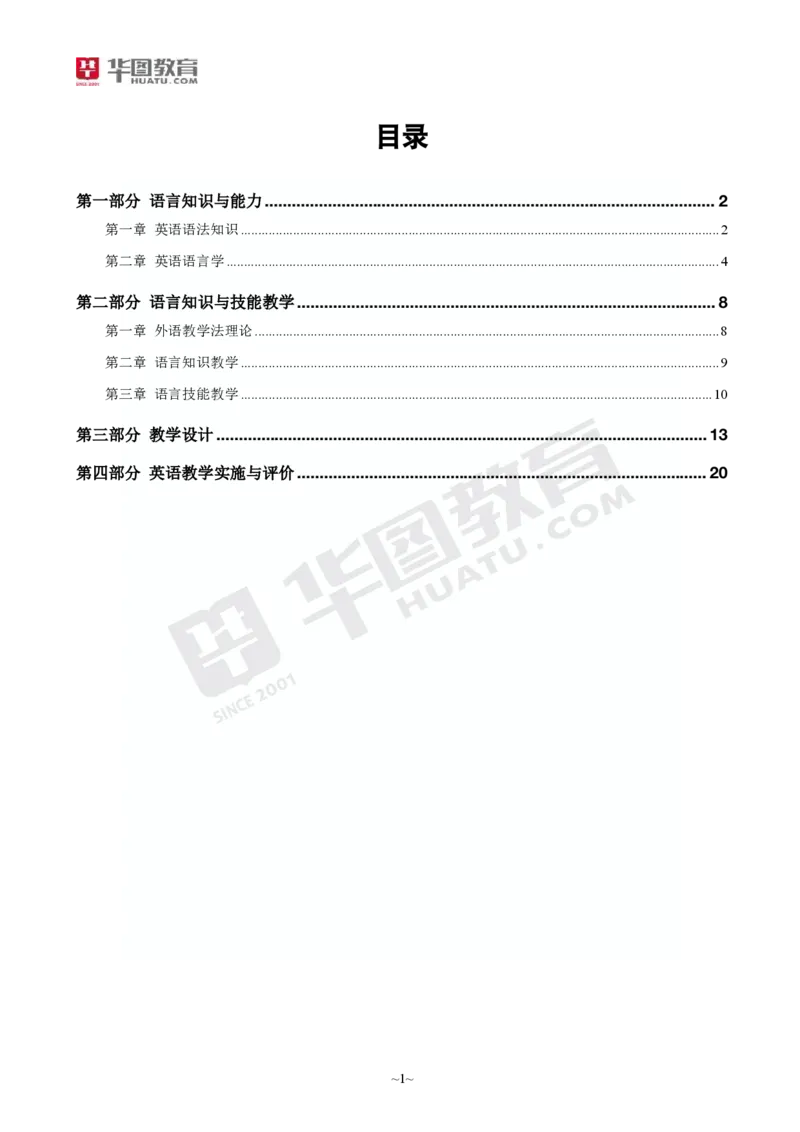
第一部分 语言知识与能力
....................................................................................................2
第一章 英语语法知识.........................................................................................................................................2
第二章 英语语言学.............................................................................................................................................4
第二部分 语言知识与技能教学
.............................................................................................8
第一章 外语教学法理论.....................................................................................................................................8
第二章 语言知识教学.........................................................................................................................................9
第三章 语言技能教学.......................................................................................................................................10
第三部分 教学设计
.............................................................................................................13
第四部分 英语教学实施与评价
...........................................................................................20
~1~第一部分 语言知识与能力
第一章 英语语法知识
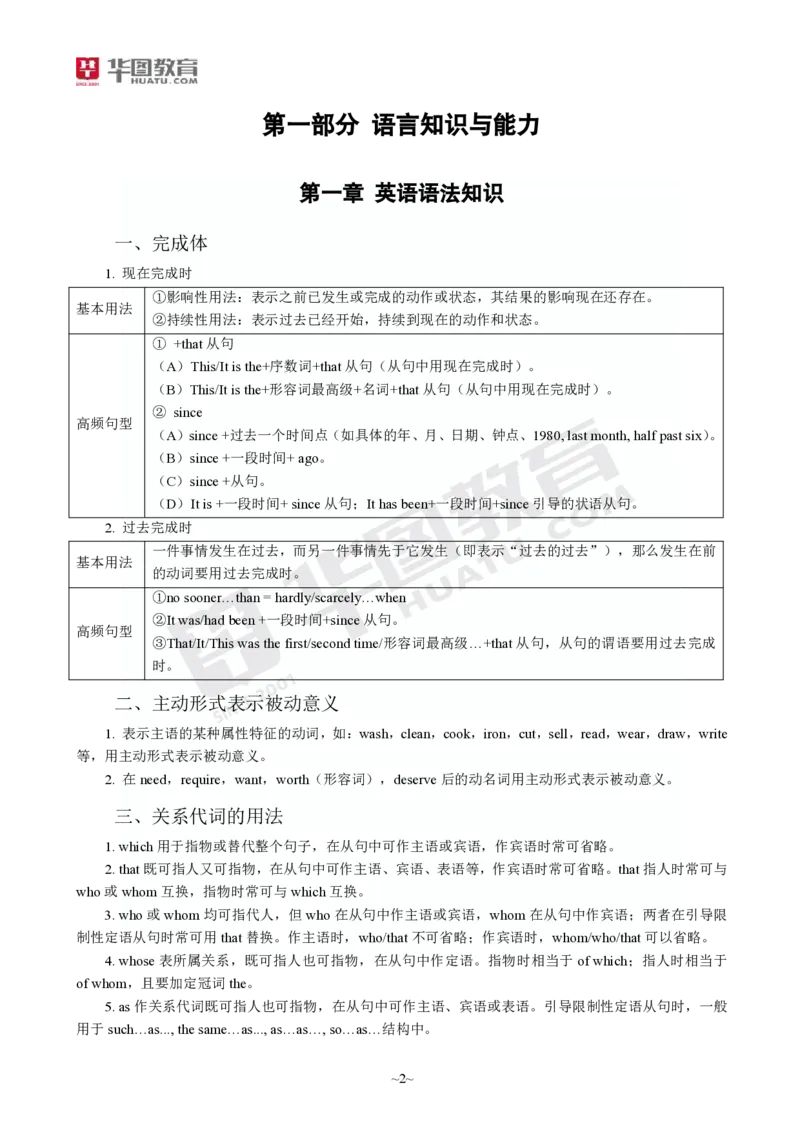
一、完成体
1. 现在完成时
①影响性用法:表示之前已发生或完成的动作或状态,其结果的影响现在还存在。
基本用法
②持续性用法:表示过去已经开始,持续到现在的动作和状态。
① +that从句
(A)This/Itisthe+序数词+that从句(从句中用现在完成时)。
(B)This/Itisthe+形容词最高级+名词+that从句(从句中用现在完成时)。
② since
高频句型
(A)since+过去一个时间点(如具体的年、月、日期、钟点、1980,lastmonth,halfpastsix)。
(B)since+一段时间+ago。
(C)since+从句。
(D)Itis+一段时间+since从句;Ithasbeen+一段时间+since引导的状语从句。
2. 过去完成时
一件事情发生在过去,而另一件事情先于它发生(即表示“过去的过去”),那么发生在前
基本用法
的动词要用过去完成时。
①nosooner…than=hardly/scarcely…when
②Itwas/hadbeen+一段时间+since从句。
高频句型
③That/It/Thiswasthefirst/secondtime/形容词最高级…+that从句,从句的谓语要用过去完成
时。
二、主动形式表示被动意义
1. 表示主语的某种属性特征的动词,如:wash,clean,cook,iron,cut,sell,read,wear,draw,write
等,用主动形式表示被动意义。
2. 在need,require,want,worth(形容词),deserve后的动名词用主动形式表示被动意义。
三、关系代词的用法
1.which用于指物或替代整个句子,在从句中可作主语或宾语,作宾语时常可省略。
2.that既可指人又可指物,在从句中可作主语、宾语、表语等,作宾语时常可省略。that指人时常可与
who或whom互换,指物时常可与which互换。
3.who或whom均可指代人,但who在从句中作主语或宾语,whom在从句中作宾语;两者在引导限
制性定语从句时常可用that替换。作主语时,who/that不可省略;作宾语时,whom/who/that可以省略。
4.whose表所属关系,既可指人也可指物,在从句中作定语。指物时相当于ofwhich;指人时相当于
ofwhom,且要加定冠词the。
5.as作关系代词既可指人也可指物,在从句中可作主语、宾语或表语。引导限制性定语从句时,一般
用于such…as...,thesame…as...,as…as…,so…as…结构中。
~2~四、部分倒装
1. 否定或半否定的词语、否定结构置于句首,如no,not,never,seldom,little,hardly,atnotime,
innoway,notuntil…,Notonly…butalso,Hardly/Scarcely…when,Nosooner…than等。
2.so,neither,nor表示“也、也不”的句子要部分倒装;so表示“的确如此”句子不倒装。
3.“Only+ 副词/介词短语/状语从句”放在句首时进行部分倒装。
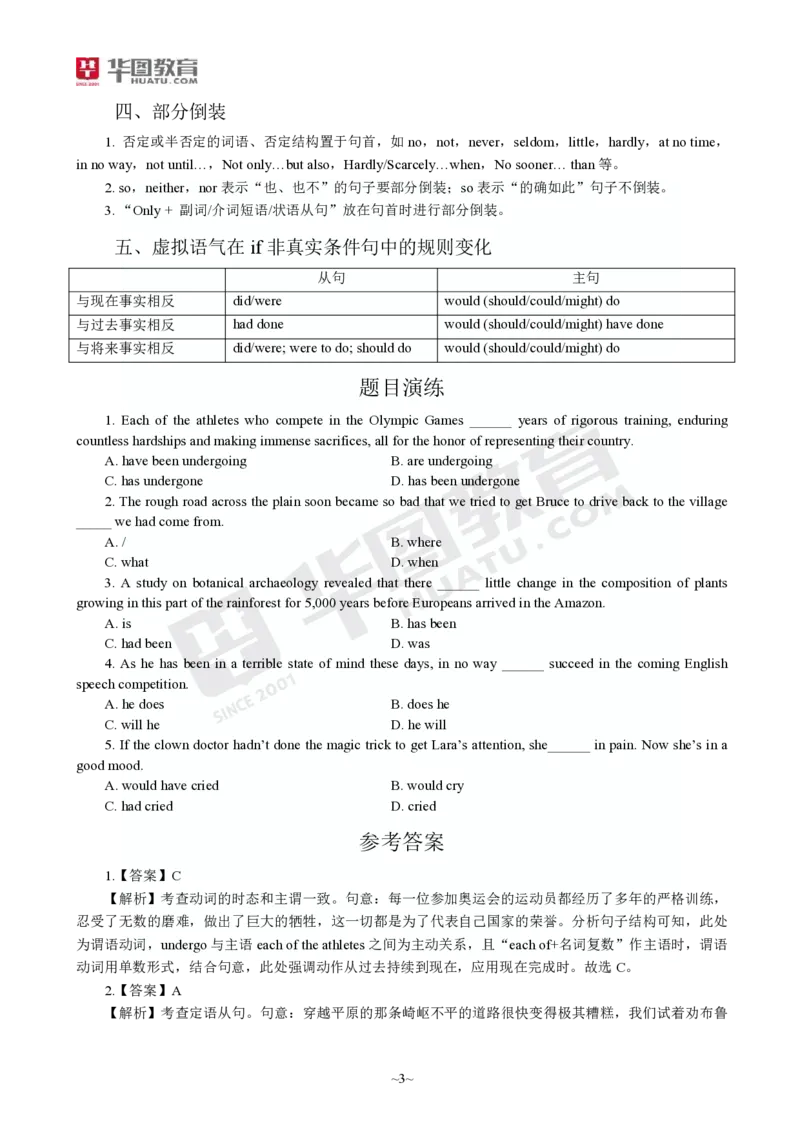
五、虚拟语气在 if 非真实条件句中的规则变化
从句 主句
与现在事实相反 did/were would(should/could/might)do
与过去事实相反 haddone would(should/could/might)havedone
与将来事实相反 did/were;weretodo;shoulddo would(should/could/might)do
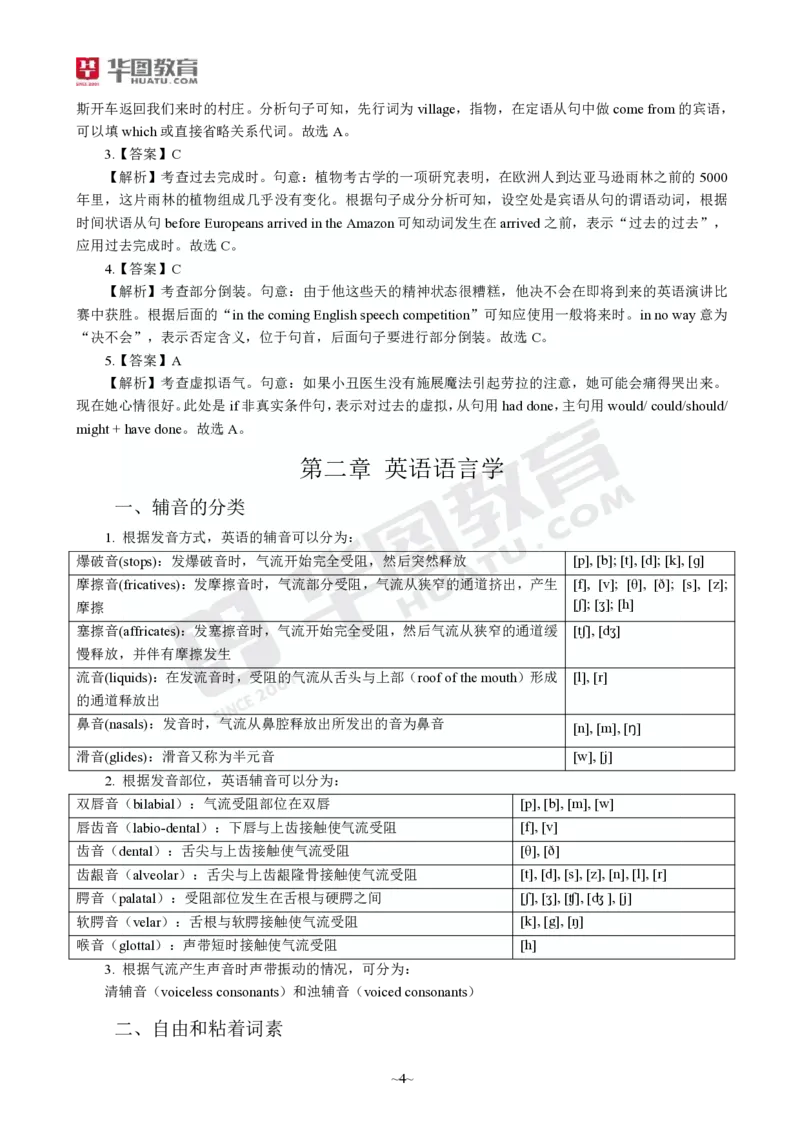
题目演练
1. Each of the athletes who compete in the Olympic Games ______ years of rigorous training, enduring
countlesshardshipsandmakingimmensesacrifices,allforthehonorofrepresentingtheircountry.
A.havebeenundergoing B.areundergoing
C.hasundergone D.hasbeenundergone
2. The rough roadacross the plain soon became so badthat we tried to get Bruce to drive back to the village
_____wehadcomefrom.
A./ B.where
C.what D.when
3. A study on botanical archaeology revealed that there ______ little change in the composition of plants
growinginthispartoftherainforestfor5,000yearsbeforeEuropeansarrivedintheAmazon.
A.is B.hasbeen
C.hadbeen D.was
4. As he has been in a terrible state of mind these days, in no way ______ succeed in the coming English
speechcompetition.
A.hedoes B.doeshe
C.willhe D.hewill
5. If the clown doctor hadn’t done the magic trick to get Lara’s attention, she______ in pain. Now she’s in a
goodmood.
A.wouldhavecried B.wouldcry
C.hadcried D.cried
参考答案
1.【答案】C
【解析】考查动词的时态和主谓一致。句意:每一位参加奥运会的运动员都经历了多年的严格训练,
忍受了无数的磨难,做出了巨大的牺牲,这一切都是为了代表自己国家的荣誉。分析句子结构可知,此处
为谓语动词,undergo与主语eachoftheathletes之间为主动关系,且“eachof+名词复数”作主语时,谓语
动词用单数形式,结合句意,此处强调动作从过去持续到现在,应用现在完成时。故选C。
2.【答案】A
【解析】考查定语从句。句意:穿越平原的那条崎岖不平的道路很快变得极其糟糕,我们试着劝布鲁
~3~斯开车返回我们来时的村庄。分析句子可知,先行词为village,指物,在定语从句中做comefrom的宾语,
可以填which或直接省略关系代词。故选A。
3.【答案】C
【解析】考查过去完成时。句意:植物考古学的一项研究表明,在欧洲人到达亚马逊雨林之前的5000
年里,这片雨林的植物组成几乎没有变化。根据句子成分分析可知,设空处是宾语从句的谓语动词,根据
时间状语从句beforeEuropeansarrivedintheAmazon可知动词发生在arrived之前,表示“过去的过去”,
应用过去完成时。故选C。
4.【答案】C
【解析】考查部分倒装。句意:由于他这些天的精神状态很糟糕,他决不会在即将到来的英语演讲比
赛中获胜。根据后面的“inthecomingEnglishspeechcompetition”可知应使用一般将来时。innoway意为
“决不会”,表示否定含义,位于句首,后面句子要进行部分倒装。故选C。
5.【答案】A
【解析】考查虚拟语气。句意:如果小丑医生没有施展魔法引起劳拉的注意,她可能会痛得哭出来。
现在她心情很好。此处是if非真实条件句,表示对过去的虚拟,从句用haddone,主句用would/could/should/
might+havedone。故选A。
第二章 英语语言学
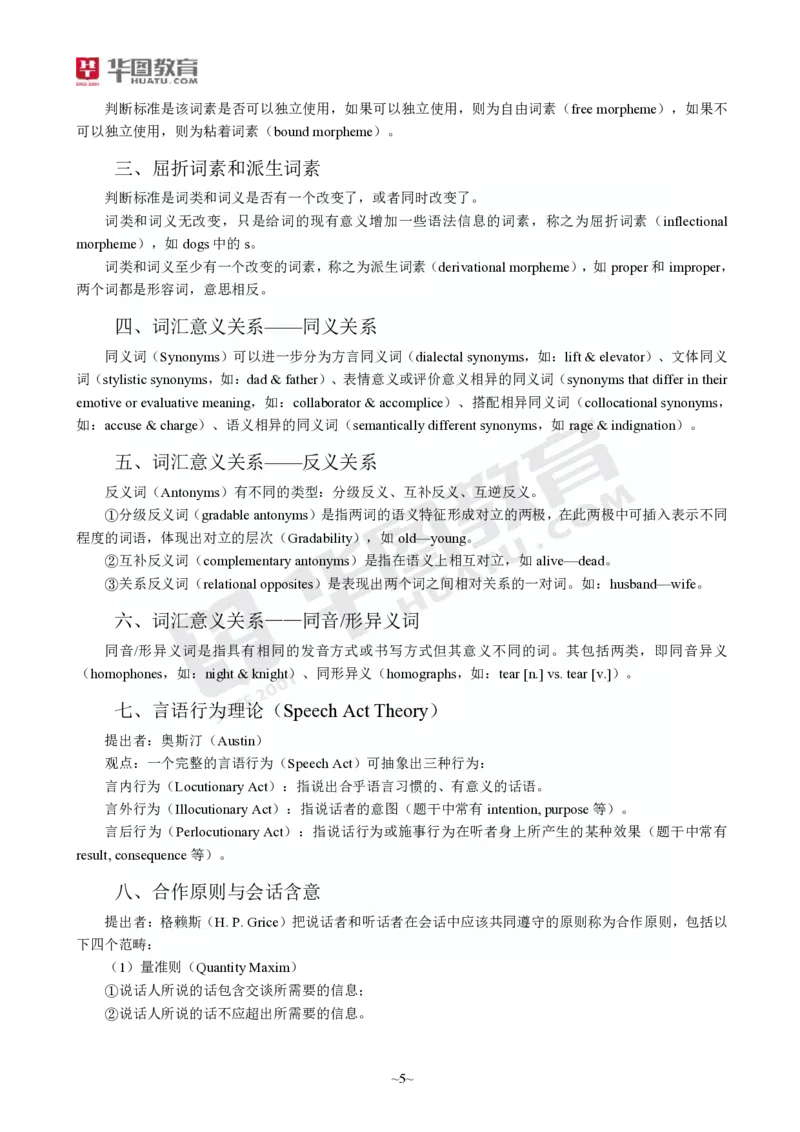
一、辅音的分类
1. 根据发音方式,英语的辅音可以分为:
爆破音(stops):发爆破音时,气流开始完全受阻,然后突然释放 [p],[b];[t],[d];[k],[ɡ]
摩擦音(fricatives):发摩擦音时,气流部分受阻,气流从狭窄的通道挤出,产生 [f], [v]; [θ], [ð]; [s], [z];
摩擦 [ʃ];[ʒ];[h]
塞擦音(affricates):发塞擦音时,气流开始完全受阻,然后气流从狭窄的通道缓 [tʃ],[dʒ]
慢释放,并伴有摩擦发生
流音(liquids):在发流音时,受阻的气流从舌头与上部(roofofthemouth)形成 [l],[r]
的通道释放出
鼻音(nasals):发音时,气流从鼻腔释放出所发出的音为鼻音
[n],[m],[ŋ]
滑音(glides):滑音又称为半元音 [w],[j]
2. 根据发音部位,英语辅音可以分为:
双唇音(bilabial):气流受阻部位在双唇 [p],[b],[m],[w]
唇齿音(labio-dental):下唇与上齿接触使气流受阻 [f],[v]
齿音(dental):舌尖与上齿接触使气流受阻 [θ],[ð]
齿龈音(alveolar):舌尖与上齿龈隆骨接触使气流受阻 [t],[d],[s],[z],[n],[l],[r]
腭音(palatal):受阻部位发生在舌根与硬腭之间 [ʃ],[ʒ],[ʧ],[ʤ],[j]
软腭音(velar):舌根与软腭接触使气流受阻 [k],[g],[ŋ]
喉音(glottal):声带短时接触使气流受阻 [h]
3. 根据气流产生声音时声带振动的情况,可分为:
清辅音(voicelessconsonants)和浊辅音(voicedconsonants)
二、自由和粘着词素
~4~判断标准是该词素是否可以独立使用,如果可以独立使用,则为自由词素(freemorpheme),如果不
可以独立使用,则为粘着词素(boundmorpheme)。
三、屈折词素和派生词素
判断标准是词类和词义是否有一个改变了,或者同时改变了。
词类和词义无改变,只是给词的现有意义增加一些语法信息的词素,称之为屈折词素(inflectional
morpheme),如dogs中的s。
词类和词义至少有一个改变的词素,称之为派生词素(derivationalmorpheme),如proper和improper,
两个词都是形容词,意思相反。
四、词汇意义关系——同义关系
同义词(Synonyms)可以进一步分为方言同义词(dialectalsynonyms,如:lift&elevator)、文体同义
词(stylisticsynonyms,如:dad&father)、表情意义或评价意义相异的同义词(synonymsthatdifferintheir
emotiveorevaluativemeaning,如:collaborator&accomplice)、搭配相异同义词(collocationalsynonyms,
如:accuse&charge)、语义相异的同义词(semanticallydifferentsynonyms,如rage&indignation)。
五、词汇意义关系——反义关系
反义词(Antonyms)有不同的类型:分级反义、互补反义、互逆反义。
分级反义词(gradableantonyms)是指两词的语义特征形成对立的两极,在此两极中可插入表示不同
①
程度的词语,体现出对立的层次(Gradability),如old—young。
互补反义词(complementaryantonyms)是指在语义上相互对立,如alive—dead。
②
关系反义词(relationalopposites)是表现出两个词之间相对关系的一对词。如:husband—wife。
③
六、词汇意义关系——同音/形异义词
同音/形异义词是指具有相同的发音方式或书写方式但其意义不同的词。其包括两类,即同音异义
(homophones,如:night&knight)、同形异义(homographs,如:tear[n.]vs.tear[v.])。
七、言语行为理论(Speech Act Theory)
提出者:奥斯汀(Austin)
观点:一个完整的言语行为(SpeechAct)可抽象出三种行为:
言内行为(LocutionaryAct):指说出合乎语言习惯的、有意义的话语。
言外行为(IllocutionaryAct):指说话者的意图(题干中常有intention,purpose等)。
言后行为(PerlocutionaryAct):指说话行为或施事行为在听者身上所产生的某种效果(题干中常有
result,consequence等)。
八、合作原则与会话含意
提出者:格赖斯(H.P.Grice)把说话者和听话者在会话中应该共同遵守的原则称为合作原则,包括以
下四个范畴:
(1)量准则(QuantityMaxim)
说话人所说的话包含交谈所需要的信息;
①
说话人所说的话不应超出所需要的信息。
②
~5~(2)质准则(QualityMaxim):努力说真话
说话者要说真话,不要说假话;
①
不要说缺乏证据的话。
②
(3)关系准则(RelationMaxim):说话要有关联、切题。
(4)方式准则(MannerMaxim):说话要明白清楚。
避免晦涩; 避免歧义; 简明扼要; 井井有条。
① ② ③ ④
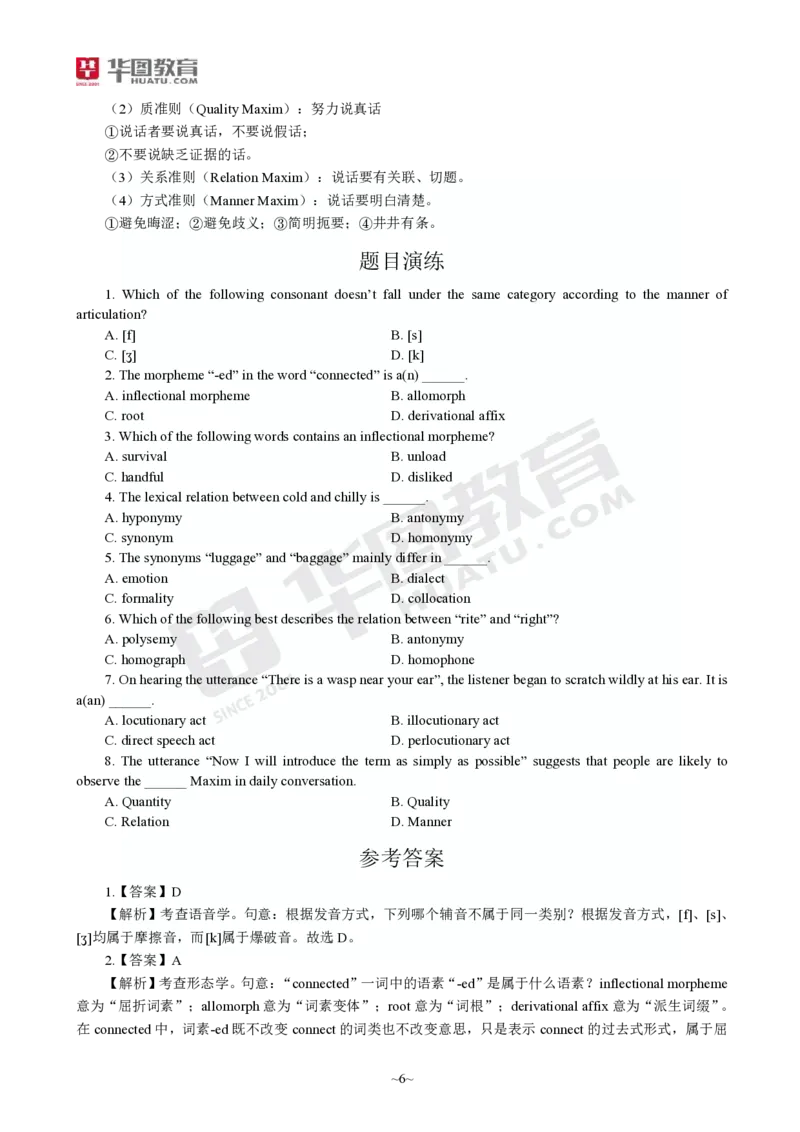
题目演练
1. Which of the following consonant doesn’t fall under the same category according to the manner of
articulation?
A.[f] B.[s]
C.[ʒ] D.[k]
2.Themorpheme“-ed”intheword“connected”isa(n)______.
A.inflectionalmorpheme B.allomorph
C.root D.derivationalaffix
3.Whichofthefollowingwordscontainsaninflectionalmorpheme?
A.survival B.unload
C.handful D.disliked
4.Thelexicalrelationbetweencoldandchillyis______.
A.hyponymy B.antonymy
C.synonym D.homonymy
5.Thesynonyms“luggage”and“baggage”mainlydifferin______.
A.emotion B.dialect
C.formality D.collocation
6.Whichofthefollowingbestdescribestherelationbetween“rite”and“right”?
A.polysemy B.antonymy
C.homograph D.homophone
7.Onhearingtheutterance“Thereisawaspnearyourear”,thelistenerbegantoscratchwildlyathisear.Itis
a(an)______.
A.locutionaryact B.illocutionaryact
C.directspeechact D.perlocutionaryact
8. The utterance “Now I will introduce the term as simply as possible” suggests that people are likely to
observethe______Maximindailyconversation.
A.Quantity B.Quality
C.Relation D.Manner
参考答案
1.【答案】D
【解析】考查语音学。句意:根据发音方式,下列哪个辅音不属于同一类别?根据发音方式,[f]、[s]、
[ʒ]均属于摩擦音,而[k]属于爆破音。故选D。
2.【答案】A
【解析】考查形态学。句意:“connected”一词中的语素“-ed”是属于什么语素?inflectionalmorpheme
意为“屈折词素”;allomorph意为“词素变体”;root意为“词根”;derivationalaffix意为“派生词缀”。
在connected中,词素-ed既不改变connect的词类也不改变意思,只是表示connect的过去式形式,属于屈
~6~折词素。故选A。
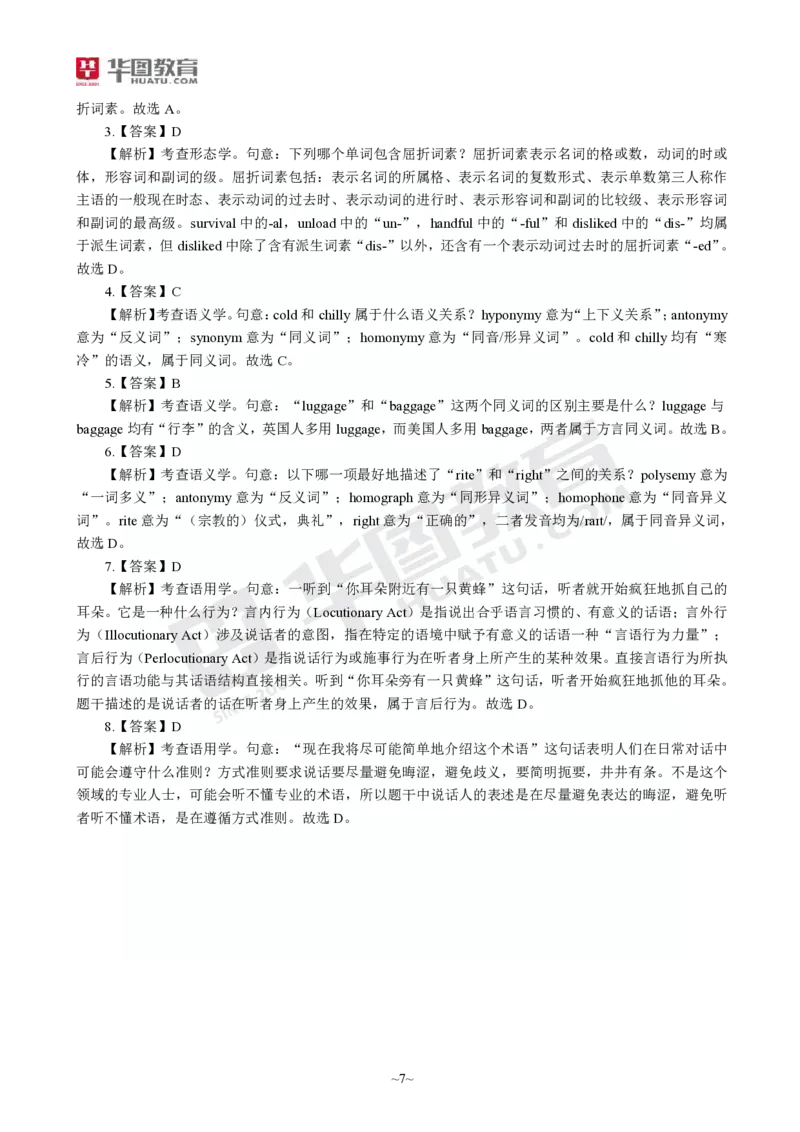
3.【答案】D
【解析】考查形态学。句意:下列哪个单词包含屈折词素?屈折词素表示名词的格或数,动词的时或
体,形容词和副词的级。屈折词素包括:表示名词的所属格、表示名词的复数形式、表示单数第三人称作
主语的一般现在时态、表示动词的过去时、表示动词的进行时、表示形容词和副词的比较级、表示形容词
和副词的最高级。survival中的-al,unload中的“un-”,handful中的“-ful”和disliked中的“dis-”均属
于派生词素,但disliked中除了含有派生词素“dis-”以外,还含有一个表示动词过去时的屈折词素“-ed”。
故选D。
4.【答案】C
【解析】考查语义学。句意:cold和chilly属于什么语义关系?hyponymy意为“上下义关系”;antonymy
意为“反义词”;synonym意为“同义词”;homonymy意为“同音/形异义词”。cold和chilly均有“寒
冷”的语义,属于同义词。故选C。
5.【答案】B
【解析】考查语义学。句意:“luggage”和“baggage”这两个同义词的区别主要是什么?luggage与
baggage均有“行李”的含义,英国人多用luggage,而美国人多用baggage,两者属于方言同义词。故选B。
6.【答案】D
【解析】考查语义学。句意:以下哪一项最好地描述了“rite”和“right”之间的关系?polysemy意为
“一词多义”;antonymy意为“反义词”;homograph意为“同形异义词”;homophone意为“同音异义
词”。rite意为“(宗教的)仪式,典礼”,right意为“正确的”,二者发音均为/raɪt/,属于同音异义词,
故选D。
7.【答案】D
【解析】考查语用学。句意:一听到“你耳朵附近有一只黄蜂”这句话,听者就开始疯狂地抓自己的
耳朵。它是一种什么行为?言内行为(LocutionaryAct)是指说出合乎语言习惯的、有意义的话语;言外行
为(IllocutionaryAct)涉及说话者的意图,指在特定的语境中赋予有意义的话语一种“言语行为力量”;
言后行为(PerlocutionaryAct)是指说话行为或施事行为在听者身上所产生的某种效果。直接言语行为所执
行的言语功能与其话语结构直接相关。听到“你耳朵旁有一只黄蜂”这句话,听者开始疯狂地抓他的耳朵。
题干描述的是说话者的话在听者身上产生的效果,属于言后行为。故选D。
8.【答案】D
【解析】考查语用学。句意:“现在我将尽可能简单地介绍这个术语”这句话表明人们在日常对话中
可能会遵守什么准则?方式准则要求说话要尽量避免晦涩,避免歧义,要简明扼要,井井有条。不是这个
领域的专业人士,可能会听不懂专业的术语,所以题干中说话人的表述是在尽量避免表达的晦涩,避免听
者听不懂术语,是在遵循方式准则。故选D。
~7~第二部分 语言知识与技能教学
第一章 外语教学法理论
一、直接法(Direct Method)
1. 主要特点:直接学习、直接理解和直接应用,不允许使用母语,用动作和图画等直观手段解释词义
和句子。
2. 语言观:语言是一种技能或习惯,习惯的养成要靠大量的重复练习和模仿。
二、听说法(Audio-lingual Method)
听说法认为外语学习是习惯的形成,采取模仿、机械练习和记忆的方法强化学生的反应;课堂上让学
生做大量的句型操练,不考虑意思和语境。听说法是以句型为纲,以句型操练为中心,着重培养听说能力
的外语教学法。
语言观:语言是口语,是说出来的话,而不是写出来的文字;语言是成套的习惯(asetofhabits)。
三、视听法(Audio-visual Method)
视听法(Audio-visualMethod)是在直接法和听说法的基础上,利用视听手段形成的一种外语教学法。
它是指在教学中综合利用图片、幻灯片等电化教具、视听手段,创造情景,学习外语。由于利用视听手段
创造情景是其主要特色,所以该方法又叫情景法(SituationalMethod)。
四、交际法(Communicative Approach)
1. 语言观:语言不只是某种形式的符号系统,语言是一种社会规范,语言的社会交际功能是语言的最
本质的功能。
2. 主要特点
(1)交际法主张让教学过程交际化,把言语交际作为外语教学的全部出发点;
(2)交际法的教材内容选取的是真实、自然的言语,而且是根据功能、意念等要素来选择的;
(3)教学活动的练习形式多样,采用二人、三人、小组和全体的相互交流形式,每一组都有不同的目
标。
五、任务型教学法(Task-based Language Teaching Approach)
任务型教学是指一种以完成具体任务为学习动力和动机,以完成任务的过程为学习过程,以展示任务
成果的方式来体现成就的教学途径,是一种强调“在做中学”(learningbydoing)的语言教学方法。任务
型教学中的“任务”是指有目标的交际活动或为达到某一具体学习目标而进行的交际活动。
题目演练
1.Intask-basedlanguageteachingmethod,whichofthefollowingdoesn’tbelongtothetypeoftaskdesign?
A.Roleplay. B.Questionnaire.
C.Experiencesharing. D.WordSolitaire.
2.Whichofthefollowingisacommunicativetask?
A.Readingaloudthedialogueonpage24.
~8~B.Writingapartyinvitationtoyourfriends.
C.TranslatingthefirstparagraphintoChinese.
D.Makingsentenceswiththeexpressionsgiven.
参考答案
1.【答案】D
【解析】考查任务型教学法。句意:在任务型语言教学法中,下列哪一项不属于任务设计类型?任务
型教学法的任务设计类型包含角色扮演、调查问卷、经验分享,但是词语接龙属于机械性练习活动。故选
D。
2.【答案】B
【解析】考查交际法。句意:以下哪个选项属于交际性任务?“Readingaloudthedialogueonpage24”
意为“朗读第24页的对话”;“Writingapartyinvitationtoyourfriends”意为“给你的朋友写一封聚会邀
请函”;“TranslatingthefirstparagraphintoChinese”意为“将第一段翻译成汉语”;“Makingsentenceswith
theexpressionsgiven”意为“用所给短语造句”。交际性任务即各种形式的交际性活动,在活动中学生通过
完成目标任务,即真实的交际性任务,达到真正运用语言的目的。A、C、D三项的任务都缺乏真实的交际
语境。故选B。
第二章 语言知识教学
一、语音教学
语音教学原则:准确性、实践性、综合性、长期性、针对性、趣味性、真实性。
二、词汇教学
1. 词汇教学内容:词义、用法、词汇信息、词法。
2. 词汇教学原则:情境原则、多样化原则、复现原则、策略原则、自主学习原则、反馈原则。
3. 词汇呈现策略:直观语境、上下文/定义、同义词/反义词、构词法、词块、翻译或解释等。
三、语法教学
1. 语法教学内容:词法、句法。
2. 语法教学原则:有效性原则、适合性原则、情景原则、形式与意义相结合、全面性原则、交际性原
则、工具性原则。
3. 语法教学模式:演绎法(thedeductivemethod)、归纳法(theinductivemethod)、指导发现法(the
guideddiscoverymethod)。
四、语篇教学
语篇教学模式:问题—解决模式(problem-solutionpattern)、提问—回答模式(question-answerpattern)、
一般—特殊模式(general-specificpattern)、主张—反应模式(claim-counterclaimpattern)、原因—结果模
式(cause-effectpattern)、时间序列模式(timesequencepattern)、比较或对比模式(comparisonorcontrast
pattern)、叙事模式(narrativepattern)
题目演练
~9~1.Ofallthefollowingpairsofwords,______isNOTtheminimalpair.
A.bet—bat B.boot—but
C.rocker—locker D.mouth—month
2.Whichofthefollowingbestdescribesthephenomenonthattheteachertellsthegrammarstructure directly
andleadsstudentstouseitinexercise?
A.Transfer B.Deduction
C.Contextualization D.Induction
3.Tomemorizevocabularybyreadingandrepeatingaloudis______thantomemorizethemincontext.
A.lesseffective B.moreeffective
C.mucheasier D.muchquicker
参考答案
1.【答案】D
【解析】考查音系学。句意:在下面所有的单词中,哪一组不是最小对立体?如果两个语音串除了在
某个相同的位置上有一个音段不同以外没有任何区别,它们就可以说构成了一个最小对立体(minimalpair)。
bet发音为[bet];bat发音为[bæt];boot发音为[buːt];but发音为[bʌt];rocker发音为[ˈrɒkə(r)];locker发音
为[ˈlɒkə(r)];mouth发音为[maʊθ];month发音为[mʌnθ],D项中mouth的ou是一个音,而month中的ou
是两个音,不符合最小对立体的定义。故选D。
2.【答案】B
【解析】考查语法教学。句意:下面哪一项最好地描述了老师直接告诉学生语法结构并引导学生在练
习中使用它的现象?Transfer意为“迁移”;Deduction意为“演绎”;Contextualization意为“语境化”;
Induction意为“归纳”。教师直接告知语法结构,并引导学生在练习题中使用该结构,这属于演绎法。故
选B。
3.【答案】A
【解析】考查词汇教学。句意:通过大声朗读和重复来记忆词汇比在上下文中记忆词汇______。通过
常识可知,在上下文中记忆单词比死记硬背更有效,记得更牢固。故选A。
第三章 语言技能教学
一、听力教学
1. 听力教学具体方法:(1)从基础入手,培养思维能力,提高听力水平;(2)在听力过程中注重听
力微技能的训练(辨音能力、交际信息辨别能力、大意理解能力、细节理解能力、词义猜测能力、推理判
断和预测能力)。
2. 听力教学具体环节:听前活动阶段、听的过程、听后活动阶段。
二、口语教学
1. 口语教学的原则:系统化原则、互动性原则、情景化原则、科学性原则、平衡流利性和准确性原则、
激励性原则。
2. 口语活动的类型:控制型活动(controlledormechanicalactivities)、半控制型活动(semi-controlled
orsemi-mechanicalactivities)、交际活动(communicativeactivities)。
三、阅读教学
~10~1. 阅读教学的原则:激发兴趣原则、因材施教原则、真实性原则、速度与准确性平衡原则、语言学习
与思维训练并重原则、综合性原则。
2. 阅读教学模式:自下而上式(bottom-upmodel)、自上而下式(top-downmodel)、交互式(Interactive
Model)。
3. 阅读教学方法(策略教学法):阅读前、阅读中、阅读后。
四、写作教学
1. 写作教学的原则:以学生为主体原则、循序渐进原则、多样化原则、真实性原则、交际性原则、综
合性原则。
2. 写作教学模式:重内容的教学模式(Content-orientedApproach)、重过程的教学模式(Process-oriented
Approach)、重结果的教学模式(Product-orientedApproach)、小组合作的教学模式。
题目演练
1.In______,thefocusofstudents’attentionisledtothelisteningtextandtheteacherscanguidethestudents
andhelpthemunderstandit.
A.pre-listening B.while-listening
C.while-reading D.post-listening
2.AccordingtoBygate(1987:8),whichofthefollowingactivitieshelppreparestudentsforreal-lifespeechin
English?
A.Readingaloud. B.Givingapreparedtalk.
C.Learningapieceoftextordialoguebyheart. D.Alltheabove.
3. Teachers who adopt the ______ model for reading comprehension may start teaching a text by providing
somebackgroundinformation.
A.parallel B.serial
C.top-down D.bottom-up
参考答案
1.【答案】B
【解析】考查听力教学。句意:在哪个环节中,学生的注意力被引导到听力文本上,教师可以引导学
生并帮助他们理解。听前环节的主要任务是激活学生的已有知识库,帮助学生了解听力活动的目标,让学
生在听听力之前对所听材料内容有所准备;听中的过程注重培养学生通过视听活动来获取信息的能力,帮
助学生练习上下文的预测、词语的搭配以及释义的技巧等,侧重点在于听力文本本身;听后活动阶段,主
要是针对刚才所进行的听力活动进行反思,以便有针对性地开展后继活动。故选B。
2.【答案】D
【解析】考查口语教学。句意:根据Bygate(1987:8),以下哪项活动有助于学生为现实生活中的英语
演讲做准备?根据王蔷《英语教学法教程》,可以为学生做好日常口语准备的活动包括:大声朗读(reading
aloud);发言前作好准备(givingapreparedtalk);用心学习文章或对话(learningapieceoftextordialogue
byheart);采访别人或被采访(interviewingsomeone,orbeinginterviewed);进行操练(doingadrill)。
故选D。
3.【答案】C
【解析】考查阅读教学。自下而上的模式(Bottom-upApproach)是一个解码的过程,从声音到单词、
句子、整篇文章的理解。自上而下的模式(Top-downApproach)是一个宏观的加工过程,通过背景、语境
~11~等信息理解文章大意,其次再对文章的细节、单词等进行分析。而交互式教学模式(InteractiveApproach)
则将前两者教学结合起来,综合两者的优势来开展教学。本题描述的是阅读时先提供背景知识的教学模式,
属于自上而下的教学模式。故选C。
~12~第三部分 教学设计
一、听说课教学过程
二、阅读课教学过程
三、写作课教学过程
~13~四、听力课教学过程
题目演练
1. 设计任务:请阅读下面学生信息和语言素材,设计一个20分钟的英语阅读课的教学方案,教案没
有固定格式,但必须包含下列要点:
● teachingobjectives
● teachingcontents
● keyanddifficultpoints
● majorstepsandtimeallocation
● activitiesandjustifications
教学时间:20分钟
学生概况:某城镇普通中学八年级(初中二年级学生),班级40人,多数学生已经达到《义务教育英
语课程标准(2022年版)》相应水平。学生课堂参与积极性一般。语言素材:
It is 8:30 a.m. at the Chengdu Research Base. Panda keepers are preparing milk for the baby pandas’
breakfast. At 9:00 a.m., they find that most of the babies are already awake and hungry. When the babies see the
keepers,theyrunovertothemwithexcitementandsomeoftheyoungpandasevenwalkintotheirfriendsandfall
~14~over!
LinWei,oneofthepandakeepers,says,“They’resocuteandlovely.Itakecareofthemlikethey’remyown
babies. I wash, feed and play with them every day. They’re very special to me.” In fact, many people around the
worldlovetheseblackandwhiteanimals.PandashavebecomesopopularthattheyarenowasymbolofChina.
Scientists say there are now fewer than 2,000 pandas living in the forests. Another 300 or so live in zoos or
research centers in China and other countries. Pandas do not have many babies, maybe only one every two years.
Thebabiesoftendiefromillnessesanddonotliveverylong.Adultpandasspendmorethan12hoursadayeating
about 10 kilos of bamboo. Many years ago, there were a lot more bamboo forests and pandas in China, but then
humans started to cut down these forests. As the forests get smaller and other human activities cause more
problems,pandascannotfindenoughtoeatandtheyarehavingfewerbabies.
An education program in Chengdu teaches children about pandas and other endangered wild animals. They
sendpeople to schoolsto tell childrenaboutthe importanceofsaving theseanimals. And theChinesegovernment
is trying hard to help save the pandas. Scientists are doing research to better understand the habits of pandas. We
allhopethatinthefuturetherewillbealotmorepandas.
2. 设计任务:请阅读下面学生信息和语言素材,设计20分钟的听力教学方案。教案没有固定格式,
但须包含下列要点:
● teachingobjectives
● teachingcontents
● keyanddifficultpoints
● majorstepsandtimeallocation
● activitiesandjustifications
教学时间:20分钟
学生概况:某城镇普通高中一年级第一学期学生,班级人数40人。多数学生已经达到《普通高中英语
课程标准(2017年版2020修订)》相应水平。学生课堂参与积极性一般。
语言素材:
~15~参考答案
1.【参考答案】
1.TeachingContents
It is a passage introducing the job at Chengdu Research Base and the pandas. It tells the current living
conditionofpandasandcallsonpeopletoprotectpandas.
2.TeachingObjectives
①Studentscangraspthekeywordsandusefulexpressionsinthetext.
②Studentswillbeabletoreadandunderstandthetexttalkingaboutpandas.
③Students’awarenessofprotectingwildanimalsandthenaturalenvironmentcanbearoused.
④Studentswillbeabletoviewtheproblemfromdifferentperspectivesthroughobservingpictures.
⑤Studentscancooperatewithotherclassmatesandfinishlearningtaskstogether.
3.TeachingKeyPoint
Howtofullyunderstandthepassageandimprovetheirreadingability.
4.TeachingDifficultPoint
Howtounderstandthesituationofpandasandraisetheirawarenesstoprotecttheendangeredanimals.
5.TeachingProcedures
~16~Step1Lead-in(1min)
(1) Play a video clip of the TV program The Animal World for students. Ask students about their feelings
afterwatching.
(2)Freetalkwithstudentsabouttheirknowledgeofthewildworld.
【Justification:Usevideostoattractstudents’attentionandarousestudents’learninginterestsothattheycan
getintotheworldofwildanimals.】
Step2Pre-reading(2mins)
(1)Showstudentsseveralpicturesofpandas.Askstudentswhattheyknowaboutpandas.
(2)Invitestudentstoguesswhatthestatusisforpandas.
【Justification:Checkandstimulatestudents’backgroundknowledgeaboutpandasandthenlayafoundation
forfurtherreading.】
Step3While-reading(10mins)
Skimming
Students read the passage for the first time quickly to find out its main idea and match each paragraph
correctlywithitscorrespondingheadline.
Para1 LiWei’sopiniontowardspandas
Para2 Thepopulationofpandas
Para3 Babypandas
Para4 Educationprogramstryingtosaveanimals
Scanning
Students read thepassage again to underline allthe numbers(in words andnumerals) in the textand find out
theirmeaningswithinthetimelimitoftwoorthreeminutes.
10—Adultpandaseat10kilosofbamboodaily.
12—Adultpandasspendmorethan12hoursadayeating.
300—About300pandasliveinzoosorresearchcentersinChinaorothercountries.
2000—Scientistssaytherearefewerthan2,000pandaslivingintheforests.
Intensivereading
Studentsreadthetextforthelasttimeandanswerthefollowingquestions:
(1)WhatisLinWei’sjob?
(2)Whyarepandasendangered?
(3)WhatdoestheeducationprograminChengdudo?
(4)Whyarescientistsdoingresearch?
【Justification:Enablestudentstodevelopreadingcomprehensionabilityandinformation-processingability.】
Step4Post-reading(6mins)
The teacher shows students a list of endangered animals in China and presents some simple pictures of these
animalsandtheirlivingcondition.Askstudentsabouttheirfeelingsafterseeingthesepictures.
Then, students discuss in groups and try to figure out some practical ways to protect these animals. The
teacherprovidesstudentswithseveralperspectivessuchaspolicies,dailyhabits,propagandas,etc.
【Justification:Improvestudents’cooperationabilityandspokenEnglish.Developstudents’criticalthinking
abilityandenhancestudents’concernandawarenessofprotectingwildanimals.】
Step5Summary(0.5min)
Students summarize the information they get from this passage. The teacher makes supplements and
emphasizestheimportanceofprotectingwildanimalsandtheenvironment.
【Justification:Checkstudents’understandingofthislessonandachieveculturalawarenessobjective.】
Step6Homework(0.5min)
~17~Search for some information of a certain kind of endangered animal. Write a short passage to introduce its
featuresandstatusquo.
【Justification: Improve students’ writing ability on the basis of reading. Enrich students’ knowledge about
wildlife.】
2.【参考答案】
1.TeachingContents
ItisalisteningmaterialaboutBuford’sself-narration.
2.TeachingObjectives
(1)Studentscangetthemainideaandsomespecificinformationofthepassage.
(2)Studentscanunderstandthedialectaccentinthelisteningmaterial.
(3) Students can be brave to face with the difficulties in their daily life and care more about others and be
interestedindifferentdialectsofEnglish.
(4)Studentscantalkabouttheirownexperience.
(5)Studentscanimprovetheirlogicalthinkingability.
3.TeachingKeyPoint
Howtohelpstudentsfullyunderstandthepassage.
4.TeachingKeyDifficultPoint
HowtoguidestudentstounderstandthedifferencebetweenthedialectinthepassageandstandardEnglish.
5.TeachingProcedures
Step1:Leadingin(1min)
PlayashortvideoofvariousaccentsofEnglish,suchasIndianEnglish,SingaporeEnglish,JapaneseEnglish,
andKoreanEnglish.Askstudentstowatchcarefullyandtrytofigureoutwhattheyaretalkingabout.Discusswith
theirpartneraboutthedifferenceamongtheseaccents.
【Justification: By playing short videos featuring various English accents, the activity aims to stimulate
students’ interest in different accents. Additionally, classroom discussions on the phonetic differences among
differentEnglishdialectscanserveasapreludetosubsequentlearningactivities.】
Step2:Pre-listening(2mins)
The teacher shares an unforgettable experience with students and lets students make a new story with the
words,suchas“water,tree,goswimmingandcatfish”.
【Justification: By sharing and creating new stories, students can predict the main content of the listening
material.】
Step3:While-listening(10mins)
(1) Ask students to listen to the tape for the first time and put these sentences in the right sequences so that
theycangetthemainideaofthelisteningmaterial.
______Lesterclimbedatree.
______Buford,BillyBobandLesterwentswimming.
______Lesterthoughtthecatfishwouldeathim.
______BufordandBillyBoblaughed.
______Lestersawacatfish.
______NowLesteristooafraidtovisittheplace.
(2)Askstudentstolistentothetapeforthesecondtimeandthenanswerthequestions:
①WhatdoesBufordthinkofTexas?Howdoyouknow?
②Howlargewasthecatfish?
③WhydidLestergetoutofthewatersoquickly?
~18~④WhydidBufordandBigBillyBoblaugh?
Afteransweringthesequestions,checktheanswersbylisteningagain.
(3) Students discuss in pairs about the difference between the dialect in the listening material and standard
English.TrytomarkoutthedifferentwordsandwritedownthematchingstandardEnglishexpressions.
【Justification:Bylisteningtoaudiomaterialsandcompletingrelatedlearningtasks,theactivityaimstohelp
studentsemploylisteningstrategiesanddeepentheirunderstandingofthelisteningtexts.】
Step4:Post-listening(5mins)
Students work in groups of four to share their unforgettable experiences. Then, choose several students to
sharetheirstoryandwhattheylearntfromthisexperience.
【Justification: Students can express their own thoughts by incorporating knowledge learned from the
listeningmaterial,therebytrainingtheircommunicativeskills.】
Step5:Summary(1min)
The teacher asks one or two students to make summaries about what they have learned in the class and if
necessary, the teacher makes some supplements. Meanwhile, the teacher stresses that they should respect others’
dialects.
【Justification:Studentscanhaveaquickreviewofthewholeclass.】
Step6:Homework(1min)
AskstudentstosearchformoreaccentsofEnglishindifferentareasof theUKandtheUSA.Trytoimitatea
shortparagraphandshowintheclassnexttime.
【Justification:Studentscanconsolidatetheimportantknowledgeinthisclassbyfinishingthehomework.】
~19~第四部分 英语教学实施与评价
一、教学实施
二、教学评价
~20~题目演练
1. What role does he/she play when a teacher thinks about teaching content, teaching methods and teaching
objectivesbeforelessons?
A.Anorganizer. B.Adesigner.
C.Anassessor. D.Acontroller.
2.Whichofthefollowingisadisplayquestionusedbyteachersinclass?
A.Whatisthesimplepasttenseof“leave”?
B.Whatdoesthephrase“fromascratch”meaninthepassage?
C.Whatdoyouthinkoftheboy’sbehavior?
D.Doyouthinkthiswoman’sbehaviorisworthitornot?
3.Whichlanguageerrordoesthefollowingdialoguebelongto?
T:Hello.
S:Haveyoueatenyet?/Whereareyougoing?
A.communicationstrategies B.culturalinterference
C.intralingualinterference D.textbookmistakes
4. 从英语学科特点出发,课堂提问可分为课堂程序性提问、课文理解性提问、现实情景性提问三种。
请简述课文理解性提问的三个类型,并为每个类型举一个例子。
5. 根据题目要求完成下列任务,用中文作答。
材料一:
T:Turntopage21,andtellmeyouranswertoquestion1“Canthedriverseethebusinthepicture?”
S1:Yes,hecan.
T:Yes, he can? Do you really think so? In the first paragraph, there is a sentence “On oneside the mountain
raisessteeply;ontheothersidethereisasheerdrop.It’sabend.”Whatdoesitmean?
S1:No,hecan’t,asthereisabendontheroad.
T:Quiteright.
材料二:
T:WhyisthemarathonthelastOlympicevent?
S2:Idon’tknow.
T:Didyoulistentomecarefully?
S2:…
T:Youcansitdown.
~21~请根据所给材料回答下列问题:
(1)请简析两位老师的反馈方法。若有不合理之处请提出改进意见。
(2)材料一体现了教师在课堂中的哪些角色?教师在教学中常扮演的角色还有哪些?
6. 根据题目要求完成下列任务,用中文作答。
下列教学片段选自某高中课堂实录:
Post-reading
Groupdiscussion:Howtointroduceacity?
Activity1:AskstudentstowatchthevideoaboutBeijinganddiscusshowtointroduceBeijing.
Activity 2: Ask students to work together in groupsto have a discussion on how to introducea city andeach
groupchoosesonerepresentativetomakeareporttoalltheclass.
Summary
The teacher summarizes the main content of this lesson, and tells students to love their motherland and
hometown.
Homework
WriteashortpassageofBeijingusingtheinformationgivenbelow.
locationandarea population
landscapeandrivers climate
natureandenvironment history
lifeandculture specialty
localflavor economy
请根据所给材料回答下列问题:
(1)上述案例中Post-reading环节运用了什么教学法?有什么好处?
(2)上述案例中的教学活动是否存在不合理之处?请提出改进建议。
参考答案
1.【答案】B
【解析】考查教师角色。句意:当教师在课前思考教学内容、教学方法和教学目标时,他/她扮演什么
角色?教师在课前思考教学内容、教学方法、以及教学目标,体现了设计者的角色。故选B。
2.【答案】A
【解析】考查课堂提问类型。句意:下列哪一项是展示性问题?A项意为“leave的一般过去式是什么”,
这个答案是唯一的,教师可用来询问学生是否掌握此知识点,是展示性问题;B项意为“fromascratch这
个短语在文中是什么意思?”这个问题需要学生根据上下文进行推理,学生结合个人的知识和课文所提供
的信息进行综合分析,属于参阅性问题;C项意为“你怎么看这个男孩的行为?”;D项意为“你认为这
个女人的行为是否值得?”后两项都属于大家可以自由发表看法的问题,不属于展示性问题,而属于评估
性问题。故选A。
3.【答案】B
【解析】考查语言错误的成因。句意:下列对话属于哪一种语言错误?外国人用Hello或者Hi打招呼,
而中国人在吃饭前后的常用语是“吃了吗?”或者是“到哪儿去啊?”。这个对话体现的是因为文化习俗
不同而引起的错误。学生如果照字面意思翻译的话,外国人听起来会比较奇怪。communicationstrategies
意为“交际策略”;culturalinterference意为“文化干扰”;intralingualinterference意为“语内干扰”;textbook
mistakes意为“教材错误”。故选B。
4.【参考答案】
~22~(1)课文理解性提问有三种类型:展示性(displayquestions)、参阅性(referentialquestions)和评估
性(estimatedquestions)。展示性提问是教师根据具体教学内容进行的提问。这类问题只要求学生对课文
进行事实性的表层理解,并根据短时记忆或者查看课文找到答案。参阅性提问是根据课文相关信息提问。
这类问题没有现成的答案,学生要结合个人的知识和课文所提供的信息进行综合分析。评估性提问要求学
生在理解课文的基础上进行深层次的逻辑思维,运用所学语言知识就课文的某个事件或观点发表自己的看
法。
(2)例子
展示性:Whatplacesdoestheauthorvisit?
参阅性:Whatdoestheword“ornament”meaninthepassage?
评估性:Whatifhumanbeingscontinuetopollutetheenvironment?What’syouropinion?
5.【参考答案】
(1)材料一中,在学生回答错误后,教师采用隐形纠错的方法,用反问语气,结合解释和引导,使学
生自己发现错误从而改正错误。这不仅保护了学生的自尊心,同时也达到了纠错的目的,值得赞扬。
材料二中,在学生回答错误后,教师仅仅是训斥学生没有认真听讲,没有耐心引导学生。这样会严重
挫伤学生的自尊心,打消学生英语学习积极性。建议该教师改变反馈方式,在学生回答错误之后,不能训
斥学生,而是应该耐心进行引导启发,让学生得出正确答案。
(2)材料一中的教师在学生回答错误后,予以学生提示,引导学生改正错误,得出正确答案,体现了
教师评定者的角色。除此之外,教师在教学中常扮演管理者、组织者、促进者、参与者、信息提供者、辅
助者、研究者等角色。
6.【参考答案】
(1)上述案例中Post-reading环节运用了任务型教学法。首先观看视频介绍北京,做好任务前的准备;
然后小组合作开展任务,讨论如何介绍一个城市,这属于任务中环节;最后小组代表汇报结果,这属于任
务后环节。
任务型教学法的作用:学生小组合作,在真实的语境中完成任务“讨论如何介绍一个城市”的同时,
锻炼思维能力和交际能力,提高学生学以致用的能力。
(2)根据《普通高中英语课程标准(2017年版2020年修订)》,英语学习活动强调以学生为主体的
整合性学习,主要通过主题、语篇、知识(语言与文化知识)、技能、策略等维度实现。但是在上述案例
的总结环节,教师自己总结本节课的内容,未能突出学生中心原则。建议让学生自主总结,必要的时候教
师予以补充。
~23~