普通高中教科书
选择性必修
第三册普通高中教科书
选择性必修
第三册
主 编:陈 琳
北京主 编:陈 琳
副 主 编:张连仲
编 者:刘 晓 李陆桂 张京生 钱建源 徐 浩 雷传利
(按照姓氏笔画排序)
项目策划:王 芳 王 勇
项目负责:张黎新 郎 崧 张 涛
基础教育出版分社:
地 址:北京市西三环北路19号 外研社大厦 基础教育出版分社(100089)
咨询电话:(010)88819117/88819688
传 真:(010)88819423前 言
本教材是外语教学与研究出版社根据教育部制定的《普通高中英语课程标准(2017年版)》,在充分
调研和科学论证的基础上推出的中小学“一条龙”英语教材——《英语》(新标准)的高中部分。
本教材的主编为北京外国语大学陈琳教授,副主编为张连仲教授,编写团队包括国内高校的知名专家
学者、教研人员和一线教师。陈琳教授秉承周恩来总理提出的“一条龙”外语教学理念,总结自己从事
外语教育工作70年的经验,提出了符合中国外语教育实践的教育理论——辩证实践外语教育途径,并在
《英语》(新标准)教材中贯彻实施。
根据教育部2017年新课程标准的精神,我们启动了《英语》(新标准)高中教材的修订工作。本次
修订全面依托新课程标准要求,坚持陈琳教授的特色理论,由陈琳教授、张连仲教授指导编写团队,在充
分考虑我国英语教育实际学情和教情的前提下,进行了全面的框架重建和内容设计,保证了理论与实践的
紧密结合。
《英语》(新标准)高中教材共分10册:1—3册为必修课程教材,4—7册为选择性必修课程教材,
8—10册为选修课程中的提高类教材。
选择性必修课程教材与必修课程教材形成递进关系,进一步夯实基础,为学生的深度发展与进阶做好
准备,既适应今后高考的普遍要求,也能够适应学生今后人生和职业发展的语言需求。《英语》(新标准)
选择性必修课程教材的主要特色如下:
一、坚持立德树人根本任务。在教材的选材、内容、语言等各个方面突出学科的育人本质,帮助学生更好
地培育中国情怀,坚定文化自信,拓展国际视野,形成正确的世界观、人生观和价值观。
二、突出学科核心素养的重要性,全面培养学生的语言能力、文化意识、思维品质和学习能力,帮助学生
逐步形成正确的价值观念、必备品格和关键能力。
三、坚持理论与实践的辩证关系。从语言实践的角度设计教材的主题架构、内容结构直至每一项具体活
动,确保有实践、可实践,并通过实践促进提升,帮助学生形成素养,发展素养。
四、遵循“理解—发展—实践”的原则,以“主题”为纲设计单元任务,重要题材在各册教材中均得到体
现,且内容逐步扩展加深、螺旋式上升,符合语言教学规律。
五、语篇题材多样、体裁丰富,语言地道鲜活、难度适中,符合学生的兴趣特点,同时能够提升学生的语
篇意识,丰富语言感知与学习体验。
六、活动设计紧密围绕主题语境,更加突出综合技能的整合训练,充分体现了英语学习活动观;同时强调
交际情境的真实性和丰富性,帮助学生掌握语言技能、建构完善的知识基础,在实践中逐步形成交际
能力,培养在获取信息、处理信息、重构信息过程中的逻辑思维、多元思维和批判性思维。
七、强调学习策略的培养,鼓励学生通过体验、实践、讨论、合作、探究等方式,利用各种学习资源完成
学习任务、解决学习中的困难;同时鼓励学生在学习过程中及时进行自我反思和评价,进一步提升自
主学习能力。
八、突出文化意识(尤其是跨文化意识)的建构与发展。通过介绍及比较中外文化,帮助学生更好地理解
文化异同,学会理解和包容不同文化,提升道路自信、文化自信,将文化知识内化为正确的文化价值
观和有利于国家和个人发展的跨文化态度与意识。
九、为教师编写了流程清晰、内容丰富的教师用书,帮助教师快速理解教材内容和相关背景知识,明确教
学目标,掌握教学节奏;同时开发了配套的网络教材和其他多媒体配套资源,丰富课程资源,拓展教
学模式。
我们希望,《英语》(新标准)高中选择性必修课程教材能够进一步培养学生的语言能力、文化意识、
思维品质和学习能力等英语学科核心素养,为他们继续学习英语和终身发展打下坚实的基础。
《英语》(新标准)系列教材
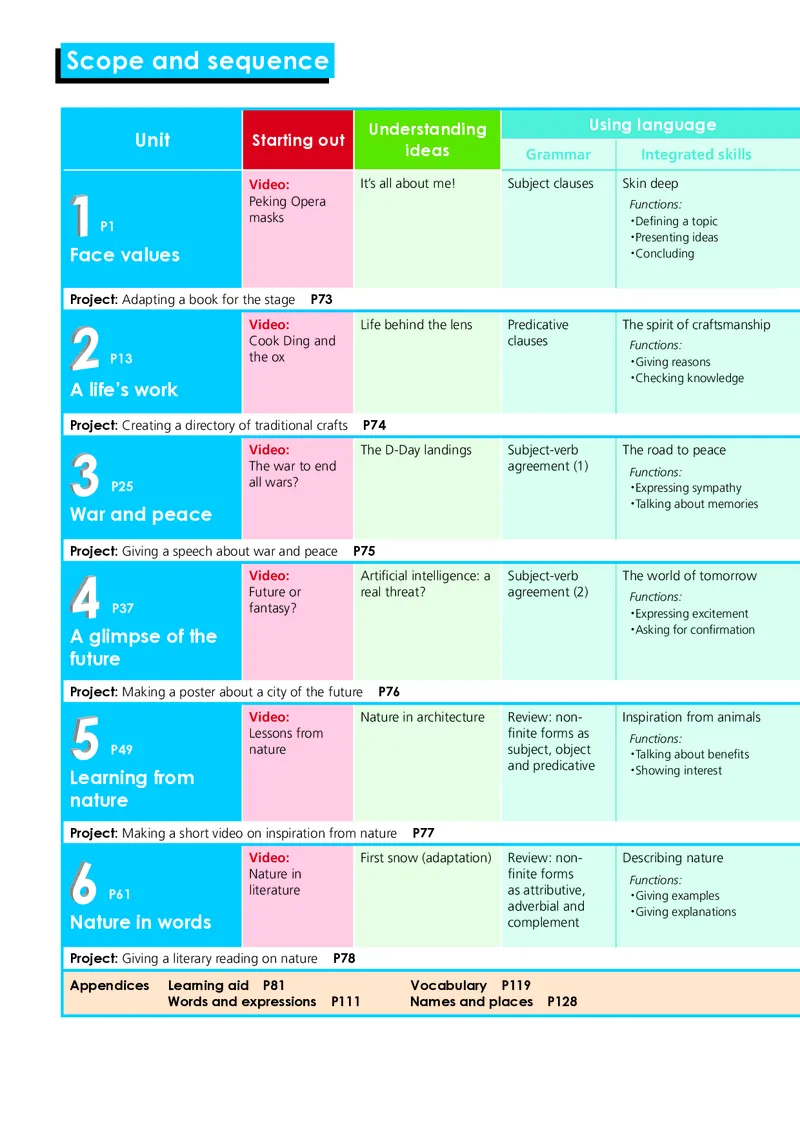
高中阶段编委会Scope and sequence
Using language
Understanding
Unit Starting out
ideas Grammar Integrated skills
Video: It’s all about me! Subject clauses Skin deep
Peking Opera Functions:
masks
・Defining a topic
P1
・Presenting ideas
Face values ・Concluding
Project: Adapting a book for the stage P73
Video: Life behind the lens Predicative The spirit of craftsmanship
Cook Ding and clauses
Functions:
P13 the ox ・Giving reasons
・Checking knowledge
A life’s work
Project: Creating a directory of traditional crafts P74
Video: The D-Day landings Subject-verb The road to peace
The war to end agreement (1)
Functions:
all wars?
P25 ・Expressing sympathy
・Talking about memories
War and peace
Project: Giving a speech about war and peace P75
Video: Artificial intelligence: a Subject-verb The world of tomorrow
Future or real threat? agreement (2)
Functions:
P37 fantasy?
・Expressing excitement
・Asking for confirmation
A glimpse of the
future
Project: Making a poster about a city of the future P76
Video: Nature in architecture Review: non- Inspiration from animals
Lessons from finite forms as
Functions:
P49 nature subject, object
・Talking about benefits
and predicative
・Showing interest
Learning from
nature
Project: Making a short video on inspiration from nature P77
Video: First snow (adaptation) Review: non- Describing nature
Nature in finite forms
Functions:
literature as attributive,
P61 ・Giving examples
adverbial and
・Giving explanations
Nature in words complement
Project: Giving a literary reading on nature P78
Appendices Learning aid P81 Vocabulary P119
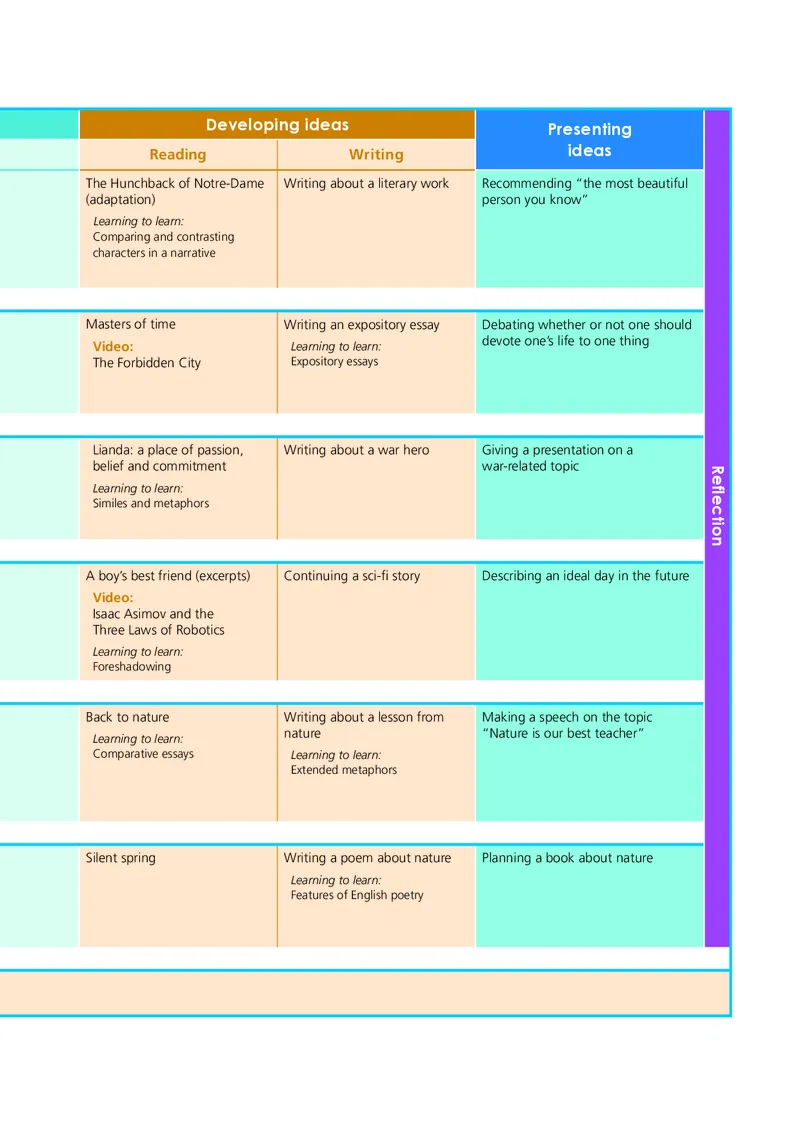
Words and expressions P111 Names and places P128Developing ideas
Presenting
Reading Writing ideas
The Hunchback of Notre-Dame Writing about a literary work Recommending “the most beautiful
(adaptation) person you know”
Learning to learn:
Comparing and contrasting
characters in a narrative
Masters of time Writing an expository essay Debating whether or not one should
devote one’s life to one thing
Video: Learning to learn:
The Forbidden City Expository essays
Lianda: a place of passion, Writing about a war hero Giving a presentation on a
belief and commitment war-related topic
Learning to learn:
Similes and metaphors
A boy’s best friend (excerpts) Continuing a sci-fi story Describing an ideal day in the future
Video:
Isaac Asimov and the
Three Laws of Robotics
Learning to learn:
Foreshadowing
Back to nature Writing about a lesson from Making a speech on the topic
nature “Nature is our best teacher”
Learning to learn:
Comparative essays Learning to learn:
Extended metaphors
Silent spring Writing a poem about nature Planning a book about nature
Learning to learn:
Features of English poetry
Reflection致 同 学
同学们,欢迎大家继续《英语》(新标准)高中教材的学习!
经过必修课程教材的学习,大家已经打下了更为扎实的英语基础,达到了高中英语学业质量水
平一的要求。现在大家应根据升学或就业的需要,对自己的学习目标提出更高的要求。由教育部制
定并颁布的《普通高中英语课程标准(2017年版)》明确规定:普通高中英语课程作为一门学习及
运用英语语言的课程,与义务教育阶段的课程相衔接,旨在为学生继续学习英语和终身发展打下良
好基础。普通高中英语课程强调对学生语言能力、文化意识、思维品质和学习能力的综合培养。这
就是同学们在高中阶段学习英语的方向和目标。
要达到这个目标,需要大家的主观努力,也需要一套适应更高更广的语言学习需求的教材。《英
语》(新标准)高中选择性必修课程教材在延续了必修课程教材的基础上,为有升学要求或有个性化
发展需求的学生设计,在话题内容、语言理论、语言技能、跨文化意识、思维能力、学习能力等方
面,都提出了更高的要求,延伸出了如下特点:
一、作为必修课程教材的延续,选择性必修课程教材的话题选择更注意广度和深度,既关注话题的
现实意义,又关注语言学习的思想内涵,充分反映语言的发展和社会的进步,力求培养同学们
的文化意识和思维能力。
二、选择性必修课程教材具体语篇内容的选择将会引导大家进入英语语言学习的较高阶段。课文中
不但会出现更有挑战性的阅读篇章,同时还会根据每个单元的主题补充更多语篇供大家阅读并
赏析,提高语言水平和鉴赏能力。
三、思维方面,选择性必修课程教材对高阶思维做了更多要求,且对思维过程的启动、运行和开展
均做了更多的过程分解与清晰化设计,更强调基于同学们头脑中已有的内容及其再加工,与新
的语言和内容输入相结合,产生更丰富、更复杂的认知互动,深化思维发展活动。
四、在新课标规定的英语学习活动观的指导下,遵循“理解—发展—实践”的原则,对活动的要求
进一步提升,在“功能运用”板块中,将原有的词汇和听力部分整合成综合语言运用活动,通
过创设符合单元主题的话题,设计一系列首尾呼应、前后紧密关联的活动串,灵活融入听、说、
读、看、写等各项技能的训练,兼顾学习策略、功能和文化的引导与思考,帮助大家全方位提
升综合语言运用水平。
五、根据该阶段教学特点、教学内容和教学要求,充分遵循循序渐进的原则,强调对义务教育阶段
和高中必修阶段语言知识的复现、综合练习与重新认识,以形成内化的语用能力。
六、在呈现更为丰富多彩的文化现象的同时,更加强调中外文化对比,尤其是中国文化、中国故事、
中国传统价值观和世界问题的中国视角的介绍,让大家更好地理解文化异同,形成正确的文化
价值观和有利于国家、个人发展的跨文化态度与意识。
七、在单元学习的过程中帮助大家总结学习成果,发现问题并及时解决,最后通过对单元主题、语
言、文化思维等多方面提出问题,帮助大家写出自我反思日志,既完成了对学习目标、语言知
识和技能、思维品质、文化意识等维度的自我评价和总结,更显性体现了学习和思维的过程,
帮助大家进一步培养自主学习和反思总结的能力。
我们衷心希望,同学们能够通过学习本教材,了解到更加丰富的信息,在理解祖国文化、坚定
文化自信的同时,发展跨文化交流能力,更好地适应宽广的世界。愿《英语》(新标准)伴随同学们
度过有意义的高中时代!U
N
I
T
Face values
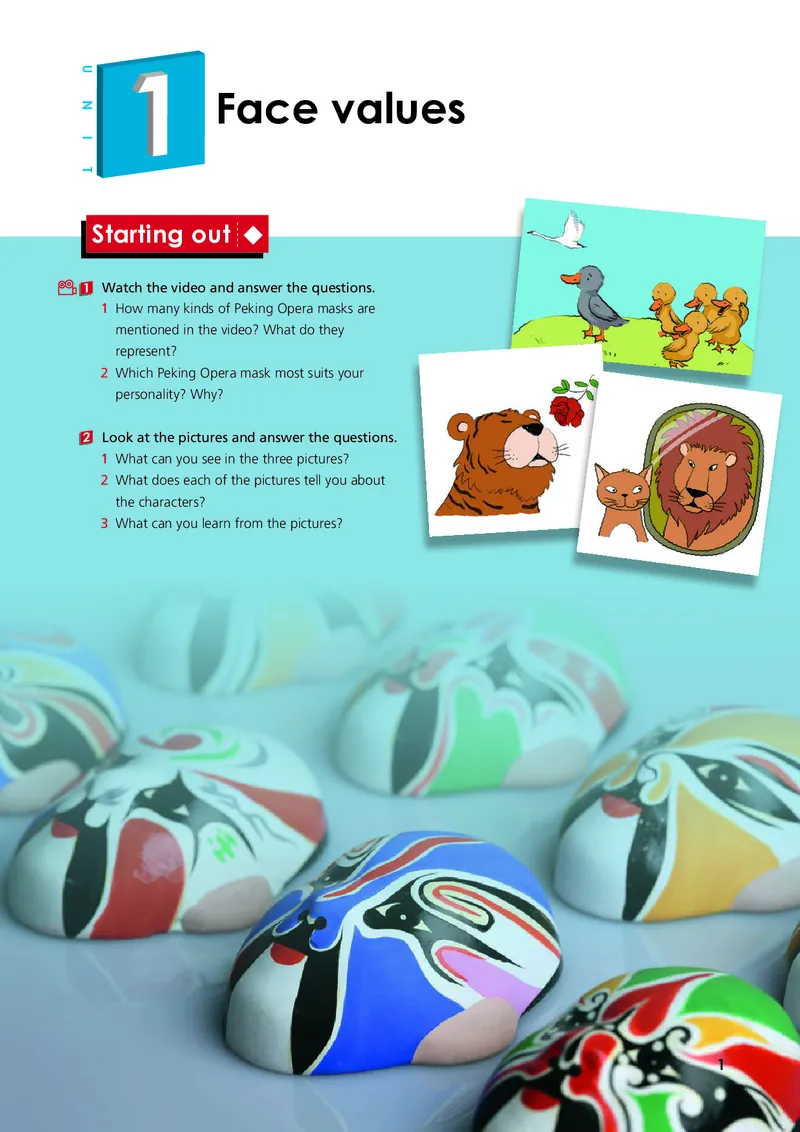
Starting out
1 Watch the video and answer the questions.
1 How many kinds of Peking Opera masks are
mentioned in the video? What do they
represent?
2 Which Peking Opera mask most suits your
personality? Why?
2 Look at the pictures and answer the questions.
1 What can you see in the three pictures?
2 What does each of the pictures tell you about
the characters?
3 What can you learn from the pictures?
1Understanding ideas
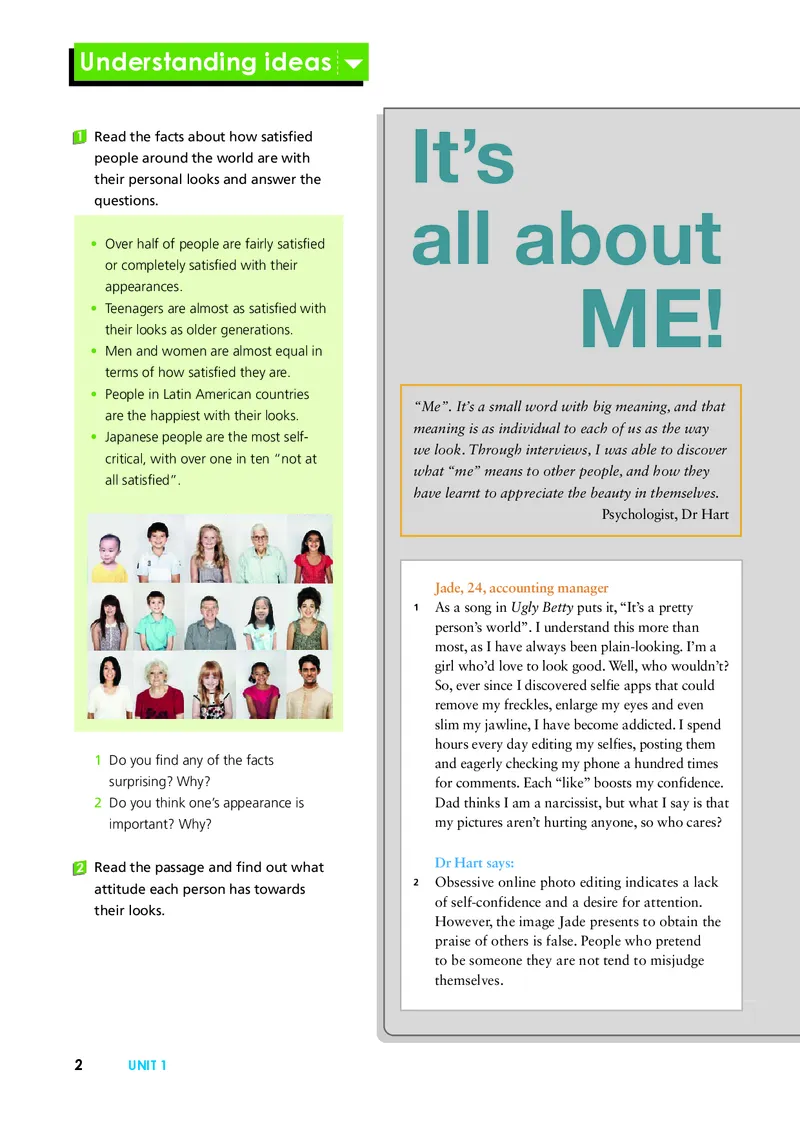
1 Read the facts about how satisfied
It’s
people around the world are with
their personal looks and answer the
questions.
all about
• Over half of people are fairly satisfied
or completely satisfied with their
appearances.
• Teenagers are almost as satisfied with ME!
their looks as older generations.
• Men and women are almost equal in
terms of how satisfied they are.
• People in Latin American countries
“Me”. It’s a small word with big meaning, and that
are the happiest with their looks.
meaning is as individual to each of us as the way
• Japanese people are the most self-
we look. Through interviews, I was able to discover
critical, with over one in ten “not at
what “me” means to other people, and how they
all satisfied”.
have learnt to appreciate the beauty in themselves.
Psychologist, Dr Hart
Jade, 24, accounting manager
1 As a song in Ugly Betty puts it, “It’s a pretty
person’s world”. I understand this more than
most, as I have always been plain-looking. I’m a
girl who’d love to look good. Well, who wouldn’t?
So, ever since I discovered selfie apps that could
remove my freckles, enlarge my eyes and even
slim my jawline, I have become addicted. I spend
hours every day editing my selfies, posting them
1 Do you find any of the facts and eagerly checking my phone a hundred times
surprising? Why? for comments. Each “like” boosts my confidence.
2 Do you think one’s appearance is Dad thinks I am a narcissist, but what I say is that
important? Why? my pictures aren’t hurting anyone, so who cares?
Dr Hart says:
2 Read the passage and find out what
2 Obsessive online photo editing indicates a lack
attitude each person has towards
of self-confidence and a desire for attention.
their looks.
However, the image Jade presents to obtain the
praise of others is false. People who pretend
to be someone they are not tend to misjudge
themselves.
2 UNIT 1Anthony, 21, college student Emma, 17, senior high school student
3 I never really cared about my appearance. 5 Ever since I was little, I’ve been larger than
That’s why I could never understand my sister, other girls. For a long time, this really bothered
who has 17 lipsticks and can’t decide which me. People would stare at me because I was
one to use every morning. I only used to have “big” and I hated the way I looked. My
five identical pairs of trousers and five identical anxiety drove me to try every means possible
shirts. When I first moved into my dormitory at to lose weight, including dieting and weight-
college, this made my roommates quite confused loss pills, but this brought me nothing but pain
as they saw me in the same clothes day after and poor health. Everything changed when one
day. Last month they registered me for a TV day I came across the success story of a plus-
programme, A New You. It felt bizarre at first. size model, Tess Holliday. Although she’s larger
I didn’t like being reviewed from head to toe. than most other models, she’s really attractive
But I was surprised at how good I looked after and has the confidence to be herself – even
the makeover! For the first time in my life I saw in an industry full of beauty stereotypes. Her
myself as a handsome and well-presented young story changed my ideas about what it means to
man. At that moment, I perceived that external be beautiful. I realised that my health, mental
beauty isn’t totally worthless. It can be an and physical, is the most important thing. Now
expression of our personalities, helping us make I exercise a couple of times a week but just to
a good and positive impression on others. keep fit. I mean, isn’t it better that I’m large
and happy, instead of skinny and unhealthy?
Dr Hart says:
4 It’s true that inner beauty is very important, Dr Hart says:
but external beauty shouldn’t be completely 6 I completely agree with Emma – being healthy is
overlooked. It plays a part in the image we beautiful, and we should wear that beauty with
present to the world, and making an effort confidence. What I really admire is the way she
with your appearance can leave a positive first has acknowledged that good health not only
impression on others and boost your confidence. makes us more beautiful, but happier, too!
Face values 33 Choose the purpose of the passage and give your reasons.
1 To persuade people to edit their photos less.
2 To prove that external beauty is not the most important thing.
3 To show the true meaning of beauty.
4 To warn readers about the physical dangers of losing weight.
4 Organise information from the passage and complete the diagram.
It’s all about
ME!
Jade Anthony Emma
Statements: Statements: Statements:
• I want to 1 . • I was surprised at 5 • My attempts to lose weight
• I have become 2 . brought me 8
. • I perceived that 6 .
• The positive comments 3 . • A plus-size model 9
. .
Dr Hart’s comment: • I realised that 10
Dr Hart’s comment: 7 .
4
Dr Hart’s comment:
11
Now talk about which story or comment makes the greatest impression on you
and give your reasons.
Think & Share
1 Do you agree that “It’s a pretty person’s world”? Why?
2 Has your understanding of the importance of appearance changed after reading
the passage? Why?
3 In addition to those methods mentioned in the passage, what other ways do you
think can make you become a better person?
4 Have you encountered any difficulties in understanding the main idea of this
passage? Share them with the class and ask for advice.
4 UNIT 1Using language
Subject clauses
1 Look at the sentences and answer the 3 Write an introduction to Ma Xu based on the
questions. Sentences (a) and (c) are from the profile. Use three or four subject clauses in
reading passage. your introduction.
a … what I say is that my pictures aren’t
hurting anyone, so who cares?
b “That my pictures aren’t hurting anyone is
what I say, so who cares?”
c It’s true that inner beauty is very important…
d That inner beauty is very important is true…
1 What is the role of the words in bold in each Ma Xu
sentence? • Ma Xu became a military doctor in 1947.
2 In sentence (a), what does “what” refer to? She applied to become a paratrooper in
3 What does “it” refer to in sentence (c)? 1961, but her first application failed because
4 Why does the author choose to use sentences (a) there were no female paratroopers at that
and (c) instead of sentences (b) and (d)? time. Ma was only 1.53 metres tall and
weighed just 37.5 kg. But she learnt to
Now look for more sentences with subject parachute by training hard in secret. After Ma
clauses in the reading passage, and summarise proved that she could jump as well as anyone
their uses in your own words. else, her application was successful.
2 Read the passage and choose the correct words. • Ma is China’s first female paratrooper. She
completed over 140 parachute jumps over a
It is a well-known fact that / what the faces some
period of 20 years – the most of any female
people show to the world might be completely
paratrooper. She also set a national record as
different to their real personalities. For instance,
the oldest enlisted woman to do a parachute
most comedians never cease to have smiles on their
jump, at the age of 51.
faces and always sound cheerful because that’s
the nature of their work. From this, it’s impossible
• In 2018, Ma donated her entire life savings
to know what / where their true feelings are.
to her home town in Mulan County. This
Smiles imply happiness, but remember – although
donation was to support local education and
they might be laughing on the outside, they
public welfare.
might be weeping on the inside. That / How
others are feeling is not something that we should
make assumptions about, because it’s not always Ma Xu is a famous paratrooper. What impress me
obvious who is truly happy. What / That is certain most are her courage, skill and determination...
is that comedians often use comedy to help them
4 Think of another famous person and give an
understand themselves and the world. In fact,
introduction to the class. Use three or four
comedy is a very serious job indeed!
subject clauses in the introduction.
Face values 5Skin deep
5 Listen to the speech. Choose the title that best 7 Complete the boxes with the
describes the topic and give your reasons. expressions from the speech.
1 How to Hide Scars
• Today, I’m going to talk about…
2 Our True Self Lies Within
• The subject of this speech is…
3 The Life Story of Dr Kleck
• First / Next / Then…
4 The Psychology of Sadness
• After that, …
• As you can see, …
6 Listen again and complete the fact sheet.
• To sum up, …
Defining a topic
The Scar Experiment
Basic facts
Dr Robert Kleck
The researcher:
Presenting ideas
1
Year:
The procedure:
• 2 was drawn on each volunteer’s
face using Hollywood-style make-up.
Concluding
• Dr Kleck showed the scars to the volunteers.
• He 3 the scars without the
volunteers’ knowing it.
• The volunteers went outside and noted how
people 4 .
• They thought that people were ruder to them,
and less kind. They thought people 5 8 Work in pairs and discuss the questions.
1 What can you learn from the
the scars.
Scar Experiment?
2 Does your appearance influence how
Findings
you feel inside?
• The volunteers 6 others‘ behaviour
towards them.
• Who we are is in our heads, not 7 .
• If people choose to feel 8 , they will
actually feel that way.
Now give a short introduction to the experiment
using the information in the fact sheet.
6 UNIT 1a Jane Eyre 9 Read the descriptions and match them to the characters from
literature. Pay attention to the words in bold.
1 He is able to transform into various animals and objects. People
often regard him as frightful or monstrous, but in fact he is
just and righteous. When there’s danger, he never hesitates to
protect others.
2 She is small and her face is plain. Despite a difficult childhood,
she grows up to be an independent, determined and
b Cowardly Lion
generous young woman. She remains true to herself and never
loses hope, faith or dignity in her search for love and happiness.
3 He has the outward appearance of the King of the Beasts,
but he has a timid and sensitive character, which causes
him to believe he is a coward. However, he performs brave
actions even when he feels afraid, proving that he is in fact a
courageous individual.
c Harry Potter
4 He is a thin and bookish boy with untidy dark hair. He doesn’t
appear to be particularly tough and sometimes looks as if he lacks
confidence. In reality, he is brave and loyal, and always ready for
a dangerous challenge when it is necessary to do the right thing.
10 Put the words in bold in Activity 9 into the boxes. Add any more
you can think of.
Appearance Personality
d Monkey King
11 Choose a character from literature and prepare a speech. Talk about
the character’s appearance and personality. Work in pairs and make
the speech to each other.
Now give feedback and talk about whether you have used the
words in this section properly in your speech.
Face values 7Developing ideas
1 Read the short introduction to Victor
Hugo and answer the questions. Published in 1831, The Hunchback of Notre-
Dame tells a tragic story of events in Paris.
Esmeralda’s beauty means that many men
fall in love with her. One such man sends the
hunchback Quasimodo to kidnap Esmeralda.
But Quasimodo fails and is captured and
tortured in public. Esmeralda hears his call
for water, and steps forwards out of mercy.
She offers Quasimodo a drink of water,
which saves him and also captures his heart.
When Esmeralda is later sentenced to death
Born in France in 1802, Victor
for a crime she did not commit, Quasimodo
Hugo was a novelist, poet and
rescues her from an angry crowd outside the
playwright and was part of the
Notre-Dame Cathedral. Esmeralda is safe
Romantic Movement. Regarded as
from execution as long as she stays inside the
one of France’s greatest writers, he is cathedral...
celebrated as the “Shakespeare
of France”. 1 Esmeralda and Quasimodo were still for
several moments, as they considered their
predicament in silence, she so graceful, he so
Hugo first found fame, as a poet,
repulsive. Every moment Esmeralda discovered
when he was about 20 years old. Less
some fresh defect in Quasimodo, as her glance
than ten years later, he published one
travelled from his knock knees to his hunched
of his best-known works,
back, from his hunched back to his single eye.
The Hunchback of Notre-Dame.
How anyone could be formed in such a way
It was immediately a huge success
was beyond her comprehension. Yet there was
and is now considered a key work of so much melancholy and so much gentleness
Romanticism. It remains one of his spread over all this that she gradually adjusted
most popular works today. to it.
2 He was the first to break the silence. “So you
1 Why do you think Victor Hugo is were telling me to return?”
known as the “Shakespeare of
France”? 3 She moved her head, and said, “Yes.”
2 What do you know about
Romanticism? Do some research to 4 He understood the motion of the head. “But!”
he said, as though hesitating whether to finish,
find out more about it.
“I am – I am deaf.”
2 Read the passage and find out why
5 “Poor wretch!” exclaimed Esmeralda, with an
Quasimodo rescued Esmeralda.
expression of heartfelt compassion.
6 He began to smile sadly.
8 UNIT 1The
Hunchback
Notre-Dame
of
7 “You suppose that was all that I was missing, 11 “Yes, I am deaf, but you shall talk to me with
do you not? Yes, I am deaf, that is the way I your hands as my master talks to me, and then
am made. It is horrible, is it not, next to your I shall quickly know your wishes from the
exquisite beauty!” movement of your lips, from your expression.”
8 There lay in the accents of the unfortunate 12 “Well!” she smiled, “Explain to me why you
man so significant an awareness of his sadness rescued me.”
that she had not the strength to utter a
syllable. In any case, he would not have heard 13 He watched her intently while she was speaking.
her. He continued:
14 “I understand,” he replied. “You ask me why I
9 “Never have I viewed my ugliness as at the rescued you. You have forgotten an unfortunate
present moment. When I compare myself to person who attempted to kidnap you one
you, I feel an immense pity for myself, poor night, this same person to whom you showed
unfortunate monster that I am! Be honest, to kindness when he was being punished. A drop
you I must resemble some savage creature. of water and a little pity – that is more than I
You, you are a ray of sunshine, a drop of dew, can repay with my life. You have forgotten that
a birdsong, whilst I am something terrible, unfortunate soul, but he remembers it.”
neither human nor beast. I don’t know what I
am, as I am coarser, more downtrodden, and 15 She listened to him with profound tenderness.
plainer than a pebble!” A tear swam in the eye of Quasimodo, but
did not fall. He seemed to make it a point of
10 Then he began to laugh, and that laugh was honour to keep it at bay.
the most heartbreaking sound in the world.
He continued: ( Adaptation from The Hunchback of Notre-Dame
by Victor Hugo )
Face values 93 Underline the sentences that describe Esmeralda and Quasimodo’s
appearances and feelings. Write a short paragraph to describe how
Esmeralda and Quasimodo see each other.
Esmeralda in Quasimodo’s eyes Quasimodo in Esmeralda’s eyes
Now work in pairs. Read the passage again and find out how Esmeralda’s
feelings towards Quasimodo changed. Share your answers with your partner.
Learning to learn
Think & Share
1 What does the sentence “A
When comparing and
tear swam in the eye of Quasimodo, but did
contrasting characters in
not fall” tell us about Quasimodo’s personality?
a narrative, consider their
appearance, actions, and 2 In what different ways do the two reading
motives. Appearance in passages in this unit raise our awareness of
literature usually has meaning; physical appearance and personal qualities?
a character’s beauty and
3 What difficulties might people like Quasimodo
ugliness is not accidental, as
face in the real world? How should people
it is in real life. It is also very
treat them?
important to consider how
4 Predict what happens next. Share your ideas
each character changes over
time, that is, to compare each with the class. Read the novel and check your
character to earlier versions prediction.
of themselves.
4 Work in groups. Give a talk about the character in the passage that makes
the greatest impression on you.
1 Organise your ideas by considering the questions.
• What is the character like?
• Has he / she experienced any emotional changes? If so, what changes are they?
• What can you learn from him / her?
2 Present your ideas in your group.
3 Collect all your group‘s ideas and present them to the class.
Now think about whether you can express yourself clearly or understand
others in the group talk, and what your strengths or weaknesses are,
compared to those of the others in your group.
10 UNIT 1Writing about a literary work
5 Read the introduction to the novel and answer the questions.
This book by Oscar Wilde tells the story of Dorian Gray, a very handsome young
man who spends his life only concerned with his own pleasure, regardless of the
suffering he brings to others.
The story starts with young Dorian having his portrait painted. His friend Lord
Wotton talks about beauty and pleasure being the only important things in life.
Fascinated by his words, Dorian wishes he could remain young and good-looking
always, with his portrait growing old instead of him.
Soon afterwards, Dorian is surprised to find his wish has come true, after he meets
Sybil, an innocent actress who falls in love with him. Dorian heartlessly abandons
her just because she performs poorly one night. When he learns that Sybil has
killed herself, Dorian finds his face in the painting has taken on a cruel look.
He hides the painting away so that no one else may see it. For the next 18 years, Dorian engages in various
evil deeds, even murdering the painter of the portrait. But he never feels guilty about the harm he is doing.
His portrait ages and reveals his inner ugliness. One day, he suddenly comes to be fearful of his past crimes
and wants to start a new life. But his portrait remains the same and reminds him of everything he has
done. Feeling desperate, he tries to destroy the portrait with a knife, but it is he who is killed. His body is
discovered, old and awful, while his portrait is young and handsome once again.
In the story, what matters most to Dorian Gray is that he is good-looking, not that he has a good heart. He
sacrifices his true self in pursuit of physical beauty and pleasure, which leads to his destruction in the end.
1 What kind of person is Dorian Gray?
2 What message do you think the novel conveys?
6 Choose another literary work with a focus on physical appearances and personal qualities, such as
The Hunchback of Notre-Dame, and complete the notes.
General introduction:
Plot:
Central theme(s):
Now write about this literary work based on your notes.
7 Work in pairs. Make improvements to each other’s introductions and share them with the class.
Face values 11Presenting ideas
1 Work in groups. Read the quote and discuss the questions.
A human being should be entirely beautiful: the face, the clothes, the mind,
the thoughts.
From Uncle Vanya by Anton Pavlovich Chekhov
1 What is your understanding of the quote?
2 What is your definition of “true beauty”?
3 What qualities should a “beautiful person” have?
2 Think of someone you want to recommend as “the most beautiful person you know”. Choose
someone you know and complete the table.
Name
Appearance:
Description of him / her
Personality:
Reasons to recommend him / her
3 Work in groups. Discuss who is “the most beautiful person you know” and agree on the best
candidate. Use the information in Activity 2 to help you.
4 Prepare a short presentation. Consider the following:
1 the structure of your presentation
2 useful words, expressions and structures
5 Give your presentation and recommend your candidate to the class. Vote for the best presentation.
Reflection
Write a reflection after completing this unit. Consider the following:
1 What is your understanding of true beauty?
2 What text types have you learnt about? What are their features?
3 What words, expressions and structures have you learnt?
4 What improvement have you made in understanding different cultures?
5 What improvement have you made in using learning strategies and exploring effective ways
of learning?
6 What improvement have you made in analysing and solving problems?
12 UNIT 1A life’s work
Starting out
1 Watch the video and answer the questions.
1 How did Cook Ding compare himself to
other cooks?
2 What lesson did Lord Wenhui learn from
Cook Ding?
2 Read the quotes and answer the questions.
1 What is your understanding of these quotes?
Pay special attention to “the price of
success”, “stay with problems longer” and “a
mere reed shaken in the wind”. Without craftsmanship,
2 What qualities does each of these inspiration is a mere reed
quotes convey? shaken in the wind.
3 Which of these quotes is the most meaningful Johannes Brahms
to you? Give your reasons.
U
N
I
T
p i I t r t ’ o s ’s b j n u le o s m t t t s t h h l a a o t t n I I g ’ s e m t r a . y so w s i m th a rt,
Albert
Einstein
I know the price of
success: dedication,
hard work, and an
unremitting
devotion
to
the things you want to
see happen.
Frank Lloyd Wright
13Understanding ideas
1 Look at the photos and answer the
questions.
Life
Behind
the Lens
1 A white-haired old man riding an ordinary bicycle
around the streets of New York, always wearing
the same blue worker’s jacket and simple black
running shoes. If you saw him, you’d never think
there was anything remarkable about him. And yet
every member of New York’s wealthy high society
wanted nothing more than to pose for this man.
2 This ordinary-looking man was Bill Cunningham,
one of the most important American photographers
1 What differences are there between of the last 50 years.
these two photographers?
2 What do you think they each want to 3 What made Cunningham so great? It certainly
show through their works? wasn’t the use of expensive, technologically-
advanced equipment. Cunningham always used
3 What does the first picture tell you
simple, relatively cheap cameras and took all
about the photographer?
his pictures on the streets of New York, not in a
studio. Nor was it a wide range of contacts and
Now read the passage and check your
connections. Although he always knew where
answers.
fashionable parties and events were happening,
Cunningham liked to photograph ordinary
people in the poor Bronx as much as VIPs in rich
Manhattan. He found inspiration where others
could not, in simple, everyday scenes, such as a
14 UNIT 2man buying oranges at the local grocery store, than have fun. “Money’s the cheapest thing,”
or a woman riding home on the graffiti- he once said, then added: “... freedom is the
covered subway. These things were real, and most expensive.” This lack of self-interest and
it was within their reality that Cunningham promotion kept Cunningham focused on his
saw both beauty and potential. Through his craft, enabling him to capture New York’s
fascination with what people were wearing, unique street style.
and not who they were, he opened the doors
of fashion to everyone – fashion as he saw 7 Cunningham’s passion for photography
it belonged to the people, not just to high lasted throughout his life. He was 87 when
society and big brands. he passed away, and had been working
right up until his last illness. Nothing ever
4 Moreover, what made Cunningham great was stopped him from getting the photo he
his devotion to photography, and the hours wanted. His hard work made him more
and hours of sheer hard work he put into than a fashion photographer – he was a
his work. Cunningham would go out onto “cultural anthropologist”, who we can thank
the streets of New York each and every day, for recording the life of a whole city and its
regardless of the weather. He would even stay people over half a century. Bill Cunningham
outside in a storm, not coming back until he was an observer, and not one of the observed,
knew he had the right photos. He hardly ever a worker not a star – and this was how he
took a day off and not once stayed home sick. wanted it.
This devotion and hard work is what we see
reflected within his photos. This is what makes
them so special.
5 Although he was a world-famous fashion
photographer, Cunningham’s approach to
life was uncomplicated. He lived in a small
apartment with a shared washroom. A simple
restaurant was where he usually had the same
meal of sausages, eggs and coffee.
6 Cunningham never accepted the benefits
offered to him for being a fashion
photographer. He valued his integrity and
would not be bought by anyone, no matter
how many free clothes or flights to faraway
destinations he was offered. And if he went to
a celebrity party, he was there to work rather
A life’s work 152 Choose another suitable title for the passage and give your reasons.
1 Social Butterfly
2 Art and Devotion
3 Follower of Fashion
4 A Life in Photographs
3 Organise information from the passage and complete the diagram.
Bill Cunningham
Beliefs about fashion Devotion to photography Life philosophy
• Fashion is not restricted to • Regardless of the weather, • He lived in 7
1 he would 4 .
. . • He ate 8
• It belongs to 2 • He wouldn’t come back .
. until 5 • He never accepted 9
• It is about what people are .
wearing, not 3 • He hardly ever 6 and valued 10
.
. .
Now come up with five words or expressions to describe Bill Cunningham.
Give your reasons.
Think & Share
1 What is your understanding of Bill Cunningham’s words
“Money’s the cheapest thing”?
2 Why is Bill Cunningham called a “cultural anthropologist”?
3 What can you learn from Bill Cunningham? Share your thoughts with the class.
4 What text types have you learnt about to help you describe people? If you were
to write about Bill Cunningham, which would you choose?
16 UNIT 2Using language
Predicative clauses
1 Look at the sentences from the reading 3 Rewrite the underlined sentences using
passage and answer the questions. predicative clauses.
a This is what makes them so special.
Mei Lanfang (1894 –1961)
b A simple restaurant was where he usually had
the same meal of sausages, eggs and coffee.
Mei Lanfang was born into a family of Peking
and Kunqu Opera performers in 1894. At the
1 What form does the predicative take in
age of eight, he started training in Peking
sentences (a) and (b)?
Opera on a daily basis. When he was 17,
2 Why is “what” used in sentence (a) and
he kept a flock of pigeons and trained them
“where” used in sentence (b)?
to fly high. Every day Mei watched them as
3 What other words do you know that can lead
they flew, which helped him to develop the
a predicative clause?
expressive eye movements that were so crucial
Now look for more sentences with predicative to his art. His hard work and dedication made
clauses in the reading passage, and summarise him a leading artist in Peking Opera.
their uses in your own words.
Mei was also an innovator. In addition to
2 Listen to the story of Ruth Bancroft and new stage designs and singing styles, his
complete the sentences with predicative innovations in make-up and costume design
clauses. Listen again if necessary. allowed for more vivid depictions of female
characters. This contributed greatly to the
1 One reason why the garden is unique is development of Peking Opera.
___________________________________
___________________________________. Until he passed away
2 Another reason for its uniqueness is in 1961, Mei had
___________________________________ been performing and
___________________________________. encouraging the spread
3 The drought-resistant plants with thick, of Peking Opera for
fleshy leaves became _________________ almost 60 years. This
___________________________________. lifelong devotion has
4 Although Walnut Creek was not _______ made him one of the
___________________________________ most celebrated Peking
__________, Ruth managed to grow them Opera artists of all time.
by much trial and error.
5 It seemed ___________________________
___________________________________
__________________________________. 4 Think of another artist and write about their
devotion to their art. Use predicative clauses
where appropriate.
A life’s work 17The spirit of craftsmanship
5 Listen to the radio programme and choose its 8 Read the passage and answer the
purpose. questions.
1 To introduce famous traditional crafts to
the audience.
2 To raise the audience’s awareness of preserving
traditional crafts.
3 To replace traditional crafts with modern technology.
4 To tell the stories of some famous craftworkers.
6 Listen again and complete the table.
Traditional • Clog making
crafts • 1
• 2
Traditional crafts have long been
has fallen.
disappearing from countries across
• Substitutes are 3
the world. With many crafts having
been, or about to be, lost forever,
Reasons for
and much cheaper, while the cost of
people are beginning to grasp the
their
4
importance of preserving those that
dying out
for craftworkers is high.
remain. In fact, after a long period of
• The younger generation is 5
decline, traditional crafts have recently
,
undergone a renaissance. There is
which can take years to master.
greater public interest in old stories
and traditions, as well as a desire for
high-quality products. Such objects
Now work in pairs. Talk about how to keep
are produced through a combination
traditional crafts from dying out.
of skill, respect for materials, devotion
to tradition, and focus on the task.
7 Complete the boxes with the expressions from the
Craftsmanship speaks to the human
radio programme.
need for skilled and socially useful
• What do you know about…? work; the sort of work that can be
• Did you know that…? admired and valued by society.
• One reason is simply that…
• Another factor is that…
1 What is currently happening to
traditional crafts?
Giving reasons Checking knowledge
2 Why are people starting to engage
more with traditional crafts?
18 UNIT 29 Read the passage and answer the questions. Pay attention to the words and
expressions in bold.
In October 1964, China exploded its first atomic bomb, marking a successful start of the
“two bombs, one satellite” project, in which more than 17,000 scientists and researchers
participated. Of those, 23 were awarded for their extraordinary contributions.
One of the 23 scientists was Deng Jiaxian, who was among the founders of China’s nuclear
programme. After coming back from the US, Deng devoted himself whole-heartedly to the
development of the “two bombs”. Spending years apart from his family and enduring the
Deng Jiaxian
extreme conditions of the Gobi desert, he refused to back down from his responsibilities
and kept on conducting scientific research. After the successful development of the atomic
bomb, he worked closely with Yu Min, another leading scientist at the cutting edge of nuclear
technology. Together, they thought outside the box and broke new ground, leading
to the breakthrough of the hydrogen bomb. This was a remarkable achievement by the
Chinese team of scientists, in such a short space of time.
Yu Min Another respected scientist among the 23 award-winners was Qian Xuesen, who was
experienced in rocketry and highly accomplished in his field. He had been working
in the United States, where his crack hand at jet propulsion had won him acclaim.
However, he sought no fame and shunned the spotlight, returning to China with
great resolution. He played a key role in China’s missile and aviation programmes,
helping fast-track the development by decades.
The 23 scientists and many more like them overcame harsh conditions and dedicated much
Qian Xuesen
of their lives to their work. Their expertise in science, perseverance, integrity and innovation
have inspired generations of scientific researchers to work towards a more powerful and
prosperous China.
1 What were the 23 scientists honoured for?
2 What challenges did they meet? How did they overcome them?
10 Put the expressions that show different qualities in Activity 9 into the boxes. Add
any more you can think of.
Perseverance Integrity Innovation Expertise
11 Work in pairs. Talk about other people who show the spirit of craftsmanship using
the words and expressions in this section. Do further research if necessary.
Now comment on each other’s performances in using the words and expressions
in this section.
A life’s work 19Developing ideas
1 Watch the video and answer the questions.
1 Who was the Forbidden City built for?
2 When did it become home to the
Palace Museum?
3 How many works of art are there in the
Palace Museum?
4 What do you think makes the Palace
Museum unique in the world?
2 Look at the title and the pictures. Predict
what the passage is about.
Now read the passage and check
your prediction.
1 In the quiet courtyards of Xi San Suo, behind
MASTERS
the high walls of the Forbidden City, time
ticks at its own pace. If it hadn’t been for a
three-episode documentary, outsiders would
never have known that the plainly-dressed
OF
people working here are masters of their craft,
who have spent their lives restoring precious
antiques. Among these is the clock restoration
master, Wang Jin.
TIME
2 Walking through the seven crimson gates
towards his workplace, Wang Jin still regards
himself as an ordinary worker in the Palace
Museum, although now he is often stopped by
admirers wanting their photo taken with him.
Day in, day out, Mr Wang and his students
spend their time restoring clocks dating back
hundreds of years. But for quite some time,
he and his student Qi Haonan used to be the
only two people repairing timepieces in the
Palace Museum.
20 UNIT 2moment. It is suddenly clear that when the
clock masters say that “these antiques have
lives”, it is neither an exaggeration nor
a metaphor.
5 But, despite the combined work of several
3 Qing emperors were very fond of clocks. generations of masters, it seems unlikely that the
Therefore, in order to please them, foreign restoration of the clocks will ever be complete.
envoys presented these emperors with the most Even if every clock in the Palace Museum were
intricate and splendid timepieces. Today, the restored, there would still be work to do, because
Palace Museum has one of the most significant restoration would probably need to begin again
collections of timepieces in the world, mainly on the clocks that were repaired long ago. This
originating from Europe and China. With is a race against time that can never be won!
objects ranging from small pocket watches to Nonetheless, Mr Wang remains optimistic about
clocks over one metre in height, each of these the future of these timepieces. Following in the
requires its own unique method of restoration. footsteps of his own teacher all those years ago,
Given the complexity of the work and the lack Mr Wang has now passed on his skills to the
of necessary materials, this means that each new members, who will take on many of the
expert can work on a maximum of two large future repairs. What’s more, inspired to follow
pieces a year. But, through their painstaking in his father’s footsteps, Mr Wang’s son now has
efforts, Mr Wang and his students do more than also taken up repairing antique clocks. This new
repair the clocks – they bring them back to life. generation of artisans will not only help preserve
traditional skills; the innovation they bring to
4 The only sound to break the silence in Wang the craft will also ensure that the art of clock
Jin’s workshop is the chiming melody of the repairing stands the test of time.
repaired and polished clocks. To Wang Jin it is
the most beautiful music in the world. Now, 6 In today’s fast-paced world, the saying that “time
after eight months of endless adjustments, the waits for no man” has never seemed more apt.
time has finally come for Mr Wang to wind up Yet inside the hidden courtyards of Xi San Suo,
the gigantic clocks that date back to the time there is something timeless about the way Mr
of Emperor Qianlong. The intricately fashioned Wang and his colleagues sedately piece together
objects that have stood still for centuries the past with skilful hands and modest hearts. It
instantly come back to life: water flows, boats is as if they have become one with their craft and
sail, dogs bark, chickens flap their wings and a with the history of the country.
woman starts to spin. It is a truly awe-inspiring
A life’s work 213 Match the questions to the paragraphs and find out the answers.
a Why is Wang Jin optimistic about the future of the timepieces in the Palace
Museum?
b Why is it painstaking for Wang Jin and his students to repair the collection of
timepieces in the Palace Museum?
c What has been done to the clocks that date back to the time of Emperor Qianlong?
d Who is Wang Jin and where does he work?
e What qualities do Wang Jin and his colleagues display in their work?
f What was special about Wang Jin and his student Qi Haonan?
Think & Share
1 What is your understanding of the title,“Masters of Time”? What figure of speech
does the author use?
2 What is your understanding of the sentence, “This is a race against time that can never
be won”? Do you agree with this? Give your reasons.
3 What do Bill Cunningham and Wang Jin in the two reading passages in this unit have in common?
4 What can you do to help to pass on traditional skills and the spirit of craftsmanship?
4 Work in groups. Give a speech about the spirit of craftsmanship in the Palace
Museum.
1 Think about other masters in the Palace Museum. Then discuss the questions within
your group to prepare for your speech. Do further research if necessary.
• Who are the masters?
• What fields do they work in?
• What specific examples can you give of their work?
• What aspects of the spirit of craftsmanship are demonstrated through their work?
• How can you develop and display such spirit in daily life?
2 Organise your speech by completing the table.
Aspects of the spirit of
craftsmanship
Supporting examples
Conclusion
3 Give your speech to the class.
Now think about your performance in the speech. Vote for the most
convincing speech and ask the speaker to share some public speaking skills.
22 UNIT 2Writing an expository essay
5 Read the passage and answer the questions. 6 Choose one person who
demonstrates the spirit of
What do the Summer Palace, Yuanmingyuan and the
craftsmanship and complete the
Chengde Mountain Resort all have in common? These
notes. Do further research
Qing-dynasty architectural marvels, along with many
if necessary.
others, were all built by members of the same
family – the Lei family.
Person:
Qualities:
For seven generations, the Lei family quietly dominated
imperial architecture. Their designs were admirable,
Examples:
varying from grand buildings to public works, such as
roads and dams. So incredible was their skill that many
of their buildings survived earthquakes and remained
Conclusion:
standing over hundreds of years.
The Lei family were also pioneering engineers, who
used a grid system to plan their projects in minute
Now write an expository essay.
detail. They took careful notes and made models of
their projects, many of which have survived to this day
Learning to learn
and are registered as part of UNESCO’s Memory of
the World Programme. An expository essay contains a fair and
balanced analysis of an event, a situation or
In addition to their architectural achievements, the Lei an idea. It commonly begins by clearly stating
what it aims to explain or analyse. The main
family showed diligence and humility. Each generation
body comprises paragraphs with supporting
conscientiously learnt their craft and undertook
evidence and facts. It concludes by reviewing
ambitious projects, many of which took years to
the main theme of the essay in light of all the
complete. Yet they did not seek fame, and even
evidence that has been presented.
today, their great works are associated more with the
imperial court than with them.
7 Work in pairs. Make improvements
to each other’s essays and share them
With their remarkable skills, innovation, diligence and
with the class. Consider how well
humility, the Lei family leave behind their buildings
you have understood how to write
and the legacy that true craftwork is a treasure that
expository essays.
can last beyond a lifetime.
1 What is the passage about?
2 What qualities of the Lei family are mentioned? Find
examples in the passage to support your answers.
3 What is the conclusion of the passage?
A life’s work 23Presenting ideas
1 Read the two points of view and answer the questions.
James Ivy
I can’t understand why some people spend I admire those people who devote their
their whole life doing just one thing. whole lives to one thing. Not only have
I know these activities require time and effort vss they mastered their skills, but they have also
to do, but I’d rather try as many different mastered their lives! I hope that I can dedicate
things as possible. I don‘t want to regret myself to, and one day master, a craft.
things when I‘m old!
1 What is James trying to express?
2 What is Ivy trying to express?
3 Which person do you agree with?
2 Work in groups and take sides. Think of arguments to support your point of
view and make notes.
Point of view:
Arguments:
Supporting examples:
3 Prepare for a debate. Consider the following:
1 the roles and responsibilities for each member of your group
2 your arguments, opening and summary
3 the opposing arguments you might face and how you can respond to them
4 useful words, expressions and structures
4 Team up with a group with the opposite point of view and hold a debate.
Reflection
Write a reflection after completing this unit. Consider the following:
1 What is your understanding of the spirit of craftsmanship?
2 What text types have you learnt about? What are their features?
3 What words, expressions and structures have you learnt?
4 What improvement have you made in understanding different cultures?
5 What improvement have you made in using learning strategies and exploring effective ways
of learning?
6 What improvement have you made in analysing and solving problems?
24 UNIT 2U
N
I
T
War and peace
Starting out A v i w s i o g i n l o n e o n o n t e d t a r . s n A i o s g r l n g d y o o i . e o t A r d v i e g s f o n i n g o g h o e d t t f e u L r l a . ozi
1 Watch the video and answer the questions.
1 Which wars are discussed in the video?
2 What was the deadliest conflict in human
history? How many people were killed?
2 Read the quotes about war and answer There never was a good
the questions. war or a bad peace.
1 What is your understanding of the quotes?
Benjamin
Franklin
2 Which of the quotes helps you to better
understand the nature of war? Give
your reasons.
3 What is your opinion on war? Come up with
three words or expressions to help express The supreme art of war
your opinion. is to beat the enemy
without fighting.
Sunzi
You cannot prevent
and
prepare
for war at the
same time.
Albert Einstein
25Understanding ideas
1 Look at the picture and the map
and answer the questions.
The
UNITED KINGDOM
English Channel 1 By spring 1944, the Second World War had been raging
Normandy
across the globe for about five years. But along the south
FRANCE coast of England, something unusual was happening:
Allied troops made up mainly of British, Canadian and
American soldiers were gathering in large numbers. This
marked one of the final stages of a top-secret operation
1 What do you think the picture and
that had been months, perhaps years, in the planning.
the map show?
Code-named “Operation Overlord”, it was the largest
2 What do you expect to read about in
combined sea, air and land operation in history, the
the passage? Share your ideas with aim being to free north-west Europe from German
the class. occupation. After waiting for the perfect combination
of weather, moon and tides, the date for the start of
Now read the passage and check Operation Overlord was set for 6 June.
your prediction.
2 An order issued by Supreme Allied Commander General
Eisenhower to the troops read: “Your task will not be
an easy one. Your enemy is well trained, well equipped
and battle-hardened… But this is the year 1944… The
tide has turned! The free men of the world are marching
together to Victory! I have full confidence in your
courage, devotion to duty and skill in battle. We will
accept nothing less than full Victory!”
26 UNIT 33 With these words ringing in their ears, Allied Channel, where people were coming together
soldiers prepared for what would become for memorial ceremonies. As part of this
known as D-Day. At dawn on 6 June, solemn and moving occasion, a former soldier
thousands landed by parachute behind enemy read out to the crowd these lines from the
lines in northern France. Meanwhile, thousands poem For the Fallen, by Laurence Binyon:
more were journeying across the English
Channel to Normandy, protected by fighter They shall grow not old, as we that are left
planes in the skies above them. Their objective grow old:
was clear: to reach the Normandy beaches Age shall not weary them, nor the years
along about 80 kilometres of French coastline. condemn.
But even in the depths of war, few could have At the going down of the sun and in the
been prepared for the violence and horror they morning
would experience there. We will remember them.
4 The fiercest fighting was at Omaha Beach. The 7 Survivors of the D-Day landings continue
enemy were hiding, ready to attack the Allied to meet to remember the fellow soldiers and
soldiers even before they reached land. Boats friends they lost that day. Although each year
were hit and men drowned, while those who they are fewer in number, their outstanding
did make it to the beach faced heavy machine acts of courage mean that we will always
gunfire. By mid-morning, hundreds lay dead in remember them – as well as those who lost
the water and amongst the tanks on the beach. their lives on the beaches of northern France.
One soldier recalled how he barely made it
with bombs falling all around him: “I was the
first one out. The seventh man was the next
one to get across the beach without being hit.
All the ones in between were hit. Two were
killed; three were injured. That’s how lucky
you had to be.”
5 But, despite the high cost in human life, the
D-Day landings were a success and were seen
widely as the beginning of the end of the
Second World War. By the end of August 1944,
the Allies had reached the River Seine, Paris was
liberated and the Germans had been removed
from north-west France. The Allied forces then
prepared to enter Germany, where they would
meet up with the Soviet military moving in
from the east.
6 Seventy years later, men who had fought on
D-Day gathered on both sides of the English
War and peace 272 Match the main ideas to the paragraphs and give your reasons.
The outcome of the operation
The background information of the operation
The severe casualties on Omaha Beach
The everlasting memory of the soldiers’ brave actions
The initial stage of the operation
The order issued by the Supreme Allied Commander before the operation
The 70th anniversary of the D-Day landings
3 Organise information from the passage and complete the fact file.
The D-Day landings
Date: Place:
Aim of the operation:
Supreme Allied Commander:
Timeline of the operation:
Spring 1944 Allied troops
6 June 1944 Start of
• dawn: thousands of troops were journeying across
• mid-morning: hundreds of soldiers
August 1944 The Allies liberated Paris and the Germans
Outcome of the operation:
Now think about how the author of the passage presents historical facts to a
powerful effect.
Think & Share
1 What is the historical significance of the D-Day landings?
2 What is your understanding of the poem For the Fallen?
3 How can you use the language you have learnt to describe another event during the
Second World War? Share your ideas with the class.
28 UNIT 3Using language
Subject-verb agreement (1)
1 Look at the sentences from the reading 3 Complete the film review with the correct
passage and answer the questions. form of the verbs in brackets.
a Your enemy is well trained, well equipped Saving Private Ryan is a
and battle-hardened... film directed by Steven
b The enemy were hiding, ready to attack Spielberg. The two main
the Allied soldiers... characters are Captain John
c ... people were coming together for Miller, played by Tom Hanks,
memorial ceremonies. and Private James Ryan,
played by Matt Damon.
1 In which sentence does the word “enemy”
refer to different members? Is it followed by a James Ryan is the fourth son
singular verb or plural verb? in his family to be sent to fight in the Second
2 In which sentence does the word “enemy” World War. The enemy 1_____________ (kill)
refer to a single unit? Is it followed by a his three brothers. Their heart-broken mother
singular verb or plural verb? Do you know any receives the news about all her dead sons on
other similar nouns? the same day. The US Army 2_____________
3 Is the word “people” usually followed by a (decide) to find Ryan and bring him home.
singular verb or plural verb? Do you know any A group of men are sent into the French
other similar nouns? countryside to try to find the fourth brother.
The rescue team 3_____________ (be) led
Now look for more sentences following this
by Captain Miller, a hero and survivor of the
rule in the reading passage, and summarise
Omaha Beach battle.
the use of subject-verb agreement in your
own words.
At the beginning of the film, the audience
4_____________ (be) thrown into an incredible
2 Correct any mistakes in these sentences or put
sequence of approximately 30 minutes,
a in the square brackets if they are correct.
depicting the landings in Normandy. They
1 Government troop have put down the uprising.
see the full horror of war, and the chaos and
[troops]
senseless waste of life.
2 The police is after him. [ ]
3 The military are well-organised and prepared
Saving Private Ryan is an unforgettable
to fight. [ ]
war film and, also, a story of courage and
4 All the machinery in this factory are made in
sacrifice. It’s my favourite film and my family
the US. [ ]
5_____________ (love) watching it, too. The
5 The soldiers’ uniform look very smart. [ ]
message of the film is simple – we want peace;
6 The group was sent to rescue the missing pilot.
we don’t want war.
[ ]
7 Politics are the study of the ways in which
4 Write a short review of a film you have
countries are governed. [ ]
seen on the theme of war. Pay attention to
subject-verb agreement.
War and peace 29The road to peace
Among the many horrors inflicted on humanity by the Second World
War was the massive bombing of civilians, often referred to as “terror
bombing”. The purpose of doing this was to destroy the morale
of ordinary people and stop them from supporting the war effort.
The Japanese used terror bombing in China, especially in Chongqing,
which they bombed more than 200 times over the duration of five
and a half years (1938–1943), killing thousands of Chinese civilians.
Did You Know ?
5 Listen to the interview and answer the questions.
1 Who is being interviewed?
2 What is the relationship between the two interviewees?
3 What are they talking about?
6 Listen again and complete the interviewer’s notes.
First memories of the Chongqing bombing?
Gao Li: 1_________________ years old; remembers the house 2_________________ and
saw 3________________
Gao Ming: 4_________________ years old; the first thing he remembers was
5_________________; went out on the street 6_________________; first felt
fascinated then 7_________________
The most terrible experience?
Gao Li: happened on 8_________________; stayed in 9_________________ and waited for
10_________________ in there; house destroyed and 11_________________ killed
Influence of bombing?
Gao Ming: felt sad but bombing didn’t destroy 12_________________
Gao Li: 13_________________ soldiers went to the front;
Chongqing became known as the 14_________________
Remembrance today?
Gao Ming: the air raid warning mourns
15_________________, and reminds us to
16_________________
30 UNIT 37 Complete the boxes with the expressions from the interview.
• I remember… • I can only imagine how it must have felt. • I feel sad for…
• That must be terrible for... • I’ll never forget…
• The first thing I remember was… • I’m sorry to hear that.
Expressing sympathy Talking about memories
8 Read the introduction to UN peacekeeping and 9 Complete the fact file about UN‘s
answer the questions. Pay attention to the words peacekeeping mission in Liberia with
and expressions in bold. the correct form of the words and
expressions in Activity 8.
The cruelty of war is reason enough to do everything
Why we came
we can to prevent it. This is the motivation behind
Liberia suffered two 1
the United Nation’s many peacekeeping missions.
from 1989 to 2003, causing half the
Peacekeepers monitor the peace process in areas
population to flee their homes, and the
that have experienced friction and civil wars, making
economy to collapse.
sure that previously warring parties keep to their
We carried out this 2 to
agreements. They work to disarm combatants and
monitor the 3
to secure weapons and ammunition, removing them
in Liberia.
from use. These measures aim to give stability to
What we did
conflict zones and allow governments to reestablish
We stabilised the 4 by:
authority. China is playing an increasingly important
• disarming combatants
role in UN peacekeeping and it has trained 8,000 troops
• securing weapons and ammunition
who are kept on standby for UN missions. Chinese
peacekeeping forces are highly-valued in conflict zones
Why we are leaving
and have received praise for their professionalism.
The professionalism of our 5
has stabilised the situation.
1 What is the significance of UN peacekeeping missions?
Government authority has been 6
2 What role is China playing in UN peacekeeping?
.
10 Work in pairs. Find out about
someone's experiences in war. Act out
an interview based on the information
you have found. Use the words and
expressions in this section.
Now think about your performance in
this activity. How did you collect useful
information? Share your experience
with the class.
War and peace 31Developing ideas
1 Look at the pictures and answer the questions. 3 Professors and students alike in the three
universities made an epic journey over a
distance of more than 2,000 kilometres,
most of them on foot. Their bed was the
dusty road and their roof was the open
sky, often lit up by exploding Japanese
bombs. Conditions were little better once
they reached the remote and mountainous
south-west part of China. They had to live
in rough buildings, packed 40 to a room,
like sardines. There were dire shortages of
food, books, and equipment. Furthermore,
classes were frequently disrupted due to
fierce air attacks and often had to be held
before 10 am and after 4 pm.
4 However, despite the immense hardships
1 What kind of university do you think it is?
and the daunting challenges, it was right in
What do you know about it?
this place, over a period of eight long years,
2 How is it different from today’s universities?
that the nation’s intellectual heritage was not
only guarded but fortified by the passion and
Now read the passage and find out what is so belief of the worthy academics of Lianda.
special about Lianda. It is no wonder that many, if not most,
of China’s leading scholars and scientists
emerged at Lianda, including the two Nobel
Prize-winning physicists, Yang Zhenning and
Li Zhengdao. “Lianda laid the foundation
1 Throughout history, the great thinkers of the
for every achievement I have made,” Yang
world have often rather romantically referred
recalled. He still remembers learning in a
to their academic struggles as being like “war”.
temporary classroom that had no glass in the
However, for most of them, the “war” has been
windows. “On windy days, we had to hold
purely symbolic. Real war is never romantic as
down the paper on the desk, which would
it brings suffering and immense challenges.
otherwise be blown away,” he said.
2 In 1937, the aggression of the Japanese
5 With the country at war, students at Lianda
army brought disaster to China’s three great
were not going to shirk their duty. Driven by
universities: Peking University and Tsinghua
a sense of commitment, a great many joined
University were occupied by Japanese troops,
the army to resist the Japanese invaders and
while Nankai University was completely
defend the honour of the nation. In fact,
destroyed by bombing. To save their educational
Lianda provided the largest number of
and intellectual heritage, the three universities
student-soldiers from any campus in China.
joined together in Kunming as National
Of the thousands of college students from
Southwest Associated University, otherwise
all over China who served as interpreters,
known as Lianda.
32 UNIT 3LIANDA:
A PLACE OF PASSION,
BELIEF AND COMMITMENT
one tenth were from Lianda, including the prominent professors and talented
well-known translators Zha Liangzheng students, but also because of the school’s
and Xu Yuanchong. Zha later depicted the strong spirit of perseverance and
contributions of his peers in a poem: dedication. In 2017, representatives from
Peking University, Tsinghua University,
Softly, on the hillside forgotten by all, Nankai University and Yunnan Normal
A misty rain falls in a gentle breeze; University gathered to commemorate the
There is no trace of the footprints of 80th anniversary of its founding.
history;
Where brave souls once stood, breathing 7 More than eighty years on, the priceless
new life into the trees. contribution of Lianda still needs to be
reaffirmed. It has become part of the
6 A product of the war, Lianda is now collective memory of the Chinese nation,
physically gone. But it has become the with its spirit as the blueprint for all
crowning glory of China’s modern universities in China in the modern era.
universities, not only because of its
War and peace 332 Choose the ideas that are conveyed in the passage. Find evidence to support
your choices.
1 Lianda was the best university in Chinese history.
2 The story of Lianda shows Chinese intellectuals’ academic pursuit and patriotism.
3 Only under difficult circumstances can students succeed.
4 Lianda has nurtured many outstanding scholars.
5 Lianda was a great success only because it had prominent professors and gifted
students.
6 People today still admire the spirit of Lianda.
3 Find out what figures of speech are used in the sentences and discuss how they
help to express the author’s emotions.
1 Their bed was the dusty road and their roof was the open sky, …
2 They had to live in rough buildings, packed 40 to a room, like sardines.
Learning to learn
Think & Share
1 What difficulties did the professors and
Similes and metaphors are two commonly
students of Lianda encounter? How did they deal with
used, but easy to confuse, figures of
these?
speech. Similes compare and show
similarities in typically different things. 2 What is your understanding of the poem written by Zha
Similes usually use connecting words such Liangzheng?
as like, as, so and resemble. For example, 3 What contribution did Lianda make to the education
He is as cool as a cucumber. Unlike similes,
of the nation?
metaphors make direct comparisons
4 In what ways is the theme of war and peace presented
without using connecting words. For
differently in the two reading passages in this unit?
example, She has a heart of a lion.
4 Work in groups. Give a talk about the spirit of Lianda.
1 Discuss the questions below.
• How can you describe the spirit of Lianda?
• What examples support your ideas?
• What can you learn from the story of Lianda?
2 Complete the diagram with your ideas and the examples that support them.
Spirit: Supporting evidence:
Lianda
Spirit: Supporting evidence:
...
3 Give your talk to the class.
Now think about your performance in this activity. Did you actively participate and
contribute ideas?
34 UNIT 3Writing about a war hero
5 Read the introduction to Yang Jingyu and answer the questions.
Yang Jingyu, an anti-Japanese hero, was born in Henan Province in 1905. He joined the
Communist Party of China (CPC) in 1927. In 1937 Yang became leader of the North-east
Anti-Japanese United Army and fought a guerrilla war against the Japanese invaders.
In 1938, the Japanese army offered a large sum of money for Yang‘s head and a large
number of troops surrounded his men. In early 1940, facing a critical lack of supplies,
Yang decided to let his men break through in small groups, but his own section of 60
men was betrayed to the Japanese. After these men were killed, Yang fought on alone
for five days. He was eventually tracked down on 23 February by a large unit of Japanese
troops. He killed more than 20 Japanese soldiers before dying in a hail of machine gunfire.
When the Japanese cut open his body, they discovered only tree bark, cotton and grass
roots, but not a single grain of rice in his stomach.
Yang’s death was a huge blow to his loyal troops, but they turned sorrow into anger and
continued to fight fiercely against the invaders. After the People‘s Republic of China (PRC)
was established, Yang was reburied with full military honours, in Tonghua, Jilin Province.
1 Who was Yang Jingyu?
2 Why did Yang decide to let small groups of his men break through the encirclement?
3 What did the Japanese find when they killed Yang?
4 How would you describe Yang‘s spirit in your own words?
6 Work in groups. Talk about other war heroes and choose one to write about.
Organise your ideas by completing the notes below. Do more research if necessary.
Introduction Main body Conclusion
Name of the person: Major events (in order): Your opinion of this person:
Background information:
Now write an introduction to the war hero you chose.
7 Make improvements to each other’s writings and share them with the class.
War and peace 35Presenting ideas
1 Work in groups. Look at the pictures and answer the questions.
1 What can you see in each picture?
2 What do the pictures tell you about war?
2 Think about the topics and complete the table. Add examples or details to
support your points. Do more research if necessary.
Why people go to war
Effects of war on people
How we can maintain
peace around the world
3 Prepare a short presentation on one of the topics from Activity 2 or think of
another relevant topic. Consider the following:
1 the structure of your presentation
2 useful words, expressions and structures
4 Give your presentation to the class.
Reflection
Write a reflection after completing this unit. Consider the following:
1 What is your understanding of war and peace?
2 What text types have you learnt about? What are their features?
3 What words, expressions and structures have you learnt?
4 What improvement have you made in understanding different cultures?
5 What improvement have you made in using learning strategies and exploring effective ways
of learning?
6 What improvement have you made in analysing and solving problems?
36 UNIT 3A glimpse of the future
U
N
I
T
Starting out
READY
PLAYER
ONE
1 Watch the video and answer the questions. 2 Look at the pictures and answer the questions.
1 What predictions about the future were 1 Have you watched any of these films? What
made? Were they correct? stories do they tell about the future of our world?
2 What is your understanding of “the future 2 Do you think the events in these films could come
has unlimited possibilities”? true? What do you think the world will be like in
the future?
37Understanding ideas
1 Read the facts about AI and answer
the questions.
Milestones in Artificial Intelligence (AI)
A REAL THREAT?
Mathematician and logician,
Alan Turing devised the
In the words of Professor Stephen Hawking, artificial
Turing Test, a test on the
intelligence will be “either the best, or the worst
ability of machines to show
thing, ever to happen to humanity”. Technology of
human-like intelligence.
Tomorrow Forum wants to hear your thoughts on
Computer scientist, John
AI. Is it our greatest human achievement so far?
McCarthy coined the term
Or is it the biggest threat to our existence?
“artificial intelligence”.
Shakey, the first mobile
robot able to make decisions
Millenniumbutterfly
according to reason, was 1 Thanks to AI, I’ve got my own super-smart
completed. personal assistant built into my phone. She always
The Electrolux Trilobite, the has an immediate answer for any question I put to
first robotic vacuum cleaner her, and even uses my answers to learn more about
my preferences. It used to feel like 50 per cent of
designed for home use, went
my time was spent researching new restaurants. In
on sale.
contrast, my PA only needs a few seconds to find
AlphaGo became the first
the right place. Every recommendation she gives
computer program to beat a
me is great since she can predict if I will like a
human professional Go player.
particular restaurant.
AlphaGo Zero beat the
previous version of AlphaGo 2 And speaking of hanging out, I’m hoping that self-
by 100 games to nil. driving cars are available soon. I’ve
been taking driving lessons
for over a year, and still
1 What can you learn from the timeline?
haven’t got my licence.
2 Are you concerned about developments Self-driving cars can
in AI? Why or why not? learn to drive in the
3 How do you think AI will develop in the same way that we
future? do, and can make
judgements based
on information.
2 Read the passage to see if it changes
And as they won’t
your opinion on the future of AI. If
be susceptible
so, in what ways?
to human error,
they’ll certainly be
38 UNIT 4a lot safer. The only thing is that there might be a few machine-learning
problems when the first cars hit the market, so perhaps I’d better learn to
drive first. Still, I do think that developments in AI will on the whole make
doing day-to-day things a lot easier.
Popkid
3 The technology you’re using and enjoying today is a basic form of AI
which can’t think independently without programming. Of course, it could
be very useful to have a more advanced form of AI – a truly independent
form of artificial intelligence, capable of exercising its own judgement,
could help us solve many of the world’s problems. But have you ever
thought about the risks? After all, why would an independent form of AI
need to consider the opinions and desires of humans? We could be seen as
a “small” inconvenience that’s in the way of a solution to a bigger problem.
If we’re lucky, AI might think we’re valuable enough to keep around. If
not, it might wipe us all out!
4 Even if that doesn’t happen, there are other risks. Millenniumbutterfly,
you say how great it would be to have self-driving cars, but what about all
the taxi drivers who would lose their jobs? They would just be among the
first victims of AI. Nearly every job is potentially at risk in the long run.
Even journalists are now being replaced with technology that can write
basic news reports. As it is, almost 50 per cent of US jobs are at risk from
automation in the next 20 years.
5 The truth is that none of us is prepared for the challenges
of AI.
Pink_haze
6 Machine learning is something we have come to accept
as a part of our modern world. I believe most of the value
of AI lies in its capacity to analyse and interpret vast
amounts of data, which means it can even solve problems
that are too challenging for human experts.
7 But while super-intelligent AI could be the biggest leap
forward in human history, if it goes wrong or falls into
the wrong hands, it could also be the most dangerous.
However, AI is not going to go away. We have no choice
but to embrace it and regulate it. One thing I think we all
agree on, though, is that saying “My AI did it!” won’t be
any excuse for illegal or immoral behaviour!
A glimpse of the future 393 Read the opinions and match them to the persons. Talk about the opinion you
agree with.
We all need to learn to live with AI technology whether we
like it or are concerned about it. We cannot stop the march
of progress.
Millenniumbutterfly
I admit that more advanced AI could be helpful in
solving the world’s problems, but there is a high level of
Popkid risk involved.
I can’t understand why some people worry so much. I
hope more breakthroughs in AI will be made soon, so that
Pink_haze we can enjoy more and more convenience.
4 Organise information from the passage and complete the diagram.
AI is a real AI is a real
achievement.
threat.
• AI can help us save time. • AI might wipe out human beings.
• 1
• 4
• 2
• 3 , • 5
including those too challenging for
if it falls into the wrong hands.
human experts.
Now come up with more ideas for each point of view and share them with
the class.
1 What did Stephen Hawking mean when he said that AI will be
Think & Share
“either the best, or the worst thing, ever to happen to humanity”?
2 Do you use AI in your daily life? What other roles can AI play in people’s lives?
3 How does the diagram help you better understand the passage?
40 UNIT 4Using language
Subject-verb agreement (2)
1 Look at the sentences from the reading passage and 3 Complete the description according to
answer the questions. the charts, paying attention to subject-
verb agreement.
a … 50 per cent of my time was spent researching
new restaurants.
b Every recommendation she gives me is great…
c … almost 50 per cent of US jobs are at risk from
F U T U R E
automation in the next 20 years.
Last week, we asked you to design
d … none of us is prepared for the challenges of AI.
your ideal planet for people on Earth
to live on in the 22nd century. We have
received over 500 entries and have
1 Why is 50 per cent singular in sentence (a) but plural
been amazed by your imaginations!
in sentence (c)?
Here’s one of the designs.
2 What are the subjects in sentences (b) and (d)?
Are they singular or plural? e
c
urf a Sea
S
Now look for more sentences following this rule
in the reading passage, and summarise the use of
25%
subject-verb agreement in your own words.
d
n
a
75% L
2 Complete the passage by choosing the singular or Residential area
plural form. Land
Forest
20%
Nowadays, there are many companies offering services
in the domain of genetic testing for children’s talents. 20% 50%
A large number of clients have / has been attracted to 20%
Arable land 10%
it. They are parents, eager to know what talents their
children may have in the future, even though they may Desert
e
still be in kindergarten. The process is simple. Every o
pl
e
P
child provide / provides a small sample of blood or
From other planets
body tissue. This is / These are analysed. Each of the 20%
children is / are given a report showing their possible
50% Original residents
talents. A recent example cited on the website is that
30%
one of the testing companies compare / compares
the talents of twins Bobby and Benny. Bobby was
From Earth
assessed and his talents was / were revealed to be
mostly scientific: a 66% chance of success in chemistry
Three quarters of the surface is made
and 54% in physics was / were shown. Meanwhile,
up of land, ...
Benny’s highest score was / were shown to be in an
arts subject: the test gave him 68% for literary studies.
4 Describe another planet for the
Is genetic testing reliable? Some scientists say that more
future, paying attention to subject-
evidence is / are needed.
verb agreement.
A glimpse of the future 41The world of tomorrow
6 Listen again and complete the table.
RULE 1 1___________________________________________
• A tourist wants to 2_________________________________
because 3_________________________________________.
• The guide told her 4_________________________________
_________________________________________________.
Passport
RULE 2 5___________________________________________
• The guide said that 6________________________________
_________________________________________________.
Time travel could result in
RULE 3 7___________________________________________
a paradox – an event that
• A tourist wants to 8_________________________________
contradicts itself. For example,
if a person travelled back _________________________________________________.
in time and prevented an • The guide told him not to because 9____________________
event, that event would never
_______________________.
have happened; there would
therefore be no reason for the
person to travel back in time Now work in pairs. Take turns to be the guide and explain the
to prevent it. rules of time travel.
Did You Know ?
7 Complete the boxes with the expressions from the conversation.
5 Listen to the conversation
• Amazing! • That’s OK, isn’t it?
and choose its main idea.
• Wow! • Are you serious?
1 Time travel is dangerous.
• I can’t wait to... • Let me get this straight. You
2 Talking to people in the past
• So, what you’re saying is that… mean that...
can change the future.
• How about… • It’ll be exciting enough to…
3 Anything you say or do
• Imagine how excited...
in the past can affect the
future. Expressing excitement Asking for confirmation
4 Time travel within your own
lifetime should be avoided.
42 UNIT 48 Read the passage and put the expressions in bold into 9 Complete the passage with the
the boxes. expressions in Activity 8.
Who knows in what exciting
ways transport will change
1________________________?
Marian
Trains that travel at the speed of
Besides time travel, we have much to look forward to in
today’s aeroplanes may sound
the future, thanks to advances in technology. One area
2________________________,
that is likely to change dramatically within our lifetimes
but scientists are already
is medical care. Although I wouldn’t bank on patients
developing “hyperloop” trains
feeling confident about seeing a robot doctor any time
that travel at over 1,000 km per
soon, I’m sure that AI doctors are on the horizon. I
hour. And although we can’t
think it’s also fair to say that we can get our hopes up
3________________________
when it comes to finding cures for serious diseases, such
flying cars being the norm
as cancer. I reckon that nanorobots that can eliminate
4________________________,
cancerous cells are just around the corner. Some of
there are plans to introduce flying
these ideas may sound far ahead of their time, but I’m
taxis that will be stationed on
sure they’re bound to happen sooner or later!
rooftops around busy cities. Many
cities already have elevated cycle
paths and I’m sure that these are
5________________________ for
many others around the world.
As well as faster, safer and more
comfortable transport being just
6________________________, we
can also 7____________________
about shorter waiting times, with
companies intending to provide
573 980 2921
on-demand services.
Expressions about time Expressions about expectation
10 Work in pairs. Talk about another
aspect of life in the future using
the expressions you have learnt in
this section.
Now think about how effectively
your partner used these
expressions, and what you could
learn from him or her.
A glimpse of the future 43Developing ideas
A Boy’s Best Friend
1 Watch the video and answer the
questions.
1 Mr Anderson said, “Where’s Jimmy, dear?”
1 How does Asimov set out the “Out on the crater,” said Mrs Anderson.
relationship between humans and “Robutt is with him. Did he arrive?” “Yes. He’s
robots? at the rocket station, going through the tests.
1
I haven’t really seen one since I left Earth 15
2 Have you read any of Asimov’s
years ago.”
novels? If so, share one story you’ve
read with the class. If not, would you
2 “Jimmy has never seen one,” said Mrs
like to read them? Why or why not?
Anderson.
2 Complete the table to compare life on
3 “Because he’s Moon-born and can’t visit Earth.
Earth with life on the Moon.
That’s why I’m bringing one here. I think it’s
Life on Earth the first one ever on the Moon.”
• Wear ordinary clothes and change
4 Jimmy was out on the crater, as his mother had
according to the seasons.
said. His arms and legs were long and agile. He
• Breathe the air freely.
looked thicker and stubbier with his spacesuit
• Have to make an effort to jump high. on, but he could handle the lunar gravity as no
• Keep pets, such as dogs, cats, etc. Earth-born human being could. The outer side
of the crater sloped southward and the Earth,
Life on the Moon
which was low in the southern sky, was nearly
• full, so that the entire crater-slope was brightly
• lit. The slope was a gentle one and even the
•
weight of the spacesuit couldn’t keep Jimmy
from racing up it in a floating hop that made
•
the gravity seem nonexistent.
5 “Come on, Robutt,” he shouted. Robutt,
Now read the passage and find who could hear him by radio, squeaked and
out what life on the Moon is like bounded after.
in the novel.
6 Jimmy, expert though he was, couldn’t outrace
Robutt, who didn’t need a spacesuit, and had
four legs and tendons of steel. Jimmy couldn’t
go wrong while Robutt was around, tripping
him when he was too near a rock, or jumping
on him to show how much he loved him, or
circling around and squeaking low and scared
when Jimmy hid behind a rock, when all the
time Robutt knew well enough where he was.
7 He heard his father’s voice on his private
wavelength. “Jimmy, come back. I have
something to tell you.”
44 UNIT 48 Mr Anderson was smiling. “We have something for you, Jimmy. It’s at the
rocket station now, but we’ll have it tomorrow after all the tests are over.”
9 “From Earth, Dad?”
10 “A dog from Earth, son. The first dog on the Moon. You won’t need Robutt
any more. We can’t keep them both, and some other boy or girl will have
Robutt.” He seemed to be waiting for Jimmy to say something, then he
said, “You know what a dog is, Jimmy. It’s the real thing. Robutt’s only a
mechanical imitation, a robot-mutt. That’s how he got his name.”
11 Jimmy frowned. “Robutt isn’t an imitation, Dad.”
12 “Robutt’s just steel and wiring and a simple positronic brain.”
13 “He does everything I want him to do, Dad. He understands me.”
14 “No, son. Robutt is just a machine. It’s just programmed to act the way it
does. A dog is alive. You’ll see the difference once he gets here.”
15 Jimmy looked at Robutt, who was squeaking again, a very low, slow squeak
that seemed frightened. Jimmy held out his arms and Robutt was in them in
one bound.
16 Jimmy said, “What will the difference be between Robutt and the dog?”
17 “It’s hard to explain,” said Mr Anderson, “but it will be easy to see. The dog
will really love you. Robutt is just adjusted to act as though it loves you.”
18 “But, Dad, we don’t know what’s inside the dog, or what his feelings are.
Maybe it’s just acting, too.”
19 Mr Anderson frowned. “Jimmy, you’ll know the difference when you
experience the love of a living thing.”
20 Jimmy held Robutt tightly. He was frowning, too, and the desperate look
on his face meant that he wouldn’t change his mind. He said, “But what’s
the difference how they act? How about how I feel? I love Robutt and
that’s what counts.”
21 And the little robot-mutt, which had never been held so tightly in all its
existence, squeaked high and rapid squeaks – happy squeaks.
(Adaptation of excerpts from “A Boy’s Best Friend” by Isaac Asimov)
A glimpse of the future 453 Complete the summary of the story. 4 Work in groups. Give a talk on
whether it is possible to have a real
Title friendship with a robot.
Author 1 Answer the questions to help to
form your point of view.
Setting
• Why do Jimmy and his parents
• Time:
have different feelings towards
• Place:
Robutt?
Characters • If you were Jimmy, which one
• Jimmy, a Moon-born boy would you choose, Robutt or a
real dog?
•
2 Organise the main points you
•
would like to cover and complete
•
the table.
Plot
Jimmy’s parents get a dog from Earth. They want to
give it to Jimmy as a pet. But... Point of view
Different attitudes towards Robutt
• Parents:
• Jimmy:
Arguments
Now talk about your attitudes towards the story.
Supporting
Think & Share details
1 What are the similarities and
differences between Robutt and a real dog?
2 Is there any foreshadowing of Jimmy’s final decision?
Find clues in the reading passage.
3 What other sci-fi novels about robots can you think
Conclusion
of? Share one with the class.
4 The two reading passages in this unit show us different
aspects of technology in the future. Which of these do
you most expect to encounter in your lifetime? 3 Give your talk to the class.
Now vote for the best speaker. Ask
Learning to learn them to share their experiences.
Foreshadowing is when the author gives a clue as to what is to
come later in the story. This often appears at the beginning of
a story, or a chapter, and helps the reader develop expectations
about the coming events in a story.
46 UNIT 4Continuing a sci-fi story
5 Read the story and answer the questions. 6 Think about what will happen
1 What happened to the prison and what was the cause? next, based on the examples of
2 What kind of job do you think Carolyn has? foreshadowing you have underlined.
3 Are there any sentences that might foreshadow what Complete the notes to plan the rest
will happen next? Underline them. of the story.
Todd cried out in shock and waved his arm at the pale
Setting
blue screen hovering above the breakfast table. The
• Time:
hologram news paused. “Carolyn,” he called across the
kitchen, “did you see this?” • Place:
His wife, Carolyn, was collecting her cereal from the
Characters
breakfast robot. “What is it, honey?” she asked. Todd
pointed at the floating blue screen. Carolyn read the
headline:
Another prison breakout: faulty robotics blamed.
Plot
“Oh, don’t worry,” Carolyn chuckled. “That’s an old
facility. The robots there were bound to break down
sooner or later. Plus, I know for a fact that they weren’t
well maintained,“ she added. “Julius was telling me
about it. That place isn’t as advanced as ours.“
“But the report says that even new, regularly-maintained Ending
robots can break down,” Todd protested. ”And in a
maximum-security prison like yours, one small error could
cause a lot of problems.”
Carolyn smiled at him. “You worry too much,” she
said. “Now, I’d better be going or I’ll be late for
work.” She grabbed her bag from the kitchen
counter and rushed out of the door. Todd heard
Now continue the story.
the aircar start up outside. It was not until an hour
later that he noticed that Carolyn had left her
7 Share your story with the class.
emergency call device on the breakfast table.
Now make comments on your
partner’s story and see whether the
language style is consistent.
A glimpse of the future 47Presenting ideas
1 Look at the pictures about the 2 Work in groups. Discuss how other daily activities might
future and answer the questions. be different in the future and complete the table.
Activities Descriptions
Studying
Eating
Socialising
Having fun
...
3 Design your own ideal day in the future. Consider the
following:
1 Is it a weekday or weekend? What activities will you do?
2 Who do you want to spend the day with?
1 What are the people doing in each
3 In what ways is it different to your present daily life?
picture?
2 Imagine and describe their daily lives.
4 Share your ideal day in the future with the class.
Would you like to live like this?
Reflection
Write a reflection after completing this unit. Consider the following:
1 What is your understanding of life in the future?
2 What text types have you learnt about? What are their features?
3 What words, expressions and structures have you learnt?
4 What improvement have you made in understanding different cultures?
5 What improvement have you made in using learning strategies and exploring effective ways
of learning?
6 What improvement have you made in analysing and solving problems?
48 UNIT 4Learning from nature
1 Read the quotes and answer the questions.
1 What is the common message conveyed in
these quotes?
2 Have you ever learnt anything from nature?
Give examples.
2 Watch the video and answer the questions.
1 What lessons from nature are mentioned in
the video?
2 Which one inspires you the most?
U
N
I
T
Starting out
The richness I achieve
comes from nature, the
source of my inspiration.
Claude Monet
A painter should regard
nature as their teacher,
and never stick with just
one style of painting.
Zhang Daqian
Let nature be your teacher.
William Wordsworth
Adopt the pace of nature:
her secret is patience.
Ralph Waldo Emerson
49Understanding ideas
1 Look at the pictures and answer
the questions.
lotus flower
1 Trees, plants and flowers are all around us and we
enjoy their beauty every day. In fact, we are so used to
them that we may even take them for granted without
realising how much inspiration they have given us.
When we look at a pine cone, we might think how much
it looks like the tiles on a roof. An open flower might
make us think how closely it resembles an umbrella. It
termite mound is natural to think in this way, but of course it wasn’t
the umbrella that inspired the flower or the roof that
inspired the pine cone.
2 Nature has inspired many of the most fascinating
designs around us, including those in architecture. From
Barcelona’s forest-like Sagrada Familia to the modern
style of Beijing’s Water Cube, nature is presented in
various architectural designs. Today, architects continue
algae
to explore ways to capture the beauty of natural forms,
to mimic the way nature works or even to make natural
1 What is shown in the pictures?
organisms part of a building.
How much do you know about them?
2 How could you associate them with
architecture?
Now read the passage and check
your ideas.
50 UNIT 5ArtScience Museum, Singapore
3 People whose interest is exploring the relationship between art and science
will enjoy Singapore’s ArtScience Museum. The building was designed to show
the connection between nature and the modern city environment in which it
sits. Shaped to resemble a lotus flower, it appears to float above the waterfront
promenade and the water that surrounds it. Its roof collects rainwater and
channels it 35 metres down to a waterfall in the centre of the space. The water
is then recycled through the building’s plumbing system. Visitors are often
amazed to find themselves in an urban building that so truly captures the
beauty of natural forms.
The Eastgate Centre, Harare
4 Harare’s Eastgate Centre is a superb example of biomimicry. To use biomimicry
is to create structures based on natural forms and processes. Zimbabwean
architect Mick Pearce was inspired to create the Centre while watching a nature
documentary in which termites were constructing their nests. The insects built
mounds covered in little holes designed to allow air to move freely in and out
of the mounds. In a similar way, the Eastgate Centre has a “skin” covered in
holes. During the day, warm air is drawn into the building through the holes,
cooling as it reaches the middle of the building. At night, the heat absorbed by
the wall during the day warms the cool air, creating a comfortable temperature
inside. The design reduces the need for traditional air conditioning and heating
systems, so the building uses less energy and costs less to run.
The Algae House, Hamburg
5 The world’s first algae-powered building is in Hamburg, Germany. The
surface of the apartment building is covered in panels that contain algae. The
algae are fed with liquid nutrients and carbon dioxide to encourage them to
grow. In bright sunshine, they grow faster and provide shade. The panels also
capture heat from the sun and convert it into energy that powers the building.
And that’s not all – the algae inside the panels can be harvested and used to
produce fuel. The building therefore not only responds to its environment and
uses less energy, but also reduces damage to the environment by generating its
own renewable energy.
6 Creating buildings such as these enables us to live in closer harmony with
our environment. To meet the needs of today while protecting the world of
tomorrow may be a challenge, but even the simplest organisms can help teach
us how to achieve this.
Learning from nature 512 Choose the magazine in which you would most likely find the passage. Give
your reasons.
1 Extraordinary Architects
2 Living on Earth
3 Architecture Frontier
4 Natural World
3 Organise information from the passage and complete the diagram.
Introduction
There is much inspiration from nature in our daily lives, and nature
has also inspired 1 around us.
Main body
To capture the beauty of To 5_________________ To 8_________________
natural forms
Based on the form and process The Algae House is covered in
Shaped to resemble a of termite mounds, Harare’s panels containing algae. While the
Eastgate Centre also has little panels provide shade, 9
2 ,
holes in the walls allowing air and convert it into
the ArtScience Museum seems
to 6 energy, the algae can also be used
to float above the waterfront
, to 10 .
promenade and 3
thus reducing the need for The building reduces damage to
. It
7 the environment by 11
collects rainwater through the
. .
roof and 4
In this way, it uses less energy
through
and costs less to run.
its own plumbing system.
Conclusion
Nature-inspired buildings enable us to 12 .
Now work in pairs and talk about other examples of architecture inspired
by nature.
Think & Share
1 Which of the three buildings are you most impressed by? Why?
2 If you were given a chance to design a building, what inspiration would you take from nature?
3 How did the pictures help your understanding of the passage? Share your ideas with the class.
52 UNIT 5Using language
Review: non-finite forms as subject, object and predicative
1 Look at the sentences from the reading passage and 3 Read the information below and
answer the questions. write a paragraph introducing the
24 Solar Terms with the words in
a Today, architects continue to explore ways to capture the
the box. Use the structures you
beauty of natural forms,…
have learnt in this unit where
b … it appears to float above the waterfront promenade
appropriate.
and the water that surrounds it.
c Visitors are often amazed to find themselves in an learn determine show
urban building that so truly captures the beauty of amaze use
natural forms.
d Creating buildings such as these enables us to live in
Origin
closer harmony with our environment.
• created by farmers in Ancient China
• based on Chinese lunar calendar
1 Look at the “to do” structures in sentences (a) and (b).
• determined by the changes in the
Do they serve the same function in each sentence?
position of the sun
2 In sentence (c), is the -ed form used as an adjective or a
Significance
past participle? Why does the author use the -ed form
• changes in weather mean a lot to
other than the -ing form?
farmers
3 What is the function of the -ing form in sentence (d)?
• determine the best time to sow
and harvest
Now look for more sentences with these structures in
• wisdom learnt from nature
the reading passage.
First term
2 Complete the passage with the correct form of the verbs • Beginning of Spring
in brackets. • days become longer and the
temperature increases
1 (draw) inspiration from nature is a Cultural heritage
• added to UNESCO’s List of
tradition that goes back centuries. Nowhere is this better
Intangible Cultural Heritage in 2016
illustrated than in the beautiful Lingering Garden of
Suzhou. The main principle of its design is 2
(recreate) natural landscapes in miniature. First established
in the Ming Dynasty, the original garden contained a
rockery to symbolise Tiantai Mountain. Pine and bamboo
groves were added later, along with a pond and an Learning from nature’s wisdom led
island. Visitors would be 3 (astonish) farmers in Ancient China to create the
to find the garden modeled closely on natural features. 24 Solar Terms…
Visitors are also supposed 4 (explore)
4 Work in pairs. Talk about one of
it scene-by-scene. This could vary from a view of a pond
the Solar Terms using the structures
and the splashing of fish, to a tree in blossom, a pagoda
you have learnt in this unit where
or a moon-shaped gate.
appropriate.
Learning from nature 53Inspiration from animals
5 Read the passage about biomimicry and answer the questions. Pay attention to
the words and expressions in bold.
When solving a design problem, you can sometimes look to nature for a solution. One of
the early examples is the study of birds to enable human flight. The Wright brothers got
their inspiration from observing pigeons in flight, and in 1903 successfully obtained a
patent for their designs for the first aeroplane. This approach, called biomimicry, studies
and imitates nature’s designs and processes to seek solutions to human problems.
There are many types of biomimicry, among which the most common one is copying
form and shape. By imitating the beak of a bird, for example, bullet trains can be made
to run much faster and more quietly. Another type of biomimicry is taking inspiration
from the abilities of animals. Inspired by dolphins, people have learnt how to send
signals underwater, which is currently employed in tsunami early-warning systems.
1 What are the types of biomimicry mentioned in the passage? What else do you know
about them?
2 What other examples of biomimicry can you think of? Share them with the class.
6 Complete the information with the words and expressions in Activity 5.
Bats use sound to As a land species, By 3 Spider silk is much
“see”. But how do how can we improve dragonflies in flight, stronger than the
they avoid crashing our performance in people have realised same weight of steel.
into each other? The water? there are better ways This means that it
answer lies in their 2 of flying. Now we are could be used in lots
use of echo-location the shape of the 4 of products, such as
to identify the scales on a shark’s dragonflies with our bullet-proof clothing.
position of objects. skin, we have created designs for small But we are still
Scientists are swimsuits that allow drones. 5
1 swimmers to swim one problem – how to
bats to improve radar much faster. increase the spiders’
systems. output!
7 Work in pairs. Talk about in what other ways we can learn from animals. Give examples.
54 UNIT 58 Read the passage and answer the 10 Listen again and complete the introduction to
questions. Wu Qin Xi.
One of the outstanding features of Wu Qin Xi was created by Hua Tuo almost 2,000
traditional Chinese martial arts is the years ago. It means “Five-animal Exercises”, and each
way they imitate animal movements. animal is 1 . By doing
This came about because many these exercises, people learn from these animals and
Chinese martial artists admired the help 2 . For example,
natural instincts, senses and fighting the tiger exercise 3 the
abilities that animals possess in order liver. The bear exercise helps people with good
to survive in the wild. digestion. The monkey exercise helps 4
; the 5 is
The first set of animal-imitating good for the kidney; and the crane exercise is 6
exercises came into being about 2,000 . Some people believe Wu
years ago. It was called Wu Qin Xi, Qin Xi helps them 7
or Five-animal Exercises, created by . Some of the Wu Qin Xi masters lived to
Hua Tuo (ca145–208). As a physician 8 , and still had good
during the Han Dynasty, Hua Tuo is eyesight, hearing and strong teeth. Wu Qin Xi has
often credited with being the first 9 , too. It can help
in China to use anesthesia during 10 .
surgery. He was known as the best
physician of his time, and was an
11 Complete the boxes with the expressions from the
expert in acupuncture.
conversation.
1 Why were Chinese martial artists • By…, you learn… • That’s interesting!
inspired by animal movements? • Really? • That’s very impressive.
2 What were Hua Tuo‘s achievements? • It helps people to… • Sounds great!
• ... is good for...
9 Listen to the conversation about
Wu Qin Xi and tick the topics
Talking about benefits Showing interest
mentioned by the speakers.
The creator of Wu Qin Xi
Who can practise the exercises
Why these animals were chosen
Physical benefits 12 Work in pairs. Think about other exercises inspired
Mental benefits by animals. Discuss how they were created and their
How to teach the exercises benefits, using the words and expressions in this section.
Now think about your performance. How well can
you use the language you have learnt to talk about
traditional Chinese exercises?
Learning from nature 55Developing ideas
1 Read the short introductions to
Tao Yuanming and Henry David
Thoreau and share what else you 1 Tao Yuanming and Henry David Thoreau were both
know about them with the class. poets, but one lived in Ancient China and the other in
19th century America. Superficially, these two men,
whose lives were separated in time by nearly 1,500
years, were polar opposites. And yet they shared an
intense respect for nature, which made them each an
influential figure of their time.
2 Both men made dramatic transformations to their lives
Born into a poor aristocratic
in order to reconnect with nature. As an official in
family in the Eastern Jin Dynasty, the Eastern Jin Dynasty, Tao felt conflicted over life at
Tao Yuanming (365–427) was court. In 405, he quit the service of the court for good,
one of China’s greatest poets expressing his unhappiness in the now famous line that
and a noted recluse. A master he would not “bow like a servant in return for five dou
of grain”. He spent the next 22 years until his death,
of the five-word line, Tao has
working the land in a poor, rural area. From his poetry,
been described as the first great
we can learn that although his life was arduous, he
“poet of fields and gardens”.
succeeded in finding contentment in its simplicity and in
drawing pleasure from nature.
3 While Tao’s return to nature was a reaction
to a lifestyle he was opposed to, Thoreau’s was
a personal decision to transform the way he lived.
Henry David Thoreau (1817–1862)
was an American essayist, poet,
and philosopher. He began
writing nature poetry in his early
twenties, with poet Ralph Waldo
Emerson as a mentor and friend.
In 1845, he began his famous
two-year stay at Walden Pond,
which he wrote about in his
masterwork, Walden.
2 Read the passage and find out
what Tao and Thoreau learnt
from nature.
56 UNIT 5He had a decent quality of life, but he wanted 5 Thoreau’s descriptions of nature emphasised
to live in a simpler way. For two years, two the beauty and purity of the wild areas around
months and two days, he lived in a cottage in him. Devoting himself to observations of the
the forest on the edge of Walden Pond, focusing natural phenomena, he recorded his detailed
on himself and his writing. He explained his findings in his journals. Thoreau’s writing aimed
reason for doing so in Walden: “I went to the to convince people that animals and plants had
woods because I wished to live deliberately, to a right to live and prosper, as we do. We should
front only the essential facts of life.” Both men live with them in harmony and enjoy nature’s
were happy to withdraw from contemporary gifts, as he describes in his journals:
life, seeking a harmonious relationship with
nature in the quietness of their lives. Live in each season as it passes; breathe the
air, drink the drink, taste the fruit, and resign
4 Although Tao and Thoreau do not treat nature yourself to the influences of each. Let them be
in quite the same way, their works show its your only diet, drink and botanical medicines.
beauty and value. Tao’s nature is a place of
fields and villages, in other words, rural, and 6 It takes considerable courage to reject the
his animals are domestic ones, such as chickens easy and familiar and instead try to live
and dogs. The calm and peaceful life he wrote closer to nature, as both Tao and Thoreau
about is in contrast to and critical of the did. Their choices led them to quiet and
depressive court life: reflective lives with fewer material desires.
In today’s modern world, their ideas about
Beyond the dark and distance lies a village, living simply and being at ease with nature
The smoke above reluctant to depart. may take us a step closer to attaining
A dog is barking somewhere down the lane, personal well-being and fulfilment.
And chickens sit atop the mulberry tree.
Back to Nature
Learning from nature 573 Organise information from the passage and complete the chart.
Tao Yuanming Similarities Henry David Thoreau
• He went back to nature They went back to nature. •
because • •
• • He wrote about nature in order
• to
•
Learning to learn
Think & Share
1 Why did it take Tao and Thoreau great
A comparative essay compares,
courage to walk away from their previous lives?
contrasts and evaluates two or
2 Why are their ideas important to our lives today?
more topics. There must be enough
similarities and differences between the 3 What do you think about living in nature like Tao and
topics so that they can be discussed Thoreau? Give your reasons.
in a meaningful way. A number of 4 Compare the two reading passages in this unit. In what
points should be discussed within a
ways does each passage contribute to the unit theme?
comparative essay.
4 Work in groups. Compare the quotes by Tao and Thoreau.
Beyond the dark and distance lies a village, Live in each season as it passes; breathe the
The smoke above reluctant to depart. air, drink the drink, taste the fruit, and resign
A dog is barking somewhere down the lane, yourself to the influences of each. Let them be
And chickens sit atop the mulberry tree. your only diet, drink and botanical medicines.
1 Find the Chinese version of Tao’s poem, and translate Thoreau’s quote into Chinese.
2 Decide which portrayal of nature you prefer and make notes.
Tao Thoreau
• Genres of their works:
• Images in their works:
• What nature means to them:
• What message they try to convey:
3 Organise your thoughts and share them with the class.
Now think about your performance in this activity. How effectively did you
compare the two literary works? What additional information did you need to
make the comparison?
58 UNIT 5Writing about a lesson from nature
5 Read the story and answer the questions. 6 Look at the pictures and think
about what you can learn from
The Meaning of nature.
Struggle
One day, a man found the pupa of
a butterfly. Seeing an opening in the
pupa, he realised that the butterfly
was ready to emerge. So he sat down
and watched as the butterfly struggled
to force its body through the little hole.
However, minutes passed and the butterfly
still couldn’t get out. The struggle was too hard for its weak
body. The man then kindly enlarged the hole in the pupa
so that the butterfly could finally break free. But instead of
flying away, it just dragged itself around weakly, then died.
The struggle to break out of the pupa was necessary for the
butterfly’s survival because it enabled its wings and body to
grow strong. Without the struggle, it was too weak to live.
In the same way, we need struggle to grow strong and
survive. We must go through some difficult things if we
really wish to spread our wings and fly.
7 Work in pairs. Plan your writing.
Consider the following:
1 What does a butterfly do to get out of its pupa? • the topic you wish to write about
2 Why did the man think he needed to help the butterfly? • whether you will use an extended
3 What happened to the butterfly after the man enlarged metaphor
the hole in the pupa? • what lesson it teaches us, and
4 What is the lesson behind this story? What else can you how we can apply this lesson to
learn from it? daily life
• a suitable title for your story
Learning to learn
Now write your story.
An extended metaphor refers to a comparison between two
things that is developed at length over many lines of text, or
8 Work in pairs. Make improvements
throughout an entire work of literature. For example, in the
butterfly story, the struggle of the butterfly illustrates life’s to each other’s stories and share
struggles. While the story appears to be about a butterfly, it is them with the class.
really about us.
Learning from nature 59Presenting ideas
1 Work in groups. Plan a speech on the topic “Nature is our best teacher”. Think
about what you have learnt in this unit.
2 Organise your ideas by answering the questions.
• How can nature help people to solve practical problems in their lives?
• What lesson can you learn from nature?
• What else do you think people can learn from nature?
• How does this unit deepen your understanding of the relationship between
people and nature?
3 Prepare a short speech. Consider the following:
1 the structure of your speech
2 useful words, expressions and structures
4 Share your speech with the class. Vote for the best speech.
Reflection
Write a reflection after completing this unit. Consider the following:
1 What is your understanding of how human beings learn from nature?
2 What text types have you learnt about? What are their features?
3 What words, expressions and structures have you learnt?
4 What improvement have you made in understanding different cultures?
5 What improvement have you made in using learning strategies and exploring effective ways
of learning?
6 What improvement have you made in analysing and solving problems?
60 UNIT 5Nature in words
1 Watch the video and answer the questions.
1 What literary forms are mentioned in the
video?
2 What other nature writers do you know of?
Tell the class about him or her.
2 Listen and read the poem by Emily Dickinson.
Answer the questions.
1 What images are used to symbolise nature?
2 What message does the poem try to convey?
3 What does nature mean to you?
U
N
I
T
Starting out
“Nature” Is What We See
by Emily Dickinson
“Nature” is what we see –
The Hill – the Afternoon –
Squirrel – Eclipse – the Bumble bee –
Nay – Nature is Heaven –
Nature is what we hear –
The Bobolink – the Sea –
Thunder – the Cricket –
Nay – Nature is Harmony –
Nature is what we know –
Yet have no art to say –
So impotent Our Wisdom is
To her Simplicity.
61Understanding ideas
1 Read the short introduction to the First Snow
author of First Snow and answer
the questions.
John Boynton Priestley (1894 –
1984) was born in the English
county of Yorkshire, and knew
early on that he wanted to
become a writer. When World
War I broke out, Priestley joined
the army, and escaped death on
a number of occasions. After
1 Mr Robert Lynd once said of Jane Austen’s
the war, he gained a degree
characters: “They are people in whose lives a
from Cambridge University,
slight fall of snow is an event.” Even at the risk of
and then moved to London,
where he worked as a freelance appearing to this fair and witty reviewer as another
writer. During World War II, Mr Woodhouse, I must insist that last night’s fall
he presented a weekly radio of snow here was an event. I was nearly as excited
programme, which became
about it this morning as the children, whom I found
immensely popular. Priestley
all looking through the window at the magic outside
wrote many successful articles,
and talking away as excitedly as if Christmas had
essays, novels and plays, but is
suddenly come round again. The fact is, however,
best remembered for his play
An Inspector Calls. Priestley that the snow was as strange and fascinating to me
loved snow and expressed a as it was to them. It is the first fall we have had here
desire to live in a country where this winter, and last year I was out of the country,
it often snowed.
sweating in a hot climate, during the snowy season,
so that it really does seem an age since I saw the
ground so fantastically carpeted.
1 What careers did Priestley have in his
lifetime?
2 The first fall of snow is not only an event but it
2 What kind of person do you think
is a magical event. You go to bed in one kind of
Priestley was? Do more research if
world and wake up to find yourself in another quite
necessary.
different, and if this is not magic, then where is it to
2 Describe snow in your own words. be found? The very secrecy and quietness of the thing
Then read the passage and underline
makes it more magical.
the expressions the author uses to
describe the first snow.
62 UNIT 63 When I got up this morning the world was a cold place of dead white
and pale blues. The light that came through the windows was very
strange, and it made the familiar business of splashing and shaving
and brushing and dressing very strange too. Then the sun came out,
and by the time I had sat down to breakfast it was shining bravely
and flushing the snow with delicate pinks. The dining-room window
had been transformed into a lovely Japanese print. The little plum tree
outside, with the faintly flushed snow lining its branches and artfully
disposed along its trunk, stood in full sunlight.
4 An hour or two later everything was a cold sparkle of white and
blue. The world had completely changed again. The little Japanese
prints had all disappeared. I looked out of my study window, over
the garden, the field, to the low hills beyond, and the ground went on
and on, the sky was thick grey, and all the trees so many black and
threatening shapes. There was indeed something curiously disturbing
about the whole prospect. It was as if our kindly countryside, close to
the very heart of England, had been turned into a cruel grassland. At
any moment, it seemed, a body of horsemen might be seen breaking
out from the black trees, so many weapons might be heard and some
distant spot of snow be reddened. It was that kind of landscape.
5 Now it has changed again. The glare has gone and no touch of the
disturbing remains. But the snow is falling heavily, in great soft flakes,
so that you can hardly see across the shallow valley, and the roofs
are thick and the trees all bending, and the weathercock of the village
church, still to be seen through the grey loaded air, has become some
creature out of Hans Andersen. From my study, which is apart from
the house and faces it, I can see the children flattening their noses
against the window, and there is running through my head a rhyme I
used to repeat when I was a child and flattened my nose against the
cold window to watch the falling snow:
Snow, snow faster:
White alabaster!
Killing geese in Scotland,
Sending feathers here!
(Adaptation from First Snow by John Boynton Priestley)
Nature in words 633 Choose the author’s purpose in writing the passage and give your reasons.
1 By describing the magical scenery of the first snow, the author encourages readers
to come to England and experience its beauty for themselves.
2 By depicting the beautiful, near-magical scenery of the first snow, the author wants to
convey his love for snow.
3 By recalling his memories as a child during the first snow, the author expresses his
longing for the innocent happiness of childhood.
4 The author uses picturesque language to depict the first snow. Complete the
diagram with the expressions you have underlined in the passage.
Timeline Scenery
The world became a 1______________________________. The light
When I got up this
coming through the windows seemed quite strange, and it made the
morning...
familiar business of splashing and shaving and brushing and dressing very
strange too.
The snow became 2______________________________. My dining-room
The sun came out... window changed into 3______________________________. The little plum tree
outside, with snow 4______________________________, stood in full sunlight.
Everything was a 5______________________________. The ground
6______________________________, the sky was 7_______________________
An hour or two later...
_______, and all the trees 8______________________________. The entire scene
looked 9______________________________.
Now... The snow is 10______________________________.
The roofs are 11______________________________. The trees are 12___________
___________________.
I can see the children flattening their noses against the window.
Now work in pairs and talk about how the author organises the structure of
the passage.
Think & Share
1 Why does the author mention Jane Austen at the beginning of
the passage?
2 What images does the author use to enhance the description of snow?
3 What other literary works about snow do you know? Share them with the class.
4 Have you encountered any difficulties in understanding this passage? Can you
use visualisation to better understand the passage?
64 UNIT 6Using language
Review: non-finite forms as attributive, adverbial and complement
1 Look at the sentences from the reading passage and 3 Look at the picture and complete the
answer the questions. travel journal entry with the words in
the box. Use the structures you have
a … I saw the ground so fantastically carpeted.
learnt in this unit where appropriate.
b … wake up to find yourself in another quite different, …
c … I can see the children flattening their noses against the
window, … find blow go see
d … flattened my nose against the cold window to watch fall relax enjoy run
the falling snow…
Today, whilst walking along a peaceful
1 What is the difference between the verbs in bold in
sentences (a) and (c)? river running through a university
2 In sentence (b), does “to find” indicate purpose or
campus, I was amazed to find
…
result?
3 In sentence (d), does “to watch” indicate purpose or
result? What is the function of “falling”?
Now look for more sentences with these structures
in the reading passage.
2 Complete the passage with the correct form
of the verbs in brackets.
The Lake Poets were a small group of poets
1 (live) in the Lake District of England
in the late 18th and early 19th centuries. The
Lake District, 2 (know) for its beauty,
is in the north-west of England. The first of the
poets 3 (come) there was Robert
Southey, one of the most 4 (respect)
poets of his time. He was followed by William
Wordsworth, perhaps Britain’s most 5
(celebrate) 19th century poet, and then Samuel
Coleridge, who had written the 6
(pioneer) work Lyrical Ballads with Wordsworth.
Soon, 7 (draw) both by its natural
4 Work in pairs. Talk about a travel
beauty and a desire to be near these famous
experience of your own that brought
poets, other poets came 8 (live) in the
you closer to nature, using the structures
Lake District. All of these poets were seen as part
you have learnt in this unit where
of the Romantic Movement.
appropriate.
Nature in words 65Describing nature
5 Read the paragraph and answer the questions. Pay 6 Put the words in Activity 5 into the
attention to the words in bold. boxes. Find out what they are used to
describe.
There is no month in the whole year in which
Sound
nature wears a more beautiful appearance than in
the month of August. Spring has many beauties,
and May is a fresh and blooming month, but
the charms of this time of year are enhanced by
their contrast with the winter season. August has
Colour
no such advantage. It comes when we remember
nothing but clear skies, green fields, and sweet-
smelling flowers – when the memory of snow,
and ice, and bleak winds, has faded from our
minds as completely as they have disappeared
from the earth – and yet what a pleasant time it is! Action
Orchards and fields sing with the sound of work;
trees bend beneath the thick clusters of rich fruit
which bow their branches to the ground; and the
wheat, piled in graceful sheaves, or waving in
every gentle wind that sweeps above it, tinges Shape
the landscape with a golden colour. A soft,
pleasant light appears to hang over the whole
earth; the influence of the season seems to extend
itself even to a passing wagon, whose slow motion
across the well-reaped field is seen by the eye, but
Smell
makes no loud noises upon the ear.
(Adaptation from The Pickwick Papers by Charles Dickens)
Sensation
Now think of more words in each
category and add them to the boxes.
Then describe nature during your
1 What does this paragraph mainly describe? favourite season with the words you
2 What aspects does the author describe? have learnt.
66 UNIT 6Open a dictionary, and you’ll be surprised to find that there are many more words about
nature than you would think. There are various ways to describe the things we see in the
natural world, no matter whether it’s a flower, a weed, an animal or the rain. For example,
there are many ways to describe the different sounds of birds, such as chatter, chirp, cluck,
hoot and tweet. These words can help us to write vivid descriptions of nature.
Did You Know ?
7 Listen to the conversation and answer the questions. 9 Complete the boxes with the
1 What book was the man reading? expressions from the conversation.
2 Why was the man annoyed?
• … such as…
3 What was the girl’s opinion?
• The main reason…
• …, for instance.
8 Listen to the conversation again and correct the
• Two reasons, I think.
mistakes in the man’s blog.
• Consider…
Eric’s blog Giving examples
Recently I was reading a book called Landmarks by
Robert Macfarlane. What the author wrote made me feel
confused. He said that many words describing nature
Giving explanations
were being added to the new version of the junior
dictionary. These are words like “pasture” and “bluebell”.
A “pasture” is a dense forest for cows and horses to eat.
“Bluebells” are fruit shaped like bells. The reason why
they are doing this is that they think these words are
irrelevant to children, so instead they’ve replaced them
with terms like “film”. Perhaps the dictionary does have
a point, because most children don’t get out into nature 10 Work in pairs. Talk about your
that much nowadays. They spend all their time watching opinions of the issue discussed in
TV instead. But it’s a pity. In my opinion,these words Activity 8 using the expressions in
form part of our literature. They add colour to our lives, this section.
and shouldn’t be lost. My granddaughter has the same
opinion as me. She says we are losing old words all the Now think about your performance.
time. And as times change, old words become as normal Have you actively participated in
to young people as the new ones are to me. the discussion? What can you do to
improve your performance?
Now work in pairs and act out the conversation.
Nature in words 67Developing ideas
1 Look at the infographic below and answer
the questions.
Facts about DDT:
• DDT was first produced in 1874 and was
later used as pesticide.
• It stays in the environment.
• It is highly poisonous to living organisms,
including humans. 1 There was a strange stillness. The birds,
• Now banned in many countries, it is still for example – where had they gone?
used in some for malaria control. Many people spoke of them, puzzled and
disturbed. The feeding stations in the
backyards were deserted. The few birds seen
anywhere were moribund; they trembled
DDT
absorbed by violently and could not fly. It was a spring
contamination
plants without voices. On the mornings that had
once throbbed with the dawn chorus of
consumed by animals robins, catbirds, doves, jays, wrens, and
scores of other bird voices there was now no
sound; only silence lay over the fields and
woods and marsh.
2 Rachel Carson was a scientist by profession,
but these lines from the opening chapter of
her 1962 book Silent Spring, “A Fable for
Tomorrow”, show her talent as a writer. By
imagining a world without birds, she aimed
to alert not only the scientific community
filtering into water but also the general public to the damaging
effects of human activity on natural
ecosystems – in particular, to the harmful
use of pesticides, such as DDT. She believed
that the chemical industry was knowingly
causing harm to plants, animals and even
1 How does DDT reach the human body in
humans, and wished to see pesticides used
the food chain?
in a more responsible, limited and carefully
2 What harm does DDT cause?
monitored way.
2 Read the book review on Silent 3 Carson urged people to make themselves
Spring, a book that led to the aware of the facts and do something about
banning of DDT. Predict what will be the situation. Silent Spring contains a lot
of scientific research and case studies. The
mentioned in the passage.
book details the gypsy moth eradication
programme, which killed birds, in addition
Now read the passage and check your
prediction.
68 UNIT 6BOOK OF THE WEEK
Silent Spring
5 Silent Spring was not, however, received
positively by everyone. Though Carson’s
research was strong and was supported by
most scientists who reviewed her work, the
book quickly became a target for critics in
the pesticide industry. They said that Carson
did not understand the science behind
her arguments because she was a marine
biologist rather than a chemist. Some also
said that her work was more emotional
than scientific. These were attempts to
damage Carson’s reputation and stop her
work from influencing public policy, but
she remained determined to stand by her
research. Carson appeared in public and on
to gypsy moths. Another case study was the television to defend her claims – and today,
fire-ant programme that killed cows, but more than 50 years after it was published,
not fire ants. The book also gives dozens of the voice of Silent Spring is still ringing loud
other examples of eradication programmes and clear.
that did nothing to reduce the problems
they were originally designed to solve. The 6 Personally, I enjoy Carson’s book. She
50 or so pages at the end of the book list made a crucial but potentially difficult-
Carson’s sources, showing how thorough to-understand subject interesting and
and precise she was as a scientist. accessible to millions of people. This is
not so much because of the quality of her
4 Carson’s message was very alarming, arguments, strong though they are, but
causing a great increase in environmental because of the beauty and elegance of her
awareness. Its impact was immediate and far- writing. Her book not only changed the
reaching: the use of DDT was banned and world; half a century later it remains a book
the Environmental Protection Agency (EPA) that deserves to be reread today, so that we
was established in the US. Silent Spring was can once again feel ourselves warm to the
therefore regarded as a milestone in the fire of its passionate message. For unless we
launch of the green movement in the Western do listen to Rachel Carson’s warning, one
world. It also earned Carson a posthumous day we may wake up to the strange and
Presidential Medal of Freedom and put her quiet horror of another silent spring.
face on the 17-cent US stamp.
Nature in words 693 Organise information from the passage and complete the notes about Silent Spring.
Silent Spring
Author: Rachel Carson
Year of publication: 1_________________________
Purposes: • Carson aimed to alert people to 2_________________________ on natural ecosystems.
• She wished to see pesticides used in a 3_________________________ way.
Features of the book: • Carson wrote a lot of 4_________________________ in the book.
• The arguments are strong and the language is 5_________________________.
Opposing voices: 6_________________________ said that Carson’s research is not precise. Carson appeared
in public and on television to 7_________________________.
Influence of the book: • 8_________________________ was banned and the EPA was established in the US.
• Carson earned a posthumous 9_________________________.
• The book changed the world by increasing people’s 10_________________________.
Now work in pairs. Talk about which aspects of the book review make you want
to read the book.
Think & Share
1 Why was Silent Spring so successful?
2 What is the moral lesson behind “A Fable for Tomorrow”?
3 Why did some people challenge Carson‘s findings?
4 In what different ways do First Snow and Silent Spring raise people’s awareness of nature?
4 Work in groups. Write an award speech for Rachel Carson.
1 Read the passage again and make notes about Rachel Carson’s contributions to
environmental protection. Consider the following:
• her most influential work • what points she tried to make
• difficulties she met with • her personal qualities
2 Rachel Carson received her Presidential Medal of Freedom posthumously in 1980. Read
the excerpt from President Carter’s award speech and note the language features.
Never silent herself in the face of destructive trends, Rachel Carson fed a spring of
awareness across America and beyond. Always concerned, always eloquent, she created
a tide of environmental consciousness that has not ebbed.
3 Write your own award speech of about 100 words and share it with the class.
Now think about your performance in group discussion. Were you able to make
an objective judgement about Rachel Carson?
70 UNIT 6Writing a poem about nature Learning to learn
Rhyme is a typical feature of English poetry. A rhyme
5 Read the poems and tick the correct box(es)
is a repetition of similar sounds (or the same sound) in
for each question.
two or more words. Children’s poems, called “nursery
rhymes”, usually contain strong rhymes so they are
a l(a easy to be remembered. In modern poetry, however,
le features other than rhyme are more important. Lines
of modern poetry can be of variable length, the shape
af
of the words on the page is more important, and
fa
rhyme is not often used.
ll
s)
one 6 Think about words and expressions related
l to nature and add them to the mind map.
iness
(“A Leaf Falls with Loneliness”
by E.E. Cummings)
b Twinkle, twinkle, little star,
How I wonder what you are!
Up above the world so high,
Like a diamond in the sky.
(from “The Star” by Jane Taylor)
c She wore her yellow sun-bonnet,
She wore her greenest gown;
She turned to the south wind 7 Work in pairs. Plan a poem. Consider the
And curtsied up and down. following:
She turned to the sunlight
• what your poem will be about
And shook her yellow head,
• what kind of poem you are going to write
And whispered to her neighbour:
• what figures of speech you will use
"Winter is dead."
• what words you can use for that rhyme (if
(“Daffodowndilly” by A.A. Milne)
using rhyme)
Which poem... a b c
Now write your poem.
... uses its shape to help
convey message?
8 Work in pairs. Make improvements to each
... has rhyming words at the
other’s poems and share them with the class.
end of lines?
... uses metaphor?
Now discuss the similarities and differences
... uses simile? between Chinese and English poems.
... uses personification?
Nature in words 71Presenting ideas
1 Work in groups. Share with each other a book 2 Discuss how many chapters the book will have
about nature you have read. Consider the and make a brief table of contents.
following:
Table of Contents
Theme Content
Genre
Chapter One
Features
Now plan your own book about nature Chapter Two
based on your research. Think about the
questions and make notes.
Chapter Three
What is the theme of your book?
Chapter Four
What is the genre of your book?
3 Think of a catchy title for your book and
design a book cover if possible.
What content will you include in your book?
4 Prepare a short introduction to the book.
Consider the following:
1 the structure of your introduction
2 useful words, expressions and structures
What makes your book interesting?
5 Give your introduction to the class. Vote for
the most creative book about nature.
Reflection
Write a reflection after completing this unit. Consider the following:
1 What is your understanding of nature in literature?
2 What text types have you learnt about? What are their features?
3 What words, expressions and structures have you learnt?
4 What improvement have you made in understanding different cultures?
5 What improvement have you made in using learning strategies and exploring effective ways
of learning?
6 What improvement have you made in analysing and solving problems?
72 UNIT 6Adapting a book for the stage
UNIT 1 From the pages of a book, words and imagination come together to bring a story
Project to life, unlimited by space and time. Many a well-loved book has gone on to be
adapted for the stage, but how successful can this really be within the physical
constraints of a theatre and a defined length of time?
1 Choose one of these books or any other book that you have enjoyed reading.
Investigate
• The Hunchback of Notre-Dame • Wonder
• The Elephant Man • The Phantom of the Opera
2 After reading, select an excerpt which you feel effectively contrasts a person’s
physical appearance with their personality and inner emotions.
1 Work in groups. Share your chosen excerpt with your group.
Plan
2 Discuss the excerpts you have shared and vote for the one that you would
like to adapt.
3 Talk about how you might adapt the excerpt into a short play to be acted
out on stage. Consider the following:
• key action in each part of the story – is there anything you will cut from
the original?
• setting – will you change the time and / or place in which the story is told?
• characters – will you keep all of these, or will you introduce new ones?
• narrative style – will you change it, or perhaps introduce a narrator?
• language – will you modernise any old-fashioned language?
1 Write your play.
Create
2 Assign roles to the members of your group:
• director(s) • set and costume designers
• actor(s) / actress(es)
3 Rehearse your play.
1 Perform your play to the class.
Present
2 Watch other performances and vote for the best play, best script, best set
and costume design, and best actor / actress.
Project 73Creating a directory of traditional crafts
UNIT 2 Traditional crafts are dying out, being replaced by newer, faster and cheaper
Project technical methods. And yet, some people still love the old ways, seeing them as
requiring more skill, resulting in more beauty, and being somehow, more human.
In preserving traditional crafts, we are also passing on our history and culture.
Do research online and visit museums, galleries and workshops. Try to interview
Investigate
craftworkers to find out about traditional crafts in your area.
1 Work in groups. Talk about your findings.
Plan
2 Choose one of these crafts for your group to include in the directory.
1 Write a directory entry for your chosen craft. You may include:
Create
• the origin and history of the craft
• how it has developed over time
• where and how it is practised today
• its cultural significance
• who the representative craftworkers are and how they learnt their art
• how the craft demonstrates the spirit of craftsmanship
• the future of the craft
2 Gather any visuals you wish to include.
1 Present your directory entry to the class. Respond to feedback and do further
Present
research into the craft if necessary.
2 As a class, collect all the entries to create the directory. Make both print and
digital versions of the directory.
3 Give the print version to the school library and upload the digital version
online to promote local traditional crafts.
74Giving a speech about war and peace
UNIT 3 War is fought with terrifying and dreadful weapons. And yet some people say the
Project greatest weapon of all is the power of human speech. Famous speeches during
wartime have lifted hearts in dark times, given hope to despair, honoured the dead
and even changed the course of history. Learn from them and write your own
speech about war and peace.
Do research online or in the library to find out about some of history’s most
Investigate
famous speeches about war and peace. Choose one to study. Pay attention to its:
• theme • language features
• historical background • historical influence
1 Work in groups. Talk about the speeches you have each found. Identify
Plan
useful words, expressions, structures and other features you can learn from.
2 Think of events during wartime that would be suitable for a speech. Consider
the following:
• acts of heroism
• key battles that helped win a war
• citizens risking their lives to help others
3 Decide on a theme and the content. Do further research if necessary.
1 Work together to write the speech.
Create
2 Rehearse delivering the speech. You might want to:
• relax and make eye contact with the audience
• use gestures when appropriate
• vary your tone and volume
1 Select a representative from the group to deliver the speech to the class.
Present
2 Vote for the best speaker.
Project 75Making a poster about a city of the future
UNIT 4 What will the cities of the future look like? With advances in science and technology,
Project cities are developing fast. At the same time, we are also facing challenges, such
as booming populations and climate change. How can we design cities that will
support ever-increasing populations? And how can we make those cities pleasant
places to live in?
1 Do research online or in the library to find out about the key features of a
Investigate
city, including its location, size, industry, transport, etc.
2 Think about the problems cities today are facing.
3 Find depictions of future cities in science fiction novels, films and other
materials. What is special about them? Do any of them propose solutions to
the problems we are facing today?
1 Work in groups. Share your research.
Plan
2 Decide what kind of city of the future you would like to design. Consider the
following:
• Where is your city located, on land, in the air, under the sea or in space?
• How large is your city? What is the population?
• Where and how do its citizens live?
• How do they travel from place to place?
• How are its citizens educated and what other facilities do they need?
• How do the citizens of your future city relax?
Make a poster introducing your city of the future. You may include:
Create
• a map of the city
• pictures to illustrate certain features
• short paragraphs to explain your design
1 Present your poster to the class and describe your city.
Present
2 Develop your poster into a webpage and upload it to the Internet.
76Making a short video on inspiration from nature
UNIT 5 People have always drawn inspiration from nature. These days, audiovisual
Project technology further exposes us to the wonder of the natural world. We can use this
technology to share the inspiration we get from nature with our families, friends,
and other nature-lovers throughout the world.
1 Work in groups. Talk about the ways in which nature inspires you. Refer
Investigate
to these words for further help:
adaptation harmony strength regeneration
beauty reliance simplicity respect
2 Go online to find specific examples supporting the inspirational power
of nature.
3 Choose one of these examples and do further research.
1 Draft the script for your video.
Plan
2 Create or source audiovisual content to accompany your script.
1 Shoot the video based on the content of the script.
Create
2 Incorporate the audiovisual content.
3 Use a video editing tool to edit your video. Remember to update your script
with any changes.
4 Add narration to the video.
1 Present your video to the class.
Present
2 Watch the other videos and vote for the best one.
3 Discuss the most significant inspiration we can get from nature.
Project 77Giving a literary reading on nature
UNIT 6 People have always loved a good performance. From Ancient Greek theatre to the
Project plays of Shakespeare, a good performance has always had the power to keep an
audience transfixed. Take the passion you feel for your favourite literary work about
nature and share it with others!
1 Look for poems or literary excerpts about nature.
Investigate
2 Work in groups. Share your poems or excerpts with your group and find out
what they think of them.
3 Choose one of the poems or excerpts and do research online or in the library
to find out about:
• its author
• background information as to when, where and why it was written
• analysis of key themes
• definitions and explanations of any unusual words or expressions
1 Plan a slide presentation to accompany your reading. The presentation
Plan
should include the following:
• the text of your reading
• results from your research
• visual elements that reflect any key themes or emotions within the work
• suitable background music
2 Assign roles to the members of your group:
• presentation designer(s)
• sound and image researcher(s)
• narrator(s)
1 Prepare your presentation and practise giving your reading.
Create
2 Remember to rehearse your reading with the slide presentation.
1 Give your reading and presentation to the class.
Present
2 Vote for the most powerful presentation.
78Appendices
• Learning aid
• Words and expressions
• Vocabulary
• Names and places1 As a song in Ugly Betty puts it, “It’s a pretty person’s
world”.
U
N
I
T
Learning aid
Key expressions
Background information
a lack of
Ugly Betty is an American television series,
a desire for
originally broadcast on ABC from 2006 to 2010.
be surprised at
It tells the story of a young woman named Betty
make an effort
Suarez. Despite her plain appearance and lack of
leave an impression on fashion sense, she lands a job at a reputable fashion
keep fit magazine and sets out on a journey to explore her
compare… to inner beauty.
attempt to do
2 Obsessive online photo editing indicates a lack of
self-confidence and a desire for attention.
a lack of: not having any or enough of something
you need
eg The match was cancelled due to a lack
of support.
3 It’s true that inner beauty is very important, but external
beauty shouldn’t be completely overlooked.
这句中的that inner beauty is very important是主语从句。
It是形式主语,代替主语从句这个真正的主语放于句首。
Q: 主语从句有哪几种类型?
A: 用作主语的从句叫做主语从句,主要有三种
类型:(1)由what,whatever等关系代词引
导的主语从句。例如:What you need is more
practice.(2)由连词that引导的主语从句。例
如:It is possible that I may not be able to
come.(3)由who,whose等连接代词,
when,where等连接副词,或whether引导
Learning aid 81Learning aid
的主语从句。例如:When they will come has not been made public.
Q: 形式主语有什么作用?
A: 作为形式主语的it并无实际语义,使用it是为了平衡句子结构,避免主语太
长、头重脚轻。
Q: 使用形式主语时应注意哪些问题?
A: (1)第一类主语从句通常直接将主语从句放在句首。例如:Whatever project
he works on is always successful.(2)由that引导的主语从句,大多数情况
下会使用形式主语it,并将从句放到句子后部。口语中,连词that可以省略。
当不用it而直接把从句放在句首作主语时,有时是为了强调主语从句的内容,
例如:That she is still alive is a consolation.有时是为了使句子前后平衡,例
如:That Shelley became a poet may have been due to his mother’s influence.
(3)第三类主语从句,可以直接将从句放于句首,或借助形式主语it把从句
放到句子后部,语义上区别不大,需根据上下文的连贯性做出选择。(4)如
果句子是疑问句,就必须使用形式主语。例如:Has it been announced when
the planes are to take off?
4 It plays a part in the image we present to the world, and making an effort with your
appearance can leave a positive first impression on others and boost your confidence.
We could also say
External beauty is important in our presenting a good image to the world.
Improving your appearance can help others to have a positive opinion of you
at first sight and also make you feel more confident about yourself.
leave an impression on: to make others have a certain opinion about you
because of the way you look, speak and behave
eg As a serious candidate, you want to leave a good impression on everyone
you meet.
5 Everything changed when one day I came across the success story of a plus-size
model, Tess Holliday.
Background information
Tess Holliday is a plus-size model in America. She advocates that women should
love themselves regardless of their body size.
826 There lay in the accents of the unfortunate man so significant an awareness of his
sadness that she had not the strength to utter a syllable.
We could also say
She perceived such great sadness in the voice of the unfortunate man that she
didn’t have the strength to say a word.
7 When I compare myself to you, I feel an immense pity for myself, poor unfortunate
monster that I am!
compare… to: to consider the similarities or differences between two or more
things or people
eg Some people compared his work to that of James Joyce.
8 You have forgotten an unfortunate person who attempted to kidnap you one night,
this same person to whom you showed kindness when he was being punished.
We could also say
You have forgotten an unfortunate person who tried to take you away one night,
but you showed kindness to this same person when he was being punished.
attempt to do: to try to do something, especially something difficult
eg In this chapter I will attempt to explain what led up to the revolution.
Supplementary reading
Of Beauty
By Francis Bacon
Virtue is like a rich stone, best plain set: and surely virtue is best in a body that is
comely, though not of delicate features: and that hath rather dignity of presence, than
Learning aid 83Learning aid
beauty of aspect. Neither is it almost seen, that very beautiful persons are otherwise
of great virtue; as if nature were rather busy not to err, than in labour to produce
excellency. And therefore, they prove accomplished, but not of great spirit; and study
rather behaviour, than virtue; but this holds not always; for Augustus Caesar, Titus
Vespasianus, Philip Ie Belle of France, Edward the Fourth of England, Alcibiades of
Athens, Ismael the Sophy of Persia, were all high and great spirits; and yet the most
beautiful men of their times. In beauty, that of favour is more than that of colour, and
that of decent and gracious motion, more than that of favour. That is the best part of
beauty, which a picture cannot express; no, nor the first sight of the life. There is no
excellent beauty, that hath not some strangeness in the proportion. A man cannot tell,
whether Apelles, or Albert Durer, were the more trifler: whereof the one would make a
personage by geometrical proportions: the other, by taking the best parts out of divers
faces, to make one excellent. Such personages, I think, would please nobody but the
painter that made them. Not but I think a painter may make a better face, than ever
was; but he must do it, by a kind of felicity (as a musician that maketh an excellent air
in music) and not by rule. A man shall see faces, that if you examine them, part by part,
you shall find never a good; and yet all together do well. If it be true, that the principal
part of beauty is in decent motion, certainly it is no marvel though persons in years
seem many times more amiable; pulchrorum autumnus pulcher:* for no youth can be
comely but by pardon, and considering the youth as to make up the comeliness. Beauty
is as summer fruits, which are easy to corrupt, and cannot last and, for the most part, it
makes a dissolute youth, and an age a little out of countenance: but yet certainly again,
if it light well, it maketh virtues shine, and vices blush.
*pulchrorum autumnus pulcher: Latin, a truly beautiful person becomes even more
beautiful as they grow older and wiser.
84U
N
I
T
1 And yet every member of New York’s wealthy high
society wanted nothing more than to pose for this man.
Key expressions
nothing more than: if you say you want nothing
nothing more than
more than a particular thing, you are emphasising
pose for
that you want that thing more than any other thing
as much as
eg I wanted nothing more than a safe place to live.
fascination with
devotion to pose for: to sit or stand somewhere so that someone
put… into can take a photograph of you or paint a picture
regardless of of you
eg The leaders posed briefly for photographs
not once
before returning to the conference hall.
approach to
passion for
at one’s own pace
day in, day out
2 This ordinary-looking man was Bill Cunningham, one of
originate from
the most important American photographers of the last
range from… to
50 years.
bring… back to life
neither… nor
Background information
pass on… to
Bill Cunningham (1929–2016) was an American
take on
fashion photographer, known for his shots of
take up emerging trends on the streets of New York City.
As a self-taught photographer, he worked for The
New York Times for nearly 40 years and contributed
significantly to fashion journalism.
3 Nor was it a wide range of contacts and connections.
We could also say
It was not a wide range of contacts and connections that
made him so great, either.
Learning aid 85Learning aid
4 Through his fascination with what people were wearing, and not who they were,
he opened the doors of fashion to everyone – fashion as he saw it belonged to the
people, not just to high society and big brands.
We could also say
He was very interested in what people were wearing, and not whether they had
a high social status. Because of this, he opened the doors of fashion to everyone.
In his opinion, fashion belonged to the people, not just to high society and big
brands.
fascination with: the state of being very interested in or attracted by something
eg Most children share a fascination with dinosaurs.
5 Moreover, what made Cunningham great was his devotion to photography, and the
hours and hours of sheer hard work he put into his work.
devotion to: love, loyalty or enthusiasm for a person or activity
eg She showed great devotion to duty.
put… into: to spend a particular amount of time doing something or make a
particular amount of effort in order to do something
eg Candidates put a lot of time and effort into gaining qualifications.
6 Cunningham would go out onto the streets of New York each and every day, regardless
of the weather.
regardless of: without being affected or influenced by anything else that happens
or exists
eg We will continue the race, regardless of the weather.
867 He hardly ever took a day off and not once stayed home sick.
not once: used to emphasise that something has never happened
eg Not once did he finish a job properly.
8 This devotion and hard work is what we see reflected within his photos.
本句中的what we see reflected within his photos是what 引导的表语从句。
Q: 什么是表语从句?
A: 用作表语的从句叫做表语从句,说明主语是什么或者怎么样。
Q: 含有表语从句的一般结构是什么?
A: 含有表语从句的一般结构为“主语 + 系动词 + 关联词 + 表语从句”。
Q: 引导表语从句的常见关联词有哪些?
A: 引导表语从句的常见关联词有连接代词who,which,whatever等,连接副
词how,why,whenever等,从属连词as,that,whether等。
9 Although he was a world-famous fashion photographer, Cunningham’s approach to
life was uncomplicated.
approach to: a particular way of thinking about or dealing with something
eg We need a fresh approach to sports in education.
10 Cunningham’s passion for photography lasted throughout his life.
passion for: a strong enthusiasm for or interest in something
eg He and his wife shared a passion for classical music.
Learning aid 87Learning aid
11 In the quiet courtyards of Xi San Suo, behind the high walls of the Forbidden City,
time ticks at its own pace.
at one’s own pace: as slowly or quickly as one likes
eg The course allows students to progress at their own pace.
Background information
The Forbidden City is located in the heart of Beijing. Built during the early Ming
Dynasty, it is one of the largest imperial palaces in the world. The magnificent
halls and walls proudly display the essence and culmination of traditional
Chinese architecture. The Palace Museum was built in it in 1925 and in 1987
the former imperial residence was listed as a UNESCO World Heritage Site.
12 Day in, day out, Mr Wang and his students spend their time restoring clocks dating
back hundreds of years.
day in, day out: every day for a long time, especially in a way that is boring or
unpleasant
eg It’s so boring, eating the same food day in, day out.
13 With objects ranging from small pocket watches to clocks over one metre in height,
each of these requires its own unique method of restoration.
range from… to: to include a variety of things
eg Products ranging from televisions to computer software are sold in this shop.
8814 Given the complexity of the work and the lack of necessary materials, this means
that each expert can work on a maximum of two large pieces a year.
We could also say
Taking the complexity of the work and the lack of necessary materials into
consideration, each expert can work on two large pieces at most every year.
15 It is suddenly clear that when the clock masters say that “these antiques have lives”,
it is neither an exaggeration nor a metaphor.
neither… nor: used for showing that something is not true of two or more
people, things, actions, qualities or ideas
eg Ron is neither as young nor as fit as the other members of the team.
16 Following in the footsteps of his own teacher all those years ago, Mr Wang has now
passed on his skills to the new members, who will take on many of the future repairs.
We could also say
Just as his own teacher did all those years ago, Mr Wang has now shared his
skills with the new members, who will be responsible for many of the
future repairs.
pass on… to: to give someone something that someone else has given you
eg When you have read the message, please pass it on to the next person.
take on: to accept some work or responsibility
eg I can’t take on any more work at the moment.
Learning aid 89Learning aid
Supplementary reading
The Literary Craftsmanship of Lu Gusun
Lu Gusun was one of China’s most renowned and loved teachers, translators, mentors
and lexicographers. Born in Shanghai in 1940, he spent the first years of his life there
before the family moved to his father’s home town in Yuyao, Zhejiang Province. Lu’s
father, who spoke excellent French and would read European novels such as The Three
Musketeers to him, was an important role model, sparking the young Lu’s lifelong
interest in language and literature.
Lu returned to Shanghai in 1950 and, in 1965, graduated from Fudan University with
a degree in English Language and Literature. His attachment to the university and
devotion to teaching were such that he continued to teach there for about 50 years.
Even at the age of 67, he was giving four classes a week to both undergraduate and
postgraduate students, as well as supervising doctoral students. Lu retired from teaching
only two years before passing away in 2016.
During his studies and working life, Lu developed a remarkable command of English,
as well as of his native Chinese. These linguistic skills enabled him to achieve many
impressive accomplishments over the course of his academic career, including
translations of notable works such as The Young Lions, The Moneychangers and The
Death of the Moth. He was also a leading expert on the works of William Shakespeare.
But of them all, one of the most notable is undoubtedly his compilation of The English-
Chinese Dictionary.
In the 1970s, Lu was assigned to compile an English-Chinese dictionary. The dictionary,
which contained some 15 million characters, was the first English dictionary to be
independently compiled by an entirely Chinese team of lexicographers, of whom Lu
remained chief editor for ten years. In order to fully dedicate himself to the task, Lu
established three rules for himself: no overseas travel, no involvement in other books
and no part-time jobs. Of the process, he remarked, “Compiling dictionaries is like
cooking in the kitchen. Anyone who cannot bear the smell of the kitchen is unable to
put up with the work of compilation.” When the first edition was finished in 1991, it
became an immediate success. Two years later, it won the first National Book Award
and was later appointed by the United Nations as the official reference for English to
Chinese translation.
In addition to his published works, Lu Gusun’s legacy lives on in the way that his
colleagues and students remember him. He always made time to listen to and talk with
them, showing them unwavering patience and a genuine interest in hearing what they
90had to say. He would respond to questions late into the night, whether in person, on
the telephone or, later, online. He was also open to receiving criticism, even from his
students, as a way to help him develop, saying that “Like little grass, we grow inch by
inch, learning about our mistakes and correcting them”.
His knowledge and devotion aside, people who knew Lu Gusun had great respect for
his integrity. Despite being a renowned scholar, he never cared for material pursuits
and personally felt no need for them. Having devoted himself to a third edition of The
English-Chinese Dictionary after his retirement, Lu continued to edit the dictionary
on the dining table of his modest Shanghai apartment. Content with what he had, his
greatest satisfaction was in his work and in inspiring those around him to take pleasure
in learning.
Learning aid 91Learning aid
1 Code-named “Operation Overlord”, it was the largest
combined sea, air and land operation in history, the aim
being to free north-west Europe from German occupation.
Key expressions
make up of
free… from: to allow someone to say and do what
free… from
they want, after controlling or restricting them in
have (…) confidence in
the past
nothing less than
eg They were freed from jail.
prepare for
make it
meet up with
2 An order issued by Supreme Allied Commander General
Eisenhower to the troops read: “Your task will not be
an easy one. Your enemy is well trained, well equipped
and battle-hardened… But this is the year 1944… The
tide has turned! The free men of the world are marching
together to Victory! I have full confidence in your
courage, devotion to duty and skill in battle. We will
accept nothing less than full Victory!”
这段话中的enemy是集体名词,表示由个体组成的集
体。集体名词是相对于个体名词而言的,此段中的order,
task等即为个体名词,指作为个体而存在的人或物。
Q: 集体名词作主语时,谓语动词用单数还是复数
形式?
A: 集体名词可归纳为以下三类。(1)有的集体
名词表示复数含义,作主语时谓语通常用复
数形式,比如cattle,people等。例如:How
many people were at the meeting?(2)有的
集体名词作主语时谓语动词可用单数形式,也
可用复数形式。若视为整体,谓语动词用单数
形式;强调集体中的各个成员时,谓语动词
用复数形式,比如family,class,enemy等。
Your enemy is well trained, well equipped and
battle-hardened… 此句将enemy视为整体,
作单数看待。His family are all music lovers.
此句中的family强调各个家庭成员,而非家
庭这一整体,因此作复数看待。(3)有的集体
名词作主语时只能用谓语动词的单数形式,
92比如baggage,clothing,furniture,machinery,jewellery等。例如:All
baggage has to be examined. Machinery was often unprotected and accidents
were frequent.
have (…) confidence in: to feel certain that something is true
eg You should have more confidence in your own abilities.
nothing less than: used for emphasising how important or serious something
really is
eg Her survival was nothing less than miraculous.
Background information
Dwight D. Eisenhower (1890–1969) was the 34th President of the US from
1953 to 1961. During World War II, he was a five-star general in the
US Army.
3 One soldier recalled how he barely made it with bombs falling all around him…
We could also say
One soldier later remembered that when bombs were falling all around him,
he came very close to losing his life, but survived in the end.
make it: to succeed in reaching safety or in surviving
eg He has lived longer than the doctors expected. They didn’t think he would
make it to November.
4 As part of this solemn and moving occasion, a former soldier read out to the crowd
these lines from the poem For the Fallen, by Laurence Binyon:
They shall grow not old, as we that are left grow old:
Age shall not weary them, nor the years condemn.
At the going down of the sun and in the morning
We will remember them.
Learning aid 93Learning aid
Background information
Laurence Binyon (1869–1943) was an English poet, dramatist and art scholar.
The excerpt above is the most memorable stanza of his most famous poem For
the Fallen, in which Binyon pledges that the living will not forget the sacrifice of
the soldiers who gave their lives.
5 Throughout history, the great thinkers of the world have often rather romantically
referred to their academic struggles as being like “war”.
We could also say
Throughout history and across the world, many great thinkers have used the
image of war to describe their quest for academic achievement in a romantic way.
6 To save their educational and intellectual heritage, the three universities joined
together in Kunming as National Southwest Associated University, otherwise known
as Lianda.
Background information
During the Chinese People’s War of Resistance Against Japanese Aggression,
in order to avoid the flames of war, Peking University, Tsinghua University and
Nankai University merged to form Changsha Temporary University in Changsha
and later National Southwest Associated University (Lianda) in Kunming. Formed
in 1937, Lianda existed for more than eight years. A year after the war ended, the
three universities moved back to their original locations and resumed their normal
activities. What was left behind in Kunming became today’s Yunnan Normal
University.
7 Conditions were little better once they reached the remote and mountainous south-
west part of China.
We could also say
Living conditions were still very rough for the professors and students, even
after they reached the remote and mountainous south-west part of China.
948 But it has become the crowning glory of China’s modern universities, not only because
of its prominent professors and talented students, but also because of the school’s
strong spirit of perseverance and dedication.
We could also say
But it has become China’s most respected university, not only because of the
excellent professors and students, but also because of the school’s strong values
of determination and duty.
Supplementary reading
The Diary of a Young Girl
WEDNESDAY, 3 MAY 1944
Dearest Kitty,
For the last two weeks we’ve been eating lunch at eleven-thirty on Saturdays; in the
mornings we have to make do with a cup of cereal. Starting tomorrow it’ll be like this
every day; that saves us a meal. Vegetables are still very hard to come by. This afternoon
we had rotten boiled lettuce. Ordinary lettuce, spinach and boiled lettuce, that’s all
there is. Add to that rotten potatoes, and you have a meal fit for a king!
As you can no doubt imagine, we often say in despair, “What’s the point of the war?
Why, oh, why can’t people live together peacefully? Why all this destruction?”
The question is understandable, but up to now no one has come up with a satisfactory
answer. Why is England manufacturing bigger and better aeroplanes and bombs and
at the same time churning out new houses for reconstruction? Why are millions spent
on the war each day, while not a penny is available for medical science, artists or the
poor? Why do people have to starve when mountains of food are rotting away in other
parts of the world? Oh, why are people so crazy?
I don’t believe the war is simply the work of politicians and capitalists. Oh no, the
common man is every bit as guilty; otherwise, people and nations would have rebelled
long ago! There’s a destructive urge in people, the urge to rage, murder and kill.
And until all of humanity, without exception, undergoes a metamorphosis, wars will
continue to be waged, and everything that has been carefully built up, cultivated and
Learning aid 95Learning aid
grown will be cut down and destroyed, only to start all over again!
I’ve often been down in the dumps, but never desperate. I look upon our life in hiding
as an interesting adventure, full of danger and romance, and every privation as an
amusing addition to my diary. I’ve made up my mind to lead a different life from other
girls, and not to become an ordinary housewife later on. What I’m experiencing here is
a good beginning to an interesting life, and that’s the reason – the only reason – why I
have to laugh at the humorous side of the most dangerous moments.
I’m young and have many hidden qualities; I’m young and strong and living through a
big adventure; I’m right in the middle of it and can’t spend all day complaining because
it’s impossible to have any fun! I’m blessed with many things: happiness, a cheerful
disposition and strength. Every day I feel myself maturing, I feel liberation drawing
near, I feel the beauty of nature and the goodness of the people around me. Every day I
think what a fascinating and amusing adventure this is! With all that, why should
I despair?
Yours,
Anne M. Frank
(Excerpts from The Diary of a Young Girl by Anne Frank)
96U
N
I
T
1 In the words of Professor Stephen Hawking, Artificial
Intelligence will be “either the best, or the worst thing,
ever to happen to humanity”.
Key expressions
happen to
Background information
so far
Stephen Hawking (1942–2018) was an English
in contrast
theoretical physicist, cosmologist and author. His
hang out
book A Brief History of Time is an international
be susceptible to bestseller. At the age of 21, he was diagnosed with
wipe out ALS, a form of Motor Neurone Disease that causes
lie in paralysis gradually. Despite this, he continued his
research into black holes and quantum gravity,
agree on
conveying it to a wide audience.
go through
difference between… and
as though
change one’s mind
2 It used to feel like 50 per cent of my time was spent
researching new restaurants.
As it is, almost 50 per cent of US jobs are at risk from
automation in the next 20 years.
两句中谓语动词的使用考虑到了主谓一致,即谓语动词
在人称和数上必须和主语一致。
Q: 主谓一致有哪些需要注意的地方?
A: (1)如果主语是一个抽象概念或不可数名
词,一般都用谓语动词的单数形式。例如:
Smoking cigarettes is bad for your health.
第一句中的比例表示的是time这一抽象名词,
所以用谓语动词的单数形式;而第二句中的比
例表示的是jobs这一名词的复数形式,因此
用谓语动词的复数形式。(2)当主语是and连
接的两个名词时,如果主语表示一个单一概
念,用谓语动词的单数形式;若指两样东西,
则需用谓语动词的复数形式。例如:Breaking
and entering is against the law. A car and a bike
are my means of transportation.(3)each和
由some,any,no,every构成的复合不定代
词作主语时,谓语动词都用单数形式。例如:
Somebody is using the phone.(4)有些集体名
Learning aid 97Learning aid
词指复数的人或动物,如people,cattle,poultry等,后面都用谓语动词的
复数形式;有些集体名词,如public,family,committee,audience等,视
作整体时跟谓语动词的单数形式,着重于所包含的成员时,则可跟谓语动
词的复数形式。例如:Cattle are grazing on the pasture. The audience was
enormous. The audience were greatly moved by the hero’s words.(5)表示
时间、重量、长度、距离、价值等的名词,尽管是复数形式,如果视作整
体,谓语动词可用单数形式。例如:Three weeks was allowed for making
the necessary preparations.(6)如果主语是单数,尽管后面有with,
together with,as well as,except这类词引导的短语,谓语动词仍用单数
形式,因为这种短语多为修饰语。例如:An expert,together with some
assistants,was sent to help with this work. ( 7)当一个句子有两个主语,
而它们又是由either / or或neither / nor连接时,以及以there开头的句子,
而主语又不止一个时,谓语动词的形式通常和最邻近的主语保持一致。例
如:Either you or David is to do the work. There is a pen, a few envelopes
and some paper for you.
3 And as they won’t be susceptible to human error, they’ll certainly be a lot safer.
be susceptible to: to be easily influenced or affected by something
eg He was highly susceptible to flattery.
4 The only thing is that there might be a few machine-learning problems when the first
cars hit the market, so perhaps I’d better learn to drive first.
We could also say
There will certainly be some short-term problems with the technology when the
first self-driving cars are sold, so perhaps I’d better learn to drive first.
5 We could be seen as a “small” inconvenience that’s in the way of a solution to a
bigger problem. If we’re lucky, AI might think we’re valuable enough to keep around.
If not, it might wipe us all out!
98We could also say
AI might see us as a minor annoyance standing in the way of the solution to
a bigger problem. In that case, if we’re lucky, AI might decide we are worth
preserving. If not, it might remove us.
wipe out: to destroy, remove, or get rid of something completely
eg The whole village was wiped out by the floods.
6 One thing I think we all agree on, though, is that saying “My AI did it!” won’t be
any excuse for illegal or immoral behaviour!
We could also say
Whatever happens, I’m sure we can all agree that nobody will be able to blame
their illegal or immoral behaviour on AI.
7 He’s at the rocket station, going through the tests.
go through: to examine or search something very carefully
eg The new model electric car went through many safety tests before it was
released to the public.
8 The outer side of the crater sloped southward and the Earth, which was low in the
southern sky, was nearly full, so that the entire crater-slope was brightly lit. The slope
was a gentle one and even the weight of the spacesuit couldn’t keep Jimmy from
racing up it in a floating hop that made the gravity seem nonexistent.
We could also say
The entire crater-slope faced south and was brightly lit by the sun’s reflection
on the Earth, which was just above the horizon to the south. Jimmy was able
to bound easily up the gentle slope, hardly noticing the weight of his spacesuit
because of the Moon’s low gravity.
Learning aid 99Learning aid
9 Jimmy couldn’t go wrong while Robutt was around, tripping him when he was too
near a rock, or jumping on him to show how much he loved him, or circling around
and squeaking low and scared when Jimmy hid behind a rock, when all the time
Robutt knew well enough where he was.
We could also say
Jimmy was always safe while Robutt was with him. Robutt would knock him
out of trouble when he was too near a rock, jump on him to show how much he
loved him, or go round in circles making noises as if he was scared when Jimmy
hid behind a rock. Robutt always knew very well where Jimmy was.
10 Robutt is just adjusted to act as though it loves you.
as though: in such a way that something seems to be true
eg Jack smiled as though he was enjoying a joke.
11 And the little robot-mutt, which had never been held so tightly in all its existence,
squeaked high and rapid squeaks – happy squeaks.
We could also say
Since its creation, the little robot-mutt had never been held so tightly. It made
high-pitched and quick sounds because it was really happy.
100Supplementary reading
Victor Frankenstein’s Horror
It was on a cold November night that I saw my creation for the first time. Feeling very
anxious, I prepared the equipment that would give life to the thing that lay at my feet.
It was already one in the morning and the rain fell against the window. My candle was
almost burnt out when, by its tiny light, I saw the yellow eye of the creature open. It
breathed hard, and moved its arms and legs.
How can I describe my emotions when I saw this happen? How can I describe the
monster who I had worked so hard to create? I had tried to make him beautiful.
Beautiful! He was the ugliest thing I had ever seen! You could see the veins beneath his
yellow skin. His hair was black and his teeth were white. But these things contrasted
horribly with his yellow eyes, his wrinkled yellow skin and black lips.
I had worked for nearly two years with one aim only, to give life to a lifeless body. For
this I had not slept, I had destroyed my health. I had wanted it more than anything in
the world. But now I had finished, the beauty of the dream vanished, and horror and
disgust filled my heart. Now my only thoughts were, “I wish I had not created this
creature, I wish I was on the other side of the world, I wish I could disappear!” When
he turned to look at me, I felt unable to stay in the same room as him. I rushed out, and
for a long time I walked up and down my bedroom. At last I threw myself on the bed
in my clothes, trying to find a few moments of sleep. But although I slept, I had terrible
dreams. I dreamt I saw my fiancée walking in the streets of our town. She looked well
and happy but as I kissed her lips, they became pale, as if she were dead. Her face
changed and I thought I held the body of my dead mother in my arms. I woke, shaking
with fear. At that same moment, I saw the creature that I had created. He was standing
by my bed and watching me. His mouth opened and he made a sound, then seemed to
smile. I think he wanted to speak, but I did not hear. He put out a hand, as if he wanted
to keep me there, but I ran out of the room. I hid in the garden and stayed there till
morning, terrified by what I had done. Again and again I thought, “I wish I had not
done this terrible thing, I wish I was dead!”
You cannot imagine the horror of that face! I had seen him when he was unfinished –
he was ugly then. But when he stood up and moved, he became a creature from my
worst nightmares.
(Adaptation from Frankenstein by Mary Shelley)
Learning aid 101Learning aid
1 In fact, we are so used to them that we may even take
them for granted without realising how much inspiration
they have given us.
Key expressions
take… for granted
此句中的realising是非限定动词,又叫非谓语动词。
an example of
convert… into
Q: 非限定动词有哪几类?
respond to A: 非限定动词共有三类,即不定式、动名词和
in return for 分词。
draw… from Q: 非限定动词与限定动词有何不同?
A: 限定动词在句中用作谓语,受主语的人称和数
reaction to
的限制。非限定动词在句中不可单独用作谓
withdraw from
语,不受主语的人称和数的限制,它们在句中
resign oneself to
可以用作其他成分,如主语、宾语、表语等。
作主语:Roller skating on rough pavement
invites accidents.
作宾语:He avoided talking about this.
作表语:My idea is to rent a bicycle.
take… for granted: to expect that someone or
something will always be there when you need them
and never think how important or useful they are
eg Losing my job taught me never to take
anything for granted.
2 From Barcelona’s forest-like Sagrada Familia to the
modern style of Beijing’s Water Cube, nature is presented
in various architectural designs.
Background information
• Barcelona is located on the Northeastern
Mediterranean coast of Spain. It has a rich
cultural heritage and is an important cultural
centre and a major tourist destination. Many
great painters and artists, such as Picasso and
Antoni Gaudí, worked here at some time and
their influence is still evident throughout the city.
102• The distinctive and unfinished Sagrada Familia is a Roman Catholic church
in Barcelona. It was designed by Catalan architect Antoni Gaudí and is a
UNESCO World Heritage Site.
• The Beijing National Aquatics Centre, also known as the Water Cube, is an
aquatics centre that was built for the swimming competitions of the 2008
Summer Olympics. The building is coated with an advanced membrane
formed by bubbles of varying sizes, symbolising water.
3 The panels also capture heat from the sun and convert it into energy that powers
the building.
convert… into: to change into a different form, or change into something that
can be used for a different purpose or in a different way
eg They converted the old school into luxury flats.
4 Superficially, these two men, whose lives were separated in time by nearly 1,500
years, were polar opposites. And yet they shared an intense respect for nature, which
made them each an influential figure of their time.
We could also say
It may seem that these two men were very different because one lived nearly one
thousand and five hundred years earlier than the other, but they in fact shared a
deep respect for nature that made them important in their own times.
5 In 405, he quit the service of the court for good, expressing his unhappiness in the
now famous line that he would not “bow like a servant in return for five dou
of grain”.
in return for: as payment or in exchange for something, or as a way of thanking
someone for something
eg We get many benefits in return for our taxes.
Learning aid 103Learning aid
6 For two years, two months and two days, he lived in a cottage in the forest on the
edge of Walden Pond, focusing on himself and his writing. He explained his reason
for doing so in Walden: “I went to the woods because I wished to live deliberately, to
front only the essential facts of life.”
Background information
Walden Pond is a lake in Concord, Massachusetts, in the United States. Thoreau,
the noted American essayist, poet and philosopher, lived for about two years in a
cabin on its shores. There, he produced his best-known book Walden, a reflection
on simple living in natural surroundings that was published in 1854.
7 Both men were happy to withdraw from contemporary life, seeking a harmonious
relationship with nature in the quietness of their lives.
withdraw from: to no longer take part in something, or to stop someone or
something from taking part
eg The injury has forced him to withdraw from the competition.
8 Live in each season as it passes; breathe the air, drink the drink, taste the fruit, and
resign yourself to the influences of each.
resign oneself to: to make oneself accept something that is bad but cannot
be changed
eg You don’t have to resign yourself to doing a job that you don’t enjoy.
104Supplementary reading
Walden
When I first paddled a boat on Walden, it was completely surrounded by thick and lofty
pine and oak woods, and in some of its coves grape-vines had run over the trees next
the water and formed bowers under which a boat could pass. The hills which form its
shores are so steep, and the woods on them were then so high that, as you looked down
from the west end, it had the appearance of an amphitheatre for some land of sylvan
spectacle. I have spent many an hour, when I was younger, floating over its surface as
the zephyr willed, having paddled my boat to the middle, and lying on my back across
the seats, in a summer forenoon, dreaming awake, until I was aroused by the boat
touching the sand, and I arose to see what shore my fates had impelled me to; days
when idleness was the most attractive and productive industry. Many a forenoon have I
stolen away, preferring to spend thus the most valued part of the day; for I was rich, if
not in money, in sunny hours and summer days, and spent them lavishly; nor do I regret
that I did not waste more of them in the workshop or the teacher’s desk. But since I left
those shores the woodchoppers have still further laid them waste, and now for many
a year there will be no more rambling through the aisles of the wood, with occasional
vistas through which you see the water... How can you expect the birds to sing when
their groves are cut down?
Now the trunks of trees on the bottom, and the old log canoe, and the dark surrounding
woods, are gone, and the villagers, who scarcely know where it lies, instead of going to
the pond to bathe or drink, are thinking to bring its water... to the village in a pipe, to
wash their dishes with! – to earn their Walden by the turning of a cock or drawing of
a plug! ...
Nevertheless, of all the characters I have known, perhaps Walden wears best, and best
preserves its purity. Many men have been likened to it, but few deserve that honor.
Though the woodchoppers have laid bare first this shore and then that, and the Irish
have built their sties by it, and the railroad has infringed on its border, and the ice-men
have skimmed it once, it is itself unchanged, the same water which my youthful eyes
fell on; all the change is in me. It has not acquired one permanent wrinkle after all its
ripples. It is perennially young, and I may stand and see a swallow dip apparently to
pick an insect from its surface as of yore. It struck me again tonight, as if I had not seen
it almost daily for more than twenty years, – Why, here is Walden, the same woodland
lake that I discovered so many years ago; ... I see by its face that it is visited by the same
reflection; and I can almost say, Walden, is it you?
(Excerpts from Walden by Henry David Thoreau)
Learning aid 105Learning aid
1 Mr Robert Lynd once said of Jane Austen’s characters:
“They are people in whose lives a slight fall of snow is
an event.” Even at the risk of appearing to this fair and
Key expressions
witty reviewer as another Mr Woodhouse, I must insist
talk away
that last night’s fall of snow here was an event.
come round
break out
Background information
alert… to
• Robert Wilson Lynd (1879–1949) was an
cause harm to Anglo-Irish writer, literary essayist and Irish
urge… to do nationalist. He is best remembered today for
target for the remarkable sequence of essays he wrote
over a period of more than thirty years.
stand by
• Jane Austen (1775–1817) was an English
novelist, best known for her social commentary
in novels such as Sense and Sensibility, Pride
and Prejudice and Emma. Mr Woodhouse is a
central character in Emma, and the father of the
protagonist, Emma Woodhouse. He is constantly
worried about his health and wants a quiet,
simple life.
2 I was nearly as excited about it this morning as the
children, whom I found all looking through the window
at the magic outside and talking away as excitedly as if
Christmas had suddenly come round again.
talk away: to continue to talk for a long time
eg Nobody’s listening, but she just keeps
talking away.
come round: to happen, often referring to a
regular event
eg The summer holidays have come round again.
1063 It is the first fall we have had here this winter, and last year I was out of the country,
sweating in a hot climate, during the snowy season, so that it really does seem an age
since I saw the ground so fantastically carpeted.
sweating和carpeted在此句中是非限定动词,分别作状语和补语。非限定动词(不定
式、动名词和分词)具有名词、形容词或副词的特征,不能在句中单独作谓语。
Q: 除了主语、宾语、表语外,非限定动词还能充当什么成分?
A: 非限定动词还可以作定语、状语、补语等。
作定语:He may be in the reading room.
作状语:He has returned only to be sent away again.
作补语:The fire is reported controlled.
4 But the snow is falling heavily, in great soft flakes, so that you can hardly see
across the shallow valley, and the roofs are thick and the trees all bending, and the
weathercock of the village church, still to be seen through the grey loaded air, has
become some creature out of Hans Andersen.
Background information
Hans Christian Andersen (1805–1875) was a Danish author who wrote some
of literature’s best-loved fairy tales, including “The Emperor’s New Clothes”,
“The Little Mermaid” and “The Ugly Duckling”. His fairy tales are among the
most frequently translated works in all of literary history, and the themes of his
stories appeal to adults and children alike.
5 By imagining a world without birds, she aimed to alert not only the scientific
community but also the general public to the damaging effects of human activity on
natural ecosystems – in particular, to the harmful use of pesticides, such as DDT.
alert… to: to make someone realise something important or dangerous
eg We will be assisting in alerting people to the dangers of cold weather.
Learning aid 107Learning aid
Background information
DDT is a chemical compound that was originally developed as an insecticide. It
has no colour, taste or odour. Its agricultural use was banned in the US in 1972
because of its damaging effects on the environment.
6 Its impact was immediate and far-reaching: the use of DDT was banned and the
Environmental Protection Agency (EPA) was established in the US.
Background information
The Environmental Protection Agency, established in 1970, is an independent
agency of the US government. It works to protect human health and the
environment through regulating auto emissions, banning the use of DDT,
cleaning up toxic waste, increasing recycling, etc.
7 Though Carson’s research was strong and was supported by most scientists who
reviewed her work, the book quickly became a target for critics in the pesticide industry.
target for: a person, idea or statement at risk of criticism
eg His war record became a target for his enemies.
8 T hese were attempts to damage Carson’s reputation and stop her work from
influencing public policy, but she remained determined to stand by her research.
stand by: to continue to have a particular belief or opinion, even though other
people have doubts about it or disagree with you
eg The doctors are standing by their claim that they are not at fault.
9 S he made a crucial but potentially difficult-to-understand subject interesting and
accessible to millions of people.
108We could also say
This subject is important but it can be difficult to understand. She made the
subject interesting and easier to understand for millions of people.
Supplementary reading
I Wandered Lonely as a Cloud
By William Wordsworth
I wandered lonely as a cloud
That floats on high o’er vales and hills,
When all at once I saw a crowd,
A host, of golden daffodils;
Beside the lake, beneath the trees,
Fluttering and dancing in the breeze.
Continuous as the stars that shine
And twinkle on the milky way,
They stretched in never-ending line
Along the margin of a bay:
Ten thousand saw I at a glance,
Tossing their heads in sprightly dance.
The waves beside them danced; but they
Out-did the sparkling waves in glee:
A poet could not but be gay,
In such a jocund company:
I gazed – and gazed – but little thought
What wealth the show to me had brought:
For oft, when on my couch I lie
In vacant or in pensive mood,
They flash upon that inward eye
Which is the bliss of solitude;
And then my heart with pleasure fills,
And dances with the daffodils.
Learning aid 109Learning aid
The Lake Isle of Innisfree
By William Butler Yeats
I will arise and go now, and go to Innisfree,
And a small cabin build there, of clay and wattles made;
Nine bean-rows will I have there, a hive for the honey-bee,
And live alone in the bee-loud glade.
And I shall have some peace there, for peace comes dropping slow,
Dropping from the veils of the morning to where the cricket sings;
There midnight’s all a glimmer, and noon a purple glow,
And evening full of the linnet’s wings.
I will arise and go now, for always night and day
I hear lake water lapping with low sounds by the shore;
While I stand on the roadway, or on the pavements grey,
I hear it in the deep heart’s core.
110Words and expressions
UNIT 1 pill / / n. 药丸,药片 3
pɪl
self-critical / ˌself ˈkrɪtɪk(ə)l / adj. 自我批评的, * stereotype / ˈsteriətaɪp / n. 模式化的思想 3
自我批判的 2 * skinny / ˈskɪni / adj. 极瘦的,皮包骨的 3
* freckle / ˈfrek(ə)l / n. ( 尤指脸上的)雀斑,斑点 2 acknowledge / əkˈnɒlɪdʒ / v. 承认(某事属实或
* enlarge / ɪnˈlɑːdʒ / v. ( 使)增大,扩大 2 某情况存在) 3
* jawline / ˈdʒɔːlaɪn / n. 下巴的形状 2 assumption / əˈsʌmpʃ(ə)n / n. 假定,假设 5
boost / / v. 促进,推动 2 saving / / n. 积蓄 5
buːst ˈseɪvɪŋ
boost one’s confidence 增加某人的信心 2 welfare / / n. 帮助;福利 5
ˈwelfeə
* narcissist / nɑːˈsɪsɪst / n. 自我陶醉者 2 psychology / saɪˈkɒlədʒi / n. 心理,心理过程 6
* obsessive / əbˈsesɪv / adj. 痴迷的,迷恋的; finding / ˈfaɪndɪŋ / n. 研究的结果;发现 6
过度的(含贬义) 2 * frightful / ˈfraɪtf(ə)l / adj. 可怕的 7
pretend / prɪˈtend / v. 假装,装作 2 * monstrous / ˈmɒnstrəs / adj. 丑陋的;骇人的 7
* misjudge / ˌmɪsˈdʒʌdʒ / v. 对(人或情况)判断 * righteous / ˈraɪtʃəs / adj. 正派的,正直的 7
错误 2 * outward / ˈaʊtwəd / adj. 外表的,表面的 7
* lipstick / ˈlɪpˌstɪk / n. 唇膏,口红 3 * beast / biːst / n. ( 尤指体型庞大或危险的)野兽 7
identical / aɪˈdentɪk(ə)l / adj. 完全相同的; * timid / ˈtɪmɪd / adj. 胆小的,胆怯的 7
非常相似的 3 * coward / ˈkaʊəd / n. 胆小鬼;懦夫 7
dormitory / ˈdɔːmɪt(ə)ri / n. 寝室 3 * bookish / ˈbʊkɪʃ / adj. 好读书的,书呆子气的 7
* roommate / ˈruːmˌmeɪt / n. ( 尤指大学里的)室友 3 * loyal / ˈlɔɪəl / adj. 忠贞的,忠实的,忠诚的 7
* bizarre / bɪˈzɑː / adj. 古怪的;奇异的 3 novelist / ˈnɒv(ə)lɪst / n. 小说家 8
from head to toe 从头到脚 3 * kidnap / ˈkɪdnæp / v. 绑架;劫持 8
* makeover / ˈmeɪkəʊvə / n. ( 以新衣服、新发型等 * torture / ˈtɔːtʃə / v. 拷打,拷问 8
进行的)打扮,装扮 3 * execution / ˌeksɪˈkjuːʃ(ə)n / n. ( 尤指依法的)处死 8
* overlook / ˌəʊvəˈlʊk / v. 忽视,忽略 3 * predicament / prɪˈdɪkəmənt / n. 尴尬的处境 8
bother / ˈbɒðə / v. ( 使)苦恼 3 * graceful / ˈɡreɪsf(ə)l / adj. 优美的,优雅的 8
注:词汇表中,未加符号的单词为选择性必修单词;加*的为未做要求的单词。
Words and expressions 111Words and expressions
* repulsive / rɪˈpʌlsɪv / adj. 令人厌恶的 8 * heartbreaking / ˈhɑːtˌbreɪkɪŋ / adj. 令人悲伤的 9
* defect / dɪˈfekt / n. 缺点,缺陷,毛病 8 * expression / ɪkˈspreʃ(ə)n / n. 表情;神色 9
* hunched / hʌntʃt / adj. 弓身的,弓背的 8 * intently / ɪnˈtentli / adv. 专心地;一心一意地 9
comprehension / ˌkɒmprɪˈhenʃ(ə)n / n. 理解(力) 8 * repay / rɪˈpeɪ / v. 报答 9
* melancholy / ˈmelənk(ə)li / n. 忧郁,无名的伤感 8 * profound / prəˈfaʊnd / adj. ( 感情)强烈的,
* wretch / retʃ / n. 可怜的人 8 深切的 9
* exclaim / ɪkˈskleɪm / v. ( 因惊讶、愤怒或兴奋而) * tenderness / ˈtendənɪs / n. 柔情 9
呼喊,惊叫 8 motive / / n. ( 尤指隐藏的)动机,原因,
ˈməʊtɪv
* heartfelt / ˈhɑːtfelt / adj. 衷心的,诚挚的 8 目的 10
* compassion / kəmˈpæʃ(ə)n / n. 怜悯;同情 8
* exquisite / ɪkˈskwɪzɪt / adj. 精美的,精致的 9 UNIT 2
accent / ˈæks(ə)nt / n. 口音 9 * lens / lenz / n. ( 照相机、摄像机的)镜头 14
* utter / ˈʌtə / v. ( 尤指吃力地)发出(声音) 9 pose / pəʊz / v. ( 使)摆好姿势 14
* syllable / ˈsɪləb(ə)l / n. 音节 9 grocery / ˈɡrəʊs(ə)ri / n. 食品杂货店 15
* immense / ɪˈmens / adj. 巨大的 9 grocery store 超级市场 15
* monster / ˈmɒnstə / n. 怪物 9 * fascination / ˌfæsɪˈneɪʃ(ə)n / n. 着迷,迷恋 15
* resemble / rɪˈzemb(ə)l / v. 像;与……类似, fashion / ˈfæʃ(ə)n / n. 时尚 15
与……相似 9 uncomplicated / / adj. 不复杂的,
ʌnˈkɒmplɪkeɪtɪd
* savage / ˈsævɪdʒ / adj. 野蛮的 9 简单的;单纯的 15
* dew / djuː / n. 露水 9 * faraway / ˈfɑːrəweɪ / adj. 遥远的 15
* whilst / waɪlst / conj. 而(用于强调两种情况、 celebrity / sɪˈlebrɪti / n. 名人,明星 15
活动等之间的差别) 9 * craft / krɑːft / n. ( 某一行业所需的)技能 15
* coarse / kɔːs / adj. 粗的,粗糙的 9 * anthropologist / ˌænθrəˈpɒlədʒɪst / n. 人类学家 15
* downtrodden / ˈdaʊnˌtrɒdn / adj. 被践踏的, trial / ˈtraɪəl / n. 试验 17
受压迫的,遭蹂躏的 9 by trial and error 反复试验(以得出最佳结果) 17
* pebble / ˈpeb(ə)l / n. 卵石,小圆石,砾石 9
112* craftsmanship / ˈkrɑːftsmənʃɪp / n. 手艺;工艺; * envoy / ˈenvɔɪ / n. 使者,使节 21
技艺 18 * intricate / ˈɪntrɪkət / adj. 错综复杂的 21
* atomic / əˈtɒmɪk / adj. 原子能的;核能的 19 maximum / ˈmæksɪməm / n. 最大量,最大值 21
back down 退让;认输 19 * painstaking / ˈpeɪnzˌteɪkɪŋ / adj. 小心的;费尽
the cutting edge (of sth) ( 某事物发展的) 心思的;精心的 21
尖端,最前沿 19 * workshop / ˈwɜːkʃɒp / n. 车间,工场 21
think outside the box 不拘一格地思考, * melody / ˈmelədi / n. 歌曲;曲调 21
跳出框框思考 19 polish / / v. 擦亮,擦光 21
ˈpɒlɪʃ
break new ground 开辟新的领域;有新发现 19 * gigantic / dʒaɪˈɡæntɪk / adj. 巨大的,庞大的 21
hydrogen / / n. 氢 19 bark / / v. ( 狗)吠叫 21
ˈhaɪdrədʒ(ə)n bɑːk
propulsion / prəˈpʌlʃ(ə)n / n. ( 车辆等的)推进力 19 * flap / flæp / v. 振(翼),扑动(翅膀) 21
jet propulsion 喷气推进 19 * spin / spɪn / v. 将(棉花、羊毛等)纺成(线),
* acclaim / əˈkleɪm / n. 表扬,赞赏 19 纺(线) 21
* shun / ʃʌn / v. ( 故意)避开,躲开 19 * exaggeration / ɪɡˌzædʒəˈreɪʃ(ə)n / n. 夸大,夸张 21
* spotlight / ˈspɒtlaɪt / n. 聚光灯;媒体的关注 19 * metaphor / ˈmetəfə / n. 隐喻,暗喻 21
* harsh / hɑːʃ / adj. 恶劣的,艰苦的,严峻的 19 * nonetheless / ˌnʌnðəˈles / adv. 然而,但是;
* prosperous / ˈprɒsp(ə)rəs / adj. 富裕的,繁荣的, 尽管如此,虽然如此 21
兴旺的,发达的 19 * artisan / ˌɑːtɪˈzæn / n. 工匠,手艺人 21
* courtyard / ˈkɔːtjɑːd / n. 庭院,院子 20 preserve / prɪˈzɜːv / v. 维护,保护;保存 21
precious / ˈpreʃəs / adj. 珍稀的;贵重的 20 * apt / æpt / adj. 适当的,恰当的 21
antique / ˌænˈtiːk / n. 古董,古玩,古物 20 * timeless / ˈtaɪmləs / adj. 永恒的,恒久的;
restoration / / n. ( 旧建筑或旧家具 永不过时的 21
ˌrestəˈreɪʃ(ə)n
等的)修复,整修 20 * sedately / sɪˈdeɪtli / adv. 安静地;慢悠悠地 21
* crimson / ˈkrɪmz(ə)n / adj. 深红色的 20 * modest / ˈmɒdɪst / adj. 谦虚的,谦逊的 21
* workplace / ˈwɜːkpleɪs / n. 工作场所 20 essay / ˈeseɪ / n. 短文,论说文 23
* timepiece / ˈtaɪmpiːs / n. 计时器;钟;表 20 dominate / ˈdɒmɪneɪt / v. 支配,控制,主宰 23
Words and expressions 113Words and expressions
architecture / / n. 建筑风格, recall / / v. 回想,回忆起 27
ˈɑːkɪtektʃə rɪˈkɔːl
建筑设计 23 barely / / adv. 勉强才能 27
ˈbeəli
ambitious / / adj. 宏大的,艰巨的 23 liberate / / v. 解放(城市、国家等) 27
æmˈbɪʃəs ˈlɪbəreɪt
associate / / v. 与……有关 23 memorial / / adj. 纪念的,追悼的 27
əˈsəʊʃieɪt məˈmɔːriəl
analysis / əˈnælɪsɪs / n. 分析 23 * solemn / ˈsɒləm / adj. 严肃的,庄重的 27
comprise / kəmˈpraɪz / v. 包括,由……构成 23 * weary / ˈwɪəri / v. ( 使)非常疲倦 27
* condemn / kənˈdem / v. 迫使(某人)处于不幸的
UNIT 3 境地 27
violent / / adj. 狂暴的,凶暴的 25 outstanding / / adj. 杰出的,优秀的 27
ˈvaɪələnt aʊtˈstændɪŋ
* landing / ˈlændɪŋ / n. ( 军队的)登陆 26 uniform / ˈjuːnɪfɔːm / n. 制服 29
* allied / ˈælaɪd / adj. ( 第二次世界大战)同盟国的 26 bomb / bɒm / v. 轰炸 30
* troop / truːp / n. 部队;军队 26 * peacekeeping / ˈpiːsˌkiːpɪŋ / n. 维持和平
* code-name / ˈkəʊdˌneɪm / v. 起代号为 26 (的行动) 31
* tide / taɪd / n. 潮水 26 * peacekeeper / ˈpiːsˌkiːpə / n. 维和人员 31
* supreme / sʊˈpriːm / adj. 最高的 26 friction / ˈfrɪkʃ(ə)n / n. 冲突,摩擦 31
* commander / kəˈmɑːndə / n. 指挥官,长官 26 * disarm / dɪsˈɑːm / v. 解除武装 31
* parachute / ˈpærəʃuːt / n. 降落伞 27 * combatant / ˈkɒmbətənt / n. 战斗人员 31
objective / / n. 目的,目标 27 weapon / / n. 武器,兵器 31
əbˈdʒektɪv ˈwepən
* coastline / ˈkəʊstlaɪn / n. 海岸线 27 * ammunition / ˌæmjʊˈnɪʃ(ə)n / n. 弹药 31
violence / / n. 暴力 27 stability / / n. 稳固,稳定 31
ˈvaɪələns stəˈbɪlɪti
* horror / ˈhɒrə / n. 惊恐 27 on standby 待命 31
* drown / draʊn / v. ( 使)淹死 27 * professionalism / prəˈfeʃ(ə)nəlɪz(ə)m /
* gunfire / ˈɡʌnfaɪə / n. 炮火 27 n. 专业水准;专业素质;职业精神 31
* amongst / əˈmʌŋst / prep. 在……当中 academic / ækəˈdemɪk / adj. 学术的 32
(= among) 27 * aggression / əˈɡreʃ(ə)n / n. 侵略 32
tank / tæŋk / n. 坦克 27 * intellectual / ɪntəˈlektʃʊəl / adj. 智力的,脑力的 32
114* associated / əˈsəuʃieɪtɪd / adj. 联合的 32 grain / ɡreɪn / n. 谷物,粮食 35
* rough / rʌf / adj. 简单的;粗糙的 32 relevant / ˈreləv(ə)nt / adj. 有关的,切题的 36
* sardine / sɑːˈdiːn / n. 沙丁鱼 32
* dire / ˈdaɪə / adj. 极其严重的 32 UNIT 4
* disrupt / dɪsˈrʌpt / v. 扰乱 32 artificial / ˌɑːtɪˈfɪʃ(ə)l / adj. 人造的,人工的 38
* daunting / ˈdɔːntɪŋ / adj. 吓人的,使人气馁的 32 artificial intelligence 人工智能 38
* fortify / ˈfɔːtɪfaɪ / v. 激励,加强 32 * humanity / hjuːˈmænɪtɪ / n. 人类 38
emerge / / v. 出现 32 assistant / / n. 助手,助理 38
ɪˈmɜːdʒ əˈsɪst(ə)nt
* shirk / ʃɜːk / v. 逃避 32 * susceptible / səˈseptəb(ə)l / adj. 易受影响的 38
* invader / ɪnˈveɪdə / n. 侵略者,侵略军 32 victim / ˈvɪktɪm / n. 受害者 39
* depict / dɪˈpɪkt / v. 描述,描写 33 potentially / pəˈtenʃ(ə)li / adv. 潜在地 39
* peer / pɪə / n. 同龄人;同辈 33 * automation / ɔːtəˈmeɪʃ(ə)n / n. 自动化 39
* misty / ˈmɪsti / adj. 多雾的 33 capacity / kəˈpæsɪti / n. 能力,才能 39
* breeze / briːz / n. 微风 33 analyse / ˈæn(ə)laɪz / v. 分析 39
* crowning / ˈkraʊnɪŋ / adj. 使圆满的,使完美的 33 * leap / liːp / n. 剧变 39
* glory / ˈɡlɔːri / n. 辉煌的成就;荣耀的事 33 * regulate / ˈreɡjʊleɪt / v. 控制,管理 39
* prominent / ˈprɒmɪnənt / adj. 著名的,杰出的 33 illegal / ɪˈliːɡ(ə)l / adj. 非法的,违法的 39
* dedication / ˌdedɪˈkeɪʃ(ə)n / n. 奉献 33 immoral / ɪˈmɒrəl / adj. 不道德的,道德败坏的 39
representative / / n. 代表 33 client / / n. 客户,客人,顾客 41
reprɪˈzentətɪv ˈklaɪənt
* commemorate / kəˈmeməreɪt / v. 庆祝,为…… cite / saɪt / v. 引用,引述 41
举行纪念活动 33 assess / / v. 评价,评定 41
əˈses
* anniversary / ˌænɪˈvɜːs(ə)ri / n. 周年纪念日 33 bank on 依靠,指望 43
* reaffirm / riːəˈfɜːm / v. 重申,再次确定 33 * horizon / həˈraɪz(ə)n / n. 地平线 43
* collective / kəˈlektɪv / adj. 集体的;共同的 33 on the horizon 将要发生 43
* blueprint / ˈbluːprɪnt / n. 蓝图 33 * reckon / ˈrekən / v. 认为,以为 43
sum / / n. 金额,款项 35 cell / / n. 细胞 43
sʌm sel
Words and expressions 115Words and expressions
bound / baʊnd / adj. 可能的 43 * mound / maʊnd / n. 土堆,土丘 50
be bound to 很有可能,肯定会 43 * algae / ˈældʒiː / n. 藻类(植物) 50
cycle / / n. 自行车 43 take… for granted 认为……理所当然 50
ˈsaɪk(ə)l
demand / / n. 需要,需求 43 pine cone 松果,松球 50
dɪˈmɑːnd
* crater / ˈkreɪtə / n. ( 物体坠落、炸弹爆炸等 * tile / taɪl / n. 瓦片 50
在地上造成的)坑 44 architect / / n. 建筑师 50
ˈɑːkɪtekt
* agile / ˈædʒaɪl / adj. 敏捷的,灵活的 44 * mimic / ˈmɪmɪk / v. 模仿 50
* slope / sləʊp / v. 倾斜,成斜坡 44 * waterfront / ˈwɔːtəfrʌnt / n. 滨水地区 51
* hop / hɒp / n. 跳跃 44 * promenade / ˌprɒməˈnɑːd / n. 滨海步行道 51
* squeak / skwiːk / v. 发出吱吱声 44 * plumbing / ˈplʌmɪŋ / n. 管道系统 51
* tendon / ˈtendən / n. 腱 44 superb / sjuːˈpɜːb / adj. 极好的,出色的 51
* wavelength / ˈweɪvleŋθ / n. 波长 44 * biomimicry / ˌbaɪəʊˈmɪmɪkri / n. 仿生学 51
mechanical / mɪˈkænɪk(ə)l / adj. 机械的 45 * dioxide / daɪˈɒksaɪd / n. 二氧化物 51
* imitation / ˌɪmɪˈteɪʃ(ə)n / n. 仿制品 45 * convert / kənˈvɜːt / v. 使转变;使转换 51
* mutt / mʌt / n. 杂种狗 45 frontier / ˈfrʌntɪə / n. ( 学科的)知识前沿 52
* frown / fraʊn / v. 皱眉 45 pond / pɒnd / n. 池塘 53
* positronic / ˌpɒzɪˈtrɒnɪk / adj. 正电子的 45 sow / səʊ / v. 播(种) 53
tightly / / adv. 紧紧地 45 wisdom / / n. 智慧 53
ˈtaɪtli ˈwɪzdəm
desperate / / adj. 拼命的,绝望的 45 seek solutions to 寻求解决方法 54
ˈdesp(ə)rət
clue / / n. 线索,提示 46 take inspiration from 从……中获取灵感 54
kluː
faulty / / adj. 有故障的,有缺陷的 47 employ / / v. 使用,运用 54
ˈfɔːlti ɪmˈplɔɪ
consistent / / adj. 一贯的,一致的 47 bat / / n. 蝙蝠 54
kənˈsɪst(ə)nt bæt
* echo-location / ˌekəʊləʊˈkeɪʃ(ə)n / n. 回声定位 54
UNIT 5 * radar / ˈreɪdɑː / n. 雷达 54
* lotus / ˈləʊtəs / n. 莲花,荷花 50 * swimsuit / ˈswɪmsuːt / n. 游泳衣 54
* termite / ˈtɜːmaɪt / n. 白蚁 50 * dragonfly / ˈdræɡənflaɪ / n. 蜻蜓 54
116* drone / drəʊn / n. 无人驾驶飞机 54 * fulfilment / fʊlˈfɪlmənt / n. 满足(感) 57
* spider / ˈspaɪdə / n. 蜘蛛 54 evaluate / ɪˈvæljueɪt / v. 评估,评价 58
physician / / n. 医生 55
fɪˈzɪʃ(ə)n
* superficially / ˌsuːpəˈfɪʃ(ə)li / adv. 表面(上)地 56 UNIT 6
bow / / v. 鞠躬 56 weekly / / adj. 一周一次的,每周的 62
baʊ ˈwiːkli
rural / / adj. 农村的,乡村的 56 inspector / / n. 检查员,巡视员 62
ˈrʊərəl ɪnˈspektə
decent / / adj. 可接受的,相当好的 57 insist / / v. 坚称,坚决认为 62
ˈdiːs(ə)nt ɪnˈsɪst
cottage / ˈkɒtɪdʒ / n. 乡村小屋 57 * secrecy / ˈsiːkrəsi / n. 保密,秘密状态 62
* deliberately / dɪˈlɪb(ə)rɪtli / adv. 不慌不忙地, shaving / ˈʃeɪvɪŋ / n. 刮胡子 63
从容不迫地 57 * flush / flʌʃ / v. ( 使)发红 63
withdraw / wɪðˈdrɔː / v. 退出 57 * plum / plʌm / n. 李子;梅子 63
domestic / dəˈmestɪk / adj. 驯养的;家养的 57 * faintly / ˈfeɪntli / adv. 微弱地;模糊地 63
depressive / dɪˈpresɪv / adj. 抑郁的 57 * dispose / dɪˈspəʊz / v. 排列,布置 63
* reluctant / rɪˈlʌktənt / adj. 不情愿的;勉强的 57 * sparkle / ˈspɑːk(ə)l / n. 闪耀,闪光 63
* depart / dɪˈpɑːt / v. 离开 57 prospect / ˈprɒspekt / n. 开阔的景观,景色 63
* lane / leɪn / n. ( 乡间的)小路 57 * redden / ˈredn / v. ( 使)变红 63
* atop / əˈtɒp / prep. 在……顶上 57 * glare / ɡleə / n. 刺眼的强光 63
* mulberry / ˈmʌlb(ə)ri / n. 桑葚;桑树 57 * flake / fleɪk / n. 小薄片 63
purity / / n. 纯洁;洁净 57 bend / / v. 变弯曲 63
ˈpjʊərɪti bend
resign / rɪˈzaɪn / v. 使自己顺从于(做)某事; * weathercock / ˈweðəkɒk / n. ( 公鸡形)风标 63
安于 57 church / / n. 教堂 63
tʃɜːtʃ
botanical / / adj. 植物(学)的 57 rhyme / / n. 儿歌,童谣 63
bəˈtænɪk(ə)l raɪm
reject / rɪˈdʒekt / v. 拒绝接受 57 * alabaster / ˈæləbɑːstə / n. 雪花石膏 63
ease / iːz / n. 舒适,悠闲 57 * goose / ɡuːs / n. 鹅 63
at ease with 不拘束,放松 57 * feather / ˈfeðə / n. 羽毛 63
attain / / v. 得到,获得 57 innocent / / adj. 天真无邪的 64
əˈteɪn ˈɪnəs(ə)nt
Words and expressions 117Words and expressions
enhance / / v. 改进;增强 64 chorus / / n. 合唱曲 68
ɪnˈhɑːns ˈkɔːrəs
* bloom / bluːm / v. 开花 66 * robin / ˈrɒbɪn / n. 知更鸟 68
* charm / tʃɑːm / n. 魅力,魔力 66 * catbird / ˈkætbɜːd / n. 猫鹊 68
* bleak / bliːk / adj. 阴冷的;阴郁的 66 * dove / dʌv / n. 鸽子 68
* fade / feɪd / v. 逐渐消失;褪色 66 * jay / dʒeɪ / n. 松鸦 68
* orchard / ˈɔːtʃəd / n. 果园 66 * wren / ren / n. 鹪鹩(一种褐色小鸟) 68
* cluster / ˈklʌstə / n. 串,丛,簇 66 * marsh / mɑːʃ / n. 沼泽,湿地 68
wheat / wiːt / n. 小麦 66 * fable / ˈfeɪb(ə)l / n. 寓言 68
* pile / paɪl / v. 堆放,摞起 66 * alert / əˈlɜːt / v. 提醒,使(某人)意识到 68
gentle / ˈdʒentl / adj. 轻柔的;温和的 66 * knowingly / ˈnəʊɪŋli / adv. 故意地 68
sweep / / v. 吹过,掠过 66 gypsy moth 舞毒蛾 68
swiːp
* tinge / tɪndʒ / v. 着淡色于…… 66 dozen / ˈdʌz(ə)n / number 一打;许多 69
* wagon / ˈwæɡən / n. 四轮运货车 66 thorough / ˈθʌrə / adj. 仔细的;缜密的 69
* reap / riːp / v. 收割(庄稼) 66 precise / prɪˈsaɪs / adj. 精确的;一丝不苟的 69
ban / / v. 禁止,取缔 68 launch / / n. 推出,发起 69
bæn lɔːntʃ
* puzzled / ˈpʌz(ə)ld / adj. 困惑的,无法理解的 68 * posthumous / ˈpɒstjʊməs / adj. 死后获得的 69
* backyard / ˌbækˈjɑːd / n. 后院 68 * marine / məˈriːn / adj. 海洋的 69
* moribund / ˈmɒrɪbʌnd / adj. 垂死的, reputation / ˌrepjʊˈteɪʃ(ə)n / n. 名誉,名望 69
奄奄一息的 68 elegance / / n. 优美;简洁 69
ˈelɪɡəns
* tremble / ˈtremb(ə)l / v. 颤抖,发抖 68 passionate / ˈpæʃ(ə)nət / adj. 具有强烈信念的 69
* throb / θrɒb / v. 生机勃勃;热闹 68 diamond / ˈdaɪəmənd / n. 钻石 71
118Vocabulary
A artificial intelligence 人工智能 38
academic / ækəˈdemɪk / adj. 学术的 32 * artisan / ˌɑːtɪˈzæn / n. 工匠,手艺人 21
accent / / n. 口音 9 assess / / v. 评价,评定 41
ˈæks(ə)nt əˈses
* acclaim / əˈkleɪm / n. 表扬,赞赏 19 assistant / əˈsɪst(ə)nt / n. 助手,助理 38
acknowledge / / v. 承认(某事属实或 associate / / v. 与……有关 23
əkˈnɒlɪdʒ əˈsəʊʃieɪt
某情况存在) 3 * associated / əˈsəuʃieɪtɪd / adj. 联合的 32
* aggression / əˈɡreʃ(ə)n / n. 侵略 32 assumption / əˈsʌmpʃ(ə)n / n. 假定,假设 5
* agile / ˈædʒaɪl / adj. 敏捷的,灵活的 44 at ease with 不拘束,放松 57
* alabaster / ˈæləbɑːstə / n. 雪花石膏 63 * atomic / əˈtɒmɪk / adj. 原子能的;核能的 19
* alert / əˈlɜːt / v. 提醒,使(某人)意识到 68 * atop / əˈtɒp / prep. 在……顶上 57
* algae / ˈældʒiː / n. 藻类(植物) 50 attain / əˈteɪn / v. 得到,获得 57
* allied / ˈælaɪd / adj. ( 第二次世界大战)同盟国的 26 * automation / ɔːtəˈmeɪʃ(ə)n / n. 自动化 39
ambitious / / adj. 宏大的,艰巨的 23
æmˈbɪʃəs
* ammunition / ˌæmjʊˈnɪʃ(ə)n / n. 弹药 31 B
* amongst / əˈmʌŋst / prep. 在……当中 back down 退让;认输 19
(= among) 27 * backyard / ˌbækˈjɑːd / n. 后院 68
analyse / / v. 分析 39 ban / / v. 禁止,取缔 68
ˈæn(ə)laɪz bæn
analysis / / n. 分析 23 bank on 依靠,指望 43
əˈnælɪsɪs
* anniversary / ˌænɪˈvɜːs(ə)ri / n. 周年纪念日 33 barely / ˈbeəli / adv. 勉强才能 27
* anthropologist / ˌænθrəˈpɒlədʒɪst / n. 人类学家 15 bark / bɑːk / v. ( 狗)吠叫 21
antique / / n. 古董,古玩,古物 20 bat / / n. 蝙蝠 54
ˌænˈtiːk bæt
* apt / æpt / adj. 适当的,恰当的 21 be bound to 很有可能,肯定会 43
architect / ˈɑːkɪtekt / n. 建筑师 50 * beast / biːst / n. ( 尤指体型庞大或危险的)野兽 7
architecture / / n. 建筑风格, bend / / v. 变弯曲 63
ˈɑːkɪtektʃə bend
建筑设计 23 * biomimicry / ˌbaɪəʊˈmɪmɪkri / n. 仿生学 51
artificial / ˌɑːtɪˈfɪʃ(ə)l / adj. 人造的,人工的 38 * bizarre / bɪˈzɑː / adj. 古怪的;奇异的 3
Vocabulary 119Vocabulary
* bleak / bliːk / adj. 阴冷的;阴郁的 66 * cluster / ˈklʌstə / n. 串,丛,簇 66
* bloom / bluːm / v. 开花 66 * coarse / kɔːs / adj. 粗的,粗糙的 9
* blueprint / ˈbluːprɪnt / n. 蓝图 33 * coastline / ˈkəʊstlaɪn / n. 海岸线 27
bomb / bɒm / v. 轰炸 30 * code-name / ˈkəʊdˌneɪm / v. 起代号为 26
* bookish / ˈbʊkɪʃ / adj. 好读书的,书呆子气的 7 * collective / kəˈlektɪv / adj. 集体的;共同的 33
boost / buːst / v. 促进,推动 2 * combatant / ˈkɒmbətənt / n. 战斗人员 31
boost one’s confidence 增加某人的信心 2 * commander / kəˈmɑːndə / n. 指挥官,长官 26
botanical / bəˈtænɪk(ə)l / adj. 植物(学)的 57 * commemorate / kəˈmeməreɪt / v. 庆祝,为……
bother / / v. ( 使)苦恼 3 举行纪念活动 33
ˈbɒðə
bound / baʊnd / adj. 可能的 43 * compassion / kəmˈpæʃ(ə)n / n. 怜悯;同情 8
bow / / v. 鞠躬 56 comprehension / / n. 理解(力) 8
baʊ ˌkɒmprɪˈhenʃ(ə)n
break new ground 开辟新的领域;有新发现 19 comprise / / v. 包括,由……构成 23
kəmˈpraɪz
* breeze / briːz / n. 微风 33 * condemn / kənˈdem / v. 迫使(某人)处于不幸的
by trial and error 反复试验(以得出最佳结果) 17 境地 27
consistent / / adj. 一贯的,一致的 47
kənˈsɪst(ə)nt
C * convert / kənˈvɜːt / v. 使转变;使转换 51
capacity / / n. 能力,才能 39 cottage / / n. 乡村小屋 57
kəˈpæsɪti ˈkɒtɪdʒ
* catbird / ˈkætbɜːd / n. 猫鹊 68 * courtyard / ˈkɔːtjɑːd / n. 庭院,院子 20
celebrity / sɪˈlebrɪti / n. 名人,明星 15 * coward / ˈkaʊəd / n. 胆小鬼;懦夫 7
cell / sel / n. 细胞 43 * craft / krɑːft / n. ( 某一行业所需的)技能 15
* charm / tʃɑːm / n. 魅力,魔力 66 * craftsmanship / ˈkrɑːftsmənʃɪp / n. 手艺;工艺;
chorus / / n. 合唱曲 68 技艺 18
ˈkɔːrəs
church / tʃɜːtʃ / n. 教堂 63 * crater / ˈkreɪtə / n. ( 物体坠落、炸弹爆炸等
cite / / v. 引用,引述 41 在地上造成的)坑 44
saɪt
client / ˈklaɪənt / n. 客户,客人,顾客 41 * crimson / ˈkrɪmz(ə)n / adj. 深红色的 20
clue / / n. 线索,提示 46
kluː
120* crowning / ˈkraʊnɪŋ / adj. 使圆满的,使完美的 33 * downtrodden / ˈdaʊnˌtrɒdn / adj. 被践踏的,
cycle / / n. 自行车 43 受压迫的,遭蹂躏的 9
ˈsaɪk(ə)l
dozen / / number 一打;许多 69
ˈdʌz(ə)n
D * dragonfly / ˈdræɡənflaɪ / n. 蜻蜓 54
* daunting / ˈdɔːntɪŋ / adj. 吓人的,使人气馁的 32 * drone / drəʊn / n. 无人驾驶飞机 54
decent / ˈdiːs(ə)nt / adj. 可接受的,相当好的 57 * drown / draʊn / v. ( 使)淹死 27
* dedication / ˌdedɪˈkeɪʃ(ə)n / n. 奉献 33
* defect / dɪˈfekt / n. 缺点,缺陷,毛病 8 E
* deliberately / dɪˈlɪb(ə)rɪtli / adv. 不慌不忙地, ease / iːz / n. 舒适,悠闲 57
从容不迫地 57 * echo-location / ˌekəʊləʊˈkeɪʃ(ə)n / n. 回声定位 54
demand / / n. 需要,需求 43 elegance / / n. 优美;简洁 69
dɪˈmɑːnd ˈelɪɡəns
* depart / dɪˈpɑːt / v. 离开 57 emerge / ɪˈmɜːdʒ / v. 出现 32
* depict / dɪˈpɪkt / v. 描述,描写 33 employ / ɪmˈplɔɪ / v. 使用,运用 54
depressive / / adj. 抑郁的 57 enhance / / v. 改进;增强 64
dɪˈpresɪv ɪnˈhɑːns
desperate / ˈdesp(ə)rət / adj. 拼命的,绝望的 45 * enlarge / ɪnˈlɑːdʒ / v. ( 使)增大,扩大 2
* dew / djuː / n. 露水 9 * envoy / ˈenvɔɪ / n. 使者,使节 21
diamond / / n. 钻石 71 essay / / n. 短文,论说文 23
ˈdaɪəmənd ˈeseɪ
* dioxide / daɪˈɒksaɪd / n. 二氧化物 51 evaluate / ɪˈvæljueɪt / v. 评估,评价 58
* dire / ˈdaɪə / adj. 极其严重的 32 * exaggeration / ɪɡˌzædʒəˈreɪʃ(ə)n / n. 夸大,夸张 21
* disarm / dɪsˈɑːm / v. 解除武装 31 * exclaim / ɪkˈskleɪm / v. ( 因惊讶、愤怒或兴奋而)
* dispose / dɪˈspəʊz / v. 排列,布置 63 呼喊,惊叫 8
* disrupt / dɪsˈrʌpt / v. 扰乱 32 * execution / ˌeksɪˈkjuːʃ(ə)n / n. ( 尤指依法的)处死 8
domestic / dəˈmestɪk / adj. 驯养的;家养的 57 * expression / ɪkˈspreʃ(ə)n / n. 表情;神色 9
dominate / ˈdɒmɪneɪt / v. 支配,控制,主宰 23 * exquisite / ɪkˈskwɪzɪt / adj. 精美的,精致的 9
dormitory / / n. 寝室 3
ˈdɔːmɪt(ə)ri
* dove / dʌv / n. 鸽子 68
Vocabulary 121Vocabulary
F * glory / ˈɡlɔːri / n. 辉煌的成就;荣耀的事 33
* fable / ˈfeɪb(ə)l / n. 寓言 68 * goose / ɡuːs / n. 鹅 63
* fade / feɪd / v. 逐渐消失;褪色 66 * graceful / ˈɡreɪsf(ə)l / adj. 优美的,优雅的 8
* faintly / ˈfeɪntli / adv. 微弱地;模糊地 63 grain / ɡreɪn / n. 谷物,粮食 35
* faraway / ˈfɑːrəweɪ / adj. 遥远的 15 grocery / ˈɡrəʊs(ə)ri / n. 食品杂货店 15
* fascination / ˌfæsɪˈneɪʃ(ə)n / n. 着迷,迷恋 15 grocery store 超级市场 15
fashion / ˈfæʃ(ə)n / n. 时尚 15 * gunfire / ˈɡʌnfaɪə / n. 炮火 27
faulty / / adj. 有故障的,有缺陷的 47 gypsy moth 舞毒蛾 68
ˈfɔːlti
* feather / ˈfeðə / n. 羽毛 63
finding / / n. 研究的结果;发现 6 H
ˈfaɪndɪŋ
* flake / fleɪk / n. 小薄片 63 * harsh / hɑːʃ / adj. 恶劣的,艰苦的,严峻的 19
* flap / flæp / v. 振(翼),扑动(翅膀) 21 * heartbreaking / ˈhɑːtˌbreɪkɪŋ / adj. 令人悲伤的 9
* flush / flʌʃ / v. ( 使)发红 63 * heartfelt / ˈhɑːtfelt / adj. 衷心的,诚挚的 8
* fortify / ˈfɔːtɪfaɪ / v. 激励,加强 32 * hop / hɒp / n. 跳跃 44
* freckle / ˈfrek(ə)l / n. ( 尤指脸上的)雀斑,斑点 2 * horizon / həˈraɪz(ə)n / n. 地平线 43
friction / ˈfrɪkʃ(ə)n / n. 冲突,摩擦 31 * horror / ˈhɒrə / n. 惊恐 27
* frightful / ˈfraɪtf(ə)l / adj. 可怕的 7 * humanity / hjuːˈmænɪtɪ / n. 人类 38
from head to toe 从头到脚 3 * hunched / hʌntʃt / adj. 弓身的,弓背的 8
frontier / / n. ( 学科的)知识前沿 52 hydrogen / / n. 氢 19
ˈfrʌntɪə ˈhaɪdrədʒ(ə)n
* frown / fraʊn / v. 皱眉 45
* fulfilment / fʊlˈfɪlmənt / n. 满足(感) 57 I
identical / / adj. 完全相同的;
aɪˈdentɪk(ə)l
G 非常相似的 3
gentle / / adj. 轻柔的;温和的 66 illegal / / adj. 非法的,违法的 39
ˈdʒentl ɪˈliːɡ(ə)l
* gigantic / dʒaɪˈɡæntɪk / adj. 巨大的,庞大的 21 * imitation / ˌɪmɪˈteɪʃ(ə)n / n. 仿制品 45
* glare / ɡleə / n. 刺眼的强光 63 * immense / ɪˈmens / adj. 巨大的 9
122immoral / ɪˈmɒrəl / adj. 不道德的,道德败坏的 39 * lotus / ˈləʊtəs / n. 莲花,荷花 50
innocent / ˈɪnəs(ə)nt / adj. 天真无邪的 64 * loyal / ˈlɔɪəl / adj. 忠贞的,忠实的,忠诚的 7
insist / / v. 坚称,坚决认为 62
ɪnˈsɪst
inspector / / n. 检查员,巡视员 62 M
ɪnˈspektə
* intellectual / ɪntəˈlektʃʊəl / adj. 智力的,脑力的 32 * makeover / ˈmeɪkəʊvə / n. ( 以新衣服、新发型等
* intently / ɪnˈtentli / adv. 专心地;一心一意地 9 进行的)打扮,装扮 3
* intricate / ˈɪntrɪkət / adj. 错综复杂的 21 * marine / məˈriːn / adj. 海洋的 69
* invader / ɪnˈveɪdə / n. 侵略者,侵略军 32 * marsh / mɑːʃ / n. 沼泽,湿地 68
maximum / / n. 最大量,最大值 21
ˈmæksɪməm
J mechanical / / adj. 机械的 45
mɪˈkænɪk(ə)l
* jawline / ˈdʒɔːlaɪn / n. 下巴的形状 2 * melancholy / ˈmelənk(ə)li / n. 忧郁,无名的伤感 8
* jay / dʒeɪ / n. 松鸦 68 * melody / ˈmelədi / n. 歌曲;曲调 21
jet propulsion 喷气推进 19 memorial / / adj. 纪念的,追悼的 27
məˈmɔːriəl
* metaphor / ˈmetəfə / n. 隐喻,暗喻 21
K * mimic / ˈmɪmɪk / v. 模仿 50
* kidnap / ˈkɪdnæp / v. 绑架;劫持 8 * misjudge / ˌmɪsˈdʒʌdʒ / v. 对(人或情况)判断
* knowingly / ˈnəʊɪŋli / adv. 故意地 68 错误 2
* misty / ˈmɪsti / adj. 多雾的 33
L * modest / ˈmɒdɪst / adj. 谦虚的,谦逊的 21
* landing / ˈlændɪŋ / n. ( 军队的)登陆 26 * monster / ˈmɒnstə / n. 怪物 9
* lane / leɪn / n. ( 乡间的)小路 57 * monstrous / ˈmɒnstrəs / adj. 丑陋的;骇人的 7
launch / lɔːntʃ / n. 推出,发起 69 * moribund / ˈmɒrɪbʌnd / adj. 垂死的,
* leap / liːp / n. 剧变 39 奄奄一息的 68
* lens / lenz / n. ( 照相机、摄像机的)镜头 14 motive / ˈməʊtɪv / n. ( 尤指隐藏的)动机,原因,
liberate / / v. 解放(城市、国家等) 27 目的 10
ˈlɪbəreɪt
* lipstick / ˈlɪpˌstɪk / n. 唇膏,口红 3 * mound / maʊnd / n. 土堆,土丘 50
Vocabulary 123Vocabulary
* mulberry / ˈmʌlb(ə)ri / n. 桑葚;桑树 57 * peacekeeping / ˈpiːsˌkiːpɪŋ / n. 维持和平
* mutt / mʌt / n. 杂种狗 45 (的行动) 31
* pebble / ˈpeb(ə)l / n. 卵石,小圆石,砾石 9
N * peer / pɪə / n. 同龄人;同辈 33
* narcissist / nɑːˈsɪsɪst / n. 自我陶醉者 2 physician / fɪˈzɪʃ(ə)n / n. 医生 55
* nonetheless / ˌnʌnðəˈles / adv. 然而,但是; * pile / paɪl / v. 堆放,摞起 66
尽管如此,虽然如此 21 pill / / n. 药丸,药片 3
pɪl
novelist / / n. 小说家 8 pine cone 松果,松球 50
ˈnɒv(ə)lɪst
* plum / plʌm / n. 李子;梅子 63
O * plumbing / ˈplʌmɪŋ / n. 管道系统 51
objective / / n. 目的,目标 27 polish / / v. 擦亮,擦光 21
əbˈdʒektɪv ˈpɒlɪʃ
* obsessive / əbˈsesɪv / adj. 痴迷的,迷恋的; pond / pɒnd / n. 池塘 53
过度的(含贬义) 2 pose / / v. ( 使)摆好姿势 14
pəʊz
on standby 待命 31 * positronic / ˌpɒzɪˈtrɒnɪk / adj. 正电子的 45
on the horizon 将要发生 43 * posthumous / ˈpɒstjʊməs / adj. 死后获得的 69
* orchard / ˈɔːtʃəd / n. 果园 66 potentially / pəˈtenʃ(ə)li / adv. 潜在地 39
outstanding / / adj. 杰出的,优秀的 27 precious / / adj. 珍稀的;贵重的 20
aʊtˈstændɪŋ ˈpreʃəs
* outward / ˈaʊtwəd / adj. 外表的,表面的 7 precise / prɪˈsaɪs / adj. 精确的;一丝不苟的 69
* overlook / ˌəʊvəˈlʊk / v. 忽视,忽略 3 * predicament / prɪˈdɪkəmənt / n. 尴尬的处境 8
preserve / / v. 维护,保护;保存 21
prɪˈzɜːv
P pretend / / v. 假装,装作 2
prɪˈtend
* painstaking / ˈpeɪnzˌteɪkɪŋ / adj. 小心的;费尽 * professionalism / prəˈfeʃ(ə)nəlɪz(ə)m /
心思的;精心的 21 n. 专业水准;专业素质;职业精神 31
* parachute / ˈpærəʃuːt / n. 降落伞 27 * profound / prəˈfaʊnd / adj. ( 感情)强烈的,
passionate / / adj. 具有强烈信念的 69 深切的 9
ˈpæʃ(ə)nət
* peacekeeper / ˈpiːsˌkiːpə / n. 维和人员 31 * promenade / ˌprɒməˈnɑːd / n. 滨海步行道 51
124* prominent / ˈprɒmɪnənt / adj. 著名的,杰出的 33 resign / rɪˈzaɪn / v. 使自己顺从于(做)某事;
propulsion / / n. ( 车辆等的)推进力 19 安于 57
prəˈpʌlʃ(ə)n
prospect / / n. 开阔的景观,景色 63 restoration / / n. ( 旧建筑或旧家具
ˈprɒspekt ˌrestəˈreɪʃ(ə)n
* prosperous / ˈprɒsp(ə)rəs / adj. 富裕的,繁荣的, 等的)修复,整修 20
兴旺的,发达的 19 rhyme / / n. 儿歌,童谣 63
raɪm
psychology / saɪˈkɒlədʒi / n. 心理,心理过程 6 * righteous / ˈraɪtʃəs / adj. 正派的,正直的 7
purity / ˈpjʊərɪti / n. 纯洁;洁净 57 * robin / ˈrɒbɪn / n. 知更鸟 68
* puzzled / ˈpʌz(ə)ld / adj. 困惑的,无法理解的 68 * roommate / ˈruːmˌmeɪt / n. ( 尤指大学里的)室友 3
* rough / rʌf / adj. 简单的;粗糙的 32
R rural / / adj. 农村的,乡村的 56
ˈrʊərəl
* radar / ˈreɪdɑː / n. 雷达 54
* reaffirm / riːəˈfɜːm / v. 重申,再次确定 33 S
* reap / riːp / v. 收割(庄稼) 66 * sardine / sɑːˈdiːn / n. 沙丁鱼 32
recall / rɪˈkɔːl / v. 回想,回忆起 27 * savage / ˈsævɪdʒ / adj. 野蛮的 9
* reckon / ˈrekən / v. 认为,以为 43 saving / ˈseɪvɪŋ / n. 积蓄 5
* redden / ˈredn / v. ( 使)变红 63 * secrecy / ˈsiːkrəsi / n. 保密,秘密状态 62
* regulate / ˈreɡjʊleɪt / v. 控制,管理 39 * sedately / sɪˈdeɪtli / adv. 安静地;慢悠悠地 21
reject / / v. 拒绝接受 57 seek solutions to 寻求解决方法 54
rɪˈdʒekt
relevant / / adj. 有关的,切题的 36 self-critical / / adj. 自我批评的,
ˈreləv(ə)nt ˌself ˈkrɪtɪk(ə)l
* reluctant / rɪˈlʌktənt / adj. 不情愿的;勉强的 57 自我批判的 2
* repay / rɪˈpeɪ / v. 报答 9 shaving / ˈʃeɪvɪŋ / n. 刮胡子 63
representative / reprɪˈzentətɪv / n. 代表 33 * shirk / ʃɜːk / v. 逃避 32
* repulsive / rɪˈpʌlsɪv / adj. 令人厌恶的 8 * shun / ʃʌn / v. ( 故意)避开,躲开 19
reputation / ˌrepjʊˈteɪʃ(ə)n / n. 名誉,名望 69 * skinny / ˈskɪni / adj. 极瘦的,皮包骨的 3
* resemble / rɪˈzemb(ə)l / v. 像;与……类似, * slope / sləʊp / v. 倾斜,成斜坡 44
与……相似 9 * solemn / ˈsɒləm / adj. 严肃的,庄重的 27
Vocabulary 125Vocabulary
sow / / v. 播(种) 53 the cutting edge (of sth) ( 某事物发展的)
səʊ
* sparkle / ˈspɑːk(ə)l / n. 闪耀,闪光 63 尖端,最前沿 19
* spider / ˈspaɪdə / n. 蜘蛛 54 think outside the box 不拘一格地思考,
* spin / spɪn / v. 将(棉花、羊毛等)纺成(线), 跳出框框思考 19
纺(线) 21 thorough / / adj. 仔细的;缜密的 69
ˈθʌrə
* spotlight / ˈspɒtlaɪt / n. 聚光灯;媒体的关注 19 * throb / θrɒb / v. 生机勃勃;热闹 68
* squeak / skwiːk / v. 发出吱吱声 44 * tide / taɪd / n. 潮水 26
stability / / n. 稳固,稳定 31 tightly / / adv. 紧紧地 45
stəˈbɪlɪti ˈtaɪtli
* stereotype / ˈsteriətaɪp / n. 模式化的思想 3 * tile / taɪl / n. 瓦片 50
sum / sʌm / n. 金额,款项 35 * timeless / ˈtaɪmləs / adj. 永恒的,恒久的;
superb / / adj. 极好的,出色的 51 永不过时的 21
sjuːˈpɜːb
* superficially / ˌsuːpəˈfɪʃ(ə)li / adv. 表面(上)地 56 * timepiece / ˈtaɪmpiːs / n. 计时器;钟;表 20
* supreme / sʊˈpriːm / adj. 最高的 26 * timid / ˈtɪmɪd / adj. 胆小的,胆怯的 7
* susceptible / səˈseptəb(ə)l / adj. 易受影响的 38 * tinge / tɪndʒ / v. 着淡色于…… 66
sweep / swiːp / v. 吹过,掠过 66 * torture / ˈtɔːtʃə / v. 拷打,拷问 8
* swimsuit / ˈswɪmsuːt / n. 游泳衣 54 * tremble / ˈtremb(ə)l / v. 颤抖,发抖 68
* syllable / ˈsɪləb(ə)l / n. 音节 9 trial / ˈtraɪəl / n. 试验 17
* troop / truːp / n. 部队;军队 26
T
take inspiration from 从……中获取灵感 54 U
take… for granted 认为……理所当然 50 uncomplicated / / adj. 不复杂的,
ʌnˈkɒmplɪkeɪtɪd
tank / / n. 坦克 27 简单的;单纯的 15
tæŋk
* tenderness / ˈtendənɪs / n. 柔情 9 uniform / ˈjuːnɪfɔːm / n. 制服 29
* tendon / ˈtendən / n. 腱 44 * utter / ˈʌtə / v. ( 尤指吃力地)发出(声音) 9
* termite / ˈtɜːmaɪt / n. 白蚁 50
126V weekly / / adj. 一周一次的,每周的 62
ˈwiːkli
victim / / n. 受害者 39 welfare / / n. 帮助;福利 5
ˈvɪktɪm ˈwelfeə
violence / / n. 暴力 27 wheat / / n. 小麦 66
ˈvaɪələns wiːt
violent / ˈvaɪələnt / adj. 狂暴的,凶暴的 25 * whilst / waɪlst / conj. 而(用于强调两种情况、
活动等之间的差别) 9
W wisdom / / n. 智慧 53
ˈwɪzdəm
* wagon / ˈwæɡən / n. 四轮运货车 66 withdraw / wɪðˈdrɔː / v. 退出 57
* waterfront / ˈwɔːtəfrʌnt / n. 滨水地区 51 * workplace / ˈwɜːkpleɪs / n. 工作场所 20
* wavelength / ˈweɪvleŋθ / n. 波长 44 * workshop / ˈwɜːkʃɒp / n. 车间,工场 21
weapon / ˈwepən / n. 武器,兵器 31 * wren / ren / n. 鹪鹩(一种褐色小鸟) 68
* weary / ˈwɪəri / v. ( 使)非常疲倦 27 * wretch / retʃ / n. 可怜的人 8
* weathercock / ˈweðəkɒk / n. ( 公鸡形)风标 63
Vocabulary 127Names and places
NAMES John Miller / / 约翰·米勒 29
dʒɒn ˈmɪlə
Dr Hart / / 哈特博士 2 Tom Hanks / / 汤姆·汉克斯 29
hɑːt tɒm hæŋks
Jade / / 杰德 2 Matt Damon / / 马特·达蒙 29
dʒeɪd mæt deɪmən
Anthony / / 安东尼 3 Alan Turing / / 艾伦·图灵 38
ˈæntəni ˈælən ˈtjʊərɪŋ
Tess Holliday / / 特丝·霍利迪 3 John McCarthy / / 约翰·麦卡锡 38
tes ˈhɒlɪdeɪ dʒɒn məˈkɑːθi
Jane Eyre / / 简·爱 7 Shakey / / 谢克 38
dʒeɪn eə ʃeɪkiː
Victor Hugo / / 维克多·雨果 8 Stephen Hawking / / 斯蒂芬·
ˈvɪktə ˈhjuːɡəʊ ˈstiːv(ə)n ˈhɔːkɪŋ
Quasimodo / / 卡西莫多 8 霍金 38
ˌkwɑːziˈməʊdəʊ
Esmeralda / / 埃斯梅拉达 8 Bobby / / 博比 41
ˌezməˈrældə ˈbɒbɪ
Dorian Gray / / 多里安·格雷 11 Benny / / 本尼 41
ˈdɔːriən ɡreɪ ˈbeni
Lord Wotton / / 沃顿勋爵 11 Robutt / / 罗布 44
lɔːd ˈwɒt(ə)n ˈrəʊbʌt
Anton Pavlovich Chekhov / Isaac Asimov / / 艾萨克·阿西
ˈæntən ˈpævləvɪtʃ ˈaɪzək ˈæzɪmɒf
/ 安东·巴甫洛维奇·契诃夫 12 莫夫 45
ˈtʃekɒf
Frank Lloyd Wright / / 弗兰克· Carolyn / / 卡罗琳 47
fræŋk lɔɪd raɪt ˈkær(ə)lɪn
劳埃德·赖特 13 Julius / / 尤利乌斯 47
ˈdʒuːliəs
Johannes Brahms / / 约翰内 William Wordsworth / /
dʒəʊˈhænɪs ˈbrɑːmz ˈwɪljəm ˈwɜːdzwəθ
斯·布拉姆斯 13 威廉·华兹华斯 49
Bill Cunningham / / 比尔·坎宁安 14 Ralph Waldo Emerson / /
bɪl ˈkʌnihæm rælf ˈwɔːldəʊ ˈeməs(ə)n
Ruth Bancroft / / 鲁丝·班克罗 拉尔夫·沃尔多·爱默生 49
ruːθ ˈbæŋkrɒːft
夫特 17 Mick Pearce / / 米克·皮尔斯 51
mɪk pɪəs
Ivy / / 艾薇 24 Henry David Thoreau / /
ˈaɪvi ˈhenri ˈdeɪvɪd ˈθɔːrəʊ
Eisenhower / / 艾森豪威尔 26 亨利·大卫·梭罗 56
ˈaɪz(ə)nhaʊə
Laurence Binyon / / 劳伦斯· Emily Dickinson / / 埃米莉·
ˈlɒr(ə)ns bɪnjən ˈemɪli ˈdɪkɪns(ə)n
比尼恩 27 狄更生 61
Steven Spielberg / / 史蒂文· John Boynton Priestley / /
ˈstiːv(ə)n ˈspiːlbɜːɡ dʒɒn ˈbɔɪntʌn ˈpriːstli
斯皮尔伯格 29 约翰·博因顿·普里斯特利 62
128Robert Lynd / / 罗伯特·林德 62 PLACES
ˈrɒbət ˈlɪnd
Woodhouse / / 伍德豪斯 62 Notre-Dame Cathedral / /
ˈwʊdhaʊs ˌnəutrə ˈdɑːm kəˈθiːdr(ə)l
Hans Andersen / / 汉斯· 巴黎圣母院大教堂 8
hæns ˈændəs(ə)n
安徒生 63 Manhattan / / 曼哈顿(美国纽约的
mænˈhæt(ə)n
Samuel Coleridge / / 塞缪 一个区) 14
ˈsæmjʊəl ˈkəʊl(ə)rɪdʒ
尔·柯尔律治 65 Bronx / / 布朗克斯(美国纽约的一个区) 14
brɒŋks
Charles Dickens / / 查尔斯· Normandy / / 诺曼底(法国地区名) 26
tʃɑːlz ˈdɪkɪnz ˈnɔːməndi
狄更斯 66 Omaha / / Beach 奥马哈海滩 27
ˈəʊməhɑː
Robert Macfarlane / / 罗伯特· Seine / / 塞纳河 27
ˈrɒbət məkˈfɑːlən ˈseɪn
麦克法兰 67 Eastgate / / Centre 伊斯特盖特中心 51
ˈiːstɡeɪt
Rachel Carson / / 蕾切尔·卡森 68 Harare / / 哈拉雷(津巴布韦首都) 51
ˈreɪtʃ(ə)l ˈkɑːsən həˈrɑːri
E.E. Cummings / / E.E. 卡明斯 71 Hamburg / / 汉堡(德国城市) 51
ˈkʌmɪŋz ˈhæmbɜːɡ
Jane Taylor / / 简·泰勒 71 Lingering Garden 留园 53
ˈteɪlə
A.A. Milne / / A.A. 米尔恩 71 Walden / / 瓦尔登湖 56
mɪln ˈwɔːld(ə)n
Yorkshire / / 约克郡(英国郡名) 62
ˈjɔːkʃə
Names and places 129后 记
为了在高中英语学科教育中全面贯彻党的教育方针,落实立德树人根
本任务,外语教学与研究出版社以党的十九大精神为指引,组织专业团队,
在深入领会《普通高中英语课程标准(2017年版)》精神的基础上,对本
套教材进行了全面修订。
在主编陈琳教授的指导下,副主编张连仲教授带领作者团队、编辑团
队和设计团队精心设计、反复打磨,确保全面落实党的教育方针,实现从
学科角度培养学生的核心素养,提升高中学生的英语应用能力和学习能力。
我们对整个团队的艰辛努力表示由衷的感谢。
本套教材在修订过程中得到了广大教研员和一线教师的无私帮助。他
们丰富细致的意见和建议,确保修订后的教材具有更为合理的内容和结构
设计,更加贴合一线教学需求。我们向各位可敬的教研员和老师致以诚挚
的谢意。
本套教材的修订也得到了英方编审专家和社会各界人士及组织的大
力支持。本册的英方编审专家是:Simon Greenall,Ingrid Wisniewska,
Chris Rose,Robert Gott,Sharon Dalgleish,Paul Mason,Melanie
Guile,Geraldine Rudge。本册第一单元马旭女士的照片由中央电视台《面
对面》栏目张士峰先生、王扬先生提供。他们的支持保证了本套教材的语
言真实地道、内容鲜活多样。在此,我们一并向他们表示真诚的感谢。
教材是学生学习与教师教学的重要内容和手段,是落实学科课程标准
的重要介质。时代在前进,教材的建设也将持续发展,教材编写工作是永
无止境的。我们热切期待《英语》(新标准)高中教材得到业内专家持续
指正,在未来的实践中亦将广泛征求使用者的意见,使之更加完善,适应
我国高中英语教育的不断发展,为学生继续学习英语和终身发展打下良好
基础,为培养具有中国情怀、国际视野和跨文化沟通能力的社会主义建设
者和接班人做出应有的贡献。
外语教学与研究出版社
2019年3月N e w S t a n d a r d