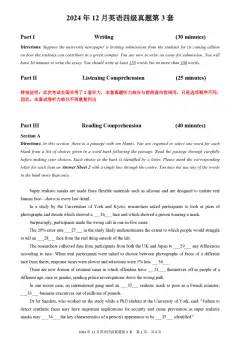
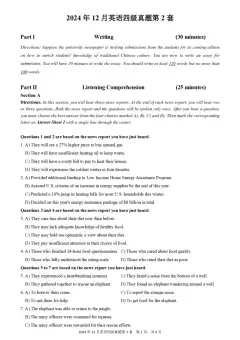
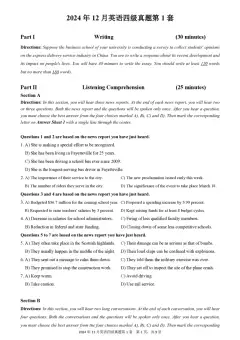
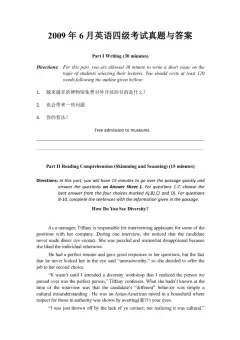
2012年12月大学英语四级真题(3)
PartⅠ Writing (30 minutes)
注意:此部分试题在答题卡1上,请在答题卡1上作答。
Direction: For this part, you are allowed 30 minutes to write a composition entitled
Education Pays based on the statistics provided in the chart below (Weekly
earnings of 2010). Please write at least 120 words but no more than 180
words.
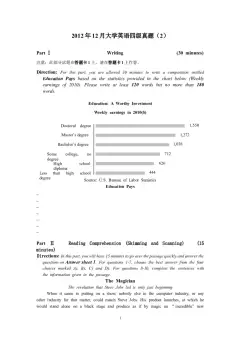
Education: A Worthy Investment
Weekly earnings in 2010($)
Doctoral degree 1,550
Master’s degree 1,272
Bachelor’s degree 1,038
Some college, no 712
degree
High school 626
diploma
Less than high school 444
degree
Source: U.S. Bureau of Labor Statistics
Education Pays
Part Ⅱ Reading Comprehension (Skimming and Scanning) (15
minutes)
Directions: In this part, you will have 15 minutes to go over the passage quickly and answer the
questions on Answer sheet 1. For questions 1-7, choose the best answer from the four
choices marked A), B), C) and D). For questions 8-10, complete the sentences with
the information given in the passage.
Suffering in silence
Despite a law designed to protect them, many people with disabling conditions are
unaware of their rights. Carole Concha-Bell tells of her experiences.
Being diagnosed with a disabling condition is always a shock. Learning to live
without the guarantee of health is like having to unlearn a previous life. The implicationsfor your working life may seem intimidating.
There is the disability Discrimination Act (DDA), of course. But does it really
provide the protection in the workplace that parliament intended? Are employers merely
paying lip service to the DDA? Or are they even aware of an employer’s legal duties and
responsibilities?
In my experience, it is the latter. I have received little support from employers to
whom I have revealed my condition. This has often left me feeling at a disadvantage and
wondering why I bothered doing so in the first place.
I had been struggling with illness long before I was diagnosed. In practical terms
the diagnosis did little to aid me. Of course, it enabled me to understand my body, my
limitations and set me on a course to stabilize my symptoms. But it brought a new
dilemma. Where I had previously struggled to work while ill, ignorant of why my body
was misbehaving, I now had a name for my daily struggle: Lupus (狼疮). This is a
chronic (慢性的), auto-immune disorder that can affect virtually any system in the body.
It also leaves a huge, dark question hanging over my head when seeking employment:
should I tell my employers I have a condition? It is a dilemma that continues to be a
root cause of anxiety both for myself and for thousands of other UK employees.
The rocky road to my unfortunate enlightenment about work and disability began
just after graduation when I’d set my sights on a career in communications and landed
my dream job with a respected public relations consultancy (咨询公司) in Bristol. But
while I was learning the art of media relations, my body wasn’t quite making it in health
terms. I often went to work with swollen limbs and fevers. At my first and last
performance review, my boss was amazed that, despite my many capabilities, I hadn’t
quite taken control of my responsibilities. A few months later, my contract wasn’t
renewed and I plunged further into new depths of ill health.
However, I was determined not to be beaten and returned to the interview trail. My
next job was in publishing. But despite a shining performance at the interview, I felt like
a fraud. How long would it be before I sank into ill health and depression again?
The job was to end with a monumental bang when I became so poorly I could no
longer function. A few feverish weeks in bed ended in a specialist appointment, where I
was diagnosed with Lupus and rushed into hospital for fear that it may have attacked my
internal organs.
The next 12 months were filled with confusion. I had no idea about benefits, felt
alienated (被视为另类) by the medical establishment and lived off my savings until I was
broke. I realized I needed help from my family and moved to London.
As soon as I felt better, I marched into a marketing recruitment consultancy and,
within 10 minutes, I had impressed the interviewer enough to be offered a job with the
agency. We agreed on a decent salary and I told him had arthritis (关节炎) and would
need to work a four-day week.
Things went well at the start but soon the client meetings began to fall on my day
off, and I rarely left the office on time. I began to slip both in health and professional
terms. The 10-hour days crashed around my head; no amount of make-up could disguise
my ill health as I battled against the odds to prove to myself that I cold still make it in
the business world. I often cried on the bus on the way back from work.Not long before my contract was due to be made permanent, I was called to the
boss’s office and given the “talk” abut how my performance was slipping, how awful I
looked. I felt too weak to fight back and agreed to leave. No attempts to offer
adjustments to my job, such as being able to work from home, were ever made. I had a
case for unfair dismissal under the DDA, but was ignorant of this at the time.
An estimated 10 million people in UK, or 17% of the population, qualify for
disability status under the DDA. I have encountered a number of them: the liver-diseased
boss; the co-worker with a heart condition; and my asthmatic (哮喘的) trainee-teacher
friend. None had disclosed (透露) their conditions to employers, and all were feeling the
strain of not doing so.
To access your rights under the DDA and to request “reasonable adjustments” to
your working conditions or your workplace requires disclosure. I had warned my former
employer about my condition but it served little purpose. They were ignorant about their
obligations to their disabled staff.
However, there are plenty of forward-thinking organizations that have inclusive
recruitment policies; are more likely to employ a worker with a disability; and are more
aware of their legal duties. The public sector out-performs the private, but not always the
voluntary, according to studies for the Disabilities Rights Commission.
I decided to give the voluntary sector a go and was surprised to be offered flexible
working conditions and other solutions to meet my needs as an employee. But given the
choice, I would still prefer a career in the private sector, which for me is more dynamic,
has more attractive salaries and offers better prospects than the voluntary or public sectors.
Despite the advances of the DDA, there will always be an army of workers who
will soldier on, maybe aware of their rights but choosing to remain silent for personal
reasons. It is important, though, to recognize the significance of the act, the protection it
affords and the obligations that employers have to us as employees and as human beings.
注意: 此部分试题请在答题卡1上作答。
1. What is people’s immediate response when they are first diagnosed with a disabling
condition?
[A] They report the situation on their employers.
[B] They come to realize the value of good health.
[C] They feel nervous about their work prospects.
[D] They try to seek protection from the DDA.
2. When the author revealed her condition to her employers, they .
[A] were quite sympathetic toward her
[B] did not give her the support she needed.
[C] made adjustments to meet her needs
[D] were annoyed not to be informed earlier
3. When the author was diagnosed with Lupus, she was in a dilemma whether she should
.[A] ask for assistance from her fellow workers
[B] find employment at a different company
[C] ignore her limitations and struggle to work
[D] inform her employers of her disability status
4. The author lost her job at the public relations consultancy in Bristol because .
[A] her boss had fund a much better replacement
[B] she was in no mood at all to discharge her duties
[C] her performance was disappointing to her boss
[D] she fail to show up for her performance review
5. Why did the author feel like a fraud when she got her second job?
[A] She knew she would fall ill any time again.
[B] She was not as competent as she appeared to be.
[C] She concealed the fact that she had just been fired.
[D] She pretended to be very keen on the job.
6. Why did the author move to London?
[A] To get help from her family. [B] To receive better medical care.
[C] To start a consulting business. [D] To seek a more suitable job.
7. The author worked hard at the marketing recruitment consultancy in order to .
[A] earn the boss’s appreciation and clients’ recognition
[B] demonstrate her strong willpower to conquer illness
[C] provide for herself without protection from the DDA
[D] prove herself capable of success in the business world
8. Although many people qualify for disability status in the UK, they would rather not
tell their employers about .
9. The author was offered flexible working conditions in the voluntary sector, but if she
had a choice, she would still like to work in
.
10. The author stresses that it is important to recognize employers’
to their disabled employees.
Part Ⅲ Listening Comprehension (35
minutes)
Section A
Directions: In this section, you will hear 8 short conversations and 2 long
conversations. At the end of each conversation, one or more questions will be asked
about what was said. Both the conversation and the question will be spoken only
once. After each question there will be a pause. During the pause, you must read the
four choices marked A),B),C) and D), and decide which is the best answer. Then markthe corresponding letter on Answer Sheet 2 with a single line through the center.
注意:此部分试题请在答题卡2上作答。
11. [A] He needs another week for the painting. [B] The painting was completed just
in time.
[C] The building won’t open until next week. [D] His artistic work has been well
received.
12. [A] Go camping. [B] Rent a tent.
[C] Decorate his house. [D] organize a party.
13. [A] She talked with Mr. Wright on the phone. [B] She is about to call Mr. Wright’s
secretary.
[C] She will see Mr. Wright at lunch time. [D] She failed to reach Mr. Wright.
14. [A] He is actually very hardworking. [B] He has difficulty finishing his
project.
[C] He needs to spend more time in the lab. [D] He seldom tells the truth about
himself.
15. [A] Rules restricting smoking. [B] Ways to quit smoking.
[C] Smokers’ health problems. [D] Hazards of passive smoking.
16. [A] He is out of town all morning. [B] He is tied up in family matters.
[C] He has been writing a report. [D] He has got meetings to attend.
17. [A] He is not easy-going. [B] He is the speakers’ boss.
[C] He is not at home this weekend. [D] He seldom invites people to his
home.
18. [A] Take a break. [B] Refuel his car.
[C] Ask the way. [D] Have a cup of coffee.
Questions 19 to 21 are based on the passage you have just heard.
19. [A] They are as good as historical films. [B] They give youngsters a thrill .
[C] They have greatly improved. [D] They are better than comics on
film.
20. [A] The effects were very good. [B] The acting was just so-so.
[C] The plot was too complicated. [D] The characters were lifelike.
21. [A] They triumphed ultimately over evil in the battle.
[B] They played the same role in War of the Worlds.[C] They are popular figures among young people.
[D] They are two leading characters in the film.
Questions 22 to 25 are based on the passage you have just heard.
22. [A] It is scheduled on Thursday night. [B] It is supposed to last nine weeks.
[C] It takes place once a week. [D] It usually starts at six.
23. [A] To make good use of her spare time in the evening.
[B] To meet the requirements of her in-service training.
[C] To improve her driving skills as quickly as possible.
[D] To get some basic knowledge about car maintenance.
24. [A] Participate in group discussions. [B] Take turns to make presentations.
[C] Listen to the teacher’s explanation. [D] Answer the teacher’s questions.
25. [A] Most of them are female. [B] Some have a part-time job.
[C] They plan to buy a new car. [D] A few of them are old chaps.
Section B
Direction: In this section, you will hear 3 short passages. At the end of each passage,
you will hear some questions. Both the passage and the questions will be spoken only
once. After you hear a question, you must choose the best answer from the four
choices marked A), B), C) and D). Then mark the corresponding letter on the
Answer Sheet with a single line through the center.
注意:此部分试题请在答题卡2上作答。
Passage One
Questions 26 to 29 are based on the passage you have just heard.
26. [A] She is not good at making friends. [B] She is not well off.
[C] She enjoys company. [D] She likes to go to concerts alone.
27. [A] Their similar social status. [B] Their interdependence.
[C] Their common interest. [D] Their identical character.
28. [A] Invite Pat to a live concert. [B] Buy some gifts for Pat’s kids.
[C] Help take care of Pat’s kids. [D] Pay for Pat’s season tickets.
29. [A] It can develop between people with a big different in income.
[B] It can be maintained among people of different age groups.
[C] It cannot last long without similar family background.
[D] It cannot be sustained when friends move far apart.Passage Two
Questions 30o 32are based on the passage you have just heard.
30. [A] Priority of students’ academic achievements.
[B] Equal education opportunities to all children.
[C] Social equality between teachers and students.
[D] Respect for students’ individuality.
31. [A] Efficient. [B] Complicated.
[C] Lengthy. [D] Democratic.
32. [A] To help them acquire hands-on experience.
[B] To try to cut down its operational expenses.
[C] To provide part-time jobs for needy students.
[D] To enable them to learn to take responsibility.
Passage Three
Questions 33to 35 are based on the passage you have just heard.
33. [A] The best way to work through a finger maze.
[B] Individual doing better in front of an audience.
[C] Researchers having contributed greatly to psychology.
[D] Improvements on the classification of human behavior.
34. [A] When you feel encouraged by the audience.
[B] When you try to figure out a confusing game.
[C] When you already know how to do something.
[D] When you compete with other people in a group.
35. [A] Practicing constantly. [B] Working by oneself.
[B] Learning by doing. [D] Using proven methods.
Section C
Directions: In this section, you will hear a passage three times. When the passage is
read for the first time, you should listen carefully for its general idea. When the
passage is read for the second time, you are required to fill in the blanks numbered
from 36 to 43 with the exact words you have just heard. For blanks numbered from
44 to 46 you are required to fill in the missing information. For these blank, you can
either use the exact words you have just heard or write down the main points in your
own words. Finally, when the passage is read for the third time, you should check
what you have written.
注意:此部分试题在答题卡2上作答。
American today have different eating habits than they had in the past. There is a
wide (36)of food available. They have a broader (37) of nutrition (营养), so they
buy more fresh fruit and (38) than ever before. At the same time, Americans (39)
increasing quantities of sweets and sodas.
Statistics show that the way people live (40) the way they eat. American
lifestyles have changed. There are now growing numbers of people who live alone, (41)
parents and children, and double-income families. These changing lifestyles are (42)
for the increasing number of people who must (43) meals or sometimes simply go
without them. Many Americans have less time than ever before to spend preparing food.
(44)
. Moreover, Americans eat out nearly
four times a week on average.
It is easy to study the amounts and kinds of food that people consume. (45)
. This
information not only tells us what people eating, but also tells us about the changes in
attitudes and tastes. (46)
. Instead, chicken, turkey and fish have become more popular.
Sales of these foods have greatly increased in recent years.
PartⅣ Reading Comprehension (Reading in Depth) (25
minutes)
Section A
Direction: In this section, there is a passage with 10 blanks. You are required to select
one word for each blank from a list of choices given in a word blank following the
passage. Read the passage through carefully before making your choices. Each choice
in the blank is identified by a letter. Please make the corresponding letter for each
item on Answer sheet 2 with a single line through the center. Y ou may not use
UUU
any of the words in the bank more than once .
Questions 47 to 56 are based on the following passage.
So many people use the cell phone so frequently every day. But 47 little is
certain about the health effects of its use. Manufacturers 48 that cell phones meet
government standards for safe radio-frequency radiation emission, but enough studies are
beginning to document a possible 49 in rate brain tumors (肿瘤), headaches and
behavioral disorders in children to cause concern. So far, the evidence isn’t 50 on
whether the use of cell phone 51 to any increased risk of cancer. In a new trial,
researchers asked 47 volunteers to 52 in a project to measure glucose (葡萄糖)
consumption in the brain by scanning the brain to see how sells use energy. For both 50-
minute scans, the volunteers had a cell phone 53 to each ear. During the first scan,
the devices were turned off, but for the second scan, the phone on the right ear was
54 on and received a recorded-message call, although the volume was muted (消音) so
the noise wouldn’t bias the results. The results of the second scan showed that the 55
of the brain nearest to the device had higher rates of glucose consumption than the rest
of the brain. The study shows that cell phones can change brain activity, and 56 awhole new avenue for scientific inquiry, though it doesn’t say anything about whether
cell-phone radiation can cause cancer.
注意:此部分试题请在答题卡2上作答。
A) conclusive I) mission
B) contributes J) participate
C) derive K) particular
D) expresses L) provides
E) fixed M) regions
F) immensely N) surprisingly
G) increase O) switched
H) maintain
Section B
Directions: There are 2 passages in this section. Each passage is followed by some
questions or unfinished statements. For each of them there are four choices marked
A),B),C) and D).You should decide on the best choice and mark the corresponding
letter on Answer sheet 2 with a single line through the center.
Passage One
Questions 57 to 61 are based on the following passage.
It’s no secret that some of the resolutions that many of us vowed to pursue in the
new year— eat healthy, lose weight, quit smoking, save more money — have already
fallen by the wayside.
Many of them are likely the same resolutions that we abandoned last January. And
it’s a good thing for whose who sell health club memberships, quit-smoking programs and
other products that help us think we can improve our lives.
Many gyms see new memberships double in January, making up for the third of
their members who do not renew each year.
And many who sign up in January will be no-shows by February.
“If I try one quick fix and it doesn’t work, I may be more likely to try the next
quick fix,” Lisa Lahey, who coaches executives how to sustain behavior change, told The
Times.
The Biggest Loser Resort at Fitness Ridge doesn’t offer any quick fixes, just a 12-
hour schedule full of exercise, a 1,200-calories-a-day diet and a fee of $2,000 a week.
The resort teaches its clients that “weight management” is a combination of fitness, diet
and emotional health.
“Given my recent weight gain, and the fact that I was turning 50,” Jennifer Conlin
wrote in The Time, “ I wanted to start a program that would make 2012 the year I
finally got in shape.”
“For years, the advice to eh overweight people has been that we simply need to
eat less ad exercise more,” Tara Parker-Pope wrote. “While there is truth to this
guidance, it fails to take into account that the human body continues to fight against
weight loss long after dieting has stopped. This translates into a sobering (令人清醒的)reality: once we become fat, most of us, despite out best efforts, will probably stay fat.”
Of course this revelation (揭示), if proven true by further study, is not good news
for the weight-loss industry. But chances are it won’t have much impact on the human
tendency to resolve to get to the gym more and avoid chocolate cake when the clock
strikes midnight on December 31.
注意:此部分试题请在答题卡2上作答。
57. What do we learn from the first paragraph about new year resolutions?
[A] They are hard to sustain. [B] They test one’s strength.
[C] They help shed bad habits. [D] They promise a good year.
58. Who do new year resolutions eventually benefit?
[A] Society in general. [B] Business executives.
[C] Health club members. [D] Health industries.
59. What is special about the Biggest Loser Resort’s weight management program?
[A] It gives top priority to emotional health. [B] It does not resort to any quick
fixes.
[C] It focuses on one’s behavior change. [D] It is not cheap but extremely
effective.
60. What happens when people stop dieting?
[A] They regain their appetite. [B] They usually stay in shape.
[C] They weight bounces back. [D] Their health is likely to fail.
61. What do people tend to do about new year resolutions?
[A] They keep making them year after year.
[B] They abandon them once progress is made.
[C] They keep trying until they finally succeed.
[D] They make them for the sake of making them.
Passage Two
Questions 62 to 66 are based on the following passage.
When University of California-Berkeley released a study this month showing
alarmingly high teacher turnover (人员流动) rates at Los Angeles charter schools, I wasn’t
surprised.
That’s not a slam at local charter schools. It’s just that the study echoed something
I’d observed many times, starting with my niece.
Bright and cheerful, my niece longed to teach high-needs children. She started out
in the San Francisco public schools, where she was assigned to the district’s toughest
elementary school. Fifth-graders threw chairs across the room — and at her. Parents
refused to show up for conferences.She wasn’t willing to deal with this level of indifference and teacher abuse, so she
switched to a highly regarded charger elementary school in the Bay Area where she
poured her energy into her job and it showed. Her students’ test scores were high as
those in a nearby wealthy school district, despite the obstacles these children faced.
Yet by her fourth year, my niece was worn out, depleted (耗尽) of the energy it
took to work with a classroom of sweet but deeply needy children who pleaded to stay
in her classroom when it was time to leave. The principal’s offer of a $10,000 raise
couldn’t stop her from giving notice. She went to work at that wealthy school district
next door — for less money.
Over the years, I’ve met many impassioned (充满激情的) teachers at charter
schools, only to call them the next year and find they’ve left. The authors of the
Berkeley study theorize that the teachers leave because of the extraordinary demands: long
hours, intense involvement in students’ complicated lives, continual searches for new ways
to raise scores. Even the strongest supporters of the reform movement concede that the
task of raising achievement among disadvantaged students is hard work.
It’s unlikely that we can build large-scale school reform on a platform of continual
new demands on teachers — more time, more energy, more devotion, more responsibility
— even if schools find ways to pay them better. This is the bigger challenge facing
schools. We need a more useful answer to the Berkeley study than “Yea, its really hard
work.”
注意:此部分试题请在答题卡2上作答。
62. Why wasn’t the author surprised at the high teacher turnover rates at Los Angles
charter schools?
[A] She had participated in the Berkeley study.
[B] She had noticed the phenomenon repeatedly.
[C] She had been involved in the local school reform.
[D] She had been informed of the problem by her niece.
63. What do we learn about the students in the public school the author’s niece taught?
[A] They were undisciplined. [B] They were tough and strong.
[C] Many of them enjoyed less parental care. [D] Many of hem dropped out of school
halfway.
64. What does the author say about her niece’s work in the charter elementary school?
[A] It won high praise from her school and colleagues.
[B] It was cited by the Berkeley study as an example.
[C] It contributed to the success of the school reform.
[D] It was well received by the disadvantaged children.
65. Why were the teacher turnover rates so high according to the Berkeley study?
[A] The students were indifferent to learning.
[B] Teachers’ salary was not high enough.
[C] Teachers’ work was too demanding.[D] Jobs elsewhere were too meaningful.
66. What is the author’s comment on the current school reform movement?
[A] It will give rise to more problems.
[B] It is not likely to be successful.
[C] It will have a positive impact on education.
[D] It demands the local authorities’ support.
Part Ⅴ Cloze (15 minutes)
Directions: There are 20 blanks in the following passage. For each blank there are four
choices marked A),B),C) and D) on the right side of the paper. You should
choose the ONE that best fits into the passage. Then mark the corresponding
letter on Answer sheet 2 with a single line through the center.
注意:此部分试题请在答题卡2上作答。
Like many of the protesters at Occupy in May have to start 72 their loans.
Wall Street in New York, Amanda Vodola Repayment requirements for private loans
is young, underemployed and loaded with kick in regardless of whether 73 have
student debt. She spends her days running found jobs. Since employment rates for
around, helping 6 7 the movement, and recent college graduates have 74 in
her evenings waiting tables at a restaurant the past
in Brooklyn. Last spring, she graduated
from Fordham University 68 a degree two years, as have starting salaries, the
in English. “I grew up with this narrative 75 of a sharp rise in student-loan
that to get a good job I need to go to delinquencies (到期未付) has led some
school,” she says. But the job she has economists to 76 that this could be
“is not the next financial crisis, rippling (波及)
into the wider economy. Total U.S.
student-loan debt, which exceeded credit-
67. [A] organize [B] establish
[C] integrate [D] assemble
68. [A] under [B] on
[C] over [D] with
enough to pay the bills.” And the bills
69. [A] puzzled [B] interrupted
she’s 69 most about are the ones tied
to that card debt 77 the first time last year,
is on track to
narrative: the $30,000 she 70 in 7 8 $1,000billion this year. That’s a
college loans.
In November, when their six-month nearly 8% 7 9 over last year.
grace period runs 71 , Vodola and
millions of other students who graduated But neither these 8 0 nor the voices of74. [A] dropped [B] reversed
students, 81 by debt, at protests in
[C] collapsed [D] slimmed
75. [A] possibility [B] stability
cities
[C] publicity [D] security
76. [A] command [B] predict
and on campuses 82 the nation are
[C] appreciate [D] instruct
likely to keep the families of high school
seniors 8 3 seeing a brand-name
77. [A] in [B] to
education as a 84 to a better life. [C] of [D] for
They’ve long been told that higher 78. [A] blow [B] knock
education is an 85 in the future — [C] hit [D] pound
even as the cost of 79. [A] advance [B] increase
[C] transfer [D] progress
80. [A] statistics [B] graphs
college has 8 6 538% over the past 30
[C] diagrams [D] abstracts
year.
81. [A] rejected [B] cleared
[C] revealed [D] burdened
[C] worried [D] distracted
82. [A] among [B] amid
70. [A] collects [B]owes
[C] throughout [D] beyond
[C] costs [D] accounts
83. [A] towards [B] from
[C] against [D] into
71. [A] down [B] up
84. [A] sign [B] label
[C] off [D] out
[C] brick [D] ticket
72. [A] raising [B] repaying
85. [A] investment [B] instrument
[C] rearranging [D] rating
[C] indication [D] inspiration
73. [A] lenders [B] owners
86. [A] intensified [B] flown
[C] borrowers [D] holders
[C] soared [D] broken
Part Ⅵ Translation (5 minutes)
Directions: Complete the sentences by translating into English the Chinese
given in brackets. Please write your translation on Answer Sheet 2.
注意:此部分试题请在答题卡2上作答,只需写出译文部分。
87. Only when you have passed the tests required (你才
能申请驾驶执照).
88. Working mothers today feel it is difficult to
(保持事业和家庭之间的平衡).
89. We (本来可以避免犯这个愚蠢的错误), but we didn’t
follow his advice.
90. He is well into his thirties. It’s about time he (安顿
下来,开始创业).
91. If you (发现自己在排长队等候) at a
supermarket checkout counter, are you likely to get impatient?2012年12月大学英语四级(CET-4)参考答案
作文范文
Education Pay
What is shown in the chart above is that those people with high degree earn more than
those with lower. For example, staff with master’s degree receive a better payment
than those with bachelor’s degree, according to a survey of the payment to the
employee. These survey indicates that education degree does have a relationship with
earnings, contrary to the recent theory of useless education.
Recently, there is a heated discussion about the significance of the education. Some
people hold a view that higher education is useless since college education cannot
mesh with the social needs. Some think that higher education is indispensable if you
want to go far in both your studies and life. Now that survey has proved which part is
wiser.
As for me, I definitely support the view that education is necessary for people’s
life. Reading can not only make me survive well in this society with fierce
competition but also help me make sense of life. I pursue for it for my whole life.
1-5 CBDCA 6-7 AD 8. their conditions 9. the private sector 10.
obligations
11-15 BADAA 16-20 DBBCA 21-25 DCDCA 26-30 BCDAC
31-35 DDBCB
36. selection 37. knowledge 38. vegetables 39. purchase 40.
determines
41. single 42. responsible 43. rush
44. Partly as a result of this limited time, over half of all American homes
now have microwave ovens
45. The United States Department of Agriculture and the food industry collect
sales statistics and keep accurate records
46. Red meat, which used to be the most popular choice for dinner ,is nolonger an American favorite.
47. N 48. H 49. G 50. A 51. B 52. J 53. E 54. O 55. M
56. L
57-61 ADBCA 62-66 BADCB
67-71 ADCBD 72-76 BCAAB 77-81 DCBAD 82-86 CBDAC
87. can you apply for a driver’s license
88. balance career and family / keep balance between career and family
89. could have avoided this silly mistake / could have avoided making this
silly mistake
90. settled down and started his own business
91. find yourself (waiting) in a long queue
听力原文
Part III Listening Comprehension
Section A Conversations
Short Conversations
11.- W:Have you finished that painting for the new student center?
M: Just this morning, I’ve been working extra hours all week, you know the building opens
tomorrow.
Q: What does the man mean?
12. M: Do you sell camping gear?
W: Yes, we have tents, sleeping bags, just about everything you might need, including
stoves.
Q: What is the man probably going to do?
13. M: Hi Jenny have you talked to Mr Wright about the new sports program?
W: well, I contacted his office half an hour ago, and his secretary said he was out for lunch
until 2:00.
Q: What does the woman mean?
14.M:Bill says he’s not working so hard on his biology project.
W: But he spends a lot of time in the lab, doesn’t he?Q: What does the woman imply about Bill?
15.M: I have to say i find the new smoking regulations too strict.
W: Well, they are for everyone’s health. I have no complaints.
Q: What are the speakers talking about?
16.W: Jack asked me to drop off this report. He’s tight up in meetings all morning.
M: I was hoping he brings it in himself, I need to talk with him about it.
Q: Why can’t Jack come in person?
17.M: Should we invite Mr.Smith to join us for dinner this weekend,he has just come back
from England.
W: You can have a try, but as far as i know,he seldom accepts invitations from his employees
Q: What can we infer about Mr.Smith?
18.W: This place doesn’t look familiar at all, we must be lost.
M:Yes,it seems so. Let’s pull in here, while i’m filling in the tank,you go ask the way and
get me something to drink please.
Q: What does the man going to do first?
Long Conversation 1
M: Well ,did you enjoy it?
W: Yes, I enjoy it much more that I thought I would.
M: Really?
W: Yes, I don’t usually go to science fiction films.I don’t think they are much better than
comics on film, if you know what I mean.
M : Yes, sure.And a few years ago,they were certainly like that. But they’ve got a lot better
now.
W: Yes, and historical films, that’s what I really like. I never miss a good film set in middle
ages. Oh, and love stories, I never miss one on TV.
M: Fondly enough, I don’t like those kinds of films at all. But to come back to this one, I
personally didn’t think it was very good . It certainly wasn’t as good as other science fiction films
I’ve ever seen.
W: Wasn’t it?
M: No, not at all. Oh, the effects were very good.
W: Yes, I thought they were marvelous. Especially the battle in space, incredable.M: Yes, but I was going to say I thought the acting was terrible.
W: Yes. I suppose Jason was too good to be true. And what was the name of the Baddy?
M: Cargon?
W: Yeah. Cargon was really evil, wasn’t he? But I suppose that’s what these films are all
about—good triumphing over evil. And the characters have to be black and white.
M: Well ,yes, but not always. Worth the well wasn’t like for example. Anyway, you enjoy
the film. That’s the most important.
W: Yes, I did. Thanks for taking me.
Q:
19. What does the man say about the science fiction films?
20. What opinion did the speakers share about the film they just seen?
21. What to be learned about Jason and Cargon?
Long Conversation 2
M: Can I ask you about your evening class? What class do you go to?
W: Car maintance.
M: What night of the week it on?
W: Wednesday night.
M: And how long does it last?
M: Well, it supposed to start at 6, but that’s a bit of problem because people have difficulty
getting through the traffic. So we start at 6: 30 and then it goes on until the 9 o’clock.
M: And what was your reason for wanting to do the class?
W: Well, I just bought my first car and I don’t know anything about cars. So I thought it was
a good opportunity to learn. I guess most of the peole in the class are in the same situation.
M: Um, and what do you actually do? Do you bring the car along to the class?
W: Yes, we do. And in the first part of the lesson, the first half hour, the man who runs the
class will go though some particular part of the car, and we’ll learn about it. And then we spend
the rest of the time, actually working on my own cars, the same problem.
M: And how many people are there in the class?
W: Mm, I think 16, but 3 quarters of them are women. It’s quite interesing because the man
is obiously used to teaching man. And he always starts his sentence by saying, ” Wow, your chops
were slow.” And then he stops and says “Oh, any woman, you ladies, but...ur..”M: Mm..sounds funny.
Q:
22. What does the woman say about her evening class?
23. Why did the wman want to attend to the class?
24.What do the people who attend the class do in the first part of the lesson?
25. What do we learn about participants in the class?
Section B Passages
Passage 1
We don’t choose friends on the basis of how much money they have, of course, but lots of
differences can be disturbing to both sides. Aaron, for example,was single, and earns a very good
salary. Her friend, Pat, the divorced mother of three, is struggling to make ends meet. “We are
both frequent theater-goers,” Aaron explains, “ and I’ll gladly pay for two tickets, just to have pass
company it plays in concerts , but she won’t go anywhere unless she can pay herown way. I hate
to go alone, so we both stay home. It all seems so silly.” Pat sees the situation differently. After
her unhappy marrige to a man who was trying to control her without considering her wishes and
feelings ,she says, “ it’s very important to me to carry my own weight. I’m not comfortable in any
relationship where all I do is take. ”
The difficult situation finally changed when Aaron moved recently. Pat’s children were with
their father, so she took a picnik lunch to her friends new plays, then spend the day helping her
unpack and get settled. “ I was so grateful, ” Aarons says, “ but I persuaded Pat to let me return the
favour in my own way with season tickets to our little theater group. I think she’s beginning to
recognize that she contributes as much to our friendship, but I do”
26. What do we learn about Pat?
27. What draws Aaron and Pat together?
28. What does Aaron do to return Pat’s favor?
29. What do we learn friendship from the passage?
Passage 2
Sun School in the town of Ashbert in England is a day school for children age 10 to 18.It is
based on the value of social equality between students and stuff, and has few rules.Sun School
believes that the healthy growth of the child is more important than academic success. It offers a
variety of lessons and activities for students to choose from. In free time for children to followtheir own interests.Classes are small,and based on the individual needs of each child. The
timetable is fixed.But democratically decided and students are expected to attend.The weekly
school meeting is at the center of the way sun school is orgnized.It mix all the decisions that affect
theschool,including rules, the timetable and accepting or rejecting new students and
teachers.Participating in thease meetings gives children an understand of democratic decision
making and helps them develops their skills of argument and persuasion.The most import
advantage of the school meeting is that it shows the children that the school is really their’s.They
have the right to decide on changes. And the school’s success or failure depends on their decisions
and their behavior.Sun School employs no cooking or cleaning stuff,these jobs are done by
students and teachers.Decorating and simple repairs are also done by students, it is believed that
school truly belongs to who use it, they must take responsibility for its maintenance.
30. what value is Sun School based on?
31. what is characteristic of the school decision making processur program?
32. why does sun school ask the students to do the maintainance?
Passage 3
Well, to continue, as i mentioned earlier, there is also research that demonstrates that
individuals perform worse, not better on tasks when other people are there. R.W.Harburt did an
interesting experiment. He had his sujects learn a finger maze. This is a game in which you
indicate with your finger the way through a complex system of passages or paths.The subjects
who had an audience did worse than the subjects who did alone.
Now how can we explain these very different results? It seemed very confusing for a long
time. Social psychologist, John Roberts, finally cleared up the confusion about why people
sometimes perform better and sometimes worse in front of an audience. Roberts found that the
presence of an audience facilitates what you already know how to do. That is, if you know what
you are doing, having an audience helps you do it better.But if you don’t already know how to do
something, you will probably make some mistakes and you will make mistakes for a longer time if
you have an audience. That’s exactly what happened to the subjects who were learning the finger
maze.
So, if you were doing well, having an audience increases the chances that you will continue
to do well. If you were doing badly, having an audience increases the chances that you willcontinue to do badly. Roberts cleverly pointed out that when you are first learning something, you
are better off working alone than practicing with other people.
33. What did the speaker probably discuss before coming to this part of the talk?
34. When does the presence of an audience facilitate your performance according to Roberts?
35. What does Roberts think as a better way to learn new things?
Section C Compound Dictation
Americans today have different eating habits than they had in the past. There is a wide
selection of food available. They have a broader knowledge of nutrition, so they buy more fresh
fruit and vegetables than ever before. At the same time, Americans purchase increasing quantities
of sweets and sodas.
Statistics show that the way people live determines the way they eat. American life-styles
have changed. There are now growing numbers of people who live alone, single parents and
children, and double-income families. These changing life styles are responsible for the incresing
number of people who must rush meals or sometimes simply go without them. Many Americans
have less time than ever before to spend preparing food. Partly as a consequence of this limited
time, over half of all American homes now have microwave ovens. Moreover, Americans eat out
nearly four times a week on average. It is easy to study the amounts and kinds of food that people
consume. The United States Department of Agriculture and the food industry collect sales
statistics and keep accurate records. This information not only tells us what people are eating but
also tells us about the changes in attitudes and tastes. Red meat, which used to be the most popular
choice for dinner, is no longer an American favorite. Instead, chicken, turkey, and fish have
become more popular. Sales of these foods have greatly increased in recent years.