文档文本内容
关注公众号:陆陆高分冲刺 ~领取:最新版“小中高考-总复习”、最新试卷下载
名词全解析
一、名词的定义
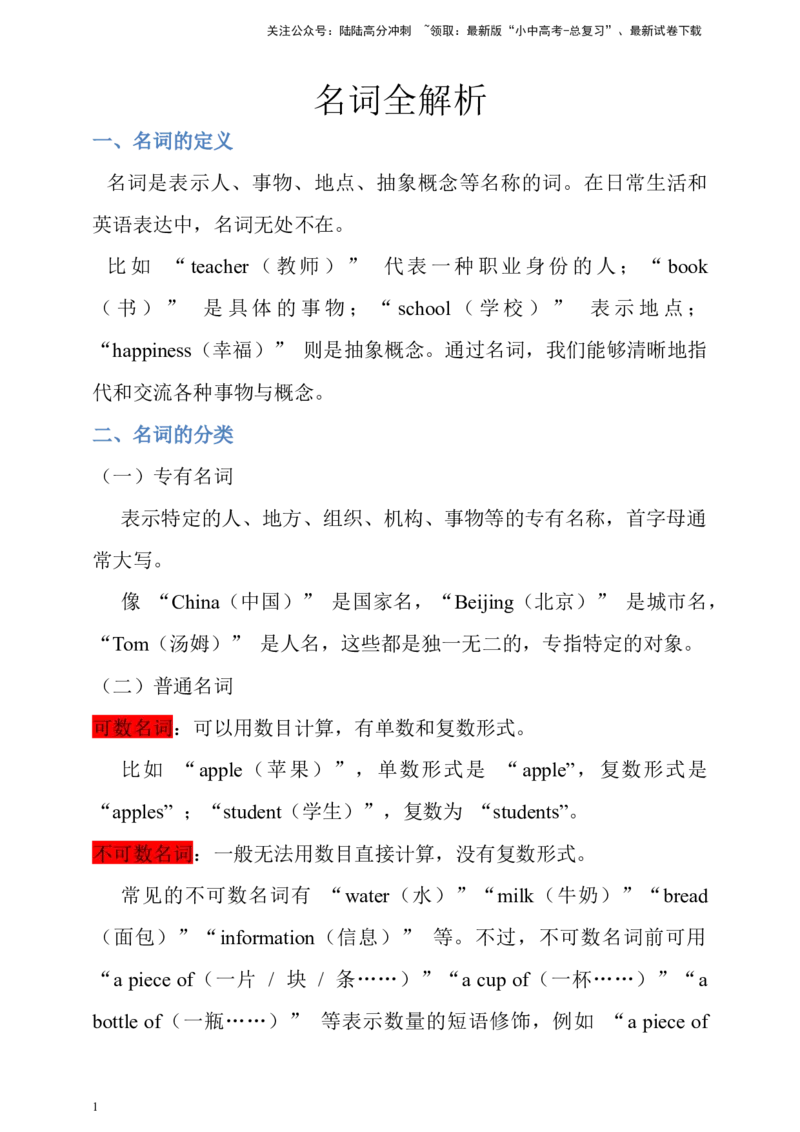
名词是表示人、事物、地点、抽象概念等名称的词。在日常生活和
英语表达中,名词无处不在。
比如 “teacher(教师)” 代表一种职业身份的人;“ book
( 书 ) ” 是 具 体 的 事 物 ; “ school ( 学 校 ) ” 表 示 地 点 ;
“happiness(幸福)” 则是抽象概念。通过名词,我们能够清晰地指
代和交流各种事物与概念。
二、名词的分类
(一)专有名词
表示特定的人、地方、组织、机构、事物等的专有名称,首字母通
常大写。
像 “China(中国)” 是国家名,“Beijing(北京)” 是城市名,
“Tom(汤姆)” 是人名,这些都是独一无二的,专指特定的对象。
(二)普通名词
可数名词:可以用数目计算,有单数和复数形式。
比如 “apple(苹果)”,单数形式是 “apple”,复数形式是
“apples” ;“student(学生)”,复数为 “students”。
不可数名词:一般无法用数目直接计算,没有复数形式。
常见的不可数名词有 “water(水)”“milk(牛奶)”“bread
(面包)”“information(信息)” 等。不过,不可数名词前可用
“a piece of(一片 / 块 / 条……)”“a cup of(一杯……)”“a
bottle of(一瓶……)” 等表示数量的短语修饰,例如 “a piece of
1关注公众号:陆陆高分冲刺 ~领取:最新版“小中高考-总复习”、最新试卷下载
bread(一片面包)”“a cup of tea(一杯茶)”。
三、名词的数
(一)可数名词复数的规则变化
一般在词尾加 -s。例如:“map - maps(地图)”“bag - bags
(包)”“day - days(天)”。
以 s、x、sh、ch 结尾的名词,在词尾加 -es。例如:“bus - buses
(公共汽车)”“box - boxes(盒子)”“brush - brushes(刷子)”
“watch - watches(手表)” 。
以 “辅音字母 + y” 结尾的名词,变 y 为 i,再加 -es。例如:
“family - families(家庭)”“city - cities(城市)”。但以 “元音
字母 + y” 结尾的名词,直接加 -s,如 “boy - boys(男孩)”“key
- keys(钥匙)”。
以 f 或 fe 结尾的名词,多数变 f 或 fe 为 v,再加 -es 。例如:
“knife - knives(刀)”“leaf - leaves(树叶)”。但也有一些直接加
-s,如 “roof - roofs(屋顶)”“belief - beliefs(信念)”。
以 o 结尾的名词,有生命的加 -es,无生命的加 -s。例如:“tomato
- tomatoes(西红柿)”“potato - potatoes(土豆)” 是有生命的;
“photo - photos(照片)”“piano - pianos(钢琴)” 是无生命的。
(二)可数名词复数的不规则变化
改变内部元音字母。例如:“man - men(男人)”“woman - women
(女人)”“foot - feet(脚)”“tooth - teeth(牙齿)”。
单复数同形。例如:“sheep - sheep(绵羊)”“deer - deer(鹿)”
“ fish - fish ( 鱼 , 指 条 数 时 ; 表 示 不 同 种 类 的 鱼 时 复 数 为
2关注公众号:陆陆高分冲刺 ~领取:最新版“小中高考-总复习”、最新试卷下载
fishes)”。
特殊变化。例如:“child - children(孩子)”“mouse - mice(老
鼠)”。
四、名词的所有格
(一)'s 所有格
一般在单数名词和不以 -s 结尾的复数名词后加's 。例如:“Tom's
book(汤姆的书)”“the children's toys(孩子们的玩具)”。
以 -s 结尾的复数名词,只在词尾加 '。例如:“the students' desks
(学生们的书桌)”。
表示两人或多人共同拥有某事物时,只在最后一个名词后加's ;表示
各自拥有时,每个名词都要加's 。例如:“Tom and Jerry's room(汤
姆和杰瑞共有的房间)”,“Tom's and Jerry's rooms(汤姆和杰瑞各
自的房间)”。
(二)of 所有格
主要用于无生命的事物。例如:“the door of the room(房间的门)”
“the name of the book(书的名字)”。但表示时间、距离、国家、城
市等无生命的事物,也可用's 所有格,如 “today's newspaper(今天
的报纸)”“Beijing's weather(北京的天气)”。
五、名词的用法
(一)作主语
名词在句子中作主语,是动作的执行者或描述的对象。
例如:“The dog runs fast.(狗跑得很快。)”,“The dog” 就是
主语;“Knowledge is power.(知识就是力量。)”,“Knowledge”
3关注公众号:陆陆高分冲刺 ~领取:最新版“小中高考-总复习”、最新试卷下载
作主语。
(二)作宾语
作及物动词的宾语:及物动词后需接宾语,名词可充当这一成分。
例如:“I like apples.(我喜欢苹果。)”,“apples” 是 “like”
的宾语。
作介词的宾语:介词后面常接名词作宾语。
例如:“He is in the classroom. (他在教室里。)”,“ the
classroom” 是介词 “in” 的宾语。
(三)作表语
放在连系动词(如 be, look, sound, feel 等)后面,说明主语的身份、
特征或状态。
例如:“My father is a doctor.(我的父亲是一名医生。)”,“a
doctor”
作表语;“The flower smells sweet.(这朵花闻起来很香。)”,
“sweet” 是形容词作表语,这里 “smells” 是连系动词,“The
flower” 是主语。
(四)作宾语补足语
对宾语进行补充说明,使句子意思更完整。
例如:“We made him our monitor.(我们选他当我们的班长。)”,
“our monitor” 是宾语 “him” 的补足语。
六、名词使用的注意事项
(一)不可数名词与数量词搭配
不可数名词不能直接用数字修饰,要借助表示数量的短语。比如不
4关注公众号:陆陆高分冲刺 ~领取:最新版“小中高考-总复习”、最新试卷下载
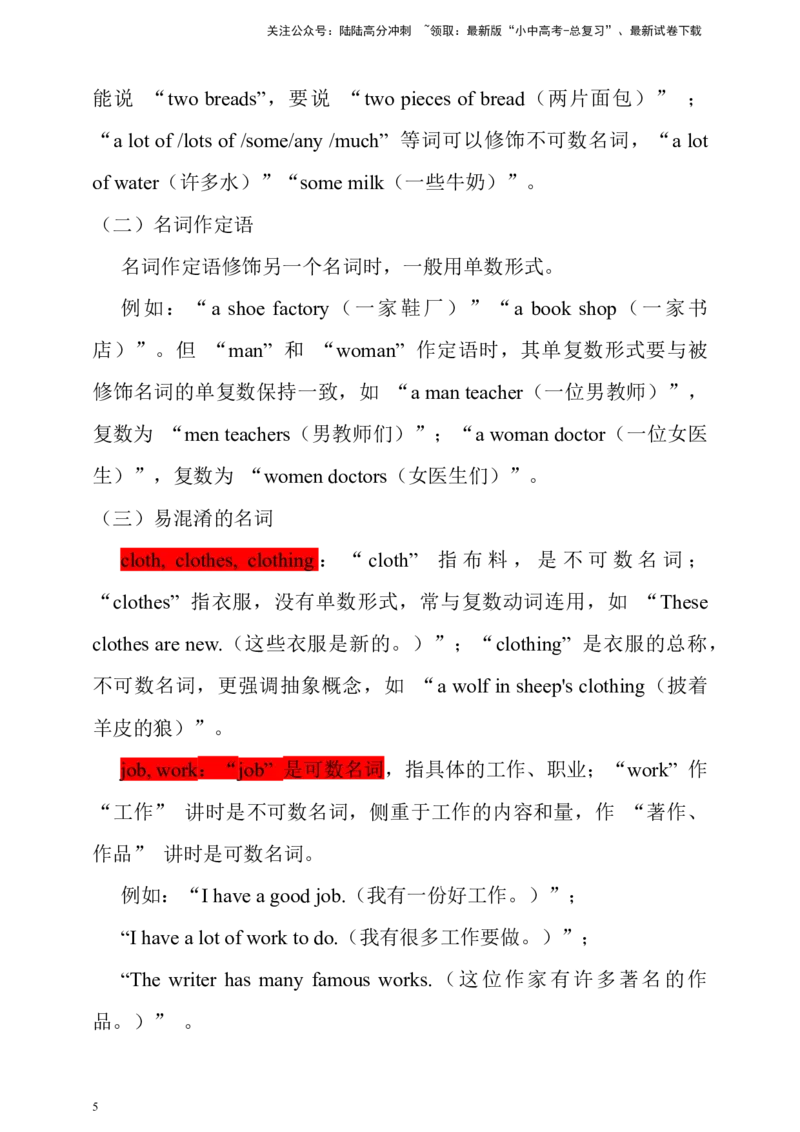
能说 “two breads”,要说 “two pieces of bread(两片面包)” ;
“a lot of /lots of /some/any /much” 等词可以修饰不可数名词,“a lot
of water(许多水)”“some milk(一些牛奶)”。
(二)名词作定语
名词作定语修饰另一个名词时,一般用单数形式。
例如:“a shoe factory(一家鞋厂)”“a book shop(一家书
店)”。但 “man” 和 “woman” 作定语时,其单复数形式要与被
修饰名词的单复数保持一致,如 “a man teacher(一位男教师)”,
复数为 “men teachers(男教师们)”;“a woman doctor(一位女医
生)”,复数为 “women doctors(女医生们)”。
(三)易混淆的名词
cloth, clothes, clothing : “ cloth” 指 布 料 , 是 不 可 数 名 词 ;
“clothes” 指衣服,没有单数形式,常与复数动词连用,如 “These
clothes are new.(这些衣服是新的。)”;“clothing” 是衣服的总称,
不可数名词,更强调抽象概念,如 “a wolf in sheep's clothing(披着
羊皮的狼)”。
job, work:“job” 是可数名词,指具体的工作、职业;“work” 作
“工作” 讲时是不可数名词,侧重于工作的内容和量,作 “著作、
作品” 讲时是可数名词。
例如:“I have a good job.(我有一份好工作。)”;
“I have a lot of work to do.(我有很多工作要做。)”;
“The writer has many famous works.(这位作家有许多著名的作
品。)” 。
5关注公众号:陆陆高分冲刺 ~领取:最新版“小中高考-总复习”、最新试卷下载
七、练习巩固
(一)用所给名词的适当形式填空
1. There are two ________ (box) on the desk.
2. I like eating ________ (tomato).
3. The ________ (child) are playing games.
4. This is my ________ (father) car.
5. The ________ (woman) doctors are very kind.
6. I need two ________ (piece) of paper.
7. There is some ________ (water) in the bottle.
8. These are my ________ (photo).
9. The ________ (leaf) on the tree turn yellow in autumn.
10.The ________ (student) books are on the desk.
(二)单项选择题
11. —What's in the ________?
—There are some ________ and ________ in them.
A. photos; potatoes; radios B. photos; potatoes; radioes
C. photoes; potatos; radios D. photoes; potatos; radioes
12.—Whose room is this?
—It's ________.
A. Lily and Lucy B. Lily's and Lucy's
C. Lily and Lucy's D. Lily's and Lucy
13.—How many ________ are there in the international village?
6关注公众号:陆陆高分冲刺 ~领取:最新版“小中高考-总复习”、最新试卷下载
—360.
A. Chinese B. Russian C. American D. German
14.I have a lot of ________ to do every day.
A. job B. work C. works D. jobs
15.—What would you like to drink?
—Two ________.
A. cup of tea B. cups of teas C. cups of tea D. cup of teas
16.The ________ of the building is very high.
A. height B. high C. weigh D. heavy
17.There are some ________ in the fridge.
A. meat B. apple C. egg D. tomatoes
18.My mother bought two ________ for me yesterday.
A. pair of shoe B. pairs of shoe
C. pair of shoes D. pairs of shoes
19.—What's your ________?
—I'm a student.
A. job B. work C. name D. age
20.—How many ________ do you have?
—Three.
A. child B. children C. childs D. childrens
(三)句型转换
21.This is Lucy's book.(对划线部分提问)
7关注公众号:陆陆高分冲刺 ~领取:最新版“小中高考-总复习”、最新试卷下载
22.There is a sheep on the farm.(改为复数句)
23.The boy's bag is new.(改为复数句)
24.These are Tom's pens.(改为一般疑问句)
25.The woman teacher is in the office.(改为复数句)
答案
(一)用所给名词的适当形式填空
1. boxes
2. tomatoes
3. children
4. father's
5. women
6. pieces
7. water
8. photos
9. leaves
8关注公众号:陆陆高分冲刺 ~领取:最新版“小中高考-总复习”、最新试卷下载
10.students'
(二)单项选择题
11. A
12.C
13.A
14.B
15.C
16.A
17.D
18.D
19.A
20.B
(三)句型转换
21.Whose book is this?
22.There are some sheep on the farm.
23.The boys' bags are new.
24.Are these Tom's pens?
25.The women teachers are in the office.
9