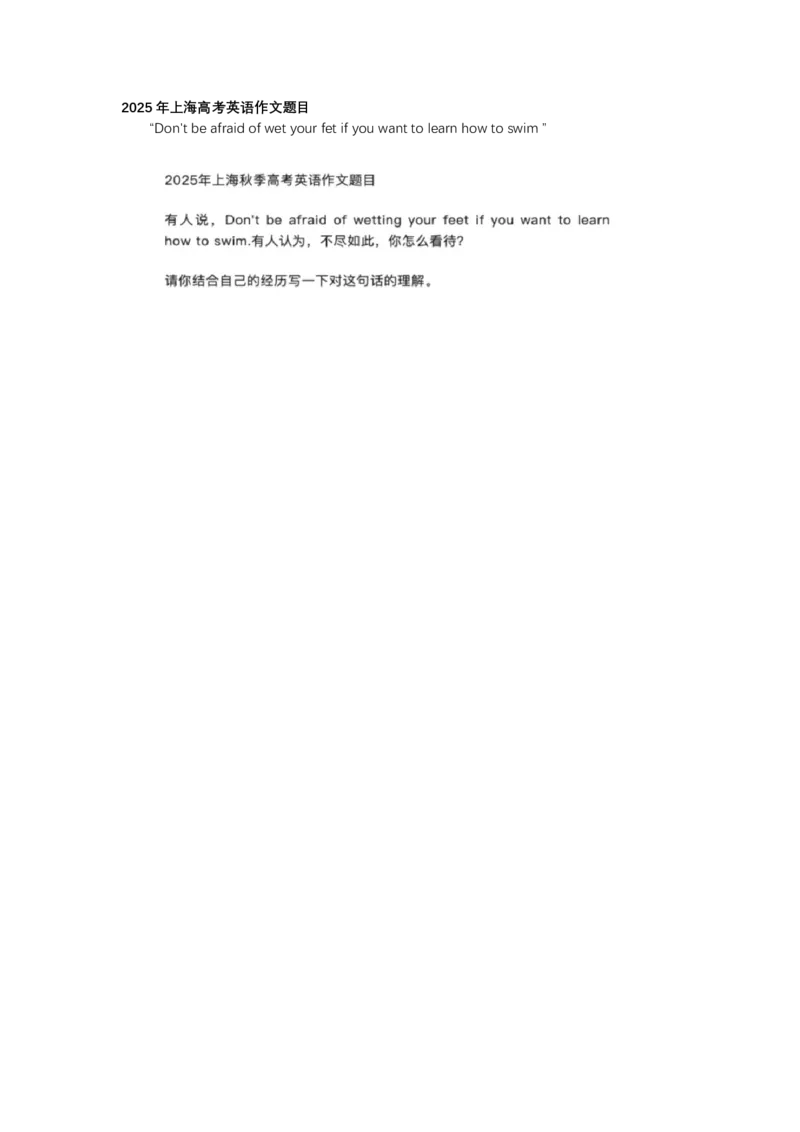
Part1 听力
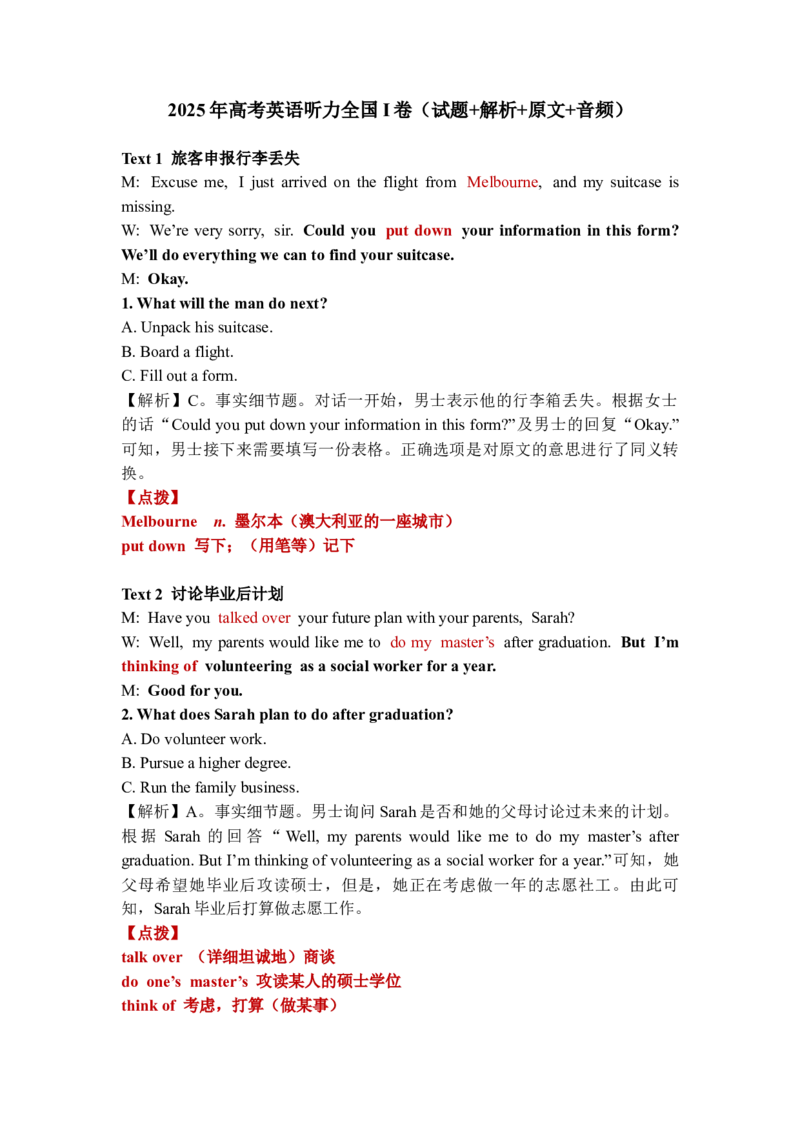
Text1:【旅客申报行李丢失及航空公司处理流程】
M:Excuseme,ljustarrivedontheflightfromMelbourne,andmysuitcaseismissing.
W:We'reverysorry,sir,couldyouputdownyourinformationinthisform?
We'lldoeverythingwecantofindyoursuitcase.
M:Okay.
Text2:【讨论毕业后计划】M:Haveyoutalkedoveryourfutureplanwithyourparents,Sarah?W:
Well,myparentswouldlikemetodomyMastersaftergraduation.l'mthinkingofvolunteeringas
asocialworkerforayear.M:Goodforyou.
Text3:【讨论搬家意向及郊区看房计划】W:Wereallyneedtomove,Steve.Somanycarsgoby
everydayandnosuncomesthroughthewindows.
M:Yeah,thishouseiskindofold.Whatdoyouhaveinmind?
W:Maybeweshouldhavealookinthesuburbs.
Text4:【初次滑雪体验及感受)
M:Doyouoftenskihere?
W:No,thisismyfirsttime.
M:Sohowdoyoulikeitsofar?
W:Thesnowisbrilliant.ltwouldbebetteriftherewerefewerpeople
Text5:【指路与目的地确认】
W: Nowwe've crossed the stonebridge, turn rightagain.Look!Here'sthe Art Center.The Grand
Theatreistwoblocksaway.M:Nearlythere.Wewon'tbelatethen.
Text6:【交通违章处理(学校区域超速)】
M:Miss,l'llneedtoseeyourdriver'slicense.
W:Wasldoingsomethingwrong?
M: You're driving in a school zone around the time school lets out.The speedlimit is 15 miles an
hour, and you were going 35,W: Butit's only 2:10 p.m..The students aren't dismissed until
3:30M:TodayisWednesday.StudentsaredismissedanhourandahalfearlieronWednesdays.
W:Oh,no,you'reright.ljustforgotthat.
Text7【: 偶遇熟人并邀请聚餐】M:Hi,Grace.Haven'tseenyouforsometime!W:Oh,Kevin.Nice
to see you. Are you also here for dinner?M: Yes. My cousin Fiona isn't in town, and this is her
favoritesteakhouse.Youmetherlastyear,right?
W:Yes,atJennifer'swedding.
M:Right?Look,areyouherealone?Wouldyouliketojoinus?W:That'sveryniceofyou,butl'm
meetingDavidandsomeotherfriendsfordinner.Youremember,David,fromClassTwo?
M: Of course. He was the captain of our school's basketball team. l haven'tseen him since
graduation.
W:Heworkedabroadfor3yearsandhasjustcomeback.M:Well,i'llgoandsayaquickhello.We
definitelyshouldgettogethersometimeandhaveadrink.
Text8【: 探讨电视节目类型(教育性与娱乐性)】W:There'snothingdecenttowatchthesedayson
TV.M: Nothing decent? There's tons of stuff.W: They've cut down on the number of news
programs, and the number ofdocumentaries. All have been replaced by these stupid realityshowsandgameshows,youknow.
M:Well,theyoftenmakemelaugh.Peoplewanttowatchthatkindofthing.It'sgood,youknow.
Aslongasthere'sabalance,there'sabitofthis,abitofthat.
W: Should we be giving people what they want to watch? Or should we be.you know, trying to
educate them?M: Well, Ty is there for entertainment. lf you want an education, you go
touniversityorcollegeorsomething,don'tyou?W:No.lreallydon'tthinkso.
Text9:【学校服务项目介绍(家校与社区互动)】W:WelcometoEducationUpdate.ThisisKathy.
WehaveRobertHalfromMountainsideHighSchoolwithustoday.Hello,Mr.Hall.Couldyoutelus
abouttheservice programin yourschool?M: Okay.ltgoeslikethis.On certaindayseachmonth ,
adultsfromtheneighborhoodsitinclasswiththestudentsandseewhat'sgoingonintheschool.
W:That'sinteresting.Whatelsecantheydo?M:Theycanalsotakeadultcoursesintheevenings
forbothfunandseriouslearning.
W:Whataboutthestudents?Whatcantheydointheprogram?M:Well,theycanchangeplaces
with adults and go working on a farm or in afactory or taking care of the housework.W: Good.
This helps them better understand the lives of their parents andknow more about their
neighborhood.M: Yes. Students have a chance to work in hospitals, nursing homes, librariesand
eveningovernmentoffices.
W: So the school is not only part of the student's lives, but also part of theneighborhood.M:
That'sexactlywhatourserviceprogramisforW:Great.Thankyou,Mr.Hall.
Text10:【艺术项目如何传播气候变化意识】
Good evening. Tonight, I'll continue to share how we can use art to spreadthe word about
thechanging climate.In ourday-to-daylives, climatechangecanbehardtosee, butsomeplaces
will feel the changes sooner than others.The city l live in is very flat and close to the water line.
And rising sea levelsare already creating floods. So l decided to do something to make
itimpossibletoignore.startedprojectanartcalled Underwater Homeowners ’ Association and
painted numbers ontothousands of large signs. Each number showed how high someone's
housewas above sea level. A one would mean that if the sea level rose one foot, thebuilding
wouldflood.lgavethesignstohomeownerswhoputthemintheiryards.Kidspaintedmoresigns
and put them near their schools and alongbusy roads. The project has already had a real world
effect. The people whoput the signs in their yards created a real homeowners association to
addressclimatechangeintheircommunities.
Part 2 阅读
阅读 A篇
探讨交通运输领域的碳排放问题,通过数据对比和利弊分析指出未来能源改革的方向,强调加
快绿色能源的发展。
阅读 B篇老师教学生写文章,学生也让老师学到了东西。主旨是教学相长。主要讲述了一位老师带领发
现当思考写作时,学生只能反馈出寥寥几行的文字,然而当他提出一些创作型命题时,学生文
思泉涌,会创造出很多有美好品格的人物。这使我意识到,我所提的问题应该激发学生创作欲
望。老师教学生写文章,学生也让老师学到了东西。
阅读 C篇
Why the rush?
A new book about urban mobility invites us to think differently about our streets: who do
theybelongto,whataretheyfor,whogetstodecide?
SARAHBARNSBOOKS21JANUARY20232641WORDS
Walkable,loveable,liveable:thestreetsofAmsterdam.FranklinHeijnen/Flickr
What do you see when you look out your front door? It’s probably a street, and on that
streetcarsarelikelytohaverightofwayoveranyotherformofmovement.Ifyouwanttoleave
yourhouse,you’regoingtoneedtonegotiatearoundthesecars.And ifyouhaveasmallchild
withyou,you’llneedtopayspecialattentiontoholdingtheirhandtightlesttheyrunontothe
streetandriskbeingkilledorseriouslyinjured.
Thissmall childdoesn’tknowthatthe streetoutthe frontoftheirhouse is,potentially,a
very dangerous place. A very dangerous place: the street outside is something all parents take
great care to teach their children to be wary of, never to linger on, never to cross without an
adult.Remember:Lookright,thenleft,thenrightagain.
Luckily,pedestrianfatalitiesinAustraliaareslowlydecreasing.In1998398pedestriansdied,
but by 2018 the number had fallen to 177, though this past decade the figure has remained
pretty steady. Worldwide, some 270,000 pedestrians are killed each year on roads, and this
numberalsoshowsadownwardtrendovertime.
So are our streets becoming less dangerous to walk on? Not necessarily. While safety
improvements might have been made in our streets in recent years, many traffic studies also
showdeclinesinpedestrianmobility,especiallyamongyoungchildren.
When quizzed on these trends, close to 70 per cent of parents in New South Wales said
there’stoomuchtrafficontheroadsfortheirchildrentowalksafelytoschoolinthemorning.
Manyparentsofsmallchildrenwillbundlethemintothecarinstead — muchsafer.
DutchauthorsThaliaVerkadeandMarcoteBrömmelstroetarebotheredbyfactslikethese.
IntheirnewbookMovement:HowtoTakeBackOurStreetsandTransformOurLivestheycallfor
aradicalrethinkofourstreetsandtheroletheyplayinourlives.
Verkade and te Brömmelstroet lead with a series of provocations: Why do we think about
streets first and foremost as places to move from A to B? Why does the need for speed and
efficiencytriumphoverotherkindsofuse?Anddoweevenknowhowtoimaginealternatives?
Questions like these hadn’t occurred to Verkade, a Rotterdam-based journalist, until she
met te Brömmelstroet, otherwise known as “the Cycling Professor,” at the University of
Amsterdam.Onassignmenttowriteaseriesonbicyclesuperhighways,Verkade’sinterviewwithte Brömmelstroet completely upended how she thought about streets, inspiring the three-year
journeyofdiscoveryrecountedinMovement.
“Bewarned,”shewrites, “Readthisbookandyoumightneverlookatthestreetoutside
yourfrontdoorinthesamewayagain.”
THECARSTHATATEPARIS — ANDLOSANGELES,SYDNEYANDDELHITOO
It’s hard to overestimate how radically the automobile has transformed how we live
together in communities. With the mass adoption across developed nations in the twentieth
centurycamethewholesalereconstructionofcityneighbourhoods.
The principle of circulation took hold: looking down on Manhattan in the 1930s from his
privilegedviewinanaeroplane,LeCorbusierwasstruckbyavisionofthecityasabodyinneed
offluidityofmovement.Hecalledmotorcars “machinesofcirculation” andlikenedroadsto
human arteries, promoting flow and reducing stagnation. Instead of crooked lane-ways and
densehousing,motorwayswerebuilttoclearcongestionandconnectfar-flungsuburbs.
Beforethetransformation:Cunningham Place,TheRocks.StateLibraryofNSWResumption
photographicsurvey/MuseumsofHistoryNSW
Life on city streets changed. Playing on the street became more dangerous as more and
more people drove cars. Whole neighbourhoods were demolished to make way for new road
networks.Kidslearnedtoplayelsewhere.
Some communities fought back. Most famously, a Canadian journalist who had moved her
family to Manhattan in the early 1950s, resisting the pull of low-rise suburbia in favour of
cheaper inner-city housing and street buskers, found herself leading a community campaign to
stop the demolition of her local park, Washington Square. Describing her alarm at its proposed
replacementwithasunkenexpressway,JaneJacobscalledonhermayortochampion“NewYork
asadecentplacetolive,andnotjustpushthrough.”
Jacobswouldgoontoleadasuccessfulten-yearbattletosavetheparkandthesurrounding
GreenwichVillage,inspiringcommunitycampaignsacrosstheworld.InAmsterdam,Verkadeand
te Brömmelstroet write, a mass campaign of tactical resistance from community and activist
groupspreventedthedemolitionofthecitycentretomakewayforanewroadnetwork.
何必匆忙?
——一本关于城市交通的新书,邀我们重新审视街道:归属谁、为何用、谁来定?
莎拉·巴恩斯 书评 2023年1月21日 共2641词
可步行、可爱、宜居:阿姆斯特丹的街道。(图片来源:富兰克林·海涅恩/Flickr)
当你望向家门口,映入眼帘的大抵是一条街道。在这条街上,汽车很可能比其他任何出
行方式都享有优先通行权。若你想出门,得小心避让这些车辆;若带着小孩,更要紧紧握住
他们的手,以防他们跑到街上,遭遇伤亡风险。
小孩子并不知道,家门前的街道可能是个极其危险的地方。“外面的街道很危险”——
这是所有父母都会反复叮嘱孩子的话:别在路边逗留,没有大人陪同绝不能横穿马路。记住:
先看右边,再看左边,最后再看右边。
幸运的是,澳大利亚的行人死亡人数正缓慢下降:1998年有398人丧生,到2018年降
至177人,不过过去十年这一数字基本稳定。全球范围内,每年约有27万行人死于道路事
故,这一数字也呈逐年下降趋势。
那么,我们的街道是否变得更安全了?未必。尽管近年来街道安全设施有所改善,但多
项交通研究显示,行人的出行活跃度在下降,尤其是儿童群体。
当被问及这一趋势时,近70%的新南威尔士州父母表示,早高峰交通太拥堵,孩子无法安全步行上学。许多有小孩的父母会选择开车送孩子——毕竟这样“更安全”。
荷兰作家塔莉娅·维尔卡德和马尔科·特·布罗梅尔斯托特,对这类现象深感忧虑。在
她们的新书《流动:如何夺回街道,重塑生活》中,呼吁人们重新思考街道的角色,以及它
在我们生活中扮演的意义。
维尔卡德和特·布罗梅尔斯托特以一系列尖锐提问开篇:为何我们首先将街道视为“从
A到B的通行工具”?为何速度和效率的优先级,远超街道的其他用途?甚至,我们真的懂
得想象“另一种可能”吗?
在遇到阿姆斯特丹大学的“自行车教授”特·布罗梅尔斯托特之前,鹿特丹记者维尔卡
德从未思考过这些问题。当时,她受命撰写一组关于“自行车超级公路”的报道,而与特·布
罗梅尔斯托特的访谈,彻底颠覆了她对街道的认知,也促成了《流动》一书中,那段历时三
年的探索之旅。
“警告:读完这本书,你看待家门前街道的眼光,可能再也回不去了。”她写道。
吞噬巴黎的汽车——洛杉矶、悉尼、德里亦未能幸免
汽车如何彻底改变了我们的社区生活,再怎么高估都不为过。20世纪,随着汽车在发
达国家大规模普及,城市街区也经历了全盘重构。
“流通至上”的原则占据了主导:20世纪30年代,勒·柯布西耶从飞机上俯瞰曼哈顿,
突然意识到“城市应像生命体般流动”。他将汽车称为“流通机器”,把道路比作人体动脉
——促进流动,消除停滞。于是,弯曲的小巷和密集的住宅被拆除,高速公路取而代之,只
为疏导拥堵、连接远郊。
变革前的景象:岩石区的坎宁安广场(图片来源:新南威尔士州历史博物馆/岩石区收
回计划摄影调查)
城市街道的生活彻底改变:越来越多人开车,在街上玩耍变得危险;整片社区被拆除,
为新路网让路;孩子们只能去别处找乐子。
一些社区开始反抗。最著名的案例来自20世纪50年代初:一位加拿大记者举家搬至曼
哈顿,拒绝“低层郊区”的诱惑,选择更廉价的市中心住房和街头艺人的氛围。却意外发现
自己领导了一场社区运动——阻止当地华盛顿广场公园被拆除,以修建下沉式高速公路。
简·雅各布斯呼吁市长:“纽约应是宜居之地,而非任人‘硬闯’的通道。”
雅各布斯随后领导了长达十年的斗争,成功保住了公园和周边的格林威治村,也激励了
全球的社区运动。维尔卡德和特·布罗梅尔斯托特写道,在阿姆斯特丹,社区与活动家发起
的“策略性抵抗运动”,阻止了市中心被拆除以修建新路网的计划。
阅读 D篇——NewScientist
Boilingtapwatercanremove80percentofthemicroplasticsinit
Tapwatercontainstinyparticlesofplasticandwedon’tknowhowtheyaffectourhealth
– nowitseemsthatboilingthewaterfor5minutescanremovemostofthem
ByChrisStokel-Walker
28February2024
Boilingtapwaterbeforeusecanremoveatleast80percentofthetiny,potentiallyharmful
plasticparticlesitcontains.
Nano and microplastics (NMPs) are pieces of plastics like polystyrene, polythene and
polypropylene that range from between 0.001 to 5 millimetres in diameter. Their impact on
healthisstillbeingstudied,butresearcherssuspecttheyaredamagingtohumans.
Eddy Zeng at Jinan University in China and his colleagues took samples of tap water and
measured their levels of NMPs, finding an average concentration of 1 milligram per litre. Theythen boiled the samples for 5 minutes, before allowing them to cool. The levels of NMPs were
thenremeasuredandfoundtohavereducedbymorethan80percent.
“We estimated that intakes of NMPs through boiled water consumption were two to five
timeslessthanthosethroughtapwateronadailybasis,” saysZeng. “Thissimplebuteffective
boiling-water strategy can ‘decontaminate’ NMPs from household tap water and has the
potentialforharmlesslyalleviatinghumanexposuretoNMPsthroughwaterconsumption.”
The NMPs were removed by becoming ensnared in crystalline structures of limescale
formed from the calcium in the water,saysZeng. More particles wereremoved from “hard”
water – thatcontaininghighlevelsofcalcium – thanfrom “soft” water,whichhaslower
levelsofit.
Allowing the water to reach boiling point was an important contributing factor to how
efficiently those crystalline structures were created. “Boiling water has some other benefits,
suchaskillingbacteriaandparasitesandremovingtraceheavymetals,” hesays.
“The waythey demonstrated how things were deposited through the boiling process was
nice,” saysCarolineGauchotte-LindsayattheUniversityofGlasgow,UK.However,sheaddsthat
the world should be seeking to solve the problem of microplasticsin drinking water long before
they reach homes. “We should be looking into modifying drinking water treatment plants so
theyremovemicroplastics,” shesays.
Part 3 七选五
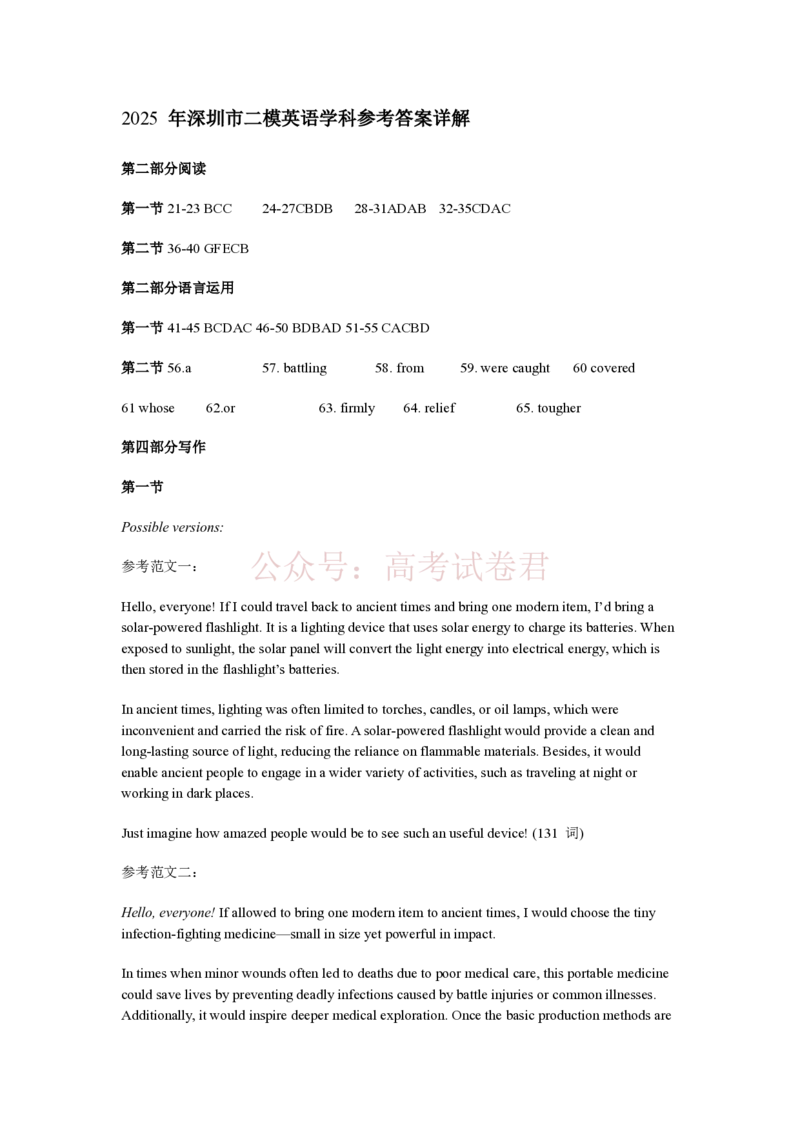
答案:EDCFG
英文原文:
Need a break between classes or just a pick - me - up? The college offers more. Not only
doesitservedrinks,italsoservessmiles.
CatherineMurphy,acafeworkerwithagreenshirtandblackhat,makessurecustomersget
what they exactly want. She goes back and forth between machines to make drinks. After
finishing the order, she calls out the names on the cups. As the students grab the drinks, she
smilesandsays"Howisyourday?".Evenwhenthelineislonger,shedoesn'tletitgetintheway
ofhergenuineconversation.
Murphy gets up at a quarter to five and drives 30 minutes every day to work on time.
Sometimesshearrivesearlytoworkearly."Idosotomakedrinksforstudents.Thatiswhatthey
need."Beingamotherandawife,Murphyknowshowtobethereforothers.
OnethingMurphydoesn'tknowisthathersmileiscontagiousandcanmakeadifferencein
herstudentshavingamuchbetterdaythantheywerehavingbeforemeetingher.XXisapolitical
sciencemajor.Shelovescoffeeandgoestothecafeatleast6timesaweek."Buyingcoffeehere
startsmydaywellandgetsmereadyforclass.Herhugesmileputsmeinagoodmood."
Murphy has served drinks for 23 years and never imagined working anywhere else. She
lovestheworkandhaseveryintentiontocontinuethejob.
中文翻译:
课间需要休息一下,还是只想来杯提神饮品?这所大学能提供的不止于此。它不仅供应
饮品,还传递微笑。
凯瑟琳·墨菲是校园咖啡馆的一名工作人员,身着绿色衬衫、头戴黑色帽子,确保每位
顾客都能得到自己真正想要的东西。她在机器之间来回忙碌地制作饮品。完成订单后,她会喊出杯身上的名字。当学生们接过饮品时,她会微笑着问候:“今天过得怎么样?” 即使
队伍排得很长,她也不会让忙碌影响真诚的交流。
墨菲每天凌晨4点45分起床,驱车30分钟准时上班。有时她会提前到岗、提前开始工
作。“我这样做是为了给学生们准备饮品,这是他们需要的。” 作为母亲和妻子,墨菲懂
得如何为他人付出。
有一件事墨菲不知道:她的微笑具有感染力,能让学生们的一天比遇见她之前更加美好。
XX是政治学专业的学生,她热爱咖啡,每周至少来这家咖啡馆6次。“在这里买咖啡让我
每天都有好的开始,也让我为上课做好了准备。她灿烂的笑容让我心情舒畅。”
墨菲已经从事饮品服务工作23年,从未想过在其他地方工作。她热爱这份工作,打算
一直做下去。
Part 4 完形填空
答案:BDACB BACDA BCDAB(仅供参考)
英文原文(完形填空):
OneAugustafternoonIsatinmykitchen,staringattheglassvasethathadn’tseendaylight
sincemywedding.
My husband and I had just sold our house and we were busy emptying out the beloved
home that family had spent 23 years filling up. We decided on key items for the apartment we
were moving to in town, donated what we could and rented a place to store supposedly
importantthings.Thatleftahousestuffedwiththingsthat,whilenotparticularlyvaluable,didn’
tbelonginalandfill.
Itookapictureofthevaseandposteditonline,for$10.Acoupleofmessagescamein,one
wantingadditionalphotos,anotheraskingforapricecut.Asourmovedaydrewnear,Isettledon
a new price ($0), and reposted it. The description: "I hate this vase maybe you won’t." In an
instant,awomanracedintomyhouseandlefthappilywiththevase.
Encouraged,Ipostedmore.MydailypostsandthevisitsIreceivedbecameapreciousrayof
light in the chaos of my house. Each exchange provides a chance to spare the landfill and to
pleaseanotherpersonImightnototherwisehaveencountered.
Isitinmyapartmenttoday,loving eachofthebelongingsthatshareoursmallspace. Itake
joyinknowingthatsomewherenearby,someoneisappreciatingsomethingthatcouldn’tcome
withus.
中文翻译:
八月的一个下午,我坐在厨房,盯着那个自婚礼后就再没见过天日的玻璃花瓶。
我和丈夫刚卖掉房子,正忙着清空这个家人花了23年填满的温馨家宅。我们选定了要
带去镇上新家公寓(apartment)的重要物件,能捐赠的都捐了,还租了个地方存放(store)
那些看似重要的物品。这让房子里塞满(stuffed)了各种东西——它们虽没多高价值
(valuable),却也不该进垃圾填埋场(landfill)。
我给花瓶拍了照,以 10 美元的价格挂到网上。几条留言传来:一条想要更多照片
(photos),另一条要求降价。随着搬家日临近,我把价格定为0美元,重新发布时附上描
述(description):“我不喜欢这花瓶,也许你会喜欢。” 眨眼间,一个女人冲进我家,开
心地带着花瓶离开了。
受到鼓舞(Encouraged),我发布了更多物品。日常的发布和收到的互动反馈(visits,
意译“访客交流”),成了杂乱搬家过程中珍贵的光芒。每次交易,既让这些物件免于(spare)被丢进垃圾填埋场,也让我有机会邂逅原本不会遇见(encountered)的人,取悦他们。
如今我坐在公寓里,爱着共处这小空间的每一件物件(belongings)。想到附近某个地
方,有人在珍视(appreciating)那些没能跟我们搬来的东西,我便满心欢喜(joy)
Part 5 语法填空
源文来自中国日报
https://www.chinadaily.com.cn/a/202306/09/WS64824f27a31033ad3f
7bb3dc.html
英文文章(语法填空):
An exhibition at the Liushi Art Museum in Shanghai is featuring
artwork inspired by Go, one of the oldest board games in the
world, 56 which originated in China more than 4,000 years ago. Go,
or weiqi in Chinese, is one of 57 the earliest binary - based games.
The movements of the black and white pieces reflect basic ideas of
Eastern philosophy, according to Tu Ningning, curator of the
exhibition.
"The exhibition brings together Go culture, cutting - edge
technology and contemporary art," says Tu. "We hope 58 to
present the rather abstract Go game and AI in a visual context, and
initiate dialogues with minimalism art, conceptual art and
expressionism."
"Go is like the algorithms (算法) in your cell phone. You try to
lead the opponent into your trap and force them to follow your 59
guidance (guide)till they lose," explains Wang Wei, a Go player
among the visitors to the exhibition."The players' personalities 60 are revealed during the game, and
one's weaknesses are exposed to the opponent," she adds. "A decent
winner always 61 tries to outplay the opponent 62by no more than one
or two points as a gesture of modesty and respect for the other side."
Tu says it was the balance between the black and white pieces, beauty
in the 63 strategic (strategy)placement of the pieces, 64 and the
energy flow following each move that inspired artists to create oil
paintings, sculptures, 65 digitally(digital)generated graphics and silk
- screen prints for the show.
中文解析(语法填空):
1. 56. which
考查定语从句关系词。引导非限制性定语从句,修饰先行词
Go(指物),且在从句中作主语,故填 which。
2. 57. the
考查冠词。形容词最高级 earliest 前需用定冠词 the,构成
“one of the + 最高级 + 名词 ”结构,故填 the。
3. 58. to present
考查非谓语动词。hope to do sth 为固定搭配(不定式作宾语,
表“希望做某事”),故填 to present。
4. 59. guidance
考查词性转换。形容词性物主代词 your 后需接名词,故填
guidance(guide 的名词形式,表“指引”)。
5. 60. are revealed
考查动词时态和语态。主语 personalities 与 reveal 构成被动
关系,且描述客观事实用 一般现在时,主语为复数,故填 are
revealed。
6. 61. tries考查动词时态和主谓一致。主语 a decent winner 为 第三人称
单数,描述客观事实用一般现在时,故填 tries。
7. 63. strategic
考查词性转换。名词 placement 前需用 形容词 修饰,故填
strategic(strategy 的形容词形式,表“策略性的”)。
8. 64. and
考查连词。“it was A, B, and C that…”为强调句的并列结构,
连接 balance、beauty、energy flow 三个并列成分,故填 and。
9. 65. digitally
考查词性转换。过去分词 generated 前需用 副词 修饰,故
填 digitally(digital 的副词形式,表“数字地”)。
补充:“by”的用法解释
文中 by no more than one or two points 中,by 表示 “以(某
种幅度/数量)”,用于说明比赛中领先的具体分数差,常描述“差
距、差值”(如分数、时间、距离等)。例句:She won the race by
5 seconds.(她以 5 秒的优势赢得比赛。)Part 6 作文一Part 7 读后续写
阅读下面材料,根据其内容和所给段落开头语续写两段,使之构成一篇完整的短文。
My wife and I wanted to share our new home with family and friends by
hosting a small gathering in the early summer. She had prepared lots of
snacks. There was plenty of space for the kids to run and play. There was just
one thing I hadn't counted on: My brother chose to bring his dog Toby, a 50
pound ball of fire. Though friendly, he could easily knock over my niece's
small boys and my six month old granddaughter. So, when my brother
showed up, I asked him to watch Toby and keep him outside.
Unexpectedly, after supper, the weather changed. It started to rain and
everyone went indoors.
It was an awkward moment. I didn't want Toby to be running around in
the house, and my brother wasn't happy with driving home with a wet dog.
Eventually, my brother decided to leave rather than force the issue.
A few days passed, and I hadn't heard anything from my brother. I texted
him and expressed wishes for him to come out again. His reply came as a
surprise a shock, actually: "Not a chance." Clearly, he was unhappy over the
way we had parted. After all, I had left him little choice. Well, he'll get over it,
I reasoned.
Two months passed. My wife suggested I get in touch with my brother,
but I resisted, thinking he should call first. However, my conscience(良心) kept
bothering me. I tried to put myself in my brother's shoes. He was facing
health problems, and his wife of 35 years had passed away a few months
earlier. Toby was his constant companion, the one who kept him going.
注意:
续写词数应为 150 左右;请按如下格式在答题卡的相应位置作答。
I realized it was me who was at fault.
With the biscuits my wife had made, I arrived at my brother's door.
详细思路和解析
确定主题:文章核心是兄弟间因聚会中对狗的处理产生矛盾,后续应围绕和解展开,
体现亲情的珍贵与包容。
第一段续写:以 “I realized it was me who was at fault.” 开头,要深入描写 “我”
反思过错的心理活动。比如回忆哥哥的遭遇,明白自己当时做法的不妥,从而决定主动修
复关系,可写 “我” 思考如何向哥哥道歉。
第二段续写:“With the biscuits my wife had made, I arrived at my brother's
door.” 接着写 “我” 带着诚意去道歉,着重描述见到哥哥后两人的对话、情感交流,最
终实现和解。
参考示例
I realized it was me who was at fault. I thought about all that my brother had
been through. Losing his wife and facing health problems, Toby was his source of
comfort. I shouldn't have been so inconsiderate about his feelings. I decided to
make things right. I called my wife and told her my plan. She was happy that I had
finally seen the error of my ways. We discussed what I could do to show my
brother how sorry I was.
With the biscuits my wife had made, I arrived at my brother's door. My heart
was pounding as I rang the doorbell. When he opened the door, I could see the
surprise on his face. "Hi," I said, feeling a bit nervous. "I came to apologize. I was
wrong not to consider how much Toby means to you." He looked at me for amoment, and then his expression softened. "Come in," he said. As we sat down
and shared the biscuits, we talked about everything. I apologized again, and he
forgave me. With Toby by our side, our relationship was mended, and I knew our
bond as brothers was stronger than any misunderstanding.
可能用到的语料
1.表达愧疚与反思
I felt a pang of guilt wash over me.(我感到一阵愧疚袭来。)
I couldn't stop reproaching myself for my thoughtless actions.(我不停地责备自己
的轻率行为。)
2.描述情感和解
The tension in the air melted away as we hugged each other.(当我们拥抱时,空气
中的紧张感消失了。)
Our eyes met and I could see the hurt replaced by warmth and understanding.(我
们目光交汇,我看到伤害渐渐消退,取而代之的是温暖与理解。)
3.关于陪伴的重要性
In times of hardship, a loyal companion can be a ray of sunshine in the darkest
days.(在艰难时刻,一个忠诚的伙伴可以是黑暗日子里的一缕阳光。)
He found solace in the unwavering loyalty of his pet.(他在宠物坚定不移的忠诚中找
到了慰藉。)
参考题目:---参考答案(仅供参考)---
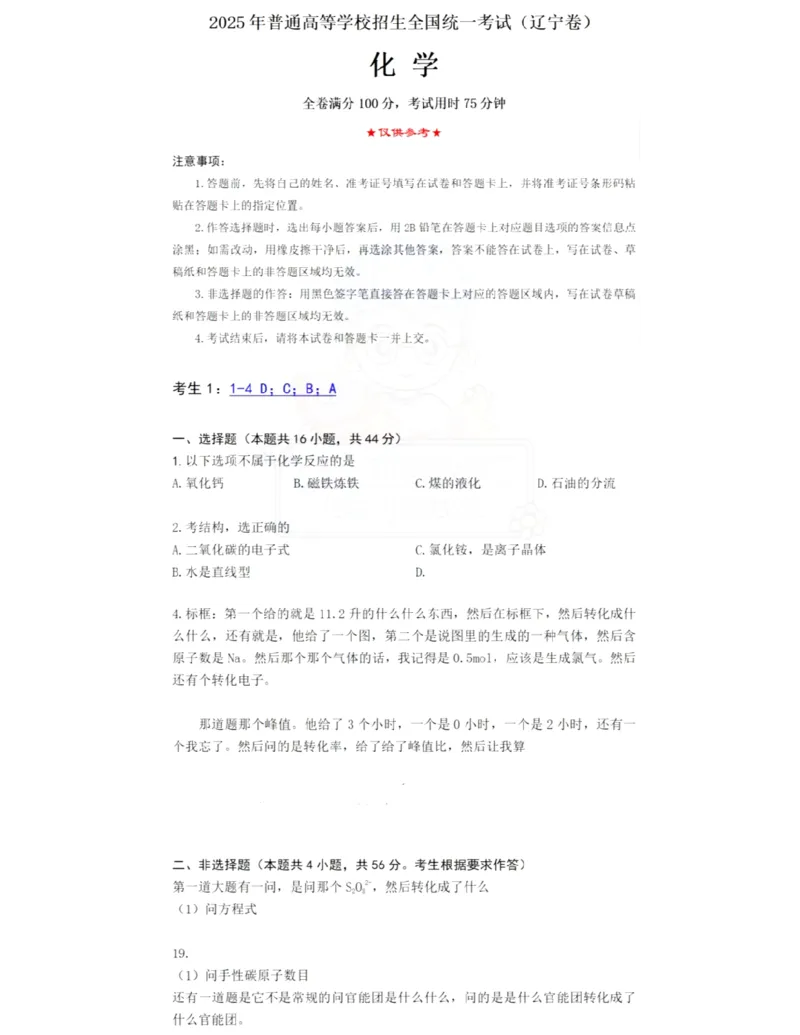
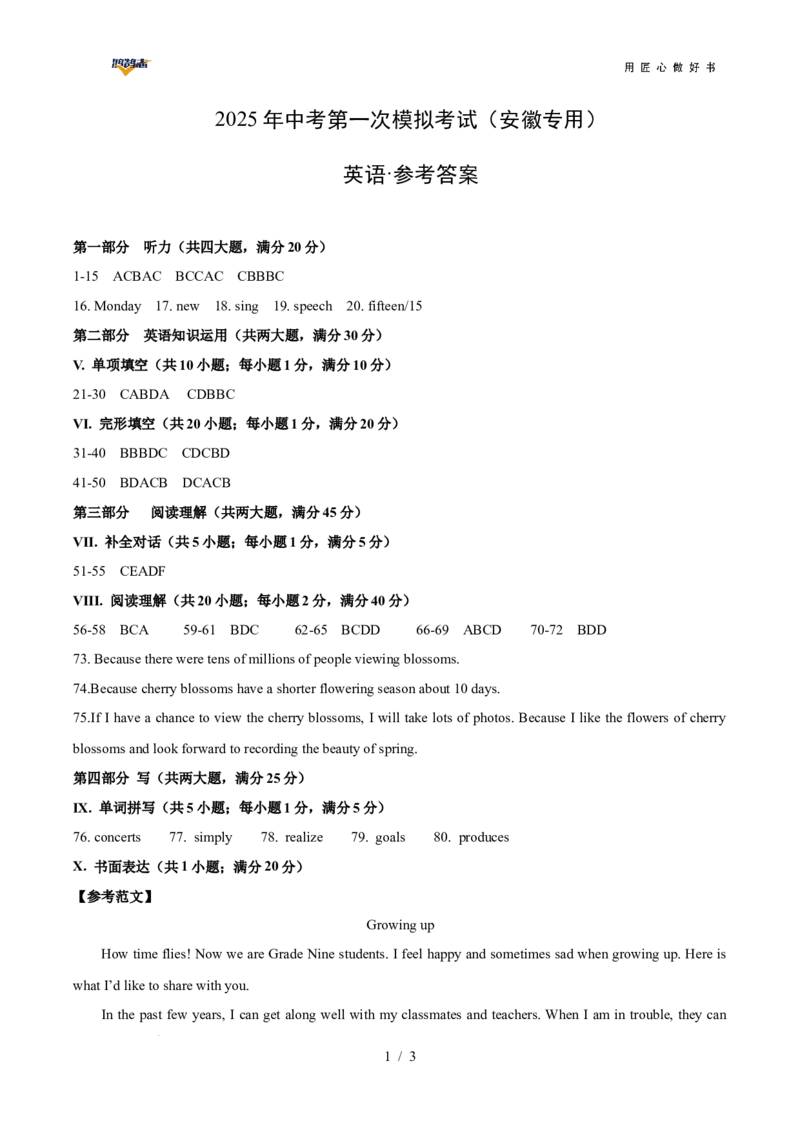
听力:
1-5:CABAC 6-10:BCAAB
11-15:CCABA 16-20:BACDC
阅读理解:
A篇:21-23CCBB篇:24-27DDBA
C篇:28-31CABAD篇:34-35CABB
七选五:
36-40EDCFG
完形填空:
41-55CDCAB,BDCDA,ABBAC
语法填空:
56.which57.the58.topresent59.guidance60.within61.arerevealed62.tries63.strategic64.and
65.digitally
分享高考最新讯息,梦飞跃英语整理