文档文本内容
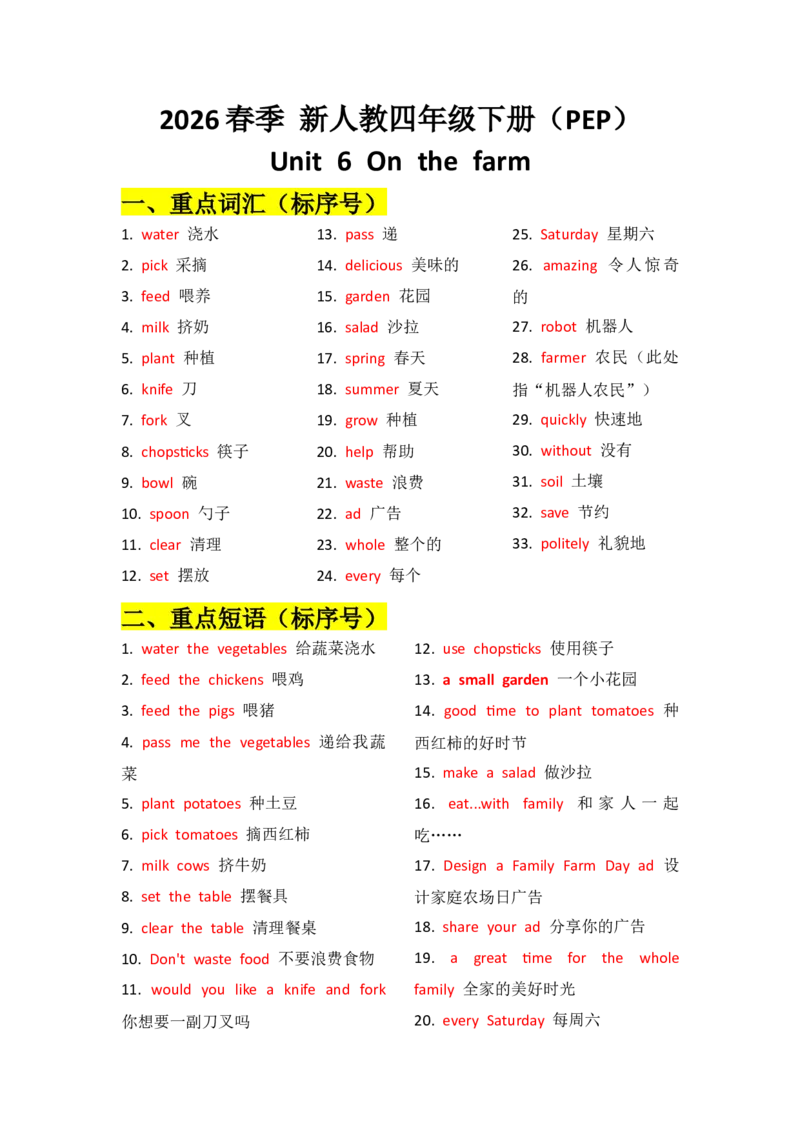
2026 春季 新人教四年级下册(PEP)
Unit 6 On the farm
一、重点词汇(标序号)
1. water 浇水 13. pass 递 25. Saturday 星期六
2. pick 采摘 14. delicious 美味的 26. amazing 令人惊奇
3. feed 喂养 15. garden 花园 的
4. milk 挤奶 16. salad 沙拉 27. robot 机器人
5. plant 种植 17. spring 春天 28. farmer 农民(此处
6. knife 刀 18. summer 夏天 指“机器人农民”)
7. fork 叉 19. grow 种植 29. quickly 快速地
8. chopsticks 筷子 20. help 帮助 30. without 没有
9. bowl 碗 21. waste 浪费 31. soil 土壤
10. spoon 勺子 22. ad 广告 32. save 节约
11. clear 清理 23. whole 整个的 33. politely 礼貌地
12. set 摆放 24. every 每个
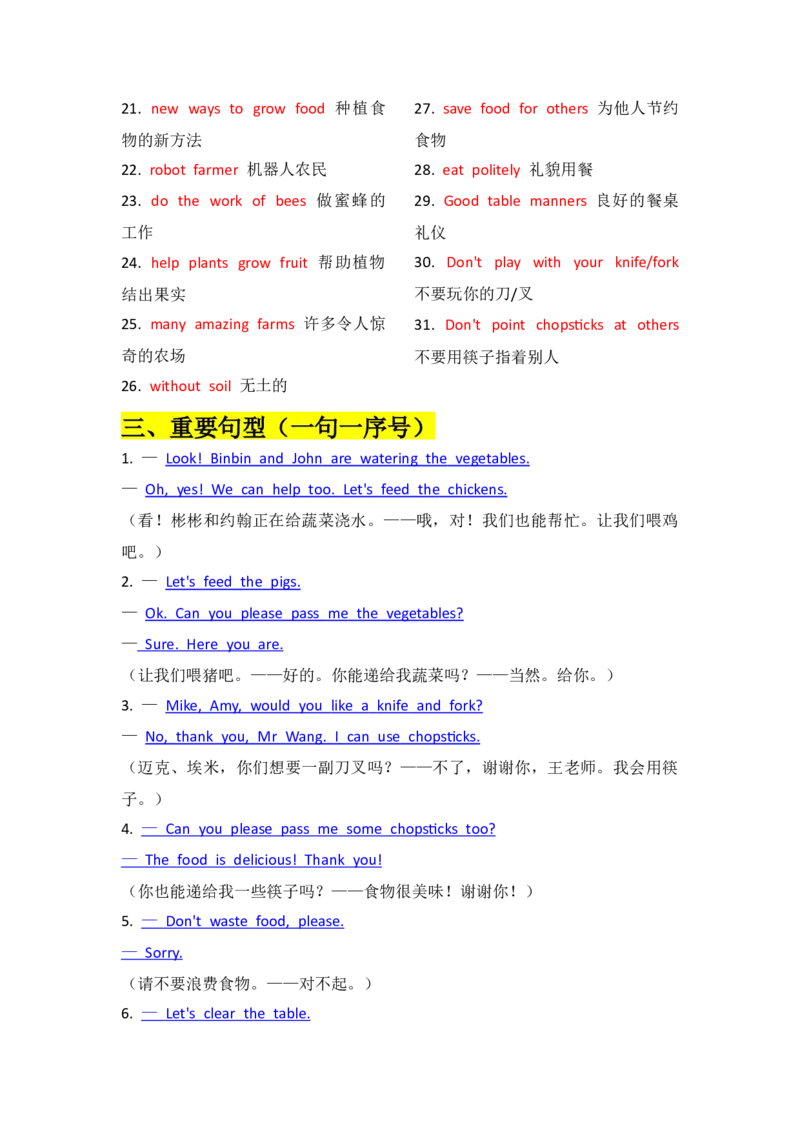
二、重点短语(标序号)
1. water the vegetables 给蔬菜浇水 12. use chopsticks 使用筷子
2. feed the chickens 喂鸡 13. a small garden 一个小花园
3. feed the pigs 喂猪 14. good time to plant tomatoes 种
4. pass me the vegetables 递给我蔬 西红柿的好时节
菜 15. make a salad 做沙拉
5. plant potatoes 种土豆 16. eat...with family 和 家 人 一 起
6. pick tomatoes 摘西红柿 吃……
7. milk cows 挤牛奶 17. Design a Family Farm Day ad 设
8. set the table 摆餐具 计家庭农场日广告
9. clear the table 清理餐桌 18. share your ad 分享你的广告
10. Don't waste food 不要浪费食物 19. a great time for the whole
11. would you like a knife and fork family 全家的美好时光
你想要一副刀叉吗 20. every Saturday 每周六21. new ways to grow food 种植食 27. save food for others 为他人节约
物的新方法 食物
22. robot farmer 机器人农民 28. eat politely 礼貌用餐
23. do the work of bees 做蜜蜂的 29. Good table manners 良好的餐桌
工作 礼仪
24. help plants grow fruit 帮助植物 30. Don't play with your knife/fork
结出果实 不要玩你的刀/叉
25. many amazing farms 许多令人惊 31. Don't point chopsticks at others
奇的农场 不要用筷子指着别人
26. without soil 无土的
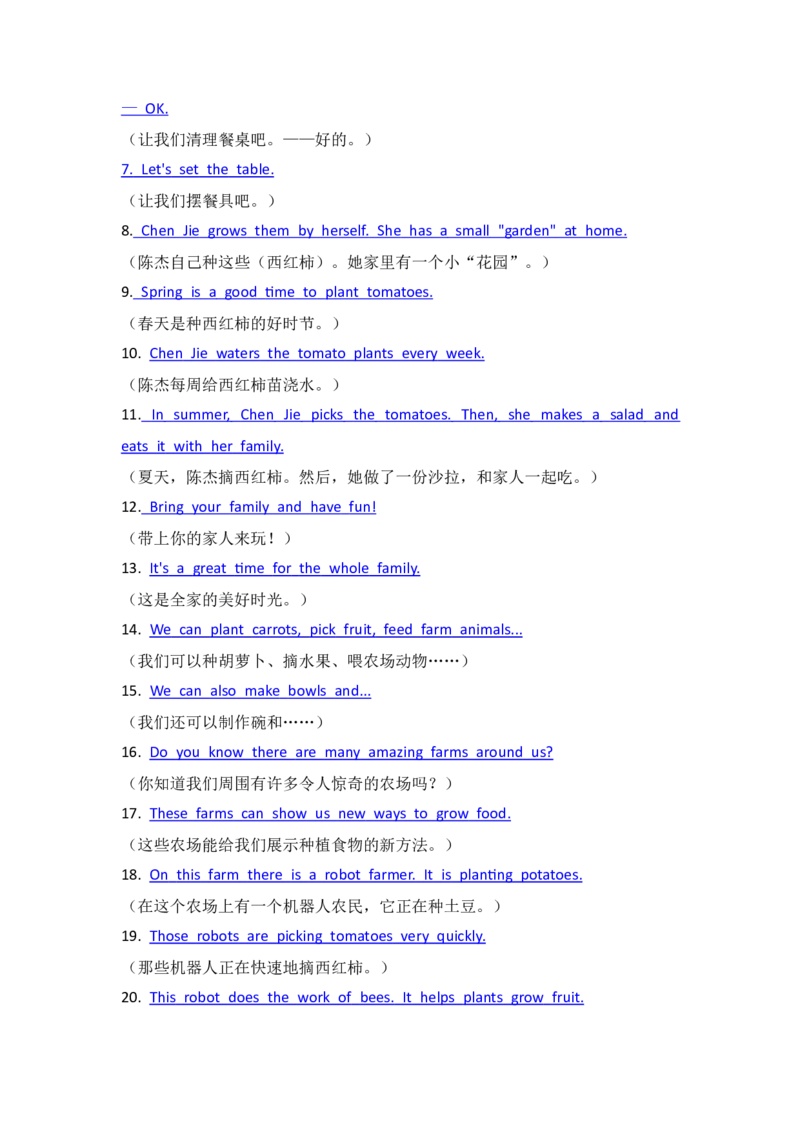
三、重要句型(一句一序号)
1. — Look! Binbin and John are watering the vegetables.
— Oh, yes! We can help too. Let's feed the chickens.
(看!彬彬和约翰正在给蔬菜浇水。——哦,对!我们也能帮忙。让我们喂鸡
吧。)
2. — Let's feed the pigs.
— Ok. Can you please pass me the vegetables?
— Sure . Her e you are .
(让我们喂猪吧。——好的。你能递给我蔬菜吗?——当然。给你。)
3. — Mike, Amy, would you like a knife and fork?
— No, thank you, Mr Wang. I can use chopsticks.
(迈克、埃米,你们想要一副刀叉吗?——不了,谢谢你,王老师。我会用筷
子。)
4. — Can you pleas e pas s m e som e chopstick s too ?
— Th e food i s delicious ! Than k you !
(你也能递给我一些筷子吗?——食物很美味!谢谢你!)
5. — Don' t wast e food , please .
— Sorry .
(请不要浪费食物。——对不起。)
6. — Let' s clea r th e table .— OK .
(让我们清理餐桌吧。——好的。)
7. Let's set the table.
(让我们摆餐具吧。)
8. Chen Ji e grow s them b y hersel f. Sh e ha s a sma ll "garden " a t home .
(陈杰自己种这些(西红柿)。她家里有一个小“花园”。)
9. Sprin g i s a good tim e to plan t tomatoes .
(春天是种西红柿的好时节。)
10. Chen Jie waters the tomato plants every week.
(陈杰每周给西红柿苗浇水。)
11. In summer , Chen Jie pick s the tomatoes . Then , she make s a salad and
eats it with her family.
(夏天,陈杰摘西红柿。然后,她做了一份沙拉,和家人一起吃。)
12. Brin g you r famil y and hav e fun !
(带上你的家人来玩!)
13. It's a great time for the whole family.
(这是全家的美好时光。)
14. We can plant carrots, pick fruit, feed farm animals...
(我们可以种胡萝卜、摘水果、喂农场动物……)
15. We can also make bowls and...
(我们还可以制作碗和……)
16. Do you know there are many amazing farms around us?
(你知道我们周围有许多令人惊奇的农场吗?)
17. These farms can show us new ways to grow food.
(这些农场能给我们展示种植食物的新方法。)
18. On this farm there is a robot farmer. It is planting potatoes.
(在这个农场上有一个机器人农民,它正在种土豆。)
19. Those robots are picking tomatoes very quickly.
(那些机器人正在快速地摘西红柿。)
20. This robot does the work of bees. It helps plants grow fruit.(这个机器人做蜜蜂的工作,它帮助植物结出果实。)
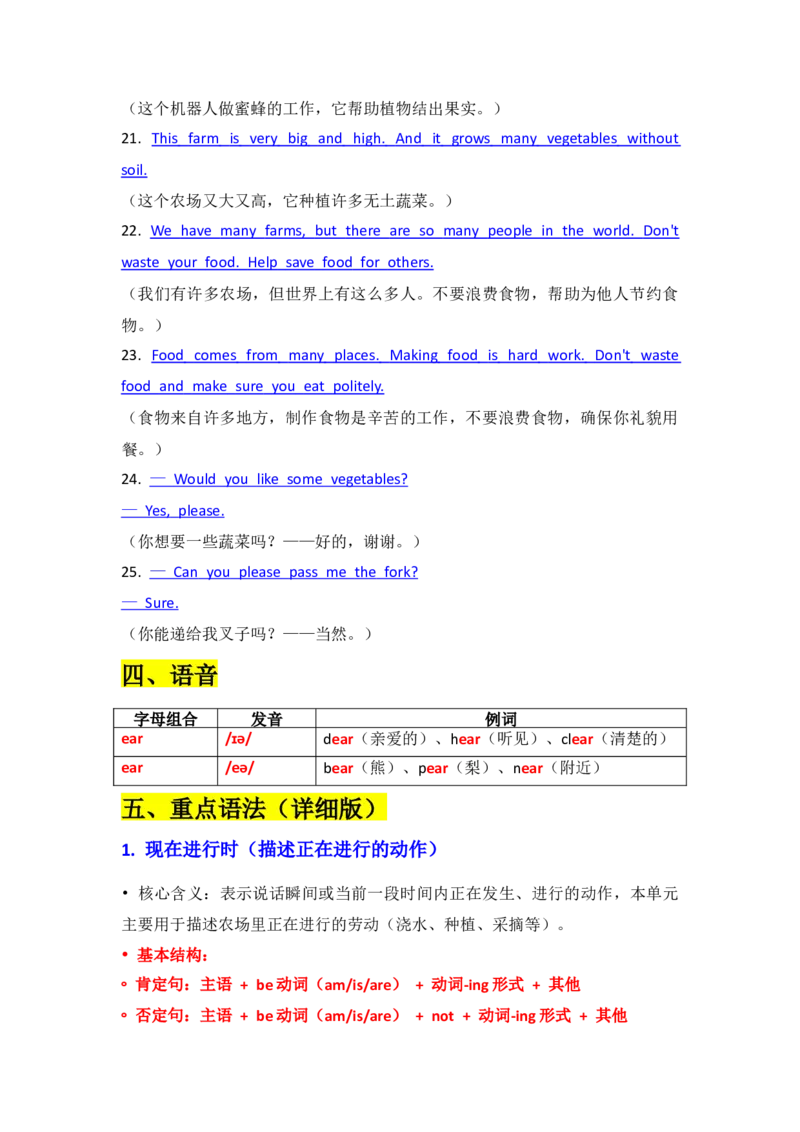
21. This farm is very big and high. And it grows many vegetables without
soil.
(这个农场又大又高,它种植许多无土蔬菜。)
22. We have many farms, but there are so many people in the world. Don't
waste your food. Help save food for others.
(我们有许多农场,但世界上有这么多人。不要浪费食物,帮助为他人节约食
物。)
23. Food comes from many places. Making food is hard work. Don't waste
food and make sure you eat politely.
(食物来自许多地方,制作食物是辛苦的工作,不要浪费食物,确保你礼貌用
餐。)
24. — Would you lik e som e vegetables ?
— Yes , please .
(你想要一些蔬菜吗?——好的,谢谢。)
25. — Can you pleas e pas s m e th e fork ?
— Sure .
(你能递给我叉子吗?——当然。)
四、语音
字母组合 发音 例词
ear /ɪə/ dear(亲爱的)、hear(听见)、clear(清楚的)
ear /eə/ bear(熊)、pear(梨)、near(附近)
五、重点语法(详细版)
1. 现在进行时(描述正在进行的动作)
• 核心含义:表示说话瞬间或当前一段时间内正在发生、进行的动作,本单元
主要用于描述农场里正在进行的劳动(浇水、种植、采摘等)。
• 基本结构:
◦ 肯定句:主语 + be动词(am/is/are) + 动词-ing形式 + 其他
◦ 否定句:主语 + be动词(am/is/are) + not + 动词-ing形式 + 其他◦ 一般疑问句:Be动词(am/is/are) + 主语 + 动词-ing形式 + 其他? → 肯
定回答:Yes, 主语 + be动词. 否定回答:No, 主语 + be动词 + not.
• 单元高频动词-ing变化(规则):
◦ 直 接 加 -ing : water→ watering ( 浇 水 ) 、 pick→ picking ( 采 摘 ) 、
feed→feeding(喂养)、plant→planting(种植)
◦ 不发音e结尾去e加-ing:clear→clearing(清理)、make→making(制作)
• 单元例句:
◦ 肯定句:Binbin and John are watering the vegetables.(彬彬和约翰正在给
蔬菜浇水。)
◦ 肯定句:It is planting potatoes.(它正在种土豆。)
◦ 否定句:They are not (aren't) wasting food.(他们没有在浪费食物。)
◦ 一般疑问句:— Is the robot picking tomatoes?(机器人正在摘西红柿
吗?)— Yes, it is.(是的,它在。)
• 关键注意点:
◦ be 动词必须与主语保持一致:I 用 am(I am = I'm);单数主语
(he/she/it/单数名词)用is(he is = he's);复数主语(we/you/they/复数名
词)用are(they are = they're)。
◦ 动词-ing形式不能遗漏,且要遵循变化规则,不能直接写原形。
2. Let's开头的祈使句(提出建议/邀请)
• 核心含义:用于主动邀请他人一起做某事,语气亲切自然,本单元常用于农
场劳动、餐桌准备等场景的提议。
• 基本结构:
◦ 肯定式:Let's + 动词原形 + 其他(Let's = Let us,“让我们”)
◦ 否定式:Let's not + 动词原形 + 其他(“让我们不要做……”)
• 单元例句:
◦ 肯定式:Let's feed the chickens.(让我们喂鸡吧。)
◦ 肯定式:Let's set the table.(让我们摆餐具吧。)
◦ 否定式:Let's not waste food.(让我们不要浪费食物。)
• 回应方式:◦ 接受邀请:OK./Great!/Sure./Good idea!(好的。/太棒了。/当然。/好主
意!)
◦ 拒绝邀请:Sorry, I can't. I have to...(对不起,我不能。我得……)
• 用法细节:
◦ 后面必须接动词原形,不能接-ing形式或第三人称单数形式(如:Let's feeds
the pigs. 错误 → Let's feed the pigs. 正确)。
◦ 句型本身已包含“邀请对方一起”的含义,无需额外加“with me”。
3. Would you like...句型(礼貌询问需求)
• 核心含义:用于委婉询问他人是否想要某物或是否愿意做某事,语气礼貌得
体,本单元重点用于餐桌场景询问餐具、食物需求。
• 基本结构:
◦ 询问“想要某物”:Would you like + 可数名词单数/不可数名词/some+可
数名词复数?
◦ 询问“愿意做某事”:Would you like to + 动词原形 + 其他?
• 单元例句:
◦ 询问某物:Would you like a knife and fork?(你想要一副刀叉吗?)
◦ 询问某物:Would you like some vegetables?(你想要一些蔬菜吗?)
◦ 询问做某事:Would you like to help pick tomatoes?(你愿意帮忙摘西红柿
吗?)
• 回答方式:
◦ 肯定回答:Yes, please.(好的,谢谢。)(必须加please,保持礼貌)
◦ 否定回答:No, thank you./No, thanks.(不了,谢谢你。)(必须加 thank
you/thanks,不能直接说“No.”)
• 关键细节:
◦ 询问“想要一些某物”时,用 some而不用any(如:Would you like some
salad? 正确,不用any),因为希望得到对方肯定回应。
◦ 句型中的would是情态动词,后面不能接动词-ing或第三人称单数形式。
4. 情态动词can的用法(表示能力/请求)
• 核心含义:本单元主要有两个用法——① 表示“某人有能力做某事”;②表示“礼貌请求他人做某事”,语气委婉。
• 基本结构:
◦ 表示“能力”:
◦ 肯定句:主语 + can + 动词原形 + 其他(“某人能做……”)
◦ 否定句:主语 + can not(can't) + 动词原形 + 其他(“某人不能
做……”)
◦ 一般疑问句:Can + 主语 + 动词原形 + 其他? → 肯定回答:Yes, 主语 +
can. 否定回答:No, 主语 + can't.
◦ 表示“礼貌请求”:
◦ 句型:Can you please + 动词原形 + 其他?(“你能……吗?”,please可
放在句末或中间,中间需加逗号)
◦ 回应:肯定 → Sure./Of course./Certainly. Here you are.(当然。/没问题。
/给你。);否定 → Sorry, I can't.(对不起,我不能。)
• 单元例句:
◦ 表示能力:I can use chopsticks.(我会用筷子。)
◦ 表示能力:Can she milk cows? Yes, she can.(她会挤牛奶吗?是的,她
会。)
◦ 表示请求:Can you please pass me the vegetables?(你能递给我蔬菜
吗?)
◦ 表示请求:Can you please clear the table? Sure.(你能清理餐桌吗?当
然。)
• 易错点:
◦ can是情态动词,后面永远接动词原形,不能接-ing形式或第三人称单数(如:
I can uses chopsticks. 错误 → I can use chopsticks. 正确)。
◦ 否定形式是can't(= can not),不能写成 cannot(书面可写,但口语常用
can't)。
◦ 表示请求时加please,语气更礼貌,符合单元“礼貌用餐、礼貌求助”的场
景要求。
5. 一般现在时(第三人称单数描述日常动作)
• 核心含义:表示经常性、习惯性的动作或客观事实,本单元用于描述农场日常劳动、个人长期的种植习惯等。
• 基本结构(第三人称单数主语):
◦ 肯定句:主语(he/she/it/单数名词/人名) + 动词第三人称单数形式 + 其
他
◦ 否定句:主语 + does not(doesn't) + 动词原形 + 其他
◦ 一般疑问句:Does + 主语 + 动词原形 + 其他? → 肯定回答:Yes, 主语 +
does. 否定回答:No, 主语 + doesn't.
• 单元高频动词第三人称单数变化(规则):
◦ 直接加-s:water→waters(浇水)、grow→grows(种植)、pick→picks(采
摘)、feed→feeds(喂养)、help→helps(帮助)
◦ 以s/x/ch/sh/o结尾加-es:pass→passes(递)、do→does(做)
• 单元例句:
◦ 肯定句:Chen Jie waters the tomato plants every week.(陈杰每周给西红
柿苗浇水。)
◦ 肯定句:This robot does the work of bees.(这个机器人做蜜蜂的工作。)
◦ 否定句:She doesn't waste food.(她不浪费食物。)
◦ 一般疑问句:Does the farmer plant potatoes in spring? Yes, he does.(农
民春天种土豆吗?是的,他种。)
• 关键规则:
◦ 第三人称单数主语包括:he(他)、she(她)、it(它)、单个人名(如
Chen Jie)、单数名词(如the robot, the farm)。
◦ 否定句和疑问句中,助动词用 does/doesn't,后面的实义动词必须变回原形
(如:Does she waters the plants? 错误 → Does she water the plants? 正
确)。
◦ 动词第三人称单数变化要遵循规则,不能遗漏-s/es(如:The robot do the
work. 错误 → The robot does the work. 正确)。Unit 6 On the farm 默写版
一、重点词汇
1. ________________ 浇水 18. ________________ 夏天
2. ________________ 采摘 19. ________________ 种植
3. ________________ 喂养 20. ________________ 帮助
4. ________________ 挤奶 21. ________________ 浪费
5. ________________ 种植 22. ________________ 广告
6. ________________ 刀 23. ________________ 整个的
7. ________________ 叉 24. ________________ 每个
8. ________________ 筷子 25. ________________ 星期六
9. ________________ 碗 26. ________________ 令人惊奇的
10. ________________ 勺子 27. ________________ 机器人
11. ________________ 清理 28. ________________ 农民(此处指
12. ________________ 摆放 “机器人农民”)
13. ________________ 递 29. ________________ 快速地
14. ________________ 美味的 30. ________________ 没有
15. ________________ 花园 31. ________________ 土壤
16. ________________ 沙拉 32. ________________ 节约
17. ________________ 春天 33. ________________ 礼貌地二、重点短语
1. ____________________________________ 给蔬菜浇水
2. ____________________________________ 喂鸡
3. ____________________________________ 喂猪
4. ____________________________________ 递给我蔬菜
5. ____________________________________ 种土豆
6. ____________________________________ 摘西红柿
7. ____________________________________ 挤牛奶
8. ____________________________________ 摆餐具
9. ____________________________________ 清理餐桌
10. ____________________________________ 不要浪费食物
11. ____________________________________ 你想要一副刀叉吗
12. ____________________________________ 使用筷子
13. ____________________________________ 一个小花园
14. ____________________________________ 种西红柿的好时节
15. ____________________________________ 做沙拉
16. ____________________________________ 和家人一起吃……
17. ____________________________________ 设计家庭农场日广告
18. ____________________________________ 分享你的广告
19. ____________________________________ 全家的美好时光
20. ____________________________________ 每周六
21. ____________________________________ 种植食物的新方法
22. ____________________________________ 机器人农民
23. ____________________________________ 做蜜蜂的工作
24. ____________________________________ 帮助植物结出果实
25. ____________________________________ 许多令人惊奇的农场
26. ____________________________________ 无土的
27. ____________________________________ 为他人节约食物
28. ____________________________________ 礼貌用餐
29. ____________________________________ 良好的餐桌礼仪30. ____________________________________ 不要玩你的刀/叉
31. ____________________________________ 不要用筷子指着别人
三、重要句型
1. —________________________________________________________________
— ________________________________________________________________
(看!彬彬和约翰正在给蔬菜浇水。——哦,对!我们也能帮忙。让我们喂鸡
吧。)
2. —________________________________________________________________
— ________________________________________________________________
— ________________________________________________________________
(让我们喂猪吧。——好的。你能递给我蔬菜吗?——当然。给你。)
3. —________________________________________________________________
— ________________________________________________________________
(迈克、埃米,你们想要一副刀叉吗?——不了,谢谢你,王老师。我会用筷
子。)
4. —________________________________________________________________
— ________________________________________________________________
(你也能递给我一些筷子吗?——食物很美味!谢谢你!)
5. —________________________________________________________________
— ________________________________________________________________
(请不要浪费食物。——对不起。)
6. —________________________________________________________________
— ________________________________________________________________
7.—________________________________________________________________
— ________________________________________________________________
(让我们清理餐桌吧。——好的。)
8.—________________________________________________________________
(让我们摆餐具吧。)
9.— ________________________________________________________________
(陈杰自己种这些(西红柿)。她家里有一个小“花园”。)10.—________________________________________________________________
(春天是种西红柿的好时节。)
11.—________________________________________________________________
(陈杰每周给西红柿苗浇水。)
11.—________________________________________________________________
(夏天,陈杰摘西红柿。然后,她做了一份沙拉,和家人一起吃。)
12.—________________________________________________________________
(带上你的家人来玩!)
13.—________________________________________________________________
(这是全家的美好时光。)
14.—________________________________________________________________
(我们可以种胡萝卜、摘水果、喂农场动物……)
15.—________________________________________________________________
(我们还可以制作碗和……)
16.—________________________________________________________________
(你知道我们周围有许多令人惊奇的农场吗?)
17.—________________________________________________________________
(这些农场能给我们展示种植食物的新方法。)
18.—________________________________________________________________
(在这个农场上有一个机器人农民,它正在种土豆。)
19.—________________________________________________________________
(那些机器人正在快速地摘西红柿。)
20.—________________________________________________________________
(这个机器人做蜜蜂的工作,它帮助植物结出果实。)
21.—________________________________________________________________
(这个农场又大又高,它种植许多无土蔬菜。)
22.—________________________________________________________________
(我们有许多农场,但世界上有这么多人。不要浪费食物,帮助为他人节约食
物。)
23.—________________________________________________________________(食物来自许多地方,制作食物是辛苦的工作,不要浪费食物,确保你礼貌用
餐。)
24. ________________________________________________________________
— ________________________________________________________________
(你想要一些蔬菜吗?——好的,谢谢。)
25. —
________________________________________________________________
— ________________________________________________________________
(你能递给我叉子吗?——当然。)