Unit 1 How can we become good learners知识清单
1. 单词(按课文排序)
2. 词组(按课文排序)
3. 句子(含例句+考点+分层练针对习)
4. 语法(含例句+考点+分层针对练习)
5. 课文(含教材答案)
6. 电子版单词表
单词
图片 单词 形式变化 其他用法
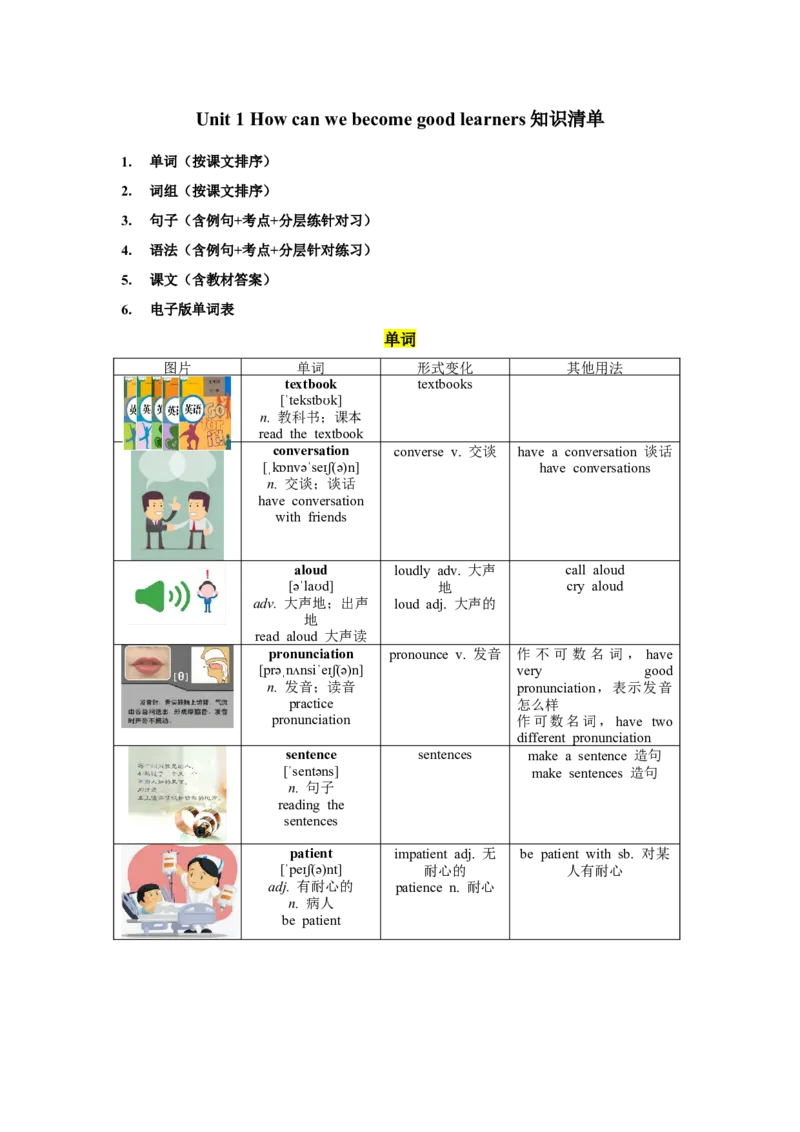
textbook textbooks
[ˈtekstbʊk]
n. 教科书;课本
read the textbook
conversation converse v. 交谈 have a conversation 谈话
[ˌkɒnvəˈseɪʃ(ə)n] have conversations
n. 交谈;谈话
have conversation
with friends
aloud loudly adv. 大声 call aloud
[əˈlaʊd] 地 cry aloud
adv. 大声地;出声 loud adj. 大声的
地
read aloud 大声读
pronunciation pronounce v. 发音 作 不 可 数 名 词 , have
[prəˌnʌnsiˈeɪʃ(ə)n] very good
n. 发音;读音 pronunciation,表示发音
practice 怎么样
pronunciation 作可数名词,have two
different pronunciation
sentence sentences make a sentence 造句
[ˈsentəns] make sentences 造句
n. 句子
reading the
sentences
patient impatient adj. 无 be patient with sb. 对某
[ˈpeɪʃ(ə)nt] 耐心的 人有耐心
adj. 有耐心的 patience n. 耐心
n. 病人
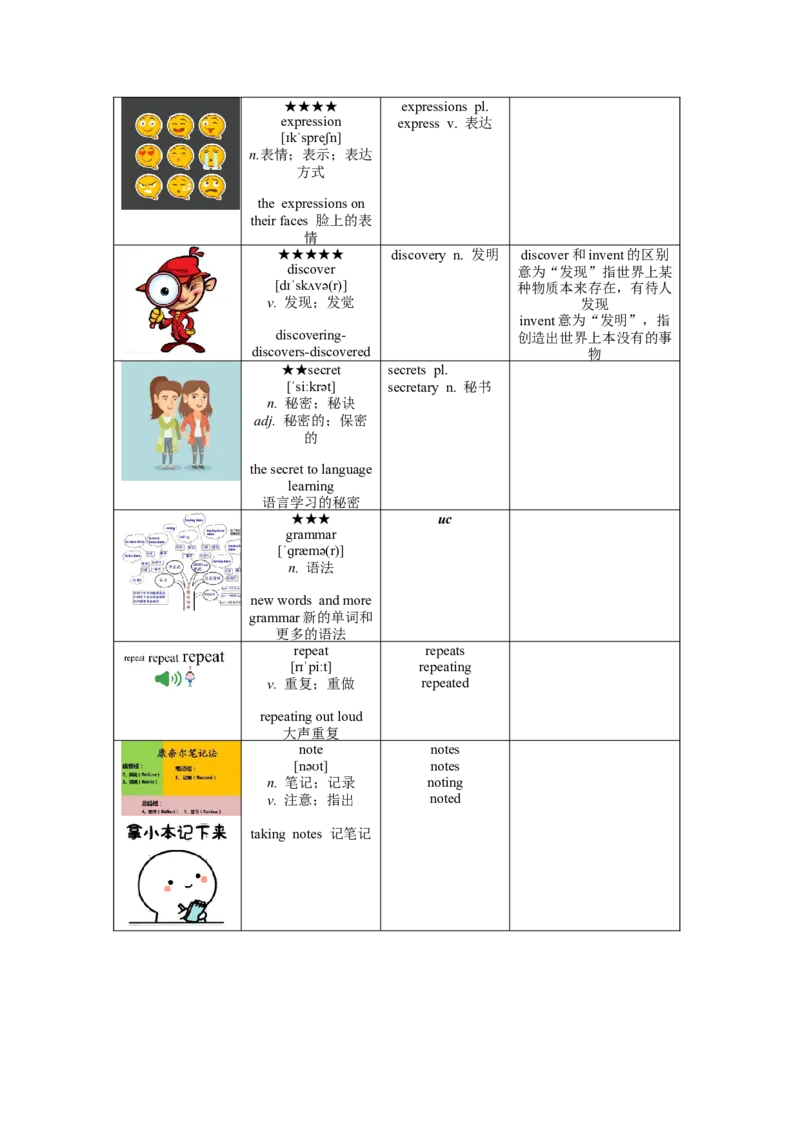
be patient★★★★ expressions pl.
expression express v. 表达
[ɪkˈspreʃn]
n.表情;表示;表达
方式
the expressions on
their faces 脸上的表
情
★★★★★ discovery n. 发明 discover和invent的区别
discover 意为“发现”指世界上某
[dɪˈskʌvə(r)] 种物质本来存在,有待人
v. 发现;发觉 发现
invent意为“发明”,指
discovering- 创造出世界上本没有的事
discovers-discovered 物
★★secret secrets pl.
[ˈsiːkrət] secretary n. 秘书
n. 秘密;秘诀
adj. 秘密的;保密
的
the secret to language
learning
语言学习的秘密
★★★ uc
grammar
[ˈɡræmə(r)]
n. 语法
new words and more
grammar新的单词和
更多的语法
repeat repeats
[rɪˈpiːt] repeating
v. 重复;重做 repeated
repeating out loud
大声重复
note notes
[nəʊt] notes
n. 笔记;记录 noting
v. 注意;指出 noted
taking notes 记笔记pal pals
[pæl]
n. 朋友;伙伴
pen pals
笔友
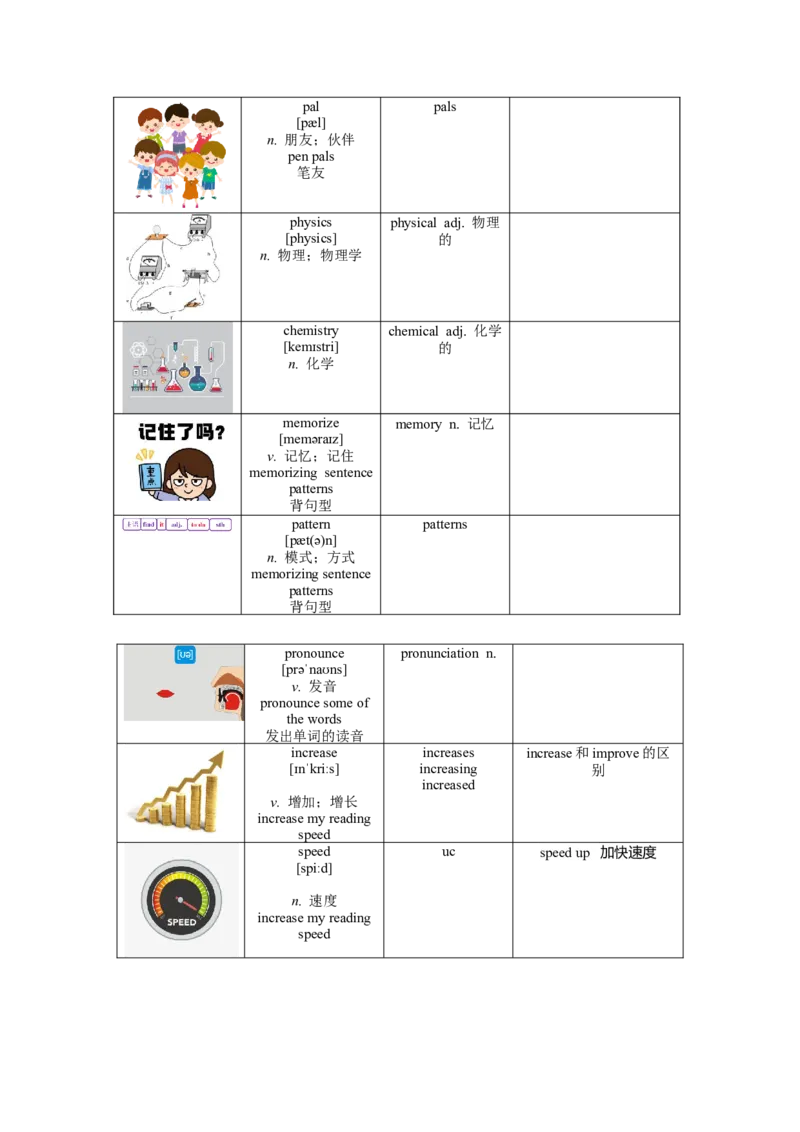
physics physical adj. 物理
[physics] 的
n. 物理;物理学
chemistry chemical adj. 化学
[kemɪstri] 的
n. 化学
memorize memory n. 记忆
[meməraɪz]
v. 记忆;记住
memorizing sentence
patterns
背句型
pattern patterns
[pæt(ə)n]
n. 模式;方式
memorizing sentence
patterns
背句型
pronounce pronunciation n.
[prəˈnaʊns]
v. 发音
pronounce some of
the words
发出单词的读音
increase increases increase和improve的区
[ɪnˈkriːs] increasing 别
increased
v. 增加;增长
increase my reading
speed
speed uc speed up 加快速度
[spiːd]
n. 速度
increase my reading
speedpartner partners pal, partner, friend的区
[ˈpɑːtnə(r)] 别
n. 搭档;同伴
have a partner
born
[bɔːn]
v. 出生
adj. 天生的
is born with
ability abilities
[əˈbɪləti] able adj.
n. 能力;才能
the ability to learn
create creative adj.
[kriˈeɪt]
v. 创造;创建
brain brains
[breɪn]
n. 大脑
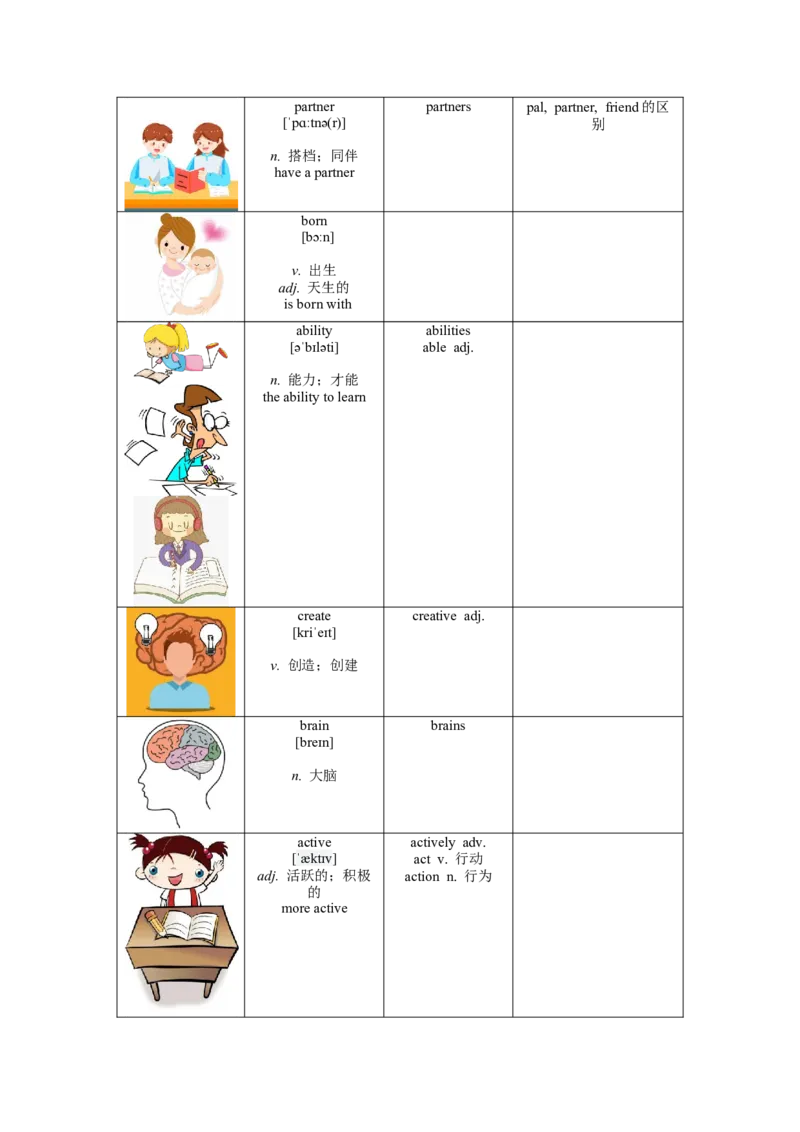
active actively adv.
[ˈæktɪv] act v. 行动
adj. 活跃的;积极 action n. 行为
的
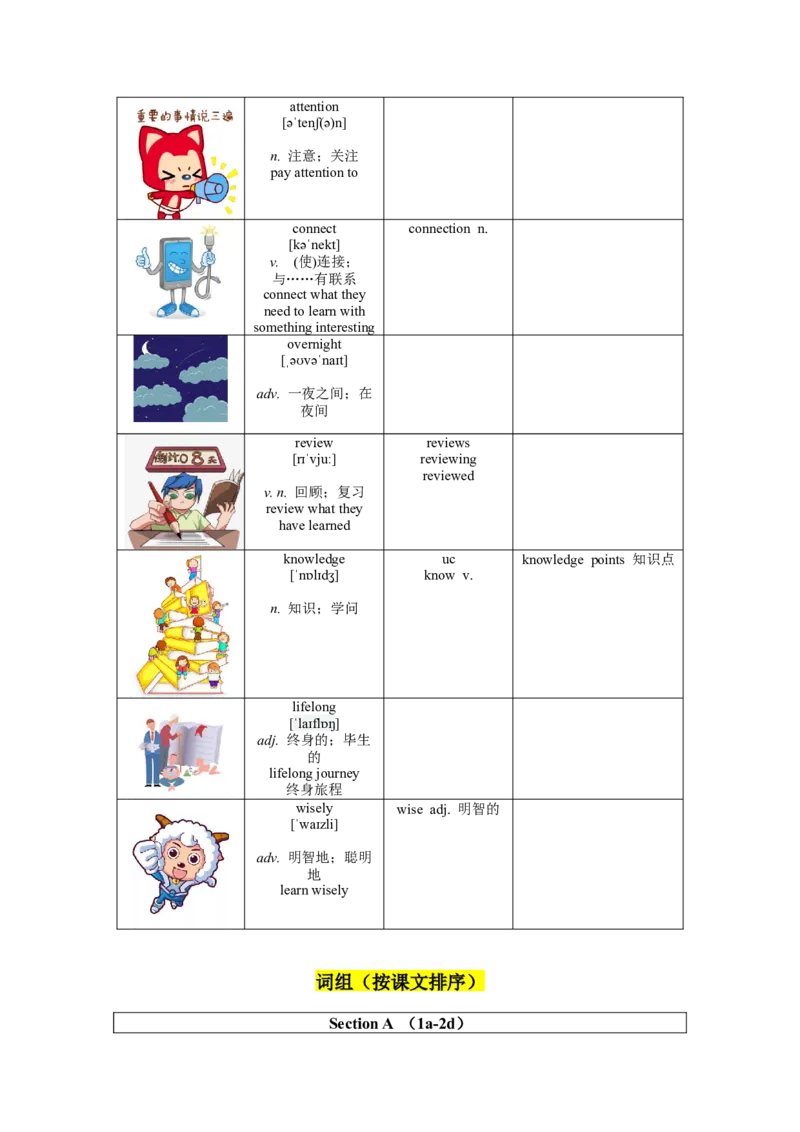
more activeattention
[əˈtenʃ(ə)n]
n. 注意;关注
pay attention to
connect connection n.
[kəˈnekt]
v. (使)连接;
与……有联系
connect what they
need to learn with
something interesting
overnight
[ˌəʊvəˈnaɪt]
adv. 一夜之间;在
夜间
review reviews
[rɪˈvjuː] reviewing
reviewed
v. n. 回顾;复习
review what they
have learned
knowledge uc knowledge points 知识点
[ˈnɒlɪdʒ] know v.
n. 知识;学问
lifelong
[ˈlaɪflɒŋ]
adj. 终身的;毕生
的
lifelong journey
终身旅程
wisely wise adj. 明智的
[ˈwaɪzli]
adv. 明智地;聪明
地
learn wisely
词组(按课文排序)
Section A (1a-2d)1. by working with friends 和朋友合作
2. work with a group 团队合作
3. ask the teacher for help 向老师寻求帮助
4. have conversation with friends 和朋友聊天
5. read aloud 大声地读
6. practice pronunciation 练习发音
7. improves my speaking skills 提高口语技能
8. too hard to understand 太难而不能理解
9. spoken English 英语口语
10. a little nervous 有一点紧张
11. finish reading 完成阅读
12. give a report 做报告
13. get the main idea 获取大意
14. word by word 逐句逐字读
15. word groups 意群
16. more than 超过
17. be patient 耐心点
18. become better 变得更好
Section A(3a-3b)
19. speak so quickly 讲得很快
20. most of time 大部分时间
21. be afraid to ask questions 害怕去问问题
22. because of 因为
23. poor pronunciation 发音不好
24. hide behind 躲在……后面
25. fall in love with sb. 爱上某人
26. body language 肢体语言
27. help sb to get the meaning帮助某人了解意思
28. key words 关键词
29. as well 也
30. listen to the conversations 听对话
31. look up (在词典、参考书中或通过电脑)查阅;抬头看
32. have a better understanding 有个更好的理解
33. It's a piece of cake 小菜一碟
34. It serves you right 你活该35. something interesting 一些有趣的东西
36. the secret to language learning语言学习的秘密
37. the expressions on their faces 脸上的表情
38. more grammar更多的语法
Section A(Grammar Focus-4c)
39. repeat out loud 大声重复
40. take notes 记笔记
41. pen pals笔友
42. memorize sentence patterns背句型
43. practice speaking 练习口语
Section B(1a-1e)
44. increase reading speed 提高阅读速度
45. spell English words 拼读英语单词
46. make mistakes 犯错
47. practice speaking 练习口语
48. have a partner 有个搭档
49. pay attention to 注意;关注
Section B(2a-2e)
50. connect … with 把……和……连接或联系起来
51. be born with 天生具有
52. the ability to learn 学习的能力
53. depends on 依靠
54. have ... in common 有……共同之处
55. more active 更活跃的
56. Knowledge comes from questioning. 知识来自质疑
57. Practice makes perfect. 熟能生巧
58. is not enough to do 还不足够做
59. mind maps 思维导图
60. lifelong journey 终身旅行
61. learn wisely 明智地学习
62. be stressed out 压力过大
63. bit by bit 一点一点地
64. instead of 而不是
65. at once 立即
66. over and over again 一再地67. improve her reading speed 提高阅读速度
句子
1. The more you read, the faster you’ll be.
The more carefully you work, the fewer mistakes you’ll make.
The kinder you are, the more friends you’ll make.
【考点】
考点①the+副词比较级
考点②the+形容词比较级
【练习】
The more we do for other people, the ________ we will be.
A.the happiest B. happy C. happier D. happiest
The more we do for other people, the ________ we will be.
A. will study; will get B. study; will get C. will study; get D. studying; getting
2. 询问学习方法的句型
—How do you study for a test?
—I study by working with a group.
—How does she study for English?
—She studies by making word cards.
【考点】
考点①by+动名词
考点②用how来提问方式
【练习】
You can improve your English by ________ more.
A. practicing B. practice C. practices D. to practice
— How do you study ________ a test?
— I study _________ working with a group.
A. for; by B. by; in C. for; from D. of; by
3. It's too hard to understand spoken English.
The little girl is too young to dress herself.
= The little girl is so young that she can’t dress herself.
= The little girl isn’t old enough to dress herself.
【考点】
考点①too + 形容词 + to do
考点②too + 形容词 + to do = so + 形容词 + that = 形容词(反义词) + enough + todo
【练习】
他说话声音很低,太难听清楚他说什么了。
He speaks in a low voice.lt's ______ ______ ______hear him clearly.
4. Why did Wei Fen find it difficult to learn English?
I find it difficult to learn physics well.
I find it difficult to understand the passage with lots of new words.
【考点】
考点①it作形式宾语
考点②其后跟动词不定式to do
考点③此结构与find有相同用法的动词还有make/believe/think
【练习】
We all think _____ necessary to stop school bullying(校园欺凌)。
A. this B. it C. that D. one
Pay treasure(支付宝) has made __________ possible for us to buy things online.
A. it B. this C. that D. one
At first,I found _________ difficult _________ what I learned in a short time.
A. it's;memorizing B. it's;to memorizing C. it;memorizing D. it;to memorize
5. I discovered that listening to something interesting is the secret to language learning.
I think eating fruit(s) is good for our health.
Watching too much TV harms your eyes.
Reading opens up a whole new world to us.
【考点】
考点①当动词或者动词短语在句中充当主语时,要用动名词形式。
考点②当动名词作主语表示不可数,be动词用三单
考点③当动名词作主语表示不可数,谓语动词用三单
【练习】
You can improve your English by ________ more.
A. practicing B. practice C. practices D. to practice
— How do you study ________ a test?
— I study _________ working with a group.
A. for; by B. by; in C. for; from D. of; by
6. I want to learn new words and more grammar so that I can have a better
understanding of English movies.
I want to learn new words and more grammar in order that I can have a better understanding
of English movies.
I want to learn new words and more grammar so as to have a better understanding ofEnglish movies.
I want to learn new words and more grammar in order to have a better understanding of
English movies.
【考点】
考点①so that + 句子 = in oder that+ 句子
考点②so as to + 动词短语 = in oder to + 动词短语
考点③so that 和 so ... that 引导的分别是不同的状语从句
考点④考查相关结构的区别:too...to...;so that;such that;so...that...
【练习】
Read it aloud ________ the whole class can hear you clearly.
A.when B.if C.although D.so that
Please answer the question in a loud voice ________ all the class may hear.
A.in order to B.or C.in order that D.but
Yesterday, Lin Tao’s speech on how to be a good volunteer was ________ wonderful that we
couldn’t stop cheering for him.
A.so B.very C.too D.quite
—What do you think of the new movie Cliff Walkers (《悬崖之上》)?
—It’s ________ wonderful ________ I really like it.
A.so; that B.such; that C.too; to D.enough; to
7. whether or not引导的主语从句
But whether or not you can do this well depends on your learning habits.
Whether or not we can hold a sports meeting tomorrow will depend on the weather.
Whether or not he can pass the exam is unknown.
【考点】
考点①whether or not引导的主语从句,其后的谓语动词用三单
考点②whether 和 if都表示“是否时”,句子中有or not只能用whether,其他情况下
可替换。
【练习】
___________ we will go for a picnic or not depends on the weather.
A. When B. While C. If D. Whether
8. 不定式句型:It+be+adj.+for+sb+to do sth
... it is also easier for you to pay attention to it for a lon1g time.
It's necessary for us to talk to our parents when we have problems.
It’s important for us to do morning exercises every day.
It's very nice of you to help me a lot.
It's clever of you to work out all the problems.
【考点】
1. it作形式主语,不可更替2. 其后的不定式是真正的主语,要用to do
3. of和for的区别在于其前面的形容词指人还是指物
【练习】
__________ is important for children to get a good education.
A. This B. That C. What D. It
It's very glad __________ me to help your English.
A. for B. with C. of D. to
It's dangerous for you ___________ the tree.
A. climb B. to climb C. climbing D. climbed
It is very important ___________ us ____________ in a good mood.
A. of; be B. of; being C. for; being D. for; to be
9. even if 引导的让步状语从句
Even if you learn something well, you will forget it unless you use it.
Even if the watch will work well it's in water.
I will support you even if you don't succeed.
Even though he didn't help me find my lost wallet, I thanked him all the same.
Mr. Wu never bought expensive clothes even though he could afford them.
【考点】考点①even if表示“即使,假设”,
考点②在假设条件下,从句是一般现在时,主句是一般将来时
考点③ even if 和 even though 的区别:even if 侧重于“假设,假如,即使”;even
though侧重于“尽管,虽然,即使”。一般情况下可互换。
【练习】
We will not give up ________ we shall fail ten times.
A. even if B. as C. though D. until
—I don't think we need to invite Mike to our party because he is busy.
—It is better to ask him ____he might refuse our invitation.
A. as soon as B. as if C. even though D. so that
语法
1. by + 动名词,用how来提问
I study by working with a group.
One way is by listening to tapes.
You can read faster by reading word groups.
2. by +交通工具,中间不能用the
I love travelling by bus.
Tom often goes to work by bike.His family want to go to Mount Emei by train.
3. by + 反身代词,独自,反身代词根据主语而定
Those boys learn to ski by themselves.
The boy learns to ski by himself.
I learn to ski by myself.
4. by + 名词,固定搭配
They met by chance.
Farm workers milked cows by hand.
I did it by mistake.
5. by + 动作执行者,被谁……
The car is washed by the man.
The town is cut off by snow.
Chinese is spoken by more and more people in the world.
6. by + 地点名词,靠近……
The policeman is standing by the window.
Old people get together and do exercise by the lake.
7. by + 时间点,截止到……,……之前
I have read 5 books by now.
They had finished their work by the end of last week.
I have to be back by ten o'clock.
8. by + the + 身体部位,常与动词catch/hold等连用(名词前需加冠词)。
The policeman caught the thief by the arm.
I took him by the hand.
课文
Section A
1a Check (√) the ways you study English. Then add other ways you sometimes study.
________ a. by working with friends
________ b. by making word cards
________ c. by reading the textbook
________ d. by listening to tapes
________ e. by asking the teacher for help1b Listen. How do these students study for a test? Write letters from 1a above.
__________ 1. Meiping
__________ 2. Peter
__________ 3. Tony
2a Listen and check (√) the questions you hear.
Questions
1.____ Does anyone learn English by watching videos?
2.____ Do you have conversations with friends in English?
3.____ What about listening to tapes?
4.____ What about reading aloud to practice pronunciation?
5.____ Have you ever studied with a group?
Answers
2b Listen again. Match each answer below with a question above.
a. Yes, I have. I've learned a lot that way.
b. Oh, yes. It really improves my speaking skills.
c. Ido that sometimes. I think it helps.
d. No. It's too hard to understand spoken English.
2d Role-play the conversation.
Jack: Annie, I'm a little nervous. I have to finish reading a book and give a report next Monday.
Annie: That doesn't sound too bad.
Jack: But I'm a very slow reader.Annie: Just read quickly to get the main ideas at first. Don't read word by word. Read word
groups.
Jack: But I don't understand many of the words. I have to use a dictionary.
Annie: Try to guess a word's meaning by reading the sentences before and after it. You probably
understand more than you think.
Jack: That sounds difficult!
Annie: Well, be patient. It takes time. You can become better by reading something you enjoy
every day. The more you read, the faster you'll be.
3a Read the passage about Wei Fen and answer the questions.
1. Why did Wei Fen find it difficult to learn English?
2. What did she do in English class?
3. What is the secret to language learning?
3a
1.The teacher spoke too quickly and Wei Fen did not understand her most of the time,but she was
afraid to ask questions because of her poor pronunciation.
2.She hid behind her textbook and never said anything.
3.For WeiFen, the secret to language learning is listening to some thing interesting.
How I Learned to Learn English
Last year, I did not like my English class. Every class was like a bad dream. The teacher spoke so
quickly that I did not understand her most of the time. I was afraid to ask questions because of my
poor pronunciation. I just hid behind my textbook and never said anything.
Then one day I watched an English movie called Toy Story. I fell in love with this exciting and
funny movie! So I began to watch other English movies, too.Although I could not understand
everything the characters said, their body language and the expressions on their faces helped me
to get the meaning. I also realized I could get the meaning by listening for just the key words. My
pronunciation improved as well by listening to the conversations in English movies. I discovered
that listening to something interesting is the secret to language learning. I also learned useful
sentences like "It's a piece of cake" or "It serves you right". I did not understand these sentences
at first. But because I wanted to understand the story, I looked them up in a dictionary.
Now I really enjoy my English class. I want to learn new words and more grammar so that I can
have a better understanding of English movies.
3b Complete the sentences with what Wei Fen learned from watching movies. Use
words and phrases from the passage.
1. I can understand the meaning by watching their ___________ and the ___________ on their
faces.
2. I can get the meaning by listening for just the ___________.
3. My pronunciation improved by listening to the ___________ in English movies.
4. I learned ____________ sentences like"It's a piece of cake" by watching the movies.
5. I can find the meaning of new words by looking them up in a ____________.
3b 1.body language,expressions 2.key words 3.conversations 4.useful
Grammar Focus
How do you learn English?
Do you learn English by reading aloud?
How can I read faster?
How can I improve my pronunciation?I learn by studying with a group.
Yes, I do. It helps my pronunciation.
You can read faster by reading word groups.
One way is by listening to tapes.
4a Match the questions and answers.
1. How do you practice speaking?
2. How do you learn new words?
3. How do you improve your writing?
4. How do you practice listening?
5. How do you improve your pronunciation?
6. How do you learn grammar?
a. By watching English programs.
b. By listening to a tape and repeating out loud.
c. By having conversations with friends.
d. By taking notes, doing exercises and reading a lot.
e. By making word cards.
f. By writing e-mails to my pen pals.
4b Make sentences using the structure"do sth. by doing"with the subjects in the box
and information that is true for you.
math physics chemistry Chinese history geography
e.g. I usually practice my English by taking notes l reading books and newspapers /
speaking English with my classmates / memorizing sentence patterns.
4c Check (√ ) what you do to learn English.Then interview your partner.
A: Do you learn English by doing grammar exercises?
B: Yes, I do.
A: How often do you do them?
B: ...
I learn English by... My partner learns English by ... yes no how often
doing grammar exercises
taking notes in English
reading English books/magazines
keeping a diary in English
using an English dictionary
Section B
1a Learning English can be difficult. What things are difficult for you?Read the list.Check
(√) the statements that are true for you.
I can't pronounce some of the words.
I can't always understand spoken English.
I don't know how to increase my reading speed.
I can't spell some English words.
I often make mistakes in grammar.
1b What other things are difficult for you? Make a list.
1. I don't know enough words to write well,
2.
3.1c Paul finds it difficult to learn English. Listen and complete the learning challenges
he talks about.
Challenges
1.He can't get the _______ right.
2.He _______ a lot of new words.
3.He can't always ________ when people talk to him.
4.He doesn't get much _________ practice.
1c 1.pronunciation 2.forgets 3.understand 4.writing
1d Listen again.Complete the solutions.
Solutions
1. __________ can help.
2.He can always ________ in his notebook and study them at home.
3. He can __________ to practice speaking.
4.He should find a __________ to practice writing.
1d 1.Listening 2.write the new words 3.join an English language club 4.pen pal
1e Role-play conversations using the information in 1c and 1d.
A: I don't have a partner to practice English with.
B: Maybe you should join an English club.
2a what good learning habits can you think of? Make a list and discuss them with your
partner.
2b Read the passage quickly and check if any of the habits you listed in 2a are
mentioned.Which four habits of successful learners can you find from the passage?
How Can You Become a Successful Learner?
Everyone is born with the ability to learn. But whether or not you can do this well depends
on your learning habits. Research shows that successful learners have some good habits in
common.
Creating an interest in what they learn
Studies show that if you are interested in something, your brain is more active and it is also
easier for you to pay attention to it for a long time.Good learners often connect what they need
to learn with something interesting. For example, if they need to learn English and they like
music or sports, they can listen to English songs or watch sports programs in English. This way
they will not get bored.
Practicing and learning from mistakes
Good learners think about what they are good at and what they need to practice more.Remember,
"Use it or lose it." Even if you learn something well, you will forget it unless you use
it."Practice makes perfect." Good learners will keep practicing what they have learned, and they
are not afraid of making mistakes.Alexander Graham Bell did not invent the telephone overnight.
He succeeded by trying many times and learning from his mistakes.
Developing their study skills
It is not enough to just study hard. Good learners know the best way they can study.For
example, they may take notes by writing down key words or by drawing mind maps. They also
look for ways to review what they have learned.They may do this by reading their notes every
day or by explaining the information to another student.
Asking questions
Good learners often ask questions during or after class.They even ask each other and try to findout the answers.Knowledge comes from questioning.
Learning is a lifelong journey because every day brings something new. Everything that you
learn becomes a part of you and changes you, so learn wisely and learn well.
2c Read the passage again and answer the questions.
1. Does the writer think that everyone is born with the ability to learn well?Do you
agree? Why or why not?
The writer doesn't think that everyone is born with the ability to learn well.
2.Why is it a good idea to connect something you need to learn with something you are
interested in?
This is because studies show that if you are interested in something,your brain is more
active and it is easier for you to pay attention to it for a long time,You will also not get
bored.
3. What do the sayings "Use it or lose it” and "Practice makes perfect”mean?Do you
agree with them?
Use it or lost it:If you stop doing something,you will forget how to do it.
Practice makes perfect:If you do something again and again,you will become very good at
it.
4.Do good learners learn from mistakes, or are they afraid of making mistakes?
They learn from mistakes,and they are not afraid of making mistakes.
5. What study skills does the writer talk about? Do you have those study skills?
Take notes by writing down key words or by drawing mind maps. Look for ways to
review what has been learnt,e g,read the notes every day or explain the information to
another student.
6.Do you agree that learning is a lifelong journey? Why or why not?
2d Look up the following words from the passage in the dictionary. Then write a
sentence for each word.
brain n.
connect v.
overnight adv.
attention n.
review v.
knowledge n.
ability n.
active adj.
wisely adv.
e.g.brain: A good way to train the brain is to do some math exercises every day.
2e Do you think you are a good learner? What learning habits do you think are
useful?Discuss with your group and share your ideas with the class.
3a Your friend wants to improve his/her English and asks you for help. What are the three
best ways to learn and why? Make some notes in the chart.
Best ways to learn Reasons Examples
1. Being interested in what If you are interested in If you like music, you can
you do something, your brain will be learn English by listening to
more active and English songs.
...
2.
3.
Self-Check
1 Fill in the blanks with the words in the box.practice develop remember prepare take notes until worry about everything
Are you stressed out each time you have a test? You don't have to be if you __________ smart
study skills. Remember to __________ in class and review them on your own or with friends
after class. Then __________ what you learned by doing exercises. Try to study and information
bit by bit instead of waiting __________ the last minute to study __________ at once.If you
__________ well for a test, then there's nothing to __________!
1 develop, take notes, practice,remember,until, everything, prepare, worry about
2 Number these sentences in order to make a conversation.
__________ What's the matter?
__________ Well, I practice my listening by listening to the tape over and over again until I
can understand everything.
__________ So you want to practice your listening?
__________ Hi, Jake. I need your help.
__________ Uh-huh. Do you have any advice?
__________ OK, I'll try that.
__________ I have a listening test next week.
2,6,4,1,5,7,3
3 Give advice to these people.
1. Jane is a very slow reader.
She should improve her reading speed __________________________.
2.Li Ming wants to improve his listening.
He could practice his listening __________________________.
3.Meiping doesn't know many English words.
She could learn more words __________________________.
电子版单词表
Words and Expressions in each unit
textbook n. 教科书;课本
conversation n. 交谈;谈话
aloud adv. 大声地;出声地
pronunciation n. 发音;读音
sentence n. 句子
patient adj. 有耐心的n. 病人
expression n.表情;表示;表达方式
discover v. 发现;发觉
secret n. 秘密;秘诀adj. 秘密的;保密的
look up (在词典、参考书中或通过电脑)查阅;抬头看
grammar n. 语法
repeat v. 重复;重做note n. 笔记;记录v. 注意;指出
pal n. 朋友;伙伴
physics n. 物理;物理学
chemistry n. 化学
memorize v. 记忆;记住
pattern n. 模式;方式
pronounce v. 发音
increase v. 增加;增长
speed n. 速度
partner n. 搭档;同伴
born v. 出生adj. 天生的
be born with 天生具有
ability n. 能力;才能
create v. 创造;创建
brain n. 大脑
active adj. 活跃的;积极的
attention n. 注意;关注
pay attention to 注意;关注
connect v. (使)连接;与……有联系
connect … with 把……和……连接或联系起来
overnight adv. 一夜之间;在夜间
review v. n. 回顾;复习
knowledge n. 知识;学问
lifelong adj. 终身的;毕生的
wisely adv. 明智地;聪明地
Annie 安妮(女名)
Alexander Graham 亚历山大•格雷厄姆•贝尔