Unit 4 单元知识清单
Section B
一、 基础知识清单
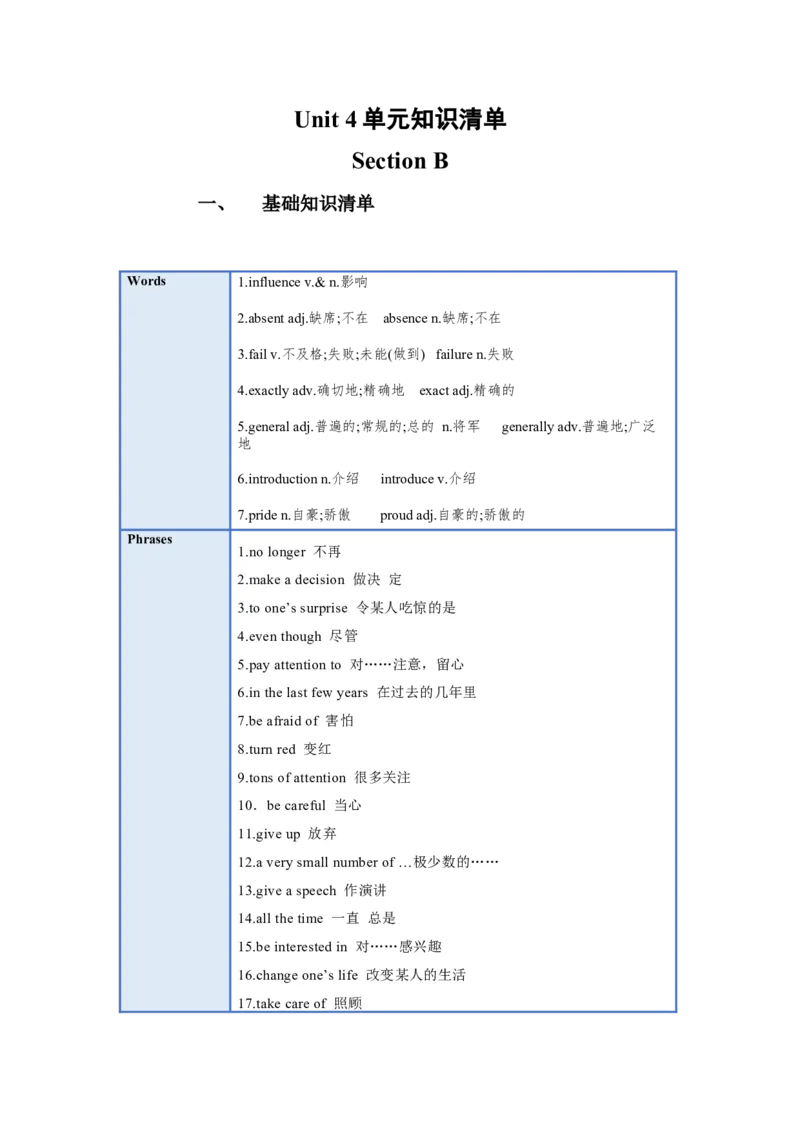
Words 1.influence v.& n.影响
2.absent adj.缺席;不在 absence n.缺席;不在
3.fail v.不及格;失败;未能(做到) failure n.失败
4.exactly adv.确切地;精确地 exact adj.精确的
5.general adj.普遍的;常规的;总的 n.将军 generally adv.普遍地;广泛
地
6.introduction n.介绍 introduce v.介绍
7.pride n.自豪;骄傲 proud adj.自豪的;骄傲的
Phrases
1.no longer 不再
2.make a decision 做决 定
3.to one’s surprise 令某人吃惊的是
4.even though 尽管
5.pay attention to 对……注意,留心
6.in the last few years 在过去的几年里
7.be afraid of 害怕
8.turn red 变红
9.tons of attention 很多关注
10.be careful 当心
11.give up 放弃
12.a very small number of …极少数的……
13.give a speech 作演讲
14.all the time 一直 总是
15.be interested in 对……感兴趣
16.change one’s life 改变某人的生活
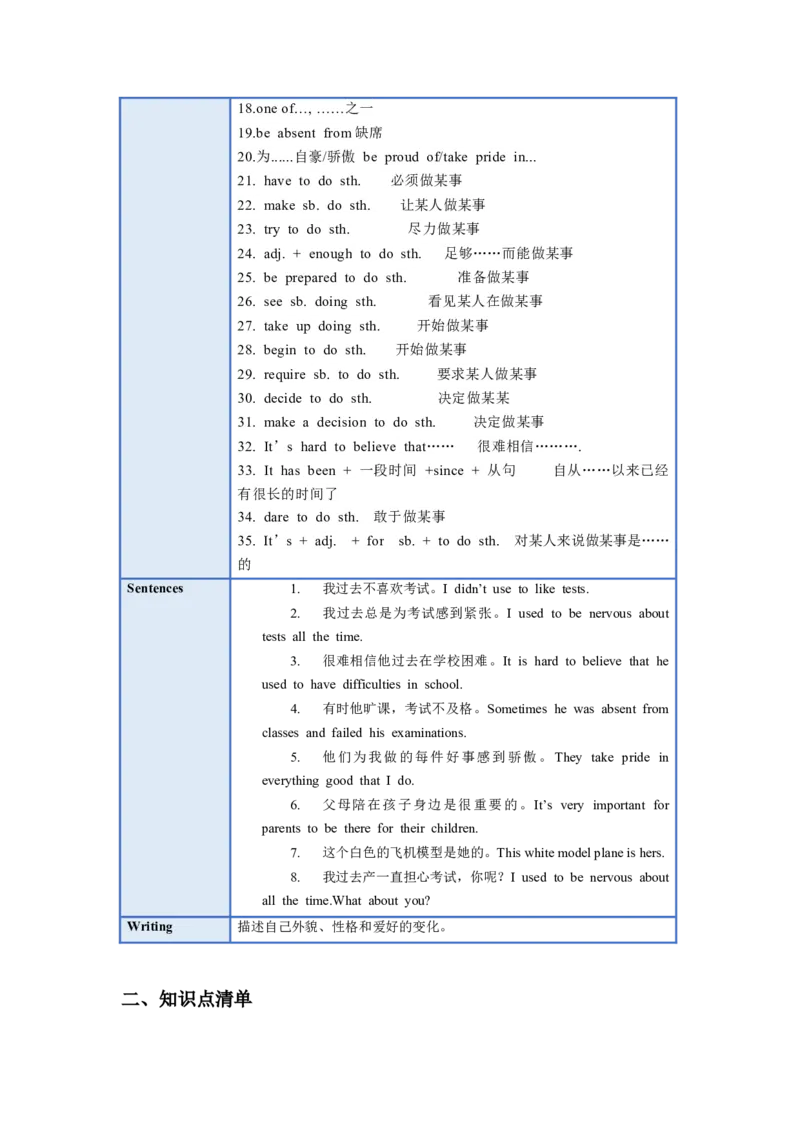
17.take care of 照顾18.one of…, ……之一
19.be absent from缺席
20.为......自豪/骄傲 be proud of/take pride in...
21. have to do sth. 必须做某事
22. make sb. do sth. 让某人做某事
23. try to do sth. 尽力做某事
24. adj. + enough to do sth. 足够……而能做某事
25. be prepared to do sth. 准备做某事
26. see sb. doing sth. 看见某人在做某事
27. take up doing sth. 开始做某事
28. begin to do sth. 开始做某事
29. require sb. to do sth. 要求某人做某事
30. decide to do sth. 决定做某某
31. make a decision to do sth. 决定做某事
32. It’s hard to believe that…… 很难相信……….
33. It has been + 一段时间 +since + 从句 自从……以来已经
有很长的时间了
34. dare to do sth. 敢于做某事
35. It’s + adj. + for sb. + to do sth. 对某人来说做某事是……
的
Sentences 1. 我过去不喜欢考试。I didn’t use to like tests.
2. 我过去总是为考试感到紧张。I used to be nervous about
tests all the time.
3. 很难相信他过去在学校困难。It is hard to believe that he
used to have difficulties in school.
4. 有时他旷课,考试不及格。Sometimes he was absent from
classes and failed his examinations.
5. 他们为我做的每件好事感到骄傲。They take pride in
everything good that I do.
6. 父母陪在孩子身边是很重要的。It’s very important for
parents to be there for their children.
7. 这个白色的飞机模型是她的。This white model plane is hers.
8. 我过去产一直担心考试,你呢?I used to be nervous about
all the time.What about you?
Writing 描述自己外貌、性格和爱好的变化。
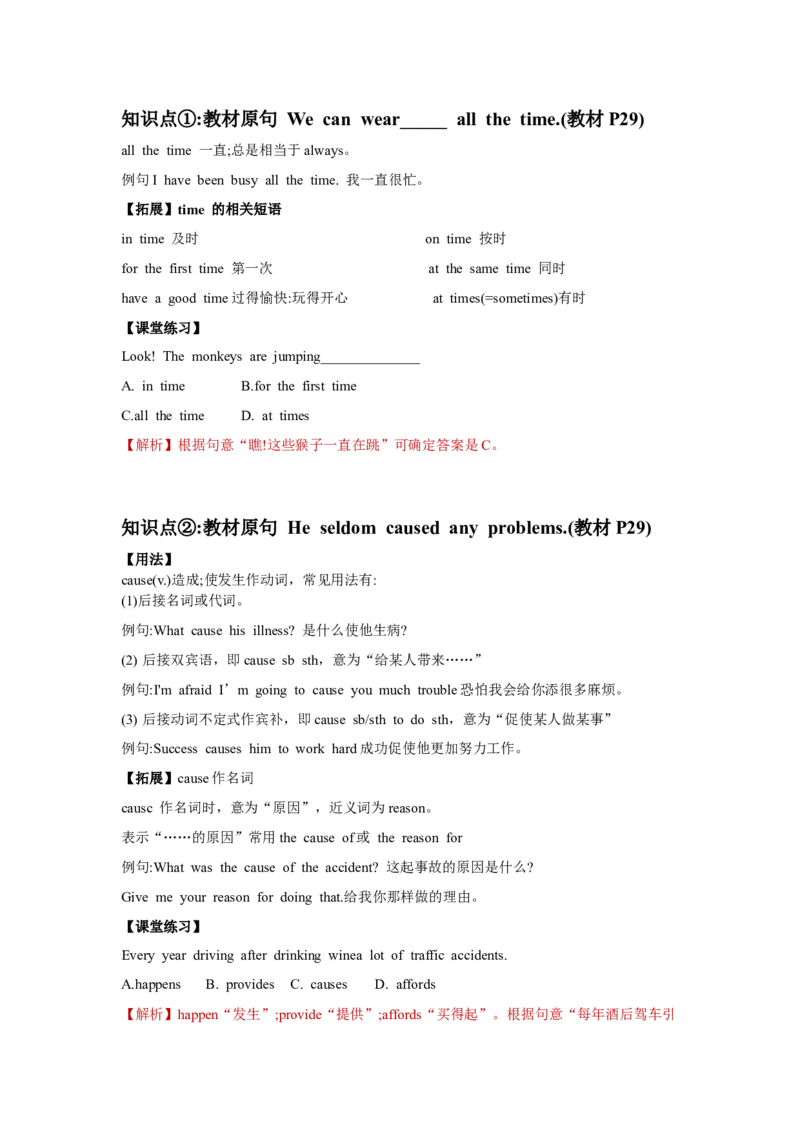
二、知识点清单知识点①:教材原句 We can wear_____ all the time.(教材P29)
all the time 一直;总是相当于always。
例句I have been busy all the time. 我一直很忙。
【拓展】time 的相关短语
in time 及时 on time 按时
for the first time 第一次 at the same time 同时
have a good time过得愉快:玩得开心 at times(=sometimes)有时
【课堂练习】
Look! The monkeys are jumping______________
A. in time B.for the first time
C.all the time D. at times
【解析】根据句意“瞧!这些猴子一直在跳”可确定答案是C。
知识点②:教材原句 He seldom caused any problems.(教材P29)
【用法】
cause(v.)造成;使发生作动词,常见用法有:
(1)后接名词或代词。
例句:What cause his illness? 是什么使他生病?
(2) 后接双宾语,即cause sb sth,意为“给某人带来……”
例句:I'm afraid I’m going to cause you much trouble恐怕我会给你添很多麻烦。
(3) 后接动词不定式作宾补,即cause sb/sth to do sth,意为“促使某人做某事”
例句:Success causes him to work hard成功促使他更加努力工作。
【拓展】cause作名词
causc 作名词时,意为“原因”,近义词为reason。
表示“……的原因”常用the cause of或 the reason for
例句:What was the cause of the accident? 这起事故的原因是什么?
Give me your reason for doing that.给我你那样做的理由。
【课堂练习】
Every year driving after drinking winea lot of traffic accidents.
A.happens B. provides C. causes D. affords
【解析】happen“发生”;provide“提供”;affords“买得起”。根据句意“每年酒后驾车引发大量交通事故”可确定选C。
知识点③:教材原句 Li Wen’s parents made the decision to send
hi to a boarding school.(教材P29)
【用法】
make a decision下决定:下决心
该短语相当于动词decide。decision是动词decide的名词形式。
例句
She could not make a decision about the dresses她对(买不买)这衣服下不了决心。
We need to make a decision on this by next week我们得在下周前就这一问题作出决定。
【课堂拓展】
Jack. will your family move to Shanghai?
-Yes. That's a very big ______my parents made.
A. decide B.decision C.education D. difference
【解析】decide是动词,意为“决定”:decision是名词,意为“决定”; education 是名词,
意为“教育”:diference 是名词,意为“差异,不同”。根据句意“那是我父母做的一个大
决定”以及空格前的a确定用decide的名词形式,故选B。
知识点④:教材原句 Sometimes he was absent from classes and
failed his examinations.(教材P29)
【用法】 absent
absent是形容词,意为“不在的;缺席的”。
例如:How many students are absent today? 今天有多少学生缺席?
Who is absent today? 今天谁不在?
【拓展】
(1)absent的名词是absence,反义词是present.
常用结构:be absent from…意为“缺席……”。与be away from…同义。
例如:Love was totally absent/away from his childhood.他童年时根本没有得到疼爱。
The manager is absent/away from the meeting. 经理缺席了会议。
(2)absent-minded意为“心不在焉的;健忘的”,可用作表语或定语。例如: He is always absent-minded.他老是心不在焉。
知识点④:教材原句 Sometimes he was absent from classes and
failed his examinations.(教材P29)
【用法】sometimes adv.
它常和一般现在时连用,表示现在经常或反复发生的动作。有时候也可表示过去经常性、
习惯性发生的动作。一般放在系动词be、助动词、情态动词之后,实义动词之前。
Bill sometimes asks me “why”.比尔总是问我“为什么”。
【拓展】常见的表示频率的副词还有:usually通常,often经常, sometimes有时,ever曾
经,never从不;always, usually, often, sometimes和never是英语中最常见的频度副词。
(1)always 的频度为100%,表示动作重复、状态继续,中间没有间断,意思是“总是”、
“永远地”。
例如: The sun always rises in the east and sets in the west. 太阳总是东升西落。
(2)usually 的频度为80%左右,意为“通常”、“平常”,即很少有例外。
例如: He usually goes to bed at ten o’clock. 他通常10点钟睡觉。
(3)often 的频度为60%左右,意为“常常”,但不如usually那么频繁,表示动作重复,
中间有间断。
例如:He is often late for school. 他上学经常迟到。
(4) sometimes 的频度为40%左右,意为“有时”,表示动作偶尔发生。可以位于句首,
以示强调。
例如: It is sometimes hot and sometimes cold. 天气忽冷忽热。
Sometimes he does it this way and sometimes he does it that way. 他有时这样做,有时那样做。
(5) seldom的频度为20%左右,意为“很少”、“不经常”。
例如:I seldom go out these days. 这些天我几乎不出门。
(6) never 的频度为0,意为“从来不”、“永不”。
例如: My parents are never late for work. 我父母上班从来不迟到。
【课堂练习】
1.If my friends have any problems, my door is _______ open to them.
A.never B. seldom(很少) C. sometimes D. always【解析】如果我的朋友有任何问题,我的大门总是向他们敞开的。always 符合题意。
故选C。
知识点⑤:教材原句 They take pride in everything good that I do
.(教材P30)
【用法】
pride是名词,意为“骄傲,自豪”。
常用的结构:take pride in sth. 意为“为某事骄傲”。
They take great pride in her daughter who is now a famous scientist.
他们为成为科学家的女儿而感到自豪。
He is the pride of our city. 他是我们城市的骄傲。
【拓展】
proud 是形容词,常用结构:be proud of sth. 意为“以……而骄傲”。
I am very proud of being a Chinese. 作为一名中国人我很自豪
be proud to do sth. 意为“为做某事而骄傲”。
We are proud to be a league member. 我们为成为团员而骄傲。
三、单元写作
1. 本单元主要谈及的哪些方面变化和句型。
2. 写作重点:审要点,structure,logic(content),language.
审题与结构(structure)
归纳明确审题6要素(主题、目的、要点、时态、人称、文体),并练习找出要素。
通过罗列要点,组织作文框架,把所列要点分布在不同的段落。
基本根据“开头-主体-结尾”的结构,构成三段式作文。
开头引出话题,结尾总结抒发,列出的要点放在不同段落。
写作目的可以告诉我们这篇作文的写作重点是什么,做到突出重点,层次写作。
1)审清题目要求:你发生了哪些变化,至 少三条。这些变化对你的影响。你还打算在哪
些方面做出变 化?
2).审文章体裁: 说明文
3).审文章结构 :三段(1)一段开头已给出(2)有哪些变化并对你有什么影响?(3)将来做出什么样的变化?
4).审文章运用时态 :过去的情况用一般过去时现。现在的变化可以用一般现在时也可以用
现在完成时。将来将做出什么样的改变,用一般将来时。
5)审文章所用人称: 第一人称。
6).课本相关内容链接和知识迁移:第四单元的Section A-3a,Section B-2b
7).基本句型: I used to… But now…
3.素材积累
对比变化常用词汇归纳:
1. 性格:humorous, silent, helpful, shy, outgoing, quiet, calm, active, interesting, funny,
serious
2. 外貌:tall, short, thin, heavy, strong, big eyes, wear glasses, beautiful, handsome
3. 学习:score, absent, fail, examination, be good at, do well in
对比变化常用句型归纳:
1. He used to be really…
2. I didn't use to be…
3. …life has changed a lot in the last few years.
4. The biggest change in my life is…
5. This is the most important change because…
6. …used to do/be
7. How/what about you?
8. …has/have changed a lot in the last few years
4.书面表达。
初中生活中, 你有什么改变?你是怎样改变的?请以“How I Have Changed”为题写一篇英
语短文。描述你发生的变化。写作内容包括兴趣爱好、行为习惯、学习习惯等方面, 100词
左右。
How I Have Changed
I have changed a lot since I was in this school three years ago.
I still remember that in my first year, I was too weak to do much exercise and I was not
good at English. But with the help of the teachers and classmates, I do exercise whenever I am free.
What's more , I try my best to read and write English as much as possible. And now I can
run much faster and I can also get better English grades.Thanks to the middle school life, I have changed so much. Thanks to the teachers and
classmates, I have learnt a lot. Never will I forget the valuable middle school life.