Unit 2 I think that mooncakes are delicious!
知识清单
1. 单词(按课文排序)
2. 词组(按课文排序)
3. 句子(含例句+考点+分层练针对习)
4. 语法(含例句+考点+分层针对练习)
5. 课文(含教材答案)
6. 电子版单词表
单词
Section A(1a-2d)
图片 单词 形式变化 其他用法
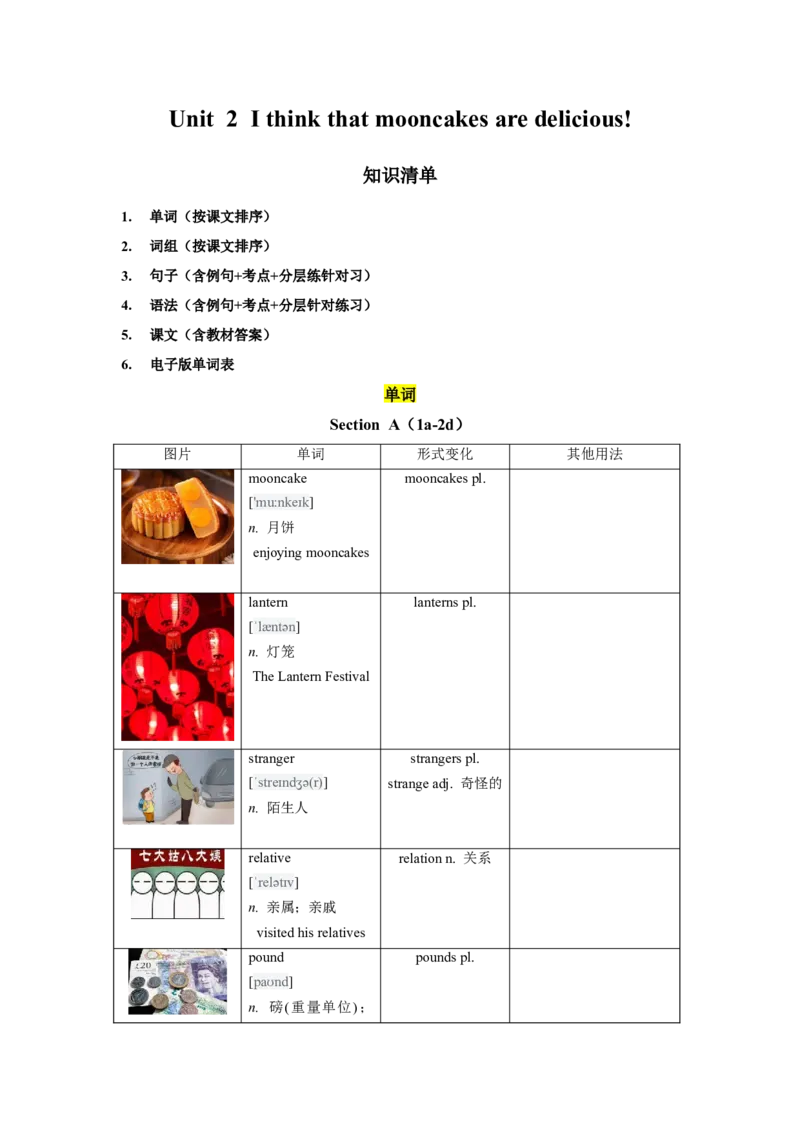
mooncake mooncakes pl.
['mu:nkeɪk]
n. 月饼
enjoying mooncakes
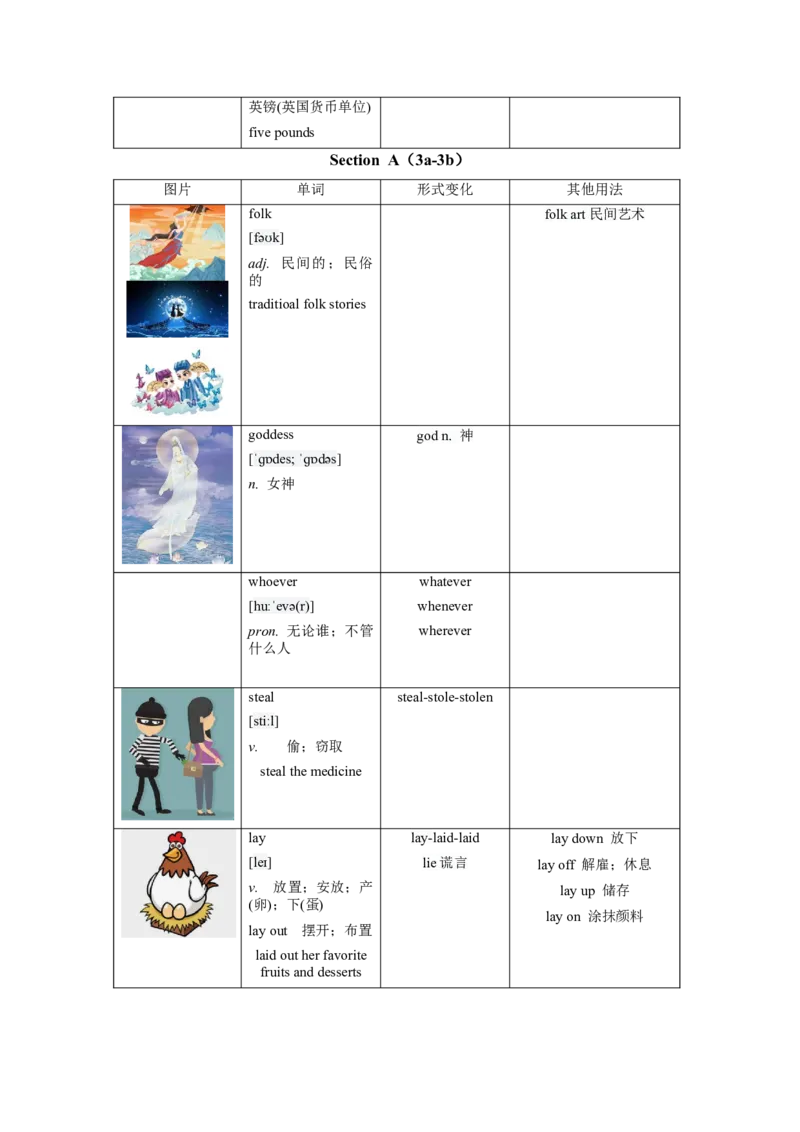
lantern lanterns pl.
[ˈlæntən]
n. 灯笼
The Lantern Festival
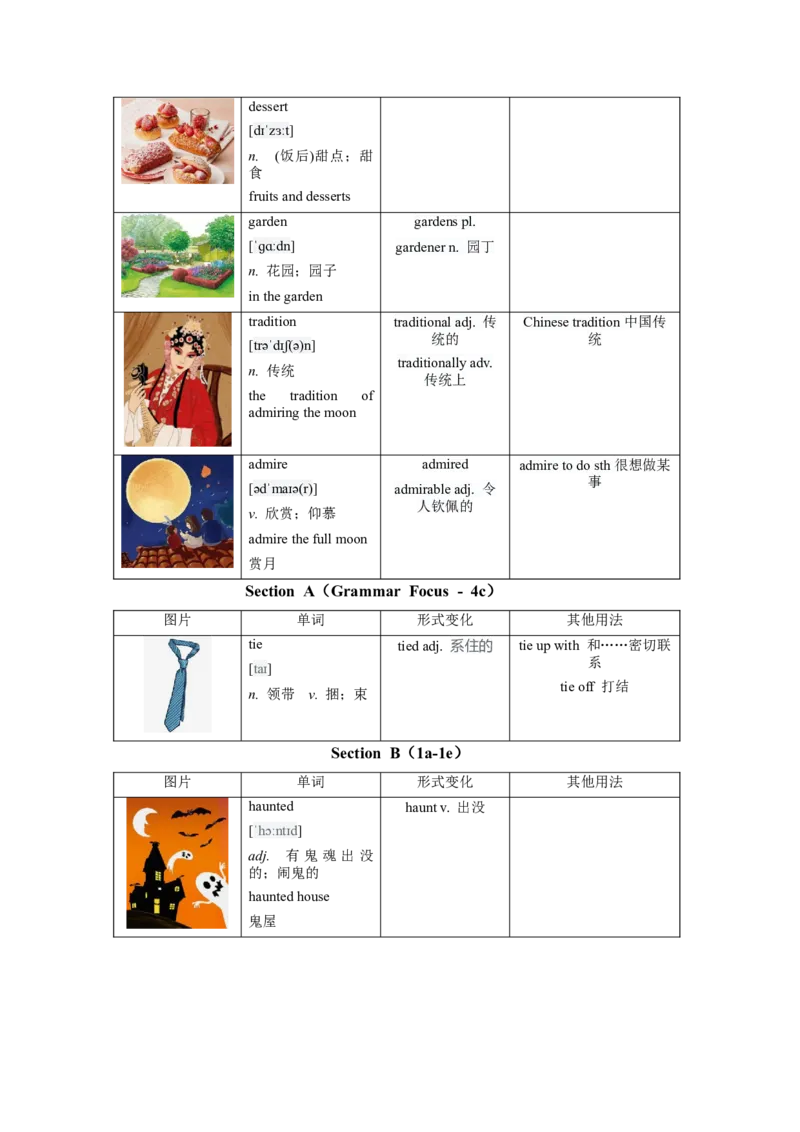
stranger strangers pl.
[ˈstreɪndʒə(r)] strange adj. 奇怪的
n. 陌生人
relative relation n. 关系
[ˈrelətɪv]
n. 亲属;亲戚
visited his relatives
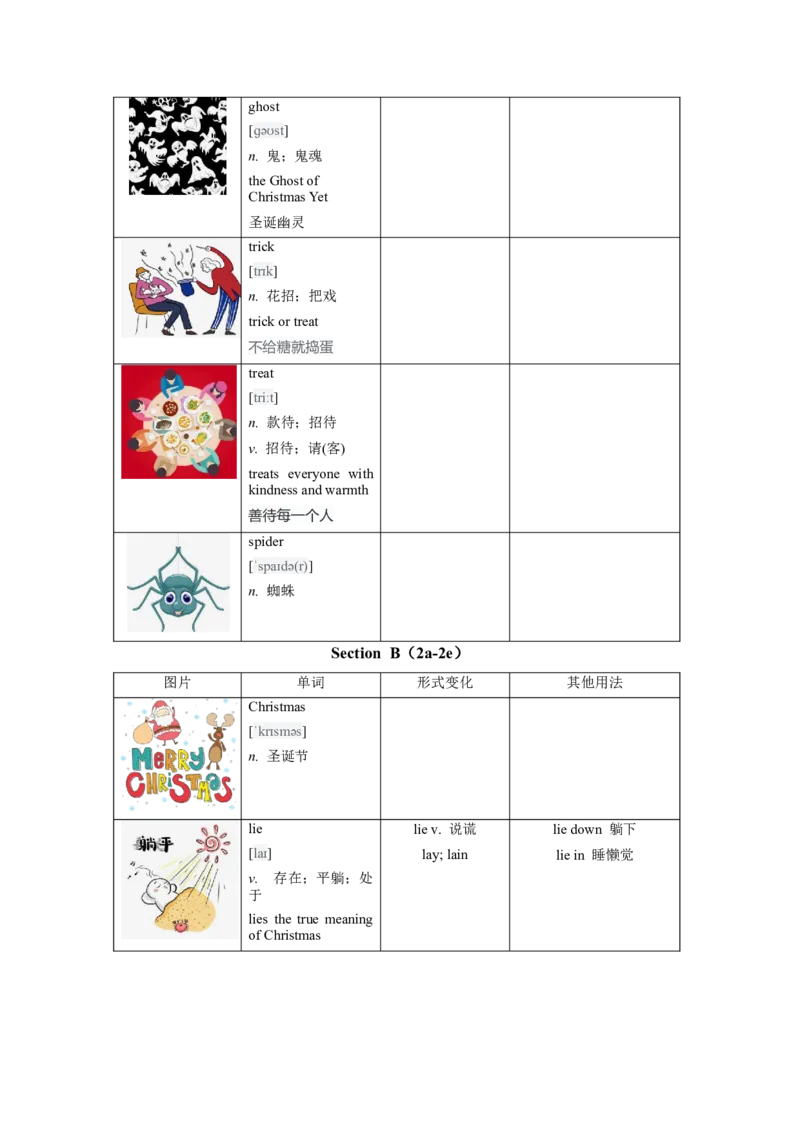
pound pounds pl.
[paʊnd]
n. 磅(重量单位);英镑(英国货币单位)
five pounds
Section A(3a-3b)
图片 单词 形式变化 其他用法
folk folk art 民间艺术
[fəʊk]
adj. 民间的;民俗
的
traditioal folk stories
goddess god n. 神
[ˈɡɒdes; ˈɡɒdəs]
n. 女神
whoever whatever
[huːˈevə(r)] whenever
pron. 无论谁;不管 wherever
什么人
steal steal-stole-stolen
[stiːl]
v. 偷;窃取
steal the medicine
lay lay-laid-laid lay down 放下
[leɪ] lie谎言 lay off 解雇;休息
v. 放置;安放;产 lay up 储存
(卵);下(蛋)
lay on 涂抹颜料
lay out 摆开;布置
laid out her favorite
fruits and dessertsdessert
[dɪˈzɜːt]
n. (饭后)甜点;甜
食
fruits and desserts
garden gardens pl.
[ˈɡɑːdn] gardener n. 园丁
n. 花园;园子
in the garden
tradition traditional adj. 传 Chinese tradition 中国传
统的 统
[trəˈdɪʃ(ə)n]
traditionally adv.
n. 传统
传统上
the tradition of
admiring the moon
admire admired admire to do sth 很想做某
事
[ədˈmaɪə(r)] admirable adj. 令
人钦佩的
v. 欣赏;仰慕
admire the full moon
赏月
Section A(Grammar Focus - 4c)
图片 单词 形式变化 其他用法
tie tied adj. 系住的 tie up with 和……密切联
系
[taɪ]
tie off 打结
n. 领带 v. 捆;束
Section B(1a-1e)
图片 单词 形式变化 其他用法
haunted haunt v. 出没
[ˈhɔːntɪd]
adj. 有 鬼 魂 出 没
的;闹鬼的
haunted house
鬼屋ghost
[ɡəʊst]
n. 鬼;鬼魂
the Ghost of
Christmas Yet
圣诞幽灵
trick
[trɪk]
n. 花招;把戏
trick or treat
不给糖就捣蛋
treat
[triːt]
n. 款待;招待
v. 招待;请(客)
treats everyone with
kindness and warmth
善待每一个人
spider
[ˈspaɪdə(r)]
n. 蜘蛛
Section B(2a-2e)
图片 单词 形式变化 其他用法
Christmas
[ˈkrɪsməs]
n. 圣诞节
lie lie v. 说谎 lie down 躺下
[laɪ] lay; lain lie in 睡懒觉
v. 存在;平躺;处
于
lies the true meaning
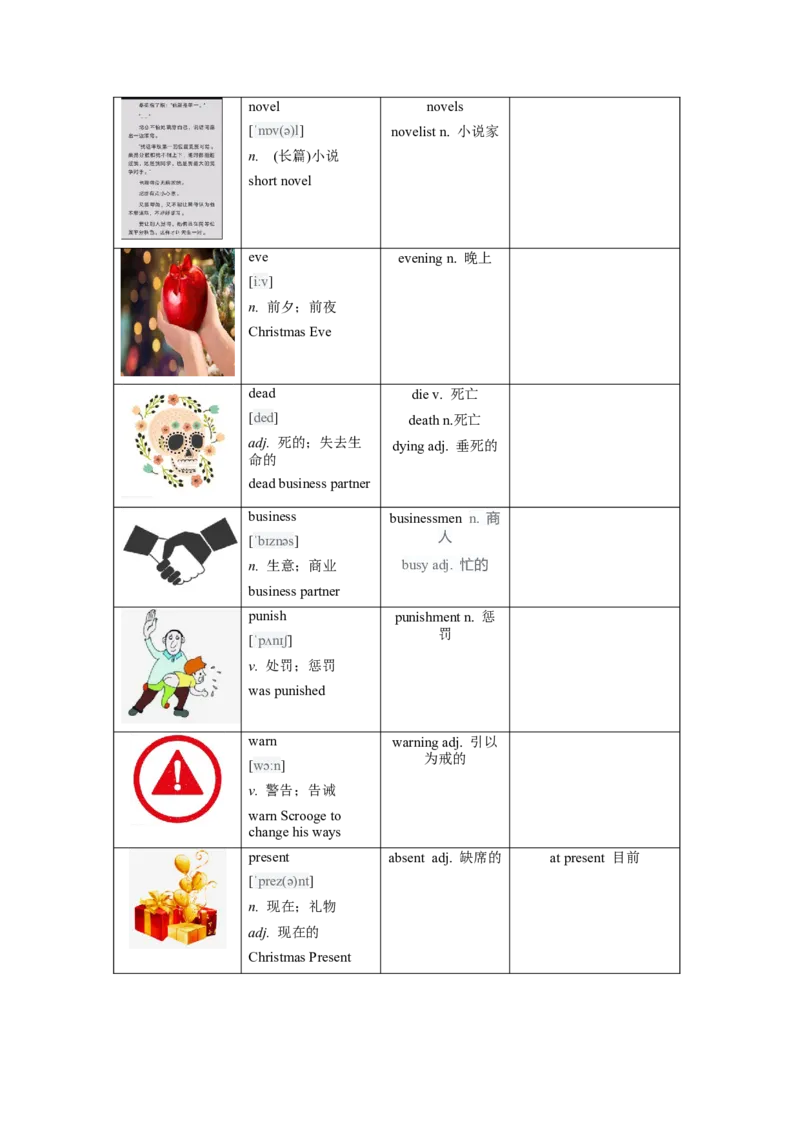
of Christmasnovel novels
[ˈnɒv(ə)l] novelist n. 小说家
n. (长篇)小说
short novel
eve evening n. 晚上
[iːv]
n. 前夕;前夜
Christmas Eve
dead die v. 死亡
[ded] death n.死亡
adj. 死的;失去生 dying adj. 垂死的
命的
dead business partner
business businessmen n. 商
[ˈbɪznəs] 人
n. 生意;商业 busy adj. 忙的
business partner
punish punishment n. 惩
罚
[ˈpʌnɪʃ]
v. 处罚;惩罚
was punished
warn warning adj. 引以
为戒的
[wɔːn]
v. 警告;告诫
warn Scrooge to
change his ways
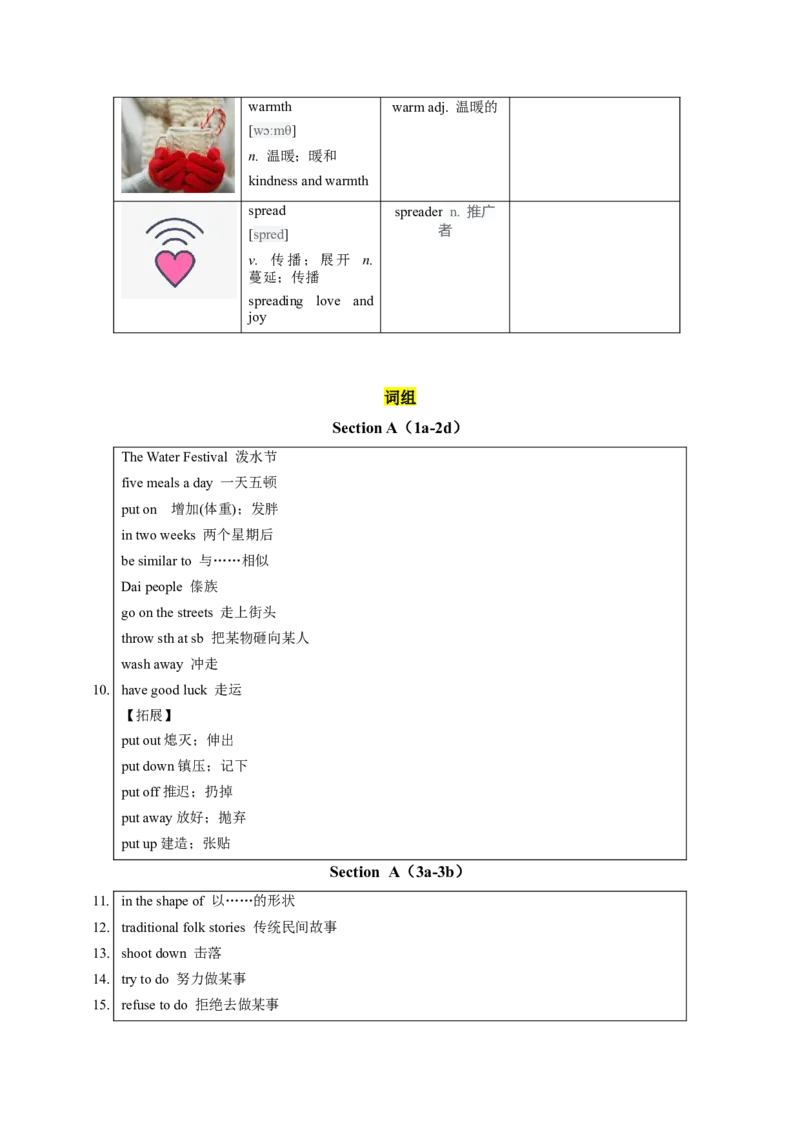
present absent adj. 缺席的 at present 目前
[ˈprez(ə)nt]
n. 现在;礼物
adj. 现在的
Christmas Presentwarmth warm adj. 温暖的
[wɔːmθ]
n. 温暖;暖和
kindness and warmth
spread spreader n. 推广
[spred] 者
v. 传播;展开 n.
蔓延;传播
spreading love and
joy
词组
Section A(1a-2d)
The Water Festival 泼水节
five meals a day 一天五顿
put on 增加(体重);发胖
in two weeks 两个星期后
be similar to 与……相似
Dai people 傣族
go on the streets 走上街头
throw sth at sb 把某物砸向某人
wash away 冲走
10. have good luck 走运
【拓展】
put out 熄灭;伸出
put down 镇压;记下
put off 推迟;扔掉
put away 放好;抛弃
put up 建造;张贴
Section A(3a-3b)
11. in the shape of 以……的形状
12. traditional folk stories 传统民间故事
13. shoot down 击落
14. try to do 努力做某事
15. refuse to do 拒绝去做某事16. fly up 飞起;向上飞
17. call out 大声叫唤
18. right and round 又亮又圆
19. lay out 摆开;布置
20. the tradition of ……的传统
21. share sth with sb 和某人分享某物
22. as a result 结果
23. plan to do 计划去做
【拓展】
动词不定式作宾语:动词+ to do
hope(希望) to do
learn(学会) to do
manage(设法) to do
expect(期待) to do
fail(未履行) to do
volunteer(自愿做) to do
Section A(Grammar Focus-4c)
24. One … the other … 一方面…另一方面…
25. more and more popular 越来越流行
Section B(1a-1e)
26. think of sth思考某物;认为某事
27. trick or treat 不给糖就捣蛋
28. play a trick on sb. 捉弄某人
29. dress up as sb/sth装扮成某人/某物
30. cartoon characters 卡通人物
【拓展】
dress oneself 自己穿衣服
Section B(2a-2e)
the importance of ……的重要性
Christmas Eve 平安夜
warn sb to do sth 警告某人做某事
change one’s life 改变某人的生活end up最终成为
reminds sb of sth. 使某人想起……
promises to do sth. 承诺做某事
celebrate sth. with sb. 和某人一起庆祝
treat sb with sth 以……方式对待某人
【拓展】
1. 含up的短语
use up 用完;用光
eat up 吃光
set up 建立
wake up 醒来
dress up 装扮
fly up 飞向
2. warn sb not to do sth 警告某人不要去做某事
Section B(3a-Self Check)
31. between … and …在……和……之间
32. give out 分发
33. give birth to life 孕育生命
34. not only …but (also) 不仅……而且
【拓展】
go out 出去
carry out 完成;实现
stick out 坚持到底
look out 留神;小心
find out 找到
break out 爆发;突然发生
lay out 放置
句子
Section A(1a-2d)
1. 关于端午节你最喜欢什么?我喜欢龙舟赛。我觉得他们看起来很有趣。(询问喜欢某个
节日的某个习俗)
【原句】What do you like best about the Dragon Boat Festival?
I love the races. I think that they're fun to watch.【例句】What do you like best about the Spring Festival?
I love eating mooncakes. I think that they're delicious.
【考点】What do you like about“关于……你最喜欢什么?”= How do you like ...? =
What do you think of ...?
2. 比尔想知道明年他们是否还会吃粽子。(whether/if引导的宾语从句)
【原句】Bill wonders whether they'll have zongzi again next year.
【例句】I wonder if we will visit the museum.
I wonder if the bookstore opens today.
Of course.
【考点】①whether和if表示“是否”可以替换,句子有“or not”时只能用whether.
②用作宾语的成分由短语或单词变成句子就叫宾语从句
③if在从句中作为引导词,引导宾语从句表“是否”,引导条件状语从句表“如
果”
④句子前无引导词是主句,句子前有引导词是从句
【拓展】①no wonder“难怪,怪不得”;
②回答wonder if可以用of course.
【练习】
1. —I wonder ________.
—Yes, of course.
A.why we will visit the museum B. if we will visit the museum
C. when we will take a trip D. what we can do in the museum
2. —I wonder ________.
—Of course it is.
A. that mooncakes are delicious
B. when the band starts playing this evening
C. whether June is a good time to visit Dandong
D. if the bookstore opens today
3. I don't know ________ he will come tomorrow. ________ he comes, I'll tell you.
A. if; Whether B. if; That C. if; If D. whether; Whether
Section A(3a-3b)
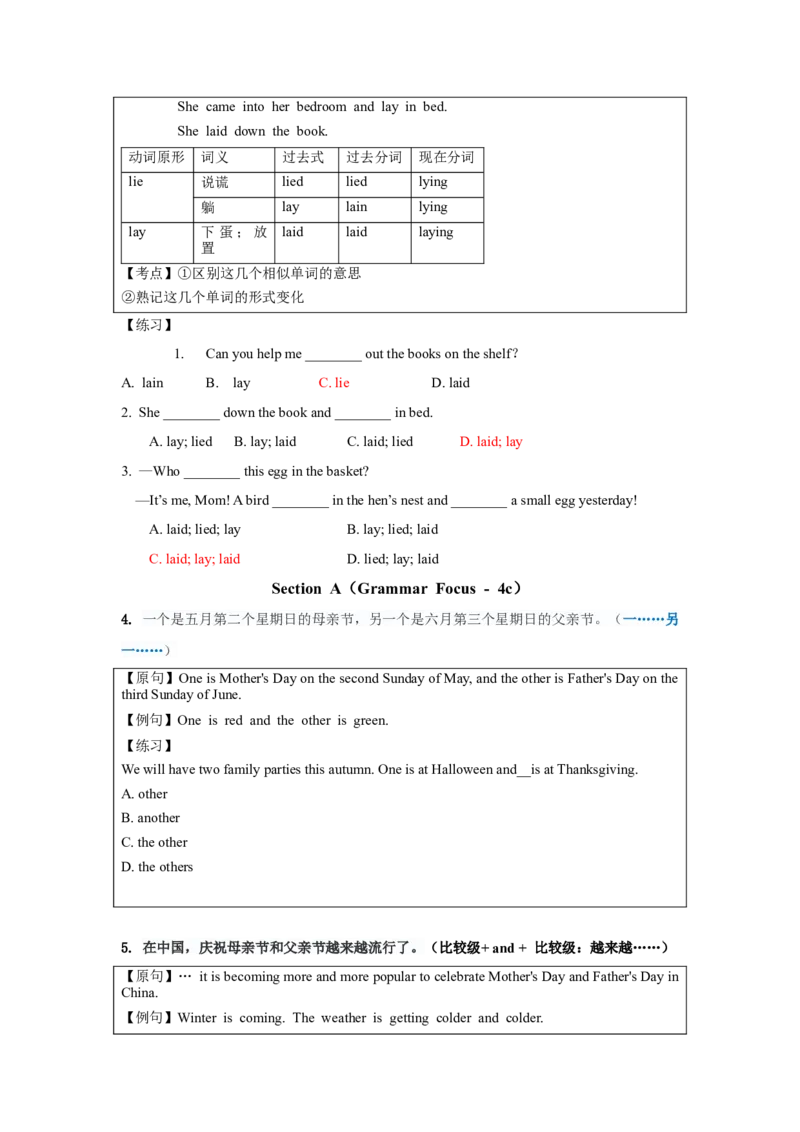
3. 但在这一切的背后是圣诞节的真谛…… (lie和lay的区别 )
【原句】But behind all these things lies the true meaning of Christmas...
【例句】He wasn’t telling the truth. He lied again.She came into her bedroom and lay in bed.
She laid down the book.
动词原形 词义 过去式 过去分词 现在分词
lie 说谎 lied lied lying
躺 lay lain lying
lay 下蛋;放 laid laid laying
置
【考点】①区别这几个相似单词的意思
②熟记这几个单词的形式变化
【练习】
1. Can you help me ________ out the books on the shelf?
A. lain B. lay C. lie D. laid
2. She ________ down the book and ________ in bed.
A. lay; lied B. lay; laid C. laid; lied D. laid; lay
3. —Who ________ this egg in the basket?
—It’s me, Mom! A bird ________ in the hen’s nest and ________ a small egg yesterday!
A. laid; lied; lay B. lay; lied; laid
C. laid; lay; laid D. lied; lay; laid
Section A(Grammar Focus - 4c)
4. 一个是五月第二个星期日的母亲节,另一个是六月第三个星期日的父亲节。(一……另
一……)
【原句】One is Mother's Day on the second Sunday of May, and the other is Father's Day on the
third Sunday of June.
【例句】One is red and the other is green.
【练习】
We will have two family parties this autumn. One is at Halloween and__is at Thanksgiving.
A. other
B. another
C. the other
D. the others
5. 在中国,庆祝母亲节和父亲节越来越流行了。(比较级+ and + 比较级:越来越……)
【原句】… it is becoming more and more popular to celebrate Mother's Day and Father's Day in
China.
【例句】Winter is coming. The weather is getting colder and colder.China is becoming stronger and stronger.
【考点】①结构:比较级 + and + 比较级
②注意:and不可能连接同个形容词的原级,and连接的是同个形容词的比较级表
示越来越……
【练习】
1. I am happy that our hometown is becoming ________.
A.beautiful and beautiful B.more beautiful and beautiful
C.more beautiful and more beautiful D.more and more beautiful
2. -What do you think of Steve's show?
-I don't want to watch it at all, It is becoming _____________ .
A.funny and funny B.more boring and more boring
C.funnier and funnier D.more and more boring
3. The study on Silk Road is becoming among young Germans. Months ago 24
German high school students came to China to experience the Silk Road culture.
A.more and more popular B.more popular and more popular
C.much and much popular D.popular and popular
Section B(2a-2e)
6. 《圣诞颂歌》是查尔斯·狄更斯写的一部著名短篇小说。(非谓语动词过去分词作定
语)
【原句】A Christmas Carol is a famous short novel written by Charles Dickens.
【例句】This is a new house designed by Johnson.
Aron Ralston wrote a book called Between a Rock and a Hard Place.
【结构】主谓宾(主系表)+ 过去分词(by)+ 其他
【考点】①过去分词在此句不做谓语,做非谓语,没有完整的“be+过去分词+by”
②过去分词含有被动意义,做定语,表示被……的
【练习】
1.— Have you ever read the book ________ by the young writer?
— No. But many of my friends have read it and they said it was very interesting.
A.written B.write C.to write D.writing
2.There is a hard-working girl ________ Kate in our grade.
A.called B.calling C.call D.calls
3.The film The Battle at Lake Changjin ________ by Kaige Chen, Hark Tsuie and Dante Lam
is worth seeing.A.is directed B.directed C.directing D.to direct
Section B(3a-Self Check)
7. 人们不仅为了寻找复活节彩蛋游戏而将彩蛋分散到周围不同的藏匿处,而且他们还分发
这些好吃的作为礼物。(部分倒装句:not only...but ... also ...)
【原句】Not only do people spread them around in different hiding places for an egg hunt, but
they also give out these treats as gifts.
【例句】Not only can it help them keep their bodies healthy, but it can also help their brains.
Not only do the art forms bring happiness to us, but they can also bring traditional art back to life.
…, he was punished after he died.
【考点】①此句为倒装句,在肯定句的主语前加助动词或情态动词
②not only ... but also 连接主语、谓语、宾语、表语表示主谓一致就近原则
【练习】
1. Not only ________ French,but she knows a little German.
A.she knows B.does she know C.did she know D.she knew
2. Not only _______ a lot of flowers, but also _______ plant trees in our school every year.
A.do we plant; we B.do we plant; do we
C.we plant; we D.they celebrate; do we
汤姆和杰克都会游泳。
________ ________ ________ ________ swim, but also Jack can.
【答案】 Not only can Tom
他们不仅会弹钢琴,而且还擅长画画。
________ ________ ________ they play the piano, but also they are good at painting.
【答案】 Not only can
语法
一、宾语从句:定义、引导词、语序、时态
二、感叹句
宾语从句
1. 宾语从句的定义
我们相信…
我们相信你
我们相信你可以做到
We believe …
We believe you.
We believe you can do that.2. 宾语从句的引导词
I know that the Water Festival is really fun.
I wonder if they'll have the races again next year.
I wonder whether June is a good time to visit Hong Kong.
陈述句:that
一般疑问句:if, whether
特殊疑问句:特殊疑问词what, who, which, why...how, how much...
【练习】
1.She heard ________ a famous writer was coming to Beijing next Saturday.
A.that B.it C.what D.this
2.I think ________ we’ll raise a lot of money by holding a food festival.
A.this B.which C.that D.what
3.—Do you know Gina is married?
—Yes. She is a mother of three children.
A.where B.when C.whether D.who
3. if和whether的比较
(1)当与or(not)连用时,通常用whether,不用if。
I wonder whether he will go himself or send you.
(2)当宾语从句位于主句之前时,通常用whether。
Whether this is true or not, I can't say.
(3)作介词宾语时,用whether。
It all depends on whether we can get their co-operation.
(4)与动词不定式连用时,用whether。
I don't know whether to accept or refuse.
【练习】
1. I’m thinking about ________ to go there.
A.if B.whether C.that D. what
2. —Will you have a picnic this Sunday?
—I’m not sure. It depends on _________ it is going to rain.
A.when B.how C.whether D.that
3. — Do you know __________ or not he will come here on time tomorrow?.
—Sorry, I don’t know.A.whether B.when C.if D.that
4. 宾语从句的陈述语序
… was there a hospital?
Could you tell me if there was a hospital?
Do you know who is he? ×
Do you know who he is? √
从句必须用陈述句语序
注意:What’s wrong with sb接在宾语从句的主句后不用改变语序
【练习】
1.Do you know when ________?
A.does the shop close B.the shop close C.the shop closes
2. —Hi, Bruce. Here is a letter for you.
—Thanks. I wonder .
A.who the letter was from B.who was from the letter
C.who was the letter from D.who from the letter was
5. 宾语从句的时态
主句是一般现在时,从句用任意时态
Tom says that he went home yesterday.
Tom asks me if I will go home tomorrow.
主句为一般过去时,从句用过去某一个时态
She said that she missed us very much.
She told me she was writing a letter then.
客观真理:不管主句是什么时态,从句要用一般现在时
My teacher told us that the earth moves around the sun.
【练习一】
1. Judy said that she ________a nice skirt in Beijing.
A.buy B.buys C.bought D.buying
2. I want to know if Mary ________ to the party tomorrow.
A.go B.went C.will go D.goes
3. In the past, few people knew that the earth _______ around the sun.
A.moved B.had moved
C.moves D.was moving
【练习二】1. Our geography teacher told us the moon ________ (circle) the earth every 28 days.
【答案】circles
2. They told me that they ________(visit)the Great Wall next month.
【答案】would visit
3. My grandfather told us that the early bird ________ (catch) the worm.
【答案】catches
4. You can’t imagine Millie ___________(重)only 3 kilos at birth.
【答案】weighed
【练习三】
1. popular, think, noodles, I, are
_____________________________________________.
【答案】I think noodles are popular
2. dream, I, he’ll, achieve, his, believe
________________________________.
【答案】I believe he’ll achieve his dream
6. 宾语从句的否定转移
I don't think you are right.
I don't believe that they've finished their work yet.
He doesn't expect we need worry.
在assume、believe、except、guess、imagine、suppose、think等动词后跟的that宾语从句是
否定式时,其谓语动词不用否定形式,而将否定句在主句中表现出来。
【练习】
1. I ________ the movie ________ interesting.
A.think, isn’t B.don’t think, is C.doesn’t think, is D.don’t think, isn’t
2. I __________ he __________ tomorrow.
A.don't think; will come B.think; won't come
C.not think; will come D.think; don't come
感叹句
What a wonderful movie it is!
What an interesting city!
What great fun chatting on the internet is!What useful books they are!
结构:What + a/an + 形容词 + 名词单数 + 主系!
What + 名词复数/不可数名词 + 主系!
How pretty the dragon boats were!
How wonderful a movie it is!
How fast the dog ran!
How wonderfully Sun Yang swims.
结构:How + 形容词 + 主系!
How + 副词 + 主谓!
【练习一】
连词成句
a, present, what, surprising, is, it!
________________________________________
What a surprising present it is!
【练习二】
Look! How _________ Kate is laughing! (happy)
happily
【练习三】
1. ________ beautiful skirt it is!
A.How B.How a C.What D.What a
2. — ________ interesting the storybook is!
— Yes. I have read it twice.
A.What an B.What C.How an D.How
3. _________beautiful flowers these are!
A.How B.What C.Why D.What a
4. Look! ________ happily the students are playing in the playground!
A.How B.What C.What a D.How a
课文
Section A
1a Match the pictures with the descriptions.
1. _________ The Water Festival in Thailand2. _________ The Dragon Boat Festival in Hong Kong
3. _________ The Chinese Spring Festival in Beijing
4. _________ The Lantern Festival in Jiangxi
1a 1.d 2.a 3.b 4.c
1b Listen and circle T for true or F for false.
1.Bill thinks that the races were not that interesting to watch. T F
2.Mary thinks that the teams were fantastic. T F
3.Bill wonders whether they'll have zongzi again next year. T F
4.Bill and Mary believe that they'll be back next year to watch the races. T F
1b 1.F 2.T 3.F 4.T
1c Talk about the festivals in 1a.
A: What do you like best about the Dragon Boat Festival?
B: I love the races. 1 think that they're fun to watch.
2a Listen to the conversation between Wu Ming and Harry and circle the correct words in
the sentences.
1. Wu Ming and Harry are cousins / strangers / friends.
2.Wu Ming went to Singapore / Hong Kong / Macao for his vacation.
3. Wu Ming visited his relatives / friends / classmates.
4.Wu Ming liked eating out / shopping / the Dragon Boat Festival best.
2a 1.friends 2.Hong Kong 3.relatives 4.the Dragon Boat Festival
2b Wu Ming did a lot of fun activities, but there were also downsides.Listen again and fill in
the chart.
Fun activities Downsides
Eating out put on weightShopping spent money
Dragon Boat Festival in June weather is hot
2c Role-play conversations between Wu Ming and Harry. Use the information in 2a and 2b
or make your own conversations.
A:What did you do on your vacation?
B: I visited my cousins. I think that we ate five meals a day!I've put on five pounds!
A: I guess the food was delicious, right?
2d Role-play the conversation.
Clara: Guess what? I'm going to Chiang Mai in two weeks.
Ben: Wow, sounds like fun! But I believe that April is the hottest month of the year there.
Clara: Yes, that's true.But there's a water festival there from April 13th to 15th.
Ben: I wonder if it's similar to the Water Festival of the Dai people in Yunnan Province.
Clara: Yes, I think so.This is the time of the Thai New Year. People go on the streets to throw
water at each other.
Ben: Cool! But why do they do that?
Clara: Because the new year is a time for cleaning and washing away bad things. Then you'll have
good luck in the new year.
3a Read the passage about the Mid-Autumn Festival and answer the questions.
1. How do people celebrate the Mid-Autumn Festival?
2.What story is the reading about?
Full Moon, Full Feelings
Chinese people have been celebrating the Mid-Autumn Festival and enjoying mooncakes for
centuries. Mooncakes are in the shape of a full moon on the Mid-Autumn night. They carry
people's wishes to the families they love and miss.
There are many traditional folk stories about this festival. However, most people think that the
story of Chang'e is the most touching. Change was Hou Yi's beautiful wife. After Hou Yi shot
down the nine suns, a goddess gave him magic medicine to thank him. Whoever drank this could
live forever, and Hou Yi planned to drink it with Chang'e. However, a bad man, Pang Meng, tried
to steal the medicine when Hou Yi was not home. Chang'e refused to give it to him and drank it
all. She became every light and flew up to the moon. Hou Yi was so sad that he called out her
name to the moon every night. One night, he found that the moon was so bright and round that he
could see his wife there. He quickly laid out her favorite fruits and desserts in the garden. How he
wished that Change could come back!
After this, people started the tradition of admiring the moon and sharing mooncakes with their
families.
3b Read the passage again. Put the events in the correct order.
Pang Meng tried to steal the medicine.A goddess thanked Hou Yi by giving him magic medicine.
Chang’e refused to give Pang Meng the medicine and drank it all.
Hou Yi shot down the nine suns and saved the people on the earth.
Hou Yi was very sad and watched the moon at night, and wished his wife could come back.
As a result, Chang’e became light and flew up to the sky.
Hou Yi planned to drink the medicine with his wife.
3b 4,2,5,1,7,6,3
3c Without looking at the passage, try to complete the sentences with the correct words.
1. People like to a _________ the full moon on the Mid-Autumn night.
2.The story of Change is one of many t_________ folk stories.
3.Hou Yi got m_________ medicine for shooting down the nine suns.
4. Pang Meng wanted to s_________ the medicine.
S. Hou Yi 1_________ out fruits and desserts in the garden.
3c 1.admire 2.traditional 3.magic 4.steal 5.laid
Grammar Focus
I know that the Water Festival is really fun.
I wonder if they'll have the races again next year.
I wonder whether June is a good time to visit Hong Kong.
I believe that April is the hottest month in Thailand.
What fun the Water Festival is!
How fantastic the dragon boat teams were!
How pretty the dragon boats were!
How delicious the food is in HongKong!
4a Write sentences using the words given.
1. think / Lantern Festival / beautiful
I think that the Lantern Festival is beautiful.
2. don't know / whether / he / come home / for the festival
3. believe / Water Festival / most / fun
4. wonder / if / mooncakes / delicious
5. how / exciting / races
6. what / interesting / city
4a 1.I think that the Lantern Festival is beautiful.
2.I don't know whether he will come home for the festival.
3.I believe that the Water Festival is the most fun.4.I wonder if the mooncakes are delicious.
5.How exciting the races were!
6.What an interesting city (Hong Kong is)!
4b Read the passage below and underline the objective clauses. If possible, write your own
sentences about Mother's Day and Father's Day using objective clauses.
Dear Xia Yu,
Do you know that there are two special days for parents in America? One is Mother's Day on the
second Sunday of May, and the other is Father's Day on the third Sunday of June. On these two
days, American children often give gifts to their parents or take them out for lunch or dinner.
Common gifts are flowers and cards for mothers and shirts or ties for fathers. I heard that it is
becoming more and more popular to celebrate Mother's Day and Father's Day in China. I wonder
if children over there also give similar gifts to their parents. I believe that there are many ways to
show our love. Actually, we don't have to spend a lot of money. It is also a good idea to help
parents to do something instead.
June
4c Which festival do you like best? Ask your group and report to the class.
e.g. In our group, David's favorite festival is ... He thinks that ...
Section B
1a Look at the pictures and words related to Halloween. What do you think this festival is
about?
scary
dress up
haunted house
black cat
candy
ghost trick or treat
October
spider1b Listen and answer the questions.
1. Where is Halloween popular?
2. When do people celebrate Halloween?
3. What does Wu Yu think of this festival?
1b
1.Halloween is popular in North America
2.They celebrate Halloween on October 31.
3.Wu Yu thinks it is a fun festival.
1c Listen again and fill in the blanks.
1. Many people make their ________ look scary. They may ________the lights and light candles.
They sometimes also put things like spiders and ghosts around the doors and ________
2.Little kids and even parents ________ as ghosts or black cats. They can also dress up as fun
things like ________ characters.
3. Parents take their children around the neighborhood to ask for ________ and treats.
4.“Trick or treat" means kids will ________ a trick on you if you don't ________ them a treat.
1c 1.houses,turn off, windows 2.dress up, cartoon 3.candies 4.play, give
1d Think about the Halloween activities that interest you most. Discusswhat you have
learned with a partner.
A: What have you learned about Halloween?
B: Oh, I know it's a popular festival in North America and it's on October 31st.
A:What do you like most about this festival?
B: I think it's fun to dress up as cartoon characters!
2a What do you know about Christmas? Discuss in groups and create a mind map."
2b Read the passage about Christmas and answer the questions.
1.What are the common things that people think of for Christmas?
2.Who wrote A Christmas Carol?
3. What is the true meaning or spirit of Christmas?
2b 1.people usually think about gifts, Christmas trees and Santa Claus.2. Charles Dickens wrote A Christmas Carol.
3. The true spirit of Christmas is the importance of sharing and giving love and joy to the people
around us.
A Christmas Carol
Many would agree that when we think of Christmas, we probably think of gifts, Christmas trees
and Santa Claus. But behind all these things lies the true meaning of Christmas: the importance of
sharing and giving love and joy to people around us. The story in A Christmas Carol is perhaps the
best example of this.
A Christmas Carol is a famous short novel written by Charles Dickens. It is about an old man
named Scrooge who never laughs or smiles. He is mean and only thinks about himself. He doesn't
treat others nicely. He just cares about whether he can make more money and he hates Christmas.
One Christmas Eve, Scrooge sees the ghost of Jacob Marley, his dead business partner. Marley
used to be just like Scrooge, so he was punished after he died. He warns Scrooge to change his
ways if he doesn't want to end up like him. He also tells Scrooge to expect three spirits to visit
him.
That night, three ghosts visit Scrooge. First, the Ghost of Christmas Past takes him back to his
childhood and reminds Scrooge of his happier days as a child. Then the second spirit, the Ghost of
Christmas Present, takes him to see how others are spending Christmas this year. Everyone is
happy, even poor people. The last one, the Ghost of Christmas Yet to Come, takes him to the
future. Scrooge sees that he is dead, but nobody cares. He is so scared that he wakes up in his bed
and finds out it is only the next morning — Christmas Day!
He decides to change his life and promises to be a better person. He happily celebrates Christmas
with his relatives. He also gives gifts to people in need. He now treats everyone with kindness and
warmth, spreading love and joy everywhere he goes. And that is the true spirit of Christmas!
2c Read the passage again and complete the chart.
What does Scrooge see when he's with ...
the Ghost of Christmas Past?
the Ghost of Christmas Present?
the Ghost of Christmas Yet to Come?
2d Answer the questions. Some answers need to be inferred.
1. Why does Scrooge hate Christmas?
2. Does Scrooge have a lot of friends? Why or why not?
3. Why was Jacob Marley punished after he died?
4. Does Jacob Marley want to help Scrooge? How do you know?
5. How does Scrooge feel when he wakes up on Christmas Day?
6. What does Scrooge do after seeing the three spirits?1. Because he has to spend money on gifts.
2. No.Because he doesn't treat others nicely.
3. Because he used to be like Scrooge.
4. Yes.He warns Scrooge to change his ways if he doesn't want to end up like him.
5. He decides to change his life and promises to be a better person.
2e What do you think the three ghosts say to Scrooge when they visit him? In groups of four,
make a conversation between the three ghosts and Scrooge. Role-play the conversation in
front of the class.
3a Your English-speaking pen pal wants to know about your favorite Chinese festival. Make
some notes about the festival.
What is the name of the festival?
When is it?
What do people eat?
What do people do?
Why do you like it so much?
3b Write a letter to your pen pal and tell him/her about your favorite Chinese festival.Use
your notes in 3a.
Use the following expressions to help you:
My favorite Chinese festival is....It is celebrated in/on ...
During this festival, people ...
It's my favorite festival because ...It makes me feel ...
In your letter:
First, introduce the festival and when it is celebrated.
Then talk about what people do and eat.
Finally, explain why you like it best and how it makes you feel.
Self Check
1 Complete the passage with the words in the box.
spread ... around
between ... and
give out
business
lay
Many Western countries celebrate Easter. This holiday is always on a Sunday _________ March
22nd _________ April 25th. It celebrates the beginning of new life. Hens _________ eggs, giving
birth to life,so an egg is a symbol of new life. A popular activity during Easter isto hide eggs around your
home or garden for friends or _________ to find. These can be real eggs, but they are more often
chocolate eggs. Not only do people _________ them _________ in different
hiding places for an egg hunt, but they also _________ these treats as gifts. So just like Christmas,
Easter creates good _________ for supermarkets and chocolate stores.
1 between,and;lay;relatives;spread,around;give out; business
2 Rewrite these sentences as exclamations.
1.The mooncakes are delicious.
2. The festival will be fun.
3.This concert is boring.
4. I'm really excited
5. The band played really loud music.
2 1.How delicious the mooncakes are!
2.What fun will the festival be?
3.How boring this concert is!
4.How excited lam!
5.What loud music the band played!
3 Make sentences about a festival/festivals you like using these words + that/whether/if.
I think
I know
I believe
I wonder
电子版单词表
Words and Expressions in each unit
1. mooncake n. 月饼
2. lantern n. 灯笼
3. stranger n. 陌生人
4. relative n. 亲属;亲戚
5. put on 增加(体重);发胖
6. pound n. 磅(重量单位);英镑(英国货币单位)
7. folk adj. 民间的;民俗的
8. goddess n. 女神
9. whoever pron. 无论谁;不管什么人10. steal v. stole, stolen 偷;窃取
11. lay v. laid, laid 放置;安放;产(卵);下(蛋)
12. lay out 摆开;布置
13. dessert n. (饭后)甜点;甜食
14. garden n. 花园;园子
15. tradition n. 传统
16. admire v. 欣赏;仰慕
17. tie n. 领带 v. 捆;束
18. haunted adj. 有鬼魂出没的;闹鬼的
19. ghost n. 鬼;鬼魂
20. trick n. 花招;把戏
21. treat n. 款待;招待 v. 招待;请(客)
22. spider n. 蜘蛛
23. Christmas n. 圣诞节
24. lie v. lay; lain 存在;平躺;处于
25. novel n. (长篇)小说
26. eve n. 前夕;前夜
27. dead adj. 死的;失去生命的
28. business n. 生意;商业
29. punish v. 处罚;惩罚
30. warn v. 警告;告诫
31. end up 最终成为;最后处于
32. present n. 现在;礼物 adj. 现在的
33. warmth n. 温暖;暖和
34. spread v. 传播;展开 n. 蔓延;传播
35. Macao 澳门
36. Chiang Mai 清迈(泰国城市)
37. Water Festival 泼水节
38. Mid-Autumn Festival 中秋节
39. Mother’s Day 母亲节
40. Father’s Day 父亲节
41. Halloween 万圣节前夕42. A Christmas Carol 《圣诞欢歌》(小说名)
43. Easter 复活节
44. Clara 克拉拉(女名)
45. Santa Claus 圣诞老人
46. Charles Dickens 查尔斯;狄更斯(英国作家)
47. Scrooge 斯克鲁奇;n. (非正式)吝啬鬼
48. Jacob Marley 雅各布•马利