Unit 5 What are the shirts made of?
九年级英语上册必备知识清单
一、词汇知识清单
I、课标词汇[注意英译汉]
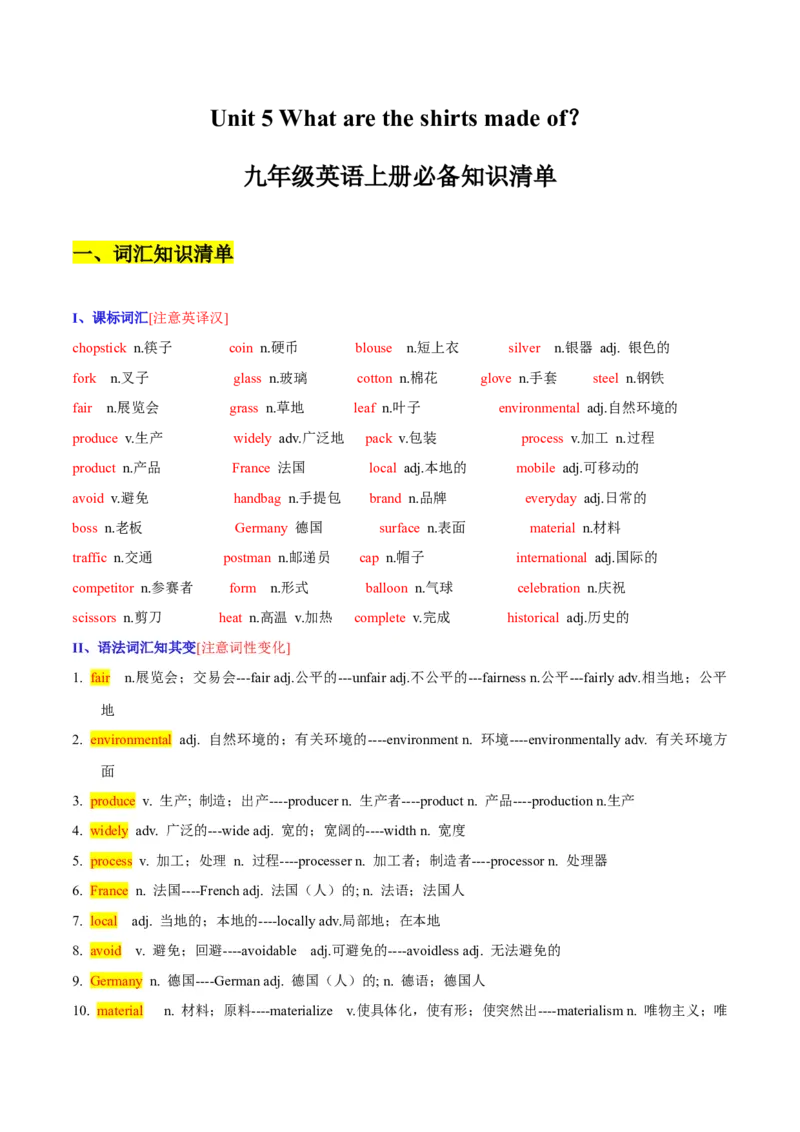
chopstick n.筷子 coin n.硬币 blouse n.短上衣 silver n.银器 adj. 银色的
fork n.叉子 glass n.玻璃 cotton n.棉花 glove n.手套 steel n.钢铁
fair n.展览会 grass n.草地 leaf n.叶子 environmental adj.自然环境的
produce v.生产 widely adv.广泛地 pack v.包装 process v.加工 n.过程
product n.产品 France 法国 local adj.本地的 mobile adj.可移动的
avoid v.避免 handbag n.手提包 brand n.品牌 everyday adj.日常的
boss n.老板 Germany 德国 surface n.表面 material n.材料
traffic n.交通 postman n.邮递员 cap n.帽子 international adj.国际的
competitor n.参赛者 form n.形式 balloon n.气球 celebration n.庆祝
scissors n.剪刀 heat n.高温 v.加热 complete v.完成 historical adj.历史的
II、语法词汇知其变[注意词性变化]
1. fair n.展览会;交易会---fair adj.公平的---unfair adj.不公平的---fairness n.公平---fairly adv.相当地;公平
地
2. environmental adj. 自然环境的;有关环境的----environment n. 环境----environmentally adv. 有关环境方
面
3. produce v. 生产; 制造;出产----producer n. 生产者----product n. 产品----production n.生产
4. widely adv. 广泛的---wide adj. 宽的;宽阔的----width n. 宽度
5. process v. 加工;处理 n. 过程----processer n. 加工者;制造者----processor n. 处理器
6. France n. 法国----French adj. 法国(人)的; n. 法语;法国人
7. local adj. 当地的;本地的----locally adv.局部地;在本地
8. avoid v. 避免;回避----avoidable adj.可避免的----avoidless adj. 无法避免的
9. Germany n. 德国----German adj. 德国(人)的; n. 德语;德国人
10. material n. 材料;原料----materialize v.使具体化,使有形;使突然出----materialism n. 唯物主义;唯物论;物质主义
11. postman n. 邮递员----postmen (复数)
12. international adj. 国际的----national adj. 国家的;民族的
13. competitor n. 参赛者;竞争者----competition n. 比赛;竞赛----compete v. 比赛;竞赛----competitive adj.
竞争的;比赛的
14. form n. 形式;类型----formal adj. 正式的;拘谨的;有条理的----informal adj. 非正式的;不拘礼节的;
随便的;通俗的----informally 非正式地;不拘礼节地----formally adv. 正式地;形式上
15. celebration n. 庆典;庆祝活动----celebrate v. 庆祝
16. lively adj. 生气勃勃的;(色彩)鲜艳的----live v. 居住;生活----living adj. 活着的----alive adj. 活着的
17. historical adj.(有关)历史的----historic adj. 具有历史意义的----history n. 历史----historian n. 历史学家
18. heat n. 热;高温 v. 加热;变热----hot adj. 热的 ----heater n.加热器
19.polish v. 磨光;修改;润色----polished adj. 擦亮的;圆滑的----punishment n. 磨光----polisher n. 磨光器
20. complete v. 完成/ adj. 完全的----completely adv. 完全地----completion n. 完成;结束----incomplete adj.
不完全的----incompletely adv. 不完全地
III、重点短语知搭配[注意固定短语的英汉互译]
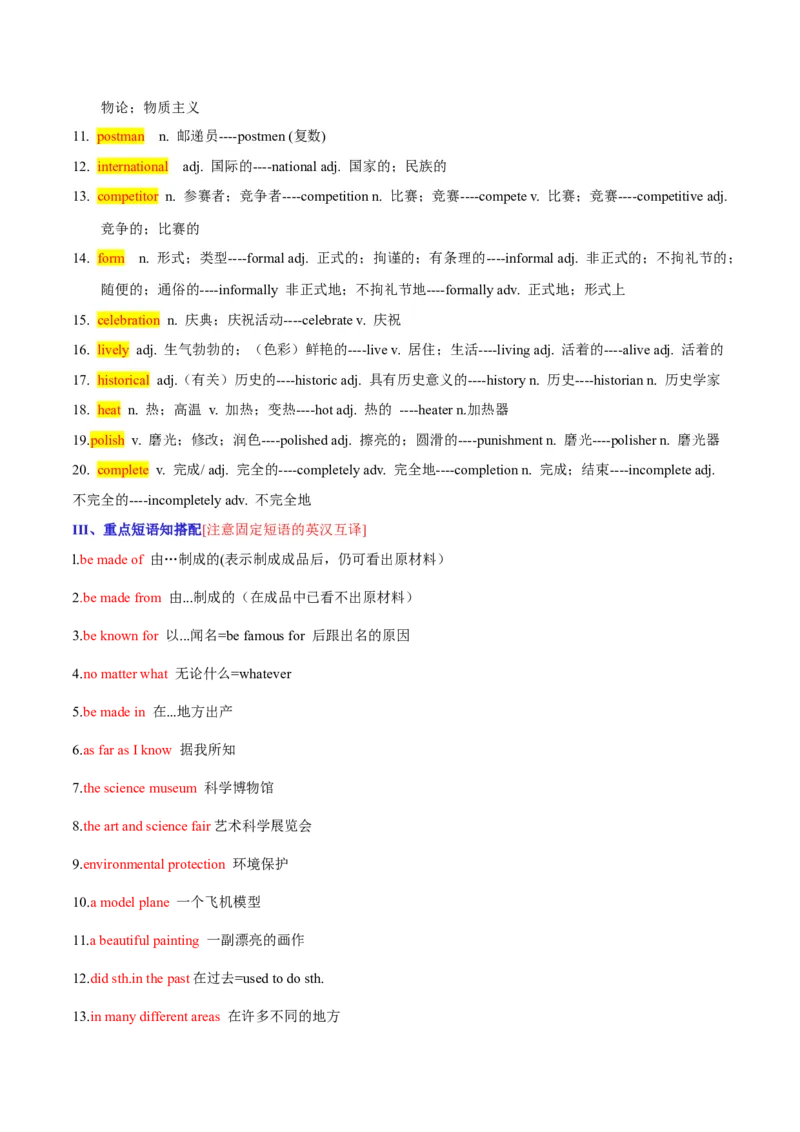
l.be made of 由…制成的(表示制成成品后,仍可看出原材料)
2.be made from 由...制成的(在成品中已看不出原材料)
3.be known for 以...闻名=be famous for 后跟出名的原因
4.no matter what 无论什么=whatever
5.be made in 在...地方出产
6.as far as I know 据我所知
7.the science museum 科学博物馆
8.the art and science fair艺术科学展览会
9.environmental protection 环境保护
10.a model plane 一个飞机模型
11.a beautiful painting 一副漂亮的画作
12.did sth.in the past在过去=used to do sth.
13.in many different areas 在许多不同的地方14.on the sides of the mountains在山坡上
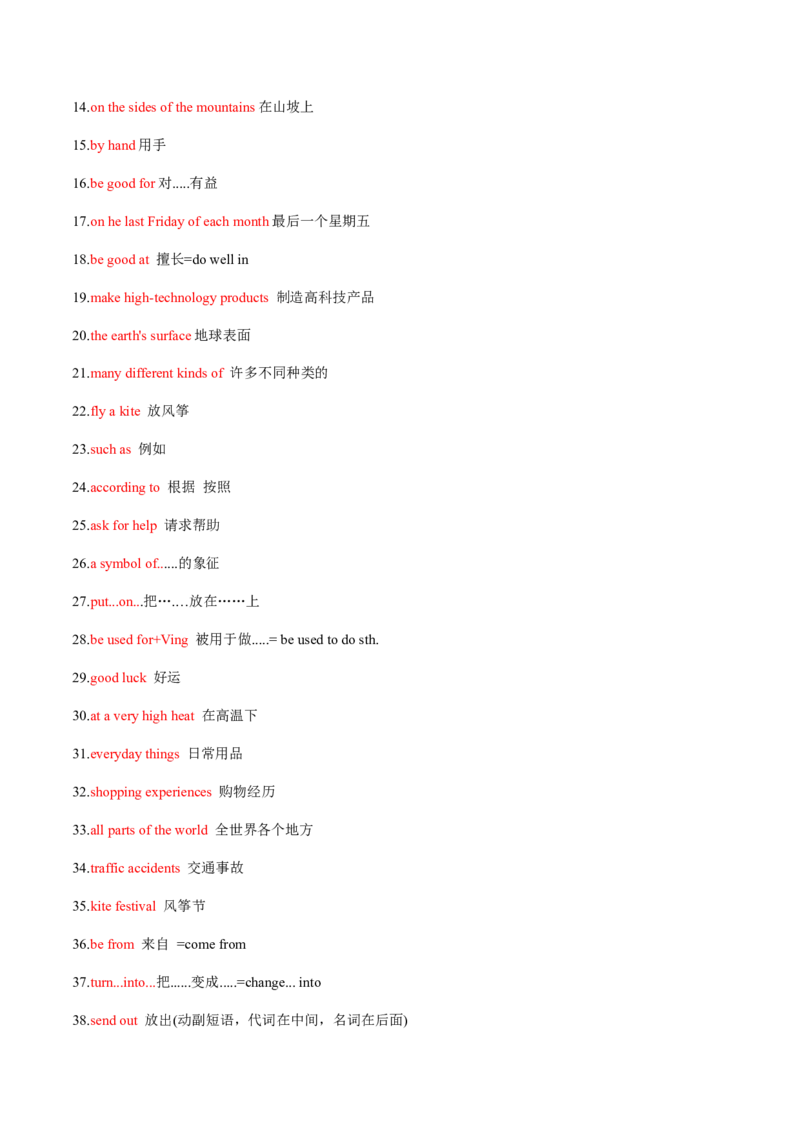
15.by hand用手
16.be good for对.....有益
17.on he last Friday of each month最后一个星期五
18.be good at 擅长=do well in
19.make high-technology products 制造高科技产品
20.the earth's surface地球表面
21.many different kinds of 许多不同种类的
22.fly a kite 放风筝
23.such as 例如
24.according to 根据 按照
25.ask for help 请求帮助
26.a symbol of......的象征
27.put...on...把….…放在……上
28.be used for+Ving 被用于做.....= be used to do sth.
29.good luck 好运
30.at a very high heat 在高温下
31.everyday things 日常用品
32.shopping experiences 购物经历
33.all parts of the world 全世界各个地方
34.traffic accidents 交通事故
35.kite festival 风筝节
36.be from 来自 =come from
37.turn...into...把......变成.....=change... into
38.send out 放出(动副短语,代词在中间,名词在后面)39.be in trouble 处于困境中=get into trouble
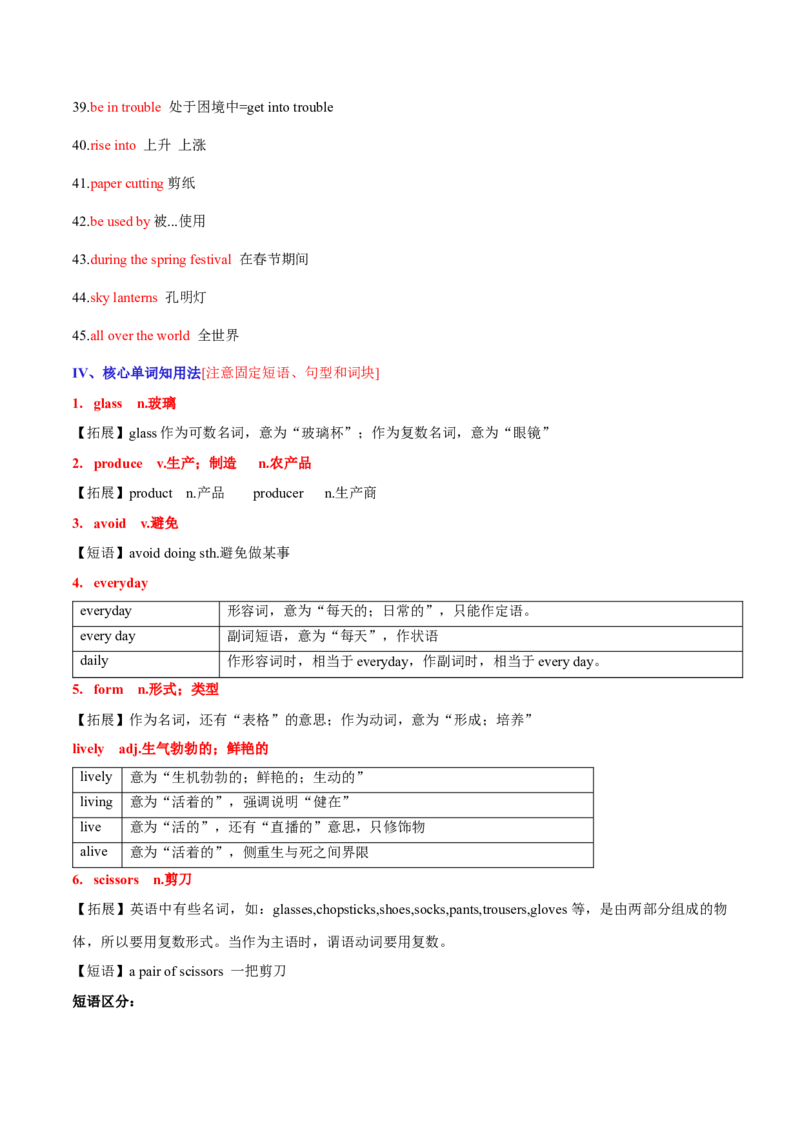
40.rise into 上升 上涨
41.paper cutting剪纸
42.be used by被...使用
43.during the spring festival 在春节期间
44.sky lanterns 孔明灯
45.all over the world 全世界
IV、核心单词知用法[注意固定短语、句型和词块]
1. glass n.玻璃
【拓展】glass作为可数名词,意为“玻璃杯”;作为复数名词,意为“眼镜”
2. produce v.生产;制造 n.农产品
【拓展】product n.产品 producer n.生产商
3. avoid v.避免
【短语】avoid doing sth.避免做某事
4. everyday
everyday 形容词,意为“每天的;日常的”,只能作定语。
every day 副词短语,意为“每天”,作状语
daily 作形容词时,相当于everyday,作副词时,相当于every day。
5. form n.形式;类型
【拓展】作为名词,还有“表格”的意思;作为动词,意为“形成;培养”
lively adj.生气勃勃的;鲜艳的
lively 意为“生机勃勃的;鲜艳的;生动的”
living 意为“活着的”,强调说明“健在”
live 意为“活的”,还有“直播的”意思,只修饰物
alive 意为“活着的”,侧重生与死之间界限
6. scissors n.剪刀
【拓展】英语中有些名词,如:glasses,chopsticks,shoes,socks,pants,trousers,gloves等,是由两部分组成的物
体,所以要用复数形式。当作为主语时,谓语动词要用复数。
【短语】a pair of scissors 一把剪刀
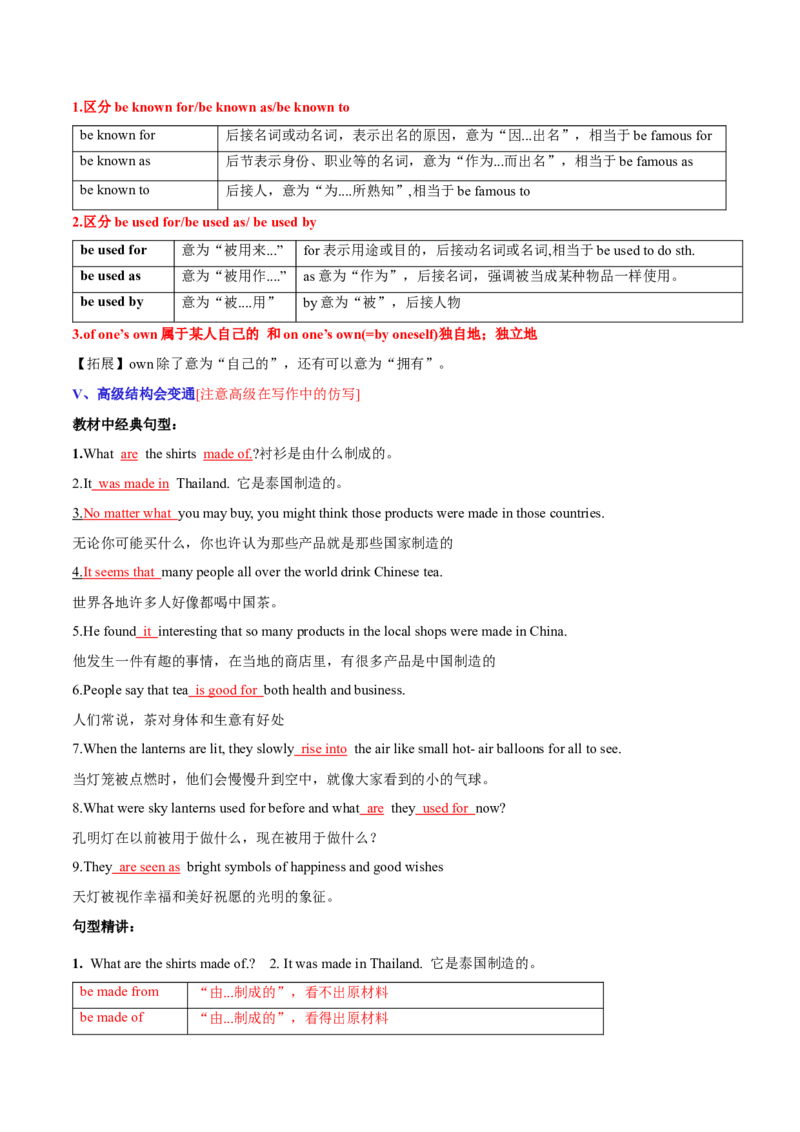
短语区分:1.区分be known for/be known as/be known to
be known for 后接名词或动名词,表示出名的原因,意为“因...出名”,相当于be famous for
be known as 后节表示身份、职业等的名词,意为“作为...而出名”,相当于be famous as
be known to 后接人,意为“为....所熟知”,相当于be famous to
2.区分be used for/be used as/ be used by
be used for 意为“被用来...” for表示用途或目的,后接动名词或名词,相当于be used to do sth.
be used as 意为“被用作....” as意为“作为”,后接名词,强调被当成某种物品一样使用。
be used by 意为“被....用” by意为“被”,后接人物
3.of one’s own属于某人自己的 和on one’s own(=by oneself)独自地;独立地
【拓展】own除了意为“自己的”,还有可以意为“拥有”。
V、高级结构会变通[注意高级在写作中的仿写]
教材中经典句型:
1.What are the shirts made of.?衬衫是由什么制成的。
2.It was made in Thailand. 它是泰国制造的。
3 . No matter what you may buy, you might think those products were made in those countries.
无论你可能买什么,你也许认为那些产品就是那些国家制造的
4 . It seems that many people all over the world drink Chinese tea.
世界各地许多人好像都喝中国茶。
5.He found it interesting that so many products in the local shops were made in China.
他发生一件有趣的事情,在当地的商店里,有很多产品是中国制造的
6.People say that tea is good for both health and business.
人们常说,茶对身体和生意有好处
7.When the lanterns are lit, they slowly rise into the air like small hot- air balloons for all to see.
当灯笼被点燃时,他们会慢慢升到空中,就像大家看到的小的气球。
8.What were sky lanterns used for before and what are they used for now?
孔明灯在以前被用于做什么,现在被用于做什么?
9.They are seen as bright symbols of happiness and good wishes
天灯被视作幸福和美好祝愿的光明的象征。
句型精讲:
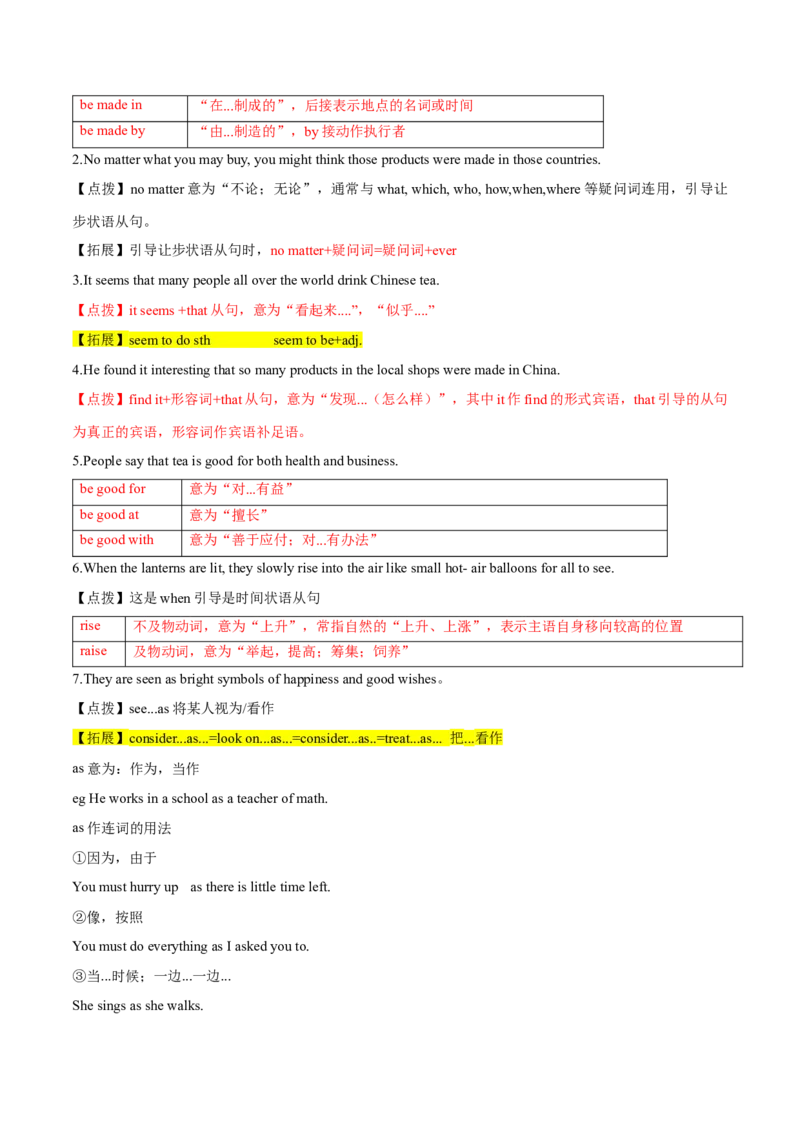
1. What are the shirts made of.? 2. It was made in Thailand. 它是泰国制造的。
be made from “由...制成的”,看不出原材料
be made of “由...制成的”,看得出原材料be made in “在...制成的”,后接表示地点的名词或时间
be made by “由...制造的”,by接动作执行者
2.No matter what you may buy, you might think those products were made in those countries.
【点拨】no matter意为“不论;无论”,通常与what, which, who, how,when,where等疑问词连用,引导让
步状语从句。
【拓展】引导让步状语从句时,no matter+疑问词=疑问词+ever
3.It seems that many people all over the world drink Chinese tea.
【点拨】it seems +that从句,意为“看起来....”,“似乎....”
【拓展】seem to do sth seem to be+adj.
4.He found it interesting that so many products in the local shops were made in China.
【点拨】find it+形容词+that从句,意为“发现...(怎么样)”,其中it作find的形式宾语,that引导的从句
为真正的宾语,形容词作宾语补足语。
5.People say that tea is good for both health and business.
be good for 意为“对...有益”
be good at 意为“擅长”
be good with 意为“善于应付;对...有办法”
6.When the lanterns are lit, they slowly rise into the air like small hot- air balloons for all to see.
【点拨】这是when引导是时间状语从句
rise 不及物动词,意为“上升”,常指自然的“上升、上涨”,表示主语自身移向较高的位置
raise 及物动词,意为“举起,提高;筹集;饲养”
7.They are seen as bright symbols of happiness and good wishes。
【点拨】see...as将某人视为/看作
【拓展】consider...as...=look on...as...=consider...as..=treat...as... 把...看作
as意为:作为,当作
eg He works in a school as a teacher of math.
as作连词的用法
①因为,由于
,
You must hurry up as there is little time left.
②像,按照
You must do everything as I asked you to.
③当...时候;一边...一边...
She sings as she walks.二、语法知识清单
一般现在时态被动语态
1.被动语态定义:被动语态表示主语是谓语动词所表示的动作的承受者。
2.被动语态的构成:be + done(过去分词)
句式 构成 例句
肯定句 主语+am/is/are+过去分词(+by sb.) Many people are killed in a traffic accidents.
否定句 主语 +am/is/are+not+ 过去 分词( +by English isn’t spoken by people here.
sb.)
一般疑问句 Am/Is/Are+主语+过去分词(+by sb.) Are the cars made in China?
特殊疑问句 特殊疑问句+am/is/are+not+主语+过去分 What is this kind of sweater made of?
词(+by sb.)?
How are these machines used?
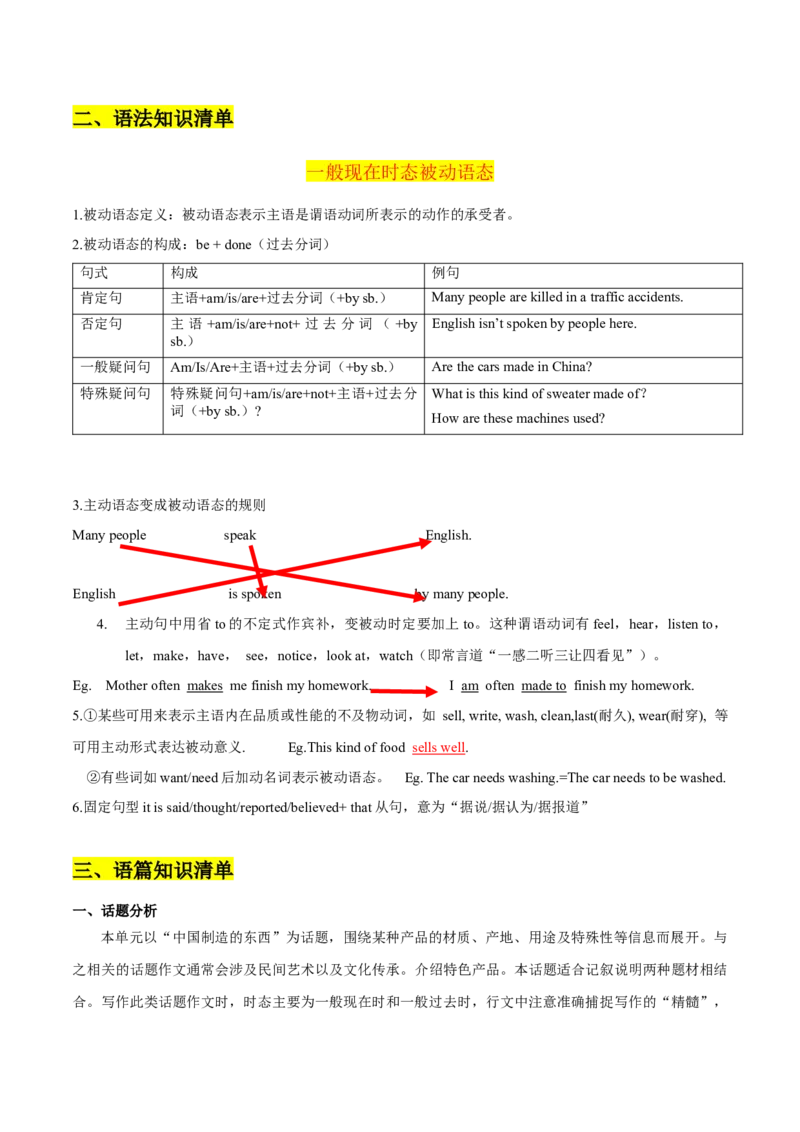
3.主动语态变成被动语态的规则
Many people speak English.
English is spoken by many people.
4. 主动句中用省to的不定式作宾补,变被动时定要加上to。这种谓语动词有feel,hear,listen to,
let,make,have, see,notice,look at,watch(即常言道“一感二听三让四看见”)。
Eg. Mother often makes me finish my homework. I am often made to finish my homework.
5.①某些可用来表示主语内在品质或性能的不及物动词,如 sell, write, wash, clean,last(耐久), wear(耐穿), 等
可用主动形式表达被动意义. Eg.This kind of food sells well.
②有些词如want/need后加动名词表示被动语态。 Eg. The car needs washing.=The car needs to be washed.
6.固定句型it is said/thought/reported/believed+ that从句,意为“据说/据认为/据报道”
三、语篇知识清单
一、话题分析
本单元以“中国制造的东西”为话题,围绕某种产品的材质、产地、用途及特殊性等信息而展开。与
之相关的话题作文通常会涉及民间艺术以及文化传承。介绍特色产品。本话题适合记叙说明两种题材相结
合。写作此类话题作文时,时态主要为一般现在时和一般过去时,行文中注意准确捕捉写作的“精髓”,表达被描述的事物时,有可能要用到被动语态结构,写作时要立足事实,表达真情实感。
二、写作方法
“总分总法”写产品介绍类的作文
1. 总起点明产品的名称;
2. 详细地描写产品的特征样式、质量、性能;
3. 总结评价。
三、素材积累
产品介绍类常用词汇:
chopstick, fork, blouse, gloves, glass, cotton, steel, handbag, material, produce, process, product, local, heat, be
made of, by hand, tun into, cover. . .with, everyday, lively, be known for, soft, strong, interesting, smooth, real, small,
cute, useful, helpful
产品介绍类常用句型:
1. My town/city/country is famous for. . .
2. . . .is becoming more and more popular.
3. It's more convenient for. . .
4. . . .is made of/from/by/in. . .
5. . . .is/are known for. . .
6. . . .is/are used for. . .
7. . . .is/are special because. .
8. China is famous for…
9. It’s great that China is so good at...·
10. …wish that in the future·will …
11. These usually try to show....
12. They are seen as symbols of ...·
四、写作训练一
【写作任务】(Section B 3a &3b)
最近,某中学生英文杂志“我的家乡”专栏,面向广大读者征文,要求介绍家乡的特色产品。请你写一篇
短文向该专栏投稿。 假如你叫李华,来自山东省潍坊市。你的加拿大笔友Marcus得知你市是
风筝之乡,他对风筝很感兴趣,于是他给你发来一封电子邮件,想让你给他介绍一些风筝的
相关情况。请你根据下面的要点提示给他回复邮件。要点提示:1. 风筝的象征意义; 2. 原材料:竹子、纸或布或塑料(plastic)、细绳(string);3.
用途:过去用于送信,现在用来娱乐和锻炼。
【思路点拨】
1. 定基调
体裁:应用文(邮件);邮件的主体部分为说明文
时态:介绍事物时用一般现在时
人称:第三人称
2. 谋布局、写句子
(1) is famous / known / well-known for its kites
(2) An international kite festival is held in my city in April every year
(3) Kites are loved / liked / enjoyed by lots of / many / a lot of people
(4) they are often painted with colorful drawings
(5) kites are used for fun and exercise
3. 巧衔接
第一次提到“风筝”时用kites,再次提到时可以用they代替;为了避免重复, in my city在
成篇章时可以用here来代替,这都是使用照应手段来使文章衔接的方法。在陈述风筝的意义
时可以使用表示原因的连词because,这是使用逻辑纽带的方式使文章衔接的方法。
4. 成篇章Dear Marcus,
How are you doing these days? I'm excited to hear from you. I'd like to tell you something
about kites in my city.
____________________________________________________________________
____________________________________________________________________
____________________________________________________________________
____________________________________________________________________
Welcome to my city! I hope you will fly a kite here!
Best wishes!
Yours,
Li Hua
5. 化“平凡”为“非凡”
People used kites to send a message in the old days. → Kites were used for sending a message in the
old days.
五、写作训练二
假如你叫李华, 来自江西省景德镇市。近日,你的加拿大笔友Marcus发来一封电子邮件,他说要来你市
旅游,询问你市以什么而闻名,并让你推荐有什么值得赠送朋友的纪念品。请你根据下面的要点提示给他
回复邮件。
要点提示:
1. 以瓷器(china)闻名及其意义;
2. 原材料:陶土;
3. 用途:可供人们欣赏、也可用来装(contain)东西;
4. 最佳推荐:青花瓷(blue and white porcelain)。
【思路点拨】
1. 定基调
体裁:应用文(邮件);邮件的主体部分为说明文
时态:介绍事物时用一般现在时
人称:第三人称
2. 列提纲、写句子
列提纲 写句子引出介绍 (1) My city, Jingdezhen in Jiangxi Province, ___________________.
的产品
(2) China is special. China is an example of exquisite Chinese craftsmanship (精美的中国工艺). __
意
介 ___________________________________________(瓷器是中国传统文化的一个象征).
义
绍
产
品 原材 (3) ______________________.
料
(4) _______________________________.
用途
(5) _______________________________. Many things are made of china in our everyday life, such
介
as cups, bowls and plates.
绍
产
品 最佳 (6) _______________________________ __________________(每天有许多不同种类的瓷器被生
产) in my city. Blue and white porcelain is the most famous one. You can buy some for your friends
and relatives.
推荐
Welcome to my city! I hope you will have a good time here!
邀请及祝
愿
巧衔接
第一次提到“瓷器”时用china,再次提到时可以用it代替;为了避免重复,句(6)中的in my city
在成篇章时可以用here来代替,这都是使用照应手段来使文章衔接的方法。在衔接瓷器的两个意义和两个
用途时可以使用表示并列关系的词and;在陈述瓷器很特别的理由时可以使用表示原因的词because,这是
使用逻辑纽带的方式使文章衔接的方法。
4. 添佳句
It is known to people around the world. (它被全世界的人们所熟知。)
5. 成篇章
Dear Marcus,
How are you doing these days? I’m excited to hear from you. I’d like to introduce something special in my city to
you.
____________________________________________________________________________________________
____________________________________________________________________________________________
____________________________________________________________________________________________
____________________________________________________________________________________________
Best wishes!
Yours,Li Hua
【参考范文】
Dear Marcus,
How are you doing these days? I'm excited to hear from you. I'd like to tell you something about kites in my
city.
My city, Weifang in Shandong Province, is famous for its kites. An international kite festival is held here in
April every year. Kites are loved by lots of people because they rise into the air with people's wishes for a better
life. They are usually made of bamboo, paper or cloth or plastic and string. There are all kinds of kites and they are
often painted with colorful drawings. And kites here often have special designs. People used kites to send a
message in the old days. Today, they are used for fun and exercise.
Welcome to my city! I hope you will fly a kite here!
Best wishes!
Yours,
Li Hua