文档文本内容
Unit 8 It must belong to Carla.
九年级英语上册必备知识清单
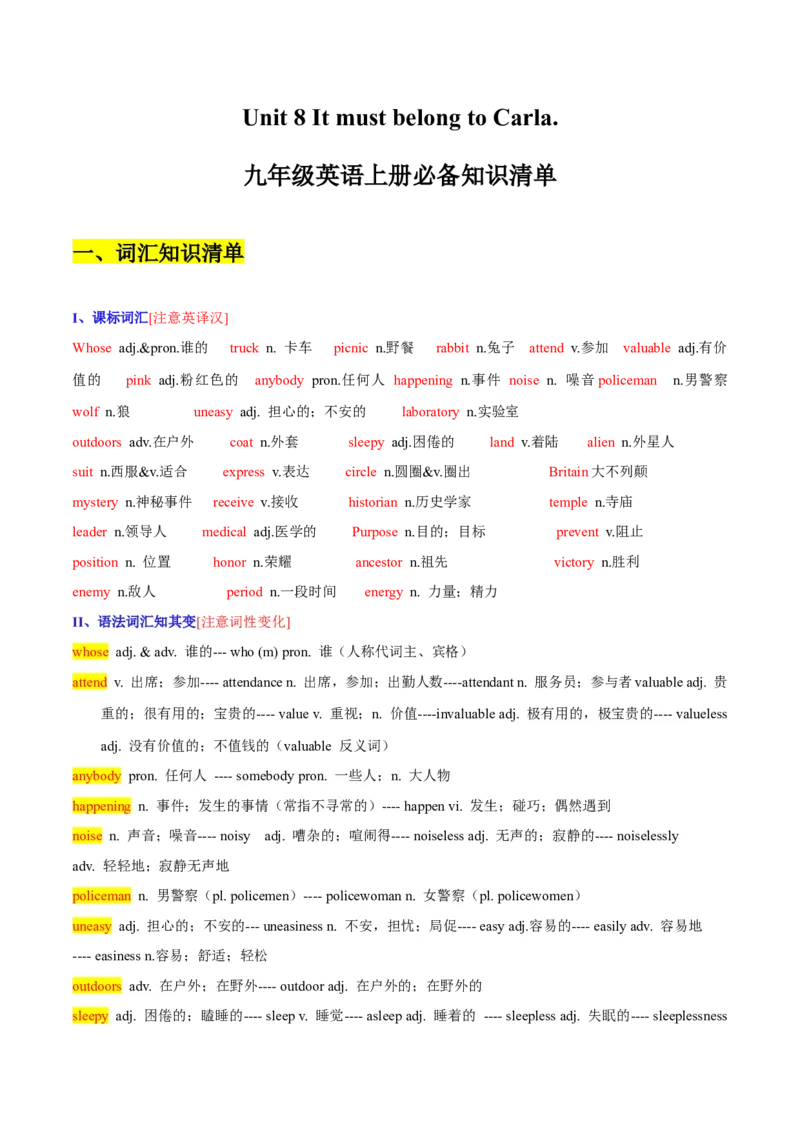
一、词汇知识清单
I、课标词汇[注意英译汉]
Whose adj.&pron.谁的 truck n. 卡车 picnic n.野餐 rabbit n.兔子 attend v.参加 valuable adj.有价
值的 pink adj.粉红色的 anybody pron.任何人 happening n.事件 noise n. 噪音policeman n.男警察
wolf n.狼 uneasy adj. 担心的;不安的 laboratory n.实验室
outdoors adv.在户外 coat n.外套 sleepy adj.困倦的 land v.着陆 alien n.外星人
suit n.西服&v.适合 express v.表达 circle n.圆圈&v.圈出 Britain大不列颠
mystery n.神秘事件 receive v.接收 historian n.历史学家 temple n.寺庙
leader n.领导人 medical adj.医学的 Purpose n.目的;目标 prevent v.阻止
position n. 位置 honor n.荣耀 ancestor n.祖先 victory n.胜利
enemy n.敌人 period n.一段时间 energy n. 力量;精力
II、语法词汇知其变[注意词性变化]
whose adj. & adv. 谁的--- who (m) pron. 谁(人称代词主、宾格)
attend v. 出席;参加---- attendance n. 出席,参加;出勤人数----attendant n. 服务员;参与者valuable adj. 贵
重的;很有用的;宝贵的---- value v. 重视;n. 价值----invaluable adj. 极有用的,极宝贵的---- valueless
adj. 没有价值的;不值钱的(valuable 反义词)
anybody pron. 任何人 ---- somebody pron. 一些人;n. 大人物
happening n. 事件;发生的事情(常指不寻常的)---- happen vi. 发生;碰巧;偶然遇到
noise n. 声音;噪音---- noisy adj. 嘈杂的;喧闹得---- noiseless adj. 无声的;寂静的---- noiselessly
adv. 轻轻地;寂静无声地
policeman n. 男警察(pl. policemen)---- policewoman n. 女警察(pl. policewomen)
uneasy adj. 担心的;不安的--- uneasiness n. 不安,担忧;局促---- easy adj.容易的---- easily adv. 容易地
---- easiness n.容易;舒适;轻松
outdoors adv. 在户外;在野外---- outdoor adj. 在户外的;在野外的
sleepy adj. 困倦的;瞌睡的---- sleep v. 睡觉---- asleep adj. 睡着的 ---- sleepless adj. 失眠的---- sleeplessnessn. 失眠---- sleepiness n. 睡意;瞌睡
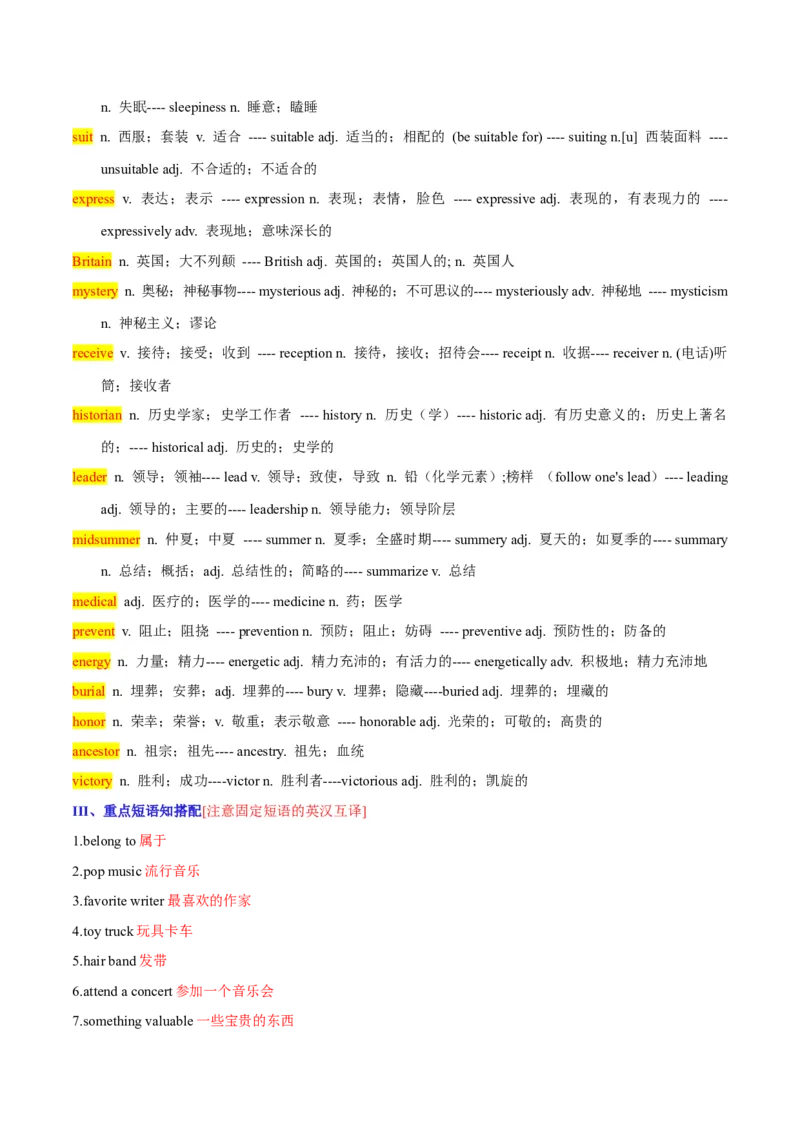
suit n. 西服;套装 v. 适合 ---- suitable adj. 适当的;相配的 (be suitable for) ---- suiting n.[u] 西装面料 ----
unsuitable adj. 不合适的;不适合的
express v. 表达;表示 ---- expression n. 表现;表情,脸色 ---- expressive adj. 表现的,有表现力的 ----
expressively adv. 表现地;意味深长的
Britain n. 英国;大不列颠 ---- British adj. 英国的;英国人的; n. 英国人
mystery n. 奥秘;神秘事物---- mysterious adj. 神秘的;不可思议的---- mysteriously adv. 神秘地 ---- mysticism
n. 神秘主义;谬论
receive v. 接待;接受;收到 ---- reception n. 接待,接收;招待会---- receipt n. 收据---- receiver n. (电话)听
筒;接收者
historian n. 历史学家;史学工作者 ---- history n. 历史(学)---- historic adj. 有历史意义的;历史上著名
的;---- historical adj. 历史的;史学的
leader n. 领导;领袖---- lead v. 领导;致使,导致 n. 铅(化学元素);榜样 (follow one's lead)---- leading
adj. 领导的;主要的---- leadership n. 领导能力;领导阶层
midsummer n. 仲夏;中夏 ---- summer n. 夏季;全盛时期---- summery adj. 夏天的;如夏季的---- summary
n. 总结;概括;adj. 总结性的;简略的---- summarize v. 总结
medical adj. 医疗的;医学的---- medicine n. 药;医学
prevent v. 阻止;阻挠 ---- prevention n. 预防;阻止;妨碍 ---- preventive adj. 预防性的;防备的
energy n. 力量;精力---- energetic adj. 精力充沛的;有活力的---- energetically adv. 积极地;精力充沛地
burial n. 埋葬;安葬;adj. 埋葬的---- bury v. 埋葬;隐藏----buried adj. 埋葬的;埋藏的
honor n. 荣幸;荣誉;v. 敬重;表示敬意 ---- honorable adj. 光荣的;可敬的;高贵的
ancestor n. 祖宗;祖先---- ancestry. 祖先;血统
victory n. 胜利;成功----victor n. 胜利者----victorious adj. 胜利的;凯旋的
III、重点短语知搭配[注意固定短语的英汉互译]
1.belong to属于
2.pop music流行音乐
3.favorite writer最喜欢的作家
4.toy truck玩具卡车
5.hair band发带
6.attend a concert参加一个音乐会
7.something valuable一些宝贵的东西8.go to a picnic去野餐
9. the rest of…其余的/剩余的…
10.pick up拣起,拾起
11. each other彼此,互相
12. used to be曾经是
13. something unusual不寻常的事
14. strange noises奇怪的声音
15. outside the window在窗外
16. call the policemen报警
17. the next-door neighbor隔壁的邻居
18. at first起初,开始
19. see sb doing sth看见某人正在做某事
20. run away逃跑
21. too… to…太…而不能…
22. feel uneasy感到不安
23. have one’s own idea有某人自己的想法
24. There must be…一定有…
25. There be …doing sth有…正在做某事
26. in one’s neighborhood在某人的小区
27. have no idea不知道
28. have fun doing sth很开心地做某事
29. too much太多
30. create fear制造恐惧
31. in the laboratory在实验室
32. wear glasses戴眼镜
33. think of doing sth考虑,打算 做某事
34. take a shower洗澡
35. cough a lot严重咳嗽
36. look like看起来像
37.be late for…迟到
38. not only…but also…不仅…而且…(注意:就近原则)
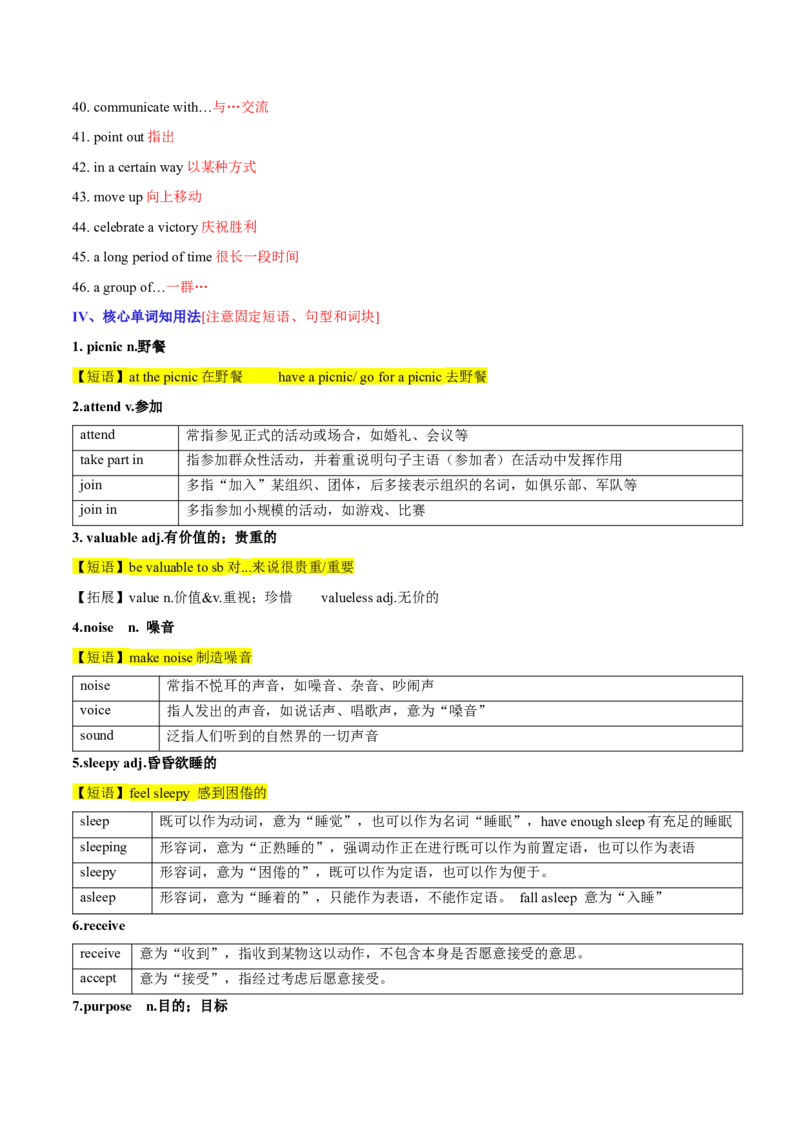
39. see the sun rising看太阳升起40. communicate with…与…交流
41. point out指出
42. in a certain way以某种方式
43. move up向上移动
44. celebrate a victory庆祝胜利
45. a long period of time很长一段时间
46. a group of…一群…
IV、核心单词知用法[注意固定短语、句型和词块]
1. picnic n.野餐
【短语】at the picnic在野餐 have a picnic/ go for a picnic去野餐
2.attend v.参加
attend 常指参见正式的活动或场合,如婚礼、会议等
take part in 指参加群众性活动,并着重说明句子主语(参加者)在活动中发挥作用
join 多指“加入”某组织、团体,后多接表示组织的名词,如俱乐部、军队等
join in 多指参加小规模的活动,如游戏、比赛
3. valuable adj.有价值的;贵重的
【短语】be valuable to sb对...来说很贵重/重要
【拓展】value n.价值&v.重视;珍惜 valueless adj.无价的
4.noise n. 噪音
【短语】make noise制造噪音
noise 常指不悦耳的声音,如噪音、杂音、吵闹声
voice 指人发出的声音,如说话声、唱歌声,意为“嗓音”
sound 泛指人们听到的自然界的一切声音
5.sleepy adj.昏昏欲睡的
【短语】feel sleepy 感到困倦的
sleep 既可以作为动词,意为“睡觉”,也可以作为名词“睡眠”,have enough sleep有充足的睡眠
sleeping 形容词,意为“正熟睡的”,强调动作正在进行既可以作为前置定语,也可以作为表语
sleepy 形容词,意为“困倦的”,既可以作为定语,也可以作为便于。
asleep 形容词,意为“睡着的”,只能作为表语,不能作定语。 fall asleep 意为“入睡”
6.receive
receive 意为“收到”,指收到某物这以动作,不包含本身是否愿意接受的意思。
accept 意为“接受”,指经过考虑后愿意接受。
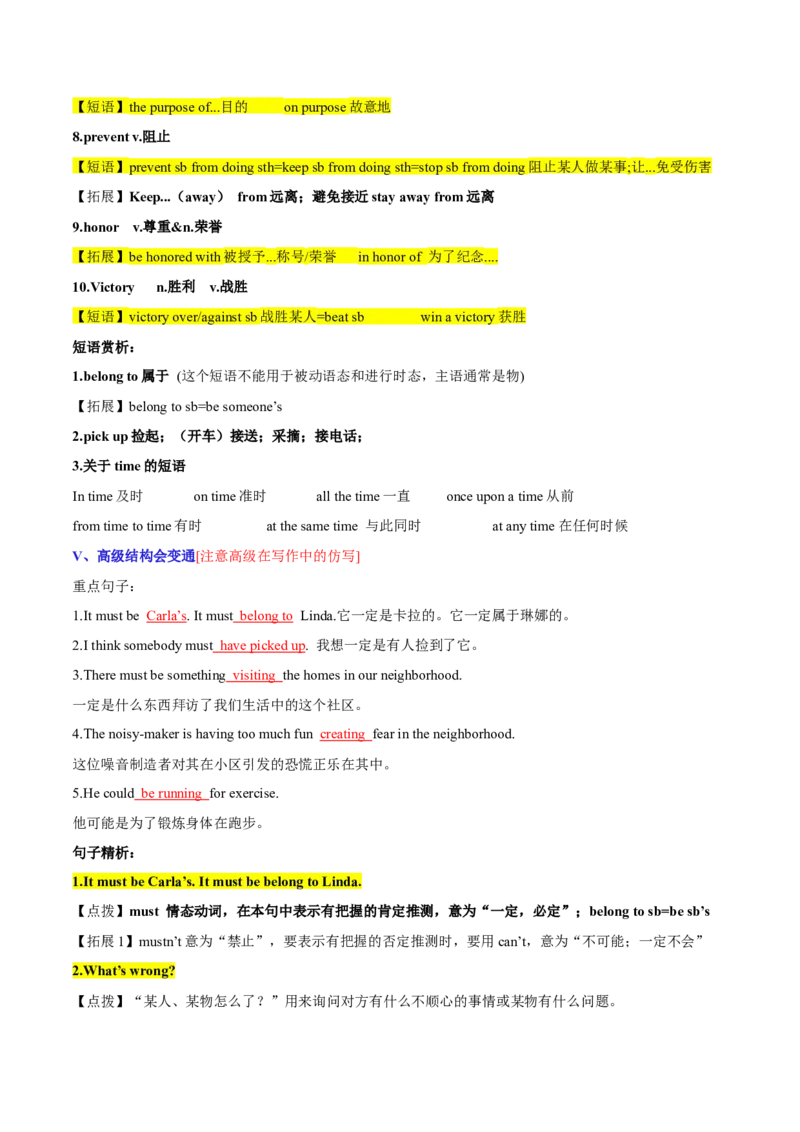
7.purpose n.目的;目标【短语】the purpose of...目的 on purpose故意地
8.prevent v.阻止
【短语】prevent sb from doing sth=keep sb from doing sth=stop sb from doing阻止某人做某事;让...免受伤害
【拓展】Keep...(away) from远离;避免接近stay away from远离
9.honor v.尊重&n.荣誉
【拓展】be honored with被授予...称号/荣誉 in honor of 为了纪念....
10.Victory n.胜利 v.战胜
【短语】victory over/against sb战胜某人=beat sb win a victory获胜
短语赏析:
1.belong to属于 (这个短语不能用于被动语态和进行时态,主语通常是物)
【拓展】belong to sb=be someone’s
2.pick up捡起;(开车)接送;采摘;接电话;
3.关于time的短语
In time及时 on time准时 all the time一直 once upon a time从前
from time to time有时 at the same time 与此同时 at any time在任何时候
V、高级结构会变通[注意高级在写作中的仿写]
重点句子:
1.It must be Carla’s. It must belong to Linda.它一定是卡拉的。它一定属于琳娜的。
2.I think somebody must have picked up. 我想一定是有人捡到了它。
3.There must be something visiting the homes in our neighborhood.
一定是什么东西拜访了我们生活中的这个社区。
4.The noisy-maker is having too much fun creating fear in the neighborhood.
这位噪音制造者对其在小区引发的恐慌正乐在其中。
5.He could be running for exercise.
他可能是为了锻炼身体在跑步。
句子精析:
1.It must be Carla’s. It must be belong to Linda.
【点拨】must 情态动词,在本句中表示有把握的肯定推测,意为“一定,必定”;belong to sb=be sb’s
【拓展1】mustn’t意为“禁止”,要表示有把握的否定推测时,要用can’t,意为“不可能;一定不会”
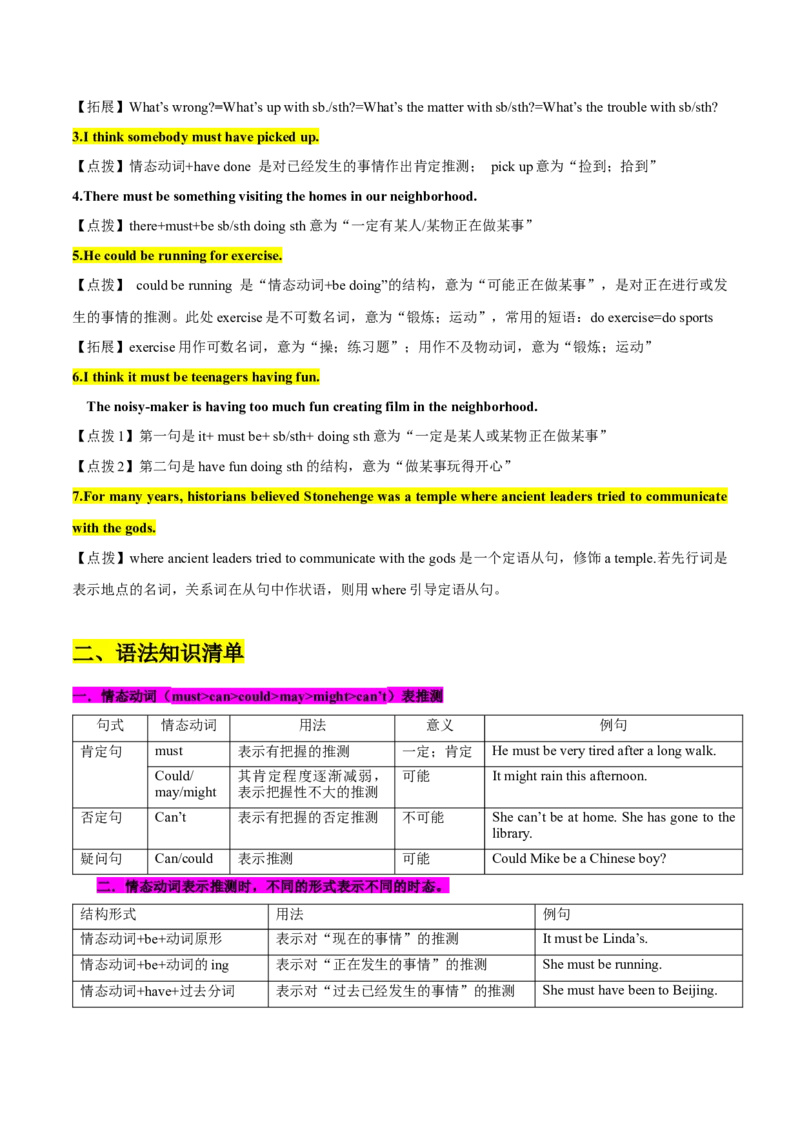
2.What’s wrong?
【点拨】“某人、某物怎么了?”用来询问对方有什么不顺心的事情或某物有什么问题。【拓展】What’s wrong?=What’s up with sb./sth?=What’s the matter with sb/sth?=What’s the trouble with sb/sth?
3.I think somebody must have picked up.
【点拨】情态动词+have done 是对已经发生的事情作出肯定推测; pick up意为“捡到;拾到”
4.There must be something visiting the homes in our neighborhood.
【点拨】there+must+be sb/sth doing sth意为“一定有某人/某物正在做某事”
5.He could be running for exercise.
【点拨】 could be running 是“情态动词+be doing”的结构,意为“可能正在做某事”,是对正在进行或发
生的事情的推测。此处exercise是不可数名词,意为“锻炼;运动”,常用的短语:do exercise=do sports
【拓展】exercise用作可数名词,意为“操;练习题”;用作不及物动词,意为“锻炼;运动”
6.I think it must be teenagers having fun.
The noisy-maker is having too much fun creating film in the neighborhood.
【点拨1】第一句是it+ must be+ sb/sth+ doing sth意为“一定是某人或某物正在做某事”
【点拨2】第二句是have fun doing sth的结构,意为“做某事玩得开心”
7.For many years, historians believed Stonehenge was a temple where ancient leaders tried to communicate
with the gods.
【点拨】where ancient leaders tried to communicate with the gods是一个定语从句,修饰a temple.若先行词是
表示地点的名词,关系词在从句中作状语,则用where引导定语从句。
二、语法知识清单
一.情态动词(must>can>could>may>might>can’t)表推测
句式 情态动词 用法 意义 例句
肯定句 must 表示有把握的推测 一定;肯定 He must be very tired after a long walk.
Could/ 其肯定程度逐渐减弱, 可能 It might rain this afternoon.
may/might 表示把握性不大的推测
否定句 Can’t 表示有把握的否定推测 不可能 She can’t be at home. She has gone to the
library.
疑问句 Can/could 表示推测 可能 Could Mike be a Chinese boy?
二.情态动词表示推测时,不同的形式表示不同的时态。
结构形式 用法 例句
情态动词+be+动词原形 表示对“现在的事情”的推测 It must be Linda’s.
情态动词+be+动词的ing 表示对“正在发生的事情”的推测 She must be running.
情态动词+have+过去分词 表示对“过去已经发生的事情”的推测 She must have been to Beijing.三、语篇知识清单
一、话题分析
本单元话题是“神秘事件”,围绕对神秘事物在生活中出现的不确定事情进行推理判断,利用情
态动词谈论一些推测。在写作方面,要求学生能描述日常生活中所发生的奇异事件,包括事件背景,这一
奇异事件是如何解决的以及人们的感受等,在写作时学会运用 must、might、could 或 can't来进行合理
的推测并给出理由。
二、写作方法
“两步法”写推测物品归属类作文。
1.推断经过-...may/might/could/can't...;
2.推断结果-...must...
三、素材积累
写作此类话题作文,
常用语块:
something strange / unusual,
strange noises, make noises,
feel uneasy/ nervous / worried,
be afraid of, call the policemen,
with the help of ... / with one's help, do /
try one' s best to ..., find out the truth, feel relaxed
常用习语:
make one's hair stand on end (使某人毛骨悚然),
have one's heart in one's mouth(吓得某人心都提到嗓子眼儿了),scare the pants off sb.(把某人吓坏了)
scare sb.to death(吓死某人了),
have cold feet(临阵胆怯;畏缩),
sb.'s blood runs cold(吓得某人不寒而栗)
常用句型
1.... think/ guess that...
2.....must be...
3....might/could/may be...
4....can't be...
5. It' s not clear that...6. It's impossible for ... to...
7....find that...
8. I remember I had my book with me after class. 我记得下课后书还在。
9....hope that...
10. I wonder whose the schoolbag is. 我想知道书包 是谁的。
四、实例讲解
【写作任务】(Section B 3b)
上周你市某小区发生了一件神秘离奇的事情,引起了人们的猜测,但最终这个谜团被解开了。假如你
是你校英文报的一名记者,请根据下面的提示内容,以“No More Mystery in the Neighborhood”为题写一则
新闻报道。
提示内容:
1. what the mystery was
2. how the mystery was solved
3. how the people in the neighborhood now feel
【思路点拨】
1. 定基调
体裁:应用文(新闻稿)
时态:以一般过去时为主
人称:以第三人称为主
2. 谋布局、写句子
3. 巧衔接
在叙述谜团是如何解开时,首句使用过去进行时(was happening)作为背景,而后再用一般过去时叙述
具体的事情。通过动词时态的前后配合,上下文很自然地建立起一种逻辑顺序关系。此外,本文中还体现
了其他的衔接手段,如词义搭配,它包括篇章中所有语义相关联的词项。本文围绕mystery一词展开,与
之相关联的词有strange, uneasy, solved, relaxed等,这些词都与描述神秘事件有关联。(1) some people tried to find out who was planting these trees
(2) Everyone / Everybody felt uneasy
(3) Three mothers wanted people here to live more comfortably
(4) so they had to work at night
(5) and they showed their thanks to the three mothers
4. 成篇章
No More Mystery in the Neighborhood
Last week, in a quiet neighborhood, something strange happened.
____________________________________________________________________________________________
____________________________________________________________________________________________
____________________________________________________________________________________________
____________________________________________________________________________________________
____________________________________________________________________________________________
____________________________________________________________________________________________
__
例文:
No More Mystery in the Neighborhood
Last week, in a quiet neighborhood, something strange happened . People found there were more and more
trees in the neighborhood. In the daytime some people tried to find out who was planting these trees, but they
couldn’t. Everyone felt uneasy.We now know what was happening in the neighborhood. One night an old man found out the truth. Three
mothers wanted people here to live more comfortably, so they decided to plant some trees. They didn’t have free
time in the daytime, so they had to work at night.
Now the mystery is solved. People in the neighborhood now feel relaxed and they showed their thanks to the
three mothers. They live there as usual.
5. 化“平凡”为“非凡”
They live there as usual. → Their life is going on as usual.
五、写作训练
你和你的同学Helen以及David 在学校图书馆里的椅子上捡到一个书包,请根据书包的颜色以及
里面的物品讨论、推测失主是谁。写出你们讨论的过程和推测的结果。不少于80个词。开头已给出,不计
人总词。
My classmates Helen, David and I found a green schoolbag on the chair in the school library ....
思路点拨
1.从体裁上来看,本文属于议论文。
2.文章的要点有三方面:点明事由;使用情态动词表达讨论过程;得出推测结果。
3.时态主要使用一般过去时,人称应用第一人称。
写作模板
开头点明事由 ... found a green schoolbag on the chair in the school library. We were
discussing whose it was.
David said that it may be Alice's.
使用情态动词表达讨论过程 Helen thought it can't belong to her.
I had no idea.
得出推测结果 So we thought it must be Lily's.
____________________________________________________________________________________________
____________________________________________________________________________________________
____________________________________________________________________________________________
____________________________________________________________________________________________
____________________________________________________________________________________________
____________________________________________________________________________________________
____________________________________________________________________________________________
【参考范文】
My classmates Helen, David and I found a green schoolbag on the chair in the school library. We were discussingwhose it was.
David said that it may be Alice's. But Helen thought it can't belong to her. She said that most girls don't like
green. David didn't agree with her. He saw the same one in Alice's desk.I had no idea.So I suggested opening the
schoolbag to find out some information. We found two books, a dictionary and a pencil case in it. There were no
names on them. But there was a report card in the dictionary. It had the name of Lily on it. So we thought it must
belong to Lily