文档文本内容
Unit 13 单元知识清单
Section A
一、基础知识清单
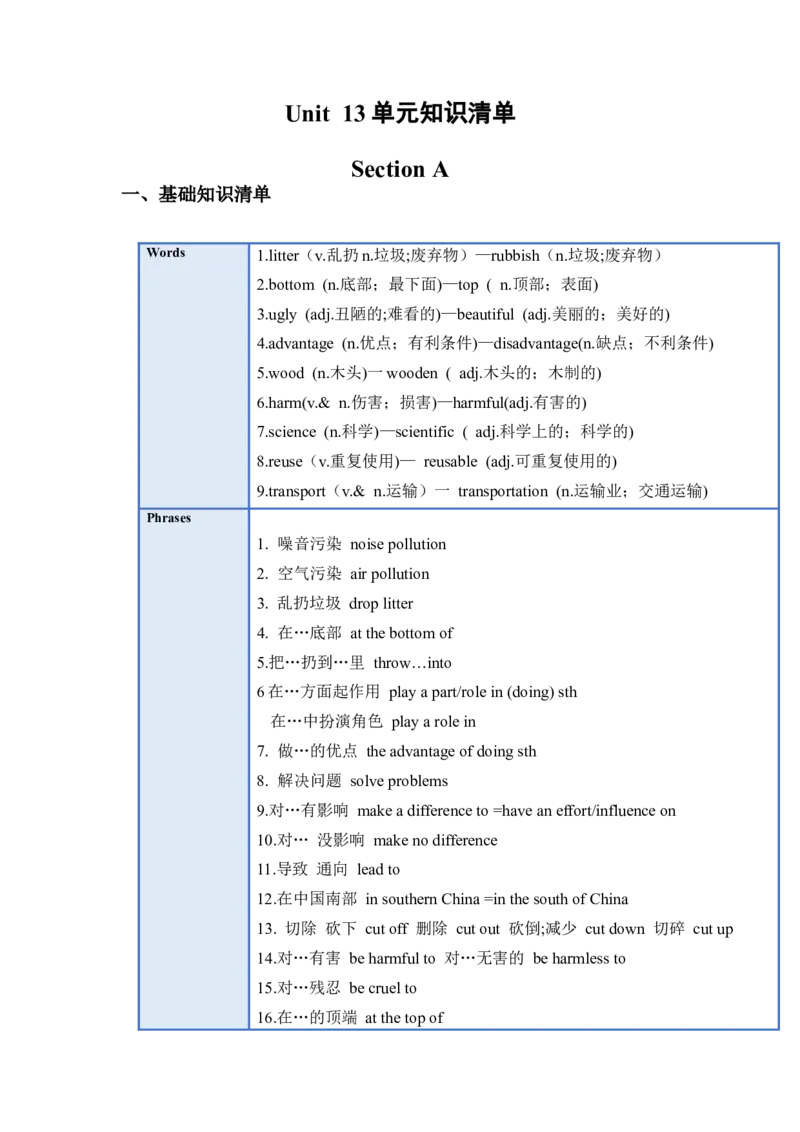
Words 1.litter(v.乱扔n.垃圾;废弃物)—rubbish(n.垃圾;废弃物)
2.bottom (n.底部;最下面)—top ( n.顶部;表面)
3.ugly (adj.丑陋的;难看的)—beautiful (adj.美丽的;美好的)
4.advantage (n.优点;有利条件)—disadvantage(n.缺点;不利条件)
5.wood (n.木头)一wooden ( adj.木头的;木制的)
6.harm(v.& n.伤害;损害)—harmful(adj.有害的)
7.science (n.科学)—scientific ( adj.科学上的;科学的)
8.reuse(v.重复使用)— reusable (adj.可重复使用的)
9.transport(v.& n.运输)一 transportation (n.运输业;交通运输)
Phrases
1. 噪音污染 noise pollution
2. 空气污染 air pollution
3. 乱扔垃圾 drop litter
4. 在…底部 at the bottom of
5.把…扔到…里 throw…into
6在…方面起作用 play a part/role in (doing) sth
在…中扮演角色 play a role in
7. 做…的优点 the advantage of doing sth
8. 解决问题 solve problems
9.对…有影响 make a difference to =have an effort/influence on
10.对… 没影响 make no difference
11.导致 通向 lead to
12.在中国南部 in southern China =in the south of China
13. 切除 砍下 cut off 删除 cut out 砍倒;减少 cut down 切碎 cut up
14.对…有害 be harmful to 对…无害的 be harmless to
15.对…残忍 be cruel to
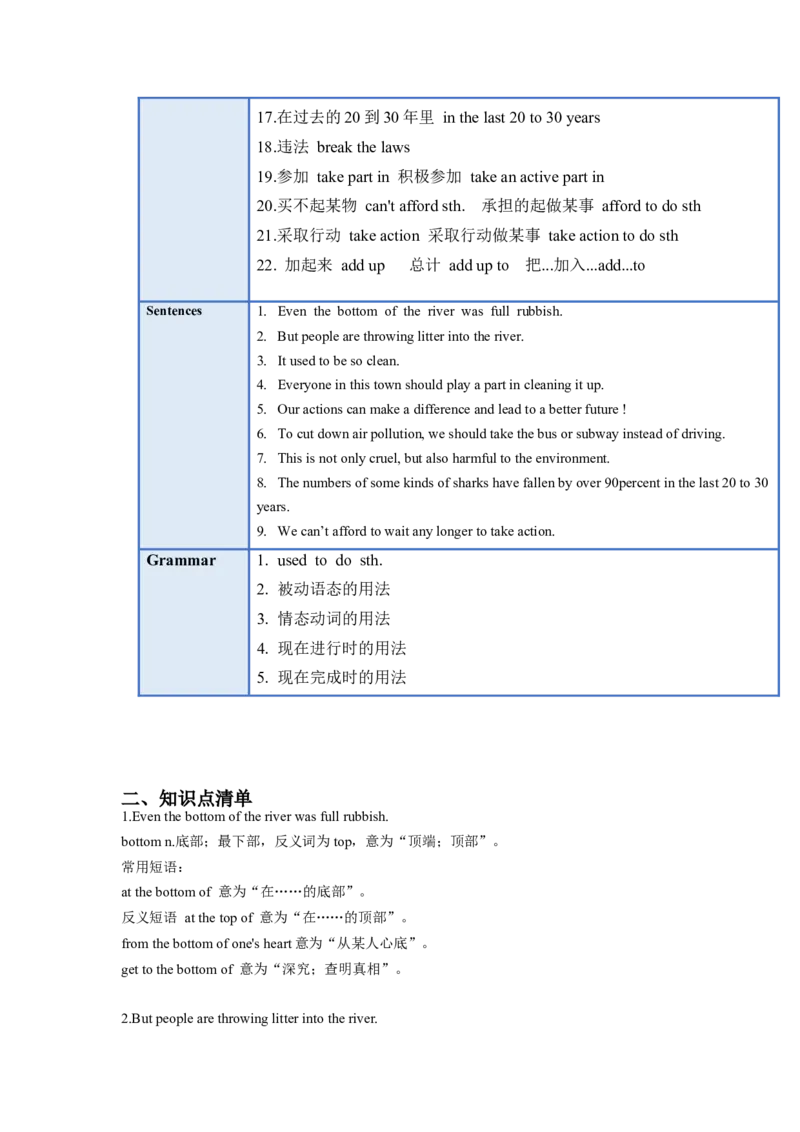
16.在…的顶端 at the top of17.在过去的20到30年里 in the last 20 to 30 years
18.违法 break the laws
19.参加 take part in 积极参加 take an active part in
20.买不起某物 can't afford sth. 承担的起做某事 afford to do sth
21.采取行动 take action 采取行动做某事 take action to do sth
22. 加起来 add up 总计 add up to 把...加入...add...to
Sentences 1. Even the bottom of the river was full rubbish.
2. But people are throwing litter into the river.
3. It used to be so clean.
4. Everyone in this town should play a part in cleaning it up.
5. Our actions can make a difference and lead to a better future !
6. To cut down air pollution, we should take the bus or subway instead of driving.
7. This is not only cruel, but also harmful to the environment.
8. The numbers of some kinds of sharks have fallen by over 90percent in the last 20 to 30
years.
9. We can’t afford to wait any longer to take action.
Grammar 1. used to do sth.
2. 被动语态的用法
3. 情态动词的用法
4. 现在进行时的用法
5. 现在完成时的用法
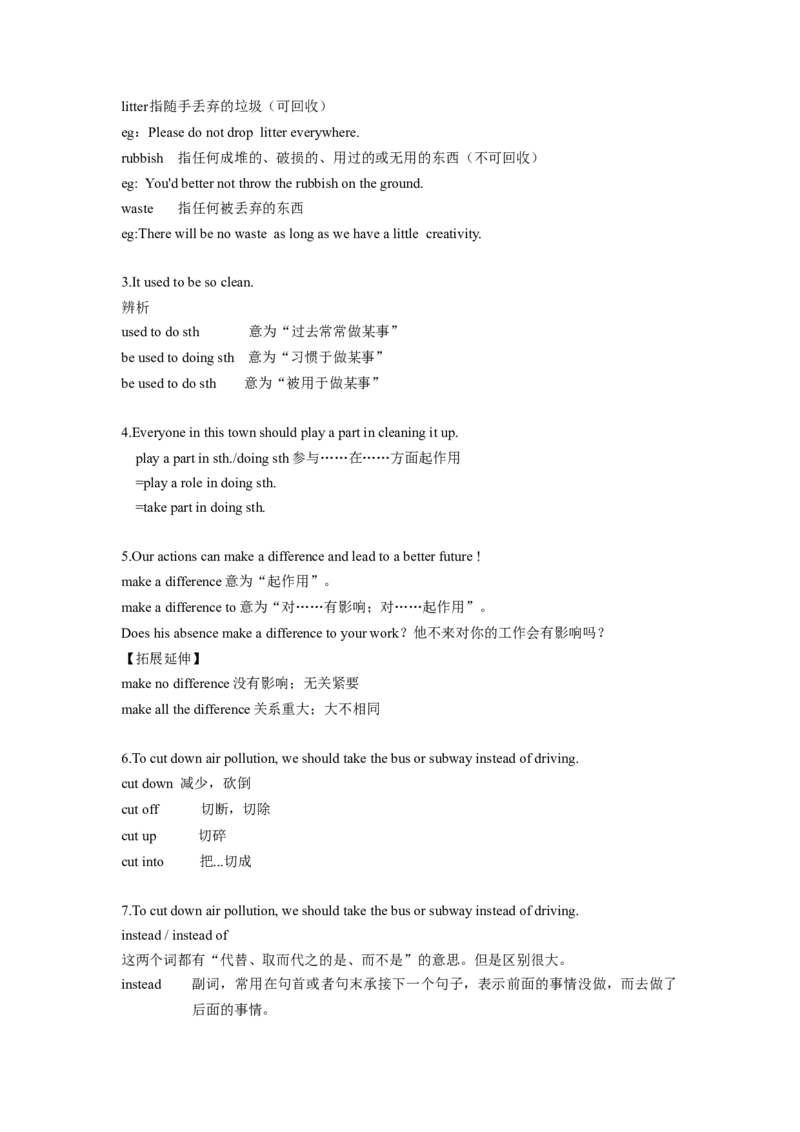
二、知识点清单
1.Even the bottom of the river was full rubbish.
bottom n.底部;最下部,反义词为top,意为“顶端;顶部”。
常用短语:
at the bottom of 意为“在……的底部”。
反义短语 at the top of 意为“在……的顶部”。
from the bottom of one's heart意为“从某人心底”。
get to the bottom of 意为“深究;查明真相”。
2.But people are throwing litter into the river.litter指随手丢弃的垃圾(可回收)
eg:Please do not drop litter everywhere.
rubbish 指任何成堆的、破损的、用过的或无用的东西(不可回收)
eg: You'd better not throw the rubbish on the ground.
waste 指任何被丢弃的东西
eg:There will be no waste as long as we have a little creativity.
3.It used to be so clean.
辨析
used to do sth 意为“过去常常做某事”
be used to doing sth 意为“习惯于做某事”
be used to do sth 意为“被用于做某事”
4.Everyone in this town should play a part in cleaning it up.
play a part in sth./doing sth参与……在……方面起作用
=play a role in doing sth.
=take part in doing sth.
5.Our actions can make a difference and lead to a better future !
make a difference意为“起作用”。
make a difference to意为“对……有影响;对……起作用”。
Does his absence make a difference to your work?他不来对你的工作会有影响吗?
【拓展延伸】
make no difference没有影响;无关紧要
make all the difference关系重大;大不相同
6.To cut down air pollution, we should take the bus or subway instead of driving.
cut down 减少,砍倒
cut off 切断,切除
cut up 切碎
cut into 把...切成
7.To cut down air pollution, we should take the bus or subway instead of driving.
instead / instead of
这两个词都有“代替、取而代之的是、而不是”的意思。但是区别很大。
instead 副词,常用在句首或者句末承接下一个句子,表示前面的事情没做,而去做了
后面的事情。instead of 短语介词,后面要接名字、代词或者动名词。
8.This is not only cruel, but also harmful to the environment.
not only … but also …”是一个并列连词词组
其意思相当于“both … and …”,但侧重点放在“but also”上。
用法如下:
① not only与but also后面所连接的词的词性必须一样;
The nurse was not only patient but also kind.
② not only只能连用,而but also既可连用,也可分开用;
③谓语动词的数与but also后主语的数保持一致;
④ not only放在句首,后接句子时要用主谓倒装结构.
cruel adj. 残酷的;残忍的 cruelty n.残忍
反义词kind/friendly/nice be cruel to sb.
I think it’s cruel to kill animals.
harmful adj. 有害的 --反义词 harmless 无害的
harm n.&v.损害,伤害,危害
be harmful to =do harm to =be bad for...
Reading in the sun is harmful to/does harm to your eyes.
9.The numbers of some kinds of sharks have fallen by over 90 percent in the last 20 to 30 years.
the numer of +可数名词复数,“...的数量”, 谓语动词用单数。
a number of + 可数名词复数,“许多,大量”,谓语动词用复数。
in the last/ past +时间 “在过去的多少...里”,一般和现在完成时连用。
10.We can’t afford to wait any longer to take action.
afford v. 承担得起(后果),买得起 常与can,be able to 连用,afford sth.
can afford to buy 能买得起
can’t afford to waste浪费不起
can’t afford to wait等不起
三、语法清单
1.used to 的用法
(1)定义:表示过去存在某种状态或者过去经常性、习惯性的动作,
或表示过去存在某种状态。暗含着这种状态或动作目前
已不存在的意思。
(2)结构:used to+动词原形;否定形式为didn't use to do sth.或usedn't to do sth.;
一般疑问形式为Used sb. to do sth.? 或Did sb. use to do sth.?;
附加疑问句式为usedn't sb.或didn't sb.
2.被动语态的用法
(1)基本结构: be+及物动词的过去分词
(2)定义:被动语态表示主语为谓语动词动作的承受者。
(3)几种常用时态的被动语态的结构:
一般现在时 am/is/are+及物动词的过去分词
一般过去时 was/were+及物动词的过去分词
一般将来时 will/shall be+及物动词的过去分词
3.情态动词 的用法
(1)情态动词+动词原形
(2)情态动词没有人称和数的变化。
(3)常用的情态动词有:can/could, may/might,must/have to,should/ought to, would,need 等。
4.现在进行时 的用法
(1)构成: am/ is/are+动词-ing形式
(2)定义:表示现在正在进行或发生的动作,也表示现阶段或当前一段时间内正在进行的
动作。
(3)常见的标志词或时间状语有:now,look, listen, these days等,有时也需要根据上
下文判断。
(4)一些表示位置移动的动词,如go,come, leave等常用现在进行时表示将来。
5.现在完成时的用法
(1)构成: have/has+动词的过去分词
(2)定义:
1)表示过去发生的某一动作对现在造成的影响或结果,
常与already,never,ever,just, before,yet,so far等连用。
2)表示过去已经开始,持续到现在的动作或状态,
常与for+时间段,
since+时间点,
since引导的从句(过去时),
since+一段时间+ago,
how long等时间状语连用。
拓展:
①“have/has been to+地点名词”表示“曾经去过某地”,强调现在已经回来,不在那里了。
②“have/has gone to+地点名词”表示“去了某地”,
强调还没有回来,可能在去的途中,也可能在目的地。
③“have/has been in/at+地点名词” 表示“待在某地”。
e.g: She has been to Shanghai.她到过上海。(现在不在上海)
She has gone to Shanghai.她去上海了。(现在已在上海或在去的途中)
She has been in Shanghai for 3 days. (待在上海3天了)