2022-2023学年九年级上册英语期中难点大串讲
Unit 5
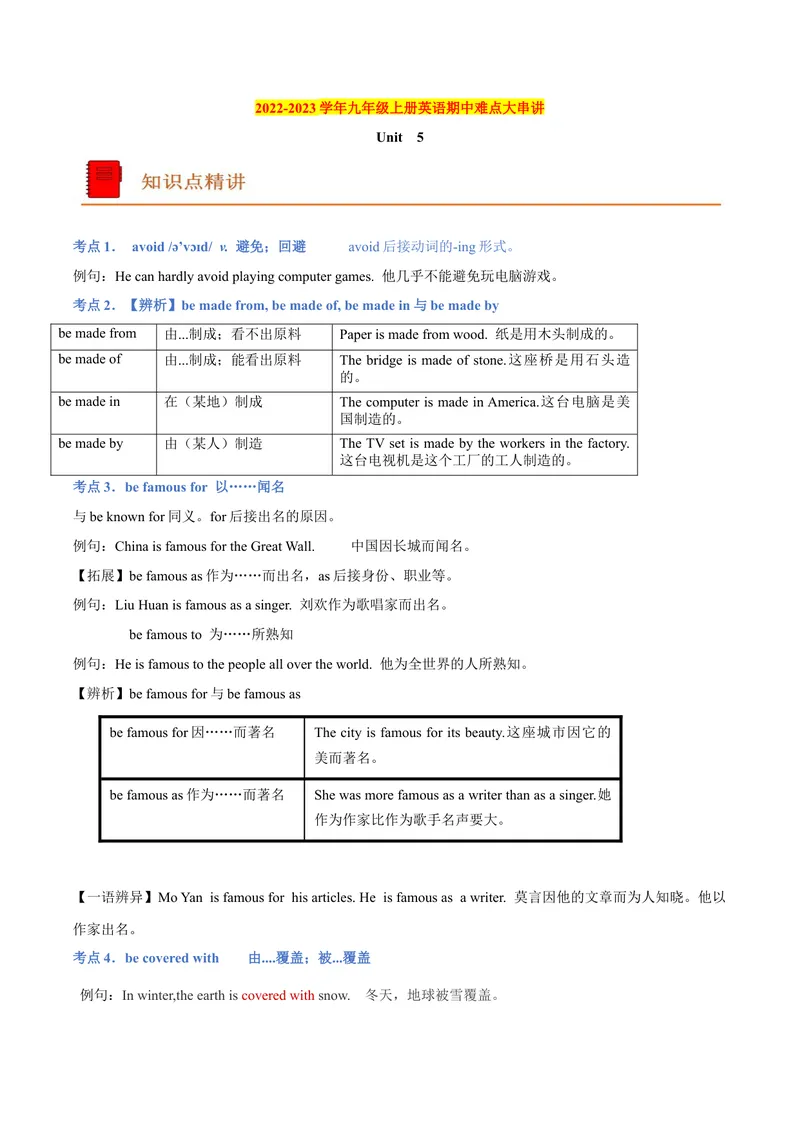
考点1. avoid /ə’vɔɪd/ v. 避免;回避 avoid后接动词的-ing形式。
例句:He can hardly avoid playing computer games. 他几乎不能避免玩电脑游戏。
考点2.【辨析】be made from, be made of, be made in与be made by
be made from 由...制成;看不出原料 Paper is made from wood. 纸是用木头制成的。
be made of 由...制成;能看出原料 The bridge is made of stone.这座桥是用石头造
的。
be made in 在(某地)制成 The computer is made in America.这台电脑是美
国制造的。
be made by 由(某人)制造 The TV set is made by the workers in the factory.
这台电视机是这个工厂的工人制造的。
考点3.be famous for 以……闻名
与be known for同义。for后接出名的原因。
例句:China is famous for the Great Wall. 中国因长城而闻名。
【拓展】be famous as作为……而出名,as后接身份、职业等。
例句:Liu Huan is famous as a singer. 刘欢作为歌唱家而出名。
be famous to 为……所熟知
例句:He is famous to the people all over the world. 他为全世界的人所熟知。
【辨析】be famous for与be famous as
be famous for因……而著名 The city is famous for its beauty.这座城市因它的
美而著名。
be famous as作为……而著名 She was more famous as a writer than as a singer.她
作为作家比作为歌手名声要大。
【一语辨异】Mo Yan is famous for his articles. He is famous as a writer. 莫言因他的文章而为人知晓。他以
作家出名。
考点4.be covered with 由....覆盖;被...覆盖
例句:In winter,the earth is covered with snow. 冬天,地球被雪覆盖。【拓展】cover....with.... 用....覆盖.....
例句:Cover the food with a cloth. 用一块布把食物罩起来。
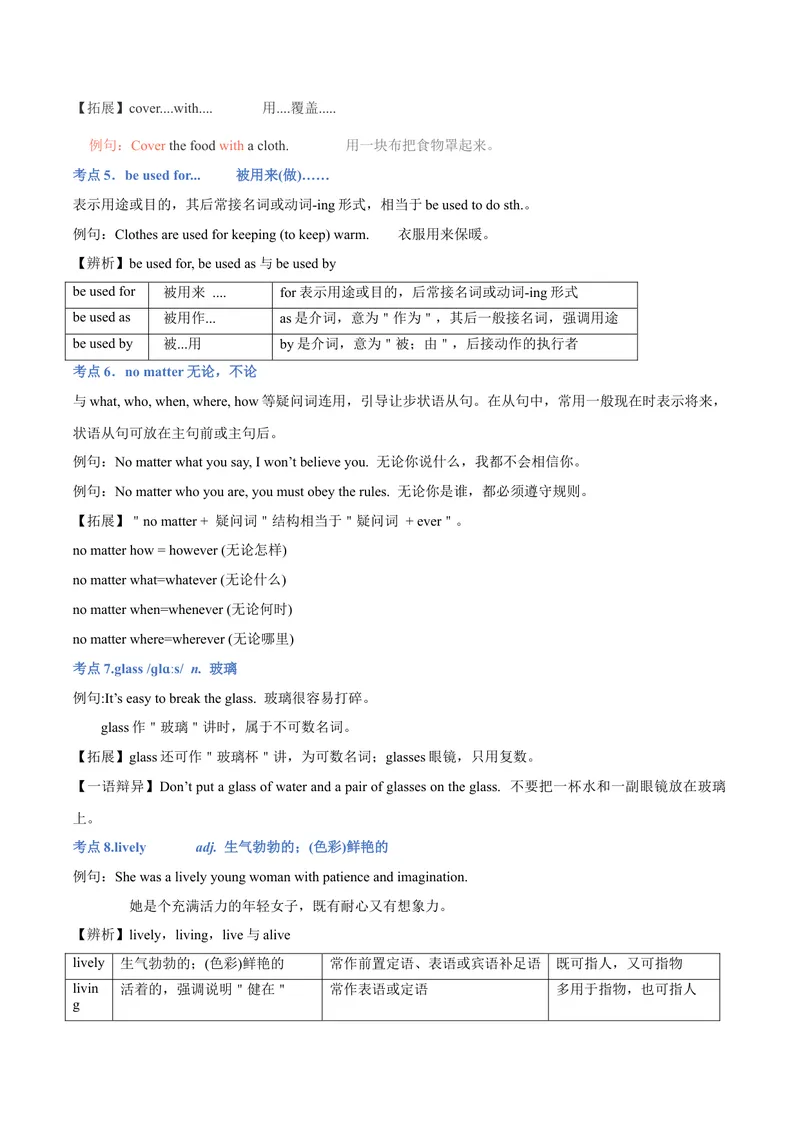
考点5.be used for... 被用来(做)……
表示用途或目的,其后常接名词或动词-ing形式,相当于be used to do sth.。
例句:Clothes are used for keeping (to keep) warm. 衣服用来保暖。
【辨析】be used for, be used as与be used by
be used for 被用来 .... for表示用途或目的,后常接名词或动词-ing形式
be used as 被用作... as是介词,意为"作为",其后一般接名词,强调用途
be used by 被...用 by是介词,意为"被;由",后接动作的执行者
考点6.no matter无论,不论
与what, who, when, where, how等疑问词连用,引导让步状语从句。在从句中,常用一般现在时表示将来,
状语从句可放在主句前或主句后。
例句:No matter what you say, I won’t believe you. 无论你说什么,我都不会相信你。
例句:No matter who you are, you must obey the rules. 无论你是谁,都必须遵守规则。
【拓展】"no matter + 疑问词"结构相当于"疑问词 + ever"。
no matter how = however (无论怎样)
no matter what=whatever (无论什么)
no matter when=whenever (无论何时)
no matter where=wherever (无论哪里)
考点7.glass /ɡlɑːs/ n. 玻璃
例句:It’s easy to break the glass. 玻璃很容易打碎。
glass作"玻璃"讲时,属于不可数名词。
【拓展】glass还可作"玻璃杯"讲,为可数名词;glasses眼镜,只用复数。
【一语辩异】Don’t put a glass of water and a pair of glasses on the glass. 不要把一杯水和一副眼镜放在玻璃
上。
考点8.lively adj. 生气勃勃的;(色彩)鲜艳的
例句:She was a lively young woman with patience and imagination.
她是个充满活力的年轻女子,既有耐心又有想象力。
【辨析】lively,living,live与alive
lively 生气勃勃的;(色彩)鲜艳的 常作前置定语、表语或宾语补足语 既可指人,又可指物
livin 活着的,强调说明"健在" 常作表语或定语 多用于指物,也可指人
glive 读作/laIv/时,意为"活的" 一般作定语 一般只修饰物,不修饰人
alive 活着的,侧重生与死之间的界 常作表语、宾语补足语或后置定语 多用于指人,也可指物
限
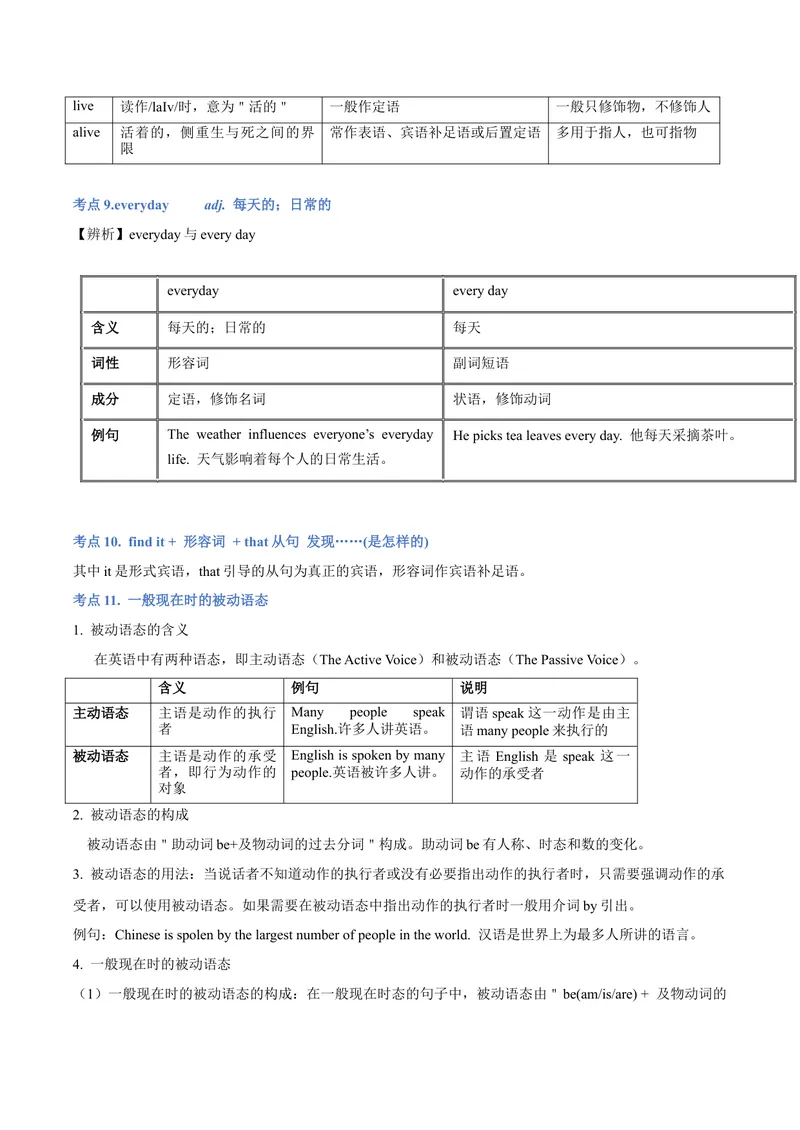
考点9.everyday adj. 每天的;日常的
【辨析】everyday与every day
everyday every day
含义 每天的;日常的 每天
词性 形容词 副词短语
成分 定语,修饰名词 状语,修饰动词
例句 The weather influences everyone’s everyday He picks tea leaves every day. 他每天采摘茶叶。
life. 天气影响着每个人的日常生活。
考点10. find it + 形容词 + that从句 发现……(是怎样的)
其中it是形式宾语,that引导的从句为真正的宾语,形容词作宾语补足语。
考点11. 一般现在时的被动语态
1. 被动语态的含义
在英语中有两种语态,即主动语态(The Active Voice)和被动语态(The Passive Voice)。
含义 例句 说明
主动语态 主语是动作的执行 Many people speak 谓语speak这一动作是由主
者 English.许多人讲英语。 语many people来执行的
被动语态 主语是动作的承受 English is spoken by many 主语 English 是 speak 这一
者,即行为动作的 people.英语被许多人讲。 动作的承受者
对象
2. 被动语态的构成
被动语态由"助动词be+及物动词的过去分词"构成。助动词be有人称、时态和数的变化。
3. 被动语态的用法:当说话者不知道动作的执行者或没有必要指出动作的执行者时,只需要强调动作的承
受者,可以使用被动语态。如果需要在被动语态中指出动作的执行者时一般用介词by引出。
例句:Chinese is spolen by the largest number of people in the world. 汉语是世界上为最多人所讲的语言。
4. 一般现在时的被动语态
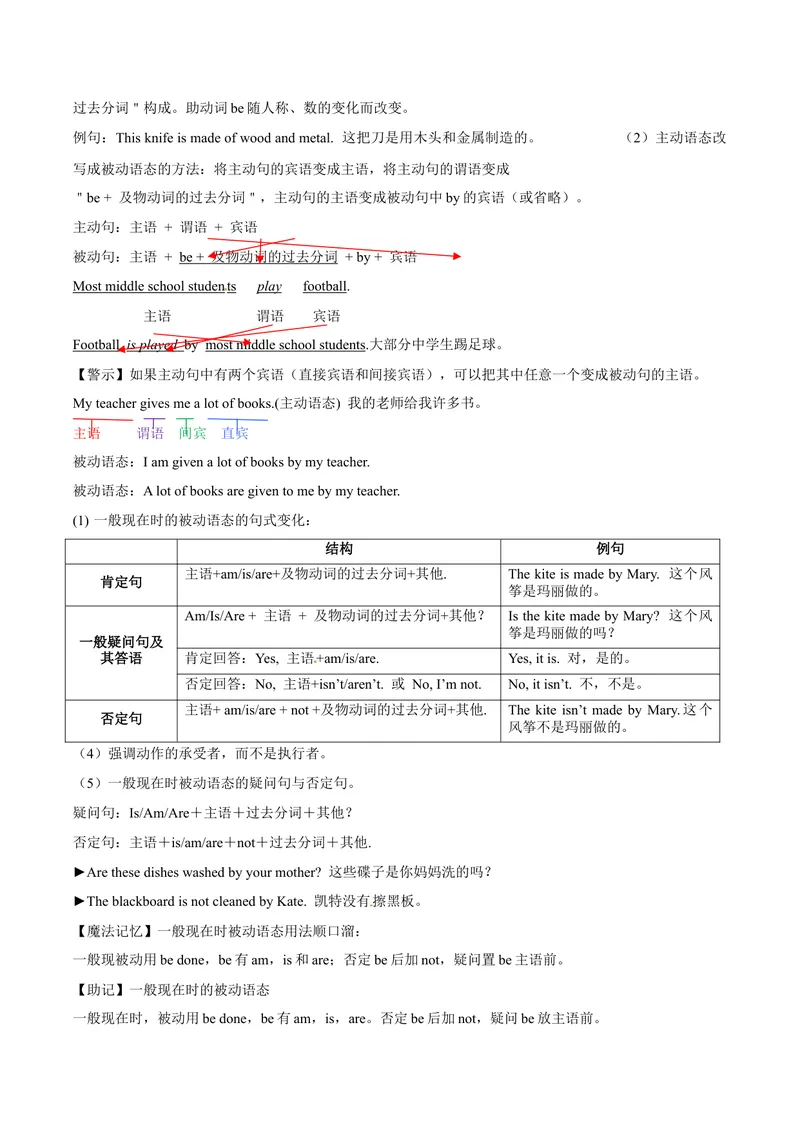
(1)一般现在时的被动语态的构成:在一般现在时态的句子中,被动语态由"be(am/is/are) + 及物动词的过去分词"构成。助动词be随人称、数的变化而改变。
例句:This knife is made of wood and metal. 这把刀是用木头和金属制造的。[来源:Z+xx+(2)主动语态改
写成被动语态的方法:将主动句的宾语变成主语,将主动句的谓语变成
"be + 及物动词的过去分词",主动句的主语变成被动句中by的宾语(或省略)。
主动句:主语 + 谓语 + 宾语
被动句:主语 + be + 及物动词的过去分词 + by + 宾语
Most middle school students play football.
主语 谓语 宾语
Football is played by most middle school students.大部分中学生踢足球。
【警示】如果主动句中有两个宾语(直接宾语和间接宾语),可以把其中任意一个变成被动句的主语。
My teacher gives me a lot of books.(主动语态) 我的老师给我许多书。
主语 谓语 间宾 直宾
被动语态:I am given a lot of books by my teacher.
被动语态:A lot of books are given to me by my teacher.
(1) 一般现在时的被动语态的句式变化:
结构 例句
主语+am/is/are+及物动词的过去分词+其他. The kite is made by Mary. 这个风
肯定句
筝是玛丽做的。
Am/Is/Are + 主语 + 及物动词的过去分词+其他? Is the kite made by Mary? 这个风
筝是玛丽做的吗?
一般疑问句及
其答语 肯定回答:Yes, 主语+am/is/are. Yes, it is. 对,是的。
否定回答:No, 主语+isn’t/aren’t. 或 No, I’m not. No, it isn’t. 不,不是。
主语+ am/is/are + not +及物动词的过去分词+其他. The kite isn’t made by Mary.这个
否定句
风筝不是玛丽做的。
(4)强调动作的承受者,而不是执行者。
(5)一般现在时被动语态的疑问句与否定句。
疑问句:Is/Am/Are+主语+过去分词+其他?
否定句:主语+is/am/are+not+过去分词+其他. [来源:学科网ZXXK]
►Are these dishes washed by your mother? 这些碟子是你妈妈洗的吗?
►The blackboard is not cleaned by Kate. 凯特没有擦黑板。
【魔法记忆】一般现在时被动语态用法顺口溜:
一般现被动用be done,be有am,is和are;否定be后加not,疑问置be主语前。
【助记】一般现在时的被动语态
一般现在时,被动用be done,be有am,is,are。否定be后加not,疑问be放主语前。一、单项选择
1.Every day, too much water ________ in our school. We should save it.
A.is wasted B.wastes C.was wasted
2.—What a strange machine! Do you know ________?
—I’m not sure. Maybe people make bread with it.
A.what it was used forB.what it is used for C.what was it used forD.what is it used for
3.It’s not your turn yet. Please wait on the chair over there until you ________.
A.are calling B.have called C.are called D.called
4.—I went to Anhua for vacation last summer. It is a small town in Hunan Province.
—As far as I know, Anhua ________ dark tea.
A.is known as B.is famous as C.is known for D.is famous to
5.Many trees ________ every year to make the environment better and better.
A.plant B.were planted C.are planted D.have planted
6.The Monkey King is a traditional Chinese cartoon hero. Today, he ________ by people of all ages.
A.loves B.will love C.is loved D.will be loved
7.The government plans to ________ more jobs for young people in western China.
A.create B.avoid C.treat D.repeat
8.—May I touch this old window, Dad?
—No, you can’t, Jim. The broken _________ may hurt you.
A.cotton B.glass C.steel D.grass
9.—I won’t come to the party unless Mary ___________.
—You mean if Mary comes, you will come.
A.will invite B.is invited C.invites D.will be invited
10.—________ Chinese knots (中国结) used during the Spring Festival?
—People usually hang them on doors or walls.
A.Why did B.Why are C.How are D.How did
二、完形填空
When I was young, I was interested in Chinese movies. I wanted to know more about Chinese ____11____
like Kungfu and Xiqu. I often dreamed to go to China one day.Luckily, I had a chance to study ____12____ when I was learning theater at university. There was a program
studying Asian theater arts ____13____ in China or in India. I decided to go to China and learn Beijing Opera in a
Chinese theater school. The school ____14____ a place to practice. It was good ____15____ I could practice
whenever I wanted. Also I had ____16____ lessons — the teacher would give me one-to-one class for three
hours. That was the best ____17____ of my study in China. I do appreciate (感激) this chance to learn the
beautiful art!
I got a lot from my study in China. It has greatly ____18____ me and helped me develop into a more skillful
actor. This Chinese art gives me plenty of tools so I can use ____19____ when I perform other shows in Europe. I
have ____20____ an art center to teach Beijing Opera. Now there are more fans of Beijing Opera in my country.
11.A.food B.culture C.medicine D.manner
12.A.abroad B.inside C.online D.down
13.A.such B.even C.neither D.either
14.A.provided B.required C.offered D.dealt
15.A.because B.unless C.until D.though
16.A.boring B.easy C.private D.social
17.A.art B.part C.way D.custom
18.A.controlled B.stopped C.troubled D.influenced
19.A.them B.it C.me D.her
20.A.taken up B.made up C.set up D.given up
三、阅读单选
Drinking tea is an important part of Chinese culture. It is seen as the national drink in China. The most
common types of Chinese tea are as follows.
Green tea is the oldest and most popular tea in China. It has a pale color and a strong flavor. It is produced
mainly in Anhui and Zhejiang. The most popular green tea is Longjing, which is produced near West Lake,
Hangzhou.
Black tea is the second most popular type of Chinese tea. It can help treat(治疗)stomachaches.
Wulong tea, also known as blue tea, has a gentle flavor and can help people lose weight. Tieguanyin Tea in
Anhui and Dongding Wulong in Taiwan are two well-known types of it.
Scented tea(花茶)is created by mixing tea leaves with flowers. It is known by strong fragrance(芳香),
and it can help people feel comfortable after drinking. Jasmine(茉莉)tea is the most popular of this kind.
Tips of Tea DrinkingDo you know how to drink tea in a right way? Here are some tips.
● Drinking it while it’s hot.
● Don’t drink too much strong tea.
● The best time to drink tea is between meals.
● Drink tea a couple of hours after taking medicine.
● Green tea is the best for office workers.
21.________ is the oldest and most popular tea in China.
A.Wulong tea B.Green tea C.Red tea
22.Black tea can ________.
A.help people lose weight B.help people feel lucky C.help treat stomachaches
23.Dongding Wulong tea is produced in ________.
A.Taiwan B.Zhejiang C.Anhui
24.Scented tea is made by ________.
A.flowers B.tea leaves C.tea leaves with flowers
25.The right way to drink tea is ________.
A.to drink it while it's cold B.to drink between meals C.to drink too much strong tea
Dragons are not real animals, but they look like a combination (结合体)of many animals, such as snakes,
fish, and deer. They have two horns and a long mustache(胡子). With fantastic power, they fly in the sky or
swim in the sea. They can make rain, too. The Chinese dragon is a symbol of strength and good luck. The emperors
of ancient China loved dragons, their clothes were covered with pictures of dragons.
We are proud to call ourselves the “descendants(传人)of the dragons”. In China, “excellent” people are
often called “dragons”. A number of Chinese sayings and idioms talk about dragons, for example, “Hoping one’s
child will become a dragon”, which means hoping one’s child will be successful.
It is said that people born in the Year of the Dragon have certain characters(性格). They are creative,
confident, brave and quick-tempered. There are some famous “dragons” who have done excellent things, like the
great man Deng Xiaoping who was born on August 22nd in 1904, the famous businessman Li Jiacheng and the
movie star Zhao Wei. They are all successful.
There are also some traditional festivals in China, such as the Dragon Head-Raising Day and the Dragon Boat
Festival. We have different kinds of activities to celebrate them. These two festivals come every year, but the Year
of the Dragon comes every twelve years.The dragon is very important in Chinese culture. As the “descendants of the dragons”, it is necessary for us to
know the views on dragons in our culture. It can help us understand why our parents always want us to be
“dragons”.
26.What does the Chinese dragon symbolize(象征)?
A.A combination of many animals. B.Chinese sayings and idioms.
C.Traditional festivals. D.Strength and good luck.
27.In the passage, the underlined sentence “Hoping one’s child will become a dragon” means “________” in
Chinese.
A.龙马精神 B.龙飞凤舞 C.望子成龙 D.龙腾虎跃
28.What characters may the people born in the Year of the Dragon have?
A.They may be creative, confident, brave and powerful.
B.They may be creative, confident, brave and quick-tempered.
C.They may be lovely, confident, brave and quick-tempered.
D.They may be lucky, confident, creative and successful.
29.Which of the following is the Year of the Dragon?
A.2012. B.2016. C.2008. D.2018.
30.According to the passage, which of the following statements(叙述)is TRUE?
A.Dragons are real animals.
B.There are many Chinese saying and idioms about dragons.
C.People born in the Year of the Dragon must be successful.
D.The “descendants of the dragons” are often called “dragons”.
Once upon a time, there was no tea at all in England. People there used to drink a light beer(啤酒). No coffee
or milk but large glasses of beer stood on the breakfast table!
When tea was first brought to England, an old couple got some as a special treat. But they did not know how
it should be used. They cooked the leaves in hot water, and spread them on a piece of bacon (熏肉) which they
were going to have for dinner. They ate the leaves, and threw the tea away!
However, tea is becoming as popular as coffee and milk in England today.
Tea is the leaf of a plant which grows widely in China, Japan and some other countries. Tea farmers usually
grow many tea plants on a large piece of land. When the tea leaves are ready to be picked, it is the busiest time
for tea farmers in a year. They pull off the leaves and dry them. In their spare time, they pick out the best leavesand get them ready for market. In China, whenever a visitor comes into a house, he is served with a cup of tea.
31.What was served for breakfast in England long ago?
A.Beer. B.Tea. C.Coffee. D.Milk.
32.The old couple in England got some tea as ________.
A.a special gift B.special leaves C.special food D.a special treat
33.Tea farmers are the busiest in a year when they _________.
A.serve visitors at home B.sell tea in the market
C.pick and dry tea leaves D.look for a piece of land
34.In which part of a magazine we can read the text?
A.Nature. B.Culture. C.Environment. D.Technology.
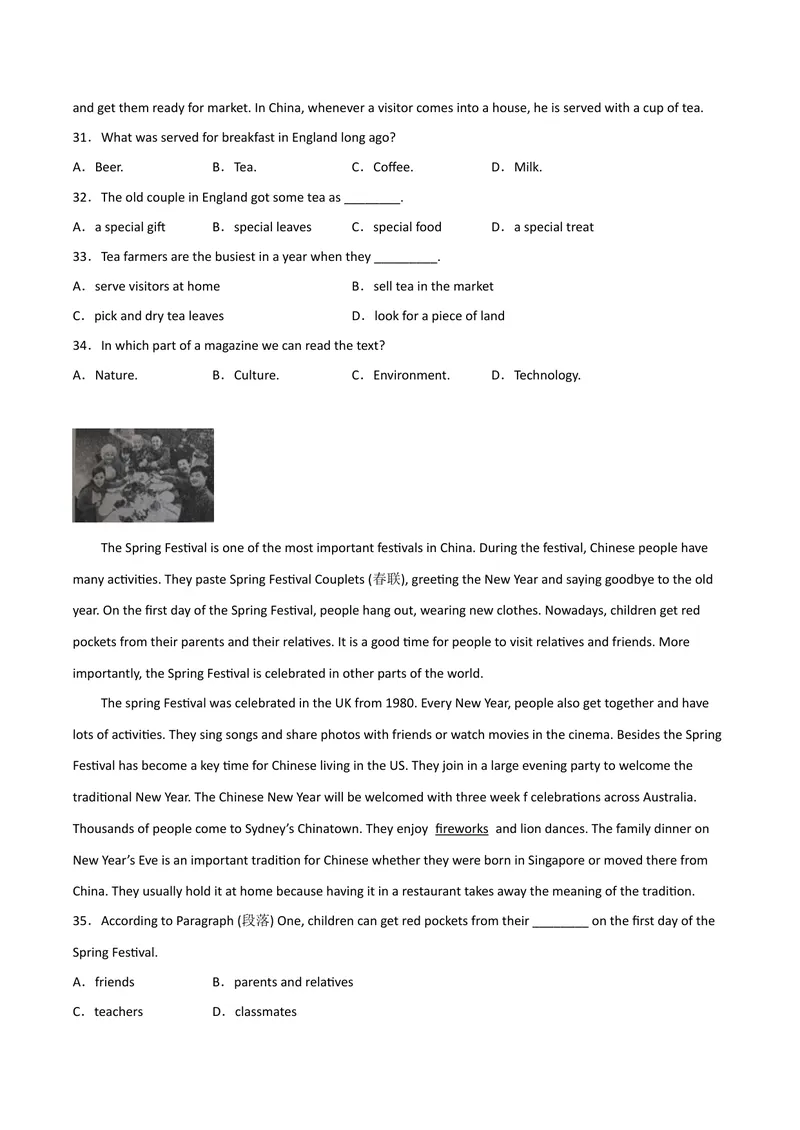
The Spring Festival is one of the most important festivals in China. During the festival, Chinese people have
many activities. They paste Spring Festival Couplets (春联), greeting the New Year and saying goodbye to the old
year. On the first day of the Spring Festival, people hang out, wearing new clothes. Nowadays, children get red
pockets from their parents and their relatives. It is a good time for people to visit relatives and friends. More
importantly, the Spring Festival is celebrated in other parts of the world.
The spring Festival was celebrated in the UK from 1980. Every New Year, people also get together and have
lots of activities. They sing songs and share photos with friends or watch movies in the cinema. Besides the Spring
Festival has become a key time for Chinese living in the US. They join in a large evening party to welcome the
traditional New Year. The Chinese New Year will be welcomed with three week f celebrations across Australia.
Thousands of people come to Sydney’s Chinatown. They enjoy fireworks and lion dances. The family dinner on
New Year’s Eve is an important tradition for Chinese whether they were born in Singapore or moved there from
China. They usually hold it at home because having it in a restaurant takes away the meaning of the tradition.
35.According to Paragraph (段落) One, children can get red pockets from their ________ on the first day of the
Spring Festival.
A.friends B.parents and relatives
C.teachers D.classmates36.Which activity is NOT mentioned (提到) in Paragraph One?
A.Hold a New Year party.
B.Hang out, wearing new clothes.
C.Visit relatives and friends.
D.Paste Spring Festival Couplets.
37.The underlined word “fireworks” in the second paragraph means “________” in Chinese.
A.火炉工 B.消防员 C.烟花表演 D.畅销书
38.Which of the following is TRUE?
A.The Spring Festival is the most important festival in China.
B.The Spring Festival is celebrated only in China.
C.The Spring Festival was celebrated in the US from 1980.
D.Chinese living in Singapore usually hold the family dinner on New Year’s Eve at home.
39.What’s the best title of the passage?
A.The Spring Festival in the World B.The Spring Festival in the UK
C.The Spring Festival in the US D.The Spring Festival in China
四、语法填空
阅读短文,然后用短文括号中所给词的适当形式填空。
Have your mum or grandma ever made embroidered(刺绣的) clothes for you? People in the past often
embroidered on handkerchiefs(手帕), bed covers and dresses. Girls would embroider on a sachet(香囊) as a gift
for ____40____ (they) lovers.
Shu embroidery comes from Sichuan. It is the ____41____ (old) kind of embroidery in China. People began
to make it during the Han Dynasty (206BC — 220AD). They ____42____ (sell) it to other countries along the
South Silk Road.
Embroidery ____43____ (take) time. It may take as long as a whole day to finish just 10 cm. By the 1970s,
Sichuan had as many as 5,000 embroiderers. But since today modern machines can make embroidery products(产
品) more ____44____ (cheap), fewer people are buying handmade Shu embroidery products. Young people
aren’t learning the ____45____ (skill). To protect this skill, Shu embroidery ____46____ (add) to China’s
intangible cultural heritage(非物质文化遗产) list in 2006.
五、短文综合填空
综合填空:根据所给音标、上下文、首字母或汉语提示完成空格中所缺单词,使短文完整通顺,语法正确,
每个空只能填一个词。The story of the Double Ninth Festival can be dated back as early as East Han Dynasty.
One day, Huan Jing and his ____47____ /ˈmædʒɪk/ art teacher, Fei Changfang were climbing a mountain. Fei
Changfang suddenly stopped ____48____ looked very sad. He told Huan Jing, “On the ninth day of the ninth
lunar month, the monster(怪兽) will come to your hometown. Now you must go home and save the villagers.
Remember to make a red bag for each one of the villagers and ____49____ /pʊt/ a spray of dogwood(茱萸) on
everyone. Then all must ____50____ (捆) your bags to your arms, leave home quickly and climb to the
t____51____ of a mountain. Most importantly, you must all drink some chrysanthemum wine(酒). Only
____52____ doing so can the villagers avoid this disaster.”
On hearing this, Huan Jing ran home and asked the villagers to do ____53____ (精确地) as his teacher said.
They climbed a high mountain nearby. They did not return u____54____ Huan Jing killed the monster with his art
sword(剑) in the evening.
Since then, climbing a ____55____, carrying a spray of dogwood and drinking chrysanthemum wine became
the traditional activities of the Double Ninth Festival, to avoid evils spirits and bad lucks.
In 1989, the Chinese government ____56____ /dɪˈsaɪdɪd/ the Double Ninth Festival as Seniors’ Day. The
traditional culture of Double Ninth and that of the modern were finely combined. It becomes a festival of
respecting for the old people, and loving, helping the old.
六、多句选词填空
用方框中所给单词的适当形式填空,每词仅用一次。
able fascinate businessman know make
57.Hawaii is a ________ place. Many visitors go there every year.
58.Mr. Green is in Japan on ________. He will be back in 2 days.
59.That mountain is ________ for its beauty.
60.He is a man with many ________, so just give him more time.
61.My teacher did what he could ________ his class lively.
七、话题作文
62.重阳节(the Double Ninth Festival)又称老人节,是我国一个传统节日。在那天人们会出游、登高。
假如你是李华,请根据以下提示,以“重阳敬老”为主题为学校英语报投稿,介绍人们怎样庆祝这个节日,
你通常做些什么来敬老助老,以及你的想法。要求∶
1.意思连贯、符合逻辑。
2.提示词语仅供选用。
3.不要写出你的校名和姓名。
4.不少于70词,文章的开头不计人总词数。
提示词语∶go outing,climb,help,look after
1. How do Chinese people celebrate the Double Ninth Festival?
2. What do you usually do to show respect(尊重)to the old?
3. Do you think it is important to respect the old? Why?
The Double Ninth Festival is a traditional Chinese festival.
_____________________________________________________________________________________________
_____________________________________________________________________________________________
_____________________________________________________________________________________________
_____________________________________________________________________________________________
_____________________________________________________________________________________________
_________
答案
1.A【解析】句意:每天,我们学校浪费了太多的水。我们应该节约它。
考查被动语态。主语“too much water”和谓语动词waste构成动宾结构,应用被动语态,由句中“Every
day”可知,此句用一般现在时的被动语态,其构成为“am/is/are+过去分词”,故选A。
2.B
【解析】句意:——多么奇怪的一个机器!你知道它被用来干什么的吗?——我不确定。也许人们会用它
来做面包。
考查宾语从句。此处是宾语从句,从句用陈述语序,排除C和D选项。根据答语“Maybe people make
bread with it”可知,从句应用一般现在时的相关语态,故选B。
3.C
【解析】句意:还没轮到你呢。请在那边的椅子上等着,直到有人叫你。
考查一般现在时的被动语态。根据“you”和“call”可知,是被动关系,且until从句时态是一般现在时,因
此是一般现在时的被动语态,故选C。
4.C
【解析】句意:——去年夏天我去安化度假。这是湖南的一个小镇。——据我所知,安化以黑茶闻名。
考查短语辨析。is known as作为……而闻名;is famous as作为……而出名;is known for因……而闻名;is
famous to对……来说很出名。安化是一个地名,dark tea是物体,此处表示某地因为某物体而闻名,C项
符合语境,故选C。
5.C
【解析】句意:每年种植许多树木,使环境越来越好。
考查被动语态。根据“every year”可知,应该是一般现在时。主语“Many trees”与谓语动词“plant”之间存
在被动关系,一般现在时的被动形式为am/is/are done。又因主语是复数,故选C。
6.C
【解析】句意:孙悟空是中国传统的卡通英雄。今天,他受到了各年龄段人们的喜爱。
考查一般现在时的被动语态。主语he与动词love之间是被动关系,根据“today”可知,此空应填一般现在
时被动语态am/is/are+done的结构。故选C。
7.A
【解析】句意:政府计划为中国西部的年轻人创造更多的就业机会。
考查动词辨析。create创造;avoid避免;treat款待;repeat重复。根据“more jobs for young people in
western China”可知是创造更多工作机会。故选A。
8.B
【解析】句意:——爸爸,我可以摸这扇旧窗户吗?——不,你不能,Jim。碎玻璃可能会伤到你。考查名词辨析。cotton棉花;glass玻璃;steel钢铁;grass草。根据“May I touch this old window”及“The
broken ... may hurt you.”可知,是碎玻璃会伤到你。故选B。
9.B
【解析】句意:——除非玛丽被邀请,否则我不会来参加聚会的。——你的意思是如果玛丽来,你也要来。
考查一般现在时的被动语态。根据“unless”可知,此处是unless引导的条件状语从句,因此从句是一般现
在时。主语“Mary”和谓语动词“invite”是被动关系,所以这里是一般现在时的被动语态,结构是“be
done”,主语是第三人称单数,因此be动词是is, invite的过去分词是invited。故选B。
10.C
【解析】句意:——春节期间,中国结是如何使用的? ——人们通常把它们挂在门上或墙上。
考查一般现在时的被动语态以及特殊疑问词。根据“People usually hang them on doors or walls.”可知,问句
是在对方式进行提问,特殊疑问词应用how;问句的主语“中国结”和谓语动词“使用”之间是被动的关
系,因此谓语动词应用被动语态,其结构为:be+动词过去分词;而根据语境可判断,问句的时态为一般
现在时,且主语“Chinese knots”为复数,因此应用are used。故选C。
11.B 12.A 13.D 14.C 15.A 16.C 17.B 18.D 19.A 20.C
【解析】
11.句意:我想更多地了解中国文化,比如功夫和戏曲。
food食物;culture文化;medicine药品;manner举止。根据“Kungfu and Xiqu.”可知功夫和戏曲都是中国
文化的一部分,故选B。
12.句意:幸运的是,当我在大学学习戏剧的时候,我有一个出国学习的机会。
abroad国外;inside在里面;online线上;down向下。根据“There was a program studying Asian theater
arts...in China or in India”可知是出国学习的机会,故选A。
13.句意:在中国或印度有一个研究亚洲戏剧艺术的项目。
such如此;even甚至;neither两者都不;either两者中的任何一个。either...or“或者……或者”,故选D。
14.句意:学校提供了一个练习的地方。
provided提供;required要求;offered提供;dealt处理。根据“The school...a place to practice”可知指的是
学校提供了练习的地方,故选C。
15.句意:这很好,因为我可以随时练习。
because因为;unless除非;until直到;though尽管。前后句是因果关系,前果后因,故选A。
16.句意:我也有私人课程——老师会给我一对一的课三个小时。
boring无聊的;easy容易的;private私人的;social社交的。根据“one-to-one class”可知一对一课程属于私人课程,故选C。
17.句意:那是我在中国学习中最棒的部分。
art艺术;part部分;way方式;custom风俗。根据“That was the best...of my study in China.”结合前文介绍
一对一课程可知这是作者在中国学习中最棒的部分。故选B。
18.句意:它极大地影响了我,帮助我发展成为一个更熟练的演员。
controlled控制;stopped停止;troubled麻烦;influenced影响。根据“I got a lot from my study in China. It
has greatly...me ”可知作者在中国学到的东西对自己影响很大,故选D。
19.句意:这种中国艺术给了我很多工具,所以我可以在欧洲的其他演出中使用它们。
them他们;it它;me我;her她。根据“This Chinese art gives me plenty of tools so I can use”可知此处的代
词是代指tools,应用them,故选A。
20.句意:我成立了一个艺术中心来教授京剧。
taken up占据;made up编造;set up建立;given up放弃。根据“an art center to teach Beijing Opera”可知
是成立艺术中心,故选C。
21.B 22.C 23.A 24.C 25.B
【解析】
21.细节理解题。根据“Green tea is the oldest and most popular tea in China.”绿茶是中国最古老、最受欢迎
的茶。可知,绿茶在中国最古老,也最受欢迎。故选B。
22.细节理解题。根据“Black tea is the second most popular type of Chinese tea. It can help treat
stomachaches.”红茶是中国第二受欢迎的茶,它可以帮助治疗胃痛。可知,红茶能帮助治疗胃痛。故选C。
23.细节理解题。根据“Tieguanyin Tea in Anhui and Dongding Wulong in Taiwan are two well-known types of
it.”安徽的铁观音茶和台湾的冻顶乌龙茶是两种著名的茶。可知,冻顶乌龙茶产于台湾。故选A。
24.细节理解题。根据“Scented tea is created by mixing tea leaves with flowers.”可知,花茶是将茶叶和花混
合而成的。故选C。
25.细节理解题。根据“The best time to drink tea is between meals.”喝茶的最佳时间是两餐之间。可知,
应在两餐之间喝茶最好。故选B。
26.D 27.C 28.B 29.A 30.B
【解析】
26.细节理解题。根据第一段“The Chinese dragon is a symbol of strength and good luck.”可知,在中国,
“龙”被看作是“力量和好运”的象征。故选D。
27.词句猜测题。根据原文“Hoping one’s child will become a dragon, which means hoping he or she will be
successful.”可知,在中国优秀的人常被称作“龙”,因此这句话代表父母希望自己的孩子成为成功人士,即“望子成龙”。故选C。
28.细节理解题。根据短文第三段“It is said that people born in the Year of the Dragon have certain
characteristics. They are creative, confident, brave and quick-tempered.”可知,龙年出生的人具有的性格特点是
有创造力、自信、勇敢、急脾气。故选B。
29.推理判断题。根据“There are some famous ‘dragons’ who have done excellent things, like the great man
Deng Xiaoping who was born on August 22nd in 1904.”,“These two festivals come every year, but the Year of
the Dragon comes every twelve years. ”可知,1904年是龙年,龙年每12年一次,可以推断出2012年是龙年。
故选A。
30.推理判断题。根据“A number of Chinese sayings and idioms talk about dragons”可知,在中国有很多与
“龙”有关的成语和俗语,B选项符合文意。故选B。
31.A 32.D 33.C 34.B
【解析】
31.细节理解题。根据“Once upon a time, there was no tea at all in England. People there used to drink a light
beer(啤酒).”可知很久以前,在英国人们早餐桌上只有大杯的啤酒。故选A。
32.细节理解题。根据“When tea was first brought to England, an old couple got some as a special treat.”可知
英国的那对老夫妇得到了一些茶作为特殊款待。故选D。
33.细节理解题。根据“When the tea leaves are ready to be picked, it is the busiest time for tea farmers in a
year. They pull off the leaves and dry them. ”可知茶农是一年中最忙的时候是他们采摘和晾晒茶叶的时候。故
选C。
34.推理判断题。通断全文可知,本文主要介绍了英国人的饮茶历史和茶的产地以及种植,所以可能在杂
志的文化部分看到,故选B。
35.B 36.A 37.C 38.D 39.A
【解析】
35.细节理解题。根据第一段“Nowadays, children get red pockets from their parents and their relatives”可知
孩子从父母或亲戚那儿得到红包。故选B。
36.细节理解题。根据第一段“They paste Spring Festival Couplets (春联), greeting the New Year and saying
goodbye to the old year... people hang out, wearing new clothes ... get red pockets from their parents and their
relatives ... to visit relatives and friends.”可知,文中提及的春节期间的活动有:贴春联、逛街和穿新衣、拜
访亲戚和朋友,而没有提及举办新年聚会。故选A。
37.词义猜测题。根据划线单词所在句后面是“lion dances舞狮”,前面是“enjoy欣赏”,以及常识,可知该句表示“春节期间人们赏烟花和舞狮”,故划线部分“fireworks”的含义是“烟花表演”。故选C。
38.细节理解题。根据最后一段“The family dinner on New Year's Eve is an important tradition for Chinese
whether they were born in Singapore or moved there from China. They usually hold it at home because having it
in a restaurant takes away the meaning of the tradition.”可知,新年除夕夜的家庭聚餐对中国人是一项传统,
无论他们生在新加坡还是搬家到那儿,他们通常在家吃年夜饭,所以D选项表述正确。故选D。
39.最佳标题题。通读全文可知,本文主要介绍了春节,这不仅是中国人最重要的节日,世界上其他国家
也在庆祝该节日;因此A选项“世界上的春节”最符合文意,为本文最佳标题。故选A。
40.their 41.oldest 42.sold 43.takes 44.cheaply 45.skill 46.was added
【解析】
40.句意:女孩们会在香囊上刺绣,作为送给爱人的礼物。空处修饰其后的名词,应用形容词性物主代词,
故填their。
41.句意:它是中国最古老的刺绣。空前有定冠词the,空处修饰其后的名词,应用形容词形式,结合“in
China”可知,此处应用最高级形式,old的最高级是oldest,故填oldest。
42.句意:他们把它卖给了沿着南丝绸之路的其他国家。结合“People began to make it during the Han
Dynasty(206 BC—220AD).”可知,陈述过去的事情,动词用过去式,故填sold。
43.句意:刺绣需要时间。陈述事实用一般现在时,主语是Embroidery,动词用三单形式,故填takes。
44.句意:但由于现代机器可以使刺绣产品更便宜,越来越少的人购买手工蜀绣产品。空处修饰句中的动
词,应用副词形式,与空前的more构成副词的比较级,故填cheaply。
45.句意:年轻人没有学习这项技能。此处指代的是前文提到的刺绣这项技能,名词用单数形式,故填
skill。
46.句意:为了保护这种技艺,蜀绣于2006年被列入中国非物质文化遗产名录。句子主语与动词之间是
被动关系,结合“in 2006”可知,此处应用一般过去时的被动,主语是单数名词,be动词用was,故填was
added。
47.magic 48.and 49.put 50.tie 51.(t)op 52.by 53.exactly 54.(u)ntil 55.mountain 5
6.decided
【解析】
47.句意:一天,桓景和他的魔术艺术老师费长芳正在爬山。根据音标提示可知,此处是magic“魔术的”,
是形容词修饰其后的名词,故填magic。
48.句意:费长芳突然停下来,看起来很难过。空格前后表示并列,应用and连接,故填and。
49.句意:记得给每个村民做一个红色的袋子,在每个人身上放一束山茱萸。根据音标提示可知,此处是put“放”,故填put。
50.句意:然后所有人都必须把袋子绑在胳膊上,迅速离开家,爬上山顶。tie“捆”,是动词,must后接
动词原形,故填tie。
51.句意:然后所有人都必须把袋子绑在胳膊上,迅速离开家,爬上山顶。根据“climb to the...of a
mountain”及首字母提示可知,此处指的是“爬上山顶”,故填(t)op。
52.句意:只有这样,村民们才能避免这场灾难。根据“doing so can the villagers avoid this disaster”可知,
此处指的是“只有通过这样做才能避免灾难”,此处应用介词by,故填by。
53.句意:桓景一听,就跑回家,要求村民们完全按照老师说的去做。exactly“精确地”,是副词,修饰动
词do,故填exactly。
54.句意:他们一直没有回来,直到晚上桓景用他的艺术剑杀死了怪物。根据“They did not return...Huan
Jing killed the monster”及首字母提示可知,此处指的是until“直到”,引导时间状语从句,故填(u)ntil。
55.句意:从此,登高、插茱萸、喝菊花酒就成为重阳节的传统活动,以驱除邪灵和厄运。根据“They
climbed a high mountain nearby.”及“climbing a”可知,此处指的是“爬山”,故填mountain。
56.句意:1989年,中国政府决定重阳节为老人节。根据音标提示可知,此处是decided“决定”,是动词
的过去式,故填decided。
57.fascinating 58.business 59.known 60.abilities 61.to make
【解析】
57.句意:夏威夷是个吸引人的地方,每年都有许多游客去那里。place名词,用形容词修饰,根据
“Many visitors go there every year”每年许多游客去那儿,可知这个地方非常吸引人, fascinate是动词,
fascinating是形容词,表示“吸引人的”,故填fascinating。
58. 句意:格林先生在日本出差。他两天后回来。on business“出差”,是固定搭配,故填business。
59.句意:那座山以其美丽而闻名。is后用形容词作表语。be known for“以……而出名”,固定搭配,故
填known。
60.句意:他是一个很有能力的人,所以给他更多的时间吧。many修饰名词复数,根据“so just give him
more time”所以再多给他点时间,判断他可以完成,即他有能力,ability是名词,abilities是名词复数。故
填abilities。
61.句意:我的老师尽他所能使他的班级生动活泼。“My teacher did what he could”我老师尽可能地,所
以此处是不定式做目的状语,lively是形容词,“活跃的”,make sth+形容词“使得……”,故填to
make。
62.范文:
The Double Ninth Festival is a traditional Chinese festival. On that day, people usually climb mountains and goouting with their family. It’s also a day to show respect to the old.
As a teenager, I try my best to do what I can to be nice to the old. I often visit my grandparents on weekends
and talk to them and cheer them up. I also help them with the housework. Meanwhile, I am polite to the old.
When I see them on the bus, I always offer them my seat. Moreover, I volunteer to look after the old who live
alone in our neighborhood. I help them carry heavy things when they need help.
I think it’s very important to respect the old because they have done a lot for their family and for the country.
One day, we will all be old.
【解析】[总体分析]
①题材:本文是一篇记叙文;
②时态:时态用“一般现在时”;
③提示:根据提示内容向人们介绍重阳节。
[写作步骤]
第一步,阐述中国人如何庆祝重阳节;
第二步,阐述自己是如何尊重老人的;
第三步,阐述认为重阳节重要的原因和理由。
[亮点词汇]
①try one’s best to do尝试做某事;
②volunteer to do志愿做某事;
③look after照顾。
[高分句型]
①As a teenager, I try my best to do what I can to be nice to the old.(宾语从句)
②Moreover, I volunteer to look after the old who live alone in our neighborhood.(定语从句)
③I think it’s very important to respect the old because they have done a lot for their family and for the country.
(宾语从句和原因状语从句)