2022-2023学年九年级上册英语期中难点大串讲
Unit 4
考点1.interview v. 采访;面试 n. 面试;访谈
interview作动词时,后接某人作宾语,表示"采访某人,面试某人",短语interview sb. about sth.表示
"采访某人关于某事";作名词时,构成短语have an interview with sb.表示"采访某人"。
【拓展】interviewer n. 面试者;采访者
interviewee n. 被访问者;被采访者
考点2.request用法
(1)vi “要求,请求” request for sth. 请求某物 ;要求某物
(2)request + that.
(2)request sb. to do sth. 要求某人做某事
考点3.advise v. 建议
advise sb. (not) to do sth.建议某人(不要)做某事
【辨析】
advise v. 建议 advice n. 建议(不可数名词)
suggest v. 建议 suggestion n 建议(可数名词)
考点4.fail v. 不及格;失败;未能(做到)
【拓展】fail in sth.表示"在某方面失败",其反义短语是succeed in sth.。
考点5.silent adj. 不说话的;沉默的
【拓展】silent的相关短语: keep silent 保持沉默
【拓展】silent的名词形式是silence,常用短语in silence沉默地。
考点6.helpful /’ helpfl/ adj. 有用的;有帮助的
【拓展】helpful的相关短语:be helpful to sb. 对某人有帮助
【拓展】helpful是在help后加形容词后缀-ful构成的形容词。类似的词还有:
thank(v. 感谢)—thankful (adj. 感谢的)
care(n. 小心)—careful (adj. 小心的)
考点7.such adj.如此的;这样的
such用作形容词,修饰名词。主要用法有:
(1) such+a(an)+adj.+单数可数名词+that从句。(2)such+adj.+不可数名词+that从句。
(3)such+adj.+名词复数+that从句。
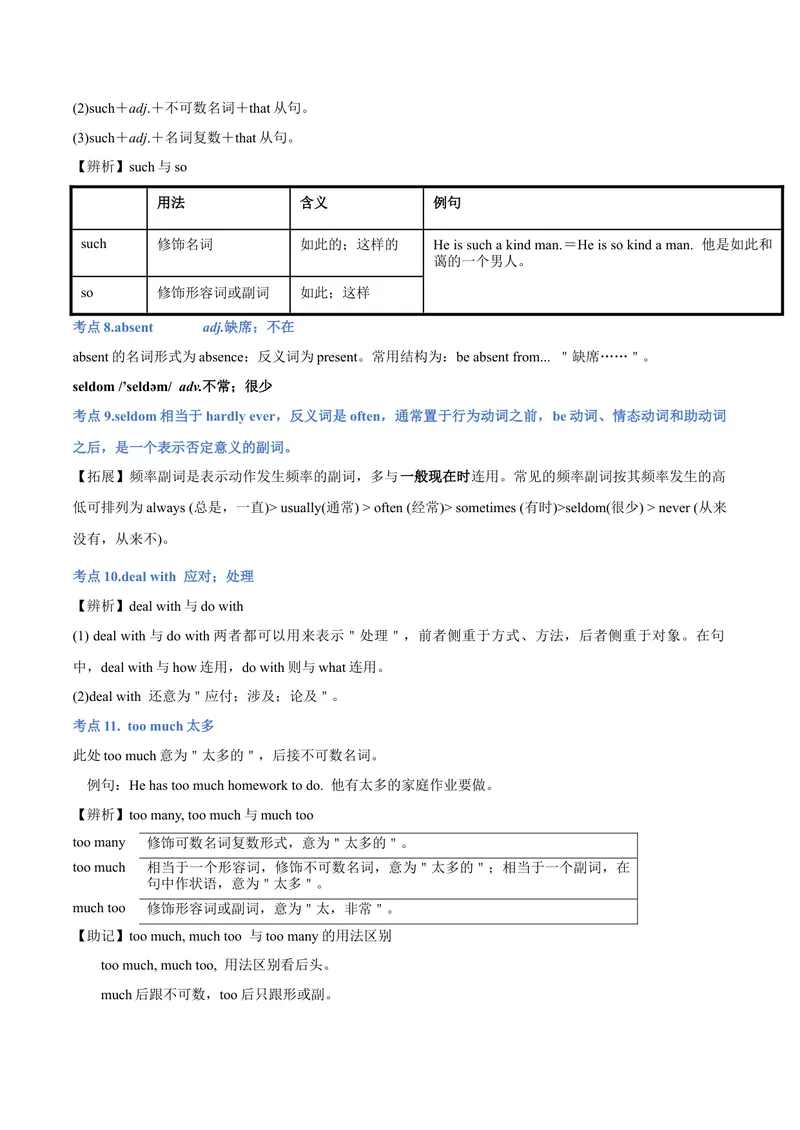
【辨析】such与so
用法 含义 例句
such 修饰名词 如此的;这样的 He is such a kind man.=He is so kind a man. 他是如此和
蔼的一个男人。
so 修饰形容词或副词 如此;这样
考点8.absent adj.缺席;不在
absent的名词形式为absence;反义词为present。常用结构为:be absent from... "缺席……"。
seldom /’seldəm/ adv.不常;很少
考点9.seldom相当于hardly ever,反义词是often,通常置于行为动词之前,be动词、情态动词和助动词
之后,是一个表示否定意义的副词。
【拓展】频率副词是表示动作发生频率的副词,多与一般现在时连用。常见的频率副词按其频率发生的高
低可排列为always (总是,一直)> usually(通常) > often (经常)> sometimes (有时)>seldom(很少) > never (从来
没有,从来不)。
考点10.deal with 应对;处理
【辨析】deal with与do with
(1) deal with与do with两者都可以用来表示"处理",前者侧重于方式、方法,后者侧重于对象。在句
中,deal with与how连用,do with则与what连用。
(2)deal with 还意为"应付;涉及;论及"。
考点11. too much太多
此处too much意为"太多的",后接不可数名词。
例句:He has too much homework to do. 他有太多的家庭作业要做。
【辨析】too many, too much与much too
too many 修饰可数名词复数形式,意为"太多的"。
too much 相当于一个形容词,修饰不可数名词,意为"太多的";相当于一个副词,在
句中作状语,意为"太多"。
much too 修饰形容词或副词,意为"太,非常"。
【助记】too much, much too 与too many的用法区别
too much, much too, 用法区别看后头。
much后跟不可数,too后只跟形或副。too many要记住,后面名词必复数。
考点12.take up 开始从事
take up此处意为"开始从事",后接名词或动名词作宾语。
【拓展】take up还可意为"占,占地方"。
【拓展】take的短语
Take+副词/介词:
take out 取出 take off 起飞;脱掉 take away 带走;掠夺
take down 取下;记下 take after (在外貌、举止或性格方面)像
其他:
take care of 照顾 take part in 参加;加入 take place 发生;加入
take one’s temperature 量体温 take a photo/photos 拍照
考点13.take pride in 为……感到自豪
in为介词,其后可接名词、代词或动词-ing形式。相当于be proud of。
例句:The young mother took pride in her son.=The young mother was proud of her son.这位年轻的妈妈为她的
儿子感到自豪。
【拓展】be proud to do sth.意为"为做某事感到骄傲/自豪"。
考点14.in public 公开地;公众
【拓展】in+名词的短语 (in +名词表示出于某种状态)
In trouble 处于困境 in time 及时 in person 亲自
in silence 沉默地;无声地 In fact 其实;实际上
in danger 处于危险中 in common 共有
考点15.语法
(1)used to意为"过去常常",后接动词原形,表示过去经常发生的动作或存在的状态(暗含现在已经不复
存在)。
►He used to play basketball at school. 他过去常常在学校里打篮球。
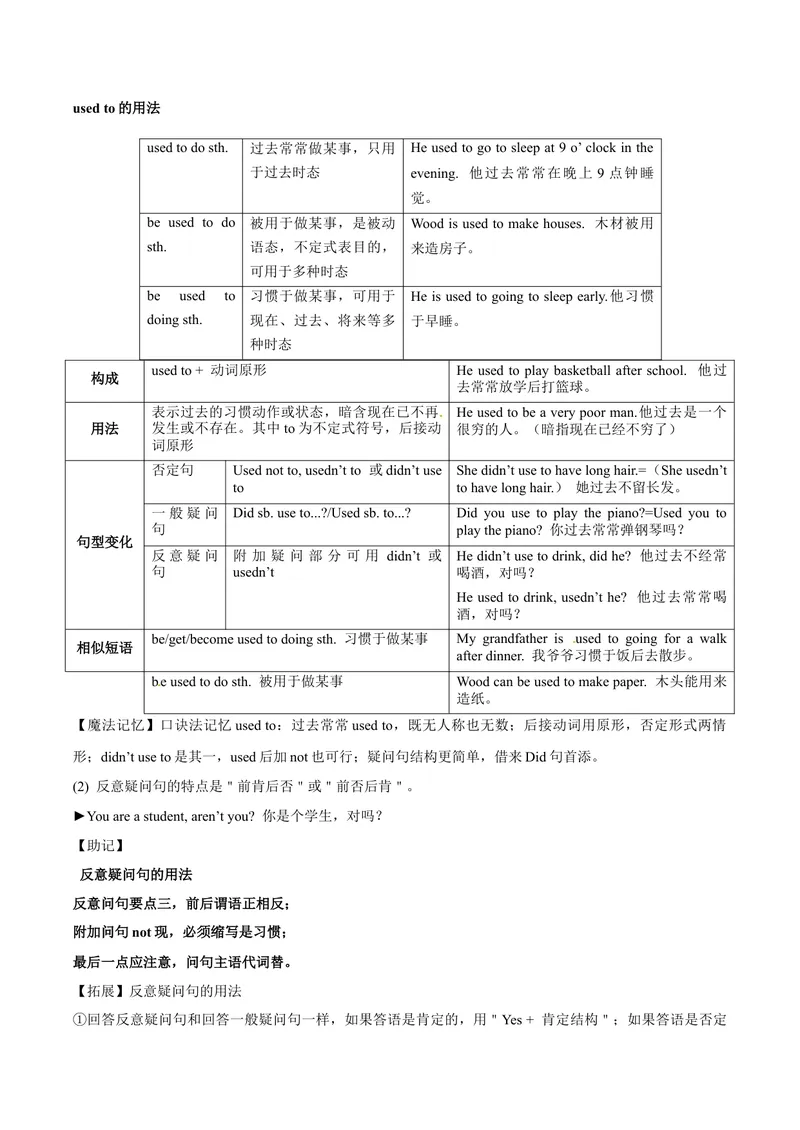
【辨析】used to do sth., be used to do sth.与be used to doing sth.used to的用法
used to do sth. 过去常常做某事,只用 He used to go to sleep at 9 o’ clock in the
于过去时态 evening. 他过去常常在晚上 9 点钟睡
觉。
be used to do 被用于做某事,是被动 Wood is used to make houses. 木材被用
sth. 语态,不定式表目的, 来造房子。
可用于多种时态
be used to 习惯于做某事,可用于 He is used to going to sleep early.他习惯
doing sth. 现在、过去、将来等多 于早睡。
种时态
used to + 动词原形 He used to play basketball after school. 他过
构成
去常常放学后打篮球。
表示过去的习惯动作或状态,暗含现在已不再 He used to be a very poor man.他过去是一个
用法 发生或不存在。其中to为不定式符号,后接动 很穷的人。(暗指现在已经不穷了)
词原形
否定句 Used not to, usedn’t to 或didn’t use She didn’t use to have long hair.=(She usedn’t
to[来源:学&科&网] to have long hair.) 她过去不留长发。
一般疑问 Did sb. use to...?/Used sb. to...? Did you use to play the piano?=Used you to
句 play the piano? 你过去常常弹钢琴吗?
句型变化
反意疑问 附 加 疑 问 部 分 可 用 didn’t 或 He didn’t use to drink, did he? 他过去不经常
句 usedn’t 喝酒,对吗?
He used to drink, usedn’t he? 他过去常常喝
酒,对吗?
be/get/become used to doing sth. 习惯于做某事 My grandfather is used to going for a walk
相似短语
after dinner. 我爷爷习惯于饭后去散步。
be used to do sth. 被用于做某事 Wood can be used to make paper. 木头能用来
造纸。
【魔法记忆】口诀法记忆used to:过去常常used to,既无人称也无数;后接动词用原形,否定形式两情
形;didn’t use to是其一,used后加not也可行;疑问句结构更简单,借来Did句首添。
(2) 反意疑问句的特点是"前肯后否"或"前否后肯"。
►You are a student, aren’t you? 你是个学生,对吗?
【助记】
反意疑问句的用法
反意问句要点三,前后谓语正相反;
附加问句not现,必须缩写是习惯;
最后一点应注意,问句主语代词替。
【拓展】反意疑问句的用法
①回答反意疑问句和回答一般疑问句一样,如果答语是肯定的,用"Yes + 肯定结构";如果答语是否定的,则用"No + 否定结构"。
②回答陈述部分为否定句的反意疑问句时,yes或no的汉语意思与其本身的词义相反。
【助记】反意疑问句的回答方法
回答反意疑问句,答案含义是依据,肯定事实用yes,否定事实用no替。
一、完形填空
I was not a confident person before. That’s because I was fat and others often ___1___ me. As a result, I.
became very shy. I was scared(害怕) to say hello to strangers, let alone(更不用说) talk or hang out(闲逛) with
them. I was afraid to ask simple questions and speak loud ___2___ others. It seemed that I felt afraid of ___3___
in my life. I used to believe that I would be like this all my life.
But one day, my friend Paul’s words changed my mind. He ___4___ me to change myself. He said, “If you
can give it a try, you still have a ___5___ to make a change. But if you ___6___ try, your life is only going to get
worse. “I was blown away(兴奋起来) by what he said. After all, I had nothing to lose. Why not have a try?
The first thing I did was lose weight. I had a ___7___ diet(饮食) and did exercise every day. After six
months, I lost ninety pounds. This taught me that I could change myself.
A few months later, I heard about a speech competition at my university. I plucked up the courage(鼓起勇气)
to sign up for the competition. For the first time, I was able to ___8___ my story and speak loud in front of dozens
of(许多) people.
After the competition, I made a to-do list and started changing in a very short time. I tried my best to ___9___
the things on the list one by one. When working on them, I became more and more confident.
I am still ___10___ now. And I will never stop.
1.A.came round B.looked after C.laughed at D.depended on
2.A.far from B.according to C.at the end of D.in front of
3.A.everything B.nothing C.somebody D.anybody
4.A.created B.avoided C.satisfied D.encouraged
5.A.culture B.chance C.comer D.coast
6.A.often B.never C.always D.sometimes
7.A.strict B.common C.whole D.usual
8.A.refuse B.divide C.share D.protect
9.A.explain B.spread C.finish D.regret10.A.feeling awful B.taking photos C.having breakfast D.making progress
二、阅读单选
Dear Sherry, I am very short. I want to be taller, I have tried jumping up and down and swimming, but none of
these things have made me taller. My classmates laugh at me. I think my height is a serious problem. What should I
do?
Yours
Mike
Dear Mike, To be honest, you can only do your best to exercise, eat well, sleep well and hope for the best.
After all, how tall you can grow mostly depends on your genes (基因). I’ve been short for pretty much my whole
life and a lot of people have made fun of me for it.
But the thing is, it doesn’t really matter that much. I know it hurts when your classmates make fun of you, but
this will happen less often as you grow up. There will always be some people who will judge (评判) you based on
(基于) your height. But there isn’t anything you can do to change their minds, And if someone thinks less of you
because of your height. They’re probably not someone who is worth getting to know anyway. Love yourself for
who you are— you’re the only you there is.
Yours,
Sherry
11.Where can we see these two letters?
A.Magazines about teenager’s problem. B.History books.
C.Newspaper. D.A dictionary.
12.What is the serious problem of Mike?
A.He is tired of jumping up and sown and swimming. B.He is too heavy.
C.His classmates laugh at him. D.He is not tall.
13.What can your height mostly depend on?
A.food B.basketball game C.study D.genes
14.What’s the advice from Sherry?
A.Change your friends’ mind.
B.Fight with people who think less of you because of your height.
C.Love yourself for who you are.
D.Change your eating habits.
Dear Joe,
I wrote you the letter to tell you about what the world used to be like when I was young. Life used to be very
different then. We didn’t have cell phones when we wanted to talk to our friends. We didn’t have e-mails either, sowe had to write letters.
When we traveled from town to town, we used to walk or ride horses or take a cart(马车). Later we had buses
and very few people had cars. Air travel was a luxury and we used to dream of riding on an airplane but now
everyone does. It’s so common.
Food is another big difference. There weren’t any supermarkets so we used to grow our own food. We would
exchange some with people from other towns to buy the things we didn’t have. We didn’t have a refrigerator (冰箱)
so we kept things cool in a special room downstairs.
But the biggest difference is electricity. We didn’t have any in our town! At night, we used to light candles
when we wanted light and we burned coal (煤) or wood to keep warm. We didn’t have television. In summer, we
used to go swimming in the river.
Life used to be very different, but we were happy.
Love,
Grandpa
15.The writer no longer ________.
A.hates carrots
B.has to grow his own food
C.buys food from the supermarket
16.As there wasn’t any electricity when the writer was young, ________.
A.he couldn’t keep warm
B.he used to light candles to get light
C.he went swimming
17.The underlined word “luxury” means “________” in Chinese.
A.奢侈品 B.消耗品 C.战利品
18.The letter talks mostly about what ________.
A.the writer used to do differently
B.the writer wants to do in the future
C.the boy should do differently
Dear Tommy,
I’m writing to you on your third birthday.I want to tell you something about your grandma’s time.I was born sixty-
eight years ago in a small village.Transportation used to be a big problem.When we traveled from village to village,we used to walk or ride horses.
Shopping was not an easy job,either.There were no supermarkets in the neighborhood.We used to grow most of our
own food:rice and vegetables.We kept things cool in a special underground room.
The biggest difference is that you have electricity.We didn’t have electricity until very late in our small village.We
didn’t have any televisions of course.We used to perform our local music and enjoy it very much.
Life used to be very hard,but I was not upset.I would like you to know about the old days and be happy about what
you have when you grow up.Remember,feeling good about life is the key to happiness.
Love,
Your grandma
19.This letter is written by .
A.a grandfather to a grandson B.a grandmother to a grandson
C.a grandfather to a granddaughter D.a grandmother to a granddaughter
20.Tommy is when the letter is written.
A.one B.two C.three D.four
21.This letter is mostly about .
A.the writer’s old life experience B.the writer’s future life
C.what a kid can do for old people D.how the writer has changed
22.Which is NOT true about the writer?
A.She was born in the countryside. B.She felt good about the village life.
C.She used to grow vegetables in the village. D.She used to walk or ride horses from city to city.
23.Why does the writer write this letter?
A.She wants to show that life now is really happy.
B.She wants to tell others that life was so hard in the past.
C.She wants the kid to be positive about life in the future.
D.She wants the kid to dream about one’s future life.
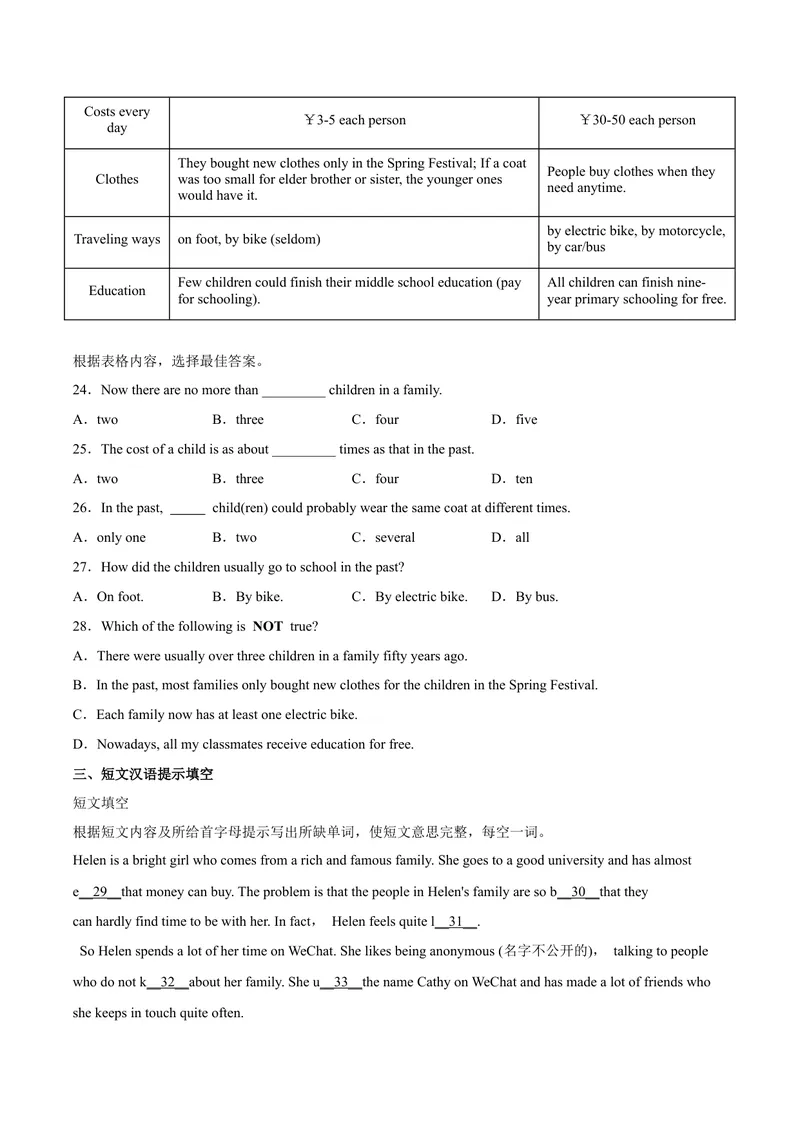
Here is some information about most families in China’s countryside.
Fifty years ago Nowadays
The number of
3-5 1-2
childrenCosts every
¥3-5 each person ¥30-50 each person
day
They bought new clothes only in the Spring Festival; If a coat
People buy clothes when they
Clothes was too small for elder brother or sister, the younger ones
need anytime.
would have it.
by electric bike, by motorcycle,
Traveling ways on foot, by bike (seldom)
by car/bus
Few children could finish their middle school education (pay All children can finish nine-
Education
for schooling). year primary schooling for free.
根据表格内容,选择最佳答案。
24.Now there are no more than _________ children in a family.
A.two B.three C.four D.five
25.The cost of a child is as about _________ times as that in the past.
A.two B.three C.four D.ten
26.In the past, child(ren) could probably wear the same coat at different times.
A.only one B.two C.several D.all
27.How did the children usually go to school in the past?
A.On foot. B.By bike. C.By electric bike. D.By bus.
28.Which of the following is NOT true?
A.There were usually over three children in a family fifty years ago.
B.In the past, most families only bought new clothes for the children in the Spring Festival.
C.Each family now has at least one electric bike.
D.Nowadays, all my classmates receive education for free.
三、短文汉语提示填空
短文填空
根据短文内容及所给首字母提示写出所缺单词,使短文意思完整,每空一词。
Helen is a bright girl who comes from a rich and famous family. She goes to a good university and has almost
e__29__that money can buy. The problem is that the people in Helen's family are so b__30__that they
can hardly find time to be with her. In fact, Helen feels quite l__31__.
So Helen spends a lot of her time on WeChat. She likes being anonymous (名字不公开的), talking to people
who do not k__32__about her family. She u__33__the name Cathy on WeChat and has made a lot of friends who
she keeps in touch quite often.Last year Helen made a very special friend on WeChat. His name was Andrew and he lived in San Francisco.
Andrew was full of stories and jokes. He and Helen had a common i__34__in rock music and modern dance. So it
always took them hours to talk h__35__on WeChat and sometimes they even forgot the time. Of course, they
wanted to know more about each other. Andrew sent a p__36__of himself: He was a tall, good-looking young
man with big, happy smile. As time went by, they b__37__good friends and often sent cards and small things
to each other.
When Helen 's father told her that he was going on business trip to San Francisco, she asked him to let her go
with him, so that she could give Andrew a s__38__for his birthday. She would take him the latest DVD of their
favorite rock singer. But when Helen knocked on Andrew's door in San Francisco, she found that the special
friend was a twelve-year-old boy named Jim.
四、多句选词填空
polite, tie, proud, whether, increase
39.I’d like to get my father a __________ as a gift on Father’s Day.
40.You should pay attention to _________ your reading speed.
41.We should speak to the old ________
42.The manager asked ______ he could find the cause of the accident.
43.I did well in the exams and my parents were _______ of me.
五、书信作文
44.学校的Buddy Club开始招募新成员了。假如你是李华,想推荐好朋友张军加入该社团。请根据下
面的信息,写一封推荐信。
推荐信的内容包括:
1. How old is he and what does he look like?
2. What’s his personality?
3. What are his hobbies and abilities?
4. What’s his future plan?
要求:
1.写作要点齐全,紧扣要点,可适当发挥;
2.文中不得出现真实人名、或校名,否则不予评分;
3.不少于80词,文章的开头和结尾已给出,不计入总词数。
________________________________________________________________________________________________________________________________________________________________________________________
____________________________________________________________________________________________
____________________________________________________________________________________________
________________________________________________________________________答案
1.C 2.D 3.A 4.D 5.B 6.B 7.A 8.C 9.C 10.D
【解析】
1.句意:那是因为我很胖,别人经常嘲笑我。
came round苏醒;looked after照顾;laughed at嘲笑;depended on依赖;根据“I was fat”可知,别人总是嘲
笑我,故选C。
2.句意:我不敢问简单的问题,不敢在众人面前大声说话。
far from远离;according to根据;at the end of在……的尽头;in front of在……前面;根据“speak
loud...others”可知,不敢在众人面前大声说话,故选D。
3.句意:我似乎对生活中的每件事都感到害怕。
everything一切;nothing没有事情;somebody某个人;anybody任何人;根据“I was scared(害怕) to say
hello to strangers, let alone(更不用说) talk or hang out(闲逛) with them. I was afraid to ask simple questions and
speak loud...others.”可知,似乎对所有的一切都害怕,故选A。
4.句意:他鼓励我改变自己。
created创造;avoided避免;satisfied满意;encouraged鼓励;根据“He said, “If you can give it a try, you still
have a...to make a change.”可知,此处是朋友鼓励我改变,故选D。
5.句意:如果你能尝试一下,你还有机会做出改变。
culture文化;chance机会;comer来者;coast海岸;根据“If you can give it a try, you still have a...to make a
change”可知,如果尝试就会有机会改变,故选B。
6.句意:但如果你从不尝试,你的生活只会变得更糟。
often经常;never从不;always总是;sometimes有时;根据“your life is only going to get worse.”可知,如
果不改变,生活会更糟,此处表达的是否定的意思,应用never,故选B。
7.句意:我严格控制饮食,每天锻炼。
strict严格的;common普通的;whole整个;usual通常的;根据“I did was lose weight.”可知,减肥是要严
格控制饮食的,故选A。
8.句意:第一次,我能够在几十个人面前大声地分享我的故事。
refuse拒绝;divide分开;share分享;protect保护;根据“my story”可知,此处是说分享自己的故事,故
选C。
9.句意:我尽了最大的努力,一件一件地完成了清单上的事情。
explain解释;spread传播;finish完成;regret后悔;根据“I made a to-do list and started changing in a veryshort time.”可知,列出的清单上待办的事情要尽力完成,故选C。
10.句意:我现在还在进步。
feeling awful感觉糟糕;taking photos拍照;having breakfast吃早餐;making progress进步;根据“When
working on them, I became more and more confident.”以及“And I will never stop.”可知,此处说的是自己仍然
在进步,并且不会停止,故选D。
11.A 12.D 13.D 14.C
【解析】
11.推理判断题。根据文章可知第一封信是求助信,而第二封信是给与答复,给予建议的回信,所以推测
这两封信应是出现在关于青少年问题的杂志上。故选A。
12.细节理解题。根据“I am very short.”可知Mike的烦恼是个子矮。故选D。
13.细节理解题。根据“After all, how tall you can grow mostly depends on your genes .”可知人长多高主要依
赖于基因。故选D。
14.细节理解题。根据“Love yourself for who you are— you’re the only you there is.”可知Sherry的建议是爱
现在的自己。故选C。
15.B 16.B 17.A 18.A
【解析】
15.推理判断题。根据“Food is another big difference. There weren’t any supermarkets so we used to grow our
own food.”可知,作者现在不再自己种植食物,故选B。
16.细节理解题。根据“But the biggest difference is electricity. We didn’t have any in our town! At night, we
used to light candles when we wanted light”可知,过去没有电,想要光只能点蜡烛,故选B。
17.词义猜测题。根据“Air travel was a luxury and we used to dream of riding on an airplane”可知,乘飞机旅
行是一种奢侈品,作者曾经梦想坐飞机,所以单词“luxury”指的是“奢侈品”,故选A。
18.主旨大意题。根据“I wrote you the letter to tell you about what the world used to be like when I was
young.”可知,这封信主要是谈论作者过去的生活是什么样的,故选A。
19.B 20.C 21.A 22.D 23.C
【解析】
19.细节理解题。根据信的开头Dear Tommy和结尾Yours grandma可知,这封信是奶奶写给自己的孙子
Tommy的,故应选B。
20.细节理解题。根据信的开头I’m writing to you on your third birthday.可知,这是奶奶的信是在Tommy的
第三个生日时写的,所以Tommy三岁了,故应选C。
21.细节理解题。根据短文中I want to tell you something about your grandma’s time可知,在信中奶奶讲述了她那个年代的事情,下文中多处出现了used to…,表示过去常常做的事,故应选A。
22.推理判断题。根据短文第二段中When we traveled from village to village, we used to walk or ride horses
可知,在奶奶的那个年代,他们通常是走路或骑马从一个村到另一个村,不是从一个城市到另一个城市,
故D不对,选D。根据短文中I was born sixty-eight years ago in a small village.、Life used to be very hard, but
I was not upset、We used to grow most of our own food: rice and vegetables可知其他三个选项都符合文意。
23.主旨大意题。根据短文最后一段I would like you to know about the old days and be happy about what you
have when you grow up. Remember, feeling good about life is the key to happiness.可知,奶奶写这封信是想让
她的孙子了解过去的日子,长大的时候,能对自己拥有的生活感到快乐。并且让他记住对生活感觉良好是
幸福的关键。因此C选项“她希望孩子对未来的生活有积极的态度”,符合文章的意思,选C。
24.A 25.D 26.C 27.A 28.C
【解析】
24.细节理解题。根据“The number of children Fifty years ago 3-5;Nowadays 1-2”可知,现在家里的孩子
不超过两个,故选A。
25.推理判断题。根据“Costs every day Fifty years ago ¥3-5 each person Nowadays¥30-50 each person”
可知,五十年前每个孩子的成本是3-5元,现在是30-50元,故推断现在每个人的成本是过去的10倍,故
选D。
26.推理判断题。根据“They bought new clothes only in the Spring Festival;If a coat was too small for elder
brother or sister, the younger ones would have it.”可知,在过去,大孩子穿得小了的衣服留个年龄小的穿,因
此几个孩子在不同时间穿同一件衣服,故选C。
27.细节理解题。根据“Traveling ways on foot, by bike (seldom)”可知,在过去孩子们经常步行或者骑自行
车去上学,故选A。
28.推理判断题。根据“by electric bike, by motorcycle, by car/bus”可知,现在孩子们上学可以骑电动车,
摩托车,坐汽车或公交车,并没有提到每家至少有一个电动车,故选C。
29.everything 30.busy 31.lonely 32.know 33.uses 34.interest 35.happily 36.picture/
photo 37.became 38.surprise
【解析】
29.句意:她上了一所好大学,几乎拥有了所有钱能买到的东西。前面介绍了海伦的家庭很富有,结合句
意,故答案为everything。
30.句意:问题是海伦家的人都很忙,他们几乎找不到时间和她在一起。根据“hardly find time to be with
her.”可知,家人都忙于自己的工作,没有时间陪海伦,故答案为busy。31.句意:事实上,海伦感到很孤独。缺少了家人的陪伴,海伦自然感到很孤独。故答案为lonely。
32.句意:她喜欢匿名,与不了解她的家人的人交流。助动词后跟动词原形,结合句意可知答案为
know。
33.句意:在微信上她用凯西的名字结交了许多的朋友,她经常与他们保持联系。此处缺少谓语动词,
and连接的前后两个时态要保持一致,同为一般现在时态,结合句意,答案为uses。
34.句意:他和海伦对摇滚乐和现代舞有共同的兴趣。此处缺少名词,have a common interest in在……方
面有共同的兴趣,故答案为interest。
35.句意:因此他们总是花几个小时的时间在微信上开心的聊天,有时他们甚至忘了时间。根据
“sometimes they even forgot the time.”判断,他们谈得很投机,副词修饰动词,结合句意可知,答案为
happily。
36.句意:安得烈发了自己的一张照片。a photo/picture of一张……的照片。根据“He was a tall, good-
looking young man with big, happy smile.”判断,安得烈发了他本人的一张照片。故答案为picture/photo。
37.句意:他们成了好朋友,经常互相寄卡片和小礼物。此处缺少谓语动词,时态为一般过去时态,根据
首字母以及句意,答案为became。
38.句意:这样她就可以给安得烈一个生日的惊喜了。give sb. a surprise给某人一个惊喜,根据上下语
境,海伦随父亲出行,去看她的网友,目的就是给对方一个惊喜,故答案为surprise。
考点:短文填空。
39.tie 40.Increasing 41.politely 42.whether 43.proud
【解析】
39.句意:我想在父亲节那天给我父亲买一条领带作为礼物。根据“as a gift”可知,此处应是一种礼物,
备选词tie“领带”符合,a修饰名词的单数形式,故填tie。
40.句意:你应该注意提高阅读速度。根据“pay attention to … your reading speed”及备选词可知,提醒要
注意提高阅读速度,pay attention to doing sth“注意做某事”,故填increasing。
41.句意:我们应该有礼貌地和老人说话。根据“speak to the old”及备选词可知,要礼貌地跟老人说话,
修饰动词speak要用副词,故填politely。
42.句意:经理问他是否能找到事故的原因。此句是宾语从句,空处缺少引导词,备选词whether“是否”
符合,故填whether。
43.句意:我考得很好,我的父母为我感到骄傲。根据“I did well in the exams”及备选词可知,考得好,
父母以我为傲,be proud of“以……为傲”,故填proud。
44.例文:
Dear Chairperson,I am Li Hua, and I am a member of the Buddy Club. I’d like to recommend my best friend Zhang Jun to join
the club.
Zhang Jun is a 13-year-old boy and we are in the same class. He has a round face and short hair. A pair of
round glasses makes him look smart. Everyone gets along well with him.
He is always helpful and honest. He often goes to the home for the elderly to do some cleaning and shopping
for the old people. He never tells lies or says a bad word about others. He is good at playing the guitar and singing.
The old people like listening to his music.
He hopes to be a great singer and bring people happiness. So he would like to be a member of the Buddy club.
Thanks for your time. I hope you can think about my recommendation. I am looking forward to hearing from
you.
Yours sincerely
Li Hua
【详解】
[总体分析]
① 题材:本文是一篇应用文,为书信作文;
② 时态:时态以“一般现在时”为主,介绍未来计划时也可用“一般将来时”;
③ 提示:写作要点已给出,考生应注意不要遗漏内容提示中有关被推荐人的信息要点,适当添加细节,
注意条理要清晰。
[写作步骤]
第一步,简单自我介绍并表明写作意图。引出被推荐人,为下文的阐述作铺垫;
第二步,具体阐述写作内容。从“年龄、外貌、性格、爱好、能力等”几个方面重点介绍被推荐人的信
息,注意要突出优势;
第三步,书写结语。表达感谢及对对方反馈的期待。
[亮点词汇]
① recommend推荐
② get along well with与……相处融洽
③ say a bad word about sb.说某人的坏话
④ be good at擅长,善于
⑤ look forward to期待
[高分句型]
① A pair of round glasses makes him look smart.(不带to的动词不定式作宾补)② He often goes to the home for the elderly to do some cleaning and shopping for the old people.(动词不定式作
目的状语)