专题 04 时态(一般现在时,现在进行时,一般过去时)讲练
一般现在时
语法解析
基本结构 ①be动词形式;②实义动词形式
常见时 表频率的副词often、 always、 usually、 sometimes等;表频率的词(组)once (twice、 three
间状语 times a day/week/...)等;every day (week, month, year...)、 on Sunday等常用词组
①当句子的主语是第三人称单数时,其谓语动词也要变成第三人称单数,通常在词尾加-s或-
es;②由that引导的宾语从句,若从句表达的是客观真理、客观事实或自然现象等,从句的时态
高频
不受主句时态的限制,仍用一般现在时。例如:
考点
My father goes to work by bike every day. 我爸爸每天骑自行车去上班。
My father told me that one and one is two. 我爸爸告诉我一加一等于二。
当主语是 ①在动词原形后 。如:play/plays, like/likes, work/works...
第三人称 ②以s、 x、 o或ch、 sh结尾的动词, 。如:do/does, go/goes, teach/teaches,
单数时,谓 wash/washes...
语动词的 ③以“辅音字母+y”结尾的动词, 。如:carry/carries, study/studies...
变化形式 ④以“元音字母+y”结尾的动词,在词尾 。如:stay/stays, play/plays
注意
1.在时间、条件和让步状语从句中,如果主句谓语动词是一般将来时,从句用一般现在时。如:
We’ll have a picnic if it is fine next Sunday.如果下个星期日天气晴朗,我们将去野餐。
I’ll call you as soon as I get to Beijing tomorrow.我明天一到北京就给你打电话。
2.某些表示起始、往返、出发、到达之意的动词,可用一般现在时表示按规定、计划或安排将要发生的动
作(此时一般都有一个表示未来时间的状语)。这类动词有:begin, come, go, leave, start, arrive, end, stop,
open, close等。如:
The meeting begins at 2:00 p.m. tomorrow.这个会议明天下午2点开始。
The next train leaves at 7 o’clock this evening.下一列火车将在今晚7点离开。
随堂训练
基础题组
一.选择填空
1.Dragon Boat Festival usually ________ in June every year.
A.come B.comes C.is coming D.will come
2.She and her classmates often ______ the old books to the school library. It makes them happy.
A.give away B.gives away C.gave away D.giving away
3.In our daily life, good communication skills _________ a big difference in getting along well with others.
A.made B.makes C.is making D.make
4.Many people ________ by train before the Spring Festival every year.
1
学科网(北京)股份有限公司A.travel B.travels C.traveled D.traveling
5.Not only Tim but also Sue and I ________ interested in DIY. We often make nice things.
A.am B.are C.was D.were
6.Every morning, Mr. Green ______ a coffee on his way to work.
A.buys B.bought C.is buying D.will buy
7.—What does your father do after dinner?
—He used to ________ at home but now he usually ________ a walk with my mother.
A.watch TV; take B.watch TV; takes C.watches TV; takes D.watches TV; take
8.My father usually ________ to work by subway every day.
A.goes B.is going C.went D.will go
9.Miss Li has a cat. She _________ it every morning before going to work.
A.feeds B.fed C.will feed D.is feeding
10.Her voice ________ sweet. It ________ a bird singing.
A.sound; sounds like B.sounds like; sounds
C.sounds; sounds like D.sound like; sound
二.正确形式填空
1.Cherry always (spend) the weekend with her grandparents.
2.Tom often (do) his homework after school.
3.On Sundays, Peter often (get) up early and helps mom with housework.
4.As we all know, the sun (rise) in the east and sets in the west.
5.How often your sister (play) the piano?
6.Tom likes vegetables very much, but he (not like) chocolate.
7.My mum, Jane always me a story at night. (read)
8.A cup of coffee always (bring) me energy in the morning.
9.I like Geography. The teacher often (teach) us by playing games.
10.After dinner, he always (play) the drums for a while.
11.My brother is really funny and he often (make) us laugh.
12.Leaves (change) color in autumn.
13.This family photo (mean) a lot to Tom. It’s the wallpaper on his phone.
14.When the spring festival comes, my grandparents usually (hang) red lanterns in hope of good
luck.
15.To tell the truth, I don’t think purple (match) your skin colour.
提升题组
请认真阅读下面短文,填入适当的单词或括号内单词的正确形式。
On Aug 23, the Thai film How to Make Millions Before Grandma Dies(《姥姥的外孙》) came out on the
Chinese mainland. It tells 1 family story.
In the film, a young man 2 (name) M volunteers (自愿) to take care 3 his dying (临终
的) grandma because he wants to get 4 (she) money.
2
学科网(北京)股份有限公司Without the big ups and downs we see in other 5 (film), this film looks at how important small
things are. It 6 (show) the love between family members from the smallest acts (行为).
Getting up early 7 (be) hard for M, but he still goes with his grandma to the hospital in the early
morning. 8 fact, when he was a little boy, his grandma began to 9 (save) money for him.
In the end, M learns that he doesn’t need to win his 10 (grandma) love. He had her love all the
time. And her love is much more important than money.
现在进行时
语法解析
1.基本结构:主语+be动词(is/am/are)+动词-ing形式。
2.用于现在进行时的时间状语:now、 at the moment、 at this time、 these days等,有时句首也会有“Look!”
或“Listen!”等提示词。
3.高频考点:通过上下文的情境确定某一动作正在进行。例如:
Look at the picture. The children are flying kites in the park. 看这幅图。那些孩子正在公园里放风筝。
4.动词现在分词的变化规则。
look/looking, think/
直接在动词
thinking, study/studying
以不发音的字母-e结尾的动词, come/coming, take/taking, dance/dancing
以重读闭音节结尾且末尾只有一个辅音 run/running,swim/swimming,shop/shopping,stop/stopping,
字母的动词, begin/beginning
少数几个以-ie结尾的动词, die/dying, lie/lying, tie/tying
注意
1、现在分词有规律,动词后面是-ing。遇到词尾哑音-e,去e再加-ing。一辅重读闭音节,双写之后添上去。-
ie换y有几例,特殊词语特殊记。
2、现在进行时有时可表示将来发生的动作,有"意图"或"打算"的含义(用于go, come,stay,1eave,
star
等表示移动的动词)。
He is corning to see you tomorrow.他明天要来看你。
They are going to the Ming tombs this coming Sunday.这个星期天他们要到十三陵去。
3、现在进行时与always, continually, forever等副词连用,表示反复出现或习惯性的动作,这种用法往往
表达说话人的某种感情,如赞扬、遗憾、讨厌或不满等。如:
The rich woman is always laughing at the poor.这个有钱的夫人总是嘲笑穷人。
随堂训练
基础题组
一.单项选择
1.My sister ________ now. Don’t make any noise.
A.sleep B.sleeps C.is sleeping D.slept
3
学科网(北京)股份有限公司2.—Who ________ in the next room?
—Oh, it must be Sally. I just saw her there.
A.sang B.is singing C.sings D.sing
3.— I called you yesterday, but you didn’t answer.
— Sorry. I ________ a report on animal protection.
A.read B.am reading C.was reading D.will read
4.—Mom, where is dad?
—Look! He ________ flowers outside.
A.waters B.watered C.is watering D.will water
5.There will be a talent show tomorrow. We ________ for it busily now.
A.are preparing B.prepares C.prepared D.will prepare
6.—Mum, where is Lily?
—She _________ the flowers in the garden.
A.waters B.watered C.is watering D.was watering
7.Wei Lun and his teammates are ________ the USA next week.
A.leave for B.leave C.leaving for D.left
8.—Alice, what are you doing?
—Oh, I ________ some pictures.
A.will draw B.am drawing C.draw D.drew
9.—Alice, what are you doing?
—Oh, I ________ some pictures.
A.will draw B.am drawing C.draw D.drew
10.—Is this raincoat yours?
—No, mine ________ there behind the door.
A.hangs B.has hung C.is hanging D.hung
二.正确形式填空
1.—What are you doing right now?
—We are (shop) in the market.
2.Look! She is (play) football now.
3.—Where is your mother?
—Oh, she (chat) with my grandma.
4.— the kids (water) the flowers in the garden?
— No. They are flying kites.
5.Hurry up, Tom! Your mother (wait) for you at the school gate.
6.Please turn down the music. Mum (sleep) in the next room.
7.Look! Some tigers (lie) on the ground in the warm sun.
8.Now Chinese food (spread) around the world quickly with some cooking videos popular on the
Internet.
4
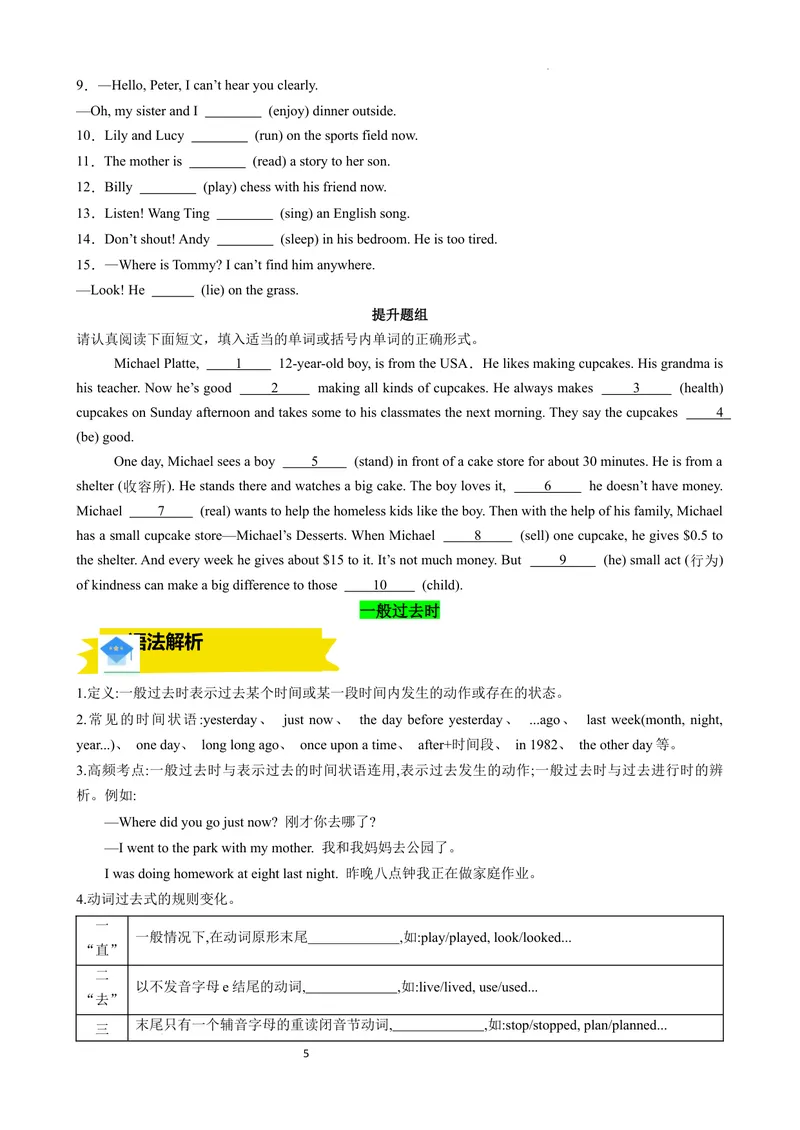
学科网(北京)股份有限公司9.—Hello, Peter, I can’t hear you clearly.
—Oh, my sister and I (enjoy) dinner outside.
10.Lily and Lucy (run) on the sports field now.
11.The mother is (read) a story to her son.
12.Billy (play) chess with his friend now.
13.Listen! Wang Ting (sing) an English song.
14.Don’t shout! Andy (sleep) in his bedroom. He is too tired.
15.—Where is Tommy? I can’t find him anywhere.
—Look! He (lie) on the grass.
提升题组
请认真阅读下面短文,填入适当的单词或括号内单词的正确形式。
Michael Platte, 1 12-year-old boy, is from the USA.He likes making cupcakes. His grandma is
his teacher. Now he’s good 2 making all kinds of cupcakes. He always makes 3 (health)
cupcakes on Sunday afternoon and takes some to his classmates the next morning. They say the cupcakes 4
(be) good.
One day, Michael sees a boy 5 (stand) in front of a cake store for about 30 minutes. He is from a
shelter (收容所). He stands there and watches a big cake. The boy loves it, 6 he doesn’t have money.
Michael 7 (real) wants to help the homeless kids like the boy. Then with the help of his family, Michael
has a small cupcake store—Michael’s Desserts. When Michael 8 (sell) one cupcake, he gives $0.5 to
the shelter. And every week he gives about $15 to it. It’s not much money. But 9 (he) small act (行为)
of kindness can make a big difference to those 1 0 (child).
一般过去时
语法解析
1.定义:一般过去时表示过去某个时间或某一段时间内发生的动作或存在的状态。
2.常见的时间状语:yesterday、 just now、 the day before yesterday、 ...ago、 last week(month, night,
year...)、 one day、 long long ago、 once upon a time、 after+时间段、 in 1982、 the other day等。
3.高频考点:一般过去时与表示过去的时间状语连用,表示过去发生的动作;一般过去时与过去进行时的辨
析。例如:
—Where did you go just now? 刚才你去哪了?
—I went to the park with my mother. 我和我妈妈去公园了。
I was doing homework at eight last night. 昨晚八点钟我正在做家庭作业。
4.动词过去式的规则变化。
一
一般情况下,在动词原形末尾 ,如:play/played, look/looked...
“直”
二
以不发音字母e结尾的动词, ,如:live/lived, use/used...
“去”
三 末尾只有一个辅音字母的重读闭音节动词, ,如:stop/stopped, plan/planned...
5
学科网(北京)股份有限公司“双”
四
以“辅音字母+y”结尾的动词, ,如:study/studied, worry/worried...
“改”
5.不规则动词的过去式的构成。
(1)动词原形中的“i”变为“a”,构成过去式。如:begin/began, give/gave, ring/rang, sit/sat, drink/drank,
swim/swam。
(2)动词原形中的开音节“i”变为“o”,构成过去式。如:write/wrote, drive/drove, ride/rode。
(3)动词原形中的“e”变为“o”,构成过去式。如:get/got, forget/forgot。
(4)动词原形中的“ee”变为“e”,构成过去式。如:meet/met, feed/fed。
(5)动词原形中的“eep”变为“ept”,构成过去式,可巧记为“加 t 去 e”。如:keep/kept, sleep/slept,
sweep/swept。
(6)动词原形中的“d”变为“t”,构成过去式,可巧记为“变 d 为 t”。如:build/built, lend/lent, send/sent,
spend/spent。
(7)动词原形中的“o”变为“a”,构成过去式。如:come/came, become/became。
(8)动词原形中的“an”变为“oo”,构成过去式。如:stand/stood, understand/understood。
(9)动词原形中的“ell”变为“old”,构成过去式。如:tell/told, sell/sold。
(10)动词原形中的“eak”变为“oke”,构成过去式。如:speak/spoke, break/broke。
(11)动词原形中的“aw/ow”变为“ew”,构成过去式。如:draw/drew, grow/grew, throw/threw, know/knew。
(12)以-ought, -aught结尾,构成过去式。如:think/thought, fight/fought, bring/brought, buy/bought, teach/taught,
catch/caught。
(13)以字母t或d结尾的动词,其过去式与原形一样,可巧记为“六t二d”。如:put, let, hit, hurt, cost, cut, read,
rid。
随堂训练
基础题组
一.单项选择
1.—Where did your mother go on vacation?
—She ________ to the mountains.
A.goes B.go C.went D.going
2.—What did you do last Sunday?
—I ________ a movie with my friends. It was really exciting.
A.watch B.watches C.watched D.am watching
3.The baby ________ 3 kilogram at birth. Do you know her ________ now?
A.weighs; weigh B.weighed; weight C.weighted; weigh D.weighed; weighs
4.The guest arrived and ________ hands with us.
A.will shake B.shake C.shakes D.shook
5.—You seem to know much about this museum.
—That’s true. I ________ here with my parents once.
6
学科网(北京)股份有限公司A.come B.is coming C.will come D.came
6.There ________ a talent show yesterday and many students took part in it.
A.is B.was C.are D.were
7.—Tom, what’s wrong with your leg?
—I had an accident and ________ off my bike last Sunday.
A.fell B.fall C.was falling D.will fall
8.Last Friday we ________ the foreign teacher a warm welcome at the party.
A.give B.gave C.are giving D.will give
9.Tom ________ to visit the Palace Museum with his parents last Sunday.
A.goes B.went C.will go D.is going
10.Jimmy joined the social practice last week and ________ an important role in it.
A.plays B.will play C.is playing D.played
二.正确形式填空
1.He (break) his left leg when he fell off the bicycle.
2.The hens (lay) many eggs last week.
3.My uncle some apple trees behind his house last year. (grow)
4.Last month,15-year-old Alkut Dilxat from Xinjiang (become) the youngest Chinese climber to
reach the top of Qomolangma.
5.All the students straight, listening to their teacher carefully when I passed. (sit)
6.Who (teach) you Japanese last year?
7.The boy (sit) down after he finished answering the question.
8.When I walked towards the white rabbit, it away quickly. (run)
9.One day last year, I (decide) to leave my job and tried to make my hobby my career.
10.Henry (leave) his hometown in 1990 and never went back.
三.完成句子
1.我直到昨天晚上才收到Tom的信.
I Tom last night.
2.当我看见她的时候,我大吃一惊。
When I saw her, I a .
3.她拿起电话说道:“你好!”
She the telephone and said: “Hello!”
4.这个小宝宝指着一幅图片发出声音。
The little baby a picture and made a sound.
5.三年前他的愿望实现了。
His wish three years ago.
6.我冲着狗大叫,希望他别过来。
I the dog and wished it not to come to me.
7.她试用了许多办法来修理电脑。
7
学科网(北京)股份有限公司She many ways to repair her computer.
8.你以前经常在开心时唱歌吗?
Did you when you were happy?
9.我们一直等到所有的灯都亮了。
We waited .
10.他 12岁就辍学开始工作了。
He .
综合训练
一.语法选择
I knocked into a stranger as he walked by me.“Oh, excuse me,” I said.He 1 with a smile and said,
“Please excuse me too. I wasn't watching out for you.” We apologized and left.
Later that day, when I 2 , my daughter was standing too close to me. When I turned to reach for some
milk, I nearly knocked her over. “You should 3 out of the way!” I shouted. She walked away sadly. But I
4 feel that I had to apologize to her.
While I was in bed that evening, my husband said to me, “While dealing with a stranger, you were polite, but
with the one you 5 , you were unkind. Your daughter brought you some flowers that she picked herself this
afternoon. You 6 them in the kitchen by the door. Have you 7 the tears in her eyes?”
I quietly went and knelt down by my daughter's bed.“Honey, I am so sorry. Are these the flowers you picked
for me?” I said. “I found them by the tree. I picked them for you. I knew you 8 like them, especially the
blue ones,” she said.
I tearfully replied, “Sweetie, I'm really sorry for the way I 9 today. I shouldn't have shouted at you.”
“It's okay. I love you anyway,” she said as she kissed me on my cheek.
If we 1 0 be polite to strangers, why can't we do the same for the ones we love?
1.A.reply B.replies C.replied D.is replying
2.A.cook B.cooks C.cooked D.was cooking
3.A.move B.moving C.moves D.moved
4.A.weren't B.don't C.won't D.didn't
5.A.love B.loves C.loved D.will love
6.A.find B.finds C.will find D.found
7.A.see B.seen C.sees D.saw
8.A.did B.would C.could D.had
9.A.act B.acted C.am acting D.was acting
10.A.can B.could C.may D.might
二.短文填空
One day, a wise old man 1 (walk) in the yard when he saw his grandson having an argument with his
wife. He asked his grandson, “Why do you raise your voice every time you argue with your wife?”
His grandson answered, “I 2 my voice so that my voice is heard.”
“Your wife is close enough for her to hear you when you say the same sentence in a calm manner. Why do
8
学科网(北京)股份有限公司you have to raise your voice?” the grandfather 3 .
“Perhaps because I need to let off some steam (发泄一些怒火) by raising my voice,” his grandson replied.
“The steam 4 (go) out in the same way if you whisper (小声说) to her. So why do that?”
“I've already 5 her what I think, but it seems that she doesn't understand my point of view,” the man
said unwillingly (不情愿地).
“But you are hurting your wife's feeling while you are shouting at her,” the old man said angrily. “In fact, if
you whisper softly, you can both hear each other clearly. So stop raising your voice when you talk to her.” His
grandson nodded his head.
1. 2. 3. 4. 5.
三.阅读下面的短文,在空白处填入1个适当的单词或括号内单词的正确形式。
How are you? I’m in 1 new school this term. And I am writing to you in my school now. My new
school is big and nice and its 2 (ten) birthday is coming this weekend. There are 1,400 students and 140
teachers in my school. We like the teachers. They are very nice to us. My classmates are really 3 (friend),
too. They teach me Chinese and I teach 4 (they) English.
Look! This is our classroom. It’s big 5 tidy. You can see a map on the wall. It’s a map of China. You
can also find a bookcase in the classroom. The books in it are 6 (we). There are trees, 7 (flower)
and green grass in the school. They are very beautiful. Behind my school there is a small river, and the water 8
(be) quite clean.
We have no classes on Saturdays or Sundays. Sometimes I go to play football. Sometimes I stay at home
and watch TV. Sometimes I go shopping 9 my father and mother. We all like China. If you are free, what
about 1 0 (come) to my school? I will show you around.
9
学科网(北京)股份有限公司