Get in touch today
877-BUY-DELL
Dell.com/SmallBusinessPartner
Latitude 3500 with an 8th Gen Intel®
Core™ i5 processor starting at $749
*Offers subject to change, not combinable with all other offers. Taxes, shipping, and other fees apply. Free shipping offer valid only in Continental (except Alaska) U.S. Offer not valid for Resellers. Dell reserves the right to cancel
orders arising from pricing or other errors. Intel and the Intel logo are trademarks of Intel Corporation in the U.S. and/or other countries. Copyright © 2019 Dell Inc. or its subsidiaries. All Rights Reserved. Dell Technologies,
Dell, EMC, Dell EMC and other trademarks are trademarks of Dell Inc. or its subsidiaries. 310656
SMALL BUSINESS
ISN’T SMALL
TO US
As Dell Small Business Technology
Advisors, we are committed to
helping you navigate your tech needs
with the right solutions, advice and
dedicated one-on-one partnership.
TECH. ADVICE. PARTNERSHIP.
CLICK CALL CHAT
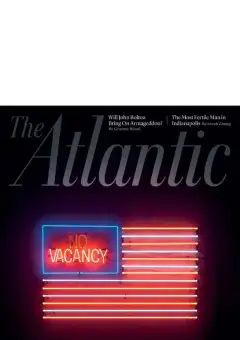
SEPTEMBER 2019
THEATLANTIC.COM
My Lyme Disease
Nightmare
By Meghan O’Rourke
An Icon’s Fall
From Grace
By Ben Rhodes
EMPOWERED WOMEN
POWER ECONOMIES
“If we find something
good and we think
we should do it, we
just do it. We cannot
be stopped.”
Before Heifer came to Bhathaili,
India, women rarely had the power
to decide their own futures.
They mostly worked in isolation.
When Heifer helped connect them
to each other, these women found
strength in community and seized
control of their own destinies.
MUNNI DEVI
HEIFER PARTNER
WWW.HEIFER.ORG
TICKETS AVAILABLE AT
WWW.THEATLANTICFESTIVAL.COM
#ATLANTICFESTIVAL
3 DAYS. 10 STAGES.
50 EVENTS.
EXPERIENCE
THE ATLANTIC.
SEPTEMBER 24–26, 2019
WASHINGTON, D.C.
UNDERWRITTEN BY
P R E S E N T I N G
S U P P O RT I N G
E XC LU S I V E A I R L I N E
C O N T R I B U T I N G
O F N O P A R T Y O R C L I Q U E
Features
T H E A T L A N T I C S E P T E M B E R 2 0 1 9 5
Even before the results were in, the mood
around Myanmar’s November 2015
election was euphoric; for the first time
in their lives, people cast a consequential
vote against the military.
62
What Happened
to Aung
San Suu Kyi?
BY B E N R H O D E S
She was a human-rights icon.
Now she serves a government that
has been accused of genocide.
An inquiry into her fall from grace.
42 The Lunch Ladies
of New Canaan
BY SA R A H S C H W E I T Z E R
Secrets and lies in the
school cafeteria
51 Life With Lyme
BY M EG H A N O’RO U R K E
After years of being ill, I found
myself with one of medicine’s
most bitterly contested
diagnoses. But new insights
are at last accumulating.
C O V E R S T O R Y
74 This Land
Was Our Land
BY VA N N R . N E W K I R K I I
How nearly 1 million black farmers
were robbed of their livelihood
C O N T E N T S | S E P T E M B E R 2 0 1 9
VO L . 3 24 – N O. 3
Y E A U N G T H U / A F P / G E T T Y
Dispatches
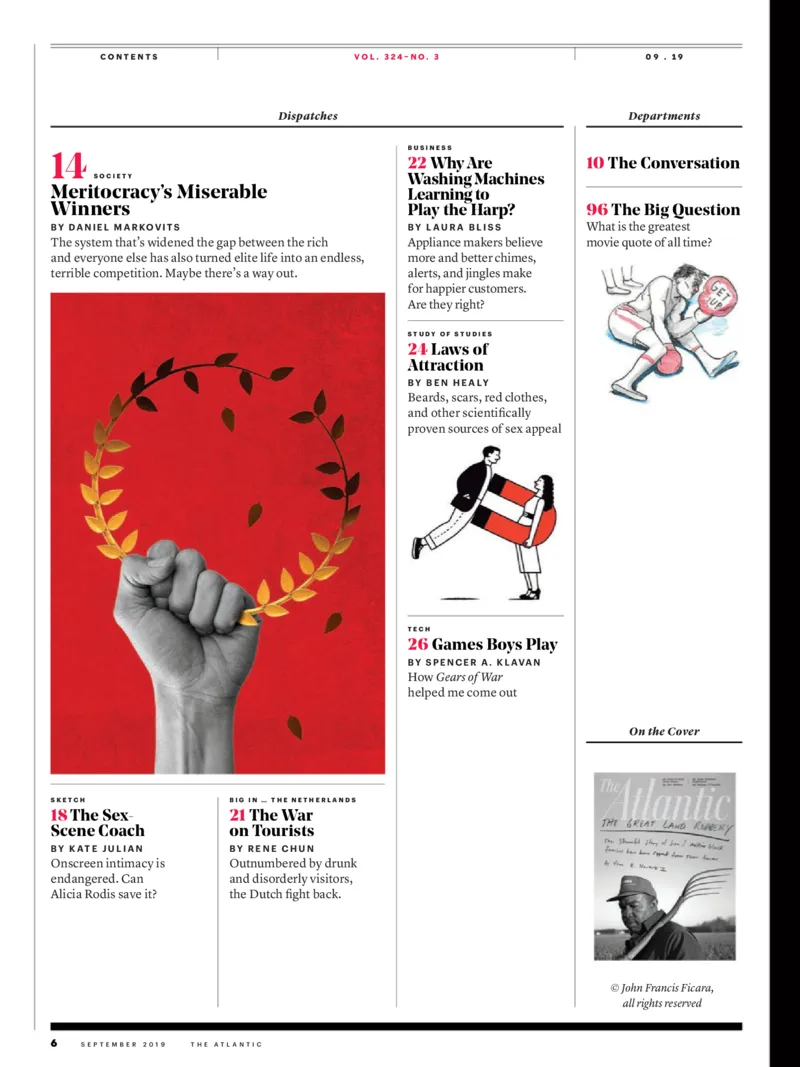
C O N T E N T S
Departments
6 S E P T E M B E R 2 0 1 9 T H E A T L A N T I C
On the Cover
V O L . 3 2 4 – N O . 3
10 The Conversation
96 The Big Question
What is the greatest
movie quote of all time?
© John Francis Ficara,
all rights reserved
S K E T C H
18 The Sex-
Scene Coach
BY K AT E J U L I A N
Onscreen intimacy is
endangered. Can
Alicia Rodis save it?
B U S I N E S S
22 Why Are
Washing Machines
Learning to
Play the Harp?
BY L AU R A B L I S S
Appliance makers believe
more and better chimes,
alerts, and jingles make
for happier customers.
Are they right?
S T U D Y O F S T U D I E S
24 Laws of
Attraction
BY B E N H E A LY
Beards, scars, red clothes,
and other scientifically
proven sources of sex appeal
T E C H
26 Games Boys Play
BY S P E N C E R A . K L AVA N
How Gears of War
helped me come out
B I G I N … T H E N E T H E R L A N D S
21 The War
on Tourists
BY R E N E C H U N
Outnumbered by drunk
and disorderly visitors,
the Dutch fight back.
14 S O C I E T Y
Meritocracy’s Miserable
Winners
BY DA N I E L M A R KOV I TS
The system that’s widened the gap between the rich
and everyone else has also turned elite life into an endless,
terrible competition. Maybe there’s a way out.
0 9 . 1 9
*Just as if you’d invested on your own, you will pay the operating expenses on the ETFs in your
portfolio — which includes Schwab ETFs™. We believe cash is a key component of an investment
SRUWIROLR��%DVHG�RQ�\RXU�ULVN�SUR÷�OH��D�SRUWLRQ�RI�\RXU�SRUWIROLR�LV�SODFHG�LQ�DQ�)',&�LQVXUHG�
deposit at Schwab Bank. Some cash alternatives outside of the program pay a higher yield.
Wealth Management refers to a number of different products and services offered through various subsidiaries of The Charles Schwab Corporation. See Schwab.com/wealth.
For Schwab Intelligent Portfolios Premium™, there is an initial planning fee of $300 upon enrollment and a $30 per month charged on a quarterly basis as detailed in the Schwab
Intelligent Portfolios Solutions™ disclosure brochures, which include important information, pricing and disclosures. Investors in Schwab Intelligent Portfolios Premium (“SIP Premium”)
do pay direct and indirect costs. These include ETF operating expenses which are the management and other fees the underlying ETFs charge all shareholders. The portfolios include
a cash allocation to a deposit account at Schwab Bank. Our affiliated bank earns income on the deposits, and earns more the larger the cash allocation is. The lower the interest rate
Schwab Bank pays on the cash, the lower the yield. Some cash alternatives outside of Schwab Intelligent Portfolios Premium pay a higher yield. Deposits held at Charles Schwab Bank
are protected by FDIC insurance up to allowable limits per depositor, per account ownership category. SIP Premium invests in Schwab ETFs. A Schwab affiliate, Charles Schwab In-
vestment Management, receives management fees on those ETFs. SIP Premium also invests in third party ETFs. Schwab receives compensation from some of those ETFs for providing
shareholder services, and also from market centers where ETF trade orders are routed for execution. Fees and expenses will lower performance, and investors should consider all
program requirements and costs before investing. Expenses and their impact on performance, conflicts of interest, and compensation that Schwab and its affiliates receive are detailed
in the Schwab Intelligent Portfolios Solutions disclosure brochures. Schwab Intelligent Portfolios Premium™ is made available through Charles Schwab & Co. Inc. (“Schwab”), a dually
registered investment advisor and broker dealer. Schwab and Schwab Bank are separate but affiliated companies and subsidiaries of The Charles Schwab Corporation. Brokerage
products, including the Schwab One brokerage account, are offered by Schwab, Inc., Member SIPC. Deposit and lending products are offered by Charles Schwab Bank, Member FDIC
and an Equal Housing Lender. ©2019 Charles Schwab & Co., Inc. All rights reserved. Member SIPC. (0519-90CM) ADP107125-00
Brokerage Products: Not FDIC Insured • No Bank Guarantee • May Lose Value
Wealth Management at Charles Schwab
PLANNING | PORTFOLIO MANAGEMENT | INCOME STRATEGIES | BANKING
Visit Schwab.com/PortfoliosPremium to learn more
For illustrative purposes only.
,1752'8&,1*
68%6&5,37,21�%$6('
),1$1&,$/�3/$11,1*��
6D\�KHOOR�WR�6FKZDE�,QWHOOLJHQW�3RUWIROLRV�3UHPLXP�Automated investing with integrated
planning for a simple, transparent subscription price.
Our robo-advisor builds and auto-rebalances
D�GLYHUVL÷�HG�SRUWIROLR�for you.
Work with a &(57,),('�),1$1&,$/�3/$11(5é�
professional as much as you like to create a
plan and track towards your goals.
Pay a one-time planning fee of $300, and just a
$30 monthly advisory fee* subscription after that.
The Culture File
Poetry
Essay
8 S E P T E M B E R 2 0 1 9 T H E A T L A N T I C
T H E O M N I V O R E
28 Sorry, Not Sorry
BY J A M E S PA R K E R
In a new translation of the
Book of Job, the famously
repentant hero gives God
a piece of his mind.
B O O K S
39 Deconstructing
Clarence Thomas
BY M I C H A E L O’D O N N E L L
The justice’s reactionary
legal philosophy
rests on faith in the
power of adversity to
fuel black progress.
B O O K S
36 Edna O’Brien’s
Lonely Girls
BY T E R R E N C E R A F F E RT Y
The setting of her new novel
is terror-ridden Nigeria,
a world away from her native
Ireland, but the psychic
territory is familiar.
86 The
Quickening
BY L E S L I E J A M I S O N
A story of two births
41 Memory Song
BY MARK JARMAN
V O L . 3 2 4 – N O . 3
C O N T E N T S
32 B O O K S
How the Dismal Science
Broke America
BY S E BAST I A N M A L L A BY
What the rise, and wrong turns, of economists and
Wall Street dealmakers reveals about our future
0 9 . 1 9
WHAT TO
EXPECT
®
WHEN YOU’RE
EXPECTING
A TEENAGER
LEARN HOW TO ADOPT
AT ADOPTUSKIDS.ORG
10 S E P T E M B E R 2 0 1 9 T H E A T L A N T I C
R E S P O N S E S & R E V E R B E R A T I O N S
Arthur C. Brooks’s insightful
piece really hit home for me. I
was a primary-care physician
for 33 years before closing
my office to concentrate on
elder and end-of-life care five
years ago, when I turned 65. I
had started feeling my fluid
intelligence ebb, even as I was
treating an ever more demand-
ing caseload in a setting of
corporatized health care.
My solution was to turn
my practice over to a capable
younger physician and embrace
long-term-care geriatrics,
where I have time to indulge my
patients and lead from my heart.
I work with an excellent
hospice team and facility staff.
Not a week goes by when I don’t
hold the hand of a dying person
or sign a death certificate. My
goal is to bring my patients
the comfort and peace that
supposed to have expressed
only one regret toward the end
of his life: “I did not drink more
champagne.” This seems a
worthy goal for all economists,
indeed for high achievers in all
careers, and much more enjoy-
able than Sannyasa.
Avinash Dixit
PRINCETON, N.J.
I am an 85-year-old male who
retired at “the top of my game”
at age 62. The retirement
decision was based on family
considerations: Our married
daughter, a soon-to-be mother,
lived in Portland, Oregon, and
asked that my wife and I move
to her town. The first six months
of settling into our new home
kept me occupied, so I did not
feel an identity crisis. But soon
I began to wonder whether we
had retired too soon, and to feel
a bit lost and depressed.
My wife suggested that I
return to playing the clarinet.
It did not take me long to
realize that having the time to
rehone my playing skills was a
gift. I got engaged in Port-
land’s music community, and
eventually became principal
clarinetist in two orchestras.
My greatest compliments come
from other, often younger
musicians who attend my recit-
als and consistently tell me that
I continue to improve.
Jules Elias
PORTLAND, ORE.
Arthur Brooks omits an
important point about profes-
sional decline after age 50. For
skill-based professions, waning
creativity is outweighed by
increasing experience and
judgment. Chesley Sullen-
berger was 58 when he landed
a jet on the Hudson River. For
heart surgeons like me, the 50s
are generally peak years.
Moreover, it is baffling
that Brooks picked Darwin
as an example of someone
who “stagnated” after age
50. Darwin published On the
allow heartfelt communication
and that is only possible with
reconciliation. Like the Buddha
Mr. Brooks encountered, I have
contemplated death and no
longer find it threatening.
John Jefferys Bandola, M.D.
KINGSTON, R.I.
The article by Arthur Brooks is
magnificent. As an 85-year-old
professional, I have already
experienced the world of angst
he is now entering. Take his
advice, please. He is espe-
cially right about the desire
to explore spirituality, which
professionals tend to neglect in
their early years.
W. R. Klemm
BRYAN, TEXAS
I seem to have intuited and
followed most of Arthur
Brooks’s precepts. During my
quite successful academic
career, I gradually shifted from
research to teaching, and from
graduate to under graduate
teaching. I retired at 66. Ten
years later, I keep my hand in
research, but purely for my
own intellectual pleasure, and
to keep my brain active and
healthy. I don’t even have an
office at the university; I work
at home in my pajamas.
The only item of Brooks’s
advice I disagree with is
Sannyasa, the “focus on more
transcendentally important
things.” The material world is
wonderful, and I now get to
enjoy it in ways I never could
before. I will not “leave my
office horizontally,” but I may
be taken horizontally off a
cruise ship.
A demigod of my voca-
tion, John Maynard Keynes, is
• T H E C O N V E R S A T I O N
Your Professional Decline
Is Coming (Much) Sooner
Than You Think
In July, Arthur C. Brooks wrote about how to make the most of it.
T H E A T L A N T I C S E P T E M B E R 2 0 1 9 11
Origin of Species in 1859 at
age 50, but he published The
Descent of Man in 1871, books
on reproduction in plants in
1876 and 1877, and his final
book in 1881, the year before
his death, at 73. By then, dete-
riorating health had confined
him to his house and garden,
so he wrote about earthworms.
A better example of declin-
ing creativity would have
been Albert Einstein. His
“miracle year” came in 1905, at
age 26, and he published his
theory of general relativity in
1915, at 36. Nothing thereafter
came close, and his lifelong
ambition, a unified field theory,
escaped him.
Lawrence I. Bonchek, M.D.
LANCASTER, PA.
Arthur Brooks writes almost
entirely of the experience of
men (and of men of a certain era,
socioeconomic class, and race).
Although a reader might be able
to infer something of the experi-
ence of women in his article, he
effectively ignores them.
So what of the women whose
careers have moved forward
in fits and starts, due to time
spent parenting or the need to
counter legal, cultural, societal,
or institutional restrictions?
What of the women who never
had the chance at a career, if
indeed they wanted one? Do
they feel the same sensations of
decline? To what stage do they
now move?
Shana Judge
ALBUQUERQUE, N.M.
The Worst Patients
in the World
Americans are hypochondriacs,
yet we skip our checkups. We
demand drugs we don’t need,
and fail to take the ones we do.
No wonder the U.S. leads the
world in health spending, David
H. Freedman wrote in July.
I found this article to be a
refreshing departure from
most writing about health
care. Of course culture matters.
As a medical anthropologist,
however, I thought David
H. Freedman missed a key
factor in health outcomes.
Many people who have the
worst compliance rates and
outcomes (Freedman lists
smokers, diabetics, and people
with sedentary lifestyles as
examples) also have the same
socioeconomic status. In other
words, they’re broke or too
busy to do everything they’re
supposed to.
While I agree that more
attention needs to be paid to
how American culture affects
our health-care choices, I’d hate
to see money and social class
fall out of the analysis. These
factors also affect how people
perceive their doctors. I grew up
in farm country and my family—
who often couldn’t afford all
the recommended treatments
or travel the two hours it would
take to see specialists—viewed
hospitals and clinics with
suspicion. Local cultures and
medical institutions affect and
shape each other. Both have to
change for Americans to have
any chance at a better health-
care system.
Theresa MacPhail
BROOKLYN, N.Y.
We can all acknowledge that
a sedentary lifestyle, poor
nutrition, and “toxic” habits
contribute to abysmal Ameri-
can health-care outcomes. But
maybe the American attitude
toward health care is not the
fundamental cause. This
attitude might be a reflection of
larger social and cultural forces
in our country.
Americans have long been
known for entitlement and
a flair for dramatic hero-
ism. Our health-care system
amplifies those traits, with its
emphasis on high-cost and
high- intervention care over
preventative care and lifestyle
changes. We demonize figures
of authority and are inher-
ently skeptical of advice from
experts. Easily offended, we
insist on ensuring comfort
rather than knowing truth.
Creating cultural change will
require far more than simply
modifying health-care incen-
tives. Treating the problem
is usually more difficult than
treating the symptoms.
David J. Berman, M.D.
BALTIMORE, MD.
Formal international compari-
sons consistently point to the
much higher prices paid in
the United States for medical
services as the primary culprit
behind our high medical spend-
ing. Prices paid in the U.S. far
exceed those paid abroad even
as Americans consume fewer
units of service (such as doctor
visits) relative to the OECD
average. Were over consumption
the cause of our over spending,
we might argue about why—are
Americans, as David Freedman
contends, both unhealthy and
too demanding, or are we the
victims of pill pushers, greedy
doctors, and the wasteful
dis organization of health care?
But one cannot possibly attri-
bute over pricing to unhealthy
behaviors. In fact, our behaviors
are no less healthy than peer
countries’. Yes, we lead the
developed world in obesity
(though Europe is not far
behind), but we have one of
the lowest smoking rates and
consume less alcohol per capita
than most European countries.
Jon Kingsdale, Ph.D.
JAMAICA PLAIN, MASS.
For the most part, David Freed-
man hits the nail on the head.
As a neurosurgeon, I know all
too well how difficult some
patients can be.
Mr. Freedman postulates
that Medicare for All would
provide an incentive to push
“patients to embrace care that’s
less flashy but may do more
good” by “refusing to pay for
unnecessarily expensive care.”
Unfortunately, it’s not that
simple. The problem is that
much of medicine falls outside
of established clinical guide-
lines. Very few conditions have
treatment algorithms that have
been tested in well-designed
studies. In fact, physicians are
surprised when patients seem
to adhere to the “textbook.”
Decisions regarding medical
care come about through the
patient-physician relation-
ship. As Mr. Freedman says,
this relationship isn’t always
healthy. However, inserting
governmental control to artifi-
cially diminish “unnecessarily
expensive care” will only strain
this relationship further and
lead to greater dissatisfaction
on both sides. Mr. Freedman
correctly identifies one of the
problems in American health
care; he is just incorrect when
he alludes to a solution.
Anthony DiGiorgio, D.O., M.H.A.
NEW ORLEANS, LA.
It’s one thing for a medical-
data wonk (or a physician who
follows what these wonks
say blindly) to declare that a
treatment is unnecessary and/
or expensive. It’s quite another
thing for the patient. Say
you’re a patient who desires a
treatment that will extend your
life by only a few months to
a year, is very expensive, has
nasty side effects, and may
not succeed. But it’s really,
really important for you to see
a family member graduate
from high school or college;
to attend a family member’s
wedding or a reunion; to cross
off items on your bucket list. It
doesn’t matter if your “quality
of life” as defined by some arbi-
trary measure declines.
Even if your chance of
survival is only 20 percent,
15 percent, 10 percent, or
5 percent, why should you be
denied that chance?
Sue McKeown
GAHANNA, OHIO
12 S E P T E M B E R 2 0 1 9 T H E A T L A N T I C
R E S P O N S E S & R E V E R B E R A T I O N S
To contribute to The
Conversation, please email
letters@theatlantic.com. Include
your full name, city, and state.
EDITORIAL OFFICES & CORRESPONDENCE The Atlantic considers unsolicited manuscripts, fiction or nonfiction, and mail for the Letters column. Manuscripts will not be returned. For
instructions on sending manuscripts via email, see theatlantic.com/faq. By submitting a letter, you agree to let us use it, as well your full name, city, and state, in our magazine and/
or on our website. We may edit for clarity. CUSTOMER SERVICE & REPRINTS Please direct all subscription queries and orders to: 800-234-2411. International callers: 515-237-3670. For
expedited customer service, please call between 3:30 and 11:30 p.m. ET, Tuesday through Friday. You may also write to: Atlantic Customer Care, P.O. Box 37564, Boone, IA 50037-0564.
Reprint requests (100+) should be made to The YGS Group, 717-399-1900. A discount rate is available for students and educators. Please visit theatlantic.com/subscribe/academic.
ADVERTISING OFFICES The Atlantic, 60 Madison Avenue, Suite 800, New York, NY 10010, 646-539-6700.
our society poor, his “fixes”
won’t work. Racial animus
is one of the most powerful
drivers of inequality. Not until
we truly have education equity
along with nonbiased policing,
no redlining of communities,
a realistic tax system, repro-
ductive rights, and full voter
agency for all citizens will we
have income equity.
Sharon Feola
HANSVILLE, WASH.
“Educationism” as described by
Nick Hanauer is a belief we are
all too familiar with and guilty
of ourselves as philanthropic
leaders. Too often we jump to
solutions before examining the
root causes of the inequities
that are present in our educa-
tion system.
While household income
is a predictor of educational
attainment, structural racism
is the enduring impediment
that undergirds the wealth and
educational opportunity gaps
across our country. If we truly
want to address economic
inequality and fix our schools,
we need to examine why such
gaps exist.
Nick Donohue
PRESIDENT AND CEO, NELLIE MAE
EDUCATION FOUNDATION
QUINCY, MASS.
John H. Jackson
PRESIDENT AND CEO,
SCHOTT FOUNDATION FOR
PUBLIC EDUCATION
QUINCY, MASS.
Finally, a fresh, realistic
perspective on what is really
going on in many of our under-
performing schools. I taught
elementary school in Boulder,
Colorado, and Erie, Pennsyl-
vania. The experiences were
night and day. Both schools,
in my opinion, had adequate
economic resources; the
David H. Freedman replies:
To say U.S. health care is expensive
because, as Jon Kingsdale notes,
its prices are high is nearly a
tautology. Why are they high?
If the cause were an evil, greedy
health-care industry, then the
industry must be raking in
massive profits not seen in other
countries. But most hospitals are
nonprofits, insurance companies
(which cover just two-thirds of
Americans) have profit margins
around 5 percent, and Big Pharma
companies are multi nationals
that sell their drugs all over the
world—are they evil and greedy
only in the U.S.? There are in fact
many reasons for high prices here,
and the evidence makes clear
that a big one is the demanding,
neglectful attitudes of American
patients. (Though, yes, lower
rates of alcohol consumption and
smoking are relative bright spots in
an otherwise troubling picture.)
Education Isn’t
Enough
Like many rich Americans, Nick
Hanauer used to think better
schools could heal the country’s
ills—a belief system he calls
“educationism.” As Hanauer wrote
in July, he has come to believe that
he was wrong; fighting inequality
must come first.
It’s about time somebody spoke
up and named the elephant in
the room. That the person who
wrote this article is essentially
the “elephant” makes it all the
more laudable. I commend
Nick Hanauer for taking on this
issue, as it is the issue concern-
ing educational inequality and
the “achievement gap” so often
spoken of. I sincerely hope
that he sparks a real national
dialogue about the treacheries
of wealth inequality, and that
the obvious response is a funda-
mental redistribution of wealth.
Catherine Jones
HAMDEN, CONN.
There is undeniably a problem
with income inequality in this
country, and I feel it person-
ally as a middle-class engineer.
However, I still consider myself
an educationist. Nick Hanauer
is dead right in saying that “a
college diploma is no longer
a guaranteed passport into
the middle class,” but it does
produce a better-informed
electorate that is demonstrably
less likely to vote for politi-
cians or policies that just aren’t
functional. Most pragmatically,
education policy is perhaps
the major institutional change
(besides infrastructure
improvement) most likely to
get past the legislative grave-
yard that Congress has become.
Robert Hodge
GEORGETOWN, COLO.
I agree with all the points
made in this article. However,
in one sense the failure of our
education system is responsible
for the state of our economy
and society: the consistent lack
of civics education. We have,
both by design and through
in attention, produced two
generations ignorant of how
our society and government
should work. The lack of civic
engagement allows the wealthy
and powerful to disenfranchise
huge masses of Americans.
Howard Schneider
PORTLAND, ORE.
Nick Hanauer’s article high-
lighted the chicken-or-egg
dilemma of education and
income. However, without
addressing deliberate efforts
that keep certain portions of
difference was the income and
education levels of the students’
parents. In Boulder I wanted
for nothing, and going to school
each day was a joy. It’s easy to be
a great teacher when you have
super-prepared children. In
Erie I saw firsthand how money
in schools doesn’t negate the
effects of poverty. All the stress-
ors in the home come right to
school, which is something no
amount of money can change.
Tina Brown
MOORPARK, CALIF.
Rather than simply acknowl-
edge that his “education-
ism” approach to improving
public education might have
been wrong, Nick Hanauer
concludes that his investment
in education was wrong.
I agree with Hanauer that
our education system can’t
compensate for a failing
economic system, but strategic
interventions and invest-
ments can strengthen existing
public schools in ways that
afford poor children access
to the same high-quality
educational opportunities
that their middle-class and
wealthy counterparts have. I
hope Hanauer will reassess
his investment in education
and understand that economic
and educational equality are
intrinsically linked.
Caro G. Pemberton
SANTA ROSA, CALIF.
Correction
“Raj Chetty’s American Dream”
(August) stated that the Mayo
Clinic is located in Minneapolis.
The clinic’s Minnesota campus
is in Rochester.
The 2020 Subaru Ascent™ can carry up to 8 passengers with the safety of a
Subaru. Standard Symmetrical All-Wheel Drive helps give you reliable traction under
adverse conditions. Plus, standard SUBARU STARLINK
® Multimedia with Apple
CarPlay™ and Android™ Auto integration. Love is now bigger than ever.
Subaru and SUBARU STARLINK are registered trademarks. Android Auto is a trademark of Google, Inc. Apple CarPlay is a registered trademark of Apple Inc. *MSRP excludes destination
and delivery charges, tax, title, and registration fees. Retailer sets actual price. Certain equipment may be required in specific states, which can modify your MSRP. See your retailer for
details. 2020 Subaru Ascent Touring shown has an MSRP of $45,045.
All-wheel drive,
all-weather friend.
Ascent. Well-equipped at $31,995*.
14 S E P T E M B E R 2 0 1 9 T H E A T L A N T I C
• S O C I E T Y
MERITOCRACY’S
MISERABLE
WINNERS
The system that’s widened
the gap between the rich
and everyone else has also
turned elite life into an
endless, terrible competition.
Maybe there’s a way out.
BY DA N I E L M A R KOV I T S
I l l u s t r a t i o n s b y E D M O N D E H A R O
I D E A S & P R O V O C A T I O N S
S E P T E M B E R 2 0 1 9
D I S P A T C H E S
You may be skeptical that an electronic jingle can make doing the dishes a life-affirming endeavor—or even bind you,
emotionally, to your dishwasher. But companies are betting otherwise. — Laura Bliss, p. 22
IN THE SUMMER OF 1987, I gradu-
ated from a public high school in Austin,
Texas, and headed northeast to attend
Yale. I then spent nearly 15 years study-
ing at various universities—the London
School of Economics, the University of
Oxford, Harvard, and finally Yale Law
School—picking up a string of degrees
along the way. Today, I teach at Yale Law,
T H E A T L A N T I C S E P T E M B E R 2 0 1 9 15
“Bankers’ hours” have
given way to the ironically
named “banker 9-to-5”—
from 9 a.m. one day to
5 a.m. the next.
where my students unnervingly resemble
my younger self: They are, overwhelm-
ingly, products of professional parents
and high-class universities. I pass on to
them the advantages that my own teach-
ers bestowed on me. They, and I, owe our
prosperity and our caste to meritocracy.
Two decades ago, when I started
writing about economic inequality, meri-
tocracy seemed more likely a cure than
a cause. Meritocracy’s early advocates
championed social mobility. In the 1960s,
for instance, Yale President Kingman
Brewster brought meritocratic admis-
sions to the university with the express
aim of breaking a hereditary elite. Alumni
had long believed that their sons had a
birthright to follow them to Yale; now pro-
spective students would gain admission
based on achievement rather than breed-
ing. Meritocracy—for a time—replaced
complacent insiders with talented and
hardworking outsiders.
Today’s meritocrats still claim to get
ahead through talent and effort, using
means open to anyone. In practice, how-
ever, meritocracy now excludes every-
one outside of a narrow elite. Harvard,
Princeton, Stanford, and Yale collec-
tively enroll more students from house-
holds in the top 1 percent of the income
distribution than from households in the
bottom 60 percent. Legacy preferences,
nepotism, and outright fraud continue to
give rich applicants corrupt advantages.
But the dominant causes of this skew
toward wealth can be traced to meritoc-
racy. On average, children whose par-
ents make more than $200,000 a year
score about 250 points higher on the
SAT than children whose parents make
$40,000 to $60,000. Only about one
in 200 children from the poorest third of
households achieves SAT scores at Yale’s
median. Meanwhile, the top banks and
law firms, along with other high-paying
employers, recruit almost exclusively
from a few elite colleges.
Hardworking outsiders no longer
enjoy genuine opportunity. According to
one study, only one out of every 100 chil-
dren born into the poorest fifth of house-
holds, and fewer than one out of every 50
children born into the middle fifth, will
join the top 5 percent. Absolute economic
mobility is also declining—the odds that
a middle-class child will outearn his par-
ents have fallen by more than half since
mid-century—and the drop is greater
among the middle class than among the
poor. Meritocracy frames this exclusion
as a failure to measure up, adding a moral
insult to economic injury.
Public anger over economic inequal-
ity frequently targets meritocratic institu-
tions. Nearly three-fifths of Republicans
believe that colleges and universities
are bad for America, according to the
Pew Research Center. The intense and
widespread fury generated by the
college-admissions scandal early this
year tapped into a deep and broad well of
resentment. This anger is warranted but
also distorting. Outrage
at nepotism and other
disgraceful forms of elite
advantage-taking implic-
itly valorizes meritocratic
ideals. Yet meritocracy
itself is the bigger prob-
lem, and it is crippling the
American dream. Meri-
tocracy has created a com-
petition that, even when
everyone plays by the
rules, only the rich can win.
But what, exactly, have the rich won?
Even meritocracy’s beneficiaries now suf-
fer on account of its demands. It ensnares
the rich just as surely as it excludes the rest,
as those who manage to claw their way to
the top must work with crushing intensity,
ruthlessly exploiting their expensive edu-
cation in order to extract a return.
No one should weep for the wealthy.
But the harms that meritocracy imposes
on them are both real and important.
Diagnosing how meritocracy hurts elites
kindles hope for a cure. We are accus-
tomed to thinking that reducing inequality
requires burdening the rich. But because
meritocratic inequality does not in fact
serve anyone well, escaping meritocracy’s
trap would benefit virtually everyone.
E
LITES FIRST CONFRONT merito-
cratic pressures in early childhood.
Parents—sometimes reluctantly, but feel-
ing that they have no alternative—sign
their children up for an education domi-
nated not by experiments and play but by
the accumulation of the training and skills,
or human capital, needed to be admit-
ted to an elite college and, eventually, to
secure an elite job. Rich parents in cities
like New York, Boston, and San Francisco
now commonly apply to 10 kindergartens,
running a gantlet of essays, appraisals,
and interviews—all designed to evaluate
4-year -olds. Applying to elite middle and
high schools repeats the ordeal. Where
aristocratic children once reveled in their
privilege, meritocratic children now cal-
culate their future—they plan and they
scheme, through rituals of stage-managed
self-presentation, in familiar rhythms of
ambition, hope, and worry.
Schools encourage children to oper-
ate in this way. At one elite northeast-
ern elementary school, for example, a
teacher posted a “problem of the day,”
which students had to solve before going
home, even though no time was set aside
for working on it. The point of the exer-
cise was to train fifth graders to snatch a
few extra minutes of work time by multi-
tasking or by sacrificing recess.
Such demands exact a toll. Elite mid-
dle and high schools now commonly
require three to five hours of homework
a night; epidemiologists at the Centers
for Disease Control and Prevention
have warned of schoolwork-induced
sleep deprivation. Wealthy students
show higher rates of drug and alcohol
abuse than poor students do. They also
suffer depression and anxiety at rates as
much as triple those of their age peers
throughout the country. A recent study
of a Silicon Valley high school found that
54 percent of students displayed moder-
ate to severe symptoms of depression
and 80 percent displayed moderate to
severe symptoms of anxiety.
These students nevertheless have
good reason to push themselves as they
do. Elite universities that just a few
decades ago accepted 30 percent of their
applicants now accept less than 10 per-
cent. The shift at certain institutions has
been even more dramatic: The Univer-
sity of Chicago admitted 71 percent of its
applicants as recently as 1995. In 2019 it
admitted less than 6 percent.
16 S E P T E M B E R 2 0 1 9 T H E A T L A N T I C
D I S P A T C H E S
A person who extracts income and
status from his own human capital places
himself, quite literally, at the disposal of
others—he uses himself up. Elite students
desperately fear failure and crave the
conventional markers of success, even
as they see through and publicly deride
mere “gold stars” and “shiny things.”
Elite workers, for their part, find it harder
and harder to pursue genuine passions or
gain meaning through their work. Meri-
tocracy traps entire generations inside
demeaning fears and inauthentic ambi-
tions: always hungry but never
finding, or even knowing, the
right food.
T
HE ELITE SHOULD NOT—
they have no right to—expect
sympathy from those who remain
excluded from the privileges and
benefits of high caste. But ignor-
ing how oppressive meritocracy is
for the rich is a mistake. The rich
now dominate society not idly
but effortfully. The familiar argu-
ments that once defeated aristo-
cratic inequality do not apply to
an economic system based on
rewarding effort and skill. The
relentless work of the hundred-
hour-a-week banker inoculates
her against charges of unearned
advantage. Better, then, to con-
vince the rich that all their work
isn’t actually paying off.
They may need less convinc-
ing than you might think. As the
meritocracy trap closes in around
elites, the rich themselves are
turning against the prevailing system.
Plaintive calls for work/life balance ring
ever louder. Roughly two-thirds of elite
workers say that they would decline a pro-
motion if the new job demanded yet more
of their energy. When he was the dean
of Stanford Law School, Larry Kramer
warned graduates that lawyers at top
firms are caught in a seemingly endless
cycle: Higher salaries require more bill-
able hours to support them, and longer
hours require yet higher salaries to jus-
tify them. Whose interests, he lamented,
does this system serve? Does anyone
really want it?
Escaping the meritocracy trap will not
be easy. Elites naturally resist policies
that threaten to undermine their advan-
tages. But it is simply not possible to get
they “hit the wall” at work, the only solu-
tion is to “climb the wall.”
Americans who work more than 60
hours a week report that they would, on
average, prefer 25 fewer weekly hours.
They say this because work subjects
them to a “time famine” that, a 2006
study found, interferes with their capac-
ity to have strong relationships with their
spouse and children, to maintain their
home, and even to have a satisfying sex
life. A respondent to a recent Harvard
Business School survey of executives
proudly insisted, “The 10 minutes that I
give my kids at night is one million times
greater than spending that 10 minutes at
work.” Ten minutes!
The capacity to bear these hours
gracefully, or at least grimly, has become
a criterion for meritocratic success. A top
executive at a major firm, interviewed by
the sociologist Arlie Russell Hochschild
for her book The Time Bind, observed
that aspiring managers who have dem-
onstrated their skills and dedication
face a “final elimination”: “Some people
flame out, get weird because they work
all the time … The people at the top are
very smart, work like crazy, and don’t
flame out. They’re still able to maintain
a good mental set, and keep their family
life together. They win the race.”
The contest intensifies when merito-
crats enter the workplace, where elite
opportunity is exceeded only by the
competitive effort required to grasp it. A
person whose wealth and status depend
on her human capital simply cannot
afford to consult her own interests or
passions in choosing her job. Instead,
she must approach work as an oppor-
tunity to extract value from her human
capital, especially if she wants an income
sufficient to buy her children the type of
schooling that secured her own eliteness.
She must devote herself to a nar-
rowly restricted class of high-
paying jobs, concentrated in
finance, management, law, and
medicine. Whereas aristocrats
once considered themselves a
leisure class, meritocrats work
with unprecedented intensity.
In 1962, when many elite law-
yers earned roughly a third of
what they do today, the American
Bar Association could confidently
declare, “There are … approxi-
mately 1,300 fee-earning hours
per year” available to the normal
lawyer. In 2000, by contrast, a
major law firm pronounced with
equal confidence that a quota of
2,400 billable hours, “if properly
managed,” was “not unreason-
able,” which is a euphemism for
“necessary for having a hope of
making partner.” Because not all
the hours a lawyer works are bill-
able, billing 2,400 hours could
easily require working from 8 a.m.
until 8 p.m. six days a week, every
week of the year, without vacation or
sick days. In finance, “bankers’ hours”—
originally named for the 10-to-3 business
day fixed by banks from the 19th century
through the mid-20th century and later
used to refer more generally to any light
work—have given way to the ironically
named “banker 9-to-5,” which begins at
9 a.m. on one day and runs through 5 a.m.
on the next. Elite managers were once
“organization men,” cocooned by lifelong
employment in a corporate hierarchy that
rewarded seniority above performance.
Today, the higher a person climbs on the
org chart, the harder she is expected to
work. Amazon’s “leadership principles”
call for managers to have “relentlessly
high standards” and to “deliver results.”
The company tells managers that when
T H E A T L A N T I C S E P T E M B E R 2 0 1 9 17
• S O C I E T Y
rich off your own human capital without
exploiting yourself and impoverishing
your inner life, and meritocrats who hope
to have their cake and eat it too deceive
themselves. Building a society in which
a good education and good jobs are avail-
able to a broader swath of people—so that
reaching the very highest rungs of the lad-
der is simply less important—is the only
way to ease the strains that now drive the
elite to cling to their status.
How can that be done? For one thing,
education—whose benefits are concen-
trated in the extravagantly trained chil-
dren of rich parents— must become open
and inclusive. Private schools and univer-
sities should lose their tax-exempt status
unless at least half of their students come
from families in the bottom two-thirds of
the income distribution. And public subsi-
dies should encourage schools to meet this
requirement by expanding enrollment.
A parallel policy agenda must reform
work, by favoring goods and services
produced by workers who do not have
elaborate training or fancy degrees. For
example, the health-care system should
emphasize public health, preventive care,
and other measures that can be overseen
primarily by nurse practitioners, rather
than high-tech treatments that require
specialist doctors. The legal system
should deploy “legal technicians”— not
all of whom would need to have a J.D.—
to manage routine matters, such as real-
estate transactions, simple wills, and even
uncontested divorces. In fi nance, regula-
tions that limit exotic fi nancial engineer-
ing and favor small local and regional
banks can shift jobs to mid-skilled work-
ers. And manage ment should embrace
practices that distribute control beyond
the C-suite, to empower everyone else in
the fi rm.
The main obstacle to overcoming
merito cratic inequality is not technical
but political. Today’s conditions induce
discontent and widespread pessimism,
verging on despair. In his book Oligarchy,
the political scientist Jeff rey A. Winters
surveys eras in human history from the
classical period to the 20th century, and
documents what becomes of societies
that concentrate income and wealth in a
narrow elite. In almost every instance, the
dismantling of such inequality has been
accompanied by societal collapse, such as
military defeat (as in the Roman empire)
or revolution (as in France and Russia).
Nevertheless, there are grounds for
hope. History does present one clear-cut
case of an orderly recovery from concen-
trated inequality: In the 1920s and ’30s,
the U.S. answered the Great Depression
by adopting the New Deal framework that
would eventually build the mid- century
middle class. Crucially, government
redistribution was not the primary engine
of this process. The broadly shared pros-
perity that this regime established came,
mostly, from an economy and a labor mar-
ket that promoted economic equality over
hierarchy— by dramatically expanding
access to education, as under the GI Bill,
and then placing mid-skilled, middle-
class workers at the center of production.
An updated version of these arrange-
ments remains available today; a
renewed expansion of education and
a renewed emphasis on middle-class
jobs can re inforce each other. The elite
can reclaim its leisure in exchange for a
reduction of income and status that it can
easily aff ord. At the same time, the mid-
dle class can regain its income and status
and reclaim the center of American life.
Rebuilding a democratic economic
order will be diffi cult. But the benefi ts
that economic democracy brings—to
everyone—justify the eff ort. And the vio-
lent collapse that will likely follow from
doing nothing leaves us with no good
alternative but to try.
Daniel Markovits is the Guido Calabresi
Professor of Law at Yale Law School.
He is the author of the new book
The Meritocracy Trap, from which
this article is adapted.
I l l u s t r a t i o n b y J O E M C K E N D R Y
• Adapted from A Good
Provider Is One Who Leaves:
One Family and Migration
in the 21st Century, by
Jason DeParle, published
by Viking in August
• V E R Y S H O R T B O O K E X C E R P T
Where Migration Is a Civil Religion
NO COUNTRY has worked harder than the
Philippines to export its people, and no people
have proved more eager to go. Since the mid-
1970s, the government has trained and marketed
overseas workers, not just drumming up jobs
but fashioning a brand—casting the Filipino as
a genial hard worker, the best in low-cost labor.
In 1977, Wingtips, the magazine of Philippine
Airlines, insisted that “Filipinos don’t pose the
problems that guest workers from, say, the
Mediterranean belt have in Western Europe.”
They wouldn’t riot or strike. Critics later called the
sale of the happy, hardworking Filipino infantilizing,
an eff ort to turn people into remittance machines,
but most Filipinos liked that their country was
known as the HR department of the world.
More than 2 million Filipinos depart each year,
enough to fill a dozen or more Boeing 747s a day.
About one in seven Filipino workers is employed
abroad, and the $32 billion that they send home
accounts for 10 percent of the GDP. Migration is
to the Philippines what cars once were to Detroit:
the civil religion. The Philippine Daily Inquirer runs
nearly 600 stories a year on overseas Filipino work-
ers, or “OFWs.” Half have the fevered feel of gold-
rush ads. Half sound like human-rights complaints:
“Remittances Seen to Set New Record.”
“Happy Days Here Again for Real Estate Sector.”
“5 Dead OFWs in Saudi.”
“We Slept With Dog, Ate Leftovers for
$200/Month.”
18 S E P T E M B E R 2 0 1 9 T H E A T L A N T I C
• S K E T C H
THE SEX-SCENE COACH
Onscreen intimacy is endangered.
Can Alicia Rodis save it?
BY K AT E J U L I A N
HIS IS MY KIT.” Alicia
Rodis, who since early last year has been
HBO’s lead intimacy coordinator, a new
title that translates roughly to chief sex-
scene coach, held up a clear vinyl case
filled with what at first glance appeared
to be toiletries and packages of pantyhose.
On closer examination, though, the prod-
ucts and their names were mysterious.
Shibue. Hibue. Stanga.
“Let’s say we’re coming in to do a sex
scene,” she said. “They’re simulating
sex and they’re excluding genitals—we
are going to see someone fully naked,
but not their genitals—and they’re in the
bed, with sheets. So what do we need to
make sure?” Here she picked up a Shibue
(“she-boo”), which looks like a panty
liner except that it’s meant to adhere to
a person rather than to an undergarment.
“We take a Shibue, open it up, and put a
silicone guard underneath so everyone
becomes like a Barbie doll.”
Rodis wants both to shield sensitive
body parts and to make their contours
un detectable. She explained that cos-
tume departments know all about the
items in her kit, but she doesn’t like to
leave anything to chance.
If she’s new on a set, she
will bring Shibues in a full
range of human skin tones
and some silicone guards,
too. She waved a lavender
package containing one
(brand name: Silicone Val-
ley), then continued rif-
fling through her supplies.
“Knee pads or elbow pads in
case someone’s on a hard
floor. Sticky tape, moleskin.
Wet Ones, tissues, breath
mints. Baby oil so they can take anything
that’s adhesive off. Razors—though usu-
ally I’ll talk with actors beforehand and
ask, ‘Could you shave your bikini line so
we know that you’re not going to get a
free spa treatment when we take off the
Shibue?’ ” She held up a Hibue. “The same
thing, but for someone who has a penis.”
Rodis, who in a previous life was
an actor and a stuntwoman, still has
headshot-ready blond ringlets and a
performer’s lithe physicality. That day, a
Wednesday, she was working from her
home office in Astoria, Queens, prepar-
ing for shoots on various shows. Among
them was The Deuce, the David Simon and
George Pelecanos drama about sex work
in 1970s Times Square and the birth of
modern porn, which begins its third and
final season this month. Rodis’s book-
shelves were packed with volumes about
theater, sex, and sword fighting; across
from her desk hung a certificate from the
Society of American Fight Directors iden-
tifying her as a stage-combat teacher and
a bulletin board covered with photos, car-
toons, and buttons with slogans like “No
does not mean Convince me.”
We sat down on a couch and Rodis
turned on an episode from The Deuce’s sec-
ond season. She fast-forwarded to a scene
that takes place on a porn set done up with
a kitschy Arabian Nights look. Like many
scenes in The Deuce, it is sexually graphic
but deliberately unsexy, in this case comi-
cally so. As the movie-shoot-within-a-
TV-episode unfolds, the porn director
barks commands at an actor named Tyler
(played by Justin Stiver), who appears to be
naked save for a gold lamé turban. Tyler
is having sex with a porn actor named
Shana, and the director wants him to raise
her hips six inches for a better camera
angle; Shana resists indignantly, offering
a vivid description of what the requested
position will mean for her insides. “I don’t
want to hurt her!” Tyler protests.
When I asked Rodis how she’d facili-
tated the scene, she explained that she’d
briefed both actors on the planned
nudity and physical interaction, and on
what type of wardrobe assistance—or
lack-of- wardrobe assistance—they
For a fight scene,
choreographers mapped
out every beat.
Why weren’t sex scenes
governed by the
same approach?
D I S P A T C H E S
“T
T H E A T L A N T I C S E P T E M B E R 2 0 1 9 19
“nonnegotiable.” Why weren’t sex scenes
governed by the same approach?
When Rodis heard that a fellow fight
choreographer, Tonia Sina, had begun
offering what she called intimacy direction
and choreography services, she reached
out to her. In 2015, the two women joined
forces with a third actor turned fight direc-
tor, Siobhan Richardson, to found their
own company, Intimacy Directors Inter-
national. Initially most of their work was
in the theater, where a series of scandals
had focused attention on the question of
how sex was performed onstage.
By late 2017, however, the nascent
#MeToo and Time’s Up movements were
drawing similar scrutiny to the TV and film
industry, with allegations of on- and off-
set wrongdoing leveled at actors includ-
ing Kevin Spacey, Jeffrey Tambor, and
Jeremy Piven. Then, in January 2018, the
Los Angeles Times published an article in
which several women accused the Deuce
executive producer and lead actor James
Franco of behavior on film sets that was
“in appropriate or sexually exploitative.”
One woman said he had removed protec-
tive guards from actresses’ genitals dur-
ing an oral-sex scene. (Franco’s attorney
disputed the women’s stories and told the
paper, “The allegations about the protec-
tive guards are not accurate.”)
The next month, shortly before The
Deuce was scheduled to begin taping its
second season, Rodis got a message from
a producer on the show. “He was like,
‘I’m looking at a website, and, um, it says
that you do a service?’ ” She called him
back, and two days later—after binge-
watching the first season of the show—
she went to Silvercup Studios in Queens
to meet with David Simon and nine or 10
long-faced HBO producers and execu-
tives, each of whom had a copy of her
résumé. “You could tell something was
up,” she said dryly.
For the show’s first season, Nina
K. Noble, an executive producer and a
longtime collaborator of Simon’s, had
taken various steps to ensure actors’ com-
fort, from personally reviewing scripts
with them to improvising intimacy barri-
ers out of yoga mats. But after #MeToo’s
allegations and revelations, Noble told
me, some of the cast members had asked
the producers to do more, and she agreed
that it was time for outside help. (I asked
Noble whether the decision was related to
the allegations against Franco; she denied
performers were often left to muddle
their way through the action. Some direc-
tors had an attitude of, as she put it, “I
want to discuss what your character does
for everything until it gets to anything sex-
ual, and then just go for it.” The message
that sends to actors is: “ ‘You know how to
kiss; kiss how you kiss.’ But no one should
give a shit about how the actor kisses”—or
comports himself sexually—“it should be
about the character.” At best, this inatten-
tion produced lackluster sex scenes. At
worst, it suggested an un serious attitude
that could leave performers feeling con-
fused if not traumatized.
Rodis was struck by how much more
care went into staging physical inter-
actions that were violent or dangerous than
into staging those that were sexual. For a
fight scene, choreographers mapped out
every beat, helping actors work through
each movement in slow motion, over and
over, until they were automatic. In stunt
work, a focus on safety was considered
should expect. The day of the shoot, the
three met in person to discuss in more
detail who would be touching whom,
how, and where. A conversation like this,
Rodis explained, can also involve cho-
reographic elements, such as “setting
the number of pumps.” Once she had
established that everyone was comfort-
able with the plan and made sure both
actors had robes to wear before and after
the scene, it was finally time for filming.
H
OWEVER BA SIC ALL of this
might seem, Rodis’s work repre-
sents a major departure from how sex
scenes have historically been planned—
or, as has often been the case, improvised.
Rodis, who is 38, began acting onstage in
her teens and continued through her 20s,
when she added some TV acting and also
took up fight directing and stunt work.
On TV sets, she found, actresses were
sometimes expected to shed their shirt
without advance notice. As for sex scenes,
I l l u s t r a t i o n b y J O H N C U N E O
20 S E P T E M B E R 2 0 1 9 T H E A T L A N T I C
• S K E T C H
D I S P A T C H E S
that it was.) Rodis was asked to explain
exactly what she might bring to the show,
so she described the objectives of her
theatrical work—including choreography,
consent and safety, and cultivating a con-
nection between actors so as to promote
chemistry. Here, Simon jumped in. “We
don’t want them to be connected,” Rodis
remembered him saying. “This is trans-
actional sex, and shame on us if we try to
make that look glorified in any way.” She
emphatically agreed. That night, she was
offered the job.
I
N THE OPENING SEASON of The
Deuce, Emily Meade’s character, Lori,
has a lot of sex—all of it transactional,
none of it glorified. Upon arriving in New
York from Minnesota, she signs up with a
pimp named C.C. and becomes a prosti-
tute and later a porn actor. Both jobs are
detailed graphically. Before The Deuce,
Meade’s career had included several diffi-
cult sex scenes (the first, when she was 16,
involved her charac ter’s rape by an older
man)—but she had powered through
them with gritted teeth. Approaching
Season 2, however, she felt ill: She now
knew just how dense with difficult sex
The Deuce could be, and #MeToo had
brought back memories of sexual trau-
mas she had suffered in her own life.
The first time Meade worked closely
with Rodis was for a scene in which
her character travels to Los Angeles for
the Adult Film Association of America
Awards. There she meets a talent scout
named Greg, played by Ryan Farrell; they
flirt, pile into the back of his limousine,
snort some cocaine, and—fully clothed—
make out. By any standard, let alone The
Deuce’s, the scene is tame. Meade was
nonetheless anxious. She didn’t know Far-
rell, and the atmosphere on TV and movie
sets had recently grown tense. “This is
right when we came back to work, right
after Time’s Up. Everyone’s walking on
eggshells,” she told me. “Obviously any
decent man is going to feel uncomfort-
able just grabbing at my breast.” Farrell
told me that he was, in fact, concerned
about Meade’s well-being, but wasn’t sure
how to effectively convey that concern. “If
you keep telling somebody you’re not a
creep, it’s kind of creepy,” he said.
Ahead of the shoot, the episode’s direc-
tor, Steph Green, explained her vision of
the scene to Rodis, who called the actors
to run through a proposed plan. Afterward,
When Rodis first arrived
at HBO, she sensed that
some veteran actors
and directors suspected
that intimacy coordinator
was code for “censor.”
character. “I’ve had to do that multiple
times, and every time it’s been either
someone inappropriately close or awk-
wardly far away,” she said. Rodis, by con-
trast, “was able to fully structure it—how
he arched his back and where he put his
hands; for him to put his mouth or his
face toward my left leg in a certain way
so it looked like he was doing that, with-
out it being in appropriate.” The goal is to
minimize, not eliminate, awkwardness.
“It’s still awkward, no matter what,”
Meade said. “You have somebody’s head
in your crotch.”
Fundamental to Rodis’s approach is
her comfort talking about human bodies
and the things they can do together. “It is
a skill just to speak freely and technically
about sex scenes,” Green said, adding:
“How can we figure out where this can all
go wrong until we can talk about what it is
in the first place?” When Rodis first arrived
at HBO, such frankness wasn’t necessar-
ily what people were expecting; to the con-
trary, she sensed that some veteran actors
and directors suspected that intimacy coor-
dinator was code for “censor”—that “the
Millennials were coming to sanitize every-
thing.” Rodis is sensitive and chooses her
words carefully—she is capable of say-
ing bloodless things like “rear backside
nudity” with a straight face. But she is also,
as Meade put it, “completely down for the
raunchy silliness of it all.” This combina-
tion of candor and lightheartedness allows
everyone around her to speak frankly, too.
And that, far from sanitizing sex, enables
richer and more realistic depictions of it.
I
N RETHINKING its approach to sex
scenes, HBO is motivated by more
than benevolence toward its actors. It is
scrambling to salvage an essential ele-
ment of its identity, not to mention its
bottom line, in the face of new realities.
Rodis made sure that each actor’s con-
tract had a rider stipulating that Farrell
would touch Meade’s clothed breasts,
and Meade would grab Farrell’s crotch
through his pants, under which he’d be
wearing a prosthetic penis. The day of
filming, Green, Rodis, and both actors met
in private to prepare. (Green has long run
trust- and chemistry- building exercises
before intimacy scenes.) Before rehears-
ing the scene, she and Rodis asked the
actors to hold each other’s
gaze for a long interval.
The actors also took turns
inviting each other to
touch agreed-upon body
parts: hand, knee, thigh,
and so on.
When it was time to
shoot, the aforementioned
prosthetic was produced.
“It was an actual fake penis
that they use in some of
the scenes,” Farrell said.
“I was like, ‘That’s pretty
extreme!’ ” He put it in his pants. “Emily
got to actually feel it when it was on top of
me,” he said, “and when things like that
start happening, it’s an icebreaker, and
everybody loosens up a bit.”
Farrell and Meade got in the back of the
limo, together with a cameraperson, while
Rodis and Green watched the scene via
monitor. (By long-standing tradition, TV
and movie sex scenes are filmed on closed
sets, without any unnecessary people mill-
ing around.) Early in the proceedings, they
paused to fine-tune the way Farrell was
touching Meade’s breast. “His hand was
sort of flat,” Meade recalled. As a result,
Rodis said, it looked as if Farrell’s char-
acter was pinning Lori down instead of
caressing her. “If you give your hand just
a little bit of a cup to it and bring it under-
neath,” she told Farrell, “it isn’t going to
look like you’re forcing her down.” The
small adjustment didn’t require added
contact or pressure, Rodis said, but it
made the scene into “an intimate moment
and not something that he was pushing
her into.” In the context of Lori’s story line,
that was a crucial distinction. For all her
sexual encounters up to this point in the
series, this is the first one we see unfold
entirely outside her pimp’s clutches—the
first one she appears to actually want.
More graphic scenes call for different
measures. In the new season, another
actor performs oral sex on Meade’s
T H E A T L A N T I C S E P T E M B E R 2 0 1 9 21
Pay cable’s freedom to titillate no longer
offers the same competitive advantage it
once did, thanks to streaming porn. Last
year, the network retired its late-night
adult programming, including reality
shows like Real Sex as well as soft-core
erotic movies. At the same time, the rev-
elations of #MeToo have made networks
more tentative about shooting sex that
could be interpreted as exploitative. Nina
Noble told me that, in her view, The Deuce
probably wouldn’t have been green-lit
post #MeToo—even though the show’s
objective is not to revel in exploitation
but to shine a critical light on it.
Financial and cultural pressures have
already had an unmistakable effect on
how sex is depicted in film. In an essay this
spring, The Guardian’s film editor, Cathe-
rine Shoard, described a new “age of cine-
matic abstinence.” In June, the Washington
Post film critic Ann Hornaday declared
that “the classic sex scene—once a staple
of high-gloss, adult-oriented, mainstream
movies—has been largely forgotten and
ignored,” as studios now favor films that
are either violent or kid-oriented.
For the moment, at least, HBO seems
intent on finding a way to make sex safe
for the small screen, and the small screen
safe for sex. Rodis now advises about two
dozen intimacy coordinators at the net-
work, who work on shows across the net-
work’s lineup, including High Maintenance,
Succession, and Westworld. I asked her
what she believes is at stake in her efforts.
Suppressing such an essential aspect of
the human experience would be negli-
gent storytelling, she told me. Imagine if
we treated sex like the ancient Greek play-
wrights treated violence, “where every-
one just went offstage, and then someone
came back and said, There was a killing!”
The costs of such an approach would
not be merely artistic, she added. Depic-
tions of sex on-screen have a power ful
ability to shape our attitudes toward inti-
macy. “Sex scenes are not just a vehicle
for someone to get off,” Rodis said. “Sex
has so many narratives, and it’s so com-
plex and it’s so important. People who
are growing up with the internet and just
seeing a certain type of pornography? I
think we owe it to them to show forms of
sexuality that are not the top 50 videos on
Pornhub.” Put another way, the severing
of sex from art would impoverish both.
Kate Julian is a senior editor at The Atlantic.
T
HE DUTCH HAVE
suffered some
brutal occupations,
from the Roman empire
and Viking raids to Spanish
and Nazi rule. But now
they face an even larger
army of invaders: tourists.
In the era of cheap
flights and Airbnb, their
numbers are staggering.
Some 19 million tourists
visited the Netherlands
last year, more people
than live there. For a coun-
try half the size of South
Carolina, with one of the
world’s highest population
densities, that’s a lot. And
according to the Nether-
lands Board of Tourism
& Conventions, the
number of annual visitors
is projected to increase
by 50 percent over the
next decade, to 29 mil-
lion. Urban planners and
city officials have a word
for what the Netherlands
and quite a few other
European countries are
experiencing: over tourism.
With such an influx of
humanity comes a decline
in quality of life. Residents’
complaints range from
inconvenience (crowds
spilling from sidewalks
to streets) to vandalism
to alcohol-induced
defilement (vomiting
in flower boxes, urinating
in mailboxes).
Amsterdam, with its
museums, guided canal
tours, and picturesque
architecture, sees much of
this collateral damage. To
combat it, the city recently
passed various pieces of
legislation, including a
moratorium on new hotel
construction in much of
the city; new fines (140
euros for public urination
or drunk and disorderly
conduct); new restric-
tions on Airbnb rentals
(30 nights a year per unit);
and a combination of
bans and restrictions on
new tourist-centric busi-
nesses, such as bike-rental
outfits and donut shops,
in the historic city center.
Guided tours of the city’s
Red Light District will be
banned in January 2020,
and thanks to new govern-
ment regulations, many
of its cannabis “coffee
shops”—the first of which
dates back to 1967—have
closed. There’s even talk
of charging day- trippers
to step foot in the city,
a bold policy recently
enacted in Venice.
Perhaps most telling,
earlier this year the Dutch
tourism board officially
shifted its mission from
“destination promotion” to
“destination management.”
Overtourism may have
pierced a part of the Dutch
psyche that once seemed
inviolable: its gedoog-
cultuur, or culture of
per missiveness. Ko Koens,
who studies sustainable
tourism at Breda University
of Applied Sciences, finds
the anti- tourist sentiment
expressed by his fellow
citizens both curious
and troubling: “There’s a
certain irony that many
left-wing people who
condemn xenophobia
nonetheless talk about ‘the
Chinese’ and ‘the English’—
if they’re tourists, that’s
seen as okay,” Koens says.
Tony Perrottet, the
author of Pagan Holiday:
On the Trail of Ancient
Roman Tourists, says
anti-tourist sentiment
can be traced at least as
far back as the first and
second centuries A.D.,
when wealthy Romans
visited Greece (where
they complained about
the food), Naples (where
they complained about
the guides), and Egypt
(where they defaced the
pyramids and the Sphinx
with graffiti). “The struc-
ture of tourism historically
is that you have resentful
locals, and rich, obnox-
ious, clueless intrud-
ers: the Greeks and the
Romans, the Brits and the
Americans, the Dutch and
Germans,” says Perrottet,
who lives in Manhattan.
“But I sympathize with the
Dutch. God, there’s noth-
ing more annoying than
getting stuck on
Fifth Avenue between a
bunch of tourists.”
I l l u s t r a t i o n b y R A M I N I E M I
• B I G I N … T H E N E T H E R L A N D S
The War on Tourists
Outnumbered by drunk and disorderly
visitors, the Dutch fight back.
BY R E N E C H U N
22 S E P T E M B E R 2 0 1 9 T H E A T L A N T I C
D I S P A T C H E S
T
HE ROAR OF the MGM lion. NBC’s
iconic chimes. The godlike C-major
chord of a booting Apple computer. Com-
panies have long used sound to distin-
guish their brands and to create a sense
of familiarity with, and even affection for,
their products. Microsoft went so far as to
tap the ambient-sound legend Brian Eno
to score the six-second overture for Win-
dows 95, a starry ripple trailed by a fading
echo. Lately, however, the sounds have
proliferated and become more sophisti-
cated. Amazon, Google, and Apple are
racing to dominate the smart-speaker
market with their voice assistants. But a
device need not speak to be heard.
No longer do household machines
merely bing or plink or blamp, as they
might have in a previous era when such
alerts simply indicated that the clothes
were dry or the coffee was brewed. Now
the machines play snippets of music. In
search of ever more tailored accompani-
ment, companies have turned to experts
such as Audrey Arbeeny, the CEO of
Audiobrain, which composes notifica-
tions for devices and machinery, among
many other audio-branding pursuits. If
you’ve heard the start-up pongs of an IBM
ThinkPad or the whispery greeting of
Xbox 360, you know her work. “We don’t
make noise,” Arbeeny told me. “We cre-
ate a holistic experience that brings about
better well-being.”
You may be skeptical that an electronic
jingle, however holistic, can make doing
the dishes a life-affirming endeavor—or
even one that might bind you, emotion-
ally, to your dishwasher. But companies
are betting otherwise, and not entirely
without reason.
H
UMAN BEINGS have always relied
on sound to interpret stimuli. A good
crackle is a sure sign that wood is burning
well; the hiss of cooking meat might be
the original branded audio experience.
Pre-digital machines offered their own
audio cues: Clocks ticked; camera shut-
ters clicked. The noises may not have
been intentional, but they let us know
that stuff was working.
An early example of a device that
communicated data through sound was
the Geiger counter. Invented in 1908 to
measure ionizing radiation, it makes an
audible snap to signal the presence of
alpha, beta, or gamma particles. (Viewers
of HBO’s Chernobyl will understand why
• B U S I N E S S
WHY ARE WASHING MACHINES
LEARNING TO PLAY THE HARP?
Appliance makers believe more and better
chimes, alerts, and jingles make
for happier customers. Are they right?
BY L AU R A B L I S S
I l l u s t r a t i o n b y P A U L S P E L L A
T H E A T L A N T I C S E P T E M B E R 2 0 1 9 23
this is useful: The person operating the
device can simultaneously observe the
surroundings for visual cues of radiation.)
Decades later, a researcher at Lawrence
Livermore National Laboratory studying
machine interfaces popularized a term
for sounds that act as vessels for easily
recognizable information: earcon. Like
an icon, but aural instead of visual.
In the 1950s and ’60s, advances by
Japanese manufacturers in piezoelectric
technology—squeezing crystals between
metal plates to generate energy—helped
usher bleeps into the consumer market.
One of the first musical notifications by
a household machine was inspired by the
Prohibition-era lyric “How dry I am,” fea-
tured in the 1952 Westinghouse D-5 Dryer.
By the 1980s, kitchen appliances around
the globe were emitting monophonic
beeps to alert us to the progress of our
coffee, dishes, and laundry. (So, too, were
in-home smoke detectors, digital watches,
and a host of other new devices.)
The digital revolution—and the
shrinking size and cost of computer
chips—means that consumer goods are
now capable of playing MP3-quality
audio files. Some of these sounds remain
fairly plain: You’ve perhaps heard an
LG washing machine play a little ditty
at start-up (do-di-deedle-di-di!). But the
trend is toward more complicated com-
positions with loftier ambitions (and not
only for household appliances, but for
automobiles, credit-card readers, food-
delivery robots).
At Audiobrain’s Creamsicle-colored
offices in Manhattan, I listened to some
of Arbeeny’s recent work for Whirlpool.
One machine, the Whirlpool Smart All-
in-One Washer & Dryer, is designed to
complete full loads in a single machine.
Arbeeny was tasked with composing
sounds that would amplify Whirlpool’s
“Every Day, Care” campaign, a market-
ing scheme intended to evoke feelings
of familial tenderness and acts of love
(because nothing says love like laundry).
To suggest an intimate touch, Arbeeny
recorded fingertips drumming on denim.
The washer’s start-up theme is a bub-
bly harp melody. Another product, the
Kitchen Aid Smart Oven+, is geared
toward “any cook looking to unlock their
creativity”: When starting up it plays a
trill of custom-made kalimba; the tick
of its digitized timer is reminiscent of a
clinking spoon.
The person washing
socks becomes the “hero”
in a domestic drama.
The machine provides
the soundtrack.
which were trying to keep up with Apple’s
earcons—the intuitive crumple of an
emptying trash can, the pleasing whoosh
of outgoing email.
A wealth of studies in consumer psy-
chology attests to the power of sound
to affect our decision making. In one
famous experiment from the ’90s, British
wine shoppers bought five times as many
French bottles as German bottles when
French accordions played in the store;
when an oompah band sounded, Ger-
man wine outsold the French. Still other
studies have suggested that slot-machine
noises, often high-pitched and in major
keys, can nudge gamblers to keep play-
ing and can even encourage riskier bets.
A kitchen isn’t a casino, however. Can
a well-considered score really make
consumers more likely to buy a Whirl-
pool over a GE? Will the sock washer
still feel heroic the 50th time he runs the
machine—or merely annoyed? Audio UX,
an audio-branding studio based in New
York, recently commissioned a study
that found that custom-made “premium”
sounds, as opposed to “generic” ones,
were likelier to be associated with the
correct action (e.g., turning on a dish-
washer) by test users, most of whom
also said they’d prefer to own the brand
that offered the customized cues. Those
results serve the interests of the com-
pany that produced them, but the find-
ings tracked with some of the academic
work in this field. Vijaykumar Krishnan,
the chair of the marketing department at
Northern Illinois University, has found
that changing a product’s sonic logo
to a more distinctive composition can
increase how much a consumer is willing
to pay for the product.
But specialized sounds for household
goods must be in keeping with a custom-
er’s expectations for them, the academics
warned. Too many audible flourishes
Arbeeny contrasts the layered, poly-
phonic compositions she’s created for
these appliances with the grating bleeps of
microwaves past. They’re softer, for one,
and more personal. “It makes you feel
like there’s a human playing that harp for
you, plucked by human hands,” she said.
Inside the conference room where we sat,
we could hear an air conditioner groan.
“And it doesn’t sound like that,” she added.
The sounds are still
intended to be functional.
Our machines prod us—
ever so gently!—through
our tasks. But they also
set a mood. The person
washing socks becomes
the “hero” in a domestic
drama, Brandon Satanek,
the global senior manag er
of product and digital
user- experience design
at Whirlpool, told me. An
appliance’s notifications provide the
soundtrack to that movie, which follows
an emotional arc. When the KitchenAid
Smart Oven+ finishes preheating, it plays
a hopeful phrase (da-da-di?), while a fin-
ished bake is accompanied by a triumphant
da-di-dum! Likewise with the washer/
dryer. “There are certain happy events
in those situations,” Satanek said. “When
you’ve finished washing your clothes, and
you’re ready to smell those clean clothes,
it’s a moment to celebrate. We want to
re inforce those things in a really positive
way with the sounds.” Cue the harps.
T
H E S E C OM PA N I E S BE L I E V E
that bespoke sounds deepen cus-
tomer loyalty: If you like what you hear,
Satanek explained, you will develop
brand allegiance, replacing a Whirlpool
with a Whirlpool, and seeking out other
members of its product family.
Whether this is a realistic bet or wish-
ful thinking is an open question. Sound
is more visceral than sight, Daniel Levi-
tin, the celebrated neuroscientist and
author of This Is Your Brain on Music,
told me. We’re more easily startled by
sound because, unlike vision, it’s pro-
cessed directly in the brain stem. But
first, sound waves cause our eardrums
to vibrate. “They sound like they’re
coming from inside our heads,” Levitin
said. “That’s very intimate.” In the 1990s,
Levitin researched how sound might be
built into Microsoft’s operating systems,
24 S E P T E M B E R 2 0 1 9 T H E A T L A N T I C
H
OT OR NOT?
The question
of whom we’re
attracted to and why
has long confounded
humankind’s greatest phi-
losophers, scientists, and
reality-show contestants.
Scads of studies
suggest that those of
us looking for Mr. or Ms.
Right may actually be
looking for Mr. Facial
Symmetry or Ms. Ideal
Waist-to-Hip Ratio (about
0.7 for women). [1, 2] But
other research suggests
that whether a trait is
attractive depends on the
type of connection you’re
looking for. For example,
women in one study found
men with facial scars
more appealing than
other men for short-term
relationships, but not
for long-term ones. [3]
In another study, men
with beards had an edge
among women seeking
long-term relationships— a
finding that might give
clean-shaven guys with
scars an idea about how to
turn a one-night stand into
something lasting. [4] (If
all of this sounds hetero-
normative, it is: Almost
all research on attraction
involves straight people.)
Should two people seek
lasting happiness, they
may want to define the
relationship, especially if
they’re already friends. As
any Harry or Sally can tell
you, while women often
mistake males’ indica-
tions of sexual interest for
expressions of friendli-
ness, men consistently
mistake females’ expres-
sions of friendliness for
sexual interest. [5–7] This
might help explain why
men are more likely to
report attraction toward
opposite-sex friends than
are women. [7] Further
complicating matters,
University of Virginia and
Harvard researchers found
that women were most
attracted to men whose
level of interest in them
was ambiguous. [8]
Those of you playing
at home may have noticed
that men have more
predictable (and physi-
cal) definitions of what
makes a woman attrac-
tive than women do for
men. [9] Elsewhere in
the “Hey, eyes up here!”
school of attraction sci-
ence, people in one study
tended to look at faces if
seeking love, and bodies
if motivated by sexual
desire. [10] In another
study, people tended to
check out a romantic pros-
pect’s head and chest—
while they focused on the
legs and feet of someone
in the friend zone. [11]
If two people can get
it together to go out, they
are likely to wear red or
black, especially com-
mon choices on a first
date. [12] No wonder: Red
makes everyone seem
more attractive, both to
themselves and to oth-
ers. [13] What they order
matters, too. Researchers
have found that a woman
is more likely to find a man
attractive if she’s eating
something that’s spicy
rather than sweet. [14] A
drink may also help—but
only one. In an experi-
ment, people who had
the equivalent of a glass
of wine were rated more
attractive than people who
drank either no alcohol
or more than a glass,
perhaps because they
seemed more relaxed, or
maybe because they were
attractively flushed. [15]
Of course, true hotness
lies within, but how do you
get someone to discover
your inner hottie if you lack
come-hither hips or pierc-
ing, symmetrical eyes? A
red shirt, a glass of wine,
and a little curry could be a
good start.
from an oven—an appliance that doesn’t
usually make much noise—could stand
out in a bad way. “A coff ee machine or
a vacuum cleaner with a ringtone would
be a marker of inauthenticity,” which
can irritate people, says Nicolai Jørgens-
gaard Graakjær, a professor of music
and sound in market communication
at Denmark’s Aalborg University. In a
Whirlpool showroom, I found the tones
Arbeeny composed for the smart oven
cheerful and unobtrusive. But in an
actual kitchen, with a jingle emanating
from the dishwasher, Slack notifica-
tions clacketing from an open laptop,
text-message alerts pinging from an
iPhone, and some Tchaikovsky burbling
from an Amazon Echo, a harried cook
might be forgiven for failing to appreci-
ate the fi ner points of the KitchenAid’s
preheat composition.
Too many sounds, carefully designed
though they may be, runs the risk of turn-
ing into an irritant, or worse. Dexter Gar-
cia, a co-founder of Audio UX, pointed
me to a 2010 article in The Boston Globe
describing “alarm fatigue.” Nurses at
Massachusetts General Hospital had
become so bombarded by constant alerts,
they ignored the critical beeps signaling a
dying patient. The problem is pervasive:
In a study at Johns Hopkins Hospital,
nearly 60,000 alarms were recorded over
12 days—that’s 350 alarms per patient, per
day, hammering staff ears.
Most households aren’t quite there yet.
Even as their notifications have grown
more baroque, machines themselves
have become quieter overall, engineered
to mute hums, drones, and grinding
motors. Arbeeny sees her work as battling
ill-considered walls of noise, and improv-
ing upon the clunky piezoelectric blurts
of old. In the abstract, she is undoubt-
edly realizing that goal. But as ever more
appliances seek to distinguish themselves
aurally, a cacophony seems inevitable,
one in which even the most carefully
wrought melody might be drowned out
by the din. Sonic branders may be in the
business of selling sound, but perhaps the
fi rst question a product designer should
ask is: Could it be quiet instead? In the
near future, the smartest machines might
turn out to be the ones that know when to
hold their peace.
Laura Bliss is the West Coast bureau chief
for CityLab.
D I S P A T C H E S
I l l u s t r a t i o n b y L U C I G U T I É R R E Z
[1] Little et al., “Symmetry Is Related
to Sexual Dimorphism in Faces”
(PLoS ONE, May 2008)
[2] Singh et al., “Cross-Cultural
Consensus for Waist-Hip Ratio and
Women’s Attractiveness” (Evolution
and Human Behavior, May 2010)
[3] Burriss et al., “Facial Scarring
Enhances Men’s Attractiveness
for Short-Term Relationships”
(Personality and Individual Diff er-
ences, Jan. 2009)
[4] Dixson et al., “The Masculinity
Paradox” (Journal of Evolutionary
Biology, Aug. 2016)
[5] Mons Bendixen, “Evidence of
Systematic Bias in Sexual Over-
and Underperception of Naturally
Occurring Events” (Evolutionary
Psychology, Nov. 2014)
[6] Haselton, “The Sexual Over-
perception Bias” (Journal of Research
in Personality, Feb. 2003)
[7] Bleske-Rechek et al., “Sex Diff er-
ences in Young Adults’ Attrac tion to
Opposite-Sex Friends” (Evolutionary
Psychological Science, Sept. 2016)
[8] Whitchurch et al., “ ‘He loves me,
he loves me not …’ ” (Psychological
Science, Feb. 2011)
[9] Wood and Brumbaugh, “Using
Revealed Mate Preferences to
Evaluate Market Force and Diff eren-
tial Preference Explanations for Mate
Selection” (Journal of Personality
and Social Psychology, June 2009)
[10] Bolmont et al., “Love Is in
the Gaze” (Psychological Science,
July 2014)
[11] Gillath et al., “Eye Movements
When Looking at Potential Friends
and Romantic Partners,” (Archives of
Sexual Behavior, 2017)
[12] Kramer and Mulgrew,
“Displaying Red and Black on a First
Date” (Evolutionary Psychology,
April 2018)
[13] Berthold et al., “The Eff ect
of Red Color on Perceived Self-
Attractiveness” (European Journal
of Social Psychology, May 2017)
[14] Miska, “Sugar, Spice, and
Everything Nice” (Psi Chi, Spring 2018)
[15] Van Den Abbeele et al.,
“Increased Facial Attractiveness
Following Moderate, but Not High,
Alcohol Consumption” (Alcohol and
Alcoholism, May/June 2015)
• S T U D Y O F S T U D I E S
Laws of Attraction
Beards, scars, red clothes, and other
scientifi cally proven sources of sex appeal
BY B E N H E A LY
THE STUDIES:
All investments involve risk, including risk of loss. TD Ameritrade, Inc., member FINRA/SIPC. © 2019 TD Ameritrade.
Make
the call
that helps
you make
the call.
Give us a call at 866-217-9917 or see what
we can do by visiting tdameritrade.com/tradedesk
Our trade desk could be your secret to trading more confidently. Just get in touch with
one of our knowledgeable trade desk associates, day or night. They’ll gut check your trade
strategy, which could help put you in the position you want.
Get up to $600 when you open and fund an account.
26 S E P T E M B E R 2 0 1 9 T H E A T L A N T I C
D I S P A T C H E S
• T E C H
GAMES BOYS PLAY
How Gears of War helped me come out
BY S P E N C E R A . K L AVA N
CAME OUT to my dad while
we were playing Spider-Man 3 on
Play Station 2. People ask me if it was
hard—he’s a political conservative and a
Christian, and they wonder if I was afraid
he would condemn me. I wasn’t. My
father is an artist from a family of New
York intellectuals. On social issues, he
takes a laissez-faire stance: Live and let
live, just don’t hurt anyone. I was pretty
sure he’d react all right.
But it was still hard, because com-
ing out to your dad is hard. Sons want to
be like their fathers—they just do—and
fathers want to see their sons become
men. Marrying a nice girl and getting her
good and pregnant is part of that, just
like playing catch in the backyard is. He
teaches and shows, you watch and learn,
and a vision of your future life emerges,
a picture of successful manhood that is
in some ways the most cherished thing
you and your dad share. At the very least,
that vision would have to be radically
re configured once I told him I’d only ever
had romantic feelings for other boys. I
was 16. We were playing Spider-Man 3,
and somehow, that made it easier.
Video games were something we
always did together—half an hour or so
every weeknight. The normalcy of that
ritual was comforting to me. The game
also gave us something to focus on, so
we wouldn’t have to look each other in
the eye. I still felt icky using the word gay
about myself (“I’m … not straight” is what
I said). It would have been intolerable to
tell him face-to-face; I almost certainly
would have choked up, as I had while tell-
ing my mom earlier that day. Coming out
felt emasculating enough. Crying would
have been utter humiliation.
He took it great, as I’d predicted, but
I think we were both glad to have some-
thing in front of us that we could look at
while we talked. The task of swinging
on webs through Spider-Man’s pixelated
streets absorbed enough of our attention
that, looking at him with my peripheral
vision, I could tell him this raw truth.
Men are good at relating to each other
in this way. We get along well when there’s
a project in front of us—when we’re side
by side looking at some third thing. All
of the classic “male bonding” activities
are like this—when you’re hunting, or
working on a car, or shooting free throws,
you can look together at the deer, or the
transmission, or the basket, and talk. The
I
I l l u s t r a t i o n b y R O S E W O N G
T H E A T L A N T I C S E P T E M B E R 2 0 1 9 27
common objective gives you something
to talk about, and not having to face each
other means you don’t have to lay the full
weight of your emotions on each other.
I suspect that’s why so many of my
closest male friendships have evolved
at least in part around gaming. My three
best buddies in high school all played.
As grunty teenagers to whom conversa-
tion didn’t come easy, we could spend
hours on the Nintendo GameCube in
my family’s back room. After my par-
ents, they were among the first people
I came out to, and boy was that scary:
What if they thought I had a crush on
one of them?
They didn’t. They were in fact mod-
els of maturity. It was my first time really
being vulnerable with them, and they
showed themselves to be the stand-up
guys they have remained ever since.
After what felt to me like an explosive
revelation, the routines of our friend
group took on new significance. Wander-
ing around town, going to action movies,
calling one another gross names—the
mere fact that we kept doing that stupid
stuff showed me I was still their pal.
That’s another important feature of
male friendship, I think: the unspoken-
ness of it. Your bros show up for you
without calling attention to it, and you
never have to thank them. In fact, they’d
probably prefer if you didn’t, otherwise
things might get awkward. My high-
school friends demonstrated their care
for me in a thousand tiny ways, most
of them involving swift and gruesome
death at their digital hands.
That they didn’t go easy on me
may be what I appreciated most. They
schooled me at Halo and shot my head
clean off in Gears of War. They contin-
ued to give me endless shit, too. Verbal
abuse is another way to show affection
indirectly, and we were ruthless because
(though we would never have said it) we
loved each other. Being gay was another
thing for them to make fun of me about,
the way I made fun of them for having
acne or being short.
Our verbal roughhousing was
egalitarian: One of us had obsessive-
compulsive disorder; we made fun of
him for how long he spent going back
over every level to pick up all the ammo.
One of us was a first-generation immi-
grant; we used to say that he couldn’t
understand English when he got a
My friends showed their
care for me in a thousand
ways, most involving
swift and gruesome death
at their digital hands.
My boyfriend, Josh, is a gamer too. He
and I have been separated by the Atlantic
Ocean for much of our relationship, and
playing together online is one of the ways
we deal with the distance. We spent a for-
mative few months playing Diablo III, a
collaborative game in which you slay
undead demons. Most of the time we
played with two other guys, who are also
a couple. I’d stumble to my laptop in the
dark at 5 a.m. in England, while Josh and
our friends would settle in at 9 p.m. in Los
Angeles. Over a four-way Skype connec-
tion, we’d alternate between strategizing
and small talk.
Sometimes, as the hours wore on,
we’d find ourselves tackling tougher
subjects: our dissatisfactions at work, or
our fears about coming out to folks who
might not respond well. We joked that
we were taking down CGI demons in the
game and personal demons in our con-
versations, helping one another defeat
whatever we were facing, online or in real
life. These bizarre and distinctly modern
get-togethers were like virtual double
dates—part hangout, part support group,
part romance. We called ourselves “The
Boys Who Fight Hell.”
Josh and I also started playing online
with my father, so that the two most
important men in my life could get to
know each other. I couldn’t help think-
ing back to that day playing Spider-Man 3,
when I had told my dad the secret I feared
might change everything. Here we were
12 years later, and it seemed as if almost
nothing had changed between us. It was
still him and me, talking and laughing
and playing games. Only now it was him
and me and Josh.
Spencer A. Klavan is a freelance writer who
recently completed his doctorate in ancient-
Greek language and literature at Oxford’s
Magdalen College.
game’s instructions wrong. And I know
how this sounds, but I would have been
devastated if I hadn’t gotten called fag-
got a couple of times. It was how I knew
my friends weren’t going to treat me dif-
ferently, and that meant everything was
going to be okay.
That kind of insensitive banter has
fallen out of fashion; in some circles it
has become anathema. I get it. Kids can
be cruel, and bully ing can have terrible
consequences. I understand the impulse
to defuse it at all costs. But in my own
case, policing schoolyard taunts would
have been counter productive. Goading
one another was part of how my friends
and I were able to connect. You couldn’t
have stopped us without blocking off one
of our main routes to true friendship.
I
N THE PAST 50 YEARS, Americans
have moved from stigmatizing homo-
sexuality to tolerating or even celebrat-
ing it. When progressives tell that story,
they often cast straight,
cisgender males as the vil-
lains: Change would have
come sooner if society
weren’t so hidebound with
outdated notions of man-
hood. We should therefore
expunge traditional forms
of masculinity from our
public life so gay people
can be liberated, along
with women and anyone
else who might feel alien-
ated. Video games, according to that nar-
rative, are breeding grounds of the boor-
ishness and exclusivity that can make
maleness so harmful.
None of that rings true for me. Like
everything else, video games and mascu-
linity can go wrong—if unchecked, they
can foster aggression or even violence.
But those are corruptions of things that
are, to me, inherently good. The playful
belligerence, the bravado, and the intense
competition with which my friends and
I gamed together weren’t obstacles to
our acceptance of one another; they
were how we formed and expressed that
acceptance. I know plenty of other guys
who came out as gay, or bi, or trans with
a controller in hand. For many of us, gam-
ing is a way of talking and relating to other
men that feels normal and relaxed—a
way to be one of the guys while still find-
ing space to open up.
I l l u s t r a t i o n b y O L I V E R M U N D A Y
28 S E P T E M B E R 2 0 1 9 T H E A T L A N T I C
M U S E O N A C I O N A L D E A R T E
T H E O M N I V O R E
Sorry,
Not Sorry
In a new translation of the
Book of Job, the famously
repentant hero gives God a
piece of his mind.
B Y J A M E S P A R K E R
C U L T U R E
F I L E
T H E
B O O K S , A R T S , A N D E N T E R T A I N M E N T
S
O GOD SAYS to Satan, “You
there, what have you been up to?”
And Satan says, “Oh, you know,
just hanging around, minding
my own business.” And God
says, “Well, take a look at my
man Job over there. He worships
me. He does exactly what I tell him. He thinks I’m
the greatest.” “Job?” says Satan. “The rich, happy,
healthy guy? The guy with 3,000 camels? Of
course he does. You’ve given him everything. Take it all away from him, and I
bet you he’ll curse you to your face.” And God says, “You’re on.”
That—give or take a couple of verses—is how it starts, the Book of Job. What
a setup. The Trumplike deity; the shrewd and loitering adversary; the cruelly
flippant wager; and the stooge, the cosmic straight man, Job, upon whose
oblivious head the sky is about to fall. A classic Old Testament skit, pungent
as a piece of absurdist theater or a story by Kafka. Job is going to be immiser-
ated, sealed into sorrow—for a bet. What is life? It’s a bleeping and blooping
Manichaean casino: You’re up or you’re down, in God’s hands or the devil’s.
Piped-in oxygen, controlled light, keep the drinks coming. We, the readers and
inheritors of his book, know this. Job, poor bastard, doesn’t.
After his herds have been finished off by marauders and gushes of heavenly
fire, and his children have been flattened by falling masonry, and he himself
has been covered in running sores from head to toe—after all this happens to
the blameless man, he cracks. He sits on an ash heap, seeping and scratching,
and reviles the day he was born. “Let that day be darkness,” as the King James
Version has it. “Let not God regard it from above, neither let the light shine
upon it. Let darkness and the shadow of death stain it; let a cloud dwell upon
it; let the blackness of the day terrify it.”
Howls of despair are a biblical staple, but Job’s self-curse—the special
physics of it, the suicidal pulse that he sends backwards, like a black rainbow,
“ENGROSSING... A SLICE OF REAL-LIFE ESPIONAGE.”
DAVID ROONEY, THE HOLLYWOOD REPORTER
“I KNOW OF NO OTHER LEAK AS
IMPORTANT AND COURAGEOUS AS THIS.”
DANIEL ELLSBERG, FORMER U.S. MILITARY ANALYST WHO RELEASED THE PENTAGON PAPERS
30 S E P T E M B E R 2 0 1 9 T H E A T L A N T I C
T H E O M N I V O R E
Here for us
in 2019,
right on time,
is a middle-
finger Job.
toward the hour of his own conception—is singular.
Dispossessed of everything, he is choosing nothing.
That first prickle of my existence, the point of light
with my name on it? Turn around, All- Fathering
One, and eclipse it. Delete.
Edward L. Greenstein’s new translation of the
Book of Job is a work of erudition with—as we shall
see—a revolutionary twist. A professor emeritus of
Bible studies at Israel’s Bar-Ilan University, Green-
stein is not going for the deep-time sonorities of
the Authorized Version. His language is lumpy
with scholarly fidelity to the text. But the shock
of repudiation is undiminished. “Why couldn’t I
die after leaving the womb—Just go out the loins
and stop breathing?” his Job demands. “For what
did knees have to receive me? For what were the
breasts that I sucked?” And later: “Why have you
made me your target?” This is where we moderns,
we dopes marooned in the universe, love Job and
find brotherhood with him. Because he’s been in
us since the beginning, since the first germ of our
separateness from everything else—a man con-
fronting the mystery, as if there was a strand of
our DNA in the shape of a question mark: Why?
Now some friends of Job appear and offer, one
after another, the conventional pieties: God is great,
Job must have done something wrong, how dare he
question the ways of the Lord, etc. They’re hard to
take, these friends—Bildad, Eliphaz, and Zophar,
droning away. Job rejects their arguments, and it’s
here, as the debate goes windily back and forth,
that a 21st-century reader reaches for his phone.
The stark, existential lines of the drama have got-
ten spoiled; the Kafka-voltage has dropped.
But then: enter God. “Up speaks YHWH,” as
Greenstein puts it, momentarily folksy—a voice
“from the windstorm.” “Bind up your loins like
a man,” God warns Job, before stamping on the
effects pedal and delivering perhaps the most shat-
tering speech ever recorded. Question after ques-
tion, power chord after power chord: “Where were
you when I laid earth’s foundations? … Can you tie
the bands of the Pleiades, Or loosen the cords of
Orion? … Do you give the horse its bravery?” No
explanation; no answer for Job; no moral or theo-
retical content whatsoever. It’s the interrogation
of consciousness by pure Being, by the Logos, by
the unstopping, unmediated act of creation itself.
Do not try this at home. “Does the falcon take
flight through your wisdom, As it spreads its wings
toward the south?” The human intellect shrinks
before the onslaught. The language is incompara-
ble. God, it turns out, is the greatest poet; no one
can touch him.
And it’s at this point, with Job reduced to a
pair of smoking sandals and the divine mega-
monologue still ringing in the vaults of the firma-
ment, that Greenstein and centuries of tradition
diverge. He has produced his new translation
of Job, he tells us in the introduction, to “set the
record straight.” Every version of the Bible that
you have read puts Job, in the wake of God’s
speech, in an attitude of awestruck contrition or
reconversion. “Wherefore I abhor myself, and
repent in dust and ashes,” he says in the King
James. “I’m sorry—forgive me,” he says in Eugene
H. Peterson’s million-selling plain- language adap-
tation, The Message. “I’ll never do that again, I
promise!” Greenstein’s Job, however, stays vine-
gary to the end. “I have heard you,” he tells God,
“and now my eye has seen you. That is why I am
fed up.” The Hebrew phrase commonly rendered
as some form of I repent, Greenstein translates
as I take pity on. Dust and ashes, meanwhile, is for
Greenstein a biblical epithet meaning humanity in
general. So the line becomes “I take pity on ‘dust
and ashes.’ ” Job’s last word: What a world you’ve
made, God. I feel sorry for everyone.
What does it mean? This newly revealed Job,
writes Greenstein, “is expressing defiance, not capit-
ulation … If God is all about power and not morality
and justice, Job will not condone it through accep-
tance.” Upon the scholarly merits of this approach,
I am unable to pronounce; as an idea, I’ll consider
it. We don’t read the Bible, it’s been said; the Bible
reads us. It searches us. And here for us in 2019,
right on time, with tyranny back in style and riding
its behemoth through the streets, is a middle-finger
Job, a Job unreconciled to the despotism of experi-
ence. He’s been shattered by life-shocks; then God,
like a wall of terrible noise, fills and overfills his
mind. His response: Thank you, but no.
Gloria Dei est vivens homo, wrote Saint Ire-
naeus: The glory of God is a living man. Might not
the Author of Life look with favor upon this bril-
liantly resis tant creature, this unappeasable critical
thinker, this supremely lonely and dissenting fig-
ure, this Bartleby with boils—unswayed by the sub-
lime, scratching his scabs in the land of Uz? That
might be the rankest heresy: Let me know, bish-
ops. But consider what Greenstein’s nonpenitent,
polarity- reversed Job has done to the ending of the
book. As before, with the experiment over, Job is
blandly restored to a state of health and wealth; as
before, God upbraids the sententious friends, the
Bildads and the Eliphazes and the Zophars, and
sends them off to make some burnt offerings, “for
you did not speak about me in honesty as did my
servant Job.” The quality or valence of this honesty,
however, has turned upside down. It has become
a kind of white-knuckle existential tenacity, a
refusal to disown oneself even in the teeth of the
windstorm. Maybe that’s what this God, faced with
this Job, is telling us: Bring it all before him, the full
grievance of your humanity. Bring him your condi-
tion, loudly. Let him have it.
James Parker is a staff writer at The Atlantic.
JOB: A NEW
TRANSLATION
EDWARD L.
GREENSTEIN
Yale University Press
smaller.
faster.
stronger.
Meet the all new SimpliSafe.
It’s smaller, faster, stronger than ever.
Engineered with a single focus: to protect.
With sensors so small they’re practically invisible.
Designed to disappear into your home
And blanket it with protection.
More than easy to use—downright delightful.
All at prices that are fair and honest.
It’s home security. Done right.
pcmag editors’ choice
4/2/18
wirecutter
april 2018
“A seamless system”
“The best home
security system”
cnet editors’ choice
3/28/18
“...SimpliSafe belongs at
the top of your list...”
Free shipping for a limited time
at SimpliSafe.com/atlantic
32 S E P T E M B E R 2 0 1 9 T H E A T L A N T I C
B O O K S
How the Dismal Science
Broke America
What the rise, and wrong turns, of economists
and Wall Street dealmakers reveals about our future
B Y S E B A S T I A N M A L L A B Y
A
LITTLE MORE THAN a generation ago, a stealthy revo-
lution swept America. It was a dual changing of the guard:
Two tribes, two attitudes, two approaches to a good soci-
ety were simultaneously displaced by upstart rivals. In
the world of business, the manufacturing bosses gave
way to Wall Street dealmakers, bent on breaking up their
empires. “Organization Man,” as the journalist William
H. Whyte had christened the corporate archetype in his 1956 book, was ousted
by “Transaction Man,” to cite Nicholas Lemann’s latest work of social history.
In the world of public policy, lawyers who counted on large institutions to deliver
prosperity and social harmony lost influence. In their place rose quantitative
thinkers who put their faith in markets. It was The Economists’ Hour, as the title
of the New York Times editorial writer Binyamin Appelbaum’s debut book has it.
Together, Lemann and Appelbaum contribute to the second wave of post-
2008 commentary. The first postmortems focused narrowly on the global
finan cial crisis, dissecting the distorted incentives, regulatory frailty, and
groupthink that caused bankers to blow up the world economy. The new round
of analysis broadens the lens, searching out larger political and intellectual
wrong turns, an expansion that reflects the morphing of the 2008 crash into a
general populist surge. By excavating history, Lemann and Appelbaum remind
us that Transaction Man and his economist allies were not always ascen-
dant, and that they won’t necessarily remain so. This frees both writers to ask
whether an alternative social contract might be imaginable, or preferable.
The first section of Lemann’s elegant history conjures up the corporatist
order that preceded Transaction Man’s arrival. The story is shaped around
Adolf Berle, a lawyer who, with the statistician Gardiner Means, wrote The
Modern Corporation and Private Property, a classic study of the concentra-
tion of power in the hands of company managers. Before the publication of
that masterpiece, in 1932, other authors had drawn attention to what one
of them called the “prestidigitation, double shuffling, honey- fugling, horn-
swaggling, and skullduggery” employed by corporate executives to dupe
their supposed masters, the shareholders. Berle went further. He laid out
in detail how shareholders, being so dispersed and numerous, could not
hope to restrain bosses—indeed, how nobody could do so. Enormous pow-
ers to shape society belonged to company chieftains who answered to no
one. Hence Berle’s prescription: The government
should regulate them.
Berle’s pro-regulatory stance won him an
introduction to Franklin D. Roosevelt, and he
became an influential New Dealer. But his vision
truly triumphed after World War II, when regula-
tion of corporate behavior was supplemented by
the rise of labor unions. In the winter of 1945–46,
more than 300,000 members of the United Auto
Workers union staged a successful strike at Gen-
eral Motors that lasted 113 days, and a few years
later, in 1950, the company resolved that further
confrontations would be too painful. In what
became known as “the Treaty of Detroit,” GM’s
bosses granted workers regular cost-of-living pay
increases, a measure of job security, health insur-
ance, and a pension— benefits that were almost
unheard-of. General Motors had “set itself up as
a comprehensive welfare state for its workers,” in
Lemann’s succinct formulation.
Berle celebrated the Treaty of Detroit by pro-
pounding a pro-corporate liberalism. The cor-
poration had become the “conscience-carrier of
twentieth- century American society,” he marveled.
Many contemporaries agreed. “The large mass-
production plant is our social reality, our represen-
tative institution, which has to carry the burden of
our dreams,” the rising management theorist Peter
Drucker wrote. Anticipating the “end of history”
triumphalism of a later era, the sociologist Daniel
Bell feted the corporatist order in a book titled The
End of Ideology.
Of course, corporatism proved less robust than
these writers expected. Berle’s “clash of the titans”
liberalism, built on checks and balances among big
corporations, big government, and big labor, fell
afoul of American individualism. Conservatives
railed against big government for stifling freedom.
Liberals denounced big corporations for reduc-
ing employees to automatons. Both sides came to
see big labor as the protector of special interests.
In 1965, as Lemann reminds us, the novelist Nor-
man Mailer had one of his characters interrupt
a lovemaking session to pluck out his partner’s
diaphragm— “a corporate rubbery obstruction.”
Yet the chief threat to Berle’s vision came not
from America’s suspicion of concentrated power.
It came from economics.
A
PPELBAUM OPENS HIS BOOK with
the observation that economics was not
always the imperial discipline. Roosevelt
was delighted to consult lawyers such as Berle, but
he dismissed John Maynard Keynes as an imprac-
tical “mathematician.” Regulatory agencies were
headed by lawyers, and courts dismissed economic
evidence as irrelevant. In 1963, President John
F. Kennedy’s Treasury secretary made a point of
excluding academic economists from a review of
I l l u s t r a t i o n b y T Y L E R C O M R I E
T H E A T L A N T I C S E P T E M B E R 2 0 1 9 33
B O O K S
the international monetary order, deeming their
advice useless. William McChesney Martin, who
presided over the Federal Reserve in the 1950s and
’60s, confi ned economists to the basement.
Starting in the 1970s, however, economists
began to wield extraordinary infl uence. They per-
suaded Richard Nixon to abolish the military draft.
They brought economics into the courtroom. They
took over many of the top posts at regulatory agen-
cies, and they devised cost-benefi t tests to ensure
that regulations were warranted. To facilitate this
testing, economists presumed to set a number on
the value of life itself; some of the best passages of
Appelbaum’s fi ne book describe this subtle revo-
lution. Meanwhile, Fed chairmen were expected
to have economic credentials. Soon the nonecono-
mists on the Fed staff were languishing in the met-
aphorical basement.
The rise of economics, Appelbaum writes,
“transformed the business of government, the
conduct of business, and, as a result, the patterns
of everyday life.” It was bound to have a marked
eff ect on Berle’s pro-corporate liberalism. Lemann
hangs this part of his story on Michael C. Jensen,
an entertainingly impassioned fi nancial economist
who reframed attitudes toward the corporation in
the mid-’70s.
Jensen agreed with Berle’s starting point: Cor-
porate managers were unaccountable because
shareholders could not restrain them. But rather
than seeing a remedy in checks exerted by regula-
tors and organized labor, Jensen proposed to over-
haul the fi rm so that ownership and control were
reunited. Executives should be rewarded more
with stock and less with salary, so that they would
think like shareholders and focus on the profits
that shareholders wanted. Managers who failed
to generate a good return would see their stock
prices languish, which would create tempting take-
over targets. A market for corporate control would
redouble the pressure on bosses to behave like
owners. Successful takeovers, in turn, would shift
corporations into the hands of single, all-powerful
proprietors, capable of overseeing management
more eff ectively than scattered stockholders could.
In sum, Jensen’s prescriptions inverted Berle’s. The
market could be made to solve the problem of the
fi rm. Government could pull back from regulation.
For ideas to have infl uence, Lemann observes,
“there has to be a confluence between the ideas
themselves, the spirit of the times, and the interests
of powerful players who fi nd the ideas congenial.”
Berle had been lucky that his treatise on the cor-
poration appeared when Roosevelt was launching
his run for the presidency. Jensen was equally for-
tunate in his own way. Shortly after the publication
of his research, the invention of junk bonds made
hostile takeovers the rage. During the ’80s, more
than a quarter of the companies on the Fortune
500 list were targeted. Jensen became the scholar
who explained why this unprecedented boardroom
bloodbath was good news for America.
And to a considerable extent, the news was good.
Shielded from market discipline, the old corporate
heads had deployed capital carelessly. They had
expanded into new markets for reasons of vanity,
squandered money on fancy management dining
rooms, and signed labor contracts like the Treaty
of Detroit, which—however statesmanlike— stored
up liabilities to retirees that would ultimately hobble
their companies. From 1977 to 1988, Jensen calcu-
lated, American corporations had increased in value
by $500 billion as a result of the new market for
corporate control. Reengineered and re invigorated,
American business staved off what might have been
an existential threat from Japanese competition.
Yet a large cost eluded Jensen’s calculations.
The social contract of the Berle era was gone: the
unstated assumption of lifetime employment,
the promise of retirement benefi ts, the sense of
34 S E P T E M B E R 2 0 1 9 T H E A T L A N T I C
The Trump
administration
and its foreign
analogues
have largely
dispensed
with economic
advisers.
B O O K S
community and stability and shared purpose
that gave millions of lives their meaning. Berle
had viewed the corporation as a social and polit-
ical institution as much as an economic one, and
the dismembering of corporations on purely eco-
nomic grounds was bound to generate fallout
that had not been accounted for. Meanwhile, Jen-
sen’s market-centric mind-set permeated finance,
enabling opaque risks to build up in banks and
other trading houses. As the collapse of Enron
and other corporate darlings revealed, a good
deal of non-market-related accounting fraud com-
pounded the fragility. Even before the 2008 crash,
Jensen disavowed the transactional culture he had
helped to legitimize. Holy shit, Jensen remembers
saying to himself. Anything can be corrupted.
T
H E W I DE R S T ORY of the market-
centric worldview provides the meat of
Appelbaum’s narrative. It is a tricky tale
to tell, because many of the myths of the era fall
apart on close inspection. Contrary to common
presumption, the economics establishment in the
1990s and 2000s did not believe that markets were
perfectly efficient. Rather, influential economists
took the pragmatic view that markets would dis-
cipline financiers more effectively than regulators
could. Alan Greenspan, the Fed chairman who
is often painted as the embodiment of the pro-
market age, had been preoccupied with the desta-
bilizing inefficiencies in finance since the 1950s.
Lawrence Summers, the Harvard economist who
became Treasury secretary under Bill Clinton, had
contributed to the aca demic literature on the lim-
its of market efficiency. The fact that such sophis-
ticated people presided over a dangerous buildup
in financial risk suggests that something larger was
at work than a naive faith in markets.
Appelbaum’s strength is that he generally
acknowl edges these complexities. He is happy to
state at the outset that market-oriented reforms
have lifted billions out of poverty, and to recognize
that the deregulation that helped undo Berle-ism
was not some kind of right-wing plot. In the late
’70s, it was initiated by Democrats such as President
Jimmy Carter and Senator Ted Kennedy.
But Appelbaum makes it his mission to highlight
instances where the market mind-set went awry.
Inequality has grown to unacceptable extremes in
highly developed economies. From 1980 to 2010,
life expectancy for poor Americans scandalously
declined, even as the rich lived longer. Meanwhile,
the primacy of economics has not generated faster
economic growth. From 1990 until the eve of the
financial crisis, U.S. real GDP per person grew by a
little under 2 percent a year, less than the 2.5 percent
a year in the oil-shocked 1970s.
As Appelbaum shows, economists have repeat-
edly made excessive claims for their discipline. In
the ’60s, Kennedy’s and Johnson’s advisers thought
they had the business cycle tamed. They believed
they could prevent recessions by “fine-tuning” tax
and spending policies. When this expectation was
exposed as hubris, Milton Friedman urged central
banks to focus exclusively on the supply of money
circulating in the economy. This too was soon dis-
credited. From the ’90s onward, economists over-
sold the benefits of targeting inflation, forgetting
that other perils—the human cost of unemploy-
ment, the destabilization wrought by financial
bubbles—might well be worse than rising prices.
Meanwhile, Greenspan and Summers ducked the
political challenge of buffering new kinds of finan-
cial trading with regulatory safeguards. To be fair,
the Wall Street lobbies presented more of an obsta-
cle to regulation than critics acknowledge. Still,
Greenspan and Summers miscalculated.
The upshot was the whirlwind of the past
decade: the greatest financial crash in recent
memory, and a crisis of legitimacy in the world’s
advanced democracies. After decades in which
economists’ influence expanded rapidly, the strik-
ing thing about the Trump administration and its
foreign analogues is that they have largely dis-
pensed with economic advi sers. The United States
has lived through the era of corporatism, the era of
transactional ism, and the economists’ hour. The
intellectual marketplace awaits a fresh approach to
the structuring of work and the good society.
L
E M A N N A N D A P P E L BAU M wisely
don’t pretend there are easy solutions.
The benevolent corporatism of the Treaty
of Detroit reflected a world in which American
indus try faced little foreign competition and new
technologies were generally developed by firmly
established businesses. By contrast, today’s fierce
international competition and disruptive innova-
tion oblige businesses to cut costs or go under. The
dilemma is that, even as they compel efficiency,
globalization and technological change exacerbate
inequality and uncertainty and therefore the need
for a compassionate social contract.
Lemann explores one response to this dilemma
through the figure of Reid Hoffman, who founded
the online professional network LinkedIn and is
the third starring character in Lemann’s history of
grand conceptions. It is an inspired piece of cast-
ing. As a stalwart of Silicon Valley, Hoffman hails
from the complex of start-ups that are intent on
disrupting what remains of the old-line corporate
establishment. At the same time, as the creator of
LinkedIn, he represents a purported antidote to
the insecurity that results from the disruption.
The promise of online professional networking is
that, by building a raft of cyberconnections, workers
will safely navigate the rapids of the new economy.
Each person’s network, not any one firm, will be the
T H E A T L A N T I C S E P T E M B E R 2 0 1 9 35
guarantor of employment. Corporations are freed
to pursue efficiency as they see fit; individuals none-
theless enjoy some of the security of the old corpo-
ratist era, because they have a new tool to help them.
LinkedIn thus becomes the psychological center of
the world of work—the successor to the corporation.
One of Hoffman’s books is titled, rather appropri-
ately, The Start-Up of You. Whereas Transaction
Man treated workers as costs on a spreadsheet, Net-
work Man wants to empower them.
One in four American adults says they use
Linked In, and many recruiters go to the site reg-
ularly. But LinkedIn is not a solution to worker
insecurity writ large, still less to inequality. On
the contrary, a world in which people compete to
gather connections may be even less equal than
our current one. A few high-octane networkers
will attract large followings, while a long tail of
pedestrians will have only a handful of buddies. At
one point in its evolution, LinkedIn published the
size of each user’s network as a spur to add to the
total. Later, realizing the anxiety this bred, the site
capped the number of connections it published at
500 per member.
Lemann is under no illusions that online net-
works are the answer to the search for security and
dignity, and he concludes with a different proposal.
It is a sort of anticonception conception: Rather than
buy in to a single grand vision, societies should pre-
fer a robust contest among interest groups—what
Lemann calls pluralism. Borrowing from the for-
gotten early-20th-century political scientist Arthur
Bentley, Lemann defines groups broadly. States and
cities are “locality groups,” income categories are
“wealth groups,” supporters of a particular politician
constitute “personality groups.” People inevitably
affiliate themselves with such groups; groups nat-
urally compete to influence the government; and
the resulting push and pull, not squabbles among
intellectuals about organizing concepts, consti-
tutes the proper stuff of politics. Lemann has a par-
ticular respect for the interest groups that fight for
Chicago Lawn, the struggling working-class neigh-
borhood that appears at intervals throughout his
book, mostly as the victim of some remote trans-
action. Organizing in one’s interests, he suggests,
“is the only effective way to get protection against
the inev itable lacunae in somebody else’s big idea.”
Lemann is aware of the risks in this conclusion.
He cites the obvious objection: “The flaw in the plu-
ralist heaven is that the heavenly chorus sings with
a strong upper-class accent.” In a contest of compet-
ing interest groups, the ones with the most money
are likely to win. Rich seniors will protect their
health benefits at the expense of public housing; the
estate tax will vanish, and so will the dream of good
preschools for poor children. Appelbaum notes
in passing how the beer magnate Joseph Coors
helped found the Heritage Foundation to promote a
conservative pro-business agenda, and how another
businessman, Howard Jarvis, spearheaded the Cal-
ifornia proposition that reduced property taxes. For
those who regard inequality as a challenge, an
interest-group free-for-all is a perilous prescription.
Lemann’s pluralism also prompts a deeper res-
ervation. His vision frames politics as a zero-sum
affair, dismissing as futile the quest for “a broad,
objectively determined meliorist plan that will help
every one.” But this postmodernist pessimism goes
too far. Some policies are better than others, and
to give up on this truth is to throw away the sharp-
est sword in the fight against inequality. The gov-
ernment should bankroll good schools because,
objec tively speaking, good schools will boost both
economic growth and social equity. Likewise, com-
petition is generally a force that gets the best out
of people, whether they are public-school teachers
or tech monopolists. America’s health-care system
is ripe for reform because it is both socially unjust
and scandalously costly.
At the close of his book, Appelbaum presents
a series of persuasive recommendations, confirm-
ing that Lemann is wrong to despair of reasoned,
technocratic argument. If policy makers want ordi-
nary Americans to appreciate the benefits of open
trade, they must ensure that displaced workers
have access to training and health care. Because
some inter est groups are weaker than others, gov-
ernment should correct the double standard by
which the power of labor unions is regarded with
antipathy but the power of business monopolies is
tolerated. Well-heeled professional cartels, such
as associations of real-estate agents who extract
6 percent commissions from hapless home sell-
ers, should be eyed with suspicion. Progressives
should look for ways to be pro-competition but
anti-inequality.
Yet however reasonable Appelbaum’s argu-
ments, readers are also left with a question about
the future. Although he sets out to write the story
of the economists’ hour—an hour that he thinks
ended in 2008—it isn’t so clear that the economists
have departed. They may not have the ear of pop-
ulists, but their resilience shouldn’t be underrated.
Indeed, throughout Appelbaum’s narrative, many
of the knights who slay the dragons of bad eco-
nomic ideology are economists themselves. The
story of the past generation is more about debates
among economists than about economists pitted
against laypeople. Perhaps, with a bit of humility
and retooling, the economists will have their day
again. If they do not come up with the next set of
good ideas, it is not obvious who will.
Sebastian Mallaby is the Paul A. Volcker Senior
Fellow for International Economics at the Council
on Foreign Relations. He is working on a book about
venture capital in Silicon Valley.
TRANSACTION MAN:
THE RISE OF
THE DEAL AND THE
DECLINE OF THE
AMERICAN DREAM
NICHOLAS LEMANN
FSG
THE ECONOMISTS’
HOUR: FALSE
PROPHETS, FREE
MARKETS, AND
THE FRACTURE OF
SOCIETY
BINYAMIN APPELBAUM
Little, Brown
I l l u s t r a t i o n b y A L E X A N D R A B O W M A N
36 S E P T E M B E R 2 0 1 9 T H E A T L A N T I C
B O O K S
Edna O’Brien’s
Lonely Girls
The setting of her new novel is terror-ridden
Nigeria, a world away from her native Ireland,
but the psychic territory is familiar.
B Y T E R R E N C E R A F F E R T Y
T
HE NOVEL IS SHORT and
spare, and its title, Girl, sounds
abstract, even generic. The
setting of the story is un spec-
ifi ed, though it’s clear enough.
It’s Nigeria, and more or less
now, during the reign of terror
of the Islamist insurgency group Boko Haram, here
referred to simply as the Jihadis. The girl of the
title, however, does have a name, Maryam, and so
do many of the other suff ering girls and boys and
men and women whose stories are told in passing
in this mournful book—people rousted from their
homes or, like Maryam, from their schools; people
captured or set wandering in an unforgiving land-
scape. Their oppressors and even their putative
saviors in the government and the army remain
anonymous. The beleaguered and the beset-upon
are the ones who count in Girl, as always in the
stories Edna O’Brien has been telling for the past
six decades. “We were at the rim of existence and
we knew it,” Maryam says at one point, and that
scary place, where a girl is alone with herself and
a dubious future, has ever been O’Brien’s favored
territory—her unnameable home.
When she made her sensational debut as a nov-
elist, with The Country Girls (1960), O’Brien was
telling the story of girls much like herself, grow-
ing up in the beauty and superstition and stifl ing
piety of Ireland’s west country and trying to fi ght
their way to another sort of life. That novel, which
T H E A T L A N T I C S E P T E M B E R 2 0 1 9 37
B O O K S
That scary
place, where
a girl is
alone with
herself and
a dubious
future, has
ever been
O’Brien’s
favored
territory.
was a wee bit franker about the sexual longings of
nice Irish Catholic girls than her countrymen were
used to, was promptly banned in Ireland, as were
its two sequels—The Lonely Girl (1962) and Girls
in Their Married Bliss (1964)—and, for good mea-
sure, her next three novels as well. (Years later, she
discovered that her own mother had redacted her
personal copy of The Country Girls, blacking out
offending words and phrases.) Like her contem-
porary Philip Roth, who later became a fast friend,
O’Brien wrote about the messiness of sex and the
paradoxes of cultural identity in ways that seemed
to get under people’s skin, in language so luxuriant
and intimate that you couldn’t deny the power of
the feelings being described. And like Roth, she
never quite cast off the whiff of scandal that clung
to her earliest fiction. She learned, as he did, to
wear it with a certain bemused pride.
O’Brien scandalizes by other means now. Her
two most recent novels, The Little Red Chairs (2015)
and Girl, find her taking on subjects that a writer of
her years and stature might sensibly avoid as too
grim: Serbian war crimes in The Little Red Chairs,
and now the barbarities of Boko Haram. In Girl she
even makes the daring choice to tell this terrible
tale in the protagonist’s own words—an 88-year-
old Irish woman speaking in the voice of a barely
pubescent Nigerian girl. (Maryam isn’t quite sure
how old she is.)
That choice feels natural because, despite the
obvious contrasts in circumstances, this girl isn’t
so different from O’Brien’s young Irish heroines.
She lives in a world that’s testing her, daring her
to survive. And she survives, in part, by the act of
writing about her ordeals. In a scrupulously hid-
den diary, she enters the stark details of what she
endures, records the nightmares she has while
sleeping and awake. “From dream to waking and
back again,” she writes. “I cannot tell the differ-
ence.” Her matter- of-factness is heartbreaking,
as she describes a brutal kidnapping, genital
mutila tion, repeated rapes, a forced marriage, a
painful childbirth, a terrified flight through the
forest, the puzzling remoteness of family and
friends and officials, the anguish of believing
that her baby is dead—and, ever present, chaos,
hunger, fear, and self-doubt. The story her furtive
diary entries tell has a stunned, muted tone, the
flat affect of someone in shock.
This is Maryam’s voice, in Girl’s first sentences:
“I was a girl once, but not any more. I smell. Blood
dried and crusted all over me, and my wrapper
in shreds. My insides, a morass. Hurtled through
this forest that I saw, that first awful night, when
I and my friends were snatched from the school.”
It’s the deadened, illusionless voice of innocence
abruptly lost, quickened here and there by little
verbal sparks like morass and hurtled, signal flares
of the soul. O’Brien has often written about women
who are victims, but her women, even the very
young ones like Maryam, are never only victims.
They’re always fighting, often with no weapon but
language, to keep hold of themselves and find a
way home.
Girl isn’t the book to read for the history of
Boko Haram and its long assault on the peaceful
citizens of Nigeria, or for a nuanced analysis of
the country’s volatile politics. Scott MacEachern’s
Searching for Boko Haram: A History of Violence in
Central Africa (2018) does those jobs admirably,
and The Chibok Girls: The Boko Haram Kidnappings
and Islamist Militancy in Nigeria (2016), by the
Nigeri an novelist Helon Habila, supplies more de-
tail about the 2014 schoolgirl abductions on which
O’Brien’s novel is loosely based. Girl is the book to
read for the sights and sounds and, yes, smells of
some Nigeri ans’ harrowing experiences, and for
a general sense of what it’s like to live in a world
of radical, deadly unpredictability. Everything in
Girl seems to happen suddenly, out of the blue or
in the darkness of deep night. The novel hurtles,
as its heroine is hurtled, from one thing to another
and another and another, with deranging, near-
hallucinatory speed.
The random-seeming quality of the storytelling
is something new for O’Brien, whose usual pace
is more measured and contemplative. The effect
is disorienting, and it’s meant to be. I can’t think
of another writer who so late in her career has so
thoroughly reimagined herself and the practice of
her art. She appears to have decided that the only
way to do justice to her subject is this helter- skelter
narrative style, in which events have no apparent
logic, dreams and reality interpenetrate, and other
voices, telling different stories or reciting learned
myths and legends, keep bobbing up in the choppy
course of Maryam’s tale.
We hear, in his own words, how a little boy
named John-John was captured by the Jihadis; in
her own words, how a schoolmate of Maryam’s
made her escape; how an “oldish” man named
Daran found his way to a crowded refugee camp;
how the grandfather of a pilgrim called Esau slew
a bull; and many other snatches of story, song, and
even scripture, all recorded by the wandering girl
Maryam as they were told to her. The rhythm of
Girl is intermittent and fearsomely strong; reading
this novel is like riding the rapids.
And that, it seems to me, is what living in one of
the world’s too-numerous war-ravaged places must
be like. The violence is awful, but just as awful, in a
way, is the day-to-day accommodation to relentless
illogic and unreason—the creeping sense, at every
moment, of certain disruption and displacement,
sudden exile and loss. Girl captures that sort of exis-
tential dread as well as any war novel I know. Early
on, Maryam describes the day of her kidnapping:
“We enter dense jungle, trees of all kinds, meshed
GIRL
EDNA O’BRIEN
FSG
38 S E P T E M B E R 2 0 1 9 T H E A T L A N T I C
B O O K S
38 S E P T E M B E R 2 0 1 9 T H E A T L A N T I C
especially these days.
But who doesn’t yearn
for an answer?
If ever a place
could claim to be
an incubator of rare
goodness, Paxson
seems to have found
it: a small plateau in
C O V E R T O C O V E R
The Plateau
MAGGIE PAXSON
RIVERHEAD
“COULD THERE be
communities that
were somehow resis-
tant to violence, per-
sistent in decency?”
That question, which
drives Maggie Pax-
son’s one-of-a-kind
book, sounds wishful,
south-central France
called Vivarais-
Lignon, where a long
tradition of extraor-
dinary kindness to
strangers peaked
during the Nazi occu-
pation. Town and
rural folks risked their
lives giving refuge to
hundreds, perhaps
thousands, of people,
many of them Jewish
and most of them
young. Group homes
for children, who
arrived from all over
Europe, sprang up.
A forebear of hers,
Paxson discovered,
took charge of one in
the fall of 1942. Daniel
Trocmé, still a restless
soul at 30, seized the
chance “not because
it’s an adventure,” he
wrote to his parents,
“but so that I would
not be ashamed
of myself.”
An anthropologist
by training, Paxson
hoped that fieldwork
among the many
rescuers’ descen-
dants might help
reveal how a group
ethos of “uncommon
decency” thrives. But
her social-science
quest propelled her
onto fraught, personal
terrain. Trocmé’s
moral odyssey roiled
and inspired her. So
did a growing need
not to analyze, but to
engage her “very own
soul,” as she does
with asylum seekers
who now find refuge
in the area. The result
is a lyrical book, by
turns ungainly and
graceful, dark and
uplifting—right in step
with the struggle “to
be good when it’s
hard to be good.”
— Ann Hulbert
together, taking us into their vile embrace. Nature
had gone amok here.” That feeling of wrongness in
nature is entirely new to her. Later, we learn that she
had won a prize at school for an essay about trees,
which did not seem then to embrace her vilely.
Quite the contrary: “In our country we depend on
trees for our lives,” she wrote.
For shelter in rain and for shade in sun. For food
of many kinds. They are our second home … But
the most important aspect of the tree is the Tree
Spirit. Ancestors who have died live there and
govern lives. They ward off evil. If these sacred
trees are harmed or lopped or burnt, ancestors
get very angry and sometimes take revenge.
Crops fail and people go hungry. “Don’t step on
the spirits,” my brother Yusuf would say when we
did spells in there, tiptoeing over the bony roots
that wound and knitted together. It was always
at evening time. Birds did not roost there, but at
certain times sang some song that was both inex-
plicably sweet and melancholy.
She dreams of this essay, at a moment when the
very trees—her second home—have turned alien
to her, malign. And when she wakes, in the Ji-
hadis’ camp, she tells her diary: “I will never get
out. I am here forever. I am asking God to please
give me no more dreams. Make me blank. Empty
me of all that was.”
This is a vision of hell: a girl, hardly begun
in her life, wishing to be emptied of all that was.
O’Brien has always been singularly alert to that
sort of bleak emotion, especially when the despair
is visited upon the young. It’s no more of a stretch
for her to imagine the feelings of a Nigerian teen-
ager than it was for her 16 years ago to fi nd her
way into the mind of another girl undone by war,
in her play Iphigenia, adapted from Euripides. Is
the experience of a contemporary African girl re-
ally less accessible to a European writer of the 21st
century than the Trojan War and the worldview
of the ancient Greeks? Iphigenia discovers in the
course of the play that her father, King Agamem-
non, means to sacrifi ce her in order to appease
the gods and, he hopes, reverse the fl agging for-
tunes of the restive military he commands. That’s
a girl whose world has turned on her. Iphigenia
naturally pleads with her father at fi rst: “Do not
destroy me before my time … I love the light … do
not despatch me down to the netherworld … hell
is dark and creepy and I have no friends there …
I am your child … I basked in your love.” But by
the inevitable end, she’s telling her mother, “One
must not love life too much.” She’s been emptied.
War does that to people, and war, O’Brien
knows, is a constant in history. Not all confl icts
are the same, but their eff ects on the human spirit
have a terrible sameness. It would be a shame if
her attempt to assume the voice of an African girl
were to be seen only, or even primarily, as an act
of cultural appropriation. O’Brien’s understand-
ing of, and sympathy for, girls in trouble tran-
scends culture— the place she’s made for them in
her fi ction is practically a country of its own. But
if Girl earns her a scolding from some quarters, or
even stirs up a bit of a scandal, that’s something
she has spent her whole long career learning to
live with. She’ll survive, in that room of her own
where the words come to her, out on the rim with
all her lonely girls.
Terrence Raff erty is the author of The Thing
Happens, a collection of writings about movies.
I can’t think
of another
writer who
so late in her
career has so
thoroughly
reimagined
herself and
the practice
of her art.
I l l u s t r a t i o n b y P A U L S P E L L A
T H E A T L A N T I C S E P T E M B E R 2 0 1 9 39
B O O K S
Deconstructing
Clarence Thomas
The justice’s reactionary legal
philosophy rests on faith in the power
of adversity to fuel black progress.
B Y M I C H A E L O ’ D O N N E L L
T
HE FIRST THING to know about Clarence Thomas is that
everybody at the Supreme Court loves him. Surprisingly,
given his uncompromising public persona and his near- total
silence during oral arguments, Thomas cultivates a jovial pres-
ence in the building’s austere marble hallways. Unlike most of
his colleagues, he learns everyone’s name, from the janitors to
each justice’s law clerks. He makes fast friends at work, at ball games, and at car
races, and invites people to his chambers, where the conversations last for hours.
Thomas’s booming laugh fills the corridors. He
passes silly notes on the bench. As the legal analyst
Jeffrey Toobin wrote in 2007, with his “effusive good
nature,” Thomas is “universally adored.”
This buoyancy marks a man whose career as a
judge is a study in brutalism. Thomas is by far the
most conservative justice on a very conservative
Court. He advances a reactionary legal philoso-
phy that would take America back to the 1930s.
That won’t happen: Unwilling to compromise and
often unable to attract the vote of a single colleague,
Thomas frequently writes only for himself. He also
endured the most searing confirmation battle of any
modern American public servant, an ordeal that
put race, sex, and power in the national spotlight.
By all accounts, including his own, the experience
nearly destroyed him—not to mention what it did to
Anita Hill, who accused him of sexual harassment.
Thomas has since nursed a long list of grievances,
vowing to “outlive” his critics and writing in his 2007
memoir, My Grandfather’s Son, about a host of antag-
onists: “posturing zealots,” “sanctimonious whites,”
and—of Hill—“my most traitorous adversary.”
Revanchist politics and a list of enemies to
rival Arya Stark’s: These things do not pair natu-
rally with bonhomie at the office. Yet such are the
contra dictions of Clarence Thomas. He is a baffling
figure. The nation’s second African-American Su-
preme Court justice and the successor to Thurgood
Marshall, Thomas opposes most policies that seek
to combat discrimination or help minorities. He
disfavors integration and even seems to resist de-
segregation. A former black activist and onetime
follower of Malcolm X, he champions a criminal-
justice system suffused with racism, and has
rejected claims of cruel and unusual punishment
made by prisoners. Thomas’s most uncomfortable
contradiction, though, rests on an abstraction. He
is the Supreme Court’s foremost originalist—that
is, he purports to interpret the Constitution as the
Founders understood it in 1789. Yet how can a black
man make such a commitment when the Founders
wrote slavery into the Constitution’s very text?
I
N HIS PROVOCATIVE new book, The
Enigma of Clarence Thomas, Corey Robin, a
political scientist at Brooklyn College and the
Graduate Center at the City University of New York,
seeks to answer this vexing question. Robin’s thesis
is that Thomas’s immersion in black nationalism in
the 1960s and ’70s profoundly shaped his conser-
vatism. Demands for a black state and a unified
black culture don’t figure on his agenda, but he is
staunchly dedicated to a separatist position rooted
in individual attainment, achievement without
assistance from whites, and self- determination
in the tradition of Booker T. Washington. He
rejects laws and programs designed to help black
people, because he views white paternalism and
D I A N A W A L K E R / T H E L I F E I M A G E S C O L L E C T I O N / G E T T Y ; E D D I E A D A M S / A P
B O O K S
40 S E P T E M B E R 2 0 1 9 T H E A T L A N T I C
its attendant stigma as the greatest impediment to
black advance ment. At the heart of Robin’s book
is this extraordinary argument: Thomas “sees
something of value in the social worlds of slavery
and Jim Crow,” not because he endorses bondage
“but because he believes that under those regimes
African Americans developed virtues of indepen-
dence and habits of responsibility, practices of self-
control and institutions of patriarchal self-help, that
enabled them to survive and sometimes flourish.”
On its face, this argument seems almost as
offensive as the “Uncle Tom” slurs that Thomas
regularly faces. Something of value? At a minimum,
Robin’s perspective is vulnerable to the charge of
overstatement. Whatever his views, Thomas has
said that he became a lawyer “to help my people.”
He has fiercely attacked the standing of white pun-
dits who question his commitment to the advance-
ment of African Americans. On the Court, he has
forcefully addressed the topic of America’s racist
past. For instance, in the 2003 case Virginia v. Black,
he wrote a solo dissent to the Court’s decision pro-
tecting cross burning under the First Amendment.
In Thomas’s view, given its racist connotations and
associations with the Ku Klux Klan, cross burning
is a “profane” act of racial terrorism that deserves
no constitutional protection. Many of his judicial
opinions turn on the assertion that his methodology
would produce better results for black people than
the prevailing liberal orthodoxy. Thomas has writ-
ten vividly about “the totalitarianism of segregation”
and “the dark oppressive cloud of governmentally
sanctioned bigotry.” Robin collects and quotes
these lines, but they don’t deter him from painting
their author as an upside-of-slavery kind of judge.
Still, Robin is not hurling insults. He is de con-
structing a sphinx, and his point carries the un-
comfortable ring of truth. If Thomas wants to take
America back to its founding, that project entails
reconciling slavery and the law. Perhaps this sim-
ply cannot be done. For his part, Thomas has not
tried, interpreting the post–Civil War amendments
far more narrowly than other justices. The Enigma
of Clarence Thomas therefore deserves credit for
attempting to understand the worldview of a jurist
who at times can seem almost willfully perverse.
“For every mountain of hardship Thomas cites”
from the Jim Crow past, “he has a matching story
of overcoming,” Robin writes. “Indeed, the entire
point of these mentions of past adversity is to nar-
rate an attendant tale of mastery.” Here Thomas’s
dramatic personal narrative takes on relevance. He
was raised by his harsh and inflex ible grandfather,
Myers Ander son, who maintained a middle-class
life through ownership of a modest fuel-delivery
business. Anderson wouldn’t let Thomas or his
brother wear work gloves on the family farm as they
cut sugar cane or helped butcher livestock. He never
praised the boys or showed them affection. “He
feared the evil consequences of idleness,” Thomas
wrote in My Grandfather’s Son, “and so made sure
that we were too busy to suffer them. In his presence
there was no play, no fun, and little laughter.”
Thomas briefly attended seminary but dropped
out because of what he felt was the Catholic
Church’s indifference to racism. Anderson pro-
ceeded to throw him out of the house. Thomas
recounts the scene in his memoir, writing of his
grandfather: “He’d never accepted any of my
excuses for failure, and he wasn’t going to start
now. ‘You’ve let me down,’ he said.” Their relation-
ship suffered for years; Anderson refused to attend
Thomas’s graduations or wedding. Where others
might never have forgiven such slights, Thomas
went on to adopt this very rigidity as his own watch-
word, praising Anderson as “the greatest man I have
ever known.”
Small wonder that a jurist who learned at the
knee of such a taskmaster would reject leniency
for vagrants, mercy for criminals, and even integra-
tion measures. Nor does it come as a surprise that
Thomas would open a dissenting opinion on affir-
mative action (which he opposes) with these lines
from Frederick Douglass:
What I ask for the negro is not benevolence, not
pity, not sympathy, but simply justice. The Amer-
ican people have always been anxious to know
what they shall do with us … I have had but one
answer from the beginning. Do nothing with us!
Your doing with us has already played the mischief
with us. Do nothing with us!
Thomas may not, like his fellow conservatives,
believe that the world, or the Constitution, is color-
blind. But he advocates a similar result, arguing that
the best way forward for African Americans is with
a clean slate, rather than clumsy attempts at redress
that only add more insidious obstacles to progress.
Robin’s book establishes that Thomas has a
serious vision, however quixotic, for the African
American community, and that it deserves to
be taken in good faith—even if progressives can
demol ish it on the merits. Robin proceeds to do
just this, as he paraphrases Thomas’s libertarian
outlook and then pillories it as a fairy tale:
In a market freed of government constraints,
extraor dinary black men like Myers Anderson
will emerge. If Myers could succeed in the market
despite Jim Crow, others can do so too. Every bit
of reality would suggest that this is a fantasy on
Thomas’s part, that the odds are overwhelmingly
against African Americans, that the market clearly
privileges whites. But that’s how all romance,
includ ing capitalism, works: One Cinderella will
be chosen, a special someone will succeed, and
that will make all the difference.
Thomas
argues that
the best way
forward is
with a clean
slate, rather
than clumsy
attempts
at redress.
T H E A T L A N T I C S E P T E M B E R 2 0 1 9 41
This magical thinking informs Thomas’s jurid-
ical approach, too. As even his admirers acknowl-
edge, Thomas stands alone in making his argument.
In his recent and admiring book, Clarence Thomas
and the Lost Constitution, the journalist and histo-
rian Myron Magnet devotes a chapter to what he
considers Thomas’s best opinions as a justice. They
are all dissents or concurrences, because Thomas
rarely has the chance to write for the Court in polit-
ically sensitive cases. Partly this has to do with his
exceptionally conservative views, but above all his
isolation reflects his disregard for the Court’s prec-
edents. He is willing to abandon whole lines of case
law, many of them generations old, and start fresh.
Though Thomas’s supporters see him as a con-
stitutional purist writing for the ages, his method
reflects a level of antipragmatism that approach es
self-sabotage. Adherence to precedent, or stare
decisis, is one of the foundational principles of our
legal system, promoting stability and order. It is
also the way of the world, as elemental to the judi-
ciary as the fact that judges wear robes.
T
HE LONELINESS OF Thomas’s constitu-
tional approach made headlines in another
context this past spring, when he filed a
concurring opinion in Box v. Planned Parenthood
linking early birth- control advocates to the eugenics
movement. Multiple scholars highlighted the flaws
of his armchair history. Thomas dispensed with
any pretense of dispassionately analyzing the Indi-
ana abortion law under review, describing women
who seek abortions as “mothers” and drawing a
rebuke from Justice Ruth Bader Ginsburg. Once
again he wrote only for himself. The opinion dis-
played Thomas’s long-evident disdain for women,
from his legal career back to his origin story as
the scion of Anderson, a powerfully self- sufficient
patri arch. Thomas has spoken disparagingly of his
sister, whom Anderson did not take in, and who
was instead raised by an aunt and deprived of the
middle-class upbringing and private education that
Thomas enjoyed. In the justice’s worldview, Robin
writes, “the effects of being raised by a woman ver-
sus a man were devastating.” Racial progress cru-
cially depends on “the saving power of black men,”
as Robin puts it.
Which leads, inevitably, to Anita Hill. No dis-
cussion of Clarence Thomas, least of all in the era
of Justice Brett Kavanaugh and the #MeToo move-
ment, can overlook her. Robin devotes only three
pages to Hill, citing the reporting of Jill Abramson
in New York magazine and Marcia Coyle in The
Nation al Law Journal and stating, “If it wasn’t clear
to everyone at the time, it’s since become clear that
Thomas lied to the Judiciary Committee when he
stated that he never sexually harassed Anita Hill.
The evidence amassed by investigative journalists
over the years is simply too great to claim otherwise.”
This is absolutely correct, but the evidence bears
repeat ing. Abramson and Jane Mayer established in
their indispensable 1994 book, Strange Justice: The
Selling of Clarence Thomas, that Thomas’s behavior
toward Hill was part of a pattern, that despite his
denials before the Senate he was obsessed with
pornog raphy, and that his penchant for extreme,
vulgar sex talk was well known among his friends.
Strange Justice also reminds us that Hill passed a
lie-detector test, while Thomas refused to take one.
When it comes to race, Thomas’s ideas deserve
a substantive hearing. But on the topic of sex he
has earned no such deference, having forfeited the
lectern through misconduct and deceit. The good
intentions that underlie his stark vision for African
Americans do not extend to his views on women,
leaving only a voting record that is consistently
hostile to their interests. Presumably the Founders
would not object, gender equality having been far
from their minds at the Constitutional Convention.
That’s good enough for an originalist. The hundreds
of millions of women who have lived in the United
States in the intervening centuries understandably
demand more. Thomas may be an enigma in his
approach to racism. On America’s other original sin,
sexism, he is just wrong.
Michael O’Donnell is a lawyer in the Chicago area.
His writing also appears in The New York Times,
The Wall Street Journal, and The Nation.
M E M O RY S O N G
Day after.
Remembered laughter.
Day before.
Even score.
Day of.
Hand in glove.
Day for night.
Twilight.
Night for day.
Star spray.
Day in. Day out.
Whisper. Shout.
— Mark Jarman
Mark Jarman’s most
recent collection is
The Heronry (2017).
I l l u s t r a t i o n b y M E L I N D A J O S I E
THE ENIGMA OF
CLARENCE THOMAS
COREY ROBIN
Metropolitan
CLARENCE THOMAS
AND THE LOST
CONSTITUTION
MYRON MAGNET
Encounter
T H E A T L A N T I C S E P T E M B E R 2 0 1 9 43
Secrets and lies
in the school
cafeteria
The
Lunch
Ladies
of
New
Canaan
BY SARAH
SCHWEITZER
L ATE ON A FALL AF TERNOON,
a skeleton crew staffed the cafeteria at
New Canaan High School, in Connecticut.
Custodial workers cleaned up the day’s
remains while one of the cooks prepped for
the evening’s athletic banquet.
A woman entered quietly through the
back door, the one designated for deliver-
ies and employees. She wore a jacket over
a loose gown. She clutched something to
her chest that appeared to be a bag con-
nected to an IV.
“What are you doing here?” one of the
workers asked.
The woman said nothing. She shuffl ed
to her small offi ce. The door clicked shut.
The workers exchanged looks. They’d
heard that Marie Wilson had been under-
going treatment for breast cancer. She had
every right to stay home and rest. Yet here
she was, hobbling into the kitchen near
sunset, reporting for duty.
There would be more days like this
one. Days when Wilson endured life’s
worst moments—a grandson’s leuke-
mia diagnosis, successive surgeries for a
wrenched wrist, a foreclosure. On every
one, without fanfare, she made an appear-
ance in the cafeteria.
To some, Wilson’s unfailing atten dance
was an act of dedication, the fastidious-
ness of a woman charged with helping to
feed some of the country’s wealthiest chil-
dren. The job didn’t lend itself to missteps.
This was New Canaan, a sylvan place of
old-money mansions and modern farm-
houses built with Wall Street bonuses.
Standards were high—for the students, for
the teachers, for the administration. The
cafeterias were no exception.
Headed by Bruce Gluck, a classically
trained chef, the kitchens of the New
Cana an public schools served farm-to-
table fare before such a label existed. Gluck
pushed his workers hard, demanding that
they achieve his formidable vision. The
workers were largely immigrant women,
many of them Italians for whom English
was a second language. Clashes inevitably
arose, and when they did, Gluck turned to
his second in command. Wilson knew how
to talk to the women; she could explain
what he wanted.
Wilson had grown up in neighboring
Stamford; her father was an Italian immi-
grant and trash hauler whose everlasting
advice to his children was that they sur-
round themselves with respectable people.
After a deli she owned shut down, Wil-
son got a job in a school cafeteria in New
Cana an and moved into a modest house
there. A year after Wilson was hired, her
P H O T O I L L U S T R A T I O N S B Y T H E V O O R H E S
T H E A T L A N T I C S E P T E M B E R 2 0 1 9 43
44 S E P T E M B E R 2 0 1 9 T H E A T L A N T I C
when it comes to the health of our children,
you have to act now.”
Gluck preached the gospel of fresh
food. His philosophy was “nature
provides”— meaning food should be
unprocessed, sourced from local sell-
ers, seasonal, and organic when pos-
sible. He eliminated junk food from the
cafeterias. Canned food went too. He
successfully pushed the district to cut
ties with the National School Lunch Pro-
gram. The program boxed him into the
Department of Agriculture food pyramid
in return for subsidies the wealthy district
didn’t need.
Free to roam, Gluck explored far-
ranging culinary fields. Souvlaki, hummus,
and quinoa tabbouleh appeared on menus.
Pizza took the form of flaxseed crusts
topped with freshly made sauce and moz-
zarella. “I roast the ducks the Chinese way,
hanging in the oven,” he told Kalafa. “We
develop our own recipes here. I use buf-
falo and ostrich, too.” Vegetables were the
real deal: leafy greens, roasted squash. Old
standbys slipped in if they could be con-
verted usefully, like chicken fingers made
with rice flour to become a gluten-free op-
tion. Desserts were low-sugar confections,
yogurt parfaits and puddings made with
block chocolate and fresh whipped cream.
For a time, Gluck considered excis-
ing the holy grail of school lunches:
milk. He told Kalafa it was a myth that
older kids needed milk the way babies
did. He relented only after he found a
hormone-free, grass-fed, minimally pas-
teurized option.
The overhaul met with bewilderment
from some parents. But Gluck had his
cheerleaders, moms and dads who advo-
cated for the new offerings. More kids
began buying meals. Higher revenue
offset increased costs. “I don’t have to
struggle to find the pennies to meet my
budget,” Gluck boasted to consultants
from the Greenwich school district who
came inquir ing.
It hardly mattered that there were no
Michelin stars to be earned in the caf-
eterias. Gluck exhorted workers to bring
him their ideas, to share in his passion.
He wanted everyone on board, everyone
working to create restaurant-quality food.
“I’ll look at something and say to the
lead cook, ‘Let me ask you a question:
Would you serve this at home?’ And if they
even hesitate I say, ‘Throw it away. Why
would you sell it here?’ And that’s what
we’ve been pounding into their heads.”
BUT ACCORDING TO a federal law-
suit filed by one of the cafeteria work-
ers, Gluck ran his kitchens with a petty
tyranny that verged on caricature. He
was a culinary artist, a Leo nardo of the
lunchroom, lashing workers for errors
large and small. He would later laugh,
recalling the time a worker attempted
to serve cucumber gazpacho hot. But
in the moment, mistakes rarely struck
him as funny. He slammed doors, threw
papers on the floor, pounded a wall,
cursed, called workers “stupid” and
“fucking bitch.” (Gluck denies all of these
allegations. The lawsuit was settled for
undisclosed terms.)
The workers were a tight group, and
they tried warning one another when
they saw his “ugly” eyes and beard com-
ing. “He used to come in, don’t say good
morning, not a smile … He used to look
around like we were doing something
wrong all the time,” one woman testified.
“Like an animal. He used to walk in and
then always mad.”
When food was not prepared to
Gluck’s liking, another woman said, “the
expression he have in the face, still today,
I still have in my mind. Mean. Mean.
Mean. Mean. He gets so red, so angry,
you know, and then he threw the stuff on
the floor and he run in the office.”
Tears were common. One woman, a
diabetic, passed out after a meeting in his
office. Another fell backwards into a chair
as he barged toward her, screaming. Wil-
son heard the woman yell “Castigare!,”
as if to say, “A pox on your children.” Yet
another worker was so thrown by his rage
younger sister, Joann Pascarelli, got a caf-
eteria job there too. Together, they rose in
the ranks, Wilson to assistant director of
food services, and Pascarelli to manager
of the middle school’s cafeteria.
For two decades, the sisters ran the
cafeterias with an iron fist. Workers bore
them grudging respect. But resent ment
bubbled too, and curiosity: Every year at
Christmas, at the party Wilson hosted,
the women stared in amazement at her
house, and her Mercedes— unremarkable
for New Canaan but stunning to workers
who wondered how she could afford her
lifestyle on a cafeteria salary.
The sisters clung to their hard-earned
places, absorbing Gluck’s stormy criti-
cism and serving as his enforcers. They
gained Gluck’s trust, which gave them a
degree of power magnified by the district’s
faith in Gluck. The arrangement appeared
to produce remarkable success: The New
Canaan kitchens attracted nation al atten-
tion, upending the notion that school-
cafeteria food was made only to be mocked.
There was a sense that something special
was being created, something best not
meddled with.
THE STUDENTS OF NEW CANAAN
are the sons and daughters of hedge-
fund principals and corporate executives
who make their homes there, drawn
by the town’s guarded seclusion. New
Canaan sits at the end of a commuter-
rail branch, latticed by stone walls and
woods, fortified by strict zoning. The
town is content to play the role of coun-
try squire to its splashier waterfront
neighbors, Westport, Greenwich, and
Darien. Continuity is prized; headlines
are avoided.
When Wilson and Pascarelli first
walked through the doors of New
Ca na an’s schools, in the late 1980s, the
cafeterias served the institutional fare
that is the bane of schoolchildren every-
where: fried this, fried that, droopy every-
thing else. In a district where superlative
was the norm, the cafeterias were outliers.
Wilson herself wrote a letter to adminis-
trators threatening to quit over the quality
of the food.
In 1994, the administration announced
a new hire. Bruce Gluck had grown up in
the Bronx and graduated from the Culi-
nary Institute of America. He arrived with
the passion of an evangelist. “Baby steps
are great in certain situations,” he told
Amy Kalafa, the author of Lunch Wars: How
to Start a School Food Revolution and Win
the Battle for Our Children’s Health. “But
One woman,
a diabetic,
passed out after
a meeting in
Gluck’s office.
Another was so
thrown by his
rage when she
tried to take
home uneaten
pizza that she
wet herself.
T H E A T L A N T I C S E P T E M B E R 2 0 1 9 45
when she tried to take home uneaten
pizza that she wet herself.
But Wilson and Pascarelli didn’t
shrink when Gluck barked. They didn’t
cry when he vented. Between them, Wil-
son had the tougher exterior. Pascarelli
was more yielding, and from a young age
had followed the lead of her older sister.
But there was a stoicism in both women,
an ability to withstand Gluck’s outbursts.
With her office next to Gluck’s, Wilson
endured his storming in and yelling loud
enough for workers on the meat slicer
to hear him. “I was a buffer, meaning if
there was a complaint between him and
a person, I would get the complaint and
I would go fix it,” Wilson testified in a
depo sition for the lawsuit.
Her fixes, according to the workers,
were punishments doled out with tiered
precision: dish duty for first-time offend-
ers, a school transfer for repeat offenders.
After a worker fractured her neck in a car
accident and missed a week and a half of
work, Wilson assigned her dish duty. The
worker handed in a doctor’s note saying
she needed light work. But Wilson would
not relent, and the worker assumed
that seeking help from the union would
be pointless: Pascarelli was the union
president. Eventually, the woman quit.
(Both Wilson and Gluck deny punishing
workers and say there is no such thing as light work
in a cafeteria.)
Wilson’s willingness to run interference for Gluck
made her essential. He came to consider her a close
friend, even as he bore down on her. She often said
she was going to work for the school district until she
retired. When there was trouble, it was either her job
on the line or someone else’s—and it wasn’t going to
be hers. Her stance was that of a woman who looked
out for herself, as the Italian women saw it, her stern-
ness a kind of hardness, like that of a man.
But phone calls from the New Canaan mothers
undid her. Gluck himself disdained the mothers. “I
don’t understand these fucking women in this town.
They put their little tennis skirts [on] and they go and
play,” he said, according to the testimony of Antonia
Torcasio, who managed one of the elementary- school
cafeterias. “And then they want me to worry about if
the kids have to eat gluten-free or not gluten-free.”
So it was Wilson who listened to them.
“They are good for nothing but just spending their
money,” Wilson would say after hanging up, Torcasio
told me. “They are rich and lazy. They don’t know
how to cook or do anything.” On and on she went,
as though she’d found a place to put everything that
Gluck dumped on her. (Gluck and Wilson deny say-
ing these things.)
IT TOOK AMY KALAFA multiple phone calls and
some persistence to arrange an interview with Gluck.
He was in high demand. His program was the envy
of other districts. Food-services directors from across
Marie Wilson (left)
and Joann Pas-
carelli (right)
arrived in the New
Canaan cafeterias
in the 1980s
and rose through
the ranks.
P H O T O I L L U S T R A T I O N B Y T H E V O O R H E S ; A S S O C I A T E D P R E S S
46 S E P T E M B E R 2 0 1 9 T H E A T L A N T I C
the country sought his advice. His cafete-
rias landed on best-of lists.
When Kalafa finally visited Gluck at
the high school in November 2010, he
was stunningly blunt—federal regula-
tions were stupid, wellness committees
worthless, Michelle Obama incremental.
Kalafa’s account was admiring; she
described Gluck in her book as a passion-
ate visionary, a curmudgeon in all the
ways a changemaker has to be. Yet from
atop the mountain, Gluck was struggling.
The catering business he operated on the
side shut down, and in 2012 he and his
wife filed for bankruptcy. The paperwork
paints a portrait of collapsed finances and
on debts of more than $900,000. She says
her husband was ill and they had racked up
medical bills. Still, a neighbor told me that,
years later, so many UPS trucks made deliv-
eries to her house, she assumed Pascarelli
ran an Etsy shop.
Meanwhile, Wilson took her brother
to court in a property dispute over her
New Cana an home. The case dragged on
for eight years before they bitterly settled
in 2012, with Wilson agreeing to pay him
money she believed she didn’t owe.
A REIGNING PRESUMPTION IN New
Canaan was that the town finances were
well in order. Such was the prerogative
unmet obligations: $140 in cash on hand,
a negative balance in a checking account,
79¢ in a savings account, unpaid rent, and
debt running pages and pages.
The sisters were in turmoil too. Their
brother alleged that while their mother,
Alba, was battling cancer, Pascarelli
and Wilson were siphoning money from
properties she owned. The fight grew
ugly; one night in 2001, the brother
rammed Wilson’s Mercedes with his
dump truck. Both sisters denied stealing
from Alba, but she cut them out of her
will before she died in 2002.
Pascarelli opened credit card after credit
card. In 2010, she declared bankruptcy
T H E A T L A N T I C S E P T E M B E R 2 0 1 9 47
of a place home to so many of the nation’s
leading financiers. For nearly two decades,
outside auditors had validated that view,
issuing annual reports that gave the town
a clean bill of finan cial health.
In 2012, however, the town decided
a fresh look was needed. A new audit-
ing firm came on board and delivered a
rude surprise. The firm found numerous
problems with the town’s practices, from
sloppy record keeping to a lack of checks
and balances. Taken together, the prob-
lems meant New Canaan was wide open
for fraud.
“You have every right to be nervous,”
the auditor told residents during a
presentation, according to the New
Cana an Advertiser.
An outcry went up. The town’s deep
bench of financial talent clamored to
help. The town convened a commit-
tee staffed with not one but two former
CEOs of Deloitte Touche Tohmatsu, the
accounting giant. But even with such
high-powered expertise, bringing the
town into compliance proved challeng-
ing. After a year of work, the committee
scolded the school board for ignoring
its recommendations. In a letter, the
committee members announced that
they would suspend their work, citing a
lack of “cooperation, trust and transpar-
ency between the Board of Education
and the Town.”
The district charged its newly hired
direc tor of finance and operations,
Jo-Ann Keating, with fixing what the audi-
tors had flagged. She zeroed in on the
obvious— the cafeterias.
School cafeterias can be financial
briar patches. They are businesses unto
themselves, taking in large sums in cha-
otic conditions. So tricky is cafeteria
oversight that many schools outsource it.
New Canaan had gone another route. It
kept both food preparation and financial
management in-house and tasked the
food- services director with oversight of
both. Its cafeterias raked in some $2 mil-
lion a year, most of it through prepaid
accounts, but about 5 percent arriving
as cash.
Keating concluded that the cafete-
rias’ cash-handling procedures were lax,
and she mandated new, tighter rules. At
the start of the 2016–17 school year, the
district also installed software on all
cash registers that provided end-of-day
cash tallies for each machine to Keating
but not to cashiers. In Keating’s words,
the system was a good, clean check—
she could tell if a register’s tally differed
board alleging that Gluck had created a
hostile work environment and discrimi-
nated against female workers.
The town stood behind Gluck. “A sense
of ‘How dare you go up against us?’ per-
meated the whole thing,” Richard Pate,
Tor casio’s attorney, told me. He recalled
district officials being united in their de-
fense of Gluck. “Everyone praised this guy.
Every one thought he was incredible.”
But a federal judge ruled in March 2017
that the suit could go forward, citing evi-
dence showing that “Gluck mistreated
many or all of his employees” and
“laughed and boasted about making
employ ees cry.” (The school-board chair
declined to comment for this article.)
The parties settled the case for un-
disclosed terms. Gluck stepped down at
the end of the school year and moved
to Vermont.
WILSON SHOULD HAVE BEEN a
natural candidate to succeed Gluck; she’d
been his deputy for more than 20 years.
But about a month before the start of the
2017–18 school year, the district passed
her over and hired an outside candidate.
The new director was told to keep an eye
on cash handling in the cafeterias.
In November, the new food- services
director alerted Keating to an argument
between employees at the middle school.
It had esca lated quickly, faster than it
should have, as if there were something
more at root. Keating decided to pay a visit.
Pascarelli, the manager, was under a
great deal of stress outside of work. Her
husband had filed for divorce and would
later accuse her of changing the locks on
their home while he was in the hospital for
heart-transplant surgery; renting out the
home without his permission; and clear-
ing out their bank account, leaving him
with $46. (Pascarelli’s attorney declined
to comment on these allegations.)
Keating, during her visit, handed out
her business card and invited workers
to contact her if they wanted to talk pri-
vately. Less than a week later, at 7 p.m.,
she received an email from a worker.
They met the next day, and Keating lis-
tened as the woman shared her com-
plaints. Of particular interest to Keating
were her concerns about cash handling.
SERGEANT KEVIN CASEY WAS
a 23-year veteran of the New Canaan
Police Department. Before joining the
force, he’d been a correctional officer
at Rikers Island, in New York City. Now
his office was a repository of some 1,600
from the amount reported to be in the
drawer at day’s end.
Soon after, Keating started noticing
problems at the high school.
ANTONIA TORCASIO FIT a familiar
profile in the kitchens— a daughter of Italy,
she grew up working in its fields, immi-
grated in 1970, became a homemaker,
and, when her children were grown, took
a job in New Canaan. She would claim in
court that she was a frequent object of
Gluck’s ire. She would get her revenge.
According to Torcasio’s version of
events, in October 2013, Wilson called
her into Gluck’s office, where he accused
her of complaining to the school principal
about her workload. He warned her not
to speak with administrators, teachers, or
staff. Then he turned to Wilson and said,
“You deal with her.” Wilson said she was
going to transfer Torcasio to a different
school. (Wilson and Gluck dispute Tor-
casio’s account of the meeting.)
Years earlier, Torcasio would have let
the inci dent go. But her daughter had
become a human- resources manager,
and told her mother she had options.
Torcasio filed two lawsuits. One was
against Wilson, claiming that she had put
her hands on Torcasio’s shoulder after
the meeting with Gluck and shoved her.
A jury found in Wilson’s favor. Torcasio
also filed a federal lawsuit against Gluck,
the town of New Canaan, and the school
Sergeant Casey
had been
a correctional
officer at Rikers
Island. Now his
office was a
repository of
some 1,600
pages of docu-
ments related
to missing
cafeteria money.
48 S E P T E M B E R 2 0 1 9 T H E A T L A N T I C
pages of documents related to missing caf-
eteria money.
District officials had contacted police
after Keating met with the middle-school
employee and further investigation
revealed what she called “significant
trends.” By then, both sisters had been
put on leave. In early December, Wilson
resigned. Ten days later, Pascarelli did too.
One afternoon in February 2018, a
cafeteria worker arrived at police head-
quarters for an interview with Casey
and another detective. The worker was
nervous, reluctant to talk. But the detec-
tives reassured her that they already
knew what was happening at the school,
accord ing to an affi davit.
Tentatively, the worker began. She said
she had seen things at the middle-school
cafeteria that she thought were weird. Like
Pascarelli telling her that when students
paid with cash she was not to enter the
amounts into her register. And Pascarelli
removing large bills from her register
between lunch periods. And, at the end
of the day, Pascarelli taking her register
drawer and forcing her to sign a deposit
slip showing a cash amount far lower than
what she knew she’d taken in.
It appeared that things might change
after the district installed the new soft-
ware and a representative from the soft-
ware company trained workers on the new
system. He showed them how to count
their drawers at the end of the day, sign a
deposit slip, and put the cash into a bank
bag. But when he was gone, she said, Pas-
carelli told the workers to continue using
the old method of not entering cash into
the system. She said it took too long. She
also kept counting workers’ drawers her-
self and filling out the deposit slips. Bank
bags never arrived, the employ ee said.
Over the next few weeks, worker
after worker sat for police interviews.
They came from the middle school and
the high school. Their accounts were
remarkably consistent, with employees
accusing Wilson of essentially the same
cash-handling practices allegedly used
by Pascarelli. (Wilson and Pascarelli both
deny mishandling cash. The school dis-
trict declined to comment on an on going
criminal investigation.)
The district tallied its losses. Nearly
half a million dollars had gone missing
from the middle- and high-school cafete-
rias over the previous five years. That was
as far back as the statute of limitations—
and the investigation—went. If the sisters
were indeed responsible, there was no
telling how much they’d taken. They’d
Soon after, a woman contacted the
New Canaan police. She said she’d
observed the high-school cafeteria up
close back in 2000, when the medical fa-
cility where she worked was under going
remodel ing and its staff shared use of the
high-school kitchen. In Marie Wilson’s
office she’d seen desk drawers filled with
cash, she told police. The money was
loose, like someone had dumped bags
of cash into the drawers. She also said
she’d seen Gluck, who was still operat-
ing his catering business at the time, pull
his Volvo up to the loading dock and fill it
with cases of food from the school. (Gluck
says he was moving the food to another
school, making room for the medical-
facility workers.)
ON A NOVEMBER MORNING in 2018,
Wilson and Pascarelli sat side by side in a
crowded courtroom for a hearing in their
criminal case.
News of their arrests had shocked New
Canaan. Parents thought perhaps the al-
leged cafeteria thieves had covered up the
stolen cash by double-charging students’
electronic accounts, and they bombarded
school-board members with calls demand-
ing to know whether they’d been fleeced.
I approached the sisters while they
waited for the judge. Wilson was stiff and
contained, her strict gray bob shielding
her face and her purse strap kept squarely
on her shoulder. Pascarelli was nervously
chatty and seemed stunned as she glanced
around the courtroom, eyeing the sea of
other criminal defendants. She told me
she didn’t think any money had gone miss-
ing. What had actual ly happened was that
the new food-services director had taken
a dislike to her. “[She] had an attitude and
decided to get rid of people,” she said. Or
perhaps it was the kids’ fault. They caused
so much confusion, Pascarelli said. They
used one another’s PINs to run up charges
on their electronic cards and parents were
always aghast, saying, “Not my child!”
The sisters had taken pride in their
work. Now they were the object of ridicule
in New Canaan. A few weeks earlier, nine
boys at the high school had donned hair-
nets and white aprons over prison- orange
jumpsuits with cash taped on them. A
local paper featured a photo of the smiling
boys with a headline announcing, “Exclu-
sive: New Canaan ‘Lunch Ladies’ Seen at
High School.” The caption called the gag
“a little parody.”
Whatever had happened with the
money, both sisters agreed, Gluck should
have known about it. And where was he?
been working in the cafeterias for some
30 years.
WILSON WASN’T SLEEPING. In April,
she showed up unannounced at police
headquarters. Casey had already ques-
tioned her and Pascarelli, and both had
steadfastly denied knowledge of any
wrongdoing. But now here she was, tell-
ing Casey she was exhausted. She lay
awake at night worried that he would
arrest her. Accord ing to an affidavit
describ ing the encoun ter, Casey asked
if she wanted to get something off her
chest. She said she did.
Seated in the interview room, Wilson
wasted no time. Bruce Gluck was the
culprit, she said. Starting in 2006, he’d
insisted she give him $100 every day out of
the cash collected from the registers. She
said if she didn’t give it to him, he would
search her desk to find it. Gluck’s daily
demand continued until he left. Wilson
began to cry. She shouldn’t have helped
him, she said, but she’d been afraid of him
and didn’t want to lose her job. So she gave
him the money.
Six weeks later, Wilson returned for a
third interview. Casey said her explanation
didn’t add up, according to his affidavit. If
Gluck had been taking $100, that still left
money unaccounted for. Was it possible
that Gluck had taken $100 a day, and she
and Pascarelli also had each taken $100?
Wilson remained adamant: Gluck
took the money. All she’d ever done
was put up with her mercurial boss. But
her denials didn’t settle the matter. In
August 2018, the sisters were charged
with larceny.
Wilson wasn’t
sleeping.
She lay awake
at night
worried that
Casey would
arrest her.
T H E A T L A N T I C S E P T E M B E R 2 0 1 9 49
Investigators, it turned out, were won-
dering the same thing. In the spring of
2018, Casey had tried to track him down.
They had scheduled an interview for mid-
March, but Gluck had canceled a few
days before hand. In May, Gluck’s lawyer
emailed detectives to say that Gluck would
not consent to an interview about the miss-
ing money. His stonewalling left police
with only Wilson’s claim that Gluck was
the thief.
But then search warrants unearthed
Gluck’s bank records, showing that he’d
made suspicious cash deposits from 2012
to 2017—more frequent in the school year
and dropping off in the summer, accord-
ing to a report cited in an affidavit. They
totaled nearly $40,000. Investigators
could identify no legitimate source of
income for the money. (Gluck says his wife
had other sources of income.)
In April 2019, police arrested Gluck
for larceny and conspiracy to commit
larceny. The criminal cases are now chug-
ging through the court system in Stam-
ford. All three defendants have pleaded
not guilty. By email, Gluck’s lawyer said
that his client had no involvement in
mis appropriating funds from the school
district and looks forward to clearing his
name in court.
When I visited Gluck’s Vermont home
hoping to speak with him, his wife ordered
me off the property, following me across the yard and
yelling, “Fuck off!”
THE ALLEGED THEFTS PERPLEXED New
Canaan— the notion that so much money could go
missing with no one noticing. New Canaan is not a
community used to being taken. Yet somehow, the
town presented the opportunity and people seized it.
“It’s curious there were no systems in place,” one
parent told me through the rolled-down window of
her Land Rover as she waited for her daughter out-
side the high school. When I pressed her for her feel-
ings about the alleged thefts, she demurred: “It’s a
topic.” Then her daughter climbed in and she had
to go.
In the cafeterias, Gluck’s buffalo and roasted
duck are gone, replaced by standard fare such as
cheese pizza, mac and cheese, and paninis. At the
middle school, lunch one day in June was a hot dog.
The cafeteria workers remain on edge, fearful
that they, too, might be accused of stealing. School
officials told them not to talk to reporters. Those
who did speak with me, though, said they’re glad
the jig is final ly up. Anyone paying attention knew
something was wrong. For years, they’d talked
among themselves. But they’d been too afraid to
report their suspicions. They had no hard evidence,
only observations.
“Your grandson almost die and you don’t take
a day off?” Torcasio said. She paused, then added,
“Because maybe she wanted to do her money.”
Sarah Schweitzer is a writer based in New Hampshire.
Bruce Gluck
transformed the
New Canaan school
cafeterias, but
investigators
later discovered
suspicious
deposits in his
bank records.
P H O T O I L L U S T R A T I O N B Y T H E V O O R H E S ; N E W C A N A A N P O L I C E D E P A R T M E N T
“A powerful analysis of one of the most
important issues facing our society today:
the quest for good jobs.”
—Mohamed A. El-Erian, author of
The Only Game in Town: Central Banks,
Instability, and Avoiding the Next Collapse
Cloth $29.95
“A breathtaking account of the fight
for the rule of law in international affairs.”
—Peter Leuprecht,
author of Reason, Justice, and Dignity
Cloth $35.00
Human Rights and Crimes against Humanity
“Anybody interested in the economic impact
of digital and AI, in particular on jobs,
will want to read The Technology Trap.”
—Diane Coyle, Enlightened Economist
Cloth $29.95
“Combining sharp analytical insight
with vivid interviews, Indebted transforms
our understanding of college finances.”
—Viviana A. Zelizer, Princeton University,
author of Economic Lives:
How Culture Shapes the Economy
Cloth $29.95
“From company scrip to Bitcoin, from
anticounterfeit technology to missed
cryptographic connections, Brunton’s
book is bedazzling cultural history.”
—Christopher M. Kelty,
University of California, Los Angeles
Cloth $26.95
“Identity Crisis is about more than an
election: it’s about the state of America
at a moment of political breakdown.”
—Molly Ball, national political
correspondent, Time
Paper $17.95
L I F E W I T H L Y M E
After years of being ill, I found myself with one of medicine’s
most bitterly contested diagnoses—a baffl ing disease
that has pitted experts against one another and against patients.
But new insights are at last accumulating.
By Meghan O’Rourke
T H E A T L A N T I C S E P T E M B E R 2 0 1 9 51
52 S E P T E M B E R 2 0 1 9 T H E A T L A N T I C
I
N THE FALL OF 1997, after I graduated
from college, I began experiencing what
I called “electric shocks”—tiny stabbing
sensations that flickered over my legs
and arms every morning. They were so
extreme that as I walked to work from my
East Village basement apartment, I often
had to stop on Ninth Street and rub my
legs against a parking meter, or else my muscles would begin
twitching and spasming. My doctor couldn’t figure out what was
wrong—dry skin, he proposed— and eventually the shocks went
away. A year later, they returned for a few months, only to go
away again just when I couldn’t bear it anymore.
Over the years, the shocks and other strange symptoms—
vertigo, fatigue, joint pain, memory problems, tremors—came
and went. In 2002, I began waking up every night drenched in
sweat, with hives covering my legs. A doctor I consulted thought,
based on a test result, that I might have lupus, but I had few
other markers of the autoimmune disease. In 2008, when I was
32, doctors identified arthritis in my hips and neck, for which I
had surgery and physical therapy. I was also bizarrely exhausted.
Nothing was really wrong, the doctors I visited told me; my tests
looked fine.
In 2012, I was diagnosed with a relatively mild autoimmune
disease, Hashimoto’s thyroiditis. Yet despite eating carefully and
sleeping well, I was having difficulty functioning, which didn’t
make sense to my doctor—or to me. Recalling basic words was
often challenging. Teaching a poetry class at Princeton, I found
myself talking to the students about “the season that comes
after winter, when flowers grow.” I was in near-constant pain,
as I wrote in an essay for The New Yorker at the time about living
with chronic illness. Yet some part of me thought that perhaps
this was what everyone in her mid-30s felt. Pain, exhaustion, a
leaden mind.
One chilly December night in 2012, I drove a few colleagues
back to Brooklyn after our department holiday party in New Jer-
sey. I looked over at the man sitting next to me—a novelist I’d
known for years—and realized that I had no idea who he was. I
pondered the problem. I knew I knew him, but who was he? It
took an hour to recover the information that he was a friend. At
home, I asked my partner, Jim, whether he had ever experienced
anything like this. He shook his head. Something was wrong.
By the following fall, any outing—to teach my class, or to
attend a friend’s birthday dinner—could mean days in bed after-
ward. I hid matters as best I could. Debt piled up as I sought out
top-tier physicians (many of whom didn’t take insurance)—
a neurologist who diagnosed neuropathy of unclear origin, a
rheuma tologist who diagnosed “unspecified connective- tissue
disease” and gave me steroids and intravenous immuno-
globulin infusions. I visited acupuncturists and nutritionists. I
saw expen sive out-of-network “integrative” doctors (M.D.s who
take a holistic approach to health) and was diagnosed with over-
exhaustion and given IV vitamin drips. Many doctors, I could
tell, weren’t sure what to think. Is this all in her head? I felt them
wondering. One suggested I see a therapist. “We’re all tired,”
another chided me.
I was a patient of relative privilege who had access to excel-
lent medical care. Even so, I felt terrifyingly alone—until, in the
fall of 2013, I found my way to yet another doctor, who had an
interest in infectious diseases, and tested me for Lyme. I had
grown up on the East Coast, camping and hiking. Over the years,
I had pulled many engorged deer ticks off myself. I’d never
gotten the classic bull’s-eye rash, but this doctor ordered several
Lyme-disease tests anyway; though indeterminate, the results
led her to think I might have the infection.
I began to do research, and discovered other patients like
me, with troubling joint pain and neurological problems. To
keep symptoms at bay, some of them had been taking oral and
intravenous antibiotics for years, which can be dangerous; one
acquaintance of mine was on her fifth or sixth course of IV drugs,
because that was the only treatment she’d found that kept her
cognitive faculties functioning. I read posts by people who expe-
rienced debilitating exhaustion and memory impairment. Some
were so disoriented that they had trouble finding their own home.
Others were severely depressed. Along the way, nearly all had
navigated a medical system that had discredited their testimony
and struggled to give them a diagnosis. Many had been shunted
by internists to psychiatrists. The stories were not encouraging.
After a decade and a half in the dark, I at last had a possible
name for my problems. Yet instead of feeling relief, I felt I had
woken into a nightmare. I wasn’t sure whether the disease I had
really was untreated Lyme. Even if I did have Lyme, there was
little agreement about how to treat a patient like me—whose test
results were equivocal and who had been diagnosed very late
in the course of the disease—and no guarantee that I would get
better if I tried antibiotics.
It was a scary path to walk down. My own doctor cautioned
that the label Lyme disease was easy to pin on one’s symptoms,
because the tests can be inaccurate. I understood. I’d gotten
my hopes up before. My experience of medicine had led me to
conclude that specialists often saw my troubles through their
particular lens—an autoimmune disease! a viral issue! your
mind! And I worried that if I were to go see a Lyme specialist—
an internist with a focus on the disease—he would say I had it
no matter what.
In the absence of medical clarity, I had to decide what to
do. Was I going to become a Lyme patient? If so, whom was I to
trust, and how far would I go? Then one night, in my rabbit-hole
searching, I stumbled on a thread of Lyme patients describing
the same electric shocks that had bedeviled me for years. The
back of my neck went cold. For nearly 20 years I had tried to find
a doctor who would think the problem was something other than
dry skin. I had asked friends if they had any idea what I was talk-
ing about. No one ever did. I had thought I was imagining it, or
being oversensitive— or was somehow at fault. To see my ordeal
described in familiar, torturous detail jolted me to attention.
I looked over at the man sitting
next to me—a novelist I’d
known for years—and realized
I had no idea who he was.
T H E A T L A N T I C S E P T E M B E R 2 0 1 9 53
P R E V I O U S S P R E A D : R I C K Y K R E S S L E I N / G E T T Y ; S C O T T W . B A K E R / G E T T Y
I knew then that I needed to learn more about the complex
reali ty of Lyme disease and tackle the near-impossible task of
sorting out what was understood and what wasn’t. I didn’t yet
know that simply by exploring whether untreated Lyme disease
could be the cause of my illness, I risked being labeled one of
the “Lyme loonies”—patients who believed that a long-ago bite
from a tick was the cause of their years of suffering. They’d
been called that in a 2007 email sent by the program officer
overseeing Lyme grants at the National Institutes of Health.
The now-infamous phrase betrayed just how fiercely contested
the disease is—“one of the biggest controversies that medicine
has seen,” as John Aucott, a physician and the direc tor of the
Johns Hopkins Lyme Disease Clinical Research Center, later
described it to me.
L
YME DISEASE WAS DISCOVERED in Connecti-
cut in the mid-1970s. Today it is a major, and growing,
health threat, whose reach extends well beyond its ini-
tial East Coast locus. Reported cases increased almost
fivefold from 1992 to 2017, and the Centers for Disease Control
and Prevention estimates that annual incidences have risen to
more than 300,000, and may even range above 400,000. Step
into parks in coastal Maine or Paris, and
you’ll see ominous signs in black and
red type warning of the presence of ticks
causing Lyme disease. In the summer in
the eastern United States, many parents
I know cover their children from head to
toe—never mind the heat—for a hike in the
woods or a jaunt to a grassy playground.
On a recent trip to my brother’s new coun-
try house in Vermont, a few weeks before
his partner woke up one morning with a
dramatic bull’s-eye rash, I chased my tod-
dler sons around, spraying them so often
with tick repellent that they thought we
were playing a special outdoor game.
By now, just about everyone knows
someone who’s been diagnosed with
Lyme disease, and most of us know to look
for the telltale rash (often described as a
bull’s-eye, many Lyme rashes are solid-
colored lesions) and to ask for a prompt
dose of antibiotics. For most of those who
get swiftly diagnosed and treated, that
will be the end of the story. But lots of
Americans have also heard second hand
reports of people who stayed sick after
that course of anti biotics. And lots know
of cases in which no rash appeared and a
diagnosis came late, when damage had
already been wrought. Plenty of others,
upon discovering an attached deer tick,
have encountered doctors who balk at
prescribing anti biotics to treat a possible
Lyme infec tion, wary of overdiagnosis.
The degree of alarm and confusion
about such a long-standing public-health
issue is extraordinary. The consequences
can’t be overestimated, now that Lyme
disease has become an almost “un-
paralleled threat to regular American life,”
as Bennett Nemser, a former Columbia
University epidemiologist who manages
the Cohen Lyme and Tickborne Dis-
ease Initiative at the Steven & Alexandra
Cohen Foundation, characterized it to me.
“Really anyone— regardless of age, gender,
political inter est, affluence—can touch a
piece of grass and get a tick on them.”
Even as changes in the climate and in land use are causing a
dramatic rise in Lyme and other tick-borne diseases, the Ameri-
can medical establishment remains entrenched in a struggle over
who can be said to have Lyme disease and whether it can become
chronic—and if so, why. The standoff has impeded research that
could help break the logjam and clarify how a wily bacterium,
and the co-infections that can come with it, can affect human
54 S E P T E M B E R 2 0 1 9 T H E A T L A N T I C
bodies. After 40 years in the public-health spotlight, Lyme dis-
ease still can’t be prevented by a vaccine; eludes reliable testing;
and continues to pit patients against doctors, and researchers
against one another. When I got my in conclusive diagnosis, I
knew better than to dream of a quick cure. But I didn’t know how
extreme the roller coaster of uncertainty would be.
L
YME DISEASE CAME INTO PUBLIC VIEW when
an epidemic of what appeared to be rheumatoid arthri-
tis began affl icting children in Lyme, Connecticut. A
young rheuma tologist at Yale named Allen Steere,
who now conducts research at Massachusetts General Hospital,
in Boston, studied the children. In 1976 he named the mysteri-
ous illness after its locale and
described its main symptoms
more fully: a bull’s-eye rash;
fevers and aches; Bell’s palsy,
or partial paralysis of the face,
and other neuro logical issues;
and rheumatological mani-
festations such as swelling of
the knees. After much study,
Steere realized that the black-
legged ticks that live on mice
and deer (among other mam-
mals) might be harboring a
pathogen responsible for the
outbreak. In 1981, the medi-
cal entomologist Willy Burg-
dorfer finally identified the
bacterium that causes Lyme,
and it was named after him:
Borrelia burgdorferi.
B. burgdorferi is a cork-
screw-shaped bacterium
known as a spirochete that can
burrow deep into its host’s tis-
sue, causing damage as it goes
and, in laboratory conditions
at least, morphing as needed
from corkscrew to cystlike
blob to, potentially, slimy “bio-
film” forms. Because of this
ability, researchers describe
it as an “immune evader.”
Once it hits the human bloodstream, it changes its outer surface
to elude an immune response, and then quickly moves from the
blood into tissue, which poses problems for early detec tion. (Hard
to fi nd in the bloodstream and other body fl uids, the B. burgdor-
feri spirochete is hard to culture, which is how bacterial infections
are defi ni tively diagnosed.) If it goes untreated, B. burgdorferi can
make its way into fl uid in the joints, into the spinal cord, and even
into the brain and the heart, where it can cause the sometimes
deadly Lyme carditis.
By the mid-’90s, a mainstream consensus emerged that
Lyme disease was relatively easy to diagnose—thanks to the
telltale rash and flulike symptoms— and to treat. Infectious
diseases are the kind of clear-cut illness that our medical sys-
tem generally excels at handling. Evidence indicated that the
prescribed treatment protocol—a few weeks of oral anti biotics,
typically doxycycline—would take care of most cases that were
caught early, while late-stage cases of Lyme disease might
require intravenous antibiotics for up to a month. That assess-
ment, made by the Infectious Diseases Society of America,
formed the basis of the IDSA’s treatment guidelines from 2006
until recently. (In late June, a revised draft called for, among
other things, a shorter course—10 days—of doxy cycline for
patients with early Lyme.)
Yet the picture on the ground looked far murkier. A signifi cant
percentage of people who had Lyme symptoms and later tested
positive for the disease had never gotten the rash. Others had
many character istic symptoms but tested negative for the infec-
tion, and entered treatment anyway. Most startling, a portion of
patients who had been promptly and conclusively diagnosed with
Lyme disease and treated with the standard course of doxycycline
didn’t really get better. When people from each of these groups
failed to recover fully, they began referring to their condition as
“chronic Lyme disease,” believing in some cases that the bacterium
was still lurking deep in their bodies.
Frustrated with the medical system’s seeming inability to help
them, patients emerged as an activist force, arguing that Lyme
disease was harder to cure than the establishment acknowledged.
Family physicians in Lyme- endemic areas, confronted with
patients who weren’t getting better, tried out other treatment
protocols, including long-term oral and intravenous antibiotics,
sometimes administered for months or years. They also started
testing assiduously for tick-borne co-infections, which were
appear ing in some of the sickest patients. Many of these doctors
rotated drugs in the hope of fi nding a more eff ective regimen.
Some patients responded well. Others didn’t get better. In 1999,
these doctors banded together to form the International Lyme
J O N L O V E T T E / G E T T Y
T H E A T L A N T I C S E P T E M B E R 2 0 1 9 55
and Associated Diseases Society. Highlighting the problems with
Lyme-disease tests and citing early evidence that bacteria could
persist in animals and humans with Lyme disease even after
they’d been treated, ILADS proposed an alternative standard of
care that defined the illness more broadly and allowed for more
extensive treatment.
But some prominent Lyme-disease researchers were skep-
tical that the infection could persist after treatment—that bac-
teria could remain in the body. They argued that many chronic
Lyme-disease patients were being treated for an infection they
no longer had, while others had never had Lyme disease in the
first place but had appropriated the diagnosis for symptoms that
could easily have other causes. Chronic Lyme disease, in the
Infectious Diseases Society of America’s view, was a pseudo-
scientific diagnosis— an ideology rather than a biological reality.
Under the sway of that ideology, it contended, credulous patients
were needlessly being treated with dangerous IV antibiotics by
irresponsible physicians. (It didn’t help when a Lyme patient in
her 30s died from an IV-related infection.)
To make its case, the IDSA cited a handful of studies indi-
cating that long-term antibiotic treatment of patients with on-
going symptoms was no more effective than a placebo—proof,
in its view, that the bacterium wasn’t causing the symptoms. The
IDSA also highlighted statistics suggesting that the commonly
cited chronic Lyme symptoms—ongoing fatigue, brain fog, joint
pain—occurred no more frequently in Lyme patients than in the
general population. In the press, experts in this camp implied that
patients who believed they had been sick with Lyme disease for
years were deluded or mentally ill.
The antagonism was “fierce and alienating for the patients,”
Brian Fallon, the director of the Lyme and Tick-Borne Diseases
Research Center at Columbia University Irving Medical Cen-
ter, told me. Hostilities continued to intensify, not just between
patients and experts, but between community doctors and aca-
demic doctors. In 2006, the IDSA guidelines for patients and phy-
sicians argued that “in many patients, posttreatment symptoms
appear to be more related to the aches and pains of daily living
rather than to either Lyme disease or a tick-borne co-infection.”
This message rang hollow for many. “Researchers were saying,
‘Your symptoms have nothing to do with Lyme. You have chronic
fatigue syndrome, or fibromyalgia, or depression,’ ” Fallon told
me. “And that didn’t make sense to these patients, who were well
until they got Lyme, and then were sick.”
B
Y THE TIME THE DOCTOR first floated the possi-
bility, in 2013, that I might have Lyme, my headaches,
brain fog, and joint pain had gotten much worse, and
tiny bruises had bloomed all over my legs and arms. I
was so dizzy that I began fainting. A black ocean, it seemed, kept
crashing over me, so that I couldn’t catch my breath. I could no
more touch the old delights of my life than a firefly could touch
the world beyond the jar in which it had been caught.
When I returned to the doctor’s office two weeks later to go
over the test results, I didn’t know what I was in for. Imperfect
diagnostics lie at the core of the whole debate over Lyme dis-
ease. Standard Lyme tests—structured in two tiers, to minimize
false positives—can’t reliably identify an infection early on or
determine whether an infection has been eradicated. That’s
because the tests are not looking for the “immune evader” it-
self—the B. burgdorferi spirochete—in your blood. Instead, they
assess indirectly: They look for the antibodies (the small proteins
our bodies create to fight infection) produced in response to the
bacteria. But antibody production takes time, which means early
detection can be hard. And once produced, antibodies can last
for years, which makes it difficult to see whether an infection is
resolved, or even whether a new one has occurred. What’s more,
antibodies to autoimmune and viral diseases can look like the
ones the body makes in response to Lyme.
For a thorough interpretive reading, some doctors will send
blood to several different labs, which can deliver results that
don’t always agree with one another. And the CDC—which rec-
ommends that only a specific pattern of antibodies, agreed on
by experts in 1994, be considered indicative of a positive test—
suggests that, when needed, doctors should use their judgment
to make what’s called a “clinical diagnosis,” based on symptoms
and likelihood of exposure, along with the lab tests.
I was confused. My doctor showed me mixed results from three
labs. Two had a positive response on one part of the test but not
the other, while the third had a negative response on both parts.
Because of my medical history as well as particular findings on my
tests, she concluded that I probably did have Lyme disease. But she
also noted that I had a few nasty viruses, including Epstein-Barr.
In addition, the test may have been picking up on autoimmune
anti bodies, given my earlier diagnosis.
At the recommendation of a science-writer friend, I finally
went to see Richard Horowitz, a doctor in upstate New York
who specializes in Lyme disease and had earned a reputation
as a brilliant diagnostician. Horowitz, who goes by “Dr. H” with
many of his patients, is a practicing Buddhist, with bright-blue
eyes and an air of brimming eagerness. He recently served as a
member of the Tick-Borne Disease Working Group convened by
the Department of Health and Human Services, which in 2018
issued a report to Congress outlining problems with the diagno-
sis and treatment of Lyme patients.
I told him that I wasn’t sure I had Lyme disease. I had brought
along a stack of lab results nearly half a foot tall—a paper trail that
would scare off many doctors. He perused every page, asking
questions and making notes. Finally, he looked up.
“Based on your labs, your symptoms, and your various
results over the years, I highly suspect you have Lyme,” he said.
“See these?”—he bent over a set of results from Stony Brook
laboratory— “these bands are specific for Lyme.”
In his waiting room, I had completed an elaborate question-
naire designed to single out Lyme patients from a pool of patients
with other illnesses that affect multiple biological systems. (It has
since been empi rically validated as a screening tool.) Now Dr. H
did a physical exam and ordered a range of tests to rule out further
Chronic Lyme disease, in the view of
the infectious-disease establishment,
was a pseudoscientific diagnosis—an
ideology rather than a biological reality.
56 S E P T E M B E R 2 0 1 9 T H E A T L A N T I C
thyroid problems, diabetes, and other possible causes of my symp-
toms. Because I had night sweats and the sensation that I couldn’t
get enough air into my lungs—a symptom known as “air hunger”—
he proposed that I might have a co-infection of babesia, a malaria-
like parasite also transmitted by ticks. Curious, I told him that I had
always thought of Lyme as a primarily arthritic disease, whereas
I had many neurological and cognitive symptoms. He explained
that B. burgdorferi is now known to come in diff erent strains, which
are thought to produce diff erent kinds of disease.
“The funny thing is, I think you’re actually a very strong and
healthy person, and that’s why you did okay for so long,” he
continued. “Now your body
needs help.”
Dr. H prescribed a month
of doxycycline, and warned me
about something I’d read online.
When I began the anti biotic, I
might at fi rst feel worse: As the
bacteria die, they release toxins
that create what’s known as a
Jarisch-Herxheimer reaction—
a flulike response that Lyme
patients commonly refer to
as “herxing.” But over time, he
said, I should feel better. If not,
we were on the wrong track.
Over dinner that night,
back in Brooklyn, I told Jim that
despite what Horowitz had
urged, I wasn’t sure I wanted
to take the antibiotics. I didn’t
have a cut-and-dried positive
test for Lyme, and I knew how
damaging anti biotics are to the
microbiome. “What do you
really have to lose?” he asked,
in disbelief. “You’re sick,
you’re suffering, and you’ve
tried every thing else.”
The next morning, I took
a dose of the doxycycline,
along with Plaquenil, which
is thought to help the anti-
biotics penetrate cells bet-
ter. I took another dose that
night with dinner. I went to
bed and woke up feeling like
hell. My throat was sore and
my head was foggy. My neck
was a fi ery rebar.
Two days later, we went out to get lunch. I was still groggy and
unwell. It was a heavy, gray day, with low clouds. Returning home,
I felt rain all over my bare arms. I told Jim we should hurry.
“Why?” he said.
“It’s raining!”
“It’s not raining,” he said. “It’s just cloudy.” I raised my hands
to show him the raindrops. A dozen pips of cold popped along
my arm. But there was no rain. As we walked home, cold drops
rushed all over my body, my skin crawling as if a strange, violent
water were cleansing it.
Several days later, though, I felt excited to fl y to a conference
in Chicago, rather than exhausted by the prospect. For three
more weeks, I took the drugs and supplements Dr. H had pre-
scribed. The doxycycline made me allergic to the sun. One late-
spring morning, I forgot to put sunblock on my right hand before
taking a walk with a friend, holding a coff ee cup. It was 9 o’clock
and cloudy. By the time I got home, my hand felt tender. Over
the next few days a second-degree burn developed, blistering
into an open wound.
After a month of antibiotic treatment, I took the train back
up to Dr. H’s offi ce. On his questionnaire, I rated my symptoms
as less severe than I had a month earlier, but my total score still
fell in the high range. Dr. H changed the protocol, adding an
anti malarial drug. He was concerned about my continued night
sweats and air hunger.
When I started taking the new drugs, in June 2014, I was nearly
as sick as I had ever been. I fl ew to Paris to teach at NYU’s summer
writing program. Within two days of arriving, I could barely walk
down the street. Violent electric shocks lacerated my skin, and
patches of burning pain and numbness spread up my neck. I shook
and shivered. The reaction lasted fi ve days, during which panic
mixed with the pain. How was I to know whether this was herx-
ing and a positive reaction to the drugs as they killed bacteria and
parasites, or a manifestation of the disease itself? Or were weeks
of antibiotics themselves causing problems for me?
T H E A T L A N T I C S E P T E M B E R 2 0 1 9 57
“I know you think you’re doing the right thing,” a concerned
colleague said, “but aren’t you just making yourself sicker?”
On the sixth day, I was sitting on the couch in my rented apart-
ment and the shocks were so violent, racing across my forearms
and thighs and calves, that when I looked up at the tall open win-
dows, the sun streaming through them, it occurred to me that I
could jump out of them and fi nd relief.
The next morning I woke up to the same bright sun, feeling
better than I had in ages. Stunned by my energy, I went out for
a run. I wasn’t exactly racing down the sidewalk, but 40 min-
utes later, for the fi rst time in years, I had run three miles. As
the weeks passed, I felt bet-
ter and better. My drenching
night sweats vanished. The air
hunger was gone. I had loads
of energy. I took antibiotics
for several more months, and
each month I had fewer symp-
toms. After eight months of
treatment, Dr. H decided that
I could stop. It was the spring
of 2015.
That fall I got pregnant, at
the age of 39. At Dr. H’s urging,
I took antibiotics on and off
during my pregnancy. In the
summer of 2016, I delivered a
healthy baby boy.
B
Y T H E T I M E I
started treatment,
the fact that Lyme
disease causes
ongoing symptoms in some
patients could no longer be
viewed as the product of
their imaginations. A well-
designed longitudinal study
by John Aucott at Johns Hop-
kins showed the presence
of persistent brain fog, joint
pain, and related issues in
approximately 10 percent
of even an ideally treated
population— patients who got
the Lyme rash and took the
recommended anti biotics.
Other studies found these
symptoms in up to 20 percent
of patients. The condition, christened “post-treatment Lyme
disease syndrome,” or PTLDS, is now recognized by the CDC.
(Of course, the term doesn’t apply to patients like me, who never
had a rash or a clearly positive test.) Even so, the condition is
hotly contested, and plenty of high-level people in the fi eld—as
well as the Infectious Diseases Society of America itself—still
don’t recognize it as an offi cial diagnosis. Perhaps most impor-
tant, crucial questions about the cause of ongoing symptoms
remain unanswered, due in part to the decades-long standoff
over whether and how the disease can become chronic. As Sue
Visser, the CDC’s associate director for policy in the Division of
Vector-Borne Diseases, acknowledges, “Many are very rightfully
frustrated that it’s been decades and we still don’t have answers
for some patients.”
Recently, though, a host of new studies has freshly tackled a lot
of those questions: Why do Lyme symptoms persist in only some
patients? What don’t we know about the behavior of the B. burg-
dorferi bacteria that might help explain the variation in patients’
responses to it?
There isn’t much federal funding to study Lyme disease, and
what there is often goes to research on prevention and transmis-
sion. (The NIH spends only $768 on each new confi rmed case of
Lyme, compared with $36,063 on each new case of hepatitis C.)
Much of the money to investigate PTLDS has come from private
foundations, including the Steven & Alexandra Cohen Founda-
tion, the Global Lyme Alliance, and the Bay Area Lyme Founda-
tion. The CDC and the NIH recently reached out to these groups,
offi cials told me, spurred on in part by the 2018 Tick-Borne Disease
Working Group report to Congress outlining major holes in the sci-
entifi c understanding of Lyme disease.
In a conversation I had with him, Bennett Nemser of the
Cohen Foundation laid out some of the hypotheses that are cur-
rently being explored. The complexity is daunting. A patient with
on going symptoms may actually still have a Lyme infection, and/
or a lingering infection from some other tick-borne disease. Or the
original infection might have caused systemic damage, leaving a
patient with recurring symptoms such as nerve pain and chronic
infl ammation. Or the Lyme infection might have triggered an
auto immune response, in which the immune system starts attack-
ing the body’s own tissues and organs. Or a patient might be suff er-
ing from some combination of all three, complicated by triggers
that researchers have not yet identifi ed.
One way or another, an intricate interplay of the infection and
the immune system, new research suggests, is at work in patients
who don’t get better. The immune response to the Lyme infection,
it turns out, is “highly variable,” John Aucott told me. For exam ple,
some research has suggested that ongoing symptoms are a result
of an overactive immune response triggered by Lyme disease.
Recent ly, though, a study co-authored by Aucott with scientists at
Stanford found that, in patients who developed PTLDS, the Lyme
bacteria had actually inhibited the immune response.
By now, accumulating evidence suggests that in many mam-
mals, Lyme bacteria can persist after treatment with antibiotics—
leading more scientists to wonder if the bacteria can do the same
in humans. In 2012, a team led by the microbiologist Monica
Embers of the Tulane National Primate Research Center found
intact B. burgdorferi lingering for months in rhesus macaques after
treatment. Embers also reported that the macaques had varying
immune responses to the infec tion, possibly explaining why active
bacteria remained in some. The study drew criticism from fi gures
in the IDSA establish ment; in their view it failed to prove that the
bacteria remained biologically active. But Embers told me that this
year, in their work with mice, she and her team have managed the
feat of culturing B. burgdorferi, showing that it was viable after a
course of doxycycline. New studies looking into possible bacterial
persistence in humans—conducted by the National Institute of
Allergy and Infectious Diseases, part of the NIH—are under way.
Meanwhile, several research ers, including Ying Zhang at the
Johns Hopkins Bloomberg School of Public Health, have proposed
another explanation for how B. burgdorferi can remain after treat-
ment: the presence of what are called “persister bacteria,” similar
to those found in certain hard-to-treat staph infections but long
thought not to exist in Lyme. In the case of Lyme disease, persister
bacteria are a subpopulation that enters a dormant state, allow ing
D O U G L A S S A C H A / G E T T Y
58 S E P T E M B E R 2 0 1 9 T H E A T L A N T I C
them to survive a normally lethal siege of antibiotics. These per-
sister bacteria, Zhang’s team found, caused severe symptoms
in mice, and the current single-antibiotic Lyme protocols didn’t
eradicate them—which makes sense: Doxycycline functions not
by directly killing bacteria, but by inhibiting their replication. Thus
it affects only active ly dividing bacteria, not dormant ones, relying
on a healthy immune system
to dispatch any B. burgdorferi
that remain.
The big outcome, though,
was that when Zhang’s team
treated the mice with a three-
antibiotic cocktail, including
a drug known to work on per-
sistent staph infections, the
mice cleared the persistent
B. burgdorferi infection. “We
now have not only a plausible
explana tion but also a poten-
tial solution for patients who
suffer from persistent Lyme-
disease symptoms despite
standard single-antibiotic
treatment,” Zhang said. Tak-
ing the next step, Kim Lewis at
Northeastern University, who
has had a distinguished career
studying persister bacteria,
is about to conduct a study,
in collaboration with Brian
Fallon, looking at whether a
compound that specifically
targets persister cells can help
patients with PTLDS.
Of course, even if active
bacteria do remain in some
Lyme patients, they may well
not be the cause of the symp-
toms, as many in the IDSA
have long contended. Paul
Auwaerter, the clinical director
of infectious diseases at Johns
Hopkins School of Medicine
and a former president of the
IDSA, points out that Lyme
bacteria can leave behind
DNA “debris” that may trigger on going “low-grade inflammatory
responses.” Lewis told me that the over arching question—
“whether the pathogen is there and is slowly causing damage, or
has already left the body and has wrecked the immune system”—
has yet to be settled, in his view. But, he said, “I’m optimistic that
we and others are going to find a cure for PTLDS.”
W
HEN MY SON was seven months old, my inter-
lude of feeling energetic and mostly symptom- free
abruptly ended. He was not a good sleeper, and
months of waking at night had worn me down. In
early April 2017, we both got sick, and I didn’t recover. My body
ached. My brain got foggy. My primary-care doctor noted that
the Epstein-Barr virus was active in my system again. Dr. H
suggested that the Lyme infection had recurred, and that I
needed another course of anti biotics, but I hesitated. I wasn’t
sure whether to believe that the Lyme infec tion could persist,
and I attributed my ill health to an autoimmune flare or post-
viral fatigue. For months I stalled, but soon the electric shocks
were back, zapping my arms and legs, and life became a slog. I
started anti biotics. Within five days, my energy returned and I
felt almost completely well again. A month later, feeling better
than I had in almost 20 years, I got pregnant with my second son.
Could this recovery be attributed to the placebo effect?, I
wondered. If so, it was the only placebo that had ever worked
for me.
Meanwhile, my father, who lived in Connecticut, had begun
to suffer drenching night sweats, fatigue, and aches and pains.
His tests were negative for Lyme but suggestive of ehrlichiosis,
another tick-borne infection, and his doctor—in the heart of
Lyme country—decided to treat what seemed like a plausible
culprit and its co-infection. My father was put on doxycycline for
five months. He didn’t improve, which surprised me, given that
I had seen imme diate results. Then one day my brother found
him at home, on the verge of collapse, and took him to an ER,
where batteries of tests revealed that he had a different problem.
He was suffering from Stage 4 Hodgkin’s lymphoma.
M A R K U S S P I S K E / U N S P L A S H
T H E A T L A N T I C S E P T E M B E R 2 0 1 9 59
In 2018, my father died of complications from pneumonia,
after recovering from the cancer. I couldn’t help wondering how
much those lost months had perhaps cost him, as the cancer
advanced and weakened him—all because Lyme had seemed
like an obvious enough explanation, and the testing was suf-
ficiently murky, that his doctor did not pursue other diag noses.
Though promising new diagnostic technologies are on the hori-
zon, we still can’t reliably sort out who has a tick-borne disease
and who doesn’t.
O
N A BRISK MARCH DAY THIS YEAR, the kind of
day that can’t decide whether it’s warm or cold, I vis-
ited a research laboratory at Massachusetts General
Hospital directed by Allen Steere, the rheumatologist
who discovered Lyme disease and helped establish the testing
parameters for it. A slim, gray-haired man with an intense gaze,
he has become, in the eyes of many Lyme patients, an embodi-
ment of the medical system’s indifference, because he has long
suggested that some chronic Lyme patients were incorrectly
diagnosed in the first place. He has been shouted down at con-
ferences and ambushed by people purporting to be journalistic
interviewers. Scientists who disagree with him had nonetheless
singled him out to me for his commitment to studying Lyme. I
wanted to hear his perspective on the disease and on the debate
after four decades of immersion in both.
While underscoring that medicine can be humbling, and that
Lyme disease is complex, Steere spoke with the calm air of some-
one setting a child straight. Emphasizing that in many people Lyme
disease can resolve on its own without antibiotics, he carefully
described a disease that in the United States frequently follows a
specific progression of stages if untreated, beginning with an early
rash and fever, then neurological symptoms, and culminating
later in inflammatory arthritis. The joint inflammation can con-
tinue for months or even years after antibiotic treatment, but not,
he believes, because the bacteria persist. His research on patients
who have these continuing arthritis symptoms has revealed one
cause to be a genetic susceptibility to an ongoing inflammatory
response. This discovery has led to effective treatment for the
longer-term challenges of Lyme arthritis, using what are called
disease- modifying anti-rheumatic agents.
After I told him a little about my case, he struck a note of
similarly solicitous firmness. He told me that in his view, late-
stage Lyme (which is what I had been diagnosed with) usually
does not cause a lot of “systemic symptoms,” such as the fatigue
and brain fog I had experienced. “I want you to free yourself
from the Lyme ideology,” he said. “You clearly were helped by
antibiotic therapy. But I don’t favor the idea that it was spiro-
chetal infection. Of course, there are other infectious agents,”
he continued, noting that some of them trigger complex
immune responses.
I left Steere’s office unnerved, thinking that if I had met a doc-
tor with some version of this view in 2014, I would never have
started doxycycline and gotten better. Could it really be that I
had some condition other than Lyme that turned out to respond
to anti biotics? He was an expert who had devoted his entire
career to studying the mechanics of the disease; I was a patient
who happens to be temperamentally both exacting and excitable,
and scientifically curious—a layperson craving evidence.
That night I curled up with my computer in my hotel room and
reread a 1976 New York Times article about the discovery of Lyme.
New things struck me, in particular Steere’s growing suspicion
back then that bacteria couldn’t be the cause, because this micro-
organism wasn’t acting like a bacterium:
The bacterial infections that are known to cause arthritis leave
permanent joint damage, and bacteria are easy to see in body flu-
ids and easy to grow in test tubes. Every effort to culture bacteria
from fluids and tissues from the patients has failed.
Steere had moved on to a new possibility: “A virus is the most
likely candidate,” he told the Times. “Just because we haven’t
found one yet doesn’t mean it isn’t there. We’ll keep looking.”
When I recently wrote to ask him if he had been “fooled” by
Lyme disease back in the 1970s, he reminded me of how much
he and others had learned, in just a few years, about this then-
new infection. He went on to remind me that science can “lead
to one ‘dead end’ after another. One needs to learn from these
dead ends and continue trying.”
“A
NYONE WHO SAYS they really understand
the pathophysiology of what’s going on is over-
simplifying to some degree,” said Ramzi Asfour, a
physician and member of the Infectious Diseases
Society of America with notably open views on Lyme disease,
when I reached him on the phone in his Bay Area office. Asfour
has found that a one-size-fits-all approach to Lyme diagnosis
and treatment is inadequate for most patients in his medical
practice. We don’t know enough yet about diseases that are
characterized by abnormal activity of the immune system,
he emphasized. But, alongside the usual standardized proto-
cols, they clearly call for the tactics of personalized medicine,
because the immune system is so complex—and so individual-
ized. For example, autoimmune diseases can be triggered by
stressors that include trauma or infection. And standard lab
reports don’t always capture early stages of disease. Listening
to patients is crucial.
“Being an infectious-disease doctor is usually pretty reward-
ing in the conventional sense,” Asfour said. “The patient is in
the ICU; you grow a bacteria, and you see it; then you give them
a magic pill. They get better and walk home. It’s very satisfying.”
The experience of Lyme patients challenges that model. As the
surgeon Atul Gawande once wrote of the medical profession,
“Nothing is more threatening to who you think you are than a
patient with a problem you cannot solve.”
In a week, or a month, or six months,
I will start feeling less well. Sharp
electric shocks will start running
along my legs and arms, for minutes,
then hours, then days.
60 S E P T E M B E R 2 0 1 9 T H E A T L A N T I C
T
HE LESS WE UNDERSTAND about a disease, as
Susan Sontag argued years ago in Illness as Metaphor,
the more we tend to psychologize or stigmatize it. In
the midst of the current debate over Lyme, I can’t
help thinking about other illnesses that modern medicine mis-
understood for years. Multiple sclerosis was once called hys-
terical paralysis, and ulcers were considered “a disease of tense,
nervous persons who live a strenuous and worri some life,” as
one mid-century medical manual put it, out lining a notion that
remained common until the 1980s. In fact,
ulcers are caused by bacteria— though
when a researcher proposed as much
in 1983, he was almost literally laughed
out of a room of experts, who swore by
the medical tenet that the stomach was
a sterile environment. Doctors now also
know that not everyone with the bacteria
gets an ulcer—it’s caused by a complex
inter play of pathogen and host, of soil and
seed, perhaps like post- treatment Lyme
disease syndrome.
It is true that Lyme disease has become
a term that stands for more than itself. If
not an ideology, it is a metonym for all
tick-borne illness, for embattled suff ering,
for the ways that medicine has fallen short
of its promised goal of doing no harm—in
this case by dismissing and mocking suf-
fering patients. As Wendy Adams of the
Bay Area Lyme Foundation put it to me,
“We now have in controvertible data that
says these people are legitimately sick.”
Just because a symptom is common and
subjective—as fatigue is—doesn’t mean
that a patient can’t tell the difference
between a normal version of it and a
pathological one. After all, we’re able to
distinguish between the common cold
and a case of the flu. When I was very
ill, I felt like a zombie—more important,
I felt categorically diff erent from myself.
By contrast, today I have aches and pains,
and I’m tired, but I am more or less “me.”
Recently, I called Richard Horowitz
and several other Lyme experts to ask
them, once again, if they really thought
it was likely that I had Lyme. “Meghan.
You have Lyme disease,” Dr. H said. “You
have had multiple Lyme-specifi c antibodies show up on your
tests. You had all the symptoms that led to a clinical diagnosis.
And you got better when you took antibiotics.” Others echoed
his conclusion.
I live in uncertainties, as the poet John Keats put it while he
was dying of an infection then thought to be a disease of sensi-
tive souls, which we now know is tuberculosis. But I am fairly
sure of one thing. In a week, or a month, or six months, I will
start feeling less well. My head will get foggier, my energy level
will sink. When I wake in the morning, I will have a severe head-
ache. Sharp electric shocks will start running along my legs and
arms, for minutes, then hours, then days. My older son will stop
eating his breakfast as I twitch in pain, and say, “What’s wrong,
Mommy?” And once again I will ask Dr. H for antibiotics.
While writing this article, it happened. I took the anti biotics.
I felt worse, and then I felt dramatically better. In a few months,
when I have stopped nursing my younger son, I will try Dr. H’s
new anti-persister regimen. Consisting of three diff erent drugs,
including antibiotics used to treat persister bacteria found in dis-
eases like TB and leprosy, it has put some of his most challenging
patients into remission for nearly two years now.
I can’t know for sure that I have Lyme disease. But to imagine
that I might never have found the treatment that has saved my
life in every sense—restoring its joy—terrifi es me. I think often
about patients who are less fortunate, whose disease, whatever
it may be, has gone unrecognized. One of the bitterest aspects of
my illness has been this: Not only did I suff er from a disease, but I
suff ered at the hands of a medical establish ment that discredited
my testimony and—simply because of my search for answers, and
my own lived experiences—wrote me off as a loon. In the throes of
illness, cut off from the life you once lived, fearing that your future
has been fi lched, what do you have but the act of witness? This is
what it is like. Please listen, so that one day you might be able to help.
Meghan O’Rourke is the editor of The Yale Review and the author
of The Long Goodbye, among other books. She is working on a
book about contested chronic illnesses.
J O N T Y S O N / U N S P L A S H
New Paperbacks
for Great Fall Reading
From #1 New York Times bestseller
and sportswriting legend
“ Another must-read from a master of
long-form sports journalism.”
—Booklist, starred review
“ Scorpion-tailed little thriller
[with] a sting you will remember.”
“ Almost Homeric in its brilliance....
“ Beautifully written....
“ An incisive, elegantly written, new book
Read excerpts, author interviews, and more at VintageAnchor.com
Also available in eBook
VINTAGE
ANCHOR
I L L U S T R A T I O N B Y A R I N Z E S T A N L E Y
B Y B E N R H O D E S
W H A T H A P P E N E D
T O
A U N G S A N S U U K Y I ?
She was a human-rights icon, a secular saint mentioned
in the same breath as Nelson Mandela. Now she
serves a government that has been accused of genocide.
An inquiry into her fall from grace.
T H E A T L A N T I C S E P T E M B E R 2 0 1 9 63
64 S E P T E M B E R 2 0 1 9 T H E A T L A N T I C
1 .
I C O N
The first time I met Aung San Suu Kyi, she embodied hope. It was
November 2012, and we were in her weathered house at 54 Uni-
versity Avenue, in Yangon, where she’d been held prisoner by
the ruling Burmese junta for the better part of two decades. She
sat at a small, round table with Barack Obama, Hillary Clinton,
and Derek Mitchell, who had recently been named the first U.S.
ambassador to Myanmar in more than 20 years. At 67, Suu Kyi
was poised and striking, a flower tucked into her long black hair,
which was streaked with gray. Looking up at the worn books on
the shelves behind her, I imagined the hours she must have spent
reading them in enforced solitude. A picture of Mahatma Gandhi
looked down with a serene smile.
The meeting was a high-water mark for three historic figures.
Obama had just decisively won a second term as president. Clin-
ton, then secretary of state, was about to prepare her own run for
the presidency. Released from house arrest in November 2010,
Suu Kyi had just been elected to the Myanmar Parliament in a
by- election that her party had won in a rout. In a country where
any un authorized assembly had until recently been illegal, tens
of thousands of people had greeted Obama’s motorcade. Later,
he would address the Burmese people at the University of Yan-
gon, which had been shuttered since shortly after students were
gunned down in the pro-democracy protests that followed Suu
Kyi’s 1988 entry into politics. It felt as if a heavy shroud was being
lifted off the country.
At her house, Suu Kyi spoke with pride about the work that
her political party, the National League for Democracy (NLD),
was doing in Parliament, challenging the military and learning
the intri cacies of parliamentary maneuvers—the nuts and bolts
of the democracy she said she wanted to build. In her years as
a political prisoner, Suu Kyi—the daughter of Aung San, who
led the country to the brink of independence in the 1940s—had
become a potent symbol, an international icon of resistance
against the military junta and the repository of the Burmese
people’s remaining hopes. But she spoke to us as though she
had no interest in being an icon. “I have always been a politi-
cian,” she told Obama firmly in her British-accented English.
After the meeting, as Obama’s motorcade snaked through a
throng of Suu Kyi’s supporters, many of them holding posters
with her face on it, he said something in the back of the limo
that has stuck in my mind. “I used to be the face on the poster,”
he said. “The image only fades.”
At the time, that seemed unlikely: Suu Kyi’s reputation still
put her at the celestial heights occupied by the likes of Václav
Havel, Lech Wałęsa, and Nelson Mandela. Since joining the
country’s political resistance in 1988, she had survived deten-
tion, house arrest, and attacks on her life by the ruling junta;
her bravery, eloquence, and persistence had won her the Nobel
Peace Prize in 1991 and made her the world’s most prominent
dissident. “The only real prison is fear,” she famously wrote,
“and the only real freedom is freedom from fear.”
But Obama was prescient. The government Suu Kyi is now
a part of—in April 2016 she became state counselor, a role simi-
lar to prime minister, after her party won a national election—
has curtailed civil liberties and press freedoms, and carried out
what the United Nations high commissioner for human rights
has called “a textbook example of ethnic cleansing.” Others have
called it a genocide. Since 2017, more than 700,000 Rohingya
T H E A T L A N T I C S E P T E M B E R 2 0 1 9 65
Muslims have been forced across the border to Bangla desh, into
refugee camps, where disease is rampant and the children are
malnourished and have almost no access to education.
Myanmar— formerly Burma (the junta changed the name in
1989)—is a complicated country with a complicated history. The
ancient kingdoms of Burma had frontiers that for thousands of
years ebbed and flowed with the fortunes of its neighbors. In
1948, after more than a century of British rule followed by years
of brutal Japanese occupation, the country achieved indepen-
dence; since then, it has endured continuous and overlapping
civil wars—the longest-running in the world—between the mili-
tary and the country’s various ethnic groups. (Some 65 percent
of the population is ethnic Bamar, but there are more than 100
other ethnicities, dozens of which have taken up arms over the
years.) The military has ruled the country either directly or indi-
rectly since 1962. In 2011, stifling martial law gave way to a partial
opening: Political prisoners were released, relatively free elec-
tions were held, and the government began to plug Myanmar into
the internet and the global economy. But modern Myanmar has
never known peace or controlled all of its borders.
The status of the Rohingya, who live in Rakhine State—which
borders Bangladesh to the north and the Bay of Bengal to the west—
has long been at issue. Many Burmese deny that the Rohingya are a
distinct ethnic group, referring to them as Bengalis— unauthorized
immigrants from Bangladesh. This was codified into law in 1982,
when legislation denied citizen ship to anyone who had come
to Myanmar during British rule; the junta used this law to deny
citizen ship to all Rohingya. In the late ’70s and again in the early
’90s, the military launched operations that brutally drove more
than 300,000 Rohingya into Bangladesh.
Many Burmese resent people of South Asian descent, in part
because when Britain governed Myanmar (then Burma) as part
of India, it put Indians in positions of authority. And many Bur-
mese Buddhists fear the fate of countries such as Afghani stan and
Indonesia, where an intolerant strain of Islam—at times financed
by Saudi Arabia—has supplanted Buddhism. (Suu Kyi has spoken
with me of those fears herself.) As an ethnic minority, as Mus-
lims, and as people who came from the Indian sub continent,
the Rohingya are thrice vulnerable. A Rohingya human-rights
activist named Wai Wai Nu, who was imprisoned by the junta for
several years, told me, “It’s all about power—keeping Burmese
Buddhist power.”
A few months before Obama’s 2012 meeting with Suu Kyi, Mus-
lim men in Rakhine State had allegedly raped a Buddhist woman.
In response, Rakhine Buddhists attacked the Rohingya, burning
their villages; ultimately more than 100,000 Rohingya were dis-
placed into squalid camps. Conditions for the estimated 1.1 million
Rohin gya in Rakhine State became more precarious. In late 2016
and early 2017, attacks by Rohingya insurgents led to wildly dispro-
portionate responses by the Burmese military, culminating in the
systematic expulsion of those 700,000 Rohin gya into Bangladesh
amid allegations of horrifying violence.
Suu Kyi has done little to stop the atrocities. Her seemingly
callous indifference has felt to many outsiders like a betrayal.
How can Suu Kyi, an avatar of human rights for so many years,
stand by while her government violently tramples them? West-
ern politicians and media have heaped criticism on her; many of
the organizations that championed her cause are rescinding the
awards they once rushed to give her. But Suu Kyi has refused to
shift course. “The obstinacy that made her into an icon makes
her dig in,” a Western diplomat who has worked with her told me.
“She likes the adulation and the prizes—but in the end she thinks
she’s right and they’re wrong.”
During my eight years in the Obama admin istration as a dep-
uty national security adviser, I met with Suu Kyi a number of times,
in a variety of places: at her family home in Yangon; at the Parlia-
ment and her state counselor’s suite in Naypyidaw, the capital;
and in Washington, D.C. I believed her commitment to human
rights was sincere. But then, Suu Kyi has always been good at mak-
ing people believe the things she says—at making people believe
in her. And many in the West were too eager to anoint her as a sav-
ior. Looking back, I realize, she has always contained multitudes—
the idealist, the activist, the politician, the cold pragmatist.
“She always called it a second Burmese revolution,” Ambas-
sador Mitchell said to me, referring to the political resistance
that she helped fuel in 1988. “Now that she is in a position of
power, what did it mean? What was it all about?”
2 .
D I S S I D E N T
D A U G H T E R
One key to understanding Aung San Suu Kyi and her appeal in
Myanmar is familial: She is her father’s daughter.
Aung San founded the modern Burmese military in 1941. He
fought alongside the Japanese to rid Burma of British colonialism,
then fought alongside the British to rid Burma of Japanese domi-
nation, then negotiated Burma’s freedom from the British. As the
country approached independence, he was seen as the only fig-
ure with the stature to poten tially unite its political factions and
S H E H A D S U R V I V E D
D E T E N T I O N , H O U S E
A R R E S T , A N D A T T A C K S
O N H E R L I F E ; H E R
B R A V E R Y , E L O Q U E N C E ,
A N D P E R S I S T E N C E
H A D W O N H E R T H E
N O B E L P E A C E P R I Z E .
Barack Obama and Aung San Suu Kyi arrive at a press conference
at her residence in Yangon. November 14, 2014.
M A N D E L N G A N / A F P / G E T T Y
66 S E P T E M B E R 2 0 1 9 T H E A T L A N T I C
ethnic groups. But in 1947, he was assassinated at the age of 32.
Unlike Mao Zedong or Jawaharlal Nehru or Suharto, Aung San
would never be dimin ished by power. As Burma descended into
civil war, dictatorship, and grinding poverty, he would remain for-
ever uncorrupted, a symbol of the lost promise of independence.
When her father was killed, Aung San Suu Kyi was 2. She
went on to attend school in India, then studied at Oxford,
where she met her husband, Michael Aris. She had two sons
and settled down in England with plans to get a doctorate in
Burmese literature. Her entry into politics was an acci dent. In
the spring of 1988, Suu Kyi traveled back to Yangon to be with
her mother, who had just suffered a stroke. At that same time,
Burmese students— infuriated by repression and by a monetary
policy that had wiped out people’s savings—were organizing
underground cells and public protests. The junta responded
with force, shutting down the universities and shooting stu-
dents in the streets. Many of the wounded were taken to the
hospital where Suu Kyi had been caring for her mother, giving
her a bloody, close-up view of the regime’s brutality.
Learning that the daughter of Burma’s national hero had
returned to her homeland, the students—who would become
known as “the 88 Generation”—recruited Suu Kyi to their
cause. Aung Din was one of the students who met with her at
her house on University Avenue. “She was smart,” he told me
recently. “She listened. She was completely different from the
politicians we’d seen. She didn’t have any agenda. She just loved
the country.” She agreed to speak at a rally at Shwedagon Pagoda,
a sprawling complex of Buddhist temples. “We didn’t realize it
would be quite this big,” Aung Din said, chuckling as he recalled
the scene. Half a million people showed up to see her. Stand-
ing in front of her father’s portrait, Suu Kyi called for multiparty
democracy and spoke perhaps the most famous words in the
history of Burmese politics: “I could not, as my father’s daugh-
ter, remain indifferent to all that is going on. This national crisis
could in fact be called the second struggle for nation al indepen-
dence.” The students started the movement; she became its hero.
The junta cracked down. Students were beaten and rounded
up, and some were killed. In April 1989, Aung Din was arrested
and put into solitary confinement. Meanwhile, Suu Kyi quickly
took to her role as a principled opponent of the regime. During
the run-up to an election that the junta permitted in 1990, she
gave thousands of speeches around the country. In the town of
Danubyu, a line of soldiers cocked their weapons, pointed them
at her, and commanded her to leave. She kept walking toward the
soldiers even after they had been given the order to fire, demand-
ing that she be allowed to pass. The soldiers stood down. The
daughter of Aung San would not be martyred.
Suu Kyi (front center) at age 2, in 1947, with her father,
Aung San; her mother, Daw Khin Kyi; and her brothers.
Her father was assassinated later that year.
K Y O D O N E W S / G E T T Y
T H E A T L A N T I C S E P T E M B E R 2 0 1 9 67
The NLD won the 1990 election in a landslide, but the junta
ignored the results. Over the next two decades, Suu Kyi spent
most of her days under house arrest at 54 University Avenue,
where her mother had lived until her death in 1988. The military
ran propaganda campaigns against her, painting her as a prosti-
tute and a tool of the West. In Myanmar, where even saying her
name was for a long time a crime, people called her “The Lady.”
Beyond Myanmar’s borders, she acquired a mystique that grew
out of her self-sacrifice: She refused repeated offers from the mil-
itary to let her return to England. With the help of the internet,
pro-democracy activists used the template of the anti-apartheid
movement in South Africa to build what one Burmese intellec-
tual calls an “organizational super structure” around her.
Derek Mitchell first met her in 1995, when he was working
for the National Democratic Institute, an international nonprofit.
He sat in her house, nestled on the shore of Inya Lake, a peace-
ful body of water ringed by the homes of prominent people—
including, in those days, Ne Win, the military dictator who had
ordered Suu Kyi’s imprisonment. “We were interested in what
she was interested in, which was democ racy,” Mitchell told me.
“She made us feel like we were a part of her movement, and you
got a sense of this incredibly strong person holding up an incred-
ibly sad, broken country,” he recalls. “So I think a lot of people
came away feeling, How can we help her? We have to help her.”
“Don’t forget us,” Suu Kyi told him. “There’s a light shining on
me because I was just released, but then it will fade.”
She was right. The rising democratic tide of the 1990s did
not reach Myanmar. In 1999, her husband died of cancer in Brit-
ain. The junta denied his dying wish to visit her, and she refused
to leave her country to be with him. She was placed back under
house arrest, often in extreme isolation. During another of her
brief releases, in 2003, the junta unleashed a mob of more than
1,000 men to engulf her motorcade. She narrowly escaped vio-
lence that killed dozens of people, but was again imprisoned.
Through the ’90s and 2000s, Suu Kyi lost her family, her free-
dom, and any semblance of normalcy. She had no way of know-
ing whether her story would have a happy ending. She had every
reason to fear that the military her father had founded would end
her life. But she leaned on an inner fortitude. She once explained
how central her father was to this strength, saying, “I would come
down at night and walk around and look up at his photograph and
feel very close to him … It’s you and me, Father, against them.”
In November 2010, as the junta took the first tentative steps
toward enhancing its popular standing at home and improving
rela tions with the United States and the West, Suu Kyi was once
again released from house arrest. She remained wary. When
Kevin Rudd, who was then Australia’s foreign minister, traveled
to see her, she told him that she wouldn’t campaign for a seat in
Parliament unless the Burmese government provided assurances
that her security would be guaranteed, which it subsequently did,
in writing. “She was petrified that she’d be killed,” Rudd told me
recently. But she ran anyway, and won.
3 .
O P P O S I T I O N
L E A D E R
“Well, what is it you want to say to me?” Aung San Suu Kyi asked
with a distinct chill. It was the summer of 2013, and I had come to
Myanmar carrying a letter from President Obama. The crisp white
envelope sat, unopened, on a table between us. We were in Nay pyi-
daw, sitting on couches in an anteroom of the Burmese Parliament.
As the leader of the opposition in Parliament, she was unhappy that
Obama had welcomed Thein Sein, then the president of Myanmar,
to the Oval Office. One purpose of my visit was to re assure her that
the Obama administration’s policy was still focused on bolstering
democracy, whose successful future in Myanmar she—and most
Burmese—believed was dependent on her.
Myanmar was in transition. The junta’s decision to open up
the country was related to events and trends that went beyond
Suu Kyi and the Western sanctions aimed at supporting her: In
2008, Cyclone Nargis had killed tens of thousands of people and
exposed the ineptitude of the government; the relative prosper-
ity of Southeast Asian neighbors such as Singapore and Vietnam
suggested that connection to the outside world was better than
isolation; and public resentment of Myanmar’s dependence on
China was putting pressure on the regime.
But Thein Sein was liberalizing the country faster than
expected— perhaps even faster than the military intended. By
early 2012, most of Myanmar’s political prisoners had been
released, and exiles had been welcomed home. The government
was beginning to respect free-speech rights, as well as the free-
dom to assemble and to form unions. A peace process with more
than a dozen separate ethnic insurgencies was on the cusp of
yielding cease-fires. In response, the U.S. and other countries had
begun to lift sanctions. “Part of Suu Kyi’s anger with Thein Sein,”
Richard Horsey, a Myanmar-based political analyst, told me
recently, was that “he was doing all the things that she’d imagined
she should be doing. She was going to be the person who brought
about the rapprochement with the West. She was going to be the
one who did all the reform—and then suddenly she found there
was this guy doing it and getting a lot of credit for it.”
A glaring exception to this democratic progress was the gov-
ernment’s handling of the Rohingya. Before my 2013 meeting
with Suu Kyi, I had met with U Soe Thein, the president’s closest
adviser. When I pressed him on the Rohingya, he detailed the
government’s steps to reduce tensions, permit humanitarian
access for groups such as Doctors Without Borders, and allow
S H E W O U L D L O O K
U P A T H E R F A T H E R ’ S
P H O T O G R A P H
A N D T H I N K : I T ’ S
Y O U A N D M E , F A T H E R ,
A G A I N S T T H E M .
68 S E P T E M B E R 2 0 1 9 T H E A T L A N T I C
individuals to apply for citizenship—but the government would
issue citizen ship cards only to those who stopped calling them-
selves Rohingya, and few would do that. “The situation is very
complicated,” U Soe Thein told me. “We aren’t going to change
the views of the local Rakhine or the people in Burma.”
In my meeting with Suu Kyi, I told her that the Obama
administration still supported a full transition to democracy,
as well as amendments to the constitution to restore civilian
control of the military. But I emphasized the importance of
the ongoing peace process with the ethnic groups and told her
that the U.S. was concerned about the plight of the Rohin gya.
“We will get to those things,” she said. “But first must come
constitutional reform.” To her, progress on human rights was
in separable from her core agenda. “We cannot have human
rights without democracy,” she insisted.
In formal meetings, Suu Kyi’s whole body seemed to reflect
her stoic discipline; she sat with ramrod posture and moved with
care, as though conserving energy. But when the conversation
shifted toward small talk she relaxed, smiled easily, and became
a charming host, talking warmly about the Obama family’s dogs.
“I am sure they are more behaved than my own dog,” she said.
Suu Kyi loves pets and pop culture with the intensity of someone
long denied simple pleasures. She was happy that Ambassador
Mitchell and I had brought along a DVD she had requested: Glory,
the underdog story of an all-black regiment during the United
States’ Civil War.
Suu Kyi was one of the few people I met while in government—
others include the Queen of England, Raúl Castro, and the Dalai
Lama—who made exactly the impression on me I expected them
to. Her regal manner, elegant Burmese clothes, and Oxford Eng-
lish, along with the ever-present flower in her hair, lent her a kind
of ethereal charisma. She seemed to straddle different worlds—
East and West, inexperienced in government yet accomplished,
imprisoned and free. Her stubbornness and her flashes of temper
only reinforced this: Given what she’s been through, I would think, no
wonder she’s angry and stubborn. Her lack of specificity—her ideal-
ism can be platitudinous—allowed others to project their own
beliefs onto her, and made them feel that her cause was their own.
4 . C A N D I D A T E
In 2015, I again traveled to Myanmar as an emissary of President
Obama; a general election was just a few months away, and I
was there to urge the government to hold a credible vote—and
to respect the results. In cavernous government buildings, I sat
oppo site senior Burmese officials in rooms the size of football
fields. My first trip to Myanmar had come soon after the Arab
Spring, when countries seemed to be shaking off the yoke of
autoc racy; this time, the Burmese inquired about U.S. rela tions
with Egypt and Thailand—two countries that had recently experi-
enced military coups. President Thein Sein seemed exasperated
by my entreaties on behalf of the Rohingya, but like the other
ruling-party officials I met with, he committed to respecting the
result of an election that was almost certain to go against him.
In her house in Yangon, Aung San Suu Kyi was energized,
once again embracing the role of an outsider. For weeks, she’d
been campaigning across the country. She made no secret of the
fact that while her party, the NLD, was running a slate of candi-
dates, she saw the election as being about her. She took a particu-
lar interest in the communications role I had played in Obama’s
2008 campaign. “How did you make sure all your people were
communicating the same message?” she asked me. Like two
campaign strategists, we discussed how to coordinate surrogates.
Suu Kyi’s main concern was whether the United States would
call the upcoming elections “free and fair.” From her perspective,
the elections could not be free and fair, because the military still
refused to reform the constitution. I assured her that we would not
refer to them that way—though largely because the Rohingya were
still prevented from voting under the 1982 citizenship law.
On election day, the mood in the country was—as David
Mathies on, who worked for Human Rights Watch in Myanmar
for many years, put it to me—a kind of “Fuck them, we did it!”
eupho ria. Before the results were even known, people cele-
brated in the streets. Car horns honked. For the first time in their
lives, people cast a consequential vote against the military. The
NLD won more than 80 percent of the vote—enough for an out-
right majority in Parliament but, given the military’s entrenched
position and prescribed 25 percent bloc of votes, not enough
to reform the constitution. After a futile post election effort to
negotiate constitutional changes that would have allowed Suu
Kyi to be president—she remains constitutionally barred from
the office by an amendment written specifically with her in mind
(it prohibits those with non-Burmese children from being presi-
dent)—the NLD created the position of state counselor, which
granted her what powers the party could. But even those pow-
ers were limited: The constitution also prevents civilian control
of the military, and leaves the military responsible for the three
ministries—Defense, Border, and Home Affairs—that subse-
quently carried out the attacks on the Rohingya.
Still, Myanmar had its first peaceful transfer of power in more
than half a century. It seemed to be a miraculous transition in a
world where democratic miracles no longer happen.
T H E S C O R C H E D - E A R T H
C A M P A I G N A G A I N S T
T H E R O H I N G Y A
H A S A L L E G E D L Y
I N C L U D E D M A S S
R A P E , E X T R A J U D I C I A L
E X E C U T I O N S ,
A N D T H E D E S T R U C T I O N
O F H U N D R E D S O F
V I L L A G E S .
T H E A T L A N T I C S E P T E M B E R 2 0 1 9 69
5 .
S T A T E
C O U N S E L O R
In the summer of 2016, I once again met with Suu Kyi in Naypyi-
daw. Now she was one of the officials occupying a cavernous gov-
ernment building, surrounded by the trappings of power. When
she became state counselor, the Obama administration urged her
to lay out a vision for the country. Instead, she largely retreated
into isolation in Naypyidaw. As one of her advisers told me, Suu
Kyi’s mind-set was: “People will judge us for what we do, not what
we say.” She launched a peace process modeled on her father’s
efforts to unite the ethnic groups—cease-fires that would lead
to negotiations and, ultimately, a federal system in which each
ethnic group had a formal degree of autonomy while still being
part of a national union. And she began efforts to reform Myan-
mar’s deeply dysfunctional economy, which had been set up on
a command- and-control basis so the military could guard its
resources and remain in power. While she’d long been in favor of
the U.S. maintaining some sanctions on Myanmar, she had come
to recognize that they had a crimping effect on the investment the
country needed to reform its economy. I told her that, with her
assent, the Obama admin istration would likely lift the sanctions.
When I said the administration was concerned that the
Burmese government’s treatment of the Rohingya was both a
humani tarian crisis and a threat to the country’s broader tran-
sition to democracy, she told me she was appointing a commis-
sion, led by former UN Secretary-General Kofi Annan, to study
the issue and make recommendations. “I told Kofi that I wouldn’t
ask him to do this if I wasn’t serious about it,” she said. Sounding
like the idealistic Aung San Suu Kyi I’d long admired, she also said
she wanted to initiate a dialogue between Rohingya women and
Buddhist women in Rakhine State. Unlike most of the military
officials I’d met, she never referred to the Rohingya as Bengalis.
(Neither has she referred to them as “Rohingya” in public, how-
ever. She instead calls them “Muslims in Rakhine State.”)
As she walked me out of the building, she talked about her
workload and how she’d looked to the example of Margaret
Thatcher, who worked notoriously long hours at the center of a
male-dominated system. She also asked me about the upcoming
U.S. election. Hillary Clinton, I assured her, would continue to be
focused on Myanmar. “Yes,” she said with a somewhat scolding
tone. “But you don’t know who is going to win.”
By the time she visited Washington a few weeks later, in Sep-
tember 2016, the White House had decided to lift the sanctions.
During a breakfast at Vice President Joe Biden’s residence, she
made the case to congressional leaders that Myanmar “could
stand on our own.” Watching her, I saw deft political skill—she
Y E A U N G T H U / A F P / G E T T Y
Suu Kyi at a ceremony marking the 100th birthday of her father,
the hero of Burmese independence. February 13, 2015.
70 S E P T E M B E R 2 0 1 9 T H E A T L A N T I C
asked Senate Majority Leader Mitch McConnell about his horses,
and Representative Joe Crowley of New York about his mother.
Yet she spoke icily to Senator Bob Corker, from Tennessee, about
a U.S. decision to publicly chide Myanmar for its poor handling of
child trafficking. “We will take care of our own children, Senator,”
she concluded, after a long lecture. She wanted Western support,
but she was adamant about national sovereignty.
The U.S. decision to lift sanctions was controversial; some
people have blamed it for the escalation of violence involv ing the
Rohingya. In October, the newly established Arakan Rohingya
Salvation Army (ARSA) attacked three Burmese border posts, kill-
ing nine police officers, and raising fears of further attacks. The
military— which had been caught unawares— responded with
brute force, displacing some 30,000 Rohingya. Lifting the sanc-
tions “gave a real sense of impunity to the military,” Sarah Margon,
who runs the Washington, D.C., office for Human Rights Watch,
told me. Others, such as Wai Wai Nu, the Rohingya activist, have
told me the same thing.
I understand this argument, but I’m skeptical that sanctions
are ever an effective deter rent. I have come to believe that sanc-
tions are generally overused by Washington; the bad guys know
how to evade them, so they hurt only the wrong people. In Myan-
mar, this means bad actors thrive in the dark economy of trad-
ing drugs, rubies, and jade while the broader public stagnates in
a sclerotic economy that can’t attract investment. Moreover, a
Myanmar that is economically stymied by the U.S. is more likely
to fall into the arms of China, which won’t raise any human-
rights concerns about the Rohingya.
In August 2017, the commission chaired by Kofi Annan
issued a comprehensive set of recommendations— including
lifting all restrictions on the Rohingya, and offering them a path
to citizenship— that, if implemented, could go a long way toward
improving the Rohingya’s safety and legal standing in Myanmar.
But two days after the report was released, ARSA attacked more
than 30 police posts, killing another 12 Burmese security per-
sonnel; in all, 71 people died. This time the military was ready.
“They had nine months to think about what they would do if a
bigger attack came,” Richard Horsey, the political analyst, told
me. “They decided they would strike back extremely hard, and
that if ARSA was going to hide among the villages, then there
would just be no villages.” Throughout the fall of 2017, this
scorched-earth campaign against largely defenseless Rohingya
allegedly included mass rape and sexual assault, extrajudicial
executions, and the destruction of hundreds of villages; this
was no mere counterinsurgency campaign. Of the 700,000
Rohingya who were driven into overcrowded camps in Bangla-
desh, 400,000 were children.
It’s possible that the military wanted to embarrass and under-
mine Suu Kyi, who did not have the formal power to stop the
attacks. But Suu Kyi has not shown any empathy for the Rohingya
and has taken little action to help them: Her public comments
have downplayed the abuses, and she’s allowed herself to
become something of a shield for a military that wants to keep
the international community out of Myanmar’s affairs. “She has
not only failed to protect this population, but she supported the
military agenda,” Wai Wai Nu told me. Despite Suu Kyi’s rhetoric
on human rights, since becoming state counselor “she has never
met with any Rohingya political leaders, even though she knows
them very well,” he noted.
One of those leaders is Wai Wai Nu’s father. “Once we are
in power,” he said Suu Kyi had told his father years ago, “these
things will be solved.”
6 .
F A D E D
I C O N
I returned to Myanmar in January. The impact of the country’s
opening to the West was visible in the new glass buildings fill-
ing Yangon’s skyline, and in the heavy traffic from the airport.
The impact of the Rohingya crisis was evident in the vacancies
at the new downtown hotel I stayed in; though economic sanc-
tions have been lifted, news coverage of the country as a place
of atrocities has caused Western tourism and investment to dry
up. I walked by 54 University Avenue. The house was empty; Suu
Kyi lives most of the time in Naypyidaw. Two booths outside the
property were manned by a small group of police officers who
chatted on folding chairs. Feral dogs roamed the sidewalk. Signs
for the NLD were on display, along with a picture of Suu Kyi.
Down the street, in a coffee shop that wouldn’t be out of
place in Brooklyn, I met Cheery Zahau, a human-rights activist
and an ethnic Chin, a persecuted Christian minority in Myan-
mar. Though the very fact that we were meeting represented an
advance of freedom—a few years ago, our conversation would
have been illegal—Cheery Zahau was critical of the pace of
liberalization and the lack of protection for the Rohingya. She
T H E A T L A N T I C S E P T E M B E R 2 0 1 9 71
complained that the West did not probe beneath Suu Kyi’s rheto-
ric about human rights. “Your government never asked tough
questions,” she told me. “The EU did not do it. The UN did not
do it. We ethnic people did not do it. Nobody.” She believes Suu
Kyi’s main preoccupation has been her own ascent, cloaked in
the language of human rights, and that she was now jockeying
for power with Than Shwe, the 86-year-old former junta leader
who still wields enormous influence. “Than Shwe and Aung San
Suu Kyi compete for a chair,” she said. “It’s not a matter of how
to improve things. It’s a matter of who gets to sit on that chair
and be the boss.”
I heard variations of this critique throughout Yangon. The
former student leader Aung Din, who had devoted much of
his life since 1988 to bringing democracy and human rights to
Myanmar’s people, told me civil-society organizations that had
been key supporters of the NLD could no longer count on the
support of Suu Kyi’s government.
Aung Zaw, one of Suu Kyi’s student bodyguards in 1988,
ended up fleeing the country and helped found The Irrawaddy,
a prominent independent newspaper. Around the time Suu
Kyi was elected to Parliament in 2012, he—like many others—
returned to the country filled with optimism. That optimism
has given way to weariness. “We had much more space during
Thein Sein’s government,” he told me. The previous day, prison
sentences for two Reuters journalists who reported on Rohingya
massacres had been upheld. (They’ve since been pardoned as
part of a general amnesty.)
Some say that this backsliding on civil liberties can be attrib-
uted to the military reasserting itself and drawing Suu Kyi into
protracted political jockeying in the capital city. After im prisoning
her in her home for decades, “now they’ve detained her in Nay-
pyidaw,” Aung Zaw joked. Many people close to Suu Kyi specu-
late that she is quietly negotiating constitutional changes with
Than Shwe. But some critics see her as embracing a kind of roy-
alism: Her decision making is centralized, and a tight circle of
advisers limits the information that reaches her. More than one
person I spoke with suggested that while Nelson Mandela was
both a hero and a politician, Suu Kyi is more of a queenlike figure.
On a Monday morning in Naypyidaw, the nearly empty high-
way from the airport—which yawns to a seemingly impossible 20
lanes—posed a stark contrast to Yangon’s clogged arteries. Con-
crete bleachers lining the road hint at the grand, North Korean–
style military parades that the junta once had in mind: The city
was built in secret, unveiled in a surprise announcement by the
military in 2006.
I met with Thaung Tun, whom Suu Kyi had appointed as both
national security adviser and minister for investment and for-
eign economic relations. A former diplomat, he emphasized that
a gradual shift from military to civilian control was happening.
Within days, he said, the General Administration Department—a
bureaucracy that helps run the country down to the village level—
would be moved from military to civilian authority, a tangi ble
albe it incremental achievement. Other Suu Kyi advisers made
the case to me that she’ll be in a stronger position to advance
her agenda after the 2020 Burmese election, so she’s biding her
time until then.
I asked Thaung Tun about the Rohingya. They would be wel-
comed back from the camps, he said, but would have to prove
T H E M O R A L S T A I N
O F T H E E T H N I C
C L E A N S I N G M A Y P R O M P T
I N T E R N A T I O N A L
C O N D E M N A T I O N ,
B U T I T H A S N ’ T C A U S E D
S U U K Y I T O P A Y
M U C H O F A P O L I T I C A L
P R I C E A T H O M E .
J E R R Y R E D F E R N / L I G H T R O C K E T / G E T T Y
A portrait of Suu Kyi’s father hangs in a coffee shop in Yangon,
at a time when the ruling military junta had made such images illegal.
January 1, 2009.
72 S E P T E M B E R 2 0 1 9 T H E A T L A N T I C
that they are from Myanmar. “You have the same issue in the
southern United States,” he said. “If they want to come, it has
to be an orderly process … In Texas they say, ‘We need this wall
because we can’t have them all coming in, but we need some of
them to come in and work.’ ”
This wasn’t the only creative interpretation I heard about
what is happening in Rakhine State. When I sat down with Aung
Tun Thet, an economist Suu Kyi appointed in 2018 to yet another
commission investigating the Rohingya crisis, he called allega-
tions of atrocities “only allegations based on anecdotes from the
refugees in Bangladesh.” This ignores the fact that the UN and
other organizations had to rely on anecdotes because the govern-
ment of Myanmar denied access to Rakhine State. “The issue is
a complex one and not a black-and-white case,” he said. “The
crisis began with the armed attacks by the terrorist group ARSA,
and the response of the security forces which resulted in the mass
movement into Bangladesh.”
The government official responsible for managing the repatri-
ation of the Rohingya is Win Myat Aye, the minister of social wel-
fare, relief, and resettlement. We sat in a large room featuring a
mural that depicted a goddesslike figure in a gold helmet pulling
a young girl from a stormy sea. The minister told me the govern-
ment of Myanmar is committed to taking back the refugees. But
then he listed the obstacles he faced: Some of the Rakhine people
don’t want the Muslims to come back, he said; relations with Ban-
gladesh are strained; only two reception centers are in operation.
Thus far, a mere 200 Rohingya have returned. When I pressed
him on the insecurity that awaited the rest, he spoke of the need
for “social cohesion” and “economic development.” When I
asked about the scale of the challenge—resettling hundreds of
thousands of displaced people—he seemed overwhelmed, and
broke from his talking points. “We are always trying our best,” he
said, pointing out the work of his office during natural disasters
such as floods and storms. “When we meet with the Muslims,
these people are our friends.”
I walked out into a silent and largely empty parking lot. Nay-
pyidaw can be eerily quiet; the powerful are out of sight, tucked
away in ministry buildings and mansions built by the generals.
The chilling truth is that the moral stain of the ethnic cleansing
may prompt inter national condemnation, but it hasn’t caused
Suu Kyi to pay much of a price at home or to alter her approach
to politics. Indeed, I could see her logic: proceed cautiously,
court the old guard, get the military comfortable with civilians
running the government, create a broader base for economic
growth, don’t rock the boat. Aung Zaw cautioned me against
reading too much into the dissatisfaction with Suu Kyi in urban
areas, because she maintains deep support in the countryside.
“Outside of the cities,” he said, “people are patient.”
As her decades of resistance showed, Aung San Suu Kyi is
more than capable of being patient.
Whether or not Suu Kyi has changed, the world around her has.
Democratizing Myanmar “would have been easier two decades
ago,” says Thaung Tun. He’s right. Twenty years ago, democ-
racy was on the march, authori tarian China wasn’t yet flexing its
muscles, neighboring India hadn’t turned decisively to Hindu
nationalism, a liberal United States was the sole under writer of
the international order, terrorism was a peripheral threat, and
the Pandora’s box of social media had not yet been opened.
Chinese influence in Myanmar is growing. One of China’s
biggest projects— part of its signature Belt and Road Initiative—is
the construction of a deep-sea port on the coast of Rakhine State.
China’s ambitions for Myanmar also feature oil and gas pipelines
to feed its insatiable energy needs. One of the pipelines cuts right
through Rakhine State—suggesting an incentive for the Burmese
military’s aggressiveness against the people living there.
The Rohingya crisis presents an opportunity for China. As
Myanmar faces Western condemnation, it will become more
reli ant on China for investment, and for protection at the UN.
“If we are rejected by our friends from the West,” Thaung Tun
told me, “then we will have to look elsewhere.” China also
offers an autocratic model for dealing with Muslim minorities,
justify ing poor treatment on counterterrorism grounds: Report-
edly at least 1 million Uighurs—a Turkic, predominantly Mus-
lim minority— are being held in what the Chinese government
calls “counterextremism training centers” but one UN panel has
called “something resembling a massive internment camp,” in
Xinjiang province.
If China represents unbridled authori tarianism, Facebook
has spread the perils of unbridled openness. In Yangon, I met
with Jes Kaliebe Petersen, a Danish entrepreneur who works
in the emerging Burmese tech sector. He explained how tele-
communications reform in 2014 transformed Myanmar, which
leapfrogged from minimal internet access to almost 90 percent
penetration in less than five years. People don’t have computers,
so the inter net is accessed almost entirely through the Facebook
app on phones. The result has been an explosion of hate speech.
Imagine living with little access to nonstate media, and then sud-
denly believing you had access to everything—only the informa-
tion is sensationalist fear mongering, much of it false, driven into
your feed by an algorithm. Petersen said every minority group
has been targeted, particularly the Rohingya.
Looking back, I agonize over whether the Obama adminis-
tration could have done more to prevent the esca lation that has
taken place in Rakhine State. Doing so makes me sympathetic
to the paucity of good options available to the current White
House: While levying punitive measures will only push Myan-
mar closer to China, engaging more deeply with the current gov-
ernment risks rewarding it. But President Donald Trump hasn’t
been engaged at all; he has said nothing publicly about Myan-
mar or the Rohingya, nor has he spoken with Suu Kyi. His rhet-
oric about Muslims and illegal immigration echoes what you
hear in Naypyidaw, and his closed door to refugees undercuts
U.S. leadership in resettling displaced peoples. The Burmese
T H E H O P E S U U K Y I
O N C E E M B O D I E D
N O W R E S I D E S
I N T H O S E W H O
H A V E P I C K E D U P
H E R T O R C H .
T H E A T L A N T I C S E P T E M B E R 2 0 1 9 73
nation al security adviser, echoing his American counterpart,
John Bolton, dismisses the International Criminal Court, a
potential source of leverage against perpetrators of ethnic
cleansing. The ICC, he told me, “should not apply to the U.S.,
Israel, or Myanmar.”
Nationalism, the spread of authoritarianism, an illiberal Amer-
ican administration, fears of terrorism, a society ravaged by social
media—as these roiling currents swirl around Myanmar, Suu Kyi
has been unwilling to rise above them. In June, she met with Vik-
tor Orbán, the autocratic leader of Hungary, publicly allying with
him on the challenge of managing Muslim immigration.
7 .
T H E F U T U R E
O F M Y A N M A R ?
Some seven years after I first met her, I’m left with a question:
What does Aung San Suu Kyi want?
There is no doubt that she wants to be the president of Myan-
mar; she wants to sit in the chair. But why? One answer is that
she just wants power over a Buddhist Burma—to claim her right-
ful inheritance as Aung San’s daughter, to realize her destiny as
the heiress who has sacrificed for the throne; democracy, in this
view, is just a means to realizing a personal ambition. Acting on
behalf of the Rohingya could imperil that goal by undermining
her political standing.
A more charitable answer is that she truly does want to trans-
form the country into a democracy—to restore civilian control
over the military, to make peace among the ethnic groups, to
build a country where people’s lives steadily improve and where
ethnic cleansing is unthinkable—and that requires patience and
unsavory compromises.
Both answers, I believe, are accurate. In my encounters with
her over the years, I have seen both the idealism she embodies
and her will to power. I can recall a woman who spoke of the
imperative of national reconciliation; who stressed nonviolence
and dialogue; who insisted that she was not an icon, merely a
politician trying to lead a political party in a messy, emerging
democracy—the woman who asked for a DVD of Glory, a story of
tragic heroism in pursuit of freedom and equality. I can also recall
a woman who had a persistent habit of steering the conversation
back to her own ambitions; who easily discarded old liberal allies
who had stood by her while she was im prisoned; whose rhetoric
about human rights and the rule of law was often gauzy and laced
with the language of sovereignty—the woman who, the last time
we talked, told me she was interested in The Crown, the drama
about the life of the British monarch.
David Mathieson, who supported her for years at Human
Rights Watch, told me that Suu Kyi’s fall from grace offers a les-
son about resting all of our hopes in one individual—the weight of a
country is too heavy to place on one person’s shoulders, no matter
how alluring her story. This rings true to me, and speaks to a failure
by many of us in the West, who are guilty of sometimes viewing
political dilemmas in complicated countries as simple morality
plays with a single star at the center. But that doesn’t absolve Suu
Kyi of the stark betray al of what she once wrote: “Fear of losing
power corrupts those who wield it, and fear of the scourge of power
corrupts those who are subject to it.”
The situation in Myanmar is not hopeless, but it depends on
investing our aspirations in more than one person. I believe that
what Suu Kyi once embodied now resides in those who have
picked up her torch. Zin Mar Aung, an NLD parliamentarian
and former political prisoner who spent nine years in solitary
confinement, still believes Suu Kyi’s example can be a “message
for the next generation … With all of the conflicts in our coun-
try’s history, we don’t want to solve the problems using force.”
Activists are more critical, but have a similar perspective. Suu Kyi
“is not consistent with what she was saying; she’s not following
her own words. That breaks our heart,” a young activist named
Thinzar Shunlei Yi told me. “And we now, internalizing her words,
cannot accept it. We truly think that somebody who had strong
principles, who kept on going whatever the situation—that’s how
we are doing. That’s how, as an advocate, as a human-rights
defend er, we have to be.”
Nearly everyone I spoke with said Myanmar had been
trauma tized by more than half a century of repression— trauma
from which it would take a long time to heal. “Every generation
since independence is worse off than the one before,” the histo-
rian Thant Myint-U told me. “That’s a tremendous psychologi-
cal burden.” Another pro-democracy activist told me that after
1988, “people died inside”; they became, she said, “small mice
in a laboratory.” We should not underestimate the damage that
such enduring oppres sion might have done to Suu Kyi herself, as
many people I spoke with in Myanmar suggested sotto voce.
The best scenario would have Suu Kyi spending her remain-
ing years as a bridge to an imperfect yet more developed, and less
traumatized, democracy and society. This will not be easy—not
at a moment when the world is being overwhelmed by authori-
tarianism and tribalism; not in a country that has already been
divided, manipulated, and bludgeoned by tribal appeals for gen-
erations. I asked Cheery Zahau, the human-rights acti vist, what
she thought the future held for Myanmar. She told me about how
deeply rooted the pain is, how it could even lead the Chin Chris-
tian minority she is a part of to turn on a Muslim minority.
“Some Chin pastor called me,” she recounted, “and he said,
‘Cheery, why are you so supportive of the Rohingya? They are
Muslims.’ And I was like, ‘Yeah, they are human beings first of
all.’ And he said, ‘But the Muslims kill Christians in Syria.’ ”
She paused, letting this sink in. “What do these two things
have to do with each other—ISIS killing Christians in Syria, and
the Rohingya being poor in their village?” Her voice rose in anger.
Nine months pregnant, she ran a hand over her stomach.
“As a society, we really need to heal ourselves … We are so trau-
matized” by ethnic division, “or just because we have different
political aspirations, or just because we have a different faith, or
language, or culture … For Burman people like Aung San Suu Kyi
or 88 people, they have been oppressed; they’ve been trauma-
tized because they want a different political system. And a large,
large population of this country is traumatized from poverty …
So all of us have this trauma, and we have not healed. And this
is why, for me, human rights is so important as a pathway to
improve and heal the society.”
A younger Aung San Suu Kyi would have agreed with that. If
the current one does, she will no longer say so.
Ben Rhodes is a co-host of Pod Save the World, a foreign-policy
podcast, and the author of The World as It Is: A Memoir of the
Obama White House.
74 S E P T E M B E R 2 0 1 9 T H E A T L A N T I C
76 S E P T E M B E R 2 0 1 9 T H E A T L A N T I C
“You ever chop before?” Willena Scott-White was testing me. I sat with her
in the cab of a Chevy Silverado pickup truck, swatting at the squadrons of
giant, fl uttering mosquitoes that had invaded the interior the last time she
opened a window. I was spending the day with her family as they worked
their fi elds just outside Ruleville, in Mississippi’s Lefl ore County. With her
weathered brown hands, Scott-White gave me a pork sandwich wrapped in
a grease-stained paper towel. I slapped my leg. Mosquitoes can bite through
denim, it turns out.
Cotton sowed with planters must be chopped—thinned and weeded
manually with hoes—to produce orderly rows of fl uff y bolls. The work is
backbreaking, and the people who do it maintain that no other job on Earth
is quite as demanding. I had labored long hours over other crops, but had to
admit to Scott-White, a 60-something grandmother who’d grown up chop-
ping, that I’d never done it.
“Then you ain’t never worked,” she replied.
The fi elds alongside us as we drove were monotonous. With row crops,
monotony is good. But as we toured 1,000 acres of land in Lefl ore and Boli-
var Counties, straddling Route 61, Scott-White pointed out the demarcations
between plots. A trio of steel silos here. A post there. A patch of scruff y wilder-
ness in the distance. Each landmark was a reminder of the Scott legacy that
she had fought to keep—or to regain—and she noted this with pride. Each one
was also a reminder of an inheritance that had once been stolen.
Drive Route 61 through the Mississippi Delta and you’ll fi nd much of
the scenery exactly as it was 50 or 75 years ago. Imposing plantations and
ramshackle shotgun houses still populate the countryside from Memphis to
Vicksburg. Fields stretch to the horizon. The hands that dig into black Delta
dirt belong to people like Willena Scott-White, African Americans who bear
faces and names passed down from men and women who were owned here,
who were kept here, and who chose to stay here, tending the same fi elds
their forebears tended.
But some things have changed. Back in the day, snow-white bolls of King
Cotton reigned. Now much of the land is green with soybeans. The farms
and plantations are much larger—industrial operations with bio engineered
plants, laser-guided tractors, and crop-dusting drones. Fewer and fewer
farms are still owned by actual farmers. Investors in boardrooms through-
out the country have bought hundreds of thousands of acres of premium
Delta land. If you’re one of the millions of people who have a retire ment
account with the Teachers Insurance and Annuity Asso ciation, for instance,
you might even own a little bit yourself.
TIAA is one of the largest pension fi rms in the United States. Together
with its subsidiaries and associated funds, it has a portfolio of more than
80,000 acres in Mississippi alone, most of them in the Delta. If the fertile
crescent of Arkansas is included, TIAA holds more than 130,000 acres in a
strip of counties along the Mississippi River. And TIAA is not the only big
corporate landlord in the region. Hancock Agricultural Investment Group
manages more than 65,000 acres in what it calls the “Delta states.” The real-
estate trust Farmland Partners has 30,000 acres in and around the Delta.
AgriVest, a subsidiary of the Swiss bank UBS, owned
22,000 acres as of 2011. (AgriVest did not respond to
a request for more recent information.)
Unlike their counterparts even two or three gen-
erations ago, black people living and working in the
Delta today have been almost completely uprooted
from the soil—as property owners, if not as laborers.
In Washington County, Mississippi, where last Febru-
ary TIAA reportedly bought 50,000 acres for more
than $200 million, black people make up 72 percent
of the population but own only 11 percent of the farm-
land, in part or in full. In Tunica County, where TIAA
has acquired plantations from some of the oldest
farm-owning white families in the state, black peo-
ple make up 77 percent of the population but own
only 6 percent of the farmland. In Holmes County,
the third-blackest county in the nation, black people
make up about 80 percent of the population but own
only 19 percent of the farmland. TIAA owns planta-
tions there, too. In just a few years, a single company
has accumulated a portfolio in the Delta almost equal
to the remain ing holdings of the African Americans
who have lived on and shaped this land for centuries.
This is not a story about TIAA—at least not pri-
marily. The company’s newfound dominance in the
region is merely the topsoil covering a history of loss
and legally sanctioned theft in which TIAA played no
part. But TIAA’s position is instrumental in under-
standing both how the crimes of Jim Crow have been
laundered by time and how the legacy of ill-gotten
gains has become a structural part of American life.
The land was wrested fi rst from Native Americans,
by force. It was then cleared, watered, and made
productive for intensive agriculture by the labor of
enslaved Africans, who after Emancipation would
come to own a portion of it. Later, through a vari-
ety of means—sometimes legal, often coercive, in
many cases legal and coercive, occa sionally violent—
farmland owned by black people came into the hands
of white people. It was aggregated into larger hold-
ings, then aggre gated again, eventually attracting the
interest of Wall Street.
Owners of small farms everywhere, black and
white alike, have long been buff eted by larger eco-
nomic forces. But what happened to black land owners
in the South, and particularly in the Delta, is distinct,
and was propelled not only by economic change but
also by white racism and local white power. A war
waged by deed of title has dispossessed 98 percent of
black agricultural land owners in America. They have
lost 12 million acres over the past century. But even
that statement falsely consigns the losses to long-ago
history. In fact, the losses mostly occurred within liv-
ing memory, from the 1950s onward. Today, except
for a handful of farmers like the Scotts who have been
able to keep or get back some land, black people in
this most productive corner of the Deep South own
almost nothing of the bounty under their feet.
T H E A T L A N T I C S E P T E M B E R 2 0 1 9 77
Above: Willena Scott-White’s son Joseph White cutting grass at the edge of a fi eld on Scott-family land, Mound Bayou,
Mississippi. Previous spread: A sign on a utility pole to deter hunters, near the old Scott-family homestead, Drew, Mississippi;
Willena’s brother Isaac Daniel Scott Sr. amid soybeans in Mound Bayou.
78 S E P T E M B E R 2 0 1 9 T H E A T L A N T I C
Mississippi’s Leflore and Sunflower Coun-
ties. Brooks was uncommonly progressive,
encouraging entrepreneur ship among the
black laborers on his plantation, building
schools and churches for them, and pro-
viding loans. Scott was ready when Brooks
decided to sell plots to black laborers, and
he bought his first 100 acres.
Unlike Bohlen Lucas, Scott largely
avoided politics. Unlike Lewis Spearman,
he paid his debts and kept some close
white allies—a necessity, since he usu-
ally rejected government assistance. And
unlike Oliver Cromwell, he led his com-
munity under the rules already in place,
appearing content with what he’d earned
for his family in an environment of total
segregation. He leveraged technical skills
and a talent for management to impress
sympathetic white people and disarm
hostile ones. “Granddaddy always had
nice vehicles,” Scott-White told me. They
were a trapping of pride in a life of toil. As
was true in most rural areas at the time,
a new truck was not just a flashy sign of
prosperity but also a sort of credit score.
Wearing starched dress shirts served the
same purpose, elevating Scott in certain
respects—always within limits— even
above some white farmers who drove
into town in dirty overalls. The trucks got
shinier as his holdings grew. By the time
Scott died, in 1957, he had amassed more
than 1,000 acres of farmland.
Scott-White guided me right up to the Quiver
River, where the legend of her family began. It was
a choked, green-brown gurgle of a thing, the kind of
lazy waterway that one imagines to be brimming with
fat, yawning catfish and snakes. “Mr. Brooks sold all
of the land on the east side of this river to black folks,”
Scott-White told me. She swept her arm to encom pass
the endless acres. “All of these were once owned by
black families.”
That era of black ownership, in the Delta and
throughout the country, was already fading by the
time Scott died. As the historian Pete Daniel recounts,
half a million black-owned farms across the country
failed in the 25 years after 1950. Joe Brooks, the for-
mer president of the Emergency Land Fund, a group
founded in 1972 to fight the problem of dispossession,
has estimated that something on the order of 6 mil-
lion acres was lost by black farmers from 1950 to 1969.
That’s an average of 820 acres a day—an area the size
of New York’s Central Park erased with each sunset.
Land has always been the main battleground of racial conflict in Missis-
sippi. During Reconstruction, fierce resistance from the planters who had
dominated antebellum society effectively killed any promise of land or pro-
tection from the Freedmen’s Bureau, forcing masses of black laborers back
into de facto bondage. But the sheer size of the black population—black peo-
ple were a majority in Mississippi until the 1930s—meant that thousands
were able to secure tenuous footholds as landowners between Emancipation
and the Great Depression.
Driven by what W. E. B. Du Bois called “land hunger” among freedmen
during Reconstruction, two generations of black workers squirreled away
money and went after every available and affordable plot they could, no mat-
ter how marginal or hopeless. Some found sympathetic white landowners
who would sell to them. Some squatted on unused land or acquired the few
homesteads available to black people. Some followed visionary leaders to all-
black utopian agrarian experi ments, such as Mound Bayou, in Bolivar County.
It was never much, and it was never close to just, but by the early 20th
century, black people had something to hold on to. In 1900, according to the
historian James C. Cobb, black landowners in Tunica County out numbered
white ones three to one. According to the U.S. Department of Agriculture,
there were 25,000 black farm operators in 1910, an increase of almost
20 percent from 1900. Black farmland in Mississippi totaled 2.2 million acres
in 1910—some 14 percent of all black-owned agricultural land in the country,
and the most of any state.
The foothold was never secure. From the beginning, even the most enter-
prising black landowners found themselves fighting a war of attrition, often
fraught with legal obstacles that made passing title to future generations
difficult. Bohlen Lucas, one of the few black Democratic politicians in the
Delta during Reconstruction (most black politicians at the time were Repub-
licans), was born enslaved and managed to buy a 200-acre farm from his
former overseer. But, like many farmers, who often have to borrow against
expected harvests to pay for equipment, supplies, and the rent or mortgage
on their land, Lucas depended on credit extended by powerful lenders. In his
case, credit depended specifically on white patronage, given in exchange for
his help voting out the Recon struction government— after which his patrons
abandoned him. He was left with 20 acres.
In Humphreys County, Lewis Spearman avoided the pitfalls of white
patronage by buying less valuable wooded tracts and grazing cattle there as
he moved into cotton. But when cotton crashed in the 1880s, Spearman, over
his head in debt, crashed with it.
Around the turn of the century, in Leflore County, a black farm orga-
nizer and proponent of self-sufficiency—referred to as a “notoriously bad
Negro” in the local newspapers—led a black populist awakening, marching
defiantly and by some accounts bringing boycotts against white merchants.
White farmers responded with a posse that may have killed as many as 100
black farmers and share croppers along with women and children. The fate
of the “bad Negro” in question, named Oliver Cromwell, is uncertain. Some
sources say he escaped to Jackson, and into anonymity.
Like so many of his forebears, Ed Scott Sr., Willena Scott-White’s grand-
father, acquired his land through not much more than force of will. As
recorded in the thick binders of family history that Willena had brought
along in the truck, and that we flipped through between stretches of work in
the fields, his life had attained the gloss of folklore. He was born in 1886 in
western Alabama, a generation removed from bondage. Spurred by that same
land hunger, Scott took his young family to the Delta, seeking opportunities to
farm his own property. He sharecropped and rented, and managed large farms
for white planters, who valued his ability to run their sprawling estates. One
of these men was Palmer H. Brooks, who owned a 7,000-acre plantation in
T H E A T L A N T I C S E P T E M B E R 2 0 1 9 79
could offer better loan terms to risky farm-
ers than banks and other lenders, and
mostly outcompeted private credit. In his
book Dispossession, Daniel calls the setup
“agrigovernment.” Land-grant universities
pumped out both farm operators and the
USDA agents who connected those oper-
ators to federal money. Large plantations
ballooned into even larger indus trial crop
factories as small farms collapsed. The
mega-farms held sway over agricultural
policy, resulting in more money, at better
interest rates, for the plantations them-
selves. At every level of agrigovernment,
the leaders were white.
Major audits and investigations of the
USDA have found that illegal pressures
levied through its loan programs created
massive transfers of wealth from black to
white farmers, especially in the period just
after the 1950s. In 1965, the United States
Commission on Civil Rights uncovered
blatant and dramatic racial differences in
the level of federal investment in farmers.
The commission found that in a sample
of counties across the South, the FmHA
provided much larger loans for small and
medium-size white-owned farms, relative
to net worth, than it did for similarly sized
black-owned farms—evidence that racial
discrimination “has served to accelerate
the displacement and impoverish ment of
the Negro farmer.”
In Sunflower County, a man named
Ted Keenan told investigators that in 1956, local
banks had denied him loans after a bad crop because
of his position with the NAACP, where he openly
advocated for voting rights. The FmHA had denied
him loans as well. Keenan described how Eugene
Fisackerly, the leader of the White Citizens’ Coun-
cil in Sunflower County, together with representa-
tives of Senator James Eastland, a notorious white
supremacist who maintained a large plantation there,
had intimidated him into renouncing his affili ation
with the NAACP and agreeing not to vote. Only
then did Eastland’s man call the local FmHA agent,
prompting him to reconsider Keenan’s loan.
A landmark 2001 investigation by the Associated
Press into extortion, exploitation, and theft directed
against black farmers uncovered more than 100
cases like Keenan’s. In the 1950s and ’60s, Norman
Weathersby, a Holmes County Chevrolet dealer who
enjoyed a local monopoly on trucks and heavy farm
equipment, required black farmers to put up land as
collateral for loans on equipment. A close friend of
his, William Strider, was the local FmHA agent. Black
farmers in the area claimed that the two ran a racket:
Strider would slow-walk them on FmHA loans, which
meant they would then default on Weathers by’s
loans and lose their land to him. Strider and Weath-
ersby were reportedly free to run this racket because
black farmers were shut out by local banks.
Black-owned cotton farms in the South almost completely dis appeared,
diminishing from 87,000 to just over 3,000 in the 1960s alone. According to
the Census of Agriculture, the racial disparity in farm acreage increased in
Mississippi from 1950 to 1964, when black farmers lost almost 800,000 acres
of land. An analysis for The Atlantic by a research team that included Dania
Francis, at the University of Massachusetts, and Darrick Hamilton, at Ohio
State, translates this land loss into a financial loss—including both property
and income—of $3.7 billion to $6.6 billion in today’s dollars.
This was a silent and devastating catastrophe, one created and main-
tained by federal policy. President Franklin D. Roosevelt’s New Deal life raft
for agriculture helped start the trend in 1937 with the establishment of the
Farm Security Admin istration, an agency within the Department of Agricul-
ture. Although the FSA ostensibly existed to help the country’s small farmers,
as happened with much of the rest of the New Deal, white administrators
often ignored or targeted poor black people—denying them loans and giving
sharecropping work to white people. After Roosevelt’s death, in 1945, conser-
vatives in Congress replaced the FSA with the Farmers Home Administration,
or FmHA. The FmHA quickly transformed the FSA’s programs for small farm-
ers, establishing the sinews of the loan-and-subsidy structure that undergirds
American agriculture today. In 1961, President John F. Kennedy’s administra-
tion created the Agricultural Stabilization and Conservation Service, or ASCS,
a complementary program to the FmHA that also provided loans to farmers.
The ASCS was a federal effort—also within the Department of Agriculture—
but, crucially, the members of committees doling out money and credit were
elected locally, during a time when black people were prohibited from voting.
Through these programs, and through massive crop and surplus purchas-
ing, the USDA became the safety net, price- setter, chief investor, and sole reg-
ulator for most of the farm economy in places like the Delta. The department
Members of the extended Scott family. From the right: Isaac Daniel
Scott Sr. and his wife, Lucy Chatman-Scott; Willena Scott-White; and
Willena’s son Joseph White, with his daughter, Jade Marie White.
80 S E P T E M B E R 2 0 1 9 T H E A T L A N T I C
and segregation, many realities never changed. The
engine of white wealth built on kleptocracy— which
powered both Jim Crow and its slave-state precursor—
continued to run. The black population in Mississippi
declined by almost one-fifth from 1950 to 1970, as the
white population increased by the exact same percent-
age. Farmers slipped away one by one into the night,
appearing later as laborers in Chicago and Detroit. By
the time black people truly gained the ballot in Mis-
sissippi, they were a clear minority, held in thrall to a
white conservative supermajority.
Mass dispossession did not require a central
organizing force or a grand conspiracy. Thousands
of individual decisions by white people, enabled or
motivated by greed, racism, existing laws, and mar-
ket forces, all pushed in a single direction. But some
white people undeniably would have organized it this
way if they could have. The civil-rights leader Bayard
Rustin reported in 1956 that documents taken from
the office of Robert Patterson, one of the founding
fathers of the White Citizens’ Councils, proposed
a “master plan” to force hundreds of thousands of
black people from Mississippi in order to reduce their
potential voting power. Patterson envisioned, in Rus-
tin’s words, “the decline of the small independent
farmer” and ample doses of “economic pressure.”
An upheaval of this scale and speed—the destruc-
tion of black farming, an occupation that had defined
the African American experience— might in any other
context be described as a revolution, or seen as a his-
torical fulcrum. But it came and went with little remark.
World War II transformed America in many ways.
It certainly transformed a generation of southern
black men. That generation included Medgar Evers,
a future civil-rights martyr, assassinated while lead-
ing the Mississippi NAACP; he served in a segregated
transportation company in Europe during the war. It
included Willena’s father, Ed Scott Jr., who also served
Analyzing the history of federal programs, the Emergency Land Fund
empha sizes a key distinction. While most of the black land loss appears
on its face to have been through legal mechanisms— “the tax sale; the par-
tition sale; and the foreclosure”—it mainly stemmed from illegal pressures,
includ ing discrimination in federal and state programs, swindles by lawyers
and speculators, unlawful denials of private loans, and even outright acts
of violence or intimidation. Discriminatory loan servicing and loan denial
by white- controlled FmHA and ASCS committees forced black farmers
into fore closure, after which their property could be purchased by wealthy
landowners, almost all of whom were white. Discrimination by private lend-
ers had the same result. Many black farmers who escaped foreclosure were
defrauded by white tax assessors who set assessments too high, leading to
unaffordable tax obligations. The inevitable result: tax sales, where, again,
the land was purchased by wealthy white people. Black people’s lack of access
to legal services complicated inheritances and put family claims to title in
jeopardy. Lynchings, police brutality, and other forms of intimidation were
sometimes used to dispossess black farmers, and even when land wasn’t a
motivation for such actions, much of the violence left land without an owner.
In interviews with researchers from the Smithsonian’s National Museum
of American History in 1985, Henry Woodard Sr., an African American who
had bought land in the 1950s in Tunica County, said he had managed to
keep up for years through a combination of his own industry, small loans
from the FmHA and white banks, and the rental of additional land from
other hard-pressed black land owners. Then, in 1966, the activist James
Meredith— whose 1962 fight to inte grate Ole Miss sparked deadly riots and a
wave of white backlash— embarked on the famous March Against Fear. The
next planting season, Woodard recalled, his white lenders ignored him. “I
sensed that it was because of this march,” he said. “And it was a lady told
me—I was at the post office and she told me, she said, ‘Henry, you Negroes,
y’all want to live like white folks. Y’all don’t know how white folks live. But
y’all are gonna have to be on your own now.’ ”
Woodard’s story would have been familiar to countless farmers in the Delta.
In Holmes County, a crucible of the voting-rights movement, a black effort to
integrate the local ASCS committees was so successful that it was subject to
surveillance and sabotage by the Mississippi State Sovereignty Commission,
an official agency created by Governor J. P. Coleman in 1956 to resist inte gra-
tion. Black landowners involved in running for the committees or organizing
for votes faced fierce retaliation. In 1965, The New Republic reported that in
Issaquena County, just north of Vicksburg, the “insurance of Negroes active
in the ASCS elections had been canceled, loans were denied to Negroes on
all crops but cotton, and ballots were not mailed to Negro wives who were co-
owners of land.” Even in the decades after the passage of the 1965 Voting Rights
Act, formal and informal complaints against the USDA poured out of the Delta.
These cases of dispossession can only be called theft. While the civil-
rights era is remembered as a time of victories against disenfranchisement
T H E A T L A N T I C S E P T E M B E R 2 0 1 9 81
in a segregated transportation company. These men
were less patient, more defiant, and in many ways
more reckless than their fathers and grandfathers had
been. They chafed under a system that forced them to
relearn how to bow and scrape, as if the war had never
happened. In the younger Scott’s case, wartime ser-
vice sharpened his inherited land hunger, pushing him
to seek more land and greater financial independence,
both for himself and for his community. One of his sib-
lings told his biographer, Julian Rankin, that the fam-
ily’s deepest conviction was that “a million years from
now … this land will still be Scotts’ land.”
Upon his return to the Delta, Scott continued
down his father’s hard path, avoiding any interface
with the FmHA and the public portions of the agri-
government system, which by that time had spread its
tendrils throughout Sunflower and Leflore Counties.
He leaned on the friendships he and his father had
made with local business owners and farmers, and
secured credit for growing his holdings from friendly
white bankers. Influenced by the civil-rights move-
ment and its emphasis on community solidarity and
activism, Scott borrowed from Oliver Cromwell’s self-
sufficiency playbook too. He used his status to provide
opportunities for other black farmers and laborers.
“Daddy said that everyone who worked for us would
always be able to eat,” Willena Scott-White told me.
He made sure of more than that. Scott sent rela-
tives’ and tenants’ children to school, paid for books,
helped people open bank accounts and buy their own land. When civil-rights
activists made their way down for Mississippi’s Freedom Summer, in 1964,
he packed up meals and brought them to rallies.
When Scott-White thinks of her father, who died in 2015, she seems to
become a young girl again. With allowances for nostalgia, she recalls a cer-
tain kind of country poorness-but-not- poverty, whereby children ran barefoot
and worked from the moment they could walk, but ate well, lived in houses
with solid floors and tight roofs, and went to high school and college if they
showed skill. “We lived in something like a utopia,” Scott-White told me. But
things changed at the tail end of the 1970s. Plummeting commodity prices
forced highly leveraged farmers to seek loans wherever they could find them.
Combined with the accelerating inflation of that decade, the begin nings of
the farm-credit crisis made farming at scale without federal assistance impos-
sible. Yet federal help—even then, two decades after the Civil Rights Act—was
not available for most black farmers. Accord ing to a 2005 article in The Nation,
“In 1984 and 1985, at the height of the farm crisis, the USDA lent a total of
$1.3 billion to nearly 16,000 farmers to help them maintain their land. Only
209 of those farmers were black.”
As Rankin tells it in his biography, Cat-
fish Dream, Scott made his first visit to
an FmHA office in 1978. With the assis-
tance of Vance Nimrod, a white man
who worked with the black-owned Delta
Foundation, a nonprofit promoting eco-
nomic advancement for black Mississip-
pians, Scott secured an operating loan
for a season of soybeans and rice from
the FmHA agent Delbert Edwards. The
first time was easy—although, crucially,
Nimrod accompanied him to the Leflore
County office, in Greenwood. When Scott
returned the next year without Nimrod,
driving a shiny new truck the way his
father used to, Edwards asked where
Nimrod was. According to Rankin, Scott
told the agent that Nimrod had only come
to help secure that first loan; he wasn’t a
business partner. When Edwards saw
Scott’s vehicle, he seemed perplexed.
“Who told you to buy a new truck?” he
asked. Edwards ended up denying the
requested loan amount.
At the same time, Edwards and the
FmHA were moving to help local white
farmers weather the storm, often by
advising them to get into raising catfish.
Commercial catfish farming was a rela-
tively new industry, and it had found a
home in the Delta as prices for row crops
crashed and new legislation gave the
USDA power and incentive to build up domestic fish farming. FmHA agents
pushed white farmers to convert wide fields on the floodplain into giant cat-
fish ponds, many of which would become contract-growing hubs for Delta
Pride Catfish, a cooperative that quickly evolved into a local monopoly. The
federal government poured millions of dollars into the catfish boom by way
of FmHA loans, many of which were seized on by the largest white land-
owners, and kept those white landowners solvent. Mississippi became the
catfish capital of the world in the 1970s. But the FmHA did not reach out
to Scott, nor is there evidence that it supported the ambitions of any black
farmers who might have wanted to get into catfish.
Scott decided to get into catfish anyway, digging eight ponds in fields
where rice had grown the season before. He found his own catfish stocks
The official opening of the processing plant for Scott’s Fresh Catfish,
February 1983. Seated, far left: Ed Scott Jr., founder and owner.
Next to Scott: Jim Buck Ross, Mississippi’s longtime commissioner
of agriculture and commerce.
C O U R T E S Y O F W I L L E N A S C O T T - W H I T E
82 S E P T E M B E R 2 0 1 9 T H E A T L A N T I C
and learned the ins and outs of the industry pretty
much on his own. Scott finished digging his ponds in
1981, at which point, according to Rankin, Edwards
of the FmHA visited the property and told him point-
blank: “Don’t think I’m giving you any damn money
for that dirt you’re moving.” The Mississippi FmHA
would eventually compel Edwards to provide loans
for Scott’s catfish operation for 1981 and 1982. But
as court records show, the amount approved was
far less than what white catfish farmers usually got—
white farmers sometimes received double or triple
the amount per acre that Scott did—and enough to
stock only four of the eight ponds. (Edwards could
not be reached for comment on any of the episodes
recounted here.)
Scott’s Fresh Catfish opened in 1983. As a marker
outside the old processing shed now indicates, it was
the first catfish plant in the country owned by an Afri-
can American. But discrimination doomed the enter-
prise before it really began. Without enough capital,
Scott was never able to raise fish at the volume he
needed. He claimed in court and later to Rankin that
he had also been denied a chance to purchase stock
in Delta Pride—a requirement to become a contract
grower—because he was black. Without access to a
cooperative, he had to do the processing and packag-
ing himself, adding to the cost of his product. In 2006,
Delta Pride and Country Select Catfish were combined
into a new business entity, Consolidated Catfish Pro-
ducers. When reached for comment, a spokes person
for Consolidated Catfish said that no employee at the
new company could “definitively answer” questions
about Scott or alleged discrimination against him.
Scott was in his 60s by the time his plant got off the
ground. The effort took a toll. He slowly went blind.
Arthritis claimed his joints. His heart began to fail.
The plant limped quietly through the ’80s and then
shut down. Lenders began the process of foreclosing
on some of Scott’s cropland as early as 1983. In 1995,
the FmHA approved a request from Scott to lease most
of his remaining acres. The USDA itself had claimed
most of his land by the late 1980s.
The downfall of the Scott catfish enterprise was
proof of the strength and endurance of what the fed-
eral government would later state could be seen as a
federally funded “conspiracy to force minority and dis-
advantaged farmers off their land through discrimina-
tory loan practices.” The Scotts were not small-timers.
They had the kind of work ethic and country savvy
that are usually respected around the Delta. When the
powers that be finally prevailed over Ed Scott Jr., they
had completed something decisive, something that
even today feels as if it cannot be undone.
But land is never really lost, not in America. Twelve million acres of farm-
land in a country that has become a global breadbasket carries immense
value, and the dispossessed land in the Delta is some of the most produc-
tive in America. The soil on the allu vial plain is rich. The region is warm and
wet. Much of the land is perfect for industrialized agriculture.
Some white landowners, like Norman Weathersby, themselves the ben-
eficiaries of government-funded dispossession, left land to their children.
Some sold off to their peers, and others saw their land gobbled up by even
larger white-owned farms. Nowadays, as fewer and fewer of the children of
aging white land owners want to continue farming, more land has wound up
in the hands of trusts and investors. Over the past 20 years, the real power
brokers in the Delta are less likely to be good ol’ boys and more likely to be
suited venture capitalists, hedge-fund managers, and agribusiness consul-
tants who run farms with the cold precision of giant circuit boards.
One new addition to the mix is pension funds. Previously, farmland
had never been a choice asset class for large-scale investing. In 1981, what
was then called the General Accounting Office (now the Government
Account ability Office) released a report exploring a proposal by a firm seek-
ing pension- investment opportunities in farmland. The report essentially
laughed off the prospect. The authors found that only about one dollar of
every $4,429 in retirement funds was invested in farmland.
But commodity prices increased, and land values rose. In 2008, a weak-
ened dollar forced major funds to broaden their search for hedges against infla-
tion. “The market in agricultural land in the U.S. is currently experiencing a
boom,” an industry analyst, Tom Vulcan, wrote that year. He took note of the
recent entry of TIAA-CREF, which had “spent some $340 million on farm-
land across seven states.” TIAA, as the company is now called, would soon
become the biggest pension-fund player in the agricultural real-estate game
across the globe. In 2010, TIAA bought a controlling interest in Westchester
Group, a major agricultural-asset manager. In 2014, it bought Nuveen, another
large asset-management firm. In 2015, with Nuveen directing its overall invest-
ment strategy and Westchester and other smaller subsidiaries operating as
purchasers and managers, TIAA raised $3 billion for a new global farmland-
investment partnership. By the close of 2016, Nuveen’s management portfolio
included nearly 2 million acres of farmland, worth close to $6 billion.
Investment in farmland has proved troublesome for TIAA in Mississippi
and elsewhere. TIAA is a pension company originally set up for teachers
and professors and people in the nonprofit world. It has cultivated a reputa-
tion for social responsibility: promoting environmental sustainability and
respecting land rights, labor rights, and resource rights. TIAA has endorsed
the United Nations–affiliated Principles for Responsible Investment, which
include special provisions for investment in farmland, including specific
guidelines with regard to sustainability, leasing practices, and establishing
the provenance of tracts of land.
The company has faced pushback for its move into agriculture. In 2015,
the international nonprofit Grain, which advocates for local control of farm-
land by small farmers, released the results of an investigation accusing TIAA’s
farmland-investment arm of skirting laws limiting foreign land acquisition in
its purchase of more than half a million acres in Brazil. The report found that
TIAA had violated multiple UN guidelines in creating a joint venture with a
Brazilian firm to invest in farmland without transparency. The Grain report
alleges that when Brazil tightened laws designed to restrict foreign invest-
ment, TIAA purchased 49 percent of a Brazilian company that then acted
as its proxy. According to The New York Times, TIAA and its subsidiaries also
appear to have acquired land titles from Euclid es de Carli, a businessman
often described in Brazil as a big-time grileiro—a member of a class of land-
lords and land grabbers who use a mix of legitimate means, fraud, and vio-
lence to force small farmers off their land. In response to criticism of TIAA’s
Brazil portfolio, Jose Minaya, then the head of private-markets asset manage-
ment at TIAA, told WNYC’s The Takeaway: “We believe and know that we
are in compliance with the law, and we are transpar-
ent about what we do in Brazil. From a title perspec-
tive, our standards are very focused around not dis-
placing individuals or indigenous people, respecting
land rights as well as human rights … In every property
that we have acquired, we don’t just do due diligence
on that property. We do due diligence on the sellers,
whether it’s an individual or whether it’s an entity.”
TIAA’s land dealings have faced scrutiny in the
United States as well. In 2012, the National Family
Farm Coalition found that the entry into agriculture
of deep- pocketed institutional investors—TIAA being
an example—had made it pretty much impossible for
smaller farmers to compete. Institutional investment
has removed millions of acres from farmers’ hands,
more or less permanently. “Pension funds not only
have the power to outbid smaller, local farmers, they
also have the long-term goal of retaining farmland for
generations,” the report noted.
Asked about TIAA’s record, a spokesperson for
Nuveen maintained that the company has built its
Delta portfolio following ethical-investment guide-
lines: “We have a long history of investing responsi-
bly in farmland, in keeping with our corporate values
and the UN-backed Principles for Responsible Investment (PRI). As a long-
term owner, we bring capital, professional expertise, and sustainable farm-
ing practices to each farm we own, and we are always looking to partner with
expansion-minded tenants who will embrace that approach and act as good
stewards of the land.” The company did not comment on the history of any
individual tract in its Delta portfolio.
But even assuming that every acre under management by big corporate
interests in the Delta has been acquired by way of ethical- investment principles,
the nature of the mid-century dispossession and its multiple layers of legitima-
tion raise the question of whether responsible investment in farmland there is
even possible. As a people and a class, black farmers were plainly targets, but
the deed histories of tax sales and foreclosures don’t reveal whether individual
debtors were moved off the land because of discrimination and its legal tools.
In addition, land records are spotty in rural areas, especially records from
the 1950s and ’60s, and in some cases it’s unclear exactly which records the
investors used to meet internal requirements. According to Tristan Quinn-
Thibodeau, a campaigner and organizer at ActionAid, an anti-poverty and
food-justice nonprofit, “It’s been a struggle to get this information.” The
organiza tion has tried to follow the trails of deeds and has asked TIAA—
which manages ActionAid’s own pension plan—for an analysis of the prov-
enance of its Delta portfolio. Such an analysis has not been provided.
What we do know is that, whatever the specific
lineage of each acre, Wall Street investors have
found a lucrative new asset class whose origins lie
in part in mass dispossession. We know that the vast
majority of black farmland in the country is no longer
in black hands, and that black farmers have suffered
far more hardships than white farmers have. The
historian Debra A. Reid points out that “between
1920 and 1997, the number of African Americans
who farmed decreased by 98 percent, while white
Americans who farmed declined by 66 percent.”
Referring to the cases studied in their 2001 inves-
tigation, Dolores Barclay and Todd Lewan of the
Associated Press observed that virtually all of the
property lost by black farmers “is owned by whites
or corporations.” The foundation of these portfolios
was a system of plantations whose owners created
the agrigovernment system and absorbed thousands
of small black-owned farms into ever larger white-
owned farms. America has its own grileiros, and they
stand on land that was once someone else’s.
Grain bins on Scott-family land, in Drew, once used for rice
and now for soybeans. The Scott family’s farms reflect a
larger economic pattern in the Mississippi Delta: the shift away
from cotton, once predominant, toward other crops.
As we drove through the patchwork remnants of the
Scotts’ land, Willena Scott-White took me to the site of
Scott’s Fresh Catfi sh. Gleaming steel silos had turned
into rusting hulks. The ponds were thick with weeds
and debris. The exterior walls of the plant itself had
collapsed. Rusted beams lay atop ruined machinery.
Fire ants and kudzu had begun nature’s reclamation.
Late in Ed Scott Jr.’s life, as he slipped into
Alzheimer’s, Willena and his lawyer, Phil Fraas,
fought to keep his original hopes alive. In the Pigford v.
Glickman lawsuit of 1997, thousands of black farmers
and their families won settlements against the USDA
for discrimination that had occurred between 1981
and the end of 1996; the outlays ultimately reached a
total of $2 billion. The Scotts were one of those fami-
lies, and after a long battle to prove their case—with
the assistance of Scott-White’s meticulous notes and
family history—in 2012 the family was awarded more
than $6 million in economic damages, plus almost
$400,000 in other damages and debt forgiveness.
The court also helped the Scotts reclaim land pos-
sessed by the department. In a 1999 ruling, Judge
Paul L. Friedman of the U.S. District Court for the
District of Columbia acknowledged that forcing the
federal government to compensate black farmers
would “not undo all that has been done” in centuries
of government-sponsored racism. But for the Scotts,
it was a start.
“The telling factor, looking at it from the long view,
is that at the time of World War I there were 1 mil-
lion black farmers, and in 1992 there were 18,000,”
Johnny Jackson, a
seasonal worker employed by the Scott family;
a Roundup sprayer; Willena talking
with her brother Isaac—up in the tractor
cabin—as he works a fi eld in Mound Bayou.
Opposite page: The Scott-family cemetery.
84 S E P T E M B E R 2 0 1 9 T H E A T L A N T I C
Fraas told me. The settlements stemming from Pigford cover only specifi c
recent claims of discrimination, and none stretching back to the period of
the civil-rights era, when the great bulk of black-owned farms disappeared.
Most people have not pushed for any kind of deeper excavation.
Any such excavation would quickly make plain the consequences of what
occurred. During my drive with Scott-White, we traveled through parts of
Lefl ore, Sunfl ower, and Washington Counties, three of the counties singled
out by Opportunity Insights, a Harvard University research group, as among
the worst in the country in terms of a child’s prospects for upward mobility.
Ten counties in the Delta are among the poorest 50 in America. Accord-
ing to new data from the Centers for Disease Control and Prevention on
all 74,000 U.S. census tracts, four tracts in the Delta are among the lowest
100 when it comes to average life expectancy. More than 30 tracts in the
Delta have an average life expectancy below 70. (The national average is
79.) In some Delta counties, the infant mortality rate is more than double
the nationwide rate. As if to add gratuitous insult to injury, a new analysis
from ProPublica fi nds that, as a result of the Internal Revenue Service’s
intense scrutiny of low-income tax payers, the Delta is audited by the IRS
more heavily than any other place in the country. In sum, the areas of deep-
est poverty and under the darkest shadow of death are the ones where dis-
possession was the most far-reaching.
The consequences of dispossession had long been predicted. Fannie Lou
Hamer, a Sunfl ower County activist whose 1964 speech to a Democratic
Nation al Convention committee galvanized support for the Voting Rights
Act, spoke often of the need for land reform as a pre condition for true free-
dom. Hamer’s utopian Freedom Farm experiment stressed coopera tive
landownership, and she said the concentration of land in the hands of a
few landowners was “at the base of our struggle for survival.” In her analy-
sis, mass dispossession should be seen as mass extraction. Even as the U.S.
T H E A T L A N T I C S E P T E M B E R 2 0 1 9 85
government invested billions in white farmers, it con-
tinued to extract wealth from black farmers in the
Delta. Each black farmer who left the region, from
Reconstruction onward, represented a tiny with-
drawal from one side of a cosmic balance sheet and
a deposit on the other side. This dynamic would only
continue, in other ways and other places, as the Great
Migration brought black families to northern cities.
This cosmic balance sheet underpins the national
conversation— ever more robust—about reparations
for black Americans. In that conversation, given
momentum in part by the publication of Ta-Nehisi
Coates’s “The Case for Reparations” in this maga-
zine in 2014, I hear echoes of Mississippi. I hear
echoes of Hamer, the Scotts, Henry Woodard Sr.,
and others who petitioned the federal government
to hold itself accountable for a history of extraction
that has extended well beyond enslavement. But that
conversation too easily becomes technical. How do
we quantify discrimination? How do we define who
was discriminated against? How do we repay those
people according to what has been defined and quan-
tified? The idea of reparations sometimes seems like
a problem of economic rightsizing— something for
the quants and wonks to work out.
Economics is, of course, a major consideration.
According to the researchers Francis and Hamil-
ton, “The dispossession of black agricultural land
resulted in the loss of hundreds of billions of dollars
of black wealth. We must emphasize this estimate is
conservative … Depending on multiplier effects, rates of returns, and other
factors, it could reach into the trillions.” The large wealth gap between white
and black families today exists in part because of this historic loss.
But money does not define every dimension of land theft. Were it not for
dispossession, Mississippi today might well be a majority-black state, with
a radically different political destiny. Imagine the difference in our national
politics if the center of gravity of black electoral strength had remained in
the South after the Voting Rights Act was passed.
Politics aside, how can reparations truly address the lives ruined, the fam-
ily histories lost, the connection to the land severed? In America, land has
always had a significance that exceeds its economic value. For a people who
were once chattel themselves, real property has carried an almost mystical
import. There’s a reason the fabled promise that spread among freedmen
after the Civil War was not a check, a job, or a refundable tax credit, but
40 acres of farmland to call home. The history of the Delta suggests that
any conversation about reparations might need to be more qualitative and
in tangible than it is. And it must consider the land.
Land hunger is ineffable, an indescribable yearning, and yet it is some-
thing that Americans, perhaps uniquely, feel and understand. That yearning
tugged at me hardest as Willena Scott-White rounded out her tour of the
fields, the afternoon slipping away. Out among the Scotts’ fields is a clear-
ing with a lone, tall tree. In the clearing is a small cemetery. A handful of
crooked, weathered tombstones stand sentinel. This is where Ed Scott Jr. is
buried, and where some of Willena’s older siblings now rest. Willena posed
for a picture beside her parents’ grave. She told me that this is where her own
bones will rest after her work on Earth is done.
“This is our land,” she said.
Vann R. Newkirk II is an Atlantic staff writer. He is the host of a forthcoming
Atlantic podcast about Hurricane Katrina.
86 S E P T E M B E R 2 0 1 9 T H E A T L A N T I C
E S S A Y
E S S A Y
By LESLIE JAMISON
Photograph by Hannah Whitaker
88 S E P T E M B E R 2 0 1 9 T H E A T L A N T I C
W
H E N
Y O U
were the size of a
poppy seed, I sat
in the bathroom
of a Boston hotel
room and peed
on a stick I’d bought from an elderly man
at a drugstore near Fenway Park. I laid the
plastic on the cold tiles and waited for it
to tell me if you existed. I wanted you to
exist so badly. It had been a year of chip-
per emails from my fertility app, asking
if I’d had sex on the right nights, and a
year of sunken hearts whenever I spot-
ted blood: at work, at home, in a sandy
bathroom on a chilly beach just north of
Morro Bay. Each rusty stain took away
the narrative I’d spent the past few weeks
imagining—that this would be the month
I found out I was having a baby. My body
kept reminding me that it controlled the
story. But then, there you were.
A week later, I sat in a movie theater
and watched aliens hatch from their
human hosts in a spaceship mess hall.
Their dark, glistening bodies broke open
rib cages and burst through the torn skin.
An evil robot was obsessed with helping
them survive. When the captain asked
him, “What do you believe in?” the robot
said: “Creation.” This was just before the
captain’s chest ripped apart to show its
own parasite baby: horrific, beetle-black,
newly born.
When a nurse asked me to step on a
scale at my first prenatal appointment, it
was the first time I had weighed myself in
years. Refusing to weigh myself had been
one way to leave behind the days I’d spent
weighing myself compulsively. Standing
on a scale and actually wanting to see that
I’d gained weight—this was a new version
of me. One of the oldest scripts I’d ever
heard about motherhood was that it could
turn you into a new version of yourself,
but that promise had always seemed too
easy to be believed. I’d always believed
more fully in another guarantee—that
wherever you go, there you are.
WHEN I WAS a freshman in college, I
walked into my dorm-room closet every
morning to step on the scale I kept hidden
there. It was embarrassing to starve myself,
and so for the ritual of weighing I retracted
into the dark, out of sight, tucked into the
folds of my musty winter coats. Since my
growth spurt at 13, it seemed like I’d been
looming over everyone. Being tall was sup-
posed to make you confident, but it just
made me feel excessive. There was too
much of me, always, and I was always so
awkward and quiet, failing to earn all the
space I took up.
In the years since those days of restric-
tion, I have found that usually when I try
to articulate this to people—I felt like I
wasn’t supposed to take up so much space—
they understand it absolutely or not at all.
And if a person understands it absolutely,
she is probably a woman.
Those hungry days were full of Diet
Cokes and cigarettes and torch songs on
Napster; a single apple and a small allot-
ment of crackers each day; long walks
through frigid winter nights to the gym
and back again; trouble seeing straight
as dark flecks crowded the edges of my
vision. My hands and feet were always
cold. My skin was always pale. It was as if
I didn’t have enough blood to go around.
During my pregnancy, 15 years later,
my gums bled constantly. I thought I’d
heard a doctor say it was because my
body was circulating more blood—four
pounds more of it—to satisfy the tiny
second set of organs. This extra blood
swelled me. It heated me. My veins were
feverish highways, thick with that hot red
syrup, flooded with necessary volume.
WHEN YOU WERE about the size of
a lentil, I flew to Zagreb for a magazine
assignment. As our plane banked over
Greenland, I ate a huge bag of Cheez-Its
and wondered if this was the week your
brain was being forged, or your heart. I
pictured a heart made of Cheez-Its beat-
ing inside me, inside you. Much of that
first trimester was spent in awe and ter-
ror: astonished that a tiny creature was
being gathered in my inner reaches, pet-
rified that I would somehow knock you
loose. What if you died and I didn’t know
it? I obsessively Googled miscarriage
without bleeding. I kept my hand over my
abdomen to make sure you stayed. You
were my bouquet of cells, my soft pit of
becoming. I cried when I found out you
would be a girl. It was as if you had sud-
denly sharpened into focus. The pronoun
was a body forming around you. I was a
body forming around you.
When I told my mom I was flying to
Croatia, she asked me to consider stay-
ing home. “Take it easy,” she said. But
she also told me that when she was five
months pregnant with my oldest brother,
she’d swum the length of a bay in Bari
while an elderly Italian man, worried, fol-
lowed her the whole way in his rowboat.
On our plane to Zagreb, a toddler cried
ahead of us, and then another toddler
cried behind. I wanted to tell you, I know
these wailers are your people. I wanted to tell
you, The world is full of stories: the men in
hand-knit yarmulkes who had delayed our
takeoff for an hour because they wouldn’t
sit next to any women; the man across the
aisle who’d stabbed himself with a blood-
sugar needle right after eating his foil-
wrapped square of goulash, who watched
the little icon of our plane creep over the
dull blue screen of the North Atlantic.
Who could know what he was dream-
ing? What beloved he was flying toward?
I wanted to tell you, Baby, I’ve seen such
incred ible things in this life. You weren’t
a baby yet. You were a possibility. But I
wanted to tell you that every person you’d
ever meet would hold an infinite world
inside. It was one of the only promises I
could make to you in good conscience.
WHEN I WAS starving myself, I kept
two journals. One tallied the number of
calories I consumed each day. The other
described all the food I imagined eat-
ing. One notebook was full of what I did;
the other was full of what I dreamed of
doing. My hypothetical feasts were col-
lages made from restaurant menus and
saturated with the minute attention of
desperation: not just mac and cheese but
four-cheese mac and cheese; not just bur-
gers but burgers with melted cheddar and
fried eggs; molten chocolate lava cake
with ice cream pooling around its gooey
heart. Restricting made me fantasize
People would say:
“You don’t look pregnant
at all!” They meant it
as a compliment. The female
body is always praised for
staying within its boundaries.
T H E A T L A N T I C S E P T E M B E R 2 0 1 9 89
about the possibility of a life where I did
nothing but eat. I didn’t want to eat nor-
mally; I wanted to eat constantly. There
was something terrifying about finishing,
as if I had to confront that I hadn’t actu-
ally been satisfied.
In those days, I filled my mouth with
heat and smoke and empty sweetness:
black coffee, cigarettes, mint gum. I was
ashamed of how desperately I wanted to
consume. Desire was a way of taking up
space, but it was embarrassing to have too
much desire—in the same way it had been
embarrassing for there to be too much of
me, or to want a man who didn’t want
me. Yearning for things was slightly less
embarrassing if I denied myself access
to them, so I grew comfortable in states
of longing without satisfaction. I came to
prefer hunger to eating, epic yearning to
daily loving.
But during pregnancy, years later, the
ghost of that old skeletal girl sloughed
off like a snakeskin. I moved toward
chocolate- chip muffins of unprecedented
size. At the coffee shop near my apart-
ment, I licked the grease from an almond
croissant off my fingers and listened to
one barista ask another, “You know that
girl Bruno was dating?” She squinted at
her cellphone. “I know she’s pregnant,
but … what the fuck is she eating? Horses?”
It took me five or six months to show.
Before that, people would say: “You don’t
look pregnant at all!” They meant it as a
compliment. The female body is always
praised for staying within its boundaries,
for making even its sanctioned expan sion
impossible to detect.
WHEN YOU WERE the size of a blue-
berry, I ate my way through Zagreb, palm-
ing handfuls of tiny strawberries at the
outdoor market, then ordering a massive
slice of chocolate cake from room service
back at my hotel, then inhaling a Snickers
bar because I was too hungry to wait for
the cake to arrive. My hands were always
sticky. I felt feral. My hunger was a differ-
ent land from where I’d lived before.
As you grew from lime to avocado, I
ate endless pickles, loving their salty snap
between my teeth. I drank melted ice
cream straight from the bowl. It was a
kind of longing that did not imply absence.
It was a longing that belonged. The word
longing itself traces its origins back to preg-
nancy. An 1899 dictionary defines it as
“one of the peculiar and often whimsical
desires experienced by pregnant women.”
When you were the size of a mango, I
flew to Louisville to give a talk and got so
hungry after my daily vat of morning oat-
meal that I decided to walk to brunch, and
got so hungry on the walk to brunch that
I stopped on the way for a snack: a flaky
slice of spanakopita that stained its paper
bag with islands of oil. By the time I got
to brunch, I was so hungry that I couldn’t
decide between scrambled eggs with
biscuits, or sausage links blistered with
grease, or a sugar-dusted stack of lemon
pancakes, so I got them all.
This endless permission felt like the
fulfillment of a prophecy: all those imagi-
nary menus I had obsessively transcribed
at 17. Eating was fully permitted now that
I was doing it for someone else. I had
never eaten like this, like I ate for you.
WHEN I WAS living on crackers and
apple slices, I didn’t get my period for
years. It made me proud not to bleed. The
absence lived inside me like a secret tro-
phy. Blood leaking out of me seemed like
another kind of excess. Not bleeding was
an appealing form of containment. It was
also, quite literally, the opposite of fertil-
ity. By thinning my body, it was as if I’d
vanquished my physical self. Starving my-
self testified to the intensity of my loneli-
ness, my self-loathing, my simultaneous
distance from the world and my hopeless
proximity, a sense of being—at once—too
much and not enough.
When I got pregnant at the age of 24, a
few years after I started getting my period
again, I saw the telltale cross on the stick
and felt flooded not by fear or wariness—
as I’d imagined—but by wonder. I was
carrying this tiny potential life. Even as
I knew intellectually that I would get an
abortion, I still felt a sharp rising lift of
awe in my gut. That awe planted some-
thing deep inside me, a tether. It said:
Someday you’ll be back.
It was only after I’d gotten the abortion
that I started to notice babies on the street.
Their little faces watched me from their
strollers. They had my number. It wasn’t
regret. It was anticipation. I’d been magne-
tized. I didn’t want to hold other people’s
babies; I just knew that I wanted eventu-
ally to hold my own—wanted to watch her
bloom into consciousness right in front of
me, apart from me, beyond me; wanted to
be surprised and mystified by a creature
who had come from me but was not me.
During the year I spent trying to get
pregnant, a decade after my abortion,
my friend Rachel told me about watch-
ing her infant son have a febrile seizure.
Her descrip tion of her own terror was
humbling. It wasn’t something I could
fully understand. I’d always resisted the
idea that parenting involves a love deeper
than any love you’ve ever felt before, and
some part of me wanted to give birth just
so I could argue against that belief, just so
I could say: This love isn’t deeper, just dif-
ferent. But another part of me knew it was
possible I’d simply become another voice
saying: There is no love as deep as this.
Once I finally got pregnant, my grati-
tude was sharpened by the wait. My body
had decided to bestow this little purse of
organs when it could have just as easily
withheld it. This second heartbeat was
nothing I could take for granted. After my
first ultrasound, I got on the subway and
looked at every single passenger, thinking,
You were once curled up inside another person.
AS YOU GREW to the size of a turnip,
then a grapefruit, then a cauliflower, I
wanted to build you from joy: summer
rainstorms and fits of laughter; the voices
of women in endless conversation. With
my friend Kyle, I swam naked in a pool at
night, under eucalyptus trees shushing in
the hot breeze, while your kicks swelled
under my skin like waves. With Colleen,
I drove to a rickety old house perched on
a hill above a post office, where rattling
trees tapped our windows. By lamplight,
we ate eggs with bright-yellow yolks. She
left the sink full of their broken shells, just
as she had when we lived together, after
both our hearts had been broken.
In Los Angeles, your grandmother had
a Cameroonian refugee staying with her.
What can I say? This was hardly surpris-
ing. It made me clench my fists with long-
ing, how much I wanted you and your
grandmother to have a thousand years
together in this world, nothing less. My
hunger for my mother during pregnancy
was like my hunger for fruit, for a second
Snickers bar, for the scrambled eggs and
the sausage links and the lemon pancakes.
There was no bottom to it. She told me she
could still remember looking at the snow
piled on the branches outside the window
of her doctor’s office when he told her I
would be a girl, as if all her longing had
gathered on those branches— impossibly
beautiful, utterly ordinary.
I wanted to give you the best parts
of my love for your father—how we
rented a house in a tiny town in northern
800-324-4934 davidmorgan.com
^
11812 N Creek Pkwy N, Ste 103•Bothell, WA 98011
order via davidmorgan.com
or request our print catalog
#KB-336-SC
Banjo Paterson
Sizes 6 ¾ - 8, Heritage Fawn or Charcoal
#1622 Banjo Paterson $184 delivered
#1746
#1632
Rain or shine the Banjo Paterson is
your perfect crossover hat, at home in
the city or country. Long lasting fur
felt, Barramundi hat band, roan leather
sweat band. 4½" crown, 2¾" brim.
90 S E P T E M B E R 2 0 1 9 T H E A T L A N T I C
saying enough Hail Marys to be forgiven
for my sins. I still thought of the disorder
as something I needed to be forgiven for.
When I submitted that early jumbled
attempt to a writing workshop, another
graduate student raised his hand during
the discussion to ask if there was such
a thing as too much honesty. “I find it
incred ibly difficult to like the narrator of
this essay,” he said. I found his phrasing
amusing, the narrator of this essay, as if she
were a stranger we could gossip about. It
was my first nonfiction class, and I wasn’t
used to the rules of displacement—all of us
pretending we weren’t also critiquing one
another’s lives. After class, the same man
who’d found it difficult to like my narrator
asked me if I wanted to get a drink. In my
head I said, Fuck you, but out loud I said,
“Sounds great.” The less you liked me, the
more I wanted you to.
By getting pregnant, it seemed as if I
had finally managed to replace “the nar-
rator of this essay”—a sick girl obsessed
with her own pain, difficult to like—with
a nobler version of myself: a woman who
wasn’t destroying her own body, but
using her body to make another body
she would care for. A stubborn internal
voice was still convinced that the eating
dis order had been all about the “I,” all
about whittling myself to the shape of
that tall rail. Now pregnancy promised a
new source of gravity: the “you.” Strang-
ers smiled at me constantly on the street.
At my ob-gyn, once a patient was preg-
nant, she got to ascend to the second floor.
I no longer visited the regular gynecologi-
cal suites on the lower level. I got to glide
up an atrium staircase instead, destined
for ultrasounds and prenatal vita mins,
leaving behind those gonorrhea tests and
birth-control prescriptions—as if I were
advancing to the next level of a video
game, or had earned a ticket to the afterlife.
BY THE TIME you were the size of a co-
conut, I was audibly huffing my way up the
subway stairs. My belly was a 20-pound
piece of luggage I carried every where. My
ligaments stretched and snapped, painful
enough to make me gasp. Each evening,
my legs were overcome by a maddening
fidgeting sensation, something my doc-
tor would call “restless legs syndrome.”
At a movie one night, I kept compulsively
crossing and recrossing them, unable to
hold still, so I left the theater to sit in a
bathroom stall for 10 minutes. My legs
jerked and stretched as if they were being
Connecticut, that summer I was preg-
nant with you, and lay on a big white bed
listening to the wail of the trains and the
patter of rain on the creek and imagined
it falling on the blue tarp covering the hot-
dog stand across the road. We ate ham-
burgers at a roadside shack and swam
in Cream Hill Lake, where the teenage
lifeguards almost kicked us out because
we weren’t members. We barely deserved
that deep blue water, those shores thick
with trees, those wooden buoys dappled
with sunshine. We’d had our whispered
resentments, our nights of fighting. But
I want you to picture us there: our voices
bantering, our laughter entwined. I want
you to know you were built from medium-
rare meat and late-afternoon light.
WHEN I FINALLY got treatment, it
gave me a sudden, liquid thrill to glimpse
the diagnosis written on one of my
medical forms: eating disorder. It was
as if there was finally an official name
for how I felt—the sense of inadequacy
and dislocation— as if the words had
constructed a tangible container around
those intangible smoke signals of hurt. It
made me feel consolidated.
The psychiatrist who diagnosed me
wasn’t interested in that consolidation.
When I told her about being lonely—
probably not the first college student to
do so—she said, “Yes, but how is starv-
ing yourself going to solve that?” She had
a point. Though I hadn’t been trying to
solve the problem, only express it, maybe
even amplify it. But how to translate these
self-defeating impulses into the language
of rational actors? I’d failed to justify the
disorder with a Legitimate Reason, like
failing to supply a parent’s note excusing
my absence from school.
For 15 years after that appointment, I
kept looking for that note. I kept trying to
explain myself to that doctor, kept trying
to purge my shame about the disorder
by listing its causes: my loneliness, my
depression, my desire for control. All of
these reasons were true. None of them
was sufficient. This was what I’d say
about my drinking years later, and what
I came to believe about human motiva-
tions more broadly: We never do anything
for just one reason.
The first time I wrote about the dis-
order, six years after getting help, I
thought if I framed it as something selfish
and vain and self-indulgent, then I could
redeem myself with self-awareness, like
Our program, one of the oldest, most prestigious and selective in the country, has been placed among
the top ten creative writing programs by The Atlantic magazine, which ranked our faculty and alumni among
the top five. In a room overlooking the Charles River, Robert Lowell once led a seminar in which Sylvia Plath,
Anne Sexton and George Starbuck were students, and more recently Leslie Epstein worked with Ha Jin,
Jhumpa Lahiri and Peter Ho Davies, and Robert Pinsky worked with Erin Belieu, Diane Mehta and Carl Phil-
lips. Poetry workshops are now led by Karl Kirchwey, Robert Pinsky, and Nicole Sealey and those in fiction
are led by Leslie Epstein, Ha Jin, and Sigrid Nunez.
All admitted students will receive full-tuition funding and a stipend. Thanks to a generous donor, we are
able to offer each student the opportunity to travel, live and write for three months anywhere outside of the
United States as part of our Global Fellowships Program. At BU, our students have the opportunity to pursue
world language study and literary translation, giving our program a truly international reach. You can follow
our Global Fellows’ blogs at blogs.bu.edu/world.
It is always hard to measure a student’s—or a writer’s—success in the world, or the value of an MFA program
to a writer. But our poetry alumni have won the Whiting Award, the Norma Farber First Book Award, the
“Discovery”/The Nation Prize (three times), and the National Poetry Series (twice); our fiction alumni have
won the Pulitzer Prize, the Drue Heinz Literature Prize, and the PEN/Faulkner, PEN/Hemingway, and National
Book Awards. Our graduates routinely place their work with major trade and nonprofit publishers and some,
like Arthur Golden and Sue Miller, have spent a good deal of time on the bestseller lists. In the past decade,
we have placed more than twenty of our graduates in tenure-track positions at leading universities, and
some have gone on to direct creative writing programs at the University of Michigan, Washington University
(St. Louis) and Florida State University.
Whatever the measure of success, what we can promise to those who join us is concentrated time in the
company of gifted fellow-writers in that river-view room, time out from the solitary discipline of writing in
which teacher and students alike share a vision of perfecting their craft through practice and discussion.
For more information about the program, our visiting writers, financial aid, or the Global Fellowships, please
visit our website at www.bu.edu/writing or write to Catherine Con at crwr@bu.edu.
Application deadline for fall 2020 is February 1, 2020.
Boston University is an equal opportunity, affirmative action institution.
Boston University
MFA in Creative Writing
“This riveting account
details the far-reaching
eff ects of immigration
raids on our social
fabric, off ering both a
searing condemnation
of racialized policing
practices and an inspiring
vision for change.”
—Sarah B. Horton,
author of They Leave
Their Kidneys in the
Fields: Illness, Injury,
and Illegality among
U.S. Farmworkers
$27.95 hardcover/ebook
press.jhu.edu
T H E A T L A N T I C S E P T E M B E R 2 0 1 9 91
commanded by someone else, as if the
tiny being inside had already taken control.
When I was in the middle of a three-
month-long cold, my mother chided me
for refusing to alter the pace of my life.
“I know you don’t want to disrupt your
plans,” she told me, “but there will be a
point when you won’t have a choice. You
will go into labor, and your plans will be
disrupted.” It was what I was most afraid
of—being disrupted. It was also what I
craved more than anything.
In a way, I was grateful for the physical
difficulty of my third trimester. It made
me feel like I was doing my job. During the
first few months, when morning sickness
hadn’t shown up, it had been like failing to
cry at a funeral. Wasn’t I supposed to feel
my boundaries flooded by pregnancy?
Wasn’t I supposed to hurt? Wasn’t that
Eve’s original punishment? I will greatly
multiply thy sorrow and thy conception; in
sorrow thou shalt bring forth children.
Some part of me craved pain as
proof that I was already a good mother,
long-suffering, while another part of me
wanted to reject hardship as the only pos-
sible proof of devotion. I’d been so eager
to fall in love with pregnancy as a conver-
sion narrative, promising to destroy the
version of myself who equated signifi-
cance with suffering and replace her with
a different woman altogether—someone
who happily watched the numbers on
I’d always resisted the idea
that parenting involves
a love deeper than any love
you’ve ever felt before,
and some part of me wanted
to give birth just so I could argue
against that belief, just
so I could say: This love isn’t
deeper, just different.
An uninterrupted magnetic dry-
erase steel writing surface with
nearly invisible seams and a
sleek frameless edge design
ENDLESS
CREATIVITY.
UNLIMITED
POSSIBILITIES.
WhiteWalls®
Magnetic Dry-Erase Wall Panels
WhiteWalls.com | 800-624-4154
Printed Styles
Available
Custom
Fit Option
Easy-
Installation
Ross-Simons Item #D00920
To receive this special offer, use offer code: BEACH104
1.800.556.7376 or visit ross-simons.com/beach
Sterling Silver Sea Life Necklace
Our delightful display brings to mind carefree ocean-side days!
'LDPRQG�FXW�DQG�SROLVKHG�ƓQLVKHV������OHQJWK��
6WHUOLQJ�VLOYHU�FXUE�FKDLQ��6SULQJULQJ�FODVS��
$OVR�DYDLODEOH�LQ��������
Only $59 plus free shipping
92 S E P T E M B E R 2 0 1 9 T H E A T L A N T I C
the scale grow bigger, who treated her-
self well, and focused on her baby, and
devoted herself wholly to unconflicted
calories and virtuous gratitude.
But as it turned out, pregnancy wasn’t
a liberation from prior selves so much as
a container holding every prior version
of myself at once. I didn’t get to shed
my ghosts so fully. It was easy to roll my
eyes at people saying, “You don’t look
pregnant at all,” and harder to admit the
pride I felt when I heard it. It was easy to
call my doctor absurd when she chided
me for gaining five pounds in a month
(rather than four!), and harder to admit
that I’d honestly felt shamed by her in
that moment. It was harder to admit the
part of me that felt a secret thrill every
time a doctor registered concern that I
was “measuring small.” This pride was
something I’d wanted desperately to
leave behind. I worried that it was imped-
ing your growth, which was really just the
distillation of a deeper fear—that I would
infect you with my own broken relation-
ship to my body, that you would catch it
like a dark inheritance.
WHEN YOU WERE the size of a pine-
apple, I wrote a birth plan. This was part
of my birth class, but it was also a species
of prophecy: telling the story of a birth
before it happened.
The birth-class teacher pointed tri-
umphantly at a model pelvis made of
plastic. She said, “People think there’s
not that much room for the baby’s head
to pass through. But there’s actually a lot
of room.” I squinted at the pelvis. Not that
much room.
When I finally got treatment,
it gave me a sudden,
liquid thrill to glimpse the
diagnosis written on
one of my medical forms:
eating disorder.
Hammacher Schlemmer
Guaranteeing the Best, the Only, and the Unexpected for171 years.
GOING PLACES
Order at hammacher.com/cycle
The 21st Century
Ultralight Electricycle
Order at hammacher.com/cycle
or call 1-866-409-5548
Use code #601082 by 10/31/19.
OFF
$25
On Orders of $125 or more.
In a way, we all lived toward that
pain. It wasn’t just about suffering; it was
about knowledge. It was impossible to
understand the pain until you’d under-
gone it. That opacity compelled me. In
sorrow thou shalt bring forth children. The
pain had been punishment for eating the
apple, for wanting to know. Now the pain
itself had become the knowledge. Soon I
would become someone who had a birth
story. I just didn’t know what that story
would be. It was understood, of course,
that there were no guarantees. Anyone
could have a C-section. It cast its shadow
across everything. It was what you tried to
avoid. The pushing—the labor—was what
made the delivery real. That’s the implicit
equation I’d absorbed.
In writing my birth plan, I saved my
strongest language for the golden hour.
That was what they called the first hour
after birth, when your new body would
rest against mine. The phrase itself
sounded like a chiming bell. If I wanted
this golden hour, I was told, I needed to
insist on it: I would like immediate uninter-
rupted skin-to-skin contact with her until
the first feeding is accomplished, I wrote in
my plan. It was like casting a spell. I would
bring you into the world. You would live
against my skin. You would eat.
WHEN YOU WERE larger than a honey-
dew but smaller than a watermelon, the
new year brought a blizzard. It was three
weeks before my due date. My doctor was
worried you were too small, so she had
scheduled another growth scan. I trudged
through piles of snow to get to her office
in Manhattan, wrapping my arms around
the swaddled globe of my belly, around a
coat that would not zip, and saying, Mine,
mine, mine. My sense of ownership was
sharpened by the icy flurry all around me.
It was primal.
At her office, my doctor said it was a
funny thing about storms—some people
believed they made a woman’s water
more likely to break. It had to do with
the drop in barometric pressure. This
seemed like something one midwife
might whisper to another in the barn,
while the sky filled with clouds, and like
a fairy tale it came true that night. I woke
at three in the morning, stepped out of
bed, and the hot warmth gushed out.
My mother’s first birth, with my oldest
brother, had also begun this way. It was
almost biblical, I told myself: As it was for
the mother, so it shall be for the daughter.
There was a pleasing symmetry.
My birth-class teacher had recom-
mended going back to sleep if my water
broke in the middle of the night, because
I would need the rest. I did not go back
to sleep. I could not even imagine the
version of myself that might go back
to sleep. Plus, I still seemed to be leak-
ing. I sat on the toilet with my laptop on
my legs and felt the amniotic fluid leave
my body while I edited an essay about
female rage. When I sent it to my editor, I
added at the bottom: “PS: I am in labor.”
By the time we took a cab to the hospital
the following afternoon, my body was
knotting with pain every few minutes as
we headed up that glorious stretch of the
highway beside the East River, lined by
docks and basketball courts and gleam-
ing sky scrapers looming across the water.
The pain meant my body knew what
it needed to do to bring you here. And I
was grateful that my body knew, because
my mind did not. It was now the body’s
INCREASE AFFECTION
tm
Created by
Winnifred Cutler,
Ph.D. in biology
from U. of Penn,
post-doc Stanford.
Co-discovered
human pheromones
in 1986
Author of 8 books
on wellness
SAVE $100 with our
6-Pak special offer
INCREASES YOUR
ATTRACTIVENESS
Athena 10X tm For Men $99.50
10:13 tm For Women $98.50
Cosmetics Free U.S. Shipping
PROVEN EFFECTIVE IN 3 DOUBLE BLIND
STUDIES IN PEER REVIEW JOURNALS
Not in stores 610-827-2200
Athenainstitute.com
Athena Institute, 1211 Braefield Rd., Chester Spgs, PA 19425
Unscented
Fragrance Additives
ATM
♥ Donna (OR) 36 orders “10:13 has made a
major impact on my life! I am in medical school
and, when I can, I order your 6 pack. Dr. Cutler,
thank you so much.”
Rec’d 5/7/19
♥ Bob (FL) 10X reorder “Your scientific magic
trick does seem to work. I give 10X
credit as one of the things I did
that helped save my marriage.”
EXPERIENCE
EVEN MORE OF
THE ATLANTIC.
Register your account
online and gain instant
access to subscriber-only
benefits like audio articles,
special issues, digital
editions of the magazine,
and more.
TO GET STARTED, JUST GO TO
THEATLANTIC.COM/REGISTER.
PROMOTION
Pima Cotton Oxfords���0ZcS��EVWbS��>W\Y��GSZZ]e��C\WdS`aWbg�Ab`W^Sa�
0`]ORQZ]bVa�1cab][�:O`US�BOZZ�0]fS`a�Ab`OWUVb�1]ZZO`a
The distinctive full roll of our unlined 3 7/16” Button
Down is unmistakable. Traditional style, absolute
comfort, always in good taste. Single needle stitching.
Guaranteed impeccable after 150+ washes.
CALL 800-705-2828
Our�SoftCollartm is “The Original.”
SWATCHES
CATALOG
MERCERANDSONS.COM
Since 1982
Made in USA
Save 25%
1st Time Buyers
94 S E P T E M B E R 2 0 1 9 T H E A T L A N T I C
humble servant, begging with its crud-
est, truest words: Please do this. I want this
more than I’ve ever wanted anything.
After we got to the hospital, I labored
through the early evening and into the
night. A monitor above my bed showed
two lines: my contractions, and your
heartbeat. My doctor started to get wor-
ried, because when the first line spiked,
the second plummeted. That wasn’t sup-
posed to be happening. Your heartbeat
always came back up, my doctor said. But
we needed to stop it from dropping. It was
supposed to stay between 160 and 110.
Don’t drop, I willed the graph. Don’t drop.
I watched the monitor vigilantly. It was as
if I believed I could keep your heart rate
above the danger line through sheer force
of will. Belief in willpower was another
familiar ghost, one of the gospels of my
hungry days.
WHEN YOUR HEART RATE sta-
bilized, it felt like we were working
together— you and I—as if you’d heard me
calling out, as if you’d felt my stubborn
insistence that you be okay settle like a
sturdy floor beneath you. The contrac-
tions were an exploded version of the hot,
twisting cramps I’d felt during the nights
following my abortion. But really the pain
was exactly like everyone had described
it: impossible to describe. Someone had
told me to picture myself lying on a sandy
beach, that each contraction would be a
wave washing over me with pain, and in
between those waves my job was to soak
up as much warmth as I could from the
sun. But very little in that delivery room
felt like waves, or sand, or sun. I asked
for an epidural: a helicopter that would
spirit me away from the shore entirely.
Approximately ten thousand minutes
passed between my saying “I’d like an
epidural” and actually getting one.
Early in my pregnancy, your father
told me that his first wife had been deter-
mined to have a natural birth. “With
you,” he said, “I imagine it being more
like, Give me all the drugs you’ve got.” I was
indig nant, but couldn’t argue. The story of
the woman determined to have a natural
childbirth felt nobler than the story of the
woman who asked for all the drugs right
away, just as the story of the pregnant
woman felt nobler than the story of the
woman who starved herself. There was
something petty or selfish or cowardly
about insisting on too much control, about
denying the body its size or its discomfort.
T H E A T L A N T I C S E P T E M B E R 2 0 1 9 95
Around two in the morning—nearly 24
hours after my water broke, following sev-
eral hours of sweet epidural haze—a nurse
I didn’t know came into the room. “What’s
going on?” she said. “Looks like you’re
having problems with the fetal heart rate.”
Her tone sounded accusatory. It was as if
I’d been withholding this information.
“What’s wrong with her heart rate?” I
said. I thought you and I had managed
to bring it up. But when I looked at the
monitor, it was just below 110—and dip-
ping further.
Another nurse came in. “Could you
use another pair of hands?” she asked,
and the first nurse said: “I could definitely
use another pair of hands.”
Why do you need so many hands? I
wanted to ask, but I didn’t want to distract
them from whatever their hands needed
to do. More nurses arrived. They told me
they needed a better measurement of
your heart rate. They stuck a wand inside
me. They had me roll onto one side, then
the other. They stuck the wand inside me
again. They asked me to get on all fours.
“We’re not finding it,” the first nurse
said, her voice more urgent, and I wanted
to ask: It’s not there? Or you can’t hear it? It
was the only question in the world.
Then my doctor was in the room. She
told me they were seeing what they didn’t
want to see. She said, “Your baby’s heart
rate is dropping and it’s not coming up.”
Everything happened very quickly
after that: 10 people in the room, 15, many
of them rolling me onto a gurney, my legs
still paralyzed from the epidural. Your
father grabbed my hand. A voice called
out, “It’s in the 60s!” And another, “It’s in
the 50s!” I knew they were talking about
your heart. Then they were pushing me
down the hallway on the gurney, running.
A nurse fit a surgical cap onto my doctor’s
head as she ran.
In the operating room, a man pinched
my abdomen and asked if I could feel
him pinching. I said I could. He seemed
annoyed. I said they should just go ahead
and cut me open anyway. He put some-
thing else in my IV and the next time he
pinched me I didn’t feel anything. My
doctor said I was going to feel pressure,
not pain. Everything would happen on
the other side of the blue curtain, where
the rest of my body was.
Your father sat on a stool beside the
operating table—worried, in a blue sur-
gical cap—and I watched his face like
a mirror, trying to read your fate. It was
only when I heard the doctor’s voice say,
“Hey there, cutie-pie” that I knew they
had opened me up and found you wait-
ing there, ready to be born.
EVERY BIRTH STORY is the story
of two births: The child is born, and the
mother is born, too— constructed by the
story of how she brought her child into the
world, shaped by the birthing and then
again by the telling. My birth plan stayed
folded in my hospital duffel bag. It was the
story of a thing that never happened.
Instead, a team of doctors separated
my mind from my womb with a blue tarp.
The hands of another woman reached
in to pull you out. My body went from
collaborator to enemy. It was no longer
labor ing; it had failed. It needed to be cut
open. The process needed to be saved by
other people, because I hadn’t managed
it myself. I’m not saying this is the truth
about C-sections. I’m saying this is the
truth of what I felt. I felt betrayed.
I’d always heard labor described in
terms of triumphant capacity, but giving
birth to you was a lesson in radical humil-
ity. My story was disrupted. My body
was disrupted. You arrived and showed
me that pain had never been my great-
est teacher. You arrived and showed me
I’d never been in control. Giving birth to
you didn’t matter because my body had
been in pain, or because it hadn’t been
in enough pain. It mattered because you
showed up glistening and bewildered and
perfect. You were still part of me. You
were beyond me.
If the work of starvation had been
as small and airless as a closet, then the
work of birth was as wide as the sky. It
expanded with all the unknowns of a life
that would happen in the body that my
body had made possible.
For much of the first hour after you
were born, I was still lying on the gurney,
asking if I could hold you. Your father
reminded me that I was still in surgery.
He was right. My abdomen was still gap-
ing open. My body was still shaking from
all the drugs they’d given me to numb the
things that had gone right, and then the
things that had gone wrong.
I didn’t know I would keep shaking
for hours. I knew only that your father
was pointing to one corner of the room,
where they were carrying a tiny bundle
to the incuba tor. One little leg stuck
out, impossi bly small. My whole body
vibrated with the need to hold you. I
kept saying: “Is she okay? Is she okay?”
The doctors’ hands were in my belly, re-
arranging my organs—pressure, not pain;
pressure, not pain—and then your wailing
filled the room. At your surging voice, I
heard my own crack open. “Oh my God.”
There you were: an arrival, a cry, the
beginning of another world.
Leslie Jamison is the author of The Empa-
thy Exams and The Recovering: Intoxi-
cation and Its Aftermath. This essay will
appear in Make It Scream, Make It Burn.
The Atlantic (ISSN 1072-7825), recognized as the same publication under The Atlantic Monthly or Atlantic Monthly (The), is published monthly except for a combined issue in January/ February
by The Atlantic Monthly Group, 600 New Hampshire Ave. NW, Washington, DC 20037 (202-266-6000). Periodicals postage paid at Washington, D.C., Toronto, Ont., and additional mailing
offices. Postmaster: send all UAA to CFS (see DMM 707.4.12.5); NONPOSTAL AND MILITARY FACILITIES: send address corrections to Atlantic Address Change, P.O. Box 37564, Boone, IA
50037-0564. Printed in U.S.A. Subscription queries: Atlantic Customer Care, P.O. Box 37564, Boone, IA 50037-0564 (or call 800-234-2411). Privacy: We occasionally get reports of unauthorized
third parties posing as resellers. If you receive a suspicious notification, please let us know at fraudalert@theatlantic.com. Advertising (646-539-6700) and Circulation (800-234-2411): 600
New Hampshire Ave. NW, Washington, DC 20037. Subscriptions: one year $39.95 in the U.S. and poss., add $10.00 in Canada, includes GST (123209926); add $20.00 elsewhere. Canada Post
Publications Mail Agreement 41385014. Canada return address: The Atlantic, P.O. Box 1051, Fort Erie, ON L2A 6C7. Back issues: send $15.00 per copy to The Atlantic, Back Issues, 1900 Industrial
Park Dr., Federalsburg, MD 21632 (or call 410-754-8219). Vol. 324, No. 3, September 2019. Copyright © 2019, by The Atlantic Monthly Group. All rights reserved.
If the work of starvation had
been as small and airless
as a closet, then the work of
birth was as wide as the sky.
It expanded with all the
unknowns of a life that would
happen in the body that
my body had made possible.
Dan Fredricks,
Janesville, Wis.
In Jaws, Police Chief Brody’s
humorous one-liner to Quint
after his experience with the
great white: “You’re gonna
need a bigger boat.”
Tom Quigley,
Garden City, N.Y.
“The world ain’t all sun-
shine and rainbows. It’s a
very mean and nasty place
and … it will beat
you to your knees and
keep you there perma-
nently if you let it. You,
me, or nobody is gonna hit
as hard as life. But it ain’t
about how hard you hit;
it’s about how hard you
can get hit and keep mov-
ing forward. How much
you can take and keep
moving forward. That’s
how winning is done.”
— Rocky Balboa
Daniela Zini, Oviedo, Fla.
“But to make yourself
feel nothing so as not
to feel anything—what
96 S E P T E M B E R 2 0 1 9 T H E A T L A N T I C
Want to see your name on this page?
Email bigquestion@theatlantic.com
with your response to the question for
our November issue: If you could go
back in time and change one thing,
what would it be?
I l l u s t r a t i o n s b y G R A H A M R O U M I E U
Q:
What is the
greatest movie quote
of all time?
tions, anyway. Which is why
the line that Dorothy utters
when she steps out into that
enchanted world defines, for
me, the inexhaustible magic
of movies: “Toto, I’ve a
feeling we’re not in Kan-
sas anymore.”
Jenny Han, author, To All
the Boys I’ve Loved Before
“As if!,” from Clueless. Short
and to the point. It gave girls
a language for dealing with
unwanted attention from
creepy guys, in a way that was
clear and bold but also funny.
READER RESPONSES
Michael E. Zuller, Great
Neck, N.Y.
Humphrey Bogart’s toast
to Ingrid Bergman in Casa-
blanca: “Here’s looking
at you, kid.” Fraught with
bitter sweet regret, a ground-
swell of longing, and, just
maybe, a glint of hope.
Alan Ruttenberg,
Englewood, N.J.
“Gentlemen! You can’t
fight in here! This is
the war room!,” from
Dr. Strangelove. It’s both
absurd and deadly serious.
And the sardonic use of the
word Gentlemen is priceless.
a waste!” Michael Stuhl-
barg’s heartbreaking speech
as Elio’s father in Call Me
by Your Name feels like cool
rain on scorched earth. He
tells his son that he accepts
him as he is, that his heart-
break will pass—and that he
shouldn’t regret his first love.
The speech reminds us that
heartbreak is a product of
our ability to feel, and should
not be taken for granted.
Kevin Morales,
Edinburg, Texas
In The Shawshank Redemp-
tion, Andy Dufresne says
to Red: “I guess it comes
down to a simple choice,
really. Get busy living, or
get busy dying.”
Frank Tokarsky,
Kettering, Ohio
A special honor should go
to the Godfather movies
for their body of memo-
rable quotes: “I’m gonna
make him an offer he
can’t refuse”; “Leave the
gun. Take the cannolis”;
“Luca Brasi sleeps with
the fishes”; “Never hate
your enemies—it affects
your judgment.”
T H E B I G Q U E S T I O N
Tracy Clayton, host,
Strong Black Legends
podcast
Nas’s character in the movie
Belly is trying to get his girl-
friend, played by T-Boz of
TLC, to go to Africa with him.
Her response is stunning in
its simplicity: “Africa is far.”
Indeed, young T-Boz!
Africa is far (from New
York City, the movie’s set-
ting). Black folks in Amer-
ica are emotionally and
spiritually removed from
Africa. So what looks like
just a simple and obvious
response is actually deep and
thought-provoking.
A. O. Scott, New York
Times film critic and
author, Better Living
Through Criticism
I grew up watching The Wiz-
ard of Oz on a black-and-
white television set, so it
wasn’t until my 20th viewing
or so that I discovered that
it was in color—the Oz por-
THE PROMISE OF
THE FUTURE, MADE
A REALITY BY USPS.
Every day, visionaries are creating new ways for us to
experience tomorrow. But they need people who know
how to deliver it. The USPS delivers more online purchases
to homes than anyone else in the country.
We deliver for you.® See how at USPS.com/visionary
© 2018 United States Postal Service. All Rights Reserved. The Eagle Logo is among the many trademarks of the U.S. Postal Service®. Please recycle packaging materials whenever possible.