文档文本内容
秋季高二英语腾飞班第十四讲导学案答案

1
Lesson 14
Preparing objects:
1. Get familiar with the key words & phrases;
2. Know how to use the key words & phrases;
3. Can fully understand the main sentences;
Preview:

Ⅰ. words & phrases
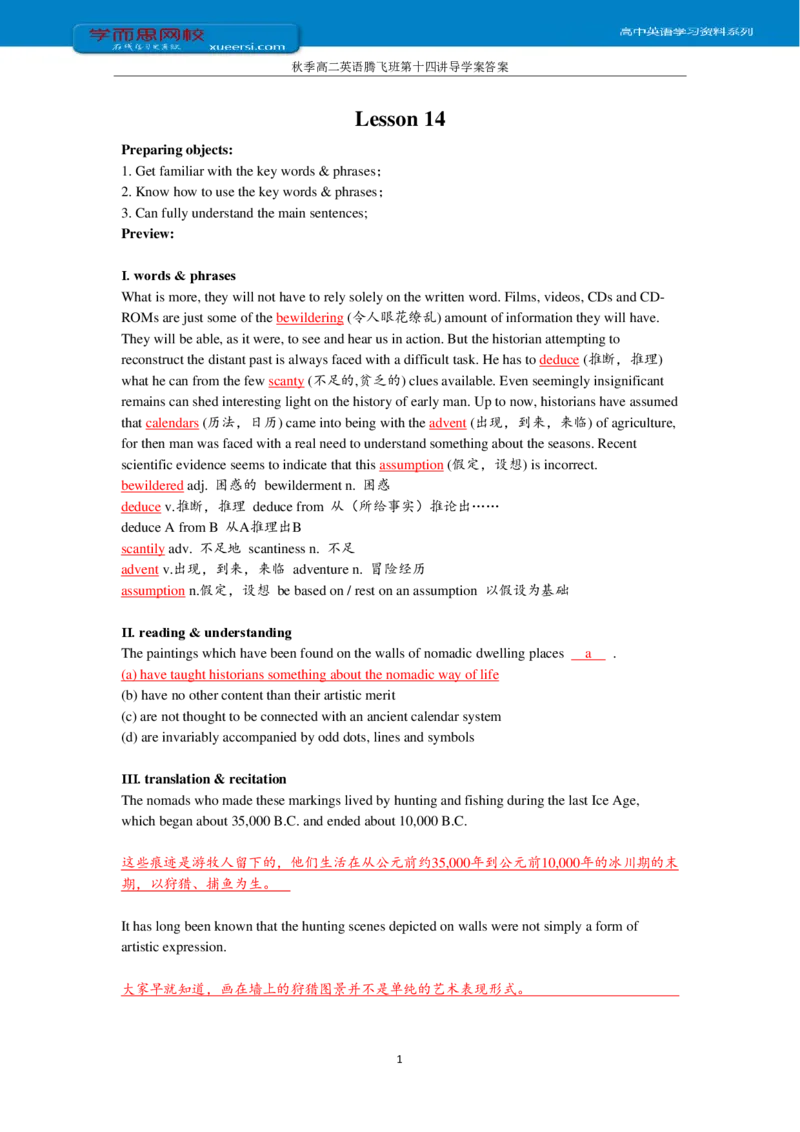
What is more, they will not have to rely solely on the written word. Films, videos, CDs and CD-
ROMs are just some of the bewildering (令人眼花缭乱) amount of information they will have.
They will be able, as it were, to see and hear us in action. But the historian attempting to
reconstruct the distant past is always faced with a difficult task. He has to deduce (推断,推理)
what he can from the few scanty (不足的,贫乏的) clues available. Even seemingly insignificant
remains can shed interesting light on the history of early man. Up to now, historians have assumed
that calendars (历法,日历) came into being with the advent (出现,到来,来临) of agriculture,
for then man was faced with a real need to understand something about the seasons. Recent
scientific evidence seems to indicate that this assumption (假定,设想) is incorrect.
bewildered adj. 困惑的 bewilderment n. 困惑
deduce v.推断,推理 deduce from 从(所给事实)推论出……
deduce A from B 从A推理出B
scantily adv. 不足地 scantiness n. 不足
advent v.出现,到来,来临 adventure n. 冒险经历
assumption n.假定,设想 be based on / rest on an assumption 以假设为基础

Ⅱ. reading & understanding
The paintings which have been found on the walls of nomadic dwelling places   a   .
(a) have taught historians something about the nomadic way of life
(b) have no other content than their artistic merit
(c) are not thought to be connected with an ancient calendar system
(d) are invariably accompanied by odd dots, lines and symbols

Ⅲ. translation & recitation
The nomads who made these markings lived by hunting and fishing during the last Ice Age,
which began about 35,000 B.C. and ended about 10,000 B.C.

这些痕迹是游牧人留下的,他们生活在从公元前约35,000年到公元前10,000年的冰川期的末
期,以狩猎、捕鱼为生。

It has long been known that the hunting scenes depicted on walls were not simply a form of
artistic expression.

大家早就知道,画在墙上的狩猎图景并不是单纯的艺术表现形式。