Lecture
2019【秋】高二腾飞班
New words and expressions
rough
/rʌf/
adj.
崎岖不平的
perturb
/pə'tɜːb/
v.
使不安
underestimate
/ʌndər'estɪmeɪt/ v.
低估
scoop
/skuːp/
v.
挖出
rip
/rɪp/
v.
划破,撕,扯
obstacle
/'ɒbstəkəl/
n.
障碍
renew
/rɪ'njuː/
v.
重复
astride
/ə'straɪd/
prep.
骑,跨
New words and expressions
boulder
/'bəʊldə/
n.
大石块
pit
/pɪt/
v.
使得坑坑洼洼
swerve
/swɜːv/
v.
急转变
hammer
/'hæmə/
v.
(用锤)击打,锤打
ominously
/'ɒmɪnəslɪ/
adv.
有预兆的,不祥的
petrol
/'petrəl/
n.
汽油
stretch
/stretʃ/
n.
一大片(平地或水)
clump
/klʌmp/
n.
丛,簇
fissure
/'fɪʃə/
n.
(石,地的)深缝
New words and expressions
pleading
/'pliːdɪŋ/
n.
恳求
gear
/gɪə/
n.
汽车排档
crack
/kræk/
n.
缝隙
zigzag
/'zɪgzæg/
n.
“之”字形
shallow
/'ʃæləʊ/
adj.
浅的
grind
/graɪnd/
v.
磨擦
halt
/hɔːlt/
n.
停
dashboard
/'dæʃbɔːd/
n.
(汽车上的)仪表盘
学而思网校
词汇拓展
(1)
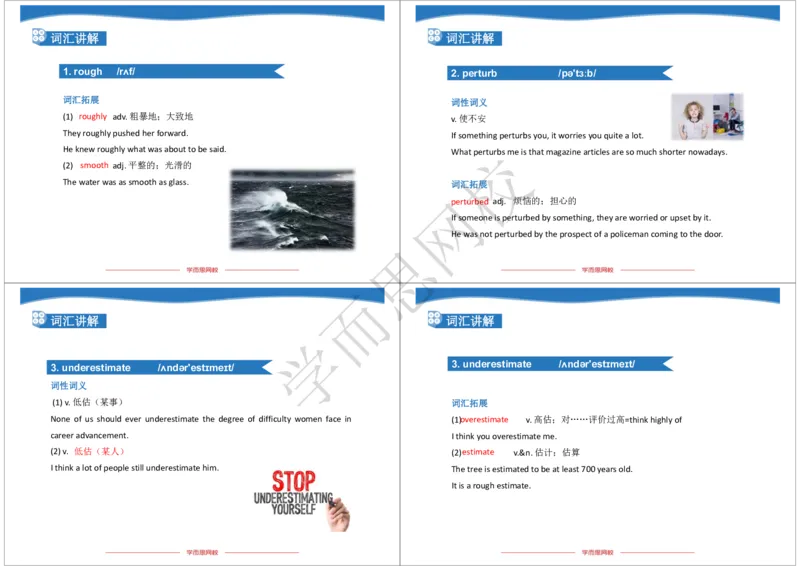
adv. 粗暴地;大致地
They roughly pushed her forward.
He knew roughly what was about to be said.
(2)
adj. 平整的;光滑的
The water was as smooth as glass.
词汇讲解
1. rough    /rʌf/
roughly
smooth
词汇讲解
2. perturb
/pə'tɜːb/
词性词义
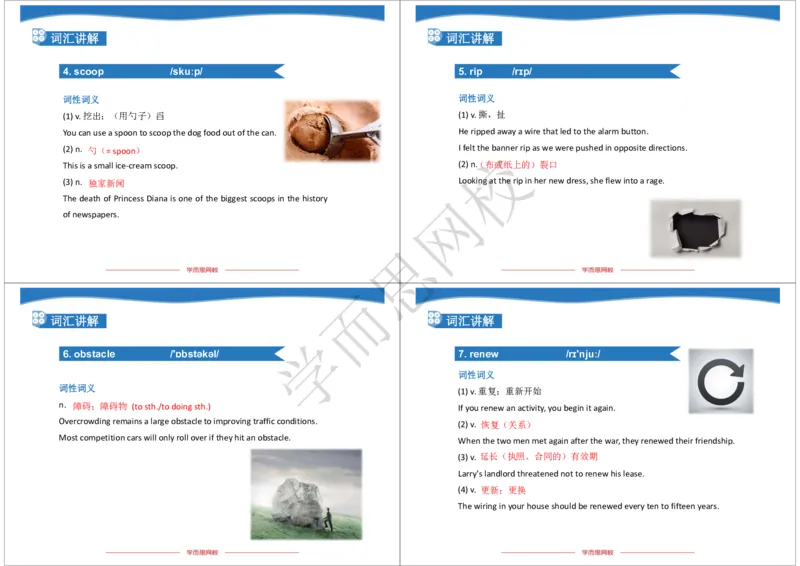
v. 使不安
If something perturbs you, it worries you quite a lot.
What perturbs me is that magazine articles are so much shorter nowadays.
词汇拓展
adj. 烦恼的;担心的
If someone is perturbed by something, they are worried or upset by it.
He was not perturbed by the prospect of a policeman coming to the door.
perturbed
词汇讲解
3. underestimate
/ʌndər'estɪmeɪt/
词性词义
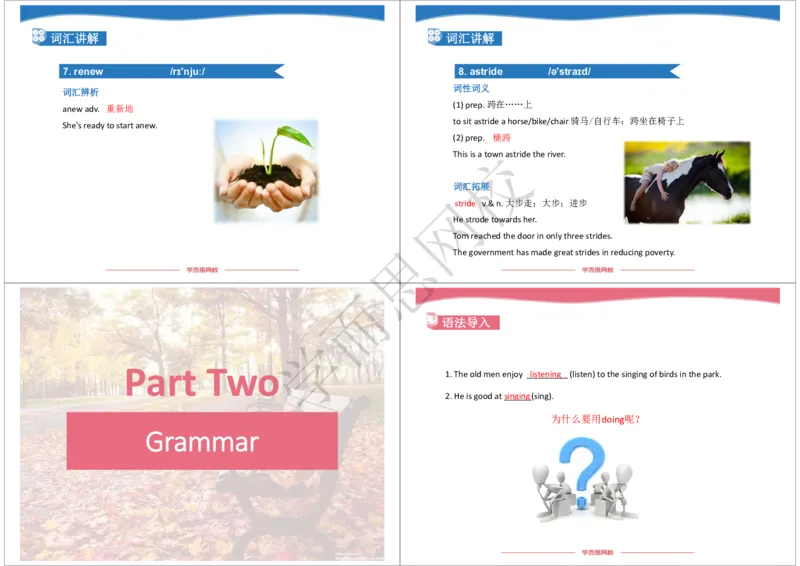
(1) v. 低估(某事)
None of us should ever underestimate the degree of difficulty women face in
career advancement.
(2) v.
I think a lot of people still underestimate him.
低估(某人)
词汇讲解
3. underestimate
/ʌndər'estɪmeɪt/
词汇拓展
(1)
v. 高估;对……评价过高=think highly of
I think you overestimate me.
(2)
v.&n. 估计;估算
The tree is estimated to be at least 700 years old.
It is a rough estimate.
estimate
overestimate
学而思网校
词汇讲解
4. scoop
/skuːp/
词性词义
(1) v. 挖出;(用勺子)舀
You can use a spoon to scoop the dog food out of the can.
(2) n.
This is a small ice‐cream scoop.
(3) n.
The death of Princess Diana is one of the biggest scoops in the history
of newspapers.
勺(= spoon)
独家新闻
词性词义
(1) v. 撕,扯
He ripped away a wire that led to the alarm button.
I felt the banner rip as we were pushed in opposite directions.
(2) n.
Looking at the rip in her new dress, she flew into a rage.
词汇讲解
5. rip
/rɪp/
(布或纸上的)裂口
词汇讲解
6. obstacle
/'ɒbstəkəl/
词性词义
n.
Overcrowding remains a large obstacle to improving traffic conditions.
Most competition cars will only roll over if they hit an obstacle.
障碍;障碍物(to sth./to doing sth.)
词性词义
(1) v. 重复;重新开始
If you renew an activity, you begin it again.
(2) v.
When the two men met again after the war, they renewed their friendship.
(3) v.
Larry's landlord threatened not to renew his lease.
(4) v.
The wiring in your house should be renewed every ten to fifteen years.
词汇讲解
7. renew
/rɪ'njuː/
恢复(关系)
延长(执照、合同的)有效期
更新;更换
学而思网校
词汇辨析
anew adv.
She's ready to start anew.
词汇讲解
7. renew
/rɪ'njuː/
重新地
词性词义
(1) prep. 跨在……上
to sit astride a horse/bike/chair 骑马/自行车;跨坐在椅子上
(2) prep.
This is a town astride the river.
词汇拓展
v.& n. 大步走;大步;进步
He strode towards her.
Tom reached the door in only three strides.
The government has made great strides in reducing poverty.
词汇讲解
8. astride
/ə'straɪd/
横跨
stride
Grammar
Part Two
语法导入
1. The old men enjoy  _________ (listen) to the singing of birds in the park.
2. He is good at ______(sing).
为什么要用doing呢?
listening
singing
学而思网校
语法讲解
英文的句子有一个特性,即:
一个简单句中有且仅有一个谓语动词。
如果一个句子里出现了超过一个动词的话:
I was watching TV and my father was reading newspaper.
He said that I should do my homework first.
I want to go shopping.
非谓语动词:不能独立作谓语的动词形式
非谓语动词的定义
语法讲解
非谓语动词
不定式
to do
动词‐ing形式
doing
现在分词
动名词
过去分词
done
非谓语动词的分类
语法讲解
请划出以下句中的非谓语动词:
1. The news meeting, to be held in that hall, has already been crowded with
reporters.
2. I heard the girl singing in the classroom.
3. The man talking with my father is Mr. Wang.
4. The boy pretended to be studying hard when his teacher came in.
5. The meeting to be held tomorrow is of great importance.
6. I still remember being sent to school for the first time.
7. Having been told many times, he still repeated the same mistake.
8. Having finished the letter, he folded it and put it into the envelope.
非谓语动词的分类
语法讲解
非谓语动词的形式
非谓语动词的各种形式
非谓语形式
体
主动形式
被动形式
复合结构
否定式
不定式
一般式
for sb. to do sth.
或of sb. to do
sth.
在“to”前加not
完成式
进行式
/
完成进行式
/
动名词/现在
分词
一般式
doing
being done
sb.或sb’s doing
在前加not特别注意复合
结构的否定式:sb’s not
doingsb’s not having
done
完成式
having done
having been
done
过去分词
done
/
在前加not
to do
to be done
to have done to have been
done
to be doing
to have
been doing
学而思网校
语法讲解
非谓语动词的形式
非谓语动词的各种形式
非谓语形式
体
主动形式
被动形式
复合结构
否定式
不定式
一般式
to do
to be done
for sb. to do sth.
或of sb. to do
sth.
在“to”前加not
完成式
to have
done
to have been
done
进行式
to be doing
/
完成进行式
to have
been doing
/
动名词/现在
分词
一般式
doing
being done
sb.或sb’s doing
在前加not特别注意复合
结构的否定式:sb’s not
doingsb’s not having
done
完成式
having
done
having been
done
过去分词
done
/
在前加not
语法讲解
非谓语动词的句法功能
所能充当的成分
主语
表语
宾语
补语
定语
状语
不定式(to do)
动词‐ing形式
现在分词
动名词
过去分词(done)
△
△
△
△
△
△
△
△
△
△
△
△
△
△
△
△
△
△
非谓语动词的句法功能
语法讲解
非谓语动词中作主语的只有动名词和不定式,规则如下:
1. 动名词、不定式都可作主语。
不定式多表示具体的、一次性的动作;
动名词则多指抽象的、习惯性的动作。
Eating too much chocolate is bad for your teeth.
To watch TV tonight will be a waste of your time.
2. 不定式作主语时,常用it作形式主语。
It's necessary to hold another meeting to discuss the issue again.
3. 动名词较少用形式主语,通常只在以下两个句型中用it作形式主语:
It is worth/fun/ no good / no use…   There be no+主语
It’s no use complaining without taking action.
There is no parking around here.
非谓语动词作主语
语法讲解
非谓语动词中作宾语的依然只有动名词和不定式,规则如下:
1. 动名词可作动词和介词的宾语;
动词不定式一般只作动词的宾语,疑问词+to do可作介词的宾语。
①They prefer walking to school to cycling.
②We decided to go there soon.
③Our English teacher often gives us advice on how to learn English.
非谓语动词作宾语
学而思网校
语法讲解
非谓语动词作宾语
2. 有些动词后只能跟不定式作宾语,常见动词口诀如下:
决心学会想希望,(decide/determine, learn, want, expect/hope/wish)
拒绝设法愿假装。(refuse, manage/attempt, care, pretend)
主动答应选计目,(offer, promise, choose, plan, aim)
同意请求帮一帮。(agree, ask/beg, help)
①They have agreed to give me another chance.
②She pretended not to see me when I passed by.
语法讲解
3. 有些动词后只能跟动名词作宾语,常见动词口诀如下:
避免错过少延期(avoid, miss, postpone/delay)
建议完成多练习(advise/suggest, finish, practice)
考虑禁止又允许(consider, forbid, allow/permit)
介意忍受还继续(mind, stand, keep)
欣赏想象禁不住(enjoy/appreciate, imagine/fancy, can’t help)
承认否认与嫉妒(admit, deny, envy)
逃避冒险莫原谅(escape, risk, excuse/pardon)
①I would appreciate your calling back this afternoon.
②My mother couldn’t help smiling when she heard the good news.
非谓语动词作宾语
语法讲解
4. 单个介词或以介词结尾的动词短语后面要跟动名词,如:give up, put off,
look forward to, be used to, feel like, be good at, lead to, insist on, stick to,
depend on, devote… to等。
①I’m looking forward to your coming.
②I insist on going with you.
非谓语动词作宾语
语法讲解
5. 有的动词后面既可以跟动名词也可以跟不定式作宾语。
动名词常表示习惯性动作,而不定式表示具体某一次动作,如:like, love,
prefer, hate, begin, start, continue等。
I like watching TV in the evening, but today I prefer to read a book.
6. 有的动词后面即可跟动名词又可跟不定式作宾语,但意义差别巨大:
一记二忘三遗憾(remember, forget, regret)
四试五图六停继(try, mean, stop, go on)
What a poor memory! I forgot borrowing money from him yesterday.
But today I forgot to return the money to him.
非谓语动词作宾语
学而思网校
语法讲解
7. need, want, require作“需要”讲时,接动名词主动形式表示被动意义,
若接不定式则应用被动形式。
The windows need/want/require cleaning.
=The windows need/ want/require to be cleaned.
8. 当不定式或动名词作宾语,而后面又有宾语补足语或状语时,常用it作
形式宾语,而将不定式或动名词后置。
①He found it difficult to stop smoking.
②She thought it no good worrying about him.
非谓语动词作宾语
语法讲解
非谓语动词的各种形式都可以做表语,但意义各不相同:
1. 不定式作表语,常表示主语的职责性质等,尤其是未来的有待实现的行
为。主语经常是以aim, idea, plan, job, suggestion 等为中心词的名词词组,
或以what引导的名词性从句,后面的不定式说明其内容。
①My idea is to climb the mountain from the north.
②What I would suggest is to start work at once.
2. 动名词作表语,一般表示比较抽象的、习惯性动作,和主语可以互换。
His hobby is collecting coins. = Collecting coins is his hobby.
非谓语动词作表语
语法讲解
3. 分词作表语,相当于形容词。
现在分词作表语表示主语所具有的特征,常译为“令人……”;
过去分词作表语表示主语自身的状态或感受。
①The news was disappointing.
②We were disappointed with it.
4. 动名词和不定式作表语时,要与主语成分对称。即:
句子中的表语是动名词时,主语也要用动名词;
句子中的表语时不定式时,主语也要用不定式。
Seeing is believing. = To see is to believe.
非谓语动词作表语
学而思网校