Elegy for the American Century
B Y G E O R G E PA C K E R
MAY 2019
THEATLANTIC.COM
What Your Dentist Isn’t
Telling You BY F E R R I S J A B R
Is the Country Ready
for Kamala Harris?
BY E L I Z A B E T H W E I L
W
hat’s called the American
century was really just a lit-
tle more than half a century.
It began with the Second World War and
the creative burst that followed—the
United Nations, the Atlantic alliance,
containment, the free world—and it
went through dizzying highs and lows,
until it expired the day before yester-
day. The thing that brings on doom
to great powers—is it simple hubris,
or decadence and squander, a kind
of inattention, loss of faith, or just
the passage of years? At some point
that thing set in, and so we are talk-
ing about an age gone by. It wasn’t
a golden age—there was plenty of
folly and wrong—but I already miss
it. Our feeling that we could do any-
thing gave us the Marshall Plan and
Vietnam, the peace at Dayton and the
endless Afghan War. Our confidence
and energy, our reach and grasp, our
excess and blindness—they were not
so different from Richard Holbrooke’s.
The American century was the span
of his life. He was our man. That’s the
reason to tell you this story.
O F N O P A R T Y O R C L I Q U E
Features
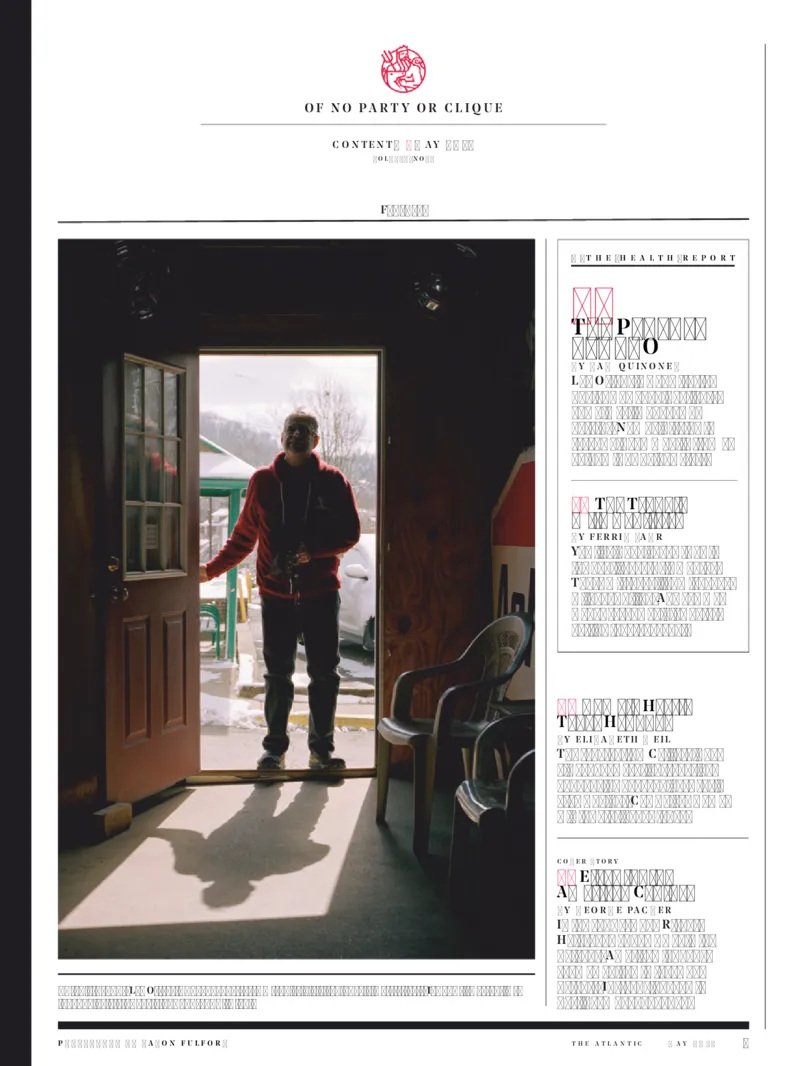
By the late 1990s, Lou Ortenzio was one of northern West Virginia’s leading opioid prescribers. It was a sign of the times
that he didn’t think anything was wrong with that.
P h o t o g r a p h b y J A S O N F U L F O R D
T H E A T L A N T I C M A Y 2 0 1 9 3
58
The Penance
of Doc O
BY SA M Q U I N O N E S
Lou Ortenzio was a trusted
doctor who got his patients—
and himself—hooked on
opioids. Now he’s trying to
rescue his community from an
epidemic he helped start.
70 The Trouble
With Dentistry
BY F E R R I S J A B R
You likely don’t need to go to
the dentist every six months.
Those microcavities might heal
without a filling. And you may
want a second opinion before
getting that root canal.
46 Kamala Harris
Takes Her Shot
BY E L I Z A B E T H W E I L
The senator from California has
always been cautious, but since
announc ing her candidacy she’s
grown bolder. Can a black woman
win the presidency today?
C O V E R S T O R Y
82 Elegy for the
American Century
BY G E O R G E PAC K E R
In the 1990s, when Richard
Holbrooke ended a war in the
Balkans, American influence
seemed poised to reach new
heights. Instead, it began to
decline. What happened?
C O N T E N T S | M AY 2 0 1 9
VO L . 3 2 3 – N O. 4
� � T H E H E A L T H R E P O R T
S K E T C H
22 The Next
George Bush
BY E L A I N A P LOT T
In a time of outsider politics,
can the ultimate insider
resurrect his family’s brand?
A N I M A L K I N G D O M
24 Salmon on
Psychotropics
BY R E B E C C A G I G G S
Pharmaceutical pollution
is altering some animals’
moods—and migratory
patterns.
B U S I N E S S
26 Stock Picks
From Space
BY F R A N K PA R T N OY
Investors are using
real-time satellite images
to predict retail ers’ sales.
Is that cheating?
Dispatches
C O N T E N T S
Departments
Mendelsund/Munday
On the Cover
V O L . 3 2 3 – N O . 4
8 The Conversation
112 The Big Question
What is the greatest act
of courage?
C R I M I N A L T E N D E N C I E S
18 Watch Your Wallet
BY R E N E C H U N
Pickpockets love our digitally
distracted age.
L A N G U A G E
20 Why Young
Adults Are Talking
Like 3-Year-Olds
BY J O H N M CW H O R T E R
Embracing your inner child
is comforting and fun—and
just might revitalize the
English language.
4 M A Y 2 0 1 9 T H E A T L A N T I C
15 P O L I T I C S
Trump’s Second Term
BY PAU L S TA R R
If it comes to pass, it will be
far more consequential than his fi rst.
0 5 . 1 9
CLICK CALL CHAT
SMALL BUSINESS
ISN’T SMALL
TO US
Get in touch today
877-BUY-DELL
Dell.com/SmallBusinessPartner
Vostro 15 5581 with an 8th Gen Intel®
Core™ i5 processor starting at $689
*Offers subject to change. Taxes, shipping, and other fees apply. Dell reserves the right to cancel orders arising from pricing or other errors. Intel, the Intel Logo, Intel Inside, Intel Core, and Core Inside are trademarks of Intel Corporation or its subsidiaries
in the U.S. and/or other countries. Microsoft and Windows are trademarks of Microsoft Corporation in the U.S. and/or other countries. Screens simulated, subject to change. Windows Store apps sold separately. App availability and experience may vary
by market. Dell, EMC, and other trademarks are trademarks of Dell Inc. or its subsidiaries. ©2019 Dell Inc. All rights reserved. 292031
As Dell Small Business Technology
Advisors, we are committed to helping
you navigate your tech needs with the
right solutions, advice and dedicated
one-on-one partnership.
TECH. ADVICE. PARTNERSHIP.
The Culture File
Poetry
C O N T E N T S
V O L . 3 2 3 – N O . 4
Essay
42 Waking
BY S TA N L E Y P L U M LY
B O O K S
43 Art After
Sexual Assault
BY M E RV E E M R E
Siri Hustvedt’s new
novel explores fiction’s
role in feminist
consciousness-raising.
B O O K S
36 The Problem
With High-
Minded Politics
BY S E A N W I L E N T Z
John Adams and John Quincy
Adams’s virtuous disdain
for partisanship was at the
root of their failures.
T H E O M N I V O R E
33 Poets in the
Press Box
BY J A M E S PA R K E R
The underappreciated
literary achievements of
sportswriters on deadline
100 Walt Whitman’s
Guide to a Thriving
Democracy
BY M A R K E D M U N D S O N
America had a mind shaped
by its Founders, but the
country needed the poet to
discover its spirit.
40 B O O K S
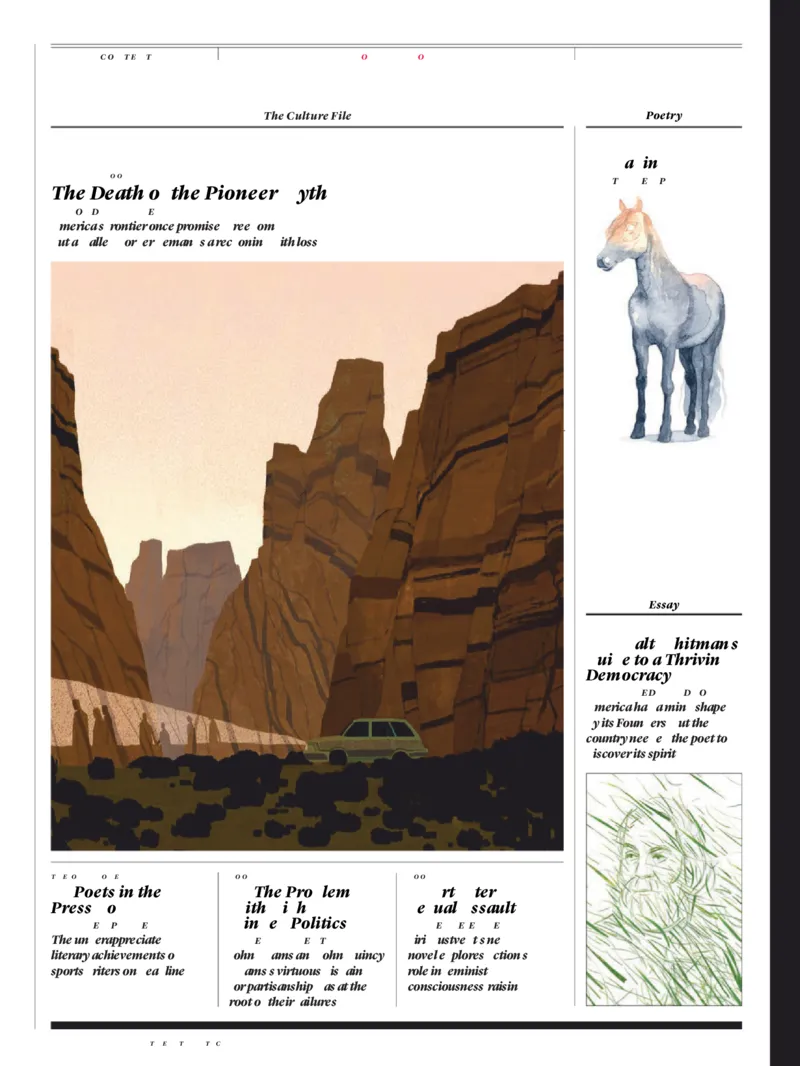
The Death of the Pioneer Myth
BY J O R DA N K I S N E R
America’s frontier once promised freedom,
but a walled border demands a reckoning with loss.
0 5 . 1 9
6 M A Y 2 0 1 9 T H E A T L A N T I C
SIGN UP NOW
THEATLANTIC.COM/DAILY
WHAT WE’RE FOLLOWING
SNAPSHOT
EVENING READ
A curated guide to the most
important and intriguing
stories of the moment
Striking images that offer
new perspectives on what’s
happening around the world
Long-form features that
our writers and editors
can’t stop talking about
Subscribe to “The Atlantic
Daily” and get the best of
The Atlantic every weekday
GET THE ATLANTIC DELIVERED
TO YOUR INBOX. EVERY DAY.
AND MORE
8 M A Y 2 0 1 9 T H E A T L A N T I C
R E S P O N S E S & R E V E R B E R A T I O N S
• T H E C O N V E R S A T I O N
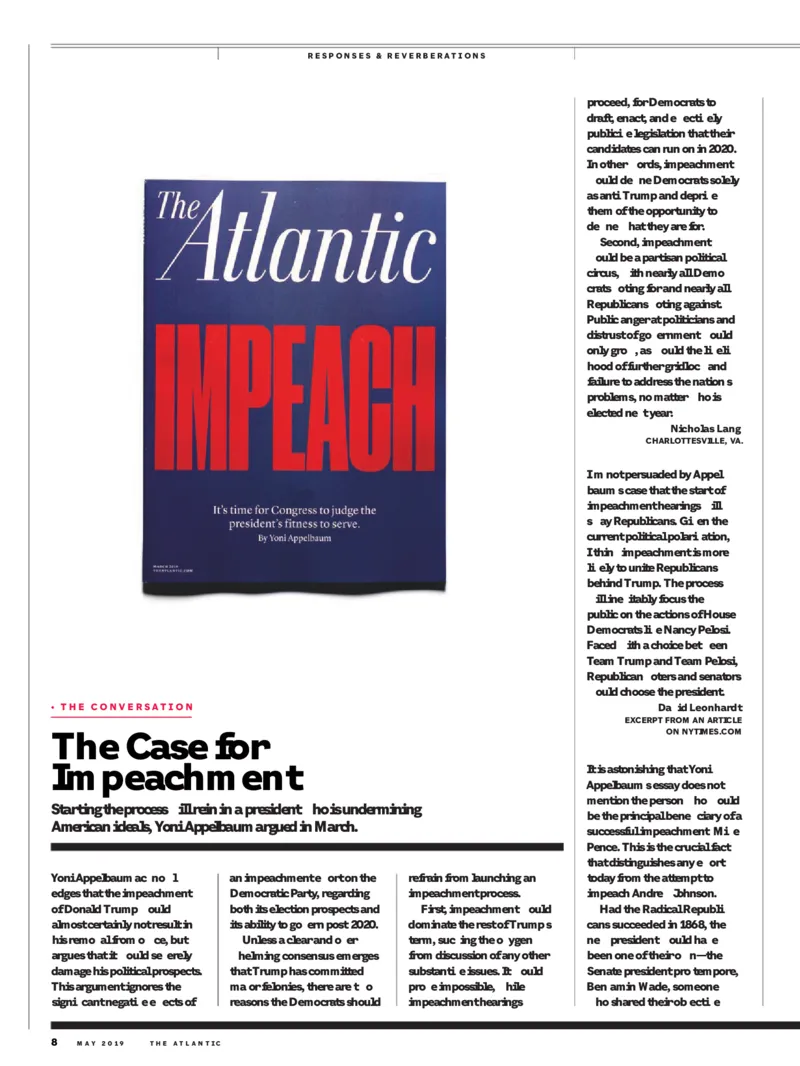
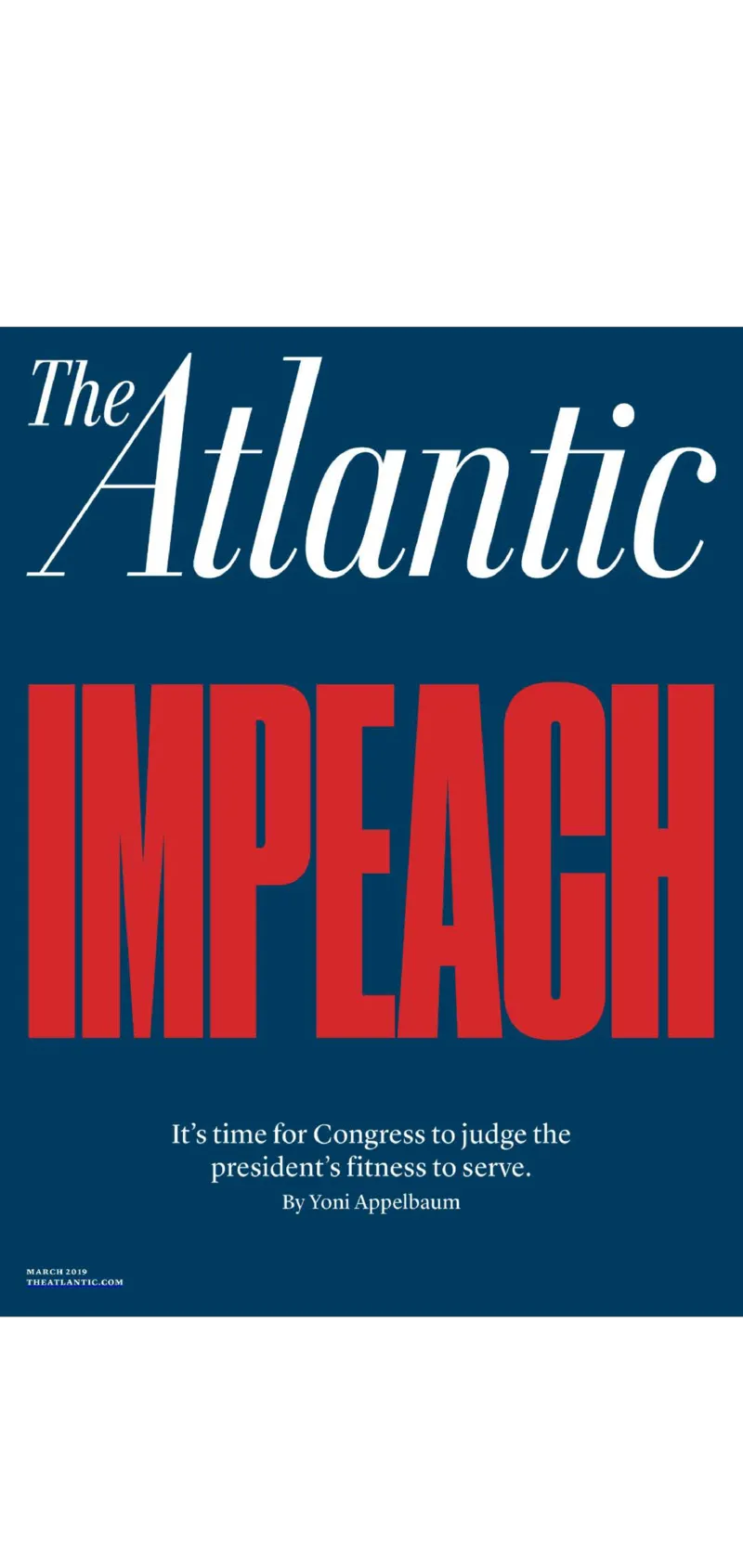
The Case for
Impeachment
Starting the process will rein in a president who is undermining
American ideals, Yoni Appelbaum argued in March.
Yoni Appelbaum acknowl-
edges that the impeachment
of Donald Trump would
almost certainly not result in
his removal from office, but
argues that it would severely
damage his political prospects.
This argument ignores the
significant negative effects of
proceed, for Democrats to
draft, enact, and effectively
publicize legislation that their
candidates can run on in 2020.
In other words, impeachment
would define Democrats solely
as anti-Trump and deprive
them of the opportunity to
define what they are for.
Second, impeachment
would be a partisan political
circus, with nearly all Demo-
crats voting for and nearly all
Republicans voting against.
Public anger at politicians and
distrust of government would
only grow, as would the likeli-
hood of further gridlock and
failure to address the nation’s
problems, no matter who is
elected next year.
Nicholas Lang
CHARLOTTESVILLE, VA.
I’m not persuaded by Appel-
baum’s case that the start of
impeachment hearings will
sway Republicans. Given the
current political polarization,
I think impeachment is more
likely to unite Republicans
behind Trump. The process
will inevitably focus the
public on the actions of House
Democrats like Nancy Pelosi.
Faced with a choice between
Team Trump and Team Pelosi,
Republican voters and senators
would choose the president.
David Leonhardt
EXCERPT FROM AN ARTICLE
ON NYTIMES.COM
It is astonishing that Yoni
Appelbaum’s essay does not
mention the person who would
be the principal beneficiary of a
successful impeachment: Mike
Pence. This is the crucial fact
that distinguishes any effort
today from the attempt to
impeach Andrew Johnson.
Had the Radical Republi-
cans succeeded in 1868, the
new president would have
been one of their own—the
Senate president pro tempore,
Benjamin Wade, someone
who shared their objective
an impeachment effort on the
Democratic Party, regarding
both its election prospects and
its ability to govern post-2020.
Unless a clear and over-
whelming consensus emerges
that Trump has committed
major felonies, there are two
reasons the Democrats should
refrain from launching an
impeachment process.
First, impeachment would
dominate the rest of Trump’s
term, sucking the oxygen
from discussion of any other
substantive issues. It would
prove impossible, while
impeachment hearings
An ad
trying to
get the
attention
of some-
one who
might be
interested
in oatmilk.
LOOK!
EDITORIAL OFFICES & CORRESPONDENCE The Atlantic considers unsolicited manuscripts, fiction or nonfiction, and mail
for the Letters column. Correspondence should be sent to: Editorial Department, The Atlantic, 600 New Hampshire
Avenue NW, Washington, DC 20037. Receipt of unsolicited manuscripts will be acknowledged if accompanied by a
self-addressed stamped envelope. Manuscripts will not be returned. For instructions on sending manuscripts
via email, see theatlantic.com/faq. CUSTOMER SERVICE & REPRINTS Please direct all subscription queries and
orders to: 800-234-2411. International callers: 515-237-3670. For expedited customer service, please call between
3:30 and 11:30 p.m. ET, Tuesday through Friday. You may also write to: Atlantic Customer Care, P.O. Box 37564,
Boone, IA 50037-0564. Reprint requests (100+) should be made to The YGS Group, 717-399-1900. A discount rate
is available for students and educators. Please visit theatlantic.com/subscribe/academic. ADVERTISING OFFICES
The Atlantic, 60 Madison Avenue, Suite 800, New York, NY 10010, 646-539-6700.
of protecting the civil rights of formerly
enslaved people.
By contrast, making Pence president
would greatly increase the likelihood
that the Republicans will keep the White
House in 2020. He would benefit from
the natural sympathy that almost all new
presidents receive, particularly those who
assume office in a crisis. If he played no
affirmative role in the removal of Trump,
he would retain the loyalty of Trump’s
followers, who would likely turn out in
droves to avenge Trump’s “martyrdom.”
Lacking the offensive aspects of Trump’s
personality, Pence would be much more
likely to retain the support of Republican
moderates and independents.
Appelbaum may have intended for his
argument to be nonpartisan; from my
perspective, for both practical and political
reasons, it would be folly to try to remove
Trump unless it is clear that 20 or more
Republican senators are ready to brave
Trump’s followers and vote for impeach-
ment. Even better would be a political
coup under the Twenty-Fifth Amendment,
which would necessitate Pence’s support.
Either would ensure a rupture in the
Republican Party that would lead to defeat
in 2020.
James K. Genden
EVANSTON, ILL.
The logic of Appelbaum’s reasoning for
impeachment is sound. Nevertheless,
the practicalities of doing so are fraught.
Should Trump be impeached and convicted
prior to the expiration of his current term
in office, Mike Pence would take over with
the full authority to pardon Trump in the
remaining days of that term. Thus, the
“sooner rather than later” urgency of the
article could end up being self-defeating.
Right now, perhaps more than at any
other time in history, serious consequences
need to be meted out, both to assuage
public outrage and to discourage despotic
behavior in future candidates. Leaving a
path for Trump to walk free subverts justice
and is not an option.
Andrew Nelson
BEND, ORE.
Donald Trump is indeed unable to fulfill the
duties of his office. The problem is that this
also seems to be true of many members of
Congress. At this juncture we need states-
men with ideals and vision, and what we
have is a collection of sorry political hacks.
Not all, to be sure, but if I were to single out
one offender, it would be Mitch McConnell.
The country is being held hostage by a badly
behaved child having a temper tantrum, and
McConnell refuses to do anything unless he
is assured that the child will approve. Yes, we
need impeachment. But who is going to do it?
Stephen Wellcome
BRUNSWICK, MAINE
Impeachment is important to pursue even
if the Senate fails to remove Trump, Appel-
baum says, and Senate Majority Leader
Mitch McConnell’s (R-Ky.) “Republican
majority has shown little will to break with
the president.”
But doesn’t this point to an easier,
better remedy to this debacle? Just ditch
Mc Connell …
True, a Republican Senate not led by
Mitch McConnell still probably wouldn’t
override Trump’s veto of a bill protect-
ing America’s public lands or try to tackle
climate change, but it might surely quash
misguided trade wars, demand qualified
Cabinet appointees, stop Trump from
pulling out of NATO or other alliances that
undergird America’s pole position in the
world pecking order, and prevent vanity
government shutdowns …
McConnell is up for re-election in 2020—
and Republicans can replace him as their
leader anytime they want someone a little
bolder and less deferential to Trump. Will
they do that? Probably not, unless they
become convinced that he’s leading them
into the political wilderness. But that’s
still more likely than a two-thirds majority
of this Senate convicting Trump of high
crimes and misdemeanors.
Peter Weber
EXCERPT FROM AN ARTICLE
ON THEWEEK.COM
Yoni Appelbaum’s terrific piece on impeach-
ment has settled my swirling mind. I now
to ensure that America would
remain a “white man’s [coun-
try].” And though impeach-
ment proceedings ultimately
failed by a single vote, they
were seemingly a success:
Johnson lost so much support
that he was unable to stand for
re-election.
I do not doubt either the
legal or the moral case for
impeaching Johnson. But
anybody who knows a little
bit about the history of
Re construction has reason to
contest the idea that it should
serve as a model for our own
perilous moment. For, while
the failed attempt to impeach
Johnson did end his career, it
did precious little to halt the
rise of his larger project. Within
a decade of his departure from
the White House, the vile
aspiration for which he had
fought—the hope of reversing
the progress blacks had made
in the immediate aftermath of
the Civil War—had triumphed.
There is every reason for
Democrats to start hold-
ing hearings into Trump’s
mis conduct. There is every
reason for them to demand
his tax returns and ask him to
testify in front of Congress. But
for now, impeachment would
be the wrong means toward a
noble end: Designed to contain
the damage a dangerous presi-
dent can wreak, it may turn out
to help Trumpism survive even
after Trump is forced to leave
the White House.
Yascha Mounk
EXCERPT FROM A SLATE ARTICLE
Raiders of the
Office Park
In March, Rene Chun docu-
mented the rising prevalence of
workplace theft.
I once worked for a steel-
fabricating company whose 12
employees were mostly welders.
Everyone had a key to the place,
and profits were shared. Wages
10 M A Y 2 0 1 9 T H E A T L A N T I C
THE BIG QUESTION
On Twitter, we asked people to pick their favorite reader responses to April’s
Big Question. Here’s how they voted.
Q: What was the best sequel
in history?
36%
The Godfather: Part II
35%
The Empire Strikes Back
18%
The Odyssey
11%
The New Testament
The author treated office
theft as a moral failing on the
part of employees. But this
misses the bigger picture. Real
wages have been mostly stag-
nant for the past few decades.
Rather than increasing salaries,
companies are offering more
perks, such as Ping-Pong
tables and occasional free food.
They do this knowing that it’s
cheaper than just giving every-
one an adequate raise, instead
think that the day after Special
Counsel Robert Mueller makes
his move, whether or not his
report goes to the House of
Representatives, impeachment
should begin. There are ample
grounds without anything
Mueller may reveal, so there
is no reason to wait once he
is done. The way Andrew
Johnson’s impeachment seems
to foreshadow Trump’s is fasci-
nating. History does rhyme.
Sandy Miley
SHERRILL, N.Y.
A salient reason to begin
impeachment proceedings
is that doing so would show
the world that democracy
works—and, I hope, would
also underscore the dangers
of authoritarianism, or those
governments listing in that
direction. Although China’s
Xi Jinping, Russia’s Vladimir
Putin, the Philippines’ Rodrigo
Duterte, North Korea’s Kim Jong
Un, and others are too far gone,
the citizens of Hungary, Turkey,
Venezuela, and others might
learn something by watching
our Constitution at work.
Virginia Mann
SAN RAFAEL, CALIF.
Abortive attempts to oust
authoritarian populists from
office have gone sour in a
depressingly large number
of cases in recent years. In
Venezuela, Hugo Chávez made
a big step toward dismantling
democracy after he narrowly
survived a recall referendum
in 2004. In Turkey, Recep
Tayyip Erdogan has crushed
the remaining liberties of his
opponents since an abortive
coup failed to oust him in the
summer of 2016.
Even Appelbaum’s favorite
case—that of Andrew Johnson—
is hardly a story of unalloyed
success. As Appelbaum tells the
story, Johnson deserved to be
impeached both because of his
authoritarian tendencies and
because of his determination
were based on years of service.
The thief among the employees
was the fastest welder. That
experience convinces me that
the increase in theft Rene Chun
describes is due in part to the
increasing number of employ-
ees who perceive themselves
as unfairly compensated in this
no-raises economy.
John Cady
HILLSDALE, N.Y.
Mr. Chun attributed the taking
of supplies and food from
work to a sense of entitlement
largely stemming from the
fact that people are working
from home more. This doesn’t
explain why, at my old office—
from which I never once
worked remotely—I took pens
and notepads and used the
printers liberally for personal
items (even to print a résumé
to apply for another job).
J A M E S G R A H A M ; W G 6 0 0
Another
ad trying
to do the
exact
same thing
as the
previous
ad.
LOOK!
transferring the money saved on labor to
already wealthy executives and shareholders.
Why shouldn’t I sometimes take a high-
lighter or a few pieces of paper that cost my
employer a cent or two, when my employer
is systematically depriving me and my
co-workers of hundreds or even thousands
of dollars a year?
Justin Schweitzer
WASHINGTON, D.C.
Rene Chun replies:
Noncash larceny (stealing stuff at work)
is frequently rationalized through the
social-cognitive mechanism known as moral
disengagement: “It’s okay for me to take a box
of Starbucks K-Cups home, because my boss
is such a jerk.” Although I didn’t specifically
mention worker pay in the piece, low and
stagnant wages are also undoubtedly high
on the list of justifications people might offer
for moral disengagement. But proceed with
caution. Here’s something that didn’t make it
into the final copy: Due to the proliferation of
video surveillance, employers frequently know
who is stealing at work. Some of these thefts
are used as grounds for dismissal, and some of
these thefts are ignored. It depends on whether
you’re a “high-value employee.” Think about
that before you steal a $1,000 Aeron chair for
the home office.
“Nobody Is Going to
Believe You”
In March, Alex French and Maximillian
Potter wrote about the director Bryan Singer,
who has been trailed by accusations of sexual
misconduct for more than 20 years, largely
without consequence.
Alex French and Maximillian Potter’s
article was keenly researched, empathetic,
and well constructed. However, there is
some misleading phrasing in the piece
regarding a movement I was involved with
at the University of Southern California’s
School of Cinematic Arts.
Up until roughly a year ago, the Division
of Cinema and Media Studies at USC was
named after Bryan Singer, an alumnus and
a significant donor. In November 2017, as
is correctly stated in the article, I started a
petition with a fellow student intended to
encourage the administration to remove
Singer’s name from our school. Thirty-one
days later, the day after Cesar Sanchez-
Guzman filed his lawsuit against Singer,
the school took his name down. From an
outsider’s perspective, these events may
appear to be correlated, and in the article,
they are implied to be. This assumption,
however, is incorrect.
The administration did not make this
change because of pressure from student
activists or out of respect for survivors of
sexual assault. It removed Bryan Singer’s
name because he personally requested
that it do so, according to an email sent by
administrators to the entire student body. In
complying with Singer’s request, the school
unashamedly allied itself with a sexual
predator, letting the community know that
although it would not respond to weeks of
collective action from a dedicated student
body, it would respond—immediately— to
a powerful and influential donor. To not
clarify this point when discussing the
matter relieves the administration of its
complicity— a benefit that it does not deserve.
Emily Halaka
LOS ANGELES, CALIF.
T H E C O N V E R S A T I O N
“We need to end a culture
that protects the abusive —
regardless of how much
they entertain or how much
they earn for those who
profit from their success.
No matter what there is
someone who doesn’t
assault people who can do
your job.”
— @realamberheard
Actor and activist,
on “Nobody Is Going to Believe You”
#TWEET of the month
Not Just a Drill
There’s scant evidence that
exercises to prepare students
for shootings are effective—but
they can be psychologically
damaging, Erika Christakis
wrote in March.
The author fails to discuss a
major motivating factor in
the precautions schools take
to prepare students for the
relatively rare instance of a
school shooter: accountabil-
ity. After a tragedy occurs in
a school, an intensive effort
is made to determine what
steps could have been taken
to protect students. Any law-
enforcement officials, school
administrators, or teachers
who are perceived to have
failed in their duty to protect
students could be held crimi-
nally or civilly liable. So woe
to the school administrator
who has to explain to grieving
parents that the school failed
to conduct lockdown drills
because it did not want to
cause unnecessary anxiety.
Steve Thompson
CORAL SPRINGS, FLA.
The majority of my career
has been focused on school-
based policing and emergency
management. I’ve been in law
enforcement for 17 years. My
role as a school resource offi-
cer and my former position as
the deputy director of a state-
wide Comprehensive School
Safety Program exposed me to
the constant evolution of poli-
cies and procedures related
to how we can best keep our
students and staff safe. Addi-
tionally, as a national instruc-
tor of school resource officers,
I am constantly communi-
cating with those involved
in both the educational and
public-safety fields. I’m also
the father of two elementary-
school students, whose physi-
cal and mental well-being is
paramount to me.
A message repeated in
Erika Christakis’s article is
that of the low likelihood of
a person being involved in a
school shooting, a fact I will
not dispute. The author states,
“The scale of preparedness
efforts is out of proportion to
the risk.” Using that rationale,
let’s examine how often our
schools conduct fire drills. In
response to state mandates,
most schools conduct fire
drills regularly. I suppose a
fire drill could be traumatic
depending on the participant
and the circumstances, but it is
a generally accepted practice
because of its “value.”
According to the National
Fire Protection Associa-
tion, the last known incident
in which a fire caused the
death of a student at a school
occurred in 1958. So, given
that fact and all the technol-
ogy we now use to prevent
and mitigate fires, why do we
continue to train our children
how to respond? Because fire
drills—which are incorporated
into every child’s school life—
will inform and empower them
with the knowledge of how to
react. And because the poten-
tial for tragedy, regardless of
its likelihood, is tremendous.
I believe violent-intruder train-
ing should be conducted for
the same reason.
I do agree that the improper
facilitation of these drills may
be traumatic for students and
staff. Any drill conducted within
a school needs to be thoroughly
and thoughtfully planned. But
preparation and education,
done the right way, are incred-
ibly empowering. I want those
tools for my community, my
school, and, most important,
my children.
Joey Melvin
GEORGETOWN, DEL.
I read this article on a Sunday.
I had just experienced my third
lockdown drill on the previous
Friday, with a kindergarten
12 M A Y 2 0 1 9 T H E A T L A N T I C
class. It was exactly as Ms.
Christakis described: dark-
ened room, sitting on the floor,
the principal forcefully jiggling
the doorknob. The other two
drills were with pre-K classes.
Each time the children had
been prepared, and each time
they responded amazingly well
during the drills themselves.
E D M O N D E H A R O
Behind the Art
Members of The Masthead, The Atlantic’s membership
program, can read exclusive stories such as the one excerpted
here, which provides insight into the editorial-art process. To
join, visit theatlantic.com/membership/join.
At the most basic level, editorial art exists to grab your
attention. If the art persuades you to pause, the words
get the chance to do their job. Editorial art can signal
an incredible array of detail. Does the story feature a
particular person, time period, or topic? Is the tone wry,
somber, shocking, or uplifting?
Consider Edmon de Haro’s illustration for “Not Just
a Drill.” De Haro quickly communicates the topic of the
story by using the ubiquitous school-crossing sign. Then
he signals that something deeply familiar has become
profoundly unsettling just by adding bulletproof vests.
The sign that once cautioned drivers (Watch out for
students) now cautions children: Watch out for gunmen.
This is editorial art at its finest. De Haro not only
captures the topic and the mood, but also demonstrates
the writer’s argument: Our current system puts the onus
on children, not adults, to stay safe at school.
Katie Martin
ASSOCIATE ART DIRECTOR, THE ATLANTIC
Another
ad try-
ing to
provide
additional
support
for the
previous
two ads.
LOOK!
To contribute to The Conversation, please
email letters@theatlantic.com. Include your
full name, city, and state.
The kids commented later that the drill
was scary. They were right! Even staff, who
are advised in advance of a drill, become
jumpy and nervous just at the idea of an
impending drill—what you’re drilling for is
that terrifying. The thought constantly runs
through your head: In an actual event, we
would not have advance warning.
Diane Serniak Piwinski
YONKERS, N.Y.
I teach 3- and 4-year-olds with special
needs, mainly autism. The stress on me
as a teacher to get through these drills
is immense. I can’t imagine what the
stress does to young developing minds,
especially to brains that already have diffi-
culties processing the world around them.
And considering my students’ language
and communication delays, debriefing
or trying to explain the “why” of these
things is impossible.
Kathy Sterling
LIBERTY, TEXAS
I applaud Erika Christakis’s courage
in writing “Not Just a Drill.” As an
elementary- school counselor and a
certified trauma practitioner, I agree that
lockdown drills risk scaring and trauma-
tizing children in an attempt to protect
them. For 30 years, I have witnessed
the evolution of lockdown drills from
nonexistent, to low-key “code reds,” to
a post–Sandy Hook lockdown protocol
so well practiced that one officer noted
it was “like 600 children just vanished.”
Now, armed with data from other school
shootings, police advise even elementary-
school teachers to consider ways to escape
with their students or fight an intruder if
necessary, and not merely to hide huddled
in the cubbies. But how can we practice
that? What next? Of course safety drills
have value, but educators must protect
both children and childhood. And every
single day, we must earn and uphold our
students’ trust.
Catherine Mallam, M.S.Ed.
HAVERTOWN, PA.
Last year I wrote an opinion piece for
JAMA Pediatrics, “The Return of Duck
and Cover and the Imminence of Death—
What It Means for Physicians,” to remind
physicians that these active-shooter drills
could have consequences, as the duck-
and-cover drills of the 1950s and early
1960s had consequences.
Toxic stress develops in the context of
intense and ongoing stress that activates
a child’s stress-response system. It occurs
in situations lacking the support of parents
and other caring adults and can lead to an
overactive response system and increased
stress hormones, which change the struc-
ture of the brain and affect learning, social
relations, emotions, judgment, and impulse
control. Could active-shooter drills, as
currently practiced, provide a culture for
the growth of toxic stress in children? The
more we make people aware of the poten-
tial consequences of these drills, the better
we can protect the mental and physical
health of our children.
Ms. Christakis writes about the “adulti-
fication” of children. This includes, for
example, the imposition on children of the
adult task of disaster preparedness and
response. The adultification of children is
an important concept to consider; in this
milieu of violence and active-shooter drills,
let us also consider the traumatization of
our children.
Mary E. Woesner, M.D.
NEW YORK, N.Y.
Story Update:
“The Fertility Doctor’s Secret,” by Sarah
Zhang (April), stated that Donald Cline
had fathered at least 48 children with
his patients. In mid-March, The Atlantic
learned that the number of biological chil-
dren had grown to at least 50, confirmed
by DNA tests. Some of the children are
advocating for a fertility-fraud bill, which
has now passed the Indiana Senate.
Experience More of
The Atlantic
Have you registered your account
online yet? If you haven’t, and
you’re already a subscriber, you’re
missing out on benefits such as
audio articles, digital editions of
recent special issues, and more.
Sign up today to receive these
perks and easily manage your
subscription from any device.
To get started, visit
theatlantic.com/register-now.
T H E C O N V E R S A T I O N
(855) 886-4824 | Ŕ rstrepublic.com | New York Stock Exchange symbol: FRC
MEMBER FDIC AND EQUAL HOUSING LENDER
“First Republic’s service and delivery have been
perfect on all fronts.”
SANTO POLITI, Co-Founder and General Partner, Spark Capital
ELEANOR GRAY BALDWIN, Owner, New England Garden Ornaments
T H E A T L A N T I C M A Y 2 0 1 9 15
OF ALL THE QUESTIONS that will
be answered by the 2020 election, one
matters above the others: Is Trumpism
a temporary aberration or a long-term
phenomenon? Put another way: Will the
changes brought about by Donald Trump
and today’s Republican Party fade away,
or will they become entrenched?
Trump’s reelection seems implausi-
ble to many people, as implausible as his
election did before November 2016. But
despite the scandals and chaos of his pres-
idency, and despite his party’s midterm
• P O L I T I C S
TRUMP’S
SECOND TERM
If it comes to pass,
it will be far
more consequential
than his first.
BY PAU L S TA R R
I l l u s t r a t i o n s b y E D M O N D E H A R O
I D E A S & P R O V O C A T I O N S
M A Y 2 0 1 9
D I S P A T C H E S
Waterways can contain traces of many drugs—among them ones for pain, fertility, mood, and sleeplessness. A platypus living in
a contaminated stream in Melbourne is likely to ingest more than half a recommended adult dose of antidepressants every day.
— Rebecca Giggs, p. 24
16 M A Y 2 0 1 9 T H E A T L A N T I C
More countries may
opt to pursue nuclear
weapons, especially
those in regions that have
relied upon American
security guarantees.
D I S P A T C H E S
losses, he approaches 2020 with two
factors in his favor. One is incumbency:
Since 1980, voters have only once denied
an incumbent a second term. The other is
a relatively strong economy (at least as of
now). Alan Abramowitz, a political scien-
tist at Emory University who weights both
of those factors heavily in his election-
forecasting model, gives Trump close to
an even chance of reelection, based on a
projected 2 percent GDP growth rate for
the first half of 2020.
So far, much of the concern about the
long-term effects of Trump’s presidency
has centered on his anti democratic
tenden cies. But even if we take those off
the table—even if we assume that Trump
continues to be hemmed in by other parts
of the government and by outside institu-
tions, and that he governs no more effec-
tively than he has until now—the impact
of a second term would be more lasting
than that of the first.
In normal politics, the policies adopted
by a president and Congress may zig one
way, and those of the next president and
Congress may zag the other. The con-
tending parties take our system’s rules as
a given, and fight over what they under-
stand to be reversible policies and power
arrangements. But some situations are
not like that; a zig one way makes it hard
to zag back.
This is one of those moments. After
four years as president, Trump will have
made at least two Supreme Court appoint-
ments, signed into law tax cuts, and rolled
back federal regulation of the environ-
ment and the economy. Whatever you
think of these actions, many of them can
probably be offset or entirely undone in
the future. The effects of a full eight years
of Trump will be much more difficult, if
not impossible, to undo.
Three areas—climate change, the risk
of a renewed global arms race, and con-
trol of the Supreme Court—illustrate the
historic significance of the 2020 election.
The first two problems will become much
harder to address as time goes on. The
third one stands to remake our constitu-
tional democracy and undermine the
capacity for future change.
I
N SHORT, the biggest difference
between electing Trump in 2016 and
reelecting Trump in 2020 would be
ir reversibility. Climate policy is now the
most obvious example. For a long time,
even many of the people who acknowl-
edged the reality of climate change
thought of it as a slow process that did
not demand immediate action. But today,
amid extreme weather events and wors-
ening scientific forecasts, the costs of our
delay are clearly mounting, as are the
associated dangers. To have a chance at
keeping global warming below 1.5 degrees
Celsius— the objective of the Paris climate
agreement—the Inter-
governmental Panel on
Climate Change says that
by 2030, CO2 emissions
must drop some 45 percent
from 2010 levels. Instead
of declining, however, they
are rising.
In his first term, Trump
has announced plans to
cancel existing climate
reforms, such as higher
fuel-efficiency standards
and limits on emissions
from new coal-fired power plants, and he
has pledged to pull the United States out of
the Paris Agreement. His reelection would
put off a national commitment to decar-
bonization until at least the second half of
the 2020s, while encouraging other coun-
tries to do nothing as well. And change that
is delayed becomes more economically
and politically difficult. According to the
Global Carbon Project, if decarbon ization
had begun globally in 2000, an emis-
sions reduction of about 2 percent a year
would have been sufficient to stay below
2 degrees Celsius of warming. Now it will
need to be approximately 5 percent a year.
If we wait another decade, it will be about
9 percent. In the United States, the eco-
nomic disruption and popular resistance
sure to arise from such an abrupt transition
may be more than our political system can
bear. No one knows, moreover, when the
world might hit irreversible tipping points
such as the collapse of the West Antarctic
Ice Sheet, which would likely doom us to a
cata strophic sea-level rise.
The 2020 election will also determine
whether the U.S. continues on a course
that all but guarantees another kind of
runaway global change—a stepped-up
arms race, and with it a heightened risk
of nuclear accidents and nuclear war.
Trump’s “America first” doctrine, attacks
on America’s alliances, and unilateral
withdrawal from arms-control treaties
have made the world far more dangerous.
After pulling the United States out of
the Iran nuclear agreement (in so doing,
badly damaging America’s reputation
as both an ally and a negotiating part-
ner), Trump failed to secure from North
Korea anything approaching the Iran
deal’s terms, leaving Kim Jong Un not
only unchecked but with increased inter-
national standing. Many world leaders
are hoping that Trump’s presidency is a
blip—that he will lose in 2020, and that his
successor will renew America’s commit-
ments to its allies and to the principles of
multilateralism and nonproliferation. If
he is reelected, however, several coun-
tries may opt to pursue nuclear weapons,
especially those in regions that have relied
on American security guarantees, such as
the Middle East and Northeast Asia.
At stake is the global nonproliferation
regime that the United States and other
countries have maintained over the past
several decades to persuade nonnuclear
powers to stay that way. That this regime
has largely succeeded is a tribute to a
combination of tactics, including U.S.
bilateral and alliance-based defense
commitments to nonnuclear countries,
punishments and incentives, and pledges
by the U.S. and Russia—as the world’s
leading nuclear powers—to make dra-
matic cuts to their own arsenals.
In his first term, Trump has begun to
undermine the nonproliferation regime
and dismantle the remaining arms- control
treaties between Washington and Moscow.
In October, he announced that the U.S.
would withdraw from the Intermediate-
Range Nuclear Forces (INF) Treaty
signed in 1987 by Ronald Reagan and
Mikhail Gorbachev. While the Russian
violations of the treaty that Trump cited
are inexcusable, he has made no effort to
hold Russia to its obligations— to the con-
trary, by destroying the treaty, he has let
T H E A T L A N T I C M A Y 2 0 1 9 17
• P O L I T I C S
of Republican appointees—Sandra Day
O’Connor, Anthony Kennedy, and most
recently John Roberts—have, by occa-
sionally breaking ranks, held the Court
back from a full-scale reversal of liberal
principles and precedents. With a 7–2
rather than a 5–4 majority, however, the
Court’s conservatives could no longer be
checked by a lone swing vote.
Much of the public discussion about
the Court’s future focuses on Roe v. Wade
and other decisions expanding rights,
protecting free speech, or mandating sep-
aration of Church and state.
Much less public attention
has been paid to conserva-
tive activists’ interest in
reversing precedents that
since the New Deal era have
enabled the federal govern-
ment to regulate labor and
the economy. In the late 19th
and early 20th centuries,
conservative justices regu-
larly struck down laws and
regulations such as limits
on work hours. Only in 1937,
after ruling major New Deal
programs un constitutional,
did the Court uphold a state
minimum-wage law. In the
decades that followed, the
Court invoked the Consti-
tution’s commerce clause,
which authorizes Con-
gress to regulate interstate
commerce, as the basis for
upholding laws regulat-
ing virtually any activity
affecting the economy. A
great deal of federal law,
from labor standards to
the Civil Rights Act of 1964 to health
and environmental regulation, rests on
that foundation.
But the Court’s conserva tive major-
ity has recently been chipping away
at the expansive interpretation of the
commerce clause, and some jurists on
the right want to return to the pre-1937
era, thereby sharply limiting the govern-
ment’s regulatory powers. In 2012, the
Court’s five conservative justices held
that the Affordable Care Act’s penalty for
failing to obtain insurance—the so-called
individual mandate—was not justified by
the commerce clause. In a sweeping dis-
sent from the majority’s opinion, four of
those justices voted to strike down the
opportunity to replace two more justices:
Ruth Bader Ginsburg will be 87 at the
beginning of the next presidential term,
and Stephen Breyer will be 82. Whether
you regard the prospect of four Trump-
appointed justices as a good or a bad
thing will depend on your politics and
preferences—but there is no denying that
the impact on the nation’s highest court
would be momentous.
Not since Richard Nixon has a presi-
dent named four new Supreme Court
justices, and not since Franklin D. Roose-
velt has one had the opportunity to alter
the Court’s ideological balance so deci-
sively. In Nixon’s time, conservatives
did not approach court vacancies with a
clear conception of their judicial objec-
tives or with carefully vetted candidates;
both Nixon and Gerald Ford appointed
justices who ended up on the Court’s lib-
eral wing. Since then, however, the con-
servative movement has built a formi-
dable legal network designed to ensure
that future judicial vacancies would not
be squandered.
The justices nominated by recent
Republican presidents reflect this shift.
But because the Court’s conservative
majorities have remained slim, a series
Russia off the hook. What’s more, he has
displayed no interest in extending New
START, which since 2011 has limited the
strategic nuclear arsenals of Russia and
the United States. If the treaty is allowed
to expire, 2021 will mark the first year since
1972 without a legally binding agreement
in place to control and reduce the deadli-
est arsenals ever created.
The prospect of a new nuclear arms
race is suddenly very real. With the end
of verifiable limits on American and Rus-
sian nuclear weapons, both countries
will lose the right to inspect
each other’s arsenal, and
will face greater uncertainty
about each other’s capabili-
ties and intentions. Already,
rhetoric has taken an omi-
nous turn: After Trump
suspended U.S. partici-
pation in the INF Treaty on
February 2, Vladimir Putin
quickly followed suit and
promised a “symmetrical
response” to new American
weapons. Trump replied a
few days later in his State of
the Union address, threat-
ening to “outspend and out-
innovate all others by far” in
weapons development.
The treaties signed by
the United States and Russia
beginning in the 1980s have
resulted in the elimination
of nearly 90 percent of their
nuclear weapons; the end of
the Cold War seemed to con-
firm that those weapons had
limited military utility. Now—
as the U.S. and Russia aban-
don their commitment to arms control, and
Trump’s “America first” approach causes
countries such as Japan and Saudi Arabia
to question the durability of U.S. security
guarantees—the stage is being set for
more states to go nuclear and for the U.S.
and Russia to ramp up weapons develop-
ment. This breathtaking historical rever-
sal would, like global warming, likely feed
on itself, becoming more and more diffi-
cult to undo.
F
INALLY, A SECOND TERM for
Trump would entrench changes at
home, perhaps the most durable of which
involves the Supreme Court. With a full
eight years, he would probably have the
18 M A Y 2 0 1 9 T H E A T L A N T I C
S
HERMAN “O. T.”
Powell, a retired
pickpocket who
honed his skills on the
streets of New York in the
1980s, claims that at the
height of his career he
could clear up to $5,000
a month (about $12,000
today, adjusting for infla-
tion). But over the years,
his income began to fall.
“Around 2000, people
started carrying less cash,
and I got out of the game,”
he told me. By 2010, the
New York Daily News
reported that year, only
40 “career pickpockets”
were left in all of Manhat-
tan, and young thieves
were no longer apprentic-
ing with seasoned ones,
as had previously been
customary. Selling drugs
was far more profitable.
“You don’t find young picks
anymore,” one cop told
the News. “It’s going to
die out.”
Except it hasn’t. Pick-
pocketing is now on the
rise in many American
cities, among them San
Francisco (where the
rapid-transit system, Muni,
reported a spike last year),
Chicago (where more
than 2,100 pickpocketing
reports were filed by tran-
sit cops in 2018, a 13 per-
cent increase over 2017),
and Indianapolis (headline:
“Thieves Pick $2,700 From
Man’s Pocket in Kroger
Frozen Food Section”).
In Manhattan, where
transit larcenies rose
15 percent last year, police
blame much of the bump
on traveling pickpocket
teams from Latin America.
The profession used to be
dominated by middle-
aged men with light fin-
gers and long rap sheets,
but these newer players,
who describe themselves
as “whiz mobs,” tend to be
made up of younger men,
and depend more on col-
laboration than on manual
dexterity. To this end, they
rely on classic ploys like
the “sandwich,” wherein
they surround a victim on
an escalator, with a “stall”
positioned in front. When
the stall abruptly stops,
the pick bumps into the
victim from behind, lifts
his wallet, and passes it to
a partner.
Bob Arno, a security
expert who has instructed
NATO counterintelligence
agencies and SEAL teams
on what he calls “distrac-
tion theft,” suggests a few
reasons for the crime’s per-
sistence. First, although
banks’ anti-theft algo-
rithms have made stolen
credit cards less lucrative
than they once were, debit
cards can still yield a tidy
profit if a thief plans ahead.
Arno says most decent
pickpockets know how
to “shoulder surf” (peek
over a mark’s shoulder at
an ATM) or use binoculars
to identify a PIN from a
distance. Second, people
carry more cash than you
might think—it remains the
most common method of
payment in the U.S.
Finally, theft may be
getting easier. Smart-
phones may have over-
taken wallets as the most
pickpocketed item, and
even a disabled iPhone
can fetch $200 on the
black market (new screens
are a particularly desir-
able part). Arno says that
snagging a phone out of a
pair of slacks is “a piece of
cake.” Phones not in pock-
ets may also be making life
easier for thieves, by leav-
ing victims less attentive
to both their wallets and
their surroundings. “The
world provides a multitude
of distractions to a brain
that evolved to be single-
minded,” says Earl Miller,
a neuroscience professor
at MIT. “Even talking on
the phone can use up all
of our cognitive capacity,
leaving little or no aware-
ness of anything else.”
Multitaskers, in other
words, are easy marks.
“We have a brain that
craves information,” yet
we’re immersed in an envi-
ronment “that provides too
much of it,” Miller says. “It’s
a pickpocket’s world.”
entire ACA for that reason. The law sur-
vived only because the fi fth conservative,
Chief Justice Roberts, held that the man-
date was a constitutional exercise of the
government’s taxing power.
If the Court had included seven con-
servative justices in 2012, it would almost
certainly have declared the ACA null
and void. This is the fate awaiting much
existing social and economic legislation
and regulation if Trump is reelected. And
that’s to say nothing of future legislation
such as measures to limit climate change,
which might well be struck down by a
Court adhering to an originalist interpre-
tation of our 18th-century Constitution.
D
EMOCRACY IS ALWAYS a gam-
ble, but ordinarily the stakes involve
short-term wins and losses. Much more
hangs in the balance next year.
With a second term, Trump’s presi-
dency would go from an aberration to a
turning point in American history. But it
would not usher in an era marked by sta-
bility. The eff ects of climate change and
the risks associated with another nuclear
arms race are bound to be convulsive. And
Trump’s reelection would leave the coun-
try contending with both dangers under
the worst possible conditions, deeply
alienated from friends abroad and deeply
divided at home. The Supreme Court,
furthermore, would be far out of line with
public opinion and at the center of politi-
cal confl ict, much as the Court was in the
1930s before it relented on the key poli-
cies of the New Deal.
The choice Americans face in 2020 is
one we will not get to make again. What
remains to be seen is whether voters will
grasp the stakes before them. In 2016,
Hillary Clinton’s emails absorbed more
media and public attention than any
other issue. In 2018, Trump tried to focus
attention on a ragtag caravan of a few
thousand Central Americans approach-
ing the southern border. That eff ort failed,
but the master of distraction will be back
at it next year. If we cannot focus on what
matters, we may sleepwalk into a truly
perilous future.
Paul Starr is a professor of sociology and
public aff airs at Princeton and a winner of
the Pulitzer Prize for General Nonfi ction.
His new book is Entrenchment: Wealth,
Power, and the Constitution of
Democratic Societies.
D I S P A T C H E S
I l l u s t r a t i o n b y J A M E S G R A H A M
• C R I M I N A L T E N D E N C I E S
Watch Your Wallet
Pickpockets love our
digitally distracted age.
BY R E N E C H U N
20 M A Y 2 0 1 9 T H E A T L A N T I C
D I S P A T C H E S
I RECENTLY HAD the honor of meeting
an award-winning literary sort, a man wry
and restrained and overall quite utterly
mature, who casually referred to having
gone through a phase in his 20s when he’d
been “pilly”—that is, when he’d taken a
lot of recreational drugs. The word had
a wonder fully childish sound to it, the
tacked-on y creating a new adjective in
the style of happy, angry, and silly. My
writer- acquaintance, I recognized, was
not alone in bending language this way.
On the sleeper-hit sitcom Schitt’s Creek, for
instance, one of the protagonists, David,
speaks of a game night getting “yelly,”
while his sister describes a love interest
as “homelessy.” Meanwhile, back in real
life, one of my podcast listeners informed
me of a Washington, D.C., gentri fier who
declared that a neighborhood was no lon-
ger as “shooty-stabby” as it once had been.
Pilly and its counterparts are not just
charming, one-off neologisms; they’re
signs of a broader shift in how Ameri-
cans nowadays are given to putting
things. More and more, adults are sprin-
kling their speech with the language of
children. Young kids tend to simplify
language, leaving out verbs (“Daddy
home!” a toddler might say as her father
walks in) or using words in incorrect but
intelligible ways—plurals like feets and
deskses are common; my daughter, at
age 3, described herself as “a talky kind
of a person.” The adoption of some of
these linguistic tics by adults—in the
form of pilly and many other terms—has
given rise to a register we might call kid-
speak. It’s a new way of sounding “real,”
with a prominence that would challenge
a time traveler from as recently as the
year 2000.
Examples of kidspeak are everywhere,
once you start to look. Take our new-
fangled use of the word because, as seen
in sentences such as I believe in climate
change because science and You’re reading
this article because procrastination. Even
10 years ago, such constructions would
have sounded like a clear grammatical
error from someone still learning to speak
English; today, they have become so wide-
spread that the American Dialect Soci-
ety crowned because 2013’s Word of the
Year. The rhetorical appeal is easy to see:
Stripped of its of, because transforms from
a way of elucidating one’s case to a puck-
ish refusal to do so. It helps its speaker hide
behind the authority of the x—and avoid
all the messiness of actual argument. In
many ways, it channels the stubbornness
of the little boy who asserts nothing more
than “Because!” when he’s asked why he
scribbled on the wallpaper with a Sharpie.
Or have you noticed that, to con-
vey emphasis or surprise, many young
women have begun appending an uh to
their sentences? “No-uh!” “Move-uh!”
“It’s for you-uh!” Most adults would recog-
nize this as a habit small children typically
outgrow by middle school, but women
have begun retaining it in adulthood—
one can catch it everywhere from the
speaking style of the comedian Aubrey
Plaza to the local Chipotle. That women
have started the trend is un surprising,
as women usually introduce new con-
structions into a language. Before long,
research shows, men tend to catch on.
Then there are exclamations like I’ve
had all the illnesses!, which one delight-
fully droll student of mine recently told
me after I asked why she’d missed class;
another student told me that his father, a
veteran bird-watcher, has seen “all the
birds.” This phrasing dates back to a 2010
comic strip by the artist Allie Brosh, in
which her character seeks, with ingenu-
ous ambition and little result, to clean
“all the things!” It reflects the cutely nar-
row view of the child who recounts to us
• L A N G U A G E
WHY YOUNG ADULTS ARE
TALKING LIKE 3-YEAR-OLDS
Embracing your inner child is comforting and fun—
and just might revitalize the English language.
BY J O H N M CW H O R T E R
I l l u s t r a t i o n b y T A M A R A S H O P S I N
T H E A T L A N T I C M A Y 2 0 1 9 21
Kidspeak does not represent
a dumbing-down of English.
Just the opposite: We are
witnessing its enrichment.
example, kidspeak refers to a “smol kitty”
and a “smol baby,” but not a “smol mail-
box” or “smol Blu-ray player.” Smol, then,
is not merely a way of spelling small, but a
more specific term referring to diminutive
cuteness. Just missing out on becoming
Word of the Year at the American Dialect
Society’s 2019 meeting was the mono-
syllabic yeet, seemingly meant to mimic
the sound of something being thrown into
a container or through a net (and often
pronounced with a celebratory gesture to
that effect). One now speaks of “yeeting”
an empty can into the trash, and the word
has even developed an irregular past-tense
form, yote. We have kidspeak to thank for
intro ducing these new layers of playful-
ness and subtlety into our repertoire.
English today is arguably more fertile
than it’s been since Shakespeare’s time,
and those itchy about the novelty of kid-
speak might consider that not so long ago
pedants were insisting the proper person
should say “bal-coh-nee” for balcony,
stamp out “nonwords” such as stand-
point, and use obnoxious to mean “ripe for
injury.” Their arguments failed miserably
when presented to everyday speakers,
who tend to have good intuition about
how language should work.
Amid today’s dreadful news cycles,
the emergence of kidspeak is something
to celebrate. This new slang is a totally
natural and endlessly witty collective
advancement of the American idiom,
wielded selectively and with a funda-
mental irony by people fully in command
of the standard language forms. It makes
for more interesting, nuanced talk. I, at
least, am glad to be living with the Eng-
lish of right now, surrounded by all the
new words.
John McWhorter teaches linguistics at
Columbia University, hosts the podcast
Lexicon Valley, and is the author, most
recently, of Words on the Move.
newly fearful of reaching adulthood,
agreeing more and more with statements
such as “I wish that I could return to the
security of childhood” and disagreeing
with ones such as “I feel happy that I am
not a child anymore.” Is it any wonder
that another example of today’s kidspeak
is referring to grown-up activities with
the ironically distancing term adulting?
Given the magnitude of recent social
and political unrest, not seeing the
upheaval reflected in
language would have
been surprising. And
social media have only
quickened the pace of
change. What 50 years
ago might have been
a ripple among people
in one city now per-
meates the nation; as
marvelous as Brosh’s
“all the things!” car-
toon is, no 1970s-era technology would
have enabled a self-published comic strip
to attain international reach and coin a
new idiom.
A
GENERATION understandably
spooked by “adulting” may well
embrace the linguistic comfort food
of childlike language. And once estab-
lished, the habit can easily make the
jump to those of us more advanced in
years. After all, a kid lurks inside every
one of us, and few people are immune
to the sheer infectiousness of creativity.
Young people are the primary drivers of
language change, but even we “olds”—
as the young are wont to put it—like to
change things up now and then. (We’re
old, not dead.) As new slang creeps across
generational divides, however, it inevita-
bly stirs up people’s deepest linguistic
anxieties. Does the new trend of kidspeak
represent a dumbing-down of the English
language—and of American society as a
whole? Just the opposite: With the rise of
kidspeak, we are actually witnessing Eng-
lish’s enrichment.
It has long been ordinary for one lan-
guage to borrow from another (schaden-
freude, hara-kiri), and even from a dialect
of the same language: Black English has
lent mainstream English words like diss
and the “angry” meaning of salty. Kid-
speak extends our word stock in exactly
the same way that Old Norse, French,
and Latin once did. On the internet, for
specificities of her life, assuming that we,
as adults, must be already knowledgeable
about them: “At the park, we were doing
the jump game and Michael told us we
couldn’t take turns until the Juicy Loops
were gone!” (What’s the jump game? The
Juicy whats? And who’s Michael?)
Clearly, kidspeak affords its users cer-
tain rhetorical advantages—the way it play-
fully softens blows is part of why younger
people on social media now often couch
what they say to one another in the toddler-
esque. But what made bright teenagers and
20 -somethings start imitating 5-year-olds
in the first place? And why are many older
Americans following suit?
T
HE SLANG OF earlier decades offers
some clues. The 1920s gave rise to the
bee’s knees, know your onions, and be your-
self! (meaning “calm down”)—phrases that
were less childish than jaunty, cocky, pert.
The 1930s and ’40s brought “hep” slang
like reet for “right” and chops for “ability.”
In the 1990s, veggies jumped from the lips
of mothers spoon-feeding their infants to
the menus of pricey organic restaurants.
Perhaps no era’s slang more closely
resembles the kidspeak of today than that
of 1970s America—a time of linguistically
jolly childishness that gave us words and
phrases like to boogie, warm fuzzies, space
cadet, and far out. The parallel isn’t so
surprising when you consider the tumult
of those times: the Vietnam War, Water-
gate, stagflation, the energy crisis. After
an interregnum of relative prosperity and
peace, gloomy sentiments have returned
with a new force, thanks to the wars in Iraq
and Afghanistan, the financial crash of
2008, the looming collapse of the environ-
ment, and the rise of a dangerous super-
annuated adolescent to the country’s high-
est office. The horrors of the real world are
enough to make a person seek the safety
of childhood by any means, including lin-
guistic ones.
Moreover, young people today are
afraid in ways that generations before
them were not. They’re also facing new,
compounding economic hardships—
many Millennials and older members
of Gen Z depend on their parents to help
cover exorbitant rents or student-loan pay-
ments. Surveys confirm intuition here: A
pair of 2016 studies led by April Smith, a
psychology professor at Miami Univer-
sity, in Ohio, showed that over the past
few decades, young people have become
22 M A Y 2 0 1 9 T H E A T L A N T I C
D I S P A T C H E S
GEORGE PRESCOTT BUSH wants you
to know that he is not low-energy.
At least, that’s the distinct impression
I got when I encountered Bush, the elder
son of Jeb and leading repository for the
hopes of an endangered political dynasty,
one January morning at a CrossFit gym in
Austin, Texas.
The day before, Bush had switched up
our meeting place from a barbecue joint,
where we were supposed to have lunch,
to the gym, where I assumed we would
exercise. But when I showed up at the
appointed time in hastily acquired work-
out garb, Bush, who was lifting a heavy
object, looked at me like I was an alien.
“Oh!” he said once the fog of confusion
lifted. “You look like you’re ready for a
class yourself!”
It quickly became clear that Bush, who
was dressed in a black T-shirt, black mesh
shorts, and a black baseball cap that read
COME AND TAKE IT (a reference to the
Texas Revolution), had not invited me
to CrossFit to work out, but to catch the
end of his own session. Once we had that
sorted out, we sat down at a table near the
middle of the gym, where, to a pulsing
soundtrack featuring lyrics like I love bad
bitches, that’s my fuckin’ problem, I asked
questions about his political future.
Being a scion of one of America’s
leading political families comes with
the advantage of inherited hindsight, or
the ability to parse what sold (and what
didn’t) in those who came before you.
In this way Bush, who is 43 and goes by
George P., can seem like the updated and
optimized product of his forebears. He
has the patrician jawline of his grand-
father but (thanks to his mother, who is
Mexican) the skin tone of the soon-to-be
plurality of Texans. Like his father, he
enjoys talking policy, but like his uncle,
you might also want to grab a beer with
him. And what he lacks in his uncle’s
easy charm, he makes up for in solid pro-
nunciation skills. Unlike any of his elders,
moreover, he actually won his first race—
in 2014, for Texas land commissioner, an
office he was reelected to in 2018.
But Bush would rather not endure com-
parisons. He would prefer to prove that he
is (as so many of those close to him have
emphasized to me) his own man, with his
own ideas. He knows that what’s in now
are the underdogs, the disrupters, the fig-
ures strange enough to accommodate this
very strange moment. And the last presi-
dential election (see Jeb’s “Please clap”
moment) suggested that the Bush family
was anything but. All the same, he seems
to view his father’s fate in 2016 as instruc-
tive rather than prophetic.
George P. Bush is running. For what?
Probably governor of Texas. When? It’s
too soon to say. But he’s inched his way
into the national consciousness in the
past two years, first as the lone Bush to
endorse Donald Trump for president,
and more recently as the final person to
eulogize George H. W. Bush before he
was laid to rest.
Which is to say, Bush is moving now to
claim his title as Future of the GOP. But
• S K E T C H
THE NEXT GEORGE BUSH
In a time of outsider politics, can the
ultimate insider resurrect his family’s brand?
BY E L A I N A P LOT T
I l l u s t r a t i o n b y J O H N C U N E O
T H E A T L A N T I C M A Y 2 0 1 9 23
will the party of Trump tolerate a can-
didate who mirrors a past class of con-
servatives in tone, in temperament, in
ideology? And even if Bush does manage
to satisfy the base’s newly populist appe-
tites, can he do so without alienating the
broader cross-section of voters needed to
win a general election?
As he struggles to reconcile these
demands, Bush has wobbled. His bal-
ancing act stands to become only more
precarious going forward: Last year’s
midterms revealed a Texas just this side
of purple, a shade that promises to deepen
in the years ahead.
B
EFORE THE LAST presidential
election, few people were giving
much thought to George P. Bush’s exis-
tence. That changed in August 2016. At
the time, the Bush family was resolutely
#Never Trump. But at a Texas GOP gather-
ing, Bush broke ranks. He told activists that,
although it was a “bitter pill to swallow,”
the time had come to get behind Donald
Trump in order to “stop Hillary Clinton.”
As the Texas GOP’s victory chair—the
person leading the state party’s election
efforts—he said he didn’t have much of a
choice. “I couldn’t look grassroots activ-
ists in the face and say, ‘Well, Trump is
good enough for you, but not for me,’ ”
he told me at CrossFit. He said his father
understood. “To be honest with you, I
think he took it a little easier than the rest
of my family … My uncle, though—that
did require a sit-down.” He delivered the
news in the library of the 43rd president’s
home in Dallas, whereupon his uncle
expressed concern that the endorse-
ment could be “a short-term gain for a
long-term cost.” As for George W. Bush’s
relationship with Trump today: He “is
not going to be the one to engage in a war
of words on Twitter.” If he were asked
for advice, Bush continued, the former
president would sit down with the current
one and provide it. But that advice hasn’t
been requested, so what Bush describes
as a “contentious relationship” continues.
Bush’s endorsement may have made
for awkward conversations with his
family, but it served him well with other
Texas Republicans. He constantly fields
questions from voters about just how
aligned his politics are with his fam-
ily’s. The biggest misconception, he said,
is “that I’m in lockstep with them on
everything.” He cited public funding of
However Bush adjusts his
tone, he’s still tied to the
president. This explains his
often awkward dance.
To stay relevant at this point, Aldrete
thinks that Bush would have to commit
to “reshaping and saving” his party. “You
haven’t seen that courage from him so far.”
T
HERE WAS A TIME when Bush
didn’t have to try so hard to distin-
guish himself from his family. In fact,
when he was younger, he looked on track
to be one of its black sheep.
In 1993, when his father launched
his first bid for Florida governor, Bush,
who was then 17, and his two younger
siblings found themselves suddenly in
the limelight. But the happy and well-
coiffed image that the extended Bush
family had always projected felt out of
step with reali ty.
That reality included the fact that
Bush’s 16-year-old sister, Noelle, had
been using progressively harsher drugs
since middle school, and that Bush him-
self was struggling academically in his
first semester at Rice University. It also
included an episode that New Year’s Eve
in which a shirtless Bush tried to break
into an ex-girlfriend’s home. Caught in the
act by her father, according to the result-
ing police report, he fled—but came back
20 minutes later with his car, in which he
proceeded to do donuts across her 80-foot
lawn. The family declined to press charges.
“I think that any kid growing up wants to
define themselves,” Bush says of those
days. “Emotionally, I wasn’t mature.”
He said he “grew into a man” after
his fitful first years of college. “I started
to take life a little bit more seriously
and started to think about other people
instead of just myself.” He worked his
way onto the honor roll and recommitted
himself to his Catholic faith. And over
steak dinners at Morton’s and Tex-Mex
at Molina’s in Houston, he began asking
his grandparents about politics.
Barbara Bush told him what she had
told every member of her brood who was
Planned Parenthood as one point of dis-
agreement. He said other members of
his family were “pretty much in support
of that,” but he’s been against abortion
rights his whole political career. It’s an
issue that Bush, who is Catholic, says is
“core to my values.”
For Bush, endorsing Trump, however
tepidly, was a chance to add another
bullet point to his I’m-my-own-man list.
Yes, he had the same concerns about the
real-estate mogul as many other tradi-
tional Republicans did, the biggest one
being whether he could defend Trump’s
charac ter to his children. Bush told me it’s
a reservation “that I still have, honestly.”
But he managed to express his concerns
about Trump without the holier-than-
thou tenor that helped tank the careers
of so many other Republicans, including
his father.
In the lead-up to Bush’s 2018 re election
campaign for land commissioner, this
was smart politics: Texas favored Trump
over Clinton by a 9 percent margin. His
endorsement also opened
the door to a friendship
with Trump’s eldest son,
Don Jr., who agreed to
headline a fund raiser for
Bush in New York last
summer, only to pull out
at the last minute, after Jeb
Bush condemned Trump’s
family- separation policy
as “heartless” on Twitter.
“Don called me and said,
‘Look, I’m in an awkward position. I can’t
do this.’ And I said I understood,” Bush
told me. (He says his father responded
“So what?” to the fallout.) Thereafter, he
tried to reassure voters that he still had his
“own message,” distinct from his family’s.
“I also have my own friendships,” he added.
Some in Texas—including those
Democrats who understood Bush’s politi-
cal need to endorse Trump— wondered
whether, in his general silence on presi-
dential positions important to Texas, such
as immigration, Bush was now sliding too
far in Trump’s direction. They were also
beginning to wonder whether the young
Hispanic Republican’s potential to unite
Texas voters might go unrealized.
“Eight years ago, he was kind of this
rising star,” says James Aldrete, a Demo-
cratic strategist in Texas. “But Trump has
taken the party,” and Bush has decided, to
his father’s embarrassment, to go along.
24 M A Y 2 0 1 9 T H E A T L A N T I C
W
HAT IMPELS
small salmon,
called smolts,
out of their nursery
brooks to the ocean?
Across thousands of miles,
the fish transmogrify from
fingerlings into troll-
ish adults—hook-jawed,
toothy, and, in the case
of many males, hump-
backed. Though revers-
ing the journey does
not rescind their meta-
morphosis, the big fish
famously return, waggling
against currents, vaulting
over dams, and pushing
together, like a blade,
toward the very gravel
beds where, years earlier,
they hatched.
The salmon “pulse,” as
some people describe this
recurrent migration, is a
marvel of animal tenacity.
But it matters for reasons
beyond natural spectacle.
The fish’s life cycle draws
nutrients from forested
areas to the ocean and
then back upstream,
onto floodplains, into
woodlands, and higher
still, to alpine lakes. En
route, salmon bodies
feed wolves, foxes, eagles,
otters, flies, and others.
Grizzlies and black bears
lug the fish into the under-
wood, plucking the richest
organs and leaving the
carcasses. Spruce forests
in the Pacific Northwest
have been fertilized by
salmon: Tree rings record
years of abundant fish as
well as thinner seasons.
Nearly a quarter of the
nitrogen available to a
river’s encircling wood-
land may have been
derived from dropped or
stranded salmon.
Those fish that man-
age to get back to their
former cradle spawn;
soon after, most make
it their graveyard. Their
decomposing bodies
nourish water grasses
and algae, which form a
camouflaging habitat for
future hatchlings until
they themselves turn
into smolts and, like their
forebears, depart.
Today, another kind
of migration—a perni-
cious, microscopic one
that folds together the
private lives of humans
with those of riverine
creatures—risks disrupting
this cycle, even as it offers
(a meager silver lining)
insight into fish mental-
ity and animal migration.
Pharmaceuticals are
emitted from our bodies,
homes, and factories,
entering waterways and
accumulating in fish, bugs,
mollusks, crustaceans,
birds, and warm-blooded
animals. Areas around
drug- manufacturing
plants are hot spots for
this kind of pollution. So
too are watercourses
near hospitals and aging
sewage infrastructure. But
medicinal compounds
have also been detected
in remote environments,
imbuing surface waters
even in Antarctica.
Waterways can
contain traces of many
drugs—among them anti-
fungals, antimicrobials,
and antibacterials, as well
as ones for pain, fertil-
ity, mood, sleeplessness,
and neuro degenerative
diseases. If current
trends persist, scientists
• A N I M A L K I N G D O M
Salmon on Psychotropics
Pharmaceutical pollution is altering some
animals’ moods—and migratory patterns.
BY R E B E C C A G I G G S
D I S P A T C H E S
considering elected office: Experience
life—and make your own mark, indepen-
dent of your father’s—before you try to
represent the lives of others.
So he did. After graduating from Rice,
he taught history at a public school in Flor-
ida. He attended law school in Texas, then
stayed in the state to practice corporate law.
He got married and had two children. He
ran a real-estate private-equity firm. He
joined the Navy, and served more than a
year in Afghanistan as an intelligence offi-
cer. Bush found his career path at once ful-
filling and blessedly under the radar. Even
his race for land commissioner, which he
won handily, made few headlines.
Nonetheless, a political profile was tak-
ing shape. Bush was an ideal avatar for the
kind of voter the party, in the aftermath
of the 2012 presidential election, hoped to
recruit—young, pragmatic, nonwhite, flu-
ent in Spanish. He was also likable. “He’s
a warm, relaxed guy,” says Will Hurd, a
Republican who represents a congressio-
nal district in southwestern Texas. “It’s
actually quite rare. And if people don’t
like you, they’re not going to listen to you.”
Not that everyone liked Bush. Soon
after starting the job, he became the tar-
get of some of the far-right voters his party
hoped he might counterbalance. As land
commissioner, he announced a full-scale
renovation of the Alamo. The project
might have inflamed tensions whoever
was in charge—we’re talking about Texas
and, well, the Alamo. But when Bush
called for moving the monument honor-
ing those who died in battle closer to their
graves, he met with blowback from right-
wing critics who (invoking the removal
of Confederate monuments) accused
him of meddling with history. Observers
I spoke with, including Democrats, were
impressed that Bush held firm and man-
aged to trounce a primary challenger at the
same time. “It’s not just the Bush name—
there’s something more in him,” says Mus-
tafa Tameez, a top Democratic consultant
in Texas. Indeed, he added, “a Bush name
in the primary is not the best thing.”
Bush was reelected land commis-
sioner with nearly 54 percent of the
vote, the highest share of any statewide
Republican candidate last year apart
from Governor Greg Abbott. But over-
all, Texas Repub licans were rattled by
the election results. Former Represen-
tative Beto O’Rourke came within three
points of beating Ted Cruz in the Senate
race. O’Rourke’s popularity, meanwhile,
carried many down-ballot Democrats to
victory, leaving Republicans with a paltry
18-seat margin in the state House. “If we
have another night in 2020 like we did a
few months ago, we’ll lose the House,”
Bush told me, adding that Texas is in
danger of becoming a “truly purple state.”
I
N AUGUST 2018, a group of Repub-
licans began pushing to oust the vice
chairman of Tarrant County’s Republican
Party, Shahid Shafi, because he is Mus-
lim. The group accused Shafi of follow-
ing Sharia law; one member declared his
appointment that July “a demoralizing
blow to the conservative rank and file of
the Republican Party.” Shafi—a surgeon
and city-council member— was forced to
clarify that he had never advocated for
Sharia, and didn’t belong to “any terror-
ist organization.”
The episode brought into relief the
Texas GOP’s predicament. That local
T H E A T L A N T I C M A Y 2 0 1 9 25
estimate, the volume of
pharmaceuticals diff using
into fresh water could
increase by two-thirds by
2050. Recent modeling
shows that a platypus
living in a contaminated
stream in Melbourne is
already likely to ingest
more than half a recom-
mended adult dose of
antidepressants every day.
Tracking medicines’
impact in the wild is dif-
ficult, but toxicologists
believe their influences
on fauna can occur at
low concentrations—and
may be distinct from
their eff ects on humans.
Already a variety of symp-
toms has been observed
in lab studies. Amphet-
amines change the timing
of aquatic insect develop-
ment. Anti depressants
impede cuttlefish’s
learning and memory,
and cause marine and
freshwater snails to peel
off rocks. Drugs that
aff ect serotonin levels
in humans cause shore
crabs to exhibit “risky
behavior,” and female
starlings to become less
attractive to males (who
in turn sing less). Dosed
with Prozac, shrimp
are more likely to swim
toward a light source—a
dangerous tendency,
given that many preda-
tors hunt in sunlit zones.
And Atlantic salmon
smolts exposed to
benzodiazepines—
medications, such as
Valium and Xanax, that
are frequently used to
treat anxiety—migrate
nearly twice as quickly
as their unmedicated
counter parts. Recklessly
so, for the juvenile fish
are likely to arrive at the
sea in an under developed
state and before seasonal
conditions are favorable.
The smolts do not usually
exhibit such gusto: In
fact, they are frequently
observed traveling tail-first,
as if reluctant. It would
seem, then, that they have
a cognitive and perhaps
emotional switch that,
when flipped, prompts
them to strike out for
sea. This complicates the
common understanding
of migration, which holds
that animals are pup-
petted by seasonal cues
and physical readiness
(here, the adaptation of
scales and gills to briny
water). Pharmaceutical
pollution reveals that a
psychobiological release
may also be required—to
set off , the smolts must
first surmount their own
feelings of stress.
We are by now
accustomed to the idea
that humans aff ect the
mental health of captive
animals. That we may
also, inadvertently, be
changing the mental
health of wildlife is an
unhappy realization,
even if it expands what
is understood of animals’
emotional worlds. As
salmon pervade their
environment, sustaining
forests, so their environ-
ment enters into them,
bringing with it evidence
of our own distant inner
lives.
• S K E T C H
know how much more I can say this to
my fellow leaders in the state party,” he
told me. “We talk in echo chambers. We
don’t go to college campuses. We’ve given
up going to churches and synagogues, to
black communities and Asian commu-
nities that hold many of our beliefs but
haven’t heard the message.” He then
mentioned his own visits to the highly
diverse county of Fort Bend, where he
took part in a Chinese New Year celebra-
tion and delivered a speech, which was
translated into Chinese, about voter regis-
tration and civic engagement. “Those are
the types of things we need to do.”
But how does one sell the party of
Trump to communities he’s repeatedly
disparaged? On immigration, Bush claims
that the challenge isn’t one of substance.
“It’s the tone that is not working,” he said,
adding that “Texas wants the national
government to come forward with solu-
tions,” such as “supporting Border Patrol,”
“strategically located physical structures,”
and a plan to deal with people who have
overstayed their visas, which Bush feels is
“the most overlooked issue.”
But however much Bush adjusts
his own tone, or focuses on advancing
reasonable policies, he’s still tied to the
president—and he still feels he needs to
be. This helps explain his often awkward
dance over the past two years. How he
endorsed Trump in 2016, but rarely utters
his name. How he joined members of his
party in denouncing the “liberal fake
news,” but spoke up when they villain-
ized a Muslim party offi cial. How Bush
repeatedly described to me significant
diff erences of opinion with Trump—he
called NAFTA the “most important free-
trade agreement in Texas state history,”
and said John Kelly’s and James Mattis’s
departures from the administration were
a threat to its “stability”— but said he does
not support a primary challenge to Trump
“right now.”
Perhaps Bush’s seesaw approach to
the president will be enough to secure
his next offi ce. Or perhaps Trump’s Texas
base will continue to grow more fervent,
at the same time that Democrats con-
tinue to mobilize millions of voters. In
that case, Bush’s future may be deter-
mined not by his ability to bridge the
political chasm, but by his willingness to
pick a side.
Elaina Plott is an Atlantic staff writer.
for such a renaissance, or tries to launch
one himself.
Perhaps realizing this, Bush was the
fi rst statewide Republican offi cial to con-
demn the group. “We must move towards
a more inclusive Republican Party and
stop tearing down our own if we are to
keep Texas red,” he tweeted.
Ultimately, the county party voted
to keep Shafi on as vice chairman, but
the ordeal still weighs on Bush’s mind.
“There’s a lot at stake in 2020, and I don’t
party members had demonized Shafi’s
religion proved they were bigots. That
their bigotry played out in a historically
red county that O’Rourke went on to
win suggested they also had a politi-
cal death wish. Bush likes to say that a
“renaissance of classical conservatism”
can yet help steer Republicans back to
mainstream political favor. But with little
evidence that Trump’s grip on the party
is loosening, Bush’s political survival
may hinge on whether he waits passively
I l l u s t r a t i o n b y E S T H E R A A R T S
26 M A Y 2 0 1 9 T H E A T L A N T I C
D I S P A T C H E S
O
NE SUMMER DAY in 2009, Tom
Diamond packed his black Infiniti
sedan with a week’s worth of clothes,
his synthesizer, and his amp. He had
just left his job as a director at a consul-
tancy that helped financial firms moni-
tor their investments. He was heading
from Chicago to Buena Vista, Colorado,
to visit his brother, Alex, who worked for
Digital Globe, a company that sells satel-
lite imagery, mostly to the government.
The financial crisis had hurt Tom’s
business, and he was ready for some-
thing new. The trip was partly about tak-
ing some time off and revisiting an old
hobby: playing rock arrangements of
classical-music standards with Alex, who
can shred Schubert’s “Suleika II” on the
electric guitar. But Tom also wanted to
talk with his brother about satellites.
Specifically, he couldn’t stop thinking
about eight satellite photos Alex had sent
him a few months earlier. One of Tom’s
clients had wanted to buy a factory in
Malaysia, and needed proof that it was
everything the seller had described. Tom
used the photos as part of a presentation
on the factory. Trucks, employee vehi-
cles, and stockpiles of raw materials were
clearly visible on the factory site. His cli-
ent was blown away; applause erupted
in the conference room. Tom thought,
“There’s something here.”
When Tom arrived at Alex’s house,
the brothers repaired to the back porch
to admire the view of Mount Columbia in
the distance. But instead of jamming, they
took out their laptops. Alex pulled up more
images taken by DigitalGlobe’s World-
View-1 satellite. Tom opened the annual
reports of several publicly traded retailers.
There is an old story about Sam Walton:
In the early days of Walmart, its founder
would monitor how stores were doing by
counting the cars in the parking lot. After
seeing the power of satellite imagery in his
factory deal, Tom had a similar idea, but
on a scale Walton could not have imagined.
He asked his brother, “What if we could
count the cars at every Walmart?”
After a week together in the Rockies,
the brothers had a plan. Alex left Digital-
Globe and negotiated with the company
to sell him three years’ worth of archival
imagery. Tom downloaded a mouse-click
counter, which allowed him to count the
cars in those photos by clicking on each
one. After a few months of scouring park-
ing lots—at Home Depot, Lowe’s, McDon-
ald’s, and, yes, Walmart—the brothers had
a data set to back-test. Sure enough, the
number of cars in a retailer’s parking lots
seemed to accurately predict the compa-
ny’s revenues.
The Diamond brothers started their
own company, called RS Metrics. (RS
stands for “remote sensing.”) Their first
client was a stock analyst who asked them
to count cars at McDonald’s, now using
real-time satellite imagery. Lowe’s hired
them to keep tabs on its own stores—and
on Home Depot’s, too. Their big break
came in mid-2010, when Neil Currie,
then an analyst at the investment bank
UBS, bought parking-lot counts for
100 representative Walmart stores and
• B U S I N E S S
STOCK PICKS FROM SPACE
Investors are using real-time satellite images
to predict retailers’ sales. Is that cheating?
BY F R A N K PA R T N OY
I l l u s t r a t i o n b y I S R A E L G . V A R G A S
T H E A T L A N T I C M A Y 2 0 1 9 27
published the results in a quarterly earn-
ings preview. The number of cars in the
parking lots, he wrote, suggested that
Walmart stock was undervalued.
Currie’s prediction proved correct. As
word spread that satellite images were a
reliable predictor of corporate profits, a
range of investment funds began buy-
ing retail-traffic data from RS Metrics.
In the following years, the company
expanded, tracking not just parked cars
but solar-panel installations, lumber
inventory at sawmills, and the mining of
metals worldwide.
Today the firm, along with start-ups
such as Descartes Labs and Orbital Insight,
uses a variety of aerial images and data to
help investors pick stocks. When traders
wanted to monitor the cars being pro-
duced at Tesla’s assembly plant in Fre-
mont, California, RS Metrics flew a plane
overhead. One morning last November,
a train carry ing 268 wagons of iron ore
derailed in the Pilbara Desert, in Western
Australia. Iron-ore prices soared on the
news that the supply of a resource used in
everything from furniture to paper clips
could be interrupted. But some traders
carefully analyzed satellite images of the
accident and saw the ore piled in a flat area
where it could easily be reloaded. They bet
that prices would soon decline. They were
right—within a couple of weeks the panic
had subsided, and they had made a fortune.
The use of such aerial photography
might seem to confer an unfair advantage
on the investors who can afford it— real-
time satellite data cost tens of thousands
of dollars a year, at a minimum. The prac-
tice is perfectly legal, however. Back in the
1960s, there was a move by regulators and
academics to enshrine in law the idea that
all investors should have equal access to
information when trading securities. But
the concept soon fell out of favor. Instead,
courts have tended to interpret securities
laws as prohibiting trading on information
in two kinds of cases: when you are a true
insider—if, say, you are a manager and
have access to privileged details about a
company’s performance— and when you
“mis appropriate” information, which
essentially means stealing it.
In theory, investors who seek out
in genious methods to acquire new and
useful information benefit the market as a
whole, as their savvy trading leads to more
accurate prices. But the information gap
has widened considerably in recent years.
The number of cars in
the parking lots suggested
that Walmart stock
was undervalued.
The researchers also discovered, to
their surprise, that stock prices did not
adjust as sophisticated investors used the
satellite data to profit from trading shares.
Instead, during the period before earnings
reports, the information stayed within the
closed loop of those who had paid for it.
(Economists don’t have a good explana-
tion for why new information doesn’t
always affect stock prices—but a lot of
people have become billionaires because
it doesn’t.) Nor did Wall Street securities
analysts, the supposedly well-informed
market watchers who regularly recom-
mend stocks—and who had been among
the first to embrace car counts—update
their quarterly forecasts. Hedge funds
that traded early based on their analysis
of the satellite data were right; the securi-
ties analysts who didn’t adjust their fore-
casts (either because they didn’t have, or
didn’t heed, the data) were wrong—as
were the individual investors who follow
their advice.
Panos N. Patatoukas, one of the study’s
co-authors, told me he thinks the use of
satellite imagery creates opportunities
for sophisticated investors at the expense
of small individual investors. In a certain
sense, buying and selling stocks based
on satellite data resembles insider trad-
ing. One reason insider trading is il legal is
that it benefits those with superior infor-
mation and deceives outsiders who lack
such an advantage. Sure, the number of
cars in a parking lot is technically public
information, but as a practical matter, few
investors have the resources to take advan-
tage of it. “Isn’t trading based on satellite
information similar to trading based on
materi al nonpublic information?” Pata-
toukas asked.
Predictably, Maneesh Sagar, the
CEO of RS Metrics, doesn’t see it that
way. While he acknowledges that satel-
lite imagery is an expensive commodity
at present, he predicts it will gradually
Today, investment firms spend hundreds
of millions of dollars a year on so-called
alternative data— tracking consumer
trends using everything from geo location
to online browsing activity. Matthew
Granade, the chief market- intelligence
officer at Point72, an asset-management
firm, told me his staff talks with more than
1,000 vendors of such data every year.
As the alternative-data arms race has
intensified, researchers have started tak-
ing a closer look at the collateral damage.
Some argue that today’s traders are using
sources such as the Diamond brothers’
satellite images to generate profits for
themselves— without returning much
value to the market as a whole. The ques-
tions these critics raise are fundamental: In
a world where information is far from free,
how can we balance the goal of efficient
markets against the principle of fair play?
T
O ANSWER THE philosophical
questions, it would help to address a
practical one: How much advantage do
alternative-data sources actually confer
on the investors who can afford them?
And is that advantage passed along to the
everyday investor?
Recently,
two
business- school profes-
sors at UC Berkeley
(where I am a profes-
sor in the law school)
endeavored to find out.
They asked the Dia-
mond brothers for their
retail-parking-lot data.
The brothers agreed to
give them nearly their
entire trove: daily car counts conducted
from 2011 to 2017 at 67,000 stores rep-
resenting 44 major U.S. retailers, among
them Costco, Nordstrom, Starbucks, Tar-
get, Walmart, and Whole Foods.
The researchers found that if, during
the weeks before a retailer reported quar-
terly earnings, you had bought its shares
when parking-lot traffic increased abnor-
mally, and sold its shares when it declined,
you would have earned a return that was
4.7 percent higher than the typical bench-
mark return. (That advantage is huge: If a
fund can reliably out perform the market
by even a fraction of a percent, investors
will throw money at it.) More cars in the
parking lots meant more earnings for the
quarter, and more earnings meant higher
stock prices. Car counting worked.
28 M A Y 2 0 1 9 T H E A T L A N T I C
D I S P A T C H E S
become cheaper and available to a wider
segment of the market, as is often the
case with new technologies. “First it is
expensive and no one has it,” he told
me. “But then it becomes cheaper, used
by more people. Eventually everyone
will have real-time satellite access on
their phone.” At that point, presumably,
market prices will reflect the informa-
tion more rapidly. In the meantime, we
live in a capitalist society: Brief periods
of inequity are the price we pay for what
will ultimately be a more efficient market.
Aerial imagery is certainly becoming
more widely available. Planet, a satel-
lite company founded by three NASA
scientists, offers a product called Planet
Explorer. I signed up for a free trial and
within minutes I was looking at photos of
retailers near my house—it was like having
a real-time version of Google Earth. But
most investors can’t afford such services
after the trial period expires, at least not yet.
By the time they can, the value of the
images may have waned. Some wealthy
investors told me that the advantages of
counting cars have already dissipated. The
most sophisticated investors have moved
on to strategies based on wider swaths of
data. “The pictures themselves give you
only a tiny edge,” Alex Diamond told me.
Hedge-fund managers now rely on
machine-learning algorithms that incor-
porate car counts as well as other types of
alternative data. Thasos Group uses the
geo location capabilities of mobile phones
to monitor consumer behavior. Other
companies track (anonymized) consumer
transactions. Combining satellite images
with analysis of spending patterns and
foot-traffic data provides an even richer—
and pricier— portrait of con sumer behavior.
T
HE MORE PEOPLE participate in
a market, the better that market will
perform: Prices will reflect the wisdom
and instincts of a wider group of investors.
But that doesn’t mean everyone ought to
open a brokerage account and start pick-
ing stocks. One hedge-fund manager
told me the lesson of the alternative-
data boom is not that markets should be
regulated, but that retail investors should
avoid betting on individual stocks. “If
average investors inevitably will be dis-
advantaged from trading, they shouldn’t
do anything except buy and hold a pas-
sive index fund,” he told me. If you can’t
be competitive, don’t play the game.
Of course, that’s coming from a Wall
Street type who is poised to play the
game and win. But it’s not just big-shot
investors who hold this view. I asked
Jill Fisch, a securities-regulation expert
at the University of Pennsylvania, what
she thought about hedge funds’ profiting
from satellite imagery. She was unper-
turbed. The idea of equal access to infor-
mation, she said, is a myth: “Some people
always have better information, and the
fact that they are informed actually pro-
tects the rest of us, because it helps make
market prices more accurate. We’d be
worse off with only uninformed traders.”
As for the fact that there’s often a delay
between when hedge funds buy satellite
data and the release of earnings reports
that shift stock prices significantly, Fisch
was similarly un troubled. “The delay is
more of a problem for the wealthy inves-
tors than for us,” she said. “They are the
ones taking more risk during this time”—
success isn’t guaranteed, even with the
most sophisticated alternative data at
hand—“and they are being compensated
for it.”
It’s unclear whether the Securities and
Exchange Commission will share this
view. Its mission is to protect investors. As
the market’s most sophisticated players
come to rely on sources of information
that are ever more out of reach for the rest
of us, the question regulators will have to
answer is: Which investors?
Frank Partnoy is a law professor at
UC Berkeley.
• B U S I N E S S
• Adapted from The Magic
Feather Effect: The
Science of Alternative
Medicine and the Surprising
Power of Belief, by Melanie
Warner, published by
Scribner in January
• V E R Y S H O R T B O O K E X C E R P T
Discovering the Placebo
HENRY BEECHER WAS a professor at Harvard who
joined the U.S. Army during World War II and served
as a doctor on battlefields in Italy. There, in makeshift
field hospitals, he saw countless soldiers arrive with
broken bones jutting through the skin, lacerations,
and assorted “penetrating wounds.” Despite their
trauma, three-quarters of them reported only slight
to moderate pain, or none at all. Back home, where
Beecher worked as the chief anesthesiologist at
Massa chusetts General Hospital, he’d seen civilians
with similarly severe injuries display far greater lev-
els of distress. Intrigued by this discrepancy, Beecher
reviewed his data and found that 83 percent of
civilians requested pain relief upon arriving at the
hospital, whereas only 32 percent of soldiers did.
Why were soldiers so much less likely to need
medication? Beecher reasoned that to a soldier, the
hospital signified an extraction from danger and
distress—“a ticket to safety.” He might lose a limb,
but he wasn’t going home in a flag-wrapped box.
For civilians, however, hospitals marked “the begin-
ning of disaster,” a menacing threshold between
a predictable existence and a challenging life of
uncertainty. Beecher found himself considering the
possibility that anytime he gave painkillers, part of
the resulting relief was not from the drugs them-
selves, but from the patients’ conviction that they
were going to feel better. Compelled by this logic,
he set up the first program to study placebo effects
and in 1955 published “The Powerful Placebo.”
He reported that in a sample of more than 1,000
patients, placebos relieved the symptoms (not only
pain) of a full 35 percent.
I l l u s t r a t i o n b y J O E M C K E N D R Y
The challenges you face, such as emerging tech
and competition, aren’t themselves unique.
But they do uniquely impact you. That’s why
we deliver solutions based on our immersion
in your business along with our decades of
experience. To ID your unique path, get in touch
at deloitte.com/makeyourimpact.
Copyright © 2019 Deloitte Development LLC. All rights reserved.
Unique problems
need unique solutions.
Leading chief information
officers (CIOs) in many
industries have made it
a priority to increase the
diversity of their workforces,
fill the leadership pipeline with
talented women and members
of other underrepresented
groups, and promote them
into executive IT leadership
positions. On the other hand,
some IT leaders are simply
focused on diverse hiring, but
their progress toward closing
the gaps within the leadership
team has stalled. How are
some CIOs and organizations
able to succeed in this regard
while others falter?
THIS CONTENT WAS WRITTEN BY
Follow us:
Repairing
the pipeline
Perspectives on
diversity and inclusion in
information technology
The current state of IT diversity
and inclusion initiatives
Most United States CIOs who participated
in the 2018 Global CIO Survey say their
organizations lack key infrastructure to
support diverse employees. Forty-four
percent say they have no specific initiatives
in place to recruit, develop, or retain a diverse
workforce. And while 36 percent say their
organizations aim to recruit and hire diverse
employees, far fewer focus on training and
development (22 percent) or retention
programs (15 percent) that can help keep
talented underrepresented employees on
board for the long term (Figure 1).
Even on IT teams with workplace diversity and
inclusion (D&I) programs, just 32 percent of
their staff are women—only 10 percent more
than teams that do not provide such pro-
grams (22 percent). And CIOs who say their IT
teams provide D&I programs have only 6 per-
cent more female direct reports (27 percent)
than those whose teams do not provide such
programs (21 percent), as shown in Figure 2.
Although the number of women and minori-
ties enrolled in tech programs is beginning
to increase and many IT organizations have
stepped up their diversity recruiting and
hiring efforts, there is still much work to
be done. Women make up only about 25
percent of technology workers; even fewer
African-American and Hispanic workers hold
tech jobs, respectively accounting for only
9 percent and 7 percent of technology work-
ers. The U.S. Equal Employment Opportunity
Commission reports that 80 percent of
technology executives are men; 82 percent
are white.
To address these challenges, a comprehen-
sive IT D&I program typically focuses not only
on hiring, but also on:
• Goals, metrics, and accountability
• Inclusive IT cultures
• Access to career development
opportunities
• Engaging male supporters
Goals, metrics, and accountability
for diversity recruiting and hiring
Diverse recruiting and interviewing teams
can proactively serve as a testament to an
organization’s commitment to diversity and
inclusion. Keysight VP and CIO Dan Krantz
increased his company's number of female
applicants and hires by sending a team of
all-female recruiters to college job fairs.
“Qualified women technologists are out there,
but you have to be intentional about finding
them,” he says.
Most companies have only general talent initiatives
Does your organization have initiatives in place specifically to recruit, develop,
or retain a diverse IT workforce?
FIGURE 1
Note: N=126.
Source: Deloitte 2018 Global CIO Survey
Deloitte Insights | deloitte.com/insights
No, we have general initiatives focused on talent
Yes, attracting and recruiting
Yes, training and development
Yes, retaining
Prefer not to answer
44%
36%
22%
15%
7%
For more, visit:
deloitte.com/insights/cio-diversity
@deloitteontech
The majority of respondents
say their organizations lack
key infrastructure to support
diverse employees.
28%
25%
Developing and publishing a
formalized plan with quantifiable
goals and metrics that track the
results of diversity recruiting and
hiring can signal a company’s
commitment to the process and
show a willingness to be held
publicly accountable.
Inclusive cultures can
make room for new
ways of thinking and
working
Researchers at Deloitte define
inclusive cultures as those that
support the diversity of thinking
that arises when companies hire
employees with diverse back-
grounds, experiences, and ideas.
Organizations with inclusive
cultures are twice as likely to
meet or exceed financial targets
as those without, three times as
likely to be high-performing, six
times more likely to be innova-
tive and agile, and eight times
more likely to achieve better
business outcomes.
Inclusive IT cultures can often
eliminate many of the obstacles
that lead women and members
of other underrepresented
groups to change companies
or leave the workforce altoge-
ther. According to one study,
organizations with inclusive
cultures have higher rates of
employee retention and find it
easier to recruit new employees
than those without. Companies
with more diverse teams have a
22 percent lower turnover than
those without.
To learn more about building a
comprehensive IT D&I program,
visit www.deloitte.com/
insights/cio-diversity
Anjali Shaikh is a senior manager at Deloitte Consulting LLP. She is based in Costa Mesa, California. Kristi Lamar is a managing director at
Deloitte Consulting LLP. She is based in Denver, Colorado. Kavitha Prabhakar is a principal at Deloitte Consulting LLP. She is based in Chicago,
Illinois. Caroline Brown is a senior writer at Deloitte LLP. She is based in Portland, Oregon.
Copyright (c) 2019 Deloitte Development LLC.
All rights reserved.
Six ways to help move the needle:
To create inclusive IT cultures that enable all employees to
thrive regardless of gender, race, age, sexual orientation,
disability, or other characteristics, consider these six leading
practices that are based on Deloitte interviews and research.
IT D&I programs are missing the mark
Agree or disagree: The IT function provides training programs that promote
diversity and inclusion in the workspace.
Note: N=118.
Source: Deloitte 2018 Global CIO Survey
Deloitte Insights | deloitte.com/insights
Percentage of female IT staff
Percentage of female direct reports to CIO
FIGURE 2
1
Articulate the
business case.
Research shows that
diverse technology teams
can improve operational
and financial performance,
boost innovation, and
more. By outlining these
benefits, CIOs can align
skeptical team members
with the D&I strategy.
2
Walk the talk.
Leaders set the tone.
CIOs’ beliefs, words, and
actions usually help
drive IT D&I goals and
objectives.
3
Pay attention to
inclusion, not just
diversity.
Organizations must
prioritize inclusivity,
provide advancement and
development opportunities,
and remove biases that
may exist in salaries,
performance reviews, and
flexible scheduling.
5
Provide
professional
development
opportunities.
Networking, mentoring,
or sponsoring create an
environment where women
and underrepresented
minorities can easily
access the same
opportunities as others.
6
Establish metrics
and hold leaders
accountable.
Diversity-related data
can help CIOs create
baseline measures, set
goals, compare progress
across teams and industry
averages, and hold IT
leaders accountable for
meeting targets.
4
Enlist everyone in
D&I initiatives.
Inclusion training provides
employees with the tools
to become proponents
of diversity.
THIS CONTENT WAS WRITTEN BY
22%
21%
32%
27%
Agree
Disagree
Neither
agree nor
disagree
Businesses chase what’s next with each
sunrise—propelled by technology, globalization,
and societal shifts. So we not only look at your
business, we look again and use our global
perspective to help you become more agile and
able in the face of change. Launch what’s next
at deloitte.com/makeyourimpact.
Copyright © 2019 Deloitte Development LLC. All rights reserved.
Where next?
I l l u s t r a t i o n b y P A T R I C K L E G E R
T H E A T L A N T I C M A Y 2 0 1 9 33
C U L T U R E
F I L E
T H E
B O O K S , A R T S , A N D E N T E R T A I N M E N T
it happens, earthly crowds do not roar, but at your desk or your wobbling perch
in Starbucks you feel it: silent terraces of angels pumping their fists.
The surprise and delight of The Great American Sports Page, John Schulian’s
selections from a century’s worth of newspaper columns about baseball, box-
ing, football, gymnastics, and (in one case) swimming the English Channel,
is how often it happens—how often the writers connect, how often the prose
approaches the condition of flat-out poetry. The brilliant hard-boiled lyricism
of Sandy Grady, in 1964, as he watches a crowd of Phillies fans after a home
loss: “They hit the sidewalk with tight mouths, like people who had seen a
train hit a car.” Or Joe Palmer, in 1951, summoning a vision of the racehorse
Man o’ War in motion: “Great chunks of sod sailed up behind the lash of his
power.” Sailed up: The soft swell of the verb puts us into slow motion. And
the lash of his power: the conceit that Man o’ War, no doubt well acquainted
with the ministry of the crop, is scourging the earth itself with loops of horse-
voltage. Bap, bap, and bap again.
Even the high bombast of Grantland Rice, who as Schulian notes “seemed
to see every event he covered as the equivalent of the Trojan War,” has a ring
of nobility to it, a straining for epic attainments. That stuff is largely gone now.
No more the voice of the bard, doing his solo, sobbing and exalting: Sports
commentary in 2019 is forensic, polyphonic, multiplatformed. Compare for
example Rice’s quivering hyperbole—“There was never a ball game like this
before, never a game with as many thrills and heart throbs strung together in
T H E O M N I V O R E
Poets in the
Press Box
The underappreciated literary
achievements of sportswriters
on deadline
B Y J A M E S P A R K E R
B
AP. THAT’S HOW Damon
Runyon, reporting on Game 1
of the 1923 World Series, Giants
versus Yankees, for the New
York American, records the
sound of Casey Stengel con-
necting with a pitch from “Bullet Joe” Bush. Bat
meets ball, the essential atomic encounter—and
Runyon puts the sound of it, the briefest, most
prodigious syllable, right in the center of his col-
umn. Everything leads to it, everything spins
out of it. Bap! Writers, those nonjocks, know this
moment too. Put the right word in the right place,
make the connection, and there’s a perceptible
sweetness of impact. Stadiums do not rise when
34 M A Y 2 0 1 9 T H E A T L A N T I C
T H E O M N I V O R E
The brain
on deadline
does what -
ever it can:
It improvises,
it compresses,
it contrives.
Inspiration
comes or
it doesn’t.
THE GREAT AMERICAN
SPORTS PAGE:
A CENTURY OF
CLASSIC COLUMNS
FROM RING LARDNER
TO SALLY JENKINS
JOHN SCHULIAN
Library of America
the making of drama that came near tearing away
the soul to leave it limp and sagging, drawn and
twisted out of shape”—with the laser-edged nitty-
gritty of a writer like Bill Barnwell, as he digs into
Super Bowl LIII for ESPN.com:
Teams that load up on twists often struggle to keep
contain or leave an obvious running lane open for
the opposing quarterback, but the Patriots did an
excellent job of getting pressure against the inte-
rior of the Rams’ line (particularly guard Austin
Blythe) while simultaneously closing down Goff
when he bootlegged out of the pocket.
This is a different kind of poetry, generated out of
the hidden matrix of a game, the deep jargon. (It
uses GIFs to make its points.) Will we still be dig-
ging it in 100 years?
The better and crazier writing in Schulian’s
book—the writing that twangs loudest with idio-
syncrasy, experience, style—is indeed the oldest,
from the 1910s, ’20s, ’30s, ’40s. It’s rather thrill-
ing, actually, the extent to which these smoking,
snarling, hat-tipped-back word mechanics were
making their own rules. Ring Lardner in 1921 turns
in a whole column, in his personalized American-
primitive idiom, about his editor not letting him
report on football: “I don’t want to be no kill joy
but I can’t resist from telling you what a treat you
missed this fall namely I was going to write up some
of the big games down east but at the last minute
the boss said no.” Heywood Broun, by contrast,
is an effort lessly glittering highbrow. At Madison
Square Garden in 1922, he finds the boxing style
of Rocky Kansas to be “as formless as the prose of
Gertrude Stein.” Kansas is fighting the crisply tra-
ditional Benny Leonard, an exemplary pugilist. A
Leonard defeat, declares Broun, would give aid to
the forces of “dissonance, dadaism, creative evo-
lution and bolshevism.”
And they were on deadline! We’re all on deadline,
of course, at all times and in all places. The last judg-
ment, as Kafka pointed out, “is a summary court in
perpetual session.” But a print deadline—the gallop-
ing clock, the smell of the editor—is a particular con-
centration of mortal tension. The brain on deadline
does whatever it can: It improvises, it compresses,
it contrives, it uses the language and the ideas that
are at hand. Inspiration comes or it doesn’t. Here the
writer is an athlete—performing under pressure and,
if he or she is good, delivering on demand.
It was Ernest Hemingway, once of The Kan-
sas City Star, who turned deadline prose into a
modern ist art, and Papa’s prints are all over The
Great American Sports Page. Jimmy Cannon goes
on a fishing trip with Joe DiMaggio near the end
of his run with the Yankees and winds up writing,
basically, a passage from The Old Man and the Sea.
“Joe said: ‘Watch out. It’s going to break water.’ The
sail fish came up out of the sun-burnished sea in a
flapping leap. It went up straight gleaming and quiv-
ering and then it was gone.” W. C. Heinz in “Death
of a Racehorse” witnesses the on-track destruction
of Air Lift, “son of Bold Venture, full brother of
Assault.” His account has an ecstatic spareness to it.
Emotion is rigorously excluded, à la Hemingway—
which means it is everywhere, and overwhelming.
There was a short, sharp sound and the colt top-
pled onto his left side, his eyes staring, his legs
straight out, the free legs quivering.
‘Aw—’ someone said.
That was all they said.
The influence attenuates over the decades, but
it never goes away. Sally Jenkins, in 2001, writes
about race-car drivers like Hemingway wrote
about bullfighters: “It’s beyond a philosophy, or a
faith, it’s simply as essential to them as breathing.
They are consumed to ashes with the idea that if
you give nothing, you get nothing.”
(Jenkins is one of just three women writers
included in Schulian’s book, alongside 43 men. This
ratio may accurately reflect the gender breakdown
of newspaper sportswriting over the past 100 years.
But it looks ridiculous; it is ridiculous. Wouldn’t a
Library of America anthology have been the perfect
occasion to find a way to even things up?)
Sport is not like life. It’s the hit, the punch,
the shot, the stroke, the break—the consecrated
instant that lasts forever. Bap! As commentary
disperses itself across in-game tweets and post-
game podcasts, and as our analysis of what actu-
ally happened gets more granular, more expert,
less Runyon-esque, are we losing touch with the
moment of contact? The clattering presses are fall-
ing silent; the internet gapes, demanding content
from every angle. (“Content,” groans the veteran
sportswriter Charles P. Pierce in his foreword to
The Great American Sports Page. “Lord how I hate
that goddamn word.”) So farewell, perhaps, to the
gymnasts of deadline prose, the ones who stuck
the landing. They were mighty in their day.
There’s a photo of Bob Ryan, a sports reporter
for The Boston Globe, sitting at the press table at the
Boston Garden in the ’70s, surrounded by admiring
Celtics fans. They’re all staring over his shoulder,
at his Olivetti Lettera 32 typewriter, into which—
grandly, performatively, a pencil between his
teeth—he is rolling a fresh sheet of paper. Sports-
writing as public art: Ryan sits in a bubble of awe,
with a hint of the Dionysian about him. He looks,
in this picture, like a better-groomed Lester Bangs.
He looks artistic, and equal to the challenge before
him. And the people are staring, I’ll say it again, at
his typewriter—at what he is about to write.
James Parker is a staff writer at The Atlantic.
I l l u s t r a t i o n b y J U L E S J U L I E N
36 M A Y 2 0 1 9 T H E A T L A N T I C
B O O K S
The Problem With
High-Minded Politics
John Adams and John Quincy Adams’s virtuous disdain
for partisanship was at the root of their failures.
B Y S E A N W I L E N T Z
H
ISTORIANS HAVE NOT YET DECIDED what to make of
Donald Trump’s election, although some of us have been try-
ing. Shortly before Trump’s inauguration, I participated in a
session at the American Historical Association’s annual meet-
ing devoted in part to assessing the president-elect in histori-
cal terms. The gathering had been planned much earlier, with Hillary Clinton’s
presumed presidency in mind, so we speakers had to shift gears in a hurry. The
best I could do was summarize Trump’s links to organized crime.
As it happens, my offhand remarks contained some foresight about public
revelations in store, but they hardly explained Trump’s historical significance.
Some scholars have reached for analogies, likening Trump’s victory to the over-
throw of Reconstruction or to the excesses of the ensuing Gilded Age. Others
have focused on the roots of Trump’s visceral appeal. Jill Lepore’s recent survey
of American history, These Truths, describes Trump as buoyed by a new version
of a conspiratorial populist tradition that dates back to the agrarian People’s
Party of the 1890s. In a new dual biography of John Adams and John Quincy
Adams, The Problem of Democracy: The Presidents Adams Confront the Cult of
Personality, Nancy Isenberg and Andrew Burstein trace Trump’s origins practi-
cally to the nation’s founding.
Not that Trump’s name ever appears in their book, but the connection is
hard to miss. In a published symposium in 2017, Isenberg and Burstein, who
both teach at Louisiana State University, in effect affirmed Trump’s bumptious
self-identification with Andrew Jackson. It was not a compliment. They loathe
Jackson as a savagely partisan demagogue who built on the dubious legacy of
Thomas Jefferson, “tapped into the democratic id,” exploited popular resent-
ment of the educated elite, and crafted a cult out of his own violent personality.
Jackson, in short, was the “proto-Trump.”
The Problem of Democracy presents a corollary argu ment that by implica-
tion renders the Adamses— the presidents defeated by Jefferson and Jackson—
historical anti-Trumps. Isenberg and Burstein complain that credulous
historians have championed Jefferson and Jackson as the creators of “our mythic
democracy”—in reality, they say, a sham democracy driven by personal ambi-
tion, partisan corruption, and shameless pandering that disguised the power ful
interests truly in charge. The Adamses had the nerve to point out the chicanery
of this racket, and for that, the authors argue, historians have dismissed them as
out-of-touch, misanthropic stuffed shirts.
Isenberg and Burstein want to recover and vindicate what they describe as
a lost “Adamsian” vision of a more elevated, virtuous, balanced, nonpartisan
polity, so unlike the system that defeated them, the all-too-familiar forerunner of
our own. By the Adamses’ standards, Trump is not
an aberration. He is an exemplar of everything in
our politics that they resisted in vain, especially the
fraudulent party democracy that substitutes tribal
loyalties and celebrity worship for informed debate.
But this view of the past and the present is flawed,
historically as well as politically. The Adamses were
chiefly the victims not of un deserving charlatans but
of their own political ineptitude. And the crisis that
has given us Donald Trump has arisen not from the
excesses of a party politics the Adamses despised,
but from the deterioration of the parties over recent
decades. Trump, the celebrity anti- politician,
exploited this decline ruthlessly, winning the White
House through a hostile takeover of a badly shaken
and divided Republican Party, which he has now
transformed into his personal fiefdom.
Trump is not a creature of the party politics
pioneered by Jefferson and Jackson. He is its anti-
thesis, a would-be strongman who captured the
presidency by demonizing party politics as a sham.
He will be stopped only if the Democrats can mount
a re invigorated, disciplined party oppo sition. In that
struggle, the Adamsian tradition is at best useless
and at worst a harmful distraction.
I
SENBERG AND BURSTEIN greatly exag-
gerate the unpopularity of the Adamses
among historians. Until Lin-Manuel Miranda
rebranded the imperious Alexander Hamilton
as a hip-hop immigrant superstar, no Founding
Father (except perhaps George Washington) had
been lionized by contemporary writers as much
as John Adams, above all in David McCullough’s
Pulitzer Prize–winning biography in 2001 and
the HBO series that followed. No fewer than four
admiring biographies of John Quincy Adams have
appeared since 1997. In an era when the public’s
regard for party politics has cratered—and a
variety of independent candidates, from John
Anderson and Ross Perot to Ralph Nader and Jill
Stein, have played on this alienation—historians’
estimation of the anti-party Adamses has soared
higher than ever.
The Problem of Democracy does add rich detail
and insight to an established pro-Adams narrative
about the politics of the early republic. The book’s
chief contribution is to entwine the biographies
of father and son, deepening our appreciation of
their personal and political lives. It is not always
a happy tale. John Adams, a self-made political
striver, could in private be difficult to abide—a
gloomy, often touchy man who, as Isenberg and
Burstein neatly observe, “did not encounter the
sublime in the world he traversed.” John Quincy
Adams, born into public service, was raised to
match severe paternal expectations. (In 1794,
when he momentarily postponed any poli tical
ambition, his father told him that if he failed to
T H E A T L A N T I C M A Y 2 0 1 9 37
B O O K S
reach the head of his country, “it will be owing
to your own Laziness Slovenliness and Obstinacy.”)
The son was afflicted all his life by what he called
an “over-anxious” disposition that looks today
like clinical depression. He nevertheless made it
to the top of the heap—unlike his less fortunate
younger brothers, Charles and Thomas, both of
whom fell into hard drinking, and one of whom
died young of alcoholism.
Despite the tension—or maybe because of it—
John and John Quincy developed a singular bond,
a convergence of temperament and intellect that
was vital to both men. They shared a love of the
classics, worshipping the philosophes’ favorite
Roman, Cicero, who combined intense political
activity and gravitas, his republicanism tempered
by an aristocratic disdain for passion and dis order.
They adhered to what Isenberg and Burstein call
“the Adamsian credo,” blending probity, dignity,
erudition, and honor. Although John Quincy
acquired a Christian moralism unknown to his
father, both men located the rising glory of Amer-
ica in its cultivation of intellectual excellence and
disinterested virtue. All of which estranged them
from the rough-and-tumble partisan politics that
were emerging everywhere they looked. In time,
they became men without a party, or more pre-
cisely, the members of a party of two.
Of all the elements of the lost Adamsian poli-
tics, disgust for political parties most attracts and
animates Isenberg and Burstein. At the nation’s
founding, they remind us, a mistrust of parties
was widely shared. Americans feared that parties,
once consolidated, would inhibit “the develop-
ment of a national political morality,” elevate
personal ambition, and wind up enshrining either
dictatorship or oligarchy.
Such lofty ideals, though, could not withstand
the clash of interests between Hamiltonian city
dwellers and financiers and Jeffersonian coun-
try yeomen and slaveholders. Those opposing
interests produced the prototypes for modern
political parties— elite-controlled vote-gathering
contraptions that flatter the masses, slander oppo-
nents, and secure loyalty with a combination of
personality cults and patronage. Caught between
the designs of Hamilton and Jefferson, the high-
minded patriot John Adams was crushed in 1800.
Nearly 30 years later—concluding a brief, one-
party Era of Good Feelings—John Quincy Adams
was overthrown by the demagogue slaveholder
Jackson and his Democratic Party of loyal news-
paper editors and wire-pullers. “Talk of democ-
racy,” Isenberg and Burstein write, “was the smoke
screen that hid the real engine behind party pol-
itics”: a thirst for material gain and imperial con-
quest, underwritten by the enslavement of blacks
and the violent expropriation of Native Americans.
B
UT THESE ACCOUNTS of the Adams
presidencies are skewed, mistaking the
Adamses’ political naïveté and incompe-
tence for independent virtue while eliding events
that don’t conform to the authors’ own anti-party
presumptions. John Adams, for example, began
his presidency by retaining George Washington’s
Cabinet, which included a knot of plotters under
the sway of the intriguer Hamilton, who, now out-
side the government, was determined to manip-
ulate the administration. The scheming of these
Federalist presidential advisers helped maneuver
Adams into actions Isenberg and Burstein some-
times acknowledge but downplay. He prepared
to launch military operations against France. He
approved Congress’s creation of a large land-
defense force that turned into a politicized stand-
ing army under Hamilton’s control. He signed the
Alien and Sedition Acts, which singled out immi-
grants and whipped up nativism while directly
attacking freedom of the press.
By abetting what Jefferson called “the reign of
witches,” the hapless Adams ensured that the Jeffer-
sonians would contest his reelection. After detect-
ing the machinations too late to regain command,
he changed course, pursued peace with France, and
dissolved the provisional army—only to be furiously
denounced by Hamilton on the eve of the election
in 1800. Adams left office dazed and embittered,
inveighing against his supposed allies as well as lying
38 M A Y 2 0 1 9 T H E A T L A N T I C
B O O K S
newspaper editors. He was convinced that his defeat
proved “we have no Americans in America.”
John Quincy Adams was a genuine visionary,
with bold plans to enlarge the nation’s moral, scien-
tific, educational, and commercial capacities. But he
came to power through one of the greatest blunders
in our political history, the so-called corrupt bargain.
In the four-way presidential contest in 1824, Andrew
Jackson claimed popular as well as Electoral Col-
lege pluralities, yet Adams won the presidency in
the House of Representatives thanks to the support
of Jackson’s nemesis, Speaker of the House Henry
Clay. Days later, Adams privately announced that
he had offered Clay the job of secretary of state, the
second- most-powerful executive post—a devastat-
ing example of how the appearance of corruption
could be as damning as the real thing.
Fairly or not, the bargain branded Adams from
the start as a conniving, illegitimate president,
and thereafter, his tone-deaf rectitude continu-
ally undermined his presidency. He announced
his daring program of federal improvements with
a cringe-inducing slap at the electorate, urging
Congress not to be “palsied by the will of our con-
stituents.” He declined to use the political tools at
his disposal, above all patronage, to shore up his
support against the emerging Jacksonian opposi-
tion. When supporters of his failed reelection bid
against Jackson in 1828 circulated scurrilous attacks
on Jackson’s wife as well as on the candidate himself,
Adams self- righteously denied any involvement in
the slanders, offended even to be implicated.
Unlike his father, John Quincy Adams had a sec-
ond act. He returned to Washington as a congress-
man and became a resourceful and implacable
foe of the slave power and its efforts to gag debate
about slavery in national politics. Yet Isenberg and
Burstein ignore how Adams, upon re entering pol-
itics, became a self-described “zealous” adher-
ent of the great populist movement of the day,
the Anti-Masonic Party, which in time dissolved
into the northern anti slavery wing of the anti-
Jacksonian Whig Party.
Although never a conventional party man,
Adams belatedly learned how to deploy his talents
within the party framework. He stirred up both
popular and congressional opinion as Old Man Elo-
quent in the House, and plotted strategy with radical
abolitionists as well as his antislavery House allies to
overturn the gag rule. They finally achieved success
in 1844. By the time Adams collapsed and died at
the Capitol, four years later, he had helped pave the
way for what would eventually become the Repub-
lican Party, the first antislavery party in history. The
greatest leader of that party would be an admirer of
Adams—the one-term Whig congressman Abraham
Lincoln, a skilled and unapologetic party politician
who happened to be on the floor of the House at the
moment Adams crumpled.
A
FTER THE CIVIL WAR, disdain for the
grubby operations of party politics pro-
duced a distinct antipartisan style, evident
across the political spectrum. Through subsequent
generations of Mugwumps, Progressives, numer-
ous other good- government groups, and “new poli-
tics” insurgencies, antipartisanship abetted diverse
crusades, united in the belief that, unshackled from
party politics, enlightened democracy would thrive.
Ironically, the antipartisan style, wedded to some
of the darker impulses of our political history, has
culminated in Donald Trump’s presidency. In the
long aftermath of the Vietnam War and Watergate,
both major parties were battered from within, insti-
tutionally as well as ideologically. The Demo crats,
reeling from the traumas of the late 1960s, especially
the violence at their national convention in 1968,
deliberately reformed their national structure to
reduce the power of party leaders. The result was to
turn the party into competing interest groups lacking
clear direction. The Republicans, commandeered
after Watergate by the movement conservatives who
championed Ronald Reagan, set in motion a process
of radicalization personified by Newt Ging rich. The
vanguard demonized government ever more stri-
dently while it continually attacked a diminishing
party establishment. Enter Trump, who promised to
drain the swamp that the corrupt “loser” politicians
had created and who vowed to put “America first,”
above everything else, includ ing party.
Other elements of Trump’s ascendancy invite
historical analogies unflattering to the Adamses.
With the Alien and Sedition Acts, for example, John
Adams unheroically approved the exploitation of
anti- immigrant nativism while persecuting and
even jailing unfriendly newspaper editors as ene-
mies of the people. His greatest act as president
was to reverse course and put his reelection at risk
once he recognized the nightmare his presidency
was creating.
John Quincy Adams left two divergent legacies.
One was of a farseeing president who disdained
party politics, achieved little, and was ruined. The
other, completed in an office far below the presi-
dency, involved advancing a radical cause through
cunning maneuvers and helping to inspire what
became the Republican Party. Looking to 2020,
the best high-minded alternative to Trump would
appear to be Howard Schultz, the former CEO of
the progressive Starbucks chain, who proclaims his
anti-party virtue as well as his reasonable modera-
tion. Tell that, though, to Trump’s truest and most
effective foe, a daughter as well as a veteran of dis-
honored, hard-bitten party politics: Speaker of the
House Nancy Pelosi.
Sean Wilentz teaches history at Princeton and is
the author, most recently, of No Property in Man:
Slavery and Antislavery at the Nation’s Founding.
The Adamses
were chiefly
the victims
not of
undeserving
charlatans
but of their
own political
ineptitude.
THE PROBLEM OF
DEMOCRACY:
THE PRESIDENTS
ADAMS CONFRONT
THE CULT OF
PERSONALITY
NANCY ISENBERG
AND ANDREW BURSTEIN
Viking
“WISE, WARM, SMART,
AND FUNNY. YOU MUST
READ THIS BOOK.”
—Susan Cain, author of Quiet
“Gottlieb is an utterly
compelling narrator: funny,
probing, savvy, vulnerable.”
—Leslie Jamison,
author of The Recovering
From the Atlantic’s
Dear Therapist columnist
“Saturated with self-
awareness and compassion,
this is an irresistibly addictive tour
of the human condition.”
—Kirkus Reviews, starred review
“This is a daring, delightful, and transformative book.”
—Arianna Huffington
hmhbooks.com
Now being
developed as a
television series
with Eva Longoria
and ABC!
© SHLOMIT LEVY BARD
“Ingenious, inspiring,
tender, and funny.”
—Amy Dickinson, author of
Strangers Tend to Tell Me Things
I l l u s t r a t i o n b y K A T H E R I N E L A M
40 M A Y 2 0 1 9 T H E A T L A N T I C
B O O K S
The Death of the
Pioneer Myth
America’s frontier once promised freedom,
but a walled border demands a reckoning with loss.
B Y J O R D A N K I S N E R
L
OST CHILDREN ARCHIVE opens as a family prepares for a
transnational journey. The man is a sound artist; the woman’s
a radio documentarian; the boy is 10; the girl, 5. The man has
announced that he has to go to Arizona on a recording quest, and
whether he intends to come home again is not clear. The woman is
opposed but eventually agrees: They will all drive west until they find what the
man is looking for, and decide later whether they’re returning home together.
If the broad details of the plot feel vaguely familiar, it’s because Valeria Lui-
selli, a Mexican novelist and essayist now living in the United States, has taken
up the American pioneer myth: A family (here named, as is traditional, “Ma”
and “Pa,” “the boy” and “the girl”) sets out from the relative safety of the East
Coast in a wagon (here, a station wagon) in wary but hopeful search of a new
home. Theirs is a pilgrimage to a kind of western
Zion, fraught with peril, undertaken because it is
the only solution to an existential threat. But the
migration in Lost Children Archive is constructed
as an inversion of the American frontier fable—its
anti-myth, its interrogator.
Luiselli’s pioneer family departs from the Bronx.
Unlike the old trope, in which the Anglo- Saxon
family confronts a wilderness populated by “hos-
tile” native tribes, this family is threatened by the
“white supremacist something” playing over the
speakers in a Virginia gas station. They clench their
teeth through an encounter with a policeman who
scolds them about getting the girl a booster seat.
(Luiselli never directly states the family’s racial
identity, but the woman’s fluent Spanish is a clue.)
The threat forcing this migration is relational
rather than physical—emotional estrangement,
broken communication, divorce. It’s a blended
family— the son is the man’s by birth, the daughter
the woman’s—but one that has entirely bonded,
until now. The woman, who narrates most of the
book, senses that she and her husband will part
ways at the end of this road trip and that the children,
who have been siblings as long as they can remem-
ber, will be separated. “Inside the car, although
we all sit at arm’s length from one another, we are
four unconnected dots,” she thinks, “each in our
seat, with our private thoughts, each dealing with
our varying moods and unspoken fears.” In leaving
home, they have lost the “small but luminous space
where we had become a family,” and without a
“center of gravity,” they seem unlikely to survive as
the family they once were.
The man’s sound project, which inspired the
road trip, is an “inventory of echoes,” an archive
of the sounds of the Chiricahua Mountains, in
southeastern Arizona, the heart of Chiricahua
Apache country, where, he tells the children, “the
last free peoples on the entire American continent
lived before they had to surrender to the white-
eyes.” (The Chiricahua, represented by Geronimo,
were in fact the last of the free tribes to surrender
to U.S. government troops, in 1886; many of the
ambient events of this book are fact-checkably
non fictional.) He is out to record “the ghosts.”
The woman, meanwhile, is working on an
audio documentary about migrant children arriv-
ing at the southern border from Central and South
America and going missing— at the hands of smug-
glers (known as “coyotes”) or the U.S. government.
A friend from New York calls to say that her two
daughters, who were migrating alone under the
super vision of a coyote and had made it into the
custody of Immigration and Customs Enforce-
ment, have suddenly vanished. Hearing reports on
the car radio of missing minors, the boy and the girl
start to call them “the lost children,” so the man
and the woman do too.
T H E A T L A N T I C M A Y 2 0 1 9 41
B O O K S
W
HAT THEY’RE DRIVING toward
isn’t so much a Zion as an absent
monu ment, not the pioneer’s “free-
dom” or “land of possibility” but the site of the
final stroke of the genocide and enslavement those
myths excused. At first it’s the man who wants
to reach the place where Geronimo surrendered,
but the children soon take an interest, imagining
other outcomes. “They come up with possible end-
ings and counterfactual histories,” Luiselli writes.
“What if Geronimo had never surrendered to the
white-eyes … The lost children would be the rulers
of Apacheria!” The woman privately comes to think
of their destination (which is, in the end, a real cor-
ner of Chiricahua National Monument called Echo
Canyon) as the place where the family will discover
which of its own possible trajectories will come to
pass: stay together, or part.
I am to see to it that I do not lose you, promises the
final line of a Walt Whitman poem that the man and
the woman recited to each other at the beginning
of their romance. This mandate haunts the book.
What happens when a person is lost to loved ones,
to herself, to history? Can such loss be prevented?
Can we be retrieved?
Both mother and son—who also narrates part
of the book—are curious about the documentary
impulse, and anxious about whether documenta-
tion can shore up the world against loss. The boy re-
ceived a Polaroid camera for his birthday just before
they set out on their journey, and he spends the first
part of the drive learning how to use it. His immedi-
ate questions aren’t so much technical as ontologi-
cal, maybe prompted by his curiosity about what his
parents do. “So what does it mean, Ma, to document
stuff?” Before the woman replies, she reflects:
Perhaps I should say that documenting is when
you add thing plus light, light minus thing,
photo graph after photograph; or when you add
sound, plus silence, minus sound, minus silence.
What you have, in the end, are all the moments
that didn’t form part of the actual experience. A
sequence of interruptions, holes, missing parts,
cut out from the moment in which the experi-
ence took place … The strange thing is this: if, in
the future one day, you add all those documents
together again, what you have, all over again, is
the experience. Or at least a version of the expe-
rience that replaces the lived experience, even
if what you originally documented were the
moments cut out from it.
What should I focus on? the boy insists.
This is a bit heady, but the book itself is attempt-
ing to solve a heady problem: how to account for the
past and the present at once, how to hear the people
who remain undocumented, how to rescue what is
lost and also make sense of what and who are still
here. By combining archivist protagonists inter-
ested in border politics and indigenous people’s
history, Luiselli invites a closer look at the word un-
documented. Being undocumented also means hav-
ing no proof of self to carry forward into the future.
The woman seems dizzied by history, as if now
is the time when all eras and their energies collide—
when the past is the present and the future is
impene trable and uncertain. She’s struck, she says,
by a change in the world.
Perhaps it’s just that we sense an absence
of future, because the present has become
too overwhelming, so the future has become
unimaginable. And without future, time feels
like only an accumulation. An accumulation of
months, days, natural disas ters, television series,
terrorist attacks, divorces, mass migrations,
birthdays, photographs, sunrises.
The boy’s question about where to point his cam-
era, the woman concludes, suggests the real prob-
lem: “Our ways of documenting the world have
fallen short.”
Lost Children Archive attempts its own new
form as if in answer to that challenge. The family’s
story is interspersed with archival lists catalog-
ing the contents of each of the seven boxes they
have brought along. Luiselli inserts photographs,
migrant- mortality reports, maps, newspaper clip-
pings, reading lists, and an annotated photo copy
of a poem by Anne Carson, as well as sequences of
notes on “stranger echoes,” “car echoes,” “insect
echoes,” “leaves echoes.” There is even a second
book within this one—the woman reads a novel
about migrant children to the boy and the girl,
and it appears chapter by chapter, as a counter-
point to their own journey. One of Lost Children
Archive’s pleasures is its resemblance to the kind
of collection that emerges when a dedicated mind
is at work on the same problem over the course of
years. Luiselli gives us the text and the metatext,
and instead of being a contrived poststructuralist
irritation, the approach feels elegant and generous.
She has left us the paper trail.
L
UISELLI HAS CREATED an extraordi-
nary allegory of this country’s current crisis
of self- concept: What do America’s borders
mean now? Why are some migration (or pioneer)
stories celebrated in the nation’s history, while oth-
ers are framed as intrusions to be erased from the
record? The same political and existential questions
animate the historian Greg Grandin’s new book, The
End of the Myth: From the Frontier to the Border Wall
in the Mind of America. In his account, lust for the
frontier has been the driving force in American
history, starting with Christopher Columbus and
sweeping westward to the Pacific, then imperially
LOST CHILDREN
ARCHIVE
VALERIA LUISELLI
Knopf
THE END OF THE
MYTH: FROM THE
FRONTIER TO THE
BORDER WALL IN THE
MIND OF AMERICA
GREG GRANDIN
Metropolitan
42 M A Y 2 0 1 9 T H E A T L A N T I C
across the world, and now back home to the con-
tested U.S.-Mexico border. Only now, he argues,
are the fallacies of America’s self-mythology of
“endless becoming and ceaseless unfurling” clearly
revealed, along with their consequences.
“This ideal of freedom as infinity,” Grandin
points out, rested on domination—first of Native
Americans, African Americans, Mexican Ameri-
cans, and Mexicans, and then of whatever countries
U.S. forces decided to occupy. The society created
through this expansionism was inevitably plagued
by injustice: economic inequality, racism, national-
ism, political sectarianism, and violence. But the
ever-receding frontier provided a safety valve for
the pressures it caused. “A constant fleeing forward
allowed the United States to avoid a true reckoning
with its social problems.”
The logical flaw is obvious: At some point the sys-
tem is going to implode. “In a nation like the United
States,” Grandin writes,
founded on a mythical belief in a kind of spe-
cies immunity—less an American exceptional-
ism than exemptionism, an insistence that the
nation was exempt from nature, society, history,
even death—the realization that it can’t go on
forever is bound to be traumatic.
He suggests that the moment of implosion has
crystallized in Trumpism’s rhetoric of division and
isolationism. “Expansion, in any form, can no lon-
ger satisfy the interests, reconcile the contradictions,
dilute the factions, or redirect the anger.”
“Something changed in the world,” Luiselli’s
woman says. “Not too long ago, it changed, and we
know it … somewhere deep in our gut or in our brain
circuits.” Americans no longer enjoy the illusion of
a limitless world. Now we are nose to nose with a
wall. Grandin, like Luiselli, is a fan of Anne Carson,
whom he also cites: “To live past the end of your
myth is a perilous thing.” If we have lived past ours,
what (or whose) mythos will take its place?
Both Grandin and Luiselli decline to imagine for-
ward into the beckoning horizon of a new nation al
story. Instead, they reach back to retrieve the nar-
ratives of those who were dominated or eclipsed
in history. Grandin’s book pays careful atten-
tion to the various peoples who were subjugated,
enslaved, or exterminated in the name of the Amer-
ican project. If Luiselli’s narrator asks whether the
un documented can be retrieved, Grandin’s answer
is yes, partly—at least for the historical record.
Luiselli’s focus is narrower: the thousands of
children who have vanished trying to cross into the
United States (the littlest, most vulnerable pioneers).
Their saga has captured the American imagination
as much as frontiersman stories did two centuries
ago, and yet their stories explicitly frame the United
States as a site of terrifying erasure rather than
self-authorship. In adopting the novel as her for-
mat, she suggests that their voices in particular are
reachable only with the help of imagination. Some
children, she admits, are simply lost. Their absence,
their horrible silence, is what’s left to record.
This silence is accented by the two tender, rowdy
children journeying in the narrator’s back seat. With
an ethnographer’s curiosity, she records their moods,
their games, their funny and poignant judgments
on the country out the window, their various asser-
tions of selfhood. The boy and the girl are the bright,
almost painful joy of the book—and the starkest
indict ment of a country at whose hands children
can be erased. Near the end of their journey, the boy
and the girl stand alone at the edge of a canyon in
Apacheria, surveying the landscape. They begin to
play a hide-and-seek game of their own invention—
hollering “Geronimo” when they spot each other—
and the girl shouts so forcefully that the name comes
back to them: “eronimo, onimo, onimo.” They have
arrived at Echo Canyon. Excited, they shout Geron-
imo’s name again, and then their own names, and
eventually their names mix with the lost name, un-
til the boy is “full of thunder-feelings, my stomach,
and full of lightning, my head.” He calls into the void
and his voice rings forward and backward, all around
him, like an arrival of ghosts.
Jordan Kisner is a writer in New York City.
B O O K S
I l l u s t r a t i o n b y M E L I N D A J O S I E
WA K I N G
Sometimes, in shadowy first light, it even looks
like a horse,
there at the end of the bed like an implement
or furniture,
no horn at the center of its forehead,
no wings, only the right number of legs,
and an outline sleek with dew.
Then, long face to face, it looms above
your breathing,
the separation of the eyes and its own
deep breathing
meant to wake you—the animal standing there
at bedside,
rocking back and forth within the stall of itself,
its fist-size nostrils hollowed out,
until, after dawn, it turns its full length around,
circles the bed as if it’s thinking, and walks
over to a wall and puts its head against it.
— Stanley Plumly
Stanley Plumly’s most
recent collection is
Against Sunset (2016).
I l l u s t r a t i o n b y A R S H R A Z I U D D I N
T H E A T L A N T I C M A Y 2 0 1 9 43
B O O K S
Art After Sexual Assault
Siri Hustvedt’s new novel explores fiction’s role
in feminist consciousness-raising.
B Y M E R V E E M R E
F
EW THINGS ARE MORE EXCRUCIATING for a writer
than confronting the words written by her younger self. Her
tone is bound to seem stilted, her thoughts alien or insignifi-
cant. Did I really think that? she wonders, aghast. Worse yet:
Did I really commit it to paper? Ensure that my words would come
back to shame me in the future? As Jane Austen well knew, the
real pleasure in reading one’s “Juvenilia” or “Scraps” comes
from measuring the distance between talent and art. At least, that is the hope.
Siri Hustvedt’s seventh novel, Memories of the Future, is a self-conscious
exercise in juvenilia. The narrator, known to us only by her initials, S.H., and
her nickname, Minnesota, is moving her mother from one area in a retirement
home to another when she stumbles across her own journal from almost 40
years earlier. She recalls herself as she was then, a lanky blonde from Web-
ster, Minnesota, who had left home for New York City to enroll in a graduate
program in comparative literature. The year was 1978. The city was severe
and inviting, alive with art, music, sex, drugs, poets,
punks, panhandlers—the perfect setting for S.H.’s
transformation into a novelist. “This book is a
portrait of the artist as a young woman, the artist
who came to New York to live and to suffer and to
write her mystery,” S.H. announces, lest there be
any doubt that the novel is a Künstlerroman. It pro-
ceeds to shift awkwardly between S.H.’s present-day
narration and a clutter of found texts: S.H.’s jour-
nal entries from 1978 and 1979, a draft of a novel
she wrote but has never finished, and delicate,
undated caricatures of people ranging from Marcel
Duchamp to Donald Trump.
A relentlessly self-aware writer, Hustvedt must
know that she is stacking the deck against S.H. and
herself. The novel amasses all the tired tropes of
urban intellectual fiction: the single girl in the city,
eager to convert life into fiction; her coterie of
witty, intellectual friends (“the Dear Ones,” she
calls them); the graduate student she dates, who,
in the heady days of high theory, is too besotted
with the work of Paul de Man and Michel Foucault
to appreciate either S.H.’s desire (her “low-grade
genital burn”) or her literariness; the dirty and
dazzling romance of New York. As she has done
in all her novels, Hustvedt indulges in lengthy
metafictional meditations on art, time, and truth.
“Every book is a withdrawal from immediacy into
reflection. Every book includes a perverse wish
to foul up time, to cheat its inevitable pull,” S.H.
thinks, and even she finds her thoughts annoying.
“Blah, blah, blah, and hum-da-di-dum. What am I
looking for? Where am I going?”
The novel is not exactly good. Then again, a
writer’s juvenilia are not supposed to be good.
They are supposed to be tentative, aspirational,
F L I P S C H U L K E A R C H I V E S ; M I R R O R P I X
44 M A Y 2 0 1 9 T H E A T L A N T I C
B O O K S
“I could see
his gums.
I found
his mouth
ugly with its
red gums.”
to pick up speed, gain in urgency. It races through
Jeff’s unwanted kiss, his menacing hiss, his shove,
the refrain of S.H.’s “pleading, sobbing voice” after
he pushes her into her bookshelf. It hurtles through
the lucky moment when Lucy, her neighbor, bangs
at the wall with a broom, sending Jeff running, never
to be seen again. “I want to tell it exactly as I remem-
ber it,” S.H. writes when she wakes up, committed
to uniting language with truth. Thirty-eight years
later, the journal entry and the narrative that follows
it remain as sharp as the five-and-a-half-inch Brazil-
ian stiletto switchblade she started carrying after the
incident. “The memory hurts me—hurts me now—
and that is how the past stays alive,” S.H. thinks.
Occurring at exactly the book’s midpoint, the
arri val of “My Almost Rapist” (as S.H. refers to Jeff)
is the novel’s cold, dark core, its most emotionally
and ethically resonant event. To put it another way,
the best writing in the novel—taut storytelling that
offers a respite from S.H.’s breathlessly labored
prose about New York and Hustvedt’s jumble of
texts—is motivated by a sexual assault. But what
does it mean that sexual assault operates as the nar-
rative hinge between immature and mature writing,
allowing S.H. to speak the truth about misog yny
clearly and directly?
F
OR HU ST VEDT, the novel’s pivotal
scene of traumatic awakening isn’t merely
personal— the liberation of a single artist’s
voice. Something bigger and more powerful, it
seems, transpires: The unconscious memories
of many victimized women are converted into a
power ful feminist awareness. The novel rides the
radical currents of 1970s second-wave- feminist
thinking about rape speak-outs and consciousness-
raising. It dips into 1980s trauma theory, too, which
sought to explain how people could become emo-
tionally possessed by the horrors of the past, so that
in reliving them, they could access a history they
had not understood when it was happening. “When
you multiply the pasts and memories and ghosts of
everyone in the room, you understand they aren’t
quiet or contained because they inevitably re -
appear,” S.H. writes.
Whether or not Hustvedt had in mind Judy
Chicago’s signature feminist art project of the
period, The Dinner Party, the setting in which she
dramatizes the triangulation of assault, mem-
ory, and autho rial voice seems fitting. After the
assault, Lucy’s friends Patty and Moth invite S.H.
to a dinner party with a charmingly ironic philos-
ophy professor at NYU named Martin Blume and
his nervous wife, Sarah. The conversation turns
to the philosophical problem of other minds, and
whether a mother could ever really know her chil-
dren (a theme, as it happens, of several moving
subplots in the book that explore how parents and
children struggle to make their peace with “an
incomplete— imitative and unrestrained. “The kind
of poem I produced in those days was hardly any-
thing more than a sign I made of being alive, of pass-
ing or having passed, or hoping to pass, through cer-
tain intense human emotions,” Vladimir Nabokov
wrote in Speak, Memory. Hust vedt’s novel asks us
to forgive its ragged edges, its aggres sive medioc-
rity. It invites us to sift through the disordered sheaf
of papers to find sentences, pages, fragments that
testify to the author’s future greatness, her ability
to one day write a work of fiction as celebrated as
The Blindfold— Hustvedt’s 1992 debut, also about a
young graduate student in New York, a concept then
still fresh—or The Blazing World, Hustvedt’s previ-
ous, Man Booker Prize–nominated novel, about a
female artist masquerading as three different male
artists to reveal the misogyny of the art world.
Y
ET HUSTVEDT is also after something
else—a politically demanding Künstler-
roman that doesn’t just chronicle the
suffer ing of a single, white, well-educated aspir-
ing writer in New York, but is ultimately catalyzed
by a generically female experience of psychic
trauma. “Given what readers have long loved about
Hust vedt’s work, it will come as no surprise that
Memories of the Future has special resonance in the
age of #metoo, with its overdue discussions about
parity, bias, and misconduct,” announces the pub-
licity letter included in review copies of the novel.
The novel’s contemporaneity is indeed pointed: The
narrative present is 2017, soon after the election of
Donald Trump. “I try not to think about the cruelty
of the presidential election,” S.H. thinks. “I hear the
roaring spleen of the white crowd as they spit and
scream at the woman. The abomination. Cast her
out. Push her hard.”
The image of women being pushed by men
links individual characters, real and fictional, to
one another in a chain of misogyny. At one end of
the chain is Hillary Clinton on November 8, 2016;
it extends back in time to S.H. on the night of May 7,
1979, when a man named Jeff walks her to her door
after meeting her at a party.
When I pushed the second key into the lock of
2B, he pressed his body against my back and
pushed me flat against the door. I felt his hips
move into my tailbone and then his fingers in my
hair as he gently tugged at a bobby pin. Didn’t he
understand me? Now I wondered if these were
practiced gestures of seduction. They had prob-
ably been successful in the past. I turned around
abruptly and looked up at him. I could see his
gums. I found his mouth ugly with its red gums.
Evoking Jeff’s awful touch, the journal’s sen-
tences shorten, the rhythm of the prose clarifies. The
descriptive excess falls away, and the novel begins
T H E A T L A N T I C M A Y 2 0 1 9 45
MEMORIES OF
THE FUTURE
SIRI HUSTVEDT
Simon & Schuster
intimacy that is not intimate”). Martin dismisses
the arguments of the women at the table with
contempt. “Please, no philosophies from female
nether regions,” he scoff s, before turning to S.H.
“I don’t suppose you have anything to add to this
venerable philosophical debate, my dear?”
When S.H. speaks, it is “as if someone other
than I, some satirical demon had taken hold of me
and was giving me dictation.” Her memories min-
gle with the memories of all the mistreated women
at the table, and spur her to debunk Martin’s patri-
archal notions of mental isolation. “If you think that
I am ignorant of the analogical, criteriological, and
theoretical-entities arguments, you are mistaken. I
am not,” she declares, mimicking the authoritative-
ness of his tone to reject his logic.
Although I see the person, watch him move, talk,
and yell in pain, I cannot assume that person has
a mind. Apparently a mind is something that
does not belong to a body. It is distinct, separate,
and invisible: “the ghost in the machine.” Aren’t
you asking me to produce proof that another
person is, in fact, another person? Then again,
where does this internal mind of yours that you
feel so confi dent about come from, sir?
She faints at the end of her speech, depleted by
the intellectual labor of consciousness-raising. The
scene isn’t meant to be funny—even when fl agging
the speech as satirical in tone, Hustvedt remains
generally earnest—but it wears its comic fl ourishes
well: S.H.’s repeated address of Martin as “sir”;
her sudden lapse into German to quote Ludwig
Wittgen stein; and the revelation, once S.H. comes
to, that Patty, Lucy, and most of the women at the
dinner party are witches in a coven. They gather to
cast spells that will prevent men from doing women
harm, channeling their anger into chants. “Don’t
turn away from your gifts,” Patty tells S.H. as she
sees her to the door. “Don’t fear your anger either.
It can be useful. And remember this: the world loves
powerful men and hates powerful women. I know.
Believe me, I know.”
In reenacting one woman’s traumatic memo-
ries, Hustvedt’s novel engages in a similarly ambi-
valent act of consciousness-raising. It recalls its
readers—most of them women, presumably—to
the project of second-wave feminism at a moment
when speaking out has reemerged as a forceful
political strategy. But the novel’s magical belief in
the alchemy of anger also reminds us to be wary of
counting on words, and words alone, to do the work
of dismantling patriarchy. “Wittgenstein, however,
even when quoted in the original, is no help at all if a
man throws you into a wall of books,” S.H. observes.
“Something is happening,” Hustvedt writes on
the fi nal page. “Something is happening in the now
of the book. Something is beginning to happen as
you read this sentence … Hold out your hand. I am
giving you the keys. One story has become another.”
On the opposite page is Hustvedt’s fi nal drawing: a
woman, naked and ecstatic, soaring over the Empire
State Building with a switchblade in her hand. It is a
perfectly ridiculous image for a perfectly ridiculous
aspiration—a naive, self- mythologizing, and imagi-
nary view of the writer’s power to shape politics. The
woman’s breasts are impossibly pert. The knife is
pointed up to the sky (rather than at the president’s
heart). But we can’t take it too seriously. Hustvedt’s
novel is only playing with the illusions of youth.
Merve Emre is an associate professor of English at the
University of Oxford. She is the author, most recently,
of The Personality Brokers: The Strange History of
Myers-Briggs and the Birth of Personality Testing.
T H E A T L A N T I C M A Y 2 0 1 9
45
C O V E R T O C O V E R
The Beneficiary:
Fortune, Misfortune,
and the Story
of My Father
JANNY SCOTT
RIVERHEAD
JANNY SCOTT,
a former New York
Times reporter, has
staked her claim to an
unusual beat: explor-
ing secret family lega-
cies. She roamed wide-
ly in pursuit of “the
untold story of Barack
Obama’s mother,” the
subtitle of A Singular
Woman, about Stanley
Ann Dunham. This time,
Scott’s terrain is her
own family’s 800-acre
estate, Ardrossan—a
multi generational
compound outside
Philadelphia that “had
survived against the
odds from one gilded
age into the next.” The
mystery she probes is
her father, entranced
yet also trapped by
his inheritance.
The arc is classic:
Robert Montgomery
Scott—scion of for-
tunes made in finance
and railroads—was
born in 1929 to par-
ents who specialized
in élan, not children.
(His dazzling mother
was reputed to be the
model for Tracy Lord
in The Philadelphia
Story.) He pulled off a
debonair act himself.
Sent away to pedi-
greed schools, he
returned to Ardrossan
and took up life as a
lawyer, avid beagler,
tireless bicyclist,
“naughty” womanizer,
lavish host, president
and chief executive of
the Philadelphia Mu-
seum of Art—before
succumbing, too soon,
to drink.
Flair is in the DNA.
As attentive to outré
details as to psycho-
logical turmoil, Scott
makes the most of the
suspense built into her
story. Her father, hav-
ing promised Scott in
her 20s that she would
inherit his many diaries,
made her hunt long
and hard for them after
his death in 2005. The
bequest was brilliant:
A man in unhappy
thrall to a place lured
his daughter further
and further in—and she
escaped with priceless
insight into its, and his,
hidden depths.
— Ann Hulbert
By
Elizabeth Weil
The senator from California
has always been cautious,
but since announcing
her candidacy
she’s grown bolder.
Can a black woman
win the presidency
today—and what
compromises must
she make to do so?
T H E A T L A N T I C M A Y 2 0 1 9 47
47
T H E A T L A N T I C M A Y 2 0 1 9 47
Photograph by Sasha Arutyunova
Kamala
Harris
Takes Her
Shot
48 M A Y 2 0 1 9 T H E A T L A N T I C
saying or doing much that could be held
against her. As attorney general, she
declined to support two ballot measures
to end the death penalty. She declined
to support making drug possession a
mis demeanor. She declined to support
legalizing pot. She declined to support a
ballot measure reforming California’s bru-
tal three-strikes law. The point is: She had
power. She kept most of it in reserve. More
important than fixing the broken criminal-
justice system, it seemed, was protecting
her status as a rising star. She had earned
that reputation by the time the first major
profile of her was written: San Francisco
Magazine, 2007. The article also described
her as “maddeningly elusive.”
It takes Harris a minute, but she decides
on a pulled-pork sandwich, with corn bread
and collard greens, and a banana pudding
to split with Maya. They sit and eat, ignor-
ing the two dozen recording devices in
their faces, talking about Scott’s vinegar-
based BBQ sauce and his recipe for banana
pudding—good territory for Harris, as
she’s a serious cook. Nearby, there are a
few appalled customers, including a family
that has driven 40 minutes to celebrate the
father’s birthday and has no idea what’s
happening, no idea even who Harris is, and
would just like this rugby squad of report-
ers to move aside long enough for their son
to refill his drink. But for the most part, the
patrons are dazzled by Harris, whose star
quality drew 20,000 people to her kick-
off rally in Oakland. The dynamism she
displayed there made the event feel like a
cause, or a concert— Kamalapalooza —and
gave her campaign significant momentum. (Laurene Pow-
ell Jobs, the president of Emerson Collective, which is the
majority owner of The Atlantic, has provided financial sup-
port to the Harris campaign.)
After 15 minutes, right on schedule, Harris sets down
her napkin and walks around back. She takes some photos
near the smoker with Scott’s family and looks deeply into
the eyes of his adorable 10-year-old son. She tells him she’s
giving a speech later and she’d like him to let her know
what he thinks of it. Then she walks back through the res-
taurant and exits, as planned, through the side door so
she can gaggle with the press. (NB: Gaggle is now a verb in
American politics, meaning “to answer questions shouted
at you by a group of reporters.”)
Here, again, Harris is graciously, militarily on point. All
good politicians stick to a script, but Harris speaks like a
woman who knows that facts are ammunition. Every thing
you say can and will be used against you. Just this week she’s
been in the weeds, so to speak, with Reefergate, a kerfuffle
that arose when Harris was asked on the Breakfast Club
radio show what music she’d listened to when she smoked
pot in college and she said Tupac and Snoop Dogg. Social
media erupted with gotchas, as those artists didn’t release
songs until after she’d graduated.
Kamala is going to walk up to Rodney Scott’s Whole Hog
BBQ from the left. At 12:50 p.m., Rodney Scott will greet
her. She’ll enter through the side door and order at the
second register, from the woman in the red shirt. Kamala,
Scott, and Maya Harris—that’s Kamala’s sister and cam-
paign chair—will sit and eat. Kamala will then exit through
the front door and walk around back to look at the smoker.
She’ll reenter through the front, cross the dining room,
and exit through the side door to take reporters’ questions.
Rodney Scott’s Whole Hog, on the corner of King and
Grove Streets in Charleston, South Carolina, is perfect—
the kind of fast-casual, deeply American spot almost any
voter can get behind: local pit master anointed by Anthony
Bourdain, outdoor seating under tasteful white Christmas
lights, wooden tables with wrought-iron legs, red stools. In
the hour leading up to Kamala’s arrival, men walking and
biking slowly down Grove Street give way to police cars,
followed by unmarked cars. At T minus 10, the campaign’s
23-year-old South Carolina communications director, Jeru-
salem Demsas, asks, “Can we get Rodney out here?” She
places Scott, handsome and regionally beloved, on his
mark to the left of the door. After Demsas leaves, Scott mut-
ters, “People with warrants must be running off the block.”
It’s all happening before you can even see her, so thick
and aggressive is the press: the 20-plus reporters with
TV cameras, boom mics, lenses larger than some dogs.
Kamala shakes Scott’s hand; touches his arm; smiles
her big, open, I-am-so-happy-to-be-with-you-right-now
smile. She’s shorter, even in heels, than one expects. But
she’s magnetic, authoritative, warm—leaning in, nod-
ding, gesturing with both hands, moving those hands
from a voter’s biceps or shoulder to a position of deep
appre ciation over her heart.
Kamala wends through the scrum of press, makes her
way to the counter, and finds the woman in the red shirt,
who happens to be Scott’s wife. Kamala greets her with a
two-handed clasp (a simple shake would come across as
too formal and masculine). Then, right there, a decision
needs to be made on the fly: What is Kamala going to order?
Kamala Harris—the Democratic presidential hope-
ful and 54-year-old junior senator from California—is a
prosecutor by training. She knows well that any misstep,
anything you say or do, can and will be held against you.
Her fundamental, almost constitutional, understanding
of this has made her cautious, at times enragingly so.
Harris’s demographic identity has always been radical.
She was San Francisco’s first female district attor ney, first
black district attorney, first Asian American district attor-
ney. She was then California’s first female attorney general,
first black attorney general, first Asian American attorney
general. She was the second black woman, ever, to win a
seat in the United States Senate. But in office, she’s avoided
So here’s the plan:
T H E A T L A N T I C M A Y 2 0 1 9 49
play, one that Hillary Clinton, frankly, could have bene-
fited from. If you wear the same outfit every single day,
pretty soon the haters will run out of snarky things to say
about your appearance and move on.
Among Harris’s core traits, arguably her Shakespearean-
tragedy trait, the one so central to her character that it has
the potential to lift her to the highest post
in the land but could also take her down,
is her discipline. It is what has allowed her
to play the long game, to protect her future.
It has also infuriated constituents over the
years who wanted Harris to take a stand
and fight for them today, not when she
reached a higher office. Yet Harris, on the
trail, seems bolder than she has in the past. She’s declared
that she’s for reparations, for the Green New Deal, for
de criminalizing sex work and legalizing pot. She comes
across as a woman who is cashing in her chips, taking all
the political and social capital she was safeguarding for
all those years and putting it on the table, declaring that
her moment is now. She’s a black female prosecutor; we
have a racist, misogynist, possibly criminal president. All
of that caretaking of her political future—what was it for
if not this?
Harris’s spokesperson said that she’d been answering a
different question, about the music she listens to now, but
even so The New York Times, The View, MSNBC, and Fox &
Friends all picked up the story. Harris’s own father, who is
Jamai can, flamed her on Jamaica Global Online for insin-
uating that she supported legalized pot because she was
Jamaican: “My dear departed grandmothers … as well as
my deceased parents, must be turning in their grave right
now to see their family’s name, reputation and proud
Jamaican identity being connected, in any way, jokingly
or not with the fraudulent stereo type of a pot-smoking joy
seeker.” The uproar caused the former Obama speech-
writer Jon Favreau to flip out on Pod Save America: “Don-
ald Trump is president … We cannot be talking about this
fucking shit again with the Democratic candidates.”
But Harris, today, gaggling, is in top form: We don’t
need a tragedy to enact commonsense gun reform. This
economy is not working for working people. Every Amer-
ican needs a path to success. We need to speak truth. If
Harris’s campaign has a mantra, that’s it: truth truth truth
truth truth. She delivers her talking points while dressed,
as she always is, in her uniform of dark suit, pearls, black
heels. I know—you think I shouldn’t be writing about her
clothes. But the clothes themselves are a smart, cautious
Harris on the trail
in South Carolina.
Once a stiff and
guarded campaigner,
she’s learned how
to radiate warmth.
P H Y L L I S B . D O O N E Y
50 M A Y 2 0 1 9 T H E A T L A N T I C
Growing up at protests,
Harris writes, she’d
seen the mechanics
of fighting for “justice
from the outside.” She
wanted insider power,
establishment power.
By Harris’s side, on the road, is not her husband, Doug
Emhoff, a Los Angeles lawyer she married in 2014, but
her sister, Maya, who was a top policy adviser for Hillary
Clinton’s 2016 presidential campaign and, before that, the
vice president for democracy, rights, and justice at the
Ford Foundation and the executive director of the ACLU
of Northern California. When the world is following you
with boom mics and long knives, Maya told me, “it’s good
to know there are people with you 100 percent. Ride or
die. Not going anywhere.”
Harris’s parents, Shyamala Gopalan and Donald Harris,
met in Berkeley, California, in the early 1960s, in the civil-
rights movement. They’d both come to the United States
to study at UC Berkeley: Shyamala, at age 19, from a Brah-
man family in India, to pursue a doctorate in endocrinol-
ogy and nutrition; Donald, from Jamaica, for a doctorate in
econom ics. As with almost everything else in her life, Harris
has a set of stock stories she tells about her upbringing, all
of which are laid out in her heav-
ily vetted, surprise-free mem-
oir, The Truths We Hold, which
was released two weeks before
she announced her candidacy.
(The big vulnerable reveal in it
is that Harris had to take the bar
exam twice.) As a girl, she loved
the outdoors; her father yelled
at her, “Run, Kamala! As fast as
you can. Run!” Her mother sang
along to Aretha Franklin; her
dad played Thelonious Monk.
They divorced when Harris
was 7. Before that, the family
attended protests together. At
one, Harris, a toddler, started
fussing. Her mother bent down
and asked, “What do you want?”
Harris said, “Fweedom!”
Shyamala, the daughter of
a diplomat father and a mother
who educated fellow Indian women about birth control
through a bullhorn, was barely 5 feet tall, and formida-
ble. She was supposed to return to India for an arranged
marriage. She refused. “She had literally no patience for
mediocrity,” Maya said. Her outlook was: “Be your best.
If you’re going to do something, be the best. Work hard,
the whole way.” En route to becoming a prominent breast-
cancer researcher, she raised her girls primarily as a single
mother. She took Harris with her to her lab when neces-
sary and directed her to wash test tubes. She covered the
kitchen in their small apartment with waxed paper and
made lollipops and other candy. If she bought gifts, she
set up a game in the style of Let’s Make a Deal. What do
you want—Door No. 1 (the bedroom) or Door No. 2 (the
kitchen)? Inside, the girls would find a blue bike with tas-
seled handlebars or an Easy-Bake Oven. In Harris’s tell-
ing, Shyamala didn’t coddle. If her children came home
from school with a problem, she would ask, “Well, what
did you do?,” in order to push them to solve it themselves.
She raised her daughters in the black community, taking
them to Berkeley’s black cultural center, Rainbow Sign,
where Maya Angelou read poetry and Nina Simone sang.
In 1971, when Harris was 7, Shirley Chisholm dropped by.
She was exploring a bid for president.
When I asked Maya about her relationship with her sis-
ter, Kamala raised her eyebrows and cocked her head, like,
This had better be good. “Well, she’s a big sister and …” Maya
paused and turned to Harris. “Are you going to qualify that?”
Harris, laughing, declined. So Maya continued: “She
was protective … Maybe just a liiiiiiiittle bossy.” If there
was a problem in the schoolyard, Harris would assess the
situation and make sure Maya was okay. The two orga-
nized a children’s protest to overturn a no-playing policy
in their apartment building’s empty courtyard. Do I even
need to say it? They won.
When Harris was in middle school, Shyamala took
a post at McGill University and moved with her daugh-
ters to Montreal. Harris attended high school there. At
Howard University, in Washington, D.C., she chaired
the eco nomics society, argued on the debate team, and
pledged the AKA sorority, the
first black sorority in the coun-
try, whose alumnae show up
at Harris’s campaign events in
force, dressed in AKA pale pink
and green, a squadron of extra
aunts. At UC Hastings College
of the Law, in San Francisco,
Harris “found her calling,” as
she writes in her memoir, and
decided to become a prosecutor.
This was not an easy sell for
her parents. Shyamala believed,
as Harris writes, that America
had “a deep and dark history of
people using the power of the
prosecutor as an instrument of
injustice.” Among Shyamala’s
closest friends was Mary Lewis,
a professor and public intellec-
tual who helped lead the black-
consciousness movement in
the Bay Area. Donald Harris, meanwhile, had become an
economics professor at Stanford University, the first black
man in his department and one of about 10 black faculty
members total. He was a left-leaning iconoclast who wrote
and taught about uneven economic development around
the world, particularly across racial lines, long before many
Americans had ever heard the phrase income inequality.
Colleagues found his progressivism threatening—he was
called “too charismatic, a pied piper leading students away
from neoclassical economics,” in The Stanford Daily.
Yet growing up at protests, Harris writes, she’d seen the
mechan ics of fighting for “justice from the outside.” That
dynam ic did not appeal to her. She wanted insider power,
establish ment power. “When activists came marching
and banging on doors,” Harris writes, “I wanted to be on
the other side to let them in.” Shyamala interrogated this
logic. As Harris says, both in her book and in speeches, “I
had to defend my choice as one would a thesis.”
It was the choice of a woman who likes control. Even
sitting with Maya, post- barbecue, in a corridor of a black
church in South Carolina before a town hall—when Harris
is laughing and slightly slouched in her chair, seemingly
T H E A T L A N T I C M A Y 2 0 1 9 51
relaxed—she’s a woman who maintains
a tight grip on the narrative. No detail is
too small.
“I stay with her a lot when I’m in D.C.,”
Maya says, trying to tell me a story about
how Harris likes to take care of people. (I
experienced this myself. I showed up that
day with a cough, and Harris instantly
offered me cough drops and green tea.)
Harris corrects Maya, quietly but
firmly: “Always.”
“Always … almost always,” Maya says.
“Okay, mostly.”
Harris stands her ground: “Always.”
Maya—a Stanford Law School grad and
one of the youngest people ever appointed
dean of a law school—drops the point.
Harris will talk about cooking, spe-
cifically and in great detail, if you ask her.
She’ll even get out her iPad and show you
the recipes she’s marked from The New
York Times’ cooking section, which she
reads in the campaign van, after events, to relax. Chicken
Cacciatore With Mushrooms, Tomatoes, and Wine—
what’s oppo research going to do with that? I can tell you
that her go-to dinner is roast chicken and that she’s cooked
almost every recipe in Alice Waters’s The Art of Simple Food.
In the kitchen, she’s a fundamentalist. “Salt, olive oil, a
lemon, garlic, pepper, some good mustard— you can do
almost anything with those ingredients.”
But turn the discussion to this moment in her life, to
taking her shot—how she’s going to both protect this
opportunity and go all out; where the line is between
being too cautious and too open—and the specificity dis-
appears. First she pivots away from caution. “I wouldn’t
say cautious as much as smart. We have to be smart. We
have to be strategic.” (This is a favorite move. For more
than a decade Harris has talked about being “smart” on
crime rather than “tough” or “soft.”) Then she turns to
truth. “We have to speak truths, and in speaking those
truths, some people are surprised that I’m actually saying
that on a stage … So we have to push it.”
Lord knows we are all desperate for a president who
values truth. But that wasn’t what I was getting at. There
are a great many truths in the world. I wanted to know
which ones were on her mind. Where is she going to be
bold? Where does she feel she needs to hold back?
“I guess a lot of how I decide [what to] talk about is
based on what people tell me they want to discuss,” Har-
ris says. “Not so much what they want to discuss as
what are the concerns for them.” This is going nowhere.
“Certainly I do think in specifics. And when I’m in a
smaller group where there’s more latitude to have a
real conversation …”
I have limited time. I drop the question and move on,
which of course was Harris’s goal.
It is truly a shame that Shyamala Gopalan isn’t here
for this—her two daughters together, Kamala running for
president of the United States.
She died 10 years ago. She had colon cancer, and when
the end was near, Harris visited her in the hospital while
running for attorney general. “She was starting to tune
things out. She’d stopped watching the news and read-
ing the paper, which was so unlike her, and she was tired.
She was sleeping a lot. And I was with
her in the hospital. I was sitting next to
her—here’s the bed,” Harris says, motion-
ing to her side, “and she was turned that
way. We were just spending time together.
And she said, looking away, with her eyes
closed, I’m sure: ‘What’s going on with
the campaign?’
“I said, ‘Well, Mommy, they said they’re gonna kick
my ass.’ My mother leaned over and looked at me and
had the biggest smile. Just the biggest smile on her face.”
Harris laughs. I ask what the smile meant. She says,
“Bring it on. Good luck to them.”
America—at least the blue parts—came to see Harris
as its potential savior in June 2017, when she questioned
then–Attorney General Jeff Sessions about the Russia
investigation. Sessions sat at a desk before the Senate
Intelligence Committee, his mouth pursed in a boyish
smirk, his white hair looking as though his mother had
combed it for him, Harris regal on the dais above. Here
was a man thinking he was going to get away with some-
thing, as he nearly always had. Then, in view of the world
and this very smart black woman 18 years his junior, he
began to realize he was not.
Harris, detailed notes in hand, had no patience for his
“I do not recall”s and his long-winded responses to run
out the clock. She just calmly and repeatedly demanded
an answer to her question: “Did you have any commu-
nication with any Russian businessmen or any Russian
nationals?” Her mental clarity was terrifying.
Sessions broke down after three and a half minutes.
“I’m not able to be rushed this fast!,” he said. “It makes
me nervous.”
Justice Brett Kavanaugh’s Supreme Court confirmation
hearings, in September 2018, cemented many Americans’
belief that Harris was the woman to go after Trump. “Have
Harris at her law-school
graduation in 1989, with
her mother, Shyamala
Gopalan (center) and
her first-grade teacher,
Frances Wilson.
C O U R T E S Y O F K A M A L A H A R R I S
52 M A Y 2 0 1 9 T H E A T L A N T I C
you discussed [Special Counsel Robert] Mueller or his
investigation with anyone at Kasowitz Benson Torres, the
law firm founded by Marc Kasowitz, Presi-
dent Trump’s personal lawyer?”
Harris—who, like any good prosecutor,
knows not to pose a question to which she
doesn’t already have the answer—asked
this nearly verbatim six times, shining a
hot and unflattering spotlight on Kava-
naugh, who responded, in order, as capillaries appeared
to burst all over his face:
1. “Ah …”
2. “I’m not remembering, but if you have something …”
3. “Kasowitz? Benson? …”
4. “Is there a person you’re talking about?”
5. “I’m not remembering, but I’m happy to be refreshed
or if you want to tell me who you’re thinking of …”
6. “Do I know anyone who works at that firm? I might
know … I would like to know the person you’re thinking of.”
Harris then said, “I think you’re thinking of someone and
you don’t want to tell us.” Finally Senator Mike Lee of Utah
raised an objection and stalled her line of questioning.
Historically, the prosecutor’s office has
been a hard place to run from on the left. You
will never really be the progressive. By defini-
tion, you are defending the state. On the stump,
Harris reframes her prosecutorial role: “My
whole life, I’ve only had one client: the people,”
which sounds nice coming from the mouth of
a public servant. What voter is not for that? Yet
when Harris entered a courtroom stating that
she was there to argue “for the people,” she
was not the voice of the underdog. She was the
voice of enforce ment, the voice of the law.
Jeff Adachi, the city’s longtime elected pub-
lic defend er (who died of an apparent heart
attack at age 59 not long after I interviewed him
for this article), met Harris when she was a first-
year law student at Hastings. “Did she always
have the charm and ambition she’s known for
today? Yeah,” he told me. Adachi was “a little
surprised,” he said, when Harris aligned her-
self “with law enforcement and wanting to put
people behind bars,” because “we had prob-
ably talked about politics before and she was
always seen as more of a liberal progressive.”
But there were very few prosecutors of color
at the time, and very few women, and, Adachi
said, the prosecutor path was “seen as a step-
ping stone to do something bigger or greater.”
When Harris ran for district attorney, in
2003, she challenged Terence Hallinan, her
former boss, from the right. He was entan-
gled in Fajita gate, a preposterous scandal that
involved three off-duty police officers beating
up two residents and then demanding their
takeout fajitas. The public saw the depart-
ment as an un professional and incompetent
bunch of good ol’ boys. (Hallinan had a low
conviction rate, and he did not help his repu-
tation when he handed members of the Fajitagate grand
jury a blank indictment form and asked them to fill in the
names of the officers they thought should be charged.)
Harris enlisted her mother to stuff envelopes and brought
an ironing board to neighborhood campaign stops, to use
as a portable table. She wasn’t a natural. She felt awkward
talking about herself with strangers.
She’d had a much-discussed relationship with future
San Francisco Mayor Willie Brown, who was 31 years older
and estranged from his wife. Brown was a local kingmaker.
Still, Harris did not assume that he would anoint her. Dur-
ing the campaign, her longtime mentee Lateefah Simon
took a BART train into the Mission early one weekday. “It’s,
like, 7:30 in the morning—legit,” she told me. “I’m coming
up the escalator and I see Kamala Harris, by herself, in a
suit at 16th and Mission.” The inter section then smelled
like feces and was filled with drug dealers. Simon looked at
Harris like, Are you stupid? What are you doing here, dressed
like that, when people are still high from the night before?
“I’m trying to win this race!” Harris told her.
“She had on pearls!,” Simon said.
Once in office, Harris got straight to work cleaning up
Hallinan’s mess. She painted the office walls, which no
one had done in years. She replaced the jam-prone copy
S A S H A A R U T Y U N O V A
As California
attorney general,
Harris referred
to herself as the
state’s “top cop.”
T H E A T L A N T I C M A Y 2 0 1 9 53
high-school degrees. But Back on Track served only 300
people; Harris never took the program to scale. She also
mentored young women, among them Lateefah Simon,
who went from being a high-school dropout to becoming a
MacArthur genius- grant winner in 10 years, which has
got to be a record.
Simon now runs the
Akonadi Foundation, in Oak-
land, dedicated to eliminating
structural racism. The two met
when Simon was 22 years old,
with a 4-year-old daughter. At
the time, Harris was running a
child-exploitation task force;
Simon showed up at a meeting
to advocate for young women
who’d been trafficked by pimps
and then charged with prostitu-
tion instead of being treated as
victims of rape. Harris listened
to Simon, recognized her intel-
ligence, and took her potential
seriously. “I was like, Who is
this woman? No one listens to
us,” Simon told me. “People
hate us. We’re garbage, in pol-
icy and in public.”
machine. If staffers tried to leave for the evening before
Harris thought they should, she shouted, “Well, I guess
justice has been done! Everybody’s going home.”
She endured one major scandal, over a rogue tech in
her crime lab. The tech stole cocaine and mishandled evi-
dence, which was bad enough.
But then Harris, likely thinking
she could address the issue qui-
etly, failed to follow procedure
and inform the defense lawyers
in the cases involved. One thou-
sand cases had to be thrown out.
Nevertheless, in her first
three years as DA, San Fran-
cisco’s conviction rate rose
from 52 to 67 percent. She
even created a new category of
crime—truancy—and punished
parents who failed to send their
children to school. Then, as
now, no one contested the link
between high-school gradua-
tion and a person’s future in a
well-paying job as opposed to
jail. Harris still talks about this.
She stirs outrage at America’s
collective failure to invest in the
education of other people’s
children, often citing the statistic that nearly
80 percent of all prisoners are high-school
dropouts or GED recipients. But is arresting
a mother whose life is so frayed that she can’t
get her child to school the best way to set that
child on the path to success? Many, particu-
larly in the black community, answered no.
They still do. “Identity politics is stupid,” says
Phoenix Calida, a co-host of The Black Podcast,
“if you’re not going to enact identity policy.”
Harris ran against the death penalty, and,
in what was arguably the first and last truly
controversial decision she’s made in her
political career, she stuck to her position and
did not seek capital punishment when a San
Francisco cop was killed in the line of duty
several months into her tenure. The pressure
to reverse her campaign promise was intense.
Senator Dianne Feinstein, who’d served as
San Francisco’s mayor from 1978 to 1988,
chastised Harris for not doing so at the slain
officer’s funeral.
Still, Harris kept her promise—and paid for
it. No police union endorsed her for 10 years.
One plausible read of her political history sug-
gests that this experience, less than a year into
elected office, taught her to fear and avoid tak-
ing a stand.
Harris calls herself a progressive pros-
ecutor, which she’s not, though she did lift
up individual lives. She started one of the
first prisoner reentry programs in the coun-
try, Back on Track. It helped young, first-time
drug offenders find jobs and services and earn
When Harris was district
attorney, if staffers
tried to leave for the
evening before she
thought they should,
she shouted, “Well,
I guess justice has
been done! Everybody’s
going home.”
54 M A Y 2 0 1 9 T H E A T L A N T I C
to have a black woman as the president,” Faison contin-
ued. But “it doesn’t matter if you’re black or not if your
policies are not for black people. And her policies are not
supportive of black families.”
To be fair, while in office, Harris did institute implicit-
bias training for police officers. She did test a large
backlog of rape kits. And she did negotiate well with the
nation’s five largest mortgage firms in the aftermath of
the 2008 economic crisis. She walked away from an offer
of $4 billion of debt relief for California home owners and
called Jamie Dimon, the chairman of JPMorgan Chase.
She told him his side needed to come up with more
money, much more. She ended
up with $20 billion.
She won her Senate seat on
the night Trump was elected. By
then Harris was walking the line
she’s on now: using “fearless”
as a campaign slogan despite
letting fear stop her from tak-
ing positions. Trump has been
a productive foil for her, high-
lighting the value of her legal
training, casting her discipline
as flattering and calm rather
than pinched and nervous.
In Washington, she hasn’t
done much—let’s be honest,
who in the Senate has in recent
years? She introduced a few bills:
one, with Kentucky Republican
Rand Paul, to study reforming
the cash-bail system; another,
with 13 Democratic colleagues,
to begin addressing the high mortality rates black women
face in childbirth. She also introduced, with fellow Demo-
cratic presidential candidate Cory Booker and Republican
Tim Scott, a bill to make lynching a hate crime. This last
one was classic Harris: tough on crime, seemingly progres-
sive, entirely risk-free. It passed the Sen ate unanimously.
By 4:30 p.m., 1,000 people had packed into the gym
of Charleston’s Royal Missionary Baptist Church, where
the scoreboard read 2020 and AKA sorority sisters rolled
in wearing full pink-and-green dress uniform. They are not
even a little ambivalent about their candidate. She’s theirs;
they love her. Who among us hasn’t been scarred by an
early humiliation and retreated from hard decisions? They
asked where the reserved AKA section was.
Backstage, Harris chatted her way through the photo
line, a mainstay of the contemporary American political
campaign: local officials and other VIPs get what is basi-
cally a school photo with the candidate—in this case, next
to a state flag, backed by a royal-blue drape. She has an
amazing ability to focus on the person right in front of her,
even as a large and impatient crowd claps and shouts “KA-
MA-LA” for her to come onstage.
“I ate with Rodney Scott today, so I’m happy,” Harris
announced to cheers when she finally appeared. Micro-
phone in hand, she slipped into a subtle southern accent.
“We have to restore in our country truth and justice, truth
Harris helped Simon raise money and throw events
for her organization. She insisted that Simon enroll in col-
lege, and when Simon said that was impossible—she was
already working and raising a daughter alone—Harris
talked about Maya, who’d had a daughter herself at age
17 and then graduated from UC Berkeley and Stanford
Law School. The powerful, polished black woman who
believed that Simon could be a powerful, polished black
woman too blew Simon’s mind: “This was before Olivia
Pope!” But Harris’s role as DA took some getting used
to. “Why would you want to do that?” Simon asked. “I so
deeply knew what was happening with girls in the system,
and the DA was our nemesis.
The DA and the pimp, right?
The DA and the pimp.”
Harris’s race for California
attorney general was extreme ly
tight—so tight that her oppo-
nent, Steve Cooley, gave a vic-
tory speech on Election Night,
which he had to retract the next
day. She campaigned as a pro-
gressive, figuring, perhaps, that
many people think they sup-
port criminal- justice reform
more than they actually do.
“They like these talking points
and these platitudes,” Phoe-
nix Calida says. Let’s be smart
on crime. “But her tough-on-
crime policies—nobody’s really
gonna complain, because they
feel safe.”
Harris’s record in that office
is marked more by what she didn’t do than what she did.
She did not support a ballot initiative reforming Califor-
nia’s three-strikes law, which incarcerated people for life
for petty crimes (an interesting family moment, because
Maya, while working at the ACLU of Northern California,
had championed a proposition to take three strikes down).
She did not join the fight against solitary confinement.
She did not support two state ballot propositions to end
the death penalty (and when a federal court in Califor-
nia struck down the death penalty as unconstitutional,
she appealed the decision). She did not support legaliz-
ing pot. She did not advocate for reopening several high-
profile cases, including a capital one widely suspected
to have resulted in a wrongful conviction. She did not
prosecute Steven Mnuchin, the CEO of OneWest Bank
and Trump’s pick for Treasury secretary, for more than
1,000 foreclosure violations. She did not take an aggres-
sive stance on officer-involved shootings—most notably,
she did not endorse a bill requiring independent inves-
tigations of them and declined to use the power of the
office to investigate the killing of Mario Woods, who was
shot 26 times by five police officers in 2015.
Harris has since taken strong progressive positions.
But some of her constituents still feel burned. “Califor-
nia has had the most police killings, and we haven’t had
any officers ever charged,” Tanya Faison, the lead orga-
nizer for Sacramento’s Black Lives Matter chapter, told
me. “That was on her watch.” Sure, “it would be beautiful
P H Y L L I S B . D O O N E Y
“It doesn’t matter if
you’re black or not
if your policies are
not for black people.
And her policies are not
supportive of black
families,” Tanya Faison,
of Sacramento’s Black Lives
Matter chapter, says.
and justice,” she said. The crowd, right there with her,
called out: “Amen!” “That’s right!”
This Charleston event was a 1/20th-scale model of
Harris’s campaign-kickoff rally in Oakland. There, Har-
ris had clapped along with her 20,000 supporters as she
made her way to the podium. Just the sight of a strong
female candidate who was not Clinton came as a relief.
Many Democrats remain traumatized by 2016, the
matchup of a deliberate and dutiful woman, straining to
mop up all messes, against an impetuous, state- trashing
bully. But in dropping her guard a little, Harris has
been trending away from Clinton and toward Michelle
Obama—adopting a persona that’s less programmed,
hipper, and more relaxed, all of which is more likable. Of
course, we care intensely about likability, especially in
our female candidates, so perhaps shucking the appear-
ance of restraint is a prudent A-student decision as well.
Harris’s campaign is shorter on specifics than Clin-
ton’s was (perhaps, again, in reaction to Clinton). It’s
shorter on specifics than some of her fellow 2020 candi-
dates’ campaigns, though she did lay out, in her Oakland
speech, a basic platform, designed to appeal to a liberal
base, not attract inde pendents: Medicare for all; univer-
sal pre-K and debt-free college; a $500-a-month tax cut
for low-income families; women’s reproductive rights; a
path to citizenship for immigrants.
Then, at minute 32 of the speech, in a moment that
managed to be both subtle and shocking, Harris addressed
the thing almost nobody wants to say but everybody who
is close to Harris thinks about: her personal risk. “As Rob-
ert Kennedy many years ago said, ‘Only those who dare
to fail greatly can ever achieve greatly.’ He also said, ‘I
do not lightly dismiss the dangers and the difficulties of
challenging an incumbent president, but these are not
ordinary times, and this is not an ordinary election.’ ”
That line passed, and Harris moved on to pablum like
“Let’s remember: In this fight we have the power of the peo-
ple.” But Harris is a target. She knows it. Reports of hate
crimes increased 17 percent during Trump’s first year in
office. In late February, a Coast Guard officer was accused
of plotting to kill Harris, along with 19 others, including
journalists, activists, and Democratic politicians. The
very fact of her campaign, Harris standing out there every
day before crowds of thousands, presenting herself to
the American people—some of whom will merely dissect
her record; others of whom will see her
female body and her brown skin, and want
her dead—is bold and brave. “Through
her career it’s been a very serious thing,”
Harris’s close friend and adviser Debbie
Mesloh told me. “She and I talked about it
[regarding] Obama … The first day he had
Secret Service. The first time I saw him in
a bullet proof vest.” Even at the relatively
small book talk Harris gave at the cozy Wilshire Ebell
Theatre, in Los Ange les, a security guard stood behind
her, not even off in the wings, visible to the audience the
whole time.
After Harris finished speaking in Oakland, her family
joined her onstage: her husband, Doug, who is white; her
sister, Maya; Maya’s husband, Tony West, who is black
(and currently the chief legal officer at Uber, formerly
the third lawyer from the top in Obama’s Justice Depart-
ment); Maya’s daughter, Meena; Meena’s partner and chil-
dren. The family is beautiful and the family looks like the
future—and not the future in which white national ists win.
Alumnae of the
AKA sorority, which
Harris pledged at
Howard University, turn
out to her campaign
events in pink-and-
green dress uniform.
56 M A Y 2 0 1 9 T H E A T L A N T I C
It’s hard not to be ambivalent about a cautious person,
particularly a person who has been working for you but
holding back, saving for the future. In truth, it’s hard not
to feel ambivalent about all the candidates. There are so
many contenders, more of them popping up like white-
haired crocuses every day. One is too old. (Well, two are
too old.) One’s too mean to her staff. One said she was
Native American and she’s not. One Instagrammed his
trip to the dentist. So many Americans have conflicting
desires for this election. They want a transformative leader
who will push this country forward. They want a rescue, a
captain to steady our faltering ship of state and restore the
rule of law. Most of all, they want a winner— whoever that
is, just tell them, they’ll vote that way. They want a sure
thing. They need a sure thing. And then they feel scared
and frustrated by all the options, because that’s not how
the system works.
Among the many lines
Harris offers on the stump is:
I intend to win this. You don’t
quite expect to hear a woman
say that. But Harris has become
very good at tapping into the
emotions of a crowd of Demo-
crats and delivering what they
want to hear. The 2020 Demo-
cratic National Convention is 15
months off, though. Over the
next year, the campaign is sure
to get ugly—Trump hasn’t even
given Harris a nickname yet. I
asked her whether she thought
that, as a black woman, she had
an extra-narrow lane of accept-
able behavior to maneuver
in. “I don’t think so,” she said.
Then she downgraded that
sentiment. “I hope not.”
Has the United States dealt
with its own racism and misogyny enough to elect a black
woman president? There’s little rational basis for saying
yes. But there was little rational basis for believing that a
man named Barack Hussein Obama could win the White
House either, let alone a huckster named Donald Trump.
That Friday night, on the 110-mile ride from Charles-
ton to Columbia, South Carolina, Harris read recipes
online. She flagged one for salted-caramel cookies and
emailed it to Lily Adams, her communications director,
who happens to be former Texas Governor Ann Richards’s
grand daughter. (Adams later laughed and said, with genu-
ine affec tion, “When do you think I’m going to bake these?
I’m going to New Hampshire with you on Monday.”)
In the morning Harris, Maya, and Adams, and the
whole rugby team of journalists, met up on Columbia’s
Lady Street—yes, Lady Street—for some retail politics.
First stop was Styled by Naida, a vintage-clothing store
run by Naida Rutherford, who grew up in the foster- care
system and was homeless before she steadied herself
economically by hosting stylish garage sales. It was
another ideal campaign stop: Ruther ford, the success
story, helped Harris pick out a hat and a black belt. Then,
as Maya paid for the items, Harris noticed a brightly
colored sequined coat, a chessboard of turquoise, purple,
yellow, green, and sky blue. The jacket was just about the
furthest fashion choice imaginable from Harris’s stan-
dard dark blazer. Still, Rutherford, a good saleswoman,
encouraged Harris, a good candidate, to try it on, and
Harris did. She looked in the mirror, the horde of jour-
nalists to her back. “This really would be perfect for the
Pride parade,” she said.
A nice, unguarded human moment. The jacket was
way too big, and she’ll almost certainly never wear it any-
where but the parade. But you’d have to be a monster—
and a tone-deaf politician—not to want to support
Ruther ford. Harris bought the coat.
That afternoon, Harris held another town hall, this time
at Colum bia’s Brookland Baptist Church, and sitting in her
car in the church parking lot, waiting for the doors to open,
was 77-year-old Gladys Carter.
Carter had fought in the civil-
rights movement. She was
heart broken and horrified by
the turn her country had taken
with Trump’s election, and
she admired how Harris had
handled Kavanaugh. But she
had questions about criminal
justice. “Some African Ameri-
cans in my circle of friends
have expressed concern about
her actually imprisoning a lot
of our people, more so than
she did the others,” Carter said.
“They say they have to really
think hard before they’re able
to trust her. She’s got to prove
that she’s willing to come out
and do some things differently.”
At the same time, Carter felt
that Americans have deeper,
even more pressing problems—
namely, our dangerous, lying president. Maybe a tough
female prosecutor is our best hope. “This country has been
controlled by white males for how many years? The way
things are right now—they screwed it up.”
Harris made it home for dinner with her husband
that evening. She slept in her own bed, in her own house,
where she likes to relax by curling up on the couch in her
sweatpants and reading more recipes. But by that night,
social media had pounced on her brief moment of spon-
taneity, making fun of her sequined jacket, her amazing
technicolor coat, harping on how stupid and frivolous it
is for a woman to be trying on clothes on the presidential
campaign trail.
It’s not easy out there. You can’t expect much forgive-
ness on Lady Street. Yet Harris, as ever, is playing the
long game. She often repeats her most succinct one-
line pitch to prospective voters: “We’re going to need
somebody who knows how to prosecute the case against
this president.”
She packed a bag for New Hampshire: all dark suits.
Elizabeth Weil is a writer at large for The New York
Times Magazine. She lives in San Francisco.
Among the many
lines Harris offers
on the stump is:
I intend to win this.
You don’t quite
expect to hear a
woman to say that.
Acclaimed Books
New in Paperback
“ Brilliant.... The author’s
science journalism shines.”
—The Wall Street Journal
PEN/Hemingway Award Winner
“ Edugyan has created a
wonder of an adventure story.”
—NPR
“ Essential
and entertaining.”
—Garry Kasparov
“A must-read.” —Peter Diamandis
“ Everyone, left and right
and center, should read
Tailspin. It will open your eyes
and challenge your assumptions.”
—Walter Isaacson
“ Breathtaking.... Kaku
grounds his readers in science
happening right now, while
throwing open the windows to
imagine where it might lead.”
—The New York Times Book Review
Longlisted for
the Man Booker Prize
“ An elegiac thriller with
the immediate allure of a dark
fairy tale.” —The Washington Post
VINTAGE
ANCHOR
Read excerpts, author interviews, and more at VintageAnchor.com
P H O T O G R A P H S B Y J A S O N F U L F O R D
� � T H E H E A L T H R E P O R T
T h e
P E N A N C E
o f
D O C
59
L O U O R T E N Z I O W A S A T R U S T E D W E S T V I R G I N I A
D O C T O R W H O G O T H I S P A T I E N T S — A N D
H I M S E L F — H O O K E D O N O P I O I D S .
N O W H E ’ S T R Y I N G T O R E S C U E H I S C O M M U N I T Y
F R O M A N E P I D E M I C H E H E L P E D S T A R T .
B y
S A M Q U I N O N E S
ELL PAST SEVEN one evening in 1988, after the nurses and
the office manager had gone home, as he prepared to see the last
of his patients and return some phone calls, Dr. Lou Ortenzio
stopped by the cupboard where the drug samples were kept.
Ortenzio, a 35-year-old family practitioner in Clarksburg, West
Virginia, reached for a box of extra-strength Vicodin. The box con-
tained 20 pills, wrapped in foil. Each pill combined 750 milligrams
of acetaminophen, the active ingredient in Tylenol, with 7.5 milli-
grams of hydro codone, an opioid painkiller.
Ortenzio routinely saw patients long after normal office hours
ended. Attempt ing to keep up with the workload on this day, he
had grown weary and was suffering from a tension headache; he
needed something to keep him going. He unwrapped a pill, a sam-
ple left by a drug-company sales rep, certain that no one would
ever know he’d taken it. Ortenzio popped the pill in his mouth.
“It was a feeling like I’d never felt before,” he told me recently.
“I’m tense and nervous, and that anxiety is crippling.” The pill
took the anxiety away. The sense of well-being lasted for four
hours, carrying him through the rest of the night’s work.
Back then, Ortenzio was one of Clarksburg’s most beloved
physicians, the kind of doctor other doctors sent their own fami-
lies to see. His patients called him “Doc O.” He made time to lis-
ten to them as they poured out the details of their lives. “To me,
he wasn’t like a doctor; he was more like a big brother, somebody
I could talk to when I couldn’t talk to anybody else,” says Phyllis
Mills, whose family was among Ortenzio’s first patients. When
Mills’s son was born with a viral brain infection and transferred
to a hospital in Morgantown, 40 miles away, Ortenzio called
often to check on the infant. Mills never forgot that.
As a physician in a small community with limited resources,
Ortenzio did a bit of everything: He made rounds in a hospital
intensive-care unit and made house calls; he provided obstetric
and hospice care. Ortenzio loved his work. But it never seemed to
end. He started missing dinners with his wife and children. The
long hours and high stress taxed his own health. He had trouble
sleeping, and gained weight. It took many years, but what began
with that one Vicodin eventually grew into a crippling addiction
that cost Ortenzio everything he held dear: his family, his prac-
tice, his reputation.
The United States is in the midst of the deadliest, most wide-
spread drug epidemic in its history. Unlike epidemics of the past,
this one did not start with mafias or street dealers. Some people
have blamed quack doctors— profiteers running pill mills—but
rogue physicians wrote no more than a fraction of the opioid pre-
scriptions in America over the past two decades. In fact, the epi-
demic began because hundreds of thousands of well- meaning
60 M A Y 2 0 1 9 T H E A T L A N T I C
doctors overprescribed narcotic pain-
killers, thinking they were doing the
right thing for suffering patients. They
had been influenced by pain specialists
who said it was the humane thing to do,
encouraged by insurance companies that
said it was the most cost-effective thing
to do, and cajoled by drug companies
that said it was a safe thing to do.
Opioid painkillers were promoted as
a boon for doctors, a quick fix for a com-
plicated problem. By the end of the 1990s,
Ortenzio was one of his region’s leading
prescribers of pain pills. It was a sign of
the times that he didn’t think there was
anything wrong with that.
C
LARKSBURG SITS
atop rolling hills in
northern West Virginia,
halfway between Pitts-
burgh and Charleston.
Lou Ortenzio came
here in 1978, a recent ly married young
resident out of the University of Maryland
School of Medicine. “Small-town living
seemed so much better than suburban
life,” he told me as we drove around town
one afternoon. “In Clarksburg, every block
had something going. We had mom-and-
pop grocery stores in every neighborhood.
All these houses were occupied by teach-
ers, downtown business owners, and peo-
ple who worked in glass factories.”
Coal mining was the state’s dominant
industry, but in Clarksburg, the glass
business boomed. Glass manufacturing
had arrived at the turn of the 20th cen-
tury, drawn by the state’s high-quality
river sand and rich fields of natural gas.
Pittsburgh Plate Glass opened a factory in
Clarksburg in 1915 and for years was one
of the world’s leading plate-glass produc-
ers. Anchor Hocking employed 800 peo-
ple making tumblers, bottles, fruit bowls.
The city had family-owned factories too:
Rolland Glass, Harvey Glass, and others.
Unlike simple resource extraction,
glassmaking required sustained techno-
logical investment to meet new demands
from the marketplace. The mass produc-
tion of plate glass made skyscrapers pos-
sible. Picture windows and sliding-glass
doors made small homes look bigger and
more luxurious. The industry forged a
middle class in Clarksburg and even gave
the city a cosmopolitan air. The glass fac-
tories attracted artisans from France and
Belgium; French was commonly heard
on the streets for years.
W
Glass manufacturing helped forge a middle class in Clarksburg, but by the mid-1980s the industry, and the city, was in decline. Clockwise from
top left: Lou Ortenzio; the abandoned Anchor Hocking glass factory; glass collected from the city’s streets; downtown Clarksburg.
62 M A Y 2 0 1 9 T H E A T L A N T I C
Each neighborhood was a self- contained world, with its own
churches, grocery stores, and school; many had a swimming pool.
High-school sports rival ries were fierce, and football games drew
large crowds. When Victory played Roosevelt-Wilson, or Wash-
ington Irving went up against Notre Dame, people knew to arrive
early to find a seat.
By the late 1970s, Clarksburg’s older physicians were retir-
ing. Like many small towns at the time, it had trouble attract-
ing young professionals. Ortenzio was among the few physicians
who moved there to fill the void. He and two other young doc-
tors opened a practice in 1982. Almost imme diately, Ortenzio
was seeing 40 to 50 patients a day.
The people who came to see him were mostly older; many had
served in World War II. They had the aches and pains to show for
a lifetime of hard work in the glass factories or at the gas com-
pany, but they had retired with something approaching financial
security. They owned homes and cars, had pensions and good
health insurance.
Ortenzio’s patients suffered from the ailments of the old—
arthritis, diabetes, hypertension—and most of them did so
stoical ly. This was partly generational and partly an Appalachian
inheritance. One man, Ortenzio remembered, came to him thin
and wasted away from cancer. “The disease was advanced, but
he put up with it. I said, ‘Why didn’t you come in earlier?’ He said,
‘Well, I wouldn’t want you to think I was complainy.’ That was the
Appalachian line—‘I wouldn’t want you to think I was complainy.’ ”
Ortenzio grew into his adopted city. In 1992, he established a
free clinic where Clarksburg’s uninsured could get medical care.
The county chamber of commerce named him Citizen of the Year
for that. He had been trained to treat patients holistically. Most
of what a doctor needs to know to make a diagnosis, his profes-
sors had taught him, could be learned from taking time to listen to
the patient. X-rays and lab tests were mostly to confirm what you
gleaned from asking questions and paying attention to the answers.
He’d also been trained to help his patients help themselves. Part of
his job was to teach them how to take care of their bodies. Pills were
a last resort. This careful approach endeared him to his patients,
but it lengthened his day. “He would have office hours until 11:30
at night,” says Jim Harris, a friend and the director of the free clinic.
“People waited until then because he was worth the wait.”
Drug salesmen visited him weekly. It was a stodgy profession
back then. Ortenzio remembers the reps as older men who had
grown up and lived locally and who cultivated long-term relation-
ships with doctors. One of the reps for Eli Lilly was a deacon in
a local Catholic church. Once a week, he would visit Ortenzio’s
office in a business suit, with information about the drugs Lilly
produced. Like many in his profession in those years, he avoided
hard-sell tactics. Ortenzio grew to rely on the salesman’s coun-
sel when it came to pharmaceuticals. Once, when the Food and
Drug Administration removed a Lilly drug from the market, the
rep dropped by Ortenzio’s office, embarrassed and apologetic.
Before long, Ortenzio and his wife saw Clarksburg as home.
They found a two-story, three-bedroom house in the Stealey
neighborhood, southwest of downtown and at the foot of a hill.
They set off to the bank for a 30-year loan. To their surprise, they
were denied. “The house won’t keep its value that long,” the
banker told them. “The best we can give you is a 15-year loan.”
T
HE BANKER WAS RIGHT. It wasn’t yet clear,
amid the bustle of Main Street and Friday-night
football, but the city’s prospects were fading.
Newer glass technologies required large facto-
ries, which meant stretches of flat land rare in
West Virginia. Mexico and Japan emerged as
competition in glass manufacturing, and plastic and aluminum
emerged as alternatives to glass. Pittsburgh Plate Glass had closed
in 1974. Anchor Hocking left in 1987. Its hulking concrete plant is
slated for demolition, but for now it remains, just off Highway 50.
By the mid-1980s, the city was in decline. Glasswork was
replaced by tele marketing. Downtown, locally owned stores
began to disappear. Homeowners yielded to renters, many
relying on Section 8 assistance from the government. The city
eventu ally had to destroy dozens of abandoned homes, leav-
ing streets with toothless gaps. The swimming pools, too, slowly
closed; resident associations lacked the money to maintain them.
Ortenzio drove me by the massive Robert C. Byrd High School,
home of the Eagles. It was built in 1995 to consolidate two smaller
high schools in Clarksburg, whose population had receded.
Replacing neighborhood schools with one centralized school
allowed for better course offerings. But Byrd is far from any stu-
dent’s home. School consolidation extinguished the sports rival-
ries that had brought people together each week. Without local
schools, neighborhoods lost their social centers.
T H E A T L A N T I C M A Y 2 0 1 9 63
new cadre of pain specialists began to argue that narcotic pain pills,
derived from the opium poppy, ought to be used more aggressively.
Many had watched terminal cancer patients die in agony because
doctors feared giving them regular doses of addictive narcotics. To
them, it was in humane not to use opioid painkillers.
The specialists began to push the idea that the pills were non-
addictive when used to treat pain. Opioids, they said, could be
prescribed in large quantities for long periods—not just to termi-
nal patients, but to almost anyone in pain. This idea had no scien-
tific support. One author of an influential paper later acknowl-
edged that the literature pain advocates relied on to make their
case lacked real evidence. “Because the primary goal was to
de stigmatize, we often left evidence behind,” he said.
Nevertheless, an alliance of specialists who saw their medical
mission as eradicating pain was soon joined by the pharmaceuti-
cal companies that manufactured opioids. Medical institutions—
the Department of Veterans Affairs, the Joint Commission on
Accreditation of Healthcare Organizations, hospitals and medi-
cal schools across the country—bought into this approach as well.
By the late 1990s, medical schools, when they taught pain
management at all, focused on narcotics. By the early 2000s,
doctors were being urged to prescribe the drugs after almost
any routine surgery: appendectomy, ACL repair, wisdom-tooth
extrac tion. They also prescribed them for chronic conditions
such as arthritis and back pain. Chronic pain had once been
treated with a combination of strategies that only sometimes
involved narcotics; now it was treated using opioids almost exclu-
sively, as insurance companies cut back on reimbursing patients
for long-term pain therapies that did not call on the drugs.
The U.S. drug industry, meanwhile, was investing heavily in
marketing, hiring legions of young salespeople to convince doc-
tors of their drugs’ various miracles. Nation wide, the number
of pharmaceutical sales reps ballooned from 38,000 in 1995 to
100,000 a decade later. The old style of drug rep, grounded in
medicine or pharmacy, largely passed from the scene.
“It went from a dozen [salesmen] a week to a dozen a day,”
Ortenzio remembered. “If you wrote a lot of scrips, you were high
on their call list. You would be marketed to several times a day by
the same company with different reps.”
Most drug companies in America adopted the new sales
approach. Among them was Purdue Pharma, which came out
with a timed-release opioid painkiller, OxyContin, in 1996. Pur-
due paid legendary bonuses—up to $100,000 a quarter, eight
times what other companies were paying. To improve their
sales numbers, drug reps offered doctors mugs, fishing hats, lug-
gage tags, all-expenses-paid junkets at desirable resorts. They
brought lunch for doctors’ staff, knowing that with the staff on
their side, the doctors were easier to influence. Once they had
When glassmaking
departed Clarks-
burg, locally owned
stores began to
disappear as well.
The city eventually
had to destroy
dozens of aban-
doned homes,
leaving streets with
toothless gaps.
Lou Ortenzio began to see people in
economic as well as physical pain. Many
were depressed, worn out by work or the
fruitless search for it. Obesity became a
more common problem. Some patients
began to ask whether he could get them
on workers’ compensation or disabil-
ity. Others left to seek job opportunities
in New York, North Carolina, Florida. “I
was always calling people out of state tell-
ing them how sick their parents or grand-
parents were,” he said.
When Ortenzio had opened his practice,
he’d tended to see young people only for
pregnancies or the occasional broken leg.
By the mid-1980s, younger people were
showing up in larger numbers. They were
coming in with ailments that their parents
and grandparents had borne in silence—
headaches, backaches, the common cold.
“The new generation that came in the
1980s, those kids began to have the expec-
tation that life should be pain-free,” Orten-
zio said. “If you went to your physician and
you didn’t come away with a prescription,
you did not have a successful visit.”
The shift was not peculiar to Clarks-
burg. Americans young and old were
becoming accustomed to medical mira-
cles that allowed them to avoid the conse-
quences of unhealthy behavior—statins
for high cholesterol, beta-blockers and
ACE inhib itors for hypertension and
heart failure, a variety of new treatments
for diabetes. Fewer patients showed up
for annu al physicals or wanted to hear
what they could do to improve their well-
ness. They wanted to be cured of what-
ever was ailing them and sent on their
way. Usually that involved pills.
The medical establishment, to a large
degree, abetted this shift. In the 1980s, a
O R T E N Z I O S H O U L D H A V E N O T I C E D
W H A T T H E P I L L S W E R E D O I N G ,
T O H I S P A T I E N T S A N D H I S C O M M U N I T Y ,
B U T H E W A S L E S S A N D L E S S H I M S E L F .
64 M A Y 2 0 1 9 T H E A T L A N T I C
the doctor’s ear, reps relied on specious and misinterpreted data
to sell their product. Purdue salespeople promoted the claim
that their pill was effectively non addictive because it gradually
released an opioid, oxycodone, into the body and thus did not
create the extreme highs and lows that led to addiction.
The reps were selling more than pills. They were selling time-
saving solutions for harried doctors who had been told that an
epidemic of pain was afoot but who had little time, or training, to
address it. For a while, Ortenzio still suggested exercise, a balanced
diet, and quitting smoking, all of which can alleviate chronic pain.
But his patients, by and large, didn’t want to hear any of this, and
he was busy. So he, too, gradually embraced pain pills. Nothing
ended an appointment quicker than pulling out a prescription pad.
T
HE NUMBER OF PEOPLE on pain pills grew
from a tiny fraction of Ortenzio’s practice to well
over half of his patients by the end of the 1990s.
The shift was gradual enough at first that he
didn’t recognize what was happening. Patients
with medical problems unrelated to pain mi-
grated to other doctors. Still, Ortenzio was working 16-hour days,
seeing patients who had been scheduled for the afternoon at 9 p.m.
The more drugs Ortenzio prescribed, the more he was sought
out by patients. Many would use up a month’s supply before the
month was out; in need of more pills, they were insistent, whee-
dling, aggressive. Many lied. Some would curse and scream
when Ortenzio told them that he couldn’t write them a new pre-
scription yet, or that he wanted to lower their dosage.
The pills were soon on the streets of Clarksburg as well. They
replaced beer and pot at many high-school parties. Phyllis Mills,
Ortenzio’s longtime patient, had two daughters who abused the
pills. Theirs did not come from Ortenzio, at least not directly, but
the supply of pills was exploding, due in large part to doctors like
him who were overprescribing them.
Ortenzio should have noticed what the pills were doing, to
his patients and his community, but he was less and less himself.
After his late-night encounter with Vicodin in 1988, he had begun
his own slide into addiction. By the late 1990s, he was using 20 to
30 pills a day, depleting even the plentiful supply of free samples
from the ubiquitous sales reps.
Desperate to get his hands on more pills, he found a friend he
could trust, a middle-aged accountant and a patient of his. “I’m
in some trouble,” Ortenzio told him. “If I write you this prescrip-
tion, can I ask you to fill it and bring it back to me?”
“Sure thing,” the man said, without asking for an explanation.
“If you gotta have it, you gotta have it. You’re the doc.”
Soon a dozen or so trusted patients were helping Ortenzio. He
knew he was out of control and needed help—even the amount of
acetaminophen he was consuming was toxic—but he feared that
seeking treatment for his addiction might cost him his medical
license. Around 1999, he found a new way to get his fix. He began
writing prescriptions in his children’s names.
Ortenzio could plainly see that the claim that these pills were
non addictive was untrue. He would try to quit and feel the symp-
toms of withdrawal. “I couldn’t be away from my supply,” he
said. His patients, too, were terrified of going without. One, a
nurse at a local hospital suffering from chronic pain as well as
depression and anxiety, would approach him in his office park-
ing lot, often bearing gifts of quilts or canned goods, insisting
that she needed her pills that morning, that she couldn’t wait for
her monthly appoint ment.
Left: A resident of the Mission, a shelter that opened in 1969 with a few beds, for alcoholics and homeless veterans.
Today, many of its 120 beds are occupied by opiate addicts. Right: A set of house rules.
66 M A Y 2 0 1 9 T H E A T L A N T I C
In October 2005, prosecutors charged
Ortenzio with health-care fraud and
fraudulent prescribing. That year, 314
West Virginians died from opioid over-
doses, more than double the number of
people five years earlier. By 2006, accord-
ing to the Centers for Disease Control
and Prevention, physicians were writing
130 opioid prescriptions for every 100
West Virginians.
In March 2006, Ortenzio pleaded
guilty. His sentencing occurred shortly
after a 2005 Supreme Court decision
made federal sentencing guidelines non-
mandatory and individual sentences up
to judges’ discretion. Despite what he’d
done, Ortenzio was still beloved in Clarks-
burg. More than 100 people wrote to the
judge on his behalf. He received five years
of supervised release plus 1,000 hours of
community service, and was ordered to
pay $200,000 in restitution. He would
serve no prison time, but he did lose
his medical license.
At 53, Ortenzio was unemployed. A
temp agency offered him a landscaping job
at the Stonewall Resort, where, as a doctor,
he had taken his family for Sunday brunch.
He’d never worked outdoors in his life, but
he took the job. It paid $6.50 an hour.
He worked at the resort for a couple of
months, then as the janitor at a local com-
munity center before returning to Stone-
wall as a full-time groundskeeper. He also
found a night job.
Tom Dyer is one of northern West Vir-
ginia’s leading defense attorneys; Orten-
zio had been his client. One night in 2006,
Dyer ordered a pizza from Fox’s Pizza
Den in Bridgeport, a town near Clarks-
burg. When the doorbell rang, he opened
the door and there stood Lou Ortenzio,
holding a pie. It took a minute before Dyer
realized: Doc O was now a pizza-delivery
guy. “I was just speechless,” Dyer told me.
“I made pizza deliveries where I used to
make house calls,” Ortenzio said. “I deliv-
ered pizzas to people who were former
patients. They felt very uncomfortable, felt
sorry for me.” But, he said, “it didn’t bother
me. I was in a much better place.”
Ortenzio eventually left pizza deliv-
ery. But the way he told me the story, the
job was an important step in his recovery:
Every pie he delivered liberated him. He
was free of the lies he’d told his colleagues,
his family, and himself to hide his addic-
tion. He liked hearing kids screaming “The
pizza guy’s here!” when he knocked on the
door. “You make people happy,” he said.
“That was what I liked about being a doctor.”
Ortenzio saw no way to break the cycle the pills had created
for the people in his care. He never found a way to get his patients
down to lower doses of narcotics. They rebelled when he sug-
gested tapering; just cutting people off made them sick. The area
didn’t have enough pain clinics or addiction specialists to refer
them to, and insurance companies wouldn’t reimburse for many
pain treatments that did not involve pills. Without good alterna-
tives for his patients, he kept on writing prescriptions.
A
DDICTION AND OVERWORK had estranged
Ortenzio from his wife and children. As
Clarksburg declined, his wife moved the
kids to Pittsburgh to find better schools. In
2004, after more than a decade of living in
different cities, they divorced. Raised Catho-
lic but without much feeling for the Church, Ortenzio joined a
Protestant congregation. Ultimately, he found Jesus in his exam
room. During an appointment one day, he and a patient, a Bap-
tist, talked of his search for redemption. The patient knelt with
Ortenzio on the linoleum floor and prayed for the doctor. Orten-
zio marks that moment as his new beginning. He had advan tages
many addicts don’t have: a home and a car, financial resources,
generous friends and colleagues, and, later, the support of a sec-
ond wife. He managed to taper off the drugs. A couple of months
later, he was baptized in a deep section of Elk Creek, where bap-
tisms have taken place since the early 1800s.
Not long after that, federal agents raided his office. They
inter rogated his staff and confiscated hundreds of patient
records. The investigation dragged on for nearly two years. His
children had to testify before a grand jury that they knew nothing
about the prescriptions their father had written in their names.
A regular
devotional service
held in the
Mission’s cafeteria
Dr. Jim Allison’s breakthrough in immunotherapy earned him the 2018 Nobel Prize and is transforming cancer care and
saving the lives of countless patients. Groundbreaking research like this allows our world-renowned team of experts
to offer the most innovative clinical trials and leading-edge treatments – giving more hope to patients and families.
Learn more at mdanderson.org/nobelprize.
Dr. Jim Allison | Nobel Laureate in Medicine
Ranked number one in the
nation for cancer care by
U.S. News & World Report.
“The ultimate prize will be
Top: Lou Ortenzio
beside one of
Clarksburg’s
abandoned
neighbor hood pools.
Ortenzio managed
to overcome his
own addiction to
narcotic painkillers
and today spends
his time helping
other addicts
recover, at the
Mission (bottom)
and elsewhere.
68 M A Y 2 0 1 9 T H E A T L A N T I C
T
ODAY, ORTENZIO
spends his days trying
to atone. He does this
through constant work.
There are places in and
around Clarksburg
where addicts can get help, and Ortenzio
can be found at most of them.
The Mission opened in 1969, in
Clarksburg’s Glen Elk neighbor hood, at
the time a small red-light district with
bars and backroom gambling. The shel-
ter started with a few beds, intended
for alcoholics and homeless veterans. A
neon-blue JESUS SAVES sign outside has
remained illuminated for all the years
since, as the shelter has expanded. Today,
many of its 120 beds are occupied by opi-
oid addicts.
One afternoon, I met Ortenzio in a small,
windowless office at the Mission. Now 66,
he is thin, gray-haired, and be spectacled;
he dresses in a hoodie, blue jeans, and
sneakers. He does a bit of everything at
the Mission, from helping the addicted
find treatment to helping them find a coat,
or shoes for their children, or a ride to the
probation department. He is a volunteer
adviser there, too, and at the county’s drug
court, where he guides addicts through the
criminal- justice system.
Ortenzio is also involved with two
newer initiatives, which suggest the chal-
lenges of repairing the damage done
by opioids. A wood-beamed downtown
church is home to Celebrate Recovery,
a Christian ministry founded in Orange
County, California. Celebrate Recov-
ery has grown nationwide due in large
part to the opioid epidemic. On the cold
Tuesday night I visited, the service fea-
tured an electric band singing the kind of
fervid new gospel music that is common
to nondenominational Christianity: “You
are perfect in all of your ways …”
Ortenzio is Celebrate Recovery’s lay
pastor in Clarksburg, running its weekly
services. The flock is about 100 or so
strong. One evening, a young mother
named Sarah stood before the congrega-
tion to give her testimony. Sarah’s story
started with parents who married too
young and divorced before she was 3. It
featured father figures who were coal
miners and truck drivers and a stepfather
who molested her repeatedly, beginning
when she was 8. Then a life of illicit drugs,
marriage, divorce, and addiction to pre-
scription pain pills.
Clarksburg’s traditional congrega-
tions have dwindled along with the city’s
C L A R K S B U R G ’ S T R A D I T I O N A L C O N G R E G A T I O N S
H A V E D W I N D L E D . I N T H E I R P L A C E
A R E C H U R C H E S P R O C L A I M I N G A G O S P E L
O F P R O S P E R I T Y A N D M I N I S T R I E S S U C H
A S C E L E B R A T E R E C O V E R Y .
population; many rely on support from former residents who
commute in from elsewhere on Sundays. The place these
churches once held in this community has been taken by
new churches proclaiming a gospel of prosperity, insisting
that God wants us all to be rich. And by ministries such as Cele-
brate Recov ery.
Ortenzio coordinates the training of recovery coaches at the
church, people who can help addicts as they try to wean them-
selves from narcotics. Addiction, however, seems as present
as ever in Clarksburg. At the Mission one day, I met a group of
recovering young drug users. Several of them had started out on
heroin but then turned to meth. In Clarksburg and many other
parts of the country, meth is coming on strong, poised to be the
fourth stage in an epidemic that began with prescribed pills, then
moved to heroin, and then to fentanyl. Meth seems to reduce the
symptoms of withdrawal from opioids, or maybe it’s just a way
to get high when anything will do. Whatever the case, like the
various forms of opioids before it, meth is now in plentiful sup-
ply in Clarksburg.
A couple of years ago, Ortenzio decided to open a sober-
living house downtown, where recovering addicts could spend
six months or more stabilizing their lives. He said God had
instructed him to undertake the project, and had told him, in
fact, where to do it—in a house right around the corner from the
duplex where Clarksburg’s first resident overdosed on fentanyl.
In 2017, more than two West Virginians a day were being claimed
by opioids. Recovering addicts needed places where they could
maintain sobriety. “We thought, This is going to be great. They’ll
throw a parade for us,” says Ben Randolph, a businessman whom
Ortenzio helped recover from pill addiction.
Instead, the idea of a sober-living house outraged many in
town. The principals of two local schools were concerned that
the house was too close to their campuses. Owners of local busi-
nesses worried that the house might further tarnish the city’s
image. “The property value of the homes around it are going to
plummet. You’re going to have both drug dealers and recovering
addicts in one area, so they’ll have a captive market,” one resi-
dent told The Exponent Telegram.
But Ortenzio persisted, and a bank eventually granted him
a mortgage. Since July 2017, he has run a six-bed home for men,
with daily supervision and no problems—no spike in crime
nearby, no complaints of loitering —reported so far. A similar
home for women opened last May. Nevertheless, the episode
showed where the city, perhaps even the country, was when it
came to addiction: afflicted mightily and wanting it to go away,
but not knowing how to make that happen.
T H E A T L A N T I C M A Y 2 0 1 9 69
L
OU ORTENZIO WAS THE FIRST Clarks-
burg doctor prosecuted for improperly pre-
scribing pain pills. He was the first person
most residents I talked with recall as putting a
different face on addiction. He was the first to
show that this was a new kind of drug plague,
and the first to puncture the idea that the supply came from street
dealers. He was also the first to publicly work at his own recovery
without shame.
He was not, however, alone. In 2005, another local doc-
tor, Brad Hall, gathered with members of the West Virginia
State Medical Association concerned about addiction among
physicians in a state that cannot afford to lose them. They
started the Physician Health Program, which has helped some
230 West Virginia doctors with substance-abuse problems
get confidential treatment and retain their license to practice.
Many are overworked, as Ortenzio had been. Some were self-
treating emotional and physical problems. About a quarter
abused opioids.
Ortenzio managed to escape drugs, but he’s still living with
the effects of his addiction. He is working to repair his relation-
ship with his youngest son; Ortenzio didn’t attend his wedding
and has yet to meet a young grandson. He leans on his faith to
keep him going. Many of his encounters with addicts prompt sud-
den, public prayers, Ortenzio bowing his head as he clasps the
person’s shoulder. His faith has humbled him, reliev ing him of
a sense of hubris that got him into trouble as a doctor: the idea
that he could heal an entire community, if he just kept the office
open a few hours longer.
Doc O will never practice medicine again. Yet his work at the
Mission doesn’t seem so different from his routine as a family
physician, tending to the needs of one person after another. One
morning, he took a resident to a clinic, then talked on the phone
with an addicted doctor living in a halfway house. A pastor from
the coalfields of southern West Virginia called to ask how to set
up a Celebrate Recovery ministry in his large but dying church. A
24-year-old mother of four from a West Virginia mountain town
was looking for $225 to pay the utilities for an apartment she was
trying to rent. Ortenzio promised to reach out to the Mission’s
supporters for a donation.
As the morning wore on, a gaunt 26-year-old man from
North Carolina, a construction worker addicted to heroin and
meth, showed up to report that he’d had five of his teeth pulled.
The dentist had prescribed a dozen hydrocodone pills. The con-
struction worker couldn’t fill the scrip without proper ID, which
he didn’t possess. Ortenzio sat and listened as the young man,
slumped beneath a baseball cap, stared at the floor and insisted
on his need for the painkiller.
The dentist had probably figured that the fellow had lost a lot
of teeth, that a dozen pills weren’t many. If that were the case, it
would mark a change. Not that long ago, the dentist might have
prescribed 20 to 40 pills.
Ortenzio offered the construction worker a prayer. The man
clearly still wanted the drugs. Ortenzio, who as a doctor had pre-
scribed pills by the hundreds each day, could only give him pack-
ets of ibuprofen.
“You want to stay away from hydrocodone,” he said.
Sam Quinones is a Los Angeles–based journalist and the author
of three books of narrative nonfiction, including his latest,
Dreamland: The True Tale of America’s Opiate Epidemic.
THE
TROUBLE
WITH
DENTISTRY
You likely don’t need to go to the dentist every
six months. Those microcavities might heal without a filling.
And you may want a second opinion before getting
that root canal. An inquiry into a profession that’s much
less scientific—and far more prone to gratuitous
procedures—than you might think.
ILLUSTRATIONS BY ARSH RAZIUDDIN
BY FERRIS JABR
� � T H E H E A L T H R E P O R T
T H E A T L A N T I C M A Y 2 0 1 9 71
72 M A Y 2 0 1 9 T H E A T L A N T I C
Terry Mitchell’s dentist retired. For a while,
Mitchell, an electrician in his 50s, stopped
seeking dental care altogether. But when
one of his wisdom teeth began to ache,
he started looking for someone new. An
acquain tance recommended John Roger
Lund, whose practice was a convenient
10- minute walk from Mitchell’s home, in
San Jose, California. Lund’s practice was
situated in a one-story building with clay
roof tiles that housed several dental offices.
The interior was a little dated, but not dingy.
The waiting room was small and the decor
minimal: some plants and photos, no fish.
Lund was a good-looking middle-aged guy
with arched eyebrows, round glasses, and
graying hair that framed a youthful face.
He was charming, chatty, and upbeat. At
the time, Mitchell and Lund both owned
Chevrolet Chevelles, and they bonded
over their mutual love of classic cars.
Lund extracted the wisdom tooth with
no complications, and Mitchell began see-
ing him regularly. He never had any pain
or new complaints, but Lund encouraged
many addi tional treatments nonetheless.
A typical person might get one or two
root canals in a lifetime. In the space of
seven years, Lund gave Mitchell nine root
canals and just as many crowns. Mitchell’s
insurance covered only a small portion of
each procedure, so he paid a total of about
$50,000 out of pocket. The number and
cost of the treatments did not trouble
him. He had no idea that it was unusual to
under go so many root canals—he thought
they were just as common as fillings. The
payments were spread out over a relatively
IN THE EARLY 2000S
He also chiseled out her bridge, replacing
it with two new ones that left a conspicu-
ous gap in her front teeth. Altogether, the
work cost her about $70,000.
In early 2012, Lund retired. Brendon
Zeidler, a young dentist looking to expand
his business, bought Lund’s practice and
assumed responsibility for his patients.
Within a few months, Zeidler began to
suspect that something was amiss. Finan-
cial records indicated that Lund had been
spectacularly successful, but Zeidler was
making only 10 to 25 percent of Lund’s
reported earnings each month. As Zeidler
met more of Lund’s former patients, he
noticed a disquieting trend: Many of them
had undergone extensive dental work—a
much larger proportion than he would
have expected. When Zeidler told them,
after routine exams or cleanings, that they
didn’t need any additional procedures at
that time, they tended to react with sur-
prise and concern: Was he sure? Nothing
at all? Had he checked thoroughly?
In the summer, Zeidler decided to take
a closer look at Lund’s career. He gathered
years’ worth of dental records and bills for
Lund’s patients and began to scrutinize
them, one by one. The process took him
months to complete. What he uncovered
was appalling.
WE HAVE A FRAUGHT RELATIONSHIP
with dentists as author ity figures. In casu al
conversation we often dismiss them as
“not real doctors,” regarding them more
as mechanics for the mouth. But that dis-
dain is tempered by fear. For more than a
long period of time. And he trusted Lund
completely. He figured that if he needed
the treatments, then he might as well get
them before things grew worse.
Meanwhile, another of Lund’s
patients was going through a similar expe-
rience. Joyce Cordi, a businesswoman
in her 50s, had learned of Lund through
1-800- DENTIST. She remembers the ser-
vice giving him an excellent rating. When
she visited Lund for the first time, in 1999,
she had never had so much as a cavity. To
the best of her knowledge her teeth were
perfectly healthy, although she’d had a
small dental bridge installed to fix a rare
congenital anomaly (she was born with
one tooth trapped inside another and
had had them extracted). Within a year,
Lund was questioning the resilience of
her bridge and telling her she needed root
canals and crowns.
Cordi was somewhat perplexed. Why
the sudden need for so many procedures
after decades of good dental health? When
she expressed uncertainty, she says, Lund
always had an answer ready. The cavity on
this tooth was in the wrong position to treat
with a typical filling, he told her on one
occa sion. Her gums were receding, which
had resulted in tooth decay, he explained
during another visit. Clearly she had been
grinding her teeth. And, after all, she was
getting older. As a doctor’s daughter, Cordi
had been raised with an especially respect-
ful view of medical professionals. Lund
was insistent, so she agreed to the proce-
dures. Over the course of a decade, Lund
gave Cordi 10 root canals and 10 crowns.
June 20–23, 2019
Aspen, CO
Join the world’s most
innovative and inspiring
leaders in health,
medicine, and science for
conversations that matter.
www.aspenideas.org/health
A masked
figure looms over
your recumbent body,
wielding power tools
and sharp metal
instruments, doing
things to your mouth
you cannot see.
century, dentistry has been half-jokingly
compared to torture. Surveys suggest that
up to 61 percent of people are apprehen-
sive about seeing the dentist, perhaps
15 percent are so anxious that they avoid
the dentist almost entirely, and a smaller
percentage have a genuine phobia requir-
ing psychiatric intervention.
When you’re in the dentist’s chair, the
power imbalance between practitioner
and patient becomes palpable. A masked
fi gure looms over your recumbent body,
wielding power tools and sharp metal
instruments, doing things to your mouth
you cannot see, asking you questions you
cannot properly answer, and judging you
all the while. The experience simultane-
ously invokes physical danger, emotional
vulnerability, and mental limpness. A
cavity or receding gum line can suddenly
feel like a personal failure. When a dentist
declares that there is a problem, that some-
thing must be done before it’s too late, who
has the courage or expertise to disagree?
When he points at spectral smudges on an
X-ray, how are we to know what’s true? In
other medical contexts, such as a visit to a
general practitioner or a cardiologist, we
are fairly accustomed to seeking a second
opinion before agreeing to surgery or an
expensive regimen of pills with harsh side
eff ects. But in the dentist’s offi ce—perhaps
because we both dread dental procedures
and belittle their medical significance—
the impulse is to comply without much
consideration, to get the whole thing over
with as quickly as possible.
The uneasy relationship between den-
tist and patient is further complicated by
an unfortunate reality: Common dental
procedures are not always as safe, eff ec-
tive, or durable as we are meant to be-
lieve. As a profession, dentistry has not yet
applied the same level of self-scrutiny as
medicine, or embraced as sweeping an
empha sis on scientifi c evidence. “We are
isolated from the larger health-care sys-
tem. So when evidence-based policies are
being made, dentistry is often left out of
the equation,” says Jane Gillette, a dentist
in Bozeman, Montana, who works closely
with the American Dental Association’s
Center for Evidence-Based Dentistry,
which was estab lished in 2007. “We’re
kind of behind the times, but increasingly
we are trying to move the needle forward.”
Consider the maxim that everyone
should visit the dentist twice a year for
cleanings. We hear it so often, and from
such a young age, that we’ve internalized it
as truth. But this supposed commandment
of oral health has no scientifi c grounding.
Scholars have traced its origins to a few
potential sources, including a toothpaste
advertisement from the 1930s and an illus-
trated pamphlet from 1849 that follows the
travails of a man with a severe toothache.
Today, an increasing number of dentists
acknowledge that adults with good oral
hygiene need to see a dentist only once
every 12 to 16 months.
Many standard dental treatments—to
say nothing of all the recent innovations
and cosmetic extravagances—are likewise
not well substantiated by research. Many
have never been tested in meticulous clini-
cal trials. And the data that are available
are not always reassuring.
The Cochrane organization, a highly
respected arbiter of evidence- based medi-
cine, has conducted systematic reviews
of oral-health studies since 1999. In these
reviews, researchers analyze the scien-
tifi c literature on a particular dental inter-
vention, focusing on the most rigorous and
well- designed studies. In some cases, the
fi ndings clearly justify a given procedure.
For example, dental sealants—liquid plas-
tics painted onto the pits and grooves of
teeth like nail polish—reduce tooth decay in
children and have no known risks. (Despite
this, they are not widely used, possibly be-
cause they are too simple and in expensive
to earn dentists much money.) But most
of the Cochrane reviews reach one of two
disheartening conclusions: Either the avail-
able evidence fails to confi rm the purported
benefi ts of a given dental inter vention, or
there is simply not enough research to say
anything substantive one way or another.
Fluoridation of drinking water seems
to help reduce tooth decay in children, but
there is insuffi cient evidence that it does
the same for adults. Some data suggest
that regular fl ossing, in addition to brush-
ing, mitigates gum disease, but there is
only “weak, very unreliable” evidence
that it combats plaque. As for common but
invasive dental procedures, an increas ing
number of dentists question the tradition
of prophylactic wisdom-teeth removal;
often, the safer choice is to monitor
unproblematic teeth for any worrying
develop ments. Little medical evidence
justifi es the substitution of tooth-colored
resins for typical metal amalgams to fi ll
cavities. And what limited data we have
don’t clearly indicate whether it’s better to
repair a root-canaled tooth with a crown
or a fi lling. When Cochrane research ers
tried to determine whether faulty metal
fillings should be repaired or replaced,
they could not fi nd a single study that met
their standards.
“The body of evidence for dentistry
is disappointing,” says Derek Richards,
the director of the Centre for Evidence-
Based Dentistry at the University of
Dundee, in Scotland. “Dentists tend to
want to treat or intervene. They are more
akin to surgeons than they are to physi-
cians. We suff er a little from that. Every-
body keeps fiddling with stuff, trying
out the newest thing, but they don’t test
them properly in a good-quality trial.”
The general dearth of rigorous
research on dental interventions gives
dentists even more leverage over their
patients. Should a patient somehow mus-
ter the gumption to question an initial
diag nosis and consult the scientifi c litera-
ture, she would probably not fi nd much to
help her. When we submit to a dentist’s
examination, we are putting a great deal
of trust in that dentist’s experience and
intuition—and, of course, integrity.
WHEN ZEIDLER PURCHASED LUND’S
practice, in February 2012, he inherited a
massive collection of patients’ dental his-
tories and bills, a mix of electronic docu-
ments, handwritten charts, and X-rays. By
August, Zeidler had decided that if any-
thing could explain the alarmingly abun-
dant dental work in the mouths of Lund’s
patients, he would fi nd it in those records.
He spent every weekend for the next nine
A masked
74 M A Y 2 0 1 9 T H E A T L A N T I C
© 2019 OPTUM, INC. ALL RIGHTS RESERVED.
At Optum, we collaborate and partner deeply, driven by a shared
vision of health care that works better for everyone.
OPTUM.COM
WE KNOW HOW. WE ARE THE HOW.
HOW DOES SHARED
HEALTH CARE INTELLIGENCE
SPARK BRILLIANT SOLUTIONS?
dentist will strengthen the tooth with a
fi lling or crown. In the rare case that infec-
tion returns, the patient must go through
the whole ordeal again or consider more
advanced surgery.
Zeidler noticed that nearly every time
Lund gave someone a root canal, he also
charged for an incision and drainage,
known as an I&D. During an I&D, a den-
tist lances an abscess in the mouth and
drains the exudate, all while the patient
is awake. In some cases the dentist slips a
small rubber tube into the wound, which
continues to drain fl uids and remains in
place for a few days. I&Ds are not routine
adjuncts to root canals. They should be
used only to treat severe infections, which
occur in a minority of cases. Yet they were
extremely common in Lund’s practice. In
2009, for example, Lund billed his patients
for 109 I&Ds. Zeidler asked many of those
patients about the treatments, but none of
them recalled what would almost certainly
have been a memorable experience.
In addition to performing scores of
seemingly unnecessary procedures that
could result in chronic pain, medical
complications, and further operations,
Lund had apparently billed patients for
treatments he had never administered.
Zeidler was alarmed and distressed.
“We go into this profession to care for
patients,” he told me. “That is why we
become doctors. To fi nd, I felt, someone
was doing the exact opposite of that—it
was very hard, very hard to accept that
someone was willing to do that.”
Zeidler knew what he had to do next.
As a dental professional, he had certain
ethical obligations. He needed to confront
Lund directly and give him the chance to
account for all the anomalies. Even more
daunting, in the absence of a credible
expla nation, he would have to divulge
his discoveries to the patients Lund had
bequeathed to him. He would have to
tell them that the man to whom they had
entrusted their care—some of them for
two decades— had apparently deceived
them for his own profi t.
THE IDEA OF THE DENTIST AS POTENTIAL
charlatan has a long and rich history.
In medieval Europe, barbers didn’t just
trim hair and shave beards; they were also
surgeons, performing a range of minor op-
erations including bloodletting, the admin-
istration of enemas, and tooth extraction.
Barber surgeons, and the more specialized
“tooth drawers,” would wrench, smash,
and knock teeth out of people’s mouths
with an intimidating metal instrument
called a dental key: Imagine a chimera of a
hook, a hammer, and forceps. Sometimes
the results were disastrous. In the 1700s,
Thomas Berdmore, King George III’s
“Operator for the Teeth,” described one
woman who lost “a piece of jawbone as big
as a walnut and three neighbouring molars”
at the hands of a local barber.
Barber surgeons came to America as
early as 1636. By the 18th century, dentistry
was fi rmly established in the colonies as a
trade akin to blacksmithing (Paul Revere
was an early American craftsman of arti-
sanal dentures). Itinerant dentists moved
from town to town by carriage with carts of
dreaded tools in tow, temporarily setting
up shop in a tavern or town square. They
yanked teeth or bored into them with hand
drills, fi lling cavities with mercury, tin, gold,
or molten lead. For anesthetic, they used
arsenic, nutgalls, mustard seed, leeches.
Mixed in with the honest tradesmen—
who genuinely believed in the thera peutic
power of bloodsucking worms—were
swindlers who urged their customers to
have numerous teeth removed in a single
sitting or charged them extra to stuff their
pitted molars with homemade gunk of
dubi ous benefi t.
In the mid-19th century, a pair of
American dentists began to elevate their
trade to the level of a profession. From
1839 to 1840, Horace Hayden and Chapin
76 M A Y 2 0 1 9 T H E A T L A N T I C
months examining the charts of hundreds
of patients treated in the preceding fi ve
years. In a giant Excel spreadsheet, he
logged every single procedure Lund had
performed, so he could carry out some
basic statistical analyses.
The numbers spoke for themselves.
Year after year, Lund had performed cer-
tain procedures at extraordinarily high
rates. Whereas a typical dentist might per-
form root canals on previously crowned
teeth in only 3 to 7 percent of cases, Lund
was performing them in 90 percent of
cases. As Zeidler later alleged in court
documents, Lund had performed invasive,
costly, and seemingly unnecessary proce-
dures on dozens and dozens of patients,
some of whom he had been seeing for
decades. Terry Mitchell and Joyce Cordi
were far from alone. In fact, they had not
even endured the worst of it.
Dental crowns were one of Lund’s
most frequent treatments. A crown is
a metal or ceramic cap that completely
encases an injured or decayed tooth,
which is fi rst shaved to a peg so its new
shell will fi t. Crowns typically last 10 to
15 years. Lund not only gave his patients
superfluous crowns; he also tended to
replace them every fi ve years—the mini-
mum interval of time before insur ance
companies will cover the procedure again.
More than 50 of Lund’s patients also
had ludicrously high numbers of root
canals: 15, 20, 24. (A typical adult mouth
has 32 teeth.) According to one lawsuit
that has since been settled, a woman in her
late 50s came to Lund with only 10 natural
teeth; from 2003 to 2010, he gave her nine
root canals and 12 crowns. The American
Association of Endo dontists claims that a
root canal is a “quick, comfortable proce-
dure” that is “very similar to a routine fi ll-
ing.” In truth, a root canal is a much more
radical operation than a fi lling. It takes lon-
ger, can cause signifi cant discomfort, and
may require multiple trips to a dentist or
specialist. It’s also much more costly.
Root canals are typically used to treat
infections of the pulp—the soft living core
of a tooth. A dentist drills a hole through
a tooth in order to access the root canals:
long, narrow channels containing nerves,
blood vessels, and connective tissue. The
dentist then repeatedly twists skinny metal
fi les in and out of the canals to scrape away
all the living tissue, irrigates the canals
with disinfectant, and packs them with a
rubberlike material. The whole process
usually takes one to two hours. After-
ward, sometimes at a second visit, the
Whereas
medicine has
reckoned with
some of its own
tendencies
toward excessive
and misguided
treatment,
dentistry has
lagged behind.
Whereas
Harris established dentistry’s first college,
scientific journal, and national associa-
tion. Some historical accounts claim that
Hayden and Harris approached the Uni-
versity of Maryland’s School of Medicine
about adding dental instruction to the cur-
riculum, only to be rebuffed by the resident
physicians, who declared that dentistry
was of little consequence. But no definitive
proof of this encounter has ever surfaced.
Whatever happened, from that point
on, “the professions of dentistry and medi-
cine would develop along separate paths,”
writes Mary Otto, a health
journalist, in her recent
book, Teeth. Becom ing a
practicing physician re-
quires four years of medi-
cal school followed by a
three-to-seven-year resi-
dency program, depending
on the specialty. Dentists
earn a degree in four years
and, in most states, can
immediately take the na-
tional board exams, get a
license, and begin treating
patients. (Some choose to
continue training in a spe-
cialty, such as ortho dontics
or oral and maxillo facial
surgery.) When physicians
complete their residency,
they typically work for a
hospital, university, or
large health-care organiza-
tion with substantial over-
sight, strict ethical codes,
and standardized treat-
ment regimens. By con-
trast, about 80 percent
of the nation’s 200,000
active dentists have indi-
vidual practices, and
although they are bound
by a code of ethics, they
typically don’t have the
same level of oversight.
Throughout history,
many physicians have la-
mented the segregation
of dentistry and medi-
cine. Acting as though
oral health is somehow
divorced from one’s over-
all well-being is absurd;
the two are inextricably
linked. Oral bacteria and
the toxins they produce
can migrate through the
bloodstream and airways,
potentially damaging the heart and lungs.
Poor oral health is associated with narrow-
ing arteries, cardiovascular disease, stroke,
and respira tory disease, possibly due
to a complex interplay of oral microbes
and the immune system. And some
research suggests that gum disease can
be an early sign of diabetes, indicating a
relation ship between sugar, oral bacteria,
and chronic inflammation.
Dentistry’s academic and profes-
sional isolation has been especially detri-
mental to its own scientific inqui ry. Most
major medical associations around the
world have long endorsed evidence-
based medicine. The idea is to shift
focus away from intuition, anecdote,
and received wisdom, and toward the
conclusions of rigorous clinical research.
Although the phrase evidence-based medi-
cine was coined in 1991, the concept began
taking shape in the 1960s, if not earlier
(some scholars trace its origins all the way
back to the 17th century). In contrast,
the dental community did not begin
having similar conversations until the
T H E A T L A N T I C M A Y 2 0 1 9 77
mid-1990s. There are dozens of journals
and organizations devoted to evidence-
based medicine, but only a handful
devoted to evidence-based dentistry.
In the past decade, a small cohort of
dentists has worked diligently to pro-
mote evidence-based dentistry, hosting
workshops, publishing clinical-practice
guidelines based on systematic reviews
of research, and creating websites that cu-
rate useful resources. But its adoption “has
been a relatively slow process,” as a 2016
commentary in the Contemporary Clinical
Dentistry journal put it. Part of the prob-
lem is funding: Because dentistry is often
sidelined from medicine at large, it simply
does not receive as much money from the
government and industry to tackle these
issues. “At a recent conference, very few
practitioners were even aware of the exis-
tence of evidence-based clinical guide-
lines,” says Elliot Abt, a professor of oral
medicine at the University of Illinois. “You
can publish a guideline in a journal, but
passive dissemination of information is
clearly not adequate for real change.”
Among other problems, dentistry’s
struggle to embrace scientific inquiry has
left dentists with considerable latitude to
advise unnecessary procedures—whether
intentionally or not. The standard euphe-
mism for this proclivity is overtreatment.
Favored procedures, many of which are
elaborate and steeply priced, include
root canals, the application of crowns
and veneers, teeth whitening and filing,
deep cleaning, gum grafts, fillings for
“microcavities”— incipient lesions that do
not require immediate treatment— and
super fluous restorations and replace-
ments, such as swapping old metal fillings
for modern resin ones. Whereas medicine
has made progress in reckoning with at
least some of its own tendencies toward
excessive and misguided treatment, den-
tistry is lagging behind. It remains “largely
focused upon surgical procedures to treat
the symptoms of disease,” Mary Otto
writes. “America’s dental care system con-
tinues to reward those surgical procedures
far more than it does prevention.”
“Excessive diagnosis and treatment are
endem ic,” says Jeffrey H. Camm, a dentist
of more than 35 years who wryly described
his peers’ penchant for “creative diagno-
sis” in a 2013 commentary published by
the American Dental Association. “I don’t
want to be damning. I think the majority
of dentists are pretty good.” But many
have “this attitude of ‘Oh, here’s a spot,
I’ve got to do something.’ I’ve been con-
tacted by all kinds of practitioners who are
upset because patients come in and they
already have three crowns, or 12 fillings, or
another dentist told them that their 2-year-
old child has several cavities and needs to
be sedated for the procedure.”
Trish Walraven, who worked as a den-
tal hygien ist for 25 years and now man-
ages a dental-software company with her
husband in Texas, recalls many troubling
cases: “We would see patients seeking a
second opinion, and they had treatment
plans telling them they need eight fillings
in virgin teeth. We would look at X-rays
and say, ‘You’ve got to be kidding me.’ It
was blatantly overtreatment— drilling into
teeth that did not need it whatsoever.”
Studies that explicitly focus on over-
treatment in dentistry are rare, but a re-
cent field experiment provides some clues
about its pervasiveness. A team of re-
searchers at ETH Zurich, a Swiss university,
asked a volunteer patient with three tiny,
shallow cavities to visit 180 randomly se-
lected dentists in Zurich. The Swiss Dental
Guidelines state that such minor cavities
do not require fillings; rather, the dentist
should monitor the decay and encourage
the patient to brush regularly, which can
reverse the damage. Despite this, 50 of
the 180 dentists suggested unnecessary
treatment. Their recommendations were
incongruous: Collectively, the over zealous
dentists singled out 13 different teeth for
drilling; each advised one to six fillings.
Similarly, in an investigation for Reader’s
Digest, the writer William Ecenbarger vis-
ited 50 dentists in 28 states in the U.S. and
received prescriptions ranging from a sin-
gle crown to a full-mouth reconstruction,
with the price tag starting at about $500
and going up to nearly $30,000.
A multitude of factors has conspired
to create both the oppor tunity and the
motive for widespread overtreatment
in dentistry. In addition to dentistry’s
78 M A Y 2 0 1 9 T H E A T L A N T I C
“EPIC. . .
A bracing
masterpiece for
a broken world—
the crowning
achievement of a
legendary scribe.”
— O U T S I D E
M A G A Z I N E
“Literary
journalism, memoir
and travelogue:
SO COMPELLING
IT DESERVES ITS
OWN GENRE.”
— W A S H I N G T O N
P O S T
K N O P F
“In these
chronicles we get
to share the travels
that helped shape
Lopez’s extraordinary
mind and heart.
A GREAT GIFT
TO US ALL.”
— B I L L
M c K I B B E N
“A celebration and
investigation of the
impulse to explore.
In his intensity,
his clarity, and his
capacity for wonder,
BARRY LOPEZ
IS UNMATCHED.”
— E L I Z A B E T H
K O L B E R T
“STRAIGHT-UP MAGNIFICENT.
To read H O R I ZO N is to be transported to wondrous landscapes far beyond the pale,
and thereby obtain an astounding perspective on our increasingly uncertain future.”
— J O N K R A K A U E R
H O R I Z O N
F R O M T H E N AT I O N A L B O O K AWA R D -W I N N I N G
A U T H O R O F A R C T I C D R E A M S
seclusion from the greater medical com-
munity, its traditional emphasis on proce-
dure rather than prevention, and its lack
of rigorous self- evaluation, there are eco-
nomic explanations. The fi nancial burden
of entering the profession is high and rising.
In the U.S., the average debt of a dental-
school graduate is more than $200,000.
And then there’s the expense of fi nding an
offi ce, buying new equipment, and hiring
staff to set up a private practice. A dentist’s
income is entirely depen dent on the num-
ber and type of procedures he or she per-
forms; a routine cleaning and examination
earns only a baseline fee of about $200.
In parallel with the rising cost of den-
tal school, the amount of tooth decay in
many countries’ populations has declined
dramatically over the past four decades,
mostly thanks to the introduction of mass-
produced fl uoridated toothpaste in the
1950s and ’60s. In the 1980s, with fewer
genuine problems to treat, some practi-
tioners turned to the newly flourish ing
industry of cosmetic dentistry, promot-
ing elective procedures such as bleaching,
teeth fi ling and straightening, gum lifts,
and veneers. It’s easy to see how dentists,
hoping to buoy their income, would be
tempted to recommend frequent exams
and proactive treatments—a small fill-
ing here, a new crown there—even when
waiting and watching would be better. It’s
equally easy to imagine how that behavior
might escalate.
“If I were to sum it up, I really think
the majority of dentists are great. But for
some reason we seem to drift toward this
attitude of ‘I’ve got tools so I’ve got to fi x
something’ much too often,” says Jeff rey
Camm. “Maybe it’s greed, or paying off
debt, or maybe it’s someone’s training.
It’s easy to lose sight of the fact that even
something that seems minor, like a fi lling,
involves remov al of a human body part. It
just adds to the whole idea that you go to
a physician feeling bad and you walk out
feeling better, but you go to a dentist feel-
ing good and you walk out feeling bad.”
IN THE SUMMER OF 2013, ZEIDLER
asked several other dentists to review
Lund’s records. They all agreed with his
conclusions. The likelihood that Lund’s
patients genuinely needed that many
treatments was extremely low. And there
was no medical evidence to justify many
of Lund’s decisions or to explain the phan-
tom procedures. Zeidler confronted Lund
about his discoveries in several face-to-
face meetings. When I asked Zeidler how
those meetings went, he off ered a single
sentence—“I decided shortly thereafter to
take legal action”—and declined to com-
ment further. (Repeated attempts were
made to contact Lund and his lawyer for
this story, but neither responded.)
One by one, Zeidler began to write, call,
or sit down with patients who had previ-
ously been in Lund’s care, explaining what
he had uncovered. They were shocked and
angry. Lund had been charismatic and pro-
fessional. They had assumed that his diag-
noses and treatments were meant to keep
them healthy. Isn’t that what doctors do?
“It makes you feel like you have been vio-
lated,” Terry Mitchell says—“somebody
performing stuff on your body that doesn’t
need to be done.” Joyce Cordi recalls a
“moment of absolute fury” when she fi rst
learned of Lund’s deceit. On top of all the
needless operations, “there were all kinds
of drains and things that I paid for and the
insurance company paid for that never
happened,” she says. “But you can’t read
the dentalese.”
“A lot of them felt, How can I be so stu-
pid? Or Why didn’t I go elsewhere?” Zeidler
says. “But this is not about intellect. It’s
about betray al of trust.”
In October 2013, Zeidler sued Lund
for misrepresenting his practice and
breaching their contract. In the lawsuit,
Zeidler and his lawyers argued that Lund’s
reported practice income of $729,000 to
$988,000 a year was “a result of fraudu-
lent billing activity, billing for treatment
Joyce Cordi’s
new dentist
says her X-rays
resemble those
of someone who
had reconstructive
facial surgery
following a
car crash.
that was unnecessary and billing for treat-
ment which was never performed.” The
suit was settled for a confi dential amount.
From 2014 to 2017, 10 of Lund’s former
patients, including Mitchell and Cordi,
sued him for a mix of fraud, deceit, bat-
tery, finan cial elder abuse, and dental
mal practice. They collectively reached a
nearly $3 million settlement, paid out by
Lund’s insurance company. (Lund did not
admit to any wrongdoing.)
Lund was arrested in May 2016 and re-
leased on $250,000 bail. The Santa Clara
County district attorney’s offi ce is prose-
cuting a criminal case against him based on
26 counts of insurance fraud. At the time of
his arraignment, he said he was inno cent
of all charges. The Dental Board of Califor-
nia is seeking to revoke or suspend Lund’s
license, which is currently inactive.
Many of Lund’s former patients worry
about their future health. A root canal is
not a permanent fix. It requires mainte-
nance and, in the long run, may need to
be replaced with a dental implant. One of
Mitchell’s root canals has already failed:
The tooth fractured, and an infection
devel oped. He said that in order to treat the
infection, the tooth was extracted and he
underwent a multistage procedure involv-
ing a bone graft and months of healing be-
fore an implant and a crown were fi xed in
place. “I don’t know how much these root
canals are going to cost me down the line,”
Mitchell says. “Six thousand dollars a pop
for an implant—it adds up pretty quick.”
Joyce Cordi’s new dentist says her
X-rays resemble those of someone who
had reconstructive facial surgery follow-
ing a car crash. Because Lund installed her
new dental bridges improperly, one of her
teeth is continually damaged by everyday
chewing. “It hurts like hell,” she says. She
has to wear a mouth guard every night.
What some of Lund’s former patients
regret most are the psycho logical repercus-
sions of his alleged duplicity: the erosion
of the covenant between practitioner and
patient, the germ of doubt that infects the
mind. “You lose your trust,” Mitchell says.
“You become cynical. I have become more
that way, and I don’t like it.”
“He damaged the trust I need to have
in the people who take care of me,” Cordi
says. “He damaged my trust in mankind.
That’s an unforgivable crime.”
Ferris Jabr is a writer based in Portland,
Oregon. His work has been anthologized
by the Best American Science and
Nature Writing series.
Joyce Cordi’s
80 M A Y 2 0 1 9 T H E A T L A N T I C
New in Paperback
“One of the deepest, most
intimate examinations of small-
town life ever undertaken.”
—David Shribman, Globe and Mail
Paper $15.95
“A remarkable, erudite, and stylish
book on an important and timely
subject: the persistent tendency toward
irrationalism in human history.”
—Kieran Setiya, author of
Midlife: A Philosophical Guide
Cloth $29.95
“Muller has brought to life the many
ways in which numerical evaluations
result in deleterious performance. . . .
This book addresses a major problem.”
—George A. Akerlof,
Nobel Prize–winning economist
Paper $17.95
“Readers of this book will find it
difficult to think about financial
markets the same way ever again.”
—Jeffry Frieden, Harvard University
Cloth $29.95
”The defining account of the stakes
in the battle over misinformation and
fake news in Western democracies. . . .
We ignore their warnings at our peril.”
—Brendan Nyhan,
University of Michigan
Cloth $26.95
“A compelling contribution
for understanding the
current transformations of
the international system.”
—Thomas Risse, Freie Universität Berlin
Cloth $29.95
New in Paperback
82 M A Y 2 0 1 9 T H E A T L A N T I C
E L E G Y
f o r t h e
A M E R I C A N
C E N T U R Y
B y
G E O R G E
P A C K E R
I N T H E 1 9 9 0 s , W H E N
R I C H A R D H O L B R O O K E
E N D E D A W A R I N T H E
B A L K A N S , A M E R I C A N
I N F L U E N C E S E E M E D
P O I S E D T O R E A C H N E W
H E I G H T S . I N S T E A D ,
I T B E G A N T O D E C L I N E .
A R E P O R T O N T H E
D E C A Y O F
P A X A M E R I C A N A .
84 M A Y 2 0 1 9 T H E A T L A N T I C
W
HAT’S CALLED THE American
century was really just a little more
than half a century, and that was the
span of Richard Holbrooke’s life. It
began with the Second World War
and the creative burst that followed—
the United Nations, the Atlantic
alliance, containment, the free
world—and it went through dizzying
lows and highs, until it expired the day
before yesterday. The thing that brings on doom to great powers—is it
simple hubris, or decadence and squander, a kind of inattention, loss
of faith, or just the passage of years? At some point that thing set in,
and so we are talking about an age gone by. It wasn’t a golden age—
there was plenty of folly and wrong—but I already miss it. The best
about us was inseparable from the worst. Our feeling that we could do
anything gave us the Marshall Plan and Vietnam, the peace at Dayton
and the endless Afghan War. Our confidence and energy, our reach
and grasp, our excess and blindness—they were not so different from
Holbrooke’s. He was our man. That’s the reason to tell you this story.
He served as a diplomat under every Democratic president from
John F. Kennedy to Barack Obama, from Vietnam to Afghan istan.
But his egotism alienated superiors and colleagues, and he never
reached his lifelong goal of becoming secretary of state. He wasn’t
a grand strategist, but his frenetic public presence made him the
embodiment of certain ideas in action. His views, like everyone’s,
emerged from his nervous system, his amygdala, the core of his
character, where America stood for something more than just its
own power. He believed that power brought responsibilities, and
if we failed to face them the world’s suffering would worsen, and
eventually other people’s problems would be ours, and if we didn’t
act, no one else would. Not necessarily with force, but with the full
weight of American influence. That was the Holbrooke doctrine,
vindicated at Dayton, where he ended a war and brought an uneasy
peace to Bosnia. The country owed its existence to the liberal inter-
nationalism of Pax Americana. Now that those words are history,
and we’ve retreated into a nationalism whose ugliness more and
more reminds me of Balkan politics, we should revisit Bosnia to see
what’s lost when America decides to leave the world alone.
I.
FOR M E R Y UG O SLAV I A
DECEMBER 1992
It was very cold but there was not yet snow on the ground. The refu-
gee camp was in a barracks town called Karlovac, an hour outside
Zagreb, the Croatian capital. Three thousand Bosnian Muslims,
mostly men, lived in two concrete buildings. The Bosnians were
sleeping in metal bunk beds stacked three high on concrete floors,
with clothing draped from the bed frames. In the musty air they
waited and waited for word of a new home in another country. The
internationals wanted them to return someday to Bosnia, but the
men had no such desire.
Holbrooke, who was in the Balkans on behalf of the Inter national
Rescue Committee, a refugee organization with a board of promi-
nent men and women, including him, leaned forward with his hands
behind his back and stood listening to a young man in a group
sprawled on the bunks. He was a baker from Prijedor, a small town in
northern Bosnia. The town had been majority Muslim until war broke
out in the spring. Then Bosnian Serb para militaries came to Prijedor—
and to Zvornik, Bijeljina, Omarska, Orašac, Bišćani, Sanski Most, and
other towns. Following careful plans, the gunmen would surround a
town, block the exits, and go house to house while local Serbs pointed
out the Muslim and, in fewer cases, Croat families. The paramilitaries
would send the residents out into the street, then loot and destroy the
houses. Women, children, and old people were driven out of town
and forced to make their way to the relative safety of Croatia. Men
were separated into groups. Those whose names appeared on lists of
local notables were taken away and never seen again.
The others were sent to concentration camps, where they were
starved and made to live in their own filth. The gunmen tormented
their prisoners with tales of wives raped and children murdered. They
ordered them to perform sexual acts on one another. They forced
them to dig mass graves and fill them with the corpses of their friends,
their kin. In some towns the paramilitaries were less discriminating
and killed every last Muslim. But the goal was everywhere the same:
to make the place purely Serb, to render it impossible for Bosnia’s
different groups to live together ever again.
When the gunmen came to Prijedor, the baker hid in the woods
and watched the Serbs destroy his house. His neighbors—whom
he’d known for years and considered friends—found him and
turned him over to the paramilitaries. The neighbors did this with-
out remorse. It was the first sign of hatred that the baker had ever
seen in them, and the suddenness of it stunned him. When Hol-
brooke asked why the Serbs had done these things, the baker said
simply, “I don’t know.” He was lucky to be a baker and not a notable.
He was taken to the concentration camp at Manjača, from which he
escaped across the border to Croatia, where he became one of the
war’s 2 million refugees.
All of this was called by an ugly euphemism that reflected the
thinking of the perpetrators: ethnic cleansing. On an earlier trip to
Bosnia, in August, Holbrooke had seen its immediate aftermath:
the destroyed houses of Muslims alongside a lonely intact Serb
house, the wrecked factories, the fields of rotting corn, the armed
Serb bullies, the Muslims lined up to sign away all their property
and then be crammed onto buses heading for Croatia. Now he was
talking with the survivors.
There was a factory worker from Sanski Most whose Serb fore-
man came to his house one night in a group of uniformed and armed
Serbs. They ordered him to leave the house, and then they blew it
up, and the whole time the foreman avoided looking him in the eye.
There was a man whose 70-year-old mother had been raped and
was still trapped in Sanski Most. Could Holbrooke help get her out
of Bosnia? There was an old man who had to drag himself across the
bunks to show Holbrooke how the Serb guards had broken his leg.
“These Serbs are so awful that they bring their little sons of 10 years
old to the camps to watch them beat us,” the old man said.
“Not all the Serbs are so bad,” a younger man said. “But those
who refused to participate were killed by the other Serbs right at
the beginning.”
The stories were all the same. A savage and inexplicable fever
had spread overnight through their friends and neighbors of many
years, and now everything was finished.
As Holbrooke started to leave, the baker brought out a dirty plas-
tic bag from under his mattress. Inside was a pair of small figures,
three or four inches tall, in blond wood. Human figures, with nearly
featureless faces and heads bowed and hands together behind their
backs. The baker had carved them with a piece of broken glass
while he was interned at the Manjača camp, where the prisoners
had stood bound for hours with their heads down to avoid being
beaten. The mute simplicity of the figures evoked immense sorrow.
As Holbrooke held them they seemed to burn in his hand. He was
too moved to do more than mumble a few words and return them.
O P E N I N G S P R E A D : B E R N A R D B I S S O N / S Y G M A / G E T T Y
T H E A T L A N T I C M A Y 2 0 1 9 85
“No,” the baker said. “Please take them back to your country and
show them to your people. Show the Americans how we have been
treated. Tell America what is happening to us.”
T
HE COLD WAR WAS OVER. Bill Clinton was about to en-
ter the White House, and the United States was at the peak
of global power. But the country and its new president were
too self-absorbed and distracted to know how to lead the world, or
whether they even wanted to. Holbrooke was 51 and in the prime of
his career, but he couldn’t get a job in the new administration—his
shameless ambition had put off too many important people. Instead
of sitting around his New York apartment while the phone didn’t
ring, he decided to spend the week after Christmas in the Balkans.
He wanted to see the war for himself. With Holbrooke, egotism and
idealism were uneasily balanced.
In central Bosnia he ran into an old friend from his Vietnam
years who was there on a humanitarian mission. They forged a UN
identity card for Holbrooke and headed to Sarajevo in a Danish
armored personnel carrier. Holbrooke sat in front in his oversize
helmet and overstuffed, antiquated flak jacket. It was New Year’s
Eve, and the Serb fighters at the checkpoint had already started
drinking, there was a woman wearing a lot of makeup, and in the
holiday mood they allowed the foreigners through, including Hol-
brooke and his suspicious card. In the late afternoon the group
reached the Sarajevo airport. The buildings were damaged, the
runway littered with debris. The airport was under UN control, and
the Blue Helmets had orders to let no unauthorized Bosnians leave,
though the lucky few who scraped together 1,000 German marks
could bribe their way out. UN officials had to negotiate with Serb
forces to let humanitarian supplies into Sarajevo—just enough got
through to keep the city on life support and the outside world satis-
fied. The United Nations, too, was part of the siege.
The siege lines hardly ever changed. The point for the Serbs was
not to take Sarajevo but to pound it and watch it die.
When Holbrooke emerged from the car, the sky was the color of
dirty milk. All around were destroyed cars. Across the road stood the
shelled and burned tower of the Sarajevo daily, Oslobođenje, which
continued to publish out of a basement bomb shelter. Children were
picking through a garbage pile for scraps of wood.
Then Holbrooke saw someone he knew—John Burns, the New
York Times correspondent in Sarajevo, leaving a press conference,
a bit of a wreck himself. Burns suggested that Holbrooke stay in
his quarters at the Holiday Inn. It would be an interesting place to
spend New Year’s Eve.
The last stretch of the trip took Holbrooke down a wide boule-
vard known as Sniper Alley, into the center of Sarajevo. It was the
271st day of the siege.
Snow was falling over the city, over the blackened high-rises and
the fresh graves and the Serb batteries in the mountains.
On Bosnian radio the announcer was saying, “The war criminal
Radovan Karadžić has said he will not abandon sovereignty over
territories which the Serbian people consider their own.”
A reporter for Oslobođenje was burning his books in his fireplace
to keep warm.
A classroom of elementary schoolchildren was receiving a lesson
on land mines from Italian peacekeepers. Children with cardboard
I L L U S T R A T I O N B Y L A T I G R E
86 M A Y 2 0 1 9 T H E A T L A N T I C
guns were running down a street. A man wiped away tears as he read
a letter from his daughter, who had reached safety in Split.
In a small, crowded apartment somewhere in the city, people
were singing, clapping, hugging, kissing, raising plastic cups to toast
the new year by candlelight.
The Holiday Inn was a yellow-and-brown concrete cube missing
most of its windows. In the months before the war, the hotel had
been the headquarters of Karadžić’s political party. Now the upper
rooms were occupied by Bosnian soldiers, and the hotel was run
by a criminal gang with connections at the top of the govern ment.
The entrance faced Sniper Alley and Serb guns in the high-rises just
across the river, so guests entered through the back, driving at high
speed into the underground garage. There was no water and no heat,
and rarely electricity. The room rate was $150 a night.
Burns slept and worked in room 305 and used room 306 for stor-
age, stockpiling 2,000 liters of fuel in the bathroom after he caught
the garage attendant siphoning his supply to sell on the black mar-
ket and replacing the stolen fuel with water. Holbrooke was billeted
in room 306.
After setting down his things, he knocked on Burns’s door. They
sat and talked amid the maps and gear—two small generators, a
word processor, and a satellite data transmitter. They had met
in Beijing when Burns was a correspondent there, and again in
Manila just after the fall of Imelda Marcos, when they explored the
abandoned presidential palace together and rummaged through
the Marcoses’ closets and Holbrooke tied one of the first lady’s bras
around his head, with the cups as ears.
Burns gave Holbrooke his view: This was no war of ancient
hatreds in which all sides were equally guilty. There were aggressors
and victims. Burns had interviewed the Serb gunners in the hills and
seen how clear a view they had of the hospital locked in their artil-
lery range, of the mother and child caught in their high-powered
scopes. In the center of Sarajevo, a mosque, a Catholic cathedral, an
Orthodox church, and a synagogue stood within a few steps of one
another, and all of them were damaged. Sarajevo had been a mixed
city forever, and now an army of fascists was destroying it. Nothing
would stop the killing except inter vention from outside.
T
HEY WENT DOWNSTAIRS to join other reporters in
the cold, smoky restaurant for a $30-a-plate New Year’s
Eve dinner, served at room temperature by waiters who
did their best to keep up appearances in black bow ties and green
Holiday Inn jackets. Sarajevo appealed to the part of Holbrooke that
had never stopped being a young adventurer with a sense of dark
absurdity whose favorite novel was Catch-22.
After dinner, the reporters invited Holbrooke to a party in the Old
Town. “You’ll see something right out of Dante’s Inferno,” Burns said.
The party was in an art school on the Miljacka River, just past the
spot where World War I began. It was called the Hole in the Wall Club,
because you entered by climbing over the rubble of a mortar round
and through a gaping hole. Inside it was dark and noisy and thick with
cigarette and pot smoke. A live band was playing Stones songs. For-
eign do-gooders and reporters and Bosnian aesthetes were crowded
next to the small stage, dancing, shouting, hugging, drinking local
plum brandy and UN beer. At the stroke of midnight they all threw
beer on one another. Everyone was young and beautiful and joyous,
and Holbrooke danced in his flak jacket, but he never lost his detach-
ment. He sensed the desperation beneath the wild spirits.
On the first day of 1993, he woke up around 7:30. Sarajevo lay
under a crust of snow. Serb guns were ringing in the new year. A
cold fog was settling low over the city. A storm was coming, and so
was a Bosnian-army offensive.
Around noon he got a ride in an unarmored car on the exposed
road to the airport. His guide negotiated with the Danish peace-
keepers, but their credentials made them a low priority. Holbrooke
sat on the floor reading. He took out his journal and wrote:
If I don’t make my views known to the new team, I will not have
done enough to help the desperate people we have just seen; but
if I push my views I will appear too aggressive. I feel trapped.
Suddenly there was room on a Canadian C-130. As darkness
fell the plane climbed straight up into the sky and veered away
from Sarajevo.
II.
B L O OD OF OU R B L O OD
The question in the Balkans was always how far back to go. Serb
nationalists went back to 1389, the year the Serbs fought the Turks
to a draw at the Field of Blackbirds in Kosovo and opened the way
for the Ottoman empire to conquer the lands of the South Slavs up
to the gates of Vienna. The Croatian president, Franjo Tudjman,
liked to start with the breakup of the Roman empire. President
Alija Izetbegović of Bosnia began his autobiography by noting that
Bosnia was first mentioned as a distinct territory in A.D. 958. Ever y
few centuries some new foreign conquerors—Slavs, Ottomans,
Austrians— swept through the Balkan Peninsula, leaving a shifting
pattern of identities and faiths. The Croats were Roman Catholics,
the Serbs were Orthodox, the Muslims were converted to Islam by
the Turks. The Serbs used Cyrillic script while the Croats and the
Muslims wrote in Latin, but they spoke pretty much the same lan-
guage. They intermarried. You couldn’t tell them apart by looking
at them. They had a violent history, but they didn’t have a genetic
predisposition to exterminate one another.
Or you could go back to the start of the 20th century, when
two Balkan wars pushed the Ottomans out of Europe, expanded
the Serb kingdom, and inflamed the nationalisms that burst out in
Sara jevo on June 28, 1914, producing the First World War and then,
at the Versailles Peace Conference, the Kingdom of Serbs, Croats,
and Slovenes, which became the Kingdom of Yugoslavia. Or, more
to the point, you could go back to the Second World War—still a liv-
ing memory when Yugoslavia entered its death throes in the early
’90s. Hitler and Mussolini attacked the country in April 1941. Serbs
were targeted and slaughtered as an enemy race. Croatia became
a nominally independent state under a puppet regime of home-
grown fascists known as the Ustashe, who subscribed to a belief
in their own Germanic origins and racial superiority. The Ustashe
killed 400,000 Croatian Serbs, along with tens of thousands of
Jews, Roma, and Communist Partisans. Bosnia was absorbed into
the Ustashe’s Croatia, which held Muslims to be Islamized Croats.
Nationalism turned out to be
stronger than communism
or democracy. It might be the
strongest idea in the world.
T H E A T L A N T I C M A Y 2 0 1 9 87
One million people were killed in Yugoslavia during World War II,
the great majority of them Serbs. This was the collective memory, the
buried ordnance, dug up by ambitious politicians half a century later.
Or you could go back to 1987. This was the year a Yugoslav
Communist Party boss named Slobodan Milošević realized that he
could rise further and faster if he picked up the forbidden flag of
Serbian nationalism. Josip Broz Tito, the half-Croat, half- Slovene
Partisan leader who had ruled Yugoslavia since the end of the war,
held the country together through a skillful mix of repres sion, de-
centralization, and the balancing of tribes. But after Tito’s death
in 1980, the whole thing began to come undone. Communism was
now a bankrupt ideology that left the souls of Belgrade intellectuals
empty. Some of them sat around in cafés over cigarettes and glasses
of plum brandy and dreamed up an idea that was big and exciting
enough to fill the place left by communism. It was the simplest idea
in the world: I am what I am. We are Serbs, history’s victims. Blood
of our blood. This land is ours.
Nationalism turned out to be stronger than communism or
democ racy, stronger than religious belief, stronger than universal
brother hood and peace. It might be the strongest idea in the world.
It was stirred up in 1986 in a manifesto written by a group of Serb
scholars—a pot of sweeping political grievances brought to a boil by
a rumor that a gang of Albanians in Kosovo had sodomized a Serb
farmer, though an examination showed that the farmer had tried to
pleasure himself in his field by sitting on the wide end of a beer bottle.
The idea spread through the rest of Yugoslavia. It stirred among
Slovenes, who considered themselves more Austrian than Slav, and
among Croats, whose leader, Tudjman, a retired general, seemed
to style himself after Francisco Franco—pompous, racist, entertain-
ing fantasies of glory for his people and himself. It stirred among
Albanians, 90 percent of the population of Kosovo, an autonomous
region of Serbia, who wanted equal status with the other Yugoslav
republics. It stirred among Bosnia’s Muslims, who were barely even
considered a nation. But by far the most aggressive strain was Serb.
Someone once said that, for Serbs, nationalism was such addictive
stuff that they couldn’t take even one sip. It had the irresistible taste
of bitterness, flavored with the sediment of ancient grievances, dis-
tilled to a dangerous potency that induced hallucinations of purifi-
cation and revenge. It was the drink of political losers. Maybe that’s
true of nationalism everywhere.
E
THNIC NATIONALISM WASN’T POSSIBLE in Bosnia
without massive killing, because it was the most mixed of
all the Yugoslav republics. So Bosnian nationality would
have to be civic—open to all citizens regardless of ethnicity. But
when the first free elections were held across Yugoslavia, in 1990,
the winners of the parliamentary election in Bosnia were the three
parties formed along ethnic lines.
Izetbegović, an intellectual and political activist who had spent
much of the 1980s in prison as a threat to Yugoslav state secu rity,
led the Muslim party. A psychiatrist-poet named Radovan Karadžić,
who had recently spent 11 months in jail on charges of writing fake
medical reports in exchange for free building materials for his
weekend home, became the head of the Bosnian Serb party. Its
other leaders were a philosopher, a Shakespeare scholar, a biology
professor, and a cement smuggler who had gone to prison with
Karadžić for embezzlement. The dominance of intellectuals in the
cast of Balkan war criminals shouldn’t surprise you. The leader of
the Shining Path was an ex-philosopher. Pol Pot became a Marxist
while studying in Paris. Ideas can be killers.
In the fall of 1991, after Croatia and Slovenia had already
seceded from Yugoslavia, Karadžić stood up in the Bosnian assem-
bly and warned the Muslims of what awaited them if they followed:
“The Muslims cannot defend themselves if there is war. How will
A Bosnian Muslim covers a person killed during fierce fighting in Sarajevo between the Yugoslav army and Muslim fighters. May 3, 1992.
D A V I D B R A U C H L I / A P
88 M A Y 2 0 1 9 T H E A T L A N T I C
you prevent everyone from being killed in Bosnia- Herzegovina?”
The Bosnian Serb parliamentary leader was threatening genocide.
The logic that drove Bosnia’s Muslims and Croats to vote over-
whelmingly for inde pendence in early 1992 was defensive: The
alterna tive was to remain under threat and humiliation in a dwin-
dling Yugo slavia that was becoming Greater Serbia. Most Serbs
boycotted the referendum. Milošević, now the president of Serbia,
secretly ordered the formation of a Bosnian Serb army, 90,000
strong, and sent Serb officers from Bosnia home to take posses-
sion of the Yugoslav army’s heavy weapons. He backed the new
army with para military terror squads from Serbia. Milošević would
finance and control the Serb fighters in Bosnia while keeping his
finger prints invisible. His plan was to create a corridor across north-
ern Bosnia that would connect a Serb statelet in Croatia with Mother
Serbia, and to turn the Drina River valley along the Bosnia-Serbia
border into a buffer zone. Both regions had Muslim majorities that
needed to be eliminated.
The ethnic cleansing began in early April with massacres in the
border towns of Bijeljina and Zvornik. Izetbegović, unprepared for
war, issued a general mobilization order. Serbs set up barricades
around Sarajevo and cut up the city into ethnic enclaves. On April 5,
100,000 citizens of all backgrounds gathered to march for a multi-
ethnic Sarajevo. Serb snipers opened fire and killed a young medical
student from Dubrovnik. The next day, the European community
recognized independent Bosnia, followed imme diately by the United
States. That night, Serb gunmen on an upper floor of the Holiday Inn
fired down into a crowd in front of Parliament and killed six people.
The Yugoslav army seized the airport, and within days the Serbs’
heavy guns in the suburbs and hillsides around Sarajevo were rain-
ing shells down on the city. The siege had begun.
By summer Bosnian Serb forces, led by a brutal general named
Ratko Mladić, controlled 70 percent of Bosnia. That wouldn’t
change for the next three years. They named their territory the
Repub lika Srpska, with Karadžić as its president.
“We don’t have a dog in that fight,” James Baker, the U.S. secre-
tary of state, said. George H. W. Bush kept having to be reminded
what the war was about. “Don’t get bogged down in a guerrilla war
where you don’t know what the hell you’re doing and you tie the
hands of the military,” he said—wasn’t that the lesson of Vietnam?
Bosnia wasn’t America’s problem. It was an age-old blood feud on
another continent. “This is the hour of Europe,” a diplomat from
Luxembourg proclaimed. “It is not the hour of the Americans.” But
Europe talked and talked while night fell on Bosnia. The only hope
was the new American president.
III.
A B L O ODY LI T T LE T R I B A L WA R
As a candidate, Bill Clinton had vowed to take strong action in Bos-
nia. As president, he couldn’t make up his mind what to do.
While Washington talked, the siege of Sarajevo entered its sec-
ond year. The Serbs closed in on Srebrenica and 56 civilians were
killed in an artillery barrage, many of them children playing soccer.
War broke out between Muslims and Croats in Mostar; the Croats
followed the Serbs in the business of ethnic cleansing and setting up
concentration camps. Muslim soldiers were so starved for weapons
that they handed off guns at their shift changes and paid kids to
collect brass bullet casings in the streets to be reloaded at an ammu-
nition factory outside Sarajevo.
After three months of talking, Clinton’s team came up with a pol-
icy. It was called “lift and strike”: lift the arms embargo the UN had
imposed on Bosnia, unilaterally if necessary, so that the Muslims
could defend themselves, and hit the Bosnian Serbs with limited
air strikes to prevent them from slaughtering the Muslims before
weapons started flowing in. The policy’s main purpose was to keep
the United States from getting pulled in deeper. The problem was
that no one seemed to believe in it. Clinton’s pollster told him that
Americans were against unilateral action in Bosnia but that public
opinion was malleable. Clinton kept postponing a final decision,
and Anthony Lake, the national security adviser, sensing the presi-
dent’s aversion to the whole mess, refrained from pushing one on
him. On May 1, Clinton finally sent Secretary of State Warren Chris-
topher to Europe to sound out the allies, who had thousands of UN
peacekeeping troops in Bosnia and an offi cial position of neutrality.
It was a disastrous trip. Christopher read through the various
options in his briefing book with his head down, no eye contact, like
a lawyer arguing a case in which he’d lost all conviction. By the time
he got to lift and strike, the British had practically tuned out. The
same happened in Paris, Brussels, and Rome. “I’m here in a listen-
ing mode,” Christopher said—words that had never crossed Dean
Acheson’s lips, words the Europeans didn’t expect or even want to
hear from the American secretary of state, with the hour of Europe
getting darker by the minute. But Christopher invited the Europeans
to answer as they did: We have troops in Bosnia; you don’t. Either put
your men where your policy is or find another policy, because lift and
strike is going to get our peacekeepers killed. Since Clinton had vowed
never to send troops into the conflict, the UN mission became the
prime reason to do nothing but stand by while the killing continued.
The Bosnians expected nothing from Europe. A genocide hap-
pened there every generation or two. Why would they think they
W I L L I A M J . C L I N T O N P R E S I D E N T I A L L I B R A R Y
T H E A T L A N T I C M A Y 2 0 1 9 89
were special? With America it was different. Haris Silajdžić, the
Bosnian prime minister, retained enough faith in the decen cy of
the American people—our innocence, Graham Greene would
have said—that he made countless trips to Washington to appear
on Larry King Live and testify on Capitol Hill, where he denounced
the arms embargo by telling a congressional committee that he
and his family deserved the chance to decide how they would die.
Enough interviews, enough testimony, and Silajdžić believed that
Americans would do the right thing.
Clinton was reading a book that his wife had given him, Balkan
Ghosts, by a journalist named Robert D. Kaplan. It portrayed the
region as soaked in the blood of ancient tribal hatreds— these peo-
ple had been fighting one another forever. Kaplan, in turn, had trav-
eled around the Balkans avidly reading Rebecca West’s enormous
classic, Black Lamb and Grey Falcon, about her journey through
Yugo slavia just before World War II, a book with a strong pro-Serb
and anti-Muslim bias. Where Europeans saw a war of civilizations,
Americans threw up their hands at incomprehensible Old World
trouble. We don’t understand other people’s nationalism— even
though we have our own, racial kind—because we made our repub-
lic out of a universal and very optimistic idea. Blood and soil are for
history’s losers.
We understand it better now that the American century is over
and some of us sound more and more like Serbs. But in 1993 we
had just won the Cold War, and we bestrode the world. Democratic
enlarge ment replaced containment as the foreign policy of the new
era. America’s grand strategy would be to expand the circle of mar-
ket democracies around the world by supporting free trade, help-
ing economies liberalize, enlarging NATO to the east, and working
through multilateral institutions. It was the foreign policy of global-
ization. What did a bloody little tribal war have to do with that?
In the Oval Office on May 6, Clinton told Colin Powell, the
chairman of the joint chiefs of staff, and Les Aspin, the secretary
of defense, that Balkan Ghosts had made a deep impression on him.
Aspin returned to the Pentagon and called Lake. “He’s going south
on this policy. His heart isn’t in it.” Christopher got the news in
Europe and came home. A travel book based on a travel book had
fallen into the young president’s hands, and he changed his mind
about Bosnia. Foreign policy makes no sense.
Vietnam haunted Clinton, who had demonstrated against the
war and avoided serving in it. Somalia haunted him too, after 19
U.S. troops were killed by Somali militiamen in Mogadishu in Octo-
ber 1993. If America decided to use force in Bosnia, people would
die far outside the control of policy makers in the Situation Room.
But people were already dying while America stood by and watched
on CNN. The lessons of Vietnam were complex and perhaps the
wrong ones for Bosnia. Perhaps, just as getting into Vietnam had
been the essential mistake of the Cold War, staying out of Bosnia
would be the essential mistake of the post–Cold War era. That was
the view of the journalists in Sarajevo—their stories and images car-
ried the opposite message of the Vietnam reporting. Bosnia stood
Vietnam on its head. Perhaps ongoing slaughter in a small, far-off
place could actually harm American interests. Perhaps the United
States had to learn to use force in a limited way, and to rebuild bro-
ken countries. Perhaps that was being pragmatic.
Vietnam did not cast a shadow on Holbrooke. He wasn’t con-
flicted about Bosnia. Twenty-four hours in Sarajevo had inoculated
him against the uncertainty of his former colleagues. And Vietnam
had given him a feel for the reality of other countries, of the people
caught in the tragedies of history. “Must be engaged in Europe,” he
wrote on a scrap of paper. “Need and desire for US engagement
(1947, not 1919).”
IV.
“SE E I F W E C A N R E S U R R EC T
A S T RON G A M E R IC A N
LE A DE RSH I P ROLE”
In the summer of 1994, Bill Clinton and Warren Christopher reluc-
tantly made Holbrooke assistant secretary of state, and gave him the
task of trying to end the Balkan catastrophe, now enter ing its fourth
year. Holbrooke took to recording his own story on microcassettes.
Tomorrow I leave for Sarajevo. It will be my third trip to the war
zone in the last 25 months, but this one will be different—I’ll be
traveling with a large official contingent, which will certainly
inhib it me greatly. Nonetheless, I’m awfully glad that my previous
trips have prepared me for all this. Everything I’m hearing about
the region and its problems, plus the political and bureaucratic
binds that we’re in, makes me increasingly depressed. Objec tively,
the correct thing to do is to put military pressure on the Serbs. They
are the aggressors, and their irredentist goals threaten the entire
region. But I’m not sure the American public or its leadership has
the will for it, the British and French are clearly opposed and say
they will pull out of peacekeeping operations to protect their own
troops, and the risks are enormous— even greater if we’re not
ready to follow through. It’s an agonizing problem, and it’s been
much worse by its mishandling over the last year and a half.
Although I remain strongly of the view that the arms embar-
go is immoral and should be lifted so the Bosnian Muslims can
President Bill Clinton meets with Richard Holbrooke
and other Bosnian-conflict negotiators on a Virginia
military base. August 23, 1995.
90 M A Y 2 0 1 9 T H E A T L A N T I C
defend themselves, getting there from here is extremely dif-
ficult in the present framework. Keeping the Bosnians alive
through covert resupply strikes me as a better option, but I
haven’t had much luck with that one yet.
The Europeans will not use NATO force to help the Muslims,
and the United States will not put ground troops into the region.
The resulting stalemate is certain to doom the Muslims, except
perhaps as a rump state. The Muslim offensive in Bihać triggered
the Serbian counteroffensive, which as of this morning is on the
brink of total success. Karadžić and Mladić, seeing an opportu-
nity to break the will of their enemies before the winter breaks
them in their isolation, have gone for broke, and the West is un-
able to figure out how to react. The allied response was pathetic.
We therefore stand today on the edge of the end of our policy
in the region. The search for a new policy is unavoidable, and
that new policy will inevitably be at the expense of the Muslims.
I feel sick about being a part of such a policy. I don’t feel
respon sible, however, as I inherited a terrible hand. Nobody
wants to say outright that the war is lost for the Muslims in its
current mode and that we should salvage a rump state in the
triangular wedge that runs from the Croatian coast up through
Sara jevo to the Tuzla plain, to seek a cease-fire and preserve
the international status of the state. No one wants to agree
to that, and yet no one wants to put enough energy into the
effort to make the Muslims win. The effort to save the Mus-
lims now would require NATO airpower and American ground
troops—something which is impossible to achieve. I had hoped
to construct a policy that would get us through the winter with
the status quo, but the Bihać offensive killed that opportunity.
Nixon and Kissinger, confronting the inevitable disaster in
Vietnam, figured out a way to pretend that it was peace with
honor to the American public, even though it was a sellout of the
South Vietnamese. They blamed the Congress, they took some
very muscular steps and said they’d done everything they could,
and they misrepresented the nature of the deal with Saigon. I’m
not suggesting we do the same thing. That level of cynicism is
unacceptable, and in any case not something that this adminis-
tration is capable of, since it lacks coherence and discipline. But
the fact remains that we must confront our dilemma, we must
confront the horrendous situation we’re in, set up some priori-
ties, and see if we can resurrect a strong American leadership
role. It’s going to be very hard to do.
Tony Lake prevents action and yet refuses to take any himself.
Warren Christopher is willing to act but only uncertainly and with
ambivalence, and only after checking with everyone else. The
president seems totally uninvolved. I am under constant attack
from Tony and lack support of the seventh floor, except from
[Christopher’s adviser] Strobe [Talbott]. That support is shaky
because the price is so high for him, and because he doesn’t like
confrontation. Yet there’s nothing more to be done except soldier
on. I feel like my government career is slowly coming to an end.
I don’t see how I can continue under the present circumstances,
although I will try. I’m already trying to think of ways to leave with
honor, dignity, and a reputation that isn’t destroyed.
V.
T H E AT E R W I T H MORTA L S TA K E S
By 1995 the Croatian army had become the strongest force in the
war, and Milošević knew that the game was nearly up. His objec-
tive shifted from establishing Greater Serbia to preserving his own
power by getting out from under punishing UN sanctions through a
peace deal. He fell to quarreling with his Bosnian Serb allies, because
Karadžić and Mladić, intoxicated by years of battlefield success, had
decided to seize as much remaining territory as possible before the
Muslim and Croat forces could turn the war around. The conflict
reached its climax in the summer of 1995, with the Serb massacre of
thousands of Muslim men and boys near Srebrenica, and a Croat-
Muslim offensive that pushed the Serbs out of territory in Croatia
and northern Bosnia that they’d held from the start. In August, just
when Holbrooke was getting ready to quit his job, the Clinton admin-
istration finally settled on a plan to use American diplomacy, backed
by NATO jets, to end the war. Holbrooke was sent to the Balkans to
try to negotiate a peace deal among the three warring leaders.
At last he had something to do, far from his agonies in Washing-
ton. A metabolic conversion was about to catalyze all his petty and
destructive traits into single-minded purpose. The mission would
focus the light in his eyes and engage everything he loved—speed,
history, America, even a little mischief. He had been waiting all his
life for this chance.
At Milošević’s palace in Belgrade, Holbrooke was greeted like
an old drinking buddy. When the white-jacketed waiter offered
glasses of mineral water and fruit drinks, Holbrooke asked, “May
I take two?,” and Milošević replied, “Ambassador, take three.” He
reached one of his thick hands into a pocket of his blue blazer, took
out a document written in Serbian, and gave it to Holbrooke. “This
paper creates a joint Yugoslav–Republika Srpska delegation for all
future peace talks.” The delegation would have six members—three
from Belgrade and three from Pale, the Bosnian Serb headquarters.
Its leader, Milošević himself, would break any tie. From now on he
would negotiate for the Republika Srpska—removing the biggest
obsta cle to getting an agreement.
Milošević lit a big Cuban cigar. Holbrooke pressed him. “How
do you know that your friends from Pale will—”
“They are not my friends,” Milošević spat. “It is awful just to be
in the same room with them for so long. They are shit.”
The talking and eating and drinking went on for eight hours.
Milošević drank steadily, getting buzzed and then sobering up several
times, while Holbrooke lifted his glass of Scotch or slivovic to his lips
and barely sipped. He didn’t stick to talking points—he had no real
talking points—but let the conversation run its meandering course
while looking for openings. Milošević digressed about Serbian wine,
the Ottoman empire, World War II, his banking days in New York,
the economic future of Serbia. Holbrooke let him go on, enjoying the
parley, and then always brought them back to the war.
So a connection formed, with the tense familiarity of two card-
playing rogues. Once, in the middle of an endless session, Hol-
brooke phoned his friend Leslie Gelb in New York. “Hey, man. I’m
here in Slobo’s office. I told him you were a Cuban-cigar smoker too,
and I asked him if he’d give you some. He said he’d send you a box,
but I wouldn’t believe him, because he lies all the time. Don’t you
lie all the time, Slobo?”
Milošević was even more direct, sprinkling fuck all over his so-so
English, needling Holbrooke: “Richard Charles Albert Holbrooke.
Why do you have all those names?” Or: “Why is your collar always
up? You’re a politician—all you politicians have something like that.
With Tudjman it’s his hair; with you it’s your collar.”
Thomas Mann called art “a very serious jest.” Holbrooke’s diplo-
macy was theater with mortal stakes. Large groups of reporters
began to follow his team’s every move, waiting in the lobby of the
Hyatt hotel across the Sava River from Milošević’s office, or outside
Tudjman’s palace in Zagreb, and Holbrooke would pause to give
them a spontaneous and perfectly crafted paragraph of non-news,
T H E A T L A N T I C M A Y 2 0 1 9 91
careful to keep expectations low, because it did him no good to raise
them. He went without sleep for a day or two then crashed for a few
hours. He gave the impression of being always in motion, sweeping
with his entourage in and out of airports and hotels, crowding each
day with meetings deep into the night, always pushing the pace.
This created momentum for the next small breakthrough, and each
breakthrough added more speed and power. The experience exhila-
rated him, and when he had to spend a whole day in Geneva confer-
ring with European diplomats and got his first full night’s sleep, in
a luxury hotel, he fell into exhaustion and wanted to get back to the
Balkans, where the tense, sleepless hours with warlords restored
his energy. If he had a strategy, it was this: He set himself in motion
and caused others to move, and things became possible that never
happened with everyone at rest.
In mid-September, after days of NATO bombs falling on Serb
positions, Holbrooke forced Karadžić and Mladić to end the siege
of Sarajevo in exchange for a halt to the bombing. He brought the
signed agreement to Sarajevo. At the presidential palace—bullet-
scarred, sandbagged, nylon sheeting over the windows, doorknobs
falling off—Izetbegović; his prime minister, Haris Silajdžić; and his
foreign minister, Muhamed Sacirbey (Holbrooke called them “Izzy,
Silly, and Mo”), were deeply unhappy with the bombing halt. They
seemed to prefer the siege to continue as long as NATO was pun-
ishing the Serbs. Sacirbey told Holbrooke that his negotiations had
contaminated him with the stench of the Serbs.
But when Holbrooke walked outside, a large crowd that had
gathered across the street began to cheer. An aide told him to wave.
Holbrooke normally used his broad shoulders and barrel chest to
dominate a room or a street. His size and energy gave Bosnians an
almost physical sense that here at last was a diplomat who intended
to solve their problem. But this time he raised his hand slowly, awk-
wardly. He was close to tears. The siege had lasted 42 months.
The Bosnian Serb army was collapsing, and Croatian and Bos-
nian forces were a dozen miles from Banja Luka, a Serb stronghold
throughout the war. Milošević begged Holbrooke not to let Banja
Luka fall. If it fell, another several hundred thousand refugees
would pour into Serbia, possibly threatening Milošević’s regime.
But Izetbegović saw in Banja Luka the Serbs’ Sarajevo. What justice
to pay them back by raining shells on their biggest city! He had not
had enough time to get used to seeing the Serbs in panic and defeat.
Holbrooke hardly ever looked back, but in the coming years he
would have two regrets about Bosnia. By the fall of 1995 all sides
knew that a peace deal would create a Bosnian state of two roughly
equal entities, one Serb, the other Muslim-Croat. Holbrooke’s first
regret was pressuring the Muslims to accept the name Republika
Srpska—Izetbegović said it was like a “Nazi name”—for the Serb
entity. Republika Srpska became a curse that the negotiators hung
around Bosnia’s neck. The second regret was forcing the Croatian
and Bosnian armies to stop short of Banja Luka and accept a cease-
fire in early October.
By then the map had been transformed on the battlefield: From
70–30 in favor of the Serbs, the Muslim-Croat federation now had
more than half of Bosnia. The cease-fire ended the shooting, but
previous cease-fires had broken down. All the devilish questions
that had started and sustained the war—who got what land, how
Bosnia would function as a state—remained to be worked out at a
peace conference scheduled for several weeks off. Having spent
two months shuttling among the Balkan leaders, Holbrooke did
not think the chances of success were good.
What if he had let Banja Luka fall? It would have been the end
of the Republika Srpska. Bosnia today would be a multiethnic state,
messy but whole. The war would have had a winner. And there
would have been no Dayton.
VI.
DAY T ON, OH IO
1995
The obvious place for a peace conference was Paris or Geneva. Hol-
brooke didn’t want either. Those sparkling cities had seduced dip-
lomats who spent years talking and talking about Vietnam, eating
well and sightseeing, while the killing continued on the other side
of the world. Holbrooke wanted the United States to host the con-
ference, and on a military base, where there would be maximum
American control, no distractions, and no temptation to linger. He
wanted the success to be American and he was willing to risk an
American failure, and although he was a mere assistant secretary
of state, the success or failure would also be his own, because this
was Holbrooke’s show and he was going to gamble everything for
his country and himself.
Almost no one else liked the idea of an American venue. Why
risk damaging the president just before an election year? But they
deferred to Holbrooke, who had brought the talks this far.
He selected Wright-Patterson Air Force Base, outside Dayton,
Ohio, one of the biggest military bases in America: 8,000 acres
sprawled across flat farm country, 23,000 employees, an airstrip
two and a half miles long. The delegations touched down on the
night of October 31, and Holbrooke was the first on the red carpet
to shake each arriving president’s hand. Near the entrance to the
base were four two-story brick barracks around a rectangular park-
ing lot—the Visiting Officers’ Quarters. These became the tempo-
rary home of the national delegations. The Bosnians and Croatians
faced each other from the north and south ends of the parking lot,
the Serbians and Americans from the east and west; the Europeans
occupied a fifth barracks just outside the quadrangle. The housing
blocks had long, narrow corridors and cramped rooms, with vinyl
trim and shabby furniture, like a $49-a-night motel.
The only places to eat on base were the Officers’ Club, a short
drive away, and Packy’s Sports Bar & Grill, in the concrete-block
Hope Hotel and Conference Center, 200 yards across a grassy field
from the barracks. Workers laid a winding path over the grass and
lined it with ground lights, a modest touch of elegance. But in the
history of international diplomacy nothing was less elegant than
Wright-Patterson.
A U.S. Air Force F-15 takes off from a base in
Italy as part of the NATO force maintaining the
UN’s no-fly zone over Bosnia. April 12, 1993.
L U C A B R U N O / A P
92 M A Y 2 0 1 9 T H E A T L A N T I C
And yet this mix of the outsize and the drab—this American,
specifically midwestern atmosphere, at once banal and imposing
and earnest—told the gilded palaces of Europe, You have the history
and the beauty, but you failed to end this war on your continent. Noth-
ing happened until the Americans got involved—until the uncouth,
sleepless Holbrooke barged in.
He arrived nervous and exhausted. He had been crisscrossing the
Atlantic and racing among Europe’s capitals for two months, sleeping
three hours a night and taking 10-minute catnaps, eating heavy food,
grinding through nonstop meetings. His face was pale and puffy. Now
he had arranged for the entire Balkan cast to reassemble 5,000 miles
away, inside the security fence of an American base.
I keep thinking of live theater— Holbrooke as a producer-
director, an impre sario. He refused to sell tickets: The enormous
international press corps was confined to a featureless building at
the far end of the base and fed a meager diet of daily briefings. He
relegated the Europeans to minor players— their lengthy procedural
discussions drove him crazy, and he soon handed off their morn-
ing meetings to his deputy. He also held Washington at bay, seeing
every question or objection as intolerable meddling.
There were hundreds of extras at Dayton, but the drama was
stripped down to half a dozen characters. The set was so intimate
that they could see the lights in barracks windows and know who
else was awake. The plot advanced in random encounters on the
parking-lot asphalt. Holbrooke created this claustrophobic stage
as if its emptiness might force the characters to face the truths that
he would show them.
There was no fixed closing date, though he didn’t think the cast
could last longer than two weeks at Wright-Patterson. He came
without a schedule or a script—this was an improv piece that could
shut down at any moment.
He thought he would probably fail. And yet here he was, thrust-
ing himself into every scene.
Tudjman, the Croatian president, came to Dayton the winner
of the Balkan wars. His entire country was now ethnically cleansed,
except for eastern Slavonia, the region across the Danube River from
Serbia where the war had begun. Eastern Slavonia was all Tudjman
wanted from Dayton—he would go back to war for it if necessary— so
he was able to come and go from Zagreb with his obsequious retinue,
playing the other two sides against each other for his own gain.
Milošević wanted peace at Dayton. He wanted the Americans
to help get him out of what he had started years ago. In Holbrooke
he’d found his redeemer, and just setting foot in the United States,
where harsh coverage greeted Milošević as the evil mastermind
of the war, was a sort of victory. He wanted to hold on to power
in Serbia, and he wanted sanctions lifted. Holbrooke had tried to
suspend them before the talks began as an incentive for a deal,
but Anthony Lake and Madeleine Albright, the U.S. ambassador
to the United Nations, had blocked him. The ongoing strangle-
hold made Milošević vulnerable—he left Belgrade fearing that
a military coup might occur in his absence or that assassination
might await his return—and at Dayton he started out in no mood
to negotiate. But he was ready to go further than anyone else for
peace. Karadžić and Mladić were not among the Bosnian Serbs at
Dayton; as indicted war criminals, they would have been arrested
by U.S. authorities.
The Bosnians were the wild card. Izetbegović hated to nego tiate,
because it required him to make decisions, and any decision would
either plunge his people back into war or ratify Serb atrocities. He
saw the peace talks as a kind of blackmail, and he found the false
niceties of diplomatic chat over meals with people who wanted to
destroy him so unpleasant that he withdrew to his quarters. He
slept badly at Dayton and woke up in the middle of the night with
his heart pounding, as if he were about to have a heart attack. “I
felt crucified,” he later wrote. His two top advisers, Silajdžić and
Sacirbey, hated each other. They were fighting for their political
future—postwar Bosnia would not have room for all three leaders.
No one could be sure of a final position from the Bosnians. They
wanted an undivided Sarajevo, and they also wanted the other
enclaves, including Srebrenica, now held by the Serbs, and they
wanted the land they and the Croatians had recent ly taken, and
they wanted war criminals prosecuted at The Hague. The Bosnians
were like an assault victim too traumatized and embittered to watch
the perpetrator cop a plea.
The three sides were so hostile that after the first day of the con-
ference, they held no formal meetings again until the very last day.
This was not the United States and North Vietnam arguing about
the shape of the table and then repeating their official positions year
after year. It wasn’t chess between two grand masters like Henry
Kissinger and Zhou Enlai. It was diplomacy in its most human form,
the bruising collisions of raw psyches.
O
N THE FIRST NIGHT, Holbrooke took Milošević to
Packy’s, the sports bar in the Hope Hotel. Haris Silajdžić
and an American diplomat were sitting at a table near a wall
of wide-screen TVs. Silajdžić was a Sarajevo academic, just turned 50,
with a modern vision of multi ethnic Bosnia, but he was moody, given
to sullen glooms, rages, and vengeful hard-line stands. Holbrooke,
always formal with Izetbegović, could deal with Silajdžić as an equal.
Since Izetbegović was an unwilling negotiator, Holbrooke knew that
Dayton would come down to getting these two men, Silajdžić and
Milošević, to talk.
But at Packy’s they ignored each other, barely shaking hands.
Milošević was in a foul temper over sanctions. He told Holbrooke
that his whole approach to the negotiations was stupid. “You don’t
understand the Balkans.”
“I’m sure I don’t, Mr. President, but we’re here to make peace,
and I hope you’ll help us.”
The bar food, Milošević declared, was “shit.” After that first
night he reserved a table at the slightly more upscale Officers’ Club
and held forth over Scotch and lobsters flown in from Maine by an
American sympathizer. He went shopping at a mall across from
the base and bought a pair of Timberland shoes for his wife, and
seemed prepared to stay in Dayton forever.
Holbrooke greets Slobodan Milošević upon his arrival
in Dayton, Ohio, for peace talks. October 31, 1995.
B E T H K E I S E R / A P ; A R I C R . S C H W A N / S T A T E D E P A R T M E N T
T H E A T L A N T I C M A Y 2 0 1 9 93
T
HE SYMBOL OF THE WAR was Sarajevo. The Bosnian
Serbs wanted to carve up Yugoslavia’s most mixed city
into ethnic districts, like Cold War Berlin or East and West
Jerusalem— Karadžić even proposed a wall. The Muslims wanted it
as Bosnia’s undivided capital, in federation territory. Holbrooke was
adamant that there could not be another Berlin Wall at the end of the
20th century in Sarajevo; the Americans proposed a third, federal
model, like the District of Columbia. The discussions went in circles.
On Saturday, November 18, Holbrooke took a walk around the
parking lot with Milošević and threatened to shut everything down.
The talks had gone on for almost three futile weeks. “Sarajevo must
be settled at Dayton,” he said.
“Okay.” Milošević laughed. “I won’t eat today until we solve
Sarajevo.”
A little later, Milošević came into Holbrooke’s suite. “Okay, okay.
The hell with your D.C. model. It’s too complicated. It won’t work.
I’ll solve Sarajevo.”
Holbrooke was stunned. Milošević was going to give up the
Bosnian capital. That was how much he had come to despise his
Bosnian Serb clients. They are shit. He told Holbrooke not to breathe
a word to the Bosnian Serbs in his delegation— Milošević had com-
pletely shut them out, refusing to show them a single map. Crucial
boundary lines remained to be drawn, but the whole city, includ-
ing its Serb-held districts, would go to the besieged. “You deserve
Sarajevo because you dug a tunnel and went in and out like foxes,”
Milošević later told Silajdžić. “You fought for it and those cowards
killed you from the hills.”
S
UNDAY DAWNED COLD. Despite Sarajevo, no one
believed there was time and will to resolve everything, and
a sense of imminent failure set in. Holbrooke, who was
going through cycles of collapse and recovery, told the Americans
to pack their bags and take them out to the parking lot, in full view
of the other delegations, for transport to the airstrip. It was a bluff,
and it failed miserably. By evening the bags were back in the rooms.
John Menzies, a U.S. diplomat, had put together a pair of charts
on poster board to show the Bosnians all they had gained thus far at
Dayton. Holbrooke let the Bosnians keep them, and when Milošević
came to talk to Izetbegović in his suite on Sunday afternoon, one chart
was propped up between the couch and a side table, with a single line
visible at the top: “Federation Gets 58% of the Territory.” Milošević
hadn’t realized how much he had given up, and whenever he tried to
find out, Holbrooke—who had access to a computerized military map
in a secure room across the hall from his suite—avoided telling him.
Milošević hurried out of the Bosnian barracks to the American
quarters and found Holbrooke in his room. “You tricked me!” he
yelled. “How can I trust you?”
Milošević was willing to give up just about anything for a deal—
even a Serb cemetery in the hills above Sarajevo—but he wouldn’t
back down from the standing agreement, which gave the Serbs
49 percent of Bosnia, and the Americans couldn’t ask him to.
So Milošević and Silajdžić stared at maps in a small conference
room of the American barracks and argued over where the 7 per-
cent would come from all evening, past midnight, into the early-
morning hours. Silajdžić wasn’t yielding, demanding a reservoir
here and a village there for the Bosnians. “You’re going to take away
my pants, too,” Milošević moaned, but he acceded to Silajdžić’s
demands and kept looking for his 7 percent. Dayton had come down
to carving up slices of land.
In the map room across the hall from Holbrooke’s suite, com-
puter engineers had transformed aerial footage of Bosnia shot by
NATO bombing planners into a 3-D video game. Using a joystick,
viewers could fly over the entire country and see its features in fine
detail. When Holbrooke brought Milošević and his sidekick, Presi-
dent Momir Bulatović of Montenegro, to experience this wonder of
American technology, he suddenly realized that there was hardly
anything on the screen to see—no houses or villages, just mountains
and rocks. He pointed this out to the two leaders.
“That’s right,” Bulatović said, “but that is Bosnia.”
Holbrooke put his head in his hands. “This is going to ruin my
marriage, ruin my life. Look at what you’re fighting for. There’s
nothing there.”
Around 3:30 a.m., Silajdžić came up with an idea: Give the Serbs
a hunk of the terrain in western Bosnia that Muslim and Croat forces
Holbrooke, Warren Christopher (center), and others map possible territorial trade-offs among Serbs, Croats, and Muslims. November 1995.
94 M A Y 2 0 1 9 T H E A T L A N T I C
had taken just before the cease-fire. Silajdžić considered most of it
worthless, and Milošević just wanted to get to 49 percent, and sud-
denly they were shaking hands. It was four in the morning. Warren
Christopher called for a bottle of his favorite California chardonnay.
They all toasted one another around a small circular table.
Tudjman was fast asleep, so his foreign minister, Mate Granić,
was summoned to give the Croatian blessing. Izetbegović was also
roused, and he arrived wearing his pajamas under an overcoat,
looking unhappy. Granić, bald and mild-mannered, studied the
map and flew into a rage. All the land that Silajdžić had given to the
Serbs was Bosnian Croat. Granić pounded the map and shouted,
“Impossible! Zero point zero percent chance that my president will
accept this!” He stormed out. Milošević and Silajdžić sat in silence.
The peace had lasted just over half an hour.
Izetbegović was staring at the northeastern corner of the map.
The town of Brčko, where Bosnia, Croatia, and Serbia converged
along the Sava River, had been in Serb hands since the ethnic
cleansing of 1992. It occupied the narrow chokepoint between the
two chunks of Bosnian Serb territory, joining them to each other and
to Serbia. For this reason the Serbs considered Brčko strategically
vital. Every diplomatic map had given Brčko to them. Milošević
kept pushing for a wider corridor—10 miles—through Brčko, while
Silajdžić wanted to narrow it down to a 30-yard under pass beneath
a railroad bridge. Earlier that night, Izetbegović had urged Silajdžić
to claim Brčko outright. The prime minister had replied that this
would end the talks. Now Izetbegović was staring at Brčko on the
map. Silajdžić had left it to the Serbs. Holbrooke knew that some-
thing was wrong. “What do you think, Mr. President? Can we finish
the negotiation right now?”
Izetbegović always took a long time to answer difficult questions.
“I cannot accept this agreement,” he said quietly in English.
“What did you say?” Christopher demanded.
Izetbegović repeated himself, louder this time.
Silajdžić threw his papers on the table. “I can’t take this any-
more!” he shouted as he rushed from the room.
Sunday had been the longest day at Dayton, and it ended in dis-
mal failure.
O
N MONDAY the sun shone and the exhausted delegates
wandered outside, running into one another in the parking
lot, stopping to talk as if in a daze. That night Christopher
went to see Izetbegović. The Bosnian president spent 10 minutes
recit ing the history of Muslim grievances against Serbs and Croats,
until Christopher finally lost his immacu late temper. Almost trem-
bling, his voice rising, he scolded the Bosnians for their irrational
behavior and gave Izetbegović one hour to change his mind, or
else the conference would end. The hour went by, and Izetbegović
answered the ulti matum. Croatia would yield 1 percent of Muslim
land in Bosnia to the Serbs—but now he wanted Brčko. This was a new
demand, and the Americans rejected it out of hand.
With the knowledge that the conference would close down in
the morning, Izetbegović went to bed and enjoyed his first good
night of sleep in a long time. He would not have to be the Bosnian
president who acquiesced to the results of genocide.
And Holbrooke? It was the worst day of his diplomatic life. He
had hardly slept in three nights. He had no more moves, no more
lines. His incomprehensible stamina was spent. The show had col-
lapsed, and much of the blame would fall on him. At a meeting with
the Europeans he slumped in his chair, shoes and socks off, shirt
open, trousers rumpled, and said, “That’s it, we’re leaving.”
It wasn’t a bluff. The delegations were asked to review a press
release announcing the failure of the peace conference. A planned
visit by President Clinton was canceled, and the next day, Tuesday,
November 21, everyone would go home. Holbrooke looked shattered.
The Balkan leaders were all crazy, he told Carl Bildt, the former Swed-
ish prime minister, who was leading the European delegation, but the
Bosnians—the war’s victims, for whom the Americans had gone so
far and done so much—the Bosnians enraged him more than anyone.
He suspected they wanted the talks to fail so they could go back to
fighting and win the war. If so, they would no longer have the Ameri-
cans behind them.
T
HERE WAS ONE PERSON who would not let Dayton fail.
Milošević ran into Bildt in the parking lot and begged
him to keep trying to get the Serbs their 49 percent: “Give
me something—hills, rocks, swamps, anything will do. It doesn’t
matter anymore.” He berated Holbrooke’s deputy: “You can’t let
this happen. You’re the United States. You can’t let the Bosnians
push you around this way. Just tell them what to do.”
On Tuesday morning it snowed. Milošević, the man most
respon sible for millions of individual tragedies during the past four
years in the Balkans, was standing in the parking lot. He was waiting
for Holbrooke to come out of an early staff meeting at which he was
thanking his American colleagues for their valiant effort to end the
war. Kati Marton, Holbrooke’s wife, spotted Milošević outside in
the snow and rushed him into Holbrooke’s crowded and unspeak-
ably messy room.
“Okay, okay,” Milošević told the Americans. “I will walk the final
mile for peace.” He would agree to submit the status of Brčko to inter-
national arbitration in a year. It was the last card he had to play.
Holbrooke instantly recovered his strength. “Chris,” he told the
secretary of state when they were alone and he’d locked the door
for privacy, “the next meeting may be the most important of your
entire tenure as secretary.” Christopher was listening hard. “We
can get this agreement—or we can lose it. Forget Washington. It’s
entirely in our hands. We must go into the meeting with an absolute
determination to succeed.”
They went next door to the Bosnian barracks. They refused to
sit down. From the doorway, Holbrooke presented Milošević’s offer.
Izetbegović, Silajdžić, and Sacirbey listened. Holbrooke repeated it.
“Do you accept the Brčko arbitration?”
Izetbegović experienced a moment of confusion. He hadn’t
expected Milošević to give in. The pause seemed to last forever.
Then he said, “It is not a just peace.” Another eon of silence. “But
my people need peace.”
“Then it’s all right,” Holbrooke said. To Silajdžić he looked like
a man who had just been pulled back from the gas chamber. He
murmured to Christopher, “Let’s get out of here fast.”
VII.
T H E DEC AY OF PA X A M E R IC A NA
Let’s give Holbrooke his due. He ended a war. Well, he and others—
but without Holbrooke I don’t know who would have stepped forward
to cajole and bully and outlast the Balkan warlords until they sat down
together for the initialing ceremony in the B-29 conference room at
the Hope Hotel that Tuesday after noon, and the signing ceremony
the next month in Paris. He was once asked what tactics he had used.
“Persistence,” he said. “A kind of relentless harassment of the parties
into concessions that they were not ready to make unless pressured
by the United States with the credible threat of the use of force.”
The end of the war came much too late for the living and the
dead. Izetbegović was right; the peace was not just. What the Serbs
T H E A T L A N T I C M A Y 2 0 1 9 95
gained by murder they were allowed to keep by agreement. You
can’t blame Holbrooke for that. By the time he took over, the Repub-
lika Srpska was a stubborn fact. The time to reverse it was in 1992
or ’93—and back then Holbrooke wanted to intervene on the side of
the victims. But by 1995 his only purpose was ending the war. That
was what the Bosnians needed more than anything. Izet begović felt
crucified at Dayton, but when he returned to Sarajevo his people
cheered him for bringing peace. On New Year’s Eve, three years
after Holbrooke spent the night shivering in the Holiday Inn, Sara-
jevans attended an outdoor concert in front of city hall.
History is efficiently brutal with our dreams. Dayton wasn’t the
highest peak after all. It wasn’t the Marshall Plan or the opening
to China. It solved a nasty problem, but it didn’t create something
new and big. For those who lived through the war, who suffered on
the inside or cared on the outside, Bosnia was immense, it was all
that mattered. But Holbrooke devoted three years of his life to a
small war in an obscure place with no consequences in the long run
beyond itself. The disproportion between effort and significance—
I respect him for it. But Dayton did not mark a new path onward and
upward in the American story. It was closer to the end of something.
It didn’t seem that way at first. It seemed as if Holbrooke might
be the author of a new doctrine.
Think of the late ’90s. Microsoft, Tomahawks, Titanic. Our
economy, military, and culture were unchallenged, apparently un-
challengeable. It hasn’t been like that before or since. Those years
were, you could say, the high-water mark of the American century.
But there was no Clinton doctrine. There was barely a Clinton foreign
policy, other than the president’s boundless confidence in globali za-
tion. Everything seemed to be getting better on its own—and if people
were killing one another in eastern Congo or the southern Balkans,
what did it really have to do with America?
Holbrooke wanted more. He was that rare American in the tree-
tops who actually gave a shit about the dark places of the Earth. You
could call it an updated version of the liberal internationalism of
Roosevelt, Truman, and Kennedy. The enemies were now murky
civil wars, second-rank tyrants, mass atrocities, failed states. Kiss-
inger would not have recognized these as subjects of high national
interest, but Holbrooke, never a practitioner of pure realpolitik, was
alive to the present.
“This is no time for fin de siècle malaise,” he said in a speech in
1997. “The post–Cold War era demands a thoughtful examination
and the design of new tools to meet its challenges—many of them
both humanitarian and political. So far into this new, as yet unnamed
era, we have only shown a capability to react, which costs dearly in
lives and money. Managing chaos is the foreign-policy challenge of
the 1990s … If we were too brash and bold at times during the Cold
War era, we are too complacent (or in different) and cautious today.”
Chaos was an even tougher problem than the Soviet Union, less
predictable, more in need of local knowledge and the help of allies.
Though the response might or might not include force, it had to
be intervention, early and persistent—whereas Americans like to
show up late, in large numbers, then impose a quick solution and
move on. Managing chaos didn’t have much of a constituency in
the United States.
The argument over how to use America’s superpower was mostly
with ourselves. We had no rivals. The circumstances were unique.
The Dayton Accords placed Russian troops in postwar Bosnia
under NATO command—the first and last time that happened.
NATO was expanding to the very borders of the former Soviet
Union, and Holbrooke brushed off the concerns of people like Kiss-
inger about provoking the old Russian paranoia. What did Russia
have to fear from the West? We wanted to include it in the enlarging
circle of European democracies, and never mind NATO. One virtue
of realpolitik is that it gives you a feel for the interests of other peo-
ple, and Kissinger thought Holbrooke was too much a swaggering
American to understand why Russia might imagine that it was being
encircled. The risk in his doctrine was a kind of liberal imperialism.
Some Europeans—some Americans, too—thought we took
the wrong lesson from Bosnia: that America only had to throw its
weight around to get results. These skeptics would draw a straight
line from Dayton to Iraq, and in Holbrooke they saw the humani-
tarian face of American hubris. I didn’t think so. I thought he repre-
sented what was best about us. It looks more complicated now, but
I’d still take him over the alternatives.
If you ask me when America’s long decline began, I might point
to 1998. We were flabby, smug, and self-absorbed. Imagine a presi-
dent careless enough to stumble into his enemies’ trap and expend
his power on a blue dress. Imagine a superpower so confident of
perpetual peace and prosperity that it felt able to waste a whole year
on Oval Office cocksucking. Not even al-Qaeda, which blew up two
American embassies in East Africa that August, could get our seri-
ous attention—Clinton’s response, a barrage of cruise missiles, was
derided left and right for following the script of Wag the Dog. The
Republicans decided that destroying the president was more urgent
than the national interest, and they attacked his every move at home
and abroad. Our leaders believed they had the luxury to start tearing
one another apart, and they’ve never stopped. Did any country ever
combine so much power with so little responsibility? Slowly, imper-
ceptibly at first, we lost that essen tial faith in ourselves.
T
HE AMERICAN CENTURY ended in Baghdad and Hel-
mand, in Aleppo and Odessa, and in Beijing. It also ended
in Wisconsin and in Silicon Valley and, maybe above all, in
Washington, D.C. It ended from overreach and exhaustion, rising
competition, the rapid changes and broken promises of globalization,
and the failure of our own middle-class democracy, which, when it
was thriving, gave us an influence that exceeded even our power.
Another place where the American century ended was Bosnia.
Twenty years after Dayton, five years after Holbrooke died when
his aorta tore open during a meeting in Secretary of State Hillary
Clinton’s office, a woman in Sarajevo named Aida began to experi-
ence insomnia. Though she had lived through the entire siege, she
never counted herself among the hundreds of thousands of Bos-
nians with post-traumatic stress disorder, but now, two decades
after the war, she lay awake night after night, unable to take her eyes
off the American presidential campaign on TV. Something about
the people at Donald Trump’s rallies was deeply familiar to Aida—
their clothes, their faces, their teeth, the men’s mustaches, the
women’s hair and makeup, the illogic of their grievances, their rage,
their need for an enemy. She knew these people, and as she watched
them her heartbeat raced, her breathing turned rapid and shallow.
Milošević found Holbrooke in
his room. “You tricked me!” he
yelled. “How can I trust you?”
96 M A Y 2 0 1 9 T H E A T L A N T I C
She began having flashbacks, not to the war but to the years just
before it, when things once unacceptable even to think suddenly
became common place to say, until every boundary of decen cy was
erased. Moments in the American campaign brought up uncanny
counterparts from those years in the Balkans. Late one night, during
the Republican National Convention, Aida suddenly heard the voices
of 1 million Serbs in the streets of Belgrade shouting for the head of
a Kosovar leader—“Arrest Vllasi! Arrest Vllasi!”—while Milošević
cupped his ear and goaded them: “I can’t hear you!” In Cleveland
they were chanting “Lock her up! Lock her up!”
Aida knew where it would all lead, and she tried to warn her
American friends that Trump was going to win. They found this
hilarious, especially when she offered them a refuge in her country,
in her house—a hiding place in Bosnia after the shit hit the fan in
America and her Bay Area friends realized that the other side had all
the weapons. Trump’s victory inspired no “I told you so”s from Aida.
After all, she had refused to see her own war coming.
After the Cold War, grand strategists proposed various scenarios
for the future of the world: liberal capitalist triumph, the clash of
civilizations, great-power rivalry, borderless anarchy. Nationalism
didn’t make the short list. The squalid, murderous politics of dying
Yugoslavia was an atavistic embarrassment, a throwback to what
Bismarck, in a fit of irritable prescience, called “some damned fool-
ish thing in the Balkans.” The fratricidal wars of the 1990s had noth-
ing to do with the age of high-speed globalization that would soon
erase national identities and make us all networked cosmopolitans.
The warlords turned out to be ahead of their time. Kurt Bassuener,
an American expert on Bosnia, calls Trump “America’s first Balkan
president.” His public performances sound like translations from the
Serbian. For Aida, Trump’s rule told her that Bosnia no longer has
anyone to count on. Europe ceased being a noble idea when populist
demagogues put up razor-wire fences to keep out refugees. Now the
American idea is gone, too. “After the United States’ values collapsed,
who’s there to look up to?” Aida asks. “Who? The Middle East? Asia?
China? They don’t have any compassion. Russia?”
Not long ago I went looking for Holbrooke’s ghost in the rocky
patch of southeastern Europe where he had staked his personal claim
on history. Maybe this will surprise you, but there are no Richard
Holbrooke Streets or Squares or statues in Sarajevo. Not one thing
is named after the man most responsible for the fact that people are
drinking Turkish coffee at outdoor tables in the Old Town. When I
pointed this out to Aida, she said, “I don’t need a monument to Dick
Holbrooke. I’m a monument to Dick Holbrooke. I am the Richard
Holbrooke Walking Monument.”
Holbrooke is still remembered in Bosnia, but without much grati-
tude, because the war never really ended. Dayton put a stop to the
killing, and I never met a Bosnian of any origin who expressed regret
for that. Željko Komšić, who lost his mother to a sniper’s bullet as
she was drinking coffee in her Sarajevo apartment in 1992, was a sol-
dier in the Bosnian army in 1995 and up to his chest in snow when he
heard that the parties had reached an agreement in Dayton. “I have
no words to describe to you the happiness and the joy I felt,” he said.
“Do you know how happy I was that I was actually going home?”
Last October, Komšić was elected as the Croat member of the
country’s three-person presidency. He has an office in the restored
presidential building in Sarajevo. Apart from a few bullet holes in
the exterior walls, there’s no trace of the war—except that Komšić is
presiding over a government that can’t form itself. Because he is not
a Croat nationalist and won election with the help of votes from Bos-
niaks (as Bosnian Muslims call themselves), rival Croat politicians
claim that Komšić does not represent the Croat people, and that this
lack of representation violates the rights granted to each group by
Dayton. So Croat nationalists, who want an entity of their own, are
blocking the formation of local governments, which paralyzes the
entire mad system of interlocking jurisdictions created at Dayton.
To stop the war, the negotiators had to come up with an un-
governable country. The constitution of Bosnia-Herzegovina—
Annex 4 of the accords—created a state that has two entities (the
Muslim-Croat federation and the Republika Srpska), three presidents
(one from each of the main ethnic groups), 10 cantons, 14 legal sys-
tems, and 152 ministries. The patient survived but remains deformed.
Foreigners, including Holbrooke, saw the Dayton agreement as a
placeholder for the evolution of a future state. They expected Serbs,
Croats, and Bosniaks to move past the war and start building a nor-
mal country—if not the generation that fought the war, then the next
generation of Bosnians, who would care more about all the oppor-
tunities of the 21st century than about tribal hatreds. Annex 4 would
give way to a new constitution that would clear out the bureau cratic
plaque, consign the geriatric nationalists to the past, and create a
functional modern state of equal citizens. Eventually, Bosnia would
take its place in the European Union and, perhaps, NATO.
None of this happened. Bosnia remains ethnically cleansed. The
refugees were supposed to return to their homes after the war, but
very few of them did. Annex 4 is still the constitution, and the war
continues by peaceful means. The country is ruled by the heirs, poli-
tical and sometimes biological, to the three national ist movements
that made war. They denounce one another publicly and stoke
mutual fears at election time, but behind the scenes they’re cro-
nies who collaborate to stay in power and fatten themselves off the
same spoils system. The governing structure cast at Dayton ensures
that nationalists will keep winning elections and ruling like mafia
bosses. Ethnic politics produces rampant corrup tion that chokes
the economy and stunts social change. Most jobs are controlled by
political patronage and sold for thousands of dollars in bribes; youth
un employment is above 60 percent; the birth rate is below replace-
ment level; more than half the population lives outside the country;
and tens of thousands of Bosnians leave every year, most for Ger-
many. But in spite of the daily tension and grimness, in spite of all
the wartime Kalashnikovs hidden in closets and rocket launchers
buried in backyards, Bosnians say that there won’t be another civil
war, because Bosnia doesn’t have enough people left to fight one.
Bassuener, who worked in Bosnia for 11 years, called the Dayton
agreement “a warlord-containment system which is also a warlord-
wish- fulfillment system.” It created a country in which almost no
one is happy. “Every body knows that they personally lost the war,
and the fuckers in the black Audis won.”
January 9 is Republika Srpska Day—the day when Bosnian Serbs
celebrate the birth, in 1992, of their dream country, christened with
a “Nazi name.” In 2016 Bosnia’s high court ruled Republika Srpska
Day discriminatory and therefore illegal, but a ceremony is still held
annually, defiantly, in Banja Luka, the capital of the Serb entity. This
past January 9, the streets of Banja Luka were draped in Serb flags,
and Serb police officers, dressed in paramilitary uniforms and bear-
ing automatic rifles, goose-stepped through the main square as they
sang the Republika Srpska national anthem, and the Night Wolves,
a gang of pro-Putin Russian bikers, joined the parade, and locally
manufactured black armored vehicles, called “Despots,” rolled past
the assembled dignitaries. Afterward, sequined dancers performed
a folk ballet of eternal love for Republika Srpska called The Birth.
You might have thought it was the early ’90s.
Milorad Dodik is the Serb member of Bosnia’s presidency. In the
years after Dayton, when Western money and personnel were pour-
ing into the country, he talked like a liberal and was the Americans’
favorite Bosnian Serb politician. But in 2006, in the run-up to an
T H E A T L A N T I C M A Y 2 0 1 9 97
themselves as Bosnians first. They want to live in a state that grants
rights to individuals, not groups. They vote for multiethnic civic par-
ties that campaign on democracy and the rule of law, such as Naša
Stranka, or “Our Party,” which is led by a Serb but did well in last
October’s local elections in Sarajevo and elsewhere. Citizens might
be fewer in number than constituent peoples, but they, too, point
to Dayton for support.
In March 2018, the body of a 21-year-old Serb named David
Dragičević was found in the mud by a river on the edge of Banja
Luka. The police declared the deceased a petty criminal and his
death an accident caused by drugs, but the findings contained so
many gaps and contradictions that Banja Lukans, led by David’s
grieving parents, began to challenge what they believed to be a
cover-up of official mischief. The daily protests became a move-
ment called Justice for David. It continued to grow throughout the
year. On some evenings tens of thousands of people filled Banja
Luka’s main square. Non-Serbs drove up from the federation to
participate, and there were solidarity protests in Sarajevo and
Tuzla. David’s father and the father of a young Bosniak who had
been mysteriously killed joined hands in Sarajevo. On November 21,
the anniversary of the Dayton Accords, a huge crowd came out in
Banja Luka. Demonstrators held up signs declaring the human
rights granted by the agreement and stolen by the authorities.
Justice for David is the first movement to unite Bosnians across
ethnic lines, against the ills that afflict them all— corruption, patron-
age, police abuse, official impunity. Nothing like it has ever happened
in Bosnia, and it alarmed the fuckers in black Audis. On December 30,
Dodik’s police assaulted the demonstrators in Banja Luka’s main
square in order to clear the streets ahead of Republika Srpska Day.
The protests moved around the corner, to the plaza in front of
an Orthodox cathedral. Several nights after January 9, 150 people
assem bled outside the church. It was a smaller gathering than
Bosnian Co-president Milorad Dodik (left), a hard-line Serb nationalist, on Republika Srpska Day in Banja Luka. January 9, 2018.
M I O M I R J A K O V L J E V I C / A N A D O L U A G E N C Y / G E T T Y
election, the same epiphany that had transformed Milošević into a
Serb nationalist two decades earlier now illuminated Dodik’s path,
and he saw his future in making the Repub lika Srpska great again.
In the years since then, Dodik has consolidated power and personal
wealth as a virulent nationalist. His avowed goal is a separate state
for Bosnian Serbs.
In his address on Republika Srpska Day, Dodik spoke as if he
were the president of an independent country, not the Serb mem-
ber of the three-headed presidency of a country called Bosnia. “We
don’t want to deprive others of their freedom, we just want it to be
known that we are ready to fight and defend our own freedom,” he
said. “In 1995 the Dayton peace agreement was created, and the
Serbs stood behind it. But … Bosnia-Herzegovina is not our desire;
it is something we had to accept. We were forced into it by an inter-
national negotiating process.” He concluded with a warning: “I love
the Republika Srpska. I love the Serb people. I don’t hate anybody.
All of our friends are welcome, be they Croats or Bosniaks, from
everywhere, from far and near. But when you come here, you will
find people who know what they want, and they will not hurt you
with anything—but make sure you don’t hurt them.”
T
HE DAYTON AGREEMENT contains two opposing forms
of nationalism— one ethnic, one civic—and the real battle
for Bosnia lies between them. The preamble to Annex 4
says, “Bosniacs, Croats, and Serbs, as constituent peoples (along
with Others), and citizens of Bosnia and Herzegovina hereby deter-
mine that the Constitution of Bosnia and Herzegovina is as follows.”
The whole contradiction is right there, in the unwieldiness of that
one sentence. Bosnia has constituent peoples—three worth nam-
ing, to be exact, along with unidentified Others, such as Jews and
Roma—and it has citizens. The constitution seems to place citizens
in a separate category from constituent peoples. Citizens think of
98 M A Y 2 0 1 9 T H E A T L A N T I C
and Dayton, described the low American profile in Bosnia this way:
“We’ve been doing a lot of leading from behind. It doesn’t work.”
A rough consensus among Bosnians dates the start of American
withdrawal to 2006, catalyzed by a general sense that Bosnia was
moving in the right direction, complacent confidence in Dodik as our
man in Banja Luka, European eagerness to become the overseer, and
the huge distraction of the Iraq War. We lost interest in this outpost of
Pax Americana. In 2007, EU troops who had replaced the Americans
were shifted to Afghanistan—apparently there was no more need for
hard power in Bosnia. The neglect deepened during the Obama years.
Bosnia became a fourth-tier issue in Washington, generally relegated
to the level of deputy assistant secretary of state. Dodik’s secession
talk got more and more extreme. In 2016 he was hit with American
sanctions, but he knew that we weren’t up for a fight over principles.
The years of squeezing Bosnian politicians had ended.
Now the nationalists have a natural ally in the White House.
“Trump should be a friend of the Serb people,” an elderly Serb woman
in Pale told me, “if only for the fact that the nanny who raised his chil-
dren was a Serb.” It’s true: Milka Milisavljević babysat Don Jr., Eric,
and Ivanka for eight years and taught them a few words of Serbian.
If Trump ever hears of Bosnia, he could destroy the country with a
single tweet. Bassuener, the Balkan expert, imagined how it would
go: “EU in chaos already with invading Muslims. Bosnia? Terrible
idea! Croatia and Serbia should just split it. Simple!”
A
S THE U.S. PULLED AWAY, Bosnia became a geo-
political vacuum. The vacuum is slowly being filled by
Russia. So far it’s all soft power: appeals to pan-Orthodox
unity, easy credit for local companies with ties to party bosses, debt
converted into political influence. Sergei Lavrov, the Russian foreign
minister, paid a visit to Dodik two weeks before last Octo ber’s elec-
tion, and President Vladimir Putin met with him twice last year. Rus-
sia’s main strategic goal is to use its influence over the Serbs to keep
Bosnia out of NATO.
“The only state that has a plan here is Russia,” Emir Suljagić,
an international-relations professor in Sara jevo who, as a teen-
ager, survived the Srebrenica genocide, told me. “The Euro peans
are muddling through, believing procedure and bureaucracy can
replace policy and vision. America is as divided as Bosnia in some
ways. Russia is the only one who has their act together.”
The 20th century began in Sara jevo. Starting with the First World
War, three wars were fought in Bosnia’s towns and mountains. Then
came Holbrooke’s achievement at Dayton, giving Bosnia a precari-
ous foothold in the liberal world. Now the American century is over,
and even Bosnia, which would not exist without the United States, is
slipping away. Maybe it was always too small and profoundly messed
up to matter. Maybe it was never possible for outsiders to make a
change there. All that foreigners could ever do was secure conditions
in which Bosnians might make a change themselves. But now we’re
becoming more like Bosnia than Bosnia is like us.
There’s something else that would trouble Holbrooke’s ghost.
Not the end of our global leadership—it was never sustainable, and
1995 was unique—but the withering-away of our example. We over-
estimate ourselves in almost every way, from jingoism to self-hatred,
and all the while we ignore nameless people in obscure places like
Sarajevo and Banja Luka who still think we stand for something that
they want for themselves. To adapt with grace to a cut in power is
wisdom. It’s folly to throw away the pearl of our real greatness.
George Packer is an Atlantic staff writer and the author of Our Man:
Richard Holbrooke and the End of the American Century, from
which this article is adapted.
the earlier ones—the police were watching from nearby—but the
citizens stood and held candles in quiet dignity. Among them was
Aleksandra Vranjes, a 41-year-old single mother. She had been a
member of Dodik’s party, but the grief of the dead youth’s parents
moved her to join Justice for David, which eventually cost her a
patron age job in the ministry of education and culture.
“I’m just a mother, a parent, a human being. You either feel these
things or you don’t feel them,” she said. “To them”—she named
Bosnia’s ruling ethnic parties—“we are a bad seed, we are the seed
of civil society that scares them the most, because we are gather-
ing people together. All they were doing was splitting people apart.
We are a threat to the system they built over the past 20 years.” On
Novem ber 21, Vranjes had joined the throng and held up a sign that
said FREEDOM OF SPEECH. “Dayton gives us those human rights
that we don’t have a right to use anymore. They’re using Dayton
just to divide people, but the Dayton peace agreement is perfect for
ordinary people, because it’s got everything to tell people they’re
free, just like people everywhere.”
Here was a movement calling for human rights and decent
government, invoking language written into the accords by
Americans— I assumed that Justice for David could count on the
United States for support. But the morning after the vigil outside
the church, Dejan Šajinović, a local journalist who covered Justice
for David and grew close to David’s father, set me straight.
“There is no U.S. involvement in supporting the Justice for David
movement. Maybe the biggest takeaway from all of this is what it
means on a micro scale when the U.S. pulls itself from international
affairs, which is what’s happening. If the U.S. was involved as it was,
like, before two or three years ago, I know exactly what I would tell
the father to do. I would tell him, ‘Go to the U.S. Embassy.’ ” No
politician in Bosnia, even the ones who hate the U.S., can ignore it.
The country that ended the war and midwifed the birth of Bosnia
still has great influence and prestige, far more than the Euro pean
Union. But the influence is waning, because it is no longer used.
“Either they are not giving statements, or they are mild,” Šaji nović
said. “All these populist things that were happening in the ’90s are
now happening again.”
He continued: “The American president is saying journalists are
the enemy of the American people. Do you know how devastating
that is here? What can the U.S. ambas sador tell about freedom of
the media?” He concluded, “The U.S. is pulling back from world
affairs generally. And it did not start with Trump; it just accelerated
with Trump.”
When I visited Sarajevo in January, the American Embassy was
between ambassadors. Because of the government shutdown in the
U.S., the embassy was functioning with a skeletal staff, and no one
was allowed to talk to me. Christopher Hill, a retired ambassador
who worked alongside Holbrooke throughout his shuttle diplomacy
Now that the American
century is over, we’re
becoming more like Bosnia
than Bosnia is like us.
theatlantic.com/crossword
PROMOTION
Across
1. It comes before bravo
5. Part of many a club
9. Going rate?
10. Something that means
something
11. The PPACA, informally
13. “Totally fine”
14. ___ gratias (ancient Roman’s
“Bless up”)
15. Piece from the past
21. Oregon city that’s home to
Nike’s headquarters
22. First word of Virgil’s Aeneid
23. Callback?
24. Response to an encore
25. Refuses
Down
1. So much
2. Antagonist of Los Tres Cerditos
3. Focus of the insecure
4. Tie Me Up! Tie Me Down!
writer and director
5. Craft pitcher, perhaps
6. Berry often served in a bowl
7. Back then
8. Chippendales’ pocketful
12. “Is that true about us?”
15. Way up on the mountain?
16. Aeneas, for one
17. Brother of Bharata, in Hindu
mythology
18. Former Yes label
19. Former Trump flunky Gary
20. It might take care of
loose ends?
A Friday crossword from Caleb Madison
Our mini puzzle gets bigger and more
challenging each weekday. See if you
can solve this Friday puzzle.
PLAY THE ATLANTIC
CROSSWORD
100 M A Y 2 0 1 9 T H E A T L A N T I C
Walt Whitman’s
Guide to a
Thriving Democracy
America had a mind shaped by its Founders,
but the country needed the poet to discover its spirit.
By MARK EDMUNDSON
Illustration by Filip Peraić
E S S A Y
100 M A Y 2 0 1 9 T H E A T L A N T I C
102 M A Y 2 0 1 9 T H E A T L A N T I C
W
ALT WHITMAN,
who was born 200
years ago this year,
is almost certainly
the greatest Amer-
ican poet. In many ways, he is also the
most enigmatic. Before 1855, the year
that Whitman published Leaves of Grass,
he had achieved no distinction what-
soever. He had no formal education—
no Oxford, no Cambridge, no Harvard
or Yale. His life up to his 35th year had
been anything but a success. He’d been a
teacher, but he was loose and a bit indo-
lent, and he refused to whip his students.
He’d published fiction of a dramatically
undistinguished sort. He’d edited a
Free Soil newspaper, which opposed the
spread of slavery into the western terri-
tories. But there was nothing remarkable
about his journalism. Much of the time,
he was a workingman. He was adept as
a typesetter, a difficult and demanding
trade. In the summer of 1854, he was a
carpenter, framing two- and three-room
houses in Brooklyn.
On his lunch break, he liked to read.
Whitman was taken with the writings
of Ralph Waldo Emerson that summer.
He surely read “Circles” and “Self-
Reliance,” and “The Poet,” an essay in
which Emerson called out for a genu-
inely American bard. Sitting quietly,
Whitman read, “We have yet had no
genius in America, with tyrannous eye,
which knew the value of our incompara-
ble materials.” I suspect that the phrase
tyrannous eye puzzled Whitman. There
was nothing especially tyrannous about
him, nor would there be about his poetry.
But as to knowing “the value of our in-
comparable materials”—maybe that was
something Whitman could claim. He
had seen a great deal of life. He loved to
wander. He loved to look life over. He’d
worked many and various jobs.
Emerson was looking for a poet whose
vision didn’t derive chiefly from books,
but from American life as it was. One sen-
tence in particular in his essay opens the
prospect of a new world—a new poetic
world, and perhaps a new world of hu-
man possibility as well: “Our logrolling,
our stumps and their politics, our fisher-
ies, our Negroes, and Indians, our boasts,
and our repudiations, the wrath of rogues,
and the pusillanimity of honest men, the
northern trade, the southern planting, the
western clearing, Oregon, and Texas, are
yet unsung.”
Though America had been a nation
for nearly 80 years, it was in complete.
The Declaration of Independence, the
Constitution—those were political doc-
uments, pragmatic in their designs for
democ racy. What America lacked was
what Emerson called for: an evocation of
what being a democratic man or woman
felt like at its best, day to day, moment to
moment. We had a mind, the mind cre-
ated by Thomas Jefferson and the other
Founders, but we did not know our own
best spirit.
Emerson couldn’t answer the call,
and tacitly admitted as much. I can’t
imagine that when he asked for volun-
teers, he believed a jack-of-all-trades in
his mid-30s, headed no place in particu-
lar, could possibly take up the task. Yet
that is what happened.
“I was simmering, simmering, sim-
mering,” Whitman told a friend. “Emer-
son brought me to a boil.” Whitman
under stood that he was a part of one of
the greatest experiments since the begin-
ning of time: the reviv al of democracy in
the modern world. The wise believed
that it probably could not be done. The
people were too ignorant, too crude, too
grasping and greedy to come together
and from their many create one. Who
were we, after all? A nation of castoffs, a
collection of crooks and failures, flawed
daughters and second sons of second
sons, unquestionable losers and highly
dubious winners. Up to now, our betters
had kept us in line: The aristocracies of
Massachusetts and Virginia had shown
us the enlightened path and dragged us
along behind them. Whitman knew (and
Emerson did too) that this could not
last forever. By sheer force of numbers,
or force plain and simple, outcasts and
ne’er-do-wells were eventually going to
take over the nation.
“S
ONG OF MYSELF,” arguably
Whitman’s greatest work, can be
seen as a vision quest. In the origi-
nal version, which had no title when it
was published in 1855, in the first edition
of Leaves of Grass, Whitman begins as an
everyday workingman. He is “one of the
roughs,” the tough, laboring type who is
depicted on the book’s frontispiece— shirt
open, hat tilted to the side, a calmly insou-
ciant expression on his face. Through a
series of poetic and spiritual encounters
he gains in experience and wisdom to
become a representative democratic indi-
vidual, one who can show his countrymen
and countrywomen the way to a thriving
and joyous life.
“I celebrate myself,” Whitman says
in the famous opening lines. “And what
I assume you shall assume, / For every
atom belonging to me as good belongs
to you.” Beginning readers of the poem
tend to believe that the “you” Whitman
refers to is the reader, and in some sense,
they are surely right. But Whitman is
also talking to that enigmatic part of
himself that he calls his soul. He says
this very clearly: “I loafe and invite my
soul.” Walking away from the houses
and rooms that are “full of perfumes”
and out to the stream bank in the woods,
where he can become “un disguised and
naked,” he begins to do all he can to
seduce his soul—yes, seduce.
Whitman’s self, the figure depicted
at the front of the book, offers the soul
joy—especially the joy of immediate
physical life:
The play of shine and shade on the
trees as the supple boughs wag,
The delight alone or in the rush of
the streets, or along the fields and
hillsides,
The feeling of health … the full-noon
trill … the song of me rising from
bed and meeting the sun.
Play, delight, health, song: Come forward,
Whitman says, and embrace these joys.
Up until now, the soul—“amused,
complacent, compassionating, idle,
unitary”— has been “both in and out of
the game, and watching and wondering
at it.” The soul as Whitman conceives it
is delicate, a figure of watchful sensitiv-
ity. It seems to be neither male nor female.
Nor is it associated with any religious con-
ceptions of the soul. It is, perhaps, too
vulnerable to emerge undefended into
What America lacked
was what Emerson
called for: an evocation
of what being a
democratic man or
woman felt like at its
best, day to day.
T H E A T L A N T I C M A Y 2 0 1 9 103
We are all—light-hued and dark-hued,
everyday people and distinguished
statespersons— blades of grass, nothing
more, nothing less. We all arise from
nature, and to nature, the grass, we re-
turn. But, and here is Whitman’s cru-
cial paradox, by affirming ourselves as
nothing but leaves of grass, we become
more than individ ual leaves. We become
part of the beautiful unity—out of many,
one—that is the field of green, blades
shining in the sun.
The grass passage might be taken
as a thought experiment offered to the
reader. Try imagining yourself as one
blade of grass among a beautiful profu-
sion of blades. You’re not identical to
the blades around you, but you are not
far from being so. At any moment you
might emphasize your singularity—what
makes you unusual among the mass. Or
you might emphasize your identity with
the blades that are around you. Some-
times you may not feel that you are much
in yourself, but the effect that you help
create overall is grand and quite formi-
dable. You have the comfort of unity, and
you have the pride and focus that come
from individuality. We are all “so many
uttering tongues.”
Knowing what he knows, feeling what
he feels, Whitman can now take us on a
tour of American democracy and show us
what we might achieve by following him.
In the famous catalogs of people doing
what they do every day, he is dramatiz-
ing something quite simple. These are
your brothers, he effectively says. These
are your sisters. Affection and friendship
can rule the day. Relax (or “loafe,” one
of Whitman’s favorite words and acts, or
anti-acts) and enjoy the experience of
being. If we can move away from the urge
to sweat and strain and compete and seek
the highest point, and instead embrace
Whitman’s demanding trope of the grass,
our experience of day-to-day life can be
different. We can look at those we pass
and say: That too is me. That too I am. Or
so Whitman believes and hopes.
The pure contralto sings in the
organloft,
The carpenter dresses his plank … the
tongue of his foreplane whistles
its wild ascending lisp,
The married and unmarried children
ride home to their thanksgiving
dinner,
The pilot seizes the king-pin, he
the world, but the self succeeds in more
than just coaxing the soul forward. In one
of a number of shocking moments in the
poem, a love scene unfolds between self
and soul—and the reticent soul becomes
rather aggressive:
I mind how we lay in June, such a
transparent summer morning;
You settled your head athwart my
hips and gently turned over upon
me,
And parted the shirt from my bosom-
bone, and plunged your tongue to
my barestript heart,
And reached till you felt my beard,
and reached till you held my feet.
Self and soul now merged, suddenly
Whitman begins—to quote another
vision ary poet—to “see into the life of
things.” He knows that all men are his
brothers and all women are his sisters and
lovers. He feels at one with God, and he
sees the miracle and mystery of creation,
down to the “mossy scabs of the worm-
fence, and heaped stones, and elder and
mullen and pokeweed.” This knowledge
becomes yours, Whitman implies, when
you dare to expose your most tender and
imaginative part, under the protection of
your most worldly side.
Alive with new powers, Whitman
offers us his central image for democ-
racy, the grass: “A child said, What is the
grass? fetching it to me with full hands.”
Whitman says that he does not know
what the grass is at its essence any more
than the child does. He then moves into
an amazing litany of metaphors. The
grass is the flag of Whitman’s disposi-
tion, “out of hopeful green stuff woven.”
It may be “the handkerchief of the Lord”
or perhaps “a child … the produced babe
of the vegetation.” It’s “the beautiful
uncut hair of graves.” The grass, Whit-
man observes, is darker than the beards
of old men and the faint red roofs of the
mouths of the dead.
But chiefly, the grass is the sign of equal-
ity, equality within democratic America:
Or I guess it is a uniform hieroglyphic,
And it means, Sprouting alike in
broad zones and narrow zones,
Growing among black folks as among
white,
Kanuck, Tuckahoe, Congressman,
Cuff, I give them the same, I
receive them the same.
heaves down with a strong arm,
The mate stands braced in the whale-
boat, lance and harpoon are ready,
The duck-shooter walks by silent and
cautious stretches,
The deacons are ordained with
crossed hands at the altar,
The spinning-girl retreats and ad-
vances to the hum of the big wheel,
The farmer stops by the bars of a Sun-
day and looks at the oats and rye,
The lunatic is carried at last to the
asylum a confirmed case,
He will never sleep any more as he
did in the cot in his mother’s
bedroom;
The jour printer with gray head and
gaunt jaws works at his case,
He turns his quid of tobacco, his eyes
get blurred with the manuscript;
The malformed limbs are tied to the
anatomist’s table,
What is removed drops horribly in a
pail;
The quadroon girl is sold at the
stand … the drunkard nods by the
barroom stove.
Whitman is moving through space at
visionary speed, seeing what there is to
see of American life. The singularity of
each being matters, and their collective
identity matters too. You become more of
an individual by being a part of this group;
the group becomes richer for containing
so many different living, breathing types.
What about that quadroon girl? What
do we make of the fact that she’s in bond-
age and perhaps on her way to a life of
servitude and violation? It’s not an easy
question. I think that by putting her in
his list, Whitman makes her equal to all
the others he names. And if that is so,
shouldn’t she be as free as any of them
are at their best of times? As Whitman
will say later in the poem, “By God! I will
accept nothing which all cannot have
their counterpart of on the same terms.”
A little vague, but one gets the idea. When
Whitman arrives at the end of his first
grand catalog, he says: “And such as it is
to be of these more or less I am.”
W
HITMAN’S VISION CAN
sound appealing. Who would
not want to be part of every-
one and everything and feel the presence
of all of one’s fellows in a democ racy—
calmly and affectionately, not in Darwin-
ian, competitive ways? But nothing is got
“A FIRST-CLASS,
LENS-CHANGING WORK.”
—James N. Mattis, former United States Secretary of Defense
Marking the 75th Anniversary of D-Day
The stirring climax to Nigel Hamilton’s three-part saga of FDR at war—
proof that he was WWII’s key strategist, even on his deathbed.
ALSO AVAILABLE FDR AT WAR
The definitive three-volume history that FDR did not live to write.
“ Masterly.”
—Wall Street Journal on Mantle of Command
“ Ably dramatizes Roosevelt’s
wranglings with Churchill during
World War II . . . Provocative.”
—New York Times Book Review on
Commander in Chief
hmhbooks.com
ON
SALE
MAY 7th
ON
SALE
MAY 7th
N I G E L H A M I L T O N
N I G E L H A M I L T O N
FDR’S FINAL ODYSSEY
D-DAY TO YALTA, 1943–1945
WAR AND
PEACE
for nothing, and it helps to know what
Whitman asks us to expend and what he
asks us to deny, or even repudi ate, in order
to be his fellow democrats.
You might resist the collective ten-
dency of the image. You might want
there to be more difference between you
and your neighbor than the difference
between one blade of grass out there on
the lawn and the next. After all, hierar-
chy has its pleasures, or at least its satis-
factions, especially if you find yourself at
the top, looking down at the mass of un-
improved humanity below. Those in the
middle regions and the lower orders, too,
can find some clarity in a world based
on order and degree. You know where
you stand, with other men and women
of course but also with God. You know
what is valuable—it’s what your masters
affirm. You know what to scorn, even if
too often that is qualities possessed by
yourself and those like you.
You might react, too, against the natu-
ralism of the image. The grass is merely
physical—it doesn’t connect itself in any
way to the creator, to theology, to heaven
and hell. You might miss the theological
dimension of existence; what the New
York Times columnist David Brooks has
called Whitman’s attempt to “spiritual-
ize democratic life” might not be enough
for you.
As the poem unfolds, Whitman navi-
gates this and other obstacles. You’ve
got to kick your obsession with heaven
and God, as traditionally conceived, he
says. Whitman sees God everywhere
and hears God’s voice in all things, “yet
I understand God not in the least,” he
says. Then: “Nor do I understand who
there can be more wonderful than my-
self.” And yourself, too, dear democratic
reader, he might have added. For our new
God is democracy; we are devoted to its
thriving and expansion. The philosopher
Richard Rorty put it a bit hyperbolically,
but accurately overall:
Whitman thought that we Americans
have the most poetical nature be-
cause we are the first thoroughgoing
experiment in national self-creation:
the first nation-state with nobody but
itself to please—not even God. We
are the greatest poem because we
put ourselves in the place of God: our
essence is our existence, and our exis-
tence is in the future. Other nations
thought of themselves as hymns to
Stop fear at the
front door.
Some days, the world can feel like a
downright alarming place. At SimpliSafe,
we know it feels good to fear less. So
we blanket your home with award-winning
24/7 security that stands up to the
unexpected, from blizzards to burglars
to blackouts. It’s exceptional protection
at an exceptionally fair price. As more than
3 million customers know, fear has no
place in a place like home.
Right now, get free shipping
at SimpliSafe.com/atlantic
19 N Columbia St, Ste 1, Port Jeff erson, NY 11777
Adventure To Go
6HD�(DJOH�����,QÁ�DWDEOH�.D\DN
For a FREE Catalog call
800-944-7496
Dept AT059B or visit
The Kayak That Fits In Your Car!
)������#��
Warranty
)��������(��#����
Period
Adventure begins with aSea Eagle® SE370 Sport Kayak.
Fits in a motorhome, car trunk or SUV. Infl ates in minutes for a fun
paddle on placid lakes, bays or up to Class III rivers.
The SE370 Pro Package includes infl atable hull, 2 infl atable seats,
2 paddles, foot pump and storage bag.
Just $379* with FREE ground shipping
to the contiguous US. *Plus local sales tax.
press.jhu.edu
Life and
Death in
Rikers Island
Homer Venters,
former Chief Medical
Officer of NYC Jails
Shining a light on
the deadly health
consequences of
incarceration.
“A crucially
important book.”
—The New Yorker
$26.95 paperback/ebook
106 M A Y 2 0 1 9 T H E A T L A N T I C
the glory of God. We redefine God as
our future selves.
Whitman is fascinated by Jesus. He
goes so far as to join him in his bloody
crowning and crucifixion: “I am the
man … I suffered … I was there.” But Jesus
is not an end in himself. Whitman’s Jesus
is not the savior or the son of God, but one
person among many, part of an “average
un ending procession,” something of an
honorary American. He is, maybe, the
first democrat, in that no one else prior
to the founding of America—or prior to
Whitman’s poetry—was so significantly
devoted to the gospel of equality: That
which you do to the least of mine, you do
also to me.
Whitman upends traditional
notions of sex, too, in strange and rather
in explicable ways. At the center of the
poem is a lengthy masturbation scene,
in which the poet’s onanism is a source
of both struggle and release: “Is this
then a touch? … quivering me to a new
identity.” Whitman isn’t sure, feeling he
is held “helpless to a red marauder,” yet
he proceeds to celebrate the power of
his semen to fructify the world. As I read
the passage, it amounts to a call for the
broadening of sexual tolerance. And it
signifies Whitman’s trust in the reader:
There’s nothing about himself he will not
reveal. He trusts us, and perhaps we will
trust him as well.
Whitman’s most difficult obstacle
in the poem is death. He tells us that no
array of terms can express how at peace
he is about God and about death. He tells
us also—and more significantly—that
“the smallest sprout shows there is really
no death.” How could this possibly be
true? Some of Whitman’s critics say that
he was a potent believer in reincarnation.
I’m not sure he was, at least not in any
conventional sense. I think Whitman’s
confidence about overcoming death is a
good deal more radical and original—and
also troubling.
What he seems to suggest is that if you
immerse yourself fully in democracy—
become that grass blade—you will
achieve a certain kind of immortality.
The way of life that you have fully com-
mitted yourself to will go on even after
you have departed. You will have contrib-
uted to something great, so you can pass
peacefully from the world believing that
it will continue. You are in a sense—but
only in a sense—immortal.
his poem prophesied. He engaged his
soul, “clear and sweet,” as he called it.
His soul became his mode of connection
with the sick and wounded and dying
men. His imagination allowed him to see
who they were, what they were feeling,
and how he could best help them.
His poetic self—tough and tireless—
was at the ready too. Whitman’s endur-
ance during the hospital years was
astound ing. He spent day after day, hour
past hour, in a hellish environment, do-
ing all he could. His health was always in
jeopardy, but somehow he held up. Whit-
man proved to be durable and strong.
(yesterd[ay] I wrote over a dozen
letters)—some like to have me feed
them (wounded perhaps in shoul-
der or wrist) perhaps a few bits of
my peaches—some want a cooling
drink, (I have some very nice syrups
from rasp berries &c.)—others want
writing paper, envelopes, a stamp,
&c.—I could fill a sheet with one day’s
items—I often go, just at dark, some-
times stay nearly all night.
When soldiers died—many did—he
wrote home to their parents in gentle,
vivid ways about their last hours and his
friendship with them in the hospitals.
He said, “My hospital ministrations are
very fascinating with all of their sadness.
The wounded & sick get incredible near
to one. Poor young men, they respond
so affectionately to kindness & magne-
tism.” Could one imagine any other poet
or writer of even half Whitman’s capaci-
ties and achievements doing as much?
While he was in Washington at what
he called “my hospitals,” I think Whit-
man effectively completed “Song of My-
self.” He became a version of the person
T
HIS IS A LOT to ask anyone to
embrace. Some think of Whit-
man as a poet of reassuring plati-
tudes. He is actually an exacting poet, not
only in what he asks of us as readers and
interpreters, but in what he asks of us as
humans. One has to wonder: Could we
ever bring Whitman’s vision fully into
the world? Could Whitman himself ever
embody his vision outside the poem—put
it into practice in his life?
In the midst of the Civil War, Whit-
man traveled to Washington, D.C., where
he gave himself over to nursing the
wounded and the dying, black and white,
young and middle-aged, Union and
Confederate. He spent two years there,
helping the men, talking to them, writing
letters for them, buying them tobacco,
and giving them small gifts. Whitman
wrote in a letter:
I adapt myself to each case … some
need to be humored, some are rather
out of their head—some merely want
me to sit down [near] them, & hold
them by the hand—one will want a
letter written to mother or father,
Whitman sees God
everywhere and hears
God’s voice in all things,
“yet I understand God
not in the least,” he says.
The #1 In Value—Guided Tours Since 1952
Grand Canyon; Monument Valley;
Go West! on a Fully Guided Caravan Tour.
Call Now for Choice Dates.
FREE Tour Catalog
Call 1-800-CARAVAN
Caravan.com
8-Day Tour $1495 + tax, fees
“Brilliant, Affordable Pricing”
—Arthur Frommer, Travel Editor
See the greatest national parks
of America's Southwest on a
fully guided tour with Caravan.
Spend 4-nights in national park
lodges. Explore Grand Canyon,
Bryce, Zion, Monument Valley,
Lake Powell, and more.
Discover why smart shoppers and
experienced travelers have chosen
Caravan Tours since 1952.
Caravan handles all the details
while you and your family
enjoy a well-earned, worry-free
vacation. Happy Travels!
Choose Your Fully Guided Tour
10 days Guatemala with Tikal
9 days Costa Rica Natural Paradise
8 days Panama Canal Cruise and Tour
10 days Nova Scotia, P. E. Island
9 days Canadian Rockies, Glacier Park
8 days Grand Canyon, Bryce, Zion
9 days California Coast, Yosemite Park
8 days Yellowstone, Mount Rushmore
8 days New England Fall Colors
800-324-4934 davidmorgan.com
^
11812 N Creek Pkwy N, Ste 103•Bothell, WA 98011
Panama Fedora
Classic sun protection handwoven in
Ecuador from toquilla fiber.
Grosgrain ribbon band. Reinforced 4½"
crown, 2½" brim. Finished in USA.
#1648 Panama Fedora $114 delivered
S (6¾-6⅞) M (7-7⅛) L (7¼-7⅜)
XL (7½-7⅝) XXL (7¾)
Shop online or request our catalog
#1622
#1649
#KB-65-2BN
He truly possessed what Emerson said
he did: “buff alo strength.” He was still
that formidable man on the frontispiece
of Leaves of Grass, but he was more than
that as well.
He didn’t bring God into the hospitals
with him. Preachers of all stripes visited
the wards in Washington, bent on shoring
up the men’s faith, or converting the way-
ward. Whitman wanted no such thing.
The soldiers knew and appreciated him
as the man who did not preach to them.
He may have gone on beholding God in
every object, but he did not surrender the
idea that he—and all others in America’s
democracy— were as marvelous as God
could ever be and maybe more so. He
included everyone in his ministrations,
as “Song of Myself” indicated he would.
If you were in the hospital, Whitman was
there to help you.
He was able to look straight at death.
He could do this in a way that almost no
one who is not a doctor or nurse can. His
vision had prepared him for that. “To
die is diff erent from what any one sup-
posed, and luckier,” he wrote. “I pass
death with the dying, and birth with the
new-washed babe … and am not con-
tained between my hat and boots.” Whit-
man knew he was a blade of grass, and
that as new, fresh grass—new citizens
of democracy— arose in the world, he
would be reincarnated: “The smallest
sprout shows there is really no death.” He
must have believed this—it had been re-
vealed to him in his vision—or he would
not have been able to face death, both his
own death and the deaths of so many sol-
diers, with as much equanimity as he did.
He came back the next day and the next
ready to give more help.
Whitman didn’t do his good deeds
under anyone’s direction but his own.
He set no store by bosses or doctors or
ward overseers. Quietly and modestly
he went about his business, putting
into practice everything he had learned
from the amazing spiritual voyage that
he had undertaken. Whitman became
“My hospital
ministrations are very
fascinating with all of
their sadness.”
Walk-In Tubs
FREE!
An In-Home
Evaluation Will
Be Scheduled
At Your Earliest
Convenience
FREE!
Savings Include an
American Standard
Right Height Toilet
FREE! ($500 Value)
�EXPERIENCE YOU CAN TRUST!
Only American Standard has OVER 140 years
of experience and offers the Liberation
Walk-In Bathtub.
�SUPERIOR DESIGN!
Ultra low easy entry and exit design, wide door,
built-in safety bar and textured fl oor provides a
safer bathing experience.
�PATENTED QUICK-DRAIN®
TECHNOLOGY
�LIFETIME WARRANTY!
The ONLY Lifetime Warranty on the bath AND
installation, INCLUDING labor backed by
American Standard.
�44 HYDROTHERAPY JETS!
More than any other tub we’ve seen.
Or Visit: www.AmericanStandardBath.com
855-508-4077
Limited Time Offer! Call Today!
Discount applied at time of purchase. Terms and Conditions Apply. * Subject to 3rd party credit approval. Minimum monthly payments required. Receive a free American
Standard Cadet Toilet with full installation of a Liberation Walk-In Bath, Liberation Shower, or Deluxe Shower. Off er valid only while supplies last. Limit one per household.
Must be fi rst time purchaser. All off ers subject to change prior to purchase. See www.AmericanStandardBathtubs.com for other restrictions and for licensing, warranty,
and company information. * CSLB B982796; Suff olk NY:5543IH; NYC:HIC#2022748-DCA. Safety Tubs Co. LLC does not sell in Nassau NY, Westchester NY, Putnam NY,
Rockland NY.
Lifetime Warranty! Finance Options Available*
WALK-IN BATHTUB SALE! SAVE $1,500
One-Touch Controls
Hand Held Shower
Comfort & Safety
Low Threshold
44 Hydrotherapy Jets
The Atlantic (ISSN 1072-7825), recognized as the same publication under The Atlantic Monthly or Atlantic Monthly (The),
is published monthly except for combined issues in January/February and July/August by The Atlantic Monthly Group,
600 New Hampshire Ave. NW, Washington, DC 20037 (202-266-6000). Periodicals postage paid at Washington, D.C.,
Toronto, Ont., and additional mailing offices. Postmaster: send all UAA to CFS (see DMM 707.4.12.5); NONPOSTAL
AND MILITARY FACILITIES: send address corrections to Atlantic Address Change, P.O. Box 37564, Boone, IA 50037-
0564. Printed in U.S.A. Subscription queries: Atlantic Customer Care, P.O. Box 37564, Boone, IA 50037-0564 (or call
800-234-2411). Privacy: we make portions of our customer list available to carefully screened companies that offer
products and services we believe you may enjoy. If you do not want to receive this information, please write to the
Customer Care address above. Advertising (646-539-6700) and Circulation (800-234-2411): 600 New Hampshire
Ave. NW, Washington, DC 20037. Subscriptions: one year $39.95 in the U.S. and poss., add $8.00 in Canada, includes
GST (123209926); add $15.00 elsewhere. Canada Post Publications Mail Agreement 41385014. Canada return address:
The Atlantic, P.O. Box 1051, Fort Erie, ON L2A 6C7. Back issues: send $7.50 per copy to The Atlantic, Back Issues, 1900
Industrial Park Dr., Federalsburg, MD 21632 (or call 410-754-8219). Vol. 323, No. 4, May 2019. Copyright © 2019, by
The Atlantic Monthly Group. All rights reserved.
INCREASE AFFECTION
tm
Created by
Winnifred Cutler,
Ph.D. in biology
from U. of Penn,
post-doc Stanford.
Co-discovered
human pheromones
in 1986
(Time 12/1/86; and
Newsweek 1/12/87)
Author of 8 books
on wellness
INCREASES YOUR
ATTRACTIVENESS
Athena 10X tm For Men $99.50
10:13 tm For Women $98.50
Cosmetics Free U.S. Shipping
PROVEN EFFECTIVE IN 3 DOUBLE BLIND
STUDIES IN PEER REVIEW JOURNALS
Not in stores 610-827-2200
Athenainstitute.com
Athena Institute, 1211 Braefield Rd., Chester Spgs, PA 19425
Unscented
Fragrance Additives
ATM
♥ Rita (CA) 9 orders “I love this 10:13 pheromone!
I have been using it for years and it helped me
get married. People react to me, especially
men. Everything is easier.”
Rec’d 3/7/18
♥ Don (CA) 23 orders. “At parties,
I’ll invariably end up surrounded
by women. The Athena 10X
claims are absolutely true.”
110 M A Y 2 0 1 9 T H E A T L A N T I C
other people. He entered their hearts
and souls, and he knew how they felt.
And he came to love the men as much as
they did him. In a letter to Emerson, he
wrote that, in the hospitals, he got to “be
welcome and useful, I find the masses
fully justified by closest contact, never
vulgar, ever calm, without greediness,
no flummery, no frivolity—responding
electric and without fail to affection,
yet no whining— not the first unmanly
whimper have yet I seen or heard.”
Whitman speaks to our moment in
many ways. One of them is quite simple:
At a time when Americans hate one
another across partisan lines as intensely
perhaps as they have since the Civil War,
Whitman’s message is that hate is not
compatible with true democracy, spiri-
tual democ racy. We may wrangle and
fight and squabble and disagree. Up to a
certain point, Whitman approved of con-
flict. But affection—friendliness—must
always define the relations between us.
When that affection dissolves, the first
order of business is to restore it. Looking
at the present, Whitman might insist not
only on bonds of affection in our country,
but on a more sane relation to Jesus and
to God. To abase oneself before them
would count to him as a serious error.
But to ridicule the teachings of Jesus and
those who follow him, or to make light
of God’s luminous but incomprehensible
presence in the world—that too would be
a mistake.
Perhaps what Whitman mainly offers
is hope—the hope that this new form of
social life can prosper and give people
access to levels of happiness and free-
dom that they have never enjoyed. Whit-
man was not programmatically cheerful,
not a grinning optimist. He was badly
depressed when Leaves of Grass failed in
its earliest incarnations to reach people.
He was horribly downcast as he saw
the Civil War gathering. But he never
withdrew his hope that America could
be a thriving nation not only for some,
but for all of its people—and that the
country would be an example for others
across the world, should they choose to
embrace it.
After Emerson brought him to a boil,
and he produced Leaves of Grass, Whit-
man sent a copy to the sage of Concord.
Emerson wrote back what may be the
most generous letter ever sent by one
great writer to another. Remember: Whit-
man was a nobody. Emerson could read-
ily have consigned the book to the trash
heap. Remember: In “Song of Myself”
Whitman achieves poetically everything
that Emerson wished to achieve (and
more). Remember: Emerson offered
the road map and Whitman followed
it. Emerson could well have melted into
jealousy when he read “Song of Myself,”
and pretended not to see what was there
before him.
That is not what happened. Of the
1855 Leaves of Grass, Emerson said: “I
find it the most extraordinary piece of
wit and wisdom that America has yet
contributed. I am very happy in reading
it, as great power makes us happy.” It
makes us happy, that is, if we can recog-
nize it for what it asserts and what it asks
of us, as Emerson did, and not turn away.
“It has the best merits,” Emerson wrote,
“namely, of fortifying and encouraging.”
So it did then. So it may now.
Mark Edmundson teaches English at the
University of Virginia. He is working on a
book about Whitman and democracy.
“I am very happy in
reading it, as great
power makes us happy,”
Emerson wrote of
Leaves of Grass.
“ I’m wearing
a watch that
can save
my life.”
Call 1-800-943-9213 Today
or visit medicalguardian.com/offermg
An Important Message To Readers:
Stay safe, active & independent
with the Freedom Guardian™ Smartwatch.
This newest advancement in medical alert technology is a
sleek watch with state-of-the-art features that can help you
maintain the lifestyle and freedom you love.
With easy-to-read icons on a simple touch screen, Freedom Guardian
is the latest innovation from Medical Guardian. Our Emergency
Trained Response Operators have helped hundreds of thousands
of older Americans live their lives safely – without limits – since 2005.
No long-term contracts or hidden fees.
• Get 3-day
local
weather
forecasts
right on
your wrist
• 24/7
emergency
protection
sends help
to your exact
location
using GPS/
WiFi
• Stay
connected
to loved
ones with
speech
texting – no
keyboard
needed
• Never miss
medications
or events
thanks to
audible
calendar
alerts and
reminders
Get help with the press
of this button
#1 by 10+
independent
review sites
Ranked
� FREE 1 Month Service ($50 value)
� FREE Lockbox ($25 value)
� FREE Ground Shipping
Use Code PRINT when ordering
*Limited time offer. For new customers only. Must purchase annual subscription term. Service, product, & equipment availability, fees, & pricing may vary. Standard
rates apply after the promotional period expires. Offer subject to change. Other fees may apply. Other restrictions apply.
Limited-Time
FREE OFFER!*
112 M A Y 2 0 1 9 T H E A T L A N T I C
Want to see your name on this page?
Email bigquestion@theatlantic.com
with your response to the question
for our July/August issue: What lost
treasure would you most like to find?
I l l u s t r a t i o n s b y G R A H A M R O U M I E U
Q:
What is the greatest
act of courage?
Underground Railroad,
Harriet Tubman risked
re-enslavement and death
by returning to the South
in at least 19 trips, to guide
as many as 300 enslaved
African Americans to
freedom. She also guided
African- American Union sol-
diers during the Combahee
Ferry Raid, which freed more
than 700 enslaved people.
Nino Campana, Sault
Ste. Marie, Ontario
That of the “tank man”
protester in Tiananmen
Square. The second-
greatest act of courage
was that of the driver who
stopped the tank.
Michael E. Zuller,
Great Neck, N.Y.
Neil Armstrong’s first step
onto the lunar surface,
or perhaps his final step into
the rocket ship that would
take him there.
Lucia Perri, Guthrie, Okla.
Anita Hill’s Senate testi-
mony. Her ordeal led to the
1992 Year of the Woman. Her
courage inspired Christine
Blasey Ford and the women
of the #MeToo movement to
speak truth to power.
Sterling S. Haukom
Anderson, Chicago, Ill.
Malala Yousafzai’s stand-
ing up for the education
Roger Moorhouse, author,
The Devils’ Alliance:
Hitler’s Pact With Stalin,
1939–1941
It is hard to top the incredible
bravery of Witold Pilecki,
a Polish soldier who in
1940 volunteered to join
a German roundup so that
he could report on what was
going on inside a newly estab-
lished concentration camp.
That camp was Auschwitz.
Heath Hardage Lee, author,
The League of Wives
On May 2, 1966, the Ameri-
can prisoner of war Jere-
miah Denton was forced
by his North Vietnamese
captors to film a propaganda
video. He signaled the
abuse POWs were
suffering by blinking
T-O-R-T-U-R-E in Morse
code. Denton knew he
risked beatings and other
severe reprisals, but he still
chose to “blow it wide open.”
Ben Edlund, writer and
creator, The Tick
Socrates’ aplomb while
drinking the hemlock
that would poison him.
I first heard the story as a
kid, and by now I’ve spent
more time worrying about
his death sentence than it
appears he did.
Deborah Lipstadt, historian
In April 1943, the first urban
uprising against the Nazis
began in the Warsaw Ghetto.
A few hundred poorly
armed young Jews held
out for three weeks. The
fighters knew they could not
“win”; they intended, as one
put it, “to pick the time and
place of our deaths.”
Samantha Allen, author,
Real Queer America
The German physician
Magnus Hirschfeld, born a
century before the Stonewall
riots, advocated for gay and
transgender rights and was
pilloried in the press as “a
freak who acted for freaks”;
his research was burned. He
died in exile, but his radical,
humanizing ideas survived.
READER RESPONSES
Maida Follini, Halifax,
Nova Scotia
After escaping slavery via the
rights of girls and women
around the world after an
assassination attempt and
continued threats.
Sarah Kersey, Denville, N.J.
Colin Kaepernick’s
unwavering dedication
to taking a knee during
the playing of the national
anthem, to the point of being
blacklisted by the NFL.
Michael Kristofik,
Rhinebeck, N.Y.
Stanislav Petrov’s decision
in September 1983 to do
nothing in response to a
nuclear-attack signal from
the Russian radar likely
averted a nuclear war.
Ann McCluskey,
South Burlington, Vt.
The signers of the
Declaration of Indepen-
dence pledged their lives,
their fortunes, and their
sacred honor to the cause
of independence, and
meant it.
T H E B I G Q U E S T I O N
THE PROMISE OF
A SMARTER HOME,
DELIVERED BY USPS.
Every day, visionaries are creating the devices of the future,
but they need people who really know how to deliver them.
The USPS delivers more online purchases to homes than
anyone else in the country.
We deliver for you.® See how at USPS.com/visionary
© 2018 United States Postal Service. All Rights Reserved. The Eagle Logo is among the many trademarks of the U.S. Postal Service®. Please recycle packaging materials whenever possible.