Lecture
2019【秋】高二腾飞班
词性词义
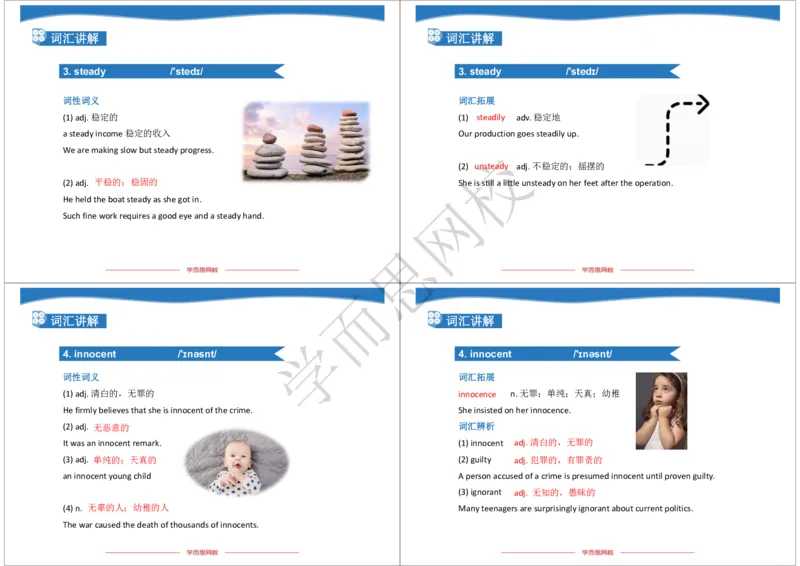
(1) v. 压垮;使应接不暇
We were overwhelmed by requests for information.
(2) v.
The army was overwhelmed by the enemy.
(3) v.
The beauty of the landscape overwhelmed me.
She was overwhelmed by feelings of guilt.
词汇讲解
1. overwhelm
/әʊvә'welm/
压倒;击败
(感情或感觉)充溢,难以禁受
词性词义
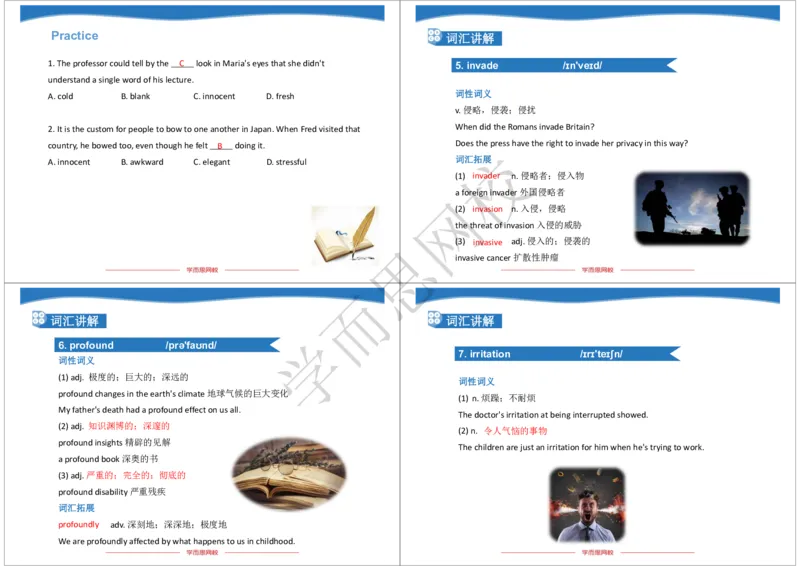
v. 遗弃,放弃
The baby has been abandoned by its mother.
When you hit an iceberg, abandon the ship immediately.
词汇拓展
adj. 被遗弃的;被离弃的;废弃的
an abandoned farm 废弃的农场
词汇讲解
2. abandon
/ә'bændәn/
abandoned
Practice
1. Peter had intended to take a job in business, but _____ that plan after the unpleasant
experience in Canada in 2010.
A. had abandoned
B. abandoned
C. abandon
D. will abandon
2. We can achieve a lot when we learn to let our differences unite , rather than _____ us.
A. divide
B. reject
C. control
D. abandon
B
A
学而思网校
词汇讲解
3. steady
/'stedɪ/
词性词义
(1) adj. 稳定的
a steady income 稳定的收入
We are making slow but steady progress.
(2) adj.
He held the boat steady as she got in.
Such fine work requires a good eye and a steady hand.
平稳的;稳固的
词汇讲解
3. steady
/'stedɪ/
词汇拓展
(1)
adv. 稳定地
Our production goes steadily up.
(2)
adj. 不稳定的;摇摆的
She is still a little unsteady on her feet after the operation.
steadily
unsteady
词汇讲解
4. innocent
/'ɪnәsnt/
词性词义
(1) adj. 清白的,无罪的
He firmly believes that she is innocent of the crime.
(2) adj.
It was an innocent remark.
(3) adj.
an innocent young child
(4) n.
The war caused the death of thousands of innocents.
无恶意的
单纯的;天真的
无辜的人;幼稚的人
词汇讲解
4. innocent
/'ɪnәsnt/
词汇拓展
n. 无罪;单纯;天真;幼稚
She insisted on her innocence.
词汇辨析
(1) innocent
(2) guilty
A person accused of a crime is presumed innocent until proven guilty.
(3) ignorant
Many teenagers are surprisingly ignorant about current politics.
innocence
adj. 清白的,无罪的
adj. 犯罪的,有罪责的
adj. 无知的,愚昧的
学而思网校
Practice
1. The professor could tell by the _____ look in Maria's eyes that she didn't
understand a single word of his lecture.
A. cold
B. blank
C. innocent
D. fresh
2. It is the custom for people to bow to one another in Japan. When Fred visited that
country, he bowed too, even though he felt _____ doing it.
A. innocent
B. awkward
C. elegant
D. stressful
C
B
词汇讲解
5. invade
/ɪn'veɪd/
词性词义
v. 侵略,侵袭;侵扰
When did the Romans invade Britain?
Does the press have the right to invade her privacy in this way?
词汇拓展
(1)
n. 侵略者;侵入物
a foreign invader 外国侵略者
(2)
n. 入侵,侵略
the threat of invasion 入侵的威胁
(3)
adj. 侵入的;侵袭的
invasive cancer 扩散性肿瘤
invader
invasion
invasive
词汇讲解
6. profound
/prә'faʊnd/
词性词义
(1) adj. 极度的;巨大的;深远的
profound changes in the earth's climate 地球气候的巨大变化
My father's death had a profound effect on us all.
(2) adj. 知识渊博的;深邃的
profound insights 精辟的见解
a profound book 深奥的书
(3) adj. 严重的;完全的;彻底的
profound disability 严重残疾
词汇拓展
adv. 深刻地;深深地;极度地
We are profoundly affected by what happens to us in childhood.
profoundly
词性词义
(1) n. 烦躁;不耐烦
The doctor's irritation at being interrupted showed.
(2) n.
The children are just an irritation for him when he's trying to work.
词汇讲解
7. irritation /ɪrɪ'teɪʃn/
令人气恼的事物
学而思网校
词汇拓展
(1)
v. 引起恼怒;激怒
It really irritates me when he doesn't help around the house.
(2)
adj. 恼怒的,生气的
John was getting irritated by all her questions.
(3)
adj. 气人的;使人愤怒的
He's the most irritating man I've ever met.
词汇讲解
7. irritation /ɪrɪ'teɪʃn/
irritate
irritated
irritating
词汇讲解
8. range
/reɪndʒ/
词性词义
(1) n. (一)批;(一)类;(一)系列
I offered her a range of options.
(2) n.
The price range is from $100 to $500.
(3) v.
Dress sizes range from petite to extra large.
Prices range between $50 and $250.
范围,幅度,区域
(在……内)变动
(4) v.
The walkers ranged through/over the hills all day.
Our discussion ranged over many current issues.
(5) v.
The troops were ranged in front of the commanding officer.
四处移动;(文章或演讲)涉及
排列;(尤指)使排列成行
词汇讲解
8. range
/reɪndʒ/
词汇拓展
(1)
一系列;一些;一套
We have a range of products from cosmetics to cleaning.
(2)
大范围的;许多各种不同的
The Internet can offer a wide range of topics to choose from.
(3)
v. 安排;筹划
They arranged to have dinner the following month.
She arranged her birthday cards along the shelf.
a range of
a wide range of
arrange
Practice
1. This restaurant has become popular for its wide _____ of foods that suit all tastes
and pockets.
A. division
B. area
C. range
D. circle
2. — Can you shoot the bird at top of the tree?
— No, it is out of _____.
A. reach
B. range
C. control
D. distance
C
B
学而思网校
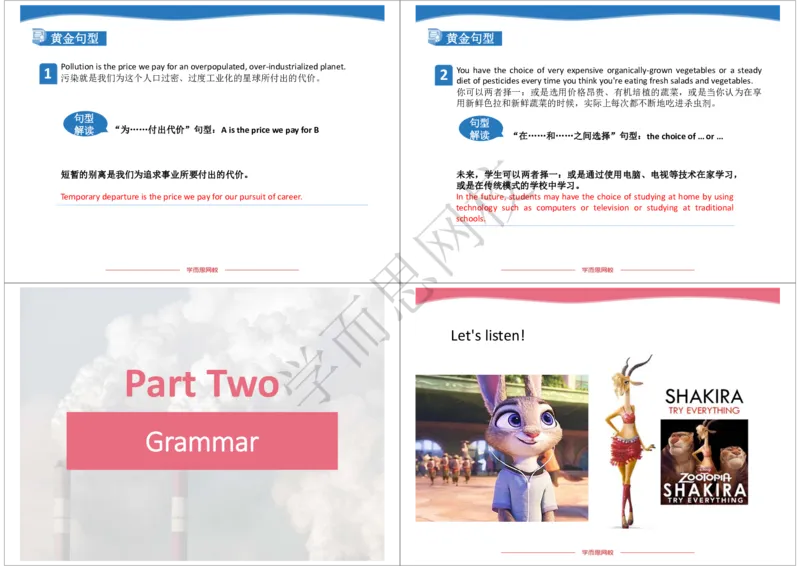
黄金句型
1
Pollution is the price we pay for an overpopulated, over‐industrialized planet.
污染就是我们为这个人口过密、过度工业化的星球所付出的代价。
句型
解读
“为……付出代价”句型:A is the price we pay for B
短暂的别离是我们为追求事业所要付出的代价。
Temporary departure is the price we pay for our pursuit of career.
In the future, students may have the choice of studying at home by using
technology such as computers or television or studying at traditional
schools.
黄金句型
2
You have the choice of very expensive organically‐grown vegetables or a steady
diet of pesticides every time you think you're eating fresh salads and vegetables.
你可以两者择一:或是选用价格昂贵、有机培植的蔬菜,或是当你认为在享
用新鲜色拉和新鲜蔬菜的时候,实际上每次都不断地吃进杀虫剂。
句型
解读
“在……和……之间选择”句型:the choice of … or …
未来,学生可以两者择一:或是通过使用电脑、电视等技术在家学习,
或是在传统模式的学校中学习。
Grammar
Part Two
Let's listen!
学而思网校
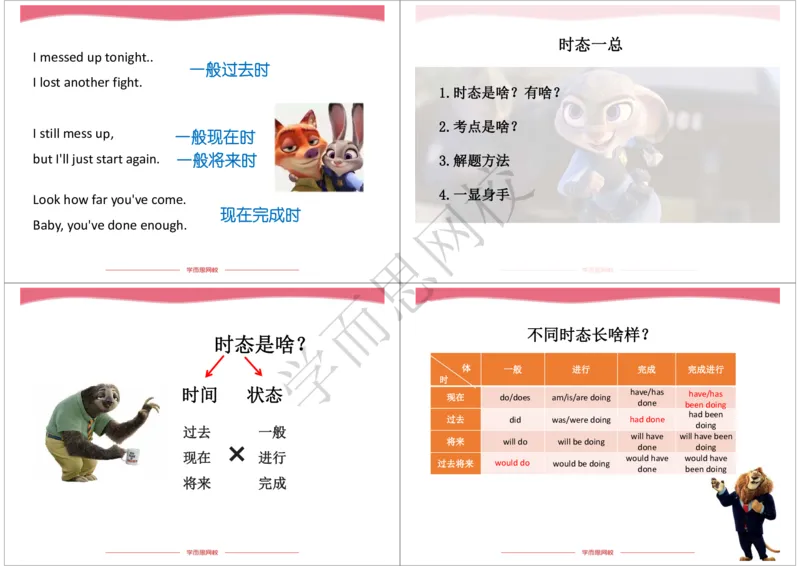
I messed up tonight..
I lost another fight.
I still mess up,
but I'll just start again.
一般过去时
一般现在时
一般将来时
Look how far you've come.
Baby, you've done enough.
现在完成时
1.时态是啥?有啥?
2.考点是啥?
3.解题方法
4.一显身手
时态一总
时态是啥?
过去
现在
将来
一般
进行
完成
×
时间
状态
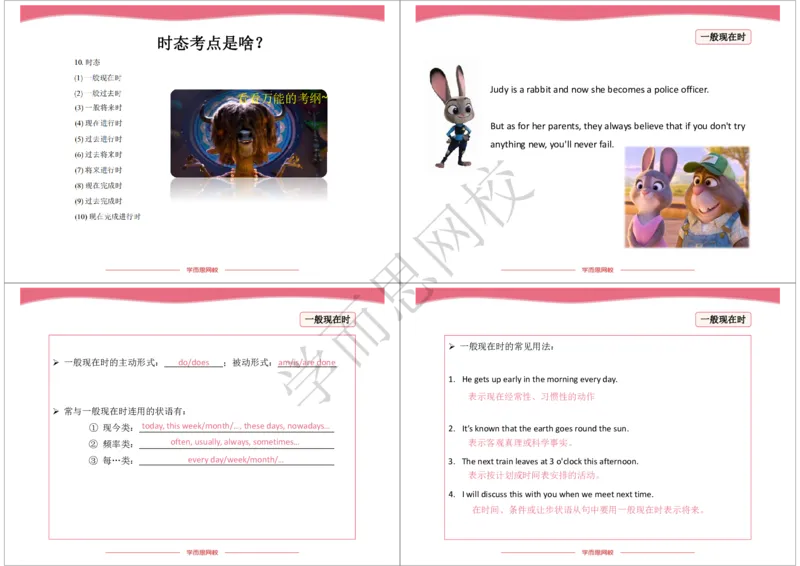
不同时态长啥样?
一般
进行
完成
完成进行
现在
过去
将来
过去将来
do/does
am/is/are doing
have/has
done
did
was/were doing
had been
doing
will do
will be doing
will have
done
will have been
doing
would be doing
would have
done
would have
been doing
时
体
have/has
been doing
would do
had done
学而思网校
时态考点是啥?
看看万能的考纲~
Judy is a rabbit and now she becomes a police officer.
But as for her parents, they always believe that if you don't try
anything new, you'll never fail.
一般现在时
一般现在时的主动形式:_____________;被动形式:_____________
常与一般现在时连用的状语有:
①现今类:___________________________________________
②频率类:___________________________________________
③每…类:___________________________________________
do/does
am/is/are done
today, this week/month/…, these days, nowadays…
often, usually, always, sometimes…
every day/week/month/…
一般现在时
一般现在时的常见用法:
1. He gets up early in the morning every day.
2. It’s known that the earth goes round the sun.
3. The next train leaves at 3 o'clock this afternoon.
4. I will discuss this with you when we meet next time.
表示现在经常性、习惯性的动作
表示客观真理或科学事实。
表示按计划或时间表安排的活动。
在时间、条件或让步状语从句中要用一般现在时表示将来。
一般现在时
学而思网校
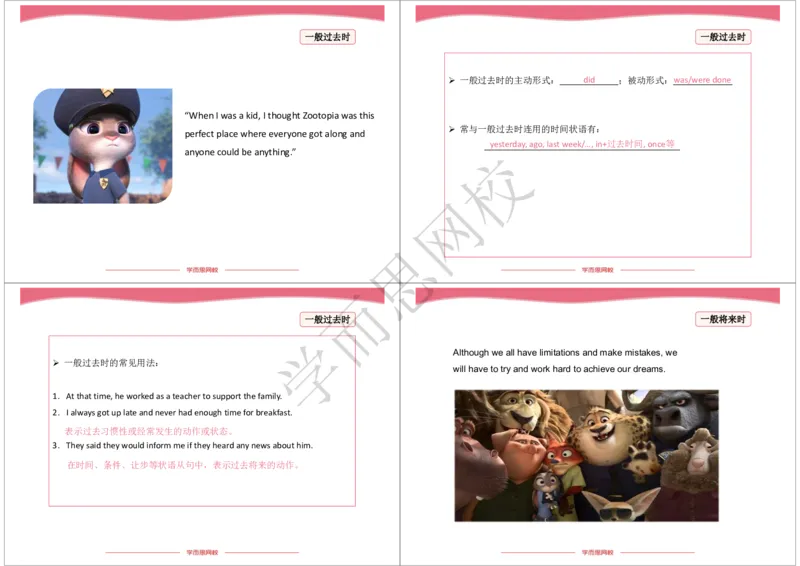
“When I was a kid, I thought Zootopia was this
perfect place where everyone got along and
anyone could be anything.”
一般过去时
一般过去时的主动形式:_____________;被动形式:_____________
常与一般过去时连用的时间状语有:
___________________________________________
did
was/were done
yesterday, ago, last week/…, in+过去时间, once等
一般过去时
一般过去时的常见用法:
1. At that time, he worked as a teacher to support the family.
2. I always got up late and never had enough time for breakfast.
3. They said they would inform me if they heard any news about him.
表示过去习惯性或经常发生的动作或状态。
在时间、条件、让步等状语从句中,表示过去将来的动作。
一般过去时
一般将来时
Although we all have limitations and make mistakes, we
will have to try and work hard to achieve our dreams.
学而思网校
一般将来时的主动形式:_____________;被动形式:________________
常与现在进行时连用的时间状语有:
___________________________________________
will/shall do
will/shall be done
tomorrow, next time/week/…, in the future, soon等
一般将来时
各结构常见用法如下:
will/shall do
1. I will be 18 years old next year.
2. The baby won’t eat anything.
3. —Do you know Mr. Smith has come to our town?
—No, I will go and visit him right now.
be going to do
1. I’m going to watch TV tonight.
2. Look at the dark clouds. It is going to rain.
表示纯将来,意愿式将来或者临时决定做某事。
表示计划、打算做某事,或者有迹象表明某事要发生。
一般将来时
be to do
1. The meeting is to take place at nine this morning.
2. You are to go to bed and keep quiet, kids.
be about to do
1. Sit down, everyone. The film is about to start.
2. I was about to leave when it started to rain.
表示正式的计划、安排,或者命令、义务等语气。
表示“即将,正要”,不和具体的时间状语连用。
常用结构:be about to do ... when ...
一般将来时
Practice
1. Now my dream is to open a cafe. Though it may appear simple, it required a lot of
ideas and efforts. (19年新课标Ⅲ)
2. As you go through this book, you ____ that each of the millions of people who lived
through World War II had a different experience.
A. will find
B. found
C. have found
D. are finding
requires
A
学而思网校
现在进行时
Nick and Judy are working together now.
现在进行时的主动形式:_____________;被动形式:________________
常与现在进行时连用的标志词有:
___________________________________________
am/is/are doing
am/is/are being done
now, at the moment, these days, look, listen等
现在进行时
现在进行时的常见用法:
1. Hurry up, kids! The school bus is waiting for us!
2. ①He is always helping others.
3. ②She is always forgetting something.
4. “The moment is coming soon,” he thought to himself, waiting nervously.
表示现在正在进行的动作。
常与always, constantly, continually, forever等副词连用,
表达说话者生气、赞叹、同情、不满、惊讶等感情色彩。
瞬间动词如go, come, leave, die等的现在进行时表将来。
现在进行时
过去进行时
Nick and Judy were taking pictures at that time.
学而思网校
过去进行时的主动形式:_____________;被动形式:________________
常与过去进行时连用的时间状语有:
_______________________________________________________
was/were doing
was/were being done
at that time/moment/…, at … o’clock yesterday, then, all morning等
过去进行时
过去进行时的常见用法:
1. She was telephoning a friend when I came in.
2. The little boy was continually asking his brother the same question,
which made his brother bored.
3. She told me that she was leaving for Italy the next day.
表示在过去某一时刻正在进行的动作。
与always, constantly, forever等副词连用表示赞美或讨厌等感情色彩。
瞬间动词come, go, leave, start等的过去进行时表示过去将来。
过去进行时
将来进行时
He will be helping you at this time tomorrow.
将来进行时的主动形式:_______________;被动形式:______________
常与现在进行时连用的时间状语有:
_______________________________________________
现在进行时的常见用法:
I’ll be flying to Beijing at two o’clock this afternoon.
will/shall be doing
不常用
at this time tomorrow, at … o’clock this afternoon, then等
将来进行时强调将来某一时刻或某一段时间内正在进行的动作。
将来进行时
学而思网校
Practice
1. When the children are walking or __________ (cycle) to school on dark mornings,
car drivers can easily see them. (19年浙江卷)
2. Jane can't attend the meeting at 3 o'clock this afternoon because she _____ a class
at that time. (15年天津卷)
A. will teach
B. would teach
C. has taught
D. will be teaching
cycling
D
过去将来时
He said he would be a rock star someday.
过去将来时的主动形式:_____________;被动形式:________________
与一般将来时类似,过去将来时的常见结构也还有三种:
过去将来时的常见用法:
He said that there would be a bad winter.
would/should do
would/should be done
•
was/were going to do
•
was/were about to do
•
was/were to do
表示从过去预计要发生的动作或者存在的状态,
常用于主句为一般过去时的宾语从句中。
过去将来时
Practice
1. I hoped I ____________ (find) a job soon.
2. At college, Barack Obama didn't know that he _________ the first black president
of the United States of America.
A. was to become
B. becomes
C. is to become
D. became
would find
A
学而思网校
现在完成时
He has become the boss of gangsters (黑帮).
现在完成时的主动形式:_____________;被动形式:________________
常与现在完成时连用的时间状语有:
____________________________________________________
have/has done
have/has been done
already, yet, recently, since, for, so far, up to now, in the past/last 10 years等
现在完成时
现在完成时的常见用法:
1. I’ve already had breakfast.
2. The reports went missing in 2012 and nobody has seen them since.
3. When you have learned English, you will find it a bridge to so much knowledge.
表示动作已经完成,但对现在造成了一定的影响。
表示过去发生的动作或存在的状态一直延续到现在。
常与since和for引导的表一段时间的状语连用。
在条件、时间或让步状语从句中,用现在完成时表示将来完成时。
现在完成时
现在完成进行时
They have been living happily ever after.
学而思网校
现在完成进行时的主动形式:_________________;被动形式:________
常与现在完成进行时连用的时间状语有:
_________________________________
现在完成进行时的常见用法:
We have been waiting for her for three hours, but she still hasn't come.
have/has been doing
不常用
since, for, all day/morning/…等
表示过去发生的动作一直延续到现在,并且很有可能继续下去。
现在完成进行时
过去完成时
By the time he went there,
the problem had already been solved.
过去完成时的主动形式:_____________;被动形式:________________
常与过去完成时连用的时间状语有:
____________________________________________________
had done
had been done
since, for, before, then, by/until+过去时间, in the past/last 10 years等
过去完成时
过去完成时的常见用法:
1. I found the lecture hard to follow because it had started when I arrived.
2. She was surprised to find that he had stayed here alone for two weeks.
3. I had meant to help you, but I was too busy at that moment.
表示在过去某一时刻或动作之前已完成的动作,即“过去的过去”。
表示某个动作从“过去的过去”一直持续到过去某个时间。
表示本打算做但事实上并未做成某事。常见的有此用法的动词有:
hope, want, mean, suppose, intend, plan, think, expect等。
过去完成时
学而思网校
Practice
1. I love coming here and seeing my family and all the friends I ___________ (make) over
the years. (19年全国新课标新课标Ⅱ)
2. — Excuse me, which movie are you waiting for?
— The new Star Wars. We ______ here for more than two hours. (16年北京卷)
A. waited
B. wait
C. would be waiting
D. have been waiting
3. I ______ to send Peter a gift to congratulate him on his marriage, but I couldn't
manage it. (19年天津卷)
A. had hoped
B. am hoping
C. have hoped
D. would hope
have made
D
A
抓住时态标志词
判断主被动关系
解题方法
I was sent to the village last month to see how the development plan ____ in the past
two years. (18年江苏卷)
A. had been carried out
B. would be carried out
C. is being carried out
D. has been carried out
A
时态语态
一般现在时
do/does
am/is/are done
现在进行时
am/is/are doing
am/is/are being done
一般将来时
will/shall do
will/shall be done
将来进行时
will/shall be doing
不常用
过去将来时
would/should do
would/should be done
Summary
经常性的动作;客观真理;时间表;主将从现
现在、现阶段正在发生的动作;感情色彩;表将来
将来要发生的动作
将来某一时刻正在发生的动作
过去预计将要发生的动作
时态语态
一般过去时
did
was/were done
过去进行时
was/were doing
was/were being done
现在完成时
have/has done
have/has been done
现在完成进行时
have/has been doing
不常用
过去完成时
had done
had been done
Summary
表示过去发生或过去经常发生的动作或状态。
表示过去某个时刻正在发生的动作。
表示动作发生在过去,截至现在已经完成,强调对现在的影响。
表示动作延续到现在并很有可能继续延续。
表示过去的过去。
学而思网校