THEATLANTIC.COM
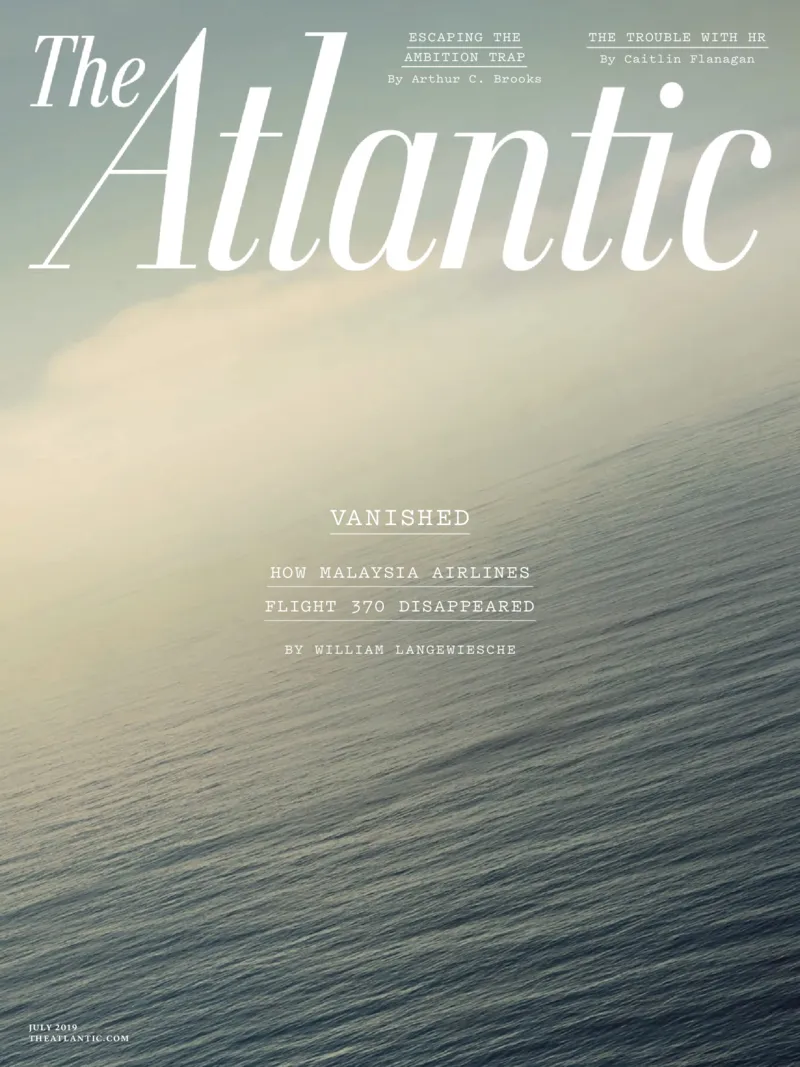
VANISHED
HOW MALAYSIA AIRLINES
FLIGHT 370 DISAPPEARED
BY WILLIAM LANGEWIESCHE
ESCAPING THE
AMBITION TRAP
By Arthur C. Brooks
THE TROUBLE WITH HR
By Caitlin Flanagan
JULY 2019
THEATLANTIC.COM
!"#$%&%$'&((&")*$"+$,-*&).**.*$
/01"**$23.$4565$71"#$&)$89:;<
!"#$%&'#(%)"#%*#+,
6..$3"#$'&((&")*$"+$='.1&0/)*$/1.$71"#&)7$23.&1$,-*&).**.*$/2
!""!#$%&"'($&")"'*&*'+,&-
.@G/BH56I$";!*,
H/A&)7$*3".*$&*$6/1/R*$@/**&")5$H/A&)7$
23.'$&)$='.1&0/$&*$3.1$'&**&")5$D3.$#.,$
&*$'/A&)7$&2$*&'@(.1$+"1$3.1$2"$0")).02$#&23
'"1.$0-*2"'.1*?$/)%$G""7(.$&*$3.(@&)75
]¥ü¥�/üė¥çÑ-%SA/,/*3&
./01234562")-,),
>/'.*?$6/1/3?$/)%$23.&1$/(@/0/*$01./2.$
#/1'$#&)2.1$A)&2*$+"1$@."@(.$/1"-)%$
23.$#"1(%$/)%$B",*$+"1$@."@(.$&)$23.&1$
0"''-)&2C5$D3.C$1.(C$")$23.$#.,$2"$1-)$
23.&1$,-*&).**?$/)%$&)$89:;?$'"1.$23/)$
E8F$"+$23.&1$*/(.*$0/'.$231"-73$G""7(.5
7,'$8696:,;,<6.=>>
=(@/0/*$"+$H")2/)/
3?.@A@1BA@1564$C62$D*&"
6C%).C$,1&)7*$B",*$2"$3.1$("0/($I/2&J.$
='.1&0/)$0"''-)&2C$/)%$,./-2&+-($
3/)%'/%.$B.#.(1C$2"$23.$#"1(%5$D31"-73$
G""7(.$=%*?$*3.$*3/1.*$23.$#"1A$"+$("0/($
¥Ŝ�ÑĀ¥çĀ�½æùáíн¹�²Ğ��ćÞѽ�¹Ñü½³ćáĞ�ĘÑćÎ�
@."@(.$&)$*./103$"+$-)&K-.$3.&1(""'$B.#.(1C5
:E>)$E63#F")8"
�ćÞѽ
�ü½Ę��½¥üĘ½Āć½ü�Ο��½Ŝ� ѽ�Y¥Ğ�///
6#&203$
�/D�/DD�c/ˏ�J<*"
tνç��ü½Ę�¥ç¹��½Ŝ�ѽ�íù½ç½¹�ćνÑü�áÑÉÎćÑçÉ
/)%$%.*&7)$*3"@?$&2$1.L.).17&M.%$23.&1$%"#)L
ćíĘç��Ñç³Ñçç¥ćÑ�³íææČçÑćĞ�²Ğ�¥Ş�ü¥³ćÑçÉ�ç½Ę�
*3"@@.1*$2"$#3/2$#/*$23.)$/)$-@L/)%L0"'&)7$
/1./5$D"$A..@$0-*2"'.1*$0"'&)7$,/0A?$23.C
-*.$G""7(.$HC$N-*&).**$2"$*3/1.$23.&1$3"-1*
/)%$("0/2&")$")$G""7(.$6./103$/)%$H/@*?$/)%
2"$*3/1.$@3"2"*$"+$23.&1$*3"#1""'5
O/*2$C./1?$G""7(.$2""(*$3.(@.%$01./2.$PEEQ$,&((&")$
&)$.0")"'&0$/02&J&2C$+"1$4565$,-*&).**.*5
C O N T E N T S | J U LY 2 0 1 9
VO L . 3 24 – N O. 1
O F N O P A R T Y O R C L I Q U E
Features
56
The End
of Expertise
BY J E R RY U S E E M
Step aboard a cutting-edge
Navy ship where specializa-
tion is out, learning never
stops, and one sailor does
the job of five. Is this the
future of work?
48 The Problem
With HR
BY C A I T L I N F L A N AGA N
For 30 years, human
resources has been charged
with preventing and
addressing workplace
sexual harassment.
How’s that working out?
66 Your
Professional
Decline Is Coming
(Much) Sooner
Than You Think
BY A R T H U R C. B R O O KS
Here’s how to make
the most of it.
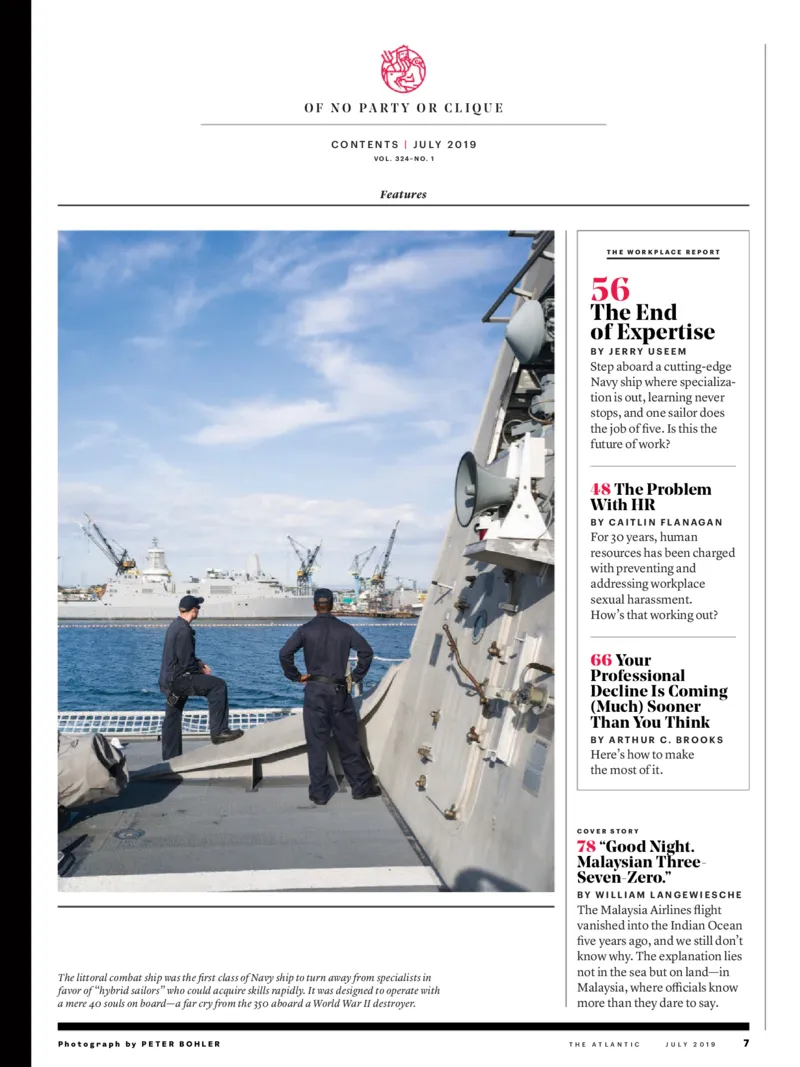
The littoral combat ship was the first class of Navy ship to turn away from specialists in
favor of “hybrid sailors” who could acquire skills rapidly. It was designed to operate with
a mere 40 souls on board—a far cry from the 350 aboard a World War II destroyer.
P h o t o g r a p h b y P E T E R B O H L E R
T H E A T L A N T I C J U L Y 2 0 1 9 7
C O V E R S T O R Y
78 “Good Night.
Malaysian Three-
Seven-Zero.”
BY W I L L I A M L A N G E W I E S C H E
The Malaysia Airlines flight
vanished into the Indian Ocean
five years ago, and we still don’t
know why. The explanation lies
not in the sea but on land—in
Malaysia, where officials know
more than they dare to say.
T H E W O R K P L A C E R E P O R T
Dispatches
C O N T E N T S
Departments
8 J U L Y 2 0 1 9 T H E A T L A N T I C
On the Cover
0 7 . 1 9
V O L . 3 2 4 – N O . 1
19 S O C I E T Y
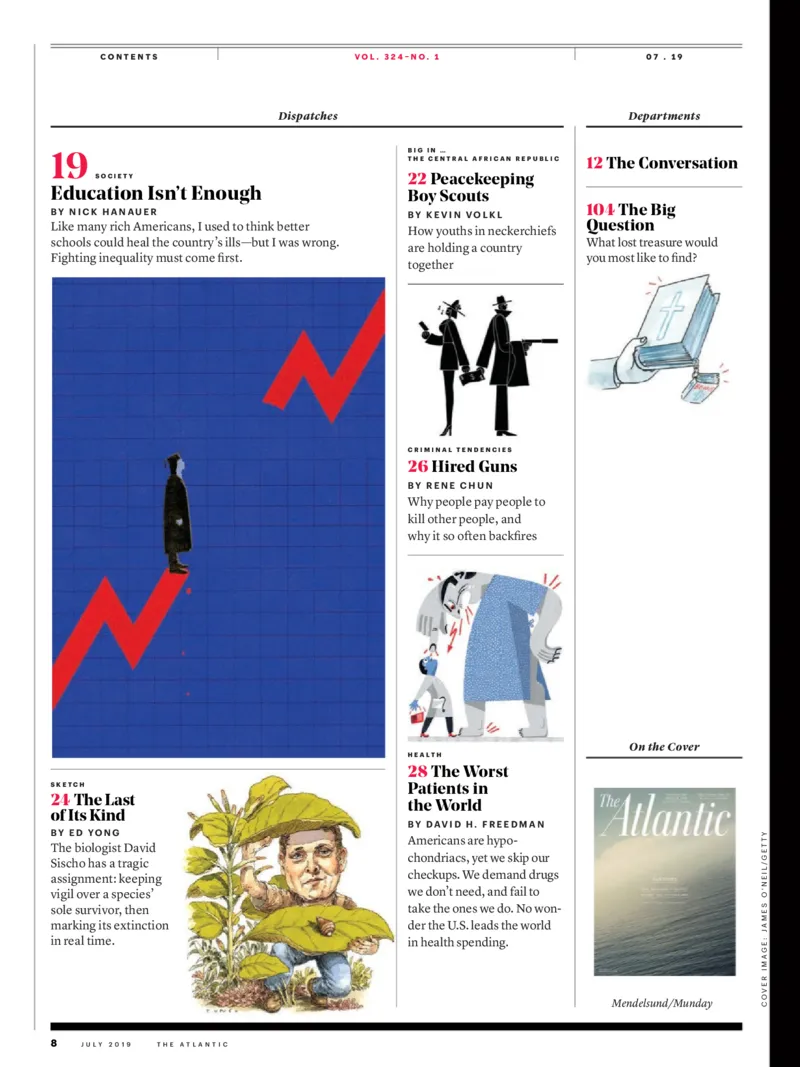
Education Isn’t Enough
BY N I C K H A N AU E R
Like many rich Americans, I used to think better
schools could heal the country’s ills —but I was wrong.
Fighting inequality must come fi rst.
12 The Conversation
104 The Big
Question
What lost treasure would
you most like to fi nd?
Mendelsund/Munday
S K E T C H
24 The Last
of Its Kind
BY E D YO N G
The biologist David
Sischo has a tragic
assignment: keeping
vigil over a species’
sole survivor, then
marking its extinction
in real time.
B I G I N …
T H E C E N T R A L A F R I C A N R E P U B L I C
22 Peacekeeping
Boy Scouts
BY K E V I N VO L K L
How youths in neckerchiefs
are holding a country
together
C R I M I N A L T E N D E N C I E S
26 Hired Guns
BY R E N E C H U N
Why people pay people to
kill other people, and
why it so often backfi res
H E A L T H
28 The Worst
Patients in
the World
BY DAV I D H . F R E E D M A N
Americans are hypo-
chondriacs, yet we skip our
checkups. We demand drugs
we don’t need, and fail to
take the ones we do. No won-
der the U.S. leads the world
in health spending.
C O V E R I M A G E : J A M E S O ’ N E I L / G E T T Y
The SUV for all you love.
Introducing the all-new 2019 Subaru Forester.
®
Forester. Well-equipped at $24,295.††
Subaru, Forester, and EyeSight are registered trademarks. *EPA-estimated highway fuel economy for 2019 Subaru Forester models. Actual mileage may vary. †EyeSight is a driver-assist system that may
not operate optimally under all driving conditions. The driver is always responsible for safe and attentive driving. System effectiveness depends on many factors, such as vehicle maintenance, weather,
and road conditions. See your owner’s manual for complete details on system operation and limitations. **2015-2019 Kelley Blue Book Brand Image Awards are based on the Brand Watch™ study from
Kelley Blue Book Strategic Insights. Award calculated among non-luxury shoppers. For more information, visit Kelley Blue Book’s KBB.com. Kelley Blue Book is a registered trademark of Kelley Blue
Book Co., Inc. ††MSRP excludes destination and delivery charges, tax, title, and registration fees. Retailer sets actual price. Certain equipment may be required in specific states, which can modify your
MSRP. See your retailer for details. 2019 Subaru Forester Touring shown has an MSRP of $34,295.
The most fuel-efficient Forester yet with standard Symmetrical
All-Wheel Drive + 33 mpg.* Standard EyeSight
® Driver Assist Technology†
helps keep you safe. Plus, you can drive in confidence knowing Subaru
is Kelley Blue Book’s Most Trusted Brand for five years running.**
The Culture File
Poetry
C O N T E N T S
10 J U L Y 2 0 1 9 T H E A T L A N T I C
0 7 . 1 9
V O L . 3 2 4 – N O . 1
36 B O O K S
The Earth’s Deepest Secrets
BY R E B E C C A G I G G S
Burrow far below the planet’s surface, and even there,
humanity has left its imprint.
B O O K S
40 George Orwell’s
Unheeded Warning
BY G E O R G E PAC K E R
Even the author of 1984
failed to imagine how
readily everyone would
embrace doublethink.
B O O K S
43 Building
the Next
Babe Ruth
BY J AC K H A M I LTO N
“Sabermetrics” changed
baseball. Now another
technological revolution is
transforming the national
pastime, for good or ill.
T H E O M N I V O R E
32 Mailer on
the Moon
BY J A M E S PA R K E R
Fifty years later, Norman
Mailer’s account of
Apollo 11 remains loony,
self-indulgent, and essential
to understanding the
mission and its legacy.
96 Cruising
in the Age
of Consent
BY S P E N C E R KO R N H A B E R
#MeToo is a reckoning
with male behavior.
Where does that leave
gay hookup culture?
Essay
38 Sugar on Snow
BY DAVID YEZZI
THE PROMISE OF
A SMARTER HOME,
DELIVERED BY USPS.
Every day, visionaries are creating the devices of the future,
but they need people who really know how to deliver them.
The USPS delivers more online purchases to homes than
anyone else in the country.
We deliver for you.® See how at USPS.com/visionary
© 2018 United States Postal Service. All Rights Reserved. The Eagle Logo is among the many trademarks of the U.S. Postal Service®. Please recycle packaging materials whenever possible.
12 J U L Y 2 0 1 9 T H E A T L A N T I C
Thank you for publishing “The
Trouble With Dentistry.” Over-
treatment is a serious problem
in our profession. While
some patients wish to have
perfect, bright-white smiles
and a mouth that looks like it
has never had any problems,
most people want to be able to
eat without pain and to have
The American Dental Asso-
ciation and dentists across
the country are dedicated
to the health and safety of
the patients they serve. As
a dentist for 32 years, I was
disappointed by the author’s
reinforcement of inaccurate,
negative stereotypes about
dentists, and the use of one
example of alleged profes-
sional misconduct to make
blanket statements about the
entire dental profession.
The ADA is dedicated to
evidence-based dentistry,
which integrates the dentist’s
clinical expertise, the patient’s
needs and preferences, and
the most current, clinically
relevant evidence. All three are
part of the decision-making
process for patient care. To
that end, the ADA successfully
advocated for evidence-based
dentistry to become a required
component of dental-school
curricula and established the
Center for Evidence-Based
Dentistry to develop resources
that help dentists integrate
relevant scientifi c evidence
into patient care. We have the
data to show that dentists all
across the country are access-
ing this content.
The author’s implication
that dentists are motivated by
profi t to pay down high educa-
tional debt is not borne out by
the facts. For instance, dentists
have for decades advocated
for fl uoridation of community
water supplies to prevent tooth
decay. Why does the profes-
sion advocate for something
that results in less need for
treatment? Because dentists
are doctors of oral health, and
tooth decay is a disease that
we want to prevent for the
good of the public.
Jeff rey M. Cole, D.D.S., M.B.A.
PRESIDENT, AMERICAN
DENTAL ASSOCIATION
CHICAGO, ILL.
At the Harvard School of
Dental Medicine and other
reasonably good aesthetics.
It’s pretty easy to provide this
without major, expensive
dentistry—but the dentist
won’t make much money. And
that’s a problem. By the time
a dentist gets out of school
and sets up or buys an existing
practice, he or she can easily
be close to $1 million in debt.
In the United States, poor
populations are largely under-
served in medicine as well as
in dentistry. If our society were
to off er some form of tuition
reduction for serving those
populations, both conditions
could be helped.
David Dalley, D.D.S.
CHARLOTTESVILLE, VA.
R E S P O N S E S & R E V E R B E R A T I O N S
• T H E C O N V E R S A T I O N
The Trouble With Dentistry
In May, Ferris Jabr wrote about a dentist named John Roger Lund, who allegedly
defrauded many of his patients by giving them unnecessary treatments. Lund was an
outlier, but even the most common dental procedures, Jabr wrote, are not always as
safe, eff ective, or durable as we are meant to believe.
They
will
stick
an ad
for oat-
milk
any-
where
these
days.
dental schools nationwide, ethics and
professionalism are at the heart of dental
education. We teach evidence-based
dentistry and highly value scientific
inquiry, requiring every student to conduct
research. We put patients’ welfare above
all else.
Speaking as the dean of a dental school,
a role I’ve held for more than 25 years, I can
assure you that the overwhelming reason
students go into the field is because of their
desire to help others. Dentists are caring,
ethical, and knowledgeable professionals
who serve their communities and care
deeply for their patients. Dentists deserve
better than the unflattering portrayal in
this article.
Bruce Donoff, D.M.D., M.D.
DEAN, HARVARD SCHOOL OF DENTAL MEDICINE
BOSTON, MASS.
I was in dental school in the late 1980s.
A joke freshman year revolved around our
professors’ not even being able to go to the
latrine without at least three coordinating
peer-reviewed double-blind studies to say it
was a good idea. Granted, we dentists don’t
have the breadth of research that our medi-
cal colleagues do, but we represent only
4.5 percent of the nation’s health-care bill.
Kenneth E. Chapman, D.D.S., M.A.G.D.
WINSTON-SALEM, N.C.
Ferris Jabr’s reliance on the Cochrane
organization’s concerns about the scien-
tific validity of some clinical studies and
common recommendations is flawed. The
Cochrane organization’s mission is to
point out where evidence-based science
is lacking. A lack of evidence does not
make something untrue. There is a lack
of solid evidence based on scientific
research for the benefits of flossing,
because it is virtually impossible to follow
a large group of people for years to verify
their self-reported daily flossing habits
and techniques, to rule out myriad other
factors affecting the study, and to put a
control group at serious health risk by
forcing them not to floss for years. As to
the scientific validity of dental treatments
such as crowns and root canals, plenty
of evidence supports their need. But
how can we ask a large group of people
in several different studies to not restore
a root canal with a crown, just to see
what happens? Some medical and dental
recommendations still rely on clinical
experience and cannot be scientifically
validated through evidence-based studies.
This does not make those recommenda-
tions bad or untrue.
Joseph A. Oleske
LAKEWOOD, N.J.
I am a retired dental hygienist and would
like to point out another troubling trend in
dentistry: Many of the big dental chains pay
their dentists and hygienists on commis-
sion. Often while filling in for colleagues,
I would find that their periodontal-probe
measurements were high (resulting in the
recommendation of costly scaling and root-
planing procedures), when my readings
were that of a healthy mouth. Attendance
at monthly staff meetings was required, and
commissions were posted and discussed
as a means of creating competition among
dentists and hygienists. With that as
common practice, how could dentistry be
anything but corrupt?
Kathleen Quartaro
HARTLAND, WIS.
Kudos to Ferris Jabr for his insightful
article. Some years ago, as a newcomer to
our area who rarely had dental problems, I
visited prospective dentists on the recom-
mendation of my previous (and trusted)
dentist as well as co-workers. One of these
was a well-known and well-advertised
practitioner. I had what I thought was a
routine examination and cleaning. To my
surprise, I was then presented with a writ-
ten, multipoint “treatment plan” laying
out a number of significant procedures
that needed to be done as soon as possible.
The cost would be more than $5,000. I
was told that this plan was a requirement
of the Florida Board of Dentistry, or some
such body. When I demurred at commit-
ting to such a plan on first acquaintance, I
was asked to sign the plan to indicate that
I had refused this “necessary” treatment
and told that the dentist would need this
for his records.
Fast-forward 15 years. I have had none
of his required procedures (or any other
significant dental work). I have been with
my current practitioner for nearly all of this
period. I’m told my teeth are just fine.
Miller Macmillan
DESTIN, FLA.
I am in my 50s and had a colonoscopy, as
my physician recommended. I’m glad he
didn’t describe it as “shoving a camera and
hose up my butt to look at my bowels, and
14 J U L Y 2 0 1 9 T H E A T L A N T I C
A R S H R A Z I U D D I N
R E S P O N S E S & R E V E R B E R A T I O N S
using an electric hot wire to rip
and burn out any polyps that
might be found.”
You can describe absolutely
any dental or surgical procedure
with emotionally charged and
barbaric terms—cutting, hacking,
ripping. But the majority of my
colleagues went into health care
and go to work every day to help
people with their problems in the
best way we can. We certainly do
not hack and rip. We treat people
and their teeth, soft tissue, bones,
and organs as delicately as the
task allows. Everything I do for
my patients is what I would do
for my most treasured family
member or friend.
Andrew C. Hartwig, D.D.S.
IOWA CITY, IOWA
Ferris Jabr replies:
In the past few months I have
received numerous emails from
dentists. Many were angry
or resentful, but the major-
ity applauded the article and
affirmed its central points. As the
article states several times, most
dentists behave ethically. Many of
the article’s critics conveniently
ignore the actions of Dr. Brendon
Zeidler, who is a paragon of
conscientiousness and integrity.
The narrative concerning Dr. John
Roger Lund is not presented as
a portrayal of all dentists, but
rather as a case study illustrat-
ing a troubling trend. One of the
challenges in reporting this piece
is that definitive statistics about
overtreatment are lacking because
it is a largely overlooked problem.
Yet the available evidence—from
the few studies that have been
conducted, newspaper archives,
court records, and interviews
with dental practitioners and
patients—indicates that Lund is
far from alone.
My article explores the many
historical, financial, and cultural
explanations for intentional and
inadvertent overtreatment in
dentistry, including the profes-
sion’s deficit in rigorous clinical
evidence. Joseph A. Oleske is
mistaken about the Cochrane
organization; its purpose is not
to highlight missing evidence but
rather, according to its website,
to “study all of the best avail-
able evidence generated through
research and make it easier to
inform decisions about health.”
Oleske further claims, “The
lack of evidence does not make
something untrue.” That is an
ontological problem. The relevant
question is whether there is
enough evidence to establish a
treatment’s benefits and justify
its risks. As I acknowledged in
the article, many dentists are
advocating for evidence-based
practices and necessary reform.
Unfortunately, Jeffrey M. Cole’s
claim that “dentists all across the
country” are embracing evidence-
based dentistry is contradicted by
practitioners who have repeatedly
lamented its slow adoption. As
one of my sources pointed out,
simply making information avail-
able or adding it to a curriculum
does not translate to a swift or
thorough transformation of an
entire profession.
I am encouraged by the many
dentists who concede their field’s
flaws and are striving to remedy
them. I hope the dental commu-
nity will listen to the thousands
of patients who recognized them-
selves in this story.
The Penance of
Doc O
In May, Sam Quinones wrote
about Lou Ortenzio, a trusted
West Virginia doctor who got his
patients—and himself—hooked
on opioids. After Ortenzio lost his
medical license, he took a night job
delivering pizza, which sometimes
brought him face to face with
former patients. Now he’s trying
to rescue his community from an
epidemic he helped start.
For years, I blamed Lou for my
mother’s addiction. I remember
how we would pharmacy-hop to
fill all the prescriptions he wrote
her. I also remember my dad
calling his office and screaming
at the receptionists to tell him
to stop prescribing her all these
unnecessary drugs. I remember
the day I found my mom over-
dosed on our back porch. I was
6. I felt Lou was the reason I had
been robbed of having a normal
mother. In the end, no one
held a gun to her head and said,
“Take these pills.” In the end,
he was an addict himself. He
needed help just like my mom.
When I started working in
home health in 2014, I had a
patient at the Mission, a shelter
that houses dozens of opiate
addicts. I walked in and was
greeted by a guy smiling ear to
ear. He said, “Hi there! I’m Lou
Ortenzio. Have you ever been
Behind the Art
“The Trouble With Dentistry” is a story about abuse of
power. Ferris Jabr writes about Dr. John Roger Lund, who
allegedly defrauded many of his patients to secure higher
profits for himself. This apparent exploitation suggested
a wide range of possible imagery: a tooth as a piggy bank;
an oil rig inside a mouth; a mountain of removed teeth. I
intended for the art to convey a sense of nefarious drama
without being too gruesome. I also wanted to capture
some of the scarier aspects of even the most routine
dental checkup (we’ve all been in that chair, unable to
speak as sharp implements descend toward our mouth).
After some discussion with the editors, I narrowed
down the concepts. The art that opens the story is a giant
tooth wrapped in caution tape; it’s meant to evoke a crime
scene. Still, I didn’t want to indict the entire practice of
dentistry, and it was important to me that some of the art
be relatable to all dental patients. Beneath Lund’s story
lies a simple truth: Our teeth are sensitive, and so are we.
Arsh Raziuddin
ASSOCIATE ART DIRECTOR, THE ATLANTIC
Some-
times
they
will
stick
two.
here?” My mouth dropped. I finally put a
face to the guy I had blamed for all those
years, but surprisingly, I wasn’t resent-
ful anymore. I saw firsthand what he was
doing for our community. It changed my
entire perception of this person, of whom
I had thought the worst. I applaud Lou for
changing himself for the better, for lifting
up our community, and for being a part of
the change.
Kayla Toryak
BRIDGEPORT, W.VA.
Why Young Adults Are Talk-
ing Like 3-Year-Olds
Embracing your inner child is comforting and
fun, John McWhorter argued in May—and it
just might revitalize the English language.
Every parent who has ever tucked in their
children has marveled at the “cuteness” of
their linguistic development. My son once
asked, “Daddy, remember the day when
this day was coming?” before securing the
word yesterday. The “cuteness” of children’s
language is a window not only into brain
development but also into the sorting-out of
concepts such as time in its full continuum,
day and night, and life and death, and
eventually the building blocks of abstract
thought. It is cute and delightful to us, but it
is serious work for our children.
Today’s baby-speak in adults seems more
a retreat from adulthood, a turning-of-backs
on reality because the future scares the hell
out of all of us. Children make up words
and play linguistic games to race toward the
future and maturity. Adults use the same
“cute” exercises to back away from the future.
Karl E. Felsen
GUILDERLAND, N.Y.
I don’t think the slang terms and manners
of speech that the author of this article
mentioned should be celebrated. For
instance, the statement “I get paid a
crummy wage because capitalism” is
not only grammatically incorrect— it also
suggests that one should believe that capi-
talism is the source of the person’s crummy
wage, without looking more deeply into the
issue. What then happens is loss of inquiry
as well as a lack of understanding of the very
language we speak.
Marco Meza
PROVO, UTAH
It was validating to read this article after
months of hearing my 11-year-old talk
about “yeeting” things into her backpack
and exclaiming “Yeet!” whenever she got
excited about anything (accompanied by the
celebratory gesture, of course). She assured
me this was “a thing,” but until I read this
article, I didn’t fully believe her.
Jessica Finn
CHARLOTTE, N.C.
For years I have thought of “kidspeak” as
immature or ignorant. I am 26, and admit-
tedly I was unaware of the word yeet. Now
you have humbled me. It does take a degree
of creative thinking and intellect to create
and use “kidspeak” in a proper way.
Jess Moore
FORTSON, GA.
Watch Your Wallet
Pickpockets love our digitally distracted age,
Rene Chun wrote in May.
Your article was very informative and helpful.
After reading it, I thought I would try my skill.
Following a quick loving embrace, I slipped
“This man, Dr. O, was my
childhood physician. I’ll never
forget the time I answered
the door and he handed me
my own pizza. But I didn’t feel
sorry for him, I admired his
bravery—even then—to share
his story so that others can
learn from his experience.”
— @AByrdinthehand
#TWEET of the month
EDITORIAL OFFICES & CORRESPONDENCE The Atlantic considers unsolicited manuscripts, fiction or nonfiction, and mail
for the Letters column. Correspondence should be sent to: Editorial Department, The Atlantic, 600 New Hampshire
Avenue NW, Washington, DC 20037. Receipt of unsolicited manuscripts will be acknowledged if accompanied by a
self-addressed stamped envelope. Manuscripts will not be returned. For instructions on sending manuscripts
via email, see theatlantic.com/faq. CUSTOMER SERVICE & REPRINTS Please direct all subscription queries and
orders to: 800-234-2411. International callers: 515-237-3670. For expedited customer service, please call between
3:30 and 11:30 p.m. ET, Tuesday through Friday. You may also write to: Atlantic Customer Care, P.O. Box 37564,
Boone, IA 50037-0564. Reprint requests (100+) should be made to The YGS Group, 717-399-1900. A discount rate
is available for students and educators. Please visit theatlantic.com/subscribe/academic. ADVERTISING OFFICES
The Atlantic, 60 Madison Avenue, Suite 800, New York, NY 10010, 646-539-6700.
16 J U L Y 2 0 1 9 T H E A T L A N T I C
J A M E S G R A H A M ; K A T I L A C K E R
R E S P O N S E S & R E V E R B E R A T I O N S
my husband’s wallet into my
pocket. Not until about three
hours later, when we were at a
store and he reached for some
money, did he notice it was
missing. The fun was his surprise
when I handed it to him.
Margaret Porter
FARMINGTON, MAINE
Was Shakespeare
a Woman?
The authorship controversy has yet
to surface a compelling alternative
to the man buried in Stratford.
Perhaps that’s because, until recently,
no one was looking in the right place.
In June, Elizabeth Winkler made the
case for Emilia Bassano.
I thank you sincerely for shed-
ding a light on the literary work
published by William Shake-
speare. I feel chills as I reread the
texts and think of a woman hold-
ing the pen, creating, imagining,
challenging, and improving the
English language. How fantastic
would it be if we could demon-
strate that the crepitating pulse
that has made us dream for
centuries actually came out of
the creative genius of a woman?
Pável Uranga
SALEM, MASS.
On the purported Shakespeare
authorship question, there is
no scholarly debate. There is
a fascinating area of inquiry
concerning Shakespeare’s collab-
orations with other dramatists
both early and late in his career,
but this is far removed from
the fantasy that some romantic
figure used a jobbing actor from
Stratford as a frontman for
works of literary genius. There
are a mere handful of academics
who give this stuff even the time
of day, let alone credence, and
Winkler has misrepresented the
state of scholar ship by insinuat-
ing that they are one side in a
scholarly dispute.
Oliver Kamm
EXCERPT FROM A QUILLETTE.COM POST
“Was Shakespeare a Woman?”
was a delightful reminder of
the richness of the authorship
field and the tantalizing possi-
bilities it surfaces for answers
to one of history’s great
mysteries. Some are ready to
heap vitriol on those who dare
to entertain those possibili-
ties. Specific points can always
be debated, and unwarranted
claims should be called out as
such. But much compelling
evidence and thoughtful analy-
sis await those who approach
the subject with an open mind
and humble curiosity. Whoever
he or she was, “Shakespeare”
would enjoy the debate.
Marc Lauritsen
HARVARD, MASS.
Elizabeth Winkler replies:
“Any worthwhile history is a
constant state of self-questioning,”
the author Hilary Mantel observed
in her Reith Lectures for the BBC.
It was in that spirit of skepticism
that I undertook a provocative
inquiry, exploring the possibil-
ity of a woman’s hand in the
works of Shakespeare. Following
the traditions of The Atlantic,
I questioned uncritically held
assumptions instead of treating
pronouncements by authorities as
truth. Consistent with journalistic
duty, I distinguished academic
opinion and received wisdom
from fact as I explored terrain on
which evidence has proved open
to varying interpretation. In their
often vitriolic zeal to condemn me
for non adherence to their position,
some critics have misconstrued
my careful formulations and
denounced my endeavor as
“conspiracism.” More troubling
still, they’ve missed my very point
of departure—that a woman
writing under another’s name
isn’t conspiracism; it’s a literary
practice that we know has gone on
for much of history.
The discourse around the
question of Shakespeare author-
ship is plagued by this sort of
anti-intellectual suppression of
inquiry. The idea of a female
author is speculative, to be sure, but
the animating impulse of my essay
was neither doctrinaire denial nor
adamant certainty. It was self-
questioning, fueled by a recognition
of how women’s voices have been
hidden. Careful readers will note
that I never claim Emilia Bassano
was the author; indeed, I charac-
terize the evidence as “circum-
stantial” and note that Bassano’s
style differs from Shakespeare’s. I
wonder, too, about the possibility
of collaboration. (If Shakespeare
had co-authors, as scholars now
concede, can we be sure a woman
wasn’t among them?) Implied in all
of this is the question of what other
women might merit consideration
in connection with English litera-
ture’s greatest—and startlingly
feminist—plays.
The personal attacks and rhetor-
ical dismissal that greet such ques-
tioning may be intended to stig-
matize the questions, yet instead
they reinforce their legitimacy. As
the author of the plays recognized,
history is a fragile construct, “a
scribbled form, drawn with a pen /
Upon a parchment.” Scholarly
opinion isn’t fact; assertions by
authorities aren’t truth; and the
journalistic imperative to question
orthodox thinking requires doubt.
People are loyal to the first version
of history they learn, Mantel notes:
“If you challenge it, it’s as if you’re
THE BIG QUESTION
On Twitter, we asked people to pick their favorite reader responses to
June’s Big Question. Here’s how they voted.
Q: What is the most
overrated invention?
45%
The Segway
36%
Engagement rings
17%
The car alarm
2%
The clock
But
never
three.
That
would
be total
over-
kill.
taking away their childhoods.” In this climate,
accusations of denialism betray themselves
as projections, and the impulse to skepticism
emerges not as madness, but as the only rational
and responsible approach.
Get Off My Lawn
In April, James Fallows wrote about how a
small group of activists— himself included—
got gas-powered leaf blowers banned in
Washington, D.C.
I am in total agreement with James Fallows.
I work for a parks nonprofit in Chicago and
we made the switch from gas-powered leaf
blowers a few years ago in response to park
patrons’ complaints of fumes and noise, and
their concerns about sustainability. We have a
few batteries we swap out among leaf blowers
and weed whackers. The batteries charge
relatively quickly. Noise and pollution levels
are down. We don’t have to spend staff time
on going to the gas station or maintaining the
combustion engines (a real nuisance). The
batteries and tools paid for themselves in one
season with only about one hour of use each
week. It’s a wonder more individuals and land
managers haven’t already made the switch!
Aaron Hammond
ASSISTANT DIRECTOR OF PARK MANAGEMENT AND
SUSTAINABILITY, LINCOLN PARK CONSERVANCY
CHICAGO, ILL.
I am the only one on my street whose
leaf blower collects dust in the cellar; my
broom and rake are readily available. It’s
not a time-saver, but my heart, my shoul-
ders, and my soul enjoy the workout. Plus,
I can hear the birds make fun of me for
working on my day off.
Colleen Maillie
ALCOA, TENN.
I was delighted to discover so much space
dedicated to that erroneously named
machine, the “leaf blower.” (A short drive
through my neighborhood any day of the
week proves that it’s actually a dust blower.)
In the article, however, the emphasis was
on the noise rather than the dust. Yes, you
probably will lose your hearing eventually, if
exposed to the noise. But the spores; pesti-
cides; rat, coyote, raccoon, and dog feces; and
hundreds of other elements in the dust will,
in time, affect your lungs. And what about the
gardener? He is particularly at risk. He blows
dust from eight or 10 houses a day every day
of the week. Don’t we care about his health?
Many people who buy organic food, recycle,
drive a Prius, donate to ocean- conservation
efforts, and tell you that their children’s
health and safety is their No. 1 priority still
allow their gardeners to use a blower.
I say ban all leaf blowers. How beautiful is
the sound of a rake.
Sandra Snegoff
SANTA MONICA, CALIF.
James Fallows replies:
I’m glad to learn from Aaron Hammond that
the Lincoln Park Conservancy has been ahead
of the trend in switching away from hyper-
polluting, uniquely noisy gas-powered leaf blow-
ers. As public-health evidence about the dangers
of emissions—and of noise—from gas-powered
leaf blowers rapidly mounts, and as battery-
powered alternatives become cheaper and
more effective, the pace of change is speeding up.
On going updates about communities making
this change can be found at QuietCleanDC.com.
Personally, I agree with Colleen Maillie. But
because I know most householders who hire
lawn crews won’t agree, I’ve been pushing for
the battery-powered alternatives.
I also agree with Sandra Snegoff, about the
many forms of destruction wrought by modern,
industrialized perfect-lawn care. My story
stressed that the people most exposed to these
risks are the lawn workers—many of whom are
immigrants or non-English speakers, and very
few of whom have good long-term health-
care coverage. The shift of rules in D.C. is one
modest step in the right direction. Our group’s
watchword is that we have been “accelerating
the inevitable.” We hope that communities
across the country prove us correct.
Editors’ Note:
“Was Shakespeare a Woman?” (June)
stated that scholars suggest the Bassano
family were conversos. We have updated
the article online to reflect that several
archival documents have led some scholars
to dismiss the possibility that the Bassanos
were ever Jewish.
To contribute to The Conversation, please
email letters@theatlantic.com. Include your
full name, city, and state.
June 23–29, 2019
T H E A T L A N T I C J U L Y 2 0 1 9 19
LONG AGO, I WAS captivated by a
seductively intuitive idea, one many of
my wealthy friends still subscribe to: that
both poverty and rising inequality are
largely consequences of America’s failing
education system. Fix that, I believed, and
we could cure much of what ails America.
• S O C I E T Y
EDUCATION ISN’T
ENOUGH
Like many rich Americans,
I used to think better schools
could heal the country’s ills—
but I was wrong. Fighting
inequality must come first.
BY N I C K H A N AU E R
I l l u s t r a t i o n s b y E D M O N D E H A R O
I D E A S & P R O V O C A T I O N S
J U L Y 2 0 1 9
D I S P A T C H E S
According to David M. Buss, an evolutionary psychologist, “91 percent of men and 84 percent of women have had at least one vivid fantasy about killing someone.”
— Rene Chun, p. 26
20 J U L Y 2 0 1 9 T H E A T L A N T I C
Great public schools are
the product of a thriving
middle class, not the other
way around.
D I S P A T C H E S
This belief system, which I have
come to think of as “educationism,” is
grounded in a familiar story about cause
and effect: Once upon a time, America
created a public-education system that
was the envy of the modern world. No
nation produced more or better-educated
high-school and college graduates, and
thus the great American middle class
was built. But then, sometime around the
1970s, America lost its way. We allowed
our schools to crumble, and our test
scores and graduation rates to fall. School
systems that once churned out well-paid
factory workers failed to keep pace with
the rising educational demands of the
new knowledge economy. As America’s
public-school systems foundered, so did
the earning power of the American mid-
dle class. And as inequality increased, so
did political polarization, cynicism, and
anger, threatening to undermine Ameri-
can democracy itself.
Taken with this story line, I embraced
education as both a philanthropic cause
and a civic mission. I co-founded the
League of Education Voters, a nonprofit
dedicated to improving public education.
I joined Bill Gates, Alice Walton, and
Paul Allen in giving more than $1 million
each to an effort to pass a ballot measure
that established Washington State’s first
charter schools. All told, I have devoted
countless hours and millions of dollars to
the simple idea that if we improved our
schools—if we modernized our curricula
and our teaching methods, substantially
increased school funding, rooted out
bad teachers, and opened enough charter
schools—American children, especially
those in low-income and working-class
communities, would start learning again.
Graduation rates and wages would
increase, poverty and inequality would
decrease, and public commitment to
democracy would be restored.
But after decades of organizing and
giving, I have come to the uncomfortable
conclusion that I was wrong. And I hate
being wrong.
What I’ve realized, decades late, is
that educationism is tragically mis-
guided. American workers are strug-
gling in large part because they are
underpaid— and they are underpaid
because 40 years of trickle-down poli-
cies have rigged the economy in favor of
wealthy people like me. Americans are
more highly educated than ever before,
but despite that, and despite nearly
record-low unemployment, most Ameri-
can workers—at all levels of educational
attainment—have seen little if any wage
growth since 2000.
To be clear: We should do everything
we can to improve our public schools. But
our education system can’t compensate
for the ways our economic system is failing
Americans. Even the most thoughtful and
well-intentioned school-reform program
can’t improve educational outcomes if it
ignores the single greatest driver of stu-
dent achievement: house-
hold income.
For all the genuine
flaws of the American
education system, the
nation still has many high-
achieving public-school
districts. Nearly all of them
are united by a thriving
community of economi-
cally secure middle-class
families with sufficient
political power to demand
great schools, the time and resources
to participate in those schools, and the
tax money to amply fund them. In short,
great public schools are the product of a
thriving middle class, not the other way
around. Pay people enough to afford dig-
nified middle-class lives, and high-quality
public schools will follow. But allow eco-
nomic inequality to grow, and educational
inequality will inevitably grow with it.
By distracting us from these truths,
educationism is part of the problem.
W
HENEVER I TALK with my
wealthy friends about the dangers
of rising economic inequality, those who
don’t stare down at their shoes invari-
ably push back with something about
the woeful state of our public schools.
This belief is so entrenched among the
philanthropic elite that of America’s 50
largest family foundations—a clique that
manages $144 billion in tax-exempt char-
itable assets—40 declare education as a
key issue. Only one mentions anything
about the plight of working people, eco-
nomic inequality, or wages. And because
the richest Americans are so politically
power ful, the consequences of their
beliefs go far beyond philanthropy.
A major theme in the educationist
narrative involves the “skills gap”—the
notion that decades of wage stagnation
are largely a consequence of workers
not having the education and skills to fill
new high-wage jobs. If we improve our
public schools, the thinking goes, and
we increase the percentage of students
attaining higher levels of education, par-
ticularly in the STEM subjects—science,
technology, engineering, and math—the
skills gap will shrink, wages will rise, and
income inequality will fall.
The real story is more complicated, and
more troubling. Yes, there is a mismatch
between the skills of the present and the
jobs of the future. In a fast- changing, tech-
nologically advanced economy, how could
there not be? But this mismatch doesn’t
begin to explain the widening inequality
of the past 40 years.
In 1970, when the golden age of the
American middle class was nearing its
peak and inequality was at its nadir, only
about half of Americans ages 25 and older
had a high-school degree or the equiva-
lent. Today, 90 percent do. Meanwhile,
the proportion of Americans attaining
a college degree has more than tripled
since 1970. But while the American peo-
ple have never been more highly educated,
only the wealthiest have seen large gains
in real wages. From 1979 to 2017, as the
average real annual wages of the top 1 per-
cent of Americans rose 156 percent (and
the top .01 percent’s wages rose by a stun-
ning 343 percent), the purchasing power
of the average American’s paycheck did
not increase.
Some educationists might argue that
the recent gains in educational attain-
ment simply haven’t been enough to
keep up with the changing economy—but
here, yet again, the truth appears more
complicated. While 34 percent of Ameri-
cans ages 25 and older have a bachelor’s
degree or higher, only 26 percent of jobs
currently require one. The job categories
that are growing fastest, moreover, don’t
T H E A T L A N T I C J U L Y 2 0 1 9 21
• S O C I E T Y
of a child’s educational success: house-
hold income.
The scientific literature on this subject
is robust, and the consensus overwhelm-
ing. The lower your parents’ income, the
lower your likely level of educational
attainment. Period. But instead of focus-
ing on ways to increase household income,
educationists in both political parties talk
about extending ladders of opportunity
to poor children, most recently in the
form of charter schools. For many chil-
dren, though—especially those raised in
the racially segregated poverty
endemic to much of the United
States—the opportunity to attend
a good public school isn’t nearly
enough to overcome the effects of
limited family income.
As Lawrence Mishel, an econo-
mist at the liberal-leaning Eco-
nomic Policy Institute, notes, pov-
erty creates obstacles that would
trip up even the most naturally
gifted student. He points to the
plight of “children who frequently
change schools due to poor hous-
ing; have little help with homework;
have few role models of success;
have more exposure to lead and
asbestos; have untreated vision, ear,
dental, or other health problems; …
and live in a chaotic and frequently
unsafe environment.”
Indeed, multiple studies have
found that only about 20 percent
of student outcomes can be attrib-
uted to schooling, whereas about
60 percent are explained by fam-
ily circumstances—most significantly,
income. Now consider that, nationwide,
just over half of today’s public-school
students qualify for free or reduced-
price school lunches, up from 38 percent
in 2000. Surely if American students
are lagging in the literacy, numeracy,
and problem-solving skills our modern
economy demands, household income
deserves most of the blame—not teach-
ers or their unions.
If we really want to give every Ameri-
can child an honest and equal opportu-
nity to succeed, we must do much more
than extend a ladder of opportunity— we
must also narrow the distance between
the ladder’s rungs. We must invest not
only in our children, but in their families
and their communities. We must provide
high-quality public education, sure, but
declining fortunes aren’t explained by sup-
ply and demand. With the un employment
rate near a 50-year floor, low-wage
industries such as accommodations,
food service, and retail are struggling to
cope with a shortage of job applicants—
leading The Wall Street Journal to lament
that “low-skilled jobs are becoming
increasingly difficult for employers to
fill.” If wages were actually set the way
our Econ 101 textbooks suggested, work-
ers would be profiting from this dynamic.
Yet outside the cities and states that
have recently imposed a substantially
higher local minimum wage, low-wage
workers have seen their real incomes
barely budge.
All of which suggests that income
inequality has exploded not because of
our country’s educational failings but
despite its educational progress. Make no
mistake: Education is an unalloyed good.
We should advocate for more of it, so long
as it’s of high quality. But the longer we
pretend that education is the answer to
economic inequality, the harder it will be
to escape our new Gilded Age.
H
OW E V E R JUSTIFIABLE THEIR
focus on curricula and innovation
and institutional reform, people who
see education as a cure-all have largely
ignored the metric most predictive
generally require a college diploma, let
alone a STEM degree. According to
federal estimates, four of the five occu-
pational categories projected to add the
most jobs to the economy over the next
five years are among the lowest- paying
jobs: “food preparation and serving”
($19,130 in average annual earnings),
“personal care and service” ($21,260),
“sales and related” ($25,360), and
“health-care support” ($26,440). And
while the number of jobs that require a
postsecondary education is expected
to increase slightly faster than
the number that don’t, the latter
group is expected to dominate the
job market for decades to come.
In October 2018 there were 1 mil-
lion more job openings than job
seekers in the U.S. Even if all of
these unfilled jobs were in STEM
professions at the top of the pay
scale, they would be little help
to most of the 141 million Ameri-
can workers in the bottom nine
income deciles.
It’s worth noting that workers
with a college degree enjoy a sig-
nificant wage premium over those
without. (Among people over age
25, those with a bachelor’s degree
had median annual earnings of
$53,882 in 2017, compared with
$32,320 for those with only a
high-school education.) But even
with that advantage, adjusted for
inflation, average hourly wages
for recent college graduates have
barely budged since 2000, while
the bottom 60 percent of college gradu-
ates earn less than that group did in 2000.
A college diploma is no longer a guaran-
teed passport into the middle class.
Meanwhile, nearly all the benefits of
economic growth have been captured
by large corporations and their share-
holders. After-tax corporate profits have
doubled from about 5 percent of GDP in
1970 to about 10 percent, even as wages
as a share of GDP have fallen by roughly
8 percent. And the wealthiest 1 percent’s
share of pre-tax income has more than
doubled, from 9 percent in 1973 to 21 per-
cent today. Taken together, these two
trends amount to a shift of more than
$2 trillion a year from the middle class to
corporations and the super-rich.
The state of the labor market provides
further evidence that low-wage workers’
M O N K E Y B U S I N E S S I M A G E S / I S T O C K
22 J U L Y 2 0 1 9 T H E A T L A N T I C
D I S P A T C H E S
also high-quality housing, health care,
child care, and all the other prerequisites
of a secure middle-class life. And most
important, if we want to build the sort of
prosperous middle-class communities in
which great public schools have always
thrived, we must pay all our workers, not
just software engineers and financiers, a
dignified middle-class wage.
Today, after wealthy elites gobble
up our outsize share of national income,
the median American family is left with
$76,000 a year. Had hourly compen-
sation grown with productivity since
1973—as it did over the preceding quar-
ter century, according to the Economic
Policy Institute—that family would now
be earning more than $105,000 a year.
Just imagine, education reforms aside,
how much larger and stronger and bet-
ter educated our middle class would be
if the median American family enjoyed a
$29,000-a-year raise.
In fact, the most direct way to address
rising economic inequality is to simply
pay ordinary workers more, by increas-
ing the minimum wage and the salary
threshold for overtime exemption; by
restoring bargaining power for labor;
and by instating higher taxes—much
higher taxes—on rich people like me and
on our estates.
Educationism appeals to the wealthy
and powerful because it tells us what we
want to hear: that we can help restore
shared prosperity without sharing our
wealth or power. As Anand Giridharadas
explains in his book Winners Take All: The
Elite Charade of Changing the World, nar-
ratives like this one let the wealthy feel
good about ourselves. By distracting from
the true causes of economic inequal-
ity, they also defend America’s grossly
unequal status quo.
We have confused a symptom—
educational inequality—with the under-
lying disease: economic inequality.
Schooling may boost the prospects of
individual workers, but it doesn’t change
the core problem, which is that the bot-
tom 90 percent is divvying up a shrinking
share of the national wealth. Fixing that
problem will require wealthy people to
not merely give more, but take less.
Nick Hanauer is an entrepreneur and a
venture capitalist, the founder of the public-
policy incubator Civic Ventures, and the
host of the podcast Pitchfork Economics.
I
F YOU VENTURE
outside Bangui, the
capital of the Central
African Republic, it’s
dangerous to travel alone.
Journeying from village to
village means navigating
jungle or savanna without
paved roads or reliable
communication networks.
CAR straddles one of the
world’s largest magnetic
anomalies, so compasses
often err. And conflict
among more than a dozen
armed religious groups
has balkanized the country.
Amid all of this, one
unlikely institution has
become crucial to the
country’s survival: the Boy
Scouts. Like scouts the
world over, members wear
trim shorts and multicolor
neckerchiefs—but their
youthful uniform belies
a grander-than-average
socio political mission.
When they aren’t earning
badges for cooking and
woodworking, they’re
guiding ailing villagers to
hospitals, or distributing
mosquito nets and food
at refugee camps. Last
year, the boys investi-
gated rumors of Ebola in a
remote part of the country.
The year before that, they
helped negotiate the
release of a Muslim com-
munity held hostage by
armed groups.
Since 2013, when
rebels staged a coup and
religious violence flared,
CAR has been in a state
of civil war. Today, the
enfeebled government in
Bangui relies on foreign
aid agencies to hold the
country together—and
the agencies in turn rely
on the country’s 20,000
boy scouts, who surpass
CAR’s largest armed fac-
tions in both size and geo-
graphic reach. UNICEF, for
example, deploys boys
to public squares to per-
form plays about hand-
washing, and sends them
door-to-door to promote
the polio vaccine.
The peacekeeping
role that scouts play in
CAR is more fitting than
it might at first seem.
Founded in 1907 by the
British army officer Robert
Baden-Powell, the scout-
ing movement combines
military reconnaissance
tactics with a pacifist
philosophy—in his famous
book Scouting for Boys,
Baden-Powell urged read-
ers to think of themselves
as “peace scouts.” Accord-
ing to Elleke Boehmer,
a professor at Oxford,
scouting technique was
also strongly influenced by
Baden-Powell’s observa-
tions during his extensive
African travels. “The Ingon-
yama chorus—a central
scouting chant—is a Zulu
chant,” she told me. And
the wooden beads on the
uniform were inspired by
“a Zulu necklace he once
found during a raid.”
For many boys and
young men in CAR, scout-
ing offers community, and
keeps them from grimmer
alternatives, such as being
enlisted by local militias
or drug dealers. Rod
Gallaut, a scout leader in
Bangui, told me that scout
training helps young men
secure work, and that he
encourages child soldiers
to lay down their weapons
and join his troop.
Unsurprisingly, given
CAR’s pervasive sectarian-
ism, Catholic, Muslim, and
evangelical scouts have
long had separate troops.
In the past few years,
however, they’ve begun
to team up—motivated
in part by a desire to join
scouting’s official world
body, which requires each
member country to have
a united national move-
ment. In 2017, Gallaut,
who is Christian, became
friends with a Muslim
scout leader when they
traveled together to
Cameroon for a scouting
conference. “This experi-
ence has changed my
conception of Muslims,”
he said. Scouts of different
denominations now attend
camps where they bond
over music and sports.
And they recently began
laying the bricks of an
interfaith training center—
and earning badges in
peacebuilding.
• B I G I N . . . T H E C E N T R A L A F R I C A N R E P U B L I C
Peacekeeping Boy Scouts
How youths in neckerchiefs
are holding a country together
BY K E V I N VO L K L
I l l u s t r a t i o n b y R A M I N I E M I
24 J U L Y 2 0 1 9 T H E A T L A N T I C
D I S P A T C H E S
O M E T I M E O N N E W
Year’s Day, as the people of Hawaii recov-
ered from a night of revelry, in a trailer on
the outskirts of Kailua, Oahu, a 14-year-
old snail named George died. David Sischo,
who works in the trailer but was taking a
rare day off, found out at 7 o’clock the next
morning, when a colleague discovered
George’s limp body and texted him. “I
usually don’t hear from her that early, so
before I even read the text, I felt that some-
thing bad had happened,” Sischo told me.
Few people would mourn a snail, but
Sischo and his team had spent years car-
ing for George. He was a daily constant,
a familiar friend. He was also the last
known snail of his kind, the final Acha-
tinella apexfulva. It is said that everyone
dies alone, but that was doubly true for
George—alone at the end both in his cage
and in the world.
When the last of a species disappears,
it usually does so unnoticed, somewhere
Few people would mourn
a snail, but George
was a familiar friend.
He was also the final
Achatinella apexfulva.
• S K E T C H
THE LAST OF ITS KIND
Like a growing number of biologists,
David Sischo has a tragic assignment:
keeping vigil over a species’ sole survivor,
then marking its extinction in real time.
BY E D YO N G
S
in the wild. Only later, when repeated
searches come up empty, will research-
ers reluctantly acknowledge that the
species must be extinct. But in rare cases
like George’s, when people are caring for
an animal’s last known representative,
extinction—an often abstract concept—
becomes painfully concrete. It happens
on their watch, in real time. It leaves
behind a body. When Sischo rang in the
new year, Achatinella apexfulva existed. A
day later, it did not. “It is happening right
in front of our eyes,” he said.
Hawaii was once known for its snails,
or kāhuli. Most are smaller than the aver-
age garden snail, and far
more beautiful. Their
shells swirl with the palette
of a chocolate box—dark
brown, chestnut, white,
the occasional splash of
mint. Sischo compares
them not only to candy
but also, because many
live in trees, to Christmas
ornaments. All of them
descended from ancestral
mollusks that arrived in
Hawaii millions of years ago, perhaps
on the bodies of birds. Those stowaways
gave rise to more than 750 species—an
incredible radiation that turned the
snails into exemplars of evolution’s gen-
erative prowess.
But in recent decades, kāhuli have
come to exemplify the opposite force:
extinction. Confined to specific valleys,
slow to breed, and inexperienced with
predators, they are uniquely vulnerable
to the carnivores that have been intro-
duced to Hawaii. Rats and chameleons
are serious threats, but their archnemesis
is another snail—Euglandina rosea, the
aptly named rosy wolf snail. Voracious
and fast (for a snail), it tracks its indig-
enous cousins by follow ing their slime
trails, then yanks them from their shells
with a serrated tongue or swallows them,
shell and all.
Sischo and his five colleagues have
been trying to save native snails since
2012, when they expanded a program
begun by the University of Hawaii in
the 1980s and now run by the state gov-
ernment. In March, when I visited the
44-foot green trailer where they work,
Sischo walked me to the back, where doz-
ens of plastic cages are stacked in glass-
fronted cabinets the size of refrigerators.
He pointed to six cages with purple lids:
“These are holding the world population
of Achatinella fuscobasis.” Then he ges-
tured to all the cabinets: “This area has 35
species in it.” Each one is already extinct
in the wild, or about to be.
Snails may seem low-maintenance,
but caring for them is surprisingly hard.
Sprinklers regularly mist them to mimic
their former forest homes, and the cabi-
nets carefully regulate temperature and
humidity. If either variable dips too low,
or if the cabinets lose power, Sischo gets
barraged by automatic emails and texts.
He never silences his phone, even when
he sleeps. When he gets alerts at odd
hours, his stomach aches.
Sischo is 35, lean, and, despite his work,
relentlessly chipper. When he talks about
the snails, he is usually stifling laughter
that is four parts gallows humor and one
part panic. But the panicked portion has
been growing. For some reason, already
declining snail populations have recently
T H E A T L A N T I C J U L Y 2 0 1 9 25
Take Mark Mandica, the executive
director of the Amphibian Foundation,
who cared for the last known Rabbs’
fringe-limbed tree frog—a new spe-
cies that was eradicated from the wild
before it even had a scientific name. In
2005, conservationists rescued dozens of
Panamanian frogs from the path of a rap-
idly spreading killer fungus, as if pulling
valuables from a burning building. Those
evacuees included several Rabbs’ fringe-
limbed tree frogs, some of whom made
their way to the Atlanta Botanical Garden,
where Mandica would later care for them.
They were housed in a repurposed ship-
ping container affectionately called the
frog pod, though no one knew how to care
for the species, let alone breed it.
By 2012, only one remained: a reddish-
brown male whose disproportionately
large eyes and feet gave him a childlike
quality. Mandica’s 2-year-old son chris-
tened him Toughie, and the frog pod
became a hospice. The species would go
extinct, and all Mandica could do was
keep its last member comfortable, clean,
and fed. “It was only a matter of time
before I came in and found him dead,”
he told me. “That was nauseating. This
species loves to hide, and when I couldn’t
find him immediately, I would feel a pit in
my stomach.”
Toughie was the silent type, but in
2014—after he’d spent years in captivity—
Mandica finally heard him calling. He
sneaked up and made a recording.
“There was something about hearing
him sing out that really affected me,”
he says. “He was calling for a mate, and
there wasn’t a mate for him on the entire
planet.” Toughie died two years later, and
with that, his species was extinct.
I asked Mandica whether he ever plays
Toughie’s song. “I do. It’s hard not to miss
him. I have lots of pictures. But there’s
something about hearing him,” he told
me, through tears.
G
LO BA L T R A D E N E T WO R K S
spread the fungus that wiped
out Toughie’s species and many other
amphibians. Hawaii’s Department of
Agriculture deliberately introduced
Euglandina rosea to the islands in an
ill-advised bid to control another, pre-
viously introduced snail. By shuffling
nature, the forces of colonization and
globalization have repeatedly wreaked
havoc on indigenous ecosystems.
there’s time,” he says. “But we’re the last
people who can do anything about this.”
W
HEN ANIMALS DIE OUT, the
last survivor is called an endling.
It is a word of soft beauty, heartbreaking
solitude, and chilling finality. The title
was borne by Lonesome George, the last
Pinta Island tortoise, after which George
the snail was named. It unites Martha the
passenger pigeon, Benjamin the thyla-
cine, and Booming Ben the heath hen. It
will eventually describe either Najin or
Fatu, the two last northern white rhinos—
both female, neither pregnant.
Endlings are avatars of loss. In the
midst of Earth’s sixth mass extinction,
these singular creatures embody the cri-
sis facing our dwindling fauna—and our
failure to avert it. By the time a species
is down to its endling, it is functionally
extinct. Caring for an endling can none-
theless serve as a final act of defiance, or
perhaps contrition. Small wonder that
the custodians of endlings often get very
attached to them.
gone into a terminal nosedive. In 2014,
for example, Sischo’s team observed a
species that hadn’t been seen since the
1980s—seven individuals, in a single tree.
It was a hopeful event, but with the trailer
still under construction, the team had
nowhere to put these survivors. When the
conservationists finally returned to res-
cue the group two years later, they were
all gone. “We clipped every freaking leaf
on that tree, and nothing,” Sischo said.
“That will probably haunt me for the rest
of my life.”
The experience, and others like it, have
recalibrated his sense of urgency. Team
members have repeatedly gone to check
on species that they thought were stable,
and ended up evacuating the remaining
handful of survivors—or finding none at
all. As Hawaii empties, their cabinets fill.
They are running out of space, and the
snails are running out of time. Without
intervention, Sischo expects that 100 spe-
cies will disappear in the next decade. “I
think everyone, when they hear about
something going extinct, thinks that
I l l u s t r a t i o n b y J O H N C U N E O
26 J U L Y 2 0 1 9 T H E A T L A N T I C
M
EGAN Daniel-
czak couldn’t
stand living
with her husband, but
couldn’t afford to live
without him. So she came
up with a plan that was
boilerplate noir: Hire a
killer to murder him, and
collect the life-insurance
payout. She met the hit
man in a Walmart parking
lot on Valentine’s Day last
year, and gave him a down
payment of three gold
rings and $402 in cash,
and a promise of another
$4,500 on the back end.
Fortunately for Daniel-
czak’s husband, if unfor-
tunately for her, the hit
man was an undercover
cop. She is now serving
two years in a Wiscon-
sin prison, having been
convicted of solicitation
to commit first-degree
intentional homicide.
Stories of unconsum-
mated contract killings
make headlines on a
regular basis. Sometimes
the motive is shockingly
impersonal: Last year, a
Houston man allegedly
took out a $2,000 con-
tract on the police officer
who had been slapping
his business’s vehicles
with tickets. More
often, the crime can be
traced to an intimate but
fractured relationship. In
February, federal authori-
ties charged an Indiana
man and his girlfriend
with murder for hire, after
the two allegedly solicited
a hit on the man’s ex-wife
following a child-custody
battle. The couple agreed
to a fee of $5,000 to
$10,000, “depending on
the job’s complexity.” As
in the Danielczak case,
both the Houston and
Indiana plots were foiled
by undercover law-
enforcement officers.
Criminologists have
a name for a person who
hires a hit man: instigator.
They also confirm what
news stories suggest:
Lots of instigators get
caught because they
don’t know what they’re
doing. After all, most of
us don’t socialize with
professional killers. The
average person therefore
looks to acquaintances or
neighbors for referrals, or
finds his way to criminal
bottom- feeders who are
likely to be inept and
inexperienced. The former
may be inclined to call law
enforcement, while the
latter may lose their nerve
or botch the job. Which
helps explain why so many
murders for hire don’t pro-
duce any dead bodies.
In 2003, the Australian
Institute of Criminology
published an analysis of
163 contract-killing cases
(some completed, others
merely attempted) in
Australia; it remains one
of the most significant
• C R I M I N A L T E N D E N C I E S
Hired Guns
Why people pay people to kill other people,
and why it so often backfires
B Y R E N E C H U N
D I S P A T C H E S
When Sischo finished showing me
around the trailer, he took me on an hour-
long drive to the northwest corner of Oahu,
to check on one of the few remaining wild
strongholds for kāhuli. As we traveled, I
came to realize that almost everything
around us had been introduced to Hawaii
from elsewhere: the cardinals and mourn-
ing doves flitting through the trees, the
mongoose scurry ing in front of the car. As
we stopped to open a gate, Sischo pointed
out Cook pines from the Cook Islands,
Christmas berry from South America, and
eucalyptus from Australia—a “shit show of
weeds,” he said.
To find native animals, we had to
hike a serpentine trail to a high clearing,
where a small patch of thickly grown
forest is surrounded by two concentric
walls. After using ladders to hop over
them, Sischo walked to the closest tree,
lifted a few leaves, and found a snail.
Mocha brown with a thick white spi-
ral, it looked like an elaborately carved
coconut— but thumbnail- size. In 10
yards, Sischo found five more without
trying. Even my untrained eyes spotted a
couple. We found two adults snuggled up;
the snails are, Sischo told me, surprisingly
sociable. We found babies, and he lit up.
This particular species—Achatinella
mustelina—was originally widespread,
but now, at least in the forest reserve we
were visiting, lives only in this spot. The
inner wall, erected in the 1990s, success-
fully protected a small population from
marauding predators, and today there
are 300 or so. But the wall is corroded
and fragile, so a better one is being built
around it. Chameleons can’t scale the
new wall’s smooth green sides. Rats
can’t burrow under its foundation. And if
E. rosea somehow manages to negotiate
its lip, traverse a spiky copper mesh, and
reach the top, it gets electrocuted.
That doesn’t stop it from trying.
Along just one face of the wall, Sischo’s
colleague Charlton Kupa’a Hee found
seven E. rosea, all trapped while trying
to storm the castle. They were faintly
monstrous, with long eyestalks and
grappling-hook-like projections on their
heads. The team would normally crush
them with extreme prejudice, but these
seven were placed in a plastic tub for
anti–E. rosea research. Immediately, a
pair started mating. The species’ fran-
tic reproduction and voracious appetite
allows it to rapidly convert snail havens
into ghost towns of empty shells. “It’s not
their fault,” Sischo said. Then, through
gritted teeth: “But I hate them.”
E. rosea is now so widespread that
“exclosures” like the one we visited are
among the few wild places where native
snails can thrive. The team has already
reintroduced into exclosures three spe-
cies that were previously extinct in the
wild. Every time, Sischo plays “Born Free”
on his phone. “It’s a happy time, but it
feels like a drop in a bucket,” he says.
At other moments, the exclosures can
recall a postapocalyptic horror movie—a
band of survivors holed up in a fortress,
with monsters pounding on the walls. In
scale, they’re not so different from the
trailer: I could jog around this one’s outer
wall in a minute. Instagrammers have
been known to sneak inside to take self-
ies with the snails, occasionally breaking
the barriers in the process. “What kind of
existence is this?” Sischo asked.
He didn’t plan on this life. He started
out as a geneticist, studying at the Uni-
versity of Hawaii with Michael Hadfield,
whose research helped establish the
snail program. But then he became the
program’s coordinator— a mantle he
seems likely to bear for quite some time.
Hawaii’s snails are long-lived, and slow to
mature and breed. “It’s like working with
a rhino,” he said. “It’s a decades-long
commitment to get them established.” I
T H E A T L A N T I C J U L Y 2 0 1 9 27
studies ever conducted of
the subject. The authors
determined that 2 percent
of all murders in Australia
were contract killings and
that contracts were, in
some cases, surprisingly
aff ordable. One un fulfilled
contract was for 500
Australian dollars; another
job was completed for
just $2,000. Among
other key findings, nearly
20 percent of all con-
tracts involved a romantic
relation ship gone wrong,
and 16 percent were finan-
cially motivated.
Another study, this
one of contract killings in
Tennessee, found instiga-
tors pretty evenly split
between men and women.
This is notable, given that
almost all conventional
murders are committed
by men. But it tracks with
the fact that women are
almost as likely as men to
wish someone dead. In
The Murderer Next Door:
Why the Mind Is Designed
to Kill, David M. Buss, an
evolutionary psychologist,
reports that “91 percent
of men and 84 percent of
women have had at least
one vivid fantasy about
killing someone.”
What of the people
who are hired to kill? Reid
Meloy, a forensic psychol-
ogist who has consulted
on a dozen murder-for-
hire cases, told me that
virtually all of the contract
killers he’s examined dis-
play moderate to severe
psycho pathy. “Psycho-
pathy, as a constellation
of personality traits, gives
them both the aggres-
sion and the emotional
detachment to be able
to carry out an act like
this for money,” he says.
Other experts I spoke with
believe that both parties
to a contract killing are
engaged in psychological
distancing. The contrac-
tor comforts himself by
saying, This is my job. I’m
just following orders. The
instigator thinks, I’m not
a murderer—he’s the one
pulling the trigger.
Park Dietz, a forensic
psychiatrist who has testi-
fied in court cases of crim-
inals ranging from serial
killers (Jeff rey Dahmer)
to deranged assassins
(John Hinckley Jr.), has
another theory as to why
homicidal people hire
help. “My prime suspect
is the depiction of hit
men in popular culture,
such as films, TV, video
games, and novels,” Dietz
told me, noting that the
last time he entered hit
man into Netflix, hun-
dreds of results appeared.
According to Dietz, such
entertainment gives “the
illusion that this is a ser-
vice available to anyone.”
In a world where danger-
ous or unpleasant tasks
are routinely outsourced,
a viewer might think, Well,
why not this too?
• S K E T C H
or other facilities; they need dedicated
equipment, experienced handlers, and a
diet of native Hawaiian plants.
Consequently, it can be hard for the
snails’ minders to relax, even when they
are outside the trailer. How do you switch
off , when your decisions mean existence
or extinction? “It’s funny to think about
species going extinct and then to hear
news about the most ridiculous things
like celebrity gossip,” Kupa’a Hee said.
For him, action lightens the burden: “At
least we’re aware of it and can do some-
thing.” And yet, with animals whose
natural history is largely unknown, that
something can be treacherous. “If you
do it wrong, the snails die,” Sischo said.
Deceased snails go in a cupboard mor-
bidly labeled DEATH CABINET. George’s
remains now sit there, in their own vial.
There have been successes, too. In
2013, the team realized that Achatinella
fulgens existed only in a small stand of
trees. This was before the trailer was
ready, so to protect the snails from E. rosea,
the researchers smeared the trunks with
salt and what Sischo described as an awk-
ward amount of Vaseline. It worked—until
a landslide swept most of the trees away.
They scoured the wreckage and found six
survivors. Today, more than 40 live in the
trailer. “I think we’re on a very good tra-
jectory,” Sischo said. “In fi ve years, they
could go back out into the wild.”
Snails are neither intelligent nor
charis matic nor beloved. Sischo’s friends
sometimes tease him about being “the
weird snail guy”; strangers ask why he
cares. He tells them that the snails recycle
nutrients in the forest, and feature heavily
in Hawaii’s traditional stories and songs.
These points rarely convince people, but
he insists that if he can just get them in
the trailer, they will understand why the
kāhuli are worth saving. “People melt,” he
said. “When you show them that the entire
population is in this chamber, it hits them.”
The cabinets are indeed inescapably
poignant, though there was little to see
in them when I visited. Snails are noctur-
nal, so by day, only a few are visible on
the sides of the cages. After sunset, I have
been told, it’s a diff erent story. The cabi-
nets bustle with activity as kāhuli swarm
around their cramped ark, oozing and
grazing, while several miles away, David
Sischo sleeps restlessly.
Ed Yong is a staff writer at The Atlantic.
was accounted for, she cleaned the cage,
packed in new foliage, and returned the
snails. The work was meditative, but the
responsibility, she said, was like “a heavy
weight sitting on you.”
The trailer feels acutely vulnerable.
It’s designed to deter would-be thieves,
and to resist hurricanes. But a fi re could
easily destroy it, or a disease could sweep
through it. Last September, a mystery
pathogen appears to have entered the
trailer on leaves fed to the snails, but it
killed individuals from only the most
numerous species. As harrowing as the
episode was, there’s no good way to
insure against future catastrophe. The
snails can’t simply be spread among zoos
asked whether that means he’s in his role
for good. He didn’t answer.
B
ACK IN THE TRAILER after our
visit to the exclosure, Lindsay Ren-
shaw, the lab manager, was refreshing
the snails’ accommodations—an on going
ritual that takes days of careful work. She
removed rotting vegetation and scoured
every leaf for snails, which she put in a
petri dish. When I arrived, she had found
a dozen of them—a third of the world’s
population of Achatinella bulimoides.
One made a break for it, crawling over
the edge of the dish with a baby stuck to
its shell. Renshaw lifted it up with a leaf
and put it back. Once every individual
I l l u s t r a t i o n b y J A M E S G R A H A M
We don’t like to be told that
unexplained symptoms
aren’t ominous enough to
merit tests.
28 J U L Y 2 0 1 9 T H E A T L A N T I C
D I S P A T C H E S
WAS STANDING two feet away
when my 74-year-old father slugged an
emergency-room doctor who was try-
ing to get a blood-pressure cuff around
his arm. I wasn’t totally surprised: An
accomplished scientist who was sharp
as a tack right to the end, my father had
nothing but disdain for the entire U.S.
health-care system, which he believed
piled on tests and treatments intended
to benefit its bottom line rather than his
health. He typically limited himself to
berating or rolling his eyes at the unlucky
clinicians tasked with ministering to him,
but more than once I could tell he was
itching to escalate.
My father was what the medical lit-
erature traditionally labeled a “hateful
• H E A LT H
THE WORST PATIENTS IN THE WORLD
Americans are hypochondriacs, yet we skip
our checkups. We demand drugs we don’t need,
and fail to take the ones we do. No wonder
the U.S. leads the world in health spending.
BY DAV I D H . F R E E D M A N
I
patient,” a term since softened to “dif-
ficult patient.” Such patients are a small
minority, but they consume a grossly dis-
proportionate share of clinician attention.
Nevertheless, most doctors and nurses
learn to put up with them. The doctor
my dad struck later apologized to me for
not having shown more sensitivity in his
cuff placement.
When he wasn’t in the hospital, my
dad blew off checkups and ignored
signs of sickness, only to reenter the
health-care system via the emergency
department. Once home
again, he enthusiastically
undermined whatever his
doctors had tried to do for
him, practically using the
list of prohibited foods as
a menu. He chain-smoked
cigars (for good measure,
he inhaled rather than
puffed). He took his pills
if and when he felt like it.
By his late 60s, he’d been
rewarded with an impressive rack of life-
threatening ailments, including failing
kidneys, emphysema, severe arrhythmia,
and a series of chronic infections. Various
high-tech feats by some of Boston’s best
hospitals nevertheless kept him alive to
the age of 76.
It was in his self-neglect, rather than
his hostility, that my father found com-
mon cause with the tens of millions of
American patients who collectively hob-
ble our health-care system.
For years, the United States’ high
health-care costs and poor outcomes
have provoked hand-wringing, and
rightly so: Every other high-income coun-
try in the world spends less than America
does as a share of GDP, and surpasses us
in most key health outcomes.
Recriminations tend to focus on how
Americans pay for health care, and on
our hospitals and physicians. Surely if we
could just import Singapore’s or Switzer-
land’s health-care system to our nation,
the logic goes, we’d get those countries’
lower costs and better results. Surely,
some might add, a program like Medicare
for All would help by discouraging high-
cost, ineffective treatments.
But lost in these discussions is, well,
us. We ought to consider the possibility
that if we exported Americans to those
other countries, their systems might end
up with our costs and outcomes. That
although Americans (rightly, in my opin-
ion) love the idea of Medicare for All, they
would rebel at its reality. In other words,
we need to ask: Could the problem with
the American health-care system lie not
only with the American system but with
American patients?
O
NE HINT THAT patient behavior
matters a lot is the tremendous
variation in health outcomes among
American states and even counties,
despite the fact that they are all part of
the same health-care system. A 2017
study published in JAMA Internal Medi-
cine reported that 74 percent of the varia-
tion in life expectancy across counties
is explained by health-related lifestyle
factors such as inactivity and smoking,
and by conditions associated with them,
T H E A T L A N T I C J U L Y 2 0 1 9 29
making a health-care decision—versus
85 percent who feel this way about a
doctor’s “compassion.” That’s one big
reason the push for “value-based care,”
which rewards providers who keep costs
down while achieving good outcomes,
is not going well: Attempts to cut back
on expensive treatments are met with
patient indignation.
For example, one cost-reduction mea-
sure used around the world is to exclude
an expensive treatment from health cov-
erage if it hasn’t been solidly proved effec-
tive, or is only slightly more effective than
cheaper alternatives. But when American
insurance companies try this approach,
they invariably run into a buzz saw of
public outrage. “Any patient here would
object to not getting the best possible
treatment, even if the benefit is measured
not in extra years of life but in months,”
says Gilberto Lopes, the associate direc-
tor for global oncology at the University
of Miami’s cancer center. Lopes has also
practiced in Singapore, where his very
first patient shocked him by refusing
the moderately expensive but effective
treatment he prescribed for her cancer—
a choice that turns out to be common
among patients in Singapore, who like
to pass the money in their government-
mandated health-care savings accounts
on to their children.
Most experts agree that American
patients are frequently overtreated,
especially with regard to expensive tests
that aren’t strictly needed. The standard
explanation for this is that doctors and
hospitals promote these tests to keep
their income high. This notion likely con-
tains some truth. But another big factor is
patient preference. A study out of Johns
Hopkins’s medical school found doctors’
two most common explanations for over-
treatment to be patient demand and fear
of malpractice suits—another particularly
American concern.
In countless situations, such as blood
tests that are mildly out of the normal
range, the standard of care is “watchful
waiting.” But compared with patients
elsewhere, American patients are more
likely to push their doctors to treat rather
than watch and wait. A study published in
the Journal of the American Board of Fam-
ily Medicine suggested that American men
with low-risk prostate cancer— the sort
that usually doesn’t cause much trouble
if left alone—tend to push for treatments
certain places with strong outcome-to-
cost ratios, like Sweden. Americans, with
our relatively weak sense of community,
are harder to influence. “We tend to see
health as something that policy making
or health-care systems ought to do for us,”
she explained. To address the problem,
Saha fostered health-boosting relation-
ships within patient communities. She
notes that patients in groups like these
have been shown to have significantly
better outcomes for an array of condi-
tions, including diabetes and depression,
than similar patients not in groups.
The absence of healthy community
norms goes a long way toward explain-
ing poor health outcomes, but it doesn’t
fully account for the extent of American
spending. To understand that, we must
consider Americans’ fairly unusual belief
that, when it comes to medical care,
money is no object. A recent survey of
10,000 patients found that only 31 per-
cent consider cost very important when
such as obesity and diabetes—which is
to say, by patients themselves. If this is
true across counties, it should be true
across countries too. And indeed, many
experts estimate that what providers do
accounts for only 10 to 25 percent of life-
expectancy improvements in a given
country. What patients do seems to mat-
ter much more.
Somava Saha, a Boston-area physi-
cian who for more than 15 years practiced
primary-care medicine and is now a vice
president at the nonprofit Institute for
Healthcare Improvement, told me that
several unhealthy behaviors common
among Americans (for example, a seden-
tary lifestyle) are partly rooted in cultural
norms. Having worked on health-care
projects around the world, she has con-
cluded that a key motivator for healthy
behavior is feeling integrated in a com-
munity where that behavior is common-
place. And sure enough, healthy com-
munity norms are particularly evident in
I l l u s t r a t i o n b y G O S I A H E R B A
30 J U L Y 2 0 1 9 T H E A T L A N T I C
D I S P A T C H E S
that may have serious side effects while
failing to improve outcomes. In most
other countries, leaving such cancers
alone is not the exception but the rule.
American patients similarly don’t like
to be told that unexplained symptoms
aren’t ominous enough to merit tests.
Robert Joseph, a longtime ob-gyn at three
Boston-area hospital systems who last
year became a medical director at a firm
that runs clinical trials, says some of his
patients used to come in demanding lapa-
roscopic surgery to investigate abdominal
pain that would almost certainly have
gone away on its own. “I told them about
the risks of the surgery, but I couldn’t talk
them out of it, and if I refused, my liabil-
ity was huge,” he says. Hospitals might
question non-indicated and expensive
surgeries, he adds, but saying the patient
insisted is sometimes enough to close the
case. Joseph, like many American doctors,
also worried about getting a bad review
from a patient who didn’t want to hear
“no.” Such frustrations were a big reason
he stopped practicing, he says.
In most of the world, what the doctor
says still goes. “Doctors are more dei-
fied in other countries; patients follow
orders,” says Josef Woodman, the CEO
of Patients Beyond Borders, a consulting
firm that researches international health
care. He contrasts this with the attitude
of his grown children in the U.S.: “They
don’t trust doctors as far as they can throw
them.” (For what it’s worth, patients in
China may be even worse than Ameri-
can patients in this regard. According
to one report, they spend an average of
eight hours a week finding and sharing
information online about their medical
conditions and health-care experiences.
Various observers have told me that Chi-
nese patients wield that information like
a club, bullying doctors into providing as
many prescriptions as possible.)
American patients’ flagrant dis regard
for routine care is another problem.
Take the failure to stick to prescribed
drugs, one more bad behavior in which
American patients lead the world. The
estimated per capita cost of drug non-
compliance is up to three times as high
in the U.S. as in the European Union.
And when Americans go to the doctor,
they are more likely than people in other
countries to head to expensive special-
ists. A British Medical Journal study found
that U.S. patients end up with specialty
• H E A LT H
referrals at more than twice the rate of
U.K. patients. They also end up in the ER
more often, at enormous cost. Accord-
ing to another study, this one of chronic
migraine sufferers, 42 percent of U.S.
respondents had visited an emergency
department for their headaches, versus
14 percent of U.K. respondents.
Finally, the U.S. stands out as a place
where death, even for the very aged,
tends to be fought tooth and nail, and not
cheaply. “In the U.K., Canada, and many
other countries, death is seen as inevi-
table,” Somava Saha said. “In the U.S.,
death is seen as optional. When [people]
become sick near the end of their lives,
they have faith in what a heroic health-
care system will accomplish for them.”
It makes sense that a wealthy nation
with unhealthy lifestyles, little interest in
preventive medicine, and expectations
of limitless, top-notch specialist care
would empower its health-care system to
accommodate these preferences. It also
makes sense that a health-care system
that has thrived by throwing over-the-
top care at patients has little incentive to
push those same patients to embrace care
that’s less flashy but may do more good.
Medicare for All could provide that incen-
tive by refusing to pay for unnecessarily
expensive care, as Medicare does now—
but can it prepare patients to start hearing
“no” from their physicians?
Marveling at what other systems
around the world do differently, without
considering who they’re doing it for, is
madness. The American health-care sys-
tem has problems, yes, but those prob-
lems don’t merely harm Americans—they
are caused by Americans.
David H. Freedman is a contributing
editor at The Atlantic.
• Adapted from Slime: How
Algae Created Us, Plague
Us, and Just Might Save Us,
by Ruth Kassinger, pub-
lished by Houghton Mifflin
Harcourt in June
• V E R Y S H O R T B O O K E X C E R P T
Put That Cow on a Diet
THE PL ANET’S 1.5 BILLION farm ruminants (cud-
chewers such as cattle and sheep) emit methane
equivalent to 7.1 billion tons of carbon dioxide
a year in its heat-trapping effects. That’s nearly
15 percent of man-made CO2 emissions—as much
as we put into the atmosphere from burning fuel
for transportation.
About 10 years ago, two Australian scientists,
Robert Kinley and Rocky de Nys, discovered that
certain seaweeds added to cows’ feed lowered
their methane emissions, but the high dosages
required upset the bovines’ digestion. Then they
tried Asparagopsis taxiformis, a macroalgae that
looks something like a pink underwater fern and
grows wild around Australia. In the lab, adding
just a little of this seaweed—2 percent of feed—to
artificial cow stomachs reduced methane output
so much that it became virtually undetectable.
Kinley, de Nys, and their colleagues have since
demonstrated that sheep fed a little A. taxiformis
produce up to 85 percent less methane. Prelimi-
nary reports from California are similarly encour-
aging: Cows eating a diet that is just 1 percent
seaweed produce 50 percent less methane, and
the reduction is immediate. What about the taste
of their milk? In a blind test, 25 testers perceived
no difference between samples from cows fed
with and without seaweed. Good thing, because
marketing milk with “a scent of the sea” would be
a challenge.
I l l u s t r a t i o n b y J O E M C K E N D R Y
© 2019 OPTUM, INC. ALL RIGHTS RESERVED.
At Optum, we collaborate and partner deeply, driven by a shared
vision of health care that works better for everyone.
OPTUM.COM
WE KNOW HOW. WE ARE THE HOW.
HOW CAN WE BRING THE PEOPLE AND
PIECES TOGETHER SO THAT HEALTH
CARE WORKS BETTER FOR ALL OF US?
P h o t o g r a p h b y K A T I E M A R T I N
32 J U L Y 2 0 1 9 T H E A T L A N T I C
C U L T U R E
F I L E
T H E
B O O K S , A R T S , A N D E N T E R T A I N M E N T
himself”; he felt fat. Now Life magazine had given him a heavyweight assign-
ment: Go to Houston and then Cape Kennedy to cover the Apollo 11 mission.
Mailer on the moonshot: loads of words, loads of money. A big deal for Life
magazine. And for Mailer? Grim opportunism. Out of tune, bardically bereft,
plucking (as it were) flaccid strands of sheep’s gut, he was ripe for anticlimax.
But he needed the cash.
And so the character he devised, stepping into this gig, was a new one. No
longer “Norman Mailer,” the raving, ballooning subjectivity at the center of
1968’s Pulitzer Prize–winning The Armies of the Night, he was now “Aquarius”
(his astrological sign): gentle Water Bearer, “detached this season from the
imperial demands of his ego.” He would not swagger; he would not orate. He
would not drizzle bourbon onto the flames of self. He would move about mildly,
discreetly, in the pomp of his modesty, sympathies softened by melancholy,
sniffing out the story and doing his homework.
Well, he did sniff out the story—or a story—and he did do his homework,
but Of a Fire on the Moon, the cosmically sprawling monograph into which the
three mega-installments of his Life report were collected, is an utterly idio-
syncratic take on the moon landing. It’s Mailer through and through, Mailer all
over: quite as bonkers and deliriously tasteless as An American Dream, more
bloated with prophetic wind than Advertisements for Myself, exceeded only by
Ancient Evenings in its level of numbing physical detail. These are all compli-
ments, incidentally. Because as always in the Mailer-verse, the dross and the
gold are whirled together. They are, God bless him, the same.
T H E O M N I V O R E
Mailer on
the Moon
Fifty years later, Norman
Mailer’s account of Apollo 11
remains loony, self-indulgent,
and essential to understanding
the mission and its legacy.
B Y J A M E S P A R K E R
“I
T WAS THE event of his lifetime, and
yet it had been a dull event. The lan-
guage which now would sing of this
extraordinary vault promised to be
as flat as an unstrung harp.” In such
terms did Norman Mailer, 50 years
ago, frame the first landing of men on the moon.
And in such terms did he also frame himself, the
shaky, earthbound Homer who had to write about
it. Mailer was in a funk. Low-grade depression had
unstrung his harp. His marriage was going down
the tubes; his just-concluded campaign for mayor
of New York City (he came in fourth in a five-man
race) had left him with “a huge boredom about
It΄s a Volkswagen ID. Buzz.
No, really, it is. And you probably can’t tell, but that’s
our head of design, Klaus, behind the wheel. Hi Klaus!
But why would Klaus take time out of his busy day to
pose for a picture he can’t be seen in? Because he knows
it’s not about him. He knows he’s just one small part
of something much bigger. And that’s something we
believe companies, us included, too often lose sight
of. After all, having one of the largest businesses on the
planet doesn’t mean much without, well, a planet.
It’s time we started to drive something bigger than
ourselves. That's why we're creating a new framework
for how to build electric cars with zero direct emissions,
making them accessible to more people, and aiming
to be carbon neutral globally by 2050.
So yes, it is a Volkswagen ID. Buzz. And it’s making a
big statement—that from now on, we plan to play our
part in the bigger picture. Drive bigger.
34 J U L Y 2 0 1 9 T H E A T L A N T I C
OF A FIRE ON
THE MOON
NORMAN MAILER
Random House
The Earth
stares back
at Armstrong
“like the
eye of a
victim just
murdered.”
T H E O M N I V O R E
The historical impulse, and the human one, was
to kneel before Apollo 11. Why not? The event had
the glare of sunlight on metal. The Saturn V was on
the launchpad, pure potentiality, blank and terrible,
with dragon fumes idling in its nostrils. Up it rose
on its slow cushion of fire, up it went into invisibil-
ity; unconsciousness rippled as it was penetrated by
Mind. Then, as it headed for the moon, the rocket
shed now-obsolete parts—it was all getting smaller,
more essential, like an idea refining itself; from
Columbia, the command module, into the Eagle,
the lunar module. Then two men were on the moon—
the moon!—speaking blunt astronaut poetry, doing
the buoyant plod of reduced gravity (one-sixth of
the Earth’s, which Buzz Aldrin later said he found
“less lonesome” than the weightlessness of Colum-
bia), making their crude and mind-blowing little
YouTube video. And then … then they didn’t die up
there, the star men—they didn’t get hexed or dis-
membered by space ghosts—but came back jolly
and intact, descending with reddening cheeks into
our common oxygen and splashing down at last on
the great sea-bosom. Home.
A triumph. A magnificent projection of Ameri-
can adventurism. The power of the launch aston-
ished Aquarius. But he was full of misgivings. His
hairs were prickling. What if this whole thing was
“a work of art designed by the Devil”? The multi-
tiered technocracy of Houston offended him; the
astronauts themselves, with their “personalities
of unequaled banality and apocalyptic dignity,”
he found unreadable. To know space, to domi-
nate space, to print the steps of men upon that
tidal magnet and ancient mistress of madness,
the moon—surely it was the sheerest hubris. It
was White Anglo-Saxon Protestantism run mad.
And Aquarius hated WASPs. They used too much
deodorant. “They had divorced themselves from
odor in order to dominate time, and thereby see if
they were able to deliver themselves from death!
No less!”
That last rim shot is a bit of a giveaway: Mailer/
Aquarius knew he was being daft. But still he
feared it, the infernal odorlessness of the WASP.
Landing on the moon was a violation, a defile-
ment. The moon was magic and metaphor—and
machines, the goddamn machines of NASA,
don’t do metaphor. Machines are literal-minded.
Who could know the consequences? Souls in
transit might find their passage to the afterlife
obstructed; curses would surely follow. Chap-
paquiddick happened while the men were in space,
the death of Mary Jo Kopechne subsumed into
political doom for Ted Kennedy, and it occurred
to Mailer to feel vindicated. “Dead was the young
lady who had been driving with him. How subtle
was the voice of the moon.” And how in delicate a
soothsayer was Aquarius. He wasn’t above blam-
ing NASA for the bad vibes in his own house:
“Sometimes his wife seemed as if deranged by
Apollo’s usurpation of the moon.”
And yet, whatever else was going on, he was
always a brilliant reporter, animally attuned to
fluctuations in mood, undercurrents antagonistic
or erotic, tremors of status, etc. His descriptions of
the action are superb. On the moon itself, Aquar-
ius saw comedy: Aldrin and Neil Armstrong, mov-
ing around on the lunar surface, resemble “heavy
elderly gentlemen dancing with verve.” But the
Earth, the silent blue-and-white ball seen through
a telescope inside the Eagle, stares back at Arm-
strong “like the eye of a victim just murdered.”
This is the glory of Of a Fire on the Moon—the
fidelity of Aqua rius to his apprehensions; his
space-operatic heebie-jeebies; his perverse, obses-
sive sense that under the achievement, something
is dying. Plenty of people regarded the moonshot
as a monstrous misallocation of resources. Aquar-
ius alone—or alone in mass-market magazines—
was ready to declare it a metaphysical catastrophe.
In his stagy rhetoric, his mangled-by-moonbeams
prose, he laments the lunar trespass by “strange,
plasticized, half-communicating Americans,” and
what it portends down here on Earth. Apollo’s suc-
cess, he declares, “set electronic engineers and
computer programs to dreaming of ways to attack
the problems of society as well as they had attacked
the problems of putting men on the moon.”
Horrific prospect. Midway through his dis-
patches, Aquarius has a sleepless night in Houston.
The abyss gapes. Futuristic vistas assail him; by
the witch’s light of insomnia he sees an America
“gassed by the smog of computer logic,” where rea-
son has become a higher insanity, and irrational-
ism a sanctuary. “Legally accepted drugs would
become a necessity for accelerated cerebration,
there would be inchings toward nuclear installa-
tion, a monotony of architectures, a pollution of
nature …” Is he about to see us, the performance-
enhanced, empty- inside people of 2019? You
can feel a zombie horde of current problems—
our technologies, our atavisms— moaning and
twitching toward the edge of his consciousness.
Of a Fire on the Moon closes, as it has to, with a
diminuendo. Ethereal disruptions do not occur in
the wake of the Apollo 11 mission, or not detect-
ably, and Aquarius—his dreads unrealized—limps
home, to his pissed-off wife in Provincetown, to
his now-unsalvageable marriage. (At least some-
thing has gone wrong.) But moon madness goes
deep, and it has its own schedule. And only Mailer,
standing athwart the current with his bandy box-
er’s legs and his pressing financial needs, was pre-
pared to think about it. His book sits there, lodged
in 1969 like a probe—awkward, driven below the
surface, blinking its signal into the future.
James Parker is an Atlantic staff writer.
SUNDAYS
I l l u s t r a t i o n b y H O K Y O U N G K I M
36 J U L Y 2 0 1 9 T H E A T L A N T I C
B O O K S
The Earth’s
Deepest Secrets
Burrow far below the planet’s surface, and even there,
humanity has left its imprint.
B Y R E B E C C A G I G G S
O
N THE SHORES of Kamilo Point, in Hawaii, geologists have
identified a new kind of stone. A sediment of recent history,
the agglutinated rock displays milky-blue flecks, iotas of dull
green, and fibrous orange twists. It is known, because of its
unique properties, as “plastiglomerate.” That the name grinds
together two familiar-sounding words is a clue to the stone’s qualities as an
amalgam. What we are talking about is a rock veined not with metal or quartz,
but with plastic. Plastiglomerate forms where polymer flotsam (trash, washed
up on the tide line in this instance) is subject to
high heat and melts, wrapping together particu-
late such as shell grit or sand. It then solidifies as
it cools. Or, if liquefied plastic drips into hairline
fissures in basalt or other porous minerals, what is
left behind—a rock crazed with ersatz colors—can
also be deemed plasti glomerate. Campfires are
one source of that high heat. Plastiglomerate may
also emerge along the scorched trail of a wildfire,
or it might be cauterized into the ground by lava.
It almost certainly appears in places where people
burn their rubbish. Call it the birthstone of the age
of unintended consequences.
Novel metals and mineraloids are everywhere
today, not made by nature but engineered in the
course of human industry. The bronze, brass, and
pewter alloys of ancient times have been succeeded
in the modern era by aluminum products (refined
from bauxite), steel, industrial abrasives, synthetic
gemstones, and laboratory-built crystals deployed
widely in lasers. Plastiglomerate— neither natural
nor fabricated, exactly—may represent the most
direct conduit between our current consumer soci-
ety and the far-flung future. This is how shopping
enters the fossil record. Junk plastic tends to shatter
or fray into filaments and specks, fine like a powder.
(One of plastic’s most pernicious qualities is that it
doesn’t so much decay as divide into smaller and
smaller pieces.) Bonded to rock, plastic gains iner-
tia and long-lasting cohesion; it gets gravity.
Researchers say that in all probability, plasti-
glomerate will be deposited into top-level strata,
plasticizing the landscape itself. But the churning
of the planet’s mantle could carry plastiglomer-
ate steadily down, over centuries or longer, to
form a seam of crushed consumables under-
ground—as lurid as opal and as imperishable as
ore. In cement ing together two different types
of matter— synthetic plastic and geochemical
rubble— plastiglomerate also offers an object les-
son in the melding of different timescales. The
slumberous plane of rocks is characterized by its
slow-motion weathering and its gradual, granular
accretions. Geology does transform and flow, of
course—the summit of Mount Ever est is famously
marine limestone—but short of major tectonic
events like earthquakes and volcanic eruptions,
changes in the mineral world are believed to hap-
pen over such protracted intervals that they prove
almost im perceptible. By contrast, the preponder-
ance of plastic refuse consists of lightweight pack-
aging products, designed to be swiftly jettisoned
and replaced. The irony is that, although the junk
may not have been built to last, it could extend
into a future well beyond individual human life-
times, perhaps even beyond the recording of
history. Folded into rock, plastic enters the time
span of forces capable of elevating a seafloor into
a mountain peak.
T H E A T L A N T I C J U L Y 2 0 1 9 37
I
N UNDERLAND: A Deep Time Journey, the
British writer Robert Macfarlane pursues
the sub surface evidence of today’s major
environmental changes, following what trickles
down into the Earth and what migrates upward
from beneath. This plunge beneath the planet’s
topsoil into caves, catacombs, sinkholes, mines,
meltwater moulins, and whirlpools opens new
terrain to a naturalist whose adventures before
now have soared skyward and reached outward.
In Mountains of the Mind: A History of a Fascina-
tion (2003), Macfarlane gauged the compelling
power of alpine ranges in history and culture. The
Wild Places (2007) went on to survey invigorating
myths of wilderness. Throughout The Old Ways: A
Journey on Foot (2012), the author’s cerebral excur-
sions into many different subjects (botany, archi-
tecture, literature, art) kept pace with his travels
over public lands, along ancient pilgrimage trails
and trading routes.
A mirror-world comes into focus in Under-
land, which quite literally fulfills Henry David
Thoreau’s dictum that any topic worth exploring
should be dug and cored headfirst. (“My head is
hands and feet,” Thoreau wrote in Walden. “I feel
all my best faculties concentrated in it. My instinct
tells me that my head is an organ for burrowing, as
some creatures use their snout and fore-paws.”)
Underland tunnels into biology, history, physics,
glaciology, and eco-poetry, among other special-
ties, as Macfarlane visits with scientists, archae-
ologists, explorers, and activists at different sites
across the Northern Hemisphere. Yet the organiz-
ing force in this book turns out to be not freedom
but claustrophobia.
Take the ruckle. Cute word; utterly terrifying
reality. An underground subsidence of boulders,
a ruckle resembles an oversize stash of marbles,
prone to shifting and toppling. Its ingress is a
route through chinks and cracks held open by the
chancy fortune of geology’s distributed weight. In
an early scene, Macfarlane, along with a fellow
caver, enters a ruckle in the Mendips, a quarried
limestone range in southwest England pocketed
with burial chambers dating back 10 millennia.
Any movement within the ruckle threatens to
destabilize it, slamming the whole structure shut
like a trap set by a long-forgotten god. At the en-
trance, Macfarlane identifies a nylon cord known
to spelunkers as an “Ariadne’s thread” (after the
ball of string Theseus deployed to navigate the
Minotaur’s maze)—a line tacked in by earlier
pathfinders that leads through the labyrinthine
compressions. Macfarlane has to contort his body
in the dark and lever himself, ever so delicately,
against frigid rock faces to proceed. No, Robert,
you think, let’s not.
I was still holding my breath, when, a page later,
he submits to the metaphysical horror of arriving at
the impassable narrowing of the ruckle— a bottle-
neck, a mentally asphyxiating socket in the rock.
No one speaks. “Language is crushed,” Macfar-
lane writes. “We are anyway too busily engaged
building structures within ourselves that might
house our spirits.” To go underground is to be ex-
posed both to physical risk and to mortal fears sur-
facing in one’s inner space—this trembling comes
from within and without. Can it get worse? The
men must summon the will to retrace their path
through the boulders, never mislaying the thread
that mean ders toward the elusive, and ever more
hallucinatory, sunlight above.
O
F ALL THE EARTH’S terrestrial verte-
brates, humans make the deepest incur-
sions into the underground. The farthest
that any animal, other than us, is known to burrow
from the surface of the planet is 13 yards—the feat
of, unbelievably, the Nile crocodile. Below this
level live permanent troglodytes, organisms that
never see the sunlight. Microbes and minuscule
stygofauna— glassy snails, shrimplike creatures—
bob in groundwater systems, and pale amphibians
furl in the murkiest reaches of caves. A species of
roundworm has been detected more than two
miles belowground. Yet humans go even far-
ther. Aided by excavating machines, people have
delved to a record depth of 7.7 miles, straight into
the rock off the Russian island of Sakhalin, and
deeper (as far as we know) than the most cavern-
ous marine trench.
Elsewhere, workers labor daily to extract gold
that lies more than two miles underground. Mac-
farlane tours a potash mine with winding passages
that reach from beneath the Yorkshire moors to
far below the North Sea. If you think such depths
are startling, consider the sheer number of holes
humans dig. One estimate suggests that for every
person alive, there may exist 21 feet of borehole
hollowed out in pursuit of geothermal energy, and
natural gas, oil, and other hydrocarbons. Even as
human toil compiles new kinds of useful metals
and crystals aboveground, it creates airy space
where raw resources were once bestrewn below.
In conceiving of the long-term legacies of
environ mental change, we are perhaps more
accus tomed to thinking of the sky, the ocean, and
the planet’s vegetated regions as locations where
the damage is, and will be, conspicuously manifest.
Atmospheric chemistry—modified by industrial,
agricultural, and transportation emissions—begets
climate breakdown. Deforestation, desertification,
and sea-level rise are topographic, horizontal cri-
ses of land-clearing, creeping dunes, and saltwater
surges. The realm of rocks, by contrast, seems too
motionless and too recondite to be shaped by un-
natural shifts above. Ashes to ashes, as they say; dust
to dust. Everything reliably cycles back to the Earth.
UNDERLAND: A DEEP
TIME JOURNEY
ROBERT MACFARLANE
W. W. Norton
People have
delved to a
record depth
of 7.7 miles,
deeper than
the most
cavernous
marine
trench.
B O O K S
I l l u s t r a t i o n b y M E L I N D A J O S I E
38 J U L Y 2 0 1 9 T H E A T L A N T I C
B O O K S
Macfarlane’s significant contribution to an
emerging canon of popular ecological writing is
to articulate how the ground beneath our feet is
not an immutable foundation, indifferent to hu-
man dominion. Far from it. Whether through the
gouging work of multinational corporations, or
as an insid ious consequence of pollution (and the
two are connected), the reach of human activity
now extends, more pervasively than ever, into the
mineral plane. The melting permafrost transforms
a static, frozen tundra into something elastic and
mushy, releasing puffs of noxious methane—a
potent greenhouse gas. Widening cavities riddle
the Arctic cryosphere. Cryolite, a mineral used to
(among other things) add yellow to fireworks, has
been mined into near- extinction. Falling water lev-
els in a river in the Czech Republic reveal engraved
“hunger stones” placed there to commemorate the
worst droughts and starvations of the distant past.
One stone reads: IF YOU SEE ME, WEEP.
W
HAT KEEPS COMING UP, every-
where, is evidence of our influence.
The themes of captivity and claustro-
phobia point the reader toward Macfarlane’s
overarching subject: how to live in a world of col-
lapsing horizons. For much of Underland, we are
made aware of existing inside a capricious nature
that is, now more than ever, of human making.
Standing on new and spiritless edge-lands ex-
posed by retreating ice in Greenland, Macfarlane
observes the uncanny symbolism of unwanted
human omni potence. Ice cores, a means by which
scientists index climatic cycles, contain beads of
air once captured between ancient snowflakes
and then compressed into ice and layered ever
deeper underground. Macfarlane sees each bub-
ble as “a museum, a silver reliquary in which is
kept a record of the atmosphere at the time the
snow first fell.”
But the rate at which glacial ice is disappearing
also puts us in touch with the realities of a heated
future: What the ice communicates in Under land
is as much about the decades and centuries to
come as it is about the weather of the past. When
a pyramid of ancient black ice, unpinned from
the depths of a slushy fjord, explodes into Mac-
farlane’s view as he overlooks the terminus of the
Knud Rasmussen Glacier, in Greenland, he calls it
“this repulsive, exqui site thing,” an “obscenity”—
alien, atavistic, and pivotal—that “should never
have surfaced.” The question Did we do that?
haunts the moment.
Subterranean environments are changing,
Macfarlane shows, and the most enduring changes
will carry on into distant time frames that are dif-
ficult, but necessary, to comprehend. Encounters
with these exhuming and liquidating geological
forces offer an opportunity to conceive of the
“deep time” of the book’s subtitle—those dura-
tions that extend far beyond individual lifetimes
and inter generational lineages. “When you arrive
at the very bottom, you will hear knocking from
below,” wrote the Polish poet Stanisław Jerzy Lec.
That aphorism echoes just beneath the surface
throughout this book. Explorations in the under-
lands may inspire claustrophobia, and bring us
into contact with the indelibility of human pow-
ers, but unexpectedly these spaces also refocus
our attention on those who will inhabit the fu-
ture—and how they will come to imagine us as
they probe the traces we have left.
Rebecca Giggs is a writer from Perth, Australia.
Her work has appeared in Granta and The New
York Times Magazine.
S U G A R O N S N OW
When you were young
you took me out
one night to where
you had been sugaring,
and we toasted
with our cups of snow,
over which the amber
sweetness of trees
had been poured.
Each spring now I
check the taps, since
you have moved away.
Maybe it’s the sleight
of hand of age, but each
year the sap sluices,
it seems, later and later,
too cold to run.
Another week, I tell myself.
If you have the secret,
it’s there with you,
daughter. The woods
are poised to hear it,
and yet it will not come
and will not come.
— David Yezzi
David Yezzi’s most
recent collection is
Black Sea (2018).
The moving story of
the 2020 presidential
candidate who has
inspired the nation
with his bold vision for
American renewal.
“The best
American political
autobiography since
Barack Obama’s Dreams
from My Father.”
—CHARLES KAISER, THE GUARDIAN
“The best written
of all these books
[from 2020 candidates]….
Stirring, honest,
and often beautiful.”
—JILL LEPORE, THE NEW YORKER
Liveright Publishing Corporation
A division of W. W. Norton & Company
www.wwnorton.com
Available now wherever books are sold
N E W Y O R K T I M E S B E S T S E L L E R
“An important entry in the
American political tradition for
the twenty-first century.” —WALTER ISAACSON
I l l u s t r a t i o n b y O L I V E R M U N D A Y
40 J U L Y 2 0 1 9 T H E A T L A N T I C
B O O K S
George Orwell’s
Unheeded Warning
Even the author of 1984 failed to imagine how
readily everyone would embrace doublethink.
B Y G E O R G E P A C K E R
N
O NOVEL OF THE PAST CEN-
TURY has had more influence than
George Orwell’s 1984. The title,
the adjec tival form of the author’s
last name, the vocabulary of the
all- powerful Party that rules the superstate Ocea-
nia with the ideology of Ingsoc—doublethink, mem-
ory hole, unperson, thoughtcrime, Newspeak, Thought
Police, Room 101, Big Brother—they’ve all entered
the English language as instantly recognizable
signs of a nightmare future. It’s almost im possible
to talk about propaganda, surveillance, authoritar-
ian politics, or perversions of truth without drop-
ping a reference to 1984. Throughout the Cold War,
the novel found avid underground readers behind
the Iron Curtain who wondered, How did he know?
It was also assigned reading for several gen-
erations of American high-school students. I first
encountered 1984 in 10th-grade English class.
Orwell’s novel was paired with Aldous Huxley’s
Brave New World, whose hedonistic and pharma-
ceutical dystopia seemed more relevant to a Cal-
ifornia teenager in the 1970s than did the bleak
sadism of Oceania. I was too young and histor-
ically ignorant to understand where 1984 came
from and exactly what it was warning against.
Neither the book nor its author stuck with me. In
my 20s, I discovered Orwell’s essays and nonfic-
tion books and reread them so many times that
my copies started to disintegrate, but I didn’t go
back to 1984. Since high school, I’d lived through
another decade of the 20th century, including the
calendar year of the title, and I assumed I already
“knew” the book. It was too familiar to revisit.
So when I recently read the novel again, I
wasn’t prepared for its power. You have to clear
away what you think you know, all the terminol-
ogy and iconography and cultural spin-offs, to
grasp the original genius and lasting greatness of
1984. It is both a profound political essay and a
shocking, heartbreaking work of art. And in the
Trump era, it’s a best seller.
The Ministry of Truth: The Biography of George
Orwell’s 1984, by the British music critic Dorian
Lynskey, makes a rich and compelling case for the
novel as the summation of Orwell’s entire body of
work and a master key to understanding the mod-
ern world. The book was published in 1949, when
Orwell was dying of tuberculosis, but Lyn skey
dates its biographical sources back more than a
decade to Orwell’s months in Spain as a volunteer
on the republican side of the country’s civil war.
His introduction to totalitarianism came in Barce-
lona, when agents of the Soviet Union created an
elaborate lie to discredit Trotskyists in the Span-
ish government as fascist spies.
Left-wing journalists readily accepted the
fabrication, useful as it was to the cause of com-
munism. Orwell didn’t, exposing the lie with
B O O K S
T H E A T L A N T I C J U L Y 2 0 1 9 41
The novel
has acquired
something of
the smother-
ing ubiquity
of Big Brother
himself.
eyewitness testimony in journalism that preceded
his classic book Homage to Catalonia—and that
made him a heretic on the left. He was stoical
about the boredom and discomforts of trench
warfare—he was shot in the neck and barely es-
caped Spain with his life—but he took the erasure
of truth hard. It threatened his sense of what
makes us sane, and life worth living. “History
stopped in 1936,” he later told his friend Arthur
Koestler, who knew exactly what Orwell meant.
After Spain, just about everything he wrote and
read led to the creation of his final masterpiece.
“History stopped,” Lynskey writes, “and Nineteen
Eighty-Four began.”
T
HE BIOGRAPHICAL STORY of 1984—
the dying man’s race against time to finish
his novel in a remote cottage on the Isle
of Jura, off Scotland—will be familiar to many Or-
well readers. One of Lynskey’s contributions is to
destroy the notion that its terrifying vision can be
attributed to, and in some way dis regarded as, the
death wish of a tuberculosis patient. In fact, termi-
nal illness roused in Orwell a rage to live—he got
remarried on his deathbed—just as the novel’s pes-
simism is relieved, until its last pages, by Winston
Smith’s attachment to nature, antique objects, the
smell of coffee, the sound of a proletarian woman
singing, and above all his lover, Julia. 1984 is crush-
ingly grim, but its clarity and rigor are stimulants to
consciousness and resistance. According to Lynskey,
“Nothing in Orwell’s life and work supports a diag-
nosis of despair.”
Lynskey traces the literary genesis of 1984 to
the utopian fictions of the optimistic 19th century—
Edward Bellamy’s Looking Backward (1888); the
sci-fi novels of H. G. Wells, which Orwell read as a
boy—and their dystopian successors in the 20th, in-
cluding the Russian Yev geny Zamyatin’s We (1924)
and Huxley’s Brave New World (1932). The most
interesting pages in The Ministry of Truth are Lyn-
skey’s account of the novel’s afterlife. The struggle
to claim 1984 began immediately upon publication,
with a battle over its political meaning. Conserva-
tive American reviewers concluded that Orwell’s
main target wasn’t just the Soviet Union but the
left generally. Orwell, fading fast, waded in with a
statement explaining that the novel was not an at-
tack on any particular government but a satire of
the totalitarian tendencies in Western society and
intellectuals: “The moral to be drawn from this dan-
gerous nightmare situation is a simple one: Don’t let
it happen. It depends on you.” But every work of art
escapes the artist’s control—the more popular and
complex, the greater the misunderstandings.
Lynskey’s account of the reach of 1984 is reve-
latory. The novel has inspired movies, television
shows, plays, a ballet, an opera, a David Bowie al-
bum, imitations, parodies, sequels, rebuttals, Lee
Harvey Oswald, the Black Panther Party, and the
John Birch Society. It has acquired something of
the smothering ubiquity of Big Brother himself:
1984 is watching you. With the arrival of the year
1984, the cultural appropriations rose to a deafen-
ing level. That January an ad for the Apple Mac-
intosh was watched by 96 million people during
the Super Bowl and became a marketing legend.
The Mac, represented by a female athlete, hurls a
sledgehammer at a giant telescreen and explodes
the shouting face of a man— oppressive technol-
ogy— to the astonishment of a crowd of gray zom-
bies. The message: “You’ll see why 1984 won’t be
like ‘1984.’ ”
The argument recurs every decade or so: Or-
well got it wrong. Things haven’t turned out that
bad. The Soviet Union is history. Technology is lib-
erating. But Orwell never intended his novel to be
a prediction, only a warning. And it’s as a warning
that 1984 keeps finding new relevance. The week of
Donald Trump’s inauguration, when the president’s
adviser Kellyanne Conway justified his false crowd
estimate by using the phrase alternative facts, the
novel returned to the best-seller lists. A theatrical
adaptation was rushed to Broadway. The vocabulary
of Newspeak went viral. An authoritarian president
who stood the term fake news on its head, who once
said, “What you’re seeing and what you’re reading
is not what’s happening,” has given 1984 a whole
new life.
W
HAT DOES the novel mean for us?
Not Room 101 in the Ministry of Love,
where Winston is interrogated and
tortured until he loses everything he holds dear. We
don’t live under anything like a totalitarian system.
“By definition, a country in which you are free to read
Nineteen Eighty-Four is not the country described in
Nineteen Eighty-Four,” Lynskey acknowledges. In-
stead, we pass our days under the nonstop surveil-
lance of a telescreen that we bought at the Apple
Store, carry with us everywhere, and tell every thing
to, without any coercion by the state. The Ministry
of Truth is Facebook, Google, and cable news. We
have met Big Brother and he is us.
Trump’s election brought a rush of cautionary
books with titles like On Tyranny, Fascism: A Warn-
ing, and How Fascism Works. My local bookstore set
up a totalitarian-themed table and placed the new
books alongside 1984. They pointed back to the
20th century—if it happened in Germany, it could
happen here—and warned readers how easily de-
mocracies collapse. They were alarm bells against
complacency and fatalism— “the politics of inev-
itability,” in the words of the historian Timothy
Snyder, “a sense that the future is just more of the
present, that the laws of progress are known, that
there are no alternatives, and therefore nothing
really to be done.” The warnings were justified, but
42 J U L Y 2 0 1 9 T H E A T L A N T I C
their emphasis on the mechanisms of earlier dicta-
torships drew attention away from the heart of the
malignancy—not the state, but the individual. The
crucial issue was not that Trump might abolish de-
mocracy but that Americans had put him in a posi-
tion to try. Unfreedom today is voluntary. It comes
from the bottom up.
We are living with a new kind of regime that
didn’t exist in Orwell’s time. It combines hard
national ism—the diversion of frustration and cyni-
cism into xenophobia and hatred—with soft distrac-
tion and confusion: a blend of Orwell and Huxley,
cruelty and entertainment. The state of mind that
the Party enforces through terror in 1984, where
truth becomes so unstable that it ceases to exist, we
now induce in ourselves. Totali tarian propaganda
unifies control over all information, until reality is
what the Party says it is—the goal of Newspeak is
to impoverish language so that poli tically incorrect
thoughts are no longer possible. Today the problem
is too much information from too many sources,
with a resulting plague of fragmentation and divi-
sion—not excessive authority but its disappearance,
which leaves ordinary people to work out the facts
for themselves, at the mercy of their own prejudices
and delusions.
During the 2016 U.S. presidential campaign,
propagandists at a Russian troll farm used social
media to disseminate a meme: “ ‘The People Will
Believe What the Media Tells Them They Be-
lieve.’ — George Orwell.” But Orwell never said
this. The moral authority of his name was stolen
and turned into a lie toward that most Orwel lian
end: the destruction of belief in truth. The Russians
needed partners in this effort and found them by the
millions, especially among America’s non-elites. In
1984, working-class people are called “proles,” and
Winston believes they’re the only hope for the fu-
ture. As Lynskey points out, Orwell didn’t foresee
“that the common man and woman would embrace
double think as enthusiastically as the intellectuals
and, without the need for terror or torture, would
choose to believe that two plus two was whatever
they wanted it to be.”
W
E STAGGER UNDER the daily load of
doublethink pouring from Trump, his
enablers in the Inner Party, his mouth-
pieces in the Ministry of Truth, and his fanatical sup-
porters among the proles. Spotting doublethink in
ourselves is much harder. “To see what is in front of
one’s nose needs a constant struggle,” Orwell wrote.
In front of my nose, in the world of enlightened and
progressive people where I live and work, a different
sort of doublethink has become pervasive. It’s not
the claim that true is fake or that two plus two makes
five. Progressive doublethink—which has grown
worse in reaction to the right-wing kind—creates a
more insidious unreality because it operates in the
name of all that is good. Its key word is justice—a
word no one should want to live without. But today
the demand for justice forces you to accept contra-
dictions that are the essence of doublethink.
For example, many on the left now share an un-
acknowledged but common assumption that a good
work of art is made of good politics and that good
politics is a matter of identity. The progressive view
of a book or play depends on its political stance, and
its stance—even its subject matter—is scrutinized
in light of the group affiliation of the artist: Personal
identity plus politi cal position equals aesthetic value.
This confusion of categories guides judgments all
across the worlds of media, the arts, and education,
from movie reviews to grant committees. Some
people who register the assumption as doublethink
might be privately troubled, but they don’t say
so publicly. Then self-censorship turns into self-
deception, until the recognition itself disappears—a
lie you accept becomes a lie you forget. In this way,
intelligent people do the work of eliminating their
own unorthodoxy without the Thought Police.
Orthodoxy is also enforced by social pressure,
nowhere more intensely than on Twitter, where
the specter of being shamed or “canceled” pro-
duces conformity as much as the prospect of add-
ing to your tribe of followers does. This pressure
can be more powerful than a party or state, because
it speaks in the name of the people and in the lan-
guage of moral outrage, against which there is, in
a way, no defense. Certain commissars with large
followings patrol the precincts of social media and
punish thought criminals, but most progressives
assent without difficulty to the stifling consensus of
the moment and the intolerance it breeds—not out
of fear, but because they want to be counted on the
side of justice.
This willing constriction of intellectual freedom
will do lasting damage. It corrupts the ability to
think clearly, and it undermines both culture and
progress. Good art doesn’t come from wokeness,
and social problems starved of debate can’t find
real solutions. “Nothing is gained by teaching a
parrot a new word,” Orwell wrote in 1946. “What is
needed is the right to print what one believes to be
true, without having to fear bullying or blackmail
from any side.” Not much has changed since the
1940s. The will to power still passes through hatred
on the right and virtue on the left.
1984 will always be an essential book, regard-
less of changes in ideologies, for its portrayal of
one person struggling to hold on to what is real
and valuable. “Sanity is not statistical,” Winston
thinks one night as he slips off to sleep. Truth, it
turns out, is the most fragile thing in the world.
The central drama of politics is the one inside
your skull.
George Packer is an Atlantic staff writer.
The state
of mind that
the Party
enforces
through
terror in
1984, we now
induce in
ourselves.
THE MINISTRY
OF TRUTH: THE
BIOGRAPHY OF
GEORGE ORWELL’S
1984
DORIAN LYNSKEY
Doubleday
B O O K S
I l l u s t r a t i o n b y G O L D E N C O S M O S
T H E A T L A N T I C J U L Y 2 0 1 9 43
B O O K S
Building the Next
Babe Ruth
“Sabermetrics” changed baseball. Now another
technological revolution is transforming the national
pastime, for good and ill.
B Y J A C K H A M I L T O N
B
ASEBALL IS the most American of sports, or so its cele-
brants, from Walt Whitman to George Will, have long
been fond of telling us. How appropriate, then, that our
national pastime is so steeped in that most American of
creeds: exceptionalism. Baseball is different from such
rival professional sports as basketball and football not
simply because it’s older and slower, but because it’s
baseball. Don’t take my word for it. Here is John Chancellor, narrating the early
minutes of Ken Burns’s 18-hour documentary Baseball, which turns 25 this year:
It is a leisurely game that demands blinding
speed; the only game in which the defense
has the ball … At its heart lie mythic contradic-
tions: a pastoral game born in crowded cities,
an exhilarating democratic sport that tolerates
cheating, and has excluded as many as it has
included. A profoundly conservative game
that often manages to be years ahead of its
time. It is an American Odyssey that links sons
and daughters to fathers and grandfathers,
and it reflects a host of age-old American ten-
sions, between workers and owners, scandal
and reform, the individual and the collective.
It is a haunted game in which every player is
measured against the ghosts of all who have
gone before. Most of all it is about time and
timelessness, speed and grace, failure and loss,
imperishable hope, and coming home.
This is a lovely passage, although its breathlessness
was dated even a quarter century ago. (In 1994, an
acrimonious labor strike led to the first cancella-
tion of the World Series in 90 years.) To that list of
contradictions, I’d add another: No other sport has
changed so much yet remained so committed to its
self-conception as unchanging.
The history of baseball is a never-ending
crisis of purity, occasioned by everything from
“curved balls” to game-fixing to night games to
integration to designated hitters to free agency to
instant replay. The composition of the ball itself
has changed repeatedly. At every juncture, the
funda mental nature of the game has been deemed
under dire threat, but somehow baseball has
endured. Perhaps the most essential part of the
sport is its belief that it has an essence. Baseball
might be excep tional, but a more colloquial way
of putting it is that baseball is weird.
In the 21st century, baseball has experienced
two watersheds. First came the performance-
enhancing- drug scandals. In 2002, Sports Illus-
trated published an explosive cover story in which
the 1996 National League MVP, Ken Caminiti,
confessed to rampant steroid use. In 2005, Con-
gress got involved, and in 2019, two of the very best
players in the history of the sport—Barry Bonds
and Roger Clemens—remain unofficially barred
from its Hall of Fame.
The second upheaval was fueled not by phar-
maceutical science but by mathematics. The
statistics- based movement commonly referred to
as “sabermetrics” (or, more broadly, “analytics”)
burst onto the scene just a year after Caminiti’s
confession, with the publication of Michael Lew-
is’s best-selling Moneyball: The Art of Winning an
Unfair Game, a wildly entertaining journey into
the renegade tactics of the improbably successful
Oakland A’s under the management of Billy Beane.
Moneyball introduced readers to the theories
44 J U L Y 2 0 1 9 T H E A T L A N T I C
of Bill James, the founder of sabermetrics (and
coiner of the term), who catalyzed a reconception
of the game as a contest deter mined by matching
minute ly calibrated player skills to particular game
situations. Lewis’s book was immensely controver-
sial upon its release, but Jamesian acolytes such as
Rob Neyer, Keith Law, and Christina Kahrl rank
among today’s most influential baseball writers.
Acronyms like WHIP (walks and hits per inning
pitched), FIP (fielding independent pitching), and
WAR (wins above replacement) are now common-
place, if still fuzzily understood by casual fans.
The steroid and stat revolutions have unfolded
very differently so far, but they arose from a com-
mon source: a desire to deploy scientific methods
to improve the way baseball is played. Steroid use
focused on player enhancement, whereas analyt-
ics focused on player value. To put it polemically,
one was a revolution driven by labor, and the other
by management, which is probably one of many
reasons the latter has been more readily accepted.
I
N THE MVP MACHINE: How Baseball’s New
Nonconformists Are Using Data to Build Better
Players, Ben Lindbergh and Travis Sawchik set
out to introduce the world to what they herald as
yet another revolution, which represents a synthe-
sis of sorts. Writers at The Ringer and Five ThirtyEight,
respectively, they are at once steeped in advanced
analytics and fixated on player improve ment. As
their subtitle indicates, they explore a growing
movement within baseball to use statistical met-
rics, biomechanical data, and cutting-edge forms
of player observation to help players hone their skills.
Their book is explicitly cast in the mold of
Money ball, to which the authors devote a substantial
portion of their opening chapter. As Lindbergh and
Sawchik rightly point out, Lewis had surprisingly
little to say about player development. The philos-
ophy that Beane brought to the A’s organization
was guided not so much by what players could be
as by what they were—it was about how to construct
a roster out of players whose specific usefulness
had been undervalued in the market. The Beane
model didn’t have much to offer players who were
interested in actually improving, aside from maybe
“try walking more” and “don’t bunt so much.” By
contrast, “this new phase is dedicated to making
players better,” Lindbergh and Sawchik write. “It’s
Betterball. And it’s taking over.”
The authors report from the front lines of a tech-
nological transformation in how we look at baseball
itself. A sport that has lately been understood pri-
marily through numbers on a spreadsheet is paying
newly fine-grained attention to the game as a hu-
man activity. Among the innovations discussed are
a high-speed camera called the Edger tronic, which
can capture minuscule variations in pitch release;
a Doppler-radar system called TrackMan, used to
provide input on batters’ swings and pitchers’ spin
rates; and even more bizarre machines with even
more Marvel Comics–sounding names, such as Pro-
teus and Rapsodo, whose stories I won’t spoil here.
The diamond has become a panopticon, and if this
strikes you as a bit creepy, you’re probably right, but
you also probably don’t play baseball for a living.
Lindbergh and Sawchik argue that these ma-
chines and the voluminous bodies of data they
yield have helped players refine their skills and ex-
tend their careers with unprecedented effectiveness.
They cite reclamation projects galore, like the relief
pitcher Craig Breslow, who found himself nearly
out of baseball before reinventing his release point
with the help of the aforementioned Rapsodo and a
device called a motusTHROW. And then there are
star players who have ascended to superstar status
through Betterball techniques. The MVPs of the
book’s title are the Boston Red Sox’s Mookie Betts
and José Altuve of the Houston Astros, the franchise
that the authors hail as Major League Baseball’s pre-
mier Betterball practitioner. Betts won the Ameri-
can League MVP Award in 2018 after coming under
the tutelage of the Better ball swing guru Doug Latta,
and Altuve won the award the previous season while
leading his team to a World Series victory.
Lindbergh and Sawchik occasionally slip into the
sort of end-of-history hyperbole that’s a hallmark
of both sports writing and tech writing—references
to Elon Musk and Malcolm Gladwell abound, as do
phrases like “a manifestation of a new philosophy of
human potential.” Still, their account of yet another
historical sea change in a sport allegedly immune
to such things is highly engag ing and thorough. It
is unusual (exceptional?) that the MLB’s amateur
draft remains a largely unwatched affair, while the
NFL’s and the NBA’s spawn endless mock drafts and
television specials, as well as a sub species of pun-
dits who speculate on the poten tials of raw talent.
Baseball also doesn’t really have anything equiva-
lent to football’s 40-yard-dash time, or basket ball’s
standing-vertical-leap height— metrics that many
hard-core fans can recall with the same precision
as sack totals or points-per-game averages. These
are measures of athleticism, of course, but also of
work: If you train hard and well, you can improve
foot speed and jumping ability.
The MVP Machine makes a compelling case
that baseball has arrived at an epistemological
turning point in the way teams approach player
develop ment, rooted in new forms of technology.
Lindbergh and Sawchik seem less interested in
the question of whether this pivot is actually good
for baseball—either for spectators or, especially,
for players. One of Michael Lewis’s many gifts
is his wry skepticism about the worlds he chron-
icles: Moneyball is so enjoyable because Lewis is
enthralled not by Beane’s genius, but by his ability
to pull one over on the establishment. Lewis also
No other sport
has changed
so much yet
remained so
committed
to its self-
conception as
unchanging.
T H E A T L A N T I C J U L Y 2 0 1 9 45
B O O K S
populated Moneyball with memorable and oddly
appealing characters—not just Beane but also his
geeky consigliere, Paul DePodesta, and players
like Scott Hatteberg and Kevin Youkilis, the “Greek
god of walks.”
As their recurring protagonists, Lindbergh
and Sawchik have chosen the Cleveland Indians
pitcher Trevor Bauer and Kyle Boddy, the founder
of an expansive training empire called Driveline.
Boddy, a man prone to blustery aphorisms, is a
former online-poker and Magic: The Gathering
enthusiast who has made himself into one of the
game’s leading trainers. The authors report that
he has a sign hanging above his toilet that reads
BEING RIGOROUS IS LIKE BEING PREGNANT: YOU
CAN’T BE A LITTLE BIT PREGNANT, a ridiculous
statement, even by the standards of motivational
posters. At one point he proclaims, “I want to
be talked about as the next Branch Rickey”—
referring to the legendary Brooklyn Dodgers
executive who, together with Jackie Robinson,
inte grated Major League Baseball—while com-
plaining in the same breath that he won’t be suf-
ficiently recognized for using weighted balls in
training regimens. (“No one is going to remember
that it was me that really popularized them.”)
But if anyone could do anything to make
Kyle Boddy look like Branch Rickey, it’s his star
client, Trevor Bauer. Bauer is a STEM-obsessed
Betterball zealot who has used avant-garde train-
ing methods and reams and reams of data to
become one of the best pitchers in baseball. He
is also one of the most unappealing off-the-field
characters in professional sports. He has traf-
ficked in birtherism and climate-change denial.
In May 2018, Bauer implied on Twitter that the
Astros—including Gerrit Cole, Bauer’s former
college teammate—were doctoring the ball. In
November, after his Cleveland teammate Corey
Kluber was named a finalist for the Cy Young
Award, Bauer tweeted, “Plot twist, I was better
than Kluber this year.” In January of this year,
Bauer spent a good part of two days publicly ha-
rassing a female college student who’d criticized
him on Twitter.
Lindbergh and Sawchik seem unsure how to
reconcile Bauer’s visionary approach to profes-
sional improvement with his relentlessly appall-
ing personal behavior. Yet Bauer’s centrality to
the narrative speaks to The MVP Machine’s most
glaring blind spot—namely, what Betterball por-
tends for labor. Certainly not every Betterball
adherent is a jerk on Bauer’s scale. Still, he is a
reminder of what the self-improvement zeal may
fail to take into account: His obsession with his
own stats and his penchant for embarrassing his
organization and antagonizing his co-workers
are real workplace issues, ones that could ham-
per his team’s current performance as well as
its prospects for future improve ment. If Bauer’s
teammates can’t stand him, if free agents don’t
want to play with him, those factors, too, belong
in the ledger of his “value.”
What’s more, the authors acknowledge that
the Houston Astros have suffered franchise-wide
morale problems due to a paranoid culture of mi-
cromanagement created by the general manager,
Jeff Luhnow. Coldly stats-driven decisions like
trading for the reliever Roberto Osuna while he
was serving a suspension for a domestic- violence
charge don’t help. (One source on the Astros con-
fesses to feeling “disgusted” by the trade, and
another adds that those in management “don’t
give a shit, to be honest, what people think about
them.”) But these anecdotes are buried in a
mostly celebratory chapter titled “We’re All As-
tronauts,” which opens with an epigraph from
Tom Wolfe’s The Right Stuff.
Most provocatively, in the book’s last chap-
ter Lindbergh and Sawchik write that a potential
downside to Betterball is that if teams can reli-
ably turn formerly middling players into stars, it
might wreak havoc on player salaries. Why would
an organization pay for a great player when it can
just make one? This fascinating observation ap-
pears more than 300 pages into the book, which
suggests that the authors themselves don’t quite
know what to do with it. If Betterball ends up
simply being another way of increasing profit
margins for team owners, the stakes of the nar-
rative change considerably. This also prompts
another, almost existential question: Would de-
mocratizing baseball greatness actually be good
for baseball? Part of what makes baseball’s great-
est players so memorable is how much better they
are at playing the game than anyone else on the
field. In important ways, the sport’s drama relies
on inequality.
The MVP Machine is an eye-opening dispatch
from the leading edge of the sport. In the early
2000s, the battle over baseball knowledge was
being fought between jocks and quants, grizzled
old scouts and pencil-pushing eggheads, or so
the story went. Now you might almost conclude
that the data- fication of jocks is giving way to
the jock- ification of data, to judge by figures like
Bauer, Boddy, and Luhnow, who come across as
standard-issue bullies convinced of their own
infal libility. Theirs is a world of trolls and pseudo-
intellectuals, where self-improvement and self-
obsession are in distinguishable, where surveillance
is cloaked in the virtues of empiricism, and where
“progress” looks suspiciously like the degradation
of human worth. In 2019, baseball has never felt
less exceptional, or more American.
Jack Hamilton is an assistant professor of American
studies and media studies at the University of Virginia.
THE MVP MACHINE:
HOW BASEBALL’S NEW
NONCONFORMISTS
ARE USING DATA
TO BUILD BETTER
PLAYERS
BEN LINDBERGH AND
TRAVIS SAWCHIK
Basic Books
46 J U L Y 2 0 1 9 T H E A T L A N T I C
NO.
T H E W O R K P L A C E R E P O R T
S T O R Y B Y
I L L U S T R A T I O N S B Y
1
—
3
P M
P M
P M
A M
A M
A M
A M
P M
T H E A T L A N T I C J U L Y 2 0 1 9 49
T H E A T L A N T I C J U L Y 2 0 1 9 49
The venue was the city’s convention center, and when a man
named Derek Irvine took the vast stage and said that there had
been “an uprising in the world of those who refuse to be silent,”
the crowd roared its support. He introduced a panel of speak-
ers who have been intimately involved with the #MeToo move-
ment: Tarana Burke, the creator of the original campaign and
hashtag; Ronan Farrow, who broke the Harvey Weinstein story
in The New Yorker; and Ashley Judd, one of the actors who says
she was harassed by Weinstein. Adam Grant, the author of many
highly regarded books on management theory and a professor at
the Wharton School, interviewed them, and their remarks were
often interrupted by loud, admiring applause.
The session ended to a standing ovation, which was not
surprising, given the moral authority of the speakers. What was
surprising, however, was the makeup of the audience: This was a
gathering not of activists, but of professionals who work in human
resources. The event was a convention called Work human, put on
by a software company.
For 30 years, ever since Anita Hill testified at Clarence Thom-
as’s Supreme Court confirmation hearings, HR has been almost
universally accepted as the mechanism by which employers
attempt to prevent, police, and investigate sexual harassment.
Even the Equal Employment Opportunity Commission directs
Americans to their HR offices if they experience harassment.
That the #MeToo movement kept turning up so many shocking
stories at so many respected places of employment seemed to me
to reflect a massive failure of human resources to do the job we
have expected it to perform. Even Harvey Weinstein’s company,
after all, had an HR department.
I went to Texas to get a sense of how the people who work in
the field were feeling about this exposure of their profession’s
shortcomings. Each morning at the convention, I fished around
in my suitcase for something that looked businessy and then
clip-clopped across the street to the convention center, joining a
stream of similarly attired women. (HR is a profession of women;
75 percent of the field’s workers are female—as, of course, are
the overwhelming majority of employees who experience sexual
harassment.) Our numbers grew in strength until we became a
river of Banana Republic blazers and Ann Taylor wrap dresses
and J.Crew slingbacks, a crowd of professional women, ages 25 to
60, all in an aggressively upbeat mood, many in chunky jewelry.
As I got to know them, I found the Workhuman attendees to
be extremely personable and helpful, eager to wave me over to
lunch tables and coffee groups. But they evinced an oddly dis-
interested attitude toward #MeToo, however. On the one hand,
they were inspired by the movement. On the other hand, they did
not exhibit any particular sense of respon sibility for the kinds of
failures that have allowed harassment to flourish. When Farrow
said that #MeToo was about the “elaborate systems in place that
could be utilized by the most powerful, the wealthiest, men” and
Grant replied that the “reporting systems in companies tend not
to work very well,” I thought the crowd might take offense, but no
one seemed insulted.
The problem of sexual harassment wasn’t merely one of “bad
apples,” Grant continued, but also of “bad barrels.” I looked
around the hall, thinking that in this analogy the harassing men
were the apples, and the systems that protect them—such as
HR—were the bad barrels. But no one else appeared to take his
50 J U L Y 2 0 1 9 T H E A T L A N T I C
remark that way. The audience members applauded graciously
when Farrow paid them a high compliment: He was “so happy to
be speaking to this room,” to people who took preventing sexual
harassment as their “sacred charge.”
No one called for reforming or replacing HR. Just the oppo-
site: The answer to the failures of HR, it seemed, was more HR.
The experience left me with a question: If HR is such a vital
component of American business, its tentacles reaching deeply
into many spheres of employees’ work lives, how did it miss the
kind of sexual harassment at the center of the #MeToo move-
ment? And given that it did, why are companies still putting so
much faith in HR? I returned to these questions many times over
the course of the following year, interviewing workplace experts,
lawyers, management consultants, and workers in the field.
Finally, I realized I had it all wrong. The simple and un palatable
truth is that HR isn’t bad at dealing with sexual harassment. HR is
actually very good at it.
N THE OLD DAYS, there was personnel: payroll,
hiring, and—should things go terribly awry—pink
slips. It was an office where the clatter of a typewriter
signaled that volumes of paperwork were being
shifted from inbox to outbox, and where employees
could be just as bloodlessly reshuffled from “in” to “out.” It was
women’s work, and in the popular imagination it was the terrain
of the spinster: humorless, a stickler.
Human resources performs all of these old functions, along
with a host of new ones. Employees often imagine that the “re-
sources” on offer are the benefits that flow to them from that
depart ment, but in the term’s 19th-century origins, it is the
workers themselves who are the resources, one more asset—
along with equipment, factories, and capital—at the company’s
disposal. Most HR reps today would never dream of speaking
about employ ees as a type of commodity (at least not to their
face), although it can be hard to understand what, exactly, these
reps are talking about, because the field is rich with jargon: on-
boarding, balanced scorecards, cultural integration, the 80/20 rule.
On The Office, Michael Scott once said of Toby, the Dunder
Mifflin HR rep: “If I had a gun with two bullets, and I was in a
room with Hitler, bin Laden, and Toby, I would shoot Toby twice.”
Over the past year, every time a friend asked what I was working
on and I mentioned the letters HR, there was a remarkably con-
sistent response: a quiet groan and a brief, skyward look—not a
two-bullet look, but not a one-bullet look, either.
Fairly or not, HR is seen as the division of the company
that slows things down, generates endless memos, meddles in
employees’ personal business, holds compulsory “trainings,” and
ruins any fun and spirit-lifting thing employees come up with. A
notorious Fast Company cover story, published in 2005, is called
“Why We Hate HR.” Its author, Keith H. Hammonds, laid out a
string of damning questions that have resonated with business-
people ever since:
Why are annual performance appraisals so time-consuming—
and so routinely useless? Why is HR so often a henchman for the
chief financial officer, finding ever-more ingenious ways to cut
benefits and hack at payroll? Why do its communications—when
we can understand them at all—so often flout reality? Why are
so many people processes duplicative and wasteful, creating a
forest of paperwork for every minor transaction? And why does
HR insist on sameness as a proxy for equity?
But the real reason many workers don’t love human resources
is that while the department often presents itself as functioning
like a union—the open door for worker complaints, the updates
on valuable new benefits—it is not a union. In a strong job market,
HR is the soul of generosity, making employees feel valued and
significant. But should the economy change, or should manage-
ment decide to go in another direction, HR can just as quickly
become assassin as friend. The last face you’ll see is Jane’s—your
pal from HR, who hands out the discounted tickets to Knott’s
Berry Farm and sends the blast emails about Chipotle Friday—
and she’ll be dry-eyed while collecting your employee badge and
invoking the executioner’s code: COBRA.
Jane’s not a bad person—she’s just carrying out orders from far
up the ladder. And when it comes to sexual harassment, women
understand that Jane reports to upper manage ment, not some
neutral body that stands in allegiance with right moral action.
If employers judged HR departments by their ability to prevent
sexual harassment, most would have gotten a failing grade long
ago. What HR is actually responsible for—one of the central ways
the department “adds value” to a company—is serving as the first
line of defense against a sexual-harassment lawsuit. These two
goals are clearly aligned, but if the past year has taught us any-
thing, it’s that you can achieve the latter without doing much of
anything at all about the former.
N OCTOBER 2014, Ellen DeGeneres did some-
thing on her talk show that we can hardly imagine
in today’s environment: She made an extended joke
about sexual harassment. “Last week we had our man-
datory sexual-harassment training seminar,” she told
the audience. “We have it every year for all of the employees, and
it combines frank discussions about the workplace behavior and …
mind-numbing boredom.” The people in the audience laughed
appreciatively—they knew exactly what she meant. Then she
introduced a game: “Sexual-Harassment Training or Late-Night
Movie?” And, with the eager participation of the audience, she
read lines of dialogue and asked the crowd to guess their source.
Ellen’s joke depended on our common understanding that in
the decades since Anita Hill’s testimony, HR has created a huge
body of instructional films, computer training modules, seminar
scripts, and written policies on sexual harass ment. That a subject
as urgent and—in its own, lurid way—bound with eros, fear, and
guilt created an oeuvre known primarily for its stupefying dull-
ness should have been a clue that the serious issue of harassment
was being funneled through a bureaucracy whose aim was not (at
least not purely) protecting women workers.
T H E A T L A N T I C J U L Y 2 0 1 9 51
52 J U L Y 2 0 1 9 T H E A T L A N T I C
T H E A T L A N T I C J U L Y 2 0 1 9 53
Hill’s testimony riveted the nation. It occurred years before the
forensically prurient Starr Report became part of breakfast-table
discourse; before hard-core pornography became a subject of
open conversation; before sex workers were inter viewed, respect-
fully, on staid national news programs. It was un precedented: a
dignified and extremely well-educated woman testifying before
a group of male senators about pubic hair on a Coke can, all while
the camera whirred before her and the entire country looked on.
It was, in other words, exactly the kind of sui generis event that
should not have resonated on a deeply personal level with any
woman, save perhaps some of Clarence Thomas’s law clerks. Yet
it did resonate with women—millions of them. Their response
was nonpartisan, unifying, nationwide, and—for many men—
eye-opening. The concept, if not the linguistic formation, of “Me
too” was born almost overnight. Hill’s composure in the face of
withering and often humiliating male commentary (including, let
us not forget, that of Joe Biden) was stirring. “I am not given to
fantasy,” she said simply. “This is not something I would have
come forward with if I were not absolutely sure.”
Hill’s testimony gave American women a way of understand-
ing something that the Supreme Court had decided four and a half
years earlier, in the famous Meritor Savings Bank v. Vinson case,
which established that sexual harassment is a form of discrimina-
tion as defined by Title VII of the Civil Rights Act. A potent com-
bination of factors was born: Women could sue for sexual harass-
ment, and their employer could be on the line for big damages.
That last fact caught the attention of American employers and is
the true father of the system that Ellen and so many other Ameri-
cans have mocked.
At solving the problem, HR is not great. At creating proto-
cols of “compliance” to defend a company against lawsuits? By
that criterion, it has been a smashing success. How do we know?
Partly because employers are so devoted to it; the first thing many
an executive will do when a company is under scrutiny for sex-
ual harassment is heap praise on its crackerjack HR team, and
describe the accused men as outliers.
Pam Teren, an employment lawyer in Los Angeles, graduated
from law school and began working at a firm in 1990. “I thought
I’d probably never have a sexual-harassment case,” she told
me. The next year, Anita Hill testified, and these cases poured
in. She told herself, “This is a five-year window. Because how
simple is this? Don’t grab women. Don’t stare at their chests.” We
both laughed—it really was pretty obvious. She figured that men
would catch on quickly and the window would close. But she
was wrong. Like thousands of lawyers across the country, she
has been taking sexual-harassment cases ever since. Her entire
career has been devoted to this work.
NE ASPECT OF the #MeToo movement that has
puzzled observers is the nature of its inciting inci-
dent: the reports of Harvey Weinstein’s alleged sex-
ual harassment. Why is it that such a singular bit of
horror—with its luxury hotels, its glamorous locales,
its involvement of famous actors, and its promises of Hollywood
stardom—launched a movement that united women from all
walks of life and all types of jobs?
The reality is that #MeToo was waiting to happen. Women’s
anger and frustration had been a simmering pot, its lid jittering.
Something was going to cause it to boil over soon enough. The
anger was about harassment; the frustration was about the sys-
tem that had been created to address it.
In the months before Weinstein’s crimes were revealed, in
October 2017, three prominent American women spoke out
against human-resources departments. In February, an Uber
engineer named Susan Fowler wrote a 3,000-word blog post
alleging sexual harassment at the company. She described her
experiences with a male manager who propositioned her and
wrote that she “expected that I would report him to HR, they
would handle the situation appropriately, and then life would go
on.” It didn’t. On April 6, Nancy Erika Smith, who represented
Gretchen Carlson in her harassment suit against Fox News chief
Roger Ailes, spoke at the annual Women in the World confer-
ence and told the audience a stark truth: “HR is not your friend.
HR will not help you.” That same day, Anita Hill wrote in The
Washington Post, “There are still companies that pay lip service
to human-resources departments while quietly allowing women
to be vilified when they come forward.” All of this set the table for
what has happened in the wake of Weinstein.
In fact, the movement could have begun a full year earlier,
in 2016, when a special task force from the EEOC released its
findings on sexual harassment. The occa sion was the anniver-
sary of the Meritor case. The task force had been charged with
determining how much progress the country had made since
that historic decision. Its finding: very little. “Much of the train-
ing done over the last 30 years has not worked as a prevention
tool,” the task force found. That’s an incredible statement—
three decades of failure.
The EEOC report is a government white paper for the ages:
sprawling, maddeningly unfocused, almost willfully opaque.
But wade through it with pen in hand, and you realize it is also a
startling document. It reveals that sexual harassment is “wide-
spread” and “persistent,” and that 85 percent of workers who
are harassed never report it. It found that employees are much
more likely to come up with their own solution—such as avoiding
the harasser, downplaying the harassment, or simply enduring
it—than to seek help from HR. They are far more likely to ask a
family member or co-worker for advice than to file a complaint,
because they fear that they will face repercussions if they do.
Anti-harassment training, and the centrality of HR in
resolving women’s problems, has been an ever-growing part
of employees’ lives since 1998, when a pair of Supreme Court
decisions, Faragher v. City of Boca Raton and Burlington Indus-
tries, Inc. v. Ellerth, changed the way courts look at harassment
claims. If a company uses a Faragher- Ellerth defense, it is assert-
ing that despite clear policy and regular training, the employee
who was harassed failed to make a report to HR and so the
employer was unable to resolve the problem. This is why all of
54 J U L Y 2 0 1 9 T H E A T L A N T I C
that training— the videos and online courses and worksheets—
seems so useless: because it’s designed to serve as a defense
against an employment lawsuit. The task force cited a study that
found “no evidence that the training aff ected the frequency of
sexual harassment experienced by the women in the workplace.”
The task force also said that HR trainings and procedures are
“too focused on protecting the employer from liability,” and not
focused enough on ending the problem.
The fi ndings are depressing. Yet in a PowerPoint presentation
accompanying the report, the task force maintains a hopeful, at
times even chipper, tone. “The good news,” it pronounces after
deliver ing the dire facts, is that “we have some creative ideas.”
One of these ideas comes in a bold assertion: “An ‘It’s On Us’
campaign in the workplace could be a game changer.” Here the
EEOC is referring to a campaign that was introduced during Pres-
ident Barack Obama’s administration to reduce sexual assault
on college campuses. There’s no indication that the campaign
did anything at all to reduce sexual assault, and after an exciting
and widely publicized launch it has been largely forgotten. Other
suggestions include bystander-intervention training and civili ty
training—the latter of which even the EEOC admits hasn’t been
“rigorously evaluated” as a tool for preventing harassment.
“Creative ideas”? A year before Weinstein, the agency ulti-
mately responsible for fi ghting sexual harassment in America
was grasping at straws.
HEN I WAS IN AUSTIN, I asked conference
attendees why HR has accomplished so little.
Over and over, they gave me a version of the same
answer: They don’t have power. They can deliver
the trainings and write the policies, they can take
reports and conduct investigations, but unless the harasser is of
relatively low status within the organization, they have little say
in the outcome. Most of the time, if the man is truly important
to the company, the case is quickly whisked out of HR’s hands,
the investigation delivered to lawyers and the fi nal decision
rendered by executives. These executives are under no legal
imperative to terminate an alleged off ender or even to enforce
a particular sanction, only to ensure that the woman who made
the report is safe in the future.
Making a show out of tossing highly placed harassers to the
curb proved good for business during the early and middle phases
of #MeToo. But social change that is built on a popular movement
is destined to fade when that movement becomes less fashionable.
Already the country has begun to move on. The steady drumbeat
of famous men being fi red has slowed, and a backlash against what
are perceived as unfair punishments has gathered strength. In
April, Taff y Brodesser-Akner wrote a New York Times Magazine
cover story about allegations of an extensive pattern of sexual
harassment and discrimination at Sterling Jewelers, a chain of
retailers that includes Kay, Jared, and Zales. Here was a major
writer reporting on an important subject —it was the kind of piece
that a year earlier would have gotten the attention of the coun-
try. But as the #MeToo movement wanes, outrage has turned to
resigned acceptance.
Like everyone else who understands the problem, including
the EEOC, the HR workers I met at the conference reported that
there is only one way to eradicate harassment from a workplace:
by creating a climate and culture that starts at the very top of the
company and establishes that harassment is not tolerated and will
be punished severely. Middle managers can’t change the culture of
a company; only the most senior people can do that. And expect-
ing an HR worker—with a car loan, a mortgage, college tuition
around the corner—to risk her job in a fi ght against manage ment
on behalf of an employee she barely knows is unrealistic.
Throughout the course of writing this article, I encountered
many alternatives to the traditional system of dealing with sexual
harassment. I talked with one hugely successful high-stakes liti-
gator in Los Angeles named Mark Baute. “I’m brutal in a court-
room,” he told me cheerfully, “and I’ve got the goods.” Baute
has sometimes been asked to speak to executives at big compa-
nies. When he is introduced, none of the men in the audience
takes much notice of him, because the subject is HR. But then,
in his booming courtroom voice, he says, “I’m here so that this
company doesn’t hire someone like me to come in and destroy
your career.” The men put down their phones. He hammers them
with every possible outcome of harassing a co-worker, and then
he shames them: “Tell me something. If you’re such a stud, why
do you only date women who depend on you for employment?
Why can’t you walk outside of this building and fi nd someone
else to date?”
Baute’s approach is aggressive, unconventional, and appar-
ently very eff ective. It struck me as exactly the kind of “creative
idea” that the EEOC might have been looking for. But no one is
talking about taking it mainstream. Instead, we can expect to see
HR deploy new techniques aimed more at protecting companies
than at protecting employees.
So-called love contracts are becoming popular, requiring
employees who are dating to report to HR to sign paperwork
affirming that they are willingly taking part in a consensual
relation ship. It is like a posting of the banns: a semipublic pro-
fession of intention, HR squirreling away one more signed docu-
ment to indemnify the company from the human impulses of its
workers. This could be understood as HR mission creep. Or it
could be understood as another mile marker of the journey we
are all on, as religion falls away and customs erode, and new
norms of behavior are reverse-engineered from employment law.
Title VII is the Bible, compliance training is the sermon, and the
HR offi ce is the confessional.
HR is no match for sexual harassment. It pits male sexual
aggression against a system of paperwork and broken promises,
and women don’t trust it. For 30 years, we’ve invested responsibil-
ity in HR, and it hasn’t worked out. We have to fi nd a better way.
Caitlin Flanagan is a contributing editor at The Atlantic.
WHAT TO
EXPECT
®
WHEN YOU’RE
EXPECTING
A TEENAGER
Yall-things-teen to be a perfect
parent. Thousands of teens are
looking for someone just like you.
LEARN HOW TO ADOPT
AT ADOPTUSKIDS.ORG
NO.
T H E W O R K P L A C E R E P O R T
S T O R Y B Y
P H O T O G R A P H S B Y
2
—
3
P M
P M
P M
A M
A M
A M
A M
P M
A M
T H E A T L A N T I C J U L Y 2 0 1 9 57
T H E A T L A N T I C J U L Y 2 0 1 9 57
58 J U L Y 2 0 1 9 T H E A T L A N T I C
the ship doesn’t look unusual. It is one more silhouette looming
pier-side at Naval Base San Diego, a home port of the U.S. Pacific
Fleet. And the scene playing out in its forward compartment, as
the crew members ready themselves for departure, is as old as the
Navy itself. Three sailors in blue coveralls heave on a massive rope.
“Avast!” a fourth shouts. A percussive thwack announces the pull of
a tugboat— and 3,000 tons of warship are under way.
But now the sun is up, and the differences start to show.
Most obvious is the ship’s lower contour. Built in 2014 from
30 million cans’ worth of Alcoa aluminum, Littoral Combat Ship 10,
the USS Gabrielle Giffords, rides high in the water on three sepa-
rate hulls and is powered like a jet ski—that is, by water-breathing
jets instead of propellers. This lets it move swiftly in the coastal
shallows (or “littorals,” in seagoing parlance), where it’s meant to
dominate. Unlike the older ships now gliding past—guided-missile
cruisers, destroyers, amphibious transports—the littoral combat
ship was built on the concept of “modularity.” There’s a volumi-
nous hollow in the ship’s belly, and its insides can be swapped out
in port, allowing it to set sail as a submarine hunter, minesweeper,
or surface combatant, depending on the mission.
The ship’s most futuristic aspect, though, is its crew. The LCS
was the first class of Navy ship that, because of technological
change and the high cost of personnel, turned away from spe-
cialists in favor of “hybrid sailors” who have the ability to acquire
skills rapidly. It was designed to operate with a mere 40 souls on
board—one-fifth the number aboard comparably sized “legacy”
ships and a far cry from the 350 aboard a World War II destroyer.
The small size of the crew means that each sailor must be like the
ship itself: a jack of many trades and not, as 240 years of tradition
have prescribed, a master of just one.
On most Navy ships, only a boatswain’s mate—the oldest of
the Navy’s 60-odd occupations— would handle the ropes, which
can quickly remove a finger or foot. But none of the three sailors
heaving on the Giffords’s ropes is a line-handling professional.
One is an information-systems technician. The second is a gun-
ner’s mate. And the third is a chef. “We wear a lot of hats here,”
Culinary Specialist 2nd Class Damontrae Butler says. After the
ropes are put away, he reports to the ship’s galley, picks up a bast-
ing brush, and starts readying a tray of garlic bread for the oven.
Two boatswain’s mates are on hand, but only to instruct and
oversee—and they too wear lots of hats, between them: fire-team
leader, search-and-rescue swimmer, crane operator, deck patroller,
helicopter-salvage coordinator. The operative concept is “mini-
mal manning.” On the bridge, five crew members do the jobs usu-
ally done by 12, thanks to high-tech display screens and the ship’s
several thousand remote sensors. And belowdecks, once-distinct
engineering roles—electrician’s mate, engine man, machinist,
gas-turbine technician—fall to the same handful of sailors.
Minimal manning—and with it, the replacement of special-
ized workers with problem-solving generalists—isn’t a particu-
larly nautical concept. Indeed, it will sound familiar to anyone in
an organization who’s been asked to “do more with less”—which,
these days, seems to be just about everyone. Ten years from now,
the Deloitte consultant Erica Volini projects, 70 to 90 percent
of workers will be in so-called hybrid jobs or superjobs—that is,
positions combining tasks once performed by people in two or
more traditional roles. Visit SkyWest Airlines’ careers site, and
you’ll see that the company is looking for “cross utilized agents”
capable of ticketing, marshaling and servicing aircraft, and
handling luggage. At the online shoe company Zappos, which
famously did away with job titles a few years back, employees
are encouraged to take on multiple roles by joining “circles” that
tackle different responsibilities. If you ask Laszlo Bock, Google’s
former culture chief and now the head of the HR start-up Humu,
what he looks for in a new hire, he’ll tell you “mental agility.”
“What companies are looking for,” says Mary Jo King, the presi-
dent of the National Résumé Writers’ Association, “is someone
who can be all, do all, and pivot on a dime to solve any problem.”
The phenomenon is sped by automation, which usurps rou-
tine tasks, leaving employees to handle the non routine and
unanticipated— and the continued advance of which throws the
skills employers value into flux. It would be supremely ironic if the
advance of the knowledge economy had the effect of devaluing
knowledge. But that’s what I heard, recurrently, while reporting
this story. “The half-life of skills is getting shorter,” I was told by
IBM’s Joanna Daly, who oversaw an apprentice ship program that
trained tech employees for new jobs within the company in as few
as six months. By 2020, a 2016 World Economic Forum report pre-
dicted, “more than one-third of the desired core skill sets of most
occupations” will not have been seen as crucial to the job when
the report was published. If that’s the case, I asked John Sullivan,
a prominent Silicon Valley talent adviser, why should anyone take
the time to master anything at all? “You shouldn’t!” he replied.
As a rule of thumb, statements out of Silicon Valley should be
deflated by half to control for hyperbole. Still, the ramifications of
Sullivan’s comment unfurl quickly. Minimal manning—and the
evolution of the economy more generally—requires a different
kind of worker, with not only different acquired skills but differ-
ent inherent abilities. It has implications for the nature and util-
ity of a college education, for the path of careers, for inequality
and employability—even for the generational divide. And that’s to
say nothing of its potential impact on product quality and worker
safety, or on the nature of the satisfactions one might derive from
work. Or, for that matter, on the relevance of the question What do
you want to be when you grow up?
T H E A T L A N T I C J U L Y 2 0 1 9 59
How deep these implications go depends, ultimately, on how
closely employers embrace the concepts behind minimal man-
ning. The Navy, curiously, has pushed the idea forward with an
abandon unseen anywhere on land. Within a few years, 35 littoral
combat ships will be afl oat, along with three minimally manned
destroyers of the new Zumwalt class. The eff ort seemed to me a
good test case for the broader questions bedeviling the economy:
Can a few brilliant, quick-thinking generalists really replace a fl eet
of specialists? Is the value of true expertise in serious decline?
I wanted to try to answer these questions—which is why, that
morning in San Diego, I joined the crew of the Giff ords as it pre-
pared to set sail.
WARSHIP IS, in the words of one Navy analysis,
a highly complicated “socio-technical system.” It
operates in an environment that is often hostile, even
outside of war; its crew— isolated by vast waters—
must be ready for every eventuality. Traditionally,
navies handled this by staffi ng their ships amply. Spain’s wood-
and-sail Santísima Trinidad carried upwards of 1,000 men at the
Battle of Trafalgar in 1805, providing redundancy in the face of
any contingency. If one system failed, there was a backup. This
may not have been effi cient, but it was eff ec tive. The U.S. Navy
adopted that model long ago—and has not lost a ship in combat
since the Korean War.
But the end of the draft, in 1973, brought rising labor costs and,
with them, a shift in thinking. “For my entire 39-year career,” the
late Admiral Jeremy Boorda said in the early ’90s, “we always
talked about buying ships and manning them with people … I
think we need to think about things diff erently now. We need to
fi gure out how to have the fewest number of people possible, and
then build [ships] to make them as eff ective as they need to be.”
In 1995, Boorda converted an aging cruiser, the USS York-
town, into an experimental “smart ship” on which watches were
combined, engine rooms were unmanned, and sailors commu-
nicated by handheld radio instead of stationary telephones. The
result was promising but modest: a 4 percent reduction in crew
size. A series of naval reports concluded that “big dollar savings”
could be achieved only with more signifi cant changes, including
greater automation and the selection and training of “generalists
rather than specialists.”
Then, in 2001, Donald Rumsfeld arrived at the Pentagon. The
new secretary of defense carried with him a briefcase full of ideas
from the corporate world: downsizing, reengineering, “transfor-
mational” technologies. Almost immediately, what had been an
experimental concept became an article of faith. In what Ronald
O’Rourke of the Congressional Research Service has called “an
analytical virgin birth,” the Navy committed itself to developing
the littoral combat ship and the Zumwalt-class destroyer, using
the principles of minimal manning. The LCS came fi rst, partly
because it borrowed an Australian design for a passenger ferry
and could therefore boost the fl eet size quickly.
“I think when the Navy started off , they had a really good plan,”
Paul Francis, of the Government Accountability Offi ce, told the
Senate in 2016. “They were going to build two ships, experimen-
tal ships.” But in 2005, having assured itself that “optimal man-
ning works,” the Navy decided to skip the experimentation and
move straight to construction. From this point on, whenever the
Navy tried to study the feasibility of minimal manning, its analy-
sis was colored by the fact that—on these ships, at least—it had
to work. Dozens of littoral combat ships were on their way. The
Giff ords was the 10th to deploy.
S THE SKYLINE of downtown San Diego receded
in the distance, we found ourselves approaching a
pier that lay along the fi nal extremity of land before
the open Pacifi c. Shimmering far off to the left was
Coronado Beach, the legendary training site for
Navy SEALs. To the right was the tower of a nuclear submarine.
Our mission for the day was to unload ammunition from the ship
to an onshore supply base.
On deck I spotted a man holding a pair of high-tech binocu-
lars and calling out distances: “Three hundred yards. Two hun-
dred yards.” Turns out it was Butler, who, in addition to his other
jobs, was working to become a certifi ed lookout. “You have to
be adaptable, very adaptable to the circumstances, or things can
really take a turn in a diff erent direction,” he told me, while esti-
mating the distance and bearing of an approaching yacht under
the tutelage of another sailor. “For me, that means thinking
about the task you’re doing, not the task you’ll have to do.” That
is: not dwelling on the garlic bread in the oven. “And asking the
right questions. Uh, 500 yards?” He checked his eyeball estimate
with the range fi nder. “Five hundred yards.”
What other jobs did he have? Should a fi re break out, Butler
said, he would become a “boundaryman” and work to stop the
spread of smoke to other compartments—a job that, on another
T H E U S S G A B R I E L L E G I F F O R D S
A T D O C K I N S A N D I E G O
60 J U L Y 2 0 1 9 T H E A T L A N T I C
S A I L O R S O N T H E N A V Y ’ S N E W L I T T O R A L C O M B A T S H I P S M U S T B E A B L E T O
C A R R Y O U T M U L T I P L E J O B S ; T H E O P E R A T I V E C O N C E P T I S “ M I N I M A L M A N N I N G . ”
62 J U L Y 2 0 1 9 T H E A T L A N T I C
ship, would be supervised by a full-time damage-control special-
ist. The LCS has only two of these—which is one reason it has a
“survivability” rating of 1, the lowest score possible. If the ship is
critically struck, crew members are expected to simply abandon
ship and escape. Traditionalists hate the idea.
Butler wasn’t the only character to reappear in different
form. During an all-hands meeting—the smallness of the group
exaggerated by the large size of the flight deck they stood on—
someone pointed to the figure strolling in from stage right. It was
one of the two boatswain’s mates who had been overseeing the
line-handlers that morning. He had swapped his blue coveralls
for head-to-toe green camo, and was walking back and forth,
appearing to survey the upper deck of the ship. Such costume
changes gave the whole ship the feel of a small theater troupe in
which the actor playing the prince’s cousin also plays the apoth-
ecary, the friar, and Messenger No. 2.
The Navy knew early on that not just anyone could handle
this kind of multitasking. By the early 2000s, the Office of Naval
Research was commissioning studies on how to select and pre-
pare a crew for the new ships. One of the academics brought in
was Zachary Hambrick, a psychology professor at Michigan State
University. Instead of trying to understand how well naval candi-
dates might master fixed skills, Hambrick began to examine how
they performed in what are known as fluid-task environments.
“We wanted to identify characteristics of people who could flex-
ibly shift,” he told me. To that end, in 2010 he administered a
test to sailors at Naval Station Great Lakes—and when I traveled
to Michigan State to find out more about his work, he invited me
to give it a try.
In Hambrick’s Expertise Lab, I sat before a screen divided
into quadrants: One showed me a fuel gauge that I had to moni-
tor; another displayed a set of letters I had to memorize; another
gave me a set of numbers to add together; and the final one pre-
sented me with a red button to push whenever a high-pitched
tone sounded. All four tasks contributed equally to my total
score, which appeared at the center of the screen. Because there
really is no such thing as multi tasking—just a rapid switching
of attention— I began to feel overstrained, put upon, and finally
irked by the impossible set of concurrent demands. Shouldn’t
someone be giving me a hand here? This, Hambrick explained,
meant I was hitting the limits of working memory—basically,
raw processing power—which is an important aspect of “fluid
intelligence” and peaks in your early 20s. This is distinct from
“crystallized intelligence”—the accumulated facts and know-how
on your hard drive—which peaks in your 50s. In a setting where
the possession of know-how is trumped by the ability to acquire
it quickly, as in Hambrick’s game, fluid intelligence is paramount.
(For more on fluid and crystallized intelligence, see “Your Profes-
sional Decline Is Coming (Much) Sooner Than You Think,” by
Arthur C. Brooks, on page 66.)
When the sailors at Naval Station Great Lakes took the test,
they were thrown a curveball that I was not: In the middle of the
test, the scoring system suddenly changed, so that one quadrant
now accounted for 75 percent of the score. Some sailors, Ham-
brick told me, were quick to spot the change and refocus their
attention accordingly. They tended to test high in fluid intelli-
gence. Others noticed the change but continued to devote equal
attention to all four tasks. Their scores fell. This group, Hambrick
found, was high in “conscientiousness”—a trait that’s normally
an overwhelming predictor of positive job performance. We like
conscientious people because they can be trusted to show up
early, double-check the math, fill the gap in the presentation, and
return your car gassed up even though the tank was nowhere near
empty to begin with. What struck Hambrick as counter intuitive
and interesting was that conscientiousness here seemed to cor-
relate with poor performance.
Hambrick wasn’t the only one to observe this correlation. While
Jeffery LePine, an Arizona State management professor and for-
mer Air Force officer, was doing Navy-funded research on decision
making in the late 1990s, he used a computer game a lot like the
one Hambrick administered. The tasks were explicitly military (for
instance, assess ing the “threat level” of 75 aircraft based on speed,
altitude, range, etc.) but the curveball was similar: Un beknownst
to the participants, the scoring rules changed partway through the
game. When this happened, he noticed that players who scored
high on conscientiousness did worse. Instead of adapting to
the new rules, they kept doing what they were doing, only more
intently, and this impeded their performance. They were the vic-
tims of their own dogged persistence. “I think of it as the person
literally going down with a sinking ship,” LePine told me.
And he discovered another correlation in his test: The peo-
ple who did best tended to score high on “openness to new
experience”—a personality trait that is normally not a major
job-performance predictor and that, in certain contexts, roughly
translates to “distractibility.” To borrow the management expert
Peter Drucker’s formulation, people with this trait are less
focused on doing things right, and more likely to wonder whether
they’re doing the right things.
High in fluid intelligence, low in experience, not terribly con-
scientious, open to potential distraction—this is not the classic
profile of a winning job candidate. But what if it is the profile of
the winning job candidate of the future? If that’s the case, some
important implications would arise.
One concerns “grit”—a mind-set, much vaunted these days in
educational and professional circles, that allows people to commit
tenaciously to doing one thing well. Angela Duckworth, a Univer-
sity of Pennsylvania psychology professor, has written power fully
about the value of grit—putting your head down, blocking out dis-
tractions, committing over a course of many years to a chosen path.
Her writing traces an intellectual lineage that can also be found in
Malcolm Gladwell’s Outliers, which explains extraor dinary suc-
cess as a function of endless, dedicated practice— 10,000 hours or
more. These ideas are inherently appeal ing; they suggest that ded-
ication can be more important than raw talent, that the dogged
and conscientious will be rewarded in the end.
In the stable environments Duckworth and Gladwell draw
from (chess, tennis, piano, higher education), a rigid adherence
to routine can no doubt serve you well. But in situations with rap-
idly changing rules and roles, a small but growing body of evi-
dence now suggests that it can leave you ill-equipped.
T H E A T L A N T I C J U L Y 2 0 1 9 63
Paul Bartone, a retired Army colonel, seemed to fi nd as much
when he studied West Point students and graduates. Traditional
measures such as SAT scores and high-school class rank “pre-
dicted leader performance in the stable, highly regulated envi-
ronment of West Point” itself. But once cadets got into actual
command environments, which tend to be fl uid and full of sur-
prises, a diff erent picture emerged. “Psychological hardiness”—
a construct that includes, among other things, a willingness to
explore “multiple possible response alternatives,” a tendency to
“see all experience as interesting and meaningful,” and a strong
sense of self-confi dence—was a better predictor of leadership
ability in offi cers after three years in the fi eld. Thus, Bartone and
his co-authors wrote, “traditional predictors [of performance]
appear not to hold in the fast-paced and unpredictable opera-
tional environment in which military offi cers are working today.”
The world of work is full of such surprises. And as the rules
change, so do ideas about what makes a good worker. “Fluid,
learning-intensive environments are going to require diff erent
traits than classical business environments,” I was told by Frida
Polli, a co-founder of an AI-powered hiring platform called Pymet-
rics. “And they’re going to be things like ability to learn quickly
from mistakes, use of trial and error, and comfort with ambiguity.”
“We’re starting to see a big shift,” says Guy Halfteck, a people-
analytics expert. “Employers are looking less at what you know
and more and more at your hidden potential” to learn new things.
His advice to employers? Stop hiring people based on their work
experience. Because in these environments, expertise can
become an obstacle. That was the fi nding of a 2015 study car-
ried out by the Yale researchers Matthew Fisher and Frank Keil,
titled “The Curse of Expertise.” The more we invest in building
and embellishing a system of knowledge, they found, the more
averse we become to unbuilding it.
Jeff ery LePine has observed this phenomenon in another part
of his life. For years, he devoted himself to understanding cars,
and amassed a collection of Pontiacs that he maintained himself.
But new developments— fuel injection and the like—convinced
him that at times he needed expert help. When one of his cars
developed a leaky engine, he called in a mechanic whose fi rst
attempt to fi x the problem was to replace the rear oil seal. The
leak persisted, so the mechanic replaced the engine and gave it
a new oil seal. Still no luck, so he replaced the whole thing again.
Finally, the mechanic read the instructions that came with the
oil seal—something a novice would have done at the outset—and
learned that newer engines required an extra step. By not doing
it, he’d been puncturing the seals and causing new leaks himself.
The Yale study nicely summed up the dynamic at play here:
All too often experts, like the mechanic in LePine’s garage, fail
to inspect their knowledge structure for signs of decay. “It just
didn’t occur to him,” LePine said, “that he was repeating the
same mistake over and over.”
C U L I N A R Y S P E C I A L I S T 2 N D C L A S S D A M O N T R A E
B U T L E R W O R K S O N D E C K A N D I N T H E K I T C H E N .
64 J U L Y 2 0 1 9 T H E A T L A N T I C
ET THE LIMITATIONS of curious, fl uidly intelli-
gent groups of generalists quickly become apparent
in the real world. The devaluation of expertise opens
up ample room for diff erent sorts of mistakes—and
sometimes creates a kind of helplessness.
Aboard littoral combat ships, the crew lacks the expertise to
carry out some important tasks, and instead has to rely on civil-
ian help. A malfunctioning crane on board one LCS, for example,
meant that the crew had to summon an expert to solve the prob-
lem, and then had to wait four days for him to arrive.
There have been other incidents. Because of a design fl aw, the
LCS engines started to corrode not long after the fl eet’s launch,
but for a long time nobody on board noticed, which led to costly
delays and repairs. When a congressional oversight committee
found out about the problem in 2011, it called the ships’ crews to
task. Who was in charge of checking the engines? The answer
was … nobody. The engine rooms were unmanned by design.
Meanwhile, the modular “plug and fight” configuration was
not panning out as hoped. Converting a ship from sub-hunter to
minesweeper or minesweeper to surface combatant, it turned
out, was a logistical nightmare. Variants of all three “mission
packages” had to be stocked at far-fl ung ports; an extra detach-
ment of 20-plus sailors had to stand ready to embark with each.
More to the point, in order to enable quick mastery by general-
ists, the technologies on each had to be user-friendly—which they
were not. So in 2016 the concept of interchangeability was scut-
tled for a “one ship, one mission” approach, in which the extra
20-plus sailors became permanent crew members.
On it went. The crew of one LCS failed to oil the main engine
gear (forcing the ship to limp home from Singapore for a $23 mil-
lion repair). The crew of another put a seal in the wrong hole,
fl ooding its engine with seawater. “Who was responsible for the
training?” the late Senator John McCain asked angrily at a hear-
ing. “Wasn’t someone?”
A chastened naval command quietly ordered all LCSs to stand
down for several months in 2016, sent their engineering crews
back to school for requalifi cation, and bulked up its high-tech
courseware, which lets LCS trainees practice tasks on a highly
detailed virtual ship. (“I’m going to show you the stern tube-shaft
seal assembly,” a virtual offi cer announces in one training video,
by way of greeting.) Onboard routines were updated to include
more oversight and double-checking. The ship passed its sea tri-
als, but not with fl ying colors. “As equipment breaks, [sailors] are
required to fi x it without any training,” a Defense Department
Test and Evaluation employee told Congress. “Those are not my
words. Those are the words of the sailors who were doing the
best they could to try to accomplish the missions we gave them
in testing.” The intentionally small crew size made the ship ill-
suited to forward combat, because not enough people were on
board to stand watch.
These results were, perhaps, predictable given the Navy’s
initial, full-throttle approach to minimal manning—and are an
object lesson on the dangers of embracing any radical concept
without thinking hard enough about the downsides. Even if
minimal manning works for a given business or institution, the
ramifi cations for society may not be entirely salubrious. Grit and
10,000 hours of training are appealing in part because they rein-
force American self-conceptions that have been present since the
country’s founding, ideas about equality of opportunity, about
the value of knowledge, about the importance of hard work. And
while no one would suggest that eff ort itself is being devalued
today—hard work is just as important in the workplace that’s
A J U N I O R O F F I C E R S T E E R S T H E S H I P
B A C K I N T O P O R T ; O N T H E G I F F O R D S ,
E V E N A R O U T I N E T R A N S I T B A C K T O B A S E
I S A C H A N C E T O L E A R N S O M E T H I N G N E W .
emerging as in the one that’s receding—a world in which men-
tal agility and raw cognitive speed eclipse hard-won expertise
is a world of greater exclusion: of older workers, slower learners,
and the less socially adept. “This sounds absurd,” retired Vice
Admiral Pete Daly (now head of the U.S. Naval Institute) told me,
“but if you keep going down this road, you end up with one really
expensive ship with just a few people on it who are geniuses …
That’s not a future we want to see, because you need a large
enough crew to conduct multiple tasks in combat.”
But it’s a future we may need to see. As the cost of comput-
ing continues to fall and artifi cial intelligence usurps more and
more human competencies, the collapse of old jobs into new
ones seems preferable to their total dis appearance. (Look at the
unmanned helicopter the Giff ords can accommodate, and it’s
distressingly easy to picture a sailorless ship. Already, the DOD
worries about the vulnerability of an LCS to “swarm boats”—
basically, dozens of explosive-laden speedboats, unmanned and
computer- coordinated.)
And while it seems fair to say that the Navy pushed the LCS
forward too hard and too heedlessly, calling its minimal-manning
project a failure would be premature. The viability of the aircraft
carrier was not obvious to military planners in the 1920s, but then,
through an extended process of on-site trial and error, engineers
added catapults and arresting wires, and reconfi gured fl ight decks,
all of which turned an interesting idea into reality. The LCS is like-
wise the scene of everyday trial, error, and adjustment.
T H E A T L A N T I C J U L Y 2 0 1 9 65
When large vessels stop to dock, for example, they have to
be tied up with ropes that are too heavy to throw. So sailors on
board throw out smaller ropes that are attached to the big ones,
which their colleagues on land can then pull over. On traditional
Navy ships, this is done from a ship’s top deck—a sailor tosses
the small rope over the side, and the rest is easy. This is how it’s
taught at the Navy’s equivalent of boot camp, on a mock wooden
ship near Lake Michigan. But on the LCS the ropes reside in the
forward compartment, where getting a good side-arm throw out
the porthole is next to impossible. One early solution—sending
a boatswain’s mate up top to make the toss—proved both awk-
ward and complicated. But this is where having a crew attracted
to novel problems is useful. At some point, a sailor had the idea
of not throwing but launching the line through the porthole. This
unknown soul started fi ddling with materials at hand, and lo, the
“slingshot” came into being: a rubber bungee cord knotted into
an X around four carabiners that clip to the inside of a porthole
and, when pulled back and then released, have enough strength
to send a bundle of rope to a sailor waiting for it on land. A tri-
umph of found materials, it’s an indication, however small, of
what a group of open-minded generalists can achieve: namely,
inventing new patterns of working that turn a lack of expertise
into an asset.
HAT DOES ALL THIS mean for those of us in
the workforce, and those of us planning to enter it?
It would be wrong to say that the 10,000-hours-of-
deliberate-practice idea doesn’t hold up at all. In
some situations, it clearly does. Sports, musician-
ship, teaching—these are fi elds where the rules don’t change
much over time. In tennis, it pays to put in the hours mastering
your serve, because you know you’ll always be serving to a box
21 feet long and 13.5 feet wide, over a net strung 3.5 feet high. In
medicine and law, the rules might change—but specialization
will probably remain key. A spinal surgery will not be performed
by a brilliant dermatologist. A criminal-defense team will not be
headed by a tax attorney. And in tech, the demand for specialized
skills will continue to reward expertise handsomely.
But in many fields, the path to success isn’t so clear. The
rules keep changing, which means that highly focused practice
has a much lower return. Zachary Hambrick and his co-authors
showed as much in a 2014 meta-analysis. In uncertain environ-
ments, Hambrick told me, “specialization is no longer the coin
of the realm.”
So where does this leave us?
It leaves us with lifelong learning, an unavoidably familiar
phrase that, before I began this story, sounded tame to me—a
motivational reminder that it’s never too late to learn Spanish or
enroll in nighttime pottery classes. But when Guillermo Miranda,
IBM’s former chief learning offi cer, used the term in describing to
me how employees take advantage of the company’s automated
career counselor, Myca, it started to sound like something new.
“You can talk to the chat bot,” Miranda said, “and say, ‘Hey, Myca,
how do I get a promotion?’ ”
Myca isn’t programmed to push any fi xed career track. It isn’t
dumb enough to try to predict the future—much less plan for
it. “There is no master plan,” Miranda said. Myca just crunches
data, notices correlations, and off ers suggestions: Take a course
on blockchain. Learn quantum computing. “Look, Jennifer!” it
might say. “Three people like you just got promoted because they
got these badges.”
Even as I reported this story, I found myself the target of
career suggestions. “You need to be a video guy, an audio guy!”
the Silicon Valley talent adviser John Sullivan told me, alluding
to the demise of print media. I found it fascinating and slightly
odd that Sullivan would so readily imagine that I would aban-
don writing— my life’s pursuit since high school—for a new line
of work. More than that, though, I found the prospect of starting
over just plain exhausting. Building a professional identity takes
a lot of resources—money, time, energy. After it’s built, we expect
to reap gains from our investment, and—let’s be honest— even do
a bit of coasting. Are we equipped to continually return to appren-
tice mode? Will this burn us out? And will the collective work that
results be as good as what came before?
Those are questions for the long haul. In 20 years, we’ll know
a lot more about the costs and benefi ts of minimal manning and
lifelong learning. But nobody on the Giff ords was pondering that
after the crew fi nished its unloading job. They had to get back to
base. So 26 crew members crammed into a briefi ng room, where
they talked tides, collision avoidance, and sea lanes, which would
be crawling with pleasure craft this time of day. “If action becomes
necessary,” said the captain, Shawn Cowan, “take action early.”
The ship’s bridge was quiet on the way home. As we sailed, I
thought back to an encounter I’d had earlier in the day with two
engineer’s mates. I’d found them in a quiet corner of the cargo
bay, testing water samples pulled from the ship’s engines for signs
of corrosion. We struck up a conversation, and they explained to
me that their responsibilities also included maintaining the ship’s
gas turbines, diesel engines, water jets, and various pumps—for
oil, fuel, drinking water. I told them that sounded like a lot. They
agreed, but then one of them added that doing so many things
was just the way things go in “this LCS business.” Not only that,
he added, but he was learning so much that he might soon earn
a promotion that would put him up on the bridge, in charge of the
whole propulsion system.
Everybody I met on the Giff ords seemed to share that men-
tality. They regarded every minute on board—even during a
routine transit back to port in San Diego Harbor—as a chance to
learn something new. Which is why, near the end of our trip, as
we approached the Coronado Bridge, Captain Cowan gave the
helm to a junior offi cer and asked her to steer us under the bridge
and into port. The offi cer looked intently at the nozzles of the
ship’s four water jets, took in the sight of the approaching bridge,
and said, “Very well, Captain.”
Then she adjusted her course.
Jerry Useem is a contributing editor at The Atlantic.
66 J U L Y 2 0 1 9 T H E A T L A N T I C
T H E W O R K P L A C E R E P O R T
S T O R Y B Y
I L L U S T R A T I O N S B Y
NO.
3
—
3
P M
P M
P M
A M
A M
A M
P M
A M
68 J U L Y 2 0 1 9 T H E A T L A N T I C
since I was a little boy.” The older man—apparently wishing for
death just a few minutes earlier—beamed with pride at the rec-
ognition of his past glories.
For selfish reasons, I couldn’t get the cognitive dissonance of
that scene out of my mind. It was the summer of 2015, shortly after
my 51st birthday. I was not world-famous like the man on the plane,
but my professional life was going very well. I was the president
of a flourishing Washington think tank, the American Enterprise
Institute. I had written some best-selling books. People came to
my speeches. My columns were published in The New York Times.
But I had started to wonder: Can I really keep this going? I work
like a maniac. But even if I stayed at it 12 hours a day, seven days
a week, at some point my career would slow and stop. And when
it did, what then? Would I one day be looking back wistfully and
wishing I were dead? Was there anything I could do, starting
now, to give myself a shot at avoiding misery—and maybe even
achieve happiness—when the music inevitably stops?
Though these questions were personal, I decided to approach
them as the social scientist I am, treating them as a research proj-
ect. It felt unnatural—like a surgeon taking out his own appendix.
But I plunged ahead, and for the past four years, I have been on a
quest to figure out how to turn my eventual professional decline
from a matter of dread into an opportunity for progress.
Here’s what I’ve found.
HE FIELD OF “happiness studies” has boomed
over the past two decades, and a consensus has
devel oped about well-being as we advance through
life. In The Happiness Curve: Why Life Gets Better After
50, Jonathan Rauch, a Brookings Institution scholar
and an Atlantic contributing editor, reviews the strong evidence
suggesting that the happiness of most adults declines through their
30s and 40s, then bottoms out in their early 50s. Nothing about this
pattern is set in stone, of course. But the data seem eerily consistent
with my experience: My 40s and early 50s were not an especially
happy period of my life, notwithstanding my professional fortunes.
So what can people expect after that, based on the data?
The news is mixed. Almost all studies of happiness over the life
span show that, in wealthier countries, most people’s content-
ment starts to increase again in their 50s, until age 70 or so. That
is where things get less predictable, however. After 70, some
people stay steady in happiness; others get happier until death.
These words came from an elderly woman sitting behind me
on a late-night flight from Los Angeles to Washington, D.C. The
plane was dark and quiet. A man I assumed to be her husband
murmured almost inaudibly in response, something to the effect
of “I wish I was dead.”
Again, the woman: “Oh, stop saying that.”
I didn’t mean to eavesdrop, but couldn’t help it. I listened with
morbid fascination, forming an image of the man in my head as
they talked. I imagined someone who had worked hard all his life
in relative obscurity, someone with unfulfilled dreams—perhaps
of the degree he never attained, the career he never pursued, the
company he never started.
At the end of the flight, as the lights switched on, I final ly got
a look at the desolate man. I was shocked. I recognized him—he
was, and still is, world-famous. Then in his mid-80s, he was
beloved as a hero for his courage, patriotism, and accomplish-
ments many decades ago.
As he walked up the aisle of the plane behind me, other pas-
sengers greeted him with veneration. Standing at the door of the
cockpit, the pilot stopped him and said, “Sir, I have admired you
T H E A T L A N T I C J U L Y 2 0 1 9 69
Others— men in particular—see their happiness plummet. Indeed,
depression and suicide rates for men increase after age 75.
This last group would seem to include the hero on the plane.
A few researchers have looked at this cohort to under stand what
drives their unhappiness. It is, in a word, irrelevance. In 2007, a
team of academic research ers at UCLA and Prince ton analyzed
data on more than 1,000 older adults. Their fi ndings, published in
the Journal of Gerontology, showed that senior citizens who rarely
or never “felt useful” were nearly three times as likely as those who
frequently felt useful to develop a mild dis ability, and were more
than three times as likely to have died during the course of the study.
One might think that gifted and accomplished people, such
as the man on the plane, would be less susceptible than others
to this sense of irrelevance; after all, accomplishment is a well-
documented source of happiness. If current accomplishment
brings happiness, then shouldn’t the memory of that accomplish-
ment provide some happiness as well?
Maybe not. Though the literature on this question is sparse,
giftedness and achievements early in life do not appear to pro-
vide an insurance policy against suff ering later on. In 1999, Carole
Holahan and Charles Holahan, psychologists at the University of
Texas, published an infl uential paper in The International Journal
of Aging and Human Develop ment that looked at hundreds of older
adults who early in life had been identifi ed as highly gifted. The
Holahans’ conclusion: “Learning at a younger age of membership
in a study of intellectual giftedness was related to … less favorable
psychological well-being at age eighty.”
This study may simply be showing that it’s hard to live up
to high expectations, and that telling your kid she is a genius is
not necessarily good parenting. (The Holahans surmise that the
children identifi ed as gifted might have made intellectual ability
more central to their self-appraisal, creating “unrealistic expec-
tations for success” and causing them to fail to “take into account
the many other life infl uences on success and recognition.”)
However, abundant evidence suggests that the waning of ability
in people of high accomplishment is especially brutal psycho-
logically. Consider professional athletes, many of whom strug-
gle profoundly after their sports career ends. Tragic examples
abound, involving depression, addiction, or suicide; unhappiness
in retired athletes may even be the norm, at least temporarily. A
study published in the Journal of Applied Sport Psychology in 2003,
which charted the life satisfaction of former Olympic athletes,
found that they generally struggled with a low sense of personal
control when they fi rst stopped competing.
Recently, I asked Dominique Dawes, a former Olympic gold-
medal gymnast, how normal life felt after competing and win-
ning at the highest levels. She told me that she is happy, but that
the adjust ment wasn’t easy—and still isn’t, even though she won
her last Olympic medal in 2000. “My Olympic self would ruin
my marriage and leave my kids feeling inadequate,” she told me,
because it is so demanding and hard-driving. “Living life as if
every day is an Olympics only makes those around me miserable.”
Why might former elite performers have such a hard time?
No academic research has yet proved this, but I strongly suspect
that the memory of remarkable ability, if that is the source of
one’s self-worth, might, for some, provide an invidious contrast
to a later, less remarkable life. “Unhappy is he who depends on
success to be happy,” Alex Dias Ribeiro, a former Formula 1 race-
car driver, once wrote. “For such a person, the end of a successful
career is the end of the line. His destiny is to die of bitterness or to
search for more success in other careers and to go on living from
success to success until he falls dead. In this case, there will not
be life after success.”
Call it the Principle of Psycho professional Gravitation: the
idea that the agony of professional oblivion is directly related to
the height of professional prestige previously achieved, and to
one’s emotional attachment to that prestige. Problems related to
achieving professional success might appear to be a pretty good
species of problem to have; even raising this issue risks seeming
precious. But if you reach professional heights and are deeply
invested in being high up, you can suff er mightily when you inev-
itably fall. That’s the man on the plane. Maybe that will be you,
too. And, without signifi cant intervention, I suspect it will be me.
The Principle of Psychoprofessional Gravitation can help
explain the many cases of people who have done work of world-
historical signifi cance yet wind up feeling like failures. Take
70 J U L Y 2 0 1 9 T H E A T L A N T I C
Charles Darwin, who was just 22 when he set out on his fi ve-
year voyage aboard the Beagle in 1831. Returning at 27, he was
celebrated throughout Europe for his discoveries in botany and
zoology, and for his early theories of evolution. Over the next 30
years, Darwin took enormous pride in sitting atop the celebrity-
scientist pecking order, developing his theories and publishing
them as books and essays—the most famous being On the Origin
of Species, in 1859.
But as Darwin progressed into his 50s, he stagnated; he hit a
wall in his research. At the same time an Austrian monk by the
name of Gregor Mendel discovered what Darwin needed to con-
tinue his work: the theory of genetic inher itance. Unfortunately,
Mendel’s work was published in an obscure academic journal
and Darwin never saw it—and in any case, Darwin did not have
the mathematical ability to understand it. From then on he made
little progress. Depressed in his later years, he wrote to a close
friend, “I have not the heart or strength at my age to begin any
investigation lasting years, which is the only thing which I enjoy.”
Presumably, Darwin would be pleasantly surprised to learn
how his fame grew after his death, in 1882. From what he could
see when he was old, however, the world had passed him by, and
he had become irrelevant. That could have been Darwin on the
plane behind me that night.
T ALSO COULD HAVE BEEN a younger version
of me, because I have had precocious experi ence
with professional decline.
As a child, I had just one goal: to be the world’s
greatest French-horn player. I worked at it slavishly,
practicing hours a day, seeking out the best teachers, and playing
in any ensemble I could fi nd. I had pictures of famous horn play-
ers on my bedroom wall for inspiration. And for a while, I thought
my dream might come true. At 19, I left college to take a job play-
ing professionally in a touring chamber-music ensemble. My
plan was to keep rising through the classical-music ranks, joining
a top symphony orchestra in a few years or maybe even becom-
ing a soloist— the most exalted job a classical musician can hold.
But then, in my early 20s, a strange thing happened: I started
getting worse. To this day, I have no idea why. My technique
began to suff er, and I had no explanation for it. Nothing helped. I
visited great teachers and practiced more, but I couldn’t get back
to where I had been. Pieces that had been easy to play became
hard; pieces that had been hard became impossible.
Perhaps the worst moment in my young but fl ailing career
came at age 22, when I was performing at Carnegie Hall. While
delivering a short speech about the music I was about to play, I
stepped forward, lost my footing, and fell off the stage into the
audience. On the way home from the concert, I mused darkly
that the experience was surely a message from God.
But I sputtered along for nine more years. I took a position
in the City Orchestra of Barcelona, where I increased my prac-
ticing but my playing gradually deteriorated. Eventually I found
a job teaching at a small music conservatory in Florida, hoping
for a magical turnaround that never materialized. Realizing that
maybe I ought to hedge my bets, I went back to college via dis-
tance learning, and earned my bachelor’s degree shortly before
my 30th birthday. I secretly continued my studies at night, earn-
ing a master’s degree in economics a year later. Finally I had to
admit defeat: I was never going to turn around my faltering musi-
cal career. So at 31 I gave up, abandoning my musical aspirations
entirely, to pursue a doctorate in public policy.
Life goes on, right? Sort of. After finishing my studies, I
became a university professor, a job I enjoyed. But I still thought
every day about my beloved fi rst vocation. Even now, I regularly
dream that I am onstage, and wake to remember that my child-
hood aspirations are now only phantasms.
I am lucky to have accepted my decline at a young enough age
that I could redirect my life into a new line of work. Still, to this
day, the sting of that early decline makes these words diffi cult to
write. I vowed to myself that it wouldn’t ever happen again.
ILL IT HAPPEN AGAIN? In some professions,
early decline is in escapable. No one expects an Olym-
pic athlete to remain competitive until age 60. But in
many physically non demanding occupations, we im-
plicitly reject the in evitability of decline before very
old age. Sure, our quads and hamstrings may weaken a little as we
age. But as long as we retain our marbles, our quality of work as a
writer, lawyer, executive, or entrepreneur should remain high up
to the very end, right? Many people think so. I recently met a man
a bit older than I am who told me he planned to “push it until the
wheels came off .” In eff ect, he planned to stay at the very top of his
game by any means necessary, and then keel over.
But the odds are he won’t be able to. The data are shockingly
clear that for most people, in most fi elds, decline starts earlier
than almost anyone thinks.
According to research by Dean Keith Simonton, a professor
emeritus of psychology at UC Davis and one of the world’s lead-
ing experts on the trajectories of creative careers, success and
productivity increase for the fi rst 20 years after the inception of a
career, on average. So if you start a career in earnest at 30, expect
to do your best work around 50 and go into decline soon after that.
The specific timing of peak and decline vary somewhat
depend ing on the fi eld. Benjamin Jones, a professor of strategy
T H E A T L A N T I C J U L Y 2 0 1 9 71
and entrepreneurship at Northwestern University’s Kellogg
School of Management, has spent years studying when people
are most likely to make prize winning scientific discoveries and
develop key inventions. His findings can be summarized by this
little ditty:
Age is, of course, a fever chill
that every physicist must fear.
He’s better dead than living still
when once he’s past his thirtieth year.
The author of those gloomy lines? Paul Dirac, a winner of the
1933 Nobel Prize in Physics.
Dirac overstates the point, but only a little. Looking at major
inventors and Nobel winners going back more than a century,
Jones has found that the most common age for producing a
magnum opus is the late 30s. He has shown that the likelihood
of a major discovery increases steadily through one’s 20s and
30s and then declines through one’s 40s, 50s, and 60s. Are
there outliers? Of course. But the likelihood of producing a
major inno vation at age 70 is approximately what it was at age
20— almost nonexistent.
Much of literary achievement follows a similar pattern.
Simonton has shown that poets peak in their early 40s. Novel-
ists generally take a little longer. When Martin Hill Ortiz, a poet
and novelist, collected data on New York Times fiction best sellers
from 1960 to 2015, he found that authors were likeliest to reach
the No. 1 spot in their 40s and 50s. Despite the famous productiv-
ity of a few novelists well into old age, Ortiz shows a steep drop-
off in the chance of writing a best seller after the age of 70. (Some
nonfiction writers—especially historians—peak later, as we shall
see in a minute.)
Entrepreneurs peak and decline earlier, on aver age. After
earning fame and fortune in their 20s, many tech entrepreneurs
are in creative decline by age 30. In 2014, the Harvard Business
Review reported that founders of enterprises valued at $1 billion
or more by venture capitalists tend to cluster in the 20-to-34 age
range. Subsequent research has found that the clustering might
be slightly later, but all studies in this area have found that the
majority of successful start-ups have founders under age 50.
This research concerns people at the very top of professions
that are atypical. But the basic finding appears to apply more
broadly. Scholars at Boston College’s Center for Retirement
Research studied a wide variety of jobs and found consider-
able susceptibility to age-related decline in fields ranging from
policing to nursing. Other research has found that the best-
performing home-plate umpires in Major League Baseball have
18 years less experience and are 23 years younger than the worst-
performing umpires (who are 56.1 years old, on average). Among
air traffic controllers, the age-related decline is so sharp—and the
potential consequences of decline-related errors so dire—that
the mandatory retirement age is 56.
In sum, if your profession requires mental processing speed
or significant analytic capabilities—the kind of profession most
college graduates occupy—noticeable decline is probably going
to set in earlier than you imagine.
Sorry.
F DECLINE NOT ONLY is inevitable but also hap-
pens earlier than most of us expect, what should we
do when it comes for us?
Whole sections of bookstores are dedicated to
becoming successful. The shelves are packed with
titles like The Science of Getting Rich and The 7 Habits of Highly
Effective People. There is no section marked “Managing Your Pro-
fessional Decline.”
But some people have managed their declines well. Con-
sider the case of Johann Sebastian Bach. Born in 1685 to a long
line of prominent musicians in central Germany, Bach quickly
distinguished himself as a musical genius. In his 65 years, he
published more than 1,000 compositions for all the available
instru mentations of his day.
Early in his career, Bach was considered an astoundingly
gifted organist and improviser. Commissions rolled in; royalty
sought him out; young composers emulated his style. He enjoyed
real prestige.
But it didn’t last—in no small part because his career was
overtaken by music al trends ushered in by, among others, his
own son, Carl Philipp Emanuel, known as C.P.E. to the genera-
tions that followed. The fifth of Bach’s 20 children, C.P.E. exhib-
ited the musi cal gifts his father had. He mastered the baroque
idiom, but he was more fascinated with a new “classical” style
of music, which was taking Europe by storm. As classical music
displaced baroque, C.P.E.’s prestige boomed while his father’s
music became passé.
Bach easily could have become embittered, like Darwin.
Instead, he chose to redesign his life, moving from innovator to
instructor. He spent a good deal of his last 10 years writing The
72 J U L Y 2 0 1 9 T H E A T L A N T I C
Art of Fugue, not a famous or popular work in his time, but one
intended to teach the techniques of the baroque to his children
and students—and, as unlikely as it seemed at the time, to any
future generations that might be interested. In his later years, he
lived a quieter life as a teacher and a family man.
What’s the diff erence between Bach and Darwin? Both were
preternaturally gifted and widely known early in life. Both
attained permanent fame posthumously. Where they diff ered
was in their approach to the midlife fade. When Darwin fell
behind as an innovator, he became despondent and depressed;
his life ended in sad in activity. When Bach fell behind, he re-
invented himself as a master instructor. He died beloved, fulfi lled,
and—though less famous than he once had been—respected.
The lesson for you and me, especially after 50: Be Johann
Sebas tian Bach, not Charles Darwin.
OW DOES ONE do that?
A potential answer lies in the work of the Brit-
ish psychologist Raymond Cattell, who in the early
1940s introduced the concepts of fl uid and crystal-
lized intelligence. Cattell defi ned fl uid intelligence
as the ability to reason, analyze, and solve novel problems—what
we commonly think of as raw intellectual horsepower. Inno-
vators typically have an abundance of fl uid intelligence. It is
highest relatively early in adulthood and dimin ishes starting in
one’s 30s and 40s. This is why tech entrepreneurs, for instance,
do so well so early, and why older people have a much harder
time innovating.
Crystallized intelligence, in contrast, is the ability to use
knowledge gained in the past. Think of it as possessing a vast
library and understanding how to use it. It is the essence of wis-
dom. Because crystallized intelligence relies on an accumulat-
ing stock of knowledge, it tends to increase through one’s 40s,
and does not diminish until very late in life.
Careers that rely primarily on fl uid intel ligence tend to peak
early, while those that use more crystallized intel ligence peak
later. For example, Dean Keith Simonton has found that poets—
highly fl uid in their creativity—tend to have produced half their
lifetime creative output by age 40 or so. Historians—who rely
on a crystallized stock of knowledge— don’t reach this mile-
stone until about 60.
Here’s a practical lesson we can extract from all this: No mat-
ter what mix of intel ligence your fi eld requires, you can always
endeavor to weight your career away from innovation and toward
the strengths that persist, or even increase, later in life.
Like what? As Bach demonstrated, teaching is an ability that
decays very late in life, a principal exception to the general pat-
tern of professional decline over time. A study in The Journal of
Higher Education showed that the oldest college professors in
disciplines requiring a large store of fi xed knowledge, specifi -
cally the humani ties, tended to get evaluated most positively by
students. This probably explains the professional longevity of
college professors, three-quarters
of whom plan to retire after age
65—more than half of them after
70, and some 15 percent of them
after 80. (The average American
retires at 61.) One day, during
my fi rst year as a professor, I asked a colleague in his late 60s
whether he’d ever considered retiring. He laughed, and told me
he was more likely to leave his offi ce horizontally than vertically.
Our dean might have chuckled ruefully at this— college
admin istrators complain that research productivity among ten-
ured faculty drops off signifi cantly in the last decades of their
career. Older professors take up budget slots that could other-
wise be used to hire young scholars hungry to do cutting-edge
research. But perhaps therein lies an opportunity: If older faculty
members can shift the balance of their work from research to
teaching without loss of professional prestige, younger faculty
members can take on more research.
Patterns like this match what I’ve seen as the head of a think
tank full of scholars of all ages. There are many exceptions, but
the most profound insights tend to come from those in their 30s
and early 40s. The best synthesizers and explainers of compli-
cated ideas—that is, the best teachers—tend to be in their mid-
60s or older, some of them well into their 80s.
That older people, with their stores of wisdom, should be
the most successful teachers seems almost cosmically right. No
matter what our profession, as we age we can dedicate ourselves
to sharing knowledge in some meaning ful way.
FEW YEARS AGO, I saw a cartoon of a man on
his deathbed saying, “I wish I’d bought more crap.”
It has always amazed me that many wealthy people
keep working to increase their wealth, amassing
far more money than they could possibly spend or
even usefully bequeath. One day I asked a wealthy friend why
this is so. Many people who have gotten rich know how to mea-
sure their self-worth only in pecuniary terms, he explained, so
they stay on the hamster wheel, year after year. They believe
that at some point, they will fi nally accu mulate enough to feel
truly successful, happy, and therefore ready to die.
This is a mistake, and not a benign one. Most Eastern phi-
losophy warns that focusing on acquisition leads to attachment
and vanity, which derail the search for happiness by obscuring
one’s essential nature. As we grow older, we shouldn’t acquire
more, but rather strip things away to fi nd our true selves—and
thus, peace.
At some point, writing one more book will not add to my life
satisfaction; it will merely stave off the end of my book-writing
career. The canvas of my life will have another brushstroke that,
if I am being forthright, others will barely notice, and will cer-
tainly not appreciate very much. The same will be true for most
other markers of my success.
T H E A T L A N T I C J U L Y 2 0 1 9 73
What I need to do, in effect, is stop seeing my life as a canvas
to fill, and start seeing it more as a block of marble to chip away at
and shape something out of. I need a reverse bucket list. My goal
for each year of the rest of my life should be to throw out things,
obligations, and relationships until I can clearly see my refined
self in its best form.
And that self is … who, exactly?
Last year, the search for an answer to this question took me
deep into the South Indian countryside, to a town called Palak-
kad, near the border between the states of Kerala and Tamil
Nadu. I was there to meet the guru Sri Nochur Venkataraman,
known as Acharya (“Teacher”) to his disciples. Acharya is a quiet,
humble man dedicated to helping people attain enlightenment;
he has no interest in Western techies looking for fresh start-up
ideas or burnouts trying to escape the religious traditions they
were raised in. Satisfied that I was neither of those things, he
agreed to talk with me.
I told him my conundrum: Many people of achievement suffer
as they age, because they lose their abilities, gained over many
years of hard work. Is this suffering inescapable, like a cosmic
joke on the proud? Or is there a loophole somewhere— a way
around the suffering?
Acharya answered elliptically, explaining an ancient Hindu
teaching about the stages of life, or ashramas. The first is Brahm-
acharya, the period of youth and young adulthood dedicated to
learning. The second is Grihastha, when a person builds a career,
accumulates wealth, and creates a family. In this second stage,
the philosophers find one of life’s most common traps: People
become attached to earthly rewards—money, power, sex,
prestige— and thus try to make this stage last a lifetime.
The antidote to these worldly temptations is Vana prastha,
the third ashrama, whose name comes from two Sanskrit words
meaning “retiring” and “into the forest.” This is the stage, usu-
ally starting around age 50, in which we purposefully focus less
on professional ambition, and become more and more devoted
to spirituality, service, and wisdom. This doesn’t mean that you
need to stop working when you turn 50—something few people
can afford to do—only that your life goals should adjust.
Vanaprastha is a time for study and training for the last stage
of life, Sannyasa, which should be totally dedicated to the fruits of
enlightenment. In times past, some Hindu men would leave their
family in old age, take holy vows, and spend the rest of their life at
the feet of masters, praying and studying. Even if sitting in a cave
at age 75 isn’t your ambition, the point should still be clear: As we
age, we should resist the conventional lures of success in order to
focus on more transcendentally important things.
I told Acharya the story about the man on the plane. He lis-
tened carefully, and thought for a minute. “He failed to leave
Grihastha,” he told me. “He was addicted to the rewards of the
world.” He explained that the man’s self-worth was probably still
anchored in the memories of professional successes many years
earlier, his ongoing recognition purely derivative of long-lost
skills. Any glory today was a mere shadow of past glories. Mean-
while, he’d completely skipped the spiritual development of
Vanaprastha, and was now missing out on the bliss of Sannyasa.
There is a message in this for those of us suffering from
the Principle of Psychoprofessional Gravitation. Say you are a
hard-charging, type-A lawyer, executive, entrepreneur, or—
hypothetically, of course—president of a think tank. From early
adulthood to middle age, your foot is on the gas, professionally.
Living by your wits—by your fluid intelligence—you seek the ma-
terial rewards of success, you attain a lot of them, and you are
deeply attached to them. But the wisdom of Hindu philosophy—
and indeed the wisdom of many philosophical traditions—
suggests that you should be prepared to walk away from these
rewards before you feel ready. Even if you’re at the height of your
professional prestige, you probably need to scale back your ca-
reer ambitions in order to scale up your metaphysical ones.
HEN THE NEW YORK TIMES columnist David
Brooks talks about the difference between “résumé
virtues” and “eulogy virtues,” he’s effectively putting
the ashramas in a practical context. Résumé virtues
are professional and oriented toward earthly success.
They require comparison with others. Eulogy virtues are ethical
and spiritual, and require no comparison. Your eulogy virtues are
what you would want people to talk about at your funeral. As in He
was kind and deeply spiritual, not He made senior vice president at an
astonishingly young age and had a lot of frequent-flier miles.
You won’t be around to hear the eulogy, but the point Brooks
makes is that we live the most fulfilling life— especially once we
reach midlife—by pursuing the virtues that are most meaning-
ful to us.
74 J U L Y 2 0 1 9 T H E A T L A N T I C
I suspect that my own terror of professional decline is rooted
in a fear of death—a fear that, even if it is not conscious, motivates
me to act as if death will never come by denying any degradation
in my résumé virtues. This denial is destructive, because it leads
me to ignore the eulogy virtues that bring me the greatest joy.
How can I overcome this tendency? The Buddha recommends,
of all things, corpse meditation: Many Theravada Buddhist mon-
asteries in Thailand and Sri Lanka display photos of corpses in
various states of decomposition for the monks to contemplate.
“This body, too,” students are taught to say about their own body,
“such is its nature, such is its future, such is its unavoidable fate.”
At fi rst this seems morbid. But its logic is grounded in psycho-
logical principles—and it’s not an exclusively Eastern idea. “To
begin depriving death of its greatest advantage over us,” Michel
de Montaigne wrote in the 16th century, “let us deprive death of
its strangeness, let us frequent it, let us get used to it; let us have
nothing more often in mind than death.”
Psychologists call this desensitization, in which repeated ex-
posure to something repellent or frightening makes it seem ordi-
nary, prosaic, not scary. And for death, it works. In 2017, a team
of researchers at several American universities recruited volun-
teers to imagine they were terminally ill or on death row, and
then to write blog posts about either their imagined feelings or
their would-be fi nal words. The researchers then compared these
expressions with the writings and last words of people who were
actually dying or facing capital punishment. The results, pub-
lished in Psychological Science, were stark: The words of the peo-
ple merely imagining their imminent death were three times as
negative as those of the people actually facing death— suggesting
that, counterintuitively, death is scarier when it is theoret ical and
remote than when it is a concrete reality closing in.
For most people, actively contemplating our demise so that it
is present and real (rather than avoiding the thought of it via the
mindless pursuit of worldly success) can make death less fright-
ening; embracing death reminds us that everything is temporary,
and can make each day of life more meaningful. “Death destroys
a man,” E. M. Forster wrote, but “the idea of Death saves him.”
ECLINE IS INEVITABLE, and it occurs earlier
than almost any of us wants to believe. But misery
is not inevitable. Accept ing the natural cadence of
our abilities sets up the possibility of transcendence,
because it allows the shifting of attention to higher
spiritual and life priorities.
But such a shift demands more than mere platitudes. I em-
barked on my research with the goal of producing a tangible road
map to guide me during the remaining years of my life. This has
yielded four specifi c commitments.
J U M P
The biggest mistake professionally successful people make is
attempt ing to sustain peak accomplishment in defi nitely, try-
ing to make use of the kind of fl uid intelligence that begins
fading relatively early in life. This is impossible. The key is to
enjoy accomp lishments for what they are in the moment, and
to walk away perhaps before I am completely ready—but on
my own terms.
So: I’ve resigned my job as president of the American
Enter prise Institute, eff ective right about the time this essay is
published. While I have not detected dete rioration in my per-
formance, it was only a matter of time. Like many executive posi-
tions, the job is heavily reliant on fl uid intelligence. Also, I wanted
freedom from the consuming responsibilities of that job, to have
time for more spiritual pursuits. In truth, this decision wasn’t
entire ly about me. I love my institution and have seen many oth-
ers like it suff er when a chief executive lingered too long.
Leaving something you love can feel a bit like a part of you
is dying. In Tibetan Buddhism, there is a concept called bardo,
which is a state of existence between death and rebirth— “like
a moment when you step toward the edge of a precipice,” as a
famous Buddhist teacher puts it. I am letting go of a professional
life that answers the question Who am I?
I am extremely fortunate to have the means and oppor tunity
to be able to walk away from a job. Many people cannot aff ord to
do that. But you don’t necessarily have to quit your job; what’s
important is striving to detach progressively from the most obvi-
ous earthly rewards—power, fame and status, money—even if
you continue to work or advance a career. The real trick is walk-
ing into the next stage of life, Vanaprastha, to conduct the study
and training that prepare us for fulfi llment in life’s fi nal stage.
I don’t just keep up,
I set the pace.
My work management platform helps me align the right people with the right work.
Now we capitalize on opportunities before the competition. Watch us win.
Learn more at workfront.com/futureofwork
76 J U L Y 2 0 1 9 T H E A T L A N T I C
S E R V E
Time is limited, and professional ambition crowds out things that
ultimately matter more. To move from résumé virtues to eulogy
virtues is to move from activities focused on the self to activities fo-
cused on others. This is not easy for me; I am a naturally egotistical
person. But I have to face the fact that the costs of catering to selfi sh-
ness are ruinous— and I now work every day to fi ght this tendency.
Fortunately, an eff ort to serve others can play to our strengths
as we age. Remember, people whose work focuses on teaching
or mentorship, broadly defi ned, peak later in life. I am thus mov-
ing to a phase in my career in which I can dedicate myself fully
to sharing ideas in service of others, primarily by teaching at a
university. My hope is that my most fruitful years lie ahead.
W O R S H I P
Because I’ve talked a lot about various religious and spiritual
traditions—and emphasized the pitfalls of overinvestment in ca-
reer success—readers might naturally conclude that I am mak-
ing a Manichaean separation between the worlds of worship and
work, and suggesting that the emphasis be on worship. That is
not my intention. I do strongly recommend that each person ex-
plore his or her spiritual self—I plan to dedicate a good part of the
rest of my life to the practice of my own faith, Roman Catholi-
cism. But this is not incompatible with work; on the contrary, if
we can detach ourselves from worldly attachments and redirect
our eff orts toward the enrichment and teaching of others, work
itself can become a transcendental pursuit.
“The aim and fi nal end of all music,” Bach once said, “should
be none other than the glory of God and the refresh ment of the
soul.” Whatever your metaphysical convictions, refreshment of
the soul can be the aim of your work, like Bach’s.
Bach fi nished each of his manuscripts with the words Soli
Deo gloria—“Glory to God alone.” He failed, however, to write
these words on his last manuscript, “Contrapunctus 14,” from
The Art of Fugue, which abruptly stops mid-measure. His son
C.P.E. added these words to the score: “Über dieser Fuge … ist
der Verfasser gestorben” (“At this point in the fugue … the com-
poser died”). Bach’s life and work merged with his prayers as he
breathed his last breath. This is my aspiration.
C O N N E C T
Throughout this essay, I have focused on the eff ect that the waning
of my work prowess will have on my happiness. But an abundance
of research strongly suggests that happiness—not just in later years
but across the life span—is tied directly to the health and plenti-
fulness of one’s relationships. Pushing work out of its posi tion of
preeminence—sooner rather than later—to make space for deeper
relationships can provide a bulwark against the angst of profes-
sional decline.
Dedicating more time to relationships, and less to work, is
not inconsistent with continued achievement. “He is like a tree
planted by streams of water,” the Book of Psalms says of the righ-
teous person, “yielding its fruit in season, whose leaf does not
wither, and who prospers in all he does.” Think of an aspen tree.
To live a life of extraordinary accomplishment is—like the tree—to
grow alone, reach majestic heights alone, and die alone. Right?
Wrong. The aspen tree is an excellent metaphor for a success-
ful person—but not, it turns out, for its solitary majesty. Above the
ground, it may appear solitary. Yet each individual tree is part of
an enormous root system, which is together one plant. In fact, an
aspen is one of the largest living organisms in the world; a single
grove in Utah, called Pando, spans 106 acres and weighs an esti-
mated 13 million pounds.
The secret to bearing my decline—to enjoying it—is to become
more conscious of the roots linking me to others. If I have prop-
erly developed the bonds of love among my family and friends,
my own withering will be more than off set by blooming in others.
HEN I TALK ABOUT this personal research proj-
ect I’ve been pursuing, people usually ask: What-
ever happened to the hero on the plane?
I think about him a lot. He’s still famous, pop-
ping up in the news from time to time. Early on,
when I saw a story about him, I would feel a fl ash of something
like pity—which I now realize was really only a refracted sense
of terror about my own future. Poor guy really meant I’m screwed.
But as my grasp of the principles laid out in this essay has
deepened, my fear has declined proportionately. My feeling
toward the man on the plane is now one of gratitude for what
he taught me. I hope that he can fi nd the peace and joy he is
inadvertently helping me attain.
Arthur C. Brooks, the president of the American Enterprise
Institute since 2009, will become a professor of public leadership at
Harvard this month. His most recent book is Love Your Enemies.
5
Acta Non Verba: Youth Urban Farm Project,
in Oakland, California, teaches young
inner-city kids about farming and uses the
revenue generated from the crops they
grow to fund college-savings accounts
for them.
Adelante Mujeres, in the rural community
of Forest Grove, Oregon, provides a com-
prehensive suite of educational, job-training,
and business-development services for
Latinas and their daughters, enabling them
to assume greater leadership roles.
The Compton Initiative, working in that
small city in southern Los Angeles County,
mobilizes 2,000 volunteers four times a
year to complete an array of community-
beautification and -renewal projects—
and in the process builds relationships
among neighbors who might otherwise
remain distant.
New Moms, operating on the West Side
of Chicago, offers a range of supports for
teenage mothers and their children while
also supplying housing and operating a
candle business that provides job training
and employment.
Welcoming the Stranger provides classes
in computer skills, English, and citizenship
for immigrants, helping them step into the
mainstream of American life.
The Atlantic and Allstate
Grant $200,000 to Local
Nonprofits Through 2019
Renewal Awards
Started in 2015, The Renewal Awards spotlight
creative grassroots solutions to challenges
faced by communities around the country and
the people making a positive difference. The
awards are the flagship initiative of The Renewal
Project, The Atlantic and Allstate’s broader
partnership that celebrates problem solvers in
local communities. The five winners each received
$40,000 from The Atlantic and Allstate, to be
distributed over the next two years. The winners
were chosen from more than 9,300 organizations
nominated by the public.
THE 2019 WINNERS
To learn more about the awards, and
read about past winners, please visit
TheRenewalProject.com
4
3
1
2
1
2
3
4
5
The Malaysia Airlines flight vanished into the Indian
Ocean five years ago, and we still don’t know why.
The explanation lies not in the sea but on land—in Malaysia,
where officials know more than they dare to say.
By William Langewiesche
T H E A T L A N T I C J U L Y 2 0 1 9 79
AT 12:42 A.M. on the quiet, moonlit night of March 8, 2014,
a Boeing 777-200ER operated by Malaysia Airlines took off from
Kuala Lumpur and turned toward Beijing, climbing to its assigned
cruising altitude of 35,000 feet. The designator for Malaysia Air-
lines is MH. The flight number was 370. Fariq Hamid, the first
officer, was flying the airplane. He was 27 years old. This was a
training flight for him, the last one; he would soon be fully certi-
fied. His trainer was the pilot in command, a man named Zaha rie
Ahmad Shah, who at 53 was one of the most senior captains at
Malaysia Airlines. In Malaysian style, he was known by his first
name, Zaharie. He was married and had three adult children. He
lived in a gated development. He owned two houses. In his first
house he had installed an elaborate Microsoft flight simulator. He
flew it frequently, and often posted to online forums about his
hobby. In the cockpit, Fariq would have been deferential to him,
but Zaharie was not known for being overbearing.
In the cabin were 10 flight attendants, all of them Malaysian.
They had 227 passengers to care for, including five children. Most
of the passengers were Chinese; of the rest, 38 were Malaysian,
and in descending order the others came from Indonesia, Austra-
lia, India, France, the United States, Iran, Ukraine, Canada, New
Zealand, the Netherlands, Russia, and Taiwan. Up in the cock-
pit that night, while First Officer Fariq flew the airplane, Captain
Zaharie handled the radios. The arrangement was standard. Zaha-
rie’s transmissions were a bit unusual. At 1:01 a.m. he radioed that
they had leveled off at 35,000 feet—a superfluous report in radar-
surveilled airspace where the norm is to report leaving an altitude,
not arriving at one. At 1:08 the flight crossed the Malaysian coast-
line and set out across the South China Sea in the direction of Viet-
nam. Zaharie again reported the plane’s level at 35,000 feet.
Eleven minutes later, as the airplane closed in on a waypoint
near the start of Vietnamese air-traffic jurisdiction, the control-
ler at Kuala Lumpur Center radioed, “Malaysian three-seven-
zero, contact Ho Chi Minh one-two-zero-decimal-nine. Good
night.” Zaharie answered, “Good night. Malaysian three-seven-
zero.” He did not read back the frequency, as he should have,
but otherwise the transmission sounded normal. It was the
last the world heard from MH370. The pilots never checked in
with Ho Chi Minh or answered any of the subsequent attempts
to raise them.
Primary radar relies on simple, raw pings off objects in the
sky. Air-traffic-control systems use what is known as secondary
radar. It depends on a transponder signal that is transmitted
by each airplane and contains richer information—for instance,
the airplane’s identity and altitude—than primary radar does.
Five seconds after MH370 crossed into Vietnamese airspace,
the symbol representing its transponder dropped from the
screens of Malaysian air traffic control, and 37 seconds later
the entire airplane disappeared from secondary radar. The time
was 1:21 a.m., 39 minutes after takeoff. The controller in Kuala
Lumpur was dealing with other traffic elsewhere on his screen
and simply didn’t notice. When he finally did, he assumed that
the airplane was in the hands of Ho Chi Minh, somewhere out
beyond his range.
The Vietnamese controllers, meanwhile, saw MH370 cross
into their airspace and then disappear from radar. They appar-
ently misunderstood a formal agreement by which Ho Chi
Minh was supposed to inform Kuala Lumpur immediately if an
airplane that had been handed off was more than five minutes
late checking in. They tried repeatedly to contact the aircraft, to
no avail. By the time they picked up the phone to inform Kuala
Lumpur, 18 minutes had passed since MH370’s disappearance
from their radar screens. What ensued was an exercise in con-
fusion and incompetence. Kuala Lumpur’s Aeronautical Rescue
Coordination Centre should have been notified within an hour
of the disappearance. By 2:30 a.m., it still had not been. Four
more hours elapsed before an emergency response was finally
begun, at 6:32 a.m.
At that moment, the airplane should have been landing in
Beijing. The search for it was initially concentrated in the South
China Sea, between Malaysia and Vietnam. It was an inter-
national effort by 34 ships and 28 aircraft from seven different
countries. But MH370 was nowhere near there. Within a matter
of days, primary-radar records salvaged from air-traffic-control
computers, and partially corroborated by secret Malaysian air-
force data, revealed that as soon as MH370 disappeared from
The mystery surrounding
MH370 has been a focus of
continued investigation and
a source of sometimes
feverish public speculation.
80 J U L Y 2 0 1 9 T H E A T L A N T I C
THE DISAPPEARANCE1
secondary radar, it turned sharply to the southwest, flew back
across the Malay Peninsula, and banked around the island of
Penang. From there it flew northwest up the Strait of Malacca
and out across the Andaman Sea, where it faded beyond radar
range into obscurity. That part of the flight took more than an
hour to accomplish and suggested that this was not a standard
case of a hijacking. Nor was it like an accident or pilot-suicide
scenario that anyone had encountered before. From the start,
MH370 was leading investigators in unexplored directions.
The mystery surrounding MH370 has been a focus of con-
tinued investigation and a source of sometimes feverish public
speculation. The loss devastated families on four continents.
The idea that a sophisticated machine, with its modern instru-
ments and redundant communications, could simply vanish
seems beyond the realm of possibility. It is hard to permanently
delete an email, and living off the grid is nearly un achievable
even when the attempt is deliberate. A Boeing 777 is meant to
be electronically accessible at all times. The disappearance of
the airplane has provoked a host of theories. Many are prepos-
terous. All are given life by the fact that, in this age, commercial
airplanes don’t just vanish.
This one did, and more than five years later its precise
whereabouts remain unknown. Even so, a great deal about
the disappearance of MH370 has come into clearer view, and
re constructing much of what happened that night is possible. The
cockpit voice recorder and the flight-data recorder may never be
recovered, but what we still need to know is unlikely to come from
the black boxes. Instead, it will have to come from Malaysia.
ON THE EVENING of the airplane’s disappearance, a middle-
aged American man named Blaine Gibson was sitting in his late
mother’s house in Carmel, California, sorting through her affairs
in preparation for selling the property. He heard the news about
MH370 on CNN.
Gibson, whom I met recently in Kuala Lumpur, is a law-
yer by training. He has lived in Seattle for more than 35 years
but spends little time there. His father, who died decades ago,
was a World War I veteran who endured a mustard-gas attack
in the trenches, received a Silver Star for gallantry, and went
on to serve as the chief justice of California for more than 24
years. His mother was a graduate of Stanford Law School and
an ardent environmentalist.
Gibson was an only child. His mother liked to travel inter-
nationally, and she took him with her. At the age of 7 he decided
that his life’s goal would be to visit every country in the world
at least once. Ultimately this challenged the definitions of visit
and country, but he stuck with the mission, forgoing any chance
of a sustained career and subsisting on a modest inheritance.
By his own account, along the way he dabbled in some famous
mysteries—the end of the Mayan civilization in the jungles of
Guatemala and Belize, the Tunguska meteor explosion in east-
ern Siberia, and the location of the Ark of the Covenant in the
mountains of Ethiopia. He printed up cards identifying himself:
ADVENTURER. EXPLORER. TRUTH SEEKER. He wore a fedora,
like Indiana Jones. When news arrived of MH370’s disappear-
ance, he was predisposed to pay attention.
Despite reflexive denials by Malaysian officials, and outright
obfuscation by the Malaysian air force, the truth about the air-
plane’s strange flight path quickly began to emerge. It turned
out that MH370 had continued to link up intermittently with a
geo stationary Indian Ocean satellite operated by Inmarsat, a
commercial vendor in London, for six hours after the airplane
dis appeared from secondary radar. This meant that the airplane
had not suddenly suffered some catastrophic event. During
those six hours it is presumed to have remained in high-speed,
high- altitude cruising flight. The Inmarsat linkups, some of them
known as “handshakes,” were electronic blips: rou-
tine connections that amounted to the merest whisper
of communi cation, because the intended contents of
the system—passenger entertainment, cockpit texts,
automated maintenance reports—had been isolated
or switched off. All told, there were seven linkups: two
initiated automatically by the airplane, and five oth-
ers initiated automatically by the Inmarsat ground sta-
tion. There were also two satellite-phone calls; they
went unanswered but provided additional data. Asso-
ciated with most of these connections were two values
that Inmarsat had only recently begun to log.
The first and more accurate of the values is known as
the burst-timing offset, or what I will call the “distance
value.” It is a measure of the transmission time to and
from the airplane, and therefore of the plane’s distance
from the satellite. It does not pinpoint a single location
but rather all equidistant locations—a roughly circular
set of possibilities. Given the range limits of MH370, the
near-circles can be reduced to arcs. The most important
arc is the seventh and last one—defined by a final hand-
shake tied in complex ways to fuel exhaustion and the
failure of the main engines. The seventh arc stretches
from Central Asia in the north to the vicinity of Antarc-
tica in the south. It was crossed by MH370 at 8:19 a.m.,
Kuala Lumpur time. Calculations of likely flight paths place the
airplane’s intersection with the seventh arc—and therefore its end
point—in Kazakhstan if the airplane turned north, or in the south-
ern Indian Ocean if it turned south.
Technical analysis indicates with near certainty that the
airplane turned south. We know this from Inmarsat’s second
logged value—the burst-frequency offset. For the sake of sim-
plicity, I will refer to this value as the “Doppler value,” because it
includes, most crucially, a measure of radio-frequency Doppler
T H E A T L A N T I C J U L Y 2 0 1 9 81
2
THE BEACHCOMBER
shifts associated with high-speed movement in relation to sat-
ellite position, and is a natural part of satellite communica-
tions for airplanes in flight. Doppler shifts have to be predicted
and compensated for by airborne systems in order for satel-
lite communications to function. But the compensation is not
quite perfect, because satellites— particularly as they age—do
not transmit signals in precisely the way airplanes have been
programmed to expect. Their orbits may tilt slightly. They are
also affected by temperature. These imperfections leave telltale
traces. Although Doppler-shift logs had never been used before
to determine the location of an airplane, Inmarsat technicians
in London were able to discern a significant distortion suggest-
ing a turn to the south at 2:40 a.m. The turn point was a bit north
and west of Sumatra, the northernmost island of Indonesia. It
has been assumed, at some analytical risk, that the airplane
then flew straight and level for a very long while in the general
direction of Antarctica, which lay beyond its range.
After six hours, the Doppler data indicated a steep descent—
as much as five times greater than a normal descent rate.
Within a minute or two of crossing the seventh arc, the plane
dived into the ocean, possibly shedding components before
impact. Judging from the electronic evidence, this was not a
controlled attempt at a water landing. The airplane must have
fractured instantly into a million pieces. But no one knew where
the impact had occurred, much less why. And no one had the
slightest bit of physical evidence to confirm that the satellite
interpretations were correct.
Less than a week after the disappearance, The Wall Street Jour-
nal published the first report about the satellite transmissions,
indicating that the airplane had most likely stayed aloft for hours
after going silent. Malaysian officials eventually admitted that the
account was true. The Malaysian regime was said to be one of the
most corrupt in the region. It was also proving itself to be furtive,
fearful, and unreliable in its investigation of the flight. Accident
investigators dispatched from Europe, Australia, and the United
States were shocked by the disarray they encountered. Because
the Malaysians withheld what they knew, the initial sea searches
were concentrated in the wrong place—the South China Sea—and
found no floating debris. Had the Malaysians told the truth right
away, such debris might have been found and used to identify
the airplane’s approximate location; the black boxes might have
been re covered. The underwater search for them ultimately
centered on a narrow swath of ocean thousands of miles away. But
even a narrow swath of the ocean is a big place. It took two years to
find the black boxes from Air France 447, which crashed into the
Atlantic on a flight from Rio de Janeiro to Paris in 2009—and the
searchers had known exactly where to look.
The initial search of surface waters ended in April 2014, after
nearly two months of futile efforts, and the focus shifted to the
ocean depths, where it remains today. Blaine Gibson followed
the frustration at first from a distance. He sold his mother’s
house and moved to the Golden Triangle of northern Laos,
where he and a business partner set about building a restaurant
on the Mekong River. He joined a Facebook discussion group
dedicated to the loss of MH370. It was filled with speculation,
but also with news that reflected useful thinking about what
could have happened to the airplane and where the main wreck-
age might be found.
Although the Malaysians were nominally in charge of the
entire investigation, they lacked the means and expertise to
mount a subsea search-and-recovery effort; the Australians, as
good inter national citizens, took the lead. The areas of the Indian
Ocean that the satellite data pointed to—about 1,200 miles south-
west of Perth—were so deep and unexplored that the first chal-
lenge was to map the undersea topography sufficiently to allow
side-scanning sonar vehicles to be safely towed miles beneath
the surface. The ocean floor was lined with ridges in a blackness
where light had never penetrated.
Gibson began to wonder whether, for all the strenuous under-
water searching, debris from the airplane might someday simply
wash up on a beach somewhere. While visiting friends on the
coast of Cambodia, he asked whether they had stumbled on
anything. They had not. Debris couldn’t possibly have drifted to
Cambodia from the southern Indian Ocean, but until the air-
plane’s wreckage was found—proving that the southern Indian
Ocean was indeed its grave—Gibson was determined to keep an
open mind.
In March 2015, a one-year commemoration of MH370’s dis-
appearance was held in Kuala Lumpur by the passengers’ next of
kin. Uninvited, and largely unknown to them, Gibson decided to
attend. Because he had no special knowledge to offer, his arrival
82 J U L Y 2 0 1 9 T H E A T L A N T I C
Left: The Malaysian lawyer and activist Grace Subathirai Nathan, whose
mother was on board MH370. Right: Blaine Gibson, an American who
has mounted a search for debris from the airplane.
Judging from the electronic
evidence, this was not a
controlled attempt at a water
landing. The airplane must have
fractured instantly into a
million pieces.
W I L L I A M L A N G E W I E S C H E
Mount Sinai has launched an unprecedented global effort to
promote cardiovascular health. We’ve established programs that
highlight the risk factors for heart disease and help kids develop
healthy habits. It’s a lofty goal to be sure. But that’s all the more
reason to pursue it. Which hospital you choose can make all the
difference in the world. mountsinai.org
REDUCE THE RISK
OF HEART DISEASE
AROUND THE WORLD.
HOW’S THAT
FOR A MISSION
STATEMENT?
84 J U L Y 2 0 1 9 T H E A T L A N T I C
raised eyebrows. People don’t know what to make of a dilettante.
The commemoration took place in an outdoor space at a shop-
ping mall, a typical event venue for Kuala Lumpur. The purpose
was to grieve collectively, but also to maintain pressure on the
government of Malaysia to provide explanations. Hundreds of
people attended, many from China. There was a bit of music on a
stage. In the background a large poster showed the silhouette of a
Boeing 777, along with the words WHERE, WHO, WHY, WHEN,
WHOM, HOW, and also IMPOSSIBLE, UNPRECEDENTED, VAN-
ISHED, and CLUELESS. The principal speaker was a young Malay-
sian woman named Grace Subathirai Nathan, whose mother had
been on the flight. Nathan is a criminal-defense lawyer specializ-
ing in death-penalty cases, of which Malaysia has many because
of draconian laws. She had emerged as the most effective rep-
resentative of the next of kin. She took to the stage wearing an
oversize T-shirt printed with a cartoon graphic of MH370 and
the exhortation SEARCH ON, and then proceeded to describe
her mother, the deep love she felt for her, and the difficulty of
enduring her disappearance. On occasion she quietly wept, as
did some in the audience, including Gibson. Afterward, he
approached Nathan and asked whether she would accept a hug
from a stranger. She did, and they became friends.
Gibson left the commemoration determined to help by address-
ing a gap he had perceived—the lack of coastal searches for floating
debris. This would be his niche. He would become MH370’s pri-
vate beachcomber. The official investigators, primarily Australian
and Malaysian, were heavily invested in their underwater search.
They would have scoffed at Gibson’s ambition, just as they would
have scoffed at the prospect that on beaches hundreds of miles
apart, Gibson would find pieces of the airplane.
THE INDIAN OCEAN washes against tens of thousands of miles
of coastline, depending on how many islands you include in your
count. When Blaine Gibson started looking for debris, he did not
have a plan. He flew to Myanmar because he had been intend-
ing to go there anyway, then went to the coast and asked some
villagers where flotsam tended to drift ashore. They directed
him to several beaches, and a fisherman took him there by boat.
He found some debris, but nothing that came from an airplane.
He advised the villagers to be on the lookout, left his contact
number, and moved on. Similarly, he visited the Maldives and the
islands of Rodrigues and Mauritius without finding debris of inter-
est. Then came July 29, 2015. About 16 months after the airplane
went missing, a municipal beach-cleanup crew on the French is-
land of Réunion came upon a torn piece of airfoil about six feet
long that seemed to have just washed ashore. The foreman of the
crew, a man named Johnny Bègue, realized that it might have
come from an airplane, but he had no idea which one. He briefly
considered making it into a memorial—setting it on an adja cent
lawn and planting some flowers around it—but instead he called a
local radio station with the news. A team of gendarmes showed up
and took the piece away. It was quickly deter mined to be a part of
a Boeing 777, a control surface called a flaperon that is attached
to the trailing edge of the wings. Subsequent examination of
serial numbers showed that it had come from MH370.
Here was the necessary physical evidence of what had
already been electronically surmised—that the flight had ended
violently in the Indian Ocean, albeit somewhere still unknown
and thousands of miles to the east of Réunion. The families of
those aboard the airplane had to surrender any fantasies that
their loved ones might still be alive. It came as a shock, no mat-
ter how rational and realistic they had been. Grace Nathan
was devastated. She told me that she could barely function for
weeks after the flaperon was found.
Gibson flew to Réunion and found Johnny Bègue on his beach.
Bègue was friendly. He showed Gibson where he had found the
flaperon. Gibson poked around for other debris but without expec-
tation, because the French government had already mounted a
follow- up search to no avail. Flotsam takes a while to drift across
the Indian Ocean, moving from east to west at the low southern
latitudes, and a flaperon might arrive sooner
than other debris because parts of it could rise
above the water and act as a sail.
A newspaper reporter in Réunion inter-
viewed Gibson for a story about the visit of this
independent American investigator. Gibson
wore a SEARCH ON T-shirt for the occasion.
He then flew to Australia, where he spoke with
two oceanographers— Charitha Pattiaratchi,
of the University of Western Australia at Perth,
and David Griffin, who worked for a govern-
ment research center in Hobart and had been
assigned to advise the Australian Transport
Safety Bureau, the lead agency in the search
for MH370. Both men were experts on Indian
Ocean currents and winds. Griffin in particular
had spent years tracking drift buoys, and had
launched an effort to model the complex drift
characteristics of the flaperon during its voyage
to Réunion—the hope being to backtrack and
narrow the geographic scope of the undersea
search. Gibson’s needs were easier to handle:
He wanted to know the most likely locations for
floating debris to come ashore. The answer was the northeast coast
of Madagascar and, to a lesser degree, the coast of Mozambique.
Gibson opted for Mozambique because he had not been there
before and could bag it as his 177th country. He chose a town called
Vilanculos, because it seemed safe and had nice beaches. He got
there in February 2016. As he recalls, he asked for advice from
local fishermen, and was told of a sandbank called Paluma that
lay beyond a reef, where fishermen would go to collect nets
and buoys that washed in from the Indian Ocean. Gibson paid
THE MOTHER LODE 3
Fascinating reading
Now in paperback
Read excerpts, author interviews, and more at VintageAnchor.com
VINTAGE
ANCHOR
“ Brilliant....
“
“Dozens upon dozens of
seminal fantasy stories,
some well-known and others
delightfully rescued from obscurity....
Admirable.” —Kirkus Reviews
“ The most authoritative
account of the
Lost Colony to date.”
“
Also available in eBook
“ The first great
novel
1:21 a.m., March 8, 2014: Over the
South China Sea, near a navigational
waypoint between Malaysia and Vietnam,
MH370 drops from air-traffic-control
radar and turns southwest, back across
the Malay Peninsula.
Roughly an hour later: After flying
northwest above the Strait of Malacca,
the airplane makes what investigators
call the “final major turn” and
heads south. The turn and the new
course are later reconstructed from
satellite data.
April 2014: The surface search is
abandoned and a deep-ocean search gets
under way. Analysis of satellite data
had located MH370’s final electronic
“handshake” along an arc.
July 2015: The first piece of debris from
MH370—a flaperon—is discovered on the island of
Réunion. Other confirmed or likely pieces have
been found on widely dispersed beaches in
the western Indian Ocean (locations in red).
I L L U S T R A T I O N B Y L A T I G R E
A
A
B
B
C
D
D
86 J U L Y 2 0 1 9 T H E A T L A N T I C
A
B
C
88 J U L Y 2 0 1 9 T H E A T L A N T I C
a boatman named Suleman to take him there. They found all
sorts of junk, mostly plastic. Suleman called Gibson over. Hold-
ing up a gray triangular scrap about two feet across, he asked,
“Is this 370?” The scrap had a honeycomb structure and the
stenciled words NO STEP on one surface. Gibson’s first impres-
sion was that it could not have come
from a large airplane. To me he said,
“So my mind was telling me it’s not
from the plane, but my heart was tell-
ing me it’s from the plane. Then we had
to take the boat back. And here we get
into the personal thing. Two dolphins
appeared and helped lead us off that
sandbank— my mother’s spirit animal.
When I saw those dolphins, I thought,
This is from the plane.”
Make of that what you will, but Gib-
son turned out to be right. The scrap—
from a horizontal-stabilizer panel—was
determined to almost certainly be from
MH370. Gibson flew to the capital,
Maputo, and handed the debris to the
Australian consul. Then he flew to Kuala
Lumpur, just in time for the second-
anniversary commemoration. This time
he was welcomed as a friend.
In June 2016, Gibson turned his
attention to the remote northeastern
shores of Madagascar. This turned out
to be the mother lode. Gibson says he found three pieces on the
first day, and another two a few days later. The following week,
on a beach eight miles away, three more pieces were delivered
to him. And so it has gone ever since. Word has gotten around
that he will pay for MH370 debris. He says he once paid so
much for a piece—$40—that an entire village went on a day-
long bender. Apparently the local rum is cheap.
A lot of debris washed up that had nothing to do with the
airplane. But of the several dozen pieces that have been iden-
tified to date as certain or likely or suspected to have come
from MH370, Gibson has been responsible for the discovery of
roughly a third. Some pieces are still being investigated. Gib-
son’s influence has been so large that David Griffin, though
grateful to him, has worried that the perceived debris pattern
may now be statistically skewed toward Madagascar, perhaps
at the expense of points farther north. He has given this worry a
name: “The Gibson Effect.”
The fact remains that, after five years, no one has yet been
able to work backwards from where the debris has washed
ashore and trace it to some point of origin in the southern
Indian Ocean. In his insistence on maintaining an open mind,
Gibson still holds out the hope of finding new debris that will
explain the disappearance— charred wiring indicating a fire, for
instance, or shrapnel- peppered evidence of a missile strike—
although what is known about the flight’s final hours largely pre-
cludes such possibilities. What Gibson’s discovery of so many
bits of debris has confirmed is that the signals analy sis was cor-
rect. The airplane flew for six hours until the flight came sud-
denly to an end. There was no effort by someone at the controls
to bring the airplane down gently. It shattered. There is still a
chance, Gibson thinks, of finding the equivalent of a message
in a bottle—a note of desperation scribbled by someone in his
or her last moments on the doomed airplane. On the beaches,
Gibson has found a few backpacks and a large number of purses,
all of which have been empty. The closest he has come to find-
ing such a note, he says, was a message written in Malay on the
underside of a baseball cap. Translated, it read, “To whom it
may concern. My dear friend, meet me at the guesthouse later.”
THREE OFFICIAL INVESTIGATIONS were launched in the
wake of MH370’s disappearance. The first was the largest, most
rigorous, and most expensive: the technically advanced Australian
underwater- search effort, which was focused on locating the main
debris in order to retrieve the airplane’s flight-data and cockpit
voice recorders. It involved calculations of aircraft performance,
the parsing of radar and satellite records, studies of oceanic drift,
doses of statistical analysis, and the physical examination of the
East African flotsam—much of which came from Blaine Gibson. It
required heavy maritime operations in some of the world’s rough-
est seas. Assisting the effort was a collection of volunteer engineers
and scientists who found one another on the internet, called them-
selves the Independent Group, and collaborated so effectively
that the Australians took their work into account and ended up
formally thanking them for their insights. In the annals of acci-
dent investigation, this had never happened before. Nonetheless,
after more than three years and about $160 million, the Australian
inves tigation closed without success. It was picked up in 2018 by an
American company called Ocean Infinity, under contract with the
Malaysian government on a “no-find, no-fee” basis. This search
used advanced underwater-surveillance vehicles and covered a
new section of the seventh arc, a section deemed most likely by
the Independent Group to bring results. After a few months, it too
ended in failure.
The second official investigation belonged to the Malaysian
police, and amounted to background checks of everyone on the
airplane as well as some of their friends. It is hard to know the true
extent of the police discoveries, because the report that resulted
from the investigation stopped short of full disclosure. The report
was stamped secret and withheld even from other Malaysian
inves tigators, but after it was leaked by someone on the inside, its
inadequacies became clear. In particular, it held back on divulg-
ing all that was known about the captain, Zaharie. No one was
THE CONSPIRACIES
4
T H E A T L A N T I C J U L Y 2 0 1 9 89
surprised. The prime minister at the time was a nasty man named
Najib Razak, who was alleged to be monumentally corrupt. The
press in Malaysia was censored. Troublemakers were being picked
up and made to disappear. Officials had reason for caution. They
had careers to protect, and maybe their lives. It is obvious that
deci sions were made to not pursue certain avenues that might
have reflected poorly on Malaysia Airlines or the government.
The third official investigation was the accident inquiry,
intended not to adjudicate liability but to find probable cause, and
to be conducted according to the highest global standards by an
inter national team. It was led by an ad hoc working group assem-
bled by the Malaysian government, and was a mess from its incep-
tion. The police and military disdained it. Government ministers
saw it as a risk. Foreign specialists who were sent to assist began
retreating almost as soon as they arrived. An American expert,
refer ring to the international aviation protocol that is supposed to
govern accident inquiries, told me, “Annex 13 is tailored for acci-
dent investigations in confident democracies, but in countries like
Malaysia, with insecure and autocratic bureaucracies, and with
airlines that are either government-owned or seen as a matter of
national prestige, it always makes for a pretty poor fit.”
A close observer of the MH370 process said, “It became clear
that the primary objective of the Malaysians was to make the sub-
ject just go away. From the start there was this instinctive bias
against being open and transparent, not because they were hiding
some deep, dark secret, but because they did not know where the
truth really lay, and they were afraid that something might come
out that would be embarrassing. Were they covering up? Yes. They
were covering up for the unknown.”
In the end the investigation produced a 495-page report in weak
imitation of Annex 13 requirements. It was stuffed with boiler-
plate descriptions of 777 systems that had clearly been lifted from
Boeing manuals and were of no technical value. Indeed, nothing in
the report was of technical value, since Australian publications had
already fully covered the relevant satellite information and ocean-
drift analysis. The Malaysian report was seen as hardly more than a
whitewash whose only real contribution was a frank description of
the air-traffic-control failures—presumably because half of them
could be blamed on the Vietnamese, and because the Malaysian
controllers constituted the weakest local target, politically. The
report was released in July 2018, more than four years after the
event. It stated that the investigative team was unable to deter-
mine the cause of the airplane’s disappearance.
Such a conclusion invites continued speculation, even if it
is unwarranted. The satellite data provide the best evidence of
the airplane’s flight path, and are hard to argue with, but people
have to have trust in numbers to accept the story they tell. All
sorts of theorists have made claims, amplified by social media,
that ignore the satellite data, and in some cases also the radar
tracks, the aircraft systems, the air-traffic-control record, the
physics of flight, and the basic contours of planetary geography.
For example, a British woman who blogs under the name of
Saucy Sailoress and does Tarot readings for hire was vagabond-
ing around southern Asia with her husband and dogs in an ocean-
going sailboat. She says that on the night MH370 disappeared
they were in the Andaman Sea, and she spotted what looked
like a cruise missile coming at her. The missile morphed into a
low-flying airplane with a well-lit cockpit, bathed in a strange
orange glow and trailing smoke. As it flew by she concluded that
it was on a suicide mission against a Chinese naval fleet farther
out to sea. She did not yet know about the disappearance of
MH370, but when, a few days later, she learned of it she drew
what was to her the obvious connection. Implausible, perhaps,
but she gained an audience.
An Australian has been claiming for several years to have found
MH370 by means of Google Earth, in shallow waters and intact;
he has refused to disclose the location while he works on crowd-
funding an expedition. On the internet you will find claims that
the airplane has been found intact in the Cambodian jungle, that
it was seen landing in an Indonesian river, that it flew into a time
warp, that it was sucked into a black hole. One scenario has the
airplane flying off to attack the American military base on Diego
Garcia before getting shot down. A recent online report that Cap-
tain Zaharie had been discovered alive and was lying in a Taiwan-
ese hospital with amnesia won sufficient acceptance that Malaysia
angri ly denied it. The news had come from a crudely satirical web-
site that also reported a sexual assault on an American trekker and
two Sherpas by a yeti-like creature in Nepal.
A New York–based writer named Jeff Wise has hypothesized
that one of the electronic systems on board the airplane may have
been reprogrammed to provide false data—indicating a turn south
into the Indian Ocean when in fact the airplane turned north to-
ward Kazakhstan— in order to lead investigators astray. He calls
this the “spoof” scenario, and has elaborated extensively on it,
most recently in a 2019 e book. He proposes that the Russians
might have stolen the airplane to create a distraction from the
annexation of Crimea, then under way. An obvious weak spot in
the argument is the need to explain how, if the airplane was flown
to Kazakhstan, all that wreckage ended up in the Indian Ocean.
Wise’s answer is that it was planted.
Blaine Gibson was new to social media when he started
his search, and he was in for a surprise. As he recalls, the trolls
emerged as soon as he found his first piece—the one labeled NO
STEP—and they multiplied afterward, particularly as the beaches
of Madagascar began to bear fruit. The internet provokes emotion
even in response to unremarkable events. A catastrophe taps into
something toxic. Gibson was accused of exploiting the families
and of being a fraud, a publicity hound, a drug addict, a Russian
agent, an American agent, and at the very least a dupe. He began
receiving death threats—messages on social media and phone
calls to friends predicting his demise. One message said that either
he would stop looking for debris or he would leave Madagascar in
The idea that a sophisticated
machine, with its modern
instruments and redundant
communications, could simply
vanish seemed beyond the realm
of possibility.
90 J U L Y 2 0 1 9 T H E A T L A N T I C
a coffin. Another warned that he would die of polonium poisoning.
There were more. He was not prepared for this, and was incapable
of shrugging it off. During the days I spent with him in Kuala Lum-
pur, he kept abreast of the latest attacks with the assistance of a
friend in London. He said, “I once made the mistake of going on
Twitter. Basically, these people are cyberterrorists. And it works.
It’s effective.” He has been traumatized.
In 2017, Gibson arranged a formal mechanism for the trans-
fer of debris: He would turn over any new find to authori ties in
Madagascar, who would hand it to Malaysia’s honorary consul,
who would pack it up and ship it to Kuala Lumpur for examination
and storage. On August 24 of that year, the honorary consul was
gunned down in his car by an assassin who escaped on a motor-
cycle and has never been found. A French-language news account
alleged that the consul had a shady past; his killing may have had
no connection to MH370 at all. Gibson, however, has assumed
that there is a connection. A police investigation is ongoing.
By now he largely avoids disclosing his location or travel plans,
and for similar reasons avoids using email and rarely speaks over
the telephone. He likes Skype and WhatsApp for their encryp-
tion. He frequently swaps out his SIM cards. He believes he is
sometimes followed and photographed. There is no arguing that
Gibson is the only person who has gone out looking for pieces
of MH370 on his own and found debris. But the idea that the
debris is worth killing for is hard to take seriously. It would be
easier to believe if the debris held clues to dark secrets and inter-
national intrigue. But the evidence—much of it now out in the
open—points in a different direction.
IN TRUTH, A LOT can now be known with certainty about the
fate of MH370. First, the disappearance was an intentional act.
It is inconceivable that the known flight path, accompanied by
radio and electronic silence, was caused by any combination
of system failure and human error. Computer glitch, control-
system collapse, squall lines, ice, lightning strike, bird strike,
meteorite, volcanic ash, mechanical failure, sensor failure,
instrument failure, radio failure, electrical failure, fire, smoke,
explosive decompression, cargo explosion, pilot confusion,
medical emergency, bomb, war, or act of God—none of these
can explain the flight path.
Second, despite theories to the contrary, control of the plane
was not seized remotely from within the electrical-equipment
bay, a space under the forward galley. Pages could be spent
explain ing why. Control was seized from within the cockpit.
This happened in the 20-minute period from 1:01 a.m., when
the airplane leveled at 35,000 feet, to 1:21 a.m., when it disap-
peared from secondary radar. During that same period, the
airplane’s automatic condition-reporting system transmitted
its regular 30-minute update via satellite to the airline’s main-
tenance department. It reported fuel level, altitude, speed, and
geographic position, and indicated no anomalies. Its transmis-
sion meant that the airplane’s satellite- communication system
was functioning at that moment.
By the time the airplane dropped from the view of
secondary— transponder-enhanced—radar, it is likely, given the
implausibility of two pilots acting in concert, that one of them
was incapacitated or dead, or had been locked out of the cock-
pit. Primary-radar records— both military and civilian— later
indicated that whoever was flying MH370 must have switched
off the autopilot, because the turn the airplane then made to the
southwest was so tight that it had to have been flown by hand.
Circumstances suggest that whoever was at the controls delib-
erately depressurized the airplane. At about the same time, much
if not all of the electrical system was deliberately shut down.
The reasons for that shutdown are not known. But one of its
effects was to temporarily sever the satellite link.
An electrical engineer in Boulder, Colorado, named Mike
Exner, who is a prominent member of the Inde pendent
Group, has studied the radar data exten sively. He believes
that during the turn, the airplane climbed up to 40,000 feet,
which was close to its limit. During the maneuver the passen-
gers would have experienced some g-forces—that feeling of
being suddenly pressed back into the seat. Exner believes the
reason for the climb was to accel erate the effects of depres-
surizing the airplane, causing the rapid incapacitation and
death of everyone in the cabin.
An intentional depressur ization would have been an
obvi ous way—and probably the only way—to subdue a
potentially unruly cabin in an airplane that was going to
remain in flight for hours to come. In the cabin, the effect
would have gone unnoticed but for the sudden appearance
of the drop-down oxygen masks and perhaps the cabin
crew’s use of the few portable units of similar design. None
of those cabin masks was intended for more than about
15 minutes of use during emergency descents to altitudes
below 13,000 feet; they would have been of no value at all
cruising at 40,000 feet. The cabin occu pants would have
become incapacitated within a couple of minutes, lost
conscious ness, and gently died without any choking or
gasping for air. The scene would have been dimly lit by the
emergency lights, with the dead belted into their seats, their
faces nestled in the worthless oxygen masks dangling on tubes
from the ceiling.
The cockpit, by contrast, was equipped with four pressurized-
oxygen masks linked to hours of supply. Whoever depressurized
the airplane would have simply had to slap one on. The airplane
was moving fast. On primary radar it appeared as an un identified
THE POSSIBILITIES
5
T H E A T L A N T I C J U L Y 2 0 1 9 91
blip approaching the island of Penang at nearly 600 miles an
hour. The mainland nearby is home to Butterworth Air Base,
where a squadron of Malaysian F-18 interceptors is stationed,
along with an air-defense radar—not that anyone was paying
atten tion. Accord ing to a former official, before the accident
report was released last summer, Malaysian air-force officers
demanded to review and edit it. In a section called “Malay sian
Military Radar,” the report provides a timeline suggesting that
the air-defense radar had been actively monitored, that the mili-
tary was well aware of the identity of the aircraft, and that it
purposefully “did not pursue to intercept the aircraft since it
was ‘friendly’ and did not pose any threat to national airspace
security, integrity and sovereignty.” The question of course is
why, if the military knew the airplane had turned around and
was flying west, it then allowed the search to continue for days
in the wrong body of water, to the east.
For all its expensive equipment, the air force had failed at
its job and could not bring itself to admit the fact. In an Austra-
lian television inter view, the former Malaysian defense minis-
ter said, “If you’re not going to shoot it down, what’s the point
in sending [an interceptor] up?” Well, for one thing, you could
positively identify the airplane, which at this point was just a
blip on primary radar. You could also look through the windows
into the cockpit and see who was at the controls.
At 1:37 a.m., MH370’s regularly scheduled 30-minute auto-
matic condition-reporting system failed to transmit. We now
know that the system had been isolated from any satellite
transmission— something easily done from within the cockpit—
and therefore could not send out any of its scheduled reports.
At 1:52 a.m., half an hour into the diversion, MH370 passed
just south of Penang Island, made a wide right turn, and headed
northwest up the Strait of Malacca. As the airplane turned, the
first officer’s cellphone registered with a tower below. It was a
single brief connection, during which no content was transmit-
ted. Eleven minutes later, on the assumption that MH370 was still
over the South China Sea, a Malaysia Airlines dispatcher sent a
The first scrap of debris found by Blaine Gibson, from a horizontal-
stabilizer panel, was recovered on a sandbank off the coast of
Mozambique in February 2016.
The Malaysian police report
held back on divulging what
was known about the captain,
Zaharie. No one was surprised.
B L A I N E G I B S O N
92 J U L Y 2 0 1 9 T H E A T L A N T I C
without firing off a warning. Furthermore, what would the purpose
be of a hijacking? Money? Politics? Publicity? An act of war? A ter-
rorist attack? The intricate seven-hour profile of MH370’s devi-
ation into oblivion fits none of these scenarios. And no one has
claimed responsibility for the act. Anonymity is not consistent with
any of these motives.
THIS LEAVES US with a different sort of event, a hijack-
ing from within where no forced entry is required—by a pilot
who runs amok. Reasonable people may resist the idea that a
pilot would murder hundreds of innocent passengers as the
collateral price of killing himself. The definitive response is
that this has happened before. In 1997, a captain working for an
Indo nesian airline called SilkAir is believed to have disabled the
black boxes of a Boeing 737 and to have plunged the airplane at
super sonic speeds into a river. In 1999, EgyptAir Flight 990 was
deliberately crashed into the sea by its co-pilot off the coast of
Long Island, resulting in the loss of everyone on board. In 2013,
just months before MH370 disappeared, the captain of LAM
Mozambique Airlines Flight 470 flew his Embraer E190 twin jet
from cruising altitude into the ground, killing all 27 passengers
and all six crew members. The most recent case is the German-
wings Airbus that was deliberately crashed into the French Alps
on March 24, 2015, also causing the loss of everyone on board. Its
co-pilot, Andreas Lubitz, had waited for the pilot to use the bath-
room and then locked him out. Lubitz had a record of depres-
sion and—as investigations later discovered—had made a study
of MH370’s disappearance, one year earlier.
In the case of MH370, it is difficult to see the co-pilot as the per-
petrator. He was young and optimistic, and reportedly planning
to get married. He had no history of any sort of trouble, dissent,
or doubts. He was not a German signing on to a life in a declining
industry of budget airlines, low salaries, and even lower prestige.
He was flying a glorious Boeing 777 in a country where the national
airline and its pilots are still considered a pretty big deal.
It is the captain, Zaharie, who raises concerns. The first warn-
ing is his portrayal in the official reports as someone beyond
text message instructing the pilots to contact Ho Chi Minh’s air-
traffic-control center. The message went un answered. All through
the Strait of Malacca, the airplane continued to be hand-flown. It
is presumed that everyone in the cabin was dead by this point. At
2:22 a.m., the Malaysian air-force radar picked up the last blip. The
airplane was 230 miles northwest of Penang, heading northwest
into the Andaman Sea and flying fast.
Three minutes later, at 2:25, the airplane’s satellite box sud-
denly returned to life. It is likely that this occurred when the full
electrical system was brought back up, and that the airplane was
repressurized at the same time. When the satellite box came
back on, it sent a log-on request to Inmarsat; the ground station
responded, and the first linkup was accomplished. Un beknownst
to anyone in the cockpit, the relevant distance and Doppler values
were recorded at the ground station, later allowing the first arc to
be established. A few minutes later a dispatcher put in a phone
call to the airplane. The satellite box accepted the link, but the call
went unanswered. An associated Doppler value showed that the
airplane had just made a wide turn to the south. To investigators,
the place where this happened became known as the “final major
turn.” Its location is crucial to all the efforts that have followed, but
it has never quite been pinned down. Indonesian air-defense radar
should have shown it, but the radar seems to have been turned off
for the night.
MH370 was now most likely flying on autopilot, cruising south
into the night. Whoever was occupying the cockpit was active and
alive. Was this a hijacking? A hijacking is the “third party” solu-
tion favored in the official report. It is the least painful explana-
tion for anyone in authority that night. It has immense problems,
however. The main one is that the cockpit door was fortified, elec-
trically bolted, and surveilled by a video feed that the pilots could
see. Also, less than two minutes passed between Zaharie’s casual
“good night” to the Kuala Lumpur controller and the start of the
diversion, with the attendant loss of the transponder signal. How
would hijackers have known to make their move precisely during
the handoff to Vietnamese air traffic control, and then gained ac-
cess so quickly and smoothly that neither of the pilots had a chance
to transmit a distress call? It is possible of course that the hijackers
were known to the pilots—that they were invited into the cockpit—
but even that does not explain the lack of a radio transmission, par-
ticularly during the hand-flown turn away from Beijing. Both of
the control yokes had transmitter switches, within the merest fin-
ger reach, and some signal could have been sent in the moments
before an attempted takeover. Further more, every one of the
passengers and cabin-crew members has been investigated and
cleared of suspicion by teams of Malaysian and Chinese investiga-
tors aided by the FBI. The quality of that police work is open to ques-
tion, but it was thorough enough to have uncovered the identities
of two Iranians who were traveling under false names with stolen
passports— seeking, however, nothing more nefarious than politi-
cal asylum in Germany. It is possible that stowaways—by definition
unrecorded on the airplane’s manifest— had hidden in the equip-
ment bay. If so, they would have had access to two circuit breakers
that, if pulled, would have unbolted the cockpit door. But that sce-
nario has problems, too. The bolts click loudly when they open—
an unambiguous sound that would have been familiar to the pilots.
The hijackers would then have had to open a galley-floor hatch
from below, climb a short ladder, evade notice by the cabin crew,
evade the surveillance video, and enter the cockpit before either
of the pilots transmitted a distress call. It is unlikely that this could
have happened, just as it is unlikely that a flight attendant held
hostage could have used the door keypad to allow sudden entry
THE CAPTAIN6
T H E A T L A N T I C J U L Y 2 0 1 9 93
reproach— a good pilot and placid family man who liked to play
with a flight simulator. This is the image promoted by Zaharie’s
family, but it is contradicted by multiple indications of trouble
that too obviously have been brushed over.
The police discovered aspects of Zaharie’s life that should
have caused them to dig more deeply. The formal conclusions
they drew were inadequate. The official account, referring to
Zaha rie as the PIC, or pilot in command, had this to say:
The PIC’s ability to handle stress at work was reported to be good.
There was no known history of apathy, anxiety, or irritability.
There were no significant changes in his lifestyle, interpersonal
conflict, or family stresses … There were no behavioral signs
of social isolation, change of habits or interest … On studying
the PIC’s behavioral pattern on the CCTV [at the airport] on
the day of the flight and prior 3 flights, there were no signifi-
cant behavioral changes observed. On all the CCTV recordings
the appearance was similar, i.e. well-groomed and attired.
The gait, posture, facial expressions and mannerisms were his
normal characteristics.
This was either irrelevant or at odds with what was knowable
about Zaharie. The truth, as I discovered after speaking in Kuala
Lumpur with people who knew him or knew about him, is that Za-
harie was often lonely and sad. His wife had moved out, and was
living in the family’s second house. By his own admission to friends,
he spent a lot of time pacing empty rooms waiting for the days be-
tween flights to go by. He was also a romantic. He is known to have
established a wistful relation ship with a married woman and her
three children, one of whom was disabled, and to have obsessed
over two young internet models, whom he encoun tered on social
media, and for whom he left Facebook comments that appar ently
did not elicit responses. Some were shyly sexual. He mentioned in
one comment, for example, that one of the girls, who was wearing
a robe in a posted photo, looked like she had just emerged from a
shower. Zaharie seems to have become somewhat disconnected
from his earlier, well-established life. He was in touch with his chil-
dren, but they were grown and gone. The detachment and solitude
that can accompany the use of social media— and Zaha rie used
social media a lot—probably did not help. There is a strong sus-
picion among investigators in the aviation and intelligence com-
munities that he was clinically depressed.
If Malaysia were a country where, in official circles, the truth
was welcome, then the police portrait of Zaharie as a healthy
and happy man would carry some weight. But Malaysia is not
such a country, and the official omission of evidence to the
contrary only adds to all the other evidence that Zaharie was a
troubled man.
Forensic examinations of Zaharie’s simulator by the FBI re-
vealed that he experimented with a flight profile roughly match-
ing that of MH370—a flight north around Indonesia followed by
a long run to the south, ending in fuel exhaustion over the Indian
Ocean. Malaysian investigators dismissed this flight profile as
merely one of several hundred that the simulator had recorded.
That is true, as far as it goes, which is not far enough. Victor Ian-
nello, an engineer and entrepreneur in Roanoke, Virginia, who has
become another prominent member of the Independent Group
and has done extensive analysis of the simulated flight, under-
scores what the Malaysian investigators ignored. Of all the profiles
extracted from the simulator, the one that matched MH370’s
path was the only one that Zaharie did not run as a continuous
flight—in other words, taking off on the simulator and letting
the flight play out, hour after hour, until it reached the destina-
tion airport. Instead he advanced the flight manually in multiple
stages, repeatedly jumping the flight forward and sub-
tracting the fuel as necessary until it was gone. Iannello
believes that Zaharie was responsible for the diversion. Given
that there was nothing technical that Zaharie could have
learned by rehears ing the act on a gamelike Microsoft consumer
product, Iannello suspects that the purpose of the simulator
flight may have been to leave a bread-crumb trail to say goodbye.
Referring to the flight profile that MH370 would follow, Iannello
said of Zaharie, “It’s as if he was simulating a simulation.”
Without a note of explanation, Zaharie’s reasoning is impossible
to know. But the simulator flight cannot easily be dismissed
as a random coincidence.
In Kuala Lumpur, I met with one of Zaharie’s lifelong friends,
a fellow 777 captain whose name I have omitted because of pos-
sible repercussions for him. He too believed that Zaharie was
guilty, a conclusion he had come to reluctantly. He described the
mystery as a pyramid that is broad at the base and one man wide
at the top, meaning that the inquiry might have begun with many
possible explanations but ended up with a single one. He said,
“It doesn’t make sense. It’s hard to reconcile with the man I knew.
But it’s the necessary conclusion.” I asked about the need Zaha-
rie would have had to somehow deal with his cockpit compan-
ion, First Offi cer Fariq Hamid. He replied, “That’s easy. Zaharie
was an examiner. All he had to say was ‘Go check something in
the cabin,’ and the guy would have been gone.” I asked about a
motive. He had no idea. He said, “Zaharie’s marriage was bad.
In the past he slept with some of the flight attendants. And so
what? We all do. You’re flying all over the world with these beau-
tiful girls in the back. But his wife knew.” He agreed that this was
hardly a reason to go berserk, but thought Zaharie’s emotional
state might have been a factor.
Does the absence of all of this from the official report—
Zaha rie’s travails; the peculiar nature of the flight profile on the
simulator—not to mention the technical inadequacies of the
report itself, constitute a cover-up? At this point, we cannot say.
We know some of what the investigators knew but chose not to
reveal. There is likely more that they discovered and that we
do not yet know.
The cabin occupants would
have become incapacitated
within a couple of minutes,
lost consciousness, and
gently died without any
choking or gasping for air.
94 J U L Y 2 0 1 9 T H E A T L A N T I C
Which brings us back to the demise of MH370. It is easy
to imagine Zaharie toward the end, strapped into an ultra-
comfortable seat in the cockpit, inhabiting his cocoon in the
glow of familiar instruments, knowing that there could be no
return from what he had done, and feeling no need to hurry. He
would long since have repressurized the airplane and warmed
it to the right degree. There was the hum of the living machine,
the beautiful abstractions on the flatscreen displays, the care-
fully considered backlighting of all the switches and circuit
breakers. There was the gentle whoosh of the air rushing by.
The cockpit is the deepest, most protective, most private sort
of home. Around 7 a.m., the sun rose over the eastern horizon,
to the airplane’s left. A few minutes later it lit the ocean far
below. Had Zaharie already died in flight? He could at some
point have depressurized the airplane again and brought his life
to an end. This is disputed and far from certain. Indeed, there
is some suspicion, from fuel-exhaustion simulations that inves-
tigators have run, that the airplane, if simply left alone, would
not have dived quite as radically as the satellite data suggest
that it did—a suspicion, in other words, that someone was at the
controls at the end, actively helping to crash the airplane. Either
way, somewhere along the seventh arc, after the engines failed
from lack of fuel, the airplane entered a vicious spiral dive with
descent rates that ultimately may have exceeded 15,000 feet a
minute. We know from that descent rate, as well as from Blaine
Gibson’s shattered debris, that the airplane disintegrated into
confetti when it hit the water.
FOR NOW THE official investigations have petered out. The
Australians have done what they could. The Chinese want to
move on and are censoring any news that might inflame the
passions of the families. The French are off in France, rehashing
the satellite data. The Malaysians just wish the whole subject
would go away. I attended an event in the administrative city
of Putrajaya last fall, where Grace Nathan and Gibson stood in
front of the cameras with the transport minister, Anthony Loke.
The minister formally accepted five new pieces of debris collected
over the summer. He was miserable to the point of being angry.
He barely spoke, and took no questions from the press. Nathan
was seething at the minister’s attitude. That night, over dinner,
she insisted that the government should not be allowed to walk
away so easily. She said, “They didn’t follow protocol. They
didn’t follow procedure. I think it’s appalling. More could have
been done. As a result of the inaction of the air force—of all of
the parties involved in the first hour who didn’t follow protocol—
we are stuck like this now. Every one of them breached protocol
one time, multiple times. Every single person who had some
form of responsibility at the time did not do what he was sup-
posed to do. To varying degrees of severity. Maybe in isolation
some might not seem so bad, but when you look at it as a whole,
every one of them contributed 100 percent to the fact that the
airplane has not been found.”
And every one of them was a government employee. Nathan
had hopes that Ocean Infinity, which had recently found a miss-
ing Argentine submarine, would return to the search, again on a
no-find, no-fee basis. The company had suggested the possibil-
ity of doing so earlier that week. But the government of Malaysia
would have to sign the contract. Because of the political culture,
Nathan worried that it might not—as so far has proved true.
If the wreckage is ever found, it will lay to rest all the theories
that depend on ignoring the satellite data or the fact that the
airplane flew an intricate path after its initial turn away from
Beijing and then remained aloft for six more hours. No, it did
not catch on fire yet stay in the air for all that time. No, it did not
become a “ghost flight” able to navigate and switch its systems
off and then back on. No, it was not shot down after long con-
sideration by nefar ious national powers who lingered on its tail
before pulling the trigger. And no, it is not somewhere
in the South China Sea, nor is it sitting intact in some
camouflaged hangar in Central Asia. The one thing
all of these explanations have in common is that they
contradict the authentic information investigators do
possess.
That aside, finding the wreckage and the two
black boxes may accomplish little. The cockpit voice
record er is a self-erasing two-hour loop, and is likely
to contain only the sounds of the final alarms go-
ing off, unless whoever was at the controls was still
alive and in a mood to provide explanations for pos-
terity. The other black box, the flight-data recorder,
will provide information about the functioning of
the airplane throughout the entire flight, but it will
not reveal any relevant system failure, because no
such failure can explain what occurred. At best it will
answer some relatively unimportant questions, such
as when exact ly the airplane was depressurized and
how long it remained so, or how exactly the satellite
box was powered down and then powered back up.
The denizens of the inter net would be obsessed, but
that is hardly an event to look forward to.
The important answers probably don’t lie in the ocean but
on land, in Malaysia. That should be the focus moving forward.
Unless they are as incompetent as the air force and air traffic
control, the Malaysian police know more than they have dared
to say. The riddle may not be deep. That is the frustration here.
The answers may well lie close at hand, but they are more
difficult to retrieve than any black box. If Blaine Gibson
wants a real adventure, he might spend a year poking around
Kuala Lumpur.
William Langewiesche is a former national correspondent for The
Atlantic. He writes frequently about aviation.
THE TRUTH 7
“While poverty has fallen around the
world, it is still far too high. If, like Tony
Atkinson, you believe we can and must
do better, this is essential reading.”
—Thomas Piketty, author of
Capital in the Twenty-First Century
Cloth $29.95
“Carles Boix puts our current predicament
with technology’s unequalizing effects
in a historical context. . . . A splendid,
richly textured, and hopeful book.”
—Dani Rodrik, author of
Straight Talk on Trade
Cloth $27.95
“Haddad tells the story of his quest to
find the rarest butterfly species in the world.
This beautiful book is full of the sorrows
of loss, but also the wonders of natural
history and the power of hope.”
—Rob Dunn, author of Never Home Alone
Cloth $24.95
“Art Rebels provides necessary tools
for examining the past, present, and
future of American popular film and music.”
—Maxine Leeds Craig, author of Sorry I Don’t
Dance: Why Men Refuse to Move
Cloth $29.95
“A must-read for all who care about
the future of capitalism.”
—David F. Swensen,
Chief Investment Officer, Yale University
Cloth $29.95
“Grube’s contribution is to show how
civil servants, in an era of bots and
deliberate misinformation, can up the
volume for veracity, pushing boundaries
while not crossing them.”
—Drew Fagan, Literary Review of Canada
Cloth $29.95
96 J U L Y 2 0 1 9 T H E A T L A N T I C
T H E H I S T O R Y P R O J E C T : D O C U M E N T I N G L G B T Q B O S T O N ; L U C I A N O M A R Q U E S / S H U T T E R S T O C K
Cruising in
the Age
of Consent
#MeToo is a reckoning with male behavior.
Where does that leave gay hookup culture?
By SPENCER KORNHABER
Illustration by Arsh Raziuddin
E S S A Y
T H E A T L A N T I C J U L Y 2 0 1 9 97
98 J U L Y 2 0 1 9 T H E A T L A N T I C
H
U N T I N G
F O R
answers to one of
life’s great questions,
the lesbian writer Rita
Mae Brown pasted on
a mustache in 1975
and walked into a bathhouse for gay men.
“The adventure attracted me, but besides
that I’ve been raised with the constantly
repeated notion that women’s sexuality
and men’s sexuality are absolutely differ-
ent,” she wrote in her essay “Queen for a
Day: A Stranger in Paradise.” The all-male
zone of Manhattan’s The Club would, she
hoped, teach her how male and female
sexuality diverged.
A robe hiding her female form, she
marveled at the sex being had around
every corner, from a dimly lit “maze” of
semi-blind groping to an “unbelievable
orgy room” of group activities to a corri-
dor of cubicles in which men lay waiting
for partners. Quickly, she began to form
theories. “Men look at each other dif-
ferently than men look at women,” she
observed. “The leer is gone, the thinly
disguised hostility of the street vanishes …
The transaction boils down to: curiosity,
no connection, disconnection.”
The way people touched felt foreign,
too. As a stranger reached for her groin,
Brown’s “first response was to turn around
and smash the offender’s face in.” Later,
to one man who hugged her from behind,
she whispered, “Thank you but I’ve been
here for an hour and I’m tired.” The man
left her alone. “The easiness of refusal
is incredible,” she wrote. “If you say ‘no’
it means ‘no,’ that’s all, and that simple
‘no’ also protects fragile egos. Sex isn’t a
weapon here, it’s a release.”
Read during today’s #MeToo wave,
Brown’s vision of a “paradise” packed
with men groping unabashedly yet
respect fully may sound like a hallucina-
tion. But many gay men might not find
the scene so strange. Yes, assimilation
and smartphones—and, before them,
legal crackdowns amid the AIDS crisis—
have thinned the ranks of spots like The
Club. Even so, 50 years after a police
raid on the Stonewall Inn catalyzed the
mainstream LGBTQ movement, gay
people still maintain spheres of separa-
tion from the wider world: nightclubs,
vacation spots, and dating apps where
like can meet like. In those places, folks
who otherwise might edit themselves for
the straight world find the miraculous-
seeming freedom to directly pursue their
desires. This pursuit can take forms as
mild as dinner and a movie. It can also
involve a crossing of physical boundaries
that bears an un deniable resemblance to
the surprise kisses and below-belt grabs
called out in the recent reckoning with
sexual harassment.
In Provincetown, Massachusetts,
where I’ve spent portions of the past few
summers, I’ve found it impossible to avoid
comparisons. Long a queer haven, the
Cape Cod artist colony grew into an inter-
nationally renowned LGBTQ party spot
during the same era when Brown made
her New York–bathhouse visit. Now day-
trippers of all sorts (heterosexuals, too)
pop in, and the particular flavor of queer
varies from week to week: lesbians for
Memorial Day and the “Girl Splash” event,
ab-flaunting men around Independence
Day, scruffier types for July’s “Bear Week.”
What’s constant is that an otherwise iron-
clad rule of life gets flipped to glorious
effect. Instead of figuring that everyone is
straight, you can figure that everyone isn’t.
I’ll never forget my first run to the
Provincetown Stop & Shop, during Bear
Week. The store was as overlit and Clorox-
scented as any suburban supermarket, but
the near-total absence of women pushing
carts lent an almost science-fictional vibe.
Shoppers scanned not only the wares on
the shelves, but one another, in a way that
recalled Larry Kramer’s description of
“cruising” in his 1978 satirical novel, Fag-
gots: “You give it a little look, pretending
not to look, but being able to see, out of
the corner of your eye only, if anyone else
is pretending not to look back at you. If you
see someone else pretending not to look,
you look the other way. Only after a few
moments do you look back, to see if he’s
still looking.”
On offer in Provincetown are all the
summer adventures typical of a quaint
seaside destination: dining, sailing, pool
lounging, beach-going. There is also easy
sex for those who want it. Bars nestle
close enough to houses and hotels that
it’s common to meet someone, take him
home, and then go out again. Certain
establishments feature certain corners
where men huddle and unzip. Other spots,
though smaller than the bathhouse of
Brown’s essay, function a lot like The Club,
right down to her description of the orgy
room: “The silence amazed me. Seventy-
five to one hundred men packed [in] … and
not one word was spoken.”
Sex spaces such as these call back to
when queer life had to be furtive, for fear
of danger, but also when, almost paradoxi-
cally, gay men found safety and eroticism
by surrendering privacy together. Cruising
in gay America now mostly happens online,
but some patterns of behavior haven’t
died. Whether in a hushed hookup spot or
against the blare of a nightclub, encoun-
ters can begin with a nod or an eye-flick.
Some begin with a touch. To dance on a
summer night at Provincetown’s Atlantic
House, one of the country’s oldest gay
bars, is to feel the loss of bodily autonomy
that comes in any crowd supercharged by
the wide presumption of flirting. No one’s
lower back, at the very minimum, goes
ungrazed by strangers.
I haven’t experienced anything trau-
matic amid the casual manhandling. Still,
uneasy situations do arise. You might hear
someone at Tea Dance—a jam-packed
seaside cocktail hour—dissect the pre-
vious night with a joke about how what
happened was dicier than anything Aziz
Ansa ri was accused of. You might see a
couple fend off an uninvited set of limbs
inserting themselves into a leather-party
make-out session. Last summer, a man
wearing a kilt and nothing under it paid
a social visit to the house I was staying in
and, without warning, lifted his hem and
straddled a housemate who’d been read-
ing on the front lawn. The guy’s behavior
was gross, we agreed. It was also laughed
off as “gays being gays,” as my somewhat
rattled friend put it after he pushed his way
out from under the kilt.
Gays being gays sounds a lot like the
boys will be boys excuse-making that the
#MeToo movement has discredited. But
it also recalls Brown’s conclusions about
the bathhouse. There, she wrote, “you get
groped, but it’s gentle compared to the
kind of grabbing a woman gets on a sub-
way.” She understood gay male spaces as
different—not just because of the force of
the grabs, but also because of their context.
In the straight world, despite the “sexual
revolution” (she put it in quotation marks),
The #MeToo movement
has highlighted a stubborn
reality: Men violate
boundaries in ways that
women rarely do.
T H E A T L A N T I C J U L Y 2 0 1 9 99
men were “geared to pursue you,” and
refusals were fraught. For women, sex
remained “a bargaining tool”—something
too socially significant to be casual, and
something that could be taken, possibly by
violence. At The Club, by contrast, every-
body really was after the same thing: sex
for the sake of sex. Brute coercion didn’t
appear to be an issue. She walked away
wishing that she had her own bathhouse
to go to—that such free pleasure might be
possible for women, too. And yet some-
thing still nagged at her. “Is this fuck pal-
ace the ultimate conclusion of sexist logic,”
she wondered, “or is it erotic freedom?”
Today, a related question looms for
gay men. The handsiness that can arise
between guys has been condemned as a
sign of male entitlement and predatory
sexuality. It has also been celebrated as
the liberated practice of a minority that
fought hard for the right to its desires and
for places to express them. In truth, gay
male spaces—physical, digital, cultural—
reflect a long and imperfect process of
managing what happens when masculin-
ity, homosexuality, and an often hostile
wider society intersect. They deserve
scrutiny both on their own terms and for
what they reveal about the problems that
gave rise to #MeToo.
E
VEN AS THE queer movement
has popularized an ever more
fluid understanding of gender,
#MeToo has highlighted a stubborn
reali ty: Men violate boundaries in ways
that women rarely do. A 2010 Centers for
Disease Control and Prevention survey
found that even among lesbians who had
experienced sexual violence other than
rape, 85 percent of them reported that
their attackers had exclusively been male.
That’s not to say women don’t ever abuse.
Nor is it to suggest that patterns of sexual
misconduct neatly fit a binary concep-
tion of gender (bisexual and trans people
face some of the highest rates of sexual
assault). And lots of men, of course,
don’t harass. But the male gender is the
one that is most urgently being called to
account lately—and a room full of gay
men is a room full of men.
Sure enough, gay men joined the reck-
oning almost as soon as #MeToo went
supernova, in late 2017. Just weeks after
the fall of Harvey Weinstein, the actor
Anthony Rapp alleged publicly that Kevin
Spacey had tried to “get with me sexually”
when Rapp was 14 and Spacey was in his
20s. More than a dozen men, some pro-
fessionally subordinate to Spacey, came
forward with their own accounts of sexual
harassment and assault; many of them
said Spacey grabbed their crotch without
warning. (Spacey tweeted that he did not
remember the encounter with Rapp but
apologized for “what would have been
deeply inappropriate drunken behav-
ior.” Spacey’s representatives have since
denied at least two of the men’s allega-
tions, and Spacey is currently fighting two
lawsuits arising from other accusations.)
As the list of alleged same-sex predators
began to grow, the film director Bryan
Singer and the Metropolitan Opera con-
ductor James Levine appeared among the
names. (Both men deny any wrongdoing.)
These stories fit a familiar pattern of
powerful guys taking monstrous advan-
tage of their status. What, if anything, such
accusations reveal about queer men hasn’t
prompted much discussion beyond sug-
gestions that the closet (whether the victim
or the aggressor or both are in it) makes
reporting crimes harder. Yet as alarm has
intensified about drunken, horny sub-
cultures of straight folks— nightclubs, frat
parties, music festivals where women
report rampant abuses—some gay men
have begun to wonder whether their
own confabs are consent catastrophes.
Broaching that idea in public risks reviv-
ing old images of gay promiscuity and
predation at just the moment when such
stereo types are losing their bite, thanks to
the growing visibility of the queer
experience in all its variety. But now that
harassment of every sort is on trial, the
issue seems unavoidable.
“How does Harvey Weinstein hap-
pen? Visit a gay bar with me,” the jour-
nalist Marc Ambinder wrote in a 2017
USA Today column about the way queer
guys grind and grope on the dance floor.
In a 2018 piece in the LGBTQ magazine
Wussy, the writer Alex Franco recounted
his memory of an app-facilitated hookup
that turned menacing when the other man
tried to prevent Franco from leaving. Gay
men, he wrote, “can either start the work
now, making clear-communicated con-
sent a foundation of our interactions, or
we can wait for a scandal to ignite.”
That unwanted advances frequently
harm gay men is already clear. According
to a CDC survey based on self-reports, the
share of gay men who have experienced
sexual violence other than rape is almost
as great as the share of straight and lesbian
women who have. Though gender differ-
ence is out of the picture, the worst cases of
same-sex abuse still tend to involve power
inequalities: disparities of wealth, age,
clout, physical size, and intoxication levels.
Race can figure in too, as when a black man
at a predominantly white bar risks being
taken for the threat rather than the victim
if he resists harassers. Gay men often don’t
report attacks to authorities out of fear of
being outed, mistreated by homo phobic
cops, and subjected to stigmas that cast
male victims as weak.
Among competing explanations for
the particular maleness of predation,
one theory rests heavily on biology, and
the gay cruising mentality can serve as a
prop for that case. “Remove women, and
you see male sexuality unleashed more
fully, as men would naturally express
it, if they could get away with it,” the
columnist Andrew Sullivan wrote in an
online piece for New York magazine titled
“#MeToo and the Taboo Topic of Nature.”
“It’s full of handsiness and groping and
objectification and lust and aggression
and passion and the ruthless pursuit of
yet another conquest.” This testosterone-
focused view—which paints the #MeToo
movement as hopelessly naive about
gender— comes close to excusing male
lechery as inevitable. It also implies a
depressing perspective on homo sexuality.
Those guys who were called sissies
throughout their youth? They grow up to
embody the very aspects of masculinity
now widely seen as destructive.
An alternative analysis of predatory
male sexuality comes to the same sad con-
clusion by pointing to nurture—the way
men are raised in a sexist society— rather
than nature. Here, too, gay men can be
deployed as an object lesson. In a 2017
essay for the queer web publication them,
the activist and writer Darnell L. Moore
fretted that even his quietest ogling
of attractive men was, fundamentally,
rooted in rape culture. “I was taught that
people are bodies, are things, are objects,
are ours to own and consume,” he wrote.
Some gay men have begun
to wonder whether their
own confabs are consent
catastrophes.
INCREASE AFFECTION
tm
Created by
Winnifred Cutler,
Ph.D. in biology
from U. of Penn,
post-doc Stanford.
Co-discovered
human pheromones
in 1986
(Time 12/1/86; and
Newsweek 1/12/87)
Author of 8 books
on wellness
INCREASES YOUR
ATTRACTIVENESS
Athena 10X tm For Men $99.50
10:13 tm For Women $98.50
Cosmetics Free U.S. Shipping
PROVEN EFFECTIVE IN 3 DOUBLE BLIND
STUDIES IN PEER REVIEW JOURNALS
Not in stores 610-827-2200
Athenainstitute.com
Athena Institute, 1211 Braefield Rd., Chester Spgs, PA 19425
Unscented
Fragrance Additives
ATM
♥ Peggy (NY) “Since I started using Athena 10:13,
I’ve begun to date frequently and currently have
2 attractive men I see regularly. They are so
interested in me! It is amazing.”
♥ Victor (TX) “Women notice me more. I have
noticed a 30% to 40% increase in
confidence. Don Juan and Casanova
are 2nd and 3rd to me!”
r��'PVS�4IBSQFOJOH�"OHMFT��
�� ��� ����BOE����EFHSFFT
r��'JOFTU�(SBEF�����(SJU�$FSBNJD��
4IBSQFOJOH �QMVT�����(SJU��
#FODITUPOF�GPS�1PMJTIJOH
r�������$PNQBUJCMF�XJUI�-BOTLZ�
$POUSPMMFE�"OHMF�4IBSQFOJOH�,JUT��
PS�-BOTLZ�5VSO�#PYFT
r��5IF�1FSGFDU�.BUF�UP�-BOTLZ T��
#FTU�TFMMJOH�2VBE�4IBSQ
-BOTLZ�DPN�t��������������
for FREE Catalog
MSRP
$18.99
/FX�$�4IBSQ
TM
The Ultimate Pocket Sharpener
for Precision Knife Care
100 J U L Y 2 0 1 9 T H E A T L A N T I C
straight people’s will end up equating
safety with, to use McDougall’s term, the
“sex-phobic propriety” that gays have
battled against.
That battle over the past half century
has led to a radical cultural achievement.
Walk around Provincetown at the height
of summer and you’ll see gaggles of
drunk young bros, throuples in padlocked
chain collars, and also actual daddies
doting on their actual children. You’ll
see singlets and jackboots and tutus and
wigs. You’ll hear casually misogynistic
comments alongside exceptionally woke
ones, sometimes sparking loud argu-
ments about sexism. (Do straight guys do
this?) On display is the wide range of gay
male life—the variety of ways in which a
group of people move past being told that
they’re not men, that they must hide, that
their desires are perverse. In the process,
gay men have helped make room in the
broader culture for different kinds of
manliness. Situationally sensitive rules of
the road have developed— evidence, per-
haps heartening for #MeToo, that men
can be made to moderate themselves.
In 1975, Martin S. Weinberg and
Colin J. Williams of Alfred Kinsey’s
Institute for Sex Research visited gay
bathhouses across the U.S. and made
observations very similar to Brown’s
about the nonverbal cues that men used
to negotiate liaisons. “Sexual invitations
follow an etiquette involving simple and
non abrasive rituals … that are charac-
terized by their gentleness,” they wrote.
“Usually they are not forceful or persis-
tent.” Such codes of conduct were often
“an import from the wider homosexual
culture,” which is to say that how people
cruised appeared to be learned behavior.
The generally nonjudgmental Kinsey
researchers compared getting a lay at the
baths to browsing at a shopping center,
but more than two decades later, in a 1999
essay about bathhouse design and eti-
quette, the artist Ira Tattelman wrote that
Weinberg and Williams had overstated
the “impersonal” aspect of cruising. “By
the late 1970s, men were lining up to get
into the baths and arriv ing at the baths in
couples,” attesting to a new “intersection
of private lives and public personas” for
gay men, he wrote. Sex could be social.
Even the most secretive kind of hook-
ups have relied on community. “One man
I interviewed was only half joking when
he argued that the Rambles in Central
Park was the safest place in New York City
“The ardent faith in the superiority of
maleness, manhood, and masculinity
(even among men who rightly deviate
from those ideas) is the reason so many
men believe the exte rior and interior
parts of another person’s being are ours
to access and dominate.” Plenty of gay
scenes are indeed steeped in machismo:
Just check out self- proclaimed “Masc-
4Masc” Grindr users who sneer at lisps
and loose wrists. But the queer art of cruis-
ing the street—born of lonely, thwarted
yearning for touch—has always relied on
a silent, probing gaze. In Moore’s telling,
that gaze is inseparable from the piggish
entitlement of catcallers and casting-
couch creeps. By this logic, it’s not behav-
ior that most urgently needs reforming,
but desire itself.
A
N Y P O R T R AYA L O F gay
men as a lab-pure reduction
of maleness— whether inborn
or social ly constructed—is too simple.
Maybe many queer men do believe that
male valor is proved by conquest. Or
maybe they’ve transcended tradition-
ally blinkered social messaging about
sex and moral virtue. Maybe they’re liv-
ing out some evolutionary drive. Maybe
they’re propelled by all of the above, to
different degrees, depending on who
they are. In any case, sexism does not
bear down on them in the same way
that it does on women. Gay men’s clas-
sic sources of trauma and violence stem
less from being hit on than from being
literally hit by homo phobes. Safety hasn’t
typically meant freedom from carnal pur-
suit; safety has meant the possibility of it.
Which is to say that gay men have
long needed to balance the free, equal,
and even crass seeking of sex against the
possibility of its abuse. If the #MeToo
movement has asked men to rethink
their desires with an eye toward the dan-
ger those desires can entail, that’s not a
new challenge in queer history. Nor, how-
ever, is the worry that the wider world’s
moralizing could destroy the refuges
that have been built. “It’s inevitable
that during this cultural shift, gay men
should question their leniency regarding
the grope,” the writer and dancer Ren-
nie McDougall observed in Slate. “But
the sanitization of gay spaces—a total
cleaning up of our sometimes messy
brushes with desire—would be a pro-
found loss.” Many fear that treating gay
people’s #MeToo issues as identical to
adventurecanada.com
1.800.363.7566
Experience the Arctic with explorers, scientists, and Inuit guides on an ice-class
expedition vessel, the Ocean Endeavor. Learn from experts about climate change, how it
DउHFWV�WKH�SHRSOH�DQG�ZLOGOLIH�RI�WKH�$UFWLF��DQG�DOO�RI�XV��6HDUFK�IRU�SRODU�EHDUV��VHDOV��
walruses, and whales in their ever-changing icy habitat.
Climate change up close
6DLO�WKH�1RUWKZHVW�3DVVDJH
EARLY BIRD SAVINGS & LAST MINUTE OPPORTUNITIES
SAVE 15% on 2020 trips when you book before October 31, 2019. Terms and conditions apply.
at night,” the sociologist John Hollister
reported in a 1999 article on men who
have sex with men in public. “Some met
regularly with the same people and sat at
picnic tables watching who was follow-
ing whom, and occasionally intervening
if someone was threatened by a preda-
tor.” In his 1998 essay collection, Times
Square Red, Times Square Blue, the novelist
Samuel R. Delany described his decades-
long habit of having sex with men in the
seats of New York City’s now-shuttered
pornographic cinemas as not just titil-
lating but downright edifying. Strangers
across social strata made connections as
they got off together and kept watch for
troublemakers—predators, narcs, thieves.
Delany once brought along a female friend
curious to gawk (a reprise of Brown). “I
thought it would be more frenetic— people
just grabbing each other and throwing
them down in the shadows and having
their way,” she told him afterward. “But it
was so easy going. And you didn’t tell me …
that so many people say ‘no.’ And that
everybody pretty much goes along with it.”
The Eros 1 theater feels a long way
away from 21st-century gentrified gay
bars, where a vodka-soda can cost $10 and
a too-sloppy make-out session can result
in expulsion. For queer folks to fi nd one
another may once have involved groping
in the dark, but now all the courtship ritu-
als that straights partake in—from meet-
the-parents holiday dinners to elaborate
wedding preparations—are available. At
the same time, explicit adventuring
clearly retains its appeal. As before, what
may look like free-for-alls can actually
be governed by a sort of forbearance. A
friend of mine noticed last summer that
during the sweatier shirtless gatherings
of Province town’s Bear Week, the grope
had been replaced by a chummier form
of contact. “Someone would lightly rub
your tummy and look at you as a way
of gauging if you were inter ested in
anything,” he observed. “You could just
touch their hand lightly and respond
‘No thank you’ without any ill will.” He’d
been annoyed by unwanted touching
at parties in the past, but found this
variant— rooted in a specifi c place and
set of people—charming.
Meanwhile, the anonymous cruise
has gotten an update with apps such as
Grindr and Scruff, where the hunt for
sex is assumed and where conversations
sometimes kick off with the sending of
an explicit picture (a male tendency noto-
riously irritating to women on Tinder).
Faces can be obscured, and the exchange
of names an afterthought. Though abuses
do occur, conduct on these platforms is rit-
ualized for safety and mutual understand-
ing. Many profi les include HIV status, and
asking when someone was last tested for
STDs is pro forma. Banter also inevitably
involves the question “What are you into?,”
which invites discussion of who tops and
who bottoms, whether both parties just
want to cuddle, and so on.
What are you into? could be thought of
as the unfussy, even hot, prelude to some-
thing often derided as a feminist pipe
What may look like free-for-
alls can actually be governed
by a sort of forbearance.
Across
1 With a huge margin
6 Dog walker’s handle
7 Friendly feeling
8 Fabric use in jeans
9 _____nous (just between us, in France)
Down
1 Not-as-sharp-as-it-sounds piece
of grass
2 Saudi Arabia’s neighbor with the
capital Sanaa
3 React dramatically in a silent
movie, say
4 Moving around
5 Proving a sound, to the previous clue
PLAY THE ATLANTIC CROSSWORD
Our mini puzzle gets bigger and more challenging
each weekday. See if you can solve this one—and
find more at theatlantic.com/crossword.
PROMOTION
A Monday crossword
from Caleb Madison
2
1
6
7
8
9
3
4
5
WhiteWalls.com | 800-624-4154
ENDLESS CREATIVITY.
UNLIMITED POSSIBILITIES.
WhiteWalls® Magnetic Dry-Erase
Whiteboard Wall Paneling
102 J U L Y 2 0 1 9 T H E A T L A N T I C
dream: affirmative consent. The popular
sex columnist Dan Savage, who’s gay, fre-
quently advises straight people to import
this norm. It starts a conversation about
expectations, can be a form of dirty-talk
foreplay, and recognizes that a hookup
doesn’t necessarily mean penetration.
“If a man is getting with a woman, the
conversation about consent usually ends
with ‘Let’s go to bed,’ ” Savage told me.
“Because what’s next is assumed. It’s vagi-
nal intercourse.” But with gay men, “half
the time, when somebody says ‘What
are you into?,’ they just want to do oral,
or mutually masturbate, or some fan-
tasy thing.” Widen the conversation to a
range of possibilities, he suggests, and a
less fraught sexual paradigm— less all-or-
nothing, conquest-or-defeat—emerges.
It was just this kind of openness about
naming and pursuing one’s most visceral
desires that Brown coveted as she left The
Club in 1975. “Despite changing attitudes
toward sex, we can’t create our version of
the baths because, for most of us, sex for
the sake of sex is still wrong—whether you
are a heterosexual woman or a lesbian,”
she wrote. “We scramble to invest sex with
love and we call men dogs because they’ve
been taught to separate the two.” Much has
changed for women since then, of course,
including anti–“slut shaming” campaigns
to cheer on the female pursuit of casual
sex. Bathhouses catering to women of all
sexualities, though rare, have cropped up
to offer experiences that, by reputation,
seem aligned with Brown’s dream: “Our
Xanadu would be less competitive than
the gay men’s baths, more laughter would
ring in the sauna, and you’d touch not only
to fuck but just to touch.”
Yet being allowed to “distinguish
between sex and love and her needs for
both,” as Brown put it back when that
freedom felt out of reach for a woman,
has not stopped the kind of abuses that
have inflamed #MeToo. Take the case
What are you into? could be
thought of as the unfussy,
even hot, prelude to some-
thing often derided as
a feminist pipe dream:
affirmative consent.
The Atlantic (ISSN 1072-7825), recognized as the same publication under The Atlantic Monthly or Atlantic Monthly (The), is published monthly except for a combined issue in January/February by
The Atlantic Monthly Group, 600 New Hampshire Ave. NW, Washington, DC 20037 (202-266-6000). Periodicals postage paid at Washington, D.C., Toronto, Ont., and additional mailing offices.
Postmaster: send all UAA to CFS (see DMM 707.4.12.5); NONPOSTAL AND MILITARY FACILITIES: send address corrections to Atlantic Address Change, P.O. Box 37564, Boone, IA 50037-0564.
Printed in U.S.A. Subscription queries: Atlantic Customer Care, P.O. Box 37564, Boone, IA 50037-0564 (or call 800-234-2411). Privacy: We occasionally get reports of unauthorized third parties
posing as resellers. If you receive a suspicious notification, please let us know at fraudalert@theatlantic.com. Advertising (646-539-6700) and Circulation (800-234-2411): 600 New Hampshire
Ave. NW, Washington, DC 20037. Subscriptions: one year $39.95 in the U.S. and poss., add $10.00 in Canada, includes GST (123209926); add $20.00 elsewhere. Canada Post Publications Mail
Agreement 41385014. Canada return address: The Atlantic, P.O. Box 1051, Fort Erie, ON L2A 6C7. Back issues: send $15.00 per copy to The Atlantic, Back Issues, 1900 Industrial Park Dr., Federals-
burg, MD 21632 (or call 410-754-8219). Vol. 324, No. 1, July 2019. Copyright © 2019, by The Atlantic Monthly Group. All rights reserved.
of Brooklyn’s much-publicized House of
Yes, a female-founded “temple of expres-
sion,” where sexually charged events
like the “Pants Off Dance Off” take
place. Since its 2015 opening, the venue
has heard complaints about the same
male groping of women that has long
plagued nightlife. Now the dance floor
is patrolled by “consenticorns”—trained
volunteers wearing light-up horns, part
of a consent program that includes
cautionary signage and waivers— who
watch to make sure that everyone parties
respectfully, and are ready to intervene
if necessary. “People think of this as an
‘anything-goes’ kind of club,” one of its
co-founders, Anya Sapozhnikova, told
Vice. “But by ‘anything goes,’ we mean
extreme self-expression, rather than
extreme sexual harassment. There is
a difference.”
Consenticorns might seem like a
parody of safe-space coddling. But to
judge by the continued sold-out crowds
at House of Yes, and by the hot-and-heavy
atmosphere of the disco extravaganza I
dropped into recently, the initiative hasn’t
tamped down the fun. Indeed, in spirit if
not in specifics, the consenticorn agenda
resembles the sort of policing to protect
pleasure that queer subcultures have long
experimented with. Bringing casual sex
into the open—for the gay world, yes, but
also the straight one—was a first step. If
participants, and especially men, turn out
to need some taming, the goal is not to
chasten them but to enable more fun.
For gay guys, the choreography of
cruising—the nod of encouragement, the
welcomed touch, the ascertaining of who
wants what—will keep evolving as people
become freer to talk about the ways in
which it can go wrong. Recently, the friend
who told me about the Bear Week belly
rubs showed me an emailed invitation to
a private all-male sex party in a major city.
It warned that “NO MEANS NO,” but also
got specific with a rule “not to pile onto
another couple or group” without the par-
ticipants clearly expressing interest—the
opposite of the impromptu grab-and-parry
paradigm Brown described in the orgy
room of 1975. Yet laden with pictures of
muscled bodies and information about the
sex supplies on offer, the invitation could
hardly be called prudish, unliberated, or
panicky. Why would it be? The excitement
of any queer enclave relies not on risk but
on shared security, the core of a Xanadu
that many might welcome—and that is still
under construction.
Spencer Kornhaber is an Atlantic staff writer.
Christopher Benfey,
author, If: The Untold
Story of Kipling’s
American Years
Vermeer’s The Concert,
taken from its frame in the
Gardner Museum in 1990
and never recovered. A
painting about life’s fugitive
joys—music, friendship, the
changing light—it turned out
to be a fl eeting joy itself.
James Grant, author,
Bagehot: The Life
and Times of the
Greatest Victorian
We have Matthew’s, Mark’s,
Luke’s, and John’s. A fi fth
Gospel is the treasure I’d
like to fi nd. What did Jesus
do during the early years of
his life? The fi fth evangelist
would break the news.
Ann Bancroft, explorer
and author
The photographic plates
of Frank Hurley. During
104 J U L Y 2 0 1 9 T H E A T L A N T I C
Want to see your name on this page?
Email bigquestion@theatlantic.com
with your response to the question
for our September issue: What is the
greatest movie quote of all time?
I l l u s t r a t i o n s b y G R A H A M R O U M I E U
Q:
What lost treasure
would you most like
to find?
Akhenaten. Her tomb would
reveal much about the period
when the ruling couple tried
to revolutionize ancient
Egyptian faith and art.
READER RESPONSES
Jim Davis, Orlando, Fla.
The Ark of the Covenant.
This ornate, gold-plated
chest topped with cherubs
housed Moses’s stone tablets
of the Ten Commandments.
It disappeared from history,
and is said to have been
taken during the Babylonian
invasion of Jerusalem in the
sixth century B.C.
Barry Cutler,
Palm Desert, Calif.
Cardenio, the lost play writ-
ten by William Shakespeare
and John Fletcher, suppos-
edly based on Miguel de
Cervantes’s Don Quixote. If
it even neared the spirit of
Quixote, it probably con-
tained at least a few good
laughs, dearly needed in
today’s world.
Pat Cilley Southward,
Lake Mary, Fla.
The Library of Alexandria.
Imagine access to the great
minds of antiquity, and to
the mathematics, philosophy,
and literature that formed
the foundation of modern
Western culture, of which we
have only fragments.
Ernest Shackleton’s 1914
expedition to cross Antarctica,
the ship was frozen in the sea
ice and crushed. All men and
equipment were jettisoned
onto the ice. When they had
to travel to survive, Hurley
left behind many of his heavy
negative plates. Shackleton—
not fully trusting that Hurley
wouldn’t backtrack and fetch
them—made him destroy
them on the ice.
Monica L. Smith,
anthropologist and
author, Cities: The First
6,000 Years
A bilingual inscription
from Mesopotamia that
would let us decipher the
4,000-year-old Harappan
script of the Indian sub-
continent. Finding it would
enable 1 billion–plus people to
unlock their earliest history.
Peter Hessler, author, The
Buried: An Archaeology of
the Egyptian Revolution
The tomb of Nefertiti. She
must be out there, because
her burial goods haven’t
appeared in other tombs
or artifact collections. And
evidence indicates that
she ruled as pharaoh after
the death of her husband,
Izabella Cresswell-Jones,
Kingston, Ontario
Genghis Khan’s treasure.
He was buried with his con-
quered world’s most beauti-
ful rare objects. Legend has
it that a river was diverted to
cover his grave.
Nick Sayer,
Santa Clara, Calif.
The original high-
resolution recordings of
the Apollo 11 moonwalk.
The footage of Neil Arm-
strong stepping onto the
lunar surface is eff ectively a
kinescope recording—made
via a camera pointed at a
video screen. NASA’s tapes
of the original transmis-
sions were likely erased and
reused in the 1980s. Only a
few people in July 1969 have
ever seen the historic moon-
walk in its full resolution.
T H E B I G Q U E S T I O N
Investing
has enough
surprises.
Hidden fees
shouldn’t be
one of them.
All investments involve risk, including risk of loss. See tdameritrade.com/600off er for off er details and restrictions/conditions. This is not an off er
or solicitation in any jurisdiction where we are not authorized to do business. TD Ameritrade, Inc., member FINRA/SIPC. © 2018 TD Ameritrade.
TD Ameritrade has no hidden fees, no trade minimums, no minimum balances,
and no surprises. Just everything you need to make trades for one low price.
Get up to $600 when you open and fund an account.
Visit tdameritrade.com/pricing to learn more.
!"#"$%&'()*+,-./,+/
!"#"$%&'($)*+*&,-$./+01$23(+$1,4$
,56,(4$1*57$,$7**8$7*+*&'/-,+/3-$
+3$8&3)/7*$93&$1/4$9,'/5($,-7$1*$
93:-7$,$6,($+3$73$+1,+$&/;1+$/-$
1/4$36-$<,0=(,&7"$>,88/-;$4(&:8$
9&3'$+1*$?@$',85*$+&**4$,&3:-7$
ÎÑĀ�tÑĀ³íçĀÑç�Îíæ½ˏ�CÑć³Î�Āć¥Ŝ�½¹�
#=/--($#+/0=4A$.,85*$#(&:8$,-7$
<*;,-$4*55/-;$1/4$6,&*4$,+$530,5$
4+3&*4"$B1*-$./+01$6,4$&*,7($
+3$*C8,-7$1/4$<:4/-*44D$1*$:4*7$
E33;5*$%74$+3$;*+$1/4$',85*$
4(&:8$/-$9&3-+$39$8*385*$4*,&01/-;$
93&$4/'/5,&$8&37:0+4"$F36$#=/--($
#+/0=4A$4*554$+3$8*385*$,55$,0&344$+1*$
;53<*D$4136/-;$G:4+$136$9,&$+1*$
6*<$0,-$+,=*$,$4',55$<:4/-*44$
36-*&$5/=*$./+01"
./+01$23(+
#=/--($#+/0=4A$.,85*$#(&:8
#**$136$'/55/3-4$39$%'*&/0,-4D$5/=*$./+01D$,&*$;&36/-;$+1*/&$<:4/-*44*4
6/+1$E33;5*A4$1*58$,+$0..0123-.452-./.4+-+467-8