绝密★考试结束前
2026 年高考第二次模拟考试
英语
(考试时间:120 分钟 试卷满分:150 分)
注意事项:
1.本试卷分第Ⅰ卷(选择题)和第Ⅱ卷(非选择题)两部分。答卷前,考生务必将自己的姓名、准
考证号填写在答题卡上。
2.回答第Ⅰ卷时,选出每小题答案后,用2B 铅笔把答题卡上对应题目的答案标号涂黑。如需改动,
用橡皮擦干净后,再选涂其他答案标号。写在本试卷上无效。
3.回答第Ⅱ卷时,将答案写在答题卡上。写在本试卷上无效。
4.考试结束后,将本试卷和答题卡一并交回。
第一部分 听力(共两节,满分 30 分)
做题时,请先将答案标在试卷上。录音内容结束后,你将有两分钟的时间将试卷上的答案转涂到答
题卡上。
第一节(共5 小题;每小题1.5 分,满分7.5 分)
听下面5 段对话。每段对话后有一个小题,从题中所给的A、B、C 三个选项中选出最佳选项。听完每段
对话后,你都有10 秒钟的时间来回答有关小题和阅读下一小题。每段对话读两遍。
1.What does Jenny plan to do?
A.Stay in the summer school. B.Do some work.
C.Travel with the man.
2.What does the man suggest the woman do?
A.Request a wake-up call. B.Catch the first flight.
C.Go to bed early.
3.What are the speakers doing?
A.Studying English.
B.Shopping in a store.
C.Ordering a meal.
4.Why does the woman talk to the man?
A.To offer information.
B.To ask for help.
C.To arrange a visit.
5.What kind of vacation does the woman recommend?
A.A beach holiday.
B.An adventure tour.
C.A trip to historical sites.
第二节(共15 小题;每小题1.5 分,满分22.5 分)
听下面 5 段对话或独白。每段对话或独白后有几个小题,从题中所给的A、B、C 三个选项中选出最佳
选项,并标在试卷的相应位置。听每段对话或独白前,你将有时间阅读各个小题,每小题 5 秒钟;听完
后,各小题将给出 5 秒钟的作答时间。每段对话或独白读两遍。
听下面一段较长对话,回答以下小题。
6.What are the speakers mainly talking about?
A.Weather changes.
B.Natural disasters.
C.Travel plans.
7.What is the man’s suggestion?
A.Avoiding outdoor activities.
B.Wearing thick clothes.
C.Planning ahead for emergencies.
听下面一段对话,回答以下小题。
8.Where does the conversation take place?
A.Over the phone.
B.At a hotel.
C.In a car.
9.When will the man arrive at the train station?
A.At about 3:00.
B.At about 3:30.
C.At about 4:30.
10.What does the man expect the driver to do?
A.Pick him up at a hotel. B.Give Mike a lift.
C.Help him with his bags.
听下面一段对话,回答以下小题。
11.What is the probable relationship between the speakers?
A.Relatives.
B.Former classmates.
C.Colleagues.
12.Why is the man making the trip?
A.To visit an old friend.
B.To attend an anniversary.
C.To celebrate a wedding.
13.What will the woman do immediately?
A.Board her train.
B.Chat longer with Jackson.
C.Change her travel plans.
听下面一段对话,回答以下小题。
14.What is the primary requirement for choosing the place?
A.Offer affordable tickets.
B.Stay quiet all the time.
C.Be suitable for disabled people.
15.How much do the tickets cost in total?
A.$200.
B.$210.
C.$290.
16.How can the woman be described?
A.Thoughtful.
B.Hesitant.
C.Ambitious.
17.Why can the needs of the students with poor eyesight be ignored?
A.The school staff can help them.
B.No such student would go there.
C.The museum is fully equipped for them.
听下面一段独白,回答以下小题。
18.Who is the speaker talking to?
A.Sports club members.
B.International tourists.
C.University students.
19.Where did Emma work for a rugby team?
A.In Manchester.
B.In Dublin.
C.In Vancouver.
20.What can be a challenge to Emma’s work?
A.Competition in the health care industry.
B.Discrimination against female scientists.
C.Influence of misinformation on the public.
第二部分 阅读(共两节,满分50 分)
第一节(共15 小题;每小题2.5 分,满分37.5 分)
阅读下列短文,从每题所给的A、B、C、D 四个选项中选出最佳选项。
A
The University of Science and Technology of China (USTC) research internship program provides the
opportunity for graduate students or 3rd/4th year undergraduate students to participate in research projects to gain
valuable experience on a variety of cutting-edge research at USTC.
Program Benefits
●Enhance research capability in state-of-the-art labs under the guidance of professors at USTC.
●Have a competitive edge in application for Master’s, Ph.D.and post-doctoral programs at USTC by developing
relationships with faculty and students.
●Apply for free Chinese language and culture class to learn basic Chinese language and explore unique Hui
culture.
Application Qualification
1. Good command of English.
2. Non-Chinese citizens with a foreign passport.
3. Currently enrolled full-time students in undergraduate Year 3/4, Master’s, or doctoral programs.
Cost
●Tuition: 2,100 RMB (≈304 USD) per month (undergraduate student or master student).
2,600 RMB (≈377 USD) per month (PhD student).
●Student dormitory: 500-1,000 RMB (≈73-146 USD) per month depending on room type and size.
●Insurance: 160 RMB (≈23 USD) per month.
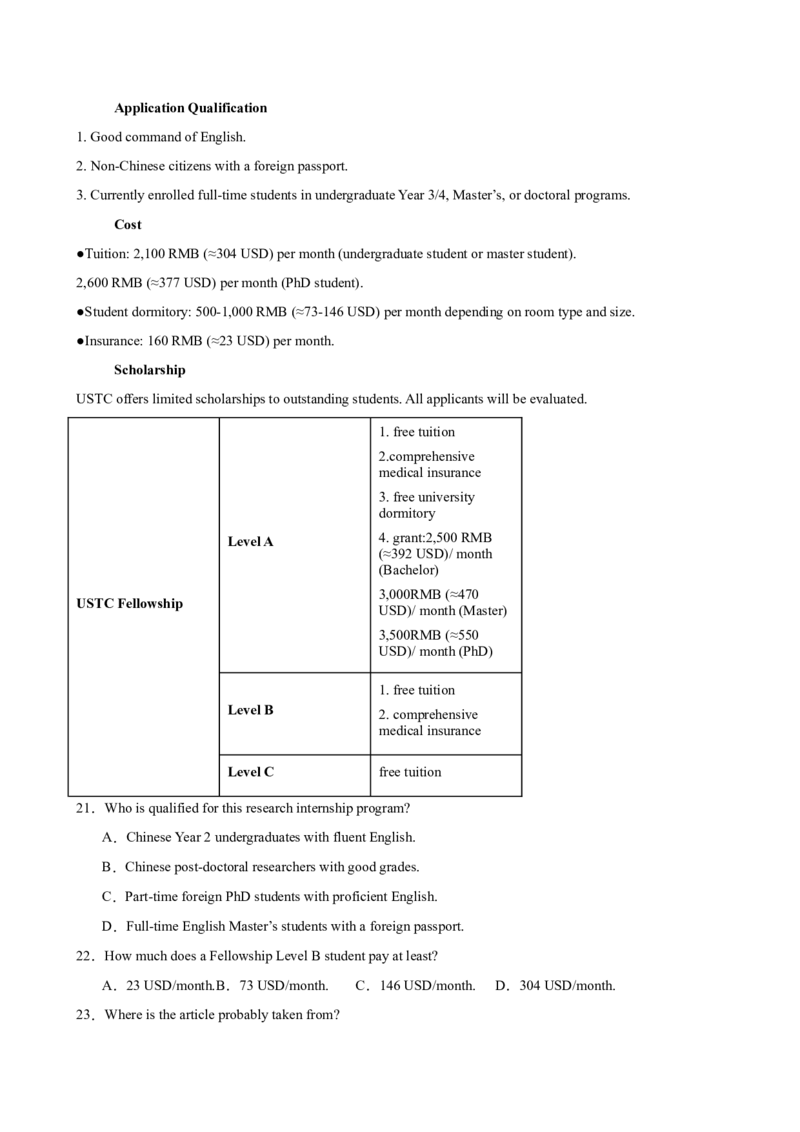
Scholarship
USTC offers limited scholarships to outstanding students. All applicants will be evaluated.
USTC Fellowship
Level A
1. free tuition
2.comprehensive
medical insurance
3. free university
dormitory
4. grant:2,500 RMB
(≈392 USD)/ month
(Bachelor)
3,000RMB (≈470
USD)/ month (Master)
3,500RMB (≈550
USD)/ month (PhD)
Level B
1. free tuition
2. comprehensive
medical insurance
Level C
free tuition
21.Who is qualified for this research internship program?
A.Chinese Year 2 undergraduates with fluent English.
B.Chinese post-doctoral researchers with good grades.
C.Part-time foreign PhD students with proficient English.
D.Full-time English Master’s students with a foreign passport.
22.How much does a Fellowship Level B student pay at least?
A.23 USD/month.B.73 USD/month.
C.146 USD/month.
D.304 USD/month.
23.Where is the article probably taken from?
A.An official notice page.
B.A college travel brochure.
C.Chinese language textbook.
D.An online job-hunting website.
B
When the bell rang for recess, children quickly poured out. However, ragged Vincent Sabella was left out.
He didn’t join the boys gathering around the horizontal bar, or the ones whispering in a far corner, nor the larger
group chasing in circles. Initially, he pretended to be busy with his shoelaces, bending to undo and retie them.
After repeating this for five minutes, he began casting stones at an invisible target— another five minutes gone,
with five still left. Then he just stood there, hands in pockets, then on hips.
Miss Price stood watching, wondering whether to intervene. Knowing the new boy was adopted from an
orphanage filled her with a sense of mission. She managed to control the urge that day and every day that week.
Her anxiety showed in class, though. His schoolwork errors were excused publicly, while his achievements got
special mention. Her campaign to build him up was painfully obvious. For instance, she would say, “Suppose
Vincent Sabella went to the store with fifteen cents. Candy bars cost five cents each. How many would he have?”
He was well on the way to becoming a teacher’s pet.
On Friday, Miss Price decided to speak to him privately. But lunchtime was trying for Vincent. Unlike
others who went home, he had lunch in the classroom from a wrinkled paper bag, which made for awkwardness.
And her visit didn’t help. The room still half full, she sat beside him, obviously sacrificing her lunch break.
Mumbling (嘟囔), he shifted his eyes to the departing children. With the door closed behind the last child, he
finally gave her his full attention. The more she talked, the more he seemed to relax. She went right on, feeling it
was as simple and satisfying as stroking a cat.
24.What do the three “five minutes” imply?
A.Vincent failed to integrate.
B.Miss Price observed keenly.
C.Vincent followed a routine.
D.Vincent’s school life was boring.
25.The underlined phrase in paragraph 2 probably refers to someone ________ by the teacher.
A.highly valued for nobility
B.overly pitied for misfortune
C.deeply admired for excellence
D.sharply criticized for misbehavior
26.What can we infer about the talk from paragraph 3?
A.It embarrassed Vincent.
B.It finally put Vincent at ease.
C.It didn’t satisfy Miss Price.
D.It was interrupted by others.
27.Which words best describe Miss Price?
A.Patient and empathetic.
B.Optimistic and creative.
C.Humble and responsible.
D.Caring and courageous.
C
A typical single-family house is encircled by green, its shrubs (灌木) and plants sitting just under windows
and hugging external walls. It’s an image that California is trying to get homeowners to rethink as the state’s risk
of extreme wildfires grows.
One year after the fast-moving Eaton and Palisades Fires destroyed more than 16,000 structures in Los
Angeles, California is drafting the toughest statewide rules in the country for vegetation. In areas at risk of
wildfires, homeowners would be required to clear some or all of the plants within five feet of their house,
depending on what regulators decide. Well-maintained trees would still be allowed. The idea, called Zone Zero, is
to prevent plants and flammable items from catching fire during a wildfire, spreading flames to the house and the
surrounding neighborhood.
Still, the pushback has been strong, even in the Los Angeles area neighborhoods where so many lost homes.
In public meetings, homeowners have voiced concerns about losing greenery and shade, as well as the cost of
clearing the vegetation. Some say they believe plants saved their homes by acting as a buffer (缓冲), though many
scientific studies show that vegetation increases the risk a building will burn. The new defensible space rules will
affect about 17% of buildings in California.
Max Moritz, wildfire specialist at UC Santa Barbara, is one of the few fire experts who say that green
plants may not pose a risk to houses and that more research needs to be done. Greener plants, which hold water in
their leaves, are harder to ignite. He agrees that some plants, like highly flammable juniper and cypress, should
not be allowed, nor should plants with dead leaves or dry branches.
“The really important aspect to the plants is the dead material,” he says. “If most homeowners are just
going to let dead material accumulate in Zone Zero anyway, then it makes sense that there shouldn’t be any plants
in Zone Zero.”
28.What is California’s concern about typical single-family houses?
A.They are easy to catch fire.
B.They need routine maintenance.
C.They are packed closely together.
D.They can’t resist extreme weather.
29.Why does the author mention Los Angeles in paragraph 3?
A.To illustrate the severity of wildfires.
B.To show strong objections to the new rules.
C.To emphasize public concerns about wildfires.
D.To indicate the widespread effect of the new rules.
30.According to Moritz, what is the key to preventing wildfires in Zone Zero?
A.Clearing away green plants.
B.Watering plants more often.
C.Getting rid of dead material in time.
D.Doing more research on plants.
31.What can be a suitable title for the text?
A.Wildfires: A Deadly threat to California
B.Zone Zero: A New Way to Maintain Plants
C.California is Drafting Toughest Rules for Plants
D.Experts are Divided on the Functions of Greenery
D
A recent study from the University of California San Diego reveals a surprising factor affecting global crop
stability: the original source of rainfall. Published in Nature Sustainability, the research tracks atmospheric
moisture back to where it first evaporated, whether from oceans or land surfaces like soil, lakes, and forests.
Sunlight heats these surfaces, turning water into vapor that rises and eventually returns as rain. While ocean-
derived moisture often travels across continents in large weather systems, land-based moisture, known as recycled
rainfall, fuels more localized storms. The study finds that the balance between ocean and land moisture strongly
influences regional drought risk and farm productivity.
“Our work changes how we view drought risk,” said Yan Jiang, the study’s lead author. “It is not just about
the amount of rain, but where that rain comes from.” Using nearly 20 years of satellite data, researchers
discovered that when more than one-third of precipitation originates from land, croplands become significantly
more vulnerable to drought. Ocean-driven systems usually bring heavier, consistent rain, whereas land-driven
systems produce lighter, less predictable showers. This makes crops especially weak during critical growth stages
when water is most needed.
The research highlights two high-risk areas: the U.S. Midwest and tropical East Africa. In the Midwest,
frequent droughts may be worsened by a reliance on land-sourced moisture. When soil dries out, evaporation
decreases, leading to less future rain — a self-reinforcing cycle known as a “rainfall feedback loop.” Since this
region supplies much of the world’s grain, such disruptions affect global food markets. Farmers there may need to
focus on saving soil moisture and improving irrigation efficiency to break this cycle.
East Africa faces a different challenge. Rapid expansion of farmland and loss of nearby rainforests threaten
the very moisture sources that sustain local rainfall. “Farmers are clearing forests to grow crops, but those forests
help generate the rain the crops need,” Jiang explained. If these moisture sources disappear, local food security
will be at greater risk. However, smarter land management, such as conserving forests, can still protect rainfall
patterns.
Ultimately, the study emphasizes that forests act as natural rainmakers. By releasing water vapor through
transpiration, they help form clouds that rain over surrounding fields. Protecting these ecosystems is not just about
biodiversity; it is essential for sustaining agriculture. This new framework links land use decisions with rainfall
patterns, offering a vital tool for climate-smart planning and drought resilience in a changing world.
32.What makes crops more likely to suffer from drought according to the study?
A.The total amount of annual rainfall.
B.The distance moisture travels from oceans.
C.A high proportion of rain coming from land.
D.The speed at which water evaporates from soil.
33.What can be inferred about the “rainfall feedback loop” in the Midwest?
A.It helps farmers predict weather changes accurately.
B.It creates a cycle where dry land leads to less rain.
C.It increases the consistency of ocean-driven storms.
D.It reduces the need for irrigation in grain production.
34.What is the main conflict facing farmers in East Africa?
A.They lack technology to track satellite data.
B.They must choose between growing crops and preserving rain sources.
C.They rely too heavily on ocean-derived moisture for farming.
D.They are forced to move their farms to coastal regions.
35.What is the author’s purpose in mentioning forests in the last paragraph?
A.To argue for stopping all agricultural expansion.
B.To explain how biodiversity protects animal habitats.
C.To highlight the role of ecosystems in maintaining rainfall.
D.To suggest replacing forests with more efficient irrigation systems.
第二节(共5 小题;每小题2.5 分,满分12.5 分)
阅读下面短文,从短文后的选项中选出可以填入空白处的最佳选项。选项中有两项为多余选项。
We’ve all had that annoying experience; another driver cuts you off in traffic, and suddenly, you feel angry
for the rest of your trip. A single event causes an emotional response in the brain, and it seems to last long. 36
A new study offers some clues by looking at how both mice and people react to a simple, annoying stimulus.
According to Dr. Karl Deisseroth, a psychiatrist at Stanford University, feeling angry at one thing, like a
bad driver, can make you more likely to get angry at something else, like a noisy child. 37
They decided on a gentle puff (a small amount) of air to the eye. It’s certainly annoying, but not painful.
They believed both humans and mice would react to it in a similar way. They were right. 38 After
several puffs, both started to squint (眯眼) in a defensive, lasting reaction. The scientists then studied the brain
activity linked to this experience. They discovered that the brain responds in two clear phases (阶段).
39 This is when the brain areas that handle sensory information — what we see, hear, and feel —
become highly active for just an instant.
Right after, the second phase begins. In this phase, brain activity moves to other areas, including those
linked to emotions. This phase is longer and more lasting, like a musical note that is held. 40 With each
new puff of air, this lasting response became stronger. Dr. Deisseroth connects this directly to what emotion is: a
lasting state that changes how we feel and act.
A.But how does the brain identify this?
B.Each new puff made this second part stronger.
C.But how does this process happen inside our brains?
D.Both people and mice closed eyes when they felt the air puff.
E.The first phase is very quick, like a short, sharp musical note.
F.To understand this better, he and his team designed a lab experiment.
G.It’s this lasting brain activity that seems to create the ongoing emotional state.
第三部分 语言运用(共两节,满分30 分)
第一节 (共15 小题;每小题1 分,满分15 分)
阅读下面短文,从每题所给的A、B、C、D 四个选项中选出可以填入空白处的最佳选项。
Last summer, I went hiking with some friends when the sky suddenly darkened and thunder rumbled (发出
隆隆声). As we hurried back, my classmate Lily 41 on a rock and fell into a shallow stream, hitting her
head against a stone. Blood 42 seeped (渗出) from her head and she lay there 43
My mind went 44 initially. “Call an ambulance!” someone shouted, but it would take hours for it
to arrive. Remembering the basic first-aid course I’d taken, I knelt down, my hands shaking. I pressed 45
on her wrist to check her pulse. It was faint but 46 . I then used my scarf to apply pressure to the wound.
Our instructor had emphasized not moving someone with a 47 injury.
Minutes 48 . Lily started shaking, and her breathing became shallow. 49 rose in my
chest, but I forced myself to stay 50 . I remembered to keep injured people warm. Quickly, I 51
my jacket and covered her, 52 , another friend separated her from the damp ground.
Just then, some local farmers, alerted ( 警觉) by our shouts, appeared with a stretcher. They praised my
actions, saying my 53 thinking had prevented shock from worsening.
At that moment, I 54 how fragile (脆弱的) life is and how powerful knowledge can be.
Sometimes, the most important lessons come not from textbooks, but from 55 where we choose to step
up. Now, whenever I see a first-aid kit, I remember: preparedness turns panic into hope.
41.A.wandered
B.waved
C.slipped
D.skipped
42.A.secretly
B.eventually
C.accidentally
D.immediately
43.A.motionless
B.fearless
C.tireless
D.painless
44.A.open
B.full
C.blank
D.narrow
45.A.tightly
B.gently
C.violently
D.comfortably
46.A.slow
B.steady
C.abnormal
D.obvious
47.A.head
B.shoulder
C.neck
D.nose
48.A.went over
B.passed down
C.went by
D.passed along
49.A.Pain
B.Stress
C.Doubt
D.Panic
50.A.calm
B.quiet
C.guilty
D.energetic
51.A.grasped
B.removed
C.buttoned
D.tore
52.A.however
B.otherwise
C.meanwhile
D.therefore
53.A.critical
B.abstract
C.forward
D.quick
54.A.realized
B.predicted
C.imagined
D.insisted
55.A.stages
B.occasions
C.experiences
D.adventures
第二节(共10 小题;每小题1. 5 分, 满分15 分)
阅读下面材料,在空白处填入适当的内容(1 个单词)或所给单词的正确形式。
China is home to many awe-inspiring architectural landmarks — from Chongqing East Railway Station, the
largest train station in the world, to one of the world’s most beautiful 56 (bookstore) in Dujiangyan.
Now, the country has added another record-breaker 57 its list: the world’s largest physical bookstore.
58 (build) and operated by Shenzhen Publishing Group, the super bookstore is located in
Shenzhen’s Bao’an District. This cultural complex covers 59 area of 131,000 square metres — nearly
the size of 18 football fields, or the entire Louvre Museum in Paris.
Inside this grand space lies a treasure trove of over 100,000 books across a 60 (vary) of genres.
The venue also 61 (feature) an open-air rooftop garden, themed reading zones, a theatre and a museum
that 62 (regular) hosts exhibitions. In addition, there’s also a tech zone 63 visitors can explore
interactive AI installations, drones and other cutting-edge gadgets (小器具).
On Aug. 26, 2025, this super bookstore launched a soft opening, hosting an advance visit for over 100
64 (profession) book reviewers and senior members. The event featured a reading session with a renowned
writer and 65 (follow) by a small music and art salon.
第四部分 写作(共两节, 满分40 分)
第一节(满分15 分)
66.假定你是李华,下周有新西兰学生访问你校,并参加“校园文化节”(Campus Culture Festival),你将
作为学生代表致欢迎辞。请为此写一篇发言稿,内容包括:
(1)表示欢迎;
(2)介绍活动安排。
注意:
(1)写作词数应为80 左右;
(2)请按如下格式在答题卡的相应位置作答。
Dear friends,
___________________________________________________________________________________________
___________________________________________________________________________________________
___________________________________________________________________________________________
___________________________________________________________________________________________
___________________________________________________________________________________________
_____
第二节(满分25 分)
67.阅读下面材料,根据其内容和所给段落开头语续写两段,使之构成一篇完整的短文。
We walk to the harbor, the early morning sun just beginning to burn pink through the fog. We’ve come to
say goodbye.
“Bye, sailboats,” Mom says. My little brother, Ben, waves his fist. “Goodbye, harbor,” Dad says. I
remember clouds of seagulls (海鸥) following the fishing boats, hoping to snap up shellfish tossed overboard.
“Any last farewells, Marissa?” Dad asks me. I bite my lower lip. Goodbye, home.
When mom and dad announced we were moving, Dad said we were going “home.” He meant out west,
where Grandma and Grandpa raised him along with lots of chickens and cattle. “The desert is beautiful in its own
way,” Dad said. I tried to smile. But I knew mountains would only stand between me and the rosy sun rising over
the ocean. “We’ll find new things to love,” Mom promised. But I knew I’d never love anything as much as waking
up to the sound of a seagull’s cry.
After five days of driving across rolling prairie, we see mountaintops on the horizon. On day six, we pull
into Grandpa’s dusty driveway. I sigh. Now this is our house, until Mom and Dad can find a new one to buy.
I take the attic (阁楼) bedroom with pink wallpaper covering the ceiling. The night before I go to school, I
pull my notebook out from under the bed. I’ve started a list of Old Things I Miss: the salt scent instead of farm
stink, seagulls instead of chickens, friends to play with instead of only Ben. I flip the page over, where I’ve started
another list: New Things I Love. It’s still blank. That night I dream of seagulls calling, their cries rising and falling
with the wind. They sail across the sky, following the fishing boats.
注意:
1.写作词数应为150 个左右;
2.请按如下格式在答题卡的相应位置作答。
The next morning, I open my eyes to the ceiling, but I still hear seagulls.
___________________________________________________________________________________________
___________________________________________________________________________________________
___________________________________________________________________________________________
___________________________________________________________________________________________
___________________________________________________________________________________________
_____
Dad tells me that these desert seagulls came here 150 years ago.
___________________________________________________________________________________________
___________________________________________________________________________________________
___________________________________________________________________________________________
___________________________________________________________________________________________
___________________________________________________________________________________________
_____