09 天气与气候
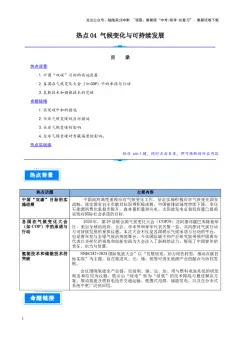
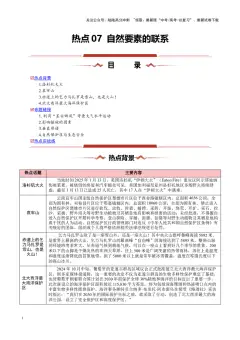
天气与气候时事热点资讯
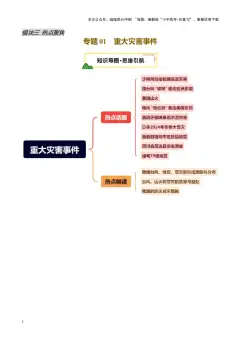
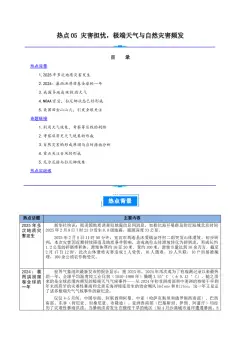
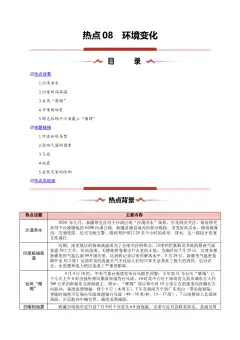
台风“摩羯”在越南造成58人死亡、40人失踪
来源:新华网2024-09-10 15:23
新华社快讯:据越南农业与农村发展部10日消息,截至当地时间9日22时,台风“摩羯”在越南已造成
58人死亡、40人失踪。
这两天今年第11号台风“摩羯”成为人们关注的焦点,7日15时30分“摩羯”在越南沿海再次登陆,这是
其以超强台风级第三次登陆随后其深入越南内陆强度便开启快速减弱模式
受“摩羯”影响9月6日20时~8日16时我市大部地区出现大暴雨局地特大暴雨沿海及海面阵风10~13
级
10日,中到大雨,局部暴雨,并可能伴有短时雷暴大风天气。
11日,中雨,局地大雨到暴雨,偏北风3~4级。
北部湾海面:今天晚上,大雨、局地暴雨,偏南风4~5级、阵风6~7级;9日,大雨到暴雨、局地大暴
雨,东南风5~6级;10日,大雨到暴雨、局地大暴雨,偏东风4~5级、阵风6级。11日,大雨,偏北风
5~6级。未来三天,雷雨时有8级以上大风。
大家要继续防范强降雨及其可能引发的中小河流洪水、山洪及地质灾害
并警惕局地雷暴大风等强对流天气的危害,注意出行安全。
阅读拓展词汇清单
threaten 威胁
planet 地球
industrialisation 工业化
disposable culture 一次性文化
average temperature 平均温度
extreme weather 极端天气
global temperatures 全球气温
centigrade 摄氏度的climate impacts 气候变化的影响
The World Meteorological Organisation 世界气象组织
the Arctic 北极圈
the Siberian Arctic 西伯利亚北极地区
heat 炎热;高温
fan 扇,吹(使火更旺)
carbon dioxide 二氧化碳
rising sea levels 海平面上升
global warming 全球气候变暖
ripple out 蔓延
carbon emissions 碳排放
heatwave 酷热期;热浪期
severe storm 强烈风暴
拓展阅读训练
The time for action is now, at least when it comes to climate change. If we don’t take measures that limit
global warming, it may be impossible to stop its progress, according to a study published in 2018.
The study claims that in 2035, we will cross a point of no return — after which it will be extremely unlikely
that we can stop Earth’s temperature from rising by 2 degrees Celsius (2℃) and kicking off dangerous global
disasters.
The 2℃ mark is very important for Earth’s well-being. Once the planet warms an additional 2℃, scientists
predict a range of disastrous effects, from widespread flooding in coastal areas to burning heat waves and extreme
storms.
One important area that could slow the movement toward a point of no return in 2035 is the changing from
fossil fuels (矿物燃料) to renewable energy sources. But even this will require significant progress. Scientists have
figured that the share of renewables worldwide must grow by at least 2 percent each year in order to slow the
process toward climate change. Two percent a year may not sound like much, but in the 20 years leading up to
2017, the percentage of energy from renewables grew by a poor total of 3.6 percent.
There is hope, though. If the use of renewable energy were to go beyond the scientists’ model, say by 5
percent per each year, the climate change deadline (最后期限) could move back by at least a decade, theresearchers note. Also, developing technology to remove greenhouse gases from the atmosphere could help slow
climate change. These gases change Earth’s atmosphere and allow it to capture more heat from the sun and cause
temperatures to rise.
“We hope that ‘having a deadline’ may stimulate the sense of urgency to act for policy makers,” Henk
Dijkstra, one of the study authors, said. “Very little time is left.”
1.What might happen once the Earth warms an additional 2℃?
A.The climate system will be rebuilt.
B.Global warming is uncontrollable.
C.Natural disasters become unavoidable.
D.Timely action will no longer be necessary.
2.What does the underlined “this” in paragraph 4 refer to?
A.The advances of scientific research.
B.The shift from fossil fuels to renewables.
C.The process of slowing down climate change.
D.The increase of public environmental awareness.
3.What is paragraph 5 mainly about?
A.The limitation of scientists’ model.
B.Possible solutions to slowing climate change.
C.The value of the ‘point of no return’ concept.
D.Serious effects of greenhouse gases on Earth.
4.Why do the researchers set a deadline?
A.To stress the need of global cooperation.
B.To call on people to use renewable energy.
C.To urge policy makers to take immediate action.
D.To show their determination to stop global warming.
高频词汇训练
单词拼写
1.He is now busy making decisions about everything from how to (装修) his new apartment to how to
find his dream job. (根据汉语提示单词拼写)
2.The Spring (节日), which falls between the first and 15th day of lunar January, is the time for
family members to reunite. (根据汉语提示单词拼写)3.I work hard to improve my English studies, and I believe my (努力) won’t be wasted.
4.If you (努力/奋斗) to do something, you try hard to do it, even though other people or things may be
making it difficult for you to succeed. (根据汉语提示单词拼写)
5.Having dreams means intense concentration on (特定的) goals, which undoubtedly increases the
possibility of success. (根据汉语提示单词拼写)
6.Real (友谊) is more valuable than money. A friend is someone whom you could tell everything to,
also the one who understands what you are going through. (根据汉语提示单词拼写)
7.The company used to have 230 employees (总共) and their income (总数达) 50,000
yuan per year. But last year things changed (完全) and the products could not be sold out. Most of the
workers became out of work, which made them in (彻底的) despair. (根据汉语提示单词拼写)
8.When the torch went by us, we all became so excited that we all (欢呼), shouted, and waved the
national flags, having totally forgotten the hot weather. (根据汉语提示单词拼写)
9.Personally, the best (选择) is a good major at a good university. If we can’t obtain both, the first
thing to consider is a good major. (根据汉语提示单词拼写)
10.More than 6,000 people from all walks of life in Chaozhou took part in the (仪式), including
students from primary, high schools and universities. (根据汉语提示单词拼写)
理解七选五
(一)
Climate anxiety is appearing as a serious mental health concern, particularly among children, teens, and
young adults, with symptoms ranging from frustration to constant anxiety.
A recent global survey illustrates the depth of anxiety many young people are feeling about climate change,
with nearly 60% admitting feeling worried. Signs of climate anxiety include: They feel helpless about climate
change. 11 They actively check climate news and weather forecasts. They experience physical symptoms
such as headaches, shortness of breath, and racing heartbeats.
So how do we cope with climate anxiety? The first step is to understand that our reactions are normal. 12
However, you can learn to deal with it. You are experiencing climate anxiety because you care about what is
happening to our planet; that’s a good thing.
Next, try to find small reasons to be hopeful. Our natural preference is to focus on the negative, and when it
comes to climate change, this can be unbearable. We may destroy the future, thinking about all the ways climate
change could ruin our lives. 13
It can also help to remember that you’re not alone. 14 Fortunately, there are ways to cope.Connecting with other like-minded people who are working to fight climate change can help you feel less alone. A
variety of organizations are taking climate action, and many are made up of people just like you.
15 Get involved in activism can help you feel like your efforts are making a difference. Whether it’s
writing to a politician or participating in marches, and get involved is an important step toward climate wellness.
A.Don’t forget to take action.
B.You have many people to turn to.
C.They worry extremely about the future.
D.This can lead to feelings of powerlessness.
E.They need support from others a great deal.
F.The climate crisis is alarming and overwhelming.
G.Many people are struggling with these feelings.
(二)
With disastrous global warming already part of the climate system, today’s children face a future entirely
unlike that of their parents. Unsurprisingly, children can have many feelings about climate change, such as being
anxious, frightened, sad and angry. In a recent survey of American teenagers, 57 percent said that climate change
made them feel scared and 52 percent said it made them feel angry. 16 .
The most important thing parents can give children is hope: there are solutions, and everyone has something
to contribute, whatever their age. Parents can help them discover the facts, know that they are not alone and find
ways to take action. 17 , which will help them manage their anxiety. It can also inspire constructive
conversations that lead to collective action. However, that can feel hard for many parents.
18 . But learning about the basics is “a critical first step in being able to talk”, according to Harriet
Shugarman, who is the author of How to Talk to Your Kids About Climate Change. She is a nationally recognized
influencer and trusted advisor to parents. 19 . Understanding the science equips them to make informed
decisions.
Coverage includes:
·The realities of the climate emergency, where we are, and how we got here. It casts light on the historical
progression of climate change.
·Strategies for talking to kids of different ages about the climate crisis. These include advice from
experienced parents.
·How to keep our own hope and that of our children.
·A list of practical actions. 20 .A.They tell families what they can do to deal with climate crisis
B.Use it as a chance to listen to their fears and hopes for the planet
C.Talking about climate change is key to preparing them for the future
D.Children can learn what a livable as well as green world looks like
E.These are very natural reactions to something uncertain and destructive
F.Parents needn’t be experts on climate science to explore the topic with children
G.This book offers both hope and practical ways to involve children in making a better world
完形填空
The Grey’s Anatomy doctors are navigating the patients that have kept them on our screens for some 400
episodes of the show. But in this episode, for the first time, the 21 to the drama is the very real issue of
climate change. It’s a relatively rare example of the many kinds of climate-related storylines that are typically
missing from 22 TV and film worlds. Social scientists argue that climate is a topic that belongs in many
kinds of on-screen stories, not just the 23 climate-disaster thriller.
But can seeing the realities of climate change affecting characters on the screen help us relate 24 to the
unfolding climate crisis – to cope better, or even change our behavior?
Non-profit storytelling consultancy Good Energy believes it can. It is among a small but growing number of
organizations 25 far more TV and film scripts to 26 climate-related storylines. In April 2022, it
released its Good Energy Playbook, a set of guidelines for embedding climate change into any on-screen story. It
joins other initiatives in drawing attention to the need for film and TV to 27 the numerous ways climate
change leaves its mark on our everyday lives.
The Good Energy Playbook’s suggestions are appropriately wide-ranging: characters with climate anxiety and
those fighting against injustice; utopian (乌托邦的) narratives that explore climate solutions; storylines that quietly
28 climate references into their characters’ worlds.
The playbook was created by Good Energy founder Anna Jane Joyner, “It started as a personal 29 ,
where I just got on the phone with as many screenwriters as I could,” she says. She quickly learned that writers
wanted to talk about climate, but “didn’t really have the support and toolset to be able to do it”.
Many research studies looked at the impact introducing climate stories had on viewers, and found it prompted
greater concern about climate change. It also 30 people’s understanding of it and made them more likely
to take action to reduce their emissions. 31 , science tells us that stories have a power that hard facts often
don’t. Research has long established that the human brain finds it easier to understand and remember information
delivered as a 32 , and has even found that stories can influence behavior.Climate stories, then, seem like a pretty good idea. But these sorts of narratives have been few and far
between. Julie Doyle, professor of media at the University of Brighton in the UK, says climate change has 33
for years to get into any form of fictional film or TV representation. “There’s been a silence around it,” she says.
It’s time to break the climate silence, says Doyle. “Mainstream media has tended to follow rather than lead,
and it would be great if mainstream media could lead this.” Day-to-day mentions of climate change in media are
especially important because, while blockbuster climate films can have a positive impact on awareness and action,
the effect is sadly 34 . People can feel inspired to take action in the moment, but the feeling 35
in a matter of weeks.
21.A.resistance B.background C.response D.application
22.A.fictional B.scientific C.educational D.theoretical
23.A.logical B.moral C.occasional D.spiritual
24.A.differently B.effortlessly C.reluctantly D.systematically
25.A.depending on B.referring to C.identifying with D.calling for
26.A.restore B.feature C.demonstrate D.sponsor
27.A.reflect B.maintain C.eliminate D.strengthen
28.A.integrate B.reverse C.initiate D.publish
29.A.transition B.campaign C.achievement D.association
30.A.transferred B.promoted C.shifted D.underestimated
31.A.For example B.As a result C.On the contrary D.In addition
32.A.narrative B.character C.plot D.memory
33.A.explored B.competed C.struggled D.appealed
34.A.narrow-mindedB.ever-changing C.short-lived D.far-sighted
35.A.resumes B.fades C.deepens D.increases
语篇填空
阅读下面短文,在空白处填入1个适当的单词或括号内单词的正确形式。
According to a recent study led by Miquelle, 46 Amur tigers were identified in four forested landscapes in
China. “Persistent efforts 36 (protect) tigers have paid off,” Miquelle said. The reason for the tigers’
sudden 37 (appear) in northeast China is due, in a large part, to a Chinese national policy called the
Natural Forest Protection Project (NFPP). “By stopping the harvesting of trees in many parts of China, they
essentially made whole villages whose economy, in the past, 38 (base) on timber harvest economic
wastelands,” Miquelle said. 39 the timber industry shutting down, the forests were able to recover, andthat’s “a big reason 40 tigers are expanding.”
The NFPP has shifted China toward environmental stewardship and wildlife protection. In 2016, China
established the Northeast Tiger Leopard National Park, which covers nearly 15,000 square kilometers, 41
(represent) the largest tiger shelter in the world. “China is working hard to turn this national park into 42
model for conservation,” Miquelle said.
Amur tigers may be well protected in northeastern China now, 43 they will face a number of threats
44 (link) to climate change. With a more changeable or 45 (dry) climate, forest fires pose a
serious threat to tiger habitat.