1
Unit 7 语法篇
__________________________________________________________________________________
__________________________________________________________________________________
熟练掌握本章重点语法知识。
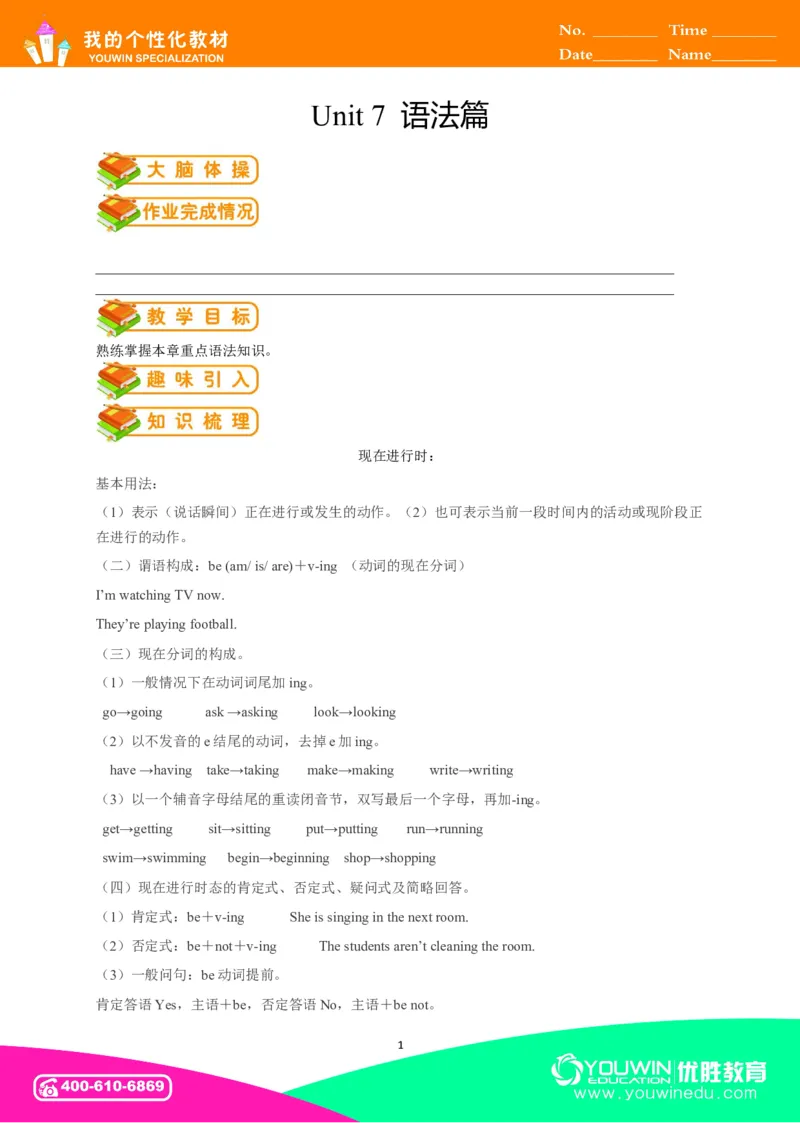
现在进行时:
基本用法:
(1)表示(说话瞬间)正在进行或发生的动作。(2)也可表示当前一段时间内的活动或现阶段正
在进行的动作。
(二)谓语构成:be (am/ is/ are)+v-ing (动词的现在分词)
I’m watching TV now.
They’re playing football.
(三)现在分词的构成。
(1)一般情况下在动词词尾加ing。
 go→going      ask →asking     look→looking
(2)以不发音的e 结尾的动词,去掉e 加ing。
  have →having  take→taking    make→making     write→writing
(3)以一个辅音字母结尾的重读闭音节,双写最后一个字母,再加-ing。
 get→getting     sit→sitting     put→putting    run→running
 swim→swimming   begin→beginning  shop→shopping
(四)现在进行时态的肯定式、否定式、疑问式及简略回答。
(1)肯定式:be+v-ing            She is singing in the next room.
(2)否定式:be+not+v-ing           The students aren’t cleaning the room.
(3)一般问句:be 动词提前。
肯定答语Yes,主语+be,否定答语No,主语+be not。
2
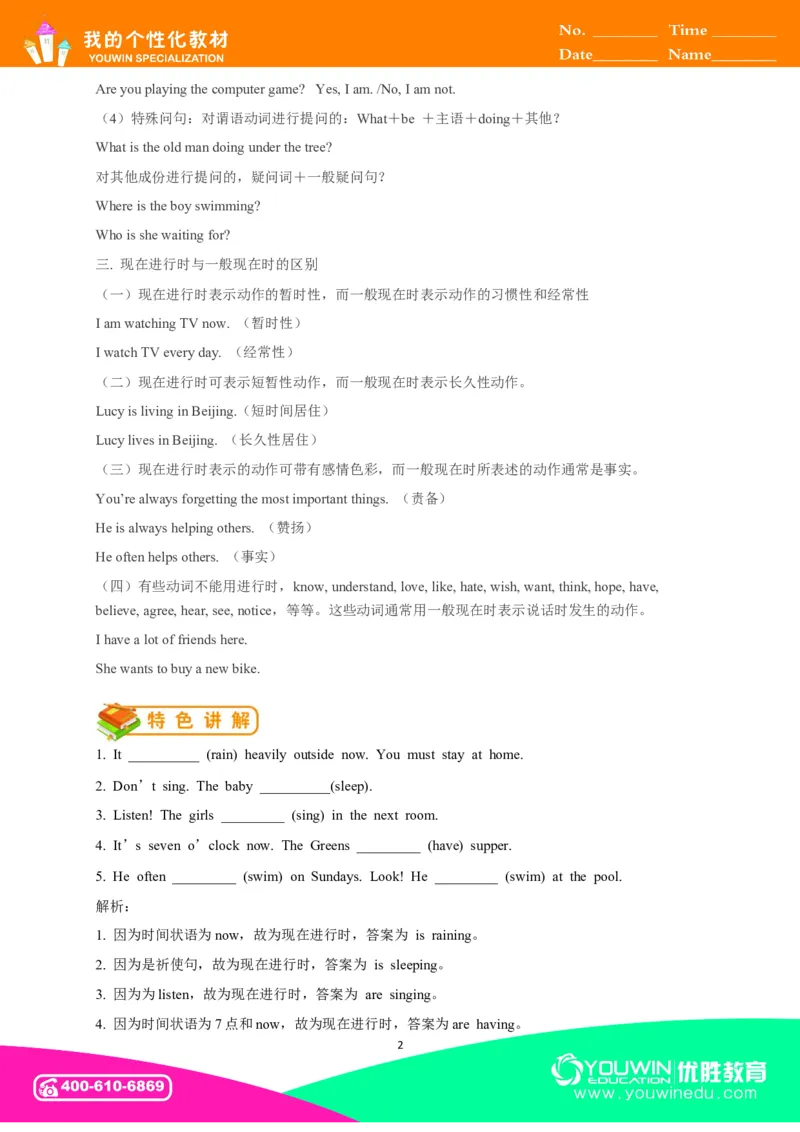
Are you playing the computer game?  Yes, I am. /No, I am not.
(4)特殊问句:对谓语动词进行提问的:What+be +主语+doing+其他?
What is the old man doing under the tree?
对其他成份进行提问的,疑问词+一般疑问句?
Where is the boy swimming?
Who is she waiting for?
三. 现在进行时与一般现在时的区别
(一)现在进行时表示动作的暂时性,而一般现在时表示动作的习惯性和经常性
I am watching TV now. (暂时性)
I watch TV every day. (经常性)
(二)现在进行时可表示短暂性动作,而一般现在时表示长久性动作。
Lucy is living in Beijing.(短时间居住)
Lucy lives in Beijing. (长久性居住)
(三)现在进行时表示的动作可带有感情色彩,而一般现在时所表述的动作通常是事实。
You’re always forgetting the most important things. (责备)
He is always helping others. (赞扬)
He often helps others. (事实)
(四)有些动词不能用进行时,know, understand, love, like, hate, wish, want, think, hope, have,
believe, agree, hear, see, notice,等等。这些动词通常用一般现在时表示说话时发生的动作。
I have a lot of friends here.
She wants to buy a new bike.
1. It __________ (rain) heavily outside now. You must stay at home.
2. Don’t sing. The baby __________(sleep).
3. Listen! The girls _________ (sing) in the next room.
4. It’s seven o’clock now. The Greens _________ (have) supper.
5. He often _________ (swim) on Sundays. Look! He _________ (swim) at the pool.
解析:
1. 因为时间状语为now,故为现在进行时,答案为 is raining。
2. 因为是祈使句,故为现在进行时,答案为 is sleeping。
3. 因为为listen,故为现在进行时,答案为 are singing。
4. 因为时间状语为7 点和now,故为现在进行时,答案为are having。
3
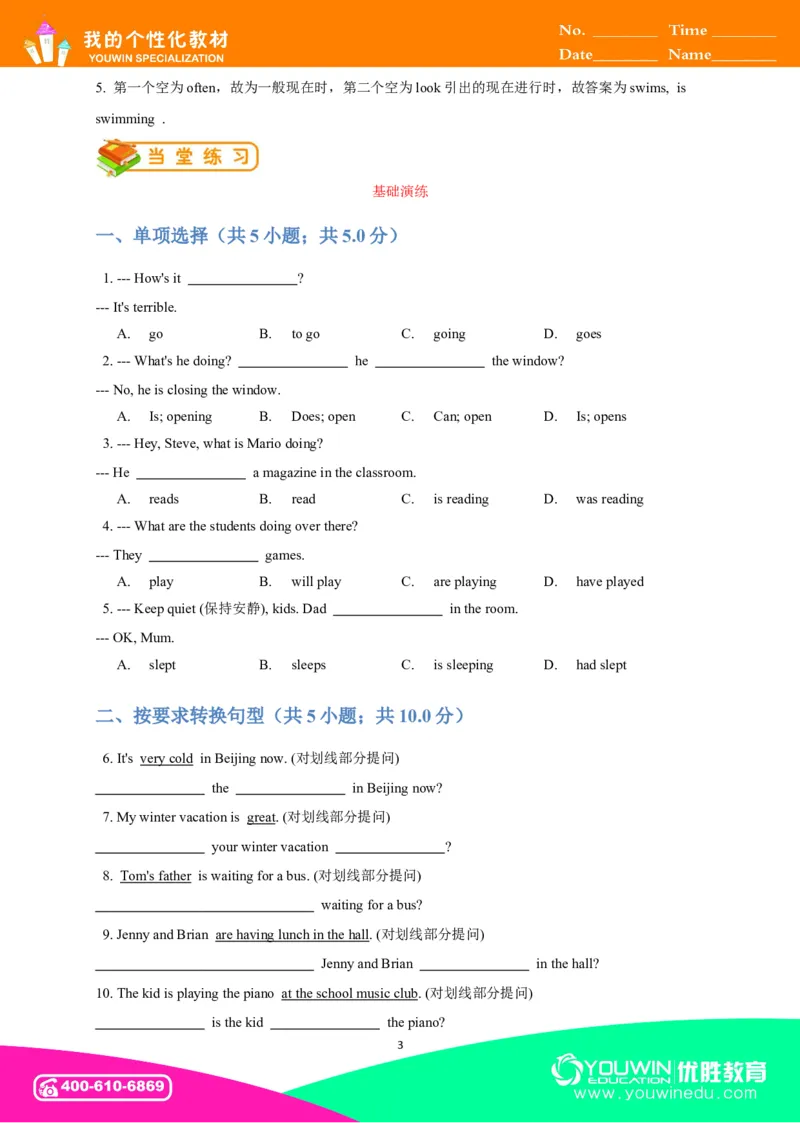
5. 第一个空为often,故为一般现在时,第二个空为look 引出的现在进行时,故答案为swims, is
swimming .
基础演练
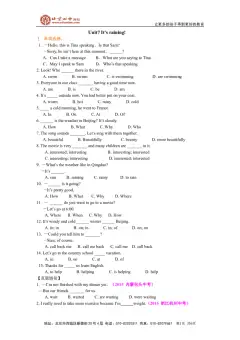
一、单项选择(共5 小题;共5.0 分)
 1. --- How's it

   ?
--- It's terrible.
A.
go
B.
to go
C.
going
D.
goes
 2. --- What's he doing?

    he

    the window?
--- No, he is closing the window.
A.
Is; opening
B.
Does; open
C.
Can; open
D.
Is; opens
 3. --- Hey, Steve, what is Mario doing?
--- He

    a magazine in the classroom.
A.
reads
B.
read
C.
is reading
D.
was reading
 4. --- What are the students doing over there?
--- They

    games.
A.
play
B.
will play
C.
are playing
D.
have played
 5. --- Keep quiet (保持安静), kids. Dad

    in the room.
--- OK, Mum.
A.
slept
B.
sleeps
C.
is sleeping
D.
had slept
二、按要求转换句型(共5 小题;共10.0 分)
 6. It's very cold in Beijing now. (对划线部分提问)


    the

    in Beijing now?
 7. My winter vacation is great. (对划线部分提问)


    your winter vacation

   ?
 8. Tom's father is waiting for a bus. (对划线部分提问)


    waiting for a bus?
 9. Jenny and Brian are having lunch in the hall. (对划线部分提问)


    Jenny and Brian

    in the hall?
10. The kid is playing the piano at the school music club. (对划线部分提问)


    is the kid

    the piano?
4
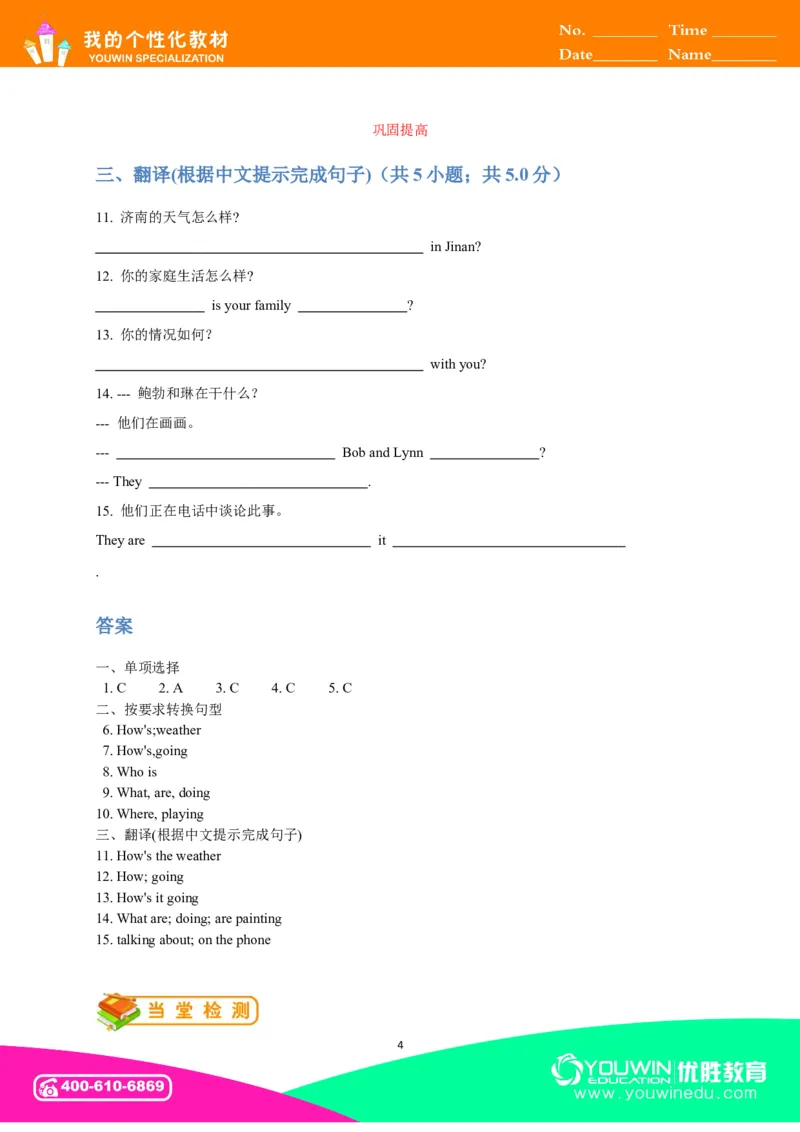
巩固提高
三、翻译(根据中文提示完成句子)(共5 小题;共5.0 分)
11. 济南的天气怎么样?


    in Jinan?
12. 你的家庭生活怎么样?


    is your family

   ?
13. 你的情况如何?


    with you?
14. --- 鲍勃和琳在干什么?
--- 他们在画画。
---


    Bob and Lynn

   ?
--- They


   .
15. 他们正在电话中谈论此事。
They are


    it


.
答案
一、单项选择
 1. C
 2. A
 3. C
 4. C
 5. C
二、按要求转换句型
 6. How's;weather
 7. How's,going
 8. Who is
 9. What, are, doing
10. Where, playing
三、翻译(根据中文提示完成句子)
11. How's the weather
12. How; going
13. How's it going
14. What are; doing; are painting
15. talking about; on the phone
5
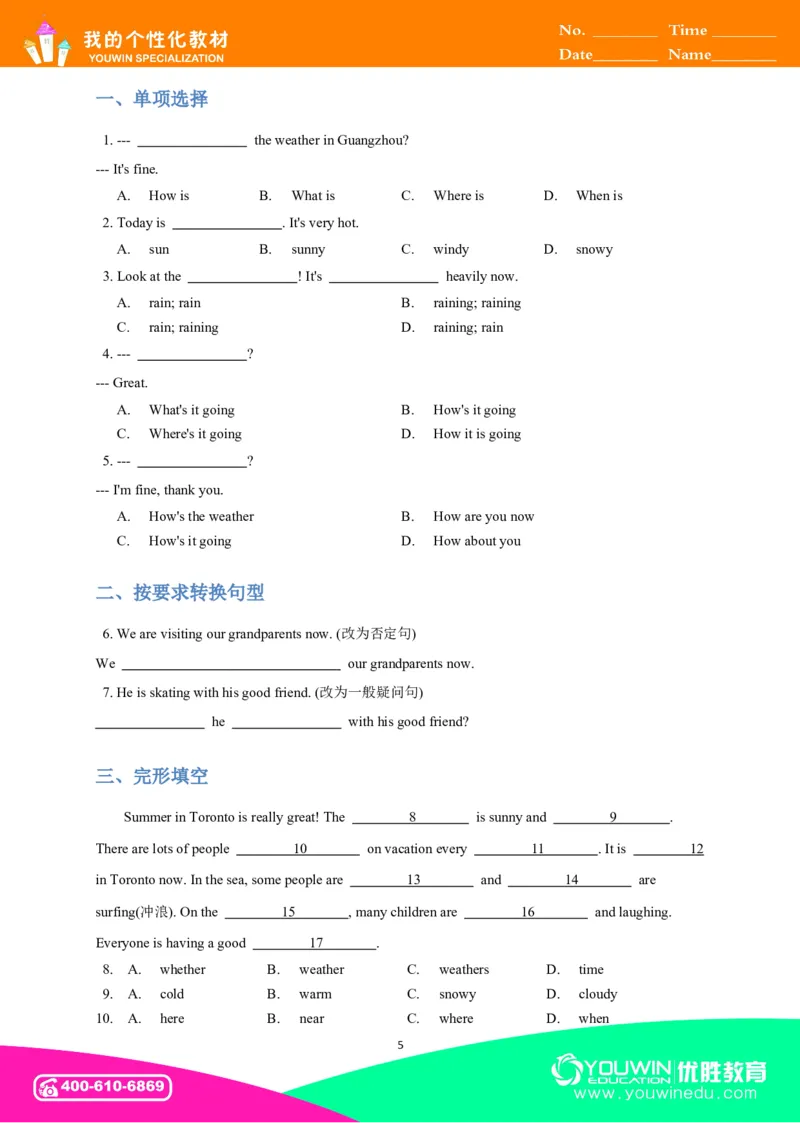
一、单项选择
 1. ---

    the weather in Guangzhou?
--- It's fine.
A.
How is
B.
What is
C.
Where is
D.
When is
 2. Today is

   . It's very hot.
A.
sun
B.
sunny
C.
windy
D.
snowy
 3. Look at the

   ! It's

    heavily now.
A.
rain; rain
B.
raining; raining
C.
rain; raining
D.
raining; rain
 4. ---

   ?
--- Great.
A.
What's it going
B.
How's it going
C.
Where's it going
D.
How it is going
 5. ---

   ?
--- I'm fine, thank you.
A.
How's the weather
B.
How are you now
C.
How's it going
D.
How about you
二、按要求转换句型
 6. We are visiting our grandparents now. (改为否定句)
We


    our grandparents now.
 7. He is skating with his good friend. (改为一般疑问句)


    he

    with his good friend?
三、完形填空
    Summer in Toronto is really great! The         8

    is sunny and         9

   .
There are lots of people         10

    on vacation every         11

   . It is         12
in Toronto now. In the sea, some people are         13

    and         14

    are
surfing(冲浪). On the         15

   , many children are         16

    and laughing.
Everyone is having a good         17

   .
 8.
A.
whether
B.
weather
C.
weathers
D.
time
 9.
A.
cold
B.
warm
C.
snowy
D.
cloudy
10.
A.
here
B.
near
C.
where
D.
when
6
11.
A.
one year
B.
years
C.
year
D.
month
12.
A.
winter
B.
summer
C.
spring
D.
autumn
13.
A.
swimming
B.
swiming
C.
swim
D.
swims
14.
A.
the other
B.
other
C.
others
D.
another
15.
A.
beach
B.
park
C.
garden
D.
sea
16.
A.
running
B.
run
C.
runs
D.
ran
17.
A.
vacations
B.
time
C.
fun
D.
times
一、单项选择
1. A 2. B
 3. C
 4. B
 5. B
二、按要求转换句型
6. aren't visiting
7. Is,skating
三、完形填空
8. B 9. B
10. A
11. C
12. B
13. A
14. C
15. A
16. A
17. B
_________________________________________________________________________________
_________________________________________________________________________________
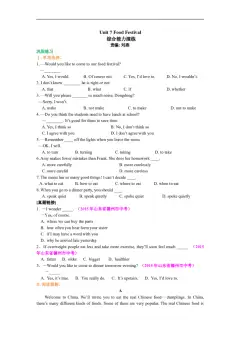
一、单项选择(北师大附属中学期中试题)
 1. There are usually

    people in the classroom.
A.
much
B.
lots of
C.
little
D.
any
 2.

    there a post office and some supermarkets near here?
A.
Have
B.
Do
C.
Are
D.
Is
 3. Let him

    these things to his parents.
A.
take
B.
taking
C.
takes
D.
to take
 4. Can you write

    me soon?
A.
with
B.
in
C.
to
D.
about
 5. There

    a meeting tomorrow afternoon.
A.
will be going to
B.
is going to is
C.
is going to be
D.
will go to be
 6. My grandfather has a small garden

    many beautiful flowers.
A.
of
B.
with
C.
have
D.
about
 7. Are you going to have a free day

    the morning of April 10th?
7
A.
in
B.
on
C.
at
D.
of
 8. He sometimes

    a picture, but now he

   .
A.
draws, sings
B.
drawing, singing
C.
draws, is singing
D.
is drawing, sings
 9. Table tennis is

    popular than gymnastics in China.
A.
much more
B.
more much
C.
very much
D.
very more
10.

    is it from London to Paris?
A.
How many
B.
How long
C.
How far
D.
How much
11. Every day

    people come to the Great Wall.
A.
thousands
B.
thousand of
C.
thousand
D.
thousands of
12. Everyone will send their homework

    the teacher

    email.
A.
from; on
B.
from; by
C.
to; on
D.
to; by
13. I have two tickets for the film. One is mine and

    is yours.
A.
another
B.
the other
C.
other
D.
others
14. My brother is two years

    than me.
A.
bigger
B.
older
C.
big
D.
old
15. The population of Tianjin is

    than that of Shanghai.
A.
larger
B.
less
C.
more
D.
fewer
16. It's Sunday today. Lily and Lucy

    in the park.
A.
is playing
B.
playing
C.
plays
D.
are playing
17. --- Are you good at history, Rose?
---

   . But I will try to study it well this term.
A.
That's all right
B.
Not very good
C.
No problem
D.
Quite well
18. Dear classmates,

    you work,

    results you'll get.
A.
the more; the more
B.
the better; the harder
C.
the harder; the better
19. Lucy's hair is longer than

   .
A.
my
B.
mine
C.
me
D.
I
20. --- The cake looks

   .
--- Yes, and it tastes even

   .
A.
well; good
B.
good; better
C.
good; worse
D.
better; best
8
二、阅读理解
A
    In England, people don't often talk to each other when they travel. If you are on a bus or on a train,
you can always see some people sitting and looking out of the window and other people reading books or
newspapers.
    English people often start a conversation(谈话) by talking about the weather. So when you meet
somebody in England, you can say "Nice weather for the time of year!"
    "But it was a little cold yesterday," somebody may answer.
    "But it will get a bit warmer later," you can say.
    Talk like this, and English people will think you are friendly.
1. Some people sit and look out of the

    on a train.
A.
window
B.
door
C.
house
D.
hole
2. English people often

    on the bus.
A.
talk a lot
B.
talk to each other
C.
eat something
D.
read newspapers
3. When you meet an Englishman, you can start a conversation by talking about the

   .
A.
weather
B.
time
C.
food
D.
countryside
4. According to the passage, if you talk to English people about the weather, they will think

.
A.
you are friendly
B.
you are right
C.
you are English
D.
you talk much
5. Which sentence is true?
A.
English people like traveling by bus.
B.
English people don't talk much when they're on public transport.
C.
English people are unfriendly.
D.
English people don't enjoy good weather.
B
    We often talk about the weather. If we want to know about the weather. We can turn on the radio(收音
机) and listen to the weather report. We can also turn on the TV and watch the Weather Show. And we can
9
ask other people in two different ways, “What's the weather like today?” or “How is the weather today?”
Sometimes you can call at 121 for the weather.
    When it's cold, we shiver and need to wear warm clothes and scarfs. When it's raining, we need
raining-coats or umbrellas(雨伞). When it's hot, we need a cool place and want a cold drink(饮料).
6. You can watch the Weather Show

   .
A.
on radio
B.
on TV
C.
at 121
D.
on other people
7. You can ask other people “

   ” to know about the weather.
A.
What's the weather
B.
How is the weather like
C.
What does the weather like
D.
How is the weather
8. We want a cold drink when it's

   .
A.
cold
B.
warm
C.
hot
D.
raining
9. Telephone 121 is for

   .
A.
ill
B.
fire
C.
weather
D.
food
10. The word "shiver" is "

   " in Chinese.
A.
颤抖
B.
出汗
C.
看病
D.
避暑
ADAAB   BDCCA
课程顾问签字:                        教学主管签字: