1
Module 11 词汇篇
______________________________________________________________________________
______________________________________________________________________________
掌握重点词汇及短语并能灵活运用。
1. smile v. &n. 微笑
We Chinese often shake hands and smile when we meet visitors, and sometimes we nod our heads.
◆
当会见来访者的时候,我们中国人经常握手微笑,有时候我们点头。
What are you smiling at?
◆
你在笑什么?
She welcomed him with a smile.
◆
她笑着欢迎他。
【探究总结】 smile 的用法
(1)smile 作动词用,常构成短语:smile at, 意为“对……微笑”;
(2)smile 作名词用,常构成短语:with a smile, 意为“面带微笑”;
(3)smile 和laugh 的区别:smile 一般是无声的微笑;laugh 一般是有声的笑、大笑,laugh at 是嘲笑。
2. each pron. 各个,每个
In the US some people shake hands, and some kiss or hug each other.
◆
在美国,有些人握手,有些人亲吻或彼此拥抱。
He gave a book to each of his parents.
◆
他给他父母各送了一本书。
He gave each boy an apple.
◆
他给每个男孩一个苹果。
【探究总结】
each 形容词代词
each
①
和other 构成相互代词each other, 相当于one another,而every 不和other 连用
each
②
可指两个或两个以上中间的每一个,而every 只可指三个或三个以上中间的每一个,不能指
两个中的每一个, 如可以说each of my eyes, 不可说every one of my eyes
every 形容词
every
①
和not 连用构成不完全否定。each 不和not 连用
②表示“每隔……”、“每……”,要用“every+基数词+复数名词”。这种结构中的every 不能
用each 替代
2
3. hold v. (held) 握着;使不动
South Americans sometimes hold your arm when they talk to you.
◆
南美人在和你谈话时,有时候会抓
住你的胳膊。
John held a knife in his hand.
◆
约翰手里握着一把小刀。
【探究总结】 hold 的用法
作及物动词用,意为“握着;使不动;举行;包含;容纳”,常构成短语:hold on 意为“(打电话
时)别挂断”;hold on to 意为“抓住不放;紧紧抓住” 。
4. It’s+形容词+to do sth. 做某事是……的
In some places, it isn’t polite to look at people when you talk.
◆
在一些地方,当你说话的时候看着人是不礼貌的。
It’s very kind of you to help me.
◆
你能帮我,真好。
It’s difficult for us to finish the work.
◆
对我们来说,完成这项工作很难。
【探究总结】 It’s + 形容词 + to do sth. 句型
(1)在英语中,如果作主语的动词不定式太长,为了避免头重脚轻,一般用it 作形式主语,而将真正
的主语置于句尾。
(2)It is+形容词+of sb. + to do sth.形容词描述行为者的性格品质,如kind, nice, polite 等.
It is+形容词+for sb. + to do sth. 形容词描述事物的特征、性质,如easy, interesting 等.
5. bring v. (brought) 带来
You cannot bring food or drink into the lab.
◆
你不能把食物和饮料带进实验室。
【探究总结】 bring 的用法
(1)bring 作动词用,意为“带来”,其过去式为brought,常构成短语:bring sb. sth. = bring sth. to
sb. 意为“给某人带来某物”;bring up 意为“养育”。
(2)bring, take, carry 与get 的用法辨析:
bring 表示从别处把某人或物“带来”或“拿来”
take 指把某人或物“带走”或“拿走”(到别处)
carry 指“搬运”,不具体说明来去的方向,有时含有沉重或麻烦之意
get 指到别处把某物取来, 相当于 go and bring
1. Our teacher came into the classroom ______.
A. with smile
B. with smiles
C. with a smile
D. in a smile
答案:C
解析:with a smile, 意为“面带微笑”
2. Everyone_______him when he ran past us.
A. laugh at
B. smile at
C. laughed
D. smiled at
答案:D
解析:smile at, 意为“对……微笑”
3. ______of the girls has got a pencil and some paper.
A. All B. Every C. Everyone
D. Each
3
答案:D
解析:each 可指两个或两个以上中间的每一个, 结构为each of……
4. — How often does the Olympic Games take place?
— ______.
A. Each four years
B. Every four years
C. Every year
D. Each year
答案:B
解析:表示“每隔……”、“每……”,要用“every+基数词+复数名词”。
5. — May I speak to Jim, please?
—______ .
A. Hold on, please
B. Hold up, please
C. Hold out, please
D. Hold over, please
答案:A
解析:hold on 意为“(打电话时)别挂断”;
6. Shall I______my sister here next time?
A. bring B. take
C. carry
D. get
答案:A
解析:bring 表示从别处把某人或物“带来”或“拿来”.
7. It’s very nice______pictures for me.
A. of you to draw
B. for you to draw
C. for you drawing
D. of you drawing
答案:A
解析:It is+形容词+of sb. + to do sth.形容词描述行为者的性格品质.
8. ______very hard______ him to study two languages.
A. It’s; of B. It’s; for
C. That’s; of
D. That’s; for
答案:B
解析:It is+形容词+for sb. + to do sth. 形容词描述事物的特征、性质.
基础演练
用所给词的适当形式填空
1. It’s polite
up when your teacher comes into the classroom. (stand)
2. Please
your homework to school tomorrow. (bring)
3. They
a meeting tomorrow. (hold)
4. My mother gave me an apple with .(smile)
5. The teachers always ________ at us. (smile)
答案:1. to stand 2. bring 3. will hold 4. a smile 5. smiles
巩固提高
4
1. 这个大厅只能容纳这么多人。
The hall can______only so many people.
2. 你应该微笑并和他们握手。
You should ________ and ________ ________ with them.
3. 让我们彼此拥抱一下吧。
Let’s _______ ________ _________.
4. 在有些国家,你说话的时候盯着别人是不礼貌的。
In some countries, to look at people when you talk.
5. 给我拿杯茶,好吗?
Would you please me a cup of tea?
答案:1. hold 2. smile; shake hands 3. hug each other 4. it isn't polite 5. bring
单项选择
1. I’m glad to meet so many ______ here.
A. visit
B. visits
C. visitor
D. visitors
2. We should speak to the old______.
A. polite
B. impolite
C. politely D. rude
3. He ran ______fast for me______ catch up with.
A. too; to
B. so; that C. such; that
D. enough; to
4. ?What do you say to your parents when you go to sleep in the evening?
—______.
A. Thank you
B. Good morning
C. Good night
D. Good evening
5. You can stand close ______ people in the Middle East.
A. for
B. to
C. at
D. around
6. Ill tell you some ways ______ English.
A. learns B. learning
C. to learn
D. learned
7. Mount Tai is ______ than Mount Emei.
A. higher
B. high
C. lower
D. low
8. My pen friend is from a ______ country.
A. foreigner
B. foreigners
C. foreign
D. west
9. I dont like apples ______.
5
A. very
B. quite
C. very much
D. at all
10. ?______ talk in class.
? Sorry, I wont.
A. Please not
B. Dont
C. Doesn’t
D. Didn’t
完形填空
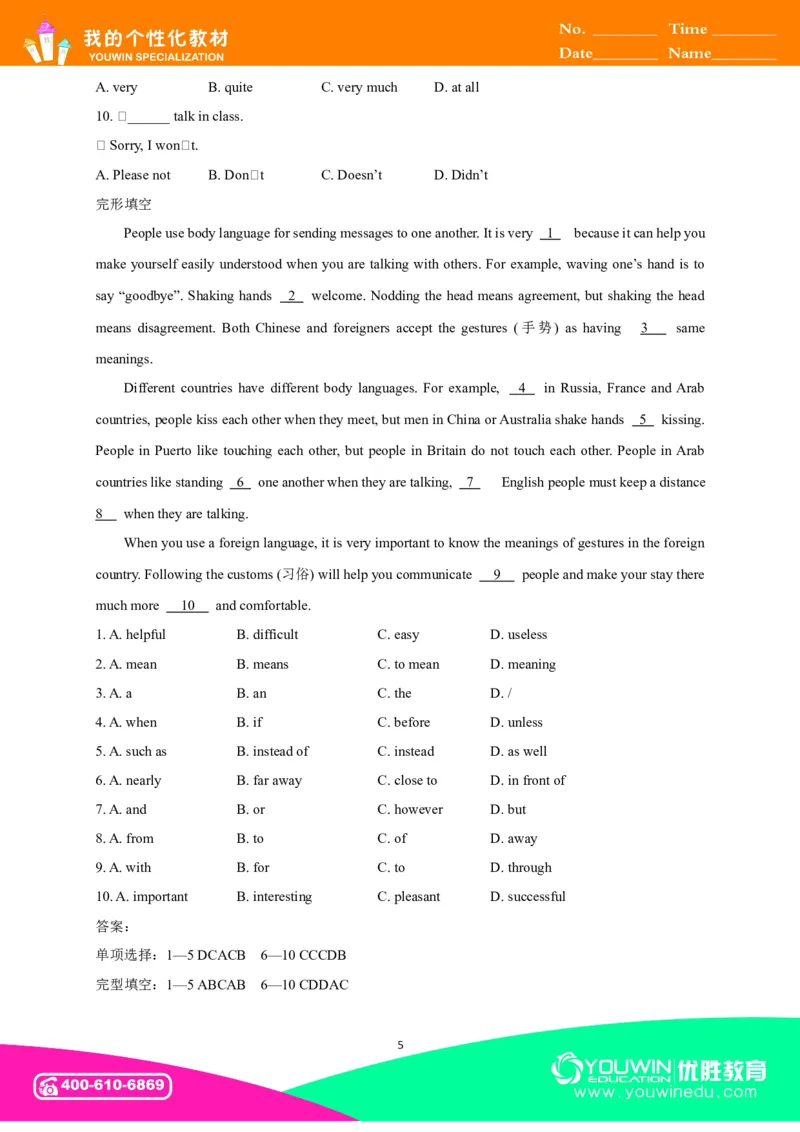
People use body language for sending messages to one another. It is very 1 because it can help you
make yourself easily understood when you are talking with others. For example, waving one’s hand is to
say “goodbye”. Shaking hands 2 welcome. Nodding the head means agreement, but shaking the head
means disagreement. Both Chinese and foreigners accept the gestures ( 手势) as having 3 same
meanings.
Different countries have different body languages. For example, 4 in Russia, France and Arab
countries, people kiss each other when they meet, but men in China or Australia shake hands 5 kissing.
People in Puerto like touching each other, but people in Britain do not touch each other. People in Arab
countries like standing 6 one another when they are talking, 7 English people must keep a distance
8 when they are talking.
When you use a foreign language, it is very important to know the meanings of gestures in the foreign
country. Following the customs (习俗) will help you communicate 9 people and make your stay there
much more 10 and comfortable.
1. A. helpful
B. difficult
C. easy
D. useless
2. A. mean
B. means
C. to mean
D. meaning
3. A. a
B. an
C. the
D. /
4. A. when
B. if
C. before
D. unless
5. A. such as
B. instead of
C. instead
D. as well
6. A. nearly
B. far away
C. close to
D. in front of
7. A. and
B. or
C. however
D. but
8. A. from
B. to
C. of
D. away
9. A. with
B. for
C. to
D. through
10. A. important
B. interesting
C. pleasant
D. successful
答案:
单项选择:1—5 DCACB 6—10 CCCDB
完型填空:1—5 ABCAB 6—10 CDDAC
6
_________________________________________________________________________________
_________________________________________________________________________________
工大附第二次月考
阅读理解
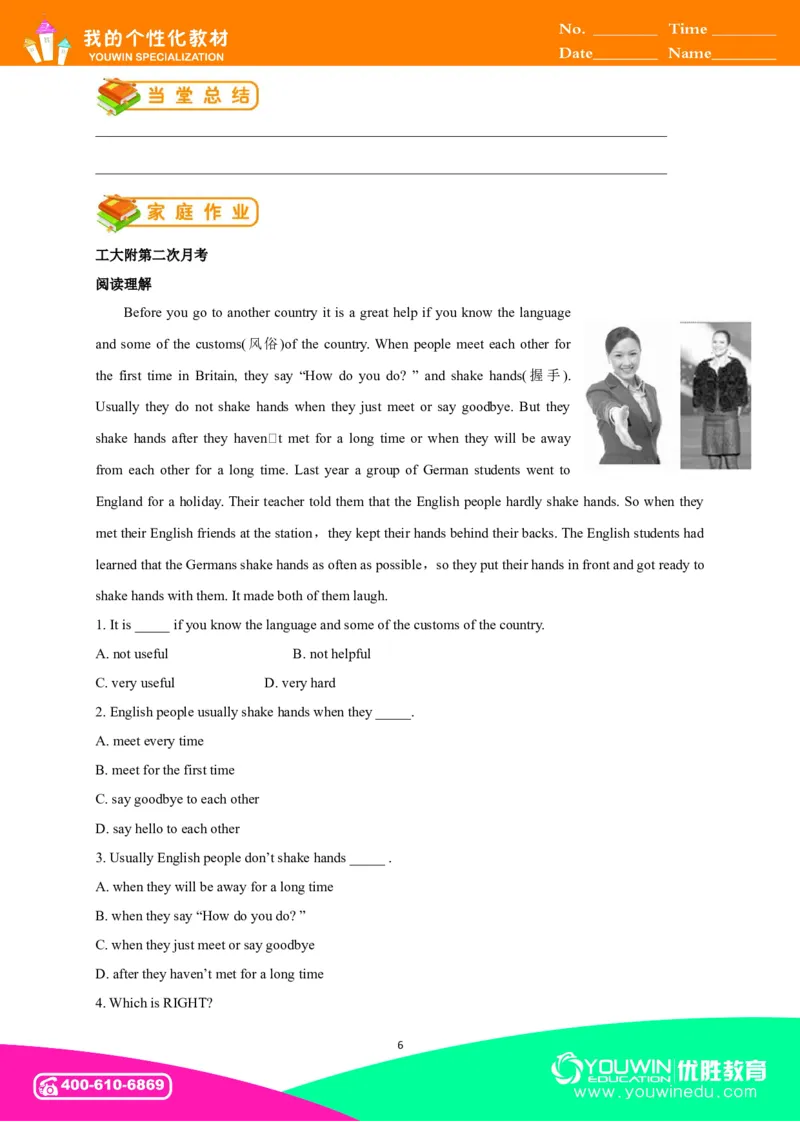
Before you go to another country it is a great help if you know the language
and some of the customs(风俗)of the country. When people meet each other for
the first time in Britain, they say “How do you do? ” and shake hands( 握手).
Usually they do not shake hands when they just meet or say goodbye. But they
shake hands after they havent met for a long time or when they will be away
from each other for a long time. Last year a group of German students went to
England for a holiday. Their teacher told them that the English people hardly shake hands. So when they
met their English friends at the station,they kept their hands behind their backs. The English students had
learned that the Germans shake hands as often as possible,so they put their hands in front and got ready to
shake hands with them. It made both of them laugh.
1. It is _____ if you know the language and some of the customs of the country.
A. not useful
B. not helpful
C. very useful
D. very hard
2. English people usually shake hands when they _____.
A. meet every time
B. meet for the first time
C. say goodbye to each other
D. say hello to each other
3. Usually English people don’t shake hands _____ .
A. when they will be away for a long time
B. when they say “How do you do? ”
C. when they just meet or say goodbye
D. after they haven’t met for a long time
4. Which is RIGHT?
7
A. German people shake hands as often as possible.
B. English people like shaking hands very much.
C. German people hardly shake hands.
D. Neither English people nor Germans like shaking hands.
5. This story is about _____ .
A. shaking hands
B. language
C. customs
D. language and customs
答案: CBCAC
单项填空
1. Here ______ a pen and some books for you.
A. be
B. are
C. is
D. being
2. How about ______ to school by bus?
A. going
B. go
C. to go
D. goes
3. ?Is the supermarket very ______ your house?
?No. It often takes me half an hour to go there by bike.
A. far from
B. close to
C. close from
D. near to
4. My foreign teacher comes from______, and he speaks______.
A. German; German
B. Japan; Japanese
C. Russian; Russia
D. British; English
5. —Do you know why he failed(失败)?
—I think that’s ______ he was too careless.
A. because
B. why
C. so
D. for
6. It is important for us ______ English well.
A. learn
B. learning
C. learned
D. to learn
7.______get off the bus before it stops.
A. Dont
B. Doesn’t
C. Didn’t D. Not
8. They entered the room______.
A. arm with arm
B. arm to arm
C. arm in arm
D. arm on arm
9. My friend ______ the book with him when he came to see me.
A. took
B. carried
C. brought
D. got
10. Lin Ming and I are good friends. We often help______.
8
A. other each
B. each other
C. others each
D. each others
完形填空
People use body language to send messages to others. It is very 1 because others can understand
you easily when you use body language. When you are talking with others, you are not just using words,
but also using 2 . For example, waving one’s hand is to say “Good-bye”. Shaking hands means
welcome, and clapping hands 3 congratulations(祝贺). Nodding the head means YES, but shaking the
head means NO.
Different countries have 4 body language. For example, when in 5 , France and Arab countries,
people kiss each other when they meet, 6 men in China or Australia shake hands. People in Puerto
Rico like touching each other, but people in Britain do not touch each other. People in Arab countries like 7
close to one another when they are talking, but English people must keep a distance away when they are
talking. It is very important 8 the meanings of gestures and movements in the foreign country 9 they
will help you communicate with people and make you stay there much more 10 and comfortable.
1. A. helpful
B. difficult
C. easy
D. useless
2. A. words
B. gestures
C. handshake
D. hands
3. A. to mean
B. mean
C. means
D. meaning
4. A. the same
B. a same
C. the different
D. different
5. A. Russia
B. the Russia
C. Russian
D. a Russia
6. A. and
B. or
C. but
D. so
7. A. stand
B. stands
C. sit
D. standing
8. A. knowing
B. know
C. to know
D. knows
9. A. when
B. because
C. so
D. if
10. A. important
B. sad
C. interesting
D. pleased
阅读理解
A
When people meet each other for the first time in Britain, they say “How do you do” and shake hands.
Usually they do not shake hands when they just meet or say goodbye. But they shake hands after they
haven’t met for a long time or when they will be away from each other for a long time.
Last year a group of German students went to England for a holiday. Their teacher told them that the
English people hardly shake hands. So when they met their English friends at the station, they kept their
hands behind their backs. The English students had learned that the Germans shake hands as often as
9
possible, so they put their hands in front and got ready to shake hands with them. It made both of them
laugh.
1. It is ______ if you know some of the customs(风俗)of the country.
A. not useful
B. not helpful
C. very helpful
D. very bad
2. English people usually shake hands when they______.
A. meet every time
B. meet for the first time
C. say goodbye to each other
D. say hello to each other
3. Usually English people dont shake hands______.
A. when they will be away for a long time
B. when they say How do you do?
C. when they just meet or say goodbye
D. after they havent met for a long time
4. Which is RIGHT?
A. German people shake hands as often as possible.
B. English people like shaking hands very much.
C. German people hardly shake hands.
D. Neither English people nor Germans like shaking hands.
5. This story is about______.
A. shaking hands
B. languages
C. customs
D. languages and customs
B
Do you know Weibo? Do you write a Weibo? If you don't, you are "out"! Weibo means micro-blog.
People may spend much time writing a blog, but it takes a little time to
write a micro-blog.Why? Because every message on a micro-blog is
less than 140 words.
Micro-blog started in the USA. It came to China in 2009 and it
has developed very fast. In 2011, the number of Chinese micro-
bloggers grew to 300 million. Now, more and more people are
interested in writing micro-blogs. For many micro-blog users, it is a great way of learning the freshest
news,talking with friends and sharing different kinds of information, including news, daily life,
10
pictures,music and so on. Many stars and famous people also write micro-blogs and share good things with
their fans.
It is easy and fast to send a message on a micro-blog. However, this can also lead to problems and
even cause panic . For example, when the big earthquake and tsunami hit Japan in March, 2011, messages
like " Salt can protect people from radiation" were hot on micro-blogs. It soon caused a crazy buying of
salt. Later people realized it was just a rumor (谣言).
In a word, micro-blog plays a new role in the life of Chinese people.
1. People spend _____ time and _____ words writing micro-blog.
A. little, a few B. a little, few C. a little, a few D. a few, a little
2. There were 300 million Chinese micro-bloggers in _____.
A. 2008 B. 2009 C.2011 D.2013
3. Which of the following is TRUE?
A. Writing a micro-blog needs a special training.
B. Micro-blog appeared in China only one year ago but it has developed rapidly.
C. As a popular thing, micro-blog has its advantages and disadvantages.
D. More and more Chinese show great interest in micro-blog because it started in the USA.
C
A famous study was done in a school by a professor from a university. At the start of the school year,
the teachers were given the names of five children. They were told that these five were the most excellent
students in the class. But the fact was that these students were only average,and they were not the best
students at all. Well, guess what? At the end of the year, all the five average students scored among the
highest in the class.
What made these average students change so much to become top students?The only difference was
the change in their teachers’ attitude. Because the teachers believed that these five kids were the top
students,they expected more from them. And so these five average students began to believe and expect
more from themselves. So they worked harder to do as well as they could.
Do you know why? If you expect the best from people, they’ll usually want to give you their best. A
great leader said, “Treat a person just how he appears to be on the outside, and you’ll make him even
worse. But treat a person like he’s already a success,and you’ll help make him the best he can be.”
Like the true story of 7-year-old Johnny, his teacher got so angry with him that one day she
said,“Johnny,you’re the naughtiest boy in this class. I’m sure you’ll never change.” The next year
11
Johnny had a new teacher. And on the first day of class ,she met with Johnny after school and
said,“Johnny, I’ve heard a lot about you! But do you know that I don’t believe a word of it.” And every
day after that, this new teacher treated Johnny as if he was one of the smartest students even when Johnny
did naughty things. Later on, Johnny became a school leader. Because that’s the power of our belief and
attitude toward children.
1. The professor started his research by _______.
A. teaching the five children himself
B. asking the five children to find a new teacher
C. telling the five students to work harder than ever before
D. telling the teacher the five students were the best in the class
2. The five average students became top students mainly because of ________.
A. the professor’s study
B. the teachers’ hard work
C. the change in the teachers
D. the change in the teachers’ attitude
3. What does the passage mainly tell us?
A. Attitude and belief can change a person.
B. Only teachers can make you a top student.
C. A professor’s study can help you score highest.
D. If you want to get more,you should have new teachers.
答案:
Ⅰ.单项填空
1. C 2. A 3. B 4. B 5. A 6. D 7. A 8. C 9. C 10.B
Ⅱ. 完形填空
1. A 2. B 3. C 4. D 5. A 6. C 7. D 8. C 9. B 10.D
Ⅲ. 阅读理解
A 篇1. C 2. B 3. C 4. A 5. C
B 篇1. C 2. C 3. C
C 篇1. D 2. D 3. A
课程顾问签字: 教学主管签字: