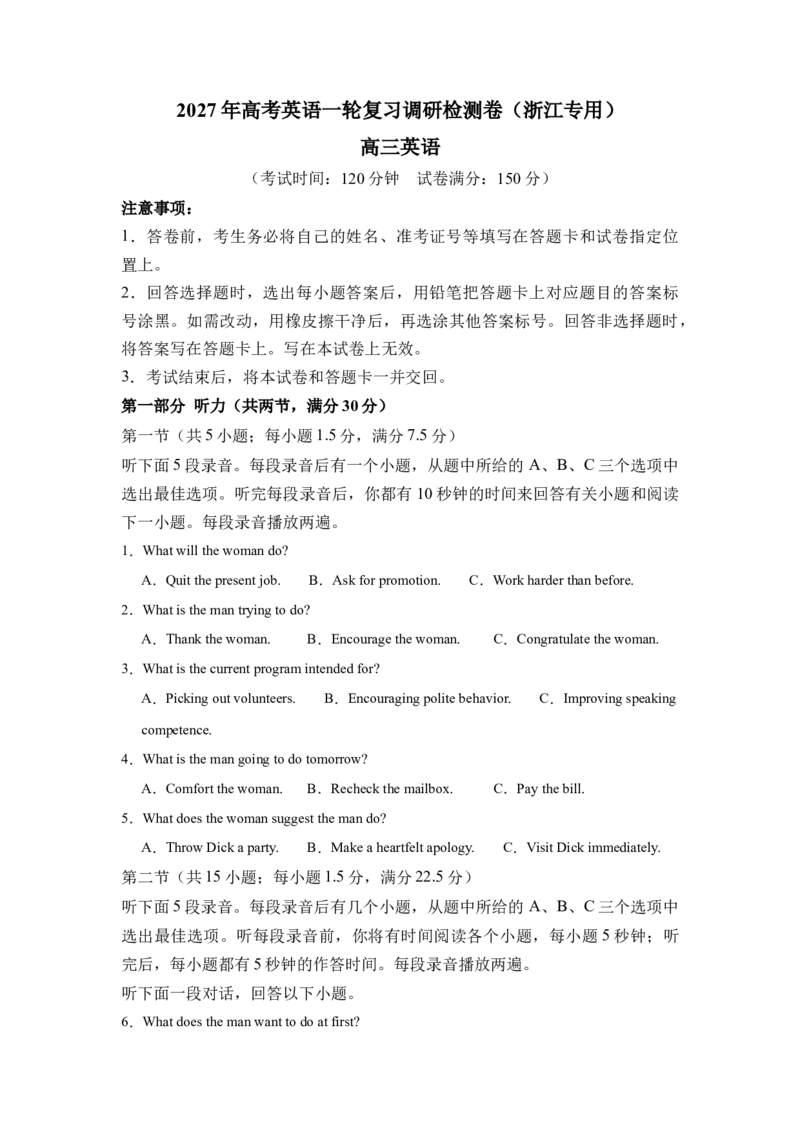
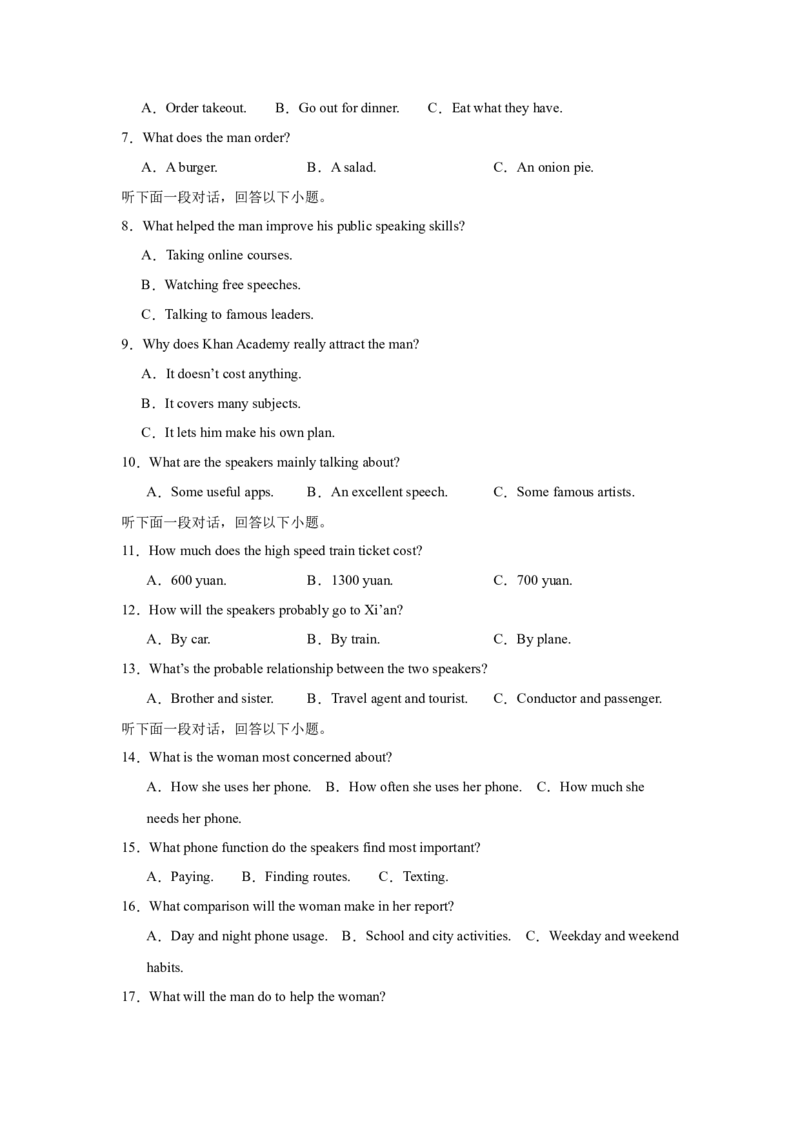
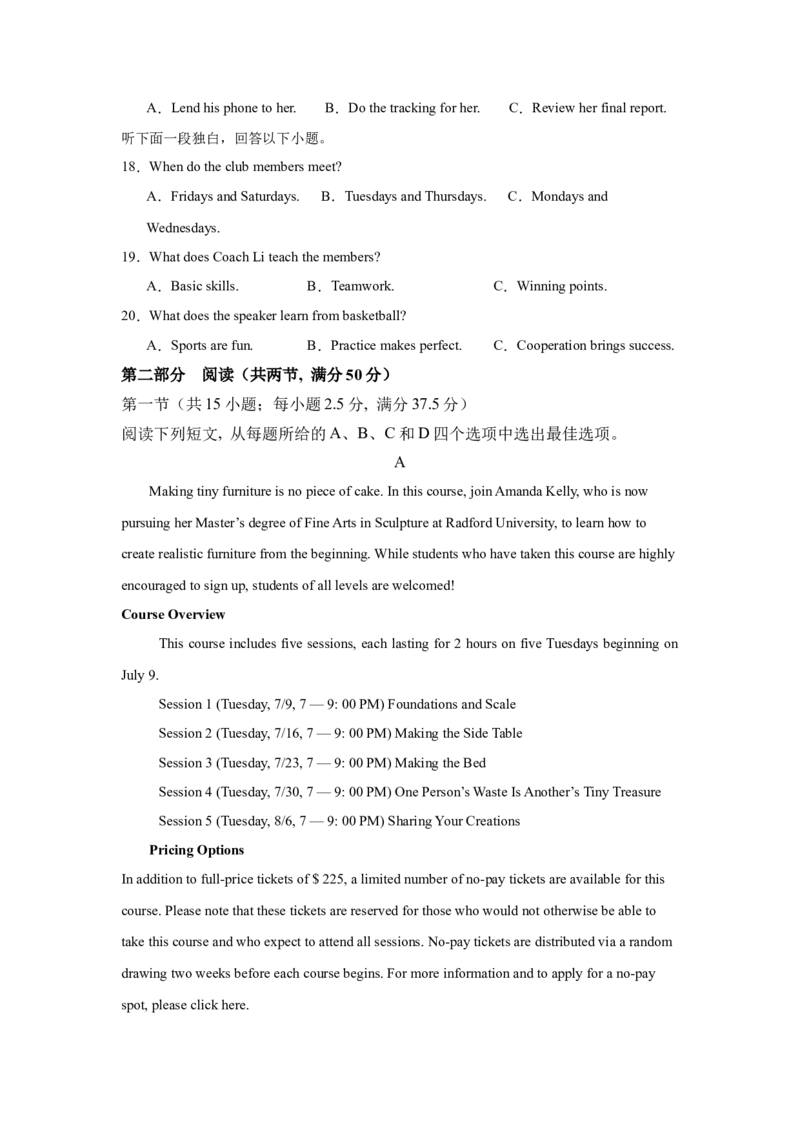
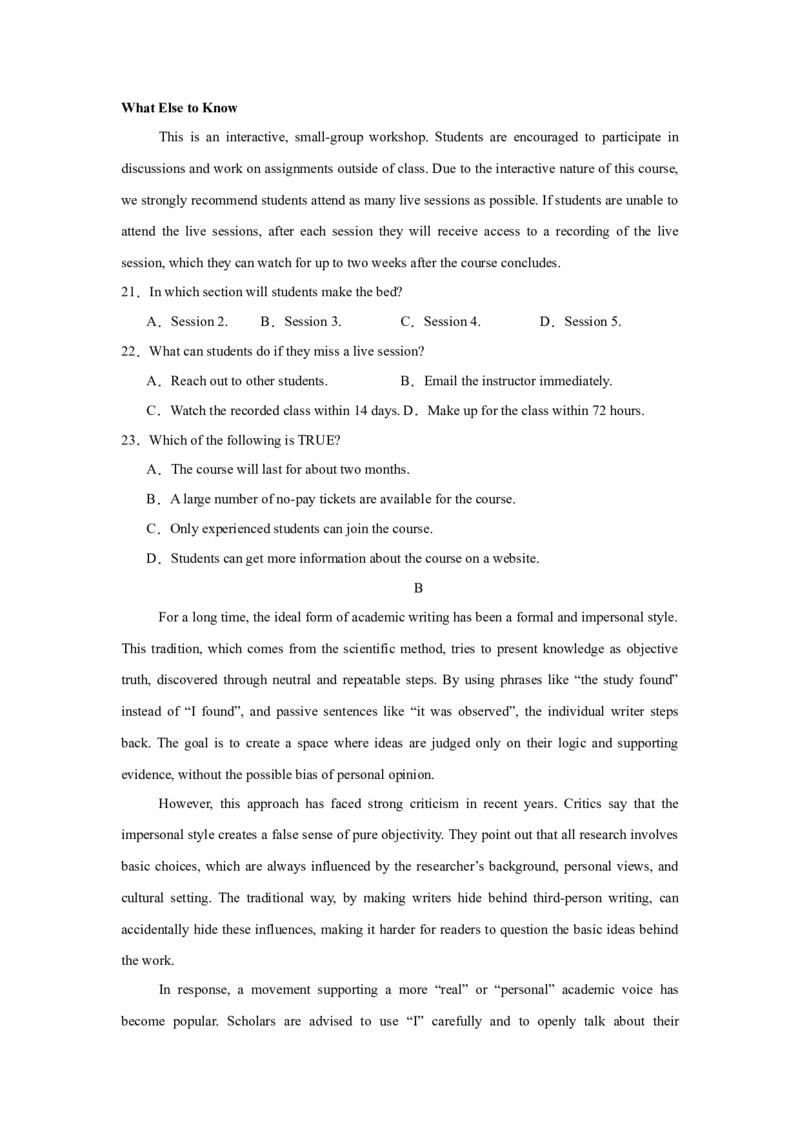
2027年高考英语一轮复习调研检测卷(浙江专用)
高三英语
(考试时间:120分钟 试卷满分:150分)
注意事项:
1.答卷前,考生务必将自己的姓名、准考证号等填写在答题卡和试卷指定位
置上。
2.回答选择题时,选出每小题答案后,用铅笔把答题卡上对应题目的答案标
号涂黑。如需改动,用橡皮擦干净后,再选涂其他答案标号。回答非选择题时,
将答案写在答题卡上。写在本试卷上无效。
3.考试结束后,将本试卷和答题卡一并交回。
第一部分 听力(共两节,满分30分)
第一节(共5小题;每小题1.5分,满分7.5分)
听下面5段录音。每段录音后有一个小题,从题中所给的 A、B、C三个选项中
选出最佳选项。听完每段录音后,你都有 10秒钟的时间来回答有关小题和阅读
下一小题。每段录音播放两遍。
1.What will the woman do?
A.Quit the present job. B.Ask for promotion. C.Work harder than before.
2.What is the man trying to do?
A.Thank the woman. B.Encourage the woman. C.Congratulate the woman.
3.What is the current program intended for?
A.Picking out volunteers. B.Encouraging polite behavior. C.Improving speaking
competence.
4.What is the man going to do tomorrow?
A.Comfort the woman. B.Recheck the mailbox. C.Pay the bill.
5.What does the woman suggest the man do?
A.Throw Dick a party. B.Make a heartfelt apology. C.Visit Dick immediately.
第二节(共15小题;每小题1.5分,满分22.5分)
听下面5段录音。每段录音后有几个小题,从题中所给的 A、B、C三个选项中
选出最佳选项。听每段录音前,你将有时间阅读各个小题,每小题 5秒钟;听
完后,每小题都有5秒钟的作答时间。每段录音播放两遍。
听下面一段对话,回答以下小题。
6.What does the man want to do at first?A.Order takeout. B.Go out for dinner. C.Eat what they have.
7.What does the man order?
A.A burger. B.A salad. C.An onion pie.
听下面一段对话,回答以下小题。
8.What helped the man improve his public speaking skills?
A.Taking online courses.
B.Watching free speeches.
C.Talking to famous leaders.
9.Why does Khan Academy really attract the man?
A.It doesn’t cost anything.
B.It covers many subjects.
C.It lets him make his own plan.
10.What are the speakers mainly talking about?
A.Some useful apps. B.An excellent speech. C.Some famous artists.
听下面一段对话,回答以下小题。
11.How much does the high speed train ticket cost?
A.600 yuan. B.1300 yuan. C.700 yuan.
12.How will the speakers probably go to Xi’an?
A.By car. B.By train. C.By plane.
13.What’s the probable relationship between the two speakers?
A.Brother and sister. B.Travel agent and tourist. C.Conductor and passenger.
听下面一段对话,回答以下小题。
14.What is the woman most concerned about?
A.How she uses her phone. B.How often she uses her phone. C.How much she
needs her phone.
15.What phone function do the speakers find most important?
A.Paying. B.Finding routes. C.Texting.
16.What comparison will the woman make in her report?
A.Day and night phone usage. B.School and city activities. C.Weekday and weekend
habits.
17.What will the man do to help the woman?A.Lend his phone to her. B.Do the tracking for her. C.Review her final report.
听下面一段独白,回答以下小题。
18.When do the club members meet?
A.Fridays and Saturdays. B.Tuesdays and Thursdays. C.Mondays and
Wednesdays.
19.What does Coach Li teach the members?
A.Basic skills. B.Teamwork. C.Winning points.
20.What does the speaker learn from basketball?
A.Sports are fun. B.Practice makes perfect. C.Cooperation brings success.
第二部分 阅读(共两节, 满分50分)
第一节(共15小题;每小题2.5分, 满分37.5分)
阅读下列短文, 从每题所给的A、B、C和D四个选项中选出最佳选项。
A
Making tiny furniture is no piece of cake. In this course, join Amanda Kelly, who is now
pursuing her Master’s degree of Fine Arts in Sculpture at Radford University, to learn how to
create realistic furniture from the beginning. While students who have taken this course are highly
encouraged to sign up, students of all levels are welcomed!
Course Overview
This course includes five sessions, each lasting for 2 hours on five Tuesdays beginning on
July 9.
Session 1 (Tuesday, 7/9, 7 — 9: 00 PM) Foundations and Scale
Session 2 (Tuesday, 7/16, 7 — 9: 00 PM) Making the Side Table
Session 3 (Tuesday, 7/23, 7 — 9: 00 PM) Making the Bed
Session 4 (Tuesday, 7/30, 7 — 9: 00 PM) One Person’s Waste Is Another’s Tiny Treasure
Session 5 (Tuesday, 8/6, 7 — 9: 00 PM) Sharing Your Creations
Pricing Options
In addition to full-price tickets of $ 225, a limited number of no-pay tickets are available for this
course. Please note that these tickets are reserved for those who would not otherwise be able to
take this course and who expect to attend all sessions. No-pay tickets are distributed via a random
drawing two weeks before each course begins. For more information and to apply for a no-pay
spot, please click here.What Else to Know
This is an interactive, small-group workshop. Students are encouraged to participate in
discussions and work on assignments outside of class. Due to the interactive nature of this course,
we strongly recommend students attend as many live sessions as possible. If students are unable to
attend the live sessions, after each session they will receive access to a recording of the live
session, which they can watch for up to two weeks after the course concludes.
21.In which section will students make the bed?
A.Session 2. B.Session 3. C.Session 4. D.Session 5.
22.What can students do if they miss a live session?
A.Reach out to other students. B.Email the instructor immediately.
C.Watch the recorded class within 14 days.D.Make up for the class within 72 hours.
23.Which of the following is TRUE?
A.The course will last for about two months.
B.A large number of no-pay tickets are available for the course.
C.Only experienced students can join the course.
D.Students can get more information about the course on a website.
B
For a long time, the ideal form of academic writing has been a formal and impersonal style.
This tradition, which comes from the scientific method, tries to present knowledge as objective
truth, discovered through neutral and repeatable steps. By using phrases like “the study found”
instead of “I found”, and passive sentences like “it was observed”, the individual writer steps
back. The goal is to create a space where ideas are judged only on their logic and supporting
evidence, without the possible bias of personal opinion.
However, this approach has faced strong criticism in recent years. Critics say that the
impersonal style creates a false sense of pure objectivity. They point out that all research involves
basic choices, which are always influenced by the researcher’s background, personal views, and
cultural setting. The traditional way, by making writers hide behind third-person writing, can
accidentally hide these influences, making it harder for readers to question the basic ideas behind
the work.
In response, a movement supporting a more “real” or “personal” academic voice has
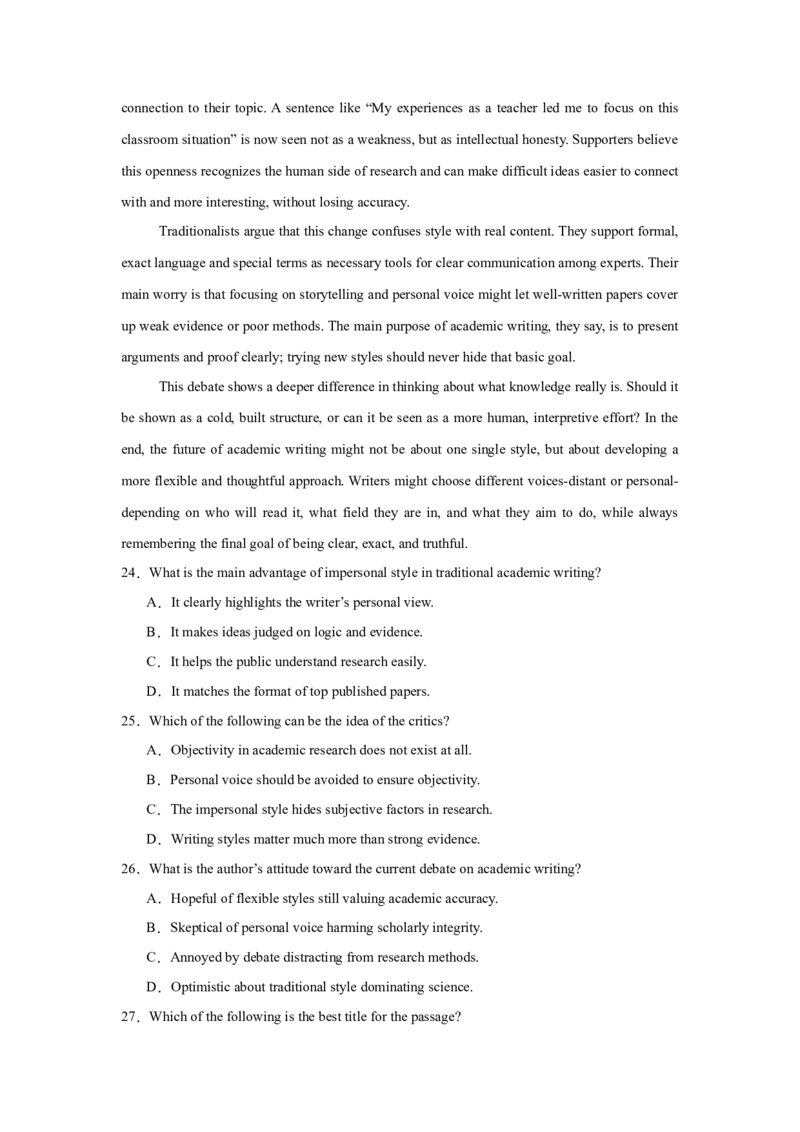
become popular. Scholars are advised to use “I” carefully and to openly talk about theirconnection to their topic. A sentence like “My experiences as a teacher led me to focus on this
classroom situation” is now seen not as a weakness, but as intellectual honesty. Supporters believe
this openness recognizes the human side of research and can make difficult ideas easier to connect
with and more interesting, without losing accuracy.
Traditionalists argue that this change confuses style with real content. They support formal,
exact language and special terms as necessary tools for clear communication among experts. Their
main worry is that focusing on storytelling and personal voice might let well-written papers cover
up weak evidence or poor methods. The main purpose of academic writing, they say, is to present
arguments and proof clearly; trying new styles should never hide that basic goal.
This debate shows a deeper difference in thinking about what knowledge really is. Should it
be shown as a cold, built structure, or can it be seen as a more human, interpretive effort? In the
end, the future of academic writing might not be about one single style, but about developing a
more flexible and thoughtful approach. Writers might choose different voices-distant or personal-
depending on who will read it, what field they are in, and what they aim to do, while always
remembering the final goal of being clear, exact, and truthful.
24.What is the main advantage of impersonal style in traditional academic writing?
A.It clearly highlights the writer’s personal view.
B.It makes ideas judged on logic and evidence.
C.It helps the public understand research easily.
D.It matches the format of top published papers.
25.Which of the following can be the idea of the critics?
A.Objectivity in academic research does not exist at all.
B.Personal voice should be avoided to ensure objectivity.
C.The impersonal style hides subjective factors in research.
D.Writing styles matter much more than strong evidence.
26.What is the author’s attitude toward the current debate on academic writing?
A.Hopeful of flexible styles still valuing academic accuracy.
B.Skeptical of personal voice harming scholarly integrity.
C.Annoyed by debate distracting from research methods.
D.Optimistic about traditional style dominating science.
27.Which of the following is the best title for the passage?A.Publishing Research in Simple Steps B.Adapting Academic Voice for Truth
C.Seeking More Personal Stories in Science D.Avoiding Bias in Academic Essays
C
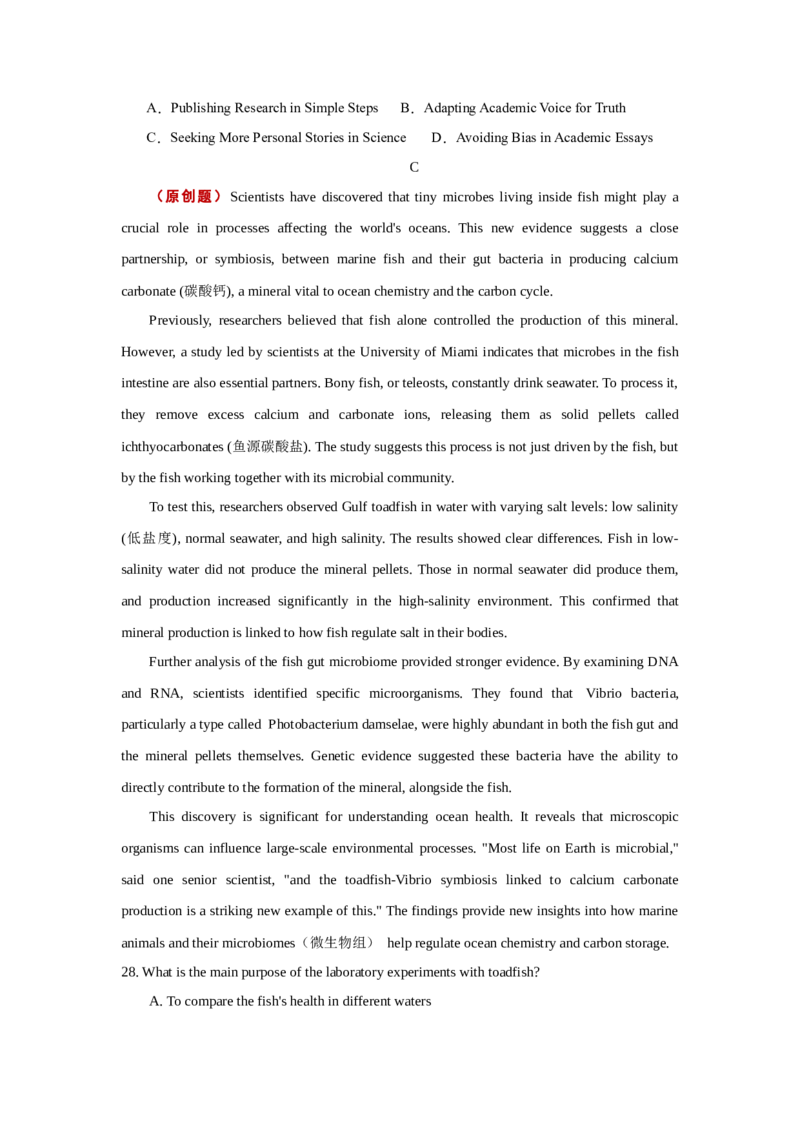
(原创题)Scientists have discovered that tiny microbes living inside fish might play a
crucial role in processes affecting the world's oceans. This new evidence suggests a close
partnership, or symbiosis, between marine fish and their gut bacteria in producing calcium
carbonate (碳酸钙), a mineral vital to ocean chemistry and the carbon cycle.
Previously, researchers believed that fish alone controlled the production of this mineral.
However, a study led by scientists at the University of Miami indicates that microbes in the fish
intestine are also essential partners. Bony fish, or teleosts, constantly drink seawater. To process it,
they remove excess calcium and carbonate ions, releasing them as solid pellets called
ichthyocarbonates (鱼源碳酸盐). The study suggests this process is not just driven by the fish, but
by the fish working together with its microbial community.
To test this, researchers observed Gulf toadfish in water with varying salt levels: low salinity
(低盐度), normal seawater, and high salinity. The results showed clear differences. Fish in low-
salinity water did not produce the mineral pellets. Those in normal seawater did produce them,
and production increased significantly in the high-salinity environment. This confirmed that
mineral production is linked to how fish regulate salt in their bodies.
Further analysis of the fish gut microbiome provided stronger evidence. By examining DNA
and RNA, scientists identified specific microorganisms. They found that Vibrio bacteria,
particularly a type called Photobacterium damselae, were highly abundant in both the fish gut and
the mineral pellets themselves. Genetic evidence suggested these bacteria have the ability to
directly contribute to the formation of the mineral, alongside the fish.
This discovery is significant for understanding ocean health. It reveals that microscopic
organisms can influence large-scale environmental processes. "Most life on Earth is microbial,"
said one senior scientist, "and the toadfish-Vibrio symbiosis linked to calcium carbonate
production is a striking new example of this." The findings provide new insights into how marine
animals and their microbiomes(微生物组) help regulate ocean chemistry and carbon storage.
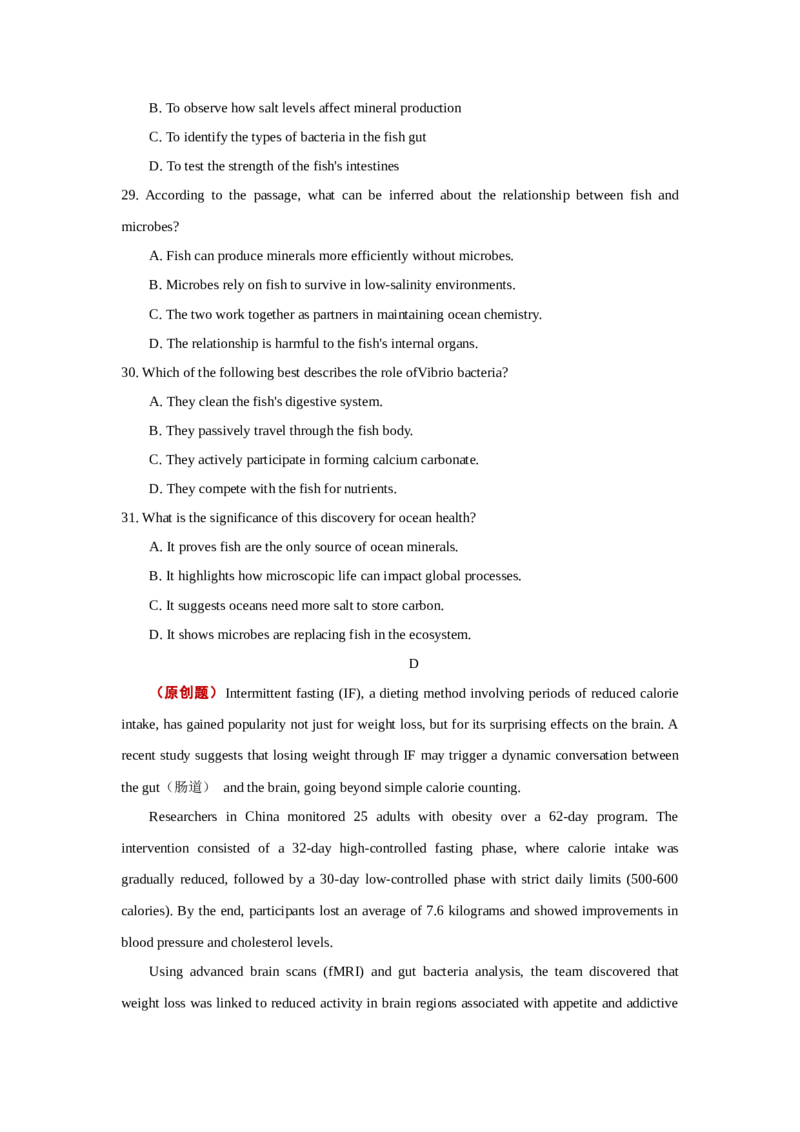
28. What is the main purpose of the laboratory experiments with toadfish?
A. To compare the fish's health in different watersB. To observe how salt levels affect mineral production
C. To identify the types of bacteria in the fish gut
D. To test the strength of the fish's intestines
29. According to the passage, what can be inferred about the relationship between fish and
microbes?
A. Fish can produce minerals more efficiently without microbes.
B. Microbes rely on fish to survive in low-salinity environments.
C. The two work together as partners in maintaining ocean chemistry.
D. The relationship is harmful to the fish's internal organs.
30. Which of the following best describes the role ofVibrio bacteria?
A. They clean the fish's digestive system.
B. They passively travel through the fish body.
C. They actively participate in forming calcium carbonate.
D. They compete with the fish for nutrients.
31. What is the significance of this discovery for ocean health?
A. It proves fish are the only source of ocean minerals.
B. It highlights how microscopic life can impact global processes.
C. It suggests oceans need more salt to store carbon.
D. It shows microbes are replacing fish in the ecosystem.
D
(原创题)Intermittent fasting (IF), a dieting method involving periods of reduced calorie
intake, has gained popularity not just for weight loss, but for its surprising effects on the brain. A
recent study suggests that losing weight through IF may trigger a dynamic conversation between
the gut(肠道) and the brain, going beyond simple calorie counting.
Researchers in China monitored 25 adults with obesity over a 62-day program. The
intervention consisted of a 32-day high-controlled fasting phase, where calorie intake was
gradually reduced, followed by a 30-day low-controlled phase with strict daily limits (500-600
calories). By the end, participants lost an average of 7.6 kilograms and showed improvements in
blood pressure and cholesterol levels.
Using advanced brain scans (fMRI) and gut bacteria analysis, the team discovered that
weight loss was linked to reduced activity in brain regions associated with appetite and addictiveeating behaviors. Simultaneously, the composition of the gut microbiome shifted significantly.
Specific "good" bacteria, such as Faecalibacterium prausnitzii, increased, while potentially
harmful Escherichia coli decreased.
The most striking finding was the close connection between these two changes. The study
revealed that certain microbes were correlated with activity in specific brain areas. For instance,
the increase of some bacteria was linked to higher activity in the brain's left orbital inferior frontal
gyrus, a region responsible for self-control and willpower. This suggests that the gut microbiome
may produce substances that influence the brain, while the brain, in turn, regulates eating
behavior.
Although the study was small and cannot prove cause and effect, it offers a new perspective:
successful weight loss might not just be about willpower. It could be a synchronized biological
shift involving the gut, metabolism, and the brain working as a team. Future research aims to
identify the precise mechanisms of this communication.
32.What is the main purpose of the study mentioned in the passage?
A. To compare different methods of calorie restriction.
B. To explore the relationship between fasting, the gut, and the brain.
C. To prove that obesity is caused by addictive eating behaviors.
D. To promote a new drug for treating high blood pressure.
33.What can be inferred about the participants' diet during the 30-day phase?
A. They ate whatever they wanted but exercised more.
B. They consumed about one quarter of their normal energy.
C. They strictly limited their daily calorie intake.
D. They only drank water and juice.
34.According to the passage, what role does the left orbital inferior frontal gyrus play?
A. It controls hunger signals from the stomach.
B. It helps people resist temptation and control impulses.
C. It produces neurotransmitters for the gut.
D. It stores information about food memories.
35. What is the author's attitude toward the findings of this study?
A. Cautiously optimistic. B. Highly critical.
C. Completely indifferent. D. Extremely doubtful.第二节 (共5小题;每小题2.5分,满分12.5分)
阅读下面短文,从短文后的选项中选出可以填入空白处的最佳选项。选项中有
两项为多余选项。
A hedgehog’s back is covered with sharp quills (刺). Though they defend the hedgehog
against enemies, they bring trouble in winter: when hedgehogs try to gather for warmth, they hurt
each other. 36 If they stay close, they suffer pain. They need to find a safe distance where
the cold is tolerable and the quills do not reach.
Humans face a similar dilemma (困境). As social animals, we long for friendship, intimacy
(亲密) and belonging. Such social needs are basic to human well-being. Being alone leads to
stress, depression, and even disease. Yet when we get close to someone, emotionally or physically,
we may notice differences in beliefs, values, or habits that hurt or push us away. 37
Arthur Schopenhauer famously used this hedgehog dilemma to describe the problem of
human intimacy. 38 The solution, according to him, is to find a “mean distance” —
politeness, good manners, and respect for others’ privacy. This safe distance seems to strike a
perfect balance between connection and comfort.
39 As Schopenhauer noted, the need for warmth will be only imperfectly satisfied,
but at least the pain is avoided. Moreover, those who possess enough “internal warmth” — who
can sustain themselves without others — will likely prefer to stay away from society altogether,
avoiding both giving and receiving pain. The unsatisfactory truth is that we may never form deep
bonds without some measure of hurt.
Thus, the hedgehog’s dilemma has no perfect solution. We must choose between the cold of
isolation and the suffering of intimacy, or settle for the compromised warmth of polite distance.
40 The wisest path depends on how much inner warmth we possess and how much pain we are
willing to tolerate to keep social bonds.
A.If they stay apart, they freeze.
B.Each option carries its own cost.
C.However, this solution is imperfect.
D.These emotional “quills” make intimacy risky.
E.None of us can survive on our own, so it’s important to cooperate with others.
F.He proposed the only way to solve this dilemma — avoiding any contact with others.G.He argued the socialization need brings us together, but our unpleasant qualities drive us
apart.
第三部分 语言运用(共两节,满分30分)
第一节(共15小题;每小题1分,满分15分)
阅读下面短文,从每题所给的A、B、C、D四个选项中选出最佳选项。
The first class I took in college — philosophy — changed my life in a way I never
expected.
I’d entered college aiming for an engineering degree, drawn to mathematics for its 41
answers and objective rules. So when I got my first assignment to write a response to Camus’ The
Myth of Sisyphus, I was completely 42 . With no guidelines, how should I interpret the
essay? The professor just said, “Show me what you 43 ”.
I read the essay repeatedly, but still drew a 44 . I could think of a million ways to
interpret the essay, but which one was my professor looking for? When I started writing, the words
just wouldn’t come. I tried various strategies-brainstorming, idea mapping, 45 They got
me nowhere; I’d never faced such an ambiguous task, Eventually, after weeks of stress, my
thoughts 46 into place. I wrote my reading and reasoning, polished it, and submitted it
with 47 .
A week or two later, the professor 48 our papers. To my surprise, I got an A.
The professor 49 my original ideas and structured argument. My relief and 50
confidence upon reading his comments could not be 51 .
This experience taught me far more than essay writing. It pushed me to 52
uncertainty and new challenges. I 53 engineering for law, becoming a lawyer. More
importantly, I saw education 54 : college isn’t just a stepping stone to a 55 ,
but a place to accumulate strength and discover your true interest.
41.A.vague B.definite C.complex D.flexible
42.A.at ease B.at fault C.at sea D.at peace
43.A.come up with B.make up for C.put up with D.look up to
44.A.line B.conclusion C.lesson D.blank
45.A.painting B.typing C.experimenting D.outlining
46.A.broke B.put C.clicked D.turned
47.A.pride B.uncertainty C.discomfort D.confidence48.A.returned B.collected C.printed D.received
49.A.credited B.doubted C.ignored D.criticized
50.A.lifelong B.long-lost C.newfound D.well-known
51.A.overvalued B.overstated C.overlooked D.overshadowed
52.A.question B.avoid C.embrace D.reject
53.A.substituted B.swapped C.sacrificed D.mistook
54.A.casually B.secretly C.seriously D.differently
55.A.career B.dream C.hobby D.fortune
第二节 语法填空(共10小题;每小题1.5分:共15分)
阅读下面短文,在空白处填入一个适当的单词或括号内单词的正确形式。
China has announced its latest nuclear fusion (核聚变) energy initiative, marking a new
phase in its efforts 56 (advance) clean energy. The Chinese Academy of Sciences (CAS)
57 (official) introduced the Burning Plasma Experimental Superconducting Tokamak (BEST)
program in Hefei. Tokamaks are often called “artificial suns” because they copy the reaction that
58 (power) the sun.
Fusion energy has long been called the “ultimate energy source” for its potential to provide
clean power on a massive scale. However, it is still far from 59 (practice), as current
reactors usually consume more energy than they generate. The BEST project, 60
(schedule) for completion by 2027, aims to overcome this challenge by achieving “burning
plasma,” a state 61 the reaction sustains itself through its own heat.
Once construction is finished, the facility will conduct experiments 62 (involve)
plasma made from deuterium and tritium, two hydrogen isotopes (氢同位素). If the project can
generate more energy than it consumes, it will demonstrate the practicability of fusion power.
Lead researcher Song Yuntao described the project 63 “an exploration into unknown
territory”.
BEST represents the next stage in China’s long-term nuclear research, following the
success of the EAST reactor, which has operated since 2006 64 has achieved several
important results. Since 2018, China has increased 65 (invest) in major scientific
projects, including space exploration and quantum (量子) technology, with BEST now a key part
of this broader effort.第四部分 写作(共两节, 满分40分)
第一节(满分15分)
假定你是李华,你校上周举办了“用英语演中国戏剧”活动。请给你的加拿大朋友
Jordan写一封邮件,内容包括:
1.你参演的剧目和角色;
2.这次经历对你的影响。
注意:
1.写作词数应为80个左右;
2.请在答题卡的相应位置作答。
_______________________________________________________________________________
_______________________________________________________________________________
_______________________________________________________________________________
_______________________________________________________________________________
_______________________________________________________________________________
_________________________________________________________________
第二节(满分25分)
阅读下面材料,根据其内容和所给段落开头语续写两段,使之构成一篇完整的
短文。
Henry once worked as an English teacher in a middle school tucked away in the rolling
mountains of a remote rural area, where most students were left-behind children cared for by their
grandparents. He loved to teach the teenagers, often staying after school to chat with them, and
worked hard to understand what his students were thinking and feeling in order to meet their
needs. When a student was struggling with lessons or personal troubles, he would work harder to
find small, gentle ways to show the child that he or she was capable and cared for.
That semester, there was a new student named Mary, who had just transferred to the school
after her parents’ divorce. She was quiet and kept to herself, always huddling in the back corner of
the classroom, always writing in a tattered blue journal during lessons, her hair falling over her
face to hide her expression. She never raised her hand even when she clearly knew the answer, and
never talked to her classmates during breaks, preferring to sit alone under the old tree in the
playground. One rainy afternoon, Henry looked over her shoulder as she was writing during self-
study class, and saw the painful words scrawled in messy ink on the page: “I am not good enough.I’m ugly. I’m stupid. No one likes me. I hate myself.” Mary was so absorbed in her writing that
she didn’t notice him standing there, the sound of rain tapping on the window drowning out his
footsteps.
A few days later, when she was out of the classroom, Henry wrote four lines of encouraging
words in her diary, the opposite of every word she had written in his neat handwriting: “You are
great. You are beautiful. You are intelligent. You are loved.” After finishing writing, he closed the
diary gently, making sure the pages were exactly as he had found them, then slipped it quietly
back into her desk drawer, leaving no trace of his visit. When she returned to the classroom and
flipped open her diary later that day, those four warm sentences jumped out at her. She stared at
the familiar handwriting for a long moment, and before she knew it, tears had blurred her vision,
rolling down her cheeks.
Several weeks later, Henry had to leave the school to join the navy, as he had been selected
for a military service program he had applied for a year earlier. He left without saying goodbye to
Mary, not wanting to draw extra attention to her.
注意:
1.续写词数应为150个左右;
2.请按如下格式在答题卡的相应位置作答。
Henry left, but the four lines stayed.
_______________________________________________________________________________
_______________________________________________________________________________
_______________________________________________________________________________
_______________________________________________________________________________
_______________________________________________________________________________
At the graduation ceremony, Mary, as the outstanding graduate representative, walked onto
the stage.
_______________________________________________________________________________
_______________________________________________________________________________
_______________________________________________________________________________
_______________________________________________________________________________
_______________________________________________________________________________、