必修一
WELCOME UNIT
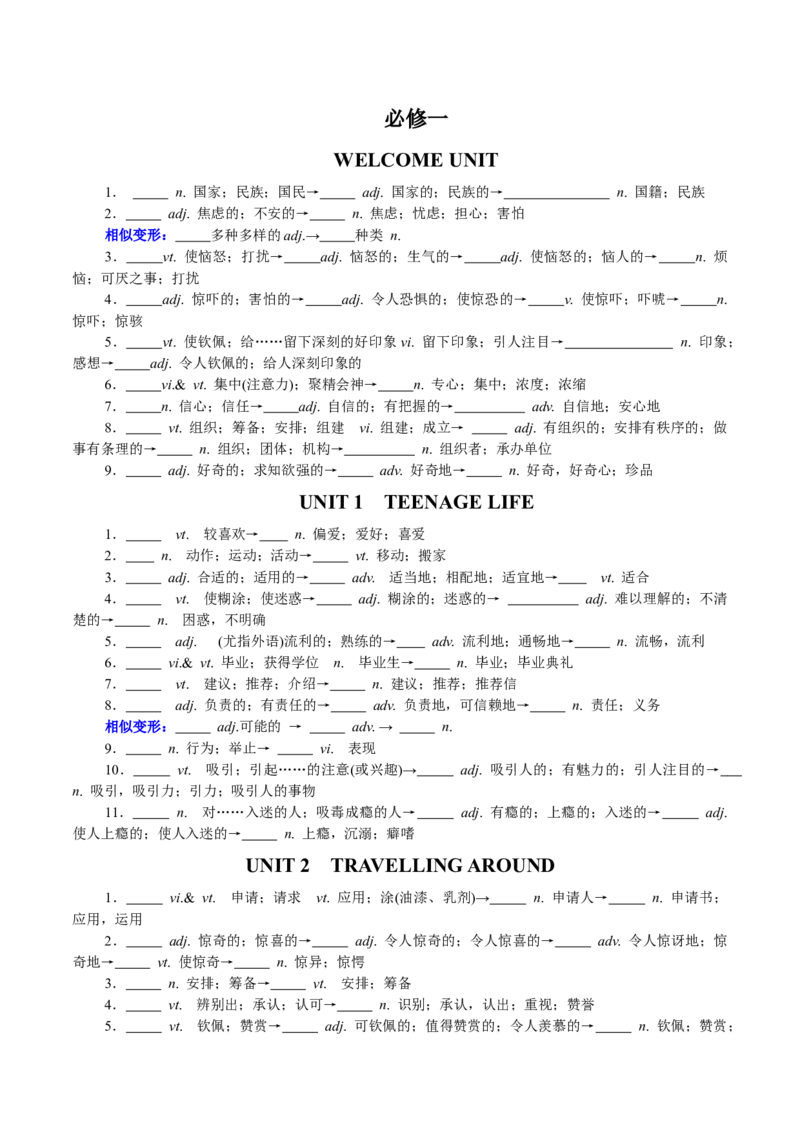
1. n. 国家;民族;国民→ adj. 国家的;民族的→ n. 国籍;民族
2. adj. 焦虑的;不安的→ n. 焦虑;忧虑;担心;害怕
相似变形: 多种多样的adj.→ 种类 n.
3. vt. 使恼怒;打扰→ adj. 恼怒的;生气的→ adj. 使恼怒的;恼人的→ n. 烦
恼;可厌之事;打扰
4. adj. 惊吓的;害怕的→ adj. 令人恐惧的;使惊恐的→ v. 使惊吓;吓唬→ n.
惊吓;惊骇
5. vt. 使钦佩;给……留下深刻的好印象vi. 留下印象;引人注目→ n. 印象;
感想→ adj. 令人钦佩的;给人深刻印象的
6. vi.& vt. 集中(注意力);聚精会神→ n. 专心;集中;浓度;浓缩
7. n. 信心;信任→ adj. 自信的;有把握的→ adv. 自信地;安心地
8. vt. 组织;筹备;安排;组建 vi. 组建;成立→ adj. 有组织的;安排有秩序的;做
事有条理的→ n. 组织;团体;机构→ n. 组织者;承办单位
9. adj. 好奇的;求知欲强的→ adv. 好奇地→ n. 好奇,好奇心;珍品
UNIT 1 TEENAGE LIFE
1. vt. 较喜欢→ n. 偏爱;爱好;喜爱
2. n. 动作;运动;活动→ vt. 移动;搬家
3. adj. 合适的;适用的→ adv. 适当地;相配地;适宜地→ vt. 适合
4. vt. 使糊涂;使迷惑→ adj. 糊涂的;迷惑的→ adj. 难以理解的;不清
楚的→ n. 困惑,不明确
5. adj. (尤指外语)流利的;熟练的→ adv. 流利地;通畅地→ n. 流畅,流利
6. vi.& vt. 毕业;获得学位 n. 毕业生→ n. 毕业;毕业典礼
7. vt. 建议;推荐;介绍→ n. 建议;推荐;推荐信
8. adj. 负责的;有责任的→ adv. 负责地,可信赖地→ n. 责任;义务
相似变形: adj.可能的 → adv. → n.
9. n. 行为;举止→ vi. 表现
10. vt. 吸引;引起……的注意(或兴趣)→ adj. 吸引人的;有魅力的;引人注目的→
n. 吸引,吸引力;引力;吸引人的事物
11. n. 对……入迷的人;吸毒成瘾的人→ adj. 有瘾的;上瘾的;入迷的→ adj.
使人上瘾的;使人入迷的→ n. 上瘾,沉溺;癖嗜
UNIT 2 TRAVELLING AROUND
1. vi.& vt. 申请;请求 vt. 应用;涂(油漆、乳剂)→ n. 申请人→ n. 申请书;
应用,运用
2. adj. 惊奇的;惊喜的→ adj. 令人惊奇的;令人惊喜的→ adv. 令人惊讶地;惊
奇地→ vt. 使惊奇→ n. 惊异;惊愕
3. n. 安排;筹备→ vt. 安排;筹备
4. vt. 辨别出;承认;认可→ n. 识别;承认,认出;重视;赞誉
5. vt. 钦佩;赞赏→ adj. 可钦佩的;值得赞赏的;令人羡慕的→ n. 钦佩;赞赏;羡慕;赞美
6. n. 经济;节约→ adj. 经济(上)的;经济学的→ n. 经济学
UNIT 3 SPORTS AND FITNESS
1. n. 健康;健壮;适合→ v. 适合,合身 adj. 健康的;合适的;恰当的;准备好的
2. n. 荣誉;尊敬;荣幸→ adj. 荣誉的;值得尊敬的;表示尊敬的;正直的
3. n. 荣誉;光荣;赞美→ adj. 光荣的;辉煌的;极好的→ vt. 赞美;美化
4. n. 决心;决定→ vt.& vi. 决定;决心
5. vt. 使受伤;损害→ adj. 受伤的;有伤的→ n. 伤害;损伤
6. adj. 优美的;优雅的→ adv. 优美地;优雅地→ n. 优雅;恩惠;魅力;
慈悲
7. n. 力量;体力→ adj. 坚强的;强壮的;牢固的;擅长的→ vt. 加强;巩固
8. n. 失败;失败的人(或事物)→ vi.& vt. 失败;未能(做到)
9. n. 压力;紧张;重音 vt. 强调;重读;使焦虑不安 vi. 焦虑不安→ adj. 紧张的;
有压力的→ adj. 焦虑不安的;心力交瘁的
UNIT 4 NATURAL DISASTERS
1. n. 死;死亡→ vi. 死亡;凋零;熄灭→ adj. 无生命的;呆板的;废弃了的→
adj. 致命的;极度的
2. n. 震惊;令人震惊的事;休克 vt. (使)震惊→ adj. 震惊的;震撼的→ adj. 令人
震惊的;可怕的,令人厌恶的;糟糕的
3. vi.& vt. 呼吸→ n. 呼吸,气息;一口气,(呼吸的)一次;瞬间→ adj. 喘不过气
来的;停止呼吸的
4. vt.& vi. 复活;(使)苏醒→ n. 振兴;复苏
相似变形: vi. 到达→ n. 到达
5. vi. 生存;存活 vt. 幸存;艰难度过→ n. 幸存,残存;幸存者,残存物→ n.
幸存者;生还者;残存物
6. adj. 镇静的;沉着的 vt. 使平静;使镇静→ adv. 镇静地,冷静地;平静地;安静
地→ n. 镇静,冷静;平静,安宁
7. vt.& vi. 递送;传达 vt. 发表→ n. 传送;递送;交付
相似变形: vt.发现→ n. 发现
8. n. 影响;结果;效果→ adj. 有效的,起作用的;实际的;给人深刻印象的→
adv. 有效地,生效地;有力地;实际上
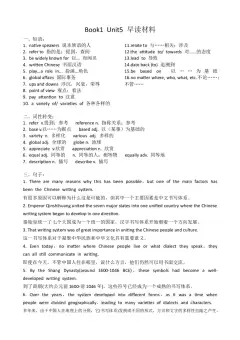
UNIT 5 LANGUAGES AROUND THE WORLD
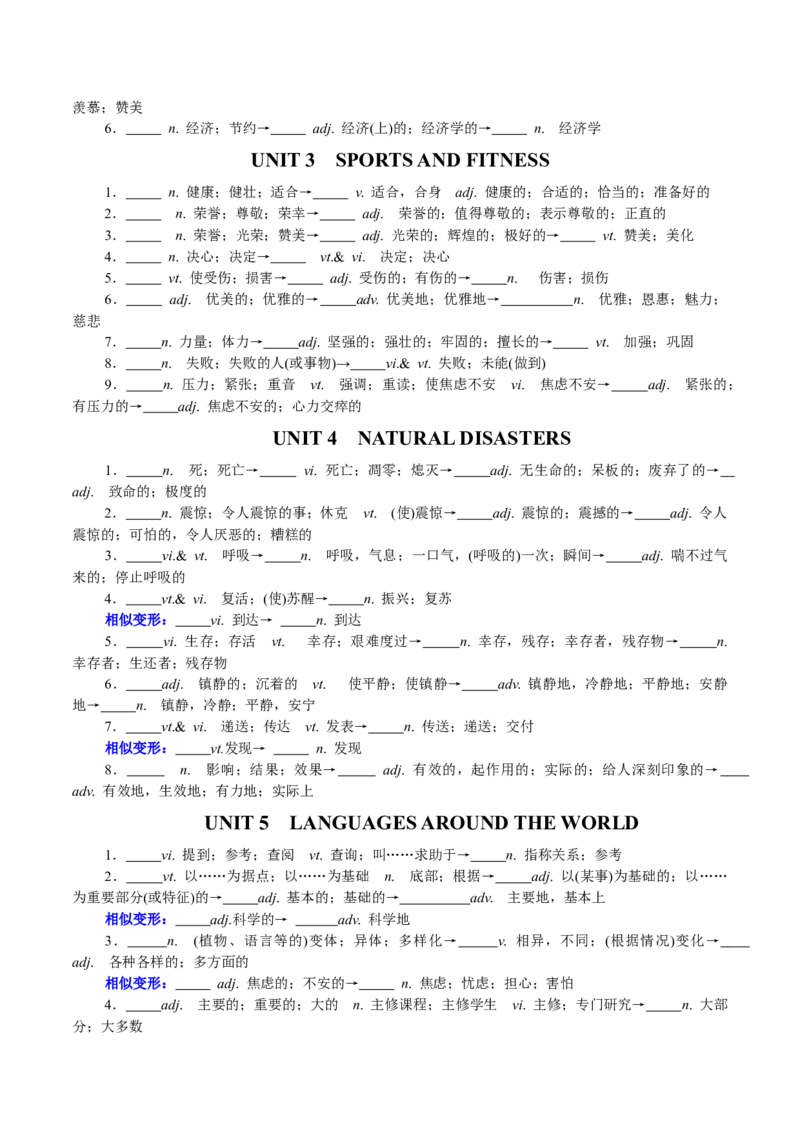
1. vi. 提到;参考;查阅 vt. 查询;叫……求助于→ n. 指称关系;参考
2. vt. 以……为据点;以……为基础 n. 底部;根据→ adj. 以(某事)为基础的;以……
为重要部分(或特征)的→ adj. 基本的;基础的→ adv. 主要地,基本上
相似变形: adj.科学的→ adv. 科学地
3. n. (植物、语言等的)变体;异体;多样化→ v. 相异,不同;(根据情况)变化→
adj. 各种各样的;多方面的
相似变形: adj. 焦虑的;不安的→ n. 焦虑;忧虑;担心;害怕
4. adj. 主要的;重要的;大的 n. 主修课程;主修学生 vi. 主修;专门研究→ n. 大部
分;大多数5. vt. 欣赏;重视;感激;领会 vi. 增值→ adj. 感激的;赏识的;有欣赏力的→
n. 欣赏,鉴别;增值;感谢
6. n. 同等的人;相等物 adj. 相同的;同样的→ adv. 同样地;相等地,平等地→
n. 平等;相等;[数]等式
7. n. 要求;需求 vt. 强烈要求;需要 vi. 查问→ adj. 要求高的;需要高技能(或耐性
等)的;费力的
8. n. 描写(文字);形容→ v. 描述;形容;把……称为→ adj. 描写的,叙述的;描
写性的
9. vt. 联系;讲述→ adj. 相对的;有关系的;成比例的 n. 亲戚;相关物→ n. 关
系;叙述;故事;亲属关系
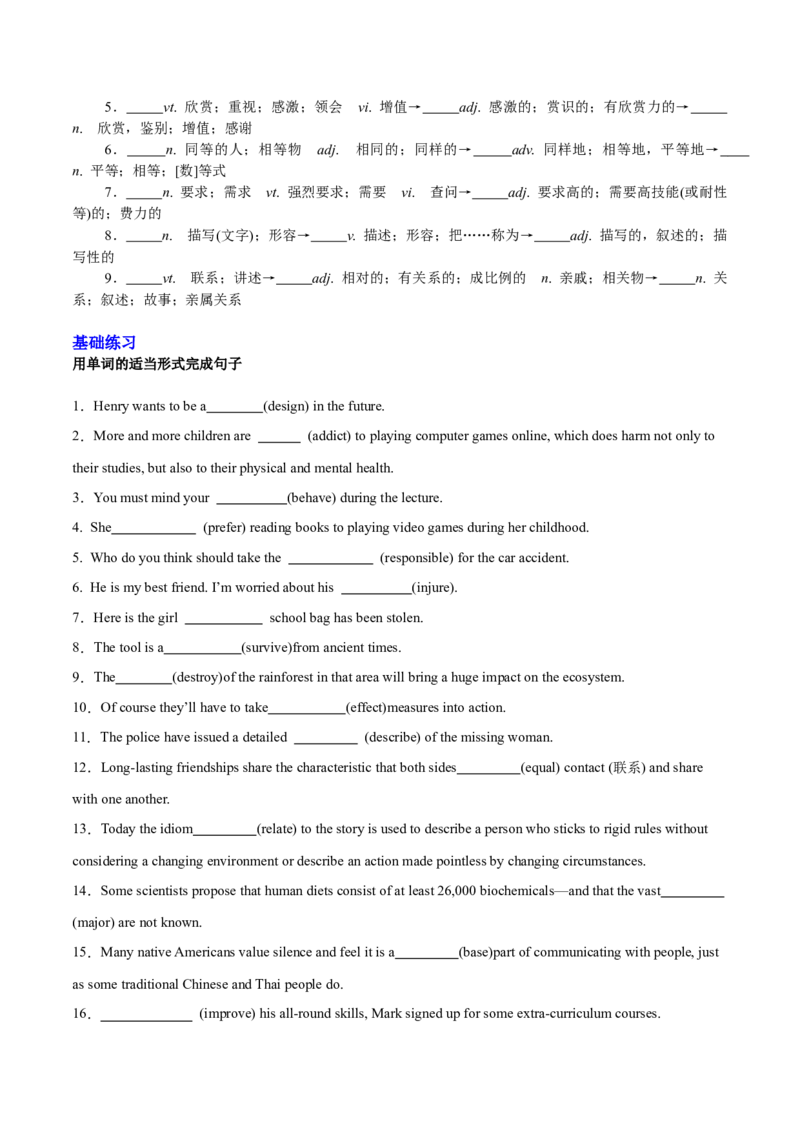
基础练习
用单词的适当形式完成句子
1.Henry wants to be a (design) in the future.
2.More and more children are (addict) to playing computer games online, which does harm not only to
their studies, but also to their physical and mental health.
3.You must mind your (behave) during the lecture.
4. She (prefer) reading books to playing video games during her childhood.
5. Who do you think should take the (responsible) for the car accident.
6. He is my best friend. I’m worried about his (injure).
7.Here is the girl school bag has been stolen.
8.The tool is a (survive)from ancient times.
9.The (destroy)of the rainforest in that area will bring a huge impact on the ecosystem.
10.Of course they’ll have to take (effect)measures into action.
11.The police have issued a detailed (describe) of the missing woman.
12.Long-lasting friendships share the characteristic that both sides (equal) contact (联系) and share
with one another.
13.Today the idiom (relate) to the story is used to describe a person who sticks to rigid rules without
considering a changing environment or describe an action made pointless by changing circumstances.
14.Some scientists propose that human diets consist of at least 26,000 biochemicals—and that the vast
(major) are not known.
15.Many native Americans value silence and feel it is a (base)part of communicating with people, just
as some traditional Chinese and Thai people do.
16. (improve) his all-round skills, Mark signed up for some extra-curriculum courses.17.The lab has recently been updated to allow more (advance) courses.
18.I found Maths quite easy and enjoyable because the material was (advance) in the UK than in
China.
19.The (confuse) look on the boy’s face suggested the contents of the new book made him doubt
his quality.
20.He expressed his (confident) that the project would be a success.
综合训练
阅读下面短文,在空白处填入1个适当单词或括号内单词的正确形式。
(一)
Lisa graduated 21 our school last June and is about to go to college in New York. She came to share
her 22 (suggest) for high school with us. Lisa said Orientation Day was really 23 (help) when she
first started high school, and it’s a fantastic opportunity for new students 24 (get) to know the school and
the other students. Though Lisa was a member of the school volleyball team, she wasn’t 25 (select) for the
end-of-year competition. At first, she was really sad, but later she 26 (realize) that she joined the team for
the love of the sport. It wasn’t just about 27 (win). So she kept working hard 28 (support) her
teammates during the training. Lisa totally agreed with the wonderful words from the writer Maya Angelou—Be a
rainbow in somebody else’s cloud. So she suggested that we give our friends 29 hand when they need it.
And this would make us feel 30 (well), too.
(二)
The English phrase “it’s a small world” has been commonly used, and the recent coronation (加冕) of King
Charles III and Queen Camilla in London on Saturday made me appreciate 31 (it) real meaning.
I was one of those who were viewing this once-in-a-life-time event on television. This meant that I literally
had a front-row seat to a ceremony 32 has been virtually unchanged for centuries. The coronation of a new
king is a significant moment in the life of many British people, but until the 20th century, the opportunity to see this
33 (impress) event was limited to a select group of people. All that was changed by the development in mass
34 (communicate), particularly the development of cinema and television.
In fact, the first time that 35 “ordinary” person in Britain could have seen, or heard the coronation was
in 1937. In that year, film cameras 36 (allow) inside London’s Westminster Abbey 37 (record) the
event for the first time. 38 , what was special about the coronation of King Charles III was that this
centuries-old ceremony had a global audience.The fact that I could sit on my sofa, many 39 (thousand) of kilometers away from those events in
London on Saturday and see the coronation as it actually happened really brought this fact home to me, 40
(make) me truly appreciate that we are now really living in such a “small world”.
(三)
High school students and those who help in their education in Cyprus have developed 41 unusual
robot. The robot uses ChatGPT artificial intelligence , or AI, technology. ChatGPT is a system 42
(develop) by U.S. company Open AI and backed by the technology company Microsoft. The aim of the students is
to use the technology 43 (improve) learning experiences in the classroom.
ChatGPT is an AI system that can have a 44 (discuss) and create written work. It can create material
based on 45 it has learned from a large database of digital books, online writings, and other media.The
robot is named AInstein. It is the size of a small adult. The robot even has a screen for a face that appears to show
human 46 (face) expressions.
Tutor Elpidoforos Anastasiou is the project’s leader. He said that students can ask it questions, it can answer
back, and the robot can even help teachers teach more 47 (effect).
Anastasiou showed how AI can be fitted to the classroom with AInstein 48 (show) how part of
Albert Einstein’s theory of time relativity can 49 (explain) by talking about a moving object called a
pendulum(钟摆).
Their experience with AInstein shows that we should not fear AI, but rather approach it 50 care
and responsible consideration."
(四)
I came across an interesting story when I visited my cousin in Henan Province, China. My cousin grew up
next door to a girl 51 (call) Li Shichun. The “Chun” part of Li Shichun stands for spring. That’s when she
was born. But that’s not all. She is also named 52 a Sui Dynasty engineer, Li Chun. Her father thought him
53 (admire) because he built bridges you can really count on. But her mother wouldn’t like her daughter 54
(have) that name because she thought that 55 (sound)too much like a boy’s name. She was worried that
her daughter would have to put up with too much teasing with 56 man’s name. So they figured out a way
to change it. They added “Shi” from her grandmother’s name. Well, that was lucky 57 she looks like her
grandmother anyway. Li Shichun 58 (final) went to university where she studied medicine. However, she
didn’t like it so she changed her studies and ended up 59 (become) an engineer! She became quite
famous when she invented a new way of holding up suspension 60 (bridge) during the buildingprocess.
(五)
Schools in the UK are making 61 effort to help deal with the growing teacher shortage with the use
of classroom robots. So far, two primary schools in Plymouth 62 (start) to use the machines as possible
replacements (替代) for teaching assistants. Britain’s lack of teaching staff has been a serious problem over the last
twenty years. 63 (graduate) are unwilling to enter the primary education department. Many teachers are
giving up the teaching jobs for careers in other fields, 64 makes matters worse.
Facing this 65 (alarm) shortage, some schools believe that robots might soon be able to fill the gap.
Tests have found that, by 66 (show) various classroom techniques, teachers can train the robots to be
teachers in a real teaching setting within just three hours. In one example, the robot teacher 67 (success)
guided the students through difficult tasks, giving them praise and 68 (encourage) when necessary. The
project has been met with mixed feelings from teachers. Some are 69 (concern) that the robots are here to
take their jobs while others optimistically regard the machines 70 a way to reduce their heavy
workloads.