




文档内容
2023 年高考英语一轮复习讲练测(人教版 2019)
必修第一册 Unit 3 基础知识强化练
Ⅰ. 单词拼写
1. I hope to be a basketball star so that I can serve my motherland as a basketball ____________(运动员).
2. He has collected more than a ____________(百万) books of different ages.
3. Tom was ____________(欺骗) out of all of his money.
4. The new song is popular with the ____________(听众).
5. You will want to continue to focus on ____________(积极的) choices.
6. Because Mary is on a diet, she is becoming ____________(苗条) than before.
7. According to the doctor, ____________(慢跑) is good for our heart.
8. The little girl can’t fall asleep because of too much ____________(压力).
9. In order to win the gold ____________(奖牌), she trained hard day after day and eventually made it.
10. It would really be a great ____________(荣幸) for us to enjoy your lecture.
Ⅱ. 选词填空
work out; make it; determine to do. . . ; give up; now and then; in honour of; lose heart; set a good example for. . .
; fall apart; compare. . . with/to
1. The manager tried to ____________ his employees by going to work on time.
2. You have to ____________ a plan as quickly as possible, or we won’t know what to do next.
3. They set sail in the morning and ____________ to a small town before dark.
4. Paul was fond of Chinese culture, so he ____________ settle in China.
5. I’ll never ____________ even if I should fail ten times.
6. This part of the road is so narrow that there are bound to be traffic jams ____________.
7. She has decided to ____________ her job and start her own business.
8. A farewell party was held ____________ the ambassador(大使).
9. Miners have dangerous jobs because occasionally the mine sinks or ____________.
10. ____________ the apple on the table, this one looks more attractive.
Ⅲ. 完成句子
1. I hope my suggestions can ____________. I’ll continue to offer help if you need.
我希望我的建议能有所作用。如果需要的话我将继续提供帮助。
2. I like Chung Yeung Festival not just ____________.我喜欢重阳节, 不仅仅是因为这些受欢迎的活动。
3. I ____________, but she hasn’t come yet.
我一直等了一个小时了, 但是她还没来。
4. Don’t be rude to them ____________ they have done something wrong.
不要对他们粗鲁, 即使他们犯了一些错误。
5. ____________ will do good to your physical health.
定期锻炼对你的身体健康有好处。
6. Although she doesn’t talk much, what she says ____________.
尽管她说得不多, 但是她说的话很有意义。
Ⅳ. 用反意疑问句完成句子(每空一词)
1. Everyone has his own hobby, ____________ ____________?
2. Nothing can be more important than health, ____________ ____________?
3. I don’t think you’ve finished your homework, ____________ ____________?
4. Don’t forget to phone me, ____________ ____________?
5. You rarely play tik tok when you are free, ____________ ____________?
6. You must have been told the result, ____________ ____________?
7. The party won’t get going till seven, ____________ ____________?
8. We don’t think that he will pass the driving test this time, ____________ ____________?
9. These are important reading materials, ____________ ____________?
10. He didn’t consider following our suggestions, ____________ ____________?
Ⅴ. 阅读理解
A
The beach may seem like an inviting place to run on a cool summer morning, but is running on the sand good
for your body? It can be, but it’s important to be aware of the challenges that some beach runners experience
before you get ready.
Running on the beach can be a good thing. It’s certainly different from running on a track or a pavement. For
starters, sand can be a challenge because it has an uneven (不平坦的) surface. As you push off, you’re going to
lose some of your push as the sand moves. So, you’re not going to be able to push yourself forward as you would
on a track or a pavement. But this unevenness has an upside; It gives your body an extra workout, forcing you to
exercise muscles that don’t get as much use during running on firm surfaces. For example, your feet, ankles and
lower back might feel sorer and more tired than usual after a beach run just because the surface is constantlymoving and changing step to step.
You also might feel sore afterward because beaches tend to slope (倾斜) down to the water. If you’re going for
a long run on the beach, you might notice that one side of your body might feel sorer because you’re putting more
pressure on it due to the slope.
Some beach runners prefer to run barefoot — not wearing anything on feet. However, if you’re not used to
barefoot running, start slowly and don’t run long distances at first. That’s because running barefoot uses more
different muscles than running with shoes, and it’s important to strengthen these muscles and adapt your feet. If
you want to run barefoot and as long as you run carefully enough into it, go for it!
Running on the sand can be a smart choice for you, because running on softer ground surfaces can reduce
muscle damage.
1. Why is it difficult to run on the beach for starters?
A. Running on its uneven surface takes much effort.
B. People need to run carefully on its smooth surface.
C. The soft surface makes people fall over easily.
D. It’s hard to keep one’s balance on its hard surface.
2. Which of the following best explains “upside” underlined in Paragraph 2?
A. Character. B. Reason.
C. Advantage. D. Challenge.
3. Where can the passage be found?
A. A primary school textbook.
B. A sports magazine.
C. A tourist guide.
D. A scientific report.
B
There’s nothing magical about the number 10, 000. In fact, the idea of walking at least 10, 000 steps a day for
health goes back many years to a marketing campaign started in Japan for the sale of a pedometer (计步器). And,
in the years that followed, it was accepted in the US as a goal to build up good health. It’s often the default setting
(默认设置) on fitness trackers, but what’s it really based on?
“The original basis of the number was not scientifically determined, ” says researcher I-Min Lee of Brigham
and Women’s Hospital. She was curious to know how many steps you need to take a day to maintain good health
and live a long life, so she and her workmates designed a study that included about 17, 000 older women. Theiraverage age was 72. The women all agreed to wear devices to track their steps as they went about their day-to-day
activities.
It turns out that women who took about 4, 000 steps per day got an increase in longevity (长寿), compared
with women who took fewer steps. In fact, women who took 4, 400 steps per day, on average, were about 40
percent less likely to die during the follow-up period of about four years compared with women who took
2, 700 steps. The findings were published on Wednesday in JAMA Internal Medicine.
Another surprise: the benefits of walking maxed out at about 7, 500 steps. In other words, women who
walked more than 7, 500 steps per day saw no additional increase in longevity.
Janz, who released the new national exercise recommendations last November, says the message that comes
from this study was encouraging. “I think it’s really good news for women who may not be particularly active. ”
says Janz. “All they have to do is walk. To me, this study suggests there are more benefits to light activities than
we were previously thinking there might be. ”
4. How did the idea of walking 10, 000 steps a day come into being?
A. It was made up by a group of elderly ladies.
B. It was indeed the result of a scientific research.
C. It actually came from a business advertisement.
D. It was based on a test by both Japan and the US.
5. Which is an ideal choice for women walkers according to the study?
A. 2, 700 steps. B. 4, 400 steps.
C. 10, 000 steps. D. 17, 000 steps.
6. Which of the following does Janz agree with?
A. Light activities benefit people most.
B. The study is not as satisfying as expected.
C. Women should be more active than before.
D. The result of the study is a little surprising.
7. In which part of a newspaper can you read the passage?
A. Health. B. Culture.
C. History. D. Tourism.
Ⅵ. 七选五
If you live in a place where most people speak the language you are learning, you may use the language for
several hours each day. But you may not have these chances to practice English. You may even be self-taught. 1It is not very difficult, but it does take effort and practice.
Think in single words.
2 In your head, try to name each object in your surroundings. As you continue with this, it becomes
more of a habit, so things are going to pop up into your head–computer, telephone, chair, and desk. Whatever it
is, wherever you are. You can also do this at home when you wake up and before you go to sleep.
3
Another exercise is describing in your mind objects you don’t know the words for. An example would be if
you couldn’t think of the word “garage, ” Hinshaw says. “If you’re looking at your house and you see your garage,
but you can’t think of the name in English. You can say, “The place inside where I put my car. ”
Think in sentences.
The next exercise is thinking in simple sentences. For example, if you are sitting in a park, you can tell
yourself things like, “It’s such a beautiful day” and “People are playing sports with their friends. ” 4
Describe your day.
Another exercise experts suggest is to describe your daily activities. You can mentally make plans in the
morning when you wake up. 5 So the skill level is a little higher.
A. Describe unknown words.
B. Guess the meaning of a new word.
C. This would require future verb tenses.
D. A good first step is to think in individual words.
E. Hinshaw says doing this can help learners of any language.
F. Once this becomes easy, you can move on to more difficult sentences.
G. The good news is that thinking in English can bring you a huge step closer to fluency!
Ⅶ. 语法填空
Qigong, 1. (call) “Life Energy Cultivation” in China, is a practice of focusing on breath,
movement, and awareness for exercise, and healing(愈合). If you have taken Chinese lessons, you must be
familiar with Confucius, according to 2. qigong provides a means to become a Junzi
(gentleman)through awareness of morality. Taoism considers qigong to be able to provide a way to achieve spiritual
improvement. Qigong is 3. (tradition) viewed as a practice to balance qi (inner life energy), which is
now practiced throughout China and worldwide. 4. a form of gentle exercise, qigong is made up of
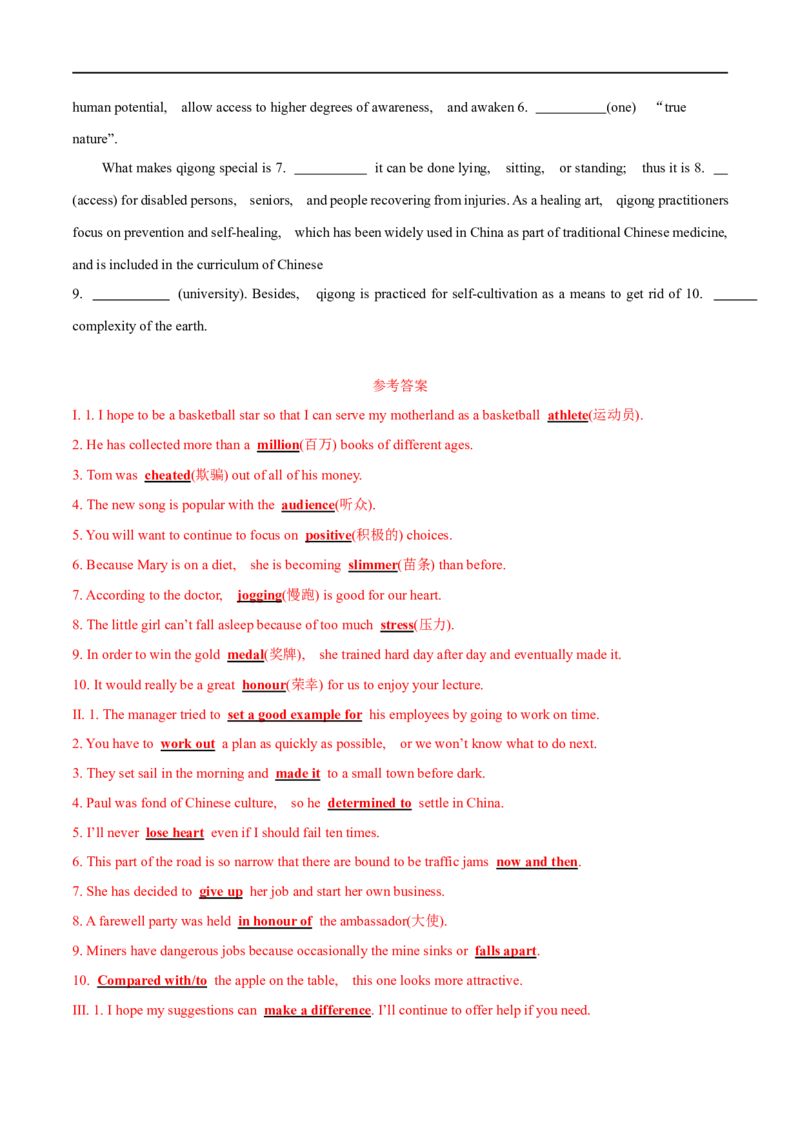
movements that are typically repeated, strengthening the body. Qigong 5. (believe) to help develophuman potential, allow access to higher degrees of awareness, and awaken 6. (one) “true
nature”.
What makes qigong special is 7. it can be done lying, sitting, or standing; thus it is 8.
(access) for disabled persons, seniors, and people recovering from injuries. As a healing art, qigong practitioners
focus on prevention and self-healing, which has been widely used in China as part of traditional Chinese medicine,
and is included in the curriculum of Chinese
9. (university). Besides, qigong is practiced for self-cultivation as a means to get rid of 10.
complexity of the earth.
参考答案
Ⅰ. 1. I hope to be a basketball star so that I can serve my motherland as a basketball athlete(运动员).
2. He has collected more than a million(百万) books of different ages.
3. Tom was cheated(欺骗) out of all of his money.
4. The new song is popular with the audience(听众).
5. You will want to continue to focus on positive(积极的) choices.
6. Because Mary is on a diet, she is becoming slimmer(苗条) than before.
7. According to the doctor, jogging(慢跑) is good for our heart.
8. The little girl can’t fall asleep because of too much stress(压力).
9. In order to win the gold medal(奖牌), she trained hard day after day and eventually made it.
10. It would really be a great honour(荣幸) for us to enjoy your lecture.
Ⅱ. 1. The manager tried to set a good example for his employees by going to work on time.
2. You have to work out a plan as quickly as possible, or we won’t know what to do next.
3. They set sail in the morning and made it to a small town before dark.
4. Paul was fond of Chinese culture, so he determined to settle in China.
5. I’ll never lose heart even if I should fail ten times.
6. This part of the road is so narrow that there are bound to be traffic jams now and then.
7. She has decided to give up her job and start her own business.
8. A farewell party was held in honour of the ambassador(大使).
9. Miners have dangerous jobs because occasionally the mine sinks or falls apart.
10. Compared with/to the apple on the table, this one looks more attractive.
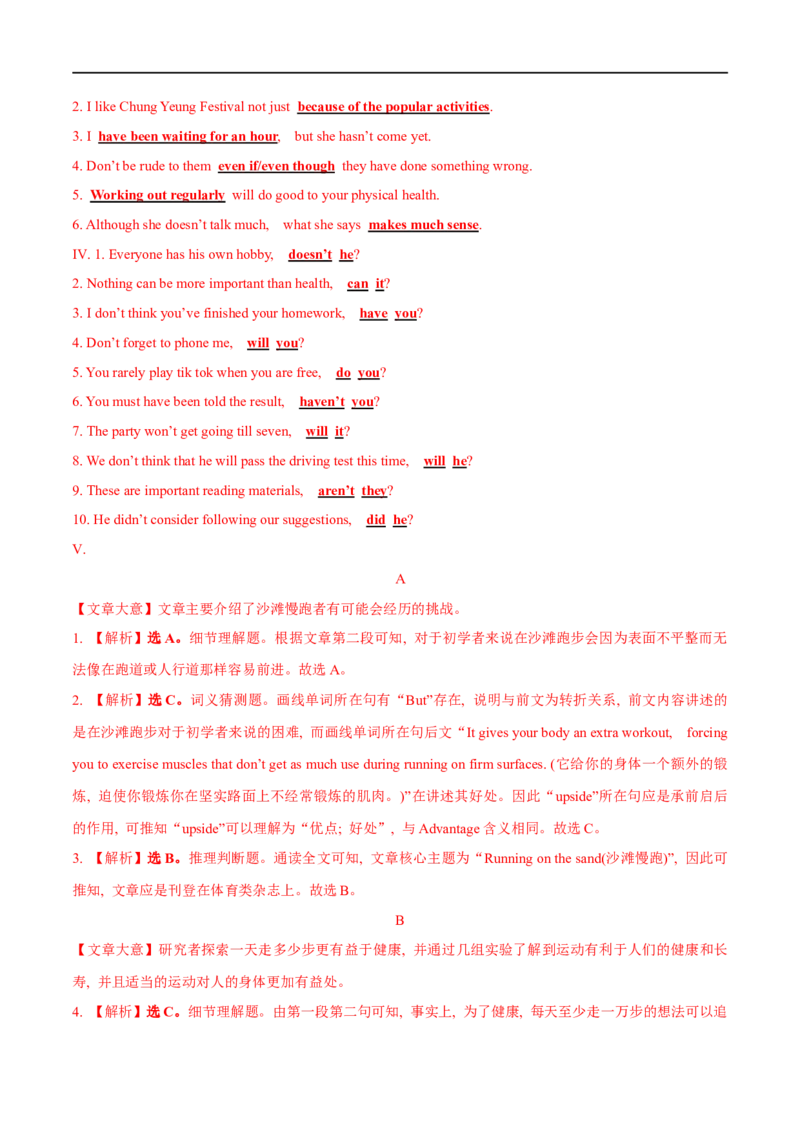
Ⅲ. 1. I hope my suggestions can make a difference. I’ll continue to offer help if you need.2. I like Chung Yeung Festival not just because of the popular activities.
3. I have been waiting for an hour, but she hasn’t come yet.
4. Don’t be rude to them even if/even though they have done something wrong.
5. Working out regularly will do good to your physical health.
6. Although she doesn’t talk much, what she says makes much sense.
Ⅳ. 1. Everyone has his own hobby, doesn’t he?
2. Nothing can be more important than health, can it?
3. I don’t think you’ve finished your homework, have you?
4. Don’t forget to phone me, will you?
5. You rarely play tik tok when you are free, do you?
6. You must have been told the result, haven’t you?
7. The party won’t get going till seven, will it?
8. We don’t think that he will pass the driving test this time, will he?
9. These are important reading materials, aren’t they?
10. He didn’t consider following our suggestions, did he?
Ⅴ.
A
【文章大意】文章主要介绍了沙滩慢跑者有可能会经历的挑战。
1. 【解析】选A。细节理解题。根据文章第二段可知, 对于初学者来说在沙滩跑步会因为表面不平整而无
法像在跑道或人行道那样容易前进。故选A。
2. 【解析】选C。词义猜测题。画线单词所在句有“But”存在, 说明与前文为转折关系, 前文内容讲述的
是在沙滩跑步对于初学者来说的困难, 而画线单词所在句后文“It gives your body an extra workout, forcing
you to exercise muscles that don’t get as much use during running on firm surfaces. (它给你的身体一个额外的锻
炼, 迫使你锻炼你在坚实路面上不经常锻炼的肌肉。)”在讲述其好处。因此“upside”所在句应是承前启后
的作用, 可推知“upside”可以理解为“优点; 好处”, 与Advantage含义相同。故选C。
3. 【解析】选B。推理判断题。通读全文可知, 文章核心主题为“Running on the sand(沙滩慢跑)”, 因此可
推知, 文章应是刊登在体育类杂志上。故选B。
B
【文章大意】研究者探索一天走多少步更有益于健康, 并通过几组实验了解到运动有利于人们的健康和长
寿, 并且适当的运动对人的身体更加有益处。
4. 【解析】选C。细节理解题。由第一段第二句可知, 事实上, 为了健康, 每天至少走一万步的想法可以追溯到多年前日本开始的一项销售计步器的营销活动。由此说明一天走至少10 000步的概念来自一款计步器
的商业广告。故选C。
5. 【解析】选B。推理判断题。由第三段第一句和第四段“women who walked more than 7, 500 steps per
day saw no additional increase in longevity. ”可知, 结果表明, 每天走大约4 000步的女性比每天走更少步的女
性寿命更长, 而每天步行超过7 500步的女性的寿命没有进一步增加, 所以走4 000步左右最适宜。故选
B。
6. 【解析】选D。细节理解题。根据最后一段最后一句内容可知, 对我来说, 这项研究表明, 轻度活动的好
处比我们之前认为的要多。所以D项研究的结果有些令人惊讶, 符合Janz的观点。故选D。
7.【解析】选A。推理判断题。本文主要叙述了人们每天走的步数与健康和长寿的关系, 因此最有可能出现
在报纸的有关身体健康的版块上。故选A。
Ⅵ. 【文章大意】文章介绍了一些如何练习用英语思考的方式。
1. 【解析】选G。结合下面已给的标题Think in single words、Think in sentences、Describe your day可知,
文章主要介绍的是一些如何练习用英语思考的方式。该句应该对下文这些内容进行概括, 结合选项, G选项
(好消息是, 用英语思考可以让你更接近流利! )符合语境。故选G。
2. 【解析】选D。根据标题“Think in single words. ”可知, 该段建议人们从单个词开始思考。后一句“In
your head, try to name each object in your surroundings(在你的头脑中, 试着给你周围的每一个物体命名)”对
该空做了进一步的说明。故D选项(好的第一步就是从单个词的角度进行思考)符合此语境。故选D。
3. 【解析】选 A。根据该段中的“Another exercise is describing in your mind objects you don’t know the
words for. (另一个练习是在脑海中描述你不认识的物体)”可知, 该段建议描绘那些不知道的物体。故选A。
4. 【解析】选F。上文提到: 下一个练习是用简单句思考。例如, 如果你坐在公园里, 你可以告诉自己一些
事情, 比如, “今天天气真好”, “人们正在和他们的朋友做运动”。该空承接上文, 结合选项, F选项(一旦这
变得容易了, 你可以继续学习更难的句子。)与之承接密切。故选F。
5. 【解析】选C。前文提到: 另一个运动专家建议是描述你的日常活动。你可以在早上醒来的时候在心里
制订计划。空后提到: 所以技能水平要高一些。根据so推知, 该空应当提出“制订计划时要求更高水平的
一些地方”。结合选项, C选项(这需要将来时动词的时态。)符合该语境。故选C。
Ⅶ. 【文章大意】本文介绍了什么是气功, 中国人眼里的气功以及气功的好处。
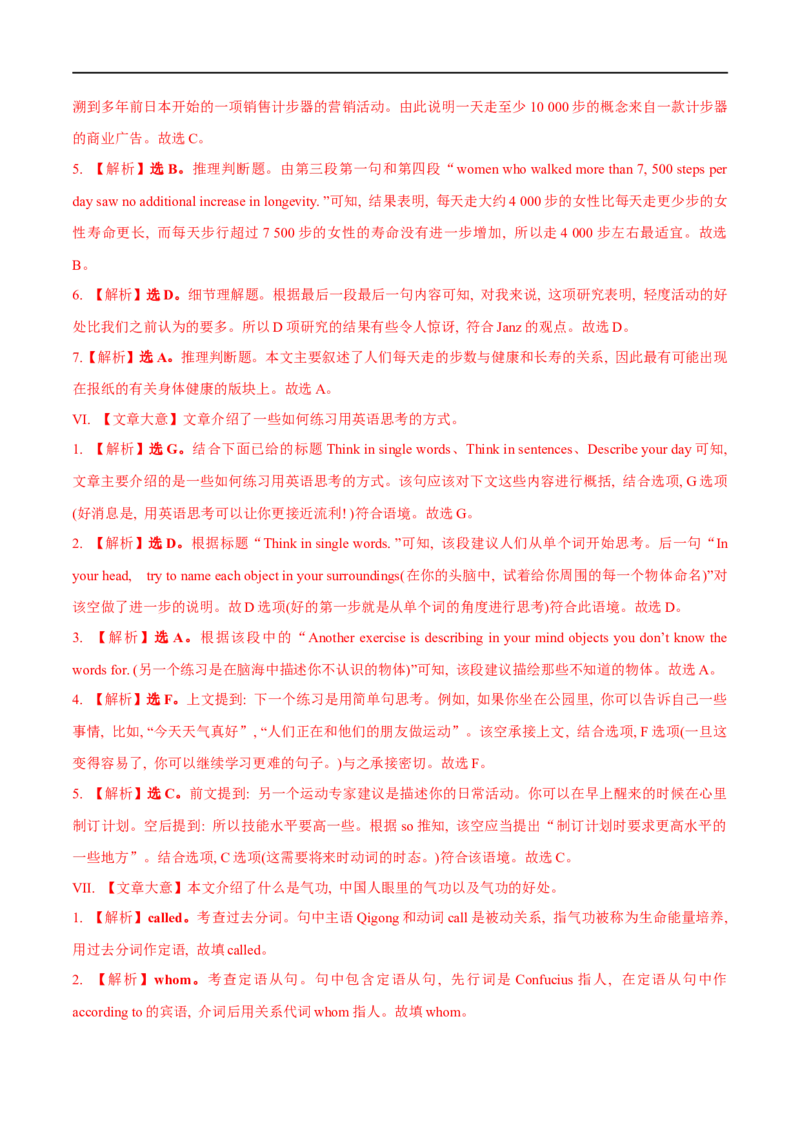
1. 【解析】called。考查过去分词。句中主语Qigong和动词call是被动关系, 指气功被称为生命能量培养,
用过去分词作定语, 故填called。
2. 【解析】whom。考查定语从句。句中包含定语从句, 先行词是 Confucius 指人, 在定语从句中作
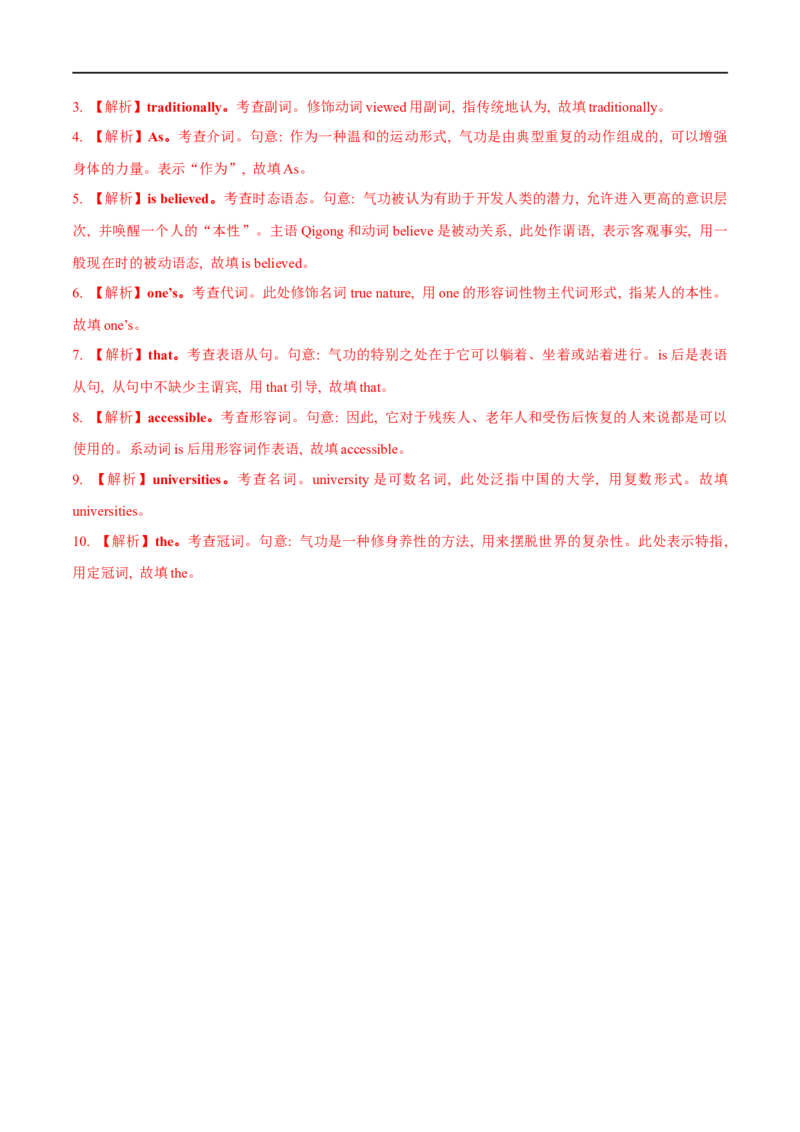
according to的宾语, 介词后用关系代词whom指人。故填whom。3. 【解析】traditionally。考查副词。修饰动词viewed用副词, 指传统地认为, 故填traditionally。
4. 【解析】As。考查介词。句意: 作为一种温和的运动形式, 气功是由典型重复的动作组成的, 可以增强
身体的力量。表示“作为”, 故填As。
5. 【解析】is believed。考查时态语态。句意: 气功被认为有助于开发人类的潜力, 允许进入更高的意识层
次, 并唤醒一个人的“本性”。主语Qigong和动词believe是被动关系, 此处作谓语, 表示客观事实, 用一
般现在时的被动语态, 故填is believed。
6. 【解析】one’s。考查代词。此处修饰名词true nature, 用one的形容词性物主代词形式, 指某人的本性。
故填one’s。
7. 【解析】that。考查表语从句。句意: 气功的特别之处在于它可以躺着、坐着或站着进行。is后是表语
从句, 从句中不缺少主谓宾, 用that引导, 故填that。
8. 【解析】accessible。考查形容词。句意: 因此, 它对于残疾人、老年人和受伤后恢复的人来说都是可以
使用的。系动词is后用形容词作表语, 故填accessible。
9. 【解析】universities。考查名词。university是可数名词, 此处泛指中国的大学, 用复数形式。故填
universities。
10. 【解析】the。考查冠词。句意: 气功是一种修身养性的方法, 用来摆脱世界的复杂性。此处表示特指,
用定冠词, 故填the。