听力百分百—备战 2022 高考英语听力专项(十六)
目录 内容
模块一 题型技巧讲解
模块二 外文时事训练
模块三 真题模拟题训练
模块一:短对话常见题型及技巧讲解
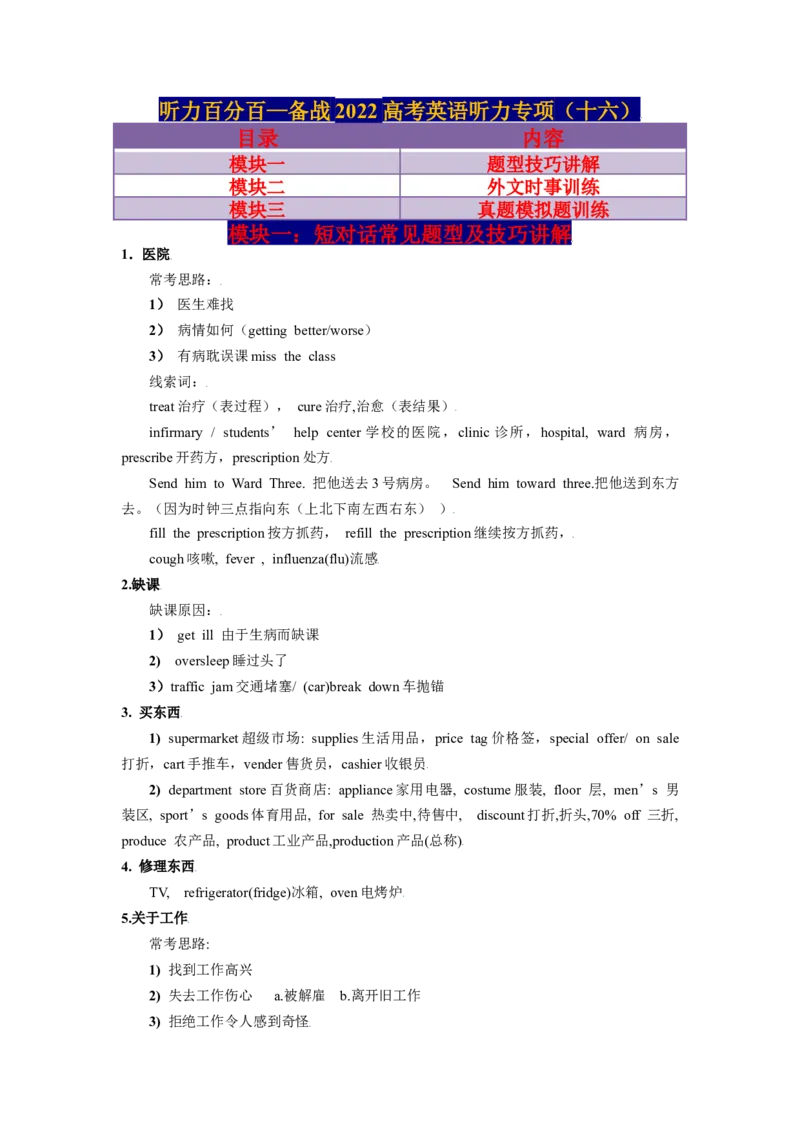
1.医院
常考思路:
1) 医生难找
2) 病情如何(getting better/worse)
3) 有病耽误课miss the class
线索词:
treat治疗(表过程), cure治疗,治愈(表结果)
infirmary / students’ help center 学校的医院,clinic 诊所,hospital, ward 病房,
prescribe开药方,prescription处方
Send him to Ward Three. 把他送去3号病房。 Send him toward three.把他送到东方
去。(因为时钟三点指向东(上北下南左西右东) )
fill the prescription按方抓药, refill the prescription继续按方抓药,
cough咳嗽, fever , influenza(flu)流感
2.缺课
缺课原因:
1) get ill 由于生病而缺课
2) oversleep睡过头了
3)traffic jam交通堵塞/ (car)break down车抛锚
3. 买东西
1) supermarket超级市场: supplies生活用品,price tag价格签,special offer/ on sale
打折,cart手推车,vender售货员,cashier收银员
2) department store百货商店: appliance家用电器, costume服装, floor 层, men’s 男
装区, sport’s goods体育用品, for sale 热卖中,待售中, discount打折,折头,70% off 三折,
produce 农产品, product工业产品,production产品(总称)
4. 修理东西
TV, refrigerator(fridge)冰箱, oven电烤炉
5.关于工作
常考思路:
1) 找到工作高兴
2) 失去工作伤心 a.被解雇 b.离开旧工作
3) 拒绝工作令人感到奇怪线索词
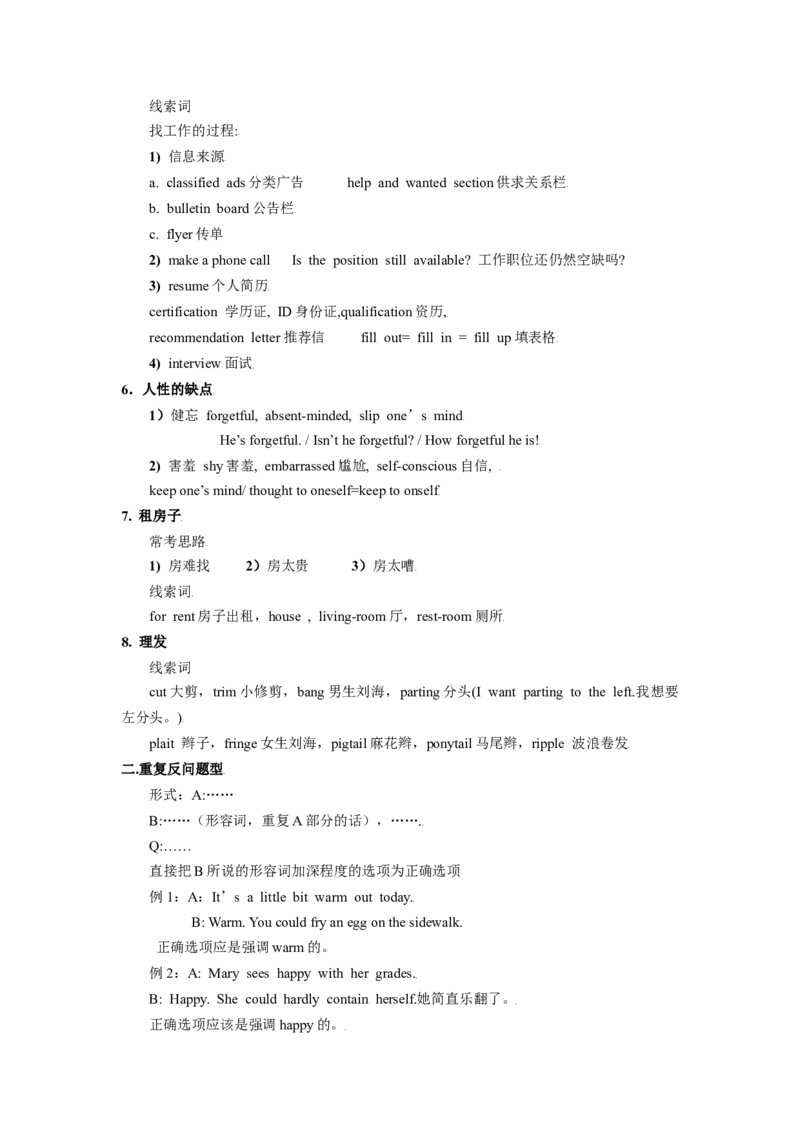
找工作的过程:
1) 信息来源
a. classified ads分类广告 help and wanted section供求关系栏
b. bulletin board公告栏
c. flyer传单
2) make a phone call Is the position still available? 工作职位还仍然空缺吗?
3) resume个人简历
certification 学历证, ID身份证,qualification资历,
recommendation letter推荐信 fill out= fill in = fill up填表格
4) interview面试
6.人性的缺点
1)健忘 forgetful, absent-minded, slip one’s mind
He’s forgetful. / Isn’t he forgetful? / How forgetful he is!
2) 害羞 shy害羞, embarrassed尴尬, self-conscious自信,
keep one’s mind/ thought to oneself=keep to onself
7. 租房子
常考思路
1) 房难找 2)房太贵 3)房太嘈
线索词
for rent房子出租,house , living-room厅,rest-room厕所
8. 理发
线索词
cut大剪,trim小修剪,bang男生刘海,parting分头(I want parting to the left.我想要
左分头。)
plait 辫子,fringe女生刘海,pigtail麻花辫,ponytail马尾辫,ripple 波浪卷发
二.重复反问题型
形式:A:……
B:……(形容词,重复A部分的话),…….
Q:……
直接把B所说的形容词加深程度的选项为正确选项
例1:A:It’s a little bit warm out today.
B: Warm. You could fry an egg on the sidewalk.
正确选项应是强调warm的。
例2:A: Mary sees happy with her grades.
B: Happy. She could hardly contain herself.她简直乐翻了。
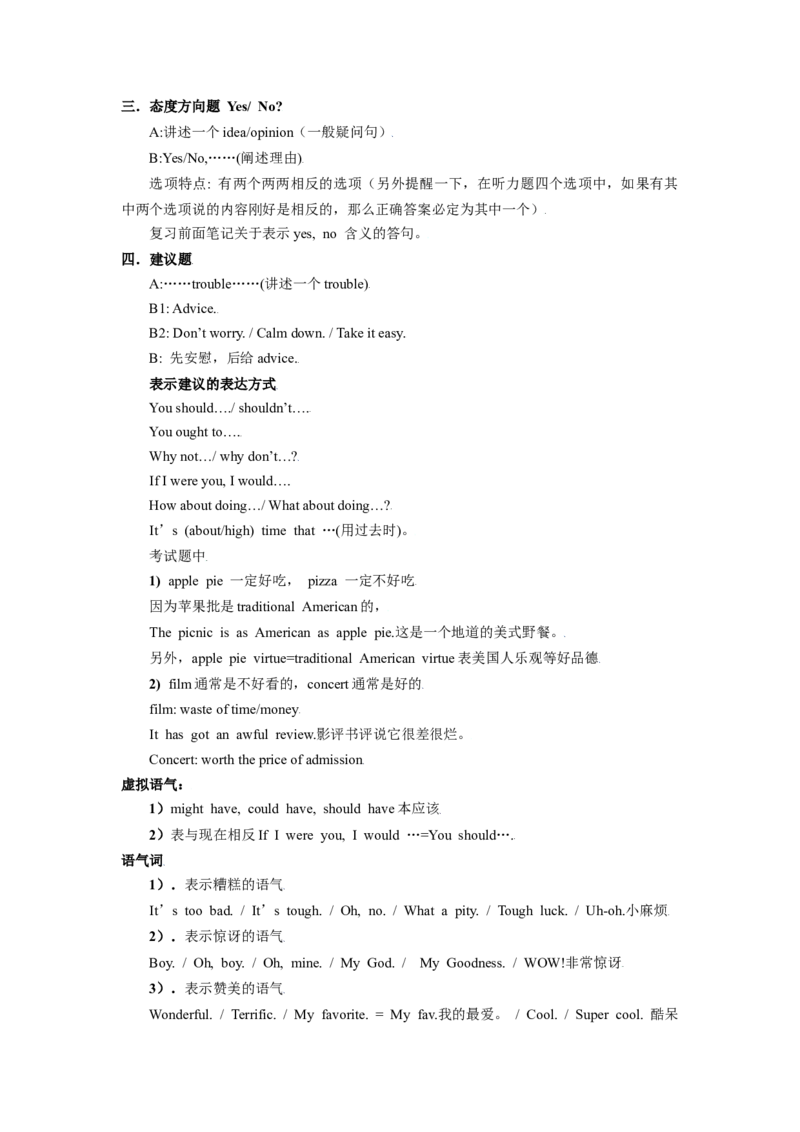
正确选项应该是强调happy的。三.态度方向题 Yes/ No?
A:讲述一个idea/opinion(一般疑问句)
B:Yes/No,……(阐述理由)
选项特点: 有两个两两相反的选项(另外提醒一下,在听力题四个选项中,如果有其
中两个选项说的内容刚好是相反的,那么正确答案必定为其中一个)
复习前面笔记关于表示yes, no 含义的答句。
四.建议题
A:……trouble……(讲述一个trouble)
B1: Advice.
B2: Don’t worry. / Calm down. / Take it easy.
B: 先安慰,后给advice.
表示建议的表达方式
You should…./ shouldn’t….
You ought to….
Why not…/ why don’t…?
If I were you, I would….
How about doing…/ What about doing…?
It’s (about/high) time that …(用过去时)。
考试题中
1) apple pie 一定好吃, pizza 一定不好吃
因为苹果批是traditional American的,
The picnic is as American as apple pie.这是一个地道的美式野餐。
另外,apple pie virtue=traditional American virtue表美国人乐观等好品德
2) film通常是不好看的,concert通常是好的
film: waste of time/money
It has got an awful review.影评书评说它很差很烂。
Concert: worth the price of admission
虚拟语气:
1)might have, could have, should have本应该
2)表与现在相反If I were you, I would …=You should….
语气词
1).表示糟糕的语气
It’s too bad. / It’s tough. / Oh, no. / What a pity. / Tough luck. / Uh-oh.小麻烦
2).表示惊讶的语气
Boy. / Oh, boy. / Oh, mine. / My God. / My Goodness. / WOW!非常惊讶
3).表示赞美的语气
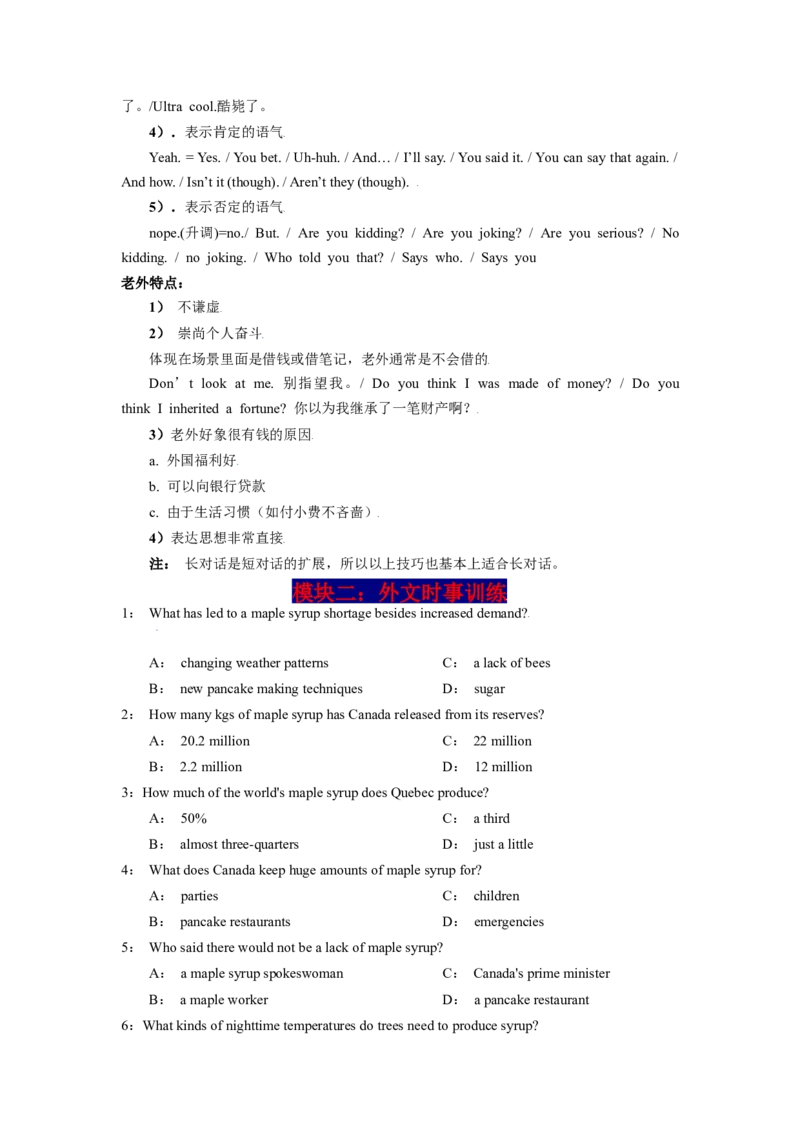
Wonderful. / Terrific. / My favorite. = My fav.我的最爱。 / Cool. / Super cool. 酷呆了。/Ultra cool.酷毙了。
4).表示肯定的语气
Yeah. = Yes. / You bet. / Uh-huh. / And… / I’ll say. / You said it. / You can say that again. /
And how. / Isn’t it (though). / Aren’t they (though).
5).表示否定的语气
nope.(升调)=no./ But. / Are you kidding? / Are you joking? / Are you serious? / No
kidding. / no joking. / Who told you that? / Says who. / Says you
老外特点:
1) 不谦虚
2) 崇尚个人奋斗
体现在场景里面是借钱或借笔记,老外通常是不会借的
Don’t look at me. 别指望我。/ Do you think I was made of money? / Do you
think I inherited a fortune? 你以为我继承了一笔财产啊?
3)老外好象很有钱的原因
a. 外国福利好
b. 可以向银行贷款
c. 由于生活习惯(如付小费不吝啬)
4)表达思想非常直接
注: 长对话是短对话的扩展,所以以上技巧也基本上适合长对话。
模块二:外文时事训练
1: What has led to a maple syrup shortage besides increased demand?
A: changing weather patterns C: a lack of bees
B: new pancake making techniques D: sugar
2: How many kgs of maple syrup has Canada released from its reserves?
A: 20.2 million C: 22 million
B: 2.2 million D: 12 million
3:How much of the world's maple syrup does Quebec produce?
A: 50% C: a third
B: almost three-quarters D: just a little
4: What does Canada keep huge amounts of maple syrup for?
A: parties C: children
B: pancake restaurants D: emergencies
5: Who said there would not be a lack of maple syrup?
A: a maple syrup spokeswoman C: Canada's prime minister
B: a maple worker D: a pancake restaurant
6:What kinds of nighttime temperatures do trees need to produce syrup?A: warm temperatures C: cool
B: just above 0ºC D: freezing temperatures
7:What was poorer than usual this year?
A: the maple quality C: people
B: the maple syrup harvest D: syrup prices
8:What was a major reason for the increase in demand for maple syrup?
A: bugs C: profit
B: no international travel D: a coronavirus pandemic
9: What might many of us have developed?
A: a maple syrup addiction C: a sweet tooth
B: headaches D: decayed teeth
10: What kinds of products are people using more of?
A: maple products C: pancake products
B: local products D: Canadian products
模块三:模拟题训练
Exercise A
第一节 (共5小题;每小题1.5分,满分7.5分)
听下面5段对话。每段对话后有一个小题, 从题中所给的A、B、C三个选项中选出最
佳选项,并标在试卷的相应位置。听完每段对话后, 你都有10秒钟的时间来回答有关小题
和阅读下一小题。每段对话仅读一遍。
1. What kind of sports did the man like very much?
A. Football. B. Tennis. C. Basketball.
2. How will the man go to Hong Kong from Shanghai?
A. By air. B. By subway. C. By bus.
3. Where does the conversation most probably take place?
A. In a laboratory. B. In a hospital. C. In a lawyer’s office.
4. What happened to the man?
A. He was asked to go back home.
B. He caught a bad cold days ago.
C. He gave the bug to his workmates in the office.
5. What do we know about the man?
A. He hasn’t got the chance to perform.
B. He doesn’t have much time to practice.
C. He is sure of winning the contest.
第二节(共15小题;每小题1.5分,满分22.5分)
听下面5段对话或独白。每段对话或独白后有几个小题,从题中所给的A、B、C三个
选项中选出最佳选项。听每段对话或独白前,你将有时间阅读各个小题,每小题 5秒钟;听完后,各小题将给出5秒钟的作答时间。每段对话或独白读两遍。
听第6段材料,回答第6、7题。
6. How was the rain last month?
A. It had been raining for half a month.
B. It rained heavily and washed away the soil.
C. The rainfall was half the monthly average.
7. What is the season now?
A. Autumn. B. Summer. C. Spring.
听第7段材料,回答第8、9题。
8. What do we know about the walking shoes?
A. They’re sold with a pair of socks.
B. They’re soft because of the material.
C. They’re too loose without the inner sole.
9. What is the man unsatisfied with?
A. The shoes polish. B. The original shoelaces. C. The color of the shoes.
听第8段材料,回答第10至12题。
10. What does the man ask the woman to do while he is dialing?
A. Make a shopping list.
B. Arrange the place for the party.
C. Find some fun things for the party.
11. Who won’t come to the party?
A. David. B. Jane. C. David’s girlfriend.
12. What will the man do?
A. Call those boys once more.
B. Go to visit David’s girlfriend.
C. Go shopping with the woman.
听第9段材料,回答第13至16题。
13. What is the man?
A. An inventor. B. A professor. C. A reporter.
14. Who is Hermione Granger based on?
A. The woman.
B. One of the woman’s best friends.
C. The woman’s favorite teacher.
15. What was beyond the woman’s expectation?
A. The publication of the Harry Potter books.
B. The popularity of the Harry Potter books.
C. The inspiration for the Harry Potter books.
16. How different will the woman’s future books on Harry Potter probably be?A. Rather exciting. B. More realistic. C. Rather scary.
听第10段材料,回答第17至20题。
17. What is the passage mainly about?
A. A visit to Arabs.
B. The business in Arab countries.
C. The Arab customs.
18. What is an unpleasant behavior for Arabs?
A. Talking business immediately.
B. Having refreshments before talking.
C. Discussing business in front of strangers.
19. What should people do when a meeting is interrupted?
A. Stop talking and leave.
B. Pretend not to hear and go on.
C. Let someone know your displeasure.
20. Why do Arabs rarely say “No” directly?
A. They consider it impolite to a guest.
B. They think it is disrespectful to God.
C. They want to have lots of time to consider.
Exercise B
第一节 (共5小题;每小题1.5分,满分7.5分)
第一节(共5小题;每小题1.5分,满分7.5分)
听下面5段对话。每段对话后有一个小题,从题中所给的A、B、C三个选项 中选出
最佳选项。听完每段对话后,你都有10秒钟的时间来回答有关小题和阅读下 一小题。每
段对话仅读一遍。
1. How does the woman check the weather?
A. She uses her phone. B. She listens to the radio. C. She watches television.
2. What will the boy do tonight?
A. Study for an exam. B. Practise debating. C. Watch a basketball game.
3. Why doesn't the boy use the method the woman gave?
A. He doesn't understand it. B. He doesn't have it yet. C. He doesn't like it.
4. What are the speakers doing?
A. Deciding the best player. B. Coming up with a plan. C. Scheduling the
game.
5. Where are the speakers?
A. At a store. B. At a bank. C. At a park.
第二节(共15小题;每小题1.5分,满分22.5分)
听下面5段对话或独白。每段对话或独白后有几个小题,从题中所给的 A、B、C三个
选项中选出最佳选项,并标在试卷的相应位置。听每段对话或独白前,你将有时间阅读各个小题,每小题5秒钟;听完后,各小题将给出5秒钟的作答时间。每段对话或独白读两
遍。
听第6段材料,回答第6、7题。
6. How does the woman probably feel?
A. Happy. B. Excited. C. Angry.
7. Who is the boy talking to?
A. A policewoman. B. His teacher. C. His mother.
听第7段材料,回答第8至10题。
8. What does Carol do when she volunteers?
A. She performs for children. B. She picks up trash. C. She serves dinner.
9. How often does Carol volunteer?
A. Once a week. B. Twice a week. C. Three times a week.
10. What does Jim worry about if he joins Carol?
A. Knowing little about the story. B. Choosing a boring book.
C. Reading for hours.
听第8段材料,回答第11至13题。
11. Which is a superfood according to the man?
A. Yogurt. B. Noodles. C. Rice.
12. Why are superfoods healthy?
A. Because they cure some terrible diseases.
B. Because they fight against some cancers.
C. Because they reduce the risks of some diseases.
13. Which food will the woman be adding to their family diet?
A. Fish. B. Tomatoes. C. Brown rice.
听第9段材料,回答第14至16题。
14. How did the man notice the problem first?
A. His bank called him. B. His bill showed him. C. His credit card was stolen.
15. What did the bank do to fix the problem?
A. They gave the man his money back at once.
B. They asked the man to provide the evidence.
C. They decided to talk to the bank's owner.
16. What do the two speakers mainly talk about?
A. Information safety. B. Shopping habits. C. Money management.
听第10段材料,回答第17至20题。
17. What does the speaker want her kids to do?
A. Help with the dishes. B. Go to bed immediately. C. Pick out something to
wear.18. When will the family probably need to leave their house tomorrow?
A. At 7:00 am. B. At 6:00 am. C. At 5:00 am.
19. Why doesn't the speaker make dinner?
A. There is no food left at home.
B. She doesn't want to make a mess.
C. They have already eaten at a restaurant.
20. What is the purpose of the talk?
A. To make sure everyone gets ready.
B. To make the house clean.
C. To make a regular plan.
Exercise C
第一节(共5小题;每题1.5分,满分7.5分)
听下面5段对话。每段对话后有一个小题,从题中所给的A、B、C三个选项中选出最
佳选项,并标在试卷的相应位置。听完每段对话后,你都有10秒钟的时间来回答有关小题和
阅读下一小题。每段对话仅读一遍。
1.What was the hotel like in the past?
A.The meals were good but not the rooms.
B.The rooms were good but not the meals.
C.The meals and the rooms were terrible.
2.What time will the ship leave?
A.At 6:55. B.At 7:05. C.At 9:15.
3.What are the two speakers trying to do?
A.Call a taxi. B.Catch a bus. C.Find a timetable.
4.What did the man buy?
A.A briefcase. B.A suitcase. C.A cigarette case.
5.What day of the week is it?
A.Saturday. B.Sunday. C.Monday.
第二节(共15小题;每小题1.5分,满分22.5分)
听下面5段对话或独白。每段对话或独白后有几个小题,从题中所给的A、B、C三个选项
中选出最佳选项,并标在试卷的相应位置。听每段对话或独白前,你将有时间阅读各个小
题,每小题5秒钟;听完后,各小题将给出5秒钟的作答时间。每段对话或独白读两遍。
听第6段材料,回答第6~8题。
6.How old was she when she became famous?
A.Twenty. B.Fifteen. C.Sixteen.
7.Why has the woman given up swimming?
A.She can’t stand the hard training.
B.She cannot compete with others.
C.She cannot win any international competitions now.8.How does she feel about her future?
A.Very excited. B.A bit lost. C.Very discouraged.
听第7段材料,回答第9~10题。
9.Where does the conversation take place?
A.In a park. B.At a restaurant. C.In an office.
10.What is Alice doing now?
A.She’s looking for a new job.
B.She’s working for a company.
C.She’s studying at a university.
听第8段材料,回答第11~13题。
11.What are the man and the woman talking about?
A.A place where people can have a drink.
B.A time when people can have fun.
C.A friend they both like to talk with.
12.For how many hours is a pub usually open?
A.From morning till night.
B.Four to eight hours a day.
C.It depends on the owner.
13.Who is not allowed to go into a pub in England?
A.Young people. B.Children under 14. C.Students.
听第9段材料,回答第14~17题。
14.What is Robert?
A.A doctor. B.A director. C.A retired manager.
15.What is the man’s job?
A.A tennis instructor. B.A physical education teacher. C.A sports club manager.
16.How would the woman describe herself?
A.Easy-going. B.Agreeable. C.Unable to handle pressure.
17.What can be the relationship between the man and the woman?
A.Teacher and student. B.Colleagues. C.Husband and wife.
听第10段材料,回答第18~20题。
18.What does the speaker really want to do?
A.She wants to give some advice to middle school students.
B.She is announcing an advertisement.
C.She wants to tell us how to choose a university.
19.What is the speaker’s suggestion?
A.To earn money after middle school.
B.To go on to study.
C.She doesn’t know what to do yet.20.Which of the following is NOT true?
A.The more years of school you attend,the more money you are likely to make.
B.The more educated you are,the more choices you have.
C.You can only choose colleges to study further beyond middle school.
Exercise D
第一节(共5小题;每小题1.5,分,满分7.5分)
听下面 5 段对话。每段对话后有一个小题,从题中所给的 A、B、C 三个选项中选出
最佳选项,并标在试卷的相应位置。听完每段对话后,你都有 10 秒钟的时间来回答有关
小题和阅读下一小题。每段对话仅读一遍。
1.When will the speakers meet?
A.9:40. B.10:00. C.10:20.
2.Where does the conversation probably take place?
A.In a supermarket. B.In the post office. C.In the street.
3.Why does the woman want to move to a new apartment?
A.Because she likes watching TV.
B.Because she needs a quiet place.
C.Because the new apartment is cheap.
4.How much will the man pay for the four tickets?
A.15 pounds. B.30 pounds. C.45 pounds.
5.What’s the date today?
A.16th. B.17th. C.18th.
第二节(共15小题;每小题1.5分,满分22.5分)
听下面5段对话或独白。每段对话或独白后有几个小题,从题中所给的A、B、C三个
选项中选出最佳选项。听每段对话或独白前,你将有时间阅读各个小题,每小题 5秒钟;
听完后,各小题将给出5秒钟的作答时间。每段对话或独白读两遍。
听第6段材料,回答第6、7题。
6.What caused the girl to lose blood?
A.A disease. B.An accident. C.An ambulance.
7.Which is right according to the woman?
A.The man can cover the girl with his coat.
B.The man should carry the girl to the roadside.
C.The man may give the girl something to eat.
听第7段材料,回答第8、9题。
8.For whom does the woman probably want to buy a jacket?
A.Her husband. B.Her son. C.Her daughter.
9.Why doesn’t the woman buy the jacket?A.It’s too expensive. B.It’s too big. C.She doesn’t like the
colours.
听第8段材料,回答第10至12题。
10.What is the job of the man?
A.A guide. B.An engineer. C.A teacher.
11.What is the man’s advantage in English?
A.Speaking. B.Listening. C.Reading.
12.How many English words has the man grasped according to himself?
A.Almost 500. B.Almost 5,000. C.Almost 5,500.
听第9段材料,回答第13至16题。
13.What was the woman planning to learn when they last met?
A.Law. B.Business. C.Medicine.
14.What made the woman change her mind?
A.That there are too many lawyers.
B.Learning law can be hard work.
C.The great need for doctors in China.
15.What language is the man learning?
A.Chinese. B.English. C.French.
16.What’s the possible relationship between the speakers?
A.Teacher and student. B.Mother and son. C.Friends.
听第10段材料,回答第17至20题。
17.When were the first Grammy Awards held?
A.In 1956. B.In 1957. C.In 1958.
18.Why did the show return to Los Angeles in 1999?
A.Because New Yorkers didn’t like the Grammy Awards at all.
B.Because the show organizers didn’t get along with the mayor of New York.
C.Because the show organizers moved there according to the original plan.
19.Which Grammy Awards were broadcast nationwide on CBS?
A.The 49th Annual Grammy Awards in Los Angeles.
B.The 49th Annual Grammy Awards in New York.
C.The 19th Annual Grammy Awards in Los Angeles.
20.Why are the tickets NOT available to the general public?
A.Because they’re ordered by nominees.
B.Because they’re “by invitation only”.
C.Because there are not many of them.