《2026 浙江1 月卷英语真题完全解读与考后提升》
专题04 2026 浙江1 月卷阅读理解D 篇(AI 辅助植物碳封存)
(解读+技巧+变式) 解析版
阅读理解关键词:说明文,人与自然,

 AI
  辅助植物碳封存,跨学科合作,人工智能应用


Carbon removal is crucial for fighting climate change. Scientists at Salk Institute are making use of the
natural capacity of plants to absorb carbon dioxide by enhancing their root systems. This optimization (优化)
aims to increase the amount of carbon stored and extend the duration of its storage.
To design these climate-saving plants, the scientists are using a research tool called SLEAP — an AI
software that tracks multiple features of root growth. Created by Salk Fellow Talmo Pereira, SLEAP was
initially designed to track animal movement in the lab. Now, Pereira has teamed up with plant scientist Professor
Wolfgang Busch to apply SLEAP to plants.
In a study published in Plant Phenomics, Busch and Pereira establish a new procedure for using SLEAP to
analyze plant root phenotypes — how deep and wide they grow, how massive their root systems become, and
other physical qualities. Prior to SLEAP, tracking the physical characteristics of both plants and animals required
a lot of labor that slowed the scientific process. SLEAP uses computer vision (the ability for computers to
understand images) and deep learning (an AI approach for training a computer to learn and work like the human
brain) to help researchers process images much more quickly.
The application of SLEAP to plants has already enabled researchers to establish the most extensive catalog
(目录) of plant root phenotypes to date. What’s more, tracking these physical root system characteristics helps
scientists find genes (基因) associated with those characteristics, as well as whether multiple root characteristics
are determined by the same genes or independently. This allows the Salk team to determine what genes are most
beneficial to their plant designs.
“Our cooperation is truly proof of what makes Salk science so special and impactful,” says Pereira. “We’re
not just ‘borrowing’ from different disciplines — we’re really putting them on equal footing in order to create
something greater than the sum of its parts.”
32. What do the scientists at Salk Institute hope to achieve?
A. Keeping more carbon in plants.
B. Optimizing the use of energy.
C. Enhancing biological diversity.
D. Reducing carbon absorption.
33. Why did Pereira create SLEAP?
A. To generate plant images.
B. To conduct research on animals.
C. To study climate patterns.
D. To track features of root growth.
34. What will SLEAP help the scientists do?
A. Pick out diseased plants in the forest.
B. Collect samples of plant root systems.
C. Identify genes for desirable plant roots.
D. Preserve the genes of endangered plants.
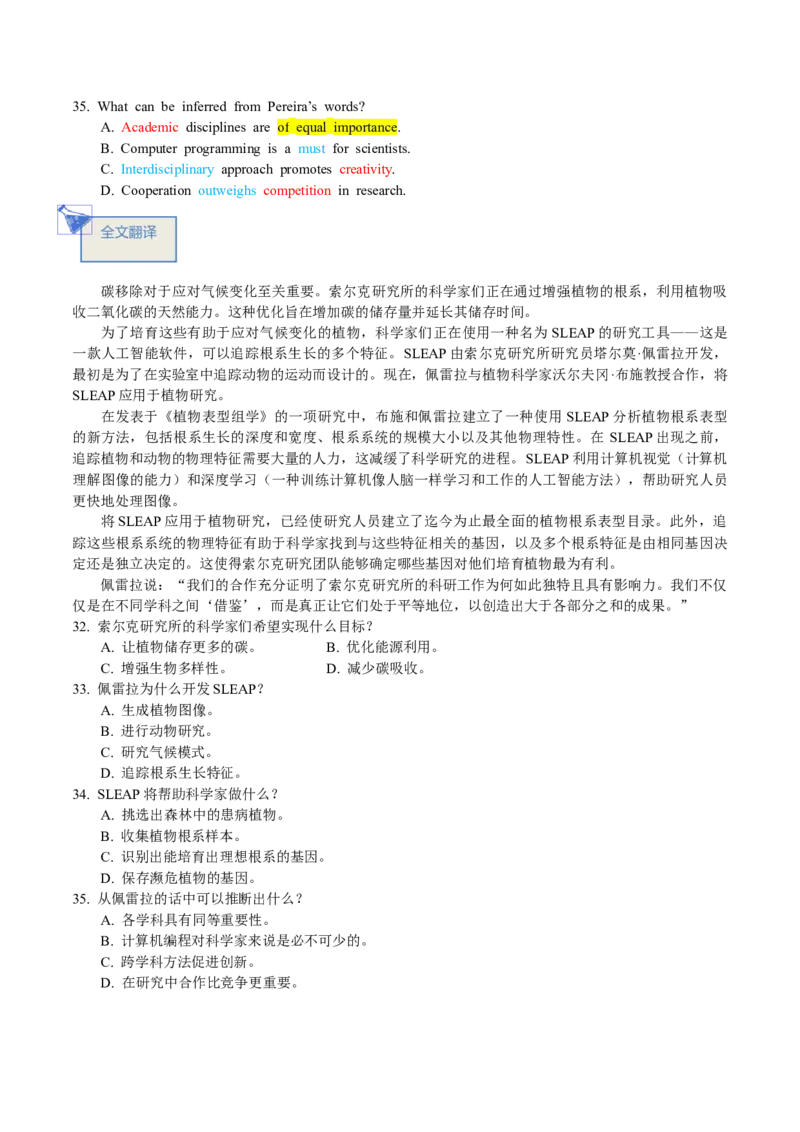
35. What can be inferred from Pereira’s words?
A. Academic disciplines are of equal importance.
B. Computer programming is a must for scientists.
C. Interdisciplinary approach promotes creativity.
D. Cooperation outweighs competition in research.
碳移除对于应对气候变化至关重要。索尔克研究所的科学家们正在通过增强植物的根系,利用植物吸
收二氧化碳的天然能力。这种优化旨在增加碳的储存量并延长其储存时间。
为了培育这些有助于应对气候变化的植物,科学家们正在使用一种名为SLEAP 的研究工具——这是
一款人工智能软件,可以追踪根系生长的多个特征。SLEAP 由索尔克研究所研究员塔尔莫·佩雷拉开发,
最初是为了在实验室中追踪动物的运动而设计的。现在,佩雷拉与植物科学家沃尔夫冈·布施教授合作,将
SLEAP 应用于植物研究。
在发表于《植物表型组学》的一项研究中,布施和佩雷拉建立了一种使用SLEAP 分析植物根系表型
的新方法,包括根系生长的深度和宽度、根系系统的规模大小以及其他物理特性。在SLEAP 出现之前,
追踪植物和动物的物理特征需要大量的人力,这减缓了科学研究的进程。SLEAP 利用计算机视觉(计算机
理解图像的能力)和深度学习(一种训练计算机像人脑一样学习和工作的人工智能方法),帮助研究人员
更快地处理图像。
将SLEAP 应用于植物研究,已经使研究人员建立了迄今为止最全面的植物根系表型目录。此外,追
踪这些根系系统的物理特征有助于科学家找到与这些特征相关的基因,以及多个根系特征是由相同基因决
定还是独立决定的。这使得索尔克研究团队能够确定哪些基因对他们培育植物最为有利。
佩雷拉说:“我们的合作充分证明了索尔克研究所的科研工作为何如此独特且具有影响力。我们不仅
仅是在不同学科之间‘借鉴’,而是真正让它们处于平等地位,以创造出大于各部分之和的成果。”
32. 索尔克研究所的科学家们希望实现什么目标?
A. 让植物储存更多的碳。
B. 优化能源利用。
C. 增强生物多样性。
D. 减少碳吸收。
33. 佩雷拉为什么开发SLEAP?
A. 生成植物图像。
B. 进行动物研究。
C. 研究气候模式。
D. 追踪根系生长特征。
34. SLEAP 将帮助科学家做什么?
A. 挑选出森林中的患病植物。
B. 收集植物根系样本。
C. 识别出能培育出理想根系的基因。
D. 保存濒危植物的基因。
35. 从佩雷拉的话中可以推断出什么?
A. 各学科具有同等重要性。
B. 计算机编程对科学家来说是必不可少的。
C. 跨学科方法促进创新。
D. 在研究中合作比竞争更重要。
全文翻译
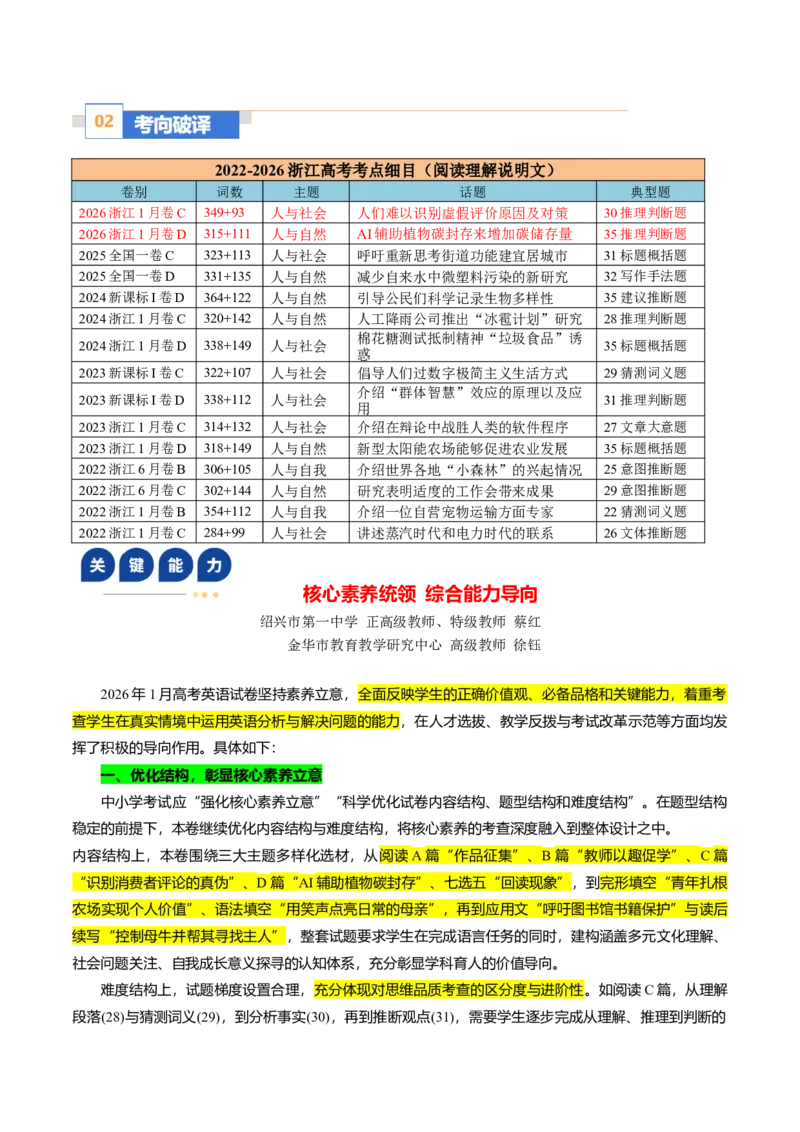
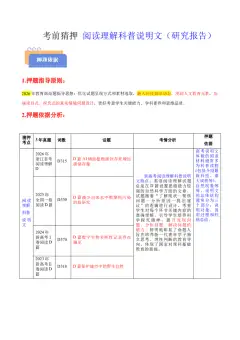
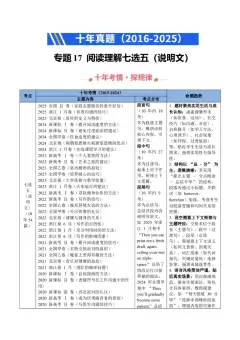
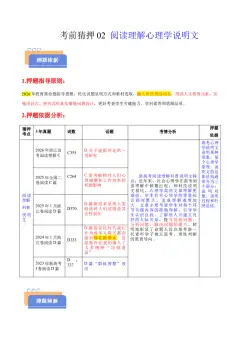
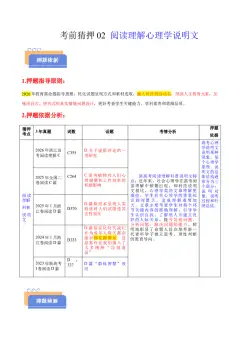
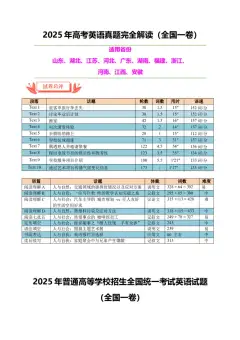
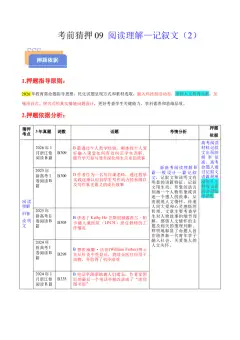
2022-2026 浙江高考考点细目(阅读理解说明文)
卷别
词数
主题
话题
典型题
2026 浙江1 月卷C
349+93
人与社会
人们难以识别虚假评价原因及对策
30 推理判断题
2026 浙江1 月卷D
315+111
人与自然
AI 辅助植物碳封存来增加碳储存量
35 推理判断题
2025 全国一卷C
323+113
人与社会
呼吁重新思考街道功能建宜居城市
31 标题概括题
2025 全国一卷D
331+135
人与自然
减少自来水中微塑料污染的新研究
32 写作手法题
2024 新课标I 卷D
364+122
人与自然
引导公民们科学记录生物多样性
35 建议推断题
2024 浙江1 月卷C
320+142
人与自然
人工降雨公司推出“冰雹计划”研究
28 推理判断题
2024 浙江1 月卷D
338+149
人与社会
棉花糖测试抵制精神“垃圾食品”诱
惑
35 标题概括题
2023 新课标I 卷C
322+107
人与社会
倡导人们过数字极简主义生活方式
29 猜测词义题
2023 新课标I 卷D
338+112
人与社会
介绍“群体智慧”效应的原理以及应
用
31 推理判断题
2023 浙江1 月卷C
314+132
人与社会
介绍在辩论中战胜人类的软件程序
27 文章大意题
2023 浙江1 月卷D
318+149
人与自然
新型太阳能农场能够促进农业发展
35 标题概括题
2022 浙江6 月卷B
306+105
人与自我
介绍世界各地“小森林”的兴起情况
25 意图推断题
2022 浙江6 月卷C
302+144
人与自然
研究表明适度的工作会带来成果
29 意图推断题
2022 浙江1 月卷B
354+112
人与自我
介绍一位自营宠物运输方面专家
22 猜测词义题
2022 浙江1 月卷C
284+99
人与社会
讲述蒸汽时代和电力时代的联系
26 文体推断题
       核心素养统领 综合能力导向
绍兴市第一中学 正高级教师、特级教师 蔡红
    金华市教育教学研究中心 高级教师 徐钰
2026 年1 月高考英语试卷坚持素养立意,全面反映学生的正确价值观、必备品格和关键能力,着重考
查学生在真实情境中运用英语分析与解决问题的能力,在人才选拔、教学反拨与考试改革示范等方面均发
挥了积极的导向作用。具体如下:
一、优化结构,彰显核心素养立意
中小学考试应“强化核心素养立意”“科学优化试卷内容结构、题型结构和难度结构”。在题型结构
稳定的前提下,本卷继续优化内容结构与难度结构,将核心素养的考查深度融入到整体设计之中。
内容结构上,本卷围绕三大主题多样化选材,从阅读A 篇“作品征集”、B 篇“教师以趣促学”、C 篇
“识别消费者评论的真伪”、D 篇“AI 辅助植物碳封存”、七选五“回读现象”,到完形填空“青年扎根
农场实现个人价值”、语法填空“用笑声点亮日常的母亲”,再到应用文“呼吁图书馆书籍保护”与读后
续写“控制母牛并帮其寻找主人”,整套试题要求学生在完成语言任务的同时,建构涵盖多元文化理解、
社会问题关注、自我成长意义探寻的认知体系,充分彰显学科育人的价值导向。
难度结构上,试题梯度设置合理,充分体现对思维品质考查的区分度与进阶性。如阅读C 篇,从理解
段落(28)与猜测词义(29),到分析事实(30),再到推断观点(31),需要学生逐步完成从理解、推理到判断的
思维跃迁。又如应用文写作,针对“图书馆书籍被勾画涂写”这一问题,学生不仅要“说明具体情况”并
“呼吁爱护书籍”,还需要建立“情况”与“呼吁”之间的逻辑关联,系统考查学生从信息整合、分析判
断到创造性表达的思维能力。
二、联系生活,凸显综合能力考查
情境是落实考查内容和考查要求的载体。本卷情境紧密联系学生的生活实际,具有真实交际意义。阅
读A 至C 篇、七选五、语法填空与应用文,涉及艺术修养、学习策略、信息素养、生活智慧与社会责任等,
均贴近学生的生活经验与认知水平。此外,阅读D 篇融入环保与科技主题,完形填空提供生涯规划与价值
取向的范例,读后续写则以生活趣事为背景,考查叙事与问题解决的能力。
生活化的试题情境能提供真实、多样的线索与条件,引导学生综合运用知识、技能和策略解决问题。
例如,阅读D 篇围绕“如何去碳以应对气候变化”这一问题,介绍“运用AI 增加植物碳封存”的方案;
从研究目的(32),到研究方法(33)与研究原理(34),再到研究意义(35),解决这一问题链,学生既需要理解
植物吸收二氧化碳的自然机制,又要认识AI 在该过程中的优化作用,进而理解科技协同自然应对环境问
题的现实路径。再如读后续写,面对“母牛迷路引起围观”这一生活事件,学生需要基于对事件脉络的把
握,按照“发现—控制—助归”的逻辑叙事,同时融入对公共安全、生命关怀和公民责任的认知与态度。
这一任务在考查学生叙事能力、问题解决策略与情感表达的同时,体现了语言运用与全人发展的有机统一。
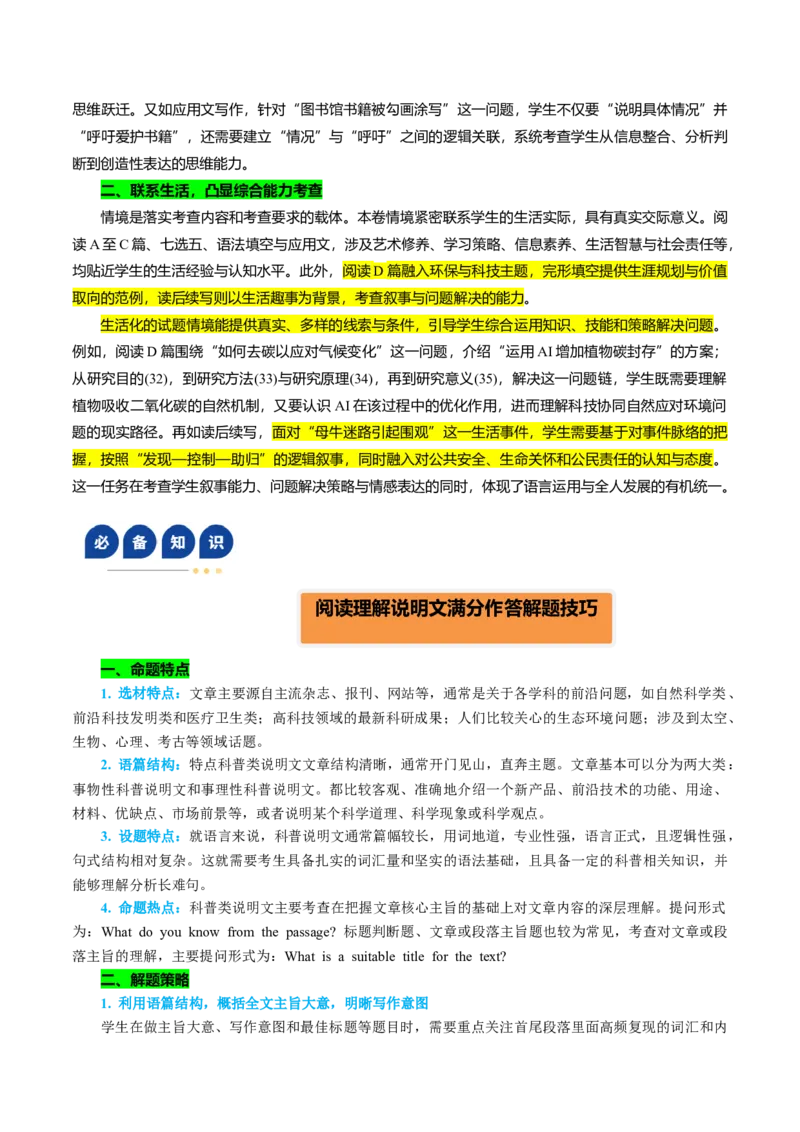
一、命题特点
1. 选材特点:文章主要源自主流杂志、报刊、网站等,通常是关于各学科的前沿问题,如自然科学类、
前沿科技发明类和医疗卫生类;高科技领域的最新科研成果;人们比较关心的生态环境问题;涉及到太空、
生物、心理、考古等领域话题。
2. 语篇结构:特点科普类说明文文章结构清晰,通常开门见山,直奔主题。文章基本可以分为两大类:
事物性科普说明文和事理性科普说明文。都比较客观、准确地介绍一个新产品、前沿技术的功能、用途、
材料、优缺点、市场前景等,或者说明某个科学道理、科学现象或科学观点。
3. 设题特点:就语言来说,科普说明文通常篇幅较长,用词地道,专业性强,语言正式,且逻辑性强,
句式结构相对复杂。这就需要考生具备扎实的词汇量和坚实的语法基础,且具备一定的科普相关知识,并
能够理解分析长难句。
4. 命题热点:科普类说明文主要考查在把握文章核心主旨的基础上对文章内容的深层理解。提问形式
为:What do you know from the passage? 标题判断题、文章或段落主旨题也较为常见,考查对文章或段
落主旨的理解,主要提问形式为:What is a suitable title for the text?
二、解题策略
1. 利用语篇结构,概括全文主旨大意,明晰写作意图
学生在做主旨大意、写作意图和最佳标题等题目时,需要重点关注首尾段落里面高频复现的词汇和内
阅读理解说明文满分作答解题技巧
容。文章导语、主体和结尾是有机整体,解题时要综合起来进行判断。
2. 利用文中语境线索分析长难句,进行逻辑推理判断
科普说明文往往专业术语较多、句式较复杂,且经常采用举例、对比、列数据、引用权威人士观点等
方法进行说明。设题形式上,主要侧重考查深层理解和推理判断、猜测生词含义以及代词指代等。
3. 谙熟选项设置规律,对比原文,去伪存真确定答案
高考作为一个成熟的考试体系,在选项设置上有章可循。正确选择一般为文中内容的“同义替换”或
者“归纳概括”。而干扰项分为“张冠李戴”、“偷梁换柱”、“无中生有”和“以偏概全”四种类型。
三、说明文实用答题妙招
1.阅读理解说明文深层理解解题居多,落实“题文同序”和“同义替换”。
2.推理判断题注重“源于文章,高于文章”,弄清来龙去脉再推断。
3 主旨大意题要关注文章的结构,尤其是“首段”和“段首”及关键词。
4.遵循“倒金字塔”模式,重视首尾段照应和首段主旨概括引领作用。
5.满分策略:读题干→找原文→做标记→留痕迹→看选项→扣字眼。
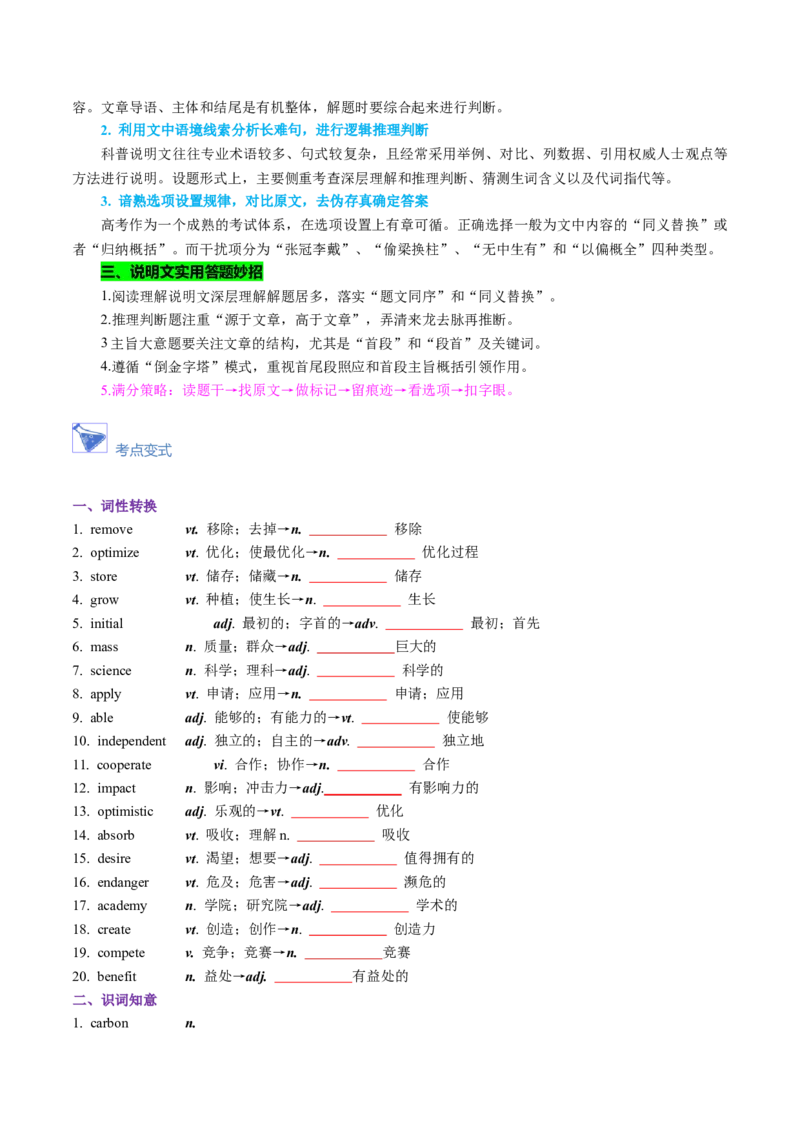
一、词性转换
1. remove
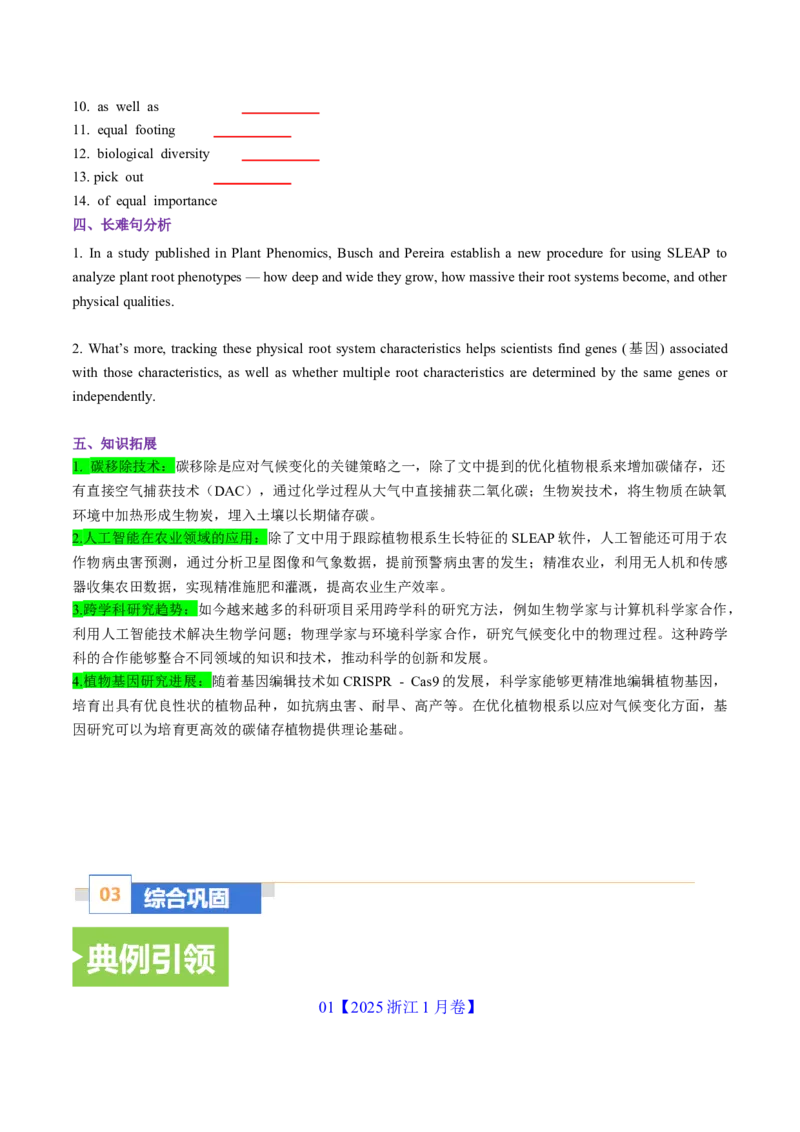
vt. 移除;去掉→n.             移除
2. optimize
vt. 优化;使最优化→n.             优化过程
3. store
vt. 储存;储藏→n.             储存
4. grow
vt. 种植;使生长→n.             生长
5. initial
adj. 最初的;字首的→adv.             最初;首先
6. mass
n. 质量;群众→adj.            巨大的
7. science
n. 科学;理科→adj.             科学的
8. apply
vt. 申请;应用→n.             申请;应用
9. able
adj. 能够的;有能力的→vt.             使能够
10. independent
adj. 独立的;自主的→adv.             独立地
11. cooperate
vi. 合作;协作→n.             合作
12. impact
n. 影响;冲击力→adj.            有影响力的
13. optimistic
adj. 乐观的→vt.             优化
14. absorb
vt. 吸收;理解n.             吸收
15. desire
vt. 渴望;想要→adj.             值得拥有的
16. endanger
vt. 危及;危害→adj.             濒危的
17. academy
n. 学院;研究院→adj.             学术的
18. create
vt. 创造;创作→n.             创造力
19. compete
v. 竞争;竞赛→n.            竞赛
20. benefit
n. 益处→adj.            有益处的
二、识词知意
1. carbon
n.
考点变式
2. capacity
n.
3. absorb
vt.
4. enhance
vt.
5. extend
vt. & vi.
6. duration
n.
7. climate-saving adj.
8. software
n.
9. track
vt. & vi.            n.
10. multiple
adj.
11. feature
n.             vt.
12. establish
vt.
13. procedure
n.
14. analyze
vt.
15. characteristic adj.            n.
16. process
n.            vt.
17. vision
n.
18. approach
v.             n.
19. extensive
adj.
20. catalog
n.            vt.
21. gene
n.
22. discipline
n.             vt.
23. generate
vt.
24. conduct
vt.            n.
25. sample
n.
26. identify
vt.
27. preserve
vt.
28. must modal
n.
29. interdisciplinary adj.
30. outweighs
vt.
31.cruicial
adj.
三、高频语块
1. fight climate change

2. make use of

3. carbon dioxide

4. aim to do

5. team up with

6. apply…to…

7. prior to

8. to date

9. be associated with
10. as well as

11. equal footing

12. biological diversity

13. pick out

14. of equal importance
四、长难句分析
1. In a study published in Plant Phenomics, Busch and Pereira establish a new procedure for using SLEAP to
analyze plant root phenotypes — how deep and wide they grow, how massive their root systems become, and other
physical qualities.
2. What’s more, tracking these physical root system characteristics helps scientists find genes ( 基因) associated
with those characteristics, as well as whether multiple root characteristics are determined by the same genes or
independently.
五、知识拓展
1. 碳移除技术:碳移除是应对气候变化的关键策略之一,除了文中提到的优化植物根系来增加碳储存,还
有直接空气捕获技术(DAC),通过化学过程从大气中直接捕获二氧化碳;生物炭技术,将生物质在缺氧
环境中加热形成生物炭,埋入土壤以长期储存碳。
2.人工智能在农业领域的应用:除了文中用于跟踪植物根系生长特征的SLEAP 软件,人工智能还可用于农
作物病虫害预测,通过分析卫星图像和气象数据,提前预警病虫害的发生;精准农业,利用无人机和传感
器收集农田数据,实现精准施肥和灌溉,提高农业生产效率。
3.跨学科研究趋势:如今越来越多的科研项目采用跨学科的研究方法,例如生物学家与计算机科学家合作,
利用人工智能技术解决生物学问题;物理学家与环境科学家合作,研究气候变化中的物理过程。这种跨学
科的合作能够整合不同领域的知识和技术,推动科学的创新和发展。
4.植物基因研究进展:随着基因编辑技术如CRISPR - Cas9 的发展,科学家能够更精准地编辑植物基因,
培育出具有优良性状的植物品种,如抗病虫害、耐旱、高产等。在优化植物根系以应对气候变化方面,基
因研究可以为培育更高效的碳储存植物提供理论基础。
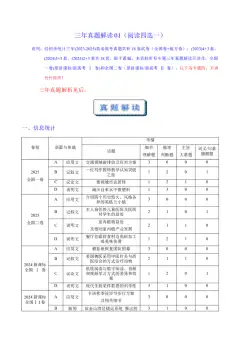
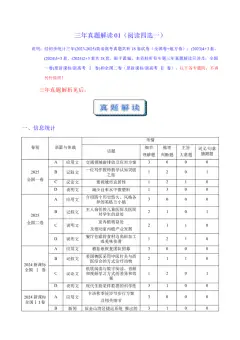
01【2025 浙江1 月卷】
典例引领
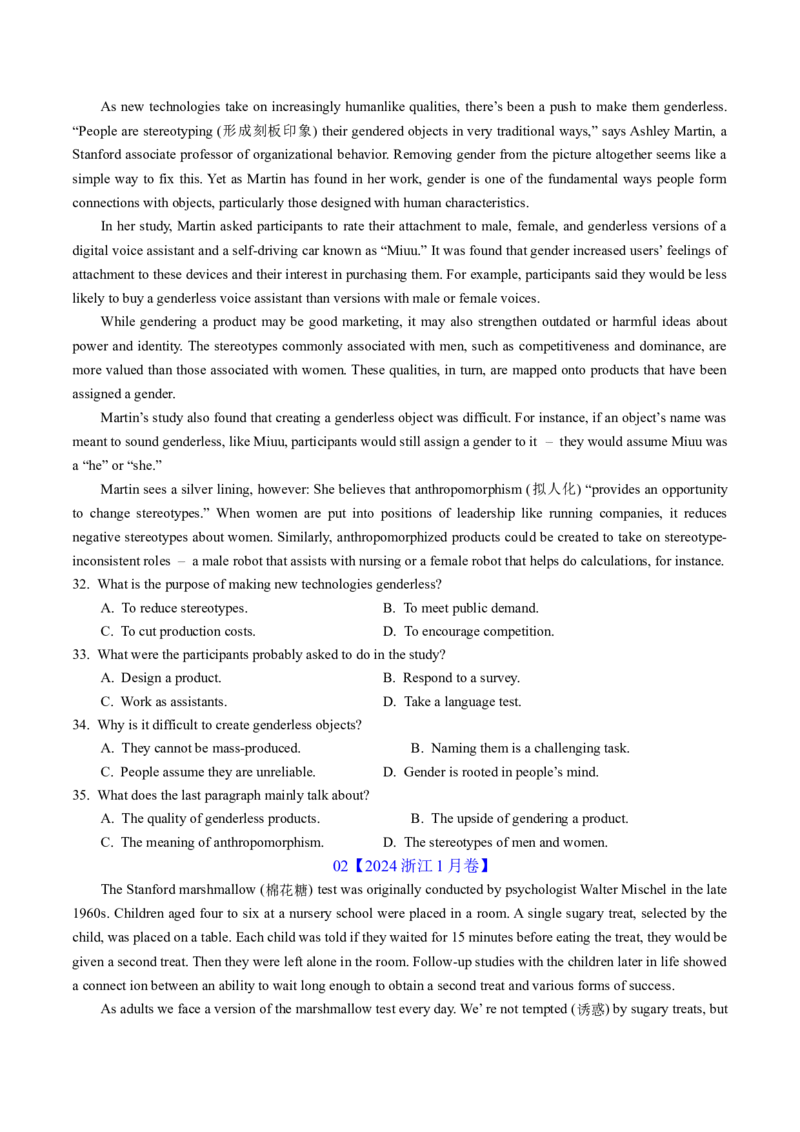
As new technologies take on increasingly humanlike qualities, there’s been a push to make them genderless.
“People are stereotyping (形成刻板印象) their gendered objects in very traditional ways,” says Ashley Martin, a
Stanford associate professor of organizational behavior. Removing gender from the picture altogether seems like a
simple way to fix this. Yet as Martin has found in her work, gender is one of the fundamental ways people form
connections with objects, particularly those designed with human characteristics.
In her study, Martin asked participants to rate their attachment to male, female, and genderless versions of a
digital voice assistant and a self-driving car known as “Miuu.” It was found that gender increased users’ feelings of
attachment to these devices and their interest in purchasing them. For example, participants said they would be less
likely to buy a genderless voice assistant than versions with male or female voices.
While gendering a product may be good marketing, it may also strengthen outdated or harmful ideas about
power and identity. The stereotypes commonly associated with men, such as competitiveness and dominance, are
more valued than those associated with women. These qualities, in turn, are mapped onto products that have been
assigned a gender.
Martin’s study also found that creating a genderless object was difficult. For instance, if an object’s name was
meant to sound genderless, like Miuu, participants would still assign a gender to it – they would assume Miuu was
a “he” or “she.”
Martin sees a silver lining, however: She believes that anthropomorphism (拟人化) “provides an opportunity
to change stereotypes.” When women are put into positions of leadership like running companies, it reduces
negative stereotypes about women. Similarly, anthropomorphized products could be created to take on stereotype-
inconsistent roles – a male robot that assists with nursing or a female robot that helps do calculations, for instance.
32. What is the purpose of making new technologies genderless?
A. To reduce stereotypes.
B. To meet public demand.
C. To cut production costs.
D. To encourage competition.
33. What were the participants probably asked to do in the study?
A. Design a product.
B. Respond to a survey.
C. Work as assistants.
D. Take a language test.
34. Why is it difficult to create genderless objects?
A. They cannot be mass-produced.
B. Naming them is a challenging task.
C. People assume they are unreliable.
D. Gender is rooted in people’s mind.
35. What does the last paragraph mainly talk about?
A. The quality of genderless products.
B. The upside of gendering a product.
C. The meaning of anthropomorphism.
D. The stereotypes of men and women.
02【2024 浙江1 月卷】
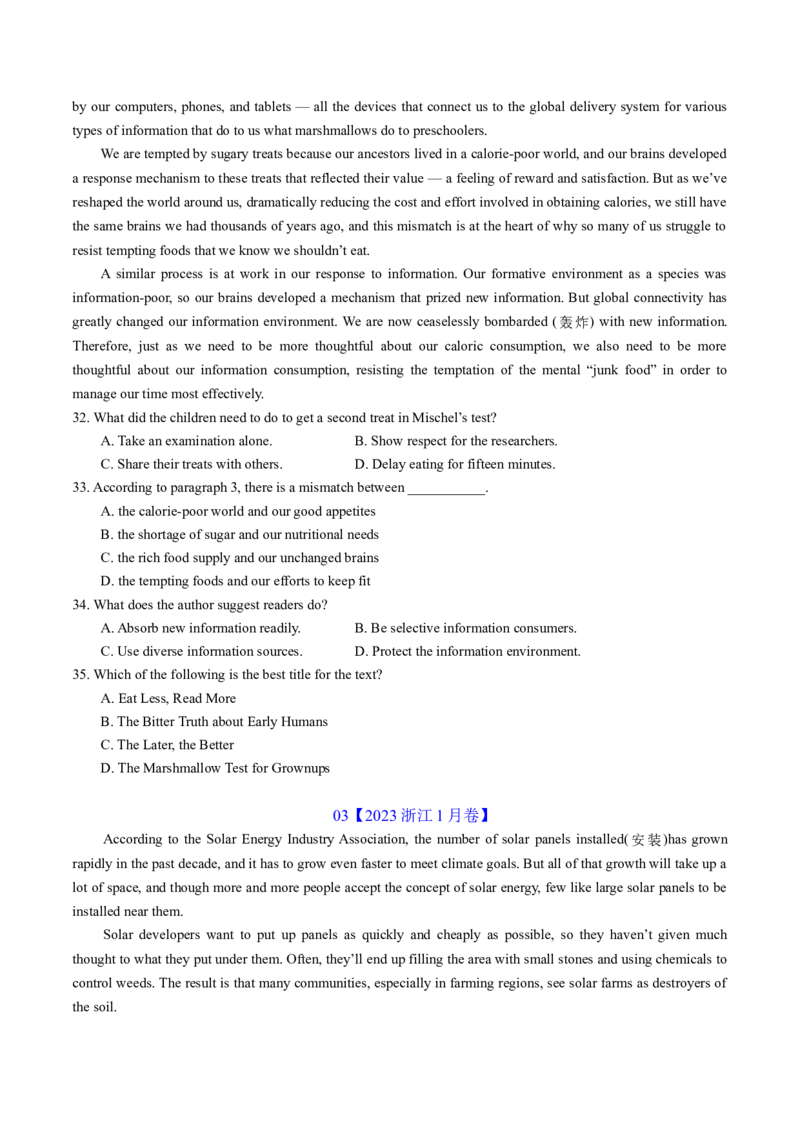
The Stanford marshmallow (棉花糖) test was originally conducted by psychologist Walter Mischel in the late
1960s. Children aged four to six at a nursery school were placed in a room. A single sugary treat, selected by the
child, was placed on a table. Each child was told if they waited for 15 minutes before eating the treat, they would be
given a second treat. Then they were left alone in the room. Follow-up studies with the children later in life showed
a connect ion between an ability to wait long enough to obtain a second treat and various forms of success.
As adults we face a version of the marshmallow test every day. We’ re not tempted (诱惑) by sugary treats, but
by our computers, phones, and tablets — all the devices that connect us to the global delivery system for various
types of information that do to us what marshmallows do to preschoolers.
We are tempted by sugary treats because our ancestors lived in a calorie-poor world, and our brains developed
a response mechanism to these treats that reflected their value — a feeling of reward and satisfaction. But as we’ve
reshaped the world around us, dramatically reducing the cost and effort involved in obtaining calories, we still have
the same brains we had thousands of years ago, and this mismatch is at the heart of why so many of us struggle to
resist tempting foods that we know we shouldn’t eat.
A similar process is at work in our response to information. Our formative environment as a species was
information-poor, so our brains developed a mechanism that prized new information. But global connectivity has
greatly changed our information environment. We are now ceaselessly bombarded (轰炸) with new information.
Therefore, just as we need to be more thoughtful about our caloric consumption, we also need to be more
thoughtful about our information consumption, resisting the temptation of the mental “junk food” in order to
manage our time most effectively.
32. What did the children need to do to get a second treat in Mischel’s test?
A. Take an examination alone.
B. Show respect for the researchers.
C. Share their treats with others.
D. Delay eating for fifteen minutes.
33. According to paragraph 3, there is a mismatch between ___________.
A. the calorie-poor world and our good appetites
B. the shortage of sugar and our nutritional needs
C. the rich food supply and our unchanged brains
D. the tempting foods and our efforts to keep fit
34. What does the author suggest readers do?
A. Absorb new information readily.
B. Be selective information consumers.
C. Use diverse information sources.
D. Protect the information environment.
35. Which of the following is the best title for the text?
A. Eat Less, Read More
B. The Bitter Truth about Early Humans
C. The Later, the Better
D. The Marshmallow Test for Grownups
03【2023 浙江1 月卷】
According to the Solar Energy Industry Association, the number of solar panels installed( 安装)has grown
rapidly in the past decade, and it has to grow even faster to meet climate goals. But all of that growth will take up a
lot of space, and though more and more people accept the concept of solar energy, few like large solar panels to be
installed near them.
Solar developers want to put up panels as quickly and cheaply as possible, so they haven’t given much
thought to what they put under them. Often, they’ll end up filling the area with small stones and using chemicals to
control weeds. The result is that many communities, especially in farming regions, see solar farms as destroyers of
the soil.
“Solar projects need to be good neighbors,” says Jordan Macknick, the head of the Innovative Site Preparation
and Impact Reductions on the Environment(InSPIRE)project. “They need to be protectors of the land and
contribute to the agricultural economy.” InSPIRE is investigating practical approaches to “low-impact” solar
development, which focuses on establishing and operating solar farms in a way that is kinder to the land. One of the
easiest low-impact solar strategies is providing habitat for pollinators(传粉昆虫).
Habitat loss, pesticide use, and climate change have caused dramatic declines in pollinator populations over
the past couple of decades, which has damaged the U.S. agricultural economy. Over 28 states have passed laws
related to pollinator habitat protection and pesticide use. Conservation organizations put out pollinator-friendliness
guidelines for home gardens, businesses, schools, cities—and now there are guidelines for solar farms.
Over the past few years, many solar farm developers have transformed the space under their solar panels into
a shelter for various kinds of pollinators, resulting in soil improvement and carbon reduction. “These pollinator-
friendly solar farms can have a valuable impact on everything that’s going on in the landscape,” says Macknick.
32. What do solar developers often ignore?
A. The decline in the demand for solar energy.
B. The negative impact of installing solar panels.
C. The rising labor cost of building solar farms.
D. The most recent advances in solar technology.
33. What does InSPIRE aim to do?
A. Improve the productivity of local farms.
B. Invent new methods for controlling weeds.
C. Make solar projects environmentally friendly.
D. Promote the use of solar energy in rural areas.
34. What is the purpose of the laws mentioned in paragraph 4?
A. To conserve pollinators.
B. To restrict solar development.
C. To diversify the economy.
D. To ensure the supply of energy.
35. Which of the following is the best title for the text?
A. Pollinators: To Leave or to Stay
B. Solar Energy: Hope for the Future
C. InSPIRE: A Leader in Agriculture
D. Solar Farms: A New Development
变式一、气候变化应对说明文3 篇
01 (25-26 高三上· 江西· 月考)As forests like the Amazon face increasing threats from fires and
deforestation, scientific interest is turning to the oceans for climate solutions. A growing body of research highlights
the potential of underwater forests — specifically, seaweed farms — to fight against climate change. Unlike the
land-based forests, these marine forests are fireproof and demonstrate remarkable efficiency in absorbing carbon
变式演练
emissions.
A groundbreaking study published in Current Biology, led by marine scientist Halley Froehlich, provides the
first global quantification of large-scale seaweed farming’s capacity to offset (抵消) carbon emissions. The research
identifies approximately 18.5 million square miles of ocean as suitable for growing seaweed.
The findings are striking: Using a mere 3.8 percent of the federal waters off the California coast could deal
with emissions from the state’s massive $50 billion agriculture industry. On a global scale, farming seaweed in just
0.001 percent of suitable waters and storing it could offset the carbon footprint of the entire aquaculture industry,
which supplies half of the world’s seafood.
The proposed method involves building industrial-scale seaweed farms, harvesting the mature seaweed, and
sinking it into the deep ocean, where the captured carbon could be stored for thousands of years. However, a
significant technological hurdle exists. Froehlich notes that the technology for deep-ocean storage does not yet
exist, underscoring the need for further engineering development.
The scientific community exhibits both enthusiasm and debate regarding this approach. Carlos Duarte, a
famous seaweed scientist, acknowledges the significant potential outlined in the study, even considering its
estimates “very conservative”. However, he argues that seaweed is too valuable a material to be placed in the deep
sea. This highlights how useful seaweed can be. Beyond capturing carbon, it can stop the oceans from becoming
more acidic, create habitats for marine life, and be used to make biofuel.
Despite its promise, the commercialization of seaweed for carbon storage faces market challenges. As
industry expert Scotty Schmidt points out, farming seaweed merely for carbon removal is not currently viable
without a strong carbon market. The path forward requires developing carbon credit rules and supportive
regulations to make this solution work.
1. What can we learn from the findings?
A. Modest seaweed farming brings great benefits.
B. California leads in seaweed farming.
C. Most oceans are suitable for farming seaweed.
D. The technology for farming seaweed is reliable.
2. What is Carlos Duarte’s attitude to sinking seaweed?
A. Enthusiastic.
B. Negative.
C. Unconcerned.
D. Cautious.
3. What does the underlined word “viable” in the last paragraph mean?
A. Helpful.
B. Practicable.
C. Famous.
D. Innovative.
4. What may be the best title for the text?
A. The challenges for seaweed farming
B. A new technology for deep-ocean storage
C. Seaweed’s value lies in carbon reduction
D. Seaweed farms help address climate change
02 (25-26 高三上· 江西· 月考)As forests like the Amazon face increasing threats from fires and
deforestation, scientific interest is turning to the oceans for climate solutions. A growing body of research highlights
the potential of underwater forests — specifically, seaweed farms — to fight against climate change. Unlike the
land-based forests, these marine forests are fireproof and demonstrate remarkable efficiency in absorbing carbon
emissions.
A groundbreaking study published in Current Biology, led by marine scientist Halley Froehlich, provides the
first global quantification of large-scale seaweed farming’s capacity to offset (抵消) carbon emissions. The research
identifies approximately 18.5 million square miles of ocean as suitable for growing seaweed.
The findings are striking: Using a mere 3.8 percent of the federal waters off the California coast could deal
with emissions from the state’s massive $50 billion agriculture industry. On a global scale, farming seaweed in just
0.001 percent of suitable waters and storing it could offset the carbon footprint of the entire aquaculture industry,
which supplies half of the world’s seafood.
The proposed method involves building industrial-scale seaweed farms, harvesting the mature seaweed, and
sinking it into the deep ocean, where the captured carbon could be stored for thousands of years. However, a
significant technological hurdle exists. Froehlich notes that the technology for deep-ocean storage does not yet
exist, underscoring the need for further engineering development.
The scientific community exhibits both enthusiasm and debate regarding this approach. Carlos Duarte, a
famous seaweed scientist. acknowledges the significant potential outlined in the study, even considering its
estimates “very conservative”. However, he argues that seaweed is too valuable a material to be placed in the deep
sea. This highlights how useful seaweed can be. Beyond capturing carbon, it can stop the oceans from becoming
more acidic, create habitats for marine life, and be used to make biofuel.
Despite its promise, the commercialization of seaweed for carbon storage faces market challenges. As
industry expert Scotty Schmidt points out, farming seaweed merely for carbon removal is not currently viable
without a strong carbon market. The path forward requires developing carbon credit rules and supportive
regulations to make this solution work.
1. What can we learn from the findings?
A. California leads in seaweed farming.
B. Modest seaweed farming brings great benefits.
C. Most oceans are suitable for farming seaweed.
D. The technology for farming seaweed is reliable.
2. What is Carlos Duarte’s attitude to sinking seaweed?
A. Negative.
B. Enthusiastic.
C. Unconcerned.
D. Cautious.
3. What does the underlined word “viable” in the last paragraph mean?
A. Helpful.
B. Innovative.
C. Famous.
D. Practicable.
4. What may be the best title for the text?
A. The challenges for seaweed farming
B. Seaweed farms help address climate change
C. Seaweed’s value lies in carbon reduction
D. A new technology for deep-ocean storage
03(25-26 高三上·河北秦皇岛·期中)Wastewater treatment plants (WWTPs) are critical to modern cities,
safeguarding public health by handling billions of liters of wastewater every day. But as the world races to reduce
greenhouse gas emissions, a key source is slipping under the radar (

 雷达

 ) : the wastewater industry itself.
In a new study published in Environmental Science and Ecotechnology (July 2025), researchers from Harbin
Institute of Technology challenge the current ways of counting WWTPs’ greenhouse gases. They warn that
conventional approaches significantly underestimate the industry’s effect on climate—especially when it comes to
fossil carbon dioxide (CO2).
It’s well known that WWTPs release methane (CH4) and nitrous oxide (N2O) during biological treatment and
waste handling. These are two strong greenhouse gases. But fewer people understand the role of fossil CO2,
released from man-made chemicals like detergents (去污剂) and industrial wastewater. This carbon originates from
fossil sources and it adds to atmospheric CO2, but most emission lists don’t include it.
Using radiocarbon (放射性碳) analysis, the study’s authors found that fossil carbon makes up 4-28% of all
carbon in the wastewater that enters WWTPs. Most of this fossil carbon turns into CO 2 and is released during
treatment. But this invisible flow of emission is ignored in most official climate reports, “Wastewater is not just a
public hygiene (卫生) issue — it’s a climate issue,” said Dr. Haiyan Li, who led the study. “By forgetting fossil CO2
and relying on outdated estimation methods, we’re reporting fewer greenhouse gases than we should.”
To help cities switch to low-carbon wastewater treatment, the authors advocate for real-time, multi-gas
monitoring systems and the inclusion of fossil CO2 in national climate lists. This would let local governments and
plant operators make emission-cutting plans based on real site conditions, not assumptions. “We need better data to
drive better policies,” the research team said. “Smarter monitoring tools can bridge the gap between science and
action.”
This research emphasizes a broader shift in thinking: wastewater treatment plants — long seen just as a tool
for hygiene — must also be seen as a key part of fighting climate change.
1. What does the author mean by saying “a key source is slipping under the radar” in paragraph 1?
A. A key emission source is unnoticed.
B. Fossil fuels are overused in WWTPs.
C. Methane release is unmonitored.
D. Emission counting tools are outdated.
2. Why is fossil CO2, left out of most emission lists?
A. It is released in a small amount.
B. It comes from natural breakdown.
C. Its source is not well recognized.
D. It is impossible to be detected.
3. What do the researchers suggest to solve the problem?
A. Stopping using man-made chemicals.
B. Adding fossil CO2, to climate records.
C. Reducing methane and nitrous oxide.
D. Closing old-fashioned wastewater plants.
4. What is the best title for the passage?
A. Strategies to Fight Climate Change
B. The Trends in Greenhouse Gas Emissions
C. Low-Carbon Methods for Wastewater Treatment
D. Underestimated WWTPs’ CO2, Emissions
变式二、人工智能助力科学研究3 篇
01(25-26 高三上·湖南·月考)Every time generative artificial intelligence drafts an e-mail or makes an
image, the planet pays for it. Making two images can consume as much energy as charging a smartphone; a single
exchange with Chat GPT can heat up a server so much that it requires a 16-ounce bottle’s worth of water to cool it.
And recent research in Nature Computational Science identifies another concern: AI’s outsize contribution to the
world’s mounting pile of electronic waste. The study found that generative AI applications alone could add 1.2
million to 5 million tons of this harmful trash to the planet by 2030.
Such a contribution would add to the tens of millions of tons of electronic products the globe gets rid of
annually. Cell phones, microwave ovens, computers, and other common digital products often contain mercury,
lead, or other poisonous substances. When improperly thrown away, they can pollute air, water and soil. The United
Nations found that in 2022 about 78 percent of the world’s e-waste wound up in landfills or at unofficial recycling
sites, where laborers risk their health to search for rare metals.
Few countries enforce proper management of e-waste. Even those with laws often fail to carry them out. In
the US, 25 states have e-waste management policies, but there’s no federal law requiring electronics recycling. In
February 2024, Senator Ed Markey of Massachusetts introduced a bill that would require federal agencies to study
and develop standards for AI’s environmental impacts, including e-waste. That bill, the Artificial Intelligence
Environmental Impacts Act of 2024, proposes a reporting system, but it would be voluntary, and AI developers
would not be forced to cooperate.
Companies that use AI have numerous options to limit e-waste. It’s possible to squeeze more life out of
servers, for instance, through regular maintenance and updates or by shifting worn-out devices to less intensive
applications. Repairing and reusing outdated hardware components can also cut waste by 42 percent, Tzachor and
his co-authors note in the study. And more efficient chip and algorithm design could reduce generative AI’s demand
for hardware and electricity. Combining all these strategies would reduce e-waste by 86 percent, the study authors
estimate.
1. What is the concern linked to generative AI in recent research?
A. Its high consumption of energy.
B. Its role in worsening the e-waste crisis.
C. Its production of intense heat during operation.
D. Its reliance on rare metals found in specific regions.
2. What is Paragraph 2 of the text mainly about?
A. The dangers of e-waste.
B. The contribution of generative AI.
C. The process of recycling e-waste.
D. The specific examples of electronic products.
3. Why did Senator Ed Markey introduce the 2024 bill?
A. To force AI developers to recycle e-waste.
B. To replace a nationwide e-waste recycling law.
C. To set federal rules for AI’s environmental effects.
D. To change existing state-level e-waste management policies.
4. Which is suggested as an effective method to limit AI-related e-waste?
A. Increasing investment in new recycling technologies.
B. Replacing broken devices with intensive applications.
C. Extending server lifespan with maintenance and updates.
D. Abandoning old hardware components to ensure efficiency.
02(25-26 高三上·湖南·月考)Music has long been recognized for its healing powers, and when combined
with artificial intelligence (AI), this potential becomes even more precise and accessible. This sentiment resonated
throughout the recent World Artificial Intelligence Conference in Shanghai.
Among the event’s many technological marvels, the globally AI music therapy pod from the Shanghai
Conservatory of Music (上海音乐学院) stood out, offering a calming, personalized healing experience. Inside the
pod, users are equipped with monitoring devices, such as headsets, sensors, and monitors. Lying back in zero-
gravity chairs, they observe a large screen displaying real-time data alongside vital signs, such as heart rate and
blood oxygen levels. Meanwhile, music featuring the natural sounds of chirping birds or flowing streams envelops
them, providing a peaceful escape from the outside-world. The experience begins with a personalized
questionnaire. Users provide details about their health status and birth date, which, combined with real-time
psychological data, drive an AI music generation model to create a multisensory experience complete with
synchronized ( 同步的) visuals. After the session, users receive a data set of their therapy process and a
personalized music prescription.
It is reported that the system enhances attention, aids in healing and relaxation, and stabilizes heart rate. “The
music therapy pod is a crystallization of the integration of technology and art.” says Liu Hao, director of the AIMT
Lab at the conservatory. The college’s music aesthetic psychology experimental center has published numerous
scientific papers, laying the groundwork for the therapy pod.
Experts note the pod represents interdisciplinary innovation with key breakthroughs. It has potential
applications in treating sleep disorders, depression, autism (自闭症), and aiding elderly health management. The
team aims to tap into natural frequencies to create sound healing maps for public well-being.
The project is already collaborating with hospitals. It will soon be adopted in institutions like Shanghai
Huashan Hospital to assist in treating children with autism and providing psychological comfort for students with
exam anxiety.
1. Why do users provide their birth date in the questionnaire?
A. To help the system identify specific health issues.
B. To assist in analyzing psychological real-time data.
C. To generate a tailored, multisensory music experience.
D. To enhance data tracking in the AI-powered therapy process.
2. The underlined word “crystallization” in paragraph 3 most likely means “______________”.
A. a perfect example
B. a scientific theory
C. a difficult problem
D. a temporary solution
3. What can be inferred about the AI music therapy pod’s potential applications’?
A. It could help address mental health issues.
B. It focuses only on entertainment purposes.
C. It is limited to use in music conservatories
D. It may replace traditional medical treatments entirely.
4. What is the author’s attitude toward the AI music therapy pod?
A. Dismissive.
B. Optimistic
C. Critical.
D. Indifferent
03(25-26 高三上·云南昭通·期中)The robot, shaped like a soup can with a rounded body, stands on a
wearer’s shoulder like a parrot. It can speak fluent Anishinaabemowin, an Indigenous (土著的) language spoken by
the Anishinaabe nation of North America. Danielle Boyer, a 24-year-old Anishinaabe roboticist, created the
“Skobot” to communicate in endangered Indigenous languages. By enabling young speakers to practice with an
engaging partner, she aims to keep these languages alive despite the growing dominance of English.
New AI technologies are revolutionizing the way we approach language preservation. Most AI translation
systems require vast training data for accuracy, and models for high-resource languages like English and Spanish
are typically trained on millions of parallel sentence pairs. However, Indigenous languages often have little public
data, posing significant challenges for standard translation methods. To address this, Jared Coleman, a computer
scientist at Loyola Marymount University, developed a tool that instructs a large language model in the grammar
and vocabulary of a target language, ensuring grammatical accuracy in the output sentences.
Since different communities have different cultural traditions, training AI models on material in Indigenous
languages, particularly ancestral stories and folk tales, can lead to unintended consequences. As Coleman
explained, certain stories are traditionally told only during the wintertime in his community. “How do you maintain
that tradition if it’s available online?” he says. In other words, AI models do not understand cultural nuance (细微
差别). If they are not trained appropriately, they can mishandle sensitive cultural information.
Indigenous researchers are undertaking AI language preservation initiatives to promote greater accessibility
and diversity at the forefront of technological innovation. As researchers Uma Pradhan and Joyeeta Dey have
explained, AI language preservation helps address historical injustice for communities previously discouraged or
even prohibited from speaking their native tongues. These initiatives not only support language revitalization (复
兴) by increasing the number of speakers but also emphasize the cultural significance of these languages within
technological spaces long dominated by English, Mandarin Chinese and a handful of other global languages.
1. What is the function of the first paragraph?
A. To criticize the limits of robot technology.
B. To detail the Anishinaabe language history.
C. To analyze language revitalization challenges.
D. To introduce the topic with a specific example.
2. What is a major challenge in using AI for Indigenous language translation?
A. Lack of public data for training.
B. High cost of developing AI models.
C. Resistance from Indigenous communities.
D. Complexity of English and Spanish grammar.
3. Why does Jared Coleman mention the tradition of telling stories only in winter?
A. To argue that stories should not be told online.
B. To show that AI can help record seasonal activities.
C. To explain how AI models learn from seasonal data.
D. To illustrate the risk of AI ignoring cultural nuances.
4. What is the main purpose of AI language preservation initiatives?
A. To revive languages and address historical injustice.
B. To boost AI-driven creativity and language diversity.
C. To scale down the use of English and Mandarin tongues.
D. To make AI translation systems more accurate and reliable.