考前猜押06 阅读理解—人工智能

1.押题指导原则:
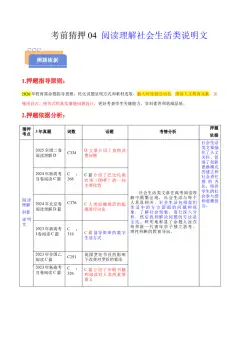
2026 年教育部命题指导思想:优化试题呈现方式和素材选取,融入科技前沿动态,浸润人文教育元素,加
强项目式、探究式的真实情境问题设计,更好考查学生关键能力、学科素养和思维品质。
2.押题依据分析:
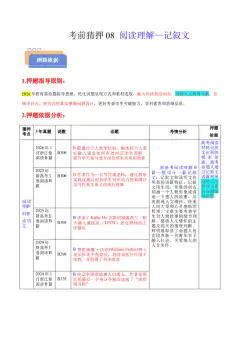
猜押
考点
3 年真题
词数
话题
考情分析
押题
依据
阅读
理解
科普
说明
文
2026 年浙江首
考阅读理解
C、D 篇
C355
D321
C 关于虚假评论的一
项研究D 追踪动物AI
工具SLEAP 应用于研
究植物根系表型,助
力筛选有益基因,这
也是跨学科合作的成
果
近年来,人工智能的发展突飞
猛进,人工智能涉及到日常生活
的各个方面。人工智能在高考阅
读理解中频繁出现,文章主要考
查学生对每个环节关键内容的准
确理解,引导学生了解科技前
沿、合理使用先进技术以及对人
工智能的深入思考。鲜明地彰显
了命题人旨在融入科技前沿动态
的命题导向。
人工智能
说明文频
繁出现在
高考阅读
理解中。
文章主语
考查学生
的推理判
断能力和
对人工智
能的评价
态度。辅
助考查细
节理解和
主旨大
意。
2024 年新高考
I 卷阅读D 篇
D
:
319
D 篇数字生物多样性
记录存在偏见
2024 年新高考
Ⅱ卷阅读D 篇
D
:
319
D 篇介绍了Catriona
Campbell 所著AI by
Design: A Plan for
Living with Artificial
Intelligence 一书
2023 年新高考
I 卷阅读C 篇
C
:
318
C 篇倡导简单的数字
生活方式
押题预测目录
一、人工智能与哲学
二、人工智能的实际运用
三、对人工智能的态度
四、人工智能与职业
五、人工智能与语言学习
六、人工智能的缺陷
七、规范人工智能的发展
八、人工智能与医疗发展
九、人工智能与农业发展
十、人工智能与教育
 一、人工智能与哲学
押题1
词数
话题
体裁
考点
押题理由
345
人工智能(AI)
与哲学之间
的关系
议论文
细节理解
推理判断
主旨大意
人工智能在高考阅读理解中频繁出现,文章主要考查学生对
每个环节关键内容的准确理解,引导学生了解科技前沿、合
理使用先进技术以及对人工智能的深入思考。鲜明地彰显了
命题人旨在融入科技前沿动态的命题导向。
New scientific understanding and engineering techniques have always impressed and frightened us, and will
continue to do so. Open AI recently announced that it anticipates superintelligent AI going beyond human abilities
within this decade. It is accordingly building a new team, and devoting 20% of its computing resources to ensuring
that the behavior of such AI systems will be aligned with (与……一致) human values.
Beyond engineers and researchers, can philosophers shape AI too? Philosophy has been instrumental to AI
from its early days. In 1956, the Logic Theorist, the first operational AI program, was created to prove
mathematical theorems (定理), drawing on ideas from philosophers Alfred North Whitehead and Bertrand Russell.
Besides, German philosopher Gottlob Frege also laid the groundwork for modern logic and computing, which
helped create early AI systems.
Today’s AI, based on deep learning, is associated with processing vast quantities of data. Philosophy,
however, remains relevant. Take Large Language Models (LLMs), like ChatGPT, which generates conversational
text. At their heart, they track statistical patterns of language use. Something very much like this idea was stated by
the Austrian philosopher Ludwig Wittgenstein: the meaning of a word is found in its use in the language.
Philosophy also raises big questions about AI’s future. Can AI truly understand language or become
conscious (有意识的)? Science has so far been unable to fully explain how consciousness arises. Similarly, can AI
be creative? British scientist Margaret Boden believes AI can produce new ideas but struggles to evaluate them like
humans do.
As AI grows more powerful, aligning AI with human values is not just a technical challenge but a social one.
It requires input from philosophers, social scientists, policymakers, and citizen users. British author Jamie Susskind
even suggests building a “digital republic” — one that rejects the political and economic systems that excessively
empower tech giants.
AI is also changing philosophy itself. Computational models simulate real-world situations, aiding
philosophers in tackling social questions. As AI develops, it provides new ways to explore age-old questions,
ensuring philosophy remains essential in guiding our technological future.
1.What is OpenAI mainly concerned about?
A.The waste of its computing resources.
B.The potential risks of superintelligent AI.
C.The decline of human competitive abilities.
D.The high cost of super intelligence research.
2.What is the main focus of Paragraph 2?
A.The technical breakthroughs in early AI.
B.The philosophy’s historical contributions to AI.
C.The role of mathematical theorems in AI creation.
D.The collaboration between philosophers and engineers.
3.Why does the author mention Wittgenstein’s viewpoint?
A.To explain the linguistic logic of LLMs.
B.To argue philosophers’ superiority in AI research.
C.To illustrate philosophy’s relevance to modern AI.
D.To prove LLMs lack genuine language understanding.
4.Which word best defines the relationship between AI and philosophy?
A.Interdependent.B.Irrelevant.
C.Competitive.
D.One-sided.
【答案】1.B    2.B    3.C    4.A
【解析】这是一篇议论文。文章探讨了人工智能(AI)与哲学之间的关系。
1.细节理解题。根据第一段“Open AI recently announced that it anticipates superintelligent AI going beyond
human abilities within this decade. It is accordingly building a new team, and devoting 20% of its computing
resources to ensuring that the behavior of such AI systems will be aligned with (与……一致) human values.
(OpenAI 最近宣布,它预计超智能人工智能将在十年内超越人类能力。因此,它正在组建一个新团队,并
投入20%的计算资源,以确保此类人工智能系统的行为与人类价值观保持一致)”可知,OpenAI 投入大量资
源以确保超智能AI 的行为与人类价值观一致,这表明其主要关注的是超智能AI 可能带来的潜在风险。故
选B。
2.主旨大意题。根据第二段“Philosophy has been instrumental to AI from its early days. In 1956, the Logic
Theorist, the first operational AI program, was created to prove mathematical theorems (定理), drawing on ideas
from philosophers Alfred North Whitehead and Bertrand Russell. Besides, German philosopher Gottlob Frege also
laid the groundwork for modern logic and computing, which helped create early AI systems. (从早期开始,哲学
就对人工智能起到了重要作用。1956 年,第一个可运行的人工智能程序“逻辑理论家”被创造出来,用于
证明数学定理,它借鉴了哲学家Alfred North Whitehead 和Bertrand Russell 的思想。此外,德国哲学家
Gottlob Frege 也为现代逻辑和计算奠定了基础,这有助于创建早期的人工智能系统)”可知,本段主要阐述
了哲学在人工智能早期发展中所做出的历史贡献。故选B。
3.推理判断题。根据第三段“Today’s AI, based on deep learning, is associated with processing vast quantities
of data. Philosophy, however, remains relevant. Take Large Language Models (LLMs), like ChatGPT, which
generates conversational text. At their heart, they track statistical patterns of language use. Something very much
like this idea was stated by the Austrian philosopher Ludwig Wittgenstein: the meaning of a word is found in its use
in the language.(如今,基于深度学习的人工智能与处理海量数据相关。然而,哲学仍然具有相关性。以大
型语言模型(LLMs)为例,比如ChatGPT,它能生成对话文本。它们的核心是追踪语言使用的统计模式。奥
地利哲学家路Ludwig Wittgenstein 也曾提出过类似的观点:一个词的意义存在于它在语言中的使用)”可知,
作者提到Wittgenstein 的观点,是为了说明哲学思想与现代AI(如大语言模型)的核心逻辑是相通的,以此来
论证哲学与现代AI 的相关性。故选C。
4.推理判断题。根据第四段“Philosophy also raises big questions about AI’s future. (哲学也提出了关于人工
智能未来的重大问题)”、第五段“As AI grows more powerful, aligning AI with human values is not just a
technical challenge but a social one. It requires input from philosophers, social scientists, policymakers, and citizen
users. (随着人工智能变得更加强大,让人工智能与人类价值观保持一致不仅是一项技术挑战,也是一项社
会挑战。它需要哲学家、社会科学家、政策制定者和公民用户的参与)”及最后一段“AI is also changing
philosophy itself. Computational models simulate real-world situations, aiding philosophers in tackling social
questions. As AI develops, it provides new ways to explore age-old questions (人工智能也在改变哲学本身。计
算模型模拟现实世界的情况,帮助哲学家解决社会问题。随着人工智能的发展,它为探索古老的问题提供
了新的方法)”可知,哲学塑造和引导AI 的发展,而AI 也为哲学研究提供了新的方法和视角,二者是相互
依存、相互影响的关系。故选A。
二、人工智能的实际运用
押题1
词数
话题
体裁
考点
押题理由
313
美术领域的
AI 程序
Aaron 能自主
创作
说明文
细节理解
猜测词义
人工智能在高考阅读理解中频繁出现,文章主要考查学生对
每个环节关键内容的准确理解,引导学生了解科技前沿、合
理使用先进技术以及对人工智能的深入思考。鲜明地彰显了
命题人旨在融入科技前沿动态的命题导向。
By the late 1960s, abstract painter Harold Cohen had represented Britain at important festivals with his oil
paintings and was seeking a new challenge. “Maybe there are more interesting things going on outside my studio
than inside it,” he thought. Cohen turned from the canvas to the screen, using computers to find new ways of
creating art. In the late 1960s, he created a program that he named Aaron. It was the first artificial intelligence
software in the world of fine art, and Cohen first presented Aaron in 1974 at the University of California, Berkeley.
Now, with AI dominating the headlines, a new exhibition at New York’s Whitney Museum of American Art,
“Harold Cohen: Aaron”, running through June 2024, draws attention to Cohen’s pioneering work. The Whitney is
offering something deeper than most previous Aaron exhibits: a real-time experience, in which visitors can watch
the software produce art.
Cohen seeded Aaron with all sorts of knowledge: about basic objects, physics, and fundamental techniques
of drawing. Aaron uses this knowledge to follow instructions, complete tasks, and make decisions like human
beings — a very different approach from today’s generative AI art programs, which don’t draw from scratch (从头
开始) but rather rely on databases of images. Versions of Aaron still generate output, but anything done after
Cohen’s death in 2016 is not considered genuine.
The Whitney is performing two versions of Cohen’s software, along with the art that each produced before
Cohen died. The 2001 version, Aaron KCAT, generates images of figures and plants and projects them onto a wall
more than ten feet high, while the 2007 version produces jungle-like scenes. The software will also create art
physically, on paper, for the first time since the 1990s. “It is absolutely thrilling,” said Christiane Paul, the
museum’s director of digital art, “to have one of those remarkable treasures of digital art in the collection.”
1.What was Aaron born out of?
A.The university’s support.
B.The museum’s donation.
C.Cohen’s imagination.
D.Cohen’s curiosity.
2.What can visitors do in the “Harold Cohen: Aaron” exhibition?
A.Observe Aaron creating art on the spot. B.Generate images with the help of Aaron.
C.Learn about the physical rules in art.
D.See the original 196Os version of Aaron.
3.What makes Aaron different from modern AI art programs?
A.Its ability to assign tasks.
B.Its use of modern techniques.
C.Its capability to make choices.
D.Its dependence on existing database.
4.What does the underlined word “projects” in the last paragraph mean?
A.Plans.
B.Throws.
C.Displays.
D.Draws.
【答案】1.D    2.A    3.C    4.C
【解析】这是一篇说明文。主要说明了抽象画家 Harold Cohen 创造了世界上首个美术领域的 AI 程序
Aaron,该程序能自主创作。如今纽约一博物馆展出其作品,让观众实时观看 AI 作画,展现了他的开创
性贡献。
1.细节理解题。根据第一段“By the late 1960s, abstract painter Harold Cohen had represented Britain at
important festivals with his oil paintings and was seeking a new challenge. “Maybe there are more interesting
things going on outside my studio than inside it,” he thought.(到了20 世纪60 年代末,抽象派画家哈罗德·科恩
凭借其油画作品代表英国参加了重要的艺术展览,并且他正在寻求新的挑战。“或许我的工作室之外还有
更多有趣的事情发生,而并非仅仅局限于工作室之内。”他这样想道)”可知,他出于好奇与探索欲创造了
Aaron。故选D。
2.细节理解题。根据第二段“The Whitney is offering something deeper than most previous Aaron exhibits: a
real-time experience, in which visitors can watch the software produce art.(惠特尼博物馆此次展出的作品比以往
大多数亚伦的展览内容都要丰富得多:这是一个实时互动体验,参观者可以亲眼目睹软件生成艺术作品的
过程)”可知,观众可以现场观看Aaron 创作艺术。故选A。
3.细节理解题。根据倒数第二段“Aaron uses this knowledge to follow instructions, complete tasks, and make
decisions like human beings — a very different approach from today’s generative AI art programs, which don’t
draw from scratch (从头开始) but rather rely on databases of images.(Aaron 利用这些知识来遵循指令、完成任
务并做出决策,就像人类一样——这与当今的生成式人工智能艺术程序有着截然不同的方式。这些程序并
非从零开始创作,而是依赖于图像数据库)”可知,Aaron 能做选择,这是和现代AI 艺术程序的区别。故选
C。
4.词句猜测题。根据划线词上文“The 2001 version, Aaron KCAT, generates images of figures and plants(2001
年版的“亚伦·KCAT”能够生成人物和植物的图像)”以及后文“them onto a wall more than ten feet high, while
the 2007 version produces jungle-like scenes(把他们……超过十英尺高的墙壁上;而2007 年版则能呈现出丛
林般的景象)”可知,2001 年版的“亚伦·KCAT”能够生成人物和植物的图像,并将其投射、展示到超过十英
尺高的墙壁上;而2007 年版则能呈现出丛林般的景象。故划线词意思是“投射、展示”。故选C。
押题2
词数
话题
体裁
考点
押题理由
355
人工智能驱
动的森林恢
复系统
说明文
细节理解
推理判断
主旨大意
人工智能在高考阅读理解中频繁出现,文章主要考查学生对
每个环节关键内容的准确理解,引导学生了解科技前沿、合
理使用先进技术以及对人工智能的深入思考。鲜明地彰显了
命题人旨在融入科技前沿动态的命题导向。
We often imagine the future of AI in grand terms. Yet, some of its most transformative work is happening not
with flashy robots, but with silent algorithms (算法), working to restore our dying forests. In the Amazon, vast
areas ruined by deforestation have struggled to regrow. The changed microclimate creates a cruel environment
where only tough species thrive (茁壮成长), often forming a low-diversity “green desert”. Traditional reforestation
is slow and has a mixed success rate.
Enter the “algorithmic gardener”. A team of scientists has developed a drone-based AI system that is
changing the game. First, drones equipped with high-resolution cameras fly over a degraded area, mapping it in
detail. They analyze soil composition and remaining vegetation plots. This data is fed into a machine learning
model trained on healthy forest ecosystems.
The AI doesn’t just suggest what to plant; it designs how to plant. It generates a precise planting blueprint.
Instead of orderly rows of a single tree species, the algorithm plans a seemingly chaotic mosaic. It might gather
together drought-resistant plants on a dry area. It calculates the best timing and spacing between native species,
copying the complex structure of a natural forest.
The magic truly unfolds at ground level. Drones don’t merely map; they also act as precision planters.
Carrying cans of seed pods, they navigate the complex planting blueprint. Each biodegradable pod contains a
careful mix: the primary tree seed and companion plants. This “precision placement” is crucial.
But the system’s intelligence extends beyond the initial design. It possesses an adaptive learning capability:
drone flights monitor the young forest’s progress. Advanced image analysis detects early signs of stress — unusual
leaf discoloration. The AI can then cross-reference this data with real-time weather information, satellite imagery,
and its original models. If necessary, it generates a revised plan.
The AI-designed forests show 50% higher survival rates after two years compared to conventionally planted
plots. Human beings are using AI as a tool to translate the complex language of nature into actionable plans. The
“algorithmic gardener” works unseen, but its potential legacy (遗产) is a planet that can breathe a little easier.
1.Why is the Amazon mentioned in paragraph 1?
A.To show its present terrible state.
B.To reveal factors for green desert.
C.To stress the traditional planting method.
D.To provide the background for AI’s application.
2.What does the underlined word “mosaic” probably mean in paragraph 3?
A.Regular pattern.
B.Empty field.
C.Complex mixture.
D.Colorful grassland.
3.What can be learned about the AI system’s adaptive learning capability?
A.Referring to satellite imagery.
B.Tracking real-time weather information.
C.Basing a conclusion on the initial design.
D.Achieving improvement through ongoing feedback.
4.Which of the following is the best title for the text?
A.How AI Is Helping Make a Blueprint
B.When Forests Learn to Breathe with Data
C.How Drones Hold the Future of Photography
D.When the End of Traditional Farming Comes
【答案】1.D   2.C    3.D    4.B
【解析】本文是一篇说明文。文章介绍了一人工智能驱动的森林恢复系统,它使用无人机测绘受损林地,
由算法设计模仿自然复杂结构的种植蓝图,并由无人机精准执行播种与后期监测,通过自适应学习优化方
案,显著提高了树木存活率。
1.推理判断题。根据第一段中“Yet, some of its most transformative work is happening not with flashy robots,
but with silent algorithms (算法), working to restore our dying forests. In the Amazon, vast areas ruined by
deforestation have struggled to regrow. The changed microclimate creates a cruel environment where only tough
species thrive (茁壮成长), often forming a low-diversity “green desert”. Traditional reforestation is slow and has a
mixed success rate. (然而,其最具变革性的工作并非依靠那些引人注目的机器人,而是依靠那些默默运行的
算法,这些算法致力于恢复我们日渐凋敝的森林。在亚马逊地区,因森林砍伐而受损的广大区域一直难以
重新生长。变化后的微气候造就了一个残酷的环境,只有生命力顽强的物种才能生存,往往形成一个低多
样性的“绿色荒漠”。传统的植树造林工作进展缓慢,成效也不尽如人意。)”可知,这里先提出算法在帮
助恢复日渐凋敝的森林,然后立即转向亚马逊森林面临的困境。由此推知,提及亚马逊是为人工智能的应
用提供背景。故选D 项。
2.词句猜测题。根据划线词的上文“Instead of orderly rows of a single tree species (并非单一树种整齐排列
的行列)”和下文“It might gather together drought-resistant plants on a dry area. It calculates the best timing and
spacing between native species, copying the complex structure of a natural forest. (它可能会在干旱地区集中种植
耐旱植物。它会计算出本地物种之间最佳的种植时间和间距,模仿自然森林的复杂结构。)”可知,算法给
出的种植方案与“规则、单一”相反,是一个由多种不同植物在空间上精心组合的复杂布局,画线词意思
应该是“复杂的混合体”。故选C 项。
3.推理判断题。根据第五段中“It possesses an adaptive learning capability: drone flights monitor the young
forest’s progress. Advanced image analysis detects early signs of stress — unusual leaf discoloration. The AI can
then cross-reference this data with real-time weather information, satellite imagery, and its original models. If
necessary, it generates a revised plan. (它具备自适应学习能力:无人机飞行会对幼林的成长情况进行监测。
先进的图像分析能够检测出早期的异常迹象——比如叶片颜色的异常变化。然后,人工智能会将这些数据
与实时天气信息、卫星图像以及其原有的模型进行交叉比对。如果有必要,它会生成一份修订后的计
划。)”可知,人工智能的自适应学习能力通过持续的反馈实现改进。故选D 项。
4.主旨大意题。通读全文,尤其是最后一段中“The “algorithmic gardener” works unseen, but its potential
legacy (遗产) is a planet that can breathe a little easier. (“算法园丁”默默工作着,但它的潜在遗产是一个可以
呼吸得更轻松的星球。)”可知,文章主要在介绍一种利用人工智能和无人机技术进行智能森林恢复的系统,
它涵盖了从数据采集、人工智能设计种植蓝图、到无人机精准执行、再到后期监测与自适应优化的过程,
其效果是帮助森林更有效地恢复。因此,B 项“当森林学会用数据呼吸”概括了技术手段与最终目标,最
适合作为文章标题。故选B 项。
押题3
词数
话题
体裁
考点
押题理由
354
一种新型人工神经元,其电
压与能耗均与生物神经元相
当,实现了更自然、高效的
“细胞间”通信
说明文
细节理解
推理判断
猜测词义
人工智能在高考阅读理解中频繁出现,文章
主要考查学生对每个环节关键内容的准确理
解,引导学生了解科技前沿、合理使用先进
技术以及对人工智能的深入思考。鲜明地彰
显了命题人旨在融入科技前沿动态的命题导
向。
Engineers at the University of Massachusetts have developed an artificial neuron (神经元) like no other. In
experiments, their newly created model was able to directly communicate with a biological neuron in a remarkably
lifelike, quiet way. The cell-to-cell flow of electrical information involves the same voltage ( 电压) and energy
consumption as natural neuron communication. The breakthrough is a first in the field, somewhat reducing the
distance between our brains and our computers.
Scientists have been developing artificial brain cells and connecting them to complex machines for years
now, but their simple functions pale in comparison to those in our brains. This newest creation is closer than ever to
imitating the real thing. “Previous versions of artificial neurons used10 times more voltage — and 100 times more
power — than the one we have created,” says engineer Jun Yao.
That’s like an artificial neuron “screaming” at the top of its lungs to a typical human neuron. All that
hollering takes a lot of energy, and if it’s too loud, the receiver may be overwhelmed and miss the key of the
message.
What Yao has created is an artificial neuron that essentially can “whisper” to a natural one. “Ours registers
only 0.1 volts, which is about the same as the neurons in our bodies,” says Yao. Other scientists have gotten
artificial neurons to communicate with real brain cells in less natural ways — for example, through the use of light.
But this new breakthrough copies a more conventional system.
The key in this case was to use protein nanowires (纳米线) grown by bacteria. Because these structures are
naturally obtained, they can survive in wet environments like real neurons.
Models like these advance the potential for neuromorphic integration. We currently have all kinds of
wearable electronic sensing systems, but they are comparatively awkward and inefficient. Every time they sense a
signal from our body, they have to electrically strengthen it so that a computer can analyze it. That intermediate step
of strengthening increases both power consumption and the circuit’s complexity, but sensors built with the low-
voltage neurons could do without any strengthening at all.
1.How does the new artificial neuron compare with natural ones?
A.It’s less likely to collapse.
B.It’s more complex.
C.It consumes more energy.
D.It shows equal efficiency.
2.What does the underlined word “hollering” in paragraph 3 most likely mean?
A.Whispering.
B.Shouting.
C.Speeding.
D.Waiting.
3.Which is a crucial factor in the breakthrough?
A.The use of protein nanowires grown by bacteria.
B.The development of new computer programming methods.
C.The discovery of how to use light for neuron communication.
D.The invention of special strengthening equipment for signals.
4.What future application is suggested for the new neurons?
A.Faster computer games.
B.Smaller smartphones.
C.Better wearable devices.
D.Brighter screens.
【答案】1.D    2.B    3.A    4.C
【解析】本文是一篇说明文。文章介绍了马萨诸塞大学工程师开发出的一种新型人工神经元,其电压与能
耗均与生物神经元相当,实现了更自然、高效的“细胞间”通信,并展望了其在可穿戴设备等领域的应用
潜力。
1.细节理解题。根据第一段中“The cell-to-cell flow of electrical information involves the same voltage and
energy consumption as natural neuron communication.(细胞间的电流信息传输涉及与自然神经元通信相同的电
压和能量消耗。)”可知,新型人工神经元与自然神经元在电压和能耗上一致,体现出同等的效率。故选
D。
2.词句猜测题。根据第三段中“That’s like an artificial neuron ‘screaming’ at the top of its lungs to a typical
human neuron. All that hollering takes a lot of energy.(这就像一个人工神经元对着人类普通神经元‘大声尖
叫’。所有这些……需要大量能量)”可知,hollering 与前文的screaming 表意一致,意为“叫嚷、大喊”。
故选B。
3.细节理解题。根据第五段中“The key in this case was to use protein nanowires grown by bacteria.(此次突破
的关键在于使用了由细菌培育的蛋白质纳米线。)”可知,该突破的核心关键因素是细菌培育的蛋白质纳米
线的使用。故选A。
4.推理判断题。根据第六段中“We currently have all kinds of wearable electronic sensing systems, but they
are comparatively awkward and inefficient(我们目前有各类可穿戴电子传感系统,但这些系统相对笨重且低
效)”和“sensors built with the low-voltage neurons could do without any strengthening at all.(用这种低压神经元
制造的传感器则完全无需信号增强。)”可知,新神经元未来可应用于改进可穿戴设备。故选C。
押题4
词数
话题
体裁
考点
押题理由
360
AI 智能眼镜Horizon X
说明文
细节理解
推理判断
人工智能在高考阅读理解中频繁出现,文章
主要考查学生对每个环节关键内容的准确理
解,引导学生了解科技前沿、合理使用先进
技术以及对人工智能的深入思考。鲜明地彰
显了命题人旨在融入科技前沿动态的命题导
向。
When Justin Cheung lost his sight in a car accident at 28, he feared his hiking passion would fade. “Trails
were my happy place, but I couldn’t even navigate sidewalks safely,” he recalled. Three years ago, he tested
Horizon X, an AI-powered smart glass by Dr. Elara Voss’s team. Today, Cheung has hiked 500+ miles across the
Rockies, guided by audio cues like “small rock 3 feet left”  or “gentle uphill 50 yards”.
Horizon X isn’t just a tool — it’s the product of Dr. Voss’s decade-long work. Her grandmother, who lost
vision to glaucoma in her 70s, inspired her to create a device that “restores independence, not just compensates for
loss”. Unlike traditional canes or magnifiers, the glasses use advanced computer vision to analyze surroundings in
real time: detect obstacles, recognize trail markers, and alert users to terrain changes affecting balance. Data is
translated into clear audio prompts via bone-conduction headphones, letting users track natural sounds key to
outdoor lovers.
“Early prototypes were bulky and slow — mixing up squirrels and boulders, taking 2 seconds to respond,”
Dr. Voss laughed. “We partnered with parks to collect 1.2 million trail images, training AI on diverse outdoor
conditions. Now it distinguishes twigs from cliff edges in 0.3 seconds.” For Cheung, it changed his life. On his first
hike with Horizon X, he navigated a narrow pre-accident trail with a steep drop-off. “I never thought I’d trust tech
like this, but it felt like a knowledgeable friend,” he said. “No overbearing instructions, just calm, accurate
guidance.”
The device has expanded beyond hiking: low-vision educators lead trips with it, rangers use it for night
patrols, and rescue teams deploy it in low visibility. Dr. Voss’s team is refining an 80-gram version with 12-hour
battery life — double the current model — and adding personalized voice commands. “Tech should remove
barriers, not create them,” she said. “Justin’s journey proves adventure isn’t about sight — it’s about what you
pursue.”
Cheung, now a Horizon X ambassador, leads monthly hikes for visually impaired people. “Blindness doesn’t
have to end exploration,” he said. “These glasses aren’t just for trails — they’re for navigating life with courage
again.”
1.What inspired Dr. Voss to develop the Horizon X?
A.Her hiking hobby
B.A friend’s accident
C.Her grandmother’s illness
D.Blind hikers’ requests
2.What makes the Horizon X stand out from traditional visual aids?
A.It uses AI for real-time analysis
B.It is cheap and easy to carry
C.It works only in outdoor areas
D.It requires no technical skills
3.Why does the author mention Justin Cheung’s first hike with the Horizon X?
A.To show the device’s flaws
B.To prove its practical value
C.To introduce its design team
D.To explain how it was invented
4.What can we infer about the Horizon X from the passage?
A.It will replace human guides soon
B.It has been used by millions of people
C.It is being improved for better performance
D.It was first tested in desert environments
【答案】1.C    2.A    3.B    4.C
【解析】本文是一篇说明文。文章主要介绍了由Elara Voss 博士团队研发的AI 智能眼镜Horizon X,这款
眼镜如何帮助视障人士重获独立性和探索世界的能力,以及它的功能特点、应用场景和未来改进方向。
1.细节理解题。根据第二段中“Her grandmother, who lost vision to glaucoma in her 70s, inspired her to create
a device that ‘restores independence, not just compensates for loss’. (她的祖母在70 多岁时因青光眼失明,这激
发了她创造一种“恢复独立,而不仅仅是弥补损失”的装置)”可知,Voss 博士开发Horizon X 的灵感来源
于她祖母的疾病。故选C 项。
2.细节理解题。根据第二段中“Unlike traditional canes or magnifiers, the glasses use advanced computer
vision to analyze surroundings in real time: detect obstacles, recognize trail markers, and alert users to terrain
changes affecting balance. (与传统的拐杖或放大镜不同,这款眼镜使用先进的计算机视觉实时分析周围环境:
检测障碍物、识别路径标记,并提醒用户注意影响平衡的地形变化)”可知,Horizon X 使用人工智能进行实
时分析,这是它与传统视觉辅助工具的不同之处。故选A 项。
3.推理判断题。根据第三段中“For Cheung, it changed his life. On his first hike with Horizon X, he navigated
a narrow pre-accident trail with a steep drop-off. ‘I never thought I’d trust tech like this, but it felt like a
knowledgeable friend,’ he said. ‘No overbearing instructions, just calm, accurate guidance.’ (对Cheung 来说,这
改变了他的生活。在第一次使用Horizon X 徒步旅行时,他沿着一条事故前狭窄的小径行走,小径的一侧
是陡峭的悬崖。‘我从未想过我会信任这样的技术,但它就像一个知识渊博的朋友,’他说。‘没有盛气
凌人的指示,只有冷静、准确的指导。’)”可推知,作者提到Justin Cheung 第一次使用Horizon X 徒步旅
行的经历,是为了证明它的实用价值。故选B 项。
4.推理判断题。根据倒数第二段中“Dr. Voss’s team is refining an 80-gram version with 12-hour battery life —
double the current model — and adding personalized voice commands. (Voss 博士的团队正在改进一款80 克的
版本,电池续航时间为12 小时,是目前型号的两倍,并增加个性化语音指令)”可推知,Horizon X 正在被
改进以获得更好的性能。故选C 项。
押题5
词数
话题
体裁
考点
押题理由
345
人工智能方法助力狮子保护
说明文
细节理解
推理判断
猜测词义
人工智能在高考阅读理解中频繁出现,文章
主要考查学生对每个环节关键内容的准确理
解,引导学生了解科技前沿、合理使用先进
技术以及对人工智能的深入思考。鲜明地彰
显了命题人旨在融入科技前沿动态的命题导
向。
Lions have two types of roar. The newly identified sound is a roar that is mixed in with the recognizable
“full-throated roar” of the lions. The study is published in the journal Ecology and Evolution.
Researchers from the University of Exeter used artificial intelligence to analyse the roars of animals to
determine if there was more than one kind of sound. A total of 1,414 roars were analysed during a two-month study
in the Nyerere National Park in Tanzania, which used microphones hidden in trees. Scientists also obtained more
than 1,700 roars from collars worn by male lions in the Zimbabwean Bubye Valley Conservancy (BVC). They
found the roar hidden between grunts (呼噜声) and full-throated roars, which was distinct enough to be classified
as its own sound. Machine learning methods were able to accurately identify the two roars 95 per cent of the time,
data show.
“Lion roars are unique and the roaring bout ( 发作) is an important behaviour,” study author Jonathan
Growcott, a PhD student at the University of Exeter, noted. “Not only does it act as a signal to other lions within
their pride (狮群) as to where they may be, but, to non-friendly lions, bouts can be used to advertise territorial
boundaries. Unfortunately, we are no closer to understanding what the communicative differences of the two roar
types may be. But it has long been considered that lion roars may convey information relating to pride size, age or
individual.”
Lion populations are dwindling. There are around 25,000 animals in the wild in Africa, around half of the
number at the start of the century. Mr Growcott added, “Until now, identifying these roars relied heavily on expert
judgment, introducing potential human bias. Our new approach using AI promises more accurate and less
subjective monitoring, which is crucial for conservationists working to protect. We believe there needs to be a shift
in wildlife monitoring and a large-scale change to using passive acoustic ( 声学) techniques. As bioacoustics
improve, they’ll be vital for the effective conservation of lions and other threatened species.”
1.What is the key discovery reported in Ecology and Evolution?
A.A distinct type of roar.
B.A specific function of roars.
C.A territorial marking method.
D.A newly discovered “full-throated roar”.
2.How did the researchers distinguish the two types of lion roars?
A.By relying on experts’ field observation.
B.By applying AI-based analysis to multiple recordings.
C.By analysing a number of roars collected in one location.
D.By using AI tools to compare roars from different lion prides.
3.What might lion roars act as according to paragraph 3?
A.A means intended to aid hunting.
B.A signature for identifying a specific lion.
C.A tool for expanding the lion pride territory.
D.A way to establish a lion’s status in the pride.
4.What does the underlined word “dwindling” mean in paragraph 4?
A.On the decline.
B.Hard to estimate.
C.Under control.
D.At a stable level.
【答案】1.A    2.B   3.B   4.A
【解析】这是一篇说明文。主要介绍了研究发现狮子有两种吼声,研究者借人工智能分析多地狮吼录音识
别出新型独特吼声,该人工智能方法助力狮子保护,应对其种群数量下降问题。
1.细节理解题。根据第一段中“Lions have two types of roar. The newly identified sound is a roar that is mixed
in with the recognizable “full-throated roar” of the lions. ( 狮子有两种咆哮。新发现的声音是一种吼声,与可
识别的狮子“全喉吼声”混合在一起。)”以及第二段中“They found the roar hidden between grunts (呼噜声)
and full-throated roars, which was distinct enough to be classified as its own sound. (他们发现这种吼声隐藏在咕
噜声和全喉咙吼声之间,这种吼声足够清晰,可以被归类为它自己的声音。)”可知,发表在《Ecology and
Evolution》上的研究关键发现是狮子除了已知的“全力吼叫”外,还有一种独特的新吼叫类型。故选A 项。
2.推理判断题。根据第二段中“Researchers from the University of Exeter used artificial intelligence to analyse
the roars of animals to determine if there was more than one kind of sound. A total of 1,414 roars were analysed
during a two-month study in the Nyerere National Park in Tanzania, which used microphones hidden in trees.
Scientists also obtained more than 1,700 roars from collars worn by male lions in the Zimbabwean Bubye Valley
Conservancy (BVC). (埃克塞特大学的研究人员使用人工智能来分析动物的吼声,以确定是否有不止一种声
音。在坦桑尼亚尼雷尔国家公园进行的为期两个月的研究中,研究人员利用隐藏在树上的麦克风,共分析
了1414 种咆哮。科学家们还从津巴布韦布拜山谷保护协会(BVC)的雄狮项圈上获得了1700 多条咆
哮。)”可推知,研究人员通过对多个录音应用基于人工智能的分析来区分这两种类型的狮子吼叫。故选B
项。
3.细节理解题。根据第三段中“But it has long been considered that lion roars may convey information relating
to pride size, age or individual. (但长期以来,人们一直认为狮子的吼声可能传达了与狮群大小、年龄或个体
有关的信息。)”可知,狮子的吼声可能传达关于狮群规模、年龄或个体身份的信息,由此可知,狮子的吼
声是识别特定狮子的标志。故选B 项。
4.词句猜测题。根据第四段中“There are around 25,000 animals in the wild in Africa, around half of the
number at the start of the century. (非洲大约有25000 只野生动物,大约是本世纪初数量的一半。)”由此可知,
现在的数量是本世纪初的一半,说明数量在减少,故可猜测“Dwindling”意为“逐渐减少的”,和A 选项
On the decline“在下降”意思一致。故选A 项。
押题6
词数
话题
体裁
考点
押题理由
306
斯坦福大学研发的一款AI
工具,该工具旨在解决器官
移植中捐赠器官存活时间预
测的难题,提高移植效率
说明文
细节理解
推理判断
猜测词义
人工智能在高考阅读理解中频繁出现,文章
主要考查学生对每个环节关键内容的准确理
解,引导学生了解科技前沿、合理使用先进
技术以及对人工智能的深入思考。鲜明地彰
显了命题人旨在融入科技前沿动态的命题导
向。
An AI tool developed by a team of doctors, scientists, and researchers at Stanford University is set to
transform the field of organ transplantation. As detailed in The Lancet Digital Health journal, this innovative
technology addresses a long-standing challenge: ensuring donor organs remain alive for transplantation.
Every year, thousands of patients worldwide are stuck on waiting lists for life-saving organ transplants. For
organs from these donors to be usable, the time between removing life support and the donor’s death must be
within 30 or 45 minutes — this narrow window is crucial for preserving organ quality. However, relying on
doctors’ subjective judgment to estimate this time frame has led to significant inefficiencies: about half of all liver
transplant preparations end up being canceled because the donor does not die within the required window. This not
only wastes valuable medical resources but also places heavy financial burden on transplant centers.
The new AI tool aims to solve this problem by providing data-driven, accurate predictions. Trained on
comprehensive data from over 2,000 donors across multiple U.S. transplant centers, the model analyzes key data to
forecast how quickly a potential donor will progress to death. Most notably, it maintains high accuracy even when
some donor information is missing, making it highly suitable for real-world clinical settings.
Dr. Kazunari Sasaki, a clinical professor of transplantation, emphasized the tool’s transformative potential.
“By identifying when an organ is likely to be useful before any preparations for surgery have started, this model
could make the transplant process more efficient,” he explained, “It also has the potential to allow more candidates
who need an organ transplant to receive one.” The research team is now looking to expand the tool’s applications,
with plans to adapt and test it for heart and lung transplants, which could further expand access to life-saving
treatments for patients in need.
1.What is the function of the AI tool developed by Stanford University?
A.To increase the number of organ donors.
B.To reduce the cost of organ transplant surgeries.
C.To shorten the waiting time for organ transplant candidates.
D.To enhance the accuracy of predicting donor organ survivability.
2.Why are about half of liver transplant preparations canceled?
A.There is no sufficient data to support the AI’s prediction.
B.The death of the donor occurs later than previously estimated.
C.Doctors make mistakes when examining the donor’s organ.
D.The 45-minute window is too short to preserve organ quality.
3.What makes the AI tool suitable for clinical use?
A.It has been tested in transplant centers worldwide.
B.It can be applied to all types of organ transplants.
C.It barely requires donor data to make exact predictions.
D.It maintains precision even with incomplete donor information.
4.Which of the following can be the best title for the passage?
A.An AI Tool for Organ Transplantation B.The Difficulties in Organ Transplantation
C.The Significance of Donor Organ Quality
D.Applications of AI Tool in the Hospitals
【答案】1.D    2.B   3.D    4.A
【解析】本文是一篇说明文。本文介绍了斯坦福大学研发的一款AI 工具,该工具旨在解决器官移植中捐
赠器官存活时间预测的难题,提高移植效率。
1.细节理解题。根据第一段中“this innovative technology addresses a long-standing challenge: ensuring donor
organs remain alive for transplantation.(这项创新技术解决了一个长期存在的挑战:确保供体器官在移植时保
持活性。)”、第二段中“However, relying on doctors’ subjective judgment to estimate this time frame has led to
significant inefficiencies: about half of all liver transplant preparations end up being canceled because the donor
does not die within the required window.(然而,依靠医生的主观判断来估算这个时间窗口导致了严重的效率
低下:大约一半的肝脏移植准备工作最终会被取消,因为捐献者未能在规定时间内死亡。)”以及第三段中
“The new AI tool aims to solve this problem by providing data-driven, accurate predictions.(这款新的AI 工具旨
在通过提供数据驱动的精准预测来解决这个问题)”可知,此AI 工具通过数据驱动的精准预测,解决了医生
主观判断不准的问题,从而确保捐献器官在移植中保持活性,即,该AI 工具的功能是提高捐赠器官存活
可能性预测的准确性,故选D。
2.细节理解题。根据第二段中“However, relying on doctors’ subjective judgment to estimate this time frame
has led to significant inefficiencies: about half of all liver transplant preparations end up being canceled because the
donor does not die within the required window. (然而,依靠医生的主观判断来估算这个时间范围导致了严重
的低效现象:大约一半的肝脏移植准备工作最终都被取消,因为捐赠者未能在规定的窗口时间内死亡。)”
可知,约一半肝脏移植准备工作取消是因为捐赠者的死亡时间超出了要求的窗口期,即捐献者死亡的时间
比先前估计的要晚。故选B。
3.细节理解题。根据第三段中“Most notably, it maintains high accuracy even when some donor information is
missing, making it highly suitable for real-world clinical settings.(最值得注意的是,即使在部分捐献者信息缺
失的情况下,它仍能保持高准确率,这使其非常适用于现实的临床环境。)”可知,即使捐赠者信息不完整,
该工具仍能保持高精度,这使其适合临床使用,故选D。
4.主旨大意题。根据第一段“An AI tool developed by a team of doctors, scientists, and researchers at Stanford
University is set to transform the field of organ transplantation. As detailed in The Lancet Digital Health journal,
this innovative technology addresses a long-standing challenge: ensuring donor organs remain alive for
transplantation.(斯坦福大学一个由医生、科学家和研究人员组成的团队开发的一款人工智能工具,即将彻
底改变器官移植领域。正如《柳叶刀
数字健康》杂志所详细报道的,这项创新技术解决了一个长期存在
・
的难题:确保捐献器官在移植过程中保持活性。)”并结合全文可知,文章主要围绕一款用于器官移植的AI
工具展开,介绍了其研发背景、功能、优势及未来应用前景,A 选项“An AI Tool for Organ
Transplantation(用于器官移植的人工智能工具)”能够概括文章主旨,适合作为最佳标题。故选A。
三、对人工智能的态度
押题1
词数
话题
体裁
考点
押题理由
314
英国小说家担忧AI 会取代
其工作、压低收入
说明文
细节理解
推理判断
主旨大意
人工智能在高考阅读理解中频繁出现,文章
主要考查学生对每个环节关键内容的准确理
解,引导学生了解科技前沿、合理使用先进
技术以及对人工智能的深入思考。鲜明地彰
显了命题人旨在融入科技前沿动态的命题导
向。
Just over half (51%) of published novelists in the UK say that artificial intelligence is likely to entirely
replace their work, a new University of Cambridge study has found.59% of novelists say they know their work has
been used to train AI Large Language Models (LLMs) without permission or payment. Most (85%) novelists
expect their future income to be driven down by AI.
The study, led by Dr. Clementine Collett, surveyed 258 novelists to estimate how AI is viewed and used in
the world of British fiction. Genre authors are considered to be the most easily replaceable, according to the report,
with 66% of all those surveyed listing romance authors as “extremely threatened”, followed closely by writers of
thrillers (61%) and crime (60%).
Despite these concerns, overall attitude in UK fiction is not anti-AI, with 80% of participants in the survey
agreeing that AI offers benefits to parts of society. In fact, most novelists use AI in their writing process, mainly for
“non-creative” tasks such as information search.
Novelists feel copyright (版权) laws have not been respected since the emergence of generative AI. They call
for respecting copyright and fair payment for the use of their work. Many warn of a potential loss of originality in
fiction, as well as the loss of trust between writers and readers if AI use is not public. Some worry that suspicion of
AI use could damage their reputation.
Writers fear AI may weaken the deep human connection between writers and readers at a time when reading
is already at historically low levels, particularly among the next generation: only a third of UK children say they
enjoy reading in their free time. Many novelists want to see more AI-free creative writing on the school curriculum,
and government-backed initiatives aimed at finding new voices to counter risks of “homogeneity” ( 同质化) in
fiction brought about by generative AI.
1.What phenomenon does the author point out in paragraph 1?
A.Novelists’ income has stopped growing.
B.Novelists fear AI may change their work.
C.AI brings unexpected benefits to novelists.
D.Novelists actively resist the application of AI.
2.What is the majority view on AI in UK fiction?
A.It can improve creativity capability.
B.Using AI for writing is totally irresponsible.
C.It has no practical value for society.
D.It serves as an aid in the writing process.
3.What is the novelists’ opinion regarding their work being used to train AI?
A.AI training should be banned completely.
B.AI’s innovation level should be enhanced.
C.It should respect their rights and interests.
D.Paying high fees is their top requirement.
4.What can be a suitable title for the text?
A.Will AI Put Novelists Out of Work?
B.How Do Novelists Use AI Tools?
C.Will AI Reshape Our Everyday Life?
D.How Will AI Impact Human Creativity?
【答案】1.B    2.D    3.C    4.A
【解析】这是一篇说明文。剑桥大学一项研究发现,超半数英国小说家担忧AI 会取代其工作、压低收入,
且多数人作品遭无授权用于AI 训练;但英国小说界并非反AI,多数人会用其辅助写作,小说家还呼吁维
护版权、规避创作同质化。
1.推理判断题。根据第一段“Just over half (51%) of published novelists in the UK say that artificial
intelligence is likely to entirely replace their work, a new University of Cambridge study has found.(剑桥大学的一
项新研究发现,英国略超一半(51%)的已出版小说家表示,人工智能有可能完全取代他们的工作。)”可
知,第一段指出了英国小说家担忧人工智能可能取代其工作、拉低收入等,即害怕人工智能改变他们的工
作现状这一现象。故选B 项。
2.细节理解题。根据第三段“Despite these concerns, overall attitude in UK fiction is not anti-AI, with 80% of
participants in the survey agreeing that AI offers benefits to parts of society. In fact, most novelists use AI in their
writing process, mainly for “non-creative” tasks such as information search.(尽管存在这些担忧,英国小说界的
整体态度并非反人工智能,80%的调查参与者认为人工智能为社会部分领域带来益处。事实上,大多数小
说家在写作过程中使用人工智能,主要用于信息搜索等“非创造性”任务。)”可知,英国小说界对人工智
能的主流看法是其能在写作过程中起到辅助作用。故选D 项。
3.细节理解题。根据第四段“Novelists feel copyright (版权) laws have not been respected since the emergence
of generative AI. They call for respecting copyright and fair payment for the use of their work.(小说家们认为,自
生成式人工智能出现以来,版权法未得到尊重。他们呼吁尊重版权,并为其作品的使用支付合理报酬。)”
可知,对于作品被用于训练人工智能,小说家们认为这一行为应尊重他们的权益。故选C 项。
4.主旨大意题。根据第一段“Just over half (51%) of published novelists in the UK say that artificial
intelligence is likely to entirely replace their work, a new University of Cambridge study has found.(剑桥大学的一
项最新研究发现,在英国已出版作品的小说家当中,略超半数(51%)的人认为,人工智能有可能完全取
代他们的工作。)”及全文围绕英国小说家对人工智能的担忧、对AI 的实际使用、维权诉求和相关呼吁展开
可知,本文核心探讨人工智能是否会让小说家失业这一问题。所以A 项Will AI Put Novelists Out of Work?
(人工智能会让小说家失业吗?)符合文意。故选A 项。
押题2
词数
话题
体裁
考点
押题理由
354
人工智能看似进展大,实则
面临可靠性等诸多问题
说明文
细节理解
推理判断
主旨大意
人工智能在高考阅读理解中频繁出现,文章
主要考查学生对每个环节关键内容的准确理
解,引导学生了解科技前沿、合理使用先进
技术以及对人工智能的深入思考。鲜明地彰
显了命题人旨在融入科技前沿动态的命题导
向。
To average people, it must seem as if the field of artificial intelligence (AI) is making great progress. Even a
high-level manager in a high-tech company went so far as to think that the attempt to create AI that has the
flexibility and resourcefulness of human intelligence — known as artificial general intelligence, or AGI, has
reached a point where the game is over. Don’t be fooled. Machines may someday be as smart as people and perhaps
even smarter, but the game is far from over. There is still a large amount of work to be done in making machines
that truly can comprehend and reason about the world around them. What we need right now is less posturing and
more basic research.
At present, AI is making progress — synthetic (合成的) images look more and more realistic, and speech
recognition can often work in noisy environments — but we are still likely decades away from general-purpose and
human-level AI that can understand the true meanings of articles and videos or deal with unexpected obstacles and
interruptions. The field is stuck on precisely the same challenges that academic scientists have been pointing out for
years: getting AI to be reliable and getting it to cope with unusual circumstances.
Unfortunately, the fact that these systems still fail to work reliably and struggle with novel circumstances is
usually buried in the fine print. One system, for instance, worked well on all the tasks the high-tech company
reported but rarely as well as other contemporary systems.
Although deep learning has advanced the ability of machines to recognize patterns in data, it has three major
faults. The patterns that it learns are superficial (表面的), not conceptual. The results it creates are hard to interpret
and difficult to use in the context of other processes, such as memory and reasoning. As Harvard University
computer scientist Leslie Valiant noted, “The central challenge going forward is to unify the formulation (规划) of
learning and reasoning.” Given these limitations, it’s time for AI researchers to concentrate on building systems that
can learn and reason, not just chase media attention.
1.How does the author develop paragraph 1?
A.By providing statistics.
B.By making assumptions.
C.By supporting the average people’s views.
D.By contrasting the public idea with reality.
2.Which statement best fits the current AI?
A.It is recognized widely.
B.It is facing reliability issues.
C.It can deal with unusual circumstances.
D.It can understand the true meaning of the text.
3.What is the author’s main purpose in writing the last paragraph?
A.To highlight AI’s strengths.
B.To redirect AI research focus.
C.To show AI’s memory processes.
D.To praise the work of AI researchers.
4.What is a suitable title for the text?
A.Treat AI Reasonably
B.AI Should Be Suspected
C.AI Is Making Great Progress
D.Get AI to Recognize Patterns in Data
【答案】1.D    2.B    3.B    4.A
【解析】本文是一篇说明文。主要介绍了当前人工智能看似进展大,实则面临可靠性等诸多问题,作者呼
吁重新引导人工智能研究重点。
1.推理判断题。根据第一段“Even a high-level manager in a high-tech company went so far as to think that the
attempt to create AI that has the flexibility and resourcefulness of human intelligence — known as artificial general
intelligence, or AGI, has reached a point where the game is over. Don’t be fooled. Machines may someday be as
smart as people and perhaps even smarter, but the game is far from over. (即使是一家高科技公司的高层管理人
员也认为,创造具有人类智能灵活性和足智多谋的人工智能——被称为通用人工智能 (AGI)——的尝试已
经到了游戏结束的地步。别被愚弄了。机器也许有一天会像人一样聪明,甚至更聪明,但游戏还远未结
束)”可知,作者通过对比公众想法与现实展开第一段。故选D 项。
2.细节理解题。根据第二段“The field is stuck on precisely the same challenges that academic scientists have
been pointing out for years: getting AI to be reliable and getting it to cope with unusual circumstances. (这个领域
正面临着学术科学家多年来一直指出的同样的挑战:让人工智能变得可靠,并让它能够应对不寻常的情
况)”以及第三段“Unfortunately, the fact that these systems still fail to work reliably and struggle with novel
circumstances is usually buried in the fine print. (不幸的是,这些系统仍然无法可靠地工作,并且在应对新情
况时存在困难,这一事实通常被隐藏在细则中)”可知,当前人工智能面临可靠性问题。故选B 项。
3.推理判断题。根据最后一段“Although deep learning has advanced the ability of machines to recognize
patterns in data, it has three major faults. (尽管深度学习提高了机器识别数据模式的能力,但它有三个主要缺
陷)”以及“Given these limitations, it’s time for AI researchers to concentrate on building systems that can learn
and reason, not just chase media attention. (鉴于这些局限性,是时候让人工智能研究人员专注于构建能够学
习和推理的系统,而不仅仅是追逐媒体关注了)”可知,作者写这一段的目的是重新引导人工智能研究的重
点。故选B 项。
4.主旨大意题。全文作者先纠正大众对人工智能发展的错误认知,再指出其当下存在的核心难题,指出
人工智能的发展还有很长的路要走,最后给出研究方向的建议,呼吁大家理性看待,减少浮夸宣传,专注
于基础研究,核心是倡导人们理性看待人工智能,所以“合理对待AI”适合作为文章标题。故选A 项。
押题3
词数
话题
体裁
考点
押题理由
349
面对能按需生成整首歌曲的
人工智能(AI)技术时的经
历与思考
议论文
细节理解
推理判断
猜测词义
人工智能在高考阅读理解中频繁出现,文章
主要考查学生对每个环节关键内容的准确理
解,引导学生了解科技前沿、合理使用先进
技术以及对人工智能的深入思考。鲜明地彰
显了命题人旨在融入科技前沿动态的命题导
向。
With artificial intelligence (AI) programs that can now generate entire songs on demand, you’d be forgiven
for thinking AI might eventually lead to the decline of human-made music. As a composer and music educator, I
happened to start working with the technology.
Music AI can be used in sound analysis, noise removal and mixing. Suno, Beethoven and Udio are some of
the companies currently leading in the AI music field. In many cases, the outputs don’t have to be excellent; they
just need to be good enough to compete with real musicians. The music industry is understandably concerned. In
April 2024, over 200 artists signed an open letter urging AI developers to stop training models with copyrighted (有
版权的) material.
In 2023, I was invited to create a new work with Sydneybased design company Kopi Su, and develop a new
music AI tool. Would this be a huge waste of time, or end with my data added to some mysterious AI data pool? Or
would it open up new creative directions for me? Nevertheless, I finally accepted it.
The new tool, called Koup Music, was based on a text-to-image model. For example, I could upload a short
vocal melody (声乐旋律) and ask the AI to turn it into an insect sound or a“hip hop” style. Though samples were
limited to 5-10 seconds, they led to unexpected ideas. Some samples were rather pleasing. Others were boring.
Some came out with unpleasant tones. The imperfection gave me permission to have fun. I focused on generating
separate musical elements with my text instructions, rather than fully arranged samples.
The process felt like cooperation-like I was making music with a “kooky colleague”. This took away the
pressure to make “perfect” music, and instead allowed me to focus on new creative possibilities.
The key to a meaningful relationship with music AI is to work alongside it-not let it do all the work. Under
the right circumstances, it can provide the tools to produce something truly creative. Making “imperfect” art that
takes time is the price of being human. And I’m grateful for that.
1.Why was the open letter signed in 2024?
A.To seek financial support from AI companies.
B.To encourage musicians to cooperate with AI.
C.To promote the development of AI music tools.
D.To protest the use of copyrighted works in AI
training.
2.What is the author’s initial attitude towards the work invitation?
A.Curious and eager.
B.Excited and confident.
C.Doubtful and hesitant.
D.Indifferent and uninterested.
3.What can the new AI tool offer to the author?
A.Musical elements with varied quality.
B.Complete songs with sweet melodies.
C.Professional noise removal solutions.
D.Perfectly arranged musical samples.
4.Which of the following might the author agree with?
A.Musicians rely too much on AI tools.
B.AI should be used as a cooperative tool.
C.AI music is a threat to human musicians.
D.The music industry overestimates AI risks.
【答案】1.D    2.C    3.A   4.B
【解析】本文是一篇议论文,主要讲的是作者作为作曲家和音乐教育工作者,面对能按需生成整首歌曲的
人工智能(AI)技术时的经历与思考。
1.推理判断题。根据第二段“In April 2024, over 200 artists signed an open letter urging AI developers to stop
training models with copyrighted (有版权的) material.(2024 年4 月,200 多名艺术家签署了一封公开信,敦促
人工智能开发者停止使用有版权的材料来训练模型。)”可知,2024 年签署这封公开信的原因是为了抗议在
人工智能训练中使用受版权保护的作品。故选D。
2.推理判断题。根据第三段“Would this be a huge waste of time, or end with my data added to some
mysterious AI data pool? Or would it open up new creative directions for me? Nevertheless, I finally accepted it.(这
会是巨大的时间浪费吗?还是会以我的数据被添加到某个神秘的AI 数据池而告终?又或者,这会为我开
辟新的创作方向?尽管如此,我最终还是接受了邀请。)”可知,作者最初对这份工作邀请的态度是怀疑且
犹豫不决的。故选C。
3.细节理解题。根据第四段“Some samples were rather pleasing. Others were boring. Some came out with
unpleasant tones.(有些样本相当悦耳,有些则枯燥乏味,还有些样本发出的音调令人不悦。)”可知,这款新
的人工智能工具能为作者带来质量各异的音乐元素。故选A。
4.推理判断题。根据倒数第二段“The process felt like cooperation-like I was making music with a “kooky
colleague”.(这个过程感觉就像是合作——就像我和一位“古怪的同事”一起创作音乐。)”和最后一段“The
key to a meaningful relationship with music AI is to work alongside it-not let it do all the work.(与音乐人工智能
建立有意义的关系的关键在于与它并肩合作——而不是让它包揽所有工作。)”可知,作者所认同的观点是
人工智能应作为协作工具被使用。故选B。
押题4
词数
话题
体裁
考点
押题理由
323
人工智能在法律领域的应用
现状、优势与局限性
说明文
细节理解
推理判断
主旨大意
人工智能在高考阅读理解中频繁出现,文章
主要考查学生对每个环节关键内容的准确理
解,引导学生了解科技前沿、合理使用先进
技术以及对人工智能的深入思考。鲜明地彰
显了命题人旨在融入科技前沿动态的命题导
向。
AI’s application in legal fields is not new — law firms widely use it for document review, like AI-powered
predictive coding, privilege log recommendations and legal research. Unlike open-source AI that learns from the
Internet, such tools only rely on provided datasets and instructions.
A 2018 experiment compared AI and experienced lawyers in document review: AI found contract risks with
94% accuracy in 26 seconds, while lawyers took 92 minutes for 85% accuracy. This shows AI can boost
productivity. However, worries about losing the “human touch” remain. For example, computer programs that
assess repeated offenses are praised for data-driven fairness but criticized for possible discrimination and lack of
empathy, as they may depend on fixed ideas.
Recent focus on open-source AI highlights its limitations: it can make up case information, like fake names
and dates, since it can’t access relevant case law, endangering lawyers who skip fact-checking. Two cases illustrate
this: New York lawyers who used ChatGPT for a brief (辩护状) with fake citations (引用) were fined, ordered to
apologize, and punished; a Colorado associate, pressured for time, submitted an AI-generated brief with fake
citations, leading to a fine and firing.
Courts have responded with rules. A Northern District of Texas judge requires lawyers to file a certificate
confirming no generative AI was used in filings, or that AI-drafted content was human-checked via legal databases
— failure to obey it may lead to Rule 11 sanctions ( 制裁). Hawaii’s federal court demands a “ Reliance on
Unchecked Source” declaration for AI-used submissions, confirming no fake material.
Critics argue such rules restrict free speech or burden small firms, but most agree AI needs tight control. Law
firms may adopt policies: requiring human review of AI work, banning AI for legal tasks, and only allowing it for
non-legal uses like marketing. Given lawyers’ duty of honesty to courts, even accidental misstatements from AI
may face strict inspection. Therefore, lawyers must use AI cautiously.
1.What do we know about AI’s use in legal fields?
A.AI can correctly predict repeated offenses.
B.AI can be well employed without datasets.
C.AI is applicable in certain aspects of law.
D.AI’s efficiency is far worse than lawyers’.
2.What do the two cases in paragraph 3 show?
A.Using AI is illegal.
B.Examining facts is important.
C.Skipping fact-checks is usual.
D.Submitting citations is reasonable.
3.Why does the author talk about court rules?
A.To demonstrate the abuse of AI.
B.To prove courts’ opposition to AI.
C.To criticize lawyers’ carelessness.
D.To present control measures in AI use.
4.What can be a suitable title for the text?
A.Can Lawyers Trust AI?
B.Can AI Ensure Justice?
C.Can AI Restore the Truth?
D.Can AI Replace Lawyers?
【答案】1.C    2.B    3.D    4.A
【解析】本文是一篇说明文。文章主要介绍人工智能在法律领域的应用现状、优势与局限性,以及法院和
律所针对AI 使用的管控措施,强调律师需谨慎使用AI。
1.细节理解题。根据第一段中的“AI’s application in legal fields is not new — law firms widely use it for
document review, like AI-powered predictive coding, privilege log recommendations and legal research. Unlike
open-source AI that learns from the Internet, such tools only rely on provided datasets and instructions.(人工智能
在法律领域的应用并非新鲜事——律师事务所广泛将其用于文档审查,例如人工智能驱动的预测编码、保
密日志建议和法律研究。与从互联网学习的开源人工智能不同,此类工具仅依赖提供的数据集和指令)”和
第二段中的“A 2018 experiment compared AI and experienced lawyers in document review: AI found contract
risks with 94% accuracy in 26 seconds, while lawyers took 92 minutes for 85% accuracy.(2018 年的一项实验在文
档审查方面对比了人工智能和资深律师:人工智能在26 秒内以94%的准确率发现了合同风险,而律师则用
了92 分钟,准确率为85%)”可知,人工智能可应用于法律领域的文档审查等特定方面,具备一定适用性。
故选C 项。
2.推理判断题。根据第三段中的“Recent focus on open-source AI highlights its limitations: it can make up
case information, like fake names and dates, since it can’t access relevant case law, endangering lawyers who skip
fact-checking. Two cases illustrate this: New York lawyers who used ChatGPT for a brief (辩护状) with fake
citations (引用) were fined, ordered to apologize, and punished; a Colorado associate, pressured for time, submitted
an AI-generated brief with fake citations, leading to a fine and firing.(最近对开源人工智能的关注凸显了其局限
性:由于无法获取相关判例法,它会编造案件信息,如虚假姓名和日期,这会使跳过事实核查的律师陷入
麻烦。两个案例说明了这一点:纽约的律师使用ChatGPT 撰写带有虚假引用的辩护状,被罚款、勒令道歉
并受到处罚;科罗拉多州一名律师因时间压力,提交了人工智能生成的带有虚假引用的诉状,最终被罚款
并解雇)”可知,这两个案例均因律师未对AI 生成内容进行事实核查而引发不良后果,以此凸显事实核查的
重要性。故选B 项。
3.推理判断题。根据第四段中的“Courts have responded with rules. A Northern District of Texas judge
requires lawyers to file a certificate confirming no generative AI was used in filings, or that AI-drafted content was
human-checked via legal databases — failure to obey it may lead to Rule 11 sanctions (制裁). Hawaii’s federal
court demands a “Reliance on Unchecked Source” declaration for AI-used submissions, confirming no fake
material.(法院已通过规则做出回应。德克萨斯州北区法官要求律师提交证明,确认文件中未使用生成式人
工智能,或人工智能起草的内容已通过法律数据库进行人工核查——不遵守可能会受到第11 条规则的制裁。
夏威夷联邦法院要求对使用人工智能提交的材料出具“依赖未核查来源”声明,确认无虚假内容)”以及第
五段中的“Critics argue such rules restrict free speech or burden small firms, but most agree AI needs tight
control.(批评者认为此类规则限制言论自由或给小律所带来负担,但大多数人同意人工智能需要严格管控)”
可知,作者提及法院规则是为了呈现针对AI 在法律领域使用的管控措施。故选D 项。
4.主旨大意题。通读全文可知,文章开篇介绍AI 在法律领域的应用场景与优势,随后重点阐述AI 存在编
造信息、可能引发歧视等局限性,以及法院和律所的管控措施,最终落脚于“律师必须谨慎使用AI”这一
核心观点,核心是围绕“律师能否信任AI”展开。A 项“律师能否相信AI?”可以作为本文的最佳标题。
故选A 项。
押题5
词数
话题
体裁
考点
押题理由
337
AI 撰写论文引发学术担
忧,研究者开发 xFakeSci
算法检测AI 论文,该工具
准确率高且将拓展应用领
域,助力维护学术诚信
说明文
细节理解
推理判断
人工智能在高考阅读理解中频繁出现,文章
主要考查学生对每个环节关键内容的准确理
解,引导学生了解科技前沿、合理使用先进
技术以及对人工智能的深入思考。鲜明地彰
显了命题人旨在融入科技前沿动态的命题导
向。
Publication is a high aim continuously pursued in academia. But what happens when the publications are
penned not by professors but by constantly productive AI models that muscle their way into scientific writing?
Large language models like Chat-GPT can produce text by drawing on human writing, raising concerns
about their misuse in academic circles. In response, Ahmed Abdeen Hamed, a visiting research fellow at
Binghamton University, has developed xFakeSci, a groundbreaking algorithm that checks AI-generated papers with
an accuracy of up to 94%.
Hamed’s primary research is in biomedical informatics, and he’s particularly concerned about the
authenticity(真实性) of information in medical publications and clinical trials. In a study published in Scientific
Reports, Hamed and Professor Xindong Wu from Hefei University of Technology in China tested xFakeSci using
150 fake(假的) articles generated by Chat-GPT on topics such as Alzheimer’s, cancer and depression, which were
compared to an equal number of genuine articles.
The algorithm uncovered distinctive patterns that set apart AI-generated content from human-authored
papers. One key difference lies in the use of bigrams(二元词组), pairs of words that frequently appear together,
such as “clinical trials” or “biomedical literature”. AI-generated articles contained fewer unique bigrams but used
them more frequently throughout the text. This pattern suggests that while AI aims to produce convincing text, real
scientists focus on accurately reporting their methods and results.
As AI models become more advanced, the line between genuine and fake scientific literature could become
more unclear. Tools like xFakeSci could become crucial gatekeepers, helping maintain the integrity of scientific
publications in an age full of AI-generated content.
Despite xFakeSci’s impressive detection rate, Hamed acknowledges that six out of 100 fake papers still slip
through the net. He plans to expand the tool’s capabilities beyond medicine to other scientific domains and even the
humanities.
Meanwhile, one thing is clear: The battle against AI-generated fake science is just beginning, but with tools
like xFakeSci, the scientific community is better equipped to ensure that the pursuit of knowledge remains firmly in
human hands.
1.What’s xFakeSci’s function based on the text?
A.To write papers.
B.To translate texts.
C.To improve writing.
D.To detect fake papers.
2.What can we know about AI articles?
A.They lack variety.
B.They focus on methods.
C.They use bigrams rarely.
D.They are more convincing.
3.How does Hamed feel about xFakeSci?
A.Critical.
B.Positive.
C.Doubtful.
D.Unconcerned.
4.How is the text developed?
A.By listing data.
B.By giving examples.
C.By making comparisons.
D.By presenting arguments.
【答案】1.D    2.A    3.B    4.C
【解析】这是一篇说明文。本文指出AI 撰写论文引发学术担忧,研究者开发 xFakeSci 算法检测AI 论文,
该工具准确率高且将拓展应用领域,助力维护学术诚信。
1.细节理解题。根据第二段中“In response, Ahmed Abdeen Hamed, a visiting research fellow at Binghamton
University, has developed xFakeSci, a groundbreaking algorithm that checks AI-generated papers with an accuracy
of up to 94%.(作为回应,宾厄姆顿大学(Binghamton University)的访问研究员Ahmed Abdeen Hamed 开发
了xFakeSci,这是一种突破性的算法,可以检查人工智能生成的论文,准确率高达94%。)”可知,
xFakeSci 基于文本的功能是识别伪造的学术论文。故选D 项。
2.推理判断题。根据第四段中“AI-generated articles contained fewer unique bigrams but used them more
frequently throughout the text. This pattern suggests that while AI aims to produce convincing text, real scientists
focus on accurately reporting their methods and results.( 人工智能生成的文章包含较少的独特二元分词,但在
整个文本中更频繁地使用它们。这种模式表明,虽然人工智能的目标是生成令人信服的文本,但真正的科
学家专注于准确地报告他们的方法和结果。)”可推知,人工智能写作缺乏多样性。故选A 项。
3.推理判断题。根据第二段中“In response, Ahmed Abdeen Hamed, a visiting research fellow at Binghamton
University, has developed xFakeSci, a groundbreaking algorithm that checks AI-generated papers with an accuracy
of up to 94%.(作为回应,宾厄姆顿大学(Binghamton University)的访问研究员艾哈迈德·阿卜丁·哈米德
(Ahmed Abdeen Hamed)开发了xFakeSci,这是一种突破性的算法,可以检查人工智能生成的论文,准确
率高达94%。)”以及倒数第二段中“He plans to expand the tool’s capabilities beyond medicine to other
scientific domains and even the humanities.( 他计划将该工具的功能从医学扩展到其他科学领域,甚至人文学
科。)”可知,Hamed 研发了xFakeSci,且该工具检测准确率高达 94%;同时他还计划拓展工具的应用领域,
覆盖医学之外的科研和人文领域。这些行为都能体现出他对 xFakeSci 的积极态度。故选B 项。
4.推理判断题。通读全文可知,文章的核心论证方式是对比:将 AI 生成的论文与人类撰写的论文在二
元词组的使用上进行对比,以此找出 AI 写作的特征;同时也通过 xFakeSci 的检测效果,凸显工具在区
分真伪论文上的作用。由此可知,文本是通过进行对比来发展的。故选C 项。
四、人工智能与职业
押题
词数
话题
体裁
考点
押题理由
368
人工智能编程
议论文
细节理解
推理判断
猜测词义
人工智能在高考阅读理解中频繁出现,文章
主要考查学生对每个环节关键内容的准确理
解,引导学生了解科技前沿、合理使用先进
技术以及对人工智能的深入思考。鲜明地彰
显了命题人旨在融入科技前沿动态的命题导
向。
For decades, computer science students have been taught a central skill: using computers to solve problems.
In practice, that has meant programming or writing code to tell a machine how to perform tasks.
Now, generative artificial intelligence tools like ChatGPT can write those programs themselves, producing
code in much the same way they write essays. A student can ask ChatGPT to write a program that sorts a list of
numbers and get a working answer in seconds. This new capability is transforming how computer scientists get
work done. Even non-programmers suddenly have the ability to create their own software tools.
This may feel like a threat to some coders’ profession. It certainly marks a significant shift for computer
scientists and those who educate them. The future of computer science education is to teach students how to master
the skill of supervision (监管). Why? Because the speed and efficiency of using AI to write code is balanced by the
reality that it often gets things wrong. These tools are designed to produce results that look convincing, but they
may still contain errors. There is still a need for humans to play a role in coding — a supervisory one, in which
programmers oversee the use of AI tools, determine if AI-generated code does what it is supposed to do and make
repairs to faulty code.
But today’s computer science education still focuses on coding as the primary activity. And worryingly, some
students are using AI tools to finish their assignments without learning or understanding how the code actually
works. Most education doesn’t yet emphasize the skills critical for programming supervision. New developers with
less than a year’s experience can actually be less efficient with AI tools than without, because they are missing
critical skills and knowledge needed to evaluate and correct what the AI produces.
The rise of generative AI should sharpen our focus on what truly matters in computer science education:
helping students develop the habits of mind that let them question, reason and apply judgment in a rapidly
developing field. As the AI pioneer Herbert Simon once advised: “Learning results from what the student does and
thinks, and only from what the student does and thinks.”
1.What can generative AI tools do in programming?
A.Teach students how to code.
B.Produce code without errors.
C.Write programs following instructions. D.Take the place of experienced coders.
2.The author thinks computer science education should primarily develop students’ ability of ______.
A.supervising and correcting AI-generated code
B.programming or writing code to perform tasks
C.coding or decoding speedily and efficiently
D.understanding and using AI tools independently
3.How does the author support his argument in paragraph 4?
A.By providing statistics.
B.By presenting facts.
C.By clarifying a concept.
D.By making a prediction.
4.What is the author’s purpose in writing this text?
A.To criticize the traditional teaching approaches.
B.To urge a change in computer science education.
C.To emphasize the importance of efficient learning.
D.To show AI tools cannot replace human teachers.
【答案】1.C    2.A    3.B    4.B
【解析】本文是一篇议论文。文章探讨了生成式人工智能根据指令编写代码这一能力,正在改变编程工作
和计算机科学教育,指出未来的教育重点应转向培养学生监督、评估和修正人工智能生成的代码的能力,
而非仅仅教授编码本身。
1.细节理解题。根据第二段中“Now, generative artificial intelligence tools like ChatGPT can write those
programs themselves, producing code in much the same way they write essays. A student can ask ChatGPT to write
a program that sorts a list of numbers and get a working answer in seconds. (如今,像ChatGPT 这样的生成式人
工智能工具能够自行编写这些程序,其编写代码的方式与撰写文章的方式颇为相似。学生可以向ChatGPT
请求编写一个能对一系列数字进行排序的程序,并且能在几秒钟内获得一个可用的解决方案。)”可知,生
成式人工智能工具可以根据指令编写程序。故选C 项。
2.细节理解题。根据第三段中“There is still a need for humans to play a role in coding — a supervisory one, in
which programmers oversee the use of AI tools, determine if AI-generated code does what it is supposed to do and
make repairs to faulty code. (人类在代码编写方面仍需发挥一定作用——一种监督性的作用,即程序员要监
督人工智能工具的使用情况,判断人工智能生成的代码是否符合预期功能,并对出现错误的代码进行修
复。)”可知,作者认为计算机科学教育应主要培养学生监督和修正人工智能生成的代码的能力。故选A 项。
3.推理判断题。根据第四段中“And worryingly, some students are using AI tools to finish their assignments
without learning or understanding how the code actually works. Most education doesn’t yet emphasize the skills
critical for programming supervision. New developers with less than a year’s experience can actually be less
efficient with AI tools than without, because they are missing critical skills and knowledge needed to evaluate and
correct what the AI produces. (令人担忧的是,一些学生使用人工智能工具来完成作业,却并未学习或理解代
码的实际运作原理。大多数教育目前尚未强调编程监督所需的关键技能。拥有不到一年经验的新开发人员
在使用人工智能工具时实际上可能比没有人工智能工具时效率更低,因为他们缺乏评估和纠正人工智能所
产生内容所需的关键技能和知识。)”可知,作者通过陈述当前教育中存在学生滥用人工智能工具,及其导
致新开发人员效率更低这两个事实,来支持其“当前计算机科学教育存在弊端”的观点。故选B 项。
4.推理判断题。通读全文,尤其是最后一段中“The rise of generative AI should sharpen our focus on what
truly matters in computer science education: helping students develop the habits of mind that let them question,
reason and apply judgment in a rapidly developing field. (生成式人工智能的兴起应当促使我们更加关注计算机
科学教育中真正重要的内容:帮助学生养成在快速发展的领域中提出问题、进行推理和运用判断力的思维
习惯。)”可知,文章围绕生成式人工智能对编程和计算机科学教育的冲击展开,指出了当前教育模式的局
限,并提出教育重心应向培养学生监督、评估和修正人工智能代码的能力转变。因此,作者的主要写作目
的是敦促计算机科学教育进行变革。故选B 项。
五、人工智能与语言学习
押题
词数
话题
体裁
考点
押题理由
312
人工智能与英语学习结合的
优势、局限性
说明文
细节理解
推理判断
人工智能在高考阅读理解中频繁出现,文章
主要考查学生对每个环节关键内容的准确理
解,引导学生了解科技前沿、合理使用先进
技术以及对人工智能的深入思考。鲜明地彰
显了命题人旨在融入科技前沿动态的命题导
向。
The combination of Artificial Intelligence (AI) with English learning is reshaping educational landscapes,
promising a future of highly personalized instruction. AI-powered platforms can analyze a student’s writing and
speaking in real time, providing instant, detailed feedback on grammar, vocabulary, and pronunciation — a level of
attentiveness impossible in a traditional classroom of forty students. This allows learners to practice and progress at
their own pace. A 2025 study by the University of Oxford found that students using an AI conversation tutor for 30
minutes daily showed significantly greater fluency gains over eight weeks compared to a group relying only on
textbook exercises.
However, this technological promise is not without its pitfalls. Critics argue that an over-reliance on AI may
lead to a narrow, stereotypical view of language. Language is more than a set of rules to be mastered; it is a
fundamentally human tool for cultural exchange, emotional expression, and critical thinking. An AI can correct a
misused idiom, but it cannot yet grasp the subtle idea in a novel behind the lines or engage in an instinctive debate
about its themes. The risk is that learners, while becoming technically accurate, might fail to develop the deeper
cultural understanding and creative flexibility that come from human interaction.
The most productive path forward, therefore, lies not in choosing between human teachers and AI, but in
strategically combining them. Imagine a classroom where an AI handles routine drills and personalized review,
freeing the teachers to let them conduct group discussions, project-based learning, and activities that build
creativity and productivity ability. In this model, the teacher shifts from a sole knowledge-deliverer to an advisor or
guider, helping students to apply their AI-practiced skills in rich, thoughtful contexts. The ultimate goal is a
partnership where technology handles precision and personalization, while humans focus on inspiration,
connection, and the higher-order thinking that makes language truly come alive.
1.According to the Oxford study, what was a key finding about using an AI conversation tutor?
A.It reduced students’ anxiety about making mistakes.
B.Students using it showed faster improvement in spoken fluency.
C.It was most effective when used for more than one hour per day.
D.Its feedback was considered more motivating.
2.What is a major limitation of current AI in English learning according to paragraph 2?
A.Its inability to provide feedback.
B.Its high cost which makes it inaccessible for most students.
C.Its lack of capacity for understanding deeper cultural and emotional language.
D.Its tendency to provide wrong corrections for complex sentences.
3.What can be inferred about the future role of human teachers?
A.They will become outdated as AI technology continues to advance.
B.Their role will change towards tasks that require human creative and productive thinking.
C.They will need to focus more on delivering knowledge.
D.Their importance will decrease to merely guiding students’ use of AI tools.
4.What is the main purpose of the passage?
A.To advertise a learning application.
B.To argue against the use of any technology in traditional language classrooms.
C.To present and advocate a balanced perspective to combine AI with English learning.
D.To show the advantages of language learning by AI.
【答案】1.B    2.C    3.B    4.C
【解析】这是一篇议论文。讨论了人工智能与英语学习结合的优势、局限性,并倡导将人工智能与人类教
师相结合的平衡学习模式。
1.细节理解题。根据第一段“A 2025 study by the University of Oxford found that students using an AI
conversation tutor for 30 minutes daily showed significantly greater fluency gains over eight weeks compared to a
group relying only on textbook exercises.(牛津大学2025 年的一项研究发现,每天使用AI 对话辅导30 分钟的
学生,在八周内的口语流利度提升,明显高于只依赖课本练习的学生)”可知,使用AI 对话辅导的学生在口
语流利度上进步更快。故选B。
2.细节理解题。根据第二段“An AI can correct a misused idiom, but it cannot yet grasp the subtle idea in a
novel behind the lines or engage in an instinctive debate about its themes. The risk is that learners, while becoming
technically accurate, might fail to develop the deeper cultural understanding and creative flexibility that come from
human interaction.(人工智能可以纠正误用的习语,但它无法理解小说字里行间的微妙含义,也无法就其主
题进行本能的辩论。风险在于,学习者虽然在技术上变得准确,但可能无法培养出通过人际互动获得的更
深层次的文化理解和创造性灵活性)”可知,当前AI 在英语学习中的主要局限是缺乏对深层文化和情感语言
的理解能力。故选C。
3.推理判断题。根据第三段“In this model, the teacher shifts from a sole knowledge-deliverer to an advisor or
guider, helping students to apply their AI-practiced skills in rich, thoughtful contexts.(在这种模式下,教师从单纯
的知识传递者转变为顾问或引导者,帮助学生在丰富、有深度的语境中运用他们通过AI 练习获得的技能)”
可知,未来教师的角色将转向需要人类创造性和生产性思维的任务。故选B。
4.推理判断题。根据第三段“The most productive path forward, therefore, lies not in choosing between human
teachers and AI, but in strategically combining them.(因此,最有成效的前进道路不在于在人类教师和人工智
能之间做出选择,而在于战略性地将两者结合起来)”并通读全文可知,文章既阐述了AI 在英语学习中的优
势,也指出了其局限性,最终倡导将AI 与人类教师相结合的平衡学习模式。因此,文章的主要目的是呈
现并倡导一种将AI 与英语学习相结合的平衡视角。故选C。
六、人工智能的缺陷
押题1
词数
话题
体裁
考点
押题理由
383
社交AI 无法提供真实的人
类认可与理解
说明文
细节理解
推理判断
主旨大意
人工智能在高考阅读理解中频繁出现,文章
主要考查学生对每个环节关键内容的准确理
解,引导学生了解科技前沿、合理使用先进
技术以及对人工智能的深入思考。鲜明地彰
显了命题人旨在融入科技前沿动态的命题导
向。
The rapid evolution of artificial intelligence (AI) is sparking intense debate about its role in human
relationships and emotional well-being. While Bill Gates predicted AI could replace educators and healthcare
workers, others envision a future where humans befriend and even fall in love with AI. This shift raises profound
questions about the nature of social connection and what it means to truly relate to another being.
Sociologist Allison Pugh highlights a subtle ( 微妙的) yet critical concern: the loss of authentic human
recognition. She recalls observing a boy in a remote online school who, after solving a math problem, looked
around for someone to share his success with. No one was watching. Advanced social AI can pretend to “pay
attention to you”, but Pugh argues this is a different experience. Before cell phones, a phone call might connect you
with an entire household, building up a sense of community. Now, technology forces us to view each other as
isolated individuals, breaking our social lives into small parts and making our connections more like a deal.
Pugh warns that social AI, being programmable and lacking an independent perspective, offers a “false” kind
of friendship. Unlike human relationships, which involve mystery, challenge, and the acceptance of an “other,” AI
is an extension of ourselves. It can be tailored to our preferences but cannot truly understand or challenge us. Real
connection requires genuine understanding — an opposing perspective that AI lacks. As human-like AI competes
for our attention, we must consider what is lost when we replace the complexity of human interaction with the
convenience of a machine. The convenience of AI may come at the cost of our deepest human needs for mutual (相
互的) understanding.
This distinction is crucial because human growth often occurs through friction ( 摩擦). When we interact
with someone who has a different background, opinion, or emotion, we learn empathy (共情) and adaptability. An
AI companion, designed to please and agree with us, removes this friction, potentially holding back our emotional
development. We risk becoming isolated in a bubble of our own preferences, losing the ability to navigate the
messy, unpredictable, but ultimately rewarding dynamics of real human relationships. Therefore, while AI can
provide comfort, it cannot replace the unique value of a bond forged between two autonomous beings.
1.Why does Pugh mention the boy studying online?
A.To highlight the rapid evolution of AI.
B.To contrast past and present social ties.
C.To stress the forces of advanced technology.
D.To show the problem of lacking human acknowledgement.
2.What can we infer about AI friendship?
A.It has independent thinking ability.
B.It fails to bring true understanding.
C.It contains mystery and challenge.
D.It can promote human adaptability.
3.What causes human emotional development?
A.Convenience from advanced machines. B.Common preferences among people.
C.Disagreement from varied human interactions.
D.The comfort provided by AI companions.
4.Which is the best title for the passage?
A.AI: A Threat to Human Relationships
B.AI: An ideal substitute for Human Recognition
C.AI: A New Way to Connect with OthersD.AI: A New Trend for Friendship and Love
【答案】1.D    2.B    3.C    4.A
【解析】本文是一篇议论文。文章探讨了人工智能(AI)在人际关系中的角色,重点分析了社交AI 无法提供
真实的人类认可与理解,并可能以牺牲人类真实互动和情感发展为代价换取便利。
1.推理判断题。根据第二段中“Sociologist Allison Pugh highlights a subtle (微妙的) yet critical concern: the
loss of authentic human recognition. She recalls observing a boy in a remote online school who, after solving a
math problem, looked around for someone to share his success with. No one was watching. (社会学家艾莉森·皮尤
强调了一个微妙但关键的问题:真实人类认可的丧失。她回忆观察到,一个在远程在线学校的男孩在解决
了一个数学问题后,环顾四周想找人与他分享他的成功。但无人在看)”可知,皮尤提到这个男孩是为了具
体说明“真实人类认可的丧失”这一现象。故选D 项。
2.推理判断题。根据第三段中“Pugh warns that social AI, being programmable and lacking an independent
perspective, offers a “false” kind of friendship. Unlike human relationships, which involve mystery, challenge, and
the acceptance of an “other,” AI is an extension of ourselves. It can be tailored to our preferences but cannot truly
understand or challenge us. Real connection requires genuine understanding — an opposing perspective that AI
lacks. (皮尤警告说,社交AI 是可编程且缺乏独立视角的,它提供一种“虚假”的友谊。与涉及神秘感、挑
战性和接纳“他者”的人际关系不同,AI 是我们自身的延伸。它可以按我们的喜好定制,但无法真正理解
或挑战我们。真正的连接需要真正的理解——这是AI 缺乏的对立视角)”可推断,由AI 建立的友谊因缺乏
真正的理解和挑战,并不能带来真正的理解。故选B 项。
3.细节理解题。根据第四段中“This distinction is crucial because human growth often occurs through friction
(摩擦). When we interact with someone who has a different background, opinion, or emotion, we learn empathy
(共情) and adaptability. (这种区别至关重要,因为人类的成长往往通过摩擦发生。当我们与具有不同背景、
观点或情感的人互动时,我们学会了共情和适应能力)”可知,人类情感发展源于在与意见不同的人互动中
产生的“摩擦”(即不同意见)。故选C 项。
4.主旨大意题。根据全文内容,特别是第一段中“The rapid evolution of artificial intelligence (AI) is
sparking intense debate about its role in human relationships and emotional well-being... This shift raises profound
questions about the nature of social connection and what it means to truly relate to another being. (人工智能的快
速发展正引发关于其在人际关系和情感福祉中作用的激烈辩论……这种转变引发了关于社交连接的本质以
及真正与另一个生命体建立关系意味着什么的深刻问题)”和第三段中“The convenience of AI may come at
the cost of our deepest human needs for mutual (相互的) understanding. (AI 的便利性可能以满足我们人类对相
互理解的最深层需求为代价)”可知,文章的核心论点在于AI 对人类真实社交关系与情感发展构成的潜在威
胁与代价。故A 项“AI: A Threat to Human Relationships(AI:对人类关系的威胁)”能概括文章主旨,适合作
文章标题。故选A 项。
押题2
词数
话题
体裁
考点
押题理由
331
人工智能存在不可靠和不准
确问题
说明文
细节理解
推理判断
猜测词义
人工智能在高考阅读理解中频繁出现,文章
主要考查学生对每个环节关键内容的准确理
解,引导学生了解科技前沿、合理使用先进
技术以及对人工智能的深入思考。鲜明地彰
显了命题人旨在融入科技前沿动态的命题导
向。
One of the world’s biggest tech companies could see AI slowing its roll after the new report exposed just
how careless and alarmingly inaccurate the technology in its current form can really be. If you’re thinking AI is a
fast track to handing in your homework, you might want to think again.
A striking report from Apple questions AI’s reliability and potential. Researchers tested large reasoning
models used in platforms like DeepSeek and Claude and large language models (the basis of ChatGPT). Both
performed poorly in complex tasks, though language models did better in simple ones. Notably, reasoning models
“reduced their effort” when tasks got too challenging, which the report called “particularly concerning”.
Problems with these models aren’t new. OpenAI claimed its o3 and o4-mini models were its “smartest,” but
researchers found o3 was wrong 51% of the time, and o4-mini 79%. Apple stopped its AI-powered news alerts after
major mistakes, such as a false claim about tennis star Rafael Nadal and an early announcement of a darts
championship winner. The BBC found 51% of AI answers on news had “significant issues”, with 19% of those
involving its content being factually wrong, and 13% of quotes from its stories altered or made up. A Chicago
newspaper once published an AI-generated summer reading guide with non-existent books, and a Dublin
Halloween parade advertised online was fake. Google’s AI also gave odd suggestions like adding glue to pizza.
Experts like Dr. Niousha Shafibady note expecting AI to be a “magic wand” is wrong. AI fails in complex
tasks due to algorithms’ (算法的) essential characteristics — they may lose logical reasoning, miss data patterns, or
waste resources on wrong solutions.
While companies say AI is improving, experts disagree. A survey by the Association for the Advancement of
Artificial Intelligence found 60% of respondents don’t think AI’s accuracy and trustworthiness issues will be solved
soon. Its president, Francesca Rossi, stressed the need to develop AI responsibly, ensuring it supports humanity and
matches human values.
1.What is one problem of reasoning models according to Apple’s report?
A.They can refuse simple assignments.
B.They can put less energy into hard work.
C.They can weaken language model functions.
D.They can cause mistakes in platform operations.
2.Why are the Chicago newspaper and Dublin parade mentioned?
A.To show misinformation of AI.
B.To give suggestions on AI errors.
C.To prove the output ability of AI.
D.To blame media for fake AI contents.
3.What does “magic wand” in Paragraph 4 probably refer to?
A.A special data tool.
B.A real magic stick.
C.An essential language model.
D.A perfect problem-solver.
4.What can we learn from the passage?
A.Experts are satisfied with AI’s improvement.
B.Companies will slow developing AI for its reliability.
C.People should be cautious using AI for accurate tasks.
D.Most respondents are confident about AI’s humanity.
【答案】1.B    2.A    3.D    4.C
【解析】本文是一篇说明文。主要介绍了苹果报告揭示人工智能存在不可靠和不准确问题,专家提醒人们
使用时要谨慎。
1.细节理解题。根据第二段“Notably, reasoning models “reduced their effort” when tasks got too challenging,
which the report called “particularly concerning”. (值得注意的是,当任务变得极具挑战性时,推理模型会
“减少努力”,报告称这“尤其令人担忧”)”可知,推理模型的问题是在困难任务上投入的精力更少。故
选B 项。
2.推理判断题。根据第三段“A Chicago newspaper once published an AI-generated summer reading guide with
non-existent books, and a Dublin Halloween parade advertised online was fake. (芝加哥一家报纸曾刊登了一份
由人工智能生成的夏季阅读指南,其中包含不存在的书籍,而都柏林网上宣传的万圣节游行也是假的)”可
知,提到芝加哥报纸和都柏林游行是为了展示人工智能的错误信息。故选A 项。
3.词句猜测题。根据第四段“Experts like Dr. Niousha Shafibady note expecting AI to be a “magic wand” is
wrong. AI fails in complex tasks due to algorithms’ (算法的) essential characteristics — they may lose logical
reasoning, miss data patterns, or waste resources on wrong solutions. (像Niousha Shafibady 博士这样的专家指出,
期望人工智能成为“magic wand”是错误的。由于算法的基本特性,人工智能在复杂任务中会失败——它们
可能会失去逻辑推理能力,错过数据模式,或者在错误的解决方案上浪费资源)”可知,这里说期望人工智
能成为“magic wand”是错误的,说明“magic wand”指一种完美的能解决问题的东西。故选D 项。
4.推理判断题。根据全文内容,尤其是最后一段“While companies say AI is improving, experts disagree. A
survey by the Association for the Advancement of Artificial Intelligence found 60% of respondents don’t think AI’s
accuracy and trustworthiness issues will be solved soon. (虽然公司表示人工智能正在改进,但专家们并不认同。
美国人工智能促进协会的一项调查发现,60%的受访者认为人工智能的准确性和可信度问题不会很快得到
解决)”可知,人们在使用人工智能进行准确任务时应该谨慎。故选C 项。
押题3
词数
话题
体裁
考点
押题理由
321
过度依赖外部工具(尤其是
人工智能)对人类认知能力
的潜在负面影响
说明文
主旨大意
推理判断
猜测词义
人工智能在高考阅读理解中频繁出现,文章
主要考查学生对每个环节关键内容的准确理
解,引导学生了解科技前沿、合理使用先进
技术以及对人工智能的深入思考。鲜明地彰
显了命题人旨在融入科技前沿动态的命题导
向。
Cognitive (认知的) offloading, the act of delegating mental work to external tools, should concern anyone
who values their own intelligence. When given the choice between thinking through a problem or letting
technology handle it, will we choose the tool, even when we’re perfectly capable of succeeding on our own?
Sam Gilbert noticed in his experiments something he calls “reminder bias.” This is the tendency to use
external memory aids even when your own memory would serve you better. Participants chose to set digital
reminders for tasks they could easily remember unaided. Even when offered money to encourage people to rely on
their own memory, they still couldn’t overcome it.
The root reason seems to be that people underestimate their own cognitive abilities. They think they’ll forget,
so they set a reminder. They think they can’t solve the problem, so they ask AI. Over time, by consistently choosing
the external tool, they never exercise the internal capability.
If the problem were limited to memory, it might not matter much. After all, what’s the problem with setting a
reminder on your phone? But research suggests the cognitive costs extend far beyond remembering appointments.
Nathaniel Barr claimed that individuals who score lower on the Cognitive Reflection Test show greater
smartphone dependence when obtaining information. These are people who, when faced with a problem,
instinctively (本能地) reach for the quickest solution.
AI hasn’t created this tendency. Humans have often preferred mental shortcuts. But AI has removed nearly
all difficulties. You don’t have to go to a library or even type a search question. You just ask, and the answer
appears, exactly as you need it.
My concern is that people may begin using AI in ways that prevent the development of analytical skills. For
a college student who consistently uses AI to work through problems, I question whether they’re building the neural
infrastructure (神经基础结构) to handle similar problems independently later in life.
1.What does the underlined word “delegating” most probably mean?
A.Assigning.
B.Comparing.
C.Applying.
D.Linking.
2.Why did participants in Gilbert’s experiment set unnecessary digital reminders?
A.They lacked confidence in their own memory.
B.They were not offered enough money.
C.They were poor in cognitive abilities.
D.They never exercised their internal capability.
3.The author mentions the Cognitive Reflection Test to show ______.
A.people rely too much on smartphones
B.AI works better than human memory
C.reminder bias causes harm to more than just memory
D.smartphones are the quickest solution to many problems
4.What is the best title of the article?
A.Cognitive Offloading: The Cause of AI Reliance
B.How External Aids Like AI Enhance Reminder Bias
C.External Tools or Internal Tool,Which Causes More Harm
D.Over-reliance on External AI Tools May Weaken Cognitive Abilities
【答案】1.A    2.A    3.C    4.D
【解析】本文是一篇说明文,主要讲的是过度依赖外部工具(尤其是人工智能)对人类认知能力的潜在负
面影响。
1.词句猜测题。根据第一段“to external tools(给外部工具)”和“When given the choice between thinking
through a problem or letting technology handle it(当面临“独立思考解决问题”与“让技术代劳”的选择时)”
可知,划线词所在句子表示“将脑力劳动委托给外部工具的行为”,delegating 的意思是“委托”,和
assigning 意思相近。故选A。
2.推理判断题。根据第三段“The root reason seems to be that people underestimate their own cognitive
abilities. They think they’ll forget, so they set a reminder. They think they can’t solve the problem, so they ask AI.
(根本原因似乎在于人们低估了自己的认知能力。他们担心遗忘,于是设置提醒;认为自己无法解决问题,
于是求助人工智能。)”可知,吉尔伯特实验中的参与者会设置不必要的数字提醒是因为他们对自己的记忆
力缺乏信心。故选A。
3.推理判断题。根据第四段“But research suggests the cognitive costs extend far beyond remembering
appointments.(但研究表明,认知成本远不止于记住约会。)”和第五段“Nathaniel Barr claimed that individuals
who score lower on the Cognitive Reflection Test show greater smartphone dependence when obtaining
information.(Nathaniel Barr 指出,在认知反射测试中得分较低的人,在获取信息时对智能手机的依赖性更
强。)”可知,作者提到认知反射测试是为了说明提醒偏差的危害不仅限于记忆。故选C。
4.主旨大意题。通读全文,尤其是最后一段“My concern is that people may begin using AI in ways that
prevent the development of analytical skills. For a college student who consistently uses AI to work through
problems, I question whether they’re building the neural infrastructure (神经基础结构) to handle similar problems
independently later in life.(我担忧的是,人们可能开始以阻碍分析能力发展的方式使用人工智能。例如,若
一名大学生始终依赖人工智能解决问题,我不禁质疑:他们是否正在构建处理同类问题的神经基础结构,
以在未来独立应对类似挑战?)”可知,本文主要讲的是过度依赖外部工具(尤其是人工智能)对人类认知
能力的潜在负面影响,因此最好的标题是D 选项“Over-reliance on External AI Tools May Weaken Cognitive
Abilities(过度依赖外部AI 工具可能削弱认知能力)”。故选D。
押题4
词数
话题
体裁
考点
押题理由
333
人工智能系统可能永远无法
真正实现安全
说明文
细节理解
推理判断
主旨大意
人工智能在高考阅读理解中频繁出现,文章
主要考查学生对每个环节关键内容的准确理
解,引导学生了解科技前沿、合理使用先进
技术以及对人工智能的深入思考。鲜明地彰
显了命题人旨在融入科技前沿动态的命题导
向。
Artificial intelligence inspires a mix of wonder and anxiety. It promises efficiency, creativity, and economic
growth. But as its use spreads, an uncomfortable truth emerges: AI systems may never be truly secure. Their
security weaknesses are not minor errors but the unavoidable consequence of how these technologies are built.
Traditional software has boundaries: defined inputs, formal reasoning, predictable outputs. Security relies on
spotting errors and fixing them. AI is different. Models learn from oceans of data, forming patterns even their
designers cannot fully trace. This cloudiness — praised as intelligence — also makes assurance impossible. What
cannot be understood cannot be secured.
Opponents thrive in that uncertainty. Slightly changed images fool facial recognition. A handful of poisonous
data points influence training results. Carefully crafted prompts (提示词) tempt systems to reveal secrets. Unlike
conventional attacks, these weaknesses cannot be patched away ( 补丁修复). They are woven into the learning
process itself, and therefore permanent.
The risks rise with adoption. A chatbot talking nonsense is an annoyance. An AI in charge of medical
diagnoses or financial trades is another matter. Imagine patient outcomes damaged by poisonous inputs, or stock
markets shocked by engineered algorithms. When fragile systems run critical infrastructure, fragility transforms
into systemic risk.
Defenders are not unoccupied. Opposing training, model monitoring, and data sanitation ( 净化) aim to
bounce back. Yet each solution has limits. Training against one attack leaves blind spots for another. Security layers
add costs and slow performance — burdens unwelcome in a global AI arms race that rewards speed over caution.
Like nuclear power or aviation, AI may require ongoing monitoring, legal framework, and international
norms. Yet regulatory responses are often reactive, lagging far behind technological leaps.
History suggests severe lessons. The Internet was built without security at its core, and decades later society
still struggles with hacking, disinformation, and cybercrime. AI seems certain for the same path: constant security
weaknesses, partial fixes, and a permanent arms race between attackers and defenders. Perfection will remain out of
reach.
1.Why is AI security fundamentally different from traditional software?
A.AI systems use formal reasoning for reliable outputs.
B.Traditional software has much more minor errors to fix.
C.AI’s security weaknesses are easier to patch through updates.
D.Traditional software has predictable and traceable boundaries.
2.What does the author think of the current efforts to defend AI systems?
A.They are sufficient to address all potential threats.
B.They are the main driver of the global AI arms race.
C.They cannot be fully secured without a balancing act.
D.They have kept up with the speed of AI development.
3.Why does the author mention the history of the Internet?
A.To predict a future of perfectly secure AI.
B.To present a security model for AI to follow.
C.To claim regulation can easily prevent AI risks.
D.To imply AI security may be a lasting social issue.
4.Which of the following is the best title for the text?
A.The Bright Future of AI: Efficiency and Creativity
B.The Security Dilemma of AI: A Built-in Challenge
C.The Path to Perfect Security: Building Unbreakable AI
D.The Weaknesses of AI’s Security: A Temporarily Challenge
【答案】1.D   2.C  3.D   4.B
【解析】本文是一篇说明文。文章介绍了人工智能在引发惊叹的同时,也带来了同等程度的不安。它预示
着效率提升、创造力迸发与经济增长,但随着其应用范围不断扩大,一个令人不安的事实逐渐显现:人工
智能系统可能永远无法真正实现安全。
1.细节理解题。根据第二段“Traditional software has boundaries: defined inputs, formal reasoning, predictable
outputs. Security relies on spotting errors and fixing them. AI is different. Models learn from oceans of data,
forming patterns even their designers cannot fully trace.(传统软件具有一定的边界:有明确的输入条件、遵循
严格的逻辑推理、能产生可预测的输出。而安全性则依赖于发现并修正错误。但人工智能则有所不同。模
型通过大量数据进行学习,能够形成其设计者也无法完全追踪的模式)”可知,人工智能安全问题与传统软
件的安全问题有着根本的不同是因为传统软件具有可预测且可追踪的边界。故选D。
2.推理判断题。根据第五段“Defenders are not unoccupied. Opposing training, model monitoring, and data
sanitation (净化) aim to bounce back. Yet each solution has limits. Training against one attack leaves blind spots for
another. Security layers add costs and slow performance — burdens unwelcome in a global AI arms race that
rewards speed over caution.(防御者们并非无所作为。相反,对抗训练、模型监控以及数据清理的工作旨在反
击。然而,每种解决方案都有其局限性。针对一种攻击进行训练会留下针对另一种攻击的漏洞。安全层会
增加成本并降低性能——在一场全球人工智能竞赛中,这种负担是不受欢迎的,因为这场竞赛更看重速度
而非谨慎)”可知,作者认为当前为人工智能系统进行防护的努力没有一种平衡的策略,这些系统是无法得
到完全保护的。故选C。
3.推理判断题。根据最后一段“History suggests severe lessons. The Internet was built without security at its
core, and decades later society still struggles with hacking, disinformation, and cybercrime. AI seems certain for the
same path: constant security weaknesses, partial fixes, and a permanent arms race between attackers and defenders.
Perfection will remain out of reach.(历史给我们带来了深刻的教训。互联网的构建之初并未将安全性作为核
心要素,数十年后,社会仍在与黑客攻击、虚假信息和网络犯罪作斗争。人工智能似乎也将走上同样的道
路:持续存在的安全漏洞、局部的解决办法以及攻击者与防御者之间永无休止的较量。完美将永远无法实
现)”可知,作者提及互联网的历史以此暗示人工智能的安全问题可能是一个长期存在的社会问题。故选
D。
4.主旨大意题。根据第一段“Artificial intelligence inspires a mix of wonder and anxiety. It promises
efficiency, creativity, and economic growth. But as its use spreads, an uncomfortable truth emerges: AI systems
may never be truly secure. Their security weaknesses are not minor errors but the unavoidable consequence of how
these technologies are built.(人工智能既令人惊叹又令人担忧。它带来了效率、创造力和经济增长的前景。
但随着其应用的广泛普及,一个令人不安的事实逐渐显现:人工智能系统可能永远无法真正实现安全。其
安全漏洞并非小错误,而是这些技术构建方式所不可避免导致的结果)”结合文章介绍了人工智能在引发惊
叹的同时,也带来了同等程度的不安。它预示着效率提升、创造力迸发与经济增长,但随着其应用范围不
断扩大,一个令人不安的事实逐渐显现:人工智能系统可能永远无法真正实现安全。故B 选项“人工智能
的安全困境:内在的挑战”最符合文章标题。故选B。
押题5
词数
话题
体裁
考点
押题理由
356
AI 垃圾内容的特征与制作
目的,指出其泛滥挤占优质
内容空间、损害创作者利益
说明文
细节理解
推理判断
猜测词义
人工智能在高考阅读理解中频繁出现,文章
主要考查学生对每个环节关键内容的准确理
解,引导学生了解科技前沿、合理使用先进
技术以及对人工智能的深入思考。鲜明地彰
显了命题人旨在融入科技前沿动态的命题导
向。
You’ve probably encountered images in your social media feeds that look like a cross between photographs
and computer-generated graphics. Some are imaginative and some are believable at a quick look — remember the
little girl carrying a little dog in a boat during a flood? These are examples of AI slop ( 垃圾), low-to mid-quality
content — video, images, audio, text or a mix — created with AI tools, often with little regard for accuracy. It’s
fast, easy and inexpensive to make this content. AI slop producers typically place it on social media to employ the
economics of attention on the Internet, displacing higher-quality material that could be more helpful.
AI slop has been increasing over the past few years. As the term “slop” indicates, that’s generally not good
for people using the Internet. The Guardian published an analysis in July 2025 examining how AI slop is taking
over YouTube’s fastest-growing channels. The journalists found that nine out of the top 100 fastest-growing
channels feature AI-generated content. In many cases, people post AI slop that’s just good enough to attract and
keep users’ attention, allowing them to profit from platforms that monetize ( 变现) streaming and view-based
content.
The ease of generating content with AI enables people to post low-quality articles to publications.
Clarkesworld, an online science fiction magazine that accepts user posts and pays contributors, stopped taking new
posts in 2024 because of the flood of AI-generated writing it was getting.
AI slop also harms artists by causing job and financial losses and crowding out content made by real
creators. The placement of this lower-quality AI-generated content is often not distinguished by the algorithms (算
法) that drive social media consumption, and it displaces entire classes of creators who previously made their
livelihood from online content.
Wherever it’s enabled, you can flag content that’s harmful or problematic. On some platforms, you can add
community notes to the content to provide context. For harmful content, you can try to report it. Along with forcing
us to be on guard for “inauthentic” social media accounts, AI is now leading to piles of rubbish degrading our
media environment.
1.Why do producers create AI slop according to Paragraph 1?
A.To replace professional materials.
B.To improve artistic expression globally.
C.To use Internet attention economies for profit.
D.To educate Internet users about new technologies.
2.What can we infer from Clarkesworld’s action in 2024?
A.Science fiction became less popular.
B.Poor AI content flooded their system.
C.Their subscriber base doubled unexpectedly.
D.They began paying higher fees for human writers.
3.What should individuals do regarding the rise of AI slop?
A.Stop using AI-generated content.
B.Avoid engaging with social media platforms.
C.Rely on algorithms to screen out low-quality content.
D.Take action by marking harmful AI-generated content.
4.Which of the following would be the best title for the text?
A.AI Slop: A New Form of Art
B.The Positive Effects of AI on Media
C.The Role of Social Media in Promoting AI Slop
D.AI Slop: The Growing Threat to Online Content
【答案】1.C    2.B    3.D    4.D
【解析】本文是一篇说明文。文章介绍了AI 垃圾内容的特征与制作目的,指出其泛滥挤占优质内容空间、
损害创作者利益,还给出了标记和举报不良内容的应对办法。
1.细节理解题。根据第一段中“AI slop producers typically place it on social media to employ the economics
of attention on the Internet, displacing higher-quality material that could be more helpful.(人工智能垃圾制造者通
常将其放在社交媒体上,利用互联网上的注意力经济,取代可能更有帮助的更高质量的材料)”以及第二段
中“In many cases, people submit AI slop that’s just good enough to attract and keep users’ attention, allowing the
submitter to profit from platforms that monetize (变现) streaming and view-based content.(在许多情况下,人们
提交的人工智能内容足以吸引和保持用户的注意力,从而允许提交者从通过流媒体和基于观看的内容赚钱
的平台中获利)”可知,创作者制作人工智能垃圾内容的目的是利用互联网注意力经济来获利。故选C。
2.推理判断题。根据第三段中“Clarkesworld, an online science fiction magazine that accepts user submissions
and pays contributors, stopped taking new submissions in 2024 because of the flood of AI-generated writing it was
getting.(在线科幻杂志《克拉克世界》接受用户投稿并向投稿者付费,但由于人工智能生成的文章泛滥成风,
该杂志从2024 年开始停止接受新投稿)”可推知,这家杂志社暂停接收新稿件是因为收到了大量人工智能生
成的投稿,其投稿系统被人工智能投稿淹没。故选B 项。
3.推理判断题。根据最后一段中“Wherever it’s enabled, you can flag content that’s harmful or problematic.
On some platforms, you can add community notes to the content to provide context. For harmful content, you can
try to report it.(在启用它的地方,您可以标记有害或有问题的内容。在某些平台上,您可以向内容添加社区
注释以提供上下文。对于有害内容,您可以尝试报告它)”可推知,核心行动为两点:①标记 (flag)有问
题的内容;②为内容添加社区注释(add community notes)以提供背景信息(即纠正误导)。故选D 项。
4.主旨大意题。通读全文可知,文章围绕人工智能垃圾内容展开,先后阐述了其特点、制作目的,还重
点说明了它抢占优质内容空间、冲击创作者生存、破坏媒体环境等危害,同时给出应对办法。D 选项“人
工智能垃圾内容:对网络内容日益严重的威胁”能全面概括文章核心主旨,适合作为文章的标题。故选D
项。
七、规范人工智能的发展
押题
词数
话题
体裁
考点
押题理由
346
制定通用的AI 治理框架与
规范
说明文
细节理解
推理判断
人工智能在高考阅读理解中频繁出现,文章
主要考查学生对每个环节关键内容的准确理
解,引导学生了解科技前沿、合理使用先进
技术以及对人工智能的深入思考。鲜明地彰
显了命题人旨在融入科技前沿动态的命题导
向。
China on Wednesday submitted a position paper on strengthening the ethical governance ( 伦理治理) of
artificial intelligence (AI) to the 2022 Meeting of the High Contracting Parties to the Convention on Certain
Conventional Weapons held in Geneva.
Li Song, China’s ambassador for disarmament ( 裁军) affairs, told the participants that China finds it
important to enhance the understanding of all countries on AI ethics and to ensure that AI is safe, reliable,
controllable and capable of better empowering global sustainable development and enhancing the common well-
being of all mankind.
“As the most representative disruptive technology, AI, while providing enormous potential development
benefits to human society, has also brought uncertainty that may give rise to multiple global challenges and even
fundamental ethical concerns,” Li said.
The position paper China submitted on Wednesday suggests that governments should give priority to ethics,
establish and improve rules, norms and accountability mechanisms for AI ethics, clarify responsibilities and power
boundaries of AI-related entities, fully respect and protect the legitimate rights and interests of all groups, and
respond to relevant ethical concerns at home and abroad in a timely manner.
According to the paper, governments should prohibit the use of AI technologies and relevant applications
that run counter to laws, regulations, ethics and standards. They should also strengthen quality monitoring and
evaluations on the use of AI products and services, and formulate emergency mechanisms and compensation
measures.
The position paper also urges governments to encourage transnational, interdisciplinary ( 跨学科的), and
cross-cultural exchanges and cooperation, ensure that the benefits of AI technologies are shared by all countries,
promote the joint participation of countries in international discussions and rules-making on major issues regarding
AI ethics, and oppose the building of exclusive groups and malicious obstruction ( 恶意阻挠) of other countries’
technological development.
“China calls on the international community to reach an international agreement on the issue of AI ethics on
the basis of broad participation, and to work to formulate widely accepted international AI governance frameworks,
standards and norms while fully respecting the principles and practices of different countries’ AI governance,” the
paper concludes.
1.What is the primary purpose of China’s position paper on AI?
A.Compete for AI weapons.
B.Ensure AI safety and ethics understanding.
C.Seek global AI leadership.
D.Pursue international AI cooperation.
2.What does paragraph 3 imply?
A.AI can be double-edged.
B.AI boosts social progress.
C.The ethical problem is very serious.
D.Human society is developing quickly.
3.What should governments do for AI ethics?
A.Leave it to international organizations. B.Focus only on fast AI development.
C.Give priority and set rules.
D.Allow free AI use in all fields.
4.What is China’s attitude to international AI ethics governance?
A.Isolated and indifferent.
B.Passive and conservative.
C.Active and cooperative.
D.Critical and skeptical.
【答案】1.B    2.A   3.C    4.C
【解析】本文是一篇新闻报道。主要介绍中国向日内瓦相关会议提交AI 伦理治理立场文件,指出AI 的双
面性,明确政府的治理举措,还呼吁国际合作制定通用的AI 治理框架与规范。
1.细节理解题。根据第二段“Li Song, China’s ambassador for disarmament (裁军) affairs, told the participants
that China finds it important to enhance the understanding of all countries on AI ethics and to ensure that AI is safe,
reliable, controllable and capable of better empowering global sustainable development and enhancing the common
well-being of all mankind.(中国裁军事务大使李松告诉与会者,中国认为,重要的是要增进各国对人工智能
伦理的理解,确保人工智能安全、可靠、可控,能够更好地促进全球可持续发展,增进全人类的共同福
祉)”可知,中国提交该立场文件的目的是增进各国对人工智能伦理的理解,确保人工智能安全可控。故选
B 项。
2.推理判断题。根据第三段“As the most representative disruptive technology, AI, while providing enormous
potential development benefits to human society, has also brought uncertainty that may give rise to multiple global
challenges and even fundamental ethical concerns, (作为最具代表性的颠覆性技术,人工智能在为人类社会提
供巨大潜在发展利益的同时,也带来了不确定性,这可能会引发多重全球挑战,甚至根本性的伦理关切)”
可知,人工智能在带来发展红利的同时,也会引发全球性挑战和伦理关切,体现出其“双刃剑”的属性。
故选A 项。
3.细节理解题。根据第四段“The position paper China submitted on Wednesday suggests that governments
should give priority to ethics, establish and improve rules, norms and accountability mechanisms for AI ethics,
clarify responsibilities and power boundaries of AI-related entities, fully respect and protect the legitimate rights
and interests of all groups, and respond to relevant ethical concerns at home and abroad in a timely manner. (中国
周三提交的立场文件建议,各国政府应优先考虑伦理问题,建立健全人工智能伦理规则、规范和问责机制,
明确人工智能相关实体的责任和权力界限,充分尊重和保护所有群体的合法权益,及时回应国内外相关伦
理问题)”以及第五段“According to the paper, governments should prohibit the use of AI technologies and
relevant applications that run counter to laws, regulations, ethics and standards. They should also strengthen quality
monitoring and evaluations on the use of AI products and services, and formulate emergency mechanisms and
compensation measures.(根据该文件,政府应禁止使用违反法律、法规、道德和标准的人工智能技术和相关
应用。他们还应加强对人工智能产品和服务使用的质量监测和评估,并制定应急机制和补偿措施)”可知,
政府应对人工智能伦理问题需要建立完善相关规则、加强质量监测、制定应急机制。故选C 项。
4.推理判断题。根据倒数第二段“The position paper also urges governments to encourage transnational,
interdisciplinary (跨学科的), and cross-cultural exchanges and cooperation, ensure that the benefits of AI
technologies are shared by all countries, promote the joint participation of countries in international discussions and
rules-making on major issues regarding AI ethics, and oppose the building of exclusive groups and malicious
obstruction (恶意阻挠) of other countries’ technological development.(该立场文件还敦促各国政府鼓励跨国、
跨学科和跨文化交流与合作,确保所有国家共享人工智能技术的利益,促进各国共同参与有关人工智能伦
理重大问题的国际讨论和规则制定,反对建立排他群体和恶意阻碍其他国家的技术发展)”以及最后一段
“China calls on the international community to reach an international agreement on the issue of AI ethics on the
basis of broad participation, and to work to formulate widely accepted international AI governance frameworks (中
国呼吁国际社会在广泛参与的基础上就人工智能伦理问题达成国际协议,并努力制定被广泛接受的国际人
工智能治理框架)”可知,中方呼吁开展跨国跨学科合作,推动各国参与国际规则制定,体现出积极合作的
态度。故选C 项。
八、人工智能与医疗发展
押题1
词数
话题
体裁
考点
押题理由
324
中医AI 辅助研究的相关情
况
说明文
细节理解
推理判断
人工智能在高考阅读理解中频繁出现,文章
主要考查学生对每个环节关键内容的准确理
解,引导学生了解科技前沿、合理使用先进
技术以及对人工智能的深入思考。鲜明地彰
显了命题人旨在融入科技前沿动态的命题导
向。
When two different traditional Chinese medicine (TCM) physicians see the same patient, they can have
opposing views on the patient’s diagnosis and treatment plan. To address this subjectivity problem, Kon Wen Xuan,
a recent graduate from Nanyang Technological University (NTU) in Singapore with a double degree in Biomedical
Sciences & Chinese Medicine, started an AI research project. The project aimed to guide practitioners, particularly
students and new professionals, on how to deal with diseases they are unfamiliar with.
“So a physician might just input the symptoms and the AI can immediately predict a diagnosis and suggest a
prescription,” Wen Xuan explains.
Wen Xuan processed patient data from the NTU TCM clinic and used it to train machine-learning models.
He processed 50,000 records, of which about 9,000 were usable. Transforming the raw information into a system
readable by AI was a time-consuming task. He carefully categorized symptoms to maintain consistency in data
interpretation.
The AI was better at answering simple questions like whether the patient is “heaty” and predicting simple
disease sub-categories. But it faced difficulties when things got more complex. Its reliance on the limited data it
was fed also posed significant challenges. The diversity of conditions in the data, totaling around 130 diseases, also
raised concerns about whether there was enough data for certain illnesses.
Considerations of AI use are crucial. “Who will be responsible if a patient is wrongly diagnosed?” Wen Xuan
asks. He envisions the AI tool as a supportive reference to aid students and new TCM professionals, rather than as
replacement for practitioners. He also emphasizes the need for standardization in training AI. “An expert group
should decide what data to use and how to train the AI,” says Wen Xuan.
Wen Xuan plans to enhance his AI research, believing there is interdisciplinary potential for the research.
“Western medicine practitioners can potentially use the AI tool to understand how TCM works and also do research
in this area,” he explains.
1.Why did Wen Xuan conduct the project?
A.To develop a new type of medicine.
B.To create a database for patient records.
C.To provide training for TCM students.
D.To help TCM practitioners with informed advice.
2.What was the problem when using AI for the project?
A.It failed to provide quick responses.
B.It struggled with complex conditions.
C.It had difficulty in simplifying the answer.
D.It was unable to process raw information effectively.
3.What does Wen Xuan suggest about standardizing AI training?
A.Getting an expert team to offer guidelines.
B.Enabling the AI to collect information online.
C.Focusing the training on the most common diseases.
D.Training the AI with data from experienced practitioners.
4.What is a possible benefit of Wen Xuan’s AI research?
A.AI could replace some Western medicine practices.
B.AI could be used to perform challenging operations.
C.Western medicine industry could be advanced by AI.
D.Western doctors could employ AI to understand TCM.
【答案】1.D    2.B    3.A    4.D
【解析】本文是一篇说明文。文章主要介绍了新加坡南洋理工大学毕业生Kon Wen Xuan 为解决中医诊断
和治疗方案主观性强的问题,开展中医AI 辅助研究的相关情况,包括研究目的、过程中遇到的问题、对
AI 使用的考量以及未来研究规划与潜力。
1.细节理解题。根据第一段中的“To address this subjectivity problem, Kon Wen Xuan, a recent graduate from
Nanyang Technological University (NTU) in Singapore with a double degree in Biomedical Sciences & Chinese
Medicine, started an AI research project. The project aimed to guide practitioners, particularly students and new
professionals, on how to deal with diseases they are unfamiliar with.(为解决这一主观性问题,新加坡南洋理工
大学生物医学科学与中医学双学位应届毕业生Kon Wen Xuan 启动了一项人工智能研究项目。该项目旨在
为中医从业者提供指导,尤其是中医专业学生和新晋从业者,帮助他们应对自身不熟悉的病症)”以及第二
段“So a physician might just input the symptoms and the AI can immediately predict a diagnosis and suggest a
prescription,” Wen Xuan explains.(Kon Wen Xuan 解释说:“这样,医生只需输入症状,人工智能就能立即
预测诊断结果并推荐处方。”)可知,Kon Wen Xuan 开展该项目是为了通过AI 为中医从业者(尤其是新手
和学生)提供有依据的建议,帮助他们应对不熟悉的疾病。故选D 项。
2.细节理解题。根据第四段中的“The AI was better at answering simple questions like whether the patient is
“heaty” and predicting simple disease sub-categories. But it faced difficulties when things got more complex.(该人
工智能更擅长回答诸如患者是否“上火”之类的简单问题,也能预测简单的疾病亚类。但当情况变得更复
杂时,它就会面临困难)”可知,AI 在处理复杂病情时存在问题。故选B 项。
3.细节理解题。根据第五段中的“He also emphasizes the need for standardization in training AI. “An expert
group should decide what data to use and how to train the AI,” says Wen Xuan.(他还强调了人工智能训练标准化
的必要性。Kon Wen Xuan 说:“应该由一个专家小组来决定使用哪些数据以及如何训练人工智能。”)”可
知,Kon Wen Xuan 建议让专家团队来为AI 训练提供指导(决定数据使用和训练方式)。故选A 项。
4.细节理解题。根据最后一段中的“Wen Xuan plans to enhance his AI research, believing there is
interdisciplinary potential for the research. “Western medicine practitioners can potentially use the AI tool to
understand how TCM works and also do research in this area,” he explains.(Kon Wen Xuan 计划推进他的人工智
能研究,认为该研究具有跨学科潜力。他解释说:“西医从业者有可能使用这个人工智能工具来了解中医
的工作原理,并在这一领域开展研究。”)”可知,该AI 研究的一个潜在益处是西医医生可以利用AI 来理
解中医。故选D 项。
押题2
词数
话题
体裁
考点
押题理由
303
虚拟现实技术从娱乐用途转
说明文
细节理解
人工智能在高考阅读理解中频繁出现,文章
向医疗领域并带来变革的相
关情况
推理判断
猜测词义
主旨大意
主要考查学生对每个环节关键内容的准确理
解,引导学生了解科技前沿、合理使用先进
技术以及对人工智能的深入思考。鲜明地彰
显了命题人旨在融入科技前沿动态的命题导
向。
What sounds like science fiction is becoming an increasingly common reality in medical facilities
worldwide. Originally, virtual reality (VR) glasses, primarily associated with gaming and entertainment, are now
emerging as powerful medical tools. Whether applied in physical recovery, pain management, or surgical training,
this wearable technology is transforming traditional medical practices. Patients can be lost in interactive therapeutic
environments while receiving real-time guidance for their treatment.
The advantages of medical VR systems begin with their user-friendly design. Modern VR wearable devices
feature lightweight construction and wireless connectivity, ensuring comfortable extended use. High-definition
displays create realistic virtual environments, while integrated sensors precisely track body movements. Advanced
models even combine eye-tracking technology to monitor patients’ visual attention, providing valuable data for
healthcare professionals. Beyond creating realistic experiences, these systems employ complicated software to
enhance treatment outcomes. Artificial intelligence algorithms (算法) can analyze patients’ movements in real time,
automatically adjusting therapy difficulty to match individual progress. The combination with cloud technology
allows for secure data storage and enables remote monitoring by medical teams. This connectivity also lets different
systems work together by connecting with other digital health platforms, like telemedicine services and wearable
fitness trackers.
The practical benefits of VR in healthcare are epoch-making. For patients, interactive virtual environments
increase engagement and motivation during recovery exercises. For medical institutions, these systems can reduce
staff workload while providing detailed progress tracking. Some VR systems have already obtained official medical
device certification, confirming their safety and effectiveness for clinical use.
Looking ahead, as technology continues to advance, VR applications in medicine are expected to expand
further. Current research explores their potential in treating psychological conditions, managing chronic pain, and
enhancing medical education. While not replacing traditional methods entirely, VR technology offers a valuable
supplement to traditional treatments, potentially making healthcare more accessible and effective for patients
everywhere.
1.What was VR mainly used for in the beginning?
A.Leisure activities.
B.Medical practices.
C.Remote monitoring.
D.Interaction guidance.
2.What can be inferred about medical VR systems from paragraph 2?
A.They merely rely on visual effects to work.
B.They aim to adapt treatment to each patient.
C.They disconnect with other medical platforms.
D.They require constant manual control by doctors.
3.What does the underlined word “epoch-making” in paragraph 3 probably mean?
A.Official.
B.Theoretical.
C.Substantial.
D.Controversial.
4.What does the last paragraph mainly say about modern VR wearable devices?
A.Their origin.
B.Their definition.
C.Their prospects.
D.Their shortcomings.
【答案】1.A    2.B    3.C    4.C
【解析】本文是一篇说明文。文章主要介绍虚拟现实技术从娱乐用途转向医疗领域并带来变革的相关情况。
1.细节理解题。根据第一段中的“Originally, virtual reality (VR) glasses, primarily associated with gaming and
entertainment, are now emerging as powerful medical tools.(最初,虚拟现实眼镜主要与游戏和娱乐相关联,如
今正逐渐成为强大的医疗工具)”可知,虚拟现实最初主要用于休闲娱乐活动。故选A 项。
2.推理判断题。根据第二段中的“Artificial intelligence algorithms (算法) can analyze patients’ movements in
real time, automatically adjusting therapy difficulty to match individual progress.(人工智能算法能够实时分析患
者的动作,自动调整治疗难度以匹配每个人的进展情况)”可知,医疗虚拟现实系统的目标是让治疗适应每
位患者的情况。故选B 项。
3.词句猜测题。根据第三段中的“For patients, interactive virtual environments increase engagement and
motivation during recovery exercises. For medical institutions, these systems can reduce staff workload while
providing detailed progress tracking.(对于患者来说,交互式虚拟环境提高了他们在康复训练中的参与度和积
极性。对于医疗机构来说,这些系统在提供详细进展追踪的同时还能减轻工作人员的工作量)”可知,虚拟
现实在医疗领域的实际益处是意义重大的。因此epoch-making 的意思与substantial(价值巨大的) 相近。
故选C 项。
4.主旨大意题。根据最后一段中的“Looking ahead, as technology continues to advance, VR applications in
medicine are expected to expand further. Current research explores their potential in treating psychological
conditions, managing chronic pain, and enhancing medical education.(展望未来,随着技术不断进步,虚拟现实
在医学领域的应用有望进一步拓展。目前的研究正在探索它们在治疗心理疾病、管理慢性疼痛以及强化医
学教育方面的潜力)”可知,最后一段主要讲述了医疗虚拟现实设备的发展前景。故选C 项。
押题3
词数
话题
体裁
考点
押题理由
350
中医舌诊智慧与人工智能技
术结合
说明文
细节理解
推理判断
主旨大意
人工智能在高考阅读理解中频繁出现,文章
主要考查学生对每个环节关键内容的准确理
解,引导学生了解科技前沿、合理使用先进
技术以及对人工智能的深入思考。鲜明地彰
显了命题人旨在融入科技前沿动态的命题导
向。
Combining ancient Chinese medical wisdom with cutting-edge artificial intelligence (AI), researchers have
developed a computer algorithm (算法) that predicts a wide range of diseases with an impressive 98% accuracy by
analyzing the color, shape, and coating of the human tongue.
For thousands of years, traditional Chinese medicine (TCM) has regarded tongue examination as a core
diagnostic tool, holding that the tongue serves as a “window to internal health” that reflects the body’s physical
changes. Today, researchers from Middle Technical University (MTU) and the University of South Australia
(UniSA) have modernized this traditional practice through advanced machine learning technology.
The AI model went rigorous training on 5,260 high-resolution tongue images and was tested on 60 clinical
samples from patients with confirmed health conditions, guaranteeing its reliability across diverse cases. The
system employs specialized cameras positioned 20 centimeters from the patient to capture subtle tongue features in
real-time, without the need for invasive procedures. As senior author Adjunct Associate Professor Ali Al-Naji notes,
distinct tongue characteristics-color, shape, and coating thickness-can reveal specific health issues: diabetes patients
often present with a yellow tongue, cancer patients with a purple tongue and thick greasy coating, and acute stroke
patients with an unusually shaped red tongue.
Co-author UniSA Professor Javaan Chahl emphasizes the technology’s unique advantages: it is secure,
efficient, user-friendly, and affordable, acting as a valuable complement to modern disease screening methods. The
system has demonstrated great promise in diagnosing over common conditions, including diabetes, stroke, anemia,
asthma, liver and gallbladder disorders, and COVID-19.
By integrating TCM’s overall insights with AI’s powerful data-processing capabilities, it enables quick,
accurate, and accessible health screenings, which may in turn lead to earlier disease detection, improved patient
outcomes, and reduced healthcare costs. Furthermore, this innovation explores the meaningful intersection of
traditional and modern medicine, showing how ancient practices can enhance contemporary healthcare and promote
more culturally inclusive medical systems.
The development of this technology also raises interesting questions about the intersection of traditional and
modern medicine. It demonstrates how ancient practices can inform and enhance contemporary medical
approaches, potentially leading to more overall and culturally inclusive healthcare systems.
1.What can we learn about the integration of AI and TCM?
A.It creates a brand-new diagnostic theory.
B.It replaces TCM with modern technology.
C.It upgrades TCM tongue diagnosis with AI.
D.It overlooks the role of tongue examination.
2.How does the AI system ensure the reliability of its diagnostic results?
A.By testing on clinical samples
B.By adopting invasive procedures
C.By relying on subjective judgment
D.By using general cameras to capture images
3.Which can be inferred about the integration of TCM and AI?
A.It is a primary screening tool.
B.It improves screening accessibility.
C.Modern medicine ignores cultural diversity.
D.It cures diseases through early detection.
4.What is the main idea of the passage?
A.TCM is superior to modern medicine.
B.AI cures various common diseases.
C.Tongue color is key to disease detection.
D.AI transforms TCM tongue diagnosis.
【答案】1.C    2.A   3.B    4.D
【解析】本文是一篇说明文。主要介绍研究人员将中医舌诊智慧与人工智能技术结合,研发出高准确率疾
病预测算法,阐述其原理、优势及对医疗领域的意义。
1.细节理解题。根据第二段中的“For thousands of years, traditional Chinese medicine (TCM) has regarded
tongue examination as a core diagnostic tool, holding that the tongue serves as a “window to internal health” that
reflects the body’s physical changes. Today, researchers from Middle Technical University (MTU) and the
University of South Australia (UniSA) have modernized this traditional practice through advanced machine
learning technology.(数千年来,中医一直将舌诊视作核心诊断手段,认为舌头是反映人体生理变化的“内
在健康之窗”。如今,中州理工大学与南澳大学的研究人员借助先进的机器学习技术,让这一传统诊疗方
法实现了现代化升级)”可知,人工智能与中医的融合,是用人工智能技术升级了中医舌诊。故选C 项。
2.细节理解题。根据第三段中的“The AI model went rigorous training on 5,260 high-resolution tongue images
and was tested on 60 clinical samples from patients with confirmed health conditions, guaranteeing its reliability
across diverse cases.(该人工智能模型对5260 张高分辨率舌像进行了严格训练,并对60 份确诊患者的临床样
本进行了测试,确保了其在不同病例中的可靠性)”可知,人工智能系统通过对临床样本的测试来保证诊断
结果的可靠性。故选A 项。
3.推理判断题。根据第五段中的“By integrating TCM’s overall insights with AI’s powerful data-processing
capabilities, it enables quick, accurate, and accessible health screenings(通过将中医的整体认知与人工智能强大
的数据处理能力相结合,该技术实现了快速、准确且易获取的健康筛查)”可推断,中医与人工智能的融合
提高了筛查的可及性。故选B 项。
4.主旨大意题。通读全文,结合第一段“Combining ancient Chinese medical wisdom with cutting-edge
artificial intelligence (AI), researchers have developed a computer algorithm (算法) that predicts a wide range of
diseases with an impressive 98% accuracy by analyzing the color, shape, and coating of the human tongue.(研究人
员将中国传统医学的古老智慧与前沿人工智能技术相结合,研发出一款计算机算法,该算法可通过分析人
体舌头的色泽、形态与舌苔,以 98% 的超高准确率预测多种疾病)”可知,该段点明核心——研究人员结
合中医智慧与人工智能,研发出通过舌像预测疾病的算法;后文围绕该算法的研发基础、训练测试、优势
及意义展开,核心是人工智能对中医舌诊的革新与改造。故选D 项。
押题4
词数
话题
体裁
考点
押题理由
326
AI 如何“再人性化”医疗
说明文
细节理解
推理判断
猜测词义
人工智能在高考阅读理解中频繁出现,文章
主要考查学生对每个环节关键内容的准确理
解,引导学生了解科技前沿、合理使用先进
技术以及对人工智能的深入思考。鲜明地彰
显了命题人旨在融入科技前沿动态的命题导
向。
In a conversation with Drs. Ben Ebert and Eliezer Van Allen of Dana-Farber Cancer Institute, Van Allen
said,“AI will re-humanize medicine.” This phrase captured the central issue: modern health care in the United
States often feels inhuman, dominated by paperwork, disputes, and rigid procedures, despite the best intentions of
medical professionals.
Over the past 25 years, digitization of medical records has not improved patient experience or clinical
outcomes. Dr. Allen Chang noted that electronic health records (EHRs) have failed to enhance job satisfaction or
operational efficiency. The 2021“quadruple aim” paper by Microsoft and University College London outlined goals
to improve population health, patient experience, caregiver satisfaction, and reduce costs. Digitization alone has
fallen short, but AI offers potential to make care more personalized, precise, predictive, and accessible.
AI is already transforming doctor-patient interactions. “Ambient scribes” transform spoken consultation into
notes for EHRs, allowing physicians to engage directly with patients instead of typing, improving satisfaction and
reclaiming time previously spent on documentation. AI also aids diagnostic ( 诊断的) thinking, supplementing
critical reasoning that doctors rarely have time for, acting as a “House on demand” with vast medical knowledge.
In research, AI accelerates drug discovery. Alpha Fold predicted structures for millions of proteins, vastly
more than previously possible. AI also helps analyze literature, repurpose drugs, and match patients to clinical
trials, increasing efficiency and enabling better decisions. Human expertise remains essential, as AI models must
understand disease complexity, lab-specific biases, and biological interactions.
Looking forward, AI can automate workflows, predict disease evolution, monitor patients remotely, and
support virtual care. Combining clinician insight with AI promises to re-humanize health care while democratizing
access. Ebert and Van Allen anticipate fully AI-enabled hospitals where patient monitoring, personalized
therapeutics, and research integration create a smooth, humane experience.
In short, AI does not replace doctors — it restores their ability to connect with patients supports complex
decision-making, and enhances care quality, fulfilling the promise of health care that is truly personal and human-
centered.
1.Why does the author mention EHRs in the second paragraph?
A.To explain a solution.
B.To make a comparison.
C.To introduce a problem.
D.To present an argument.
2.What does the underlined phrase “Ambient scribes” in paragraph 3 refer to?
A.Databases that store medical records.
B.Software that records clinical interactions.
C.Devices that improve patients’ well-being.
D.Notes that summarize physicians’ diagnoses.
3.What do Ebert and Van Allen focus on regarding AI-enabled hospitals?
A.A clinical study.
B.A statistical analysis.
C.A practical application.
D.A theoretical framework.
4.What is the author’s attitude toward AI-enabled hospitals?
A.Unclear.
B.Disapproving.
C.Doubtful.
D.Favorable.
【答案】1.C    2.B    3.C   4.D
【解析】本文是一篇说明文。文章探讨了AI 如何“再人性化”医疗,通过取代繁琐的文书工作、辅助诊
断决策、加速药物研发和优化工作流程,使医生能更专注于患者,从而提升医疗体验和质量。
1.推理判断题。根据第二段中“Over the past 25 years, digitization of medical records has not improved patient
experience or clinical outcomes. Dr. Allen Chang noted that electronic health records (EHRs) have failed to
enhance job satisfaction or operational efficiency. (过去25 年里,医疗记录的数字化并未改善患者体验或临床
结果。Allen Chang 博士指出,电子健康记录未能提高工作满意度或运营效率)”可知,作者提及EHRs(电子
健康记录)是为了说明过去的数字化尝试(以EHRs 为代表)并没有解决医疗中的问题(如患者体验差、效率低),
即通过EHRs 来引入这个问题,从而为后文AI 作为潜在的解决方案做铺垫。故选C 项。
2.词句猜测题。根据第三段中““Ambient scribes” transform spoken consultation into notes for EHRs,
allowing physicians to engage directly with patients instead of typing... (“Ambient scribes”将口头问诊转化为电
子健康记录中的笔记,使医生能够直接与患者互动,而不是打字……)”可知,“Ambient scribes”指的是一
种能将医生与患者的临床互动(口头问诊) 自动记录下来的软件工具,其核心功能是记录临床互动。故选B
项。
3.细节理解题。根据第五段中“Ebert and Van Allen anticipate fully AI-enabled hospitals where patient
monitoring, personalized therapeutics, and research integration create a smooth, humane experience. (Ebert 和Van
Allen 展望了全面启用AI 的医院,其中患者监测、个性化治疗和研究整合将创造一种流畅、人性化的体
验)”可知,他们对AI 医院所关注的是如何将AI 技术实际应用到医院的各项功能(监测、治疗、研究)中,以
提升体验,这是一种对实际应用的关注。故选C 项。
4.推理判断题。通读全文,作者在介绍AI 对医疗的影响时,描述了其在改善医患互动、辅助决策、加速
研究等方面的积极应用,并在最后一段总结“In short, AI does not replace doctors — it restores their ability to
connect with patients... (简而言之,AI 不会取代医生——它恢复了医生与患者沟通的能力……)”,并称之为
“fulfilling the promise of health care that is truly personal and human-centered (实现真正个性化、以人为本的
医疗承诺)”。这表明作者对AI 赋能医院持支持、肯定的态度。故选D 项。
押题5
词数
话题
体裁
考点
押题理由
359
AI 完全取代医生的观点,
指出AI 局限性,主张人机
协作推动医疗发展
议论文
细节理解
推理判断
猜测词义
人工智能在高考阅读理解中频繁出现,文章
主要考查学生对每个环节关键内容的准确理
解,引导学生了解科技前沿、合理使用先进
技术以及对人工智能的深入思考。鲜明地彰
显了命题人旨在融入科技前沿动态的命题导
向。
As a general doctor and medical educator deeply committed to doctor-patient relationships, I approach
Charlotte Blease’s Dr Bot with an open mind toward AI’s potential in healthcare. While I fully acknowledge AI as a
valuable innovative tool that can improve medical efficiency, the book’s core argument that AI should completely
replace doctors made me speechless. Blease’s perspective overlooks the great advancement of modern medical
practice and the irreplaceable human elements that lie at the heart of effective care.
Her reasoning contains critical mistakes: she ignores the importance of caring for others — a quality
extensively proven to boost patient satisfaction, treatment following and overall clinical outcomes — as an obstacle
to sensible clinical decision-making. She also ignores AI’s natural limitations: it cannot perform physical
examinations, surgeries or handle complex emergency situations that demand human judgment and adaptability.
Additionally, she underestimates pressing risks associated with AI, including data leaks, unequal access to
advanced tools across different populations and the too much energy and resource consumption tied to AI
operations.
AI already contributes meaningfully to medicine, from making easier notes about communicating with
doctors to speeding up literature reviews, and Australian doctors readily accept these innovations to reduce
administrative workload. Younger doctors, raised in the digital era, are particularly eager to integrate AI into their
daily practice. Yet as physician Dhruv Khullar warns, over-reliance on AI risks diminishing doctors’ diagnostic
(诊断) skills and clinical judgment due to a lack of practice, leaving patients in danger when technology fails — an
increasingly likely situation during climate-driven problems and system failures.
I openly acknowledge the imperfections of the medical profession, including occasional instances of
overconfidence, insensitivity and human error. However, today’s doctors — especially younger generations —
bring greater awareness of diverse patient needs, strong communication abilities and a genuine commitment to
using AI to improve care quality. The path forward doesn’t lie in replacing doctors with AI, but in building good
teamwork between the two. Blease’s call for full doctor replacement is shortsighted. True healthcare progress
depends on using AI to boost, not replace, the human kindness, clinical skills, knowledge, and contextual
understanding — the qualities that define effective, patient-centered medicine.
1.Which is a noted shortcoming of AI in medicine?
A.Lack of data processing ability.
B.Inability to conduct surgeries.
C.Refusal to integrate with clinics.
D.Failure to analyze medical papers.
2.What does the underlined word “diminishing” in paragraph 3 probably mean?
A.Weakening.
B.Deepening.
C.Refreshing.
D.Demonstrating.
3.What is the author’s argument?
A.Banning AI in clinical settings.
B.Fully replacing doctors with AI.
C.Promoting AI-doctor cooperation.
D.Limiting AI to administrative work.
4.What is the author’s attitude toward Blease’s core argument?
A.Fully supportive.
B.Strongly critical.
C.Mildly doubtful.
D.Totally indifferent.
【答案】1.B    2.A    3.C    4.B
【解析】本文是一篇议论文。文章作者驳斥用AI 完全取代医生的观点,指出AI 局限性,主张人机协作推
动医疗发展。
1.细节理解题。根据第二段中“She also ignores AI’s natural limitations: it cannot perform physical
examinations, surgeries or handle complex emergency situations that demand human judgment and adaptability.(她
还忽视了人工智能的固有局限性:它无法进行体格检查、手术或处理需要人类判断和适应能力的复杂紧急
情况)”可知,人工智能在医学领域的一个显著缺点是不能做手术。故选B。
2.词句猜测题。根据第三段中“Yet as physician Dhruv Khullar warns, over-reliance on AI risks diminishing
doctors’ diagnostic (诊断) skills and clinical judgment due to a lack of practice, leaving patients in danger when
technology fails — an increasingly likely situation during climate-driven problems and system failures.(然而,正
如医生德鲁夫
库拉所警告的那样,过度依赖人工智能会因缺乏实践而有
・
diminishing 医生诊断技能和临床
判断力的风险,当技术出现故障时,患者将陷入危险 —— 在气候引发的问题和系统故障期间,这种情况
发生的可能性越来越大)”可知,缺乏实践会让医生的专业能力变弱,因此“diminishing”意为 “削弱”。
故选A。
3.推理判断题。根据最后一段中“The path forward doesn’t lie in replacing doctors with AI, but in building
good teamwork between the two.(未来的发展方向不在于用人工智能取代医生,而在于建立两者之间良好的
协作关系)”可知,作者主张促进人工智能和医生的合作。故选C。
4.推理判断题。根据第一段中“While I fully acknowledge AI as a valuable innovative tool that can improve
medical efficiency, the book’s core argument that AI should completely replace doctors made me speechless. (虽然
我完全承认人工智能是一种可以提高医疗效率的宝贵创新工具,但这本书中人工智能应该完全取代医生的
核心论点让我无言以对)”以及最后一段中“Blease’s call for full doctor replacement is shortsighted. (布莱斯呼
吁用人工智能完全取代医生的想法是目光短浅的)”可知,作者对布莱斯的核心论点持强烈批判态度。故选
B。
九、人工智能与农业发展
押题
词数
话题
体裁
考点
押题理由
421
探讨了人工智能在农业领域
的应用及其影响
说明文
细节理解
推理判断
人工智能在高考阅读理解中频繁出现,文章
主要考查学生对每个环节关键内容的准确理
解,引导学生了解科技前沿、合理使用先进
技术以及对人工智能的深入思考。鲜明地彰
显了命题人旨在融入科技前沿动态的命题导
向。
On farms all over the country, even the most traditional ones, thought is being given to the possibilities of AI.
For the moment, artificial intelligence isn’t making much of an impact on the daily lives of most British farmers.
But the way AI can change agriculture in the near future is very much a reality in universities and research labs. My
eyes were opened to the possibilities on a visit to a lab where cows were being automatically (自动化) monitored in
an innovative ‘smart’ dairy. AI was learning to recognize each individual cow and keep a record of its behavior. It
then analyzed the data to warn of any signs of illness.
Meanwhile, in my home county, work is underway to ensure that the upcoming generation of farmers isn’t
left behind. In a few weeks’ time, newly arrived students at the Royal Agricultural University (RAU) will start their
course in Agricultural Technology, at the heart of which is AI’s role in making farming more effective, productive
and adaptive in a world of changing weather patterns. This would have sounded like science fiction in the 1950s,
but now, 70 years on, I’m encouraged that tomorrow’s farmers are being armed with the know-how to succeed in
the new digital age.
Naturally, there are concerns about what all this might mean for the countless number of people who depend
on farming for their livelihood (生计). Soft fruit and seasonal vegetables are extremely tender and need an army of
pickers and packers who may find themselves replaced at some point by the sort of standard precision-robots that
have been trialled (试用) on a strawberry farm.
In recent years many places have struggled to employ and keep seasonal workers, so rather than create
unemployment, AI might just provide the answer to a worrying labor gap. It’s worth saying that this technology will
need a whole new set of workers to produce the hardware, input new data and then install (安装), maintain, repair
and replace systems and kit. So don’t lose hope but do consider upskilling (技能提升).
Since the Industrial Revolution, every generation of farmers has had to deal with the technological changes
of the day and they have successfully adapted to survive. Who knows! AI may well turn out to be just the latest in a
long line of challenges to be accepted by adaptable and spirited farmers. And anything that saves me the worry of
checking the weather forecast day and night during harvest season must be a good thing.
1.What did the author discover during his visit to the lab?
A.AI has made automation a reality in the dairy industry.
B.AI has helped most British farmers to closely monitor cows.
C.AI is being developed to improve cow health through behavior analysis.
D.AI is primarily being used to change universities and labs across Britain.
2.What is the focus of the course in Agricultural Technology at the RAU?
A.The role of traditional methods in increasing crop productivity.
B.The development of AI in agricultural practices in the UK.
C.The ways climate change affects global food security.
D.The impact of AI on improving farming efficiency and productivity.
3.What can be inferred about the introduction of AI in agriculture from the third and the fourth paragraphs?
A.It will lead to widespread unemployment.
B.It may help address the labor shortage issue.
C.It will remove the need for human labor completely.
D.It doesn’t affect the nature of seasonal workers.
4.What is the author’s attitude towards the use of AI in agriculture?
A.Optimistic.
B.Distrustful.
C.Doubtful.
D.Concerned.
【答案】1.C    2.D    3.B   4.A
【解析】本文是一篇夹叙夹议文。文章主要探讨了人工智能在农业领域的应用及其影响,通过作者参观实
验室和皇家农业大学的课程介绍,展现了AI 在提升农业效率、解决劳动力短缺问题等方面的潜力,并表
达了作者对AI 在农业中应用的乐观态度。
1.细节理解题。根据第一段中“AI was learning to recognize each individual cow and keep a record of its
behavior. It then analyzed the data to warn of any signs of illness.(人工智能正在学习识别每一头奶牛,并记录
它们的行为。然后,它分析数据以警告任何疾病的迹象)”可知,作者在参观实验室时发现,AI 正在被开发
用于通过行为分析来改善奶牛健康。故选C 项。
2.细节理解题。根据第二段中“In a few weeks’ time, newly arrived students at the Royal Agricultural
University (RAU) will start their course in Agricultural Technology, at the heart of which is AI’s role in making
farming more effective, productive and adaptive in a world of changing weather patterns.(几周后,皇家农业大学
(RAU)的新生将开始他们的农业技术课程,其核心是人工智能在变化的气候模式下使农业更有效、多产和
适应性的作用)”可知,RAU 农业技术课程的核心是人工智能在提高农业效率和生产力方面的作用。故选D
项。
3.推理判断题。根据第三段中“Soft fruit and seasonal vegetables are extremely tender and need an army of
pickers and packers who may find themselves replaced at some point by the sort of standard precision-robots that
have been trialled (试用) on a strawberry farm.(软果和季节性蔬菜非常娇嫩,需要大量的采摘者和包装工,他
们可能会在某个时候被在草莓农场试用的那种标准精密机器人所取代)”以及第四段中“In recent years many
places have struggled to employ and keep seasonal workers, so rather than create unemployment, AI might just
provide the answer to a worrying labor gap.(近年来,许多地方都在努力雇佣和留住季节性工人,因此,人工
智能可能不会造成失业,而是为令人担忧的劳动力缺口提供答案)”可推知,人工智能的引入可能有助于解
决农业中的劳动力短缺问题。故选B 项。
4.推理判断题。根据最后一段“Since the Industrial Revolution, every generation of farmers has had to deal
with the technological changes of the day and they have successfully adapted to survive. Who knows! AI may well
turn out to be just the latest in a long line of challenges to be accepted by adaptable and spirited farmers. And
anything that saves me the worry of checking the weather forecast day and night during harvest season must be a
good thing.(自工业革命以来,每一代农民都不得不应对当时的技术变革,并且他们成功地适应了生存。谁
知道呢!人工智能很可能只是一系列挑战中的最新一个,这些挑战将被适应性强、精神饱满的农民所接受。
任何能让我在收获季节不用日夜担心天气预报的事情都是好事)”可推知,作者对人工智能在农业中的应用
持乐观态度。故选A 项。
十、人工智能与教育
押题
词数
话题
体裁
考点
押题理由
334
一款能自主发现全新学习方
式的AI 系统,该系统在多
项测试中表现优于人类设计
的算法,打破了AI 学习规
则需由人类设定的传统模式
说明文
细节理解
推理判断
猜测词义
主旨大意
人工智能在高考阅读理解中频繁出现,文章
主要考查学生对每个环节关键内容的准确理
解,引导学生了解科技前沿、合理使用先进
技术以及对人工智能的深入思考。鲜明地彰
显了命题人旨在融入科技前沿动态的命题导
向。
In most AI’s history, machines have not truly “figured things out” on their own. They have learned — but
only after humans first engineered the rules that allow them to learn. Even in reinforcement learning, where an AI
agent trains itself by trial and error, the backbone of the process — the learning algorithm ( 算法) — is always
human-designed. But a new study published in Nature hints that this division of labor may not last long.
Researchers have created an AI system that discovered a completely new way to learn, without being told how to
do it—and then outperformed the best human-designed algorithms on some of the hardest tests in the field.
The researchers created a vast population of AI agents, dropped them into numerous complex environments,
and gave them an initial learning rule. Each agent tried to solve its tasks. Their successes and failures were then
evaluated by a separate AI system, a kind of meta-intelligence (元智能) , which acted like evolution itself. This
meta-network did not learn the tasks. It learned how to change the learning rule itself. After each generation of
agents, it adjusted the rule so the next generation could adapt more successfully. Over many cycles, a new learning
rule emerged. The researchers named the discovered rule DiscoRL, and a specific implementation (实施) , tested on
57 Atari environments, was nicknamed Disco57.
The team used it to train a fresh AI agent and evaluated its performance against some of the strongest
human-engineered algorithms ever developed. Disco57-trained agents outperformed all human-designed
reinforcement algorithms. And in the hardest tests, where strategies must be invented on the fly, again, DiscoRL
showed state-of-the-art performance, despite never being clearly programmed by humans for these domains.
This really matters because doing well on unseen tasks is the closest thing AI has to a definition of “true
intelligence.” It demonstrates not memorization but transferable learning. DiscoRL wasn’t just running a rule
invented by researchers — it was using a learning strategy invented by itself.
1.Why does the author mention “the backbone of the process”?
A.To prove AI can figure out tasks independently.
B.To confirm AI’s ability to reinforce task-learning.
C.To present the fact that AI can divide backbones efficiently.
D.To illustrate that AI machines do missions programmed by humans.
2.What does Paragraph 2 mainly talk about?
A.The organizer of the study.
B.The process of the research.
C.The implication of the research.
D.The application of the study.
3.What does the underlined word “state-of-the-art” in Paragraph 3 mean?
A.Totally different.
B.Particularly disadvantaged.
C.The best available.
D.Arranged in a beautiful way.
4.What is the author’s purpose in writing the text?
A.To recommend a book on AI research. B.To present a discovery in AI development.
C.To clarify the classification of AI agents.
D.To honor an emerging AI computing company.
【答案】1.D    2.B    3.C    4.B
【解析】本文是一篇说明文,主要介绍人工智能领域的一项新突破——一款能自主发现全新学习方式的AI
系统,该系统在多项测试中表现优于人类设计的算法,打破了AI 学习规则需由人类设定的传统模式。
1.推理判断题。根据第一段中的“They have learned — but only after humans first engineered the rules that
allow them to learn. Even in reinforcement learning, where an AI agent trains itself by trial and error, the backbone
of the process— the learning algorithm (算法) — is always human-designed. (人工智能确实具备学习能力,但
前提是人类必须先为其设计好学习规则。即便是在智能体通过反复试错自主训练的强化学习领域,该过程
的核心——学习算法——也始终是由人类设计的)”可知,作者提及“the backbone of the process”是为了阐明
人工智能执行任务的基础是人类编写的程序。故选D 项。
2.主旨大意题。根据第二段“The researchers created a vast population of AI agents, dropped them into
numerous complex environments, and gave them an initial learning rule. Each agent tried to solve its tasks. Their
successes and failures were then evaluated by a separate AI system, a kind of meta-intelligence (元智能) , which
acted like evolution itself. This meta-network did not learn the tasks. It learned how to change the learning rule
itself. After each generation of agents, it adjusted the rule so the next generation could adapt more successfully.
Over many cycles, a new learning rule emerged. The researchers named the discovered rule DiscoRL, and a
specific implementation (实施) , tested on 57 Atari environments, was nicknamed Disco57.(研究人员打造出一大
批人工智能智能体,将它们投放至各式各样的复杂环境中,并为其设定了一套初始学习规则。每一个智能
体都尝试着手解决分配给自己的任务。随后,一个独立的人工智能系统 —— 一种兼具进化功能的元智能
—— 会对这些智能体的成败进行评估。这个元网络并不学习具体任务,而是习得如何自主调整学习规则。
每一代智能体完成任务后,它都会对规则进行优化,以便下一代智能体能够更顺利地适应环境。经过多轮
循环迭代,一套全新的学习规则应运而生。研究人员将这套新发现的规则命名为 DiscoRL,其中一个在
57 个雅达利游戏环境中完成测试的具体实施方案,被赋予了 “Disco57” 的昵称)”可知,该段主要介绍
了这项研究的具体实施过程。故选B 项。
3.词句猜测题。根据第三段中的“Disco57-trained agents outperformed all human-designed reinforcement
algorithms. And in the hardest tests, where strategies must be invented on the fly, again, DiscoRL showed state-of-
the-art performance (经Disco57 训练的智能体,表现优于所有人类设计的强化学习算法。在需要实时制定策
略的高难度测试中,DiscoRL 再次展现出state-of-the-art 的性能)”可知,前文强调该系统优于人类设计的算
法,因此“state-of-the-art”应表示“顶尖的;现有最优的”。故选C 项。
4.推理判断题。通读全文,文章开篇指出传统AI 的学习规则由人类设计的局限性,接着详细介绍一款能
自主进化学习规则的新AI 系统的研发过程、测试表现,最后点明这项突破对实现“真正的人工智能”的
意义。由此可推知,作者的写作目的是介绍人工智能发展领域的一项新发现。故选B 项。