专题 09 标题归纳题
知考法 明考向:
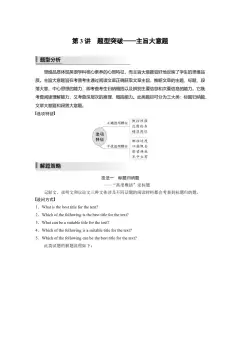
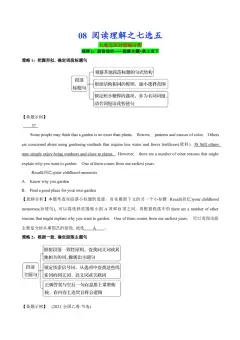
该题型属于主旨大意题的考查类型之一。每一段都是围绕一个特定的主题按照一定的逻辑顺:序展开,所以
每一段都有一个中心,且中心思想通常通过段落主题句表现出来。考生做此类题时,要找到段落.题句即为段
落大意,有时也要通过阅读整段内容进行归纳得出段落大意,从而找到正确选项。
做真题 悟技法
(2023·新课标 II , B篇)
Turning soil, pulling weeds, and harvesting cabbage sound like tough work for middle and high school kids.
And at first it is, says Abby Jaramillo, who with another teacher started Urban Sprouts, a school garden program at
four low-income schools. The program aims to help students develop science skills, environmental awareness, and
healthy lifestyles.
Jaramillo’s students live in neighborhoods where fresh food and green space are not easy to find and fast food
restaurants outnumber grocery stores. “The kids literally come to school with bags of snacks and large bottles of
soft drinks,” she says. “They come to us thinking vegetables are awful, dirt is awful, insects are awful.” Though
some are initially scared of the insects and turned off by the dirt, most are eager to try something new.
Urban Sprouts’ classes, at two middle schools and two high schools, include hands-on experiments such as soil
testing, flower-and-seed dissection, tastings of fresh or dried produce, and work in the garden. Several times a year,
students cook the vegetables they grow, and they occasionally make salads for their entire schools.
Program evaluations show that kids eat more vegetables as a result of the classes. “We have students who say
they went home and talked to their parents and now they’re eating differently,” Jaramillo says.
She adds that the program’s benefits go beyond nutrition. Some students get so interested in gardening that
they bring home seeds to start their own vegetable gardens. Besides, working in the garden seems to have a calming
effect on Jaramillo’s special education students, many of whom have emotional control issues. “They get outside,”
she says, “and they feel successful.”
1.What do we know about Abby Jaramillo?
A.She used to be a health worker. B.She grew up in a low-income family.
C.She owns a fast food restaurant. D.She is an initiator of Urban Sprouts.2.What was a problem facing Jaramillo at the start of the program?
A.The kids’ parents distrusted her. B.Students had little time for her classes.
C.Some kids disliked garden work. D.There was no space for school gardens.
3.Which of the following best describes the impact of the program?
A.Far-reaching. B.Predictable.
C.Short-lived. D.Unidentifiable.
4.What can be a suitable title for the text?
A.Rescuing School Gardens B.Experiencing Country Life
C.Growing Vegetable Lovers D.Changing Local Landscape
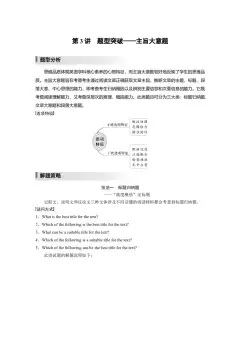
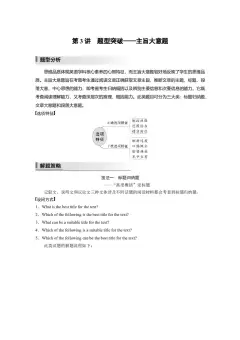
技法点拨: 文章主旨定标题
最佳标题
1.方法 a. 根据文章中心句,提炼主题词充当文章标题
b. 依据反复出现的词和多次重复的观点,确定题目中心词
c. 反证排除干扰项
2. 特点
a. 概括性--准确、简短
b. 针对性-标题外延正好与文章内容相符,避免以偏概全
c. 醒目性--新颖奇特,激发读者的阅读兴趣
3. 错误选项特点
a. 断章取义
b. 以偏概全
c. 离题太远
练模拟 提能力
Passage 1
(2024·江苏泰州·一模)The human body possesses an efficient defense system to battle with flu viruses.
The immune system protects against the attack of harmful microbes (微生物) by producing chemicals called
antibodies, which are programmed to destroy a specific type of microbe. They travel in the blood and search the
body for invaders (入侵者). When they find an invasive microbe, antibodies attack and destroy any cell thatcontains the virus. However, flu viruses can be a terrible enemy. Even if your body successfully fights against the
viruses, with their ability to evolve rapidly, your body may have no protection or immunity from the new ones.
Your body produces white blood cells to protect you against infectious diseases. Your body can detect
invading microbes in your bloodstream because they carry antigens in their proteins. White blood cells in your
immune system, such as T cells, can sense antigens in the viruses in your cells. Once your body finds an antigen, it
takes immediate action in many different ways. For example, T cells produce more antibodies, call in cells that eat
microbes, and destroy cells that are infected with a virus.
One of the best things about the immune system is that it will always remember a microbe it has fought before
and know just how to fight it again in the future. Your body can learn to fight so well that your immune system can
completely destroy a virus before you feel sick at all.
However, even the most cautious people can become infected. Fortunately, medical scientists have developed
vaccines (疫苗), which are weakened or dead flu viruses that enter a person’s body before the person gets sick.
These viruses cause the body to produce antibodies to attack and destroy the strong viruses that may invade during
flu season.
1.Why does flu pose a threat to the immune system?
A.Microbes contain large quantities of viruses.
B.Antibodies are too weak to attack flu viruses.
C.The body has few effective ways to tackle flu.
D.It’s hard to keep pace with the evolution of viruses.
2.What does the underlined word “antigens” refer to in Paragraph 2?
A.The cell protecting your body from viruses.
B.The matter serving as the indicator of viruses.
C.The antibodies helping to fight against viruses.
D.The substance destroying cells infected with viruses.
3.How do vaccines defend the body against the flu viruses?
A.They strengthen the body’s immune system.
B.They battle against weakened or dead viruses.
C.They help produce antibodies to wipe out viruses.
D.They expose the body to viruses during flu season.
4.Which of the following is a suitable title for the text?
A.Antibodies Save Our Health. B.Vaccines Are Of Great Necessity.C.Infectious Flu Viruses Are Around. D.Human Body Fights Against Flu Viruses.
Passage 2
(2024·浙江嘉兴·模拟预测)July 2023 was the world’s warmest month on record, according to the World
Meteorological Organization. UN Secretary—General Antonio Guterres said in a speech that the planet is entering
an “era of global boiling”. How to cool the planet has long been a troubling question for scientists. They are now
turning to sun-blocking technology, which refers to reflecting sunlight back into space in order to keep down the
temperature of the planet’s climate.
According to Euronews, a European television news network, one idea involves pumping sun-blocking
particles (粒子) into the upper atmosphere. The particles will then stay in the air and redirect sunshine back
upwards. It is like applying sunscreen on the outside of Earth. Researchers at Yale University, US, outlined a plan to
use 125 high-flying planes to spread the particles at latitudes (纬度) of 60 degrees north and south. The particles
will then travel toward the poles, which could possibly cool the temperature there by 2℃.
Another very promising technique is called “cloud brightening”, according to Chris Sacca, a US climate
expert. This method involves sending sea salt particles into clouds above the sea, making them whiter and thus they
reflect more sunlight back into space.
In June, the US government announced in a report that it was offering support for solar engineering research
as a way to slow the rise of global temperatures. According to the report, the US government believes that the
technology “offers the possibility of cooling the planet significantly in a few years”.
However, following the report, an open letter by more than 60 scientists called for caution and more research
first. Kristen Rasmussen, a climate scientist at Colorado State University, US, has been studying how these sun-
blocking methods will affect rainfall patterns. She said that apart from rainfall, ecosystems and even human
communities would also be affected. “We need to be very cautious on this,” Rasmussen told Scientific American.
5.What do we know about sun-blocking particles?
A.They can catch and take in sunlight. B.They function as a protective cover for Earth.
C.They can release cool air into the atmosphere. D.They are most effective when used at the poles.
6.What is the US government’s attitude toward sun-blocking technology?
A.Favorable. B.Pessimistic. C.Objective. D.Dismissive.
7.What is Kristen Rasmussen’s main concern regarding sun-blocking methods?
A.Their potential impact on human health. B.Their practicability in actual application.
C.Their high cost and limited effectiveness.D.Their far-reaching negative consequences.8.Which is the most suitable title for the text?
A.Cooling Our Planet B.Era of Global Boiling
C.Pumping Blocking Particles D.The Technique of Cloud Brightening
Passage 3
(2024·浙江绍兴·一模)Have you ever lost something in a hard-to-reach space, like behind a couch or a
cupboard? Wouldn’t it be nice to just be able to squeeze in and out? New innovations in the field of robotics will
soon be able to make this nice idea into a reality.
In a study published on Jan. 25 in the science journal Matter, engineers from The Chinese University of Hong
Kong and Carnegie Mellon University in the US have developed small robots that can quickly change back and
forth from liquid to solid states.
According to the website Mashable, the scientists were inspired by sea cucumbers (海参). They are able to
change the stiffness of their body or reduce the potential for physical damage. The robots in the study were made
from gallium, a soft metal with a low melting point of 30℃. The scientists then used changes in the magnetic field
to handle the magnetic particles (粒子) inside the gallium material to provide heat. This heat then allowed the
robots to change between solid and liquid states as well as to move around.
As the website Tech Xplore pointed out, other similar materials require external heat sources such as heat guns
and electrical currents to bring a change of states; but now, the robots can use a heat source inside itself to change
states independently.
During the robots’ experimental trials, the scientists conducted a number of tests. These tests included having
the robots melt into liquid and re-form to escape a prison-like cage. It can remove a foreign object from and deliver
medicinal drugs to a model stomach. The robot is also able to build and repair hard-to-reach circuits. The robots’
ability to switch between states of matter allows for a number of possible uses and advancements in different fields,
such as the biomedical and circuit assembly industries.
Still, in the words of senior author Carmel Majidi at Carnegie Mellon University, for now these are all just
“proofs of concept” which show the abilities of these new kinds of robots.
9.What can we learn about the small robots?
A.They were produced by British scientists.
B.They came from inspiration of sea cucumbers.
C.They can help people squeeze in and out freely.
D.They were made from a newly invented material.10.How did scientists change the state of the robots?
A.By employing a heat source.
B.By using electrical currents.
C.By controlling the magnetic particles.
D.By building hard-to-reach circuits.
11.What can be inferred about the robots from Majidi’s words?
A.Their abilities are overstated.
B.They have great market potential.
C.Proof is needed to understand the concept.
D.It will take time for them to be widely used.
12.What might be the best title of the passage?
A.Ongoing Challenges the New Robots Face
B.Amazing Features the New Robots Possess
C.Potential Limitations the New Robots Have
D.New Melting Robots Switching between Different States
Passage 4
(2024·全国·一模)Every year, as the surface water temperature off the United States mid-Atlantic coast
rises steadily from late spring through the summer, a pocket of uncharacteristically cool and crisp water gets
trapped at the bottom of the ocean. Packed with nutrients this thick band of cold water, known as the mid-Atlantic
cold pool, is a vital home for shellfish species. Extending at its seasonal peak from Nantucket, Massachusetts, to
Cape Hatteras, North Carolina, the cold poll creates a diverse ecosystem ranging from algae(海藻)to fish — and
some of the most valuable shellfish fisheries in the United States.
Now, however, two pressures have scientists worrying about whether the cold pool will last. The first is no
surprise: climate change. Over the past five decades, climates change has destabilized the cold pool, causing it to
warm and shrink. Compared with 1968, the cold pool is now 13℃ warmer and has lost more than one-third of its
area.
The second concern is 1ess certain. In 2023, the US federal government approved plans to install(安装)98
wind turbines(涡轮机)off the New Jersey coast, covering an area of more than 300 square kilometers. Yet putting
so many turbines to the seafloor could have unexpected consequences for the cold pool. That’s why Travis Miles, a
researcher at New Jersey’s Rutgers University, and his colleagues are investigating. So far, Miles and his colleaguescan’t definitively say what will happen to the cold pool, saying more research is needed to assess how climate
change and offshore wind, together, could affect the cold pool. However, their initial analyses suggest the cold pool
should be fine — at least in normal conditions.
New Jersey’s offshore wind plans are strongly opposed mainly by fossil fuel-industry funded efforts. Miles
worries that an overabundance of caution or fear of potential impacts, including on the cold pool, might slow down
the development of renewable energy. “...it’s quite clear that climate change is far more damaging than installing
wind farms,” he says. “I don’t think any scientist would argue with that.”
13.What do we know about the mid-Atlantic cold pool?
A.It forms in early spring. B.It’s a band of cold near-bottom water.
C.It serves as a habitat of most sea species.D.It extends from Nantucket to New Jersey.
14.What does the underlined word “shrink” in paragraph 2 mean?
A.Break down. B.Get polluted. C.Dry up. D.Become smaller.
15.Miles’ attitude toward installing wind farms can be described as ______.
A.supportive B.dismissive C.overcautious D.skeptical
16.What is the best title for the text?
A.The Cold Pool Plays a Role on species
B.Opinions Divide on Offshore Wind Farms
C.Scientists Eye Potential Risks to the Cold Pool
D.Renewable Energy Helps to Race Against Climate Change
Passage 5
(2024·山东泰安·一模)As to psychological well-being, the comfort zone is frequently perceived as a
haven, a familiar location where individuals feel calm and peaceful. Pushing beyond this psychological state might
have benefits.
The comfort zone can be understood as a behavioral metaphor. Within a comfort zone, an individual takes on a
state of minimal anxiety without a perception of risk, responding predictably to deliver a consistent level of
performance. These include behaviors that people do commonly, find relaxing, or that take them away from high-
stress situations. Engaging in the same manner over time leads to a predictable and familiar zone of comfort. As
creatures of habit, we become dependent on these routines that we know we can complete well to feel secure.
However, by stepping outside of our comfort zone, we learn about our ability to handle new situations and control
risks, leading to greater self-confidence, and lower levels of anxiety.One study found that individuals who are more secure in stepping out of their comfort zone are more likely to
be excited by and look forward to new experiences, feeling greater confidence in their ability to take them on.
One behavior that demonstrates the benefits of stepping out of a comfort zone is learning to play a musical
instrument. When we consider actions outside of our comfort zone, we must assess our desire to engage in that
activity. By weighing the pros and cons, we evaluate how uncomfortable a situation may seem, and whether the
danger of entering such an unknown situation will be worth the risk.
Music offers a safe way to step out of your initial comfort zone because you can begin by practicing in an
isolated setting, which offers a casual, safe way to build a new skill set. By picking up and practicing a new
instrument, you have proven to yourself that you are capable of meeting an unfamiliar objective, thus decreasing
anxiety.
17.What does the underlined word “haven” in Paragraph 1 most probably mean?
A.Habitat. B.Shelter. C.Community. D.Destination.
18.Which will not be considered when we step out of our comfort zone?
A.We recall the old experience.
B.We think whether it is worth the risk.
C.We evaluate our thirsty for the activity.
D.We weigh the strengths and weaknesses.
19.What will be probably discussed in the following paragraph?
A.The definition of the comfort zone.
B.The importance of psychological well-being.
C.The process of learning a new musical instrument.
D.The benefits of stepping out of one’s comfort zone.
20.Which of the following is the best title for the text?
A.How to Identify Comfort Zone
B.Staying Inside Comfort Zone is Important
C.Stepping Outside Comfort Zone Promotes Learning
D.How to Take Yourself Away from High-stress Situations
Passage 6
(2024·山东济宁·一模)My wife and I have always had a non-negotiable when looking for a place to rent: a
gas stove. We love cooking together, and countless food shows have impressed upon us that there is nothing more
essential to a tasty meal than a flame.Then came the shift of work forcing us to move into a new apartment with an induction cooker. Past
encounters with the slow and inconsistent heating elements of early electric stoves had soured us to the idea of
cooking with electricity, but it took only a couple of days for us to realize that our new induction cooker was far
superior: Water boiled at lightning speed; I could set a timer and walk away knowing the heat would automatically
turn off.
Our belated switch to induction came amid a rise of horrifying stories about the health and climate risks of gas
stoves. Studies have found cooking with gas is like having secondhand smoke in the kitchen. Worse still, the
primary ingredient that fuels gas stoves are methane, a greenhouse gas 80 times more harmful to the environment
than carbon dioxide. That’s why I finally quit using gas stoves and abandoned my prior conviction that I could
never live in a home without one.
Don’t get me wrong—there’s still a place for flame, and there’s a reason why barbecued—food is so delicious.
Barbecuing food imparts special flavour that you can’t experience with an electric cooker. But dishes that truly
require cooking over an open flame are the exception, not the rule.
Changing the fundamentals of our lives is hard. But just as we have stopped commuting by horse, or have
replaced a coal fireplace with central heating, it’s time to move gas out of our kitchens. Some might be horrified.
The rest of us, though, can step calmly into the future. Hopefully the governments, too, will soon smell the gas.
21.How did the author feel about cooking with early electric stoves?
A.Unpleasant. B.Concerned. C.Panicky. D.Stressed.
22.What can be inferred from paragraph 4?
A.The author regrets giving up gas stoves. B.Barbecued food is tastier and healthier.
C.It is a common practice to cook outdoors. D.Gas stoves still have a role to play.
23.What does the author want to convey in the last paragraph?
A.Be open to changes. B.Be brave in the face of uncertainty.
C.The old should give way to the new. D.Governments should be gas advocates.
24.What’s the best title of the text?
A.Barbecue: Tasty or Risky B.A New “Flame” Has Come
C.Gas Stoves: To Leave or to Stay D.Electricity Has Taken the Lead