考点2 阅读理解—记叙文
温馨提示:
本资料注重培优,集中强化重点,突破难度,规避易混易错点,练习全部
是26 年新模拟题
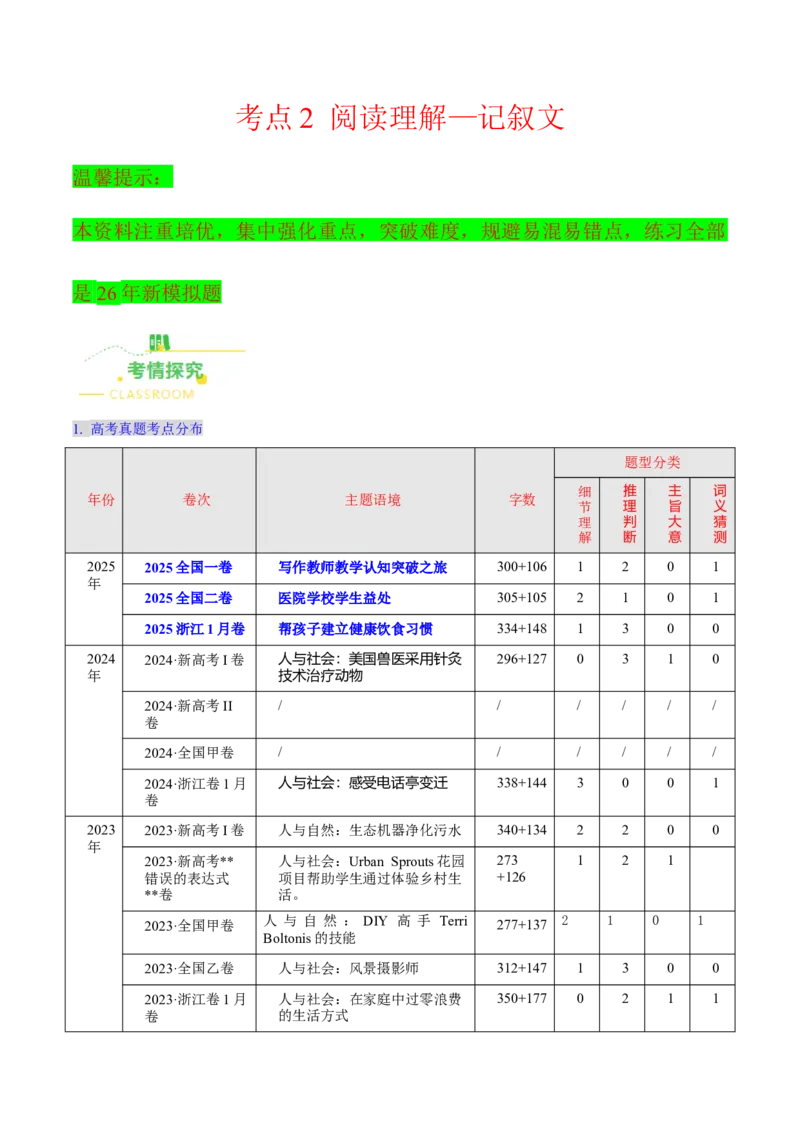
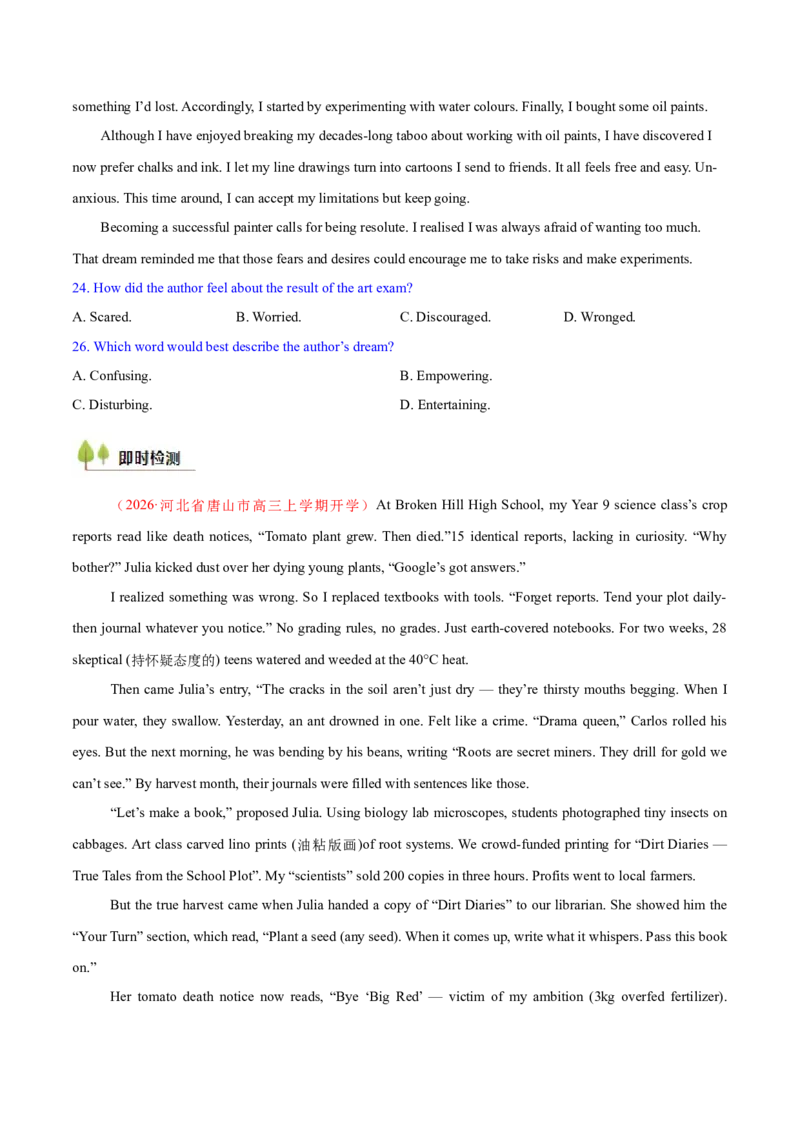
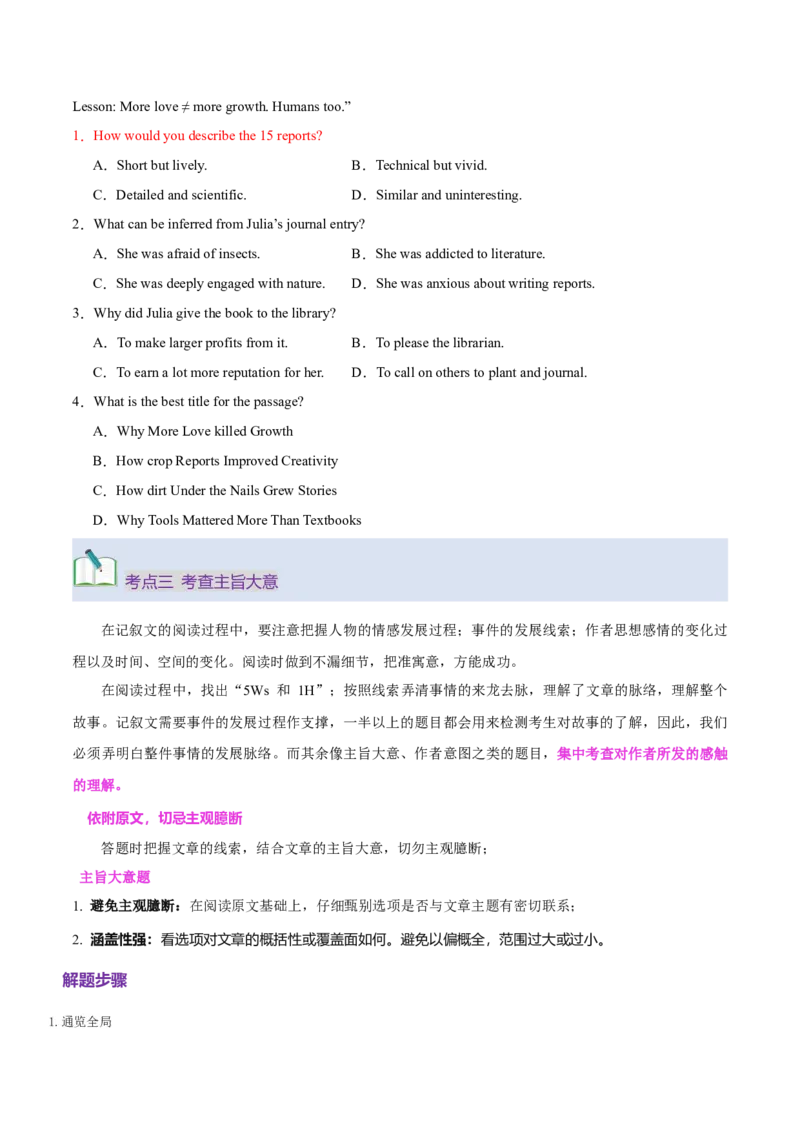
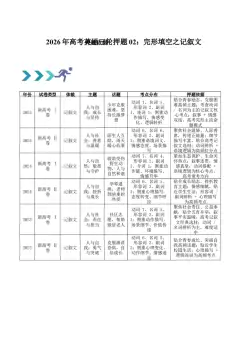
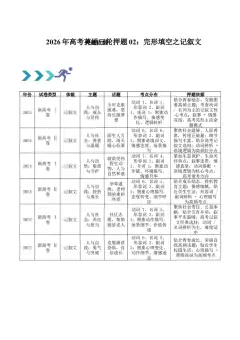
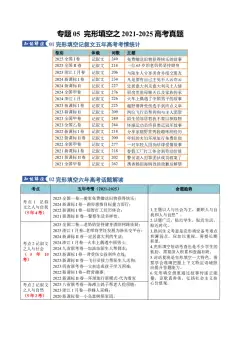
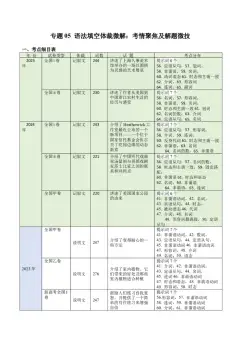
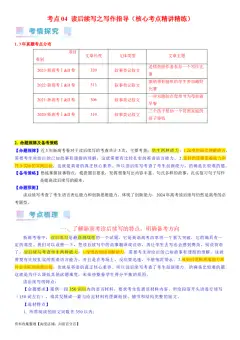
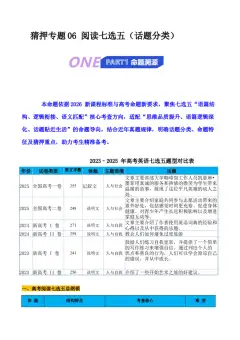
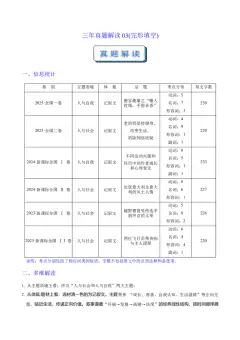
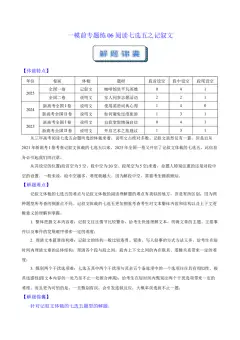
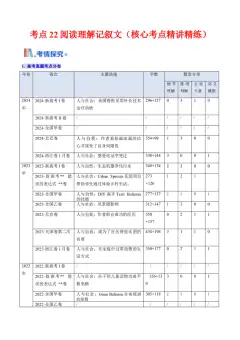
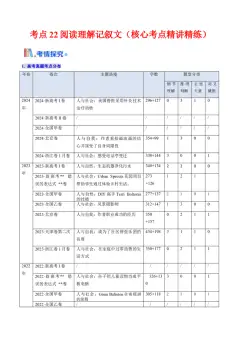
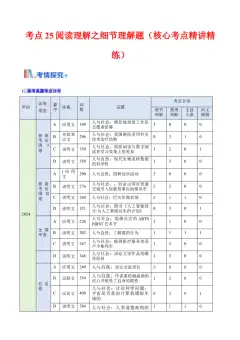
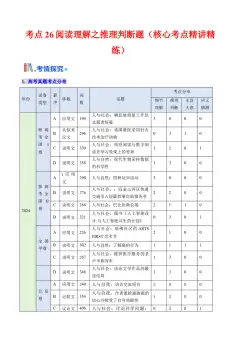
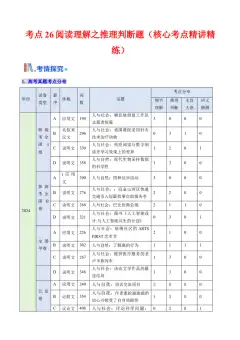
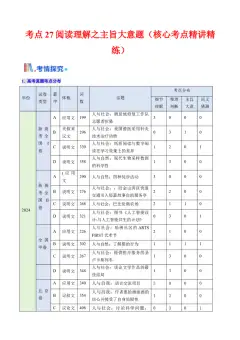
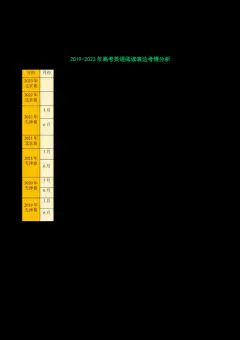
1. 高考真题考点分布
年份
卷次
主题语境
字数
题型分类
细
节
理
解
推
理
判
断
主
旨
大
意
词
义
猜
测
2025
年
2025 全国一卷
写作教师教学认知突破之旅
300+106
1
2
0
1
2025 全国二卷
医院学校学生益处
305+105
2
1
0
1
2025 浙江1 月卷
帮孩子建立健康饮食习惯
334+148
1
3
0
0
2024
年
2024·新高考I 卷
人与社会:美国兽医采用针灸
技术治疗动物
296+127
0
3
1
0
2024·新高考II
卷
/
/
/
/
/
/
2024·全国甲卷
/
/
/
/
/
/
2024·浙江卷1 月
卷
人与社会:感受电话亭变迁
338+144
3
0
0
1
2023
年
2023·新高考I 卷
人与自然:生态机器净化污水
340+134
2
2
0
0
2023·新高考**
错误的表达式
**卷
人与社会:Urban Sprouts 花园
项目帮助学生通过体验乡村生
活。
273
+126
1
2
1
2023·全国甲卷
人与自然:DIY 高手Terri
Boltonis 的技能
277+137
2
1
0
1
2023·全国乙卷
人与社会:风景摄影师
312+147
1
3
0
0
2023·浙江卷1 月
卷
人与社会:在家庭中过零浪费
的生活方式
350+177
0
2
1
1
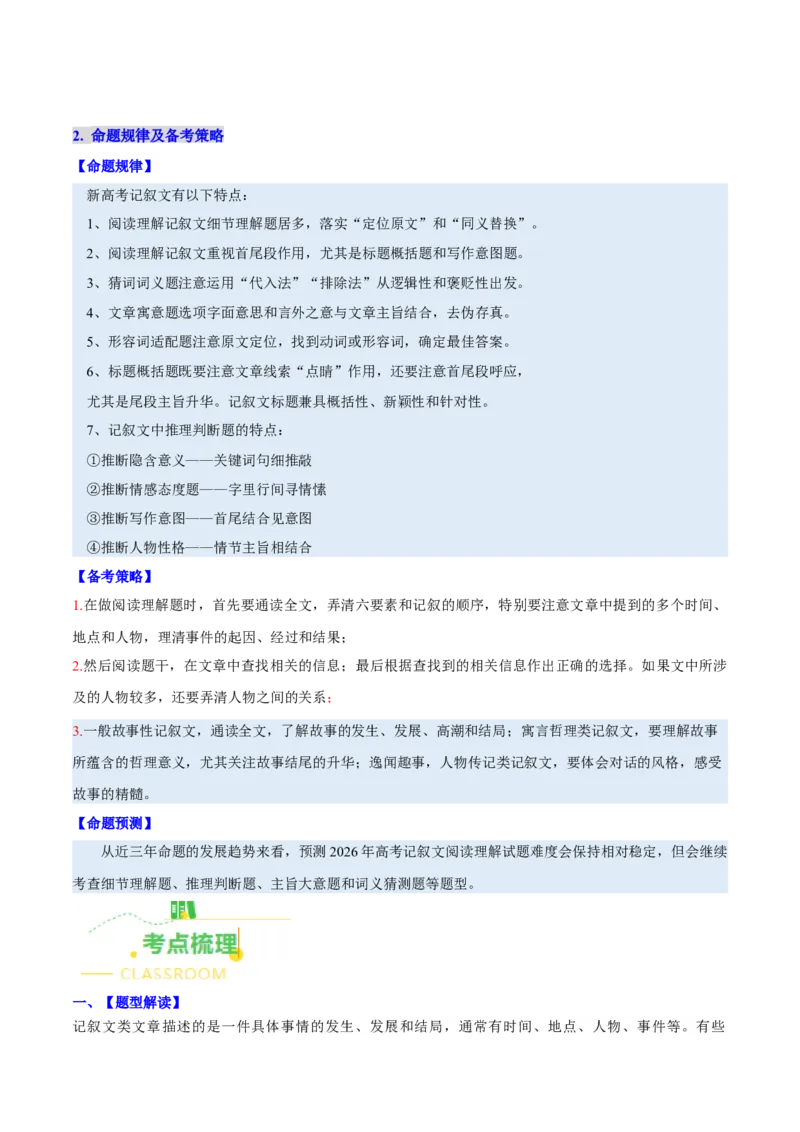
2. 命题规律及备考策略
【命题规律】
新高考记叙文有以下特点:
1、阅读理解记叙文细节理解题居多,落实“定位原文”和“同义替换”。
2、阅读理解记叙文重视首尾段作用,尤其是标题概括题和写作意图题。
3、猜词词义题注意运用“代入法”“排除法”从逻辑性和褒贬性出发。
4、文章寓意题选项字面意思和言外之意与文章主旨结合,去伪存真。
5、形容词适配题注意原文定位,找到动词或形容词,确定最佳答案。
6、标题概括题既要注意文章线索“点睛”作用,还要注意首尾段呼应,
尤其是尾段主旨升华。记叙文标题兼具概括性、新颖性和针对性。
7、记叙文中推理判断题的特点:
①推断隐含意义——关键词句细推敲
②推断情感态度题——字里行间寻情愫
③推断写作意图——首尾结合见意图
④推断人物性格——情节主旨相结合
【备考策略】
1.在做阅读理解题时,首先要通读全文,弄清六要素和记叙的顺序,特别要注意文章中提到的多个时间、
地点和人物,理清事件的起因、经过和结果;
2.然后阅读题干,在文章中查找相关的信息;最后根据查找到的相关信息作出正确的选择。如果文中所涉
及的人物较多,还要弄清人物之间的关系;
3.一般故事性记叙文,通读全文,了解故事的发生、发展、高潮和结局;寓言哲理类记叙文,要理解故事
所蕴含的哲理意义,尤其关注故事结尾的升华;逸闻趣事,人物传记类记叙文,要体会对话的风格,感受
故事的精髓。
【命题预测】
从近三年命题的发展趋势来看,预测2026 年高考记叙文阅读理解试题难度会保持相对稳定,但会继续
考查细节理解题、推理判断题、主旨大意题和词义猜测题等题型。
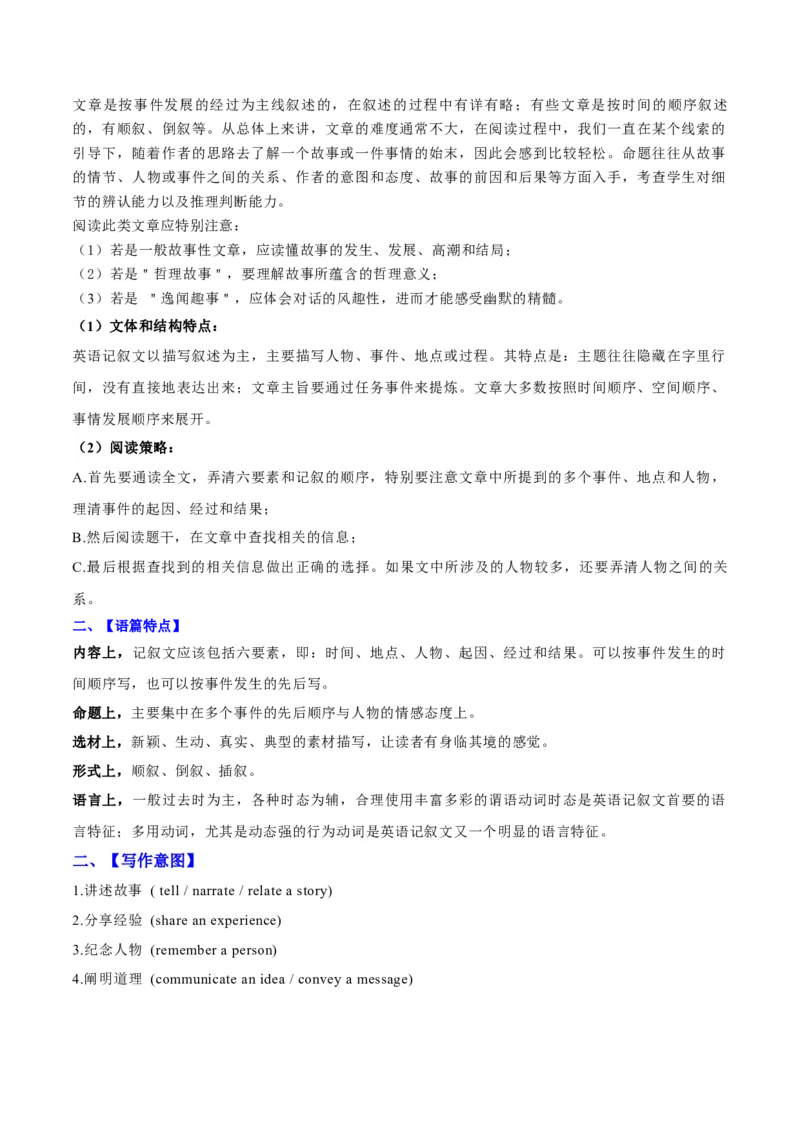
一、【题型解读】
记叙文类文章描述的是一件具体事情的发生、发展和结局,通常有时间、地点、人物、事件等。有些
文章是按事件发展的经过为主线叙述的,在叙述的过程中有详有略;有些文章是按时间的顺序叙述
的,有顺叙、倒叙等。从总体上来讲,文章的难度通常不大,在阅读过程中,我们一直在某个线索的
引导下,随着作者的思路去了解一个故事或一件事情的始末,因此会感到比较轻松。命题往往从故事
的情节、人物或事件之间的关系、作者的意图和态度、故事的前因和后果等方面入手,考查学生对细
节的辨认能力以及推理判断能力。
阅读此类文章应特别注意:
(1)若是一般故事性文章,应读懂故事的发生、发展、高潮和结局;
(2)若是"哲理故事",要理解故事所蕴含的哲理意义;
(3)若是 "逸闻趣事",应体会对话的风趣性,进而才能感受幽默的精髓。
(1)文体和结构特点:
英语记叙文以描写叙述为主,主要描写人物、事件、地点或过程。其特点是:主题往往隐藏在字里行
间,没有直接地表达出来;文章主旨要通过任务事件来提炼。文章大多数按照时间顺序、空间顺序、
事情发展顺序来展开。
(2)阅读策略:
A.首先要通读全文,弄清六要素和记叙的顺序,特别要注意文章中所提到的多个事件、地点和人物,
理清事件的起因、经过和结果;
B.然后阅读题干,在文章中查找相关的信息;
C.最后根据查找到的相关信息做出正确的选择。如果文中所涉及的人物较多,还要弄清人物之间的关
系。
二、【语篇特点】
内容上,记叙文应该包括六要素,即:时间、地点、人物、起因、经过和结果。可以按事件发生的时
间顺序写,也可以按事件发生的先后写。
命题上,主要集中在多个事件的先后顺序与人物的情感态度上。
选材上,新颖、生动、真实、典型的素材描写,让读者有身临其境的感觉。
形式上,顺叙、倒叙、插叙。
语言上,一般过去时为主,各种时态为辅,合理使用丰富多彩的谓语动词时态是英语记叙文首要的语
言特征;多用动词,尤其是动态强的行为动词是英语记叙文又一个明显的语言特征。
二、【写作意图】
1.讲述故事 ( tell / narrate / relate a story)
2.分享经验 (share an experience)
3.纪念人物 (remember a person)
4.阐明道理 (communicate an idea / convey a message)

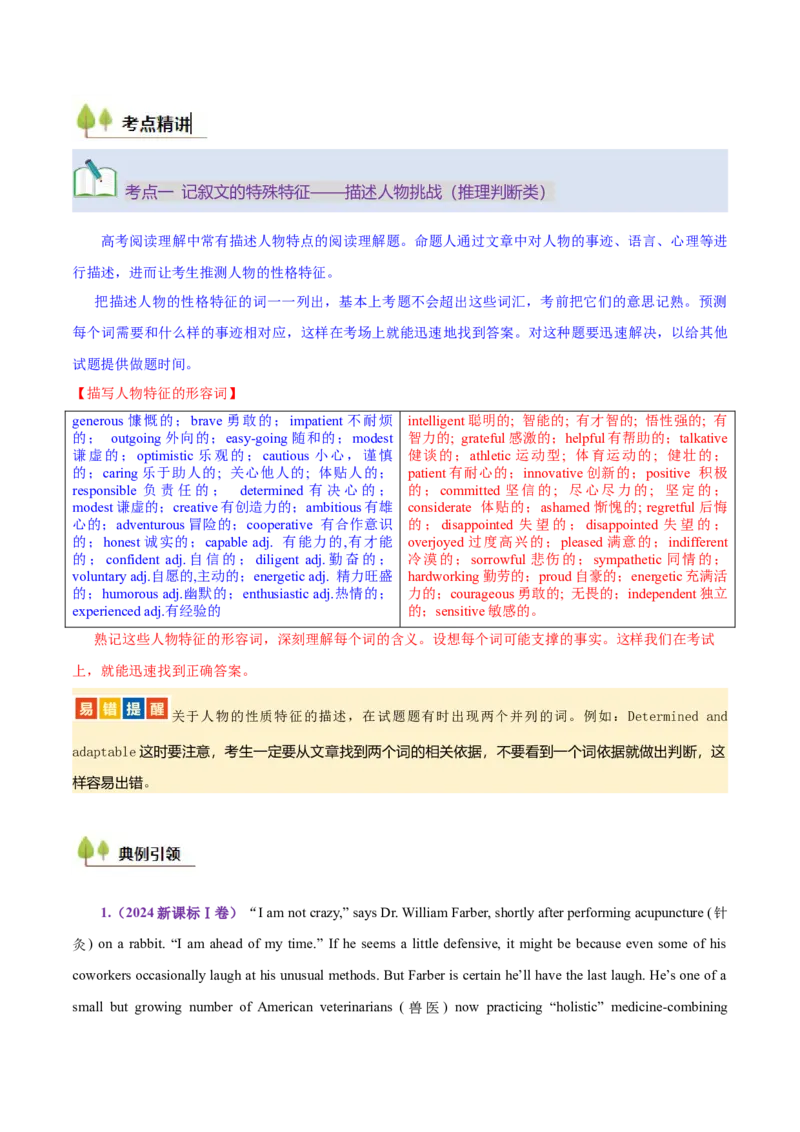
考点一 记叙文的特殊特征——描述人物挑战(推理判断类)
高考阅读理解中常有描述人物特点的阅读理解题。命题人通过文章中对人物的事迹、语言、心理等进
行描述,进而让考生推测人物的性格特征。
   把描述人物的性格特征的词一一列出,基本上考题不会超出这些词汇,考前把它们的意思记熟。预测
每个词需要和什么样的事迹相对应,这样在考场上就能迅速地找到答案。对这种题要迅速解决,以给其他
试题提供做题时间。
【描写人物特征的形容词】
generous 慷慨的;brave 勇敢的;impatient 不耐烦
的; outgoing 外向的;easy-going 随和的;modest
谦虚的;optimistic 乐观的;cautious 小心,谨慎
的;caring 乐于助人的; 关心他人的; 体贴人的;
responsible 负责任的; determined 有决心的;
modest 谦虚的;creative 有创造力的;ambitious 有雄
心的;adventurous 冒险的;cooperative 有合作意识
的;honest 诚实的;capable adj. 有能力的,有才能
的;confident adj. 自信的;diligent adj. 勤奋的;
voluntary adj.自愿的,主动的;energetic adj. 精力旺盛
的;humorous adj.幽默的;enthusiastic adj.热情的;
experienced adj.有经验的
intelligent 聪明的; 智能的; 有才智的; 悟性强的; 有
智力的; grateful 感激的;helpful 有帮助的;talkative
健谈的;athletic 运动型; 体育运动的; 健壮的;
patient 有耐心的;innovative 创新的;positive 积极
的;committed 坚信的; 尽心尽力的; 坚定的;
considerate 体贴的;ashamed 惭愧的; regretful 后悔
的;disappointed 失望的;disappointed 失望的;
overjoyed 过度高兴的;pleased 满意的;indifferent
冷漠的;sorrowful 悲伤的;sympathetic 同情的;
hardworking 勤劳的;proud 自豪的;energetic 充满活
力的;courageous 勇敢的; 无畏的;independent 独立
的;sensitive 敏感的。
   熟记这些人物特征的形容词,深刻理解每个词的含义。设想每个词可能支撑的事实。这样我们在考试
上,就能迅速找到正确答案。
关于人物的性质特征的描述,在试题题有时出现两个并列的词。例如:Determined and
adaptable 这时要注意,考生一定要从文章找到两个词的相关依据,不要看到一个词依据就做出判断,这
样容易出错。
1.(2024 新课标Ⅰ卷)“I am not crazy,” says Dr. William Farber, shortly after performing acupuncture (针
灸) on a rabbit. “I am ahead of my time.” If he seems a little defensive, it might be because even some of his
coworkers occasionally laugh at his unusual methods. But Farber is certain he’ll have the last laugh. He’s one of a
small but growing number of American veterinarians ( 兽医) now practicing “holistic” medicine-combining
traditional Western treatments with acupuncture, chiropractic (按摩疗法) and herbal medicine.
24. What do some of Farber’s coworkers think of him?
A. He’s odd.
B. He’s strict.
C. He’s brave.
D. He’s rude.
2.(2022 年新高考全国Ⅱ卷)Sorry, kid. This book is not part of your high-tech world. It’s an outdated, lifeless
thing. An antique, like your grandfather. Well, I may be old, but I’m not hopelessly challenged, digitally speaking. I
edit video and produce audio. I use mobile payment. I’ve even built websites.
6. What does the author think of himself?
A. Socially ambitious.
B. Physically attractive.
C. Financially independent.
D. Digitally competent.
3.(2025·河北省部分学校高三下学期二轮复习联考(三))At first, Lamm tried to put her phone in a drawer
and didn’t look at it for a whole day, which she said “was very inconvenient to everyone in my life”. It took her
about a year to sell her smartphone and fully commit to the dumbphone lifestyle. Her dumbphone offers only basic
calling and texting.
Still, there are certain things that may feel impossible to navigate without smartphones, since they are more
than just texting and scrolling (滚动) through social media. In 2025, these devices function as virtual wallets, health
trackers, identification tools, and even personal assistants. However, Lamm has found solutions for the challenges.
“You figure out these solutions by asking,” Lamm said, “like asking the parking company if they can give you
another option when you can’t use parking meter (计时器), and a lot of the time they will”
21.How can we best describe August Lamm according to the text?
A.Responsible and strict.
B.Determined and adaptable.
C.Generous and charitable.
D.Fashionable and knowledgeable.
1.(2026·陕青晋宁四省高三上学期第一次联考)I was 21 when I broke the world record as the youngest
woman to ski solo (独自地) to the South Pole. On the hardest day, snow piled up to my knees, the wind howled like
a wild beast, and the cold pierced through every layer of my clothes. My sledge (雪橇) felt heavier with each step,
my muscles burning, and my breath shallow in the thin air. But I refused to stop.
Growing up in Norway, I was easily exposed to the wilderness. Stories of Roald Amundsen, the first man to
reach the South Pole, filled me with wonder. And that was when my desire to explore nature was born. I spent hours
skiing in the mountains, camping under stars, and starting campfires with frozen fingers.
At 14, I made a brave decision — to ski across Greenland. Most people doubted me. I was just under 5 feet
tall and looked more like a child than an explorer. But Lars Ebbesen, a famous polar guide, saw my determination
and trained me. He taught me how to fix broken equipment with frozen hands and read the sky for signs of danger.
“You must be strong and smart,” he told me over and over.
To prove myself, I then went on a training trip to Finnmark, where darkness ruled and temperatures fell to
-35℃. I learned to set up tents with frozen hands and sleep through winds that shook the earth. Finally I set off with
Lars and it took us 28 days to cross Greenland.
Encouraged, at 15, I decided my next goal was Antarctica. My father helped me make plans. My mother,
though cautious, eventually supported me. When I finally began my 1,130 km journey to the South Pole last
November, I was 21. Some days, I cried behind my glasses, struggling through snowstorms, dragging my aching
body forward. But I never gave up. Fifty-four days later, I reached the South Pole. I stood in silence, tears freezing
on my cheeks. I sent Lars a chick emoji — at last, the “polar egg” hatched.
1.What inspired the author to explore nature?
A.Her desire to break a record.
B.Her love for South Pole.
C.Her mother’s encouragement.
D.Her admiration for Roald.
2.How did Lars help the author?
A.By teaching her survival skills.
B.By financing her exploration.
C.By training her to ski skillfully.
D.By convincing her parents to support her.
3.What can we learn from paragraph 4 about the author?
A.She gathered some hands-on experience. B.She went to Finnmark accompanied by a guide.
C.She was praised for her courage by many people.
D.She met many challenges when crossing
Greenland.
4.Which of the following can best describe the author?
A.Outgoing and caring.
B.Ambitious and sensitive.
C.Humorous and considerate.
D.Adventurous and determined.
2.(2026·河北省部分学校高三上学期9 月开学考试)
Growing up, I was one of those energetic kids who never sat still. I was always doing cartwheels, flips, and
generally bouncing off the walls whenever I got the chance. At the age of 4, I started in gymnastics and used that as
an outlet for my endless energy for several years. I participated in gymnastics until the age of 10, when I had a
conversation with my parents that changed the direction of my life forever.
When talking about my early gymnastics career, I failed to mention that I was born with fibular hemimelia
(腓侧半肢畸形) — meaning I didn’t have fibulas, ankles, heels, and most of the other bones in my feet. At 18
months old, both of my lower legs were cut off, so I could be fitted with prosthetic (假体的) legs and learn to walk.
Then, as a 10-year-old, my parents sat me down to tell me that at some point I would have to wear
prosthetics during gymnastics because I would damage my knees from all of the force I was subjecting them to. I
tried gymnastics with my prosthetics and it just didn’t feel right.
At that point, I knew my future wasn’t in gymnastics. But I always felt like I was a mermaid ( 美人鱼) or a
fish when I got into the water, so after moving on from the beam (平衡木) to the pool, I started doing competitive
swimming.
Through years of hard training, however, I went from the little girl who wasn’t comfortable doing
gymnastics with my prosthetics to a 17-time Paralympic medalist with my eyes squarely set on the next Paralympic
Games.
I’m often asked by media or people I come across what advice I have for kids with disabilities or kids that
might be going through issues in school. My answer is that it’s important to always be confident, find something
you’re really passionate about — whether it’s reading, music, cooking, or sports, and really go for it.
1.What was the author’s initial passion?
A.Music.
B.Gymnastics.
C.Cooking.
D.Swimming.
2.Why did the author start to work on swimming?
A.It was her dream to become a swimmer.
B.Her parents stopped her from doing gymnastics.
C.She wanted to participate in Paralympic Games.
D.Gymnastics with prosthetics made her uncomfortable.
3.Which words can best describe the author?
A.Talented and generous.
B.Friendly and humorous.
C.Energetic and confident.
D.Brilliant and warm-hearted.
4.What may be the best title for the text?
A.A Disabled Girl’s Sad Story
B.To Win Paralympic Medals
C.From the Beam to the Pool
D.My Great Sports Achievements

考点二 描述作者对发生事件的态度
高考记叙文阅读理解中常有描述作者对事件的态度阅读理解题。命题人通过文章中对文章的整体内容
的思考,进而让考生推测作者的写作态度。
【解题指导】
把描述作者态度的词一一列出,基本上考题不会超出这些词汇,考前把它们的意思记熟。预测每个词
需要和什么样的事实相对应,这样在考场上就能迅速地找到答案。对这种题要迅速解决,以给其他试题提
供做题时间。
【描写作者态度的形容词】(选项常用词)
ambitious 有雄心的;undoubted 无怀疑的;
indifferent 冷漠的;unconfident 没信心的;uncaring
不关心的;worried 担心的;satisfied 满意的;
cautious 谨慎的;favorable 赞同的;doubtful 怀疑
的;uninterested 不感兴趣的;frightened 害怕的;
puzzled 迷惑不解的;concerned 关心的;happy 高兴
的;tolerant 忍受的;sympathetic 同情的; delighted
高兴的;carefree 无忧无虑的; 无牵挂的; 不负责任
的
unclear 不清楚的; opposed 反对的;appreciative
adj.感激的; 感谢的; 欣赏的; 赏识的; suspicious adj.
感觉可疑的; 怀疑的; 令人怀疑的; 可疑的; 不信任
的; 持怀疑态度的;objective adj.客观的; 就事论事
的; 不带个人感情的; 客观存在的; 基于事实的;
confused 迷惑不解的;conservative adj.保守的; 守旧
的;pessimistic 悲观的; disapproving 不同意的;
ambiguous 模棱两可的;skeptical 怀疑的
熟记这些作者态度的形容词,深刻理解每个词的含义。设想每个词可能的描述事实。这样我们在考试
上,就能迅速找到正确答案。
(2024 北京卷)When I was a little girl, I liked drawing, freely and joyously making marks on the walls at
home. In primary school, I learned to write using chalks. Writing seemed to be another form of drawing. I shaped
individual letters into repeating lines, which were abstract forms, delightful but meaningless patterns.
In secondary school, art was my favourite subject. Since. I loved it so much I thought I was good at it. For the
art O-level exam I had to present an oil painting. I found it difficult, but still hoped to pass. I failed, with a low
grade. I’d been over-confident. Now I’d been declared talentless.
But other channels of creativity stayed open: I went on writing poems and stories. Still, I went to exhibitions
often. I continued my habitual drawing, which I now characterised as childish doodling (乱画). In my 30s, I made
painter friends and learned new ways of looking at art. However, I couldn’t let myself have a go at actually doing it.
Though these new friends were abstract painters using oil paints, or were printmakers or sculptors, I took oil
painting as the taboo (禁忌) high form I wasn’t allowed to practice.
One night, in my early 40s, I dreamed that a big woman in red approached me, handed me a bag of paints, and
told me to start painting. The dream felt so authoritative that it shook me. It was a form of energy, giving me back
something I’d lost. Accordingly, I started by experimenting with water colours. Finally, I bought some oil paints.
Although I have enjoyed breaking my decades-long taboo about working with oil paints, I have discovered I
now prefer chalks and ink. I let my line drawings turn into cartoons I send to friends. It all feels free and easy. Un-
anxious. This time around, I can accept my limitations but keep going.
Becoming a successful painter calls for being resolute. I realised I was always afraid of wanting too much.
That dream reminded me that those fears and desires could encourage me to take risks and make experiments.
24. How did the author feel about the result of the art exam?
A. Scared.
B. Worried.
C. Discouraged.
D. Wronged.
26. Which word would best describe the author’s dream?
A. Confusing.
B. Empowering.
C. Disturbing.
D. Entertaining.
(2026·河北省唐山市高三上学期开学)At Broken Hill High School, my Year 9 science class’s crop
reports read like death notices, “Tomato plant grew. Then died.”15 identical reports, lacking in curiosity. “Why
bother?” Julia kicked dust over her dying young plants, “Google’s got answers.”
I realized something was wrong. So I replaced textbooks with tools. “Forget reports. Tend your plot daily-
then journal whatever you notice.” No grading rules, no grades. Just earth-covered notebooks. For two weeks, 28
skeptical (持怀疑态度的) teens watered and weeded at the 40°C heat.
Then came Julia’s entry, “The cracks in the soil aren’t just dry — they’re thirsty mouths begging. When I
pour water, they swallow. Yesterday, an ant drowned in one. Felt like a crime. “Drama queen,” Carlos rolled his
eyes. But the next morning, he was bending by his beans, writing “Roots are secret miners. They drill for gold we
can’t see.” By harvest month, their journals were filled with sentences like those.
“Let’s make a book,” proposed Julia. Using biology lab microscopes, students photographed tiny insects on
cabbages. Art class carved lino prints (油粘版画)of root systems. We crowd-funded printing for “Dirt Diaries —
True Tales from the School Plot”. My “scientists” sold 200 copies in three hours. Profits went to local farmers.
But the true harvest came when Julia handed a copy of “Dirt Diaries” to our librarian. She showed him the
“Your Turn” section, which read, “Plant a seed (any seed). When it comes up, write what it whispers. Pass this book
on.”
Her tomato death notice now reads, “Bye ‘Big Red’ — victim of my ambition (3kg overfed fertilizer).
Lesson: More love ≠ more growth. Humans too.”
1.How would you describe the 15 reports?
A.Short but lively.
B.Technical but vivid.
C.Detailed and scientific.
D.Similar and uninteresting.
2.What can be inferred from Julia’s journal entry?
A.She was afraid of insects.
B.She was addicted to literature.
C.She was deeply engaged with nature.
D.She was anxious about writing reports.
3.Why did Julia give the book to the library?
A.To make larger profits from it.
B.To please the librarian.
C.To earn a lot more reputation for her.
D.To call on others to plant and journal.
4.What is the best title for the passage?
A.Why More Love killed Growth
B.How crop Reports Improved Creativity
C.How dirt Under the Nails Grew Stories
D.Why Tools Mattered More Than Textbooks

考点三 考查主旨大意
在记叙文的阅读过程中,要注意把握人物的情感发展过程;事件的发展线索;作者思想感情的变化过
程以及时间、空间的变化。阅读时做到不漏细节,把准寓意,方能成功。
在阅读过程中,找出“5Ws 和 1H”;按照线索弄清事情的来龙去脉,理解了文章的脉络,理解整个
故事。记叙文需要事件的发展过程作支撑,一半以上的题目都会用来检测考生对故事的了解,因此,我们
必须弄明白整件事情的发展脉络。而其余像主旨大意、作者意图之类的题目,集中考查对作者所发的感触
的理解。
依附原文,切忌主观臆断
答题时把握文章的线索,结合文章的主旨大意,切勿主观臆断;
 主旨大意题
1. 避免主观臆断:在阅读原文基础上,仔细甄别选项是否与文章主题有密切联系;
2. 涵盖性强:看选项对文章的概括性或覆盖面如何。避免以偏概全,范围过大或过小。
  解题步骤
1.通览全局
2.关注首尾段落:70%的记叙文在开头点题,结尾升华
3.勾画重复出现的关键词(人物行为/情感变化/象征物)
4.分析结构 情节发展: 开端 → 发展 → 高潮 → 结局 → 感悟
5.情感曲线: 通过形容词/副词捕捉情绪变化(如:frustrated → determined → relieved)
6.定位核心要素
①主人公的关键抉择或顿悟时刻
②人物关系转折点(如:从冲突到和解)
③象征物的深层含义(如:broken watch 象征时间珍贵)
④排除干扰项 错误选项特征: □ 仅概括某个细节(出现具体人名/数字) □ 包含未提及的推论(出现must/only 等绝
对词) □ 与作者情感基调相悖(如文章悲伤却选乐观选项)
实战技巧
1.标题关联法:结合文章标题理解主旨(如标题"The Gift"多指情感馈赠而非实物)
2.三问检验法:
①主要人物经历了什么?
②这个经历带来什么改变?
③作者想通过这个变化说明什么?
④高频词统计:快速统计重复3 次以上的名词/动词
⑤视角判断:第一人称故事往往包含个人成长主题
典型错误规避
1.混淆客观事实与主观意图:避免把故事内容当主旨
2.过度解读:不添加原文未有元素
1.(2023 年新高考全国Ⅱ卷)Turning soil, pulling weeds, and harvesting cabbage sound like tough work for
middle and high school kids. And at first it is, says Abby Jaramillo, who with another teacher started Urban
Sprouts, a school garden program at four low-income schools. The program aims to help students develop science
skills, environmental awareness, and healthy lifestyles.
Jaramillo’s students live in neighborhoods where fresh food and green space are not easy to find and fast food
restaurants outnumber grocery stores. “The kids literally come to school with bags of snacks and large bottles of
soft drinks,” she says. “They come to us thinking vegetables are awful, dirt is awful, insects are awful.” Though
some are initially scared of the insects and turned off by the dirt, most are eager to try something new.
Urban Sprouts’ classes, at two middle schools and two high schools, include hands-on experiments such as soil
testing, flower-and-seed dissection, tastings of fresh or dried produce, and work in the garden. Several times a year,
students cook the vegetables they grow, and they occasionally make salads for their entire schools.
Program evaluations show that kids eat more vegetables as a result of the classes. “We have students who say
they went home and talked to their parents and now they’re eating differently,” Jaramillo says.
She adds that the program’s benefits go beyond nutrition. Some students get so interested in gardening that
they bring home seeds to start their own vegetable gardens. Besides, working in the garden seems to have a calming
effect on Jaramillo’s special education students, many of whom have emotional control issues. “They get outside,”
she says, “and they feel successful.”
7. What can be a suitable title for the text?
A. Rescuing School Gardens
B. Experiencing Country Life
C. Growing Vegetable Lovers
D. Changing Local Landscape
2.(2021 年新高考全国Ⅱ 卷)A British woman who won a S1 million prize after she was named the World's Best
Teacher will use the cash to bring inspirational figures into UK schools.
Andria Zafirakou,a north London secondary school teacher, said she wanted to bring about a classroom
revolution (变革). “We are going to make a change, ”she said.“I’ve started a project to promote the teaching of the
arts in our schools.”
The project results from the difficulties many schools have in getting artists of any sort - whether an up-and-
coming local musician or a major movie star - into schools to work with and inspire children.
Zafirakou began the project at Alperton Community School, her place of work for the past twelve years. “I've
seen those magic moments when children are talking to someone they are inspired by - their eyes are shining and
their faces light up,” she said. “We need artists . more than ever in our schools."
Artist Michael Craig-Martin said: “Andria's brilliant project to bring artists from all fields into direct contact
with children is particularly welcome at a time when the arts are being downgraded in schools." It was a mistake to
see the arts as unnecessary, he added.
Historian Sir Simon Schama is also a supporter of the project. He said that arts education in schools was not
just an add-on. “It is absolutely necessary. The future depends on creativity and creativity depends on the young.
What will remain of us when artificial intelligence takes over will be our creativity, and it is our creative spirit, our
visionary sense of freshness,that has been our strength for centuries."
11. Which of the following is a suitable title for the text?
A. Bring Artists to Schools
B. When Historians Meet Artists
C. Arts Education in Britain
D. The World's Best Arts Teacher
【解题思维过程】
1.(2026·江苏省南通市如东市高三上学期第一次学情检测)
On the 31st of January, 1863, a small book began appearing in bookstores all over France. It was the
adventures of three travellers. Readers found themselves puzzled by this book. Was it fact or fiction? It read like a
real travel diary, including detailed descriptions of natural phenomena that were seen and notes taken on the spot as
the travellers moved, but the adventures seemed fantastic!
The title of this amazing work was Five Weeks in a Balloon and its first-time author was a man named Jules
Verne. Jules Verne was born on February 8th, 1828, in the city of Nantes, France. From the family’s summer house
just outside the city, young Jules could see the great docks and shipbuilding facilities of the region. And he often
used his imagination to climb the great ships and go to foreign ports.
Verne’s father sent him to Paris to study law. But there he found himself attracted to the theatre. Verne tried
his hand at writing plays and the first one was produced in 1850. In order to support himself, Verne became a
stockbroker (股票经纪人), a career that he did not like, but gave him enough financial support to write.
There is a legend that in 1862 he stood on the steps of the Paris Stock Exchange and announced there, “My
boys, I believe that I’m about to leave you. I’ve just written a new kind of novel, and if it succeeds it will be an
unexplored gold mine.”
It is hard to say if the above story is true. However, Verne certainly did invent a kind of novel, and it did
bring him fortune and fame. Through Five Weeks in a Balloon and other books like Journey to the Center of the
Earth, the 19th-century author’s novel predicted submarines ( 潜艇), flying machines, skyscrapers and even the
moon landing while at the same time inspiring some of the world’s most important scientists.
1.Why were readers confused about the small book in 1863?
A.Its author was unknown to them.
B.The adventures described in it looked real.
C.Its content was beyond their understanding.
D.They couldn’t figure out its type of writing.
2.What can we learn about Jules Verne from paragraphs 2 and 3?
A.Going to Paris was a turning point in his life. B.His first play was about a balloon adventure.
C.Young Verne often took a trip to foreign ports.D.His career as a lawyer ensured his financial security.
3.Which word can describe Jules Verne’s attitude to his new novel from the legend?
A.Doubtful.
B.Positive.
C.Worried.
D.Unclear.
4.What is the best title for the text?
A.Inspiration from the Past
B.An Unexpected Adventure
C.A Writer Ahead of His Time
D.Some Works from the Future
2.(2026·河南省青桐鸣联考高三上学期9 月月考)
While most children struggle to form full sentences until they’re three or four, three-year-old Master Caleb
Stewart was delivering speeches with more enthusiasm than a TED Talk. Now eleven years old, Caleb became the
youngest motivational speaker (male) at the age of three, when he gave his first speech on the importance of self-
belief.
It was at the ALARM International Church in Tallahassee, and the young Master of Reading remembers his
first speech fondly: “Everyone stood up for me and I felt proud of myself. It felt really good to see how I made an
impact and inspired everyone.”
Ever since that first experience, Caleb has continued to speak to schools, churches, and community leaders
about topics ranging from dreaming big and believing in yourself to the importance of literacy and reading fluency.
He made his second speech at Raa Middle School where, as a keynote speaker at a teacher training event, he stood
on a table and spoke to the staff about the benefits of reading and having big dreams. A video of this speech became
popular.
Caleb writes his own speeches by picking a topic, breaking his thoughts into sections, and then putting them
together to study. His key recommendations for a great speech are: “Be confident, be calm, and if you mess up,
keep going. Speak loud and clear.”
He is a passionate reader who, in his own words, “reads at every opportunity he gets”. When he was seven
years old, after reading an article highlighting the lack of reading proficiency (能力) among today’s children, he
decided that he wanted to help them improve their skills. So, he set up the Master Caleb’s Discovery Library—a
non-profit library through which he donates books from his personal collection, along with other learning materials,
to kids in his community.
For Caleb, it’s always been a family affair—his passion for motivational speaking is not only supported but
also greatly inspired by those closest to him. His favorite speaker to listen to is his uncle, while his grandmother
inspires him the most and assists with his motivational speaking and academic growth.
1.What was the topic of Caleb’s first speech?
A.The benefits of reading books.
B.The tips on writing a good speech.
C.The necessity of dreaming big.
D.The significance of believing in oneself.
2.What can be inferred about Caleb’s second speech at Raa Middle School?
A.It was delivered in an informal manner.
B.It was poorly received by the audience.
C.It was recorded and gained wide attention.
D.It focused mainly on academic performance.
3.Why did Caleb set up the Master Caleb’s Discovery Library?
A.To enhance kids’ reading skills.
B.To compete with other libraries.
C.To earn money by selling books.
D.To follow his uncle’s career path.
4.What is the text mainly about?
A.The influence of family on a child’s growth.
B.The challenges of early childhood education.
C.The journey of a young motivational speaker. D.The importance of speaking skills in society.
3.(2026·海南省文昌中学高三上学期第一次月考)Last September, I visited a protected wetland near my
home. Though I’d used binoculars (望远镜), field guides and song identification apps all summer while hiking, this
was the first time I only watched birds.
I’ve always cared about birds and have written about them as a science writer, but the moment I decided with
purpose to devote time and energy to bird-watching marked my transformation into a birder. Seven months later,
I’ve seen 452 species, learned dozens of calls, tracked rare birds, and even went looking for owls at night.
I didn’t start from zero. My career spent writing about nature taught me about the habitats; journalism
allowed me to quickly familiarize myself with new topics and new people. I crowdsourced tips on social media
platforms and went out with experienced birders. I used tools available to beginners.
Many regard birding as just turning lives into checklist numbers, but even that is harder without knowledge.
To find the birds, you have to know them. And in doing that, much else falls into space.
Birding has boosted my time outdoors, pushing me to explore my neighborhood in ways I never would have:
amazing hot spots in industrial areas, wastewater treatment plants, and random parks. I seem imperious to heat,
cold, hunger, and thirst. My mind quiets, focusing only on the present.
I also feel a much deeper connection to nature, which I’ve long written about but always remained slightly
distant from. Every bird I meet gives color and sound to the facts I once knew only from books. Birds I assumed
lived far away — golden eagles, cranes — have all appeared within an hour of my house.
People call birding an escape from reality. I reject that. Instead, I see it as involvement with the true reality. I
don’t need to know social media drama when I can spend an hour hunting for a rare bird. The choice is obvious.
Spring is coming. New birds will soon flood the Bay Area. I can’t wait.
1.What is paragraph 1 mainly about?
A.When the author became a birder.
B.The author’s early interest in birding.
C.An ideal destination for new birders.
D.A memorable birding trip without tools.
2.What does the author emphasize in paragraph 3?
A.Why new birders can never start from zero.
B.How prior skills have aided his/ her birding.
C.The difficulties of birding without guidance.
D.The use of effective bird identification tools.
3.What does the underlined phrase “imperious to” mean in paragraph 5?
A.extremely afraid of.
B.Strongly opposed to.
C.easily contented with.
D.completely unaffected by.
4.What is the author’s main message?
A.Birding is an escape from reality.
B.Technology kills real experience.
C.Simple joys like birding enrich life.
D.Hobbies require a lot of knowledge.

考点四 考查推理判断之人生感悟
1.命题形式
人生感悟是记叙文的独特的命题形式,它是从故事中人物的思想变化,经过一系列事物的发展,最终到达
一个成熟的人生,从而感悟真谛,产生联想。人生感悟属于主旨概括题,类似于中心大意题。一方面,需
要考生研读全文把握大意。另一方面需要吃透选项字面意思和言外之意方能把二者有效结合起来做出最佳
选择。
27. What does the author’s experience show?  (2025 全国一卷)
45. What message does Tara's story convey?  (2023 天津卷)
2.解题策略
①平时多注意收集英语谚语并吃透其字面意思和言外之意,有备无患;
②仔细阅读文本,把握大意,尤其是关注记叙文尾段,多是感想或体会;
③把文章大意和四个选项内容逐一进行比对,逐个排除,筛选出最佳答案。
1.(2021 全国甲卷第23 题)
…
I walked into class believing that writing is important as a means of communication. However, my students
demonstrated something more important to me. When the final bell rang in June, I walked away with a yearbook
full of messages about writing’s most powerful significance — the ability to connect people, to put us in another’s
skin, to teach us what it means to be human.
27. What does the author’s experience show?
A. Teaching is learning.
B. Still waters run deep.
C. Knowledge is power.
D. Practice makes perfect.
2.(2023 天津卷B 篇)
I looked through the window of the charming little violin shop, and my heart began to race.
I'd been out to dinner that evening. Since it wasn't dark yet after the meal, I decided to walk home from the
restaurant. I had traveled that way before, yet I had never noticed that old little shop. But that night I felt drawn to
the violin shop the moment I came across it.
I wiped the dirt from the window to get a better look inside. Several violins hung from the dark walls, quietly
waiting to be chosen. As my eyes rested on them, I felt as though I were looking through a window into my own
past.
My childhood was all about the pursuits I had attempted, most of which had been chosen by Mom. She was
like, “Join the swim team, Tara. Your sister is a good swimmer;surely you will be, too. ”What she refused to
acknowledge, however, was that I was visibly afraid of water.
Every Saturday I begged Mom not to make me go to the swim meet, but had little chance of success. That
said, with a bang of the starting gun, I would dive into the cold water with all my strength and swim to the other
side of the pool as fast as I could, only to find that the other swimmers slid past me. I would have given it up if I
had not heard my father's encouraging shouts to cheer me on. When at last my hand would grab the edge of the
pool, he would always be there with a warm, dry towel, telling me how proud he was of my desperate efforts.
Then came a turning point in my life the day our school orchestra( 管弦乐队)visited my class, and gave a
demonstration. The drums annoyed me. The flutes( 笛子)bored me. But the violin…ah, the violin. It made the
sweetest sound I'd ever heard!My heart was dancing along with its flowing tune. For the first time in my life, I went
so wild with joy.
Tightly holding the permission slip from the orchestra director, I ran all the way home after school, and shakily
handed it to my parents with a fear that they might dismiss my desire. They didn't. Mom was thrilled to see me
finally excited about something, and Dad winked(眨眼示意)at me while eagerly signing the slip.
I began practicing the violin with great passion, and rose quickly in ability. Before long I had won the first seat
in the community orchestra …
45. What message does Tara's story convey?
A. It's never too young to learn.
B. A passionate interest works wonders.
C. Hard work will pay off in the long run.
D. Like mother, like daughter.
1.(2026·湖北省湖北省部分市州高三上学期9 月调研一模)
When Appa passed away peacefully one morning, part of my priceless inheritance (遗产) from him is a box
of yellow pencils. Some barely used, some worn-down, but each unfailingly functional, they remind me of his love
of solving crossword puzzles.
In his 80s, Appa would read the day’s newspaper, cover to cover. A few minutes of reading with the sun
streaming in through the bay windows. A spark in his mind, and bingo! He’d get that puzzling word to complete the
puzzle.
While my father used words for love, I did the same for a living. In my own mind, it did not matter how
much I got paid for writing. I wrote because I loved it, often for or about non-profits — that is until recently.
“You were paid peanuts!” said some of my younger, more worldly-wise friends. Unlike me, they found the
best places to publish their work and the best editors to work with. But their words didn’t affect me.
However, when an editor surprised me with a lower rate of pay for a piece they chose to publish online rather
than in print, as was originally proposed, I was shocked... and hurt! But like my father, I saw the bright side — so
many people read the piece and loved it, sharing joyful emotions and praise on social media. It did wonders for my
confidence.
Today, when doubts cloud my mind, I think of Appa’s sharpened pencil. Its purpose may have been to solve
a crossword. A crossword is complete — and gives one joy — with only so many words, and only when each word
rests on elements from the others. Couldn’t my words hold a duality (双重性) that completes my purpose too? And
so, now I take up assignments, some that pay well, some that don’t, but together, and most importantly, they fill me
with joy. After all, it is only our heartfelt passion that matters.
1.Why did the author mention his father in the article?
A.To express the author’s love for his father.
B.To emphasize his father’s influence on him.
C.To introduce his father’s passion for the puzzles.
D.To indicate his father’s supporting his career as a writer.
2.What does the underlined sentence “You were paid peanuts” mean in paragraph 4?
A.You were paid in cash.
B.You were paid lots of money.
C.You were paid very little money.
D.You were paid with valuable items.
3.What made the author feel hurt?
A.The editor refused to publish his article.
B.His article was published in print as proposed.
C.His article was published online with a lower pay.
D.The editor reduced the payment due to budget cuts.
4.What can we learn from this passage?
A.Like father, like son.
B.Follow your own path, and let others talk.
C.What is done with passion is done well.
D.Love what you do and do what you love.
2.(2026·江苏省南京市临江高级中学高三一模)
Victor Su never imagined that a life-altering health challenge would bring him back to Northwestern
University. After earning degrees in chemical and industrial engineering at Northwestern University, he spent
twenty years in consulting and finance, ultimately working around the world — from America to Japan to the
United Kingdom.
However, because of putting in long hours at his job in London, Su suffered from a severe disease. His
doctors didn’t expect him to survive. But after returning to New York City, via an air ambulance, Su overcame
numerous difficulties. He gradually pulled himself out of a tough situation. He underwent five months of treatment
and learned to walk again. He also struggled with right-side paralysis (瘫痪), memory loss, and a communication
disorder that could affect his ability to talk, read, write, and understand spoken language.
After Su was discharged from the hospital, his wife, Patricia Kou, knew he would need more treatment to
keep improving. Searching online, she found a one-month intensive program at the Northwestern University Center
for Audiology, Speech, Language, and Learning. In 2017, Kou accompanied Su to Northwestern University, where
he worked five to six hours a day with speech and language clinicians. “It was a lifesaver for Su,” Kou says. “He
regained his ability to communicate at the center and continued to progress at home through online sessions with
the medical team.”
“The treatment I received at Northwestern University made a huge difference in my recovery,” Su says. “I
am forever grateful.”
In gratitude for the treatment Su received, the family made a generous gift to establish the Su Family
Community Impact Fund, which would help the university expand diagnostic and treatment services to underserved
children and adults throughout the Chicago area.
“One of our top priorities is to provide high-quality clinical services, not just to those who come to our clinic
but to everybody in the community who may have trouble accessing them,” says a professor. The gift from the Su
family will also support innovative and interdisciplinary research partnerships within the university.
1.What can we learn about Su from the first two paragraphs?
A.He fell ill on account of overworking.
B.He graduated from the United Kingdom.
C.He was believed to recover within five months.
D.He was sent from Japan to America for treatment.
2.What did Kou think of the program for Su at the Northwestern University Center?
A.Relaxing.
B.Fruitful.
C.Time-consuming.
D.Complicated.
3.Which word can best describe the Su family?
A.Selfless.
B.Honest.
C.Underserved.
D.Troublesome.
4.What can be concluded from the text?
A.All roads lead to Rome.
B.Facts speak louder than words.
C.Innovation is the key to success.
D.Gratitude creates more goodwill.

考点五 考查推理判断之写作手法和意图
1.解题技巧:
写作意图推断题要求考生根据文章的论述,揣测作者的写作意图及作者运用某种写作手法的目的。作
者一般不直接表明自己的意图,而是通过文章所提供的事实,客观地使读者信服某种想法或观点。这种题
型要求考生不但能理解文章的大意,同时还要具备对作者阐述问题的方法进行分析和归纳总结的能力。
一般来说,我们可以通过分析文章的文体特点,理解作者的词句选择和识别文章的语气来推断出作者
的写作意图。
2.目的意图题的设问方式
What is the main purpose of the author writing the text?
The purpose of the text is to get more people to _______.
The writer of the story wants to tell us that________.
The fact…is mentioned by the author to show________.
The author writers the last paragraph in order to ________.
(2023 年新高考全国Ⅰ卷)When John Todd was a child, he loved to explore the woods around his house,
observing how nature solved problems. A ditry stream, for example, often became clear after flowing through
plants and along rocks where tiny creatures lived. When he got older, John started to wonder if this process could
be used to clean up the messes people were making.
After studying agriculture, medicine, and fisheries in college, John went back to observing nature and asking
questions. Why can certain plants trap harmful bacteria (细菌)? Which kinds of fish can eat cancer-causing
chemicals? With the right combination of animals and plants, he figured, maybe he could clean up waste the way
nature did. He decided to build what he would later call an eco-machine.
The task John set for himself was to remove harmful substances from some sludge (污泥). First, he
constructed a series of clear fiberglass tanks connected to each other. Then he went around to local ponds and
streams and brought back some plants and animals. He placed them in the tanks and waited. Little by little, these
different kinds of life got used to one another and formed their own ecosystem. After a few weeks, John added the
sludge.
He was amazed at the results. The plants and animals in the eco-machine took the sludge as food and began to
eat it! Within weeks, it had all been digested, and all that was left was pure water.
Over the years, John has taken on many big jobs. He developed a greenhouse-like facility that treated sewage
(污水) from 1,600 homes in South Burlington. He also designed an eco-machine to clean canal water in Fuzhou, a
city in southeast China.
“Ecological design” is the name John gives to what he does. “Life on Earth is kind of a box of spare parts for
the inventor,” he says. “You put organisms in new relationships and observe what’s happening. Then you let these
new systems develop their own ways to self-repair.”
4. What can we learn about John from the first two paragraphs?
A. He was fond of traveling.
B. He enjoyed being alone.
C. He had an inquiring mind.
D. He longed to be a doctor.
5. Why did John put the sludge into the tanks?
A. To feed the animals.
B. To build an ecosystem.
C. To protect the plants.
D. To test the eco-machine.
6. What is the author’s purpose in mentioning Fuzhou?
A. To review John’s research plans.
B. To show an application of John’s idea.
C. To compare John’s different jobs.
D. To erase doubts about John’s invention.
7. What is the basis for John’s work?
A. Nature can repair itself.
B. Organisms need water to survive.
C. Life on Earth is diverse.
D. Most tiny creatures live in groups.
1.(2026·四川省成都市第七中学高三上学期8 月入学)Living a zero-waste lifestyle might seem like a
daunting challenge to many, but for Robin Greenfield, an environmental activist, it’s a joyful mission to inspire
change.
To promote awareness of waste issues, he created the outstanding “Trash Walk”. Last year, he undertook
another walk in Los Angeles. For a month, he lived like an average city resident — eating, shopping, and
consuming — while attaching every piece of trash he produced to his body. By the end of the month, he wore a
massive “trash suit” made of bottles, plastic, paper, and cans as he wandered through the streets of LA.
And Robin Greenfield is not doing art for art’s sake. He has many useful recommendations on how to avoid
trash, how to live sustainably and how to find out what is really important in life. He draws attention to works like
The Story of stuff, which explores the interconnections of 21st-century capitalism. His book Food Freedom tackles
one big problem of consumerist society: the broken system and terrible mechanisms of industrial agriculture. As
always, he’s donating the profits and most of his earnings to important causes — this time to Indigenous and Black-
led food sovereignty projects, many of which are run by women. He relies on exchanging knowledge and skills to
live with minimal financial resources.
Robin Greenfield enhances his authenticity by living his values. He’s working with others to build food
systems that are regenerative, fair, and just. He demonstrates contentment through minimal material needs and
inspirational actions, such as building sustainable tiny houses from recycled materials — projects he has repeated
multiple times.
His point was crystal clear — we don’t usually see the impact of all the waste we produce. But waste doesn’t
just disappear. As a walking “trash man”, he invites everyone to imagine — and practically build — a world where
protecting the planet becomes second nature.
1.What did Robin Greenfield do during his walk last year?
A.He collected trash from the streets.
B.He wore all the trash he generated.
C.He resided in the streets of LA.
D.He sold many artworks of trash.
2.Why is his book mentioned in paragraph 3?
A.To emphasize his popularity as an author.
B.To prove the benefits of living sustainably.
C.To show his practical efforts for the environment.
D.To criticize modern capitalism and consumerism.
3.What does Robin Greenfield suggest people do?
A.Reuse and recycle waste materials.
B.Lead an eco-friendly life instinctively.
C.Maximize their material needs.
D.Engage in industrial agriculture.
4.Which of the following best describes Robin Greenfield?
A.Inspiring and caring.
B.Innovative and serious.
C.Passionate and carefree.
D.Persistent and ambitious.

考点六 考查推理判断之人物感受
记叙文以人物故事发展为主线,涉及人物的思想、情感的变化都融入到故事中,这样推断人物的情感
变化及人物的感受就成为记叙文独特的命题方向。
(2023 年北京卷)Sitting in the garden for my friend’s birthday. I felt a buzz (振动) in my pocket. My heart
raced when I saw the email sender’s name. The email started off: “Dear Mr Green, thank you for your interest” and
“the review process took longer than expected.” It ended with “We are sorry to inform you…”and my vision
blurred (模糊). The position—measuring soil quality in the Sahara Desert as part of an undergraduate research
programme — had felt like the answer I had spent years looking for.
I had put so much time and emotional energy into applying, and I thought the rejection meant the end of the
road for my science career.
So I was shocked when, not long after the email, Professor Mary Devon, who was running the programme,
invited me to observe the work being done in her lab. I jumped at the chance, and a few weeks later I was equally
shocked—and overjoyed—when she invited me to talk with her about potential projects I could pursue in her lab.
What she proposed didn’t seem as exciting as the original project I had applied to, but I was going to give it my all.
I found myself working with a robotics professor on techniques for collecting data from the desert remotely.
That project, which I could complete from my sofa instead of in the burning heat of the desert, not only survived
the lockdown but worked where traditional methods didn’t. In the end, I had a new scientific interest to pursue.
When I applied to graduate school, I found three programmes promising to allow me to follow my desired
research direction. And I applied with the same anxious excitement as before. When I was rejected from one that
had seemed like a perfect fit, it was undoubtedly difficult. But this time I had the perspective (视角) to keep it from
sending me into panic. It helped that in the end I was accepted into one of the other programmes I was also excited
about.
Rather than setting plans in stone, I’ve learned that sometimes I need to take the opportunities that are offered,
even if they don’t sound perfect at the time, and make the most of them.
1. How did the author feel upon seeing the email sender’s name?
A. Anxious.
B. Angry.
C. Surprised.
D. Settled.
2. After talking with Professor Devon, the author decided to ________.
A. criticise the review process
B. stay longer in the Sahara Desert
C. apply to the original project again
D. put his heart and soul into the lab work
3. According to the author, the project with the robotics professor was ________.
A. demanding
B. inspiring
C. misleading
D. amusing
4. What can we learn from this passage?
A. An invitation is a reputation.
B. An innovation is a resolution.
C. A rejection can be a redirection.
D. A reflection can be a restriction.
1.(2026·湖北省孝感高级中学高三上学期8 月测试)Friends Yuri Williams and Rodney Smith Jr. spend
the weeks leading up to Christmas crossing the country. They visit kids who are sick or disabled, arriving with
plenty of toys. In past years, Williams has dressed as various superheroes, while Smith dresses up as a Christmas
fairy.
Though Williams has been spreading joy this way for years, the stimulus came from a joyless place. In 2009,
he lost his mother to cancer and fell into a five-year depression. But he dug himself out by honoring his mother’s
memory through charitable acts, including collecting gifts for children with special needs. Williams launched his
nonprofit, A Future SuperHero and Friends, in 2018. His goal is to bring smiles to children with health challenges,
including those fighting life-threatening conditions.
“He was the first person to put a smile on AJ’s face,” says Katrina Morris about her son, who was diagnosed
with cancer at the age of two. “I will never forget that day.”
Williams and Smith start their gift-giving journey by driving through the 48 states before flying to Alaska
and Hawaii. Along the way, they stock up on toys, funded by donations through the Future SuperHero website.
People nominate families for the pair to visit by filling out an online form, explaining why the family deserves a
visit. But they often dip into Williams’s own savings as well. Even more important than the gifts they bring,
Williams and Smith spend time with the people who need it most — and that’s not just the children. “The parents
seem more excited than the kids sometimes,” Williams told KTVQ News after a visit to Billings, Montana, last
year.
The pair say they want to make sure families facing tough battles never feel alone. It’s what keeps them
going, even when they barely get any sleep in the process. “Every day, I get to wake up and do what I love,” Smith
says. “I can’t go wrong with that.” “I don’t look to get paid to do this,” Williams adds. “It’s just healing for me for
losing my mother, just keeping her name alive by doing this.”
1.What motivated Willams to start his charitable work?
A.The need of relieving his depression.
B.The wish to inspire others to volunteer.
C.The desire for honoring his late mother.
D.The hope of gaining support for his nonprofit.
2.What does the underlined word “nominate” in paragraph 4 probably mean?
A.Favour.
B.Invite.
C.Register.
D.Recommend.
3.Why do Williams and Smith spend time with families during visits?
A.To deliver gifts to children.
B.To make the families feel cared for.
C.To understand the families’ struggles.
D.To raise money for their organization.
4.How does Williams feel about his work?
A.It is exhausting and brings him money.
B.It is challenging and makes him social.
C.It is comforting and gives him purpose.
D.It is enjoyable and wins him friendship.
2.(2026·云南三校高三备考实用性8 月联考卷(二))For Cai Guoqiang, every time feels like the first
time. His nerves still hurt, his mind still races before he lights the fuse (引线) and the gunpowder explodes. It’s an
intensity that hasn’t lessened even after 40 years. That’s how long Cai’s been making art through the use of
explosives. “The anxiety is part of my motivation to create artwork,” Cai says.
And there’s high demand for Cai’s art, famous worldwide. In China, he led visual and special effects for the
2008 Summer and 2022 Winter Olympics’ ceremonies. He spent eight years in Japan as a young artist and now
lives in New York. Each time he lights a match, he briefly returns to his childhood — when he first played with
firecrackers innocently.
It helped that his hometown, Quanzhou City, was one that was known for its collection of fireworks sellers.
But that didn’t mean he immediately grasped their artistic potential. First, he tried firing them headlong into blank
canvases, which “wasn’t very successful because the whole canvas would burn completely through,” says Cai.
But art was in his DNA.His father was a small-time poet and brush-and-ink calligrapher; and his mother,
though not an artist herself, was a temple-going and incense-burning woman whose spiritual beliefs influenced her
son.
In his youth, Cai says, he was “unconsciously exposed to the ties between fireworks and the fates of humans,
from the Chinese practice of setting off firecrackers at a birth, a death and during a wedding.” He felt something in
the mix of matter and energy — maybe a comparison between mind and matter, humans and the universe — in the
hot center of an explosion. Soon, he found he could take gunpowder out of firecrackers and light it directly on
canvas, making mysterious, messy black-and-brown pictures of space, nature and time.
The explosive aspect of the gunpowder took on a symbolic meaning for Cai. “As a person, it’s fine to be
careful and cautious, but as an artist, you may need to break free and let yourself go a little,” says the artist.
1.What’s Cai’s feeling after having worked as an explosives artist for decades?
A.Proud and satisfied.
B.Fresh and motivated.
C.Anxious and insecure.
D.Exhausted and indifferent.
2.What does the underlined word “headlong” in paragraph 3 probably mean?
A.Delicately.
B.Slowly.
C.Carelessly.
D.Skilfully.
3.Which of the following factors hasn’t contributed to Cai’s artistic creations?
A.The upbringing of his father, who was also an artist.
B.The high demand for innovative artists around the world.
C.The influence of his temple-going and incense-burning mother.
D.The fact that he grew up in a place famous for firecrackers.
4.What can be inferred from the last paragraph?
A.People should take their careers seriously.
B.There are lots of things worth celebrating in one’s life.
C.Our time on earth is limited and we should treasure it.
D.Artists should free their mind to have innovation.
(最新模拟试题演练)
1.(2026·江苏省南通市高三上学期9 月调研测试)
Twenty-two years ago, I went to London on a special mission — talking about establishing a museum to
celebrate the founder of genetics, Gregor Mendel. Suddenly, someone came in and told me I had won the Nobel
Prize in Physiology or Medicine jointly with Tim and Leland Hartwell, for our work on how cells control their
division.
Suddenly you become a public character being asked to do all sorts of things: to give lectures, to sit on
committees and reviews you are not always well qualified to be on. A big problem is that people think you have
something sensible to say about nearly everything. Over time, a potential red flag is that you start to believe that
perhaps you do know about nearly everything. This is a disease I’ve called “Nobelitis”, which I sincerely hope I
have managed to avoid.
Within a year of getting the prize, I was offered and accepted the Presidency of Rockefeller University in
New York. The Royal Society, the UK’s national academy of sciences, elected me president. The society
traditionally elects accomplished researchers, which greatly helps it to be taken seriously when it gives scientific
advice. Meanwhile, I became director of the Francis Crick Institute.
What about my research after the prize? Doing high-quality science depends on high-quality researchers.
When you are young and are starting a new field, it’s not difficult to attract very good research colleagues because
people like working with new researchers in exciting areas, but as you get older that can become more difficult.
Having a Nobel Prize does help. I’ve just started three excellent new PhD students. It’s a privilege for me to be able
to pursue curiosity-driven research at this late stage of my career.
Anyway, one thing I am glad to say that the Nobel Prize did not influence was peer review from my fellow
scientists, responsible for assessing the suitability of my own research for publication, and my funding applications.
My rejection rates have remained essentially the same before and after the prize. And that, of course, is exactly how
it should be.
1.What was the author’s original aim of visiting London 22 years ago?
A.To honor a pioneer in science.
B.To attend Nobel Prize ceremony.
C.To promote the author’s work on cells.
D.To show gratitude to the author’s colleagues.
2.Which of the following can best explain “Nobelitis”?
A.A burning desire to win a Nobel Prize.
B.Being addicted to being a public character.
C.A Nobel Prize winner acting as a “Mr. Know-all”.
D.Being overconfident in a particular research field.
3.What do paragraph 3 and 4 mainly talk about?
A.How the author contributed to various institutes.
B.How the author balanced leadership and research.
C.How the Nobel Prize impacted the author’s career.
D.How the Nobel Prize enhanced the author’s reputation.
4.What does the author take comfort in after winning the Nobel Prize?
A.The ever-increasing public recognition.
B.The objective and fair evaluation from peers.
C.The closer cooperation with fellow scientists.
D.The easier accessibility of funding opportunities.
2.(2026·山东省枣庄市第八中学高三上学期第零次诊断测试)
Lately, I have found myself rarely paying close attention to trends, watching fashion shows or following
fashion influencers. I love looking at everyone’s unique style, and believe that fashion of personal taste is one of the
best ways to express ourselves. The findings astonish me. My attitude and behavior have undergone a
transformation that I once wanted but lacked the courage to pursue without me realizing.
The media we consume, and the people we’re around affect how we dress and express ourselves. When I
was in high school, I was afraid to wear the clothes I wanted. When I wore an item that seemed normal for a girl
like me but was considered strange by my classmates—a bright purple dress—people laughed at me in the hall. I
remember putting it into the back of my closet (衣柜) and never wearing it again.
Now, I don’t care as much; I like trying almost all kinds of style. Actually it’s because I’m in college now,
and college students have more important things to pay attention to than what someone else wears, but I finally feel
I can dress in the way I want and express myself. I take fashion inspiration from my favorite colors and cartoons.
The self-expression brings me more reflection and I’m not going to change myself for anyone. Everyone can
follow their heart and develop their own style, and they should be able to do so freely. When I go outside wearing
what I like to wear, I feel confident and more like myself. I no longer feel like I’m wearing clothes that will make
me blend in with (协调) the crowd. Blending in with the crowd that way is meaningless.
1.Why is the author surprised?
A.She changes unknowingly.
B.Fashion trends become diverse.
C.People have their own style.
D.Her focus of interest is different.
2.What does the author aim to show in paragraph 2?
A.It’s hard to insist on our decision.
B.Dignity is linked with what people wear.
C.Views of the majority can be wrong.
D.People may be pressured to satisfy others.
3.What makes the author start to worry less about her wear now?
A.Her desire to express herself.
B.The shift in students’ concerns.
C.Her acceptance of various types.
D.The awakening of self-awareness.
4.What will the author do later?
A.Pursue more unique style.
B.Value inspiration from favorites.
C.Stick to her inner voice.
D.Avoid meaningless interaction.
3.(2026·湘豫名校高三上学期入学摸底)
Jesse Barber, a documentary photographer and lifelong resident of Western North Carolina, brings a deeply
personal camera to cover the destruction of Hurricane Helene. As a graduate of Appalachian State University in
Documentary and Appalachian Studies, Barber focuses on capturing (拍摄) rural life in his beloved mountains.
However, Helene presented an unexpected challenge.
“The photos of destruction are endless, and are going to continue to be endless,” he said. Barber drove over
1,000 miles in the region over three days last week, to Brevard and beyond, finding the shots, talking with rescue
workers and residents. But as a local, Barber brought a different focus than many journalists and photographers
covering the storm’s destruction and the beginnings of recovery. “I started to feel the outsider in me becomes the
insider,” he says.
His copious knowledge of the conditions in the area proved crucial. When an editor suggested staying in an
Asheville hotel, Barber knew it was impossible. Leaving his own flooding basement, he found no gas or food,
realizing the situation was far worse than editors understood. At a Marion gas station, he photographed a man
whose house was half-destroyed, a pure introduction to the degree of personal loss.
Barber’s approach prioritized connection over quick disaster shots. “I’m trying to experience and listen,” he
says, valuing the sense of place and people. While documenting shocking geological changes, he also sought
resilience (韧性) and hope among the disaster. He met tired and hungry residents maintaining positive attitudes,
like a Bat Cave-born volunteer firefighter in Chimney Rock who insisted, “We’ll be all right… Things will be a
little different but we’ll still be here.”
As national attention shifts, Barber will remain focused on Appalachia. His rapid response during Helene
“confirmed my investment in staying rooted in place,” he says, ensuring his choice to live in Morganton over larger
art centres. “I do feel like my work and my instruction are worthwhile. I just want to do my people good.”
1.What prepared Barber to cover Hurricane Helene?
A.His studies in big cities.
B.His local life experience.
C.Special disaster training.
D.Work with national media.
2.What does the underlined word “copious” in paragraph 3 mean?
A.Limited.
B.Enormous.
C.Advanced.
D.Further.
3.What makes Barber’s photos different from others?
A.Centering on destruction.
B.Ignoring people’s suffering.
C.Focusing on people’s spirits.
D.Avoiding geological change.
4.What does Barber’s story show?
A.Social responsibilities matter.
B.Disaster shots define impact.
C.Big cities offer better growth.
D.Teamwork is crucial in media.
4.(2026·安徽省六校教育研究会高三上学期9 月月考)
Walking into Dryden Theater, I felt as if I had stepped into a time machine — the traditional, old-timey box
office, tons of old-style movie posters on the walls. As everyone took their seats, an older gentleman who looked
like he walked straight out of the 1920s spoke to all of the attendees.
Normally, Philip Carli is pianist playing the live accompaniment for the films. However, The Barker has
music synchronized (同步) with the film, so he was tasked with giving the audience a historical background of the
film. Carli’s wide breadth of knowledge about the background of the film made it feel as if I was transported to the
time and place of The Barker before the start of the film.
Earlier, films were played with live accompaniment, contained intertitles to add context, and some added
sound bites. With the invention of synchronized sound, films slowly added talking dialogue in scenes occasionally.
The Barker, released in 1928, is considered a “part-talkie”.
The film, which explores the lives of workers, is the first appearance of all of the main cast in a talking role.
It was revolutionary for the technology but also for the actors. My film experience consists of mostly talkies (有声
电影), so watching The Barker, I felt like I witnessed something brand new.
The experience was unlike any movie-going experience I have ever had. Since viewing films has gradually
been reduced to streaming services, especially since the pandemic, this has increased the accessibility of film but
we are stripped of a social experience to watch a movie — one that attending The Barker reminded me of. This
allowed us to return to the movie-going adventure. Finally, everyone wanted big screens and surround sound rather
than the tiny screens in bedrooms. More importantly, we were all able to interact with a piece of content alongside
other people.
The experience brought back the pastime of going to the cinema — one that I think we should continue to
enjoy. I say we take a page out of the 1920s playbook and return back to the cinema.
1.Who is Philip Carli?
A.A famous pianist in the film.
B.A person introducing the music.
C.A staff member in a box office.
D.A musician playing music live.
2.What can we know about The Barker?
A.Its main cast had dialogues.
B.It had an old-style movie poster.
C.It was a talkie about workers.
D.It attracted quantities of audience.
3.What does the underlined word “stripped” probably mean in paragraph 5?
A.Disapproved.
B.Dispossessed.
C.Transferred.
D.Transformed.
4.What’s the purpose of this passage?
A.To introduce a brand new film.
B.To compare silent films and sound films.
C.To appeal for seeing films in the cinema. D.To show the author’s preference for films.
5.(2026·安徽省华师联盟高三上学期9 月开学联考)I’ve always been an adventurer. As a kid in
Hackney, London, I wandered around the streets. In my 20s, I hiked through the Americas. After returning to
Liverpool and working as a photographer, I settled down. However, when my relationship ended, I was heartbroken
but decided to return to my adventurous roots. In 2016, I began a 1,000-mile trip by myself through Uzbekistan,
Tajikistan, and Kyrgyzstan, mostly on foot.
Travelling slowly allowed me to connect with people from all walks of life. In the UK, I struggled to make
such connections, but abroad, my foreignness drew people to me. For my next adventure — a five-month walk
across the UK — I decided to bring a donkey ( 驴) to make myself more approachable. I found a donkey named
Martin from a local farm. After seven months of training, we set off on a 700-mile journey from Cape Wrath in the
Highlands to Dorset.
The journey was incredibly arduous. The west Highlands were hilly, full of bogs (沼泽地), and filled with
biting insects. For the first six weeks, I felt out of my depth and often questioned whether I should continue. There
were moments of depression, like when Martin refused to cross a bog, leaving me feeling both angry and guilty.
However, I kept going, walking through paths, rivers, and roads.
People everywhere were happy to see us, offering help, food, and places to camp. Martin became a
conversation starter, making it easier for me to connect with others. This journey restored my faith in people and
taught me that worrying doesn’t solve anything. I also learned that building trust with Martin made our journey
more enjoyable. By putting Martin’s needs before my own, he became more affectionate, and we formed a strong
bond.
When I returned home, I bought Martin. He still lived on the farm, but I paid his keep and continued to visit
him regularly. We’ve done more walks together since then. This journey not only allowed me to explore the UK but
also led to a lifelong friendship with a donkey named Martin.
1.What made the author decide to return to an adventurous life?
A.The desire to travel abroad.
B.The conclusion of a relationship.
C.The success of a previous hike.
D.The influence of childhood adventures.
2.Why did the author bring a donkey on the UK walk?
A.To carry his heavy luggage.
B.To make the journey more interesting.
C.To have a companion in the long journey.
D.To make himself more accessible to others.
3.What does the underlined word “arduous” in Paragraph 3 probably mean?
A.Challenging.
B.Fantastic.
C.Boring.
D.Leisurely.
4.What did the author realize about human-donkey relationships?
A.Trust and prioritizing the donkey’s needs are essential.
B.Donkeys require strict training to follow commands.
C.Donkeys are more affectionate than other animals.
D.Relationships with donkeys are harder to build than with humans.
6.(2026·安徽皖江名校联盟高三上学期9 月开学考试)
A New Hampshire woman has raised nearly $400,000 for an elderly disabled man named Donald, who has
been battling to keep up with bills while caring for his wife. The story began when Jenelle encountered Donald at a
pawn (典当) shop in Manchester, where he was unwillingly pawning jewelry to cover his bills.
Donald shared with Jenelle the hardships he was facing; his rent had increased, and he was finding it
increasingly difficult to make ends meet while caring for his wife. He feared they might lose their home and that his
beloved wife could end up in a care facility due to their financial pressure. Deeply moved by his situation, Jenelle
immediately took action. She gathered $1,300 from her own savings and contributions from friends and family to
help the 90-year-old. A video she shared of Donald receiving the money quickly went viral, recording the moment
he called Jenelle “an angel”.
The outpouring of support didn’t stop there. Jenelle set up a GoFundMe page for Donald, and the response
was overwhelming ( 无法抗拒的). Donations poured in from around the world, bringing the total to nearly
$400,000. In an update, Jenelle shared the emotional moment she told Donald about the incredible generosity of
strangers. “I told him that meant that everyone in the world was seeing this and stepping forward to donate,” she
said. “Even before I told him the amount, he was already extremely emotional and couldn’t believe the kindness of
strangers across the world.”
Despite the outpouring of support, Donald remained humble, insisting he didn’t deserve it and that he was
“just an ordinary man”. But as Jenelle explained to him, he’s much more than that to the countless people who have
been touched by his story. Jenelle plans to keep the fundraiser open until she and Donald can meet with an attorney
(代理人) to ensure the money is safely managed. This remarkable act of kindness shows how the generosity of
strangers can transform lives, offering hope and security to those who need it most.
1.What’s Donald’s difficulty?
A.Making ends meet.
B.Caring for his wife.
C.Pawning his jewelry.
D.Managing his movement.
2.What does paragraph 2 mainly talk about?
A.What was Donald’s fear in his life.
B.How Jenelle launched a donation campaign.
C.Hardships Donald and Jenelle shared.
D.Why Donald called Jenelle “an angel”.
3.Which can be used to describe GoFundMe?
A.Limited.
B.Regular.
C.Occasional.
D.Viral.
4.What can we conclude from the text?
A.Donald was overjoyed with the donations.
B.People are cautious with donation to the needy.
C.Donald’s story shows the world is full of love.
D.Jenelle’s efforts end with Donald’s need being met.
6.(2026·广西高三上学期开学考试)Isabella Osbourne’s weight loss journey is an inspiring story. For years,
she’d struggled with her weight, which often left her feeling limited in her ability to fully enjoy life. She’d openly
shared that her weight often left her feeling tired and sleepy, which affected her energy levels and overall mood.
This, together with seeing her parents and her son Wolf live healthy lives, inspired her to lose weight. As a mother,
she wanted to show Wolf the importance of self-love and taking care of one’s body.
Isabella’s remarkable weight loss in 2025 was driven by her commitment to making sustainable and mindful
dietary changes. She included whole foods into her meals, such as fresh fruits, vegetables, lean proteins, and whole
grains, and focused on meals rich in fiber and protein, which helped limit her appetite and prevent overeating. She
reduced her consumption of processed foods and sugary drinks, opting instead for whole, nutrient-dense options.
She also started using smaller plates and bowls to help avoid overeating. Additionally, drinking plenty of water
throughout the day and maintaining a consistent sleep schedule supported her overall health.
Meanwhile, Isabella kept working out regularly. Aside from jogging, running and swimming, Isabella also
included strength training into her fitness routine to build lean muscle mass. She focused on exercises like squats,
deadlifts, and resistance band workouts to target different muscle groups. Strength training has been shown to
increase resting metabolic (代谢的) rate, meaning that even at rest, the body burns more calories.
Additionally, Isabella incorporated stress management techniques into her daily routine. She practiced
mindfulness meditation (冥想) and deep-breathing exercises to stay calm and focused. These practices not only
helped her manage stress but also improved her mental clarity and emotional resilience (适应性).
Isabella’s journey taught her the value of balance and consistency. She learned sustainable weight loss isn’t
about perfection but about making small, meaningful changes over time. By focusing on both her physical and
mental well-being, Isabella was able to create a lifestyle that supported her goals and brought her joy.
1.What is a reason for driving Isabella to lose weight?
A.Her parents’ advice.
B.Her family’s healthy lives.
C.Her son’s love.
D.Her medical report.
2.What is paragraph 2 mainly about?
A.A well-structured fitness routine.
B.A strong support group.
C.Isabella’s lifestyle adjustments.
D.The impact of mental health.
3.What can we infer about Isabella’s exercise routine?
A.It involved varied training.
B.It was impossible to follow.
C.It ignored strength workouts.
D.It was about quick fixes.
4.What key lesson did Isabella learn from her weight loss experience?
A.The necessity of extreme diets.
B.The meaning of training tools.
C.The role of professional training.
D.The value of gradual changes.
1.(2026·安徽省江淮十校高三上学期8 月第一次联考)Maria Rodriguez, our school cafeteria server for
ten years, always greeted us with a warm smile while preparing meals. One Monday, however, I noticed her quietly
wiping tears in the corner of the staff room. My first thought was that she might be facing personal hardships —
until I saw her gently holding a framed certificate and whispering, “I did it... finally.” Her tears, I soon realized,
were of overwhelming pride. At 42, Maria had just earned her high school diploma.
Struggling with hearing loss since childhood, Maria dropped out at 15 to support her sick parents. She
worked multiple low-income jobs until securing stable work in our school cafeteria. Last year, when the school
introduced a new digital ordering system, Maria’s supervisor gently explained that operating it required basic
computer literacy — which in turn required a high school credential. “We’ll keep your position,” he said, “but to
continue long-term, you’ll need to complete your diploma within two years.”
Maria enrolled in night classes at a local adult education center. Balancing her cafeteria shifts, parenting two
teenagers, and studying meant surviving on 4-5 hours of sleep nightly. She tracked her progress uniquely: every
passed practice test earned a gold star on her kitchen calendar. “Those stars shouted ‘Keep going!’ on exhausting
days,” she laughed. Her biology teacher remarked, “Maria often stayed after class to review materials — her
determination was extraordinary.”
When Maria received her diploma last month, she called it “a key unlocking doors I thought were sealed
forever.” But for her, graduation isn’t an endpoint — it’s a launchpad. She now enrolled in online business courses.
“My next goal is to manage a food-service team,” she declared. “This is just the beginning.”
4.Why was Maria crying in the staff room?
A.She felt exhausted from overwork.
B.She recalled her family difficulties.
C.Her supervisor criticized her performance.
D.She had achieved an important milestone.
5.What did the school require Maria to do to keep her job?
A.Master the digital system within a nonth.
B.Complete her high school education.
C.Train another staff member.
D.Switch to part-time work.
6.How did Maria motivate herself during tough times?
A.By focusing on small symbols of progress.
B.By reducing her workload significantly.
C.By seeking financial support from the school.
D.By prioritizing sleep over studying.
7.What can we learn from Maria’s story?
A.Nothing can stop a willing heart.
B.The early bird catches the worm.
C.Always prepare for a rainy day.
D.Grasp all, lose all.
2.(2025·湖南省怀化市高三上学期开学)I was born and raised on the Gold Coast by a single parent, my
incredible mother, Christine. Mum always placed a lot of emphasis on higher education and I was educated from a
young age to enter university.
Unfortunately for Mum, the thing that I had a special love for was cooking — not what she would have
chosen for me. Knowing how hard restaurant work is, she wasn’t pleased with my idea. To keep my options open, I
decided to apply for university but also cook throughout my studies with a part-time job. However, it wasn’t long
before I found I was stuck in studying something not appealing to me, and this part-time work became my thing. I
made the tough decision to quit my university major after graduation, switching to pursue a career in the kitchen.
Although she wasn’t favorable with my choice, Mum has since been an incredible supporter.
Soon, I fell back into old patterns working in kitchens but feeling unfulfilled. Then, social media changed
everything. As an early user, I poured my creativity into the platform, discovering a talent for photography and
storytelling. Soon, my audience grew to 200,000 followers. Recognizing the opportunity, I quit my job to pursue
travel photography and social media full-time.
I traveled 50 trips a year at my peak while expanding into consulting, public speaking, and project
management. I created social media content, photography and campaign reports. As a pioneer in Australia’s
influencer market, my services became highly sought-after.
I established a travel account, teaching others to build careers in the industry, and launched an online
photography course for beginners. Next year, I’ll lead my first photography tour in Zimbabwe, my partner’s
homeland, combining my passions with conservation and community support. My journey has been challenging yet
deeply fulfilling. Making money is no longer the main driver — instead, I seek meaningful experiences and
opportunities to inspire others. What began as a small idea has grown into a life of adventure, creativity and
purpose.
24.Why did the author quit his university major after graduation?
A.He was often discouraged by his mother. B.He wanted to follow his dream as a cook.
C.He was financially struggling with his life.
D.He realized it was hard for him to be hired.
25.What does paragraph 3 focus on?
A.The great hardship facing social media.
B.The rapid development of social media.
C.Why the author became influential on social media.
D.How social media affected the author’s career path.
26.What does the author value most in his current career?
A.Sharing his adventures online.
B.Traveling around the world.
C.Making a difference to others.
D.Gaining community support.
27.Which words can best describe the author?
A.Adventurous and helpful.
B.Easy-going and responsible.
C.Straightforward and honest.
D.Strong-willed and humorous.
3.(2026·广东省湛江市湛江市八校联考高三上学期8 月月考)My mother told me that I would never
know what it was like to be ignorant. I soon came to find out.
I remembered standing in line at the Social Security Office with my mother. When we got to the front of the
line, my mother looked at the form and started to ask the lady a question, “Excuse me, can I...” The lady cut her off
and said, “Madam, take the form to the desk, fill it out, and come back. Next!” My mother and I walked to the desk,
and she looked at the form. Tears started to well up in her eyes, and I asked, “Mom, what’s wrong?” “Boy, I can’t
read or write,” she answered. Then she hugged me and said, “You’ll never know what it’s like to be ignorant.” At
that time, as a child, I didn’t know much about what she meant. All I know was I should do something to assist her.
Because my parents were illiterate (不识字的), they wanted to encourage my reading. They decided to buy
me books with pretty pictures. When I was ten years old, I started to gather up a big collection of books. I was
ready for the world with reading. However, because of a tight budget, there was little chance that I would go to
college or get a scholarship. So I had to join the army. During my service, I would hear the army lawyers talk and
noticed how someone could be found guilty or not guilty, with just a turn of a phrase. I started thinking, “When I
get out of the army, I’m going to become a lawyer!”
I started attending night school. For seven years, I showed up at class whatever the situation. And two years
after I retired from the army, I earned my bachelor’s degree. Although I didn’t become a lawyer, the journey did
take me to a place where I could fight against ignorance in the classroom.
4.How did the author’s mother feel when asked to fill in the form?
A.Impatient.
B.Helpless.
C.Confused.
D.Frightened.
5.What made the author develop the idea of becoming a lawyer?
A.A notice at college.
B.The army’s requirements.
C.His parents’ encouragement.
D.The conversation between some people.
6.Which words can best describe the author?
A.Ambitious and determined.
B.Wealthy and wise.
C.Competitive and cooperative.
D.Creative and productive.
7.What is a suitable title for the text?
A.Fight Against Ignorance
B.Ignorance Isn’t Innocent
C.Struggle to Join the Army
D.Struggle to Become a lawyer
4.(2026·河南省安阳市高三上学期9 月调研)
Twenty years ago, I had a plan. I was completing my Ph. D.in geography in Louisiana, and about to begin
law school. I tried my best to study for the entrance exam for law school, and it paid off. Then, Hurricane Katrina
made landfall. My law school closed. I returned to the lab, where I had been a graduate student, now as a research
associate. I felt aimless and lost my sense of identity.
Later, during routine field mapping, a woman walked over, looked at my map, and pointed out that it was
incomplete — I was missing the underlying human factors, which I could never have known as an outsider.
Although I could map vegetation overgrowth, for example, I had missed how that visible process connected with
the community’s varied uses of different areas as meeting spots, recreation areas, and more. That moment redrew
my map, literally and for the rest of my career.
Law school finally reopened, offering me a chance to get back on my original track. But the chance
encounter stayed with me. I couldn’t deny my new interest: studying how people can be environmental sensors and
developing systems using this knowledge. The idea of abandoning my long-held plans scared me. I cried in
sadness. Then, I chose the unknown.
I became a research assistant professor. For several years I switched between teaching-focused and research-
focused appointments, which made it difficult to build drive. But I did not look back. Now, I’m an associate
professor, doing work I love. I start my classes by saying science is a human endeavor ( 努力), with the unique
human parts making us strongerif we let them. My students in turn often share their stories of plans changing
because of illnesses, care-giving, injuries, and more. We smile, hug, and carry on.
4.How did Hurricane Katrina affect the author?
A.It destroyed his research lab.
B.It delayed his law school plan.
C.It forced him to leave Louisiana.
D.It strengthened his career identity.
5.What did the woman’s comment lead the author to realize?
A.His map lacked human perspectives.
B.He should update his mapping equipment.
C.His community interactions were limited.D.He shouldn’t have considered himself an outsider.
6.What does the author’s career shift suggest about life plans?
A.They should correspond to initial goals. B.They are bound to cause emotional struggles.
C.They depend mainly on academic achievements.
D.They can advance through some unexpected
events.
7.Which of the following can best describe the author?
A.Innovative but sensitive.
B.Determined and proud.
C.Knowledgeable but indecisive.
D.Adaptable and curious.
5.(2026·福建省福州市福州第一中学高三上学期开学)We just got back from a week-long trip through
New Mexico where we traveled through desert landscapes, hiked up mountains, and walked through dry creek
beds. We experienced nature and wildlife that was vastly distinct from what I’ve seen before.
We’ve lived in Atlanta for 25 years so it was quite a change from our “city in a forest”. My husband and I
were joined by our adult son who now lives in San Diego and is a little more familiar with the west. We like to visit
national parks and explore interesting ecosystems.
In New Mexico, everything seemed striking and amazing. Starting in Albuquerque, we took a tram up the
Sandia Peak in the Sandia Mountains, where we had fantastic views as we watched parasailers float off into the
unending sky. We then drove to Abiquiu, the town where artist Georgia O’Keeffe was so inspired. We stayed at a
lovely home pretty much in the middle of nowhere. First, we noticed the breathtaking setting. Then we noticed the
ants: billions of tiny ants were marching all over the outside of the property. They were carrying off a few of the
native bees that had fallen to the ground near the house.
Once we were awakened in the middle of the night by howling that was both strange and musical. We were
told about the coyotes (郊狼) that share the area, so we weren’t surprised when we woke up the next morning to
some pretty impressive paw prints right outside the back door. On our final morning hike before heading south in
the state, we even spotted a large snake curled up on the path, enjoying the warm morning sun. We stayed far out of
its way but certainly watched our steps a little more carefully.
We talked about sustainability throughout the trip. In the past several decades, there’s been so much
noticeable change in our travel adventures. That will be great to keep the skies cleaner and save energy. And the
coyotes and snakes can be left to dance and enjoy in peace.
4.What can be inferred about the family’s travel preferences?
A.They prefer city life over nature.
B.They love places with artistic heritage.
C.They like to visit familiar places.
D.They seek diverse natural settings.
5.What do the wildlife encounters suggest about the local environment?
A.It is dangerous for visitors.
B.It is little changed by humans.
C.It lacks diverse animal species.
D.It is mainly a desert habitat.
6.What message does the author want to convey in the last paragraph?
A.It’s beneficial for us to take an adventure tour.
B.Travel should be safer and more comfortable.
C.It’s necessary to boost sustainable tourism.
D.Wildlife is adapting to changes.
7.What is the best title for this passage?
A.Exploring New Mexico’s Wild Beauty.
B.Wildlife Encounters in New Mexico.
C.A Family Trip to Atlanta.
D.The Challenges of Desert Travel.
6.(2026·福建省厦门双十中学高三上学期开学)About 15 years ago, I was working at a sewing (缝纫)
machine when I lost focus and put the needle straight through my left middle finger — the wound never quite
recovered. It’s the kind of warning teachers tell new sewists, but it also creates a metaphor for a feeling that maybe
familiar to the 7.7 million people who enjoy sewing as a hobby: the effect of sewing lives on under our skin. It’s a
theme that runs through historian Barbara Burman’s book exploring the cultural history of sewing: The Point of the
Needle: Why Sewing Matters. For Barbara, her own interest in sewing is something that can be traced back through
her life.
 “I grew up in a poor household, and I had two very practical parents,” she recalls. “My mother actually
taught sewing, dressmaking, and soft tailoring, so I was surrounded by people making things and talking about
tools. My interest in sewing comes from an interest in the history of ordinary people, particularly women’s lives. I
feel that it’s a kind of untold story. We’re so used to it that we don’t think about it. We put our clothes on, and there
we are. But I wanted to look at what sewing actually means at an individual level, as well as a more global level.”
We notice the invention of electricity and countless other creations — but sewing, despite the fact that we
couldn’t go about our daily lives without it, is often overlooked. When I ask Barbara why the story of sewing is
largely untold, she has some insight.
“Mostly because it’s connected so thoroughly with women, and women have always been, as it were,
‘second rate’,”  she explains. “We’ve also lived with this quite false separation between working with our brains
and working with our hands. So manual work is thought of as secondary to head work. But, in fact, our hands, and
particularly our sense of touch, give us such a huge amount of information in the world. Countless studies have
confirmed how beneficial crafts can be for our mental health and well-being.”
4.What does the underlined part in paragraph 1 imply?
A.Sewing may cause physical injury to sewists.
B.Sewing is rooted in people’s life for a long time.
C.Sewing holds a deep meaning for sewing lovers.
D.Sewing is popular with a large number of people.
5.What’s mainly talked about in paragraph 2?
A.How Barbara’s parents taught her to sew.
B.What sewing meant to the general public.
C.How Barbabra got interested in sewing.
D.What family environment Barbara grew up in.
6.Why is the story of sewing ignored according to Barbara?
A.Women and manual work are undervalued.
B.People take no interest in the history of sewing.
C.Sewing is not as important as other inventions.
D.People prefer technology rather than hand-craft.
7.What does Barbara think of sewing?
A.It is a dying craft.
B.It is a secondary job.
C.It is a dangerous practice.
D.It is a rewarding skill.
7.(2026·河北省邯郸市高三上学期第一次调研监测)In 2010, Brad Montague learned that a West
Tennessee homeless shelter had a desperate need for socks, an item often overlooked because used pairs are usually
too worn to donate. Without fresh socks, unhoused people easily develop frostbite. Determined to find a solution,
Montague took the problem to a dozen teens at the middle school in Henderson, Tennessee, where he volunteered.
Together they invented “Socktober”, a simple call for the community to donate new socks every October. The first
drive ended with more socks than Montague’s car could hold, and hand-delivering them while greeting recipients
with “Happy Socktober!” became, he recalled, “an uplifting and emotional experience.”
Montague posted the results on social media. In 2013, he reinforced (推广) the idea with a “Kid President”
web episode — written and directed by Montague — and urged viewers to start local sock drives. The clip (片段)
went viral, and participation exploded. Almost fifteen years later, Socktober is held annually in every U.S. state and
in Canada, Australia, and India. Montague estimates “millions” of new pairs have been donated, stressing that
“anyone can do it,” since socks are inexpensive, universally needed, and easy to share.
To sustain the movement, Montague’s website targets nearby shelters and offers step-by-step tips for
successful drives. Schools have become the engine of the tradition. Special-education teacher Rachel Taylor at
Elmore Park Middle in Bartlett, Tennessee, has guided students to give roughly 10,000 pairs over the past eight
years, calling Socktober “so much more than just socks — it’s love, generosity, and joy.” Eleven-year-old fifth-
grader Anderson Brown agrees: “We should show that we care about everybody, no matter what.”
Reflecting on the movement’s quiet power, Montague says, “There are challenges and darkness in the world,
but there is also another story happening that involves the quiet work of thousands.”
4.What was the purpose of Socktober?
A.To raise money for the local middle school.
B.To collect new socks for the homeless.
C.To organize a festive community event for October.
D.To provide a project management experience for teens.
5.How did Socktober achieve massive growth after 2013?
A.Montague organized national fundraising events.
B.Montague placed an advertisement to promote it.
C.Montague hired influencers to post about it.
D.Montague produced an online video to spread it.
6.What value does Anderson Brown connect to Socktober?
A.Promoting educational equality.
B.Encouraging youth leadership.
C.Showing care for everybody.
D.Supporting local businesses.
7.Which of the following words can best describe Socktober?
A.Far-reaching.
B.Experimental.
C.Resource-intensive. D.Disorganized.
8.(2026·云南师范大学附属中学高考适应性月考卷(二))In 2004 Khan offered to tutor his 12-year-
old cousin Nadia, who was struggling with math. The tutoring classes continued over the phone, and soon he
realized how essential personalized learning was for students. Eventually, he found himself tutoring around 15
cousins. However, scheduling challenges pushed him to adopt a more scalable approach. In 2006, Khan began
recording tutorial videos and uploading them to YouTube, allowing learners to access the material at their own
pace. As things started getting out of hand, he decided to create a website for them to practice problems, using
Yahoo Doodle for visualizing calculations during phone sessions.
The transition to internet videos occurred two years later when a friend questioned the scalability of Khan’s
lessons. While he was initially skeptical about YouTube, Khan eventually tried making tutorial videos. To his
surprise, the format gained popularity, with his cousins telling him that they preferred the online explanations more.
The demand grew, reaching a broader audience, and by 2008, he was teaching tens of thousands of learners each
month.
Khan started recording his educational videos in a makeshift “studio” at his home, specifically in a closet.
The setup consisted of a $900 desktop from Best Buy, a $200 microphone, a pen tablet from Amazon, and screen
capture software. In this humble space, Khan drew on an art program on his computer while providing explanations
into the microphone.
Around 2009, Khan made the decision to leave his job to dedicate himself full-time to building the Khan
Academy. In September 2010, Khan Academy secured substantial grants, including $2 million from Google and
$1.5 million from the Bill and Melinda Gates Foundation. This influx (流入) of funds marked the beginning of
organizational expansion. In October 2010, the growing team moved into their first official office space, solidifying
the foundation for Khan Academy’s continued growth.
Today, be it for school or college, Khan Academy has become one of the most popular platforms that
students turn to for getting their doubts cleared.
24.Why did Khan begin recording tutorial videos in 2006?
A.His cousins requested more flexible learning schedules.
B.He wanted to become a popular YouTuber.
C.Managing schedules for multiple cousins became difficult.
D.Schools asked him to create online materials.
25.What did Khan initially use to create educational videos?
A.A professional camera and studio lighting in a makeshift “studio”.
B.A desktop, a microphone, a pen tablet, and screen capture software.
C.A laptop, free drawing software and a microphone used to explain.
D.YouTube, Yahoo Doodle for visualizing and a smartphone.
26.What can be inferred from Khan’s decision to leave his job in 2009?
A.He wanted to pursue a career in online education.
B.The fund industry was experiencing a downturn.
C.His family pressured him to focus on tutoring full-time.
D.He needed to move into an official office for the academy.
27.What is the text mainly about?
A.The impact of Khan Academy on modern education.
B.The development course of a global learning platform.
C.The financial growth of Khan Academy through grants.
D.The major challenges of online learning platforms.
1. 【2024 浙江1 月卷】When was the last time you used a telephone box? I mean to make an actual phone
call — not to shelter from the rain. Ages ago, right? The last time I used a phone box for its intended purpose
was…2006. I was conducting auditions (试演) for my play in my tiny old shared house in London. Hoping to
impress some talented actors to come and work for me for nothing, I spread some throws over the sofas and lit
candles to make it seem a bit more ”young professional”.
As I rushed outdoors to empty the wastepaper baskets, the door swung shut behind me. Suddenly I was locked
outside. My mobile phone was inside, but luckily there was a telephone box across the street. So, I called Directory
Assistance, got put through to our landlady’s managing agent, and had a spare key sent to me with just enough time
to get back in before the actors arrived.
As it has been many years since I last used one, I should hardly be surprised that then are no longer any public
telephones near my house. The last one standing has just been turn into a “mini community library”: any passer-by
can “borrow” a book from its shelves return it later, or replace it with another title from their own collection.
For a few months after the “library” opened, I didn’t bother taking a look, as I had assumed that it would be
stuffed full of cheese love stories. Then I noticed fork conducting spring cleans dropping boxes of voluminous
books on various subjects there. And these books were free. This unbeatable price-point encouraged me to
experiment with dozens of titles that I would never normally consider buying. And I’ve discovered some great
books!
If I ever get trapped outside my house again, my local telephone box will, sadly no longer be able to connect
me with my keys. But it can certainly keep me entertained while I wait for my wife to rescue me.
4. What does the underlined word “it” in the first paragraph refer to?
A. The play.
B. The shared house.
C. The sofa.
D. The telephone box.
5. Why did the author use the telephone box in 2006?
A. To place an urgent call.
B. To put up a notice.
C. To shelter from the rain.
D. To hold an audition.
6. What do we know about the “mini community library”?
A. It provides phone service for free.
B. Anyone can contribute to its collection.
C. It is popular among young readers.
D. Books must be returned within a month.
7. Why did the author start to use the “library”?
A. He wanted to borrow some love stories.
B. He was encouraged by a close neighbour.
C. He found there were excellent free books.
D. He thought it was an ideal place for reading.
2.【2023 年全国乙卷】 Living in Iowa and trying to become a photographer specializing in landscape (风
景) can be quite a challenge, mainly because the corn state lacks geographical variation.
Although landscapes in the Midwest tend to be quite similar, either farm fields or highways, sometimes I find
distinctive character in the hills or lakes. To make some of my landscape shots, I have traveled up to four hours
away to shoot within a 10-minute time frame. I tend to travel with a few of my friends to state parks or to the
countryside to go on adventures and take photos along the way.
Being at the right place at the right time is decisive in any style of photography. I often leave early to seek the
right destinations so I can set up early to avoid missing the moment I am attempting to photograph. I have missed
plenty of beautiful sunsets/sunrises due to being on the spot only five minutes before the best moment.
One time my friends and I drove three hours to Devil’s Lake, Wisconsin, to climb the purple quartz (石英)
rock around the lake. After we found a crazy-looking road that hung over a bunch of rocks, we decided to
photograph the scene at sunset. The position enabled us to look over the lake with the sunset in the background. We
managed to leave this spot to climb higher because of the spare time until sunset. However, we did not mark the
route (路线) so we ended up almost missing the sunset entirely. Once we found the place, it was stressful getting
lights and cameras set up in the limited time. Still, looking back on the photos, they are some of my best shots
though they could have been so much better if I would have been prepared and managed my time wisely.
4. How does the author deal with the challenge as a landscape photographer in the Midwest?
A. By teaming up with other photographers.
B. By shooting in the countryside or state parks.
C. By studying the geographical conditions.
D. By creating settings in the corn fields.
5. What is the key to successful landscape photography according to the author?
A. Proper time management.
B. Good shooting techniques.
C. Adventurous spirit.
D. Distinctive styles.
6. What can we infer from the author trip with friends to Devil’s Lake?
A. They went crazy with the purple quartz rock.
B. They felt stressed while waiting for the sunset.
C. They reached the shooting spot later than expected.
D. They had problems with their equipment.
7. How does the author find his photos taken at Devil’s Lake?
A. Amusing.
B. Satisfying.
C. Encouraging.
D. Comforting.
3.【2023 年全国甲卷】Terri Bolton is a dab hand when it comes to DIY (do-it-yourself). Skilled at putting
up shelves and piecing together furniture, she never pays someone else to do a job she can do herself.
She credits these skills to her late grandfather and builder Derek Lloyd. From the age of six, Terri, now 26,
accompanied Derek to work during her school holidays. A day’s work was rewarded with £5 in pocket money. She
says: “I’m sure I wasn’t much of a help to start with, painting the rooms and putting down the flooring throughout
the house. It took weeks and is was backbreaking work, but I know he was proud of my skills.”
Terri, who now rents a house with friends in Wandsworth, South West London, says DIY also saves her from
losing any deposit when a tenancy (租期) comes to an end. She adds: “I’ve moved house many times and I always
like to personalise my room and put up pictures, so, it’s been useful to know how to cover up holes and repaint a
room to avoid any charges when I’ve moved out.”
With millions of people likely to take on DIY projects over that coming weeks, new research shows that more
than half of people are planning to make the most of the long, warm summer days to get jobs done. The average
spend per project will be around £823. Two thirds of people aim to improve their comfort while at home. Two fifth
wish to increase the value of their house. Though DIY has traditionally been seen as male hobby, the research
shows it is women now leading the charge.
24. Which is closest in meaning to “a dab hand” in paragraph 1?
A. An artist.
B. A winner.
C. A specialist.
D. A pioneer.
25. Why did Terri’s grandfather give her £5 a day?
A. For a birthday gift.
B. As a treat for her work.
C. To support her DIY projects.
D. To encourage her to take up a hobby.
26. How did Terri avoid losing the deposit on the house she rented?
A. By making it look like before.
B. By furnishing it herself.
C. By splitting the rent with a roommate.
D. By cancelling the rental agreement.
27. What trend in DIY does the research show?
A. It is becoming more costly.
B. It is getting more time-consuming.
C. It is turning into a seasonal industry.
D. It is gaining popularity among females.
4.【2022 年北京卷】My name is Alice. Early last year, I was troubled by an anxiety that crippled ( 削弱 )
my ability to do anything. I felt like a storm cloud hung over me. For almost a year I struggled on, constantly
staring at this wall that faced me. My perfectionist tendencies were the main root of this: I wanted to be perfect at
whatever I did, which obviously in life is not possible, but it consumed me.
One day, I attended a presentation by wildlife conservationist Grant Brown at my high school. His presentation
not only awed and inspired me, but also helped emerge an inner desire to make a difference in the world. I joined a
pre-presentation dinner with him and that smaller setting allowed me to slowly build up my courage to speak one-
on-one with him—an idea that had seemed completely impossible. This first contact was where my story began.
A month later, Brown invited me to attend the World Youth Wildlife Conference. Looking back, I now see that
this would be the first in a series of timely opportunities that my old self would have let pass, but that this new and
more confident Alice enthusiastically seized. Shortly after I received his invitation, applications to join the Youth
for Nature and the Youth for Planet groups were sent around through my high school. I decided to commit to
completing the applications, and soon I was a part of a growing global team of young people working to protect
nature. Each of these new steps continued to grow my confidence.
I am writing this just six months since my journey began and I’ve realised that my biggest obstacle ( 障碍 )
this whole time was myself. It was that voice in the back of my head telling me that one phrase that has stopped so
many people from reaching their potential: I can’t. They say good things come to those who wait; I say: grab every
opportunity with everything you have and be impatient. After all, nature does not require our patience, but our
action.
24. What was the main cause for Alice’s anxiety?
A. Her inability to act her age.
B. Her habit of consumption.
C. Her desire to be perfect.
D. Her lack of inspiration.
25. How did Grant Brown’s presentation influence Alice?
A. She decided to do something for nature.
B. She tasted the sweetness of friendship.
C. She learned about the harm of desire.
D. She built up her courage to speak up.
26. The activities Alice joined in helped her to become more ________.
A. intelligent
B. confident
C. innovative
D. critical
27. What can we learn from this passage?
A. Practice makes perfect.
B. Patience is a cure of anxiety.
C. Action is worry’s worst enemy.
D. Everything comes to those who wait.
5. 【2022 年浙江卷6 月】Pasta and pizza were on everyone’s lunch menu in my native land of Italy.
Everyone who had such a lunch was fair-skinned and spoke Italian. A few years later, as I stood in the lunch line
with my kindergarten class in a school in Brooklyn, I realized things were no longer that simple. My classmates
ranged from those kids with pale skin and large blue eyes to those with rich brown skin and dark hair. The food
choices were almost as diverse as the students. In front of me was an array of foods I couldn’t even name in my
native language. Fearing that I would pick out something awful, I desperately tried to ask the boy ahead of me for a
recommendation. Unfortunately, between us stood the barrier of language.
Although my kindergarten experience feels like a century ago, the lessons I learned will stick in my mind
forever. For the past three summers, I have worked in a government agency in New York. New immigrants much
like the little girl in the lunch line flooded our office seeking help. I often had to be an interpreter for the Italian-
speaking ones. As I served the role of vital communication link, I was reminded of my desperate struggle to
converse before I learned English. I watched with great sympathy as elderly Italians tried to hold a conversation in
Italian with people who did not speak the language. It suddenly became very clear to me how lucky I was to be
fluent in two languages.
In New York, a multicultural city, students like me are blessed with a chance to work with a diverse
population. In my English to Italian translations, I’ve learned about social programs that I didn’t know existed. This
work expanded my mind in ways that are impossible inside the four walls of a classroom. Walking through the
streets of Brooklyn today, I am no longer confused by this city’s sounds and smells. Instead, enjoy its diversity.
1. What did the author realize after entering school in Brooklyn?
A. Time passed quickly.
B. English was hard to learn.
C. The food was terrible.
D. People were very different.
2. Who does “the little girl” in paragraph 2 refer to?
A. An Italian teacher.
B. A government official.
C. The author herself.
D. The author’s classmate.
3. How did the summer job benefit the author?
A. It strengthened her love for school.
B. It helped sharpen her sense of direction.
C. It opened her eyes to the real world.
D. It made her childhood dream come true.
6.【2022 年浙江卷1 月】 For nearly a decade now, Merebeth has been a self-employed pet transport
specialist. Her pet transport job was bom of the financial crisis (危机)in the late 2000s. The downturn hit the
real estate (房地产)firm where she had worked for ten years as an office manager. The firm went broke and left
her looking for a new job. One day, while driving near her home, she saw a dog wandering on the road, clearly lost.
She took it home, and her sister in Denver agreed to take it. This was a loving home for sure, but 1, 600 miles away.
It didn't take long for Merebeth to decide to drive the dog there herself. It was her first road trip to her new job.
Merebeth*s pet delivery service also satisfies her wanderlust. It has taken her to every state in the US except
Montana, Washington and Oregon, she says proudly. If she wants to visit a new place, she will simply find a pet
with transport needs there. She travels in all weathers. She has driven through 55 mph winds in Wyoming, heavy
flooding and storms in Alabama and total whiteout conditions in Kansas.
This wanderlust is inherited from her father, she says. She moved their family from Canada to California when
she was one year old, because he wanted them to explore a new place together. As soon as she graduated from high
school she left home to live on Catalina Island off the Californian coast, away from her parents, where she enjoyed
a life of sailing and off-road biking.
It turns out that pet transporting pays quite well at about $30, 000 per year before tax. She doesn't work in
summer, as it would be unpleasantly hot for the animals in the car, even with air conditioning. As autumn comes,
she gets restless—the same old wanderlust returning. It’s a call she must heed alone, though. Merebeth says,
*'When I am on the road, I'm just in my own world. I've always been independent-spirited and I just feel strongly
that I mush help animals.
1.Why did Merebeth changed her job?
A.She wanted to work near her home.
B.She was tired of working in the office.
C.Her sister asked her to move to Denver.
D.Her former employer was out of business.
2.The word "wanderlust" in paragraph 2 means a desire to

 ?
A.make money.
B. try various jobs.
C. be close to nature.
D. travel to different places.
3 What can we learn about Merebeth in her new job?
A.She has chances to see rare animals.
B.She works hard throughout the year.
C.She relies on herself the whole time.
D.She earns a basic and tax-free salary.
7. 【2022 年浙江卷6 月】Pasta and pizza were on everyone’s lunch menu in my native land of Italy.
Everyone who had such a lunch was fair-skinned and spoke Italian. A few years later, as I stood in the lunch line
with my kindergarten class in a school in Brooklyn, I realized things were no longer that simple. My classmates
ranged from those kids with pale skin and large blue eyes to those with rich brown skin and dark hair. The food
choices were almost as diverse as the students. In front of me was an array of foods I couldn’t even name in my
native language. Fearing that I would pick out something awful, I desperately tried to ask the boy ahead of me for a
recommendation. Unfortunately, between us stood the barrier of language.
Although my kindergarten experience feels like a century ago, the lessons I learned will stick in my mind
forever. For the past three summers, I have worked in a government agency in New York. New immigrants much
like the little girl in the lunch line flooded our office seeking help. I often had to be an interpreter for the Italian-
speaking ones. As I served the role of vital communication link, I was reminded of my desperate struggle to
converse before I learned English. I watched with great sympathy as elderly Italians tried to hold a conversation in
Italian with people who did not speak the language. It suddenly became very clear to me how lucky I was to be
fluent in two languages.
In New York, a multicultural city, students like me are blessed with a chance to work with a diverse
population. In my English to Italian translations, I’ve learned about social programs that I didn’t know existed. This
work expanded my mind in ways that are impossible inside the four walls of a classroom. Walking through the
streets of Brooklyn today, I am no longer confused by this city’s sounds and smells. Instead, enjoy its diversity.
1. What did the author realize after entering school in Brooklyn?
A. Time passed quickly.
B. English was hard to learn.
C. The food was terrible.
D. People were very different.
2. Who does “the little girl” in paragraph 2 refer to?
A. An Italian teacher.
B. A government official.
C. The author herself.
D. The author’s classmate.
3. How did the summer job benefit the author?
A. It strengthened her love for school.
B. It helped sharpen her sense of direction.
C. It opened her eyes to the real world.
D. It made her childhood dream come true.
8.【2021 年新高考全国Ⅰ 卷】By day, Robert Titterton is a lawyer. In his spare on stage beside pianist
Maria Raspopova — not as a musician but as her page turner. “I’m not a trained musician, but I’ve learnt to read
music so I can help Maria in her performance.”
Mr Titterton is chairman of the Omega Ensemble but has been the group’s official page turner for the past four
years. His job is to sit beside  the pianist and turn the pages of the score so the musician doesn’t have to break the
flow of sound by doing it themselves. He said he became just as nervous as those playing instruments on stage.
“A lot of skills are needed for the job. You have to make sure you don’t turn two pages at once and make sure
you find the repeats in the music  when you have to go back to the right spot.” Mr Titterton explained.
Being a page turner requires plenty of practice. Some pieces of music can go for 40 minutes and require up to
50 page turns, including back turns for repeat passages. Silent onstage communication is key, and each pianist has
their own style of “nodding” to indicate a page turn which they need to practise with their page turner.
But like all performances, there are moments when things go wrong. “I was turning the page to get ready for
the next page, but the draft wind from the turn caused the spare pages to fall off the stand,” Mr Titterton said,
“Luckily I was able to catch them and put them back.”
Most page turners are piano students or up-and-coming concert pianists, although Ms Raspopova has once
asked her husband to  help her out on stage.
“My husband is the worst page turner,” she laughed. “He’s interested in the music, feeling every note, and I
have to say: ‘Turn, turn!’ “Robert is the best page turner I’ve had in my entire life.”
24. What should Titterton be able to do to be a page turner?
A. Read music.
B. Play the piano.
C. Sing songs.
D. Fix the instruments.
25. Which of the following best describes Titterton’s job on stage?
A. Boring.
B. Well-paid.
C. Demanding.
D. Dangerous.
26. What does Titterton need to practise?
A. Counting the pages.
B. Recognizing the “nodding”.
C. Catching falling objects.
D. Performing in his own style.
27. Why is Ms Raspopova’s husband “the worse page turner”?
A. He has very poor eyesight.
B. He ignores the audience.
C. He has no interest in music.
D. He forgets to do his job.