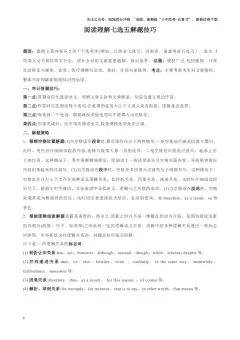
专题 02 主旨题
策略分析
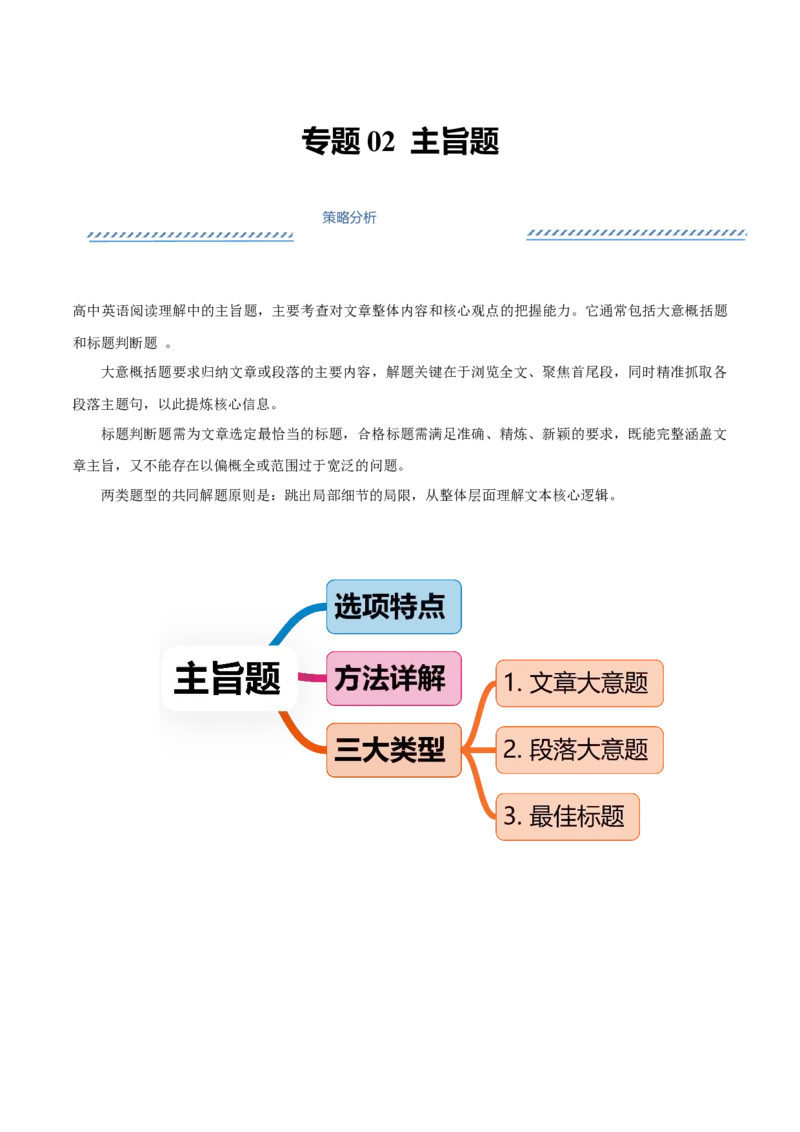
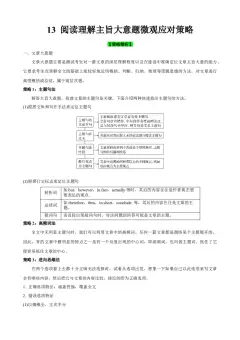
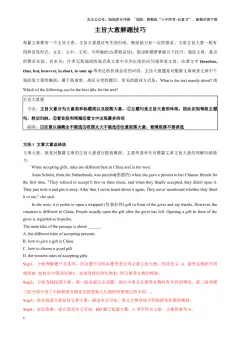
高中英语阅读理解中的主旨题,主要考查对文章整体内容和核心观点的把握能力。它通常包括大意概括题
和标题判断题 。
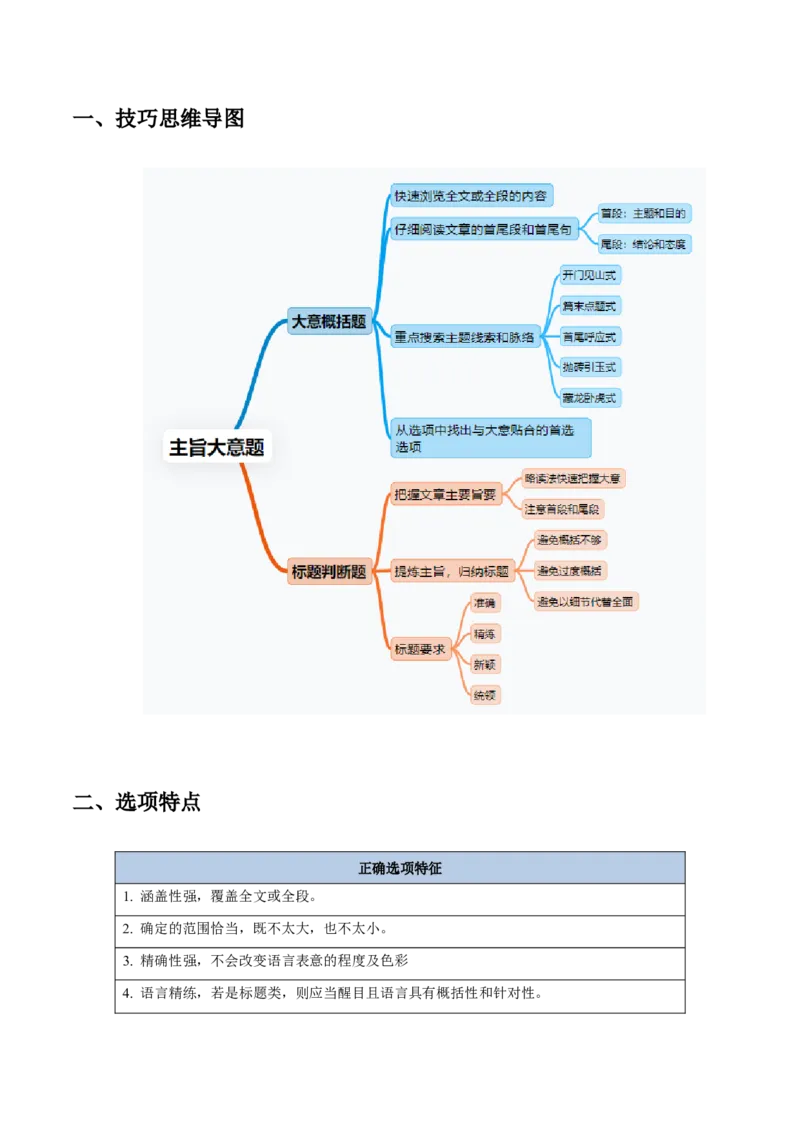
大意概括题要求归纳文章或段落的主要内容,解题关键在于浏览全文、聚焦首尾段,同时精准抓取各
段落主题句,以此提炼核心信息。
标题判断题需为文章选定最恰当的标题,合格标题需满足准确、精炼、新颖的要求,既能完整涵盖文
章主旨,又不能存在以偏概全或范围过于宽泛的问题。
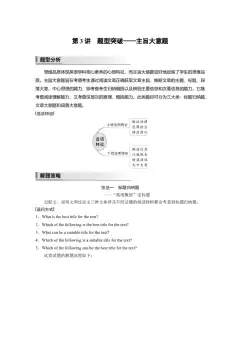
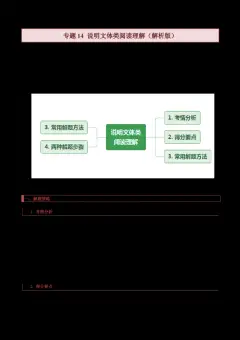
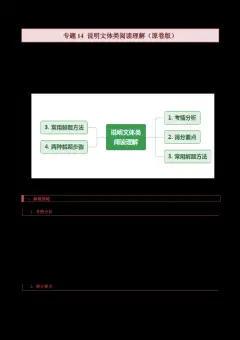
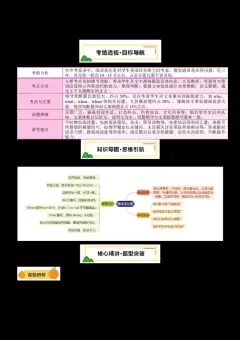
两类题型的共同解题原则是:跳出局部细节的局限,从整体层面理解文本核心逻辑。一、技巧思维导图
二、选项特点
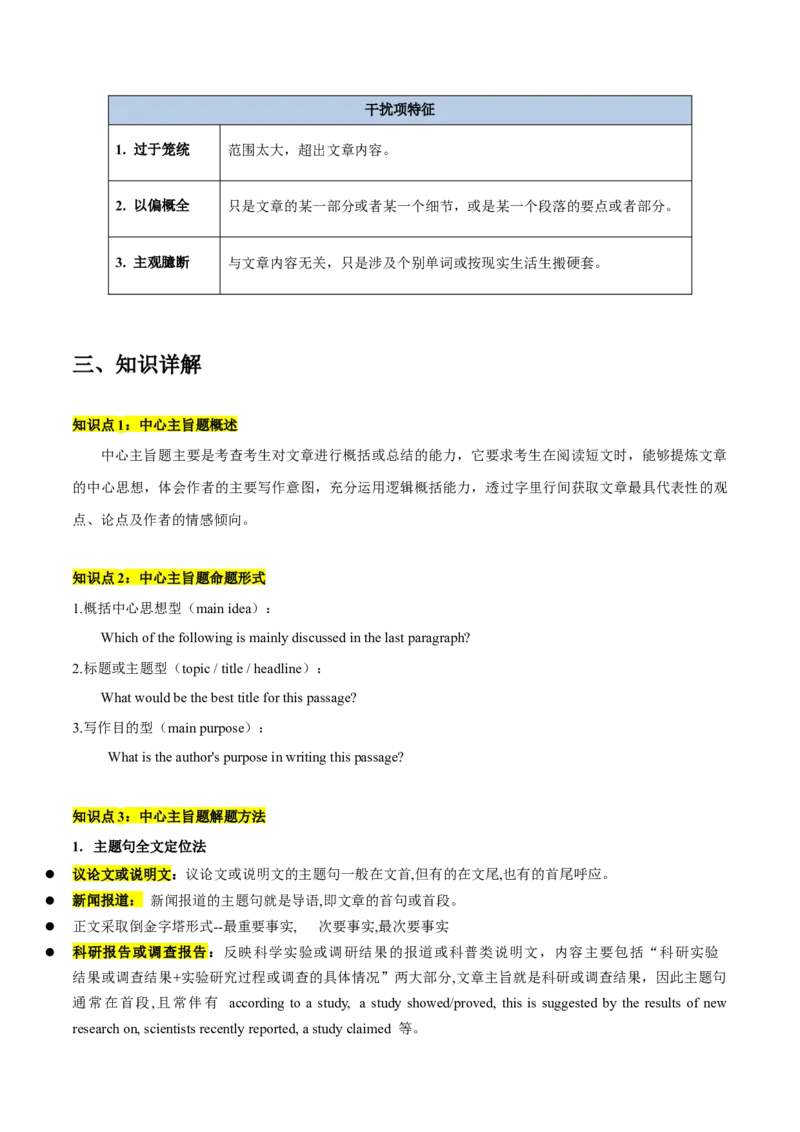
正确选项特征
1. 涵盖性强,覆盖全文或全段。
2. 确定的范围恰当,既不太大,也不太小。
3. 精确性强,不会改变语言表意的程度及色彩
4. 语言精练,若是标题类,则应当醒目且语言具有概括性和针对性。干扰项特征
1. 过于笼统 范围太大,超出文章内容。
2. 以偏概全 只是文章的某一部分或者某一个细节,或是某一个段落的要点或者部分。
3. 主观臆断 与文章内容无关,只是涉及个别单词或按现实生活生搬硬套。
三、知识详解
知识点1:中心主旨题概述
中心主旨题主要是考查考生对文章进行概括或总结的能力,它要求考生在阅读短文时,能够提炼文章
的中心思想,体会作者的主要写作意图,充分运用逻辑概括能力,透过字里行间获取文章最具代表性的观
点、论点及作者的情感倾向。
知识点2:中心主旨题命题形式
1.概括中心思想型(main idea):
Which of the following is mainly discussed in the last paragraph?
2.标题或主题型(topic / title / headline):
What would be the best title for this passage?
3.写作目的型(main purpose):
What is the author's purpose in writing this passage?
知识点3:中心主旨题解题方法
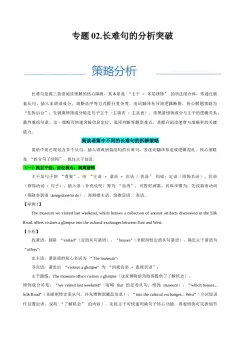
1. 主题句全文定位法
议论文或说明文:议论文或说明文的主题句一般在文首,但有的在文尾,也有的首尾呼应。
新闻报道: 新闻报道的主题句就是导语,即文章的首句或首段。
正文采取倒金字塔形式--最重要事实, 次要事实,最次要事实
科研报告或调查报告:反映科学实验或调研结果的报道或科普类说明文,内容主要包括“科研实验
结果或调查结果+实验研究过程或调查的具体情况”两大部分,文章主旨就是科研或调查结果,因此主题句
通常在首段,且常伴有 according to a study, a study showed/proved, this is suggested by the results of new
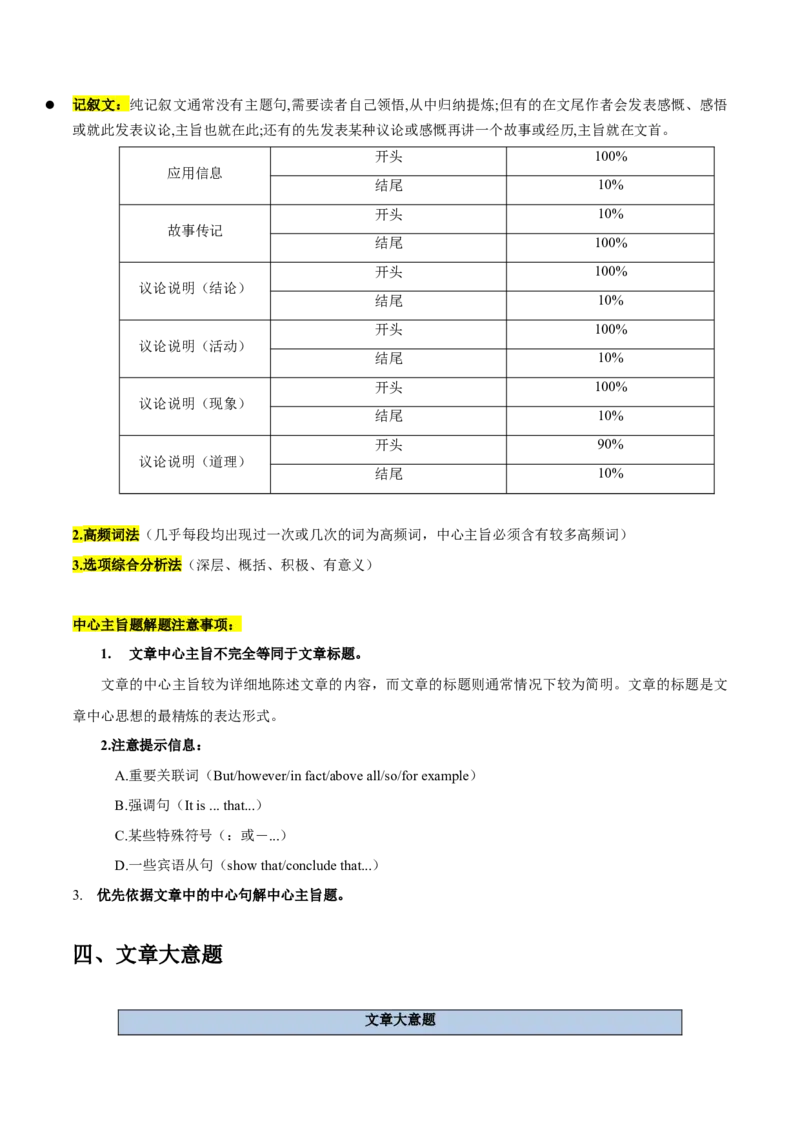
research on, scientists recently reported, a study claimed 等。 记叙文:纯记叙文通常没有主题句,需要读者自己领悟,从中归纳提炼;但有的在文尾作者会发表感慨、感悟
或就此发表议论,主旨也就在此;还有的先发表某种议论或感慨再讲一个故事或经历,主旨就在文首。
开头 100%
应用信息
结尾 10%
开头 10%
故事传记
结尾 100%
开头 100%
议论说明(结论)
结尾 10%
开头 100%
议论说明(活动)
结尾 10%
开头 100%
议论说明(现象)
结尾 10%
开头 90%
议论说明(道理)
结尾 10%
2.高频词法(几乎每段均出现过一次或几次的词为高频词,中心主旨必须含有较多高频词)
3.选项综合分析法(深层、概括、积极、有意义)
中心主旨题解题注意事项:
1. 文章中心主旨不完全等同于文章标题。
文章的中心主旨较为详细地陈述文章的内容,而文章的标题则通常情况下较为简明。文章的标题是文
章中心思想的最精炼的表达形式。
2.注意提示信息:
A.重要关联词(But/however/in fact/above all/so/for example)
B.强调句(It is ... that...)
C.某些特殊符号(:或―...)
D.一些宾语从句(show that/conclude that...)
3. 优先依据文章中的中心句解中心主旨题。
四、文章大意题
文章大意题借助各段段落主题句归纳 段首;段中;段尾
首段(新闻报道、说明文、议论文);尾段(记叙文、议论
借助文章主题段进行归纳 文)
借助主题词或关键句归纳 文中出现频率较高的关键词进行归纳,多为主题词
根据位置确定主题句:
1. 主题句在文首
文章开门见山,给出了主题句,随之用细节对其进行解释、支撑。作者在首段常常亮出观点、表明立
场。大多数文章的主题句就是文章的首句,所以要认真阅读文章首句。
2. 主题句在文末
有的主题句放在文章的末尾,先摆出事实细节,最后总结, 从而形成强有力的结论, 要求考生耐心地读
完全文。
有时主题句首尾呼应,开篇先提出主题,结尾再次升华主题。
3. 主题句在文中或隐含
主题句在段中间或隐含在文中, 让读者很难发现, 这种情况难度较大,考生要通观全文,分清主旨细节,进
行归纳推理。最后概括出来的中心意思一定要涵盖全文或整个段落,切忌以偏概全或离题太远、太笼统。解
答此类题时考生需要把握作者的观点、态度、语气等,分析文章的篇章结构,抓住文章开头的主题句或文章
最后的结论,捕捉与题目有关的信息,从而找出能概括文章主旨的题目和中心思想。
【真题典例1】 2024年6月新课标全国Ⅱ卷C
We all know fresh is best when it comes to food. However, most produce at the store went through weeks of
travel and covered hundreds of miles before reaching the table. While farmer’s markets are a solid choice to reduce
the journey, Babylon Micro-Farm (BMF) shortens it even more.
BMF is an indoor garden system. It can be set up for a family. Additionally, it could serve a larger audience
such as a hospital, restaurant or school. The innovative design requires little effort to achieve a reliable weekly
supply of fresh greens.
Specifically, it’s a farm that relies on new technology. By connecting through the Cloud, BMF is remotely
monitored. Also, there is a convenient app that provides growing data in real time. Because the system is
automated, it significantly reduces the amount of water needed to grow plants. Rather than watering rows of soil,
the system provides just the right amount to each plant. After harvest, users simply replace the plants with a new
pre-seeded pod (容器) to get the next growth cycle started.
Moreover, having a system in the same building where it’s eaten means zero emissions (排放) from
transporting plants from soil to salad. In addition, there’s no need for pesticides and other chemicals that pollute
traditional farms and the surrounding environment.BMF employees live out sustainability in their everyday lives. About half of them walk or bike to work. Inside
the office, they encourage recycling and waste reduction by limiting garbage cans and avoiding single-use plastic.
“We are passionate about reducing waste, carbon and chemicals in our environment,” said a BMF employee.
11. What does the text mainly talk about?
A. BMF’s major strengths. B. BMF’s general management.
C. BMF’s global influence. D. BMF’s technical standards.
五、段落大意题
通过结构或暗示概括段落大意:
1.根据逻辑结构概括段落大意:要准确概括段落大意,务必知道该段落的逻辑结构。如该段为总分顺
序组织,则主题句在段首;如该段为分总顺序组织,则主题句在段尾;如该段为分总分顺序组织,则主题
句在段中;如该段对比各事物,则其异同点即为该段大意。一个主题句常常是一个段落的开头,其后是论证
性细节。在说明文、论述文或新闻报道中多采用这种形式
2.通过暗示揣摩段落大意:有时,作者不直接写出主题句,而是通过情感态度等方法暗示性地体现主
题,此时要根据文中所叙述的事实和线索综合判断去揣摩并概括出段落大意。
【真题典例】2025年6月新高考2卷D篇
It should be noted that none of the items on wastED’s menu was technically made from garbage. Instead, all
the ingredients (配料) used were examples of meat cuts and produce that most restaurants would never consider
serving. Things like kale ribs, fish collars, rejected sweet potatoes, and cucumber butts were all re-appropriated and,
with the help of a number of good chefs, turned into excellent cuisine.
14. What is paragraph 5 mainly about?
A. Why the ingredients were used. B. Which dishes were best liked.
C. What the dishes were made of. D. Where the ingredients were bought.
六、最佳标题
三大方法定标题
1. 最佳标题应具备以下三大特征:
① 概括--准确而又简短;
② 针对性--标题外延正好与文章内容相符;
③ 题目--能引发读者的阅读欲望。三大方法:
① 正面肯定法:在理解文章主旨的基础上,揣摩哪个选项能准确概括主旨;
② 反面否定法:撇开原文,设想各选项写出来应是什么样的文章,然后和原文比对,逐一排除不符
项;
③ 研读备选项:认真研读备选项里的中心词、结构、概括性、修饰词的变化,查看与中心思想是否
相符。
【真题典例】2025年6月新高考2卷C篇
When Sonja Detrinidad opened her online shop selling houseplants, she didn’t have high hopes for it. But the
opposite happened: She was flooded, shipping out 1,200 orders in June of 2020 alone. In the past year, Detrinidad
sent out more than 70,000 plants. Her success is just one example of increased time at home leading to an explosion
in the houseplant industry.
“Plants are in fashion right now,” says Dr. Melinda Knuth, a researcher from the University of Florida.
“People who live in plant-rich environments report a higher life satisfaction rating, ” she says. “Adding more nature
to our environment can change our mood and how we think.” Plants can improve our state of mind in a few ways
but the biggest is by decreasing our level of cortisol, the stress hormone (激素) in our body.
“Students who are around plants perform better academically than students who are in a classroom without
plants,” says Knuth. “This productivity also translates into the workplace for adults. Our study showed that there
was a 30% decrease in sick leave for people who were in plant-rich workplaces.”
If you’re among the groups of people who are enjoying the mental and physical health benefits of surrounding
yourself with plants, don’t beat yourself up if one (or a few!) doesn’t make it. “Doctors practice medicine and
lawyers practice law and you should allow yourself the practice it takes to sustain a plant. Tending to plants is an
exercise in patience and learning. Be invested in taking care of it, but if it dies, go get another one,” Detrinidad
says.
11. What can be a suitable title for the text?
A. Time to Replace Houseplants B. Plants Boost Your Mood
C. Tips on Choosing Houseplants D. Plants Brighten Your Home
真题演练
1. 2025年6月新高考1卷B篇
In my ninth-grade writing class last year, I met a cowboy who saved his town, a strict father who demandedhis son earn straight A’s, and a modern-day Juliet who died of heartbreak after her parents rejected the love of her
young life. More than once, I found myself wondering just how my students, who’d created these people, knew
their subjects so well.
But things were different for their first essay, which was about the question: “Why is writing important?” Most
of the essays filled less than one page, and few contained a sentence that could be interpreted as a thesis (论点)
statement. I was shocked. Then I realized that the problem was the question itself. They could have written pages
on the necessity of computers, but writing, in and of itself, simply didn’t strike them as important. This would have
to change.
As a new unit started, I asked everyone to write a persuasive piece on a health-related topic of their choice.
This time they found the exercise much more interesting. For the next two assignments, a personal-narrative unit
followed by a creative-writing workshop, I only required that the piece meet the specifications of its genre (体裁)
and that it contain a thesis. The results were staggering. The students took on diverse topics and turned in stories,
10 to 20 pages each, with characters that broadened my view and touched my heart.
,
I walked into class believing that writing is important as a means of communication. However my students
demonstrated something more important to me. When the final bell rang in June, I walked away with a yearbook
full of messages about writing’s most powerful significance — the ability to connect people, to put us in another’s
skin, to teach us what it means to be human.
7. What does the author’s experience show?
A. Teaching is learning. B. Still waters run deep.
C. Knowledge is power. D. Practice makes perfect.
2. 2025年6月新高考1卷C篇
While safety improvements might have been made to our streets in recent years, transport studies also show
declines in pedestrian (行人) mobility, especially among young children. Many parents say there’s too much traffic
on the roads for their children to walk safely to school, so they pack them into the car instead.
Dutch authors Thalia Verkade and Marco te Brömmelstroet are bothered by facts like these. In their new book
Movement: How to Take Back Our Streets and Transform Our Lives, they call for a rethink of our streets and the
role they play in our lives.
Life on city streets started to change decades ago. Whole neighbourhoods were destroyed to make way for
new road networks and kids had to play elsewhere. Some communities fought back. Most famously, a Canadianjournalist who had moved her family to Manhattan in the early 1950s led a campaign to stop the destruction of her
local park. Describing her alarm at its proposed replacement with an expressway, Jane Jacobs called on her mayor
(市长) to champion “New York as a decent place to live, and not just rush through.” Similar campaigns occurred in
Australia in the late 1960s and 1970s as well.
Although these campaigns were widespread, the reality is that the majority of the western cities were
completely redesigned around the needs of the motor car. The number of cars on roads has been increasing rapidly.
In Australia we now have over twenty million cars for just over twenty-six million people, among the highest rate
of car ownership in the world.
We invest a lot in roads that help us rush through, but we fail to account for the true costs. Do we really
recognise what it costs us as a society when children can’t move safely around our communities? The authors of
Movement have it right: it’s time to think differently about that street outside your front door.
11. What can be a suitable title for the text?
A. Why the Rush? B. What’s Next? C. Where to Stay? D. Who to Blame?
3. 2025年6月新高考2卷C篇
When Sonja Detrinidad opened her online shop selling houseplants, she didn’t have high hopes for it. But the
opposite happened: She was flooded, shipping out 1,200 orders in June of 2020 alone. In the past year, Detrinidad
sent out more than 70,000 plants. Her success is just one example of increased time at home leading to an explosion
in the houseplant industry.
“Plants are in fashion right now,” says Dr. Melinda Knuth, a researcher from the University of Florida.
“People who live in plant-rich environments report a higher life satisfaction rating, ” she says. “Adding more nature
to our environment can change our mood and how we think.” Plants can improve our state of mind in a few ways
but the biggest is by decreasing our level of cortisol, the stress hormone (激素) in our body.
“Students who are around plants perform better academically than students who are in a classroom without
plants,” says Knuth. “This productivity also translates into the workplace for adults. Our study showed that there
was a 30% decrease in sick leave for people who were in plant-rich workplaces.”
If you’re among the groups of people who are enjoying the mental and physical health benefits of surrounding
yourself with plants, don’t beat yourself up if one (or a few!) doesn’t make it. “Doctors practice medicine and
lawyers practice law and you should allow yourself the practice it takes to sustain a plant. Tending to plants is an
exercise in patience and learning. Be invested in taking care of it, but if it dies, go get another one,” Detrinidadsays.
11. What can be a suitable title for the text?
A. Time to Replace Houseplants B. Plants Boost Your Mood
C. Tips on Choosing Houseplants D. Plants Brighten Your Home
4. 2025年6月新高考2卷D篇
It should be noted that none of the items on wastED’s menu was technically made from garbage. Instead, all
the ingredients (配料) used were examples of meat cuts and produce that most restaurants would never consider
serving. Things like kale ribs, fish collars, rejected sweet potatoes, and cucumber butts were all re-appropriated and,
with the help of a number of good chefs, turned into excellent cuisine.
14. What is paragraph 5 mainly about?
A. Why the ingredients were used. B. Which dishes were best liked.
C. What the dishes were made of. D. Where the ingredients were bought.
5. 2025年6月北京卷B篇
Throughout our Junior year, my classmates and I have been worried about what colleges will see when they
look at our whole life story reduced to a single 200-word essay. Will the golden word “success” form in their minds
when they review our achievements? Or will they see the big word “fail” in red? The shadow of this mysterious (神
秘的) institution steals away what success means to us.
My first step of redefining success began with course registrations. It is a well-known fact, especially in my
school, that Junior year is the time of packing many AP classes into the schedule. When asked why they chose so
many AP classes, my friends responded: “I don’t know.” They themselves don’t know why they are following the
crowd and longing for the pressures of academic difficulty. Therefore, they do not feel the satisfaction of being
academically challenged.
Completing many courses no longer brings out the feeling of success because more than four AP classes per
year is a norm set by top universities. Determined to follow my instincts (本能) on what I felt success means, I only
chose two classes that I knew I would enjoy. The feeling of success was no longer attached to what grade I received
but to the pure joy of learning.
Even my failures are attached to a feeling of success; after I take a step back and look at the big picture, I see
them as a launching pad (平台) for my next big achievement. In the ninth grade, I went in for my first groupinterview for a leadership position as a shy girl. Not standing a chance against competitive applicants, I came out of
the interview with an upset look. Nevertheless, this interview wasn’t a wasted opportunity. I talked to one of the
senior applicants who answered questions in a way that reflected the faith she had in herself.
This year, with an open mind and new knowledge in mind, I walked into another group interview while telling
myself I was that cool senior. I managed to secure a leadership position. Ultimately, success came little by little.
27. What can we learn from this passage?
A. Everyone is the maker of their own success.
B. Success favours those with a golden heart.
C. Success knocks at your door only once.
D. A college holds the key to success.
C
Not too long ago, on a cold winter night, there was a teenager who wanted more screen time and a parent who
said no. The teenager was advocating for her right to scroll (翻屏) for an extra 30 minutes. The parent argued that
none of her friends’ parents let them have screens after 9 o’clock. “I thought, in this family, we don’t compare
ourselves with other people, Dad?” the teenager replied. The parent — who was me, by the way — just got served.
Since they were young, I have told my kids not to compare themselves with other people. I have argued countless
times that comparisons are the “thief of joy”.
Although my daughter didn’t win, she did help expose one of the worst pieces of advice I have ever given. In
my defence, I did what we’ve all done before, which is repeat received wisdom without exploring the nuances. But
now is the time to set the record straight, which starts with questioning the idea that all social comparison is
unhealthy.
Social comparisons do, of course, often get us into emotional trouble. But they can be harnessed (利用) for our
betterment if we understand how they work. The social comparisons we make — ones that lead us to feel good or
bad about ourselves — are vital to our ability to thrive (成长). Science provides a guide we can use to harness the
way we perform these comparisons to reduce their negative emotional impacts.
Comparing yourself with someone who is outperforming you could result in feelings of envy if you focus on
the things they have and you don’t, or it can be energizing and inspiring if you use these comparisons as a source of
motivation, for example, “If they can achieve that, so can I.” Comparing yourself with someone who is doing worse
than you could result in fear and worry if you think about how you could fall into similar circumstances, or it can
draw out feelings of gratitude and appreciation if you use that comparison to broaden your views — for example,“Wow, things could be much worse; I’m doing great.”
What I wish I taught my daughter earlier are these nuances. How we feel about ourselves rests not just on
whom we compare ourselves with but also on how we think about that comparison. That’s something we all have
control over.
30. Which would be the best title for the passage?
A. Comparing Ourselves with Others Can Become a Healthy Habit
B. Comparing Ourselves with Others Can Strengthen Family Ties
C. Social Comparisons Can Get Us into Emotional Trouble
D. Social Comparisons Can Be Controlled by Science
D
The call to “know yourself” has been there since ancient times, but our sense of self doesn’t always match
what others perceive. Considering the stories we tell about ourselves can help us to change our minds for better.
For many years, psychologists saw identity as a combination of someone’s values, beliefs, goals and social
roles. Then, in the 1980s, Bob Johnson created the life story model of identity, in which he proposes that, as we go
through life, these core features are built in with our memories to create a personal story through which we
understand our lives.
Our life story is something that starts coming together in our teenage years, when we begin to organise our
lives into chapters around key events or life changes, and begin to see ourselves as both the central character and, to
a varying extent, the story’s author. People with more consistent stories tend to have a stronger sense of identity,
and they feel their life has more meaning, direction and sense of purpose. Such people show greater overall life
satisfaction, too.
Johnson has also investigated the link between well-being and certain story themes. He discovered that
whether someone describes having had some control over events in their past is an important predictor of a person’s
mental health. Another key theme involves finding some kind of positive meaning after stressful events. “People
could talk about gaining knowledge or personal growth,” says Johnson. His research shows that this is often
missing for people with mental health conditions. The good news is that there is evidence we can learn to change
our own story.
Lisa Green, another researcher, sounds a few notes of caution (谨慎). For instance, hearing about the power of
redemptive (拯救性的) stories, many people may feel forced to find a positive angle on horrible events. She says
that Western culture already pushes people to look for the silver lining behind every cloud.If you want to turn over a new leaf, though, one top tip is that it helps to choose a significant date that signals
the start of a new “chapter”. Contrary to popular doubt, resolutions made on I January are more effective for this
reason. So, whether your goal is saving money or getting fit, there is no better time to become the author of our
own destiny (命运).
34. What is the passage mainly about?
A. How self-identity works. B. How story-tellers are made.
C. How personal stories raise doubts. D. How timing affects personal identity.
6. 2025年1月浙江卷C
A novel design approach to gardening has been gaining in popularity worldwide. Referred to as matrix
planting, this approach aims for nature to do a lot more of the heavy lifting in the garden, and even some of the
designing. Eschewing fertilizers(化肥) and power tools, it’s based on an elegantly simple principle: to garden
more like nature does.
The concept was born when German city planners sought to plant large areas of parkland after World War II in
a reproducible way that would need minimal maintenance. Planners created planting mixes that could be used
modularly (模块化). In a matrix garden, plants with similar cultural needs are grouped so that they will grow
together above and below ground, forming a cooperative ecosystem that conserves water and discourages weeds.
Dutch plantsman and designer Piet Oudolf’s gardens popularized this style, adding artistic flavors to the
planting mixes while playing with color and form, including four-season interest and serving the needs of wildlife.
Beautiful year-round, they invite you to enjoy the smallest detail, from the sound of grasses in the gentle wind to
the sculpture of odd-looking seed heads.
It takes a lot of thought to look this natural. While matrix gardens appear wild, they are carefully planned, with
cultural needs the first consideration. Led by the concept of “right plant, right place,” they match plants that enjoy
the same soil, sun and weather conditions, and arrange them according to their patterns of growth.
The benefits are substantial for both gardener and planet. With human inputs dramatically reduced, the
garden’s ecology can develop well. Established matrix gardens should not need the life support we give most
gardens: fertilizer, dividing, regular watering. Compared to traditional garden plots, they increase carbon
absorption, reduce stormwater runoff and boost habitat and biodiversity significantly.
31. Which of the following can be a suitable title for the text?
A. The future of gardening is WILD B. Nature treats all lives as EQUALSC. Matrix gardens need more CARE D. Old garden plots work WONDERS
7. 2024年6月新课标全国Ⅰ卷B
“I am not crazy,” says Dr. William Farber, shortly after performing acupuncture (针灸) on a rabbit. “I am
ahead of my time.” If he seems a little defensive, it might be because even some of his coworkers occasionally
laugh at his unusual methods. But Farber is certain he’ll have the last laugh. He’s one of a small but growing
number of American veterinarians (兽医) now practicing “holistic” medicine-combining traditional Western
treatments with acupuncture, chiropractic (按摩疗法) and herbal medicine.
Farber, a graduate of Colorado State University, started out as a more conventional veterinarian. He became
interested in alternative treatments 20 years ago when he suffered from terrible back pain. He tried muscle-relaxing
drugs but found little relief. Then he tried acupuncture, an ancient Chinese practice, and was amazed that he
improved after two or three treatments. What worked on a veterinarian seemed likely to work on his patients. So,
after studying the techniques for a couple of years, he began offering them to pets.
Leigh Tindale’s dog Charlie had a serious heart condition. After Charlie had a heart attack, Tindale says, she
was prepared to put him to sleep, but Farber’s treatments eased her dog’s suffering so much that she was able to
keep him alive for an additional five months. And Priscilla Dewing reports that her horse, Nappy, “moves more
easily and rides more comfortably” after a chiropractic adjustment.
Farber is certain that the holistic approach will grow more popular with time, and if the past is any indication,
he may be right: Since 1982, membership in the American Holistic Veterinary Medical Association has grown from
30 to over 700. “Sometimes it surprises me that it works so well,” he says. “I will do anything to help an animal.
That’s my job.”
26. What does paragraph 3 mainly talk about?
A. Steps of a chiropractic treatment.
B. The complexity of veterinarians’ work.
C. Examples of rare animal diseases.
D. The effectiveness of holistic medicine.
8. 2024年6月新课标全国Ⅱ卷C
We all know fresh is best when it comes to food. However, most produce at the store went through weeks of
travel and covered hundreds of miles before reaching the table. While farmer’s markets are a solid choice to reducethe journey, Babylon Micro-Farm (BMF) shortens it even more.
BMF is an indoor garden system. It can be set up for a family. Additionally, it could serve a larger audience
such as a hospital, restaurant or school. The innovative design requires little effort to achieve a reliable weekly
supply of fresh greens.
Specifically, it’s a farm that relies on new technology. By connecting through the Cloud, BMF is remotely
monitored. Also, there is a convenient app that provides growing data in real time. Because the system is
automated, it significantly reduces the amount of water needed to grow plants. Rather than watering rows of soil,
the system provides just the right amount to each plant. After harvest, users simply replace the plants with a new
pre-seeded pod (容器) to get the next growth cycle started.
Moreover, having a system in the same building where it’s eaten means zero emissions (排放) from
transporting plants from soil to salad. In addition, there’s no need for pesticides and other chemicals that pollute
traditional farms and the surrounding environment.
BMF employees live out sustainability in their everyday lives. About half of them walk or bike to work. Inside
the office, they encourage recycling and waste reduction by limiting garbage cans and avoiding single-use plastic.
“We are passionate about reducing waste, carbon and chemicals in our environment,” said a BMF employee.
11. What does the text mainly talk about?
A. BMF’s major strengths. B. BMF’s general management.
C. BMF’s global influence. D. BMF’s technical standards.
9. 2024年6月新课标全国甲卷B
Animals can express their needs using a lot of ways. For instance, almost all animals have distinct vocals (声
音) that they rely on to either ask for help, scare away any dangerous animals or look for shelter. But cats are
special creatures who possess amazing vocalization skills. They are able to have entire conversations with humans
using meows and you're able to interpret it. If a pet cat is hungry, it will keep meowing to attract attention and find
food. However, when a cat is looking for affection, they tend to produce stretched and soft meows. Meowing starts
as soon as a baby cat is brought to life and uses it to get the mother's attention and be fed.
Cats have many heightened senses, but their sense of smell is quite impressive. They use their noses to assess
their environment and look out for any signs of danger. They will sniff out specific areas before they choose a place
to relax. However, another way the cats are able to distinguish between situations is by looking for familiar smells.
Your cat will likely smell your face and store the smell in its memory and use it to recognize you in the future.That's why most pet cats are able to tell immediately if their owners were around any other cats, which they don't
usually like.
Dogs are known for their impressive fetching habit, but cats take this behavior up a notch. Many cats will find
random objects outside and bring them to their owners. This is a very old habit that's been present in all kinds of
predators (食肉动物). Cats bring gifts for their owners to show they love you. These adorable little hunters are just
doing something that it's been in their nature since the beginning of time. So just go along with it!
7. What is a suitable title for the text?
A. Tips on Finding a Smart Cat B. Understanding Your Cat's Behavior
C. Have Fun with Your Cat D. How to Keep Your Cat Healthy
10. 2024年6月北京卷D
Franz Boas’s description of Inuit (因纽特人) life in the 19th century illustrates the probable moral code of
early humans. Here, norms (规范) were unwritten and rarely expressed clearly, but were well understood and taken
to heart. Dishonest and violent behaviours were disapproved of; leadership, marriage and interactions with other
groups were loosely governed by traditions. Conflict was often resolved in musical battles. Because arguing angrily
leads to chaos, it was strongly discouraged. With life in the unforgiving Northern Canada being so demanding, the
Inuit’s practical approach to morality made good sense.
The similarity of moral virtues across cultures is striking, even though the relative ranking of the virtues may
vary with a social group’s history and environment. Typically, cruelty and cheating are discouraged, while
cooperation, humbleness and courage are praised. These universal norms far pre-date the concept of any moralising
religion or written law. Instead, they are rooted in the similarity of basic human needs and our shared mechanisms
for learning and problem solving. Our social instincts (本能) include the intense desire to belong. The approval of
others is rewarding, while their disapproval is strongly disliked. These social emotions prepare our brains to shape
our behaviour according to the norms and values of our family and our community. More generally, social instincts
motivate us to learn how to behave in a socially complex world.
The mechanism involves a repurposed reward system originally used to develop habits important for self-care.
Our brains use the system to acquire behavioural patterns regarding safe routes home, efficient food gathering and
dangers to avoid. Good habits save time, energy and sometimes your life. Good social habits do something similar
in a social context. We learn to tell the truth, even when lying is self-serving; we help a grandparent even when it is
inconvenient. We acquire what we call a sense of right and wrong.Social benefits are accompanied by social demands: we must get along, but not put up with too much. Hence
self-discipline is advantageous. In humans, a greatly enlarged brain boosts self-control, just as it boosts problem-
solving skills in the social as well as the physical world. These abilities are strengthened by our capacity for
language, which allows social practices to develop in extremely unobvious ways.
34. Which would be the best title for this passage?
A. Virtues: Bridges Across Cultures B. The Values of Self-discipline
.
C Brains: Walls Against Chaos D. The Roots of Morality
押题演练
1.
The future of space food could be simple and strange. For decades, astronauts have relied mostly on
prepackaged food or the occasional grown vegetables during their visits to outer space. With missions beyond
Earth’s orbit in sight, a NASA led competition is hoping to change all that and start a new era of sustainable space
food.
To solve the problem of feeding astronauts on long duration missions, the US space agency started the Deep
Space Food Challenge in January 2022, asking companies to propose novel ways to develop sustainable foods for
future missions. About 200 companies entered, which were narrowed down to 11 teams in January 2023 as part of
phase 2. On November 19, NASA announced the teams that will progress into the final phase of the competition,
with some winners to be announced in March, 2025.
All teams had to show systems that could operate for three years and feed a crew of four on a future space
mission. The proposals did not need to supply a crew’s entire diet, but they did need to create a variety of nutritious
foods to the astronauts.
One company took an incredibly unusual approach to the task. Air Company, based in New York, designed a
system that could use the carbon dioxide breathed out by astronauts in space to produce alcohol, which can then be
fed to yeast (酵母) and produce “something that’s suitable for eating”. “It’s making food out of the air.” says
Stafford Sheehan, co-founder and chief technology officer of Air Company, “It sounds like magic, but when you
see it actually operating, it’s much more simple.”
Interstellar Lab in Florida had a different approach. Its system, called NUCLEUS, is a set of small capsules.
Each is self-contained, with its own temperature, watering system, etc. That would allow different vegetables to beplanted so that astronauts can easily grow their own food in space.
While the winning ideas from the Deep Space Food Challenge won’t immediately be used by astronauts,
they show what might be possible on future missions. “You’ve got to start years in advance to make sure you have
the capability in place when you need it,” says Ralph Fritsche, senior project manager for space crop production at
NASA’s Kennedy Space Center in Florida.
1.Why was the Deep Space Food Challenge launched?
A.To find tasty foods for astronauts.
B.To found a space food supply center.
C.To develop a new source of space food.
D.To attract astronauts to food exploration.
2.Which might be the requirement to become the winning company?
A.Future space missions lasting three years.
B.Entire diets for long-lasting space research.
C.Concrete proposals involving a crew of four.
D.Sustainable supply of nutritious space foods.
3.What do paragraphs 4 and 5 focus on?
A.Describing future space food.
B.Showing solutions from competing companies.
C.Introducing the current status of space food.
D.Explaining the nutritional needs of space food.
4.What is the most suitable title for the text?
A.Astronauts produce more space food.
B.Space explorers face a lack of nutrition.
C.New types of space foods are on the way.
D.Future space missions last even longer.
2.
A global study comparing 2,062 birds finds that, in highly variable environments, birds tend to have either
larger or smaller brains relative to their body size. Birds with smaller brains tend to use ecological strategies that
are not available to big-brained ones. “The fact is that there are a great many species that do quite well with
small brains,” said Trevor Fristoe, first author of the study from Washington University.Previous studies had found general trends toward larger relative brain sizes at higher latitudes (纬度), where
conditions are more variable. This new study is different because it looks at the full distribution of brain sizes
across environments, allowing the researchers to test whether different sizes are over-or under-represented. They
found that at higher latitudes, bird brains are significantly more likely to be either relatively large or relatively small
compared to body size.
What was going on here? Fristoe, born in Alaska, had a few ideas. He suggests that the Alaska state bird, the
ptarmigan (雷鸟), might be a typical example of the small-brained species. Lovable though it is, it’s not exactly
known for its smarts. The ptarmigan can, however, feed on branches and willow leaves.
“We find that small-brained species in these environments employ strategies that are unachievable with a
large brain. These species are able to live on readily available but difficult to digest resources such as needles of
conifers (针叶树), or even branches. These foods can be found even during extreme winter conditions, but they are
fibrous and require a large gut (肠道) to digest,” Fristoe said. “Gut tissue, like brain tissue, is energetically
demanding, and limited budgets mean that it is challenging to maintain a lot of both.”
“Brains are not evolving separately — they are part of a broader suite of adaptations that help creatures
succeed in their lives,” said Carlos Botero, assistant professor of biology and co-author of the study. “Biologists,
ourselves included, have historically believed that environmental variability drives the expansion of brain size. But
when we take a broader view, we realize that other strategies also work — and remarkably, the alternative here
involves making a brain actually smaller!”
1.How does Fristoe’ s research differ from previous studies?
A.It arrives at a conflicting conclusion. B.It focuses on birds with smaller brains.
C.It covers a wider range of brain sizes. D.It reveals birds’ evolving processes.
2.What do we know about the ptarmigan?
A.It is considered fairly intelligent. B.It has a powerful digesting system.
C.It has a relatively large body size. D.It has a selective feeding habit.
3.What can be inferred about smaller brains from Botero’s words?
A.They are typical of independent evolution. B.They are a result of limited budgets.
C.They are not for variable environments. D.They are an effective survival strategy.
4.what can be a suitable title for the text?
A.The Smaller the Brain, the Smarter B.Big Brains: Adapt to Higher Latitudes
C.Big Brains or Big Guts: Choose One D.Evolutions of Brain Size in Birds3.
Scientists have been looking at DNA to store all types of data, not just biological, but also digital. Yet while
DNA is a great storage material, it’s also quite delicate. Water or heat can damage it easily unless it’s given an
amber-like (似琥珀) coating. That new idea was borrowed from the 1993movie Jurassic Park, in which scientists
cloned dinosaurs from DNA trapped in amber.
DNA is the world’s oldest data storage device. The most amazing thing about DNA is that it can potentially
be used to store any type of data. Putting information into DNA uses a process called encoding. “Your computer
stores information in a binary format (二进制), zeroes and ones,” notes Karishma Matange, a computational
biologist. “Encoding works to change these zeroes and ones into A, C, G and T, the DNA bases that can store
information.” The order of the bases in DNA is called sequence (序列), which spells out the information it holds.
To pull information back out from the DNA, you rewind the process.
Scientists can store DNA for long periods. But it requires freezing temperatures, special equipment and
dangerous chemicals, which makes the process costly. James Banal, a scientist in San Carlos, California, and his
team came up with a new method T-REX. His team uses this method to trap DNA in a material similar to plastic.
“Plastics are durable.” Banal points out. Besides, T-REX is a cheap alternative to enclose DNA.
To test it, the team encoded the Jurassic Park theme music and a person’s genome into DNA.Then they put
the DNA in the glassy plastic. Damp and heat are DNA’s biggest threats. But the T-REX material keeps damp out.
The researchers heated it up to 75° Celsius. Later, they got the DNA by breaking the coating down. The best part,
Banal says, is that the broken-down material can be reused to store DNA again.
Banal and his colleagues want to use the T-REX method to preserve genetic data or even safely store
biological samples that will be launched into space. And we might one day use it to store the massive amounts of
data people generate every day.
1.How is digital information stored into DNA?
A.By turning binary code into DNA bases.
B.By freezing the DNA at low temperatures.
C.By coating the DNA with amber material.
D.By sequencing DNA from ancient samples.
2.What is the main advantage of the T-REX method for DNA storage?
A.Breaking DNA down with chemicals.B.Offering cost-effective storage of DNA.
C.Helping DNA survive extreme wetness.
D.Withdrawing whole DNA from dinosaurs.
3.What will the DNA storage technology be used for in the future?
A.Cloning extinct dinosaurs. B.Reducing global plastic pollution.
C.Preserving diverse samples. D.Speeding future space exploration.
4.What’s the main idea of the text?
A.A breakthrough in DNA data storage technology.
B.How digital technology advances DNA analysis.
C.The biological applications of DNA repairing system.
D.How Jurassic Park inspired DNA preservation research.
4.
Food is key to our daily functions by fueling our activity and supporting our bodies and minds. In space,
where astronauts face extreme environmental and physical changes, the need for safe, nutritious and energy- laden
food is particularly vital to overall health.
Space food must provide enough energy to fuel astronauts on their demanding missions, according to
NASA.In microgravity (low gravity state that makes astronauts appear to be weightless) environments, proper
nutrition can fight against the resulting degradation of bones and muscles. For example, vitamins D, K and C aid in
synthesizing (合成) calcium into bone. Meanwhile, dietary supplements like iron, omega-3 fatty acids and B12 can
make up for dietary insufficiency.
After decades of nutritional studies and food technology advancements, NASA has moved focus away from
supplements and dietary formulas (配方) toward providing as many nutrients from fruits and vegetables as
possible. However, it can be difficult to rely heavily on fruits and vegetables as a space food source because they
don’t contain many calories. This poses an issue for spaceflight, where cargo (货物) room is precious.
NASA can’t merely consider health when designing space food, though. The nutritional value of a meal only
goes so far if it doesn’t appeal to astronauts. Rather, Grace Douglas, the lead scientist for NASA’s Advanced Food
Technology research group, and her colleagues aim to offer astronauts several meal. options to avoid menu fatigue
(疲劳). Such variety also provides psychological health benefits.“ Food becomes more important with mission
duration because it’s one of the only familiar things that they have, ” Douglas says.As space organizations look ahead to. long- duration missions, it will be key to craft a sustainable food
source that doesn’t require resupply missions. To achieve this, NASA scientists are studying the best ways to grow
crops in microgravity. On the International Space Station, astronauts have successfully grow n a variety of leafy
greens and flowers in the Vegetable Production System, known as Veggie. Eating a fresh leafy green could help
astronauts feel connected with the distant green planet they call home.
1.What is the second paragraph mainly about?
A.The importance of space food design. B.The challenges for astronauts in space.
C.The general requirements for space food.D.The impact of microgravity on astronauts.
2.How do Douglas’s team enhance astronauts’ dining experience?
A.They make food look appealing. B.They rearrange the menu schedule.
C.They provide multiple food choices. D.They conduct taste tests on astronauts.
3.What can astronauts expect from Veggie?
A.A supplement to the oxygen supply.
B.Supply of psychological comfort
C.Enhancement of the nutritional quality.
D.An improvement in communication with Earth.
4.What can be a suitable title for the text?
A.How do astronauts eat in space?
B.What makes space food so special?
C.What space food will we have in the future?
D.How do scientists build the best diet for astronauts?
5.
While conducting a workshop on creativity, I gave each small group a small box of paper clips (回形针). I
invited each group to record as many different uses for a paper clip as they could in five minutes. Obviously, these
third-grade student groups were able to generate multiple responses and the quality of those responses was all over
the map. Their creativity was in full swing.
We often have this belief that when faced with a creative challenge, we need to generate a really good idea
that will save the day. As a result, we focus on “the perfect idea” or “the best solution” without the necessity of
generating lots of bad ones along the way. Yet producing unworkable, impractical, and worthless ideas is a
necessary and essential part of the creative process.One of the classic books, one that goes against the grain of what most writing instruction books do, is the
incomparable Writing Down the Bones: Freeing the Writer Within by Natalie Goldberg. One of the finest pieces of
advice in the book is for writers and anyone trying to generate creative thoughts to give themselves permission to
create crappy (蹩脚的) ideas.
Creativity is based on the concept of producing multiple ideas — ideas without any restrictions, definitions,
or limitations. When we imagine the quality of an idea, we limit its effectiveness. When we pre-assess thoughts in
advance of putting them into action, we reduce their worth or ultimate use. The impacts are shocking. There is an
idea that a sustained focus on producing only “good” or “perfect” ideas forces us into a “don’t take any risks”
mindset and significantly reduces our creative spirit.
The solution when faced with a creative challenge: generate overmuch ideas without regard to their
appropriateness or usefulness. Some of those ideas will be possibilities and some will be useless. That’s OK.
Ultimately, know this: generating crappy ideas is an essential part of the creative process. It’s your brain with its
“pedal (踏板) to the metal”.
1.What does the author believe about the creative process?
A.It must avoid taking any risks. B.It requires some perfect ideas.
C.It’s limited to practical solutions. D.It should involve producing crappy ideas.
2.Why does the author mention the book Writing Down the Bones in paragraph 3?
A.To explain a rule. B.To present a fact.
C.To prove an opinion. D.To make a prediction.
3.What impact does focusing on perfect ideas have on creativity?
A.Enhancing risk-taking. B.Limiting logical thoughts.
C.Destroying creative spirit. D.Encouraging diverse thinking.
4.What would be the best title for this text?
A.How We Overcome Creative Blocks B.Why It’s Good to Have Crappy Ideas
C.The Ways of Generating Rich CreativityD.The Importance of Increasing Writing Art
6.
In a world where our digital devices have become extensions of ourselves, it’s no surprise that we often
immerse (沉浸) ourselves in screens rather than engage with the world and people around us.
But amidst this digital deluge (涌现的事物), something vital is being lost: the art of genuine humanconnection. These devices offer a convenient escape from boredom or discomfort, allowing us to avoid awkward
social situations or difficult emotions.
Small talk often receives criticism for being empty or insignificant. Rarely does someone express a fondness
for it, let alone find fulfillment in it. However, small talk matters a lot in social interactions. Think of it as the
warm-up before a workout — it helps us ease into deeper conversations and establishes a foundation of trust and
understanding. It lays the groundwork for assessing whether the exchange has the potential to cultivate a friendship
or deeper connection. Even one-off exchanges with someone at the grocery store or at the bus stop offer
opportunities for connection.
But our aversion (厌恶) to small talk is significant. We may convince ourselves that we’re not good at it or
that it’s unnecessary, but that’s simply an excuse. Yes, of course, social anxiety is real, but the only way to
overcome the fears is through practice, gaining confidence by slowly taking risks, and actively engaging in
conversations.
So, how can we embrace small talk and harness its power? Start by paying attention to your surroundings
and engaging with those around you. Whether it’s commenting on the weather or striking up a conversation about a
shared experience, small talk provides an opportunity to connect with others on a basic level.
Like any skill, small talk requires practice. Start small by initiating conversations with strangers or
acquaintances and gradually work your way up to deeper connections. With each interaction, you’ll gain confidence
and build the skills necessary for meaningful conversations.
It may feel uncomfortable at first, but with practice, we can regain the richness of human interaction and
cultivate relationships that truly nourish(滋养)the soul, build confidence, and reclaim the internal real estate that is
overrun with anxious thoughts.
1.Why do people often prefer to engage with digital devices rather than the real world?
A.They find it more convenient to do so. B.They are afraid of genuine relationships.
C.They have little time to engage with others. D.They want to avoid face-to-face communication.
2.What does the author think of small talk?
A.It is an unnecessary and hard skill. B.It takes a lot of meaningful time.
C.It plays a crucial role in social interactions. D.It is difficult to master for most people.
3.What does the underlined word “harness” in Paragraph 5 probably mean?
A.Hold. B.Employ. C.Discover. D.Overlook.
4.Which of the following can be the best title for the text?A.How to Overcome Social Anxiety B.The Challenges of Modern Social Life
C.Digital Devices and Human Connection D.The Power of Small Talk in Social Life
7.
What if everything happens for a reason? It’s a theory that we’ve all heard more than once. And in many ways,
burnt toast theory can be seen as a modern take on this classic idea, implying that every little inconvenience we
experience in our day-to-day lives happens for a bigger reason.
We’ve all been there. Say you accidentally burn your toast before leaving for work. According to burnt toast
theory, this single, tiny inconvenience is enough to have a domino effect (多米诺效应). Your morning is then
pushed back by what, maybe three to five minutes? Perhaps that is enough time to leave the house a little bit later
than usual, and to avoid getting in a car accident. Or it might mean you end up getting a later train, and avoid
bumping into someone who you’d really rather avoid.
In other words, the burnt toast theory is a reminder to shift your thinking pattern. When we choose to view
the world in a more positive light, we can help to reduce feelings of anxiety, and release our fear of being out of
control of the world around us. It prevents us from thinking over something that isn’t really all that bad in the grand
perspective of things and encourages us to make meaning of challenges we may experience, thus making us more
adaptive to the future setbacks. The next time you feel yourself becoming annoyed or frustrated by an
inconvenience in your life, try reshaping your thoughts by telling yourself why you’re grateful for the
inconvenience.
While maintaining a positive mindset can go a long way, burnt toast theory is not without its drawbacks. Be
mindful that only allowing yourself to focus on positive thoughts can mean that you are denying yourself the
chance to properly engage with challenging or difficult emotions, instead focusing on creating a false positive
profile.
1.What may be a case of the burnt toast theory?
A.Gaining rewards after paying efforts.
B.Losing a job after forgetting to set an alarm.
C.Meeting a future employer after missing a flight.
D.Mending friendship after clearing misunderstandings.
2.What is the result of applying the burnt toast theory according to paragraph 3?
A.Better judgement on fears. B.Richer experience from failures.C.The removal of daily inconveniences. D.The harvest of a positive mindset.
3.Which aspect of the theory does the last paragraph focus on?
A.Would-be projects. B.Real-world applications.
C.Potential weaknesses. D.Practical advantages.
4.What is probably the best title of the text?
A.Less Is More B.Make a Lemon Lemonade
C.Once Bitten, Twice Shy D.Better Late Than Never
8.
In Malcolm Gladwell’s thought — provoking book Outliers (异类), the Matthew effect (马太效应) suggests
that an individual’s success is intricately tied to the timing of their birth date and the subsequent opportunities that
arise. While Gladwell claims that this seemingly random factor initiates a chain of advantages leading to success,
this essay seek to challenge that perception. It argues that success is an interplay of multiple factors, insisting that
individual ambition, inborn talent, and family influences are equally crucial, if not more so, in shaping one’s path to
success.
Gladwell argues that those who possess will receive more, and those without will lose even the little they
have. He extends this to success, attributing it to hidden birth dates advantages, but neglects the profound impact of
individual ambition, innate talent, and family influences on the success.
Contrary to Gladwell’s perspective, individual ambition emerges as a powerful force in determining success.
Ambition acts as the driving force behind individuals who, regardless of their age or birth date, strive for excellence
and surpass the norm. A convincing example is found in the story of Stephanie Bradley, a young girl with a strong
desire to become a doctor. Stephanie’s upbringing in a modest environment with parents of limited education did
not provide her with extraordinary opportunities. However, her unwavering ambition stimulated her to overcome
obstacles. Her story vividly illustrates the power of ambition in fostering determination, maintaining focus, and
creating opportunities independent of external advantages.
While Gladwell focuses mainly on accumulative advantages, he overlooks the significant role of inborn
talent in inspiring individuals to success. Natural abilities, distinct from skills acquired through training, often act as
a catalyst (催化剂) for extraordinary achievement. Consider the case of Taylor, a high school freshman on a local
swim team. Taylor’s story challenges Gladwell’s theory by illustrating innate talent triumphing over accumulative
advantages. Despite lacking the opportunities, training scheme, and financial backing of his competitors, Taylor’snatural talent powerfully facilitated him to victory. His success demonstrates that innate talent, independent of
external advantages, can be a driving force in the pursuit of excellence.
In conclusion, while Gladwell’s Matthew effect makes some sense in certain instances, it oversimplifies
success. The stories of Stephanie Bradley and Taylor show how personal drive and natural abilities can stimulate
individuals to success, challenging the conclusive view presented by Gladwell. Success is a combination of
multiple factors, and recognizing these is crucial for understanding achievement.
1.Which example does the author use to demonstrate the power of individual ambition?
A.Malcolm Gladwell’s definition of “outliers”.
B.The achievements of the Medicine Hat hockey team.
C.The story of Stephanie Bradley who desires to be a doctor.
D.The experience of Taylor, a high-school freshman on a swim team.
2.What can we infer from the passage about Gladwell’s perspective on success?
A.It has been supported by scholars in the field.
B.It fully takes into account the diverse factors influencing success.
C.It might overlook the significance of certain internal factors for success.
D.It provides an comprehensive and accurate theory for understanding success.
3.What implication can we draw from the example of Taylor?
A.Athletes without financial support can never achieve great success.
B.Innate talents can fuel success even without external advantages.
C.Accumulative advantages are the decisive factor for an athlete’s victory.
D.High-school freshmen are more likely to shine in sports competitions.
4.Which of the following would be the best title for this passage?
A.Success: Is It All about Birth Dates or Something More?
B.Malcolm Gladwell’s Outliers: A Groundbreaking Theory
C.The Matthew Effect: Unveiling the True Secret of Success
D.The Stories of Stephanie Bradley and Taylor: Keys to Success