2026 高考英语·二轮复习专题突破
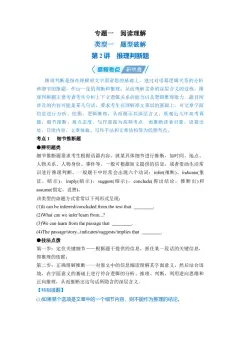
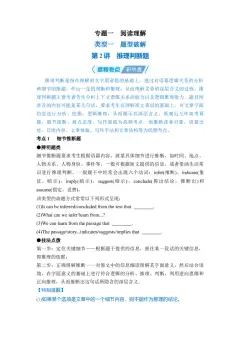
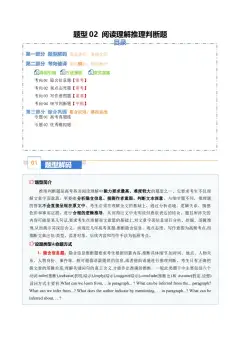
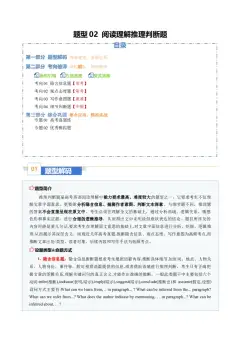
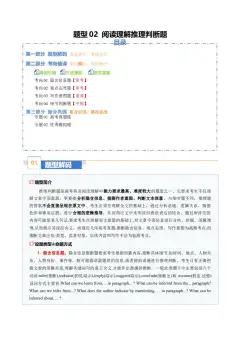
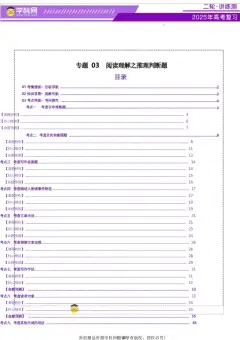
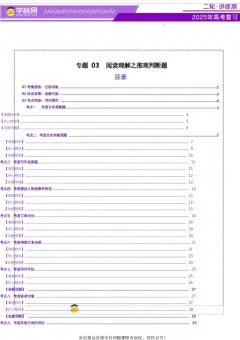
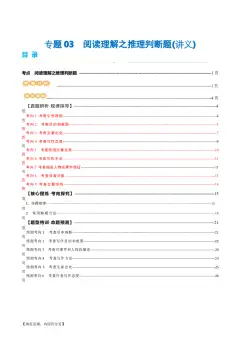
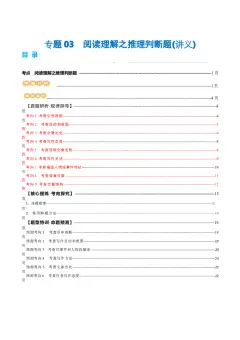
专题 03 · 阅读理解之推理判断题
核
【核心知识·深度解读】
推理判断题是阅读理解中难度较高的题型,要求考生根据文章提供的信息
进行逻辑推断,理解字里行间的隐含意义。这类题目考查的是深层理解能力,
答案不能直接从原文中找到,但可以通过文中线索合理推出。掌握推理方法,
有助于提升阅读思维品质。
一、常见推理类型
● 隐含意义推断:根据文中事实推断作者的言外之意、人物的态度或事情的
结果。
● 观点态度推断:通过作者使用的词汇、语气、例子等推断作者对某事物的
情感倾向。
● 写作目的推断:判断作者写文章是为了说明、说服、娱乐还是报道。
● 后续发展推断:根据已有情节预测接下来可能发生的事。
二、解题步骤
① 定位线索:找到题干所涉及的信息在文中的位置,仔细研读该句及前后文。
② 分析逻辑:注意文中使用的逻辑关系词(如 however, therefore,
because),它们往往暗示推理方向。③ 区分事实与观点:明确哪些是客观事实,哪些是作者的主观评价。
④ 排除过度推断:推理必须基于原文,不能加入个人主观臆测。
三、常见干扰项特征
- 与原文事实相反。
- 原文中未提及,属于无中生有。
- 过度推理,超出了原文允许的范围。
- 虽与原文部分相符,但非最佳推断。
四、真题示例(2025·新高考Ⅰ卷)
原文:The company's decision to use recycled materials was not only
environmentally friendly but also surprisingly cost-effective. In
fact, they saved 20% compared to using new materials.
题目:What can be inferred about the company's decision?
选项:A. It was made only for environmental reasons.
B. It turned out to be economically beneficial.
C. It increased production costs.
D. It was opposed by employees.
解析:文中说“surprisingly cost-effective”和“saved 20%”,可推断
经济上也有好处,选 B。A 与“not only”矛盾;C 与事实相反;D 无中生有。
题型:阅读下列短文,从每题所给的A、B、C、D四个选项中选出最佳选项。
🔹 专项突破·推理判断题20题
Passage 1 (主题:个性化学习)
In recent years, many schools have adopted personalized learning approaches,
where students progress at their own pace using digital tools. Advocates claimthis method boosts engagement and achievement. However, a three-year study
tracking 1,200 students across 20 schools found mixed results. While students
who were already high-achieving showed significant gains, those who struggled
often fell further behind. The researchers noted that personalized learning
requires strong teacher involvement to be effective. Without guidance, students
can become lost in the endless options. The study also found that schools with
successful programs had invested heavily in teacher training and technology
infrastructure. As one principal put it, “Personalized learning is not about
leaving students alone with a computer. It's about using data to provide the
right support at the right time.”
1. What can be inferred about the effectiveness of personalized learning?
A. It benefits all students equally.
B. Its success depends on teacher support and training.
C. It is more effective than traditional teaching.
D. It works best without teacher involvement.
2. What does the principal's statement imply?
A. Teachers are not needed in personalized learning.
B. Personalized learning is just giving students computers.
C. Proper implementation requires active teacher role.
D. Students should learn completely independently.
3. What can we infer about schools with successful personalized learning
programs?
A. They had lower budgets than others.
B. They focused only on high-achieving students.
C. They invested in teacher training and technology.
D. They used traditional teaching methods instead.
Passage 2 (主题:虚拟现实技术)
Virtual reality (VR) technology has advanced rapidly, with applications from
gaming to medical training. However, a recent study raises concerns about its
long-term effects. Researchers found that after just 20 minutes of VR use,
participants experienced difficulty distinguishing between real and virtual
memories. In extreme cases, some users reported feeling “detached from
reality” for hours after. The study's lead author warned that while VR has
enormous potential, we are still in the early stages of understanding its
psychological impact. She called for industry-wide safety guidelines before the
technology becomes even more widespread. Meanwhile, VR developers are rushing
to improve hardware, with lighter headsets and higher resolution displays. The
commercial market is expected to double in size by 2028. Some experts suggest
that users should limit their VR sessions to 30 minutes at a time and take
frequent breaks.
4. What can be inferred about the long-term effects of VR from the passage?
A. They are fully understood. B. They are not a concern for developers. C. More
research is needed to understand them. D. They are entirely positive.5. What is the author's attitude towards the rapid development of VR?
A. Enthusiastic support. B. Cautious concern.
C. Complete indifference. D. Strong opposition.
6. What can be inferred about VR developers from the passage?
A. They are ignoring safety concerns.
B. They are prioritizing hardware improvements.
C. They are collaborating with researchers.
D. They are slowing down production.
Passage 3 (主题:一位科学家的故事)
Dr. Maya Patel was 32 when she discovered a compound that could slow the
progression of Alzheimer's disease. The finding earned her international
recognition, but she never sought fame. Colleagues describe her as someone who
worked tirelessly in the lab, often staying until midnight. When asked about
her motivations, she once said, “I think about my grandmother, who didn't
recognize me in her final years. That's the only motivation I need.” Her
discovery came after years of failed experiments, a period she calls “the long
dark” when many colleagues urged her to change focus. She persisted, believing
the science would eventually work. Now, the compound is in clinical trials, and
early results are promising. Despite the success, Dr. Patel remains modest. “I
didn't do it alone,” she says. “Science is built on the work of many
people.”
7. What can be inferred about Dr. Patel's personality?
A. She is fame-seeking. B. She is modest and persistent.
C. She gives up easily. D. She works alone.
8. What does “the long dark” in the passage imply?
A. A period when she lost her grandmother.
B. A time of repeated failures and doubt.
C. The night when she worked in the lab.
D. A difficult time in her childhood.
9. What can be inferred about Dr. Patel's grandmother?
A. She suffered from Alzheimer's disease. B. She was a scientist herself.
C. She encouraged Dr. Patel to pursue research. D. She is still alive.
Passage 4 (主题:职场中的“安静辞职”)
A new trend called “quiet quitting” has been making headlines. It refers to
employees doing only what their job requires, without going above and beyond.
Proponents argue that it's a healthy way to set boundaries and prevent burnout.
However, many managers see it as a lack of engagement. A recent survey found
that 60% of workers admit to doing only the minimum required. The phenomenon
has been linked to factors such as low pay, lack of recognition, and the
blurring lines between work and home life. Some experts suggest that companies
need to address the root causes—offering better compensation, meaningful
feedback, and clear career paths. Others believe the trend reflects agenerational shift in attitudes toward work. One thing is certain: the
traditional expectation of always giving 110% is being questioned. Whether
quiet quitting is a temporary trend or a lasting change remains to be seen.
10. What can be inferred about workers who practice quiet quitting?
A. They are lazy and unambitious. B. They are setting boundaries to protect
their well-being. C. They are likely to be fired soon. D. They never work hard.
11. What can be inferred about the managers' perspective on quiet quitting?
A. They fully support it. B. They are concerned about decreased productivity.
C. They think it is a passing fad. D. They encourage it to prevent burnout.
12. What does the author imply about the future of quiet quitting?
A. It will definitely become permanent. B. It may disappear quickly.
C. Its long-term impact is still uncertain. D. It will be solved by higher pay.
Passage 5 (主题:城市绿化)
Urban green spaces, such as parks and community gardens, are more than just
pleasant additions to a city. A recent study in 12 European cities found that
increasing tree coverage by just 5% could reduce summer temperatures by up to
2°C. Moreover, residents living within 300 meters of green space reported
significantly lower stress levels. The benefits extend to mental health, with
studies showing that even brief exposure to nature can improve mood and
cognitive function. However, access to green space is not equal across
neighborhoods. Wealthier areas tend to have more parks and trees, while lower-
income areas often lack them. Some cities are now working to address this
disparity through programs that plant trees in underserved communities and
create new pocket parks. As one urban planner noted, “Green space is not a
luxury; it's a necessity for healthy cities.”
13. What can be inferred about the relationship between green space and health?
A. Only physical health benefits from green space.
B. Both physical and mental health are positively affected.
C. Green space has no effect on mental health.
D. Wealthy people benefit more from green space.
14. What can be inferred about access to green space in cities?
A. It is equal across all neighborhoods. B. Wealthier areas have better access.
C. Lower-income areas have more parks. D. All cities have solved the inequality
problem.
15. What does the urban planner's statement imply?
A. Green space is only for the wealthy.
B. Green space should be considered essential, not optional.
C. Cities cannot afford more parks.
D. People don't need green space.
Passage 6 (主题:语言与思维)
Does the language we speak shape how we think? This question has fascinated
linguists for decades. Research suggests the answer is yes—to some extent. Forexample, speakers of languages that have specific words for light blue and dark
blue distinguish between those shades more quickly than English speakers.
Similarly, cultures that use cardinal directions (north, south, east, west)
instead of relative directions (left, right) develop an internal compass that
keeps them oriented at all times. However, language does not determine thought
completely. Humans are remarkably adaptable, and thinking can influence
language as much as language influences thinking. The relationship is a two-way
street. As one researcher put it, “Language is a tool for thinking, not a cage
for thought.”
16. What can be inferred about the relationship between language and thought?
A. Language completely determines thought. B. Thought is independent of
language. C. They influence each other in a mutual way. D. Only thought
influences language.
17. What does the example of cardinal directions suggest about speakers of such
languages?
A. They have a better sense of direction. B. They struggle to use left and
right. C. They think differently about time. D. They are less adaptable.
18. What does the researcher's statement “Language is a tool for thinking, not
a cage for thought” imply?
A. Language limits what we can think.
B. Language helps us think but does not restrict us.
C. People cannot think without language.
D. Language is the only tool for thinking.
Passage 7 (主题:循环经济)
The linear economy—take, make, dispose—has dominated industry for centuries.
But its limits are becoming clear: resources are finite, and waste is piling
up. Enter the circular economy, which aims to keep materials in use, regenerate
natural systems, and design out waste. Companies adopting circular models are
finding unexpected benefits. For instance, a furniture company that started
leasing rather than selling products found that customers were more loyal and
returned products for refurbishment, reducing raw material costs. Another
company turned factory waste into new products, cutting disposal costs and
creating a new revenue stream. However, transitioning to a circular economy
requires significant investment and redesign of supply chains. Some industries
are moving faster than others. The fashion industry, notorious for waste, has
seen pioneers create clothes from recycled fabrics. Yet, for the circular
economy to become mainstream, consumer behavior must also shift. Buying less,
repairing, and choosing durable goods are part of the equation.
19. What can be inferred about the linear economy?
A. It is sustainable in the long run.
B. It is being replaced due to resource and waste issues.
C. It is more profitable than the circular economy.
D. It is preferred by most companies.20. What does the example of the furniture company suggest?
A. Leasing products is less profitable than selling.
B. Circular models can increase customer loyalty and reduce costs.
C. Customers prefer to buy rather than lease.
D. Refurbishment is too expensive.
参考答案及解析
Passage 1
1. B (推理题。文中“requires strong teacher involvement to be effective”和
“schools with successful programs had invested heavily in teacher training”说
明成功依赖教师支持)
2. C (推理题。校长的话“not about leaving students alone with a computer”强调
教师作用)
3. C (推理题。文中明确“successful programs had invested heavily in teacher
training and technology infrastructure”)
Passage 2
4. C (推理题。研究者呼吁更多研究,且说“we are still in the early stages of
understanding”)
5. B (态度题。作者既提到VR潜力,也提出心理影响担忧,持谨慎态度)
6. B (推理题。文中“VR developers are rushing to improve hardware”说明他们优先
硬件改进)
Passage 3
7. B (推理题。从“never sought fame”“persisted”“remains modest”可推断)
8. B (推理题。上文“years of failed experiments”和“many colleagues urged her
to change focus”说明是困难和怀疑期)
9. A (推理题。她提到祖母最后几年不认识她,暗示祖母患阿尔茨海默症)
Passage 4
10. B (推理题。“set boundaries and prevent burnout”表明是为了保护健康)
11. B (推理题。“many managers see it as a lack of engagement”暗示他们担心投入
不足)
12. C (推理题。最后一句“whether quiet quitting is a temporary trend or a
lasting change remains to be seen”表明未来不确定)
Passage 5
13. B (推理题。文中提到降低气温(物理)和降低压力、改善情绪(心理))
14. B (推理题。“wealthier areas tend to have more parks and trees, while
lower-income areas often lack them”)
15. B (推理题。“not a luxury; it's a necessity”强调必要性)
Passage 6
16. C (推理题。“the relationship is a two-way street”表明相互影响)
17. A (推理题。使用基本方向培养“internal compass”暗示方向感更强)
18. B (推理题。工具帮助思考,但非牢笼,意味着帮助但不限制)
Passage 7
19. B (推理题。“its limits are becoming clear: resources are finite, and waste
is piling up”说明它正被取代)
20. B (推理题。公司发现客户更忠诚、降低成本,说明循环模式有益)教学使用建议: 建议学生做题时先仔细审题,再回原文定位线索,注意作
者使用的措辞、例子和逻辑词。做完后对照解析,分析推理依据和干扰项特
征。可结合历年真题进行强化训练。