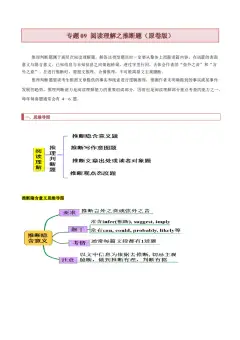
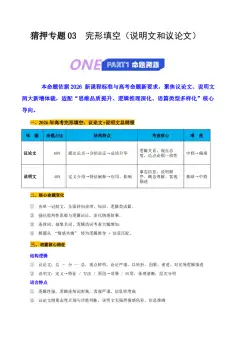
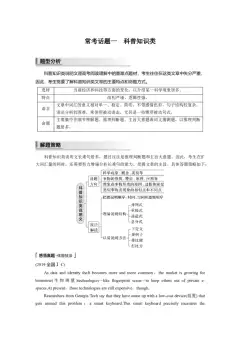
题型02 阅读理解推理判断题
题型简介
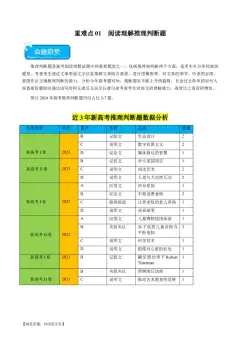
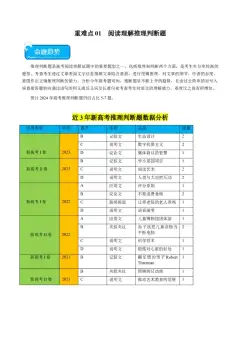
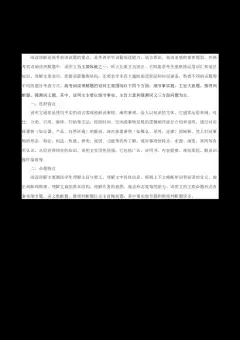
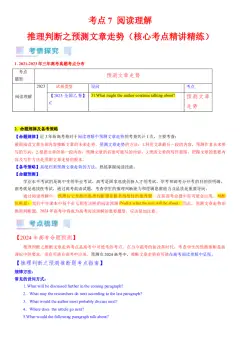
推理判断题是高考英语阅读理解中能力要求最高、难度较大的题型之一。它要求考生不仅理
解文章字面意思,更要能分析隐含信息、揣测作者意图、判断文本深意。与细节题不同,推理题
的答案不会直接呈现在原文中。考生必须在理解全文的基础上,通过分析语境、逻辑关系、情感
色彩和事实证据,进行合理的逻辑推导,从而得出文中未明说但意欲表达的结论。题目所涉及的
内容可能是某几句话,要求考生在理解原文意思的基础上,对文章字面信息进行分析、挖掘、逻辑推
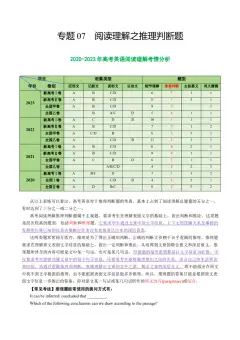
理,从而揭示其深层含义。纵观近几年高考真题,推断隐含信息、观点态度、写作意图为高频考点,而
推断文章出处/类型、读者对象、后续内容和写作手法为低频考点。
设题类型&命题方式
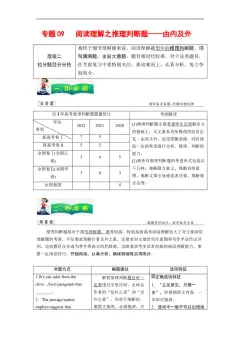
1. 隐含信息题:隐含信息推断题要求考生根据语篇内容,推断具体细节,如时间、地点、人物关
系、人物身份、事件等。般可根据语篇提供的信息,或者借助语境进行推理判断。考生只有正确把
握文章的逻辑关系,理解关键词句的真正含义,才能作出准确的推断。一般此类题干中主要包括六个
动词:infer(推断),indicate(表明,暗示),imply(暗示),suggest(暗示),conclude(推断出)和 assume(假定,设想)
设问方式主要有:What can we learn from, .. in paragraph... ? What can be inferred from the... paragraph?
What can we infer from...? What does the author indicate by mentioning. . . in paragraph...? What can be
inferred about. . . ?
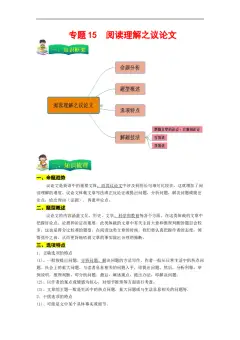
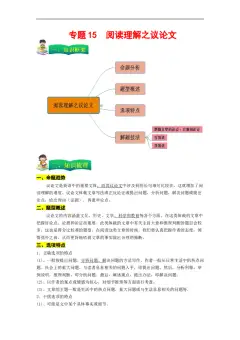
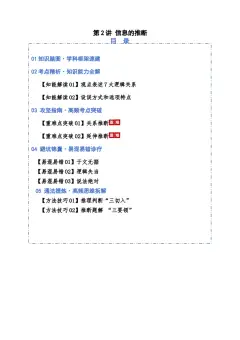
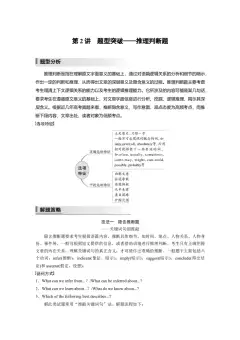
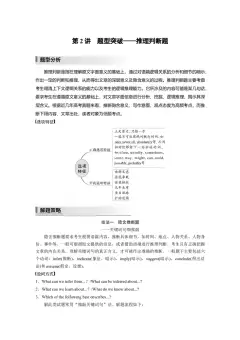
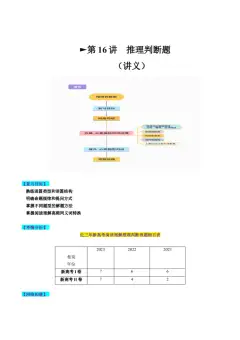
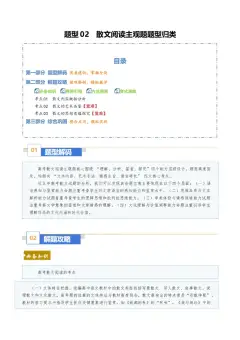
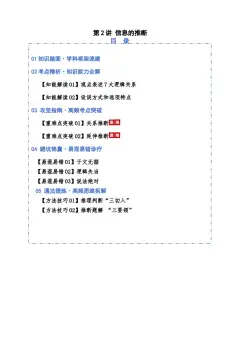
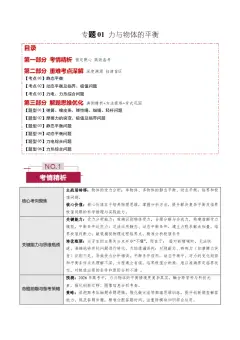
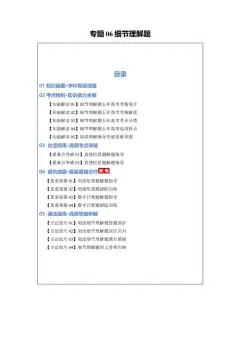
目录
第一部分 题型解码 高屋建瓴,掌握全局
第二部分 考向破译
解
微观
剖,精细教学
典例引领
方法透视
变式演练
考向01 隐含信息题【常考】
考向02 观点态度题【常考】
考向03 写作意图题【重难】
考向04 细节判断题【中频】
第三部分 综合巩固 整合应用,模拟实战
专题01 高考真题练
专题02 优秀模拟题
2. 观点态度题:此类试题往往让考生推断文章作者或文中人物对某事物所持的态度、观点或
看法,或推断文中人物的语气、性格等。设问方式主要有:What is the author's attitude toward...? What
does the author think of. .. ? How does the author find. .. ?观点和态度一般分为三大类:①支持、赞同、
乐观;②客观、中立;③反对、批评、怀疑、悲观。作者或文中人物的这种思想倾向和感情色彩往往
隐含在文章的字里行间。因此,在推断过程中,应特别注意文中的措辞,尤其是表达感情色彩的形容
词或副词。
3. 写作意图题:各种话题的阅读材料都可能考查写作目的/意图。通常情况下,作者在文中不直
接陈述自己的意图,而是通过文中所列事物使读者感受到其所传递的想法。所以,这种题型要求考生
具备对作者阐述的内容进行总结和分析的能力。设问方式主要有:What is the author's purpose in
writing this passage? What is the purpose of this text? What is the author's purpose in mentioning... ? What
is the purpose of. .. mentioned in paragraph. .. ?
4.细节判断题: 这类考题考查频率较低,常包括文章出处/类型题、读者对象题、后续内容题
和写作手法题等。一般来讲,文章出处/类型题要求考生具备一定的常识,能够根据文章的体裁和题
材来推断文章的出处或类别;读者对象推断题要求考生根据短文内容和文中的措辞推断文章的读者
对象;后续内容推断题要求考生能根据整篇文章的情节发展预测文章的后续内容,这种题型对考生的
能力要求较高;写作手法题主要考查整篇文章或某个段落的写作手法。设问方式主要有: Where is the
text most probably taken from?(文章出处题)Which of the following books is the text most likely selected
from?(文章出处题)What is the text?(文章类型题)What might the author continue talking about?(后续内
容题)Who are the intended readers of the text?( 读者对象题)How is the topic introduced in the first
paragraph?(写作手法题)
解题思路
1: 隐含信息题解题步骤
第一步:精准定位,提取信息:根据题干关键词,迅速定位至原文相关语句。准确抓取其中
对人物、事件、环境的直接描述,明确文本表层信息。
第二步:剖析语境,解读内涵:在理解字面意思的基础上,深入分析关键词句在具体语境中
的功能与含义。重点把握情感色彩、语气态度及逻辑关系(如因果、转折、对比)。
第三步:多维关联,合理推断:将文本信息与上下文语境、普遍性常识及逻辑规律相结合,
进行综合研判。透过表面表述,推导出作者未明言但意图表达的深层观点、写作目的或潜在结论。
第四步:验证整合,确定答案:将推断结论与原文主旨及全部已知信息进行比对验证,确保
推断内容在文中有所依托、符合逻辑。最终筛选出最具支撑性且表述准确的选项。
2. 观点态度题解题步骤
一、核心态度词汇
支持/肯定
favorable, positive, approving, supportive, enthusiastic, optimistic
反对/否定
critical, negative, disapproving, doubtful, skeptical, pessimistic
中立/客观
objective, neutral, impartial, unbiased, detached
主观/情感
subjective, emotional, sentimental, passionate
消极态度
indifferent, unconcerned, cynical, sarcastic, ironic
二、解题步骤
第一步:定位关键信息。迅速扫描题干关键词,定位至原文相关段落。重点关注:直接表达
观点的陈述句;人物的直接引语或独白;带有感情色彩的形容词、副词,评价性的行为动词。
第二步:分析语言特征。仔细分析定位语句中的措辞特点:辨析褒义、贬义或中性词汇;注
意修饰词的程度强弱(如extremely, slightly),识别特殊句式(如反问、感叹、虚拟语气),抓取
重复出现的评价性表达。
第三步:推断态度倾向。基于文本证据进行合理推断:对比不同观点的对立之处,分析事例
选择的倾向性,考量语气基调的一致性,注意转折词后的真实态度。
第四步:验证选项匹配。将推断结果与选项进行精确比对:排除文中无依据的过度推断,区
分作者态度与文中人物态度,警惕绝对化表述的干扰项,确保所选答案与全文基调一致。
3. 写作意图题解题步骤
第一步:辨识文章体裁。快速判断文章所属文体类型:广告类:结构分明,含标题、图表、
价格等信息;记叙文:以人物经历或事件发展为主线;说明文:客观介绍事物特征、原理或流程;
书评:包含书籍介绍与个人评价两部分内容;议论文:提出观点并展开论证,试图说服读者。
第二步:把握核心主旨。通过关键位置抓取文章要义:先重点阅读首尾段落及每段首句再标
记反复出现的关键词与核心概念最后梳理文章内容的逻辑推进方向
第三步:推断写作目的。结合文体特征与主旨内容进行判断:广告类:吸引关注、推广产品、
促进消费;记叙文:分享体验、传递感悟、给予启示;说明文:普及知识、提供指导、提出建议;
书评:评价内容、推荐或批评作品;议论文:说服读者、倡导行动、批驳观点。
4.细节判断题解题步骤
第一步:识别文体类。通过以下特征判断文章体裁:
广告类:呈现产品特色、价格信息、促销内容,结构分明
指南类:提供旅游、会展等实用信息,注重生活指引
新闻报道:突出时效性,首段为概括性导语,客观陈述事件
科普文章:介绍科技成果,包含实验数据与专业术语
杂志文章:话题具体,生活气息浓厚,主观色彩明显
书评:兼具书籍介绍与思想评论,体现评价性
第二步:分析内容特征。根据文章内容要素进行判断:
涉及商品交易信息
广告
→
提供行程安排、注意事项
指南
→
报道近期发生的事件
新闻报道
→
解释科学原理或发现
科普文章
→
探讨日常生活话题
杂志文章
→
评价书籍内容价值
书评
→
第三步:把握语言风格。通过语言特点进一步确认:
简洁有力、富有鼓动性
广告
→
实用具体、描述细致
指南
→
客观准确、时效性强
新闻报道
→
严谨专业、术语丰富
科普文章
→
轻松活泼、情感丰富
杂志文章
→
生动形象、评价精准
书评
→
确定读者对象的方法:
明确文章主题:概括核心话题与主要内容
分析内容适配度:判断信息难度、专业程度与兴趣点适合何种群体
对应读者特征:将文章特点与可能的读者群体进行匹配(如专业人士、普通大众、特定兴趣群体
等)
考向01 隐含信息题
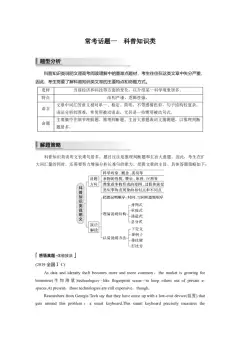
【例1-1】(浙江省强基联盟2025 年10 月高三联考英语试题)
After eight days, we ventured to Molokai, Hawaii's least developed island. No resorts or chain stores spoiled
its wild beauty—just dramatic cliffs meeting rough seas. Deep in the eastern wilderness, we met Greg Solatario,
whose family has taken care of this land for generations. His simple off-grid life perfectly embodied mālama. Greg
welcomed us warmly before leading us through jungle-covered ruins of ancestral villages. As we approached, his son
Devak blew a conch shell—a traditional request to enter. "The land remembers, "Greg explained, showing us medicinal
plants and ancient fishing spots. His parting words stayed with me:“Malama shouldn’t be just Hawaiian —the whole
world needs this way of caring."
1.What do we know about Greg Solatario's family?
A. They built new resorts in the wild.
B. They have long protected the land.
C. They offered guided tours to locals.
D. They fixed up the old village ruins.
【答案】B
【详解】 此题为细节推理题。解题关键在于定位描述Greg 家庭的信息。文章第五段提到:"we met Greg
Solatario, whose family has taken care of this land for generations."(我们遇到了格雷格·索拉塔里奥,他
的家族世代照料着这片土地)。"for generations"(世代)直接对应B 选项中的"长期"。"has taken care
of"(照料)与"保护"含义高度一致。A 选项"建造新度假村"与文中描述的莫洛凯岛"没有度假村"的野生状
态相矛盾。C 选项"为当地人提供导游服务"文中未提及,他们是为作者这样的游客进行了引导和讲解。D
选项"修复了古老的村庄废墟"错误,文中描述他们带领作者参观的是"jungle-covered ruins"(丛林覆盖的废
墟),并未说他们进行了修复。
【例1-2】(广东“六校联盟”2026 届高三年级第二次联考英语试题)
The red-crowned crane ( 丹顶鹤) is a national first-class protected wildlife. However, due to
environmental and ecological damage, the number of red-crowned cranes had been dangerously declining
when Zhao Shiwei joined the Zhaoquan River Management Station in 1992. Artificial breeding of red-crowned
cranes became an important part of Zhao’s work.
3 red-crowned crane birds hatched at the station through his artificial program in 1996. Despite tasting success,
Zhao and his team encountered hardships the following year. In 1997, not a single red-crowned crane bird hatched.
And in 1998, only one red-crowned crane chick hatched through artificial breeding, but it died soon after.
1. What does the author imply about the red-crowned cranes in the first two paragraphs?
A. They’re at risk of going extinct.
B. They top all other wildlife in value.
C. Their artificial breeding started in 1992.
D. Their number stopped declining in 1996.
【答案】A
【详解】 此题为隐含信息推理判断题。解题需要从文字描述中推断言外之意。正确选项A 的依据:首段
明确指出"the number of red-crowned cranes had been dangerously declining" (数量一直危险地下
降),"dangerously"一词暗示情况严峻;第二段描述孵化工作屡遭挫折,1997 年零孵化,1998 年孵化后死
亡,这些事实共同暗示该物种面临严重的生存危机,即"濒临灭绝"。错误选项解析:B. 错误原因:文中虽
提及是"国家一级保护野生动物",但未与其他野生动物比较价值高低。C. 错误原因:赵世伟1992 年加入管
理站并开始参与人工繁育,但无法推断这是丹顶鹤人工繁育的起始年份。D. 错误原因:1996 年孵化3 只只
是一个短暂成功,随后两年又遇困境,无法得出"数量停止下降"的结论。
【变式1-1】(25-26 高三上·湖南衡阳市八中·期中)
解|题|技|巧
1.
精准定位:根据题干关键词,找到原文相关句段。
2.
分析线索:细读上下文,抓住逻辑关系(因果、转折)、情感词汇和事实依据。
3.
合理推断:基于文本信息进行逻辑延伸,得出作者暗示但未明说的结论。
4.
验证排除:确保推论有原文支撑,果断排除无中生有、过度推断或偷换概念的选项。
注|意|事|项
警惕三大陷阱:
1.
想太多——答案必须源于文本,不能自由发挥。比如看到“一级保护”就脑补“价值最高”,
这就是过度推断。
2.
看串行——注意时间顺序和主语对象,别把1996 年的成功当成持续好转(例1-2)。
3.
漏重点——轻描淡写的修饰词往往是解题钥匙,比如“dangerously”这种词绝对不能忽略。
Picture this, you win two tickets to a sold-out concert and eagerly text to ask your friends if they’d like to join.
There comes their response “Maybe.” Your mood immediately turns, for you need to wait for their decisions before
you can figure out your plans for the concert.
If you’ve experienced anything like the above anecdote, you’re not alone. People responding “maybe” to
invitations is a common yet annoying aspect of social life. What goes on in people’s heads when they aren’t sure
whether to accept an invitation? Social invitations can be a delicate dance. People often misread what someone
extending an invitation wants to hear and overestimate an inviter’s likelihood of preferring a “maybe” over a “no.”
Moreover, they fail to realize how much more disrespected people feel when they receive a “maybe” in response to
their invitation.
1. Why is the concert anecdote mentioned at the beginning?
A. To explain the background of the invitation.
B. To stress the importance of quick replies.
C. To encourage immediate decision- making.
D. To introduce a common social situation.
【变式1-2】(25-2 江西省南昌市2025-2026 学年高三上学期开学考试英语试卷)
On our very first trade, our partner welcomed us with a bottle of wine and some cheese in the fridge, and we’ve
kept that gracious tradition going with our own “guests”. Since then, we’ve encountered all kinds of thoughtful acts
— from the young couple who left the keys in their mailbox along with a note that said “Enjoy!” to the family who
provided piles of maps, brochures, and local restaurant menus. With these small “insider” tips, we don’t just visit a
city — we slip into its daily flow, free from the rush of moving from one landmark to another.
Yes, house trading did begin with our desire to travel on the cheap, but it’s become so much more than just a
way to save money. It let us get glimpses of places we might never have explored otherwise, grew our belief in the
warmth of strangers, and confirmed our decision to choose a lifestyle that values time over money. We all learned to
share by the time we were in kindergarten, right? It’s not too late to rediscover that simple truth on a whole new
level.
1. Why does the author mention hosts’ thoughtful acts?
A.To suggest travel tips.
B.To show local customs.
C.To instruct hosting skills.
D.To highlight special gains.
2. What message does the author convey in the last paragraph?
A.Trust requires shared values.
B.Sharing bears lasting worth.
C.Budget travel cuts living costs.
D.Early habits shape adulthood.
考向02 观点态度题
【例2-1】(2025-2026 学年第一学期天域全国名校协作体联考英语试题)
Philosopher Jonathan Birch, also a judge of the Jeremy Coller Centre, stressed that the Challenge is looking
beyond the interspecies communication we have with pets, or that a farmer has with a sheepdog. Those relationships
involve signalling and behavioural responses, Birch explains, “but that’s not telling us how animals communicate
with each other... this prize is about understanding it so well that we can start to join the conversation.”
While Coller hopes his charity will reshape our attitude to animals, the truth is that even
groundbreaking research has largely failed to move the dial on their welfare. Recent work on
cephalopod’s (头足类动物) intelligence has not stopped plans to farm the creatures. We might one day be
able to understand what animals are saying — but there is no guarantee we will listen.
1. What’s the author’s attitude toward the practical effect of the research?
A. Optimistic.
B. Doubtful.
C. Objective.
D. Dismissive.
【答案】B
【详解】 此题为作者态度题。解题需聚焦末段的批判性语气。作者先以“虽然”承认科勒的初衷,
但用“真相是”强势转折,指出研究“ largely failed to move the dial”( largely failed to move the
dial),并以头足类动物案例佐证。结尾句“but there is no guarantee we will listen”(但不能保证我们会
倾听)更以悲观口吻强调了对研究落地效果的深度怀疑。A 选项“乐观的”与末段整体基调相反;C 选项
“客观的”不准确,因作者明显带有倾向性质疑;D 选项“不屑一顾的”程度过重,作者并未完全否定研
究价值,而是聚焦于其现实效果的局限性。
【例2-2】(2025-2026 学年度武汉市部分学校高三年级九月调研考试)
Harold Simmons never intended to become a neighborhood legend(传奇).At 73, he was just a retired
worker with too much time and an empty backyard. What started as a simple garden railroad project
quickly became something extraordinary.
It began with a single circular track and an old steam engine he'd rescued from a sale. Each day, he would add
tiny details —a tiny general store, a little church and some handcrafted trees. The neighborhood children would
sometimes look over the fence, their eyes wide with wonder.
One particularly curious 10-year-old named Maya started visiting regularly after school. Her working parents
appreciated that Harold didn't mind her watching him work. He'd explain each tiny detail. Word spread. Neighbors
who had previously just waved politely stopped to admire Harold's growing landscape. Children brought their parents.
Retired workers shared stories about the real trains and towns the models represented.
1. What was the neighbors' attitude toward Harold's project?
A. Critical. B. Negative.
C. Appreciative. D. Uncertain.
【答案】C
【详解】 此题是观点态度题。解题需要从文中对邻居行为的描述中推断其态度。第三段提
到:"Neighbors who had previously just waved politely stopped to admire Harold's growing landscape." 其中
的"admire"(钦佩,欣赏)一词直接表明了他们的积极和赞赏的态度。随后"Children brought their parents.
Retired workers shared stories..."也进一步印证了社区成员们的参与和支持。A(批评的)、B(消极的)、
D(不确定的)均与文中描述的积极场景不符。
【变式2-1】(北京市通州区2025-2026 学年高三上学期11 月期中英语试题节选)
I came to realize I wasn’t so different. Like those men, I had tied my dignity to my occupation. Technology
keeps pushing aside what we took as permanent, and hard-earned skills are irrelevant in a blink. Holding on to who
you were can feel suffocating (令人窒息的), but letting go is painful. Status is like clothing—superficial (肤浅的),
but one’s dignity depends on it.
I suspect that many people will struggle with this during the coming AI transformation, which may replace
jobs and remove entire occupations. But1. these changes also present us with an opportunity: to get rid of the idea
that we each must find a calling, then hold on to that identity or admit failure. Perhaps the dignified life involves
several versions of you.
My student days are now over, for the second time. When I last exchanged classroom for job market, I was 23,
解|题|技|巧
这类题目的核心是:通过文本中的描述性语言、情感词汇和具体事例,推断出作者或文中人物的态度、
看法或情感倾向。
1.
定位关键信息:首先找到题目所问的“态度”的主体(是作者?还是文中某个人物/群体?)和
对象(是针对什么事的态度?)。然后在原文中找到直接描述或涉及该主体与对象的段落和句
子。
2.
分析语言线索:寻找情感/评价性词汇: 这是最直接的线索。例如,admire(欣赏)、wonder
(惊叹)、failed (失败)、no guarantee (无法保证)等。关注转折词:
像 but, however, yet, while 等词后面的内容往往是态度的真正体现,尤其对于作者态度题至关
重要。(如例2-1 中的 While... hopes..., the truth is that...)分析具体事例: 作者列举的事例是为
了支撑其观点。事例的性质(积极的还是消极的)直接反映了态度。(如例2-1 用“头足类动
物研究未能阻止养殖计划”这一负面例子,来表达对研究实际效果的怀疑。)
3.
匹配选项,排除干扰:将分析出的态度(积极、消极、怀疑、客观等)与选项进行匹配。
排除法非常有效:排除文中完全没有体现的选项。排除与文章基调或事实相反的选项。
排除程度不当的选项(如例2-1 中,作者是“怀疑”而非完全“不屑一顾”)。
注|意|事|项
1.
不要将自己的观点代入。
2.
区分“作者态度”与“文中人物态度”。 题目问的是作者的看法,不是科勒(Coller)或伯奇
(Birch)的看法。
3.
重点阅读段落首尾句,尤其是转折词之后的内容。 作者的核心观点常在此处。
4.
警惕“绝对化”或“情绪化”词汇。 正确选项通常是程度适中的,如 doubtful(怀疑的)、
cautious(谨慎的)、objective(客观的)。而 dismissive(不屑一顾的)、enthusiastic(狂热
的)等程度过强的词往往是干扰项,除非文章有非常明确的证据。
an ambitious writer hoping to create something on paper that might outlast me. But print isn’t what it used to be. Nor
am I.
1.
Which would best describe the author’s attitude towards future?
A.Joyful.
B.Adaptive.
C.Indifferent.
D.Pessimistic.
【变式2-2】(辽宁名校联考2025-2026 学年高三上学期11 月期中英语试题)
Chiavaccini’s team videotaped 40 goats of various kinds, ages and different medical conditions at a
veterinary (兽医的) hospital, making over 5,000 fixed frames. Using a behavioral pain scale, clinical history and
physical exams, they classified each goat as in pain or not. The team tried three approaches, training an algorithm (算法)
on different image groups while reserving others to test that training. The most balanced model was trained, adjusted
and finally tested for five times, which gave 80% average accuracy. “Such training basically builds 30 years of clinical
experience in 30 minutes,” Chiavaccini says.
AI-powered tools built with similar methods could someday help veterinarians make quicker and more accurate
diagnoses or warn farmers of early pain in livestock. “This study shows a silver lining of AI in animal care and
highlights the need for further exploration across diverse species,” says Mahmoud, a scientist in human and animal
behavioral AI.
Such tools already exist for nonverbal human patients, but these systems’ effectiveness can be limited by poor
image quality or nonstandard camera angles. “Many of the engineering problems we solved, like adapting to messy,
real-world conditions, could be helpful to human medicine,” Chiavaccini says. “Doctors worry about perfect lighting
or head positioning. Meanwhile I’m out here racing after a goat with my camera.”
1. What’s Mahmoud’s attitude toward the application of AI in animal care?
A.Ambiguous. B.Cautious.
C.Promising. D.Doubtful.
考向03 写作意图题
【例3-1】(2026 届山东省济南市高三年级英语开学摸底考试)
While fight-or-flight seems logical for survival, freezing appears counterproductive --- potentially too much to
handle, making us incapable of acting or making a decision. But is that really all that's going on? Not according to
Prof Karin Roelofs, a neuroscientist who studies freezing at Radboud University. “Many people think that freezing
is a kind of shutdown of the system,” she says. “What we actually find is that in threatening situations, freezing
actually helps gain more information, prepare actions, and improve perception and decision making.” Freezing acts
like an emergency flow state: watchful, not petrified.
Importantly, this response can be trained. Roelofs highlights two groups controlling freezing: living
statues, street performers maintaining extreme stillness and snipers (狙击手) requiring absolute stillness
while making decisions. Lab research confirms this. A virtual reality shooting game showed players with stronger
freezing responses performed better and decided faster. Freezing doesn't slow responses. “Brain noise reduces.
Perception increases. You make better decisions faster,” Roelofs clarifies.
1.
Why are living statues and snipers mentioned in Paragraph 4?
A. To contrast response types.
B. To illustrate freezing causes.
C. To support response training.
D. To criticize stressful professions.
【答案】C
【详解】 此题为写作目的题。解题需看例子所服务的论点。该段主旨句是首句“Importantly, this
response can be trained.”(重要的是,这种反应是可以训练的)。紧接着,作者提到“活体雕塑”和“狙
击手”,就是为了给出能够通过训练来控制冻结反应的真实例子,以此支持“可训练”这一论点。A 选项
“对比反应类型”错误,文中并未对比这两种职业的反应。B 选项“说明冻结原因”错误,例子是用来说
明如何控制冻结,而非其原因。D 选项“批评压力大的职业”完全偏离文章客观中立的科普基调。
【例3-2】(2026 届浙江省Z20 名校联盟高三上学期第一次联考英语试题节选)
When Clara took over her grandfather’s Brooklyn bookshop in 2018, the first thing she removed wasn’t the
outdated stocks, but the WiFi router. Regulars protested. A lawyer threatened to transfer his $500 monthly coffee
budget elsewhere. “Books deserve the same undivided attention we demand from lovers,” she told me, polishing the
brass counter her grandfather installed in 1967.
……………………
Last winter, I found her battling a new threat. A property developer had purchased their building, tripling the
rent overnight. What unfolded next could fill a novel: customers organized protests on the sidewalk; the judge
represented them for free; even the lawyer who once threatened to leave funded their legal defense.
1. Why is the lawyer mentioned again in paragraph 4?
A. To show his contradictory behavior.
B. To illustrate the content of a novel.
C. To stress the mass support Clara received.
D. To explain the difficulty Clara came across.
【答案】C
【详解】此题为写作目的题。解题需分析人物再次出现的叙事功能。第四段的核心是讲述社区如何团
结起来支持书店对抗开发商。作者列举了“customers”、“the judge”和“even the lawyer”这三种具有
代表性的人物。律师的再次出现,尤其是“even”(甚至连)这个词,起到了强烈的强调和对比作用:曾
经最可能因不便而离开的顾客,如今也成为了坚定的支持者。这极有力地说明了克拉拉获得的支持范围之
广、程度之深,是“mass support”的体现。A(展示矛盾行为)是表面现象,作者的深层目的不是写律师
本人,而是以他为例来证明支持的力量。B(解释小说内容)是比喻说法,并非真正原因。D(解释遇到的
困难)中,困难是涨租,律师的出现是解决方案的一部分,而非困难本身。
【变式3-1】(浙江省杭州第二中学2025-2026 学年高三上学期10 月月考英语试题节选)
Fooled by Randomness is a famous book in Nassim Nicholas Taleb’s landmark Incerto series, an investigation
of luck, uncertainty, probability, human error, risk, and decision-making in a world we don’t understand.
Now in a striking new hardcover edition, Fooled by Randomness is the word-of-mouth sensation that will change
the way you think about business and the world. Nassim Nicholas Taleb — seasoned trader, renowned risk expert,
knowledgeable scholar, and New York Times bestselling author of The Black Swan — has written a modern classic
that turns on its head what we believe about luck and skill.
This book is about luck — or more precisely, about how we perceive and deal with luck in life and business. Set
against the backdrop of the most notable forum in which luck is mistaken for skill — the world of trading — Fooled by
Randomness provides captivating insight into one of the least understood factors in all our lives. Writing in an
entertaining narrative style, the author tackles major intellectual issues related to the underestimation of the influence
of happenstance on our lives.
The book is populated with a number of characters, some of whom have grasped, in their own way, the
significance of chance: the baseball legend Yogi Berra; the philosopher of knowledge Karl Popper; the modern
financier George Soros; and the Greek voyager Odysseus. We also meet the fictional Nero, who seems to understand
the role of randomness in his professional life but falls victim to his own irrational foolishness.
1.
What’s the purpose of mentioning the characters in paragraph 4?
A. To highlight the significance of their achievements.
B. To emphasize their success in the trading world.
C. To illustrate how foolishness always leads to failure.
D. To show examples of those who understood randomness.
【变式3-2】(江西省南昌市2026 届高三年级9 月测试(零模))
…………..
House trading isn't the same as Airbnb or renting a room in someone's home: there's no exchange of money, no
check-in desks or strict rules, which makes it feel more like staying as guests in each other's houses. Living in someone
else's space builds a unique closeness --- admiring their bookshelf picks, the way they arrange potted plants, or family
photos on the fridge turns virtual strangers into familiar faces. We've even grown repeat trades into real friendships.
解|题|技|巧
定位主旨:明确例子所在段落的中心论点(常为首句)。
分析功能:判断例子与论点的关系,是“证明”、“阐述”还是“对比”。
排除干扰:正确选项通常指向深层论证目的,而非例子本身的表面信息。
注|意|事|项
答案永远服务于段落核心思想。警惕就事论事的选项,例子本身细节不是目的。反复出现的人物/事
物,其后续功能(如强调、转折)是解题关键
On our very first trade, our partner welcomed us with a bottle of wine and some cheese in the fridge, and we've
kept that gracious tradition going with our own "guests". Since then, we've encountered all kinds of thoughtful acts
--- from the young couple who left the keys in their mailbox along with a note that said "Enjoy!" to the family who
provided piles of maps, brochures, and local restaurant menus. With these small "insider" tips, we don't just visit a
city --- we slip into its daily flow, free from the rush of moving from one landmark to another.
1. Why does the author mention hosts' thoughtful acts?
A. To suggest travel tips.
B. To show local customs.
C. To instruct hosting skills.
D. To highlight special gains.
考向04 细节判断题
【例4-1】(南京市2026 届高三年级学情调研考试(零模)英语试题)
1. Where is this text probably taken from?
A. A school website.
B. A travel plan.
C.A transportation guide.
D. A poster board.
【答案】A
【详解】 此题问文章出处。开篇“欢迎来到我校的在线社区”表明文章来自学校官方在线平台,内
容针对学生提供交通服务信息,故A(学校网站)最合适。B 旅行计划可能涉及更广泛的行程安排,但本
文聚焦校园服务;C 交通指南虽相关,但出处更具体为学校网站;D 海报展板通常以简洁宣传为主,而非
Welcome to our school’s online community! Whether you’re hoping to explore the East Coast or are just
making your way around campus, there are several transportation service options that University of Pennsylvania
(Penn) students can take advantage of.
Penn Walking Escorts (护送)
Penn’s Division of Public Safety offers free walking escorts 24 hours a day, 365 days a year. Penn students
can request an escort to walk them to their destinations whether that is a campus building, a dorm, or the school
hospital. To request a walking escort, students can ask any Public Safety Officer or call 215-898-WALK
(9255).
Penn Accessible Transit
The Penn Accessible Transit service offers on-campus transportation during term time for individuals with
visual disabilities and those with limitations from other conditions. To obtain access to PAT, students must email
the Office of Student Disabilities Services. For teachers or staff, they can obtain approval by contacting the Office
of Affirmative Action.
详细文本。
【例4-2】(浙江省强基联盟2025 年10 月高三联考英语试题)
My husband, children and I were in Hawaii. Here, we were introduced to the ancient Hawaiian concept of
malama (to care for) which encourages visitors to give back to the environment and local communities through
activities like habitat restoration, beach cleanups or food provision. But mālama goes beyond ecotourism — it's about
leaving a place better than you found it.
And after seeking out these experiences during a three-week stay, we found mālama not only improves Hawaii,
but it also made our time there much more meaningful.
1. How does the author present the topic in the first paragraph?
A. By quoting an expert.
B. By giving examples.
C. By explaining a concept.
D. By providing statistics.
【答案】C
【详解】此题为写作手法题。解题关键在于分析第一段的内容构成。该段核心是围绕"mālama"这个词
展开的:首先给出了它的中文含义("关爱"),然后解释了它的具体表现(鼓励游客参与的活动),最后
点明了它的深层目标("离开时让地方更美好")。整个段落都是在界定和阐述"mālama"这一概念。A 选项
(引用专家)在第一段未出现;B 选项(举例)虽然后文有,但第一段中的活动列举是为了解释概念,并
非作为引入主题的主要方式;D 选项(提供数据)未涉及。因此,C 选项最准确地概括了第一段的写作手
法。
【变式4-1】(2025-2026 学年第一学期天域全国名校协作体联考英语试题节选)
解|题|技|巧
精准定位:根据题干关键词(如专有名词、核心概念),快速扫描原文,锁定相关信息句。
仔细比对:将选项与原文信息进行逐字逐句的细致比较,关注表述的精确性。
识别手法:对于写作手法题,分析段落如何展开(如:下定义、举例子、列数据、引言论等)。
注|意|事|项
细节判断题:答案往往是原文信息的同义转换。警惕“无中生有”和“偷换概念”(如改变主语、
时态或程度)的干扰项。
写作手法题:聚焦段落的核心展开方式。区分“解释概念”与“列举例子”——前者是定义和阐释,
后者是用具体事例支撑观点。
Is text-messaging driving us apart? These days, we talk to each other a lot with our thumbs — sending six billion
text messages a day, and likely a few billion more on services like Whats App.
But some worry that so much messaging leads to less communication. For instance, when hanging out with
friends, we’d be texting secretively at the same time, pretending to maintain eye contact but mentally somewhere
else.
1. What’s the function of the first paragraph?
A. To introduce the topic.
B. To describe a scene.
C. To offer an argument.
D. To issue a warning.
【变式4-2】(广东“六校联盟”2026 届高三年级第二次联考英语试题节选)
One of my bad habits is saying “busy” when people ask me how I’m doing. Sometimes it’s because I actually
am busy, but other times it’s because that’s what I think I’m supposed to say. That’s what important people say. That’s
what people who get promoted say. But working long hours doesn’t drive better results. Never taking a vacation
won’t lead to a promotion. So why are we so proud to talk about how busy we are all the time?
1. How does the author introduce the topic in the first paragraph?
A. By quoting famous people.
B. By presenting statistical data.
C. By comparing different opinions.
D. By introducing personal experience.
专题01 高考真题练
A
(2025 高考北京卷英语真题)
Throughout our Junior year, my classmates and I have been worried about what colleges will see when they
look at our whole life story reduced to a single 200-word essay. Will the golden word “success” form in their minds
when they review our achievements? Or will they see the big word “fail” in red? The shadow of this mysterious (神
秘的) institution steals away what success means to us.
My first step of redefining success began with course registrations. It is a well-known fact, especially in my
school, that Junior year is the time of packing many AP classes into the schedule. When asked why they chose so
many AP classes, my friends responded: “I don’t know.” They themselves don’t know why they are following the
crowd and longing for the pressures of academic difficulty. Therefore, they do not feel the satisfaction of being
academically challenged.
Completing many courses no longer brings out the feeling of success because more than four AP classes per
year is a norm set by top universities. Determined to follow my instincts (本能) on what I felt success means, I only
chose two classes that I knew I would enjoy. The feeling of success was no longer attached to what grade I received
but to the pure joy of learning.
Even my failures are attached to a feeling of success; after I take a step back and look at the big picture, I see
them as a launching pad (平台) for my next big achievement. In the ninth grade, I went in for my first group interview
for a leadership position as a shy girl. Not standing a chance against competitive applicants, I came out of the interview
with an upset look. Nevertheless, this interview wasn’t a wasted opportunity. I talked to one of the senior applicants
who answered questions in a way that reflected the faith she had in herself.
This year, with an open mind and new knowledge in mind, I walked into another group interview while telling
myself I was that cool senior. I managed to secure a leadership position. Ultimately, success came little by little.
1.Throughout the Junior year, what was the author’s major concern?
A.Pressure from choosing AP classes.
B.Performance in group interviews.
C.Competition with seniors.
D.Recognition by colleges.
2.The author chose fewer AP classes because of _______.
A.her own understanding of success
B.her desire for academic challenges
C.her strong urge to follow the crowd
D.her dream of entering a top university
3.Which would best describe the author’s first group interview?
A.Dignifying.
B.Rewarding.
C.Engaging.
D.Relaxing.
4.What can we learn from this passage?
A.Everyone is the maker of their own success.
B.Success favours those with a golden heart.
C.Success knocks at your door only once.
D.A college holds the key to success.
B
(浙江首考2025 年1 月普通高等学校招生全国统一考试英语试题真题)
When I was a child I was often told what not to eat. “You don’t want to get fat” was on constant repeat
throughout my childhood. It really messed up my relationship with food — something that took me years to overcome.
Because of this, I’m careful not to connect what my kids weigh with their worth as people. I encourage my daughter to
make healthy snack choices and often dissuade (劝阻) her from a second dessert. But one day when I heard her saying
“I think I’m too fat,” my heart sank. It made me wonder if giving her advice on snacks was having an unintentionally
negative impact.
According to Charlotte Markey, a professor of psychology, food is one of the rare subjects where, as parents,
saying less is more. “There are so many things in parenting that are good to talk through, but I’m not convinced that
food is one of them,” she says. “It just creates some worries and insecurities in kids that aren’t necessarily healthy.”
Instead, she recommends applying a well-known concept among nutrition experts called the “Division of
Responsibility,” where parents provide a variety of mostly healthy foods to their kids at fixed times, and the kids
themselves decide what and how much they want to consume — even if that means occasionally eating more cookies
than carrots.
Allowing kids to eat what they want also exposes them to the natural consequences of their decisions. “When
your child says, ‘My stomach hurts,’ you can say, ‘Well you had a lot of sugary foods and you might feel better if you
made some other choices,’” says Markey. “Let them feel like they have some control over it.”
I’ve been trying out these strategies and I’ve found that when I’m less restrictive, they do make better decisions.
“Feeding is a long game,” says Markey. “The food you have available makes a huge difference. Even if they don’t
eat it, they’ re seeing it. And then all of a sudden it clicks.”
1.What can be inferred about the author from the first paragraph?
A.She is upset by her kids’ weight.
B.She is critical of the way she was fed.
C.She is interested in making food.
D.She is particular about what she eats.
2.Which of the following would Markey disapprove of?
A.Allowing kids to eat cookies occasionally.
B.Offering various foods to kids at fixed times.
C.Explaining to kids the risks of taking snacks.
D.Talking with kids about school at mealtimes.
3.What should kids do according to the “Division of Responsibility”?
A.Make diet decisions on their own.
B.Share their food with other kids.
C.Eat up what is provided for them.
D.Help their parents do the dishes.
4.What does the author think of the strategies she has been following?
A.Costly.
B.Complex.
C.Workable.
D.Contradictory.
C
(2025 年全国高考二卷英语真题真题)
Does your soul die a little every time you throw away unused food? Mine does. Maybe that feeling comes
from growing up in South Africa, where the phrase “there are children starving in Africa” was more of an uncomfortable
reminder of fact than a prayer at dinner time.
Food waste is a growing concern in the restaurant, supermarket, and supply chain industries. From technological
solutions to educational campaigns, food producers and sellers are looking for ways to use more of what we’re already
growing. But last month, one popular New York City restaurant tried a different way: It changed its menu to exclusively (
专门) offer food that would otherwise be thrown away.
For two weeks in March, Greenwich Village’s Blue Hill restaurant was renamed wastED, and served items
like fried skate cartilage, a juice pulp burger, and a dumpster diver’s vegetable salad. Each dish was tailor-made to
raise awareness regarding food waste.
A study by the Food Waste Alliance determined that the average restaurant generates 33 pounds of food waste
for every $1,000 in revenue (收入), and of that waste only 15.7% is donated or recycled. Up to 84.3% is simply
thrown out. Restaurants like Silo in the UK have experimented with zero-waste systems, but wastED took the concept
to its logical conclusion.
It should be noted that none of the items on wastED’s menu was technically made from garbage. Instead, all
the ingredients (配料) used were examples of meat cuts and produce that most restaurants would never consider
serving. Things like kale ribs, fish collars, rejected sweet potatoes, and cucumber butts were all re-appropriated and,
with the help of a number of good chefs, turned into excellent cuisine.
Though wastED received enthusiastic reviews, it was designed from the start as a short-lived experiment; Blue
Hill has since returned to its regular menu. Nevertheless, it serves as a reminder that there are many ways to address
problems of sustainability, and that you can make an amazing meal out of almost anything.
1.What can be inferred about the author’s early life?
A.He witnessed food shortage.
B.He enjoyed the local cuisine.
C.He donated food to Africans.
D.He helped to cook at home.
2.Why did Blue Hill carry out the experiment?
A.To customize dishes for guests.
B.To make the public aware of food waste.
C.To test a food processing method.
D.To improve the UK’s zero-waste systems.
3.What is paragraph 5 mainly about?
A.Why the ingredients were used.
B.Which dishes were best liked.
C.What the dishes were made of.
D.Where the ingredients were bought.
4.What can we learn about wastED?
A.It has ended as planned.
B.It is creating new jobs.
C.It has regained popularity.
D.It is criticized by top chefs.
D
(2025 年全国高考一卷英语真题)
Microplastics have become a common source of pollution across the Earth — they have settled in the deep sea
and on the Himalayas, stuck inside volcanic rocks, filled the stomachs of seabirds and even fallen in fresh Antarctic
snow. They are even appearing inside humans.
Now, new research suggests that a simple, cheap measure may significantly reduce the level of microplastics
in water from your tap (水龙头): boiling and filtering (过滤) it. In a study published Wednesday in Environmental
Science & Technology Letters, researchers from China found that boiling tap water for just five minutes — then
filtering it after it cools — could remove at least 80 percent of its microplastics.
Crucially, this process relies on the water containing enough calcium carbonate (碳酸钙) to trap the plastics.
In the study, boiling hard water containing 300 milligrams of calcium carbonate led to an almost 90 percent drop in
plastics. But in samples with less than 60 milligrams of calcium carbonate, boiling reduced the level of plastics by
just 25 percent. Additionally, the research didn’t include all types of plastics. The team focused only on three common
types — polystyrene, polyethylene and polypropylene — and they didn’t study other chemicals previously found in
water such as vinyl chloride.
Still, the findings show a potential path forward for reducing microplastic exposure — a task that’s becoming
increasingly difficult. Even bottled water, scientists found earlier this year, contains 10 to 1,000 times more
microplastics than originally thought.
Scientists are still trying to determine how harmful microplastics are — but what they do know has raised
concerns. The new study suggests boiling tap water could be a tool to limit intake. “The way they demonstrated how
microplastics were trapped through the boiling process was nice,” Caroline Gauchotte-Lindsay, an environmental
engineer of the University of Glasgow in Scotland who was not involved in the research, tells New Scientist. “We
should be looking into upgrading drinking water treatment plants so they remove microplastics.”
1.How does the author present the issue in the first paragraph?
A.By quoting an expert.
B.By defining a concept.
C.By giving examples.
D.By providing statistics.
2.What determines the effectiveness of trapping microplastics in water?
A.The hardness of water.
B.The length of cooling time.
C.The frequency of filtering.
D.The type of plastic in water.
3.What does the author try to illustrate by mentioning bottled water in paragraph 4?
A.The importance of plastic recycling.
B.The severity of the microplastic problem.
C.The danger in overusing pure water.
D.The difficulty in treating polluted water.
4.What is Gauchotte-Lindsay’s suggestion about?
A.Choice of new research methods.
B.Possible direction for further study.
C.Need to involve more researchers.
D.Potential application of the findings.
专题02 优秀模拟题
A
(25-26 高三上·湖南长沙长郡中学·月考)
As a senior resident, I often distributed poems to my team, printing and posting them above the computers in
our hospital workrooms. Once, during a rare quiet moment in the ICU, with permission from my colleagues, I read a
couple of poems out loud. I remember watching my colleagues’ eyes close and their bodies visibly relax as the words
washed over them.
Since then, I have shared poems — my own and others’ — in talks at my institution and across the country.
I’ve also led other healthcare providers in creative writing exercises during workshops, lectures and classes. Many
institutions host book clubs, story slams, film screenings and other opportunities for medical learners to engage with
the humanities (人文学科).
While poetry can be frightening to some, many contemporary poems provide approachable emotional
experiences. Pieces like Safiya Sinclair’s “Notes on the State of Virginia” fully illustrate how a place that seems
innocent or even beautiful to some can be upsetting to others. Monica Sok’s “ABC for Refugees” powerfully paints
a portrait of a young child caught between languages and cultures — a reality that many pediatric (儿科的) patients
face. “Ode to Small Towns” by Tyree Daye overturns common assumptions about rural life. In “Medical History”,
Nicole Sealey shares a patient’s perspective on a part of health care that, for many of my students and colleagues, has
been reduced to a series of check boxes on a computer screen. These and other poems provide fertile ground for
enhanced understanding of the human condition, as well as inspiration for a clinician’s own potentially transformative
reflective writing.
The possibilities for cooperation between literature and medicine are wide open. I believe all clinicians have
a role in recognizing and dealing with how everyone has been shaped by an unreasonable society. The history,
sociopolitical context, imaginative perspective and reflective practices the humanities offer may improve the practice
of medicine. Through understanding others’ experiences and reflecting critically on their own, every clinician can
move closer to being the kind of healer they intend to be.
1. What can we infer about the author's practice of sharing poems?
A.It started in the ICU and has expanded to multiple settings.
B.It focuses only on creating original poems for medical teams.
C.It has replaced other humanities activities in medical institutions.
D.It is mainly carried out through public lectures across the country.
2. Whose poem may change people's beliefs about the countryside?
A.Monica Sok’s.
B.Tyree Daye’s.
C.Safiya Sinclair’s.
D.Nicole Sealey’s.
3. What does Nicole Sealey’s work seem to imply?
A.Doctors should have better medical skills.
B.It's urgent to upgrade the medical equipment.
C.There's room for improvement in medical care.
D.A patient can be treated from different perspectives.
4. Which statement does the author probably agree with?
A.The humanities help make a better doctor.
B.The clinicians are to shape our future society.
C.Doctors must learn from each other’s experiences.
D.Reflective writing greatly benefits a doctor’s skills.
B
(25-26 高三上·湖北圆创联盟·月考)
Alex is an ear, nose and throat specialist, who works wonders restoring people’s hearing. But as the chief
resident at a teaching hospital, he couldn’t make his young trainees listen. They were talented, but also made mistakes
about which he offered clear and direct feedback. These residents kept making the same errors, as though he had
never said anything to them. He couldn’t figure out why.
Alex was trapped by the mentor’s dilemma: the fact that constructive criticism, meant to push young people
to do better, can hurt their confidence and motivation. What can be done?
Many people believe in the compliment sandwich — burying criticism between two pieces of praise. But
research shows that when young people are criticized by an authority, they care less about whether the authority is a
positive person, but more about an existential question: Does this person who has power over my life think I’m
incompetent? The compliment sandwich, rather than addressing a young person’s fears of unworthiness, actually
confirms anxieties, if the praise is for something seemingly unimportant. Studies show that young people are hungry
for signs of social standing and respect, so they are especially insulted (冒犯) when they sense they are being talked
down to.
There is, in fact, a simple but effective solution. Young people are found willing to take even the most severe
criticism if the feedback was motivated by an appreciation for their potential. We call this “wise feedback”. It fits the
needs of mentees ( 被指导者) well, who neither want to be held to an impossible standard, nor want to feel
overprotected or dismissed. Studies also show that when you hold young people to high standards and make it clear
that you believe they can meet them, young people rise to the challenge because you show respect by taking them
seriously.
After knowing this, Alex sees why he couldn’t get his medical trainees to listen. He starts explaining to the
medical residents that he provides critical feedback because he thinks they can improve and he takes them and their
potential seriously. Alex’s young trainees have been more receptive and responsive, ultimately making fewer mistakes.
They are listening to him now, partly because they feel listened to.
1. What did Alex find it difficult to do with his young trainees?
A.Make them faultless.
B.Get them to take his advice.
C.Offer them clear feedback.
D.Help them to develop their talent.
2. Why is the compliment sandwich ineffective for young people?
A.They are keen on gentle criticism.
B.They are desperate for more praise.
C.They are doubtful about the authority.
D.They are fearful of being seen as incapable.
3. What can be inferred about young people from paragraph 4?
A.They tend to feel left out.
B.They want standards to be lowered.
C.They try to refuse challenges.
D.They expect their abilities to be trusted.
4. What is the basic structure of the text?
A.Problem-Solution.
B.Cause and Effect.
C.Argument-Evidence.
D.Comparison and Contrast.
C
(2026 届浙江省湖州市吴兴区等5 地高三一模英语试题)
I often catch myself asking my questions to AI chatbots with a “please” and a “thank you.” Apparently, I am
not alone. A 2024 survey found that approximately 67% of U.S. AI users are also polite and show gratitude toward
AI search engines. Some even joked about the cost: if every polite word consumes electricity, the bill must be high.
OpenAI’s CEO Sam Altman replied: “Tens of millions of dollars well spent — you never know.”
In reality, of course, AI chatbots do not appreciate politeness; they lack consciousness, feelings or social needs.
From a purely utilitarian (功利主义的) standpoint, all those pleases and thank yous are just flushing money down
the toilet.
Still, there may be value that isn’t immediately measurable in showing gratitude toward AI. Psychologists
Robert Emmons and Michael McCullough carried out an experiment in which they divided participants into three
groups, asking the first to list things they are grateful for, while others listed daily troubles or simply kept journals.
After 10 weeks, they found that the first group reported 25% higher happiness levels, stronger inner strength and
even better physical health.
What’s true of gratitude is also true of kindness and generosity more generally. Experiments at UC Riverside
found that performing “five small acts of kindness per week” produced steady increases in happiness. This idea isn’t
new. The medieval thinker Maimonides wrote that “it is better for a person to give one coin to a thousand poor people
than to give a thousand coins to one poor person.” He believed that regular acts of goodness, like giving charity and
expressing gratitude, make us happier in the long run by turning virtue into a habit.
So perhaps all of our pleases and thank yous to AI have value, even if they cost OpenAI millions of dollars
annually. Showing appreciation, even toward a machine, reinforces positive habits of courtesy (礼貌), patience and
empathy. In our increasingly digital and automated world, preserving these human qualities may be more valuable
than the cost of a little extra electricity. Ultimately, the beneficiary of our politeness isn’t the AI at all, but
ourselves.
1.How does the author introduce the topic in paragraph 1?
A.By quoting an expert.
B.By telling a story.
C.By presenting a phenomenon.
D.By defining a concept.
2.What value of gratitude does the experiment in paragraph 3 show?
A.It strengthens our bodies and minds.
B.It reduces daily stress levels.
C.It improves memory and creativity.
D.It deepens social relationships.
3.Which of the following would Maimonides most likely approve of?
A.Giving gifts to friends on birthdays.
B.Making a large donation to a charity.
C.Expressing gratitude on Thanksgiving Day.
D.Volunteering weekly at a community kitchen.
4.What message does the author mainly convey in the text?
A.Courtesy to AI saves electricity bills.
B.AI improves the quality of human life.
C.Politeness benefits humans rather than AI.
D.AI learns empathy from human behavior.
D
(25-26 高三上·湖南名校联盟联考·月考)
Like many people I know, I decided about a month ago to get a new iPhone. My old iPhone’s fancy features
were now weak and barely working. Its battery was a joke. I went off to the Verizon store.
I made an appointment and was told it would be quick. But it wasn’t quick at all. The sales representative’s
explanation of pricing and plans lasted longer than many of my lectures. It was 10 times as hard to follow. I placed
my order anyway.
Three days later, when I went back to trade in my old, slow phone for the new one, the data transfer (传输)
that was supposed to take 60 minutes took over three hours. Then I spent days sending text messages and emails to
the sales representative to fix all the problems. Ah, the paradoxes (矛盾) of progress.
More conveniences also bring more and more inconveniences. You must download this. You must upload that.
You must take a photo. You must change this setting and then that setting, and have you updated the app? Update the
app! Because then you’ll be able to customize your experience even further, provided you have the time and patience
to educate yourself on the infinite customizations.
Yes, I’m old, and younger people are better at using all the different parts of our wireless technology. Old
people and technology go together like peanut butter and sardines (沙丁鱼) — they just don’t match well. But it’s
also true that people from all generations — baby boomers, Gen X, millennials, and Gen Z — all struggle with lots
of things like inputs, outputs, passwords, QR codes, and reminders that didn’t exist 25 years ago.
Those tech annoyances accompany innovations that undeniably streamline a range of experiences — calling a
ride, plotting a route, buying a movie or concert ticket, checking in for a flight — to a degree that I wouldn’t be
foolish enough to wish away. But the innovations seldom live up fully to their promises of ease and speed, and they
introduce complications and imperfections all their own.
1. Why did the author decide to buy a new iPhone?
A.He needed a new phone for work.
B.He was influenced by friends to upgrade.
C.His old iPhone had failing features and a poor battery.
D.He was offered a special discount at the Verizon store.
2. Which of the following can best describe the author’s experience at the Verizon store?
A.Enjoyable and user-friendly.
B.Quick but disappointing.
C.Confusing and time-consuming.
D.Necessary but boring.
3. What does the author think of modern technology?
A.It makes life simpler but also more complicated.
B.It is mainly beneficial to younger generations.
C.It has removed many inconveniences.
D.It is too expensive for most people.
4.What can be inferred about the author from the last paragraph?
A.He is completely satisfied with technological innovations.
B.He wishes these technological innovations will disappear.
C.He believes technological innovations bring more problems than solutions.
D.He acknowledges the benefits of technology but also highlights its limitations.
E
(25-26 高三上·广东执信中学、汕头金山中学、深圳外国语学校·调研)
The great elephant stands in the hot African sun. Slowly the beast lifts its head and its thick trunk delicately
curls around the leaves of a nearby tree, pulling out the leaves and politely slipping them into its mouth.
The beast’s great grey skin is partly broken and aged from the African sun. Some mud drops on one side from
its last trip to a nearby river. Its rough hair sticks out from all over its skin and two large, white tusks curve elegantly
from either side of its mouth.
Somewhere a lion roars and something else gives a loud high shout. A vulture (秃鹫) drifts over far above this
world, barely a black dot in the sky. The buzzing of the countless bush insects seems to collectively shift up in high
tune, almost like the whole of the savanna (热带草原) was singing some song that only they knew.
I peer through the lens (镜头) at this scene. The zoom lens shows almost every detail of the elephant: the three
small cuts in its left ear from playing as a baby around thorn trees, the scar down its front leg where a lion caught it
unaware as a young adult, and weathering on its great, valuable tusks from decades of living in this unforgiving
grassland on a dusty continent.
And then the elephant looks at me. It looks at me with those big, eyelashed eyes with a warmth coming
outwards from a vast, hidden depth there. I can suddenly feel its soul, and feel the line of elephants that came before
this one, trailing back to the very beginnings of this great savanna. We will never understand what wonders this
ancient being and its kind have seen and whispered to each other across the ages on this old, sacred grassland.
It looks at me, and it looks through me and sees me. The elephant knows I am there. It always did. It is not
running away, nor is it fighting. It accepts and forgives. It loves. But, mostly, it just feels sad. It feels sorry for me. I
cannot do this anymore.
I take my eye off the sights and hand the gun back to my partner. “Let’s go home,” I said in a quiet voice, “let’s
just go home.”
1. According to the first two paragraphs, which word can best describe the elephant?
A.Mysterious.
B.Depressed.
C.Aggressive.
D.Graceful.
2. When the author sees through the lens, he is ________.
A.deeply moved and filled with sympathy
B.overwhelmed by the elephant’s strength
C.annoyed at the presence of other animals
D.shocked and scared by the elephant’s scars
3. What does the shift in focus from the elephant to the vulture and insects imply?
A.The elephant is about to be attacked.
B.The author is losing interest in the elephant.
C.The elephant is part of a larger and living world.
D.The author wants to show the savanna’s dangers.
4. What can we learn from the passage?
A.Nature calms our anger.
B.Nature purifies our souls.
C.Nature heals our wounds.
D.Nature enriches our imagination.
F
(25-26 高三上·安徽A10 联盟·期中)
For swimmers and surfers, sharks without teeth may sound like a relief. Yet a new study warns that this could
one day become a reality, as ocean acidification threatens the sharp teeth that these top predators rely on to survive.
Sharks have several rows of teeth, and new ones usually replace lost ones quickly. But researchers found that
rising ocean acidity may damage teeth faster than they can be replaced, making it harder for sharks to feed. This could
affect both shark populations and the balance of the marine ecosystem.
Ocean acidification occurs when the sea absorbs large amounts of carbon dioxide, lowering pH levels. By the
year 2300, the ocean’s pH may drop from today’s 8.1 to about:7.3. Such a change could bring serious challenges to
many sea creatures.
To test the impact, scientists placed 60 shark teeth into tanks. One tank had normal seawater (pH 8.1) and the
other was more acidic (pH 7.3). After eight weeks, teeth in the acidic water showed about twice as much damage.
The teeth had come from blacktip reef sharks at a German aquarium, which were collected after the sharks naturally
lost them.
According to lead researcher Maximilian Baum, acidification adds to other threats sharks already face, such
as overfishing and loss of prey (猎物). Earlier research also showed that shark skin scales, which are tooth-like
structures, suffer similar harm. More sensitive shark species, especially those with slower tooth replacement, may
face greater risks.
Still, Baum believes sharks may adapt by replacing teeth more quickly or strengthening them. Shark tooth
expert Lisa Whitenack added that even corroded teeth might still function. She stressed the need for future studies to
test whether damaged teeth can still cut or puncture prey effectively.
The findings highlight the importance of reducing human-made carbon emissions. Protecting sharks’ teeth is
not only about the animals themselves, but also about the health of the entire ocean ecosystem.
1. What can be inferred from the study’s findings?
A.Sharks will evolve larger jaws soon.
B.Artificial lighting brings sharks more food.
C.Cutting carbon emissions helps protect sharks.
D.Most sharks already adapt well to acidic waters.
2. What did the shark tooth experiment show?
A.Teeth grew stronger in acidic water.
B.Acidic water doubled tooth damage.
C.pH 7.3 water improved tooth strength.
D.Teeth in pH 8.1 water remained perfect.
3. What does Lisa Whitenack’s statement suggest?
A.Corroded teeth are useless for hunting.
B.Damaged teeth need functional testing.
C.Sharks will evolve new teeth structures.
D.Acidification only affects tooth appearance.
4. What is the best title for the text?
A.Sharks’ Teeth at Risk from Acid.
B.Why Sharks lose Teeth in Old Age.
C.New Discoveries About Shark Teeth.
D.The Role of Shark Teeth in Marine Ecosystems.
G
(25-26 高三上·河北秦皇岛普中·期中)
Known as the “Noah’s Ark (诺亚方舟) For Plants”, the Gurukula Botanical Reserve in Kerala, India, protecting
valuable plant species damaged by deforestation, urbanization, and climate change, is carefully tended by a team of
20 mostly local women.
It began in 1981 when Wolfgang Theuerkauf, a German conservationist, was gifted seven acres of old-growth
rainforest. Back then, the surrounding land was being cleared for tea and fruit plantations (种植园). Wolfgang quickly
acted when he saw the ancient rainforest, holding diverse plant species, start to disappear. He began to collect
endangered plants, bringing them back to his land, where the Reserve was initially created. He employed and trained
women of the local, rural communities. Though lacking formal education, the women were familiar with their
surroundings. They learned through hands-on experience: transplanting, observing, and persevering through trial and
error.
One of them, Laly Joseph, joined as a young woman. “I liked working with plants, so I joined,” she recalls.
Years later, she now leads the Reserve’s plant conservation work and has even co-authored several scientific papers.
Another woman, Lakshmi, used to pick coffee beans for low wages. Now she manages over 100 species of plants.
There is also Sheena, a senior gardener who joined at age 15. The job has supported her children and mother after
she lost her husband.
Using traditional wisdom and hands-on experimentation, the team patiently cultivates endangered plants until
they can be reintroduced into the wild. Specifically, they focus on herbaceous (草本的) plants, which are vital for
holding the ecosystem together. “Forests are substantially more than trees,” shares Subrabha Seshan, an educator at
the Reserve. As the restored forest becomes thicker and more ecologically complex, it has attracted a wealth of
wildlife: 240 bird species, 20 snake species, over 65 butterfly species, and 15 small mammal species. This biodiversity
proves that the team is on the right path.
“We’re restoring nature’s ability to heal (治愈) itself,” Seshan tells the Guardian, “We do some work, but
nature’s doing most of the work.”
1. What motivated Wolfgang to start the Reserve?
A.The request from tea growers.
B.His commitment to the gifted land.
C.The loss of the local rainforest.
D.His determination to fight climate change.
2. What did the team of women benefit from working in the Reserve?
A.Interest in scientific research.
B.Formal university education.
C.Personal growth and stable life.
D.Working skills and international fame.
3. What do Subrabha Seshan’s words mean in paragraph 4?
A.Substantial trees should be planted.
B.Forests include diverse creatures.
C.Wildlife protection is necessary.
D.Forest ecosystem is stable.
4. Which can be a suitable title for the passage?
A.Restoring Forests: Women Lead the Way
B.A German Conservationist’s Contribution
C.How to Protect Endangered Plant Species
D.Rich Biodiversity in Kerala’s Rainforests
H
(2026 届浙江省宁波市海曙区等5 地高三一模英语试题)
Last spring, my neighbor Donna and I, both in our seventies, spent several hours in the glorious sunshine
enjoying the new season. When it was time to sit down and relax, Donna pulled out her red metal chair from her
garage (车库), and I sat on an overturned plastic bucket (桶). It was fun to catch up on the news that we had missed
during the long winter indoors.
However, over the next few days, it turned out that we needed more than a chair and a bucket which were not
quite comfortable. Donna decided we needed a bench. After dismissing unsuitable options from local stores, she
found a perfect one online. The next day it arrived. Excitedly, she opened the box and started putting it together. We
proudly high-fived each other as the pieces joined up and the bench started to look like one. After a few minutes’
assistance from a neighbour, it was complete. What’s more, it was the perfect fit for two 70-somethings to carry on
late afternoon chats.
Soon, the bench attracted other neighbors. One day, someone called out from the sidewalk, “What do you do
on that bench?” Quick-thinking Donna called back, “It’s our ‘Thinking Bench’! We think about important things
happening in our lives.” Then, the name gradually evolved—after one neighbor sat alone deep in thought, he declared
it a “Decision-Making Bench”; another time, when Donna was caught napping, she insisted she was “meditating (冥
想) ”, adding yet another name.
Last fall, with the temperature falling, we came to the end of sitting outdoors. We were faced with one dilemma-
what to do about it in the winter? Well, we sat down and thought and meditated and decided to put it in Donna’s
garage for the winter.
When I glimpsed it a few times over the next months, the bench sat lonely, holding empty flower pots, and
some flat, old boxes. But now after a long winter, spring flowers are ready to bloom in the warm sunshine, and we
neighbours are ready to welcome “The Bench” back into our lives.
1.Donna decided to replace the chair and bucket to _________.
A.lighten the carrying load
B.attract more neighbours
C.get better seating for chats
D.adapt to warmer weather
2.How did the bench get its various names?
A.From items placed on it.
B.From seasonal discussions.
C.From users’ activities on it.
D.From Donna’s creative ideas.
3.Why are pots and boxes mentioned in the last paragraph?
A.To suggest the flowers would soon be planted.
B.To show the bench was not serving its purpose.
C.To describe the bench’s practical use in winter.
D.To explain why the bench needed winter storage.
4.What does “The Bench” represent by the story’s end?
A.A symbol of community bonds.
B.A solution to the aging problem.
C.A reminder of the past summer.
D.A memory of a valued online order.
I
(25-26 高三上·湖北十堰云学名校联盟·月考)
Each morning, the soft sound of slicing fills the air at a processing workshop in Zhangshu, Jiangxi province.
Yuan Xiaoping, 69, stands by his workbench, skillfully slicing white peony root into pieces. The technique may seem
effortless, but it is the result of more than 50 years of disciplined practice.
Yuan is a nationally recognized inheritor (继承人) of the Zhangshu traditional Chinese medicine processing
technique, a form of craftsmanship named as national intangible cultural heritage in 2018. For over 1,800 years,
Zhangshu, China’s medicine capital, has perfected the art of traditional herb processing, transforming raw plants into
precise medicine. This craft relies on four signature tools: sharp knives for paper-thin slicing, copper pots for controlled
heating, mineral-rich local water, and secret methods passed from master to apprentice.
Born into a family with a tradition in Chinese medicine, Yuan began working as an apprentice at the old
Tiangitang pharmacy at the age of 16. He later studied under master craftsman Yu Shouxiang, who was renowned for
his expertise in medicinal (药用的) cutting. Yuan devoted decades to mastering core skills of the craft, including
some specialized methods. For him, the heart of the craft lies in two skills: cutting and processing.
“Every step demands precision, but it’s the knife work that truly stands out: each slice cut to perfect thickness,
almost like art. “Yuan said. “Processing is not just about preparing herbs. It demands reverence for the natural
properties of medicinal herbs and the application of precise methods to unlock their medical value.”
Despite modern production technologies, Yuan believes many essential steps remain dependent on experience.
“Machines can cut, but they can’t read the color, smell or texture of herbs,” Yuan said. “Some techniques are simple
in appearance, but they require years of repetition to do well.”
1. What can be learned about the technique?
A.It features simplicity
B.It is dismissed as impractical.
C.It remains unchanged.
D.It requires effort and accuracy.
2. What does the underlined word “reverence” (Para. 4) mean?
A.Awe.
B.Love.
C.Talent.
D.Blame.
3. Which of the following can best describe Yuan?
A.Disciplined and energetic.
B.Committed and highly-skilled.
C.Hardworking and friendly.
D.Forward-thinking and devoted.
4. What does Yuan’s story mainly show?
A.Look before you leap.
B.Honesty is the best policy.
C.Practice makes perfect.
D.Strike while the iron is hot.
J
(25-26 高三上·福建龙岩九校联考·期中)
In the history of Jamaica’s Winter Olympic participation, Benjamin Alexander’s name is regarded as a pioneer-
and his journey reads like a script of unlikely courage. Born in the UK to a Jamaican father, Alexander spent his 20s
and early 30s far from snow: first in finance, then spinning tracks as an international DJ in Shanghai and Hong Kong.
At 32, a casual ski trip to Canada changed his life-he stumbled 27 times on his first day, yet left the mountain,
determined to turn this newfound passion into something bigger.
What followed was a six-year hardship that defied all odds. Moved by Jamaica’s small, underfunded
delegation (代表团) at the PyeongChang 2018 Games, Alexander quit his lucrative DJ career to train full-time. With
no national team support, he slept in hostels, consulted 28 coaches across 12 countries, and logged 450 training days
in Wyoming’s harsh winters-all while crowdfunding to cover costs. In January 2022, he made history: at a qualifying
tournament in Cape Verde, he secured a spot at the Beijing Winter Olympics, becoming Jamaica’s first-ever alpine
skier. Though he finished 46th in the men’s giant slalom, his presence at the opening ceremony-carrying Jamaica’s
flag amid cheers-was a victory in itself.
For The Gleaner, Alexander’s story is more than a personal triumph; it’s a blame to the myth that “it’s too late
to chase dreams” and a wake-up call for Caribbean winter sports. His choice to walk away from a stable career for a
shot at the Olympics is a testament to stubborn hope, while his lack of resources highlights the barriers facing athletes
from warm-weather nations.
Today, the 39-year-old isn’t resting on his honors. He now leads Jamaica’s Ski Federation, building a youth
training program and partnering with local schools to introduce skiing to kids who’ve never seen snow. “My medal
isn’t a podium finish,” he told our reporter. “It’s a kid in Kingston saying, ‘If he can do it, so can I.’” For Jamaica,
Alexander isn’t just a skier-he’s a bridge between a sun-soaked nation and the snowy slopes of possibility.
1. What do we know about Benjamin Alexander according to the first paragraph?
A.He was born and raised in Jamaica.
B.He worked as a DJ in tropical Asian cities.
C.He planned to expand his DJ career internationally.
D.He fell repeatedly during his first skiing experience in Canada.
2. How did Alexander fund his training for the Olympics?
A.Through support from Jamaica’s Ski Federation.
B.By relying on his savings from his DJ career.
C.Via crowdfunding and staying in low-cost hostels.
D.Through sponsorships from winter sports brands.
3. Which words can best describe Benjamin Alexander?
A.Brave and helpful.
B.Honest and thankful.
C.Determined and encouraging.
D.Strict and demanding.
4. What can we learn from the story of Benjamin Alexander?
A.Practice makes perfect.
B.Better late than never.
C.Constant dripping wears away a stone.
D.Nothing is impossible to a willing mind.
K
(25-26 高三上·辽宁名校联考·期中)
Local fashion designer Amy Deal used her love of skateboarding to bring her community together.
“I didn’t grow up here, ” explains Amy, 60, a member of the local traditional community. “I was adopted and
came home five years ago, which puts me at 5 years old here.” She may technically be only a kindergartner, but she
has accomplished an unbelievable amount in just five years. Since coming home, Amy, a former designer of high-
end sportswear for brands like Puma and Reebok, had opened her own fashion shop, 4Kinship, one of the only
community-owned shops in Santa Fe, NM. But she also wanted to build something special for the children in the
area. “They face some challenges: we have high poverty and facility issues. I wanted to create a transformative space
for their physical and mental health,” she says. “A skate park seemed to be a good fit.”
“Staying active is really important,” Amy continues. “The community faces alarmingly high level of diabetes
and obesity. Skateboarding is accessible from a cost standpoint — all you need is a board and a helmet — and you
can do it alone or with friends. And I wanted them to feel cool, and skateboarding's kind of cool sport.”
Two Grey Hills Skatepark has become a comfort zone in ways Amy never imagined. “I thought I was building it
for the kids, but the reality is that it’s bringing our community together. It's an inter-generational space,” she says.
“People are learning a lot of life lessons there: having confidence, falling down and getting up — that’s very
transformative.” Not having grown up in the culture, Amy has found it extraordinarily meaningful to have a place
where generations can come together: “Whenever children call me ‘Auntie Amy, come to see this’ at the skate park,
it is one of the most joyful things ever. When I’m there, it’s just a feeling that I’m home.”
1. What can we learn about Amy from the first two paragraphs?
A.She was born in the community.
B.She had strong designing abilities.
C.She once worked in a kindergarten.
D.She opened the only community shop.
2. Why did Amy decide to build a skate park in the area?
A.To renew the facilities.
B.To improve children’s health.
C.To expand her business plan.
D.To help families escape poverty.
3. Which of the following best describes the impact of the Two Grey Hills Skatepark?
A.Far-reaching.
B.Short-lived.
C.Damaging.
D.Predictable.
4. What does Amy’s experience show?
A.Practice makes perfect.
B.Hard work finally pays off.
C.Health is the key to success.
D.A small action makes a difference.
L
(25-26 高三上·重庆·期中)
The first week of July was the hottest week on record — yet another sign that climate change is “out of control”,
the UN secretary general said. Punishing heat waves and extreme weather events like hurricanes and floods are going
to become more common as the climate crisis worsens, making it more important than ever before to produce accurate
weather forecasts.
AI is proving increasingly helpful with that. In the past year, weather forecasting has been having an AI
moment. Three recent papers from NVIDIA, Google DeepMind, and Huawei have introduced machine-learning
methods that are able to predict weather at least as accurately as conventional methods, and much more quickly.
Recently I wrote about Pangu-Weather, an AI model developed by Huawei. Pangu-Weather is able to forecast not
only weather but also the path of tropical cyclones (热带气旋).
Huawei’s Pangu-Weather, NVIDIA’s Fourcast Net, and Google DeepMind’s GraphCast are making
meteorologists (气象学家) reconsider how we use machine learning and weather forecasts, Peter Dueben, head of
Earth system modeling at the European Centre for Medium-Range Weather Forecasts(ECMWF), told me for the
story.
ECMWF’s forecasting model is considered the gold standard for medium-term weather forecasting (up to
15days ahead). Pangu-Weather managed to get accuracy comparable to that of the ECMWF model, while
GoogleDeepMind claims to have beaten it 90% of the time in the combinations that were tested.
Although AI models can create forecasts in just seconds, they are unlikely to replace conventional weather
prediction models anytime soon. AI-powered forecasting models are trained on historical weather data that goes back
decades, which means they are great at predicting events that are similar to the weather of the past. That’s a problem in
an era of increasingly unpredictable conditions.
We don’t know if AI models will be able to predict rare and extreme weather events, says Dueben. He thinks
the way forward might be for AI tools to be adopted alongside traditional weather forecasting models to get the most
accurate predictions.
1. What does the UN secretary general’s statement imply?
A.Climate change is worsening rapidly.
B.Weather forecasts are becoming easier.
C.Global warming is a natural phenomenon.
D.Extreme weather is already out of control.
2. What can be inferred from Peter Dueben’s statement about the AI models?
A.They are too complex for experts to understand.
B.They will replace human meteorologists soon.
C.They are less accurate than traditional methods.
D.They are causing a major shift in the field.
3. What does the gold standard status of ECMWF suggest?
A.Its model is slow but accurate.
B.Its forecasts are highly reliable.
C.It is easily beaten by AI models.
D.It focuses on short- term predictions.
4. Why might AI fail with rare and extreme weather?
A.It processes data too slowly.
B.Its training is still incomplete.
C.It relies on past weather patterns.
D.It cannot process real-time data.