专题 37 考前必做保温小卷+读后续写一句多译+完形填空高频
词汇 168 词+书面表达押题 原卷版
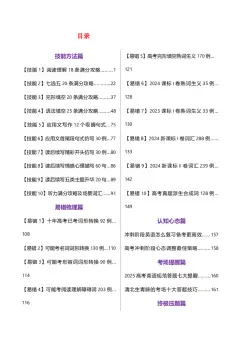
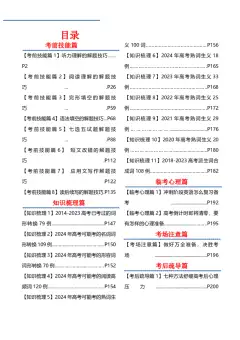
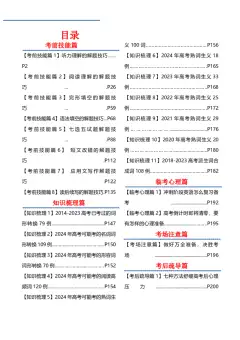
目录
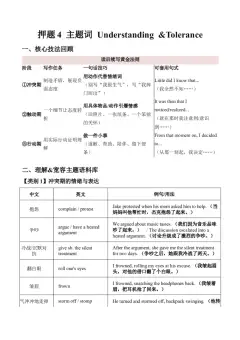
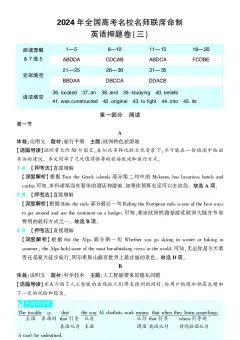
读后续写一句多译(三)
九、他们跳入水中,很快就到了两兄弟那里。
(1) They dived into the water and soon reached the two brothers.
(2) Plunging into the water, they swiftly arrived at the brothers' location.
(3) Making a dive into the water, they speedily made their way to the two brothers.
十、她用轻微颤抖的手打开了礼物。
(1) She opened the gift with her hands shaking slightly.
(2) She unwrapped the gift with slightly trembling hands.
(3) Her hands trembled slightly as she opened the present.
十一、那个人打开自己的行李,把裤子给了一个完全陌生的人.
(1)The man opened his own luggage and gave a complete stranger his pants.
(2) The man opened his luggage and gave a pair of pants to a complete stranger.
(3) The person unpacked his belongings and bestowed a pair of pants upon a complete
stranger.
十二、在试图游回来但失败后,他们开始挥手尖叫寻求帮助。
(1)After trying and failing to swim back, they started waving and screaming for help.
(2)After attempting to swim back but failing, they began waving their hands and
screaming for help.(3)Unable to swim back, they frantically waved and screamed, seeking assistance.
(4)Having failed in their attempt to swim back, they frantically waved and cried out for
aid.
保温小卷
阅读理解C篇---人与社会,保护拟消失的语言
阅读理解D篇---人与社会,回声定位技术为盲人开发感知软件
阅读理解七选五---人与自我,如何发展批判性思维技能
完形填空---人与社会,野火废墟上创作画作为受灾者带来希望的故事
语法填空---人与社会,老外第一次中国游的经历和感受
增值礼包
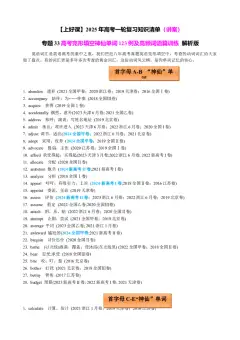
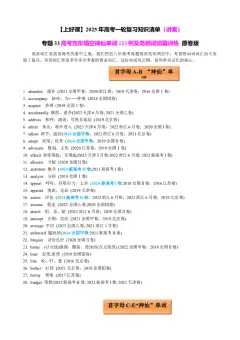
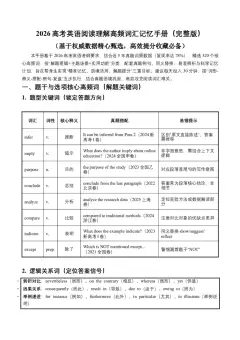
2019-2023高考完形填空高频词汇
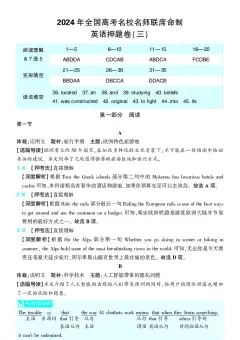
保温小卷
第二部分 阅读(共两节,满分50分)
第一节(共15小题:每小题2.5分,满分37.5分)
阅读下列短文,从每题所给的A、B、C、D四个选项中选出最佳选项。
C
Right now someone is speaking or thinking in a language that is on the verge of disappearing. Of the world’s
roughly 7,000 spoken languages, one dies every 40 days, according to one estimate—languages like Babanki, spoken
in Cameroon.
And some of the places where rare languages are the most concentrated are also most vulnerable (易受影响
的) to climate change. Especially, linguists call global warming the final nail in the coffin (致命一击) for more than
half of humanity’s language disappearing.
Let’s take Vanuatu, a South Pacific island nation, for example. It’s very small, but it has 110 languages spoken
there, which is the highest density (密度) of languages in the world. It is also one of the countries most at risk of sea
level rise and climate change. There, you can often see perfect hurricanes.
So if rising seas or storms force people in Vanuatu to move to Australia, what happens to the language they
speak? Well, what often happens is that they aren’t necessarily displaced with the same people in their community,and also, even if they are displaced with other people in their community, they and their children will often adopt the
language of Australia, the dominant language there because it’s economically advantageous for them to speak the
new language, the dominant language. And their language dies.
However, there is so much culturally lost when a language dies. It is because the language carries so much
local knowledge and culture.
In fact, in the 1970s, it was something like 2,000 native speakers of Hawaiian remained. But activists
launched some schools where children are taught from birth, usually by kind of grandparents, and now more than
18,700 people speak it. And the same thing happened in New Zealand in the 1970s. Only 5% of young Maori people
spoke the language, but now something like 25% now speak it.
28.What do we know about Vanuatu?
A.Its most languages have died out.
B.It is sensitive to climate change.
C.It witnesses various disasters every year.
D.It is the highest density of population in the world.
29.What will happen to people who are forced to leave Vanuatu for Australia?
A.They lose their advantages in economy.
B.They have few chances to speak their own language.
C.They fail to contact people in their previous community.
D.They willingly teach their kids the language of Australia.
30.What is the author’s attitude towards language disappearing?
A.Favourable.
B.Concerned.
C.Doubtful.
D.Unclear.
31.What does the last paragraph want to convey?
A.More languages are faced with dying out.
B.It’s a must for kids to learn their mother tongue.
C.Grandparents play a vital role in passing down languages.
D.More efforts have been made to save endangered languages.
D
Working with ARIA Research, a startup developing vision for the blind, Phoebe Peng is using technologically
advanced human echolocation (回声定位) that enables blind users to perceive their surroundings in precise detail.
The process uses event cameras which, unlike normal cameras that take complete images of a scene, trackchanges in an image over time, making them ideal for the observation of small objects like table tennis balls. The
images are then processed into sound using a specialised algorithm (算法). This is then communicated back to the
player via a lot of loudspeakers, ultimately with the aim of allowing players to track the ball and movements using
sounds.
According to Peng, table tennis makes a perfect test case for the kind of technology being developed by ARIA
Research. “Table tennis has been played for decades as a more accessible version of tennis. The sport is beginner-
friendly while maintaining a rich level of competitive play. However, like many sports, it remains difficult for people
who suffer vision loss or have low vision,” said Ms Peng, who will soon complete a Bachelor of Engineering in
Software Engineering.
“The small size of the ball and table, along with the movement of the ball in 3D space, are things that make
table tennis difficult to play for those with low vision and complete blindness,” said Peng, who is completing the
work for her degree. “Making this sport more accessible while also exploring the potential of event cameras were my
two biggest motivators,” she said.
In one study, using two perfectly positioned cameras, Ms Peng was able to identify and track a ball in three
dimensions in real time. She then fed that data into an algorithm controlling the loudspeakers standing along the
sides of the table, which created a sound field matching the position of the ball.
While the results are promising, more experimentation will be needed before the system will be ready for
actual play. “There are limitations on how accurately people can perceive sound localisation. What type of sound
should be used? Should the sound be continuous? This is what we’ll be tackling in the next stage of development,”
said Ms Peng.
32.How are event cameras different from normal ones?
A.They can have sounds located.
B.They are linked with loudspeakers.
C.They constantly follow image changes.
D.They take complete images of a scene.
33.What makes table tennis a perfect test case for the research?
A.Its unique feature.
B.Its fierce competition.
C.Its technical complexity.
D.Its beginner-friendliness.
34.What is the last paragraph mainly about concerning the study?
A.Its inspiring results.
B.Its promising future.C.Its practical applications.
D.Its technological challenge.
35.What could be the best title for the text?
A.Technology Opens up Blind Table Tennis
B.Blind People Work Wonders in Table Tennis
C.Event Camera Reshapes Future for the Disabled
D.Algorithm Helps Translate Imagination to Sound
第二节(共5小题:每小题2.5分,满分12.5分)
阅读下面短文,从短文后的选项中选出可以填入空白处的最佳选项。选项中有两项为多余选项。
How to Develop Critical Thinking Skills
There’s no magic method to change your thinking processes. Improvement happens with small, intentional
changes in your everyday habits until a more critical approach to thinking is automatic. Here are some tips for
building stronger self-awareness and learning how to improve critical thinking:
Be careful
36 . One of the key principles of critical thinking is asking questions and analyzing the available
information. You might surprise yourself at what you find when you stop to think before taking action. Before
making a decision, use evidence, logic, and reasoning to support your own opinions or challenge ideas. 37
.
Ask open-ended questions
“Yes” or “no” questions invite agreement rather than reflection. 38 . Digging deeper can help you
identify potential biases, uncover assumptions, and arrive at new possible solutions.
Learn to be quiet
Active listening is the intentional practice of concentrating on a conversation partner instead of your own
thoughts. 39 . If you’re brainstorming with your team or having a 1:1 with a coworker, listen, ask
clarifying questions, and work to understand other people’s viewpoints. This will help you find weaknesses in
arguments for better solutions.
Put it down
Recording your thoughts with pen and paper can lead to stronger brain activity than typing them out on a
keyboard. If you’re stuck and want to think more critically about a problem, writing your ideas can help you process
information more deeply. 40 . Ideas are more likely to remain in the background of your mind, leading to
deeper thinking that informs your decision-making process.
A.Comparing different views helps you learn
B.There’s nothing wrong with a little bit of doubtC.It helps you avoid being misled by inaccurate information
D.It involves focusing on details and valuing others’ opinions
E.Try to engage with people who help you develop your ideas
F.The act of recording ideas on paper can also improve your memory
G.Instead, ask open-ended questions that force you to engage in analysis
第三部分英语知识运用(共两节,满分30分)
第一节(共15小题;每小题1分,满分15分)
阅读下面短文,从每题所给的A、B、C、D四个选项中,选出可以填入空白处的最佳选项。
It was the most destructive wildfire in California history. It started in Paradise (天堂镇) and caused $16.5
billion in 41 , destroying nearly 19,000 buildings and killing 85 in all. The beauty of this 42 named
place was gone.
Grammer, working in Los Angeles, grew up there. When his friend Edwards posted pictures of his white
chimney — the only part of his house to survive — he felt 43 . And then he had an idea.
“I’ve got to 44 that chimney,” he says, “I’m not trying to say anything. I’m an artist. It was an
opportunity for me to 45 .”
Grammer spent three hours painting an image of a woman on the 46 — a reminder of the chimney, of
the beauty of life, or even just of 47 itself.
Grammer posted the image on Instagram. Those who were affected by the fire, 48 , could not calm
down. Someone 49 , “You bring beauty and hope.”
Greatly inspired, Grammer returned eight times. Outside one house, he found a photo of a girl, Eleanor. He
painted a picture of her on the wall of her home left 50 . It was a stamp that life was here and that life
can 51 to be here. The painting has 52 meaning for the homeowner. Eleanor’s father,
recalls how she used to play just feet away. Eleanor herself returned once to 53 the painting.
Ironically (讽刺的是) that first painting, on the chimney in Paradise, 54 only a few months —
the bulldozer (推土机) is a cruel art critic. However, Grammer couldn’t be more delighted. It means that the 55
of Paradise is rising again.
41.A.damage B.collection C.debt D.reserve
42.A.basically B.generally C.beautifully D.seriously
43.A.disappointed B.interested C.helpless D.fearless
44.A.beautify B.paint C.build D.repair
45.A.succeed B.improve C.practice D.express
46.A.chimney B.wall C.window D.door
47.A.art B.life C.nature D.beauty48.A.on average B.in general C.on earth D.in particular
49.A.argued B.insisted C.posted D.suggested
50.A.standing B.existing C.fallen D.destroyed
51.A.pretend B.afford C.continue D.decide
52.A.new B.special C.practical D.real
53.A.copy B.handle C.donate D.admire
54.A.flashed B.suffered C.survived D.waited
55.A.spirit B.size C.fame D.power
第二节(共10小题;每小题1.5分,满分15分)
阅读下面短文,在空白处填入1个适当的单词或括号内单词的正确形式。
My journey to China first began in 2017. At that time I 56 (admit) to China Three Gorges University in
China. I was both happy and 57 (frighten) as I was traveling to a new country with no travel experience. I
wondered whether I would be able to deal with the culture environment, food, and language much different from my
home country of Nepal.
But 58 I encountered as I stayed here were many acts of kindness from the people. 59 the
language barrier, I found almost all Chinese more than willing to help and guide whenever needed. During my stay
in Yichang, I also learned some Chinese for daily life, 60 (help) me adapt to the local environment, food,
language, and culture.
Of the many things I am impressed about China, one of them is public 61 (safe), apart from its
excellent transportation infrastructure, 62 makes it possible for anyone to travel just about anywhere with
ease.
After two years of the COVID-19 pandemic, I am back in this beautiful country to continue my education at
Tsinghua University, I can’t wait 63 (explore) this country againg. I’m not sure what the future holds, 64
what I am sure of is that I am going to explore this country even more in the future. I shall 65 (proud) share
my beautiful experience in this wonderful land with a larger audience.
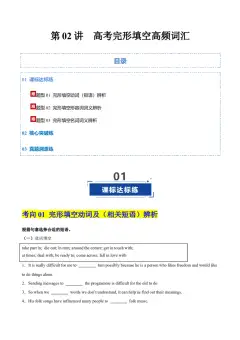
增值礼包:完形填空高频词汇
abandon v. 遗弃,抛弃(需要保护或帮助的人);丢弃,舍弃(某物)
acquire v. (通过自身努力)掌握,获得
advocate v. 提倡;赞成;主张
analyze /analyse v. 分析;剖析
appeal v. 吸引力;感染力;魅力;恳求;请求;上诉
appoint v. 指定;任命;委派assess v. 评价;评估;评定
accompany v. 陪伴,陪同(某人);为……伴奏
address v. (在信件、包裹等上)写收信人姓名地址;致辞;演讲;处理;应对
admit v. (勉强)承认,接受;准许进入
adopt v. 收养,领养;过继;采纳,采取,采用(别种方式、方法等)
allocate v. 分配;分派
assist v. 帮助,协助
assume v. 假定;假设;认为
attach v. 系上;贴上;连接;归属;附加
attempt v. 企图;试图
bargain v. 讨价还价;商讨条件
bathe v. (以光线)撒满,覆盖;使沐浴(在光线下);洗澡
bear v. 忍受;承受;容忍;承担;负担
bite v. 咬;(昆虫或蛇)叮,蜇,咬
bother v. 使烦扰;使不安;打断;打扰
betray v. 背叛;违背(信仰、原则等)
calculate v. 计算;估算;推测;预测
clarify v. 使清楚;使更清晰
confirm v. 确证;证实;证明;确认;确定
crash v. 猛撞;撞毁
cancel v. 取消;撤销;使作废;终止;废除
claim v. 声称;断言;认定;索要;要求
commit v. 犯(罪);做(坏事或错事);(使)承诺,承担义务
convince v. 使信服;说服(某人做某事)
deliver v. 递送;传送;发表;宣布;发布
declare v. 公布;宣布;声称;宣称;断言
defeat v. 击败,战胜
defend v. 防御,保护,保卫
demand v. 强烈要求
deny v. 否认;拒绝承认;拒绝给予
disturb v. 打扰;干扰;妨碍;使烦恼;使焦虑;使不安
display v. 显露;展示;表现;显露;展示;表现
donate v. 捐赠;捐献
drag v. (费力地)拖,拉,拽;(用鼠标)拖动
define v. 给……下定义;阐明;使明确;使清楚
deserve v. 应受;应得;值得
distinguish v. 辨别;区别;区分;使有别于;使……有特色
distribute v. 分发;发放;分配;散布;使分布
dive v. 跳水(双臂和头先入水);俯冲;(向某物)起跳,扑去,冲去
encounter v. 遭遇,遇到(问题或困难等);偶然碰到;意外遇见;与……邂逅
erupt v. 爆发;突然发生;突然开始(喊叫、鼓掌等)evaluate v. 评估;评价
expand v. 扩大;扩展;膨胀;充分阐述;详述;把……全部写出
expose v. 暴露;使遭受;使处于……影响(或作用)下;揭穿,揭发(隐情、欺诈等)
fade v. 逐渐消失;衰弱;褪色
forbid v. 禁止;不准
frame v. 表达;制订;装框;装裱
imply v. 暗指;暗示
interrupt v. 使中断,使暂停
involve v. 包含;牵涉;使参与;使参加
identify v. 认出;识别;查明;发现
load v. 装上,装入
make v. 成功获得或达到(某一位置、速度等)(熟词生义)
migrate v. 移居;(候鸟或动物)迁徙
matter v. 有重大影响;要紧;事关紧要
measure v. 量;测量;计量;衡量,判断(某事物的重要性、价值、程度等)
pace v. (尤指因紧张而)来回踱步,走来走去
pave v. 铺(路)
postpone v. 推迟;延后
permit v. 允许;准许;使……有可能
persuade v. 劝说,说服
predict v. 预言;预告;预报
prohibit v. (尤指以法令)禁止 ;阻止
pray v. 祈望;企盼;祈求;恳求
promise v. 许诺;承诺;答应;保证
purify v. 使(某物)洁净;净化;精炼
quit v. 离(任);离(职);停止;戒掉;迁出;搬走
qualify v. 使……合格;使……胜任;获得资格;使……具有权利
reserve v. 预订,预约(房间、桌子、座位等)
recite v. 朗诵;诵读;背诵
reflect v. 反映;认真思考;仔细考虑;(光、声等)反射
register v. 登记,注册(信息);流露出,表达出(某种情感)
remove v. 去除;脱下;摘下;去掉;除去;消除
repeat v. 重复一遍;复述;重做;再次达到
reunite v. 使重逢;使团聚;使再联合
review v. 审查;检查;审核;评论;温习
roll v. 滚动;打滚;翻滚;把身体缩成一团;隆隆;轰鸣
rush v. 快速移动;冲;奔;仓促行动;急速流向;涌向
sacrifice v. 牺牲
score v. (在游戏或比赛中)得分
seize v. 抓住,把握(机会等);(某种情绪)突然侵袭
shine v. 出色,出类拔萃simplify v. 使简单;使容易
ski v. 滑雪;滑水
skyrocket v. 飞涨,猛涨
sink v. 下沉;下陷;沉没;(心情)低落;陷入(沮丧);减少;降低
start v. 发动;启动
strike v. 打;撞;(灾难、疾病等)侵袭;使受灾难;突然想到;突然意识到
skip v. 跳过;略过;蹦跳;蹦跳着走;跳绳
spot v. 看到;认出;注意到
submit v. 认输;屈服;提交
swear v. 咒骂;发誓
switch v. (使)改变,转变;交换
sew v. 缝;缝补;缝纫
split v. (尤指沿着一条直线)裂开;分开;使分裂(成不同的派别);分摊;分担
sponsor v. 赞助;资助;倡议
tell v. 看出;确切地判断(熟词生义)
transform v. 使改观,彻底改变
tremble v. (因害怕、紧张、兴奋等)颤抖,哆嗦
trust v. 想;希望;期望(熟词生义)
urge v. 敦促;强烈要求;催促;力劝;驱赶;鞭策
volunteer v. 自愿做;义务做;无偿做;自愿提供;主动给予
witness v. 目睹(某事发生);是发生……的地点(或时间);见证
wander v. 闲逛;游荡;徘徊;蜿蜒
weep v. 哭泣;流泪
whisper v. 低语;发出沙沙声;发出习习
zoom v. 快速移动;疾行;激增
增值礼包:应用文押题
假定你是李华, 英语老师安排你今天做课前演讲,你打算谈谈上周班内英语辩论赛,内容包括:
1.你的观感;
2. 你的建议。
增值礼包:读后续写押题(竞选谦让之美德)
阅读下面材料,根据其内容和所给段落开头语续写两段,使之构成一篇完整的短文。
I didn’ t like Del so much. He always called me the nickname “ Germy,” which
meant“dirty,”instead of my real name“Jamie.”Besides, he was known as a trouble-maker in school.Sowhen the head teacher Mr. Smith asked Del to come to his office, I naturally thought that Del had done
something mean to someone. Through the window, I caught sight of a smaller boy crying. Del seemed
unhappy, too.
He did not return to class that day. All of us were discussing what had happened to him.What
else could such an annoying boy do?“He must have hit the boy and was sent home,”I whispered to my
friends. Their eyes widened. It felt good to see them so interested in what I said.
The next morning, the whole school was talking about Del being expelled (开除) for beating up
a kid. I was surprised that my assumptions were passed on so quickly. So when Del walked into the
classroom, all the kids were shocked. The kids next to him shifted their desks away.“What’s your
problem?” Del asked.“ I don’ t want you to attack me,” one kid said. Some laughed.“ Yeah, I
might,”said Del. I could tell he was joking, but many kids thought he admitted he did beat up someone.
During recess(课间休息), Del tried to join the kickball game.“Neither team wants you,”one of
the players said.“Why?”Del asked, looking confused.“I always play with you guys.”They ignored him
and went on playing. Del sat by himself while the rest of the school enjoyed their recess away from him.
Del looked lonely and sad, much different from before. I started to feel sorry for him.
Later that day, I learned what really happened. The kid was Del's little brother and he was crying
because their mother fell ill and was sent to hospital. I felt even sorrier for what I said before. I started a
rumor (谣言).
注意:
1、续写词数应为 150 左右;
2、请按如下格式在答题卡的相应位置作答。
续写第一段开头句:
At recess the next day, I saw Del sitting alone watching the kickball game.
续写第二段开头句:
Now that Del had forgiven me, I decided to do more before the recess was over.