2025—2026 学年高一上学期9 月开学
英语试卷
(试卷满分150 分,考试时间120 分钟)
注意事项:
1. 答卷前,考生务必将自己的姓名、考生号等填写在答题卡上。
2. 回答选择题时,选出每小题答案后,用铅笔把答题卡上对应题目的答案标号涂黑。
如需改动,用橡皮擦干净后,再选涂其他答案标号。回答非选择题时,将答案写在答题卡
上,写在本试卷上无效。
3. 考试结束后,将本试卷和答题卡一并交回。
第一部分  听力(共两节,满分30 分)
做题时,先将答案标在试卷上。录音内容结束后,你将有两分钟的时间将试卷上的答
案转涂到答题卡上。
第一节(共5 小题;每小题1.5 分,满分7.5 分)
听下面5 段对话。每段对话后有一个小题,从题中所给的A、B、C 三个选项中选出最
佳选项,并标在试卷的相应位置。听完每段对话后,你都有10 秒钟的时间来回答有关小题
和阅读下一小题。每段对话仅读一遍。
1. What kind of fruit does Adam like best?
A. Oranges.
B. Apples.
C. Pears.
2. Why does the man call Olivia?
A. To invite her to a party.
B. To cancel an appointment.
C. To ask about the homework.
3. What are the speakers going to do next?
A. Have a meeting.
B. Wait for Mark.
C. Go to the hospital.
4. What will the weather be like this afternoon?
A. Cloudy.
B. Rainy.
C. Sunny.
5. What are the speakers talking about?
A. A new measure.
B. A car accident.
C. City traffic.
第二节(共15 小题;每小题1.5 分,满分22.5 分)
听下面5 段对话或独白。每段对话或独白后有几个小题,从题中所给的A、B、C 三个
选项中选出最佳选项,并标在试卷的相应位置。听每段对话或独白前,你将有时间阅读各
个小题,每小题5 秒钟;听完后,各小题将给出5 秒钟的作答时间。每段对话或独白读两
遍。
听下面一段对话,回答第6 和第7 两个小题。
6. Where did Cindy grow up?
A. In England.
B. In Germany.
C. In Poland.
7. Why did Cindy come to Beijing?
A. For study.
B. For work.
C. For sightseeing.
听下面一段对话,回答第8 和第9 两个小题。
8. How old is Clark now?
A. 10.
B. 12.
C. 22.
9. What will Clark do in New Zealand in September?
A. Take a holiday.
B. Visit his family.
C. Receive some training.
听下面一段对话,回答第10 至第12 三个小题。
10. What is the book mainly about?
A. A writer.
B. An artist.
C. A parrot.
11. Who drew pictures for the book?
A. Amy Guglielmo.
B. Brett Helquist.
C. Cezanne.
12. How does the man feel after reading the book?
A. Encouraged.
B. Disappointed.
C. Surprised.
听下面一段对话,回答第13 至第16 四个小题。
13. What is Jennifer?
A. A teacher.
B. A student.
C. A tour guide.
14. What will Jennifer do first this summer?
A. Do some volunteer work.
B. Take a trip abroad.
C. Visit her grandparents.
15. What subject will the man probably teach?
A. English.
B. Geography.
C. Science.
16. When will the man finish his work in Nepal?
A. On July 10th.
B. On July 16th.
C. On July 23rd.
听下面一段对话,回答第17 至第20 四个小题。
17. Who needs a babysitter now?
A. The speaker’s relative.
B. The speaker’s neighbor.
C. The speaker’s friend.
18. Where do the couple most probably work?
A. At a restaurant.
B. At a hospital.
C. At school.
19. When does the babysitter need to work?
A. In the morning.
B. In the afternoon.
C. In the evening.
20. What are the couple like according to the speaker?
A. Easy-going.
B. Serious.
C. Interesting.
第二部分 阅读(共两节,满分50 分)
第一节(共15 小题;每小题2.5 分,满分37.5 分)
阅读下列短文,从每题所给的A、B、C、D 四个选项中选出最佳选项。
A
Four Beautiful Beaches In Singapore
In Singapore, there are a range of special beaches where you can relax for a day. At
these popular beaches, you’ll feel as if you’re in paradise (天堂) — like Bali. Here are
four of the best beaches there.
Tanjong Beach
The white-sandy beach is man-made and it’s the perfect place to relax in the sun,
read a book away from the crowds, or go for a swim in the ocean. Especially, the
Tanjong Beach Club is a top nightlife spot for drinking cocktails (鸡尾酒) and enjoying
water sports like surfing.
St. John’s Island Beach
You can enjoy a quiet beach on St. John’s Island. This pretty place has a beach
that’s great for sunbathing, swimming in clear water, and having picnics away from the
city. Visitors can also spot unique marine life ( 海洋生物), go fishing, and even rent
cabins or bungalows to stay on the island. Make sure to bring everything you need —
there are no shops on the island.
Coney Island
Coney Island beach is the perfect place to relax away from the crowds. This hidden
destination offers a couple of sandy spots to relax — whether you’re walking or cycling
around Coney Island. It is definitely one of the best beaches to visit alone for a therapeutic (治
愈的) experience.
Pulau Hantu
This island has a quiet beach far from busy tourist spots. The island consists of two
small islands that join at low tide. There’s soft white sand and clear blue-green water
here, teeming with (充满) colorful corals and marine life. People often camp overnight on
the island, as it is only accessible by boat.
Enjoyed this? Check out The

   Best

   Island

   Getaways

   In
    and

   Around

   Singapore.


21. Which place is hard to return from in one day?
A. St John’s Island.
B. Tanjong Beach.
C. Coney Island.
D. Pulau Hantu.
22. What does the four beaches have in common?
A. They are famous for the nightlife.
B. They provide a quiet atmosphere.
C. They have fishing nets for rent.
D. They are popular with cyclists.
23. Where is the text probably taken from?
A. A magazine.
B. A textbook.
C. A website.
D. A report.
B
Yesterday, my 6-year-old son taught me a valuable lesson that stayed with me for
hours. It might sound surprising, but he taught me a powerful lesson.
A few weeks ago, I had to travel for work, and I couldn’t spend much time with
my son. Even though he is a bit stubborn (固执的), he’s growing up fast. That’s when
the lesson happened. While I was eating dinner, he was in the bath, and suddenly he
started crying. I asked him what happened, and he said, “Shampoo (洗发水) got in my
eyes.”
I got really worried and rushed into the bathroom. I tried to help by splashing (泼)
water on his eyes, but things got worse when he rubbed his eyes with his soapy hands. I
was nervous, telling him not to use his hands.
Out of the blue, he said, “ Calm down! Dad.” It amazed me. I realized I was
making things worse. I stopped splashing water, washed his hands, and calmly told him to
use his hands to clean his eyes while blinking (眨眼). It worked, and he felt better.
I’m not sure where he learned to stay calm, maybe from me or somewhere else. But
the bigger lesson is that when we face problems, acting emotionally and quickly might
not be best. Staying calm and thinking about the right solution is better.
In today’s tough job market with many people losing their jobs, it’s easy to feel
worried. My son’s lesson reminded me that staying calm and taking a moment to relax
can help us face challenges with a clear mind, more energy, and better solutions.
24. What happened to the author’s son yesterday?
A. He argued with his dad.
B. He fell in the bathroom.
C. He got angry due to the meal.
D. He felt something in his eyes.
25. Why did the author worsen the situation at first?
A. He missed an important step.
B. He told his son to keep quiet.
C. His hands were covered with soap.
D. His son disagreed with his advice.
26. How can we solve problems according to the author?
A. By putting forward many ideas.
B. By getting our thoughts straight.
C. By turning to friends for assistance.
D. By finding out causes behind them.
27. What does the author’s experience show?
A. Knowledge is power.
B. Still waters run deep.
C. Parenting is learning.
D. Actions speak louder.
C
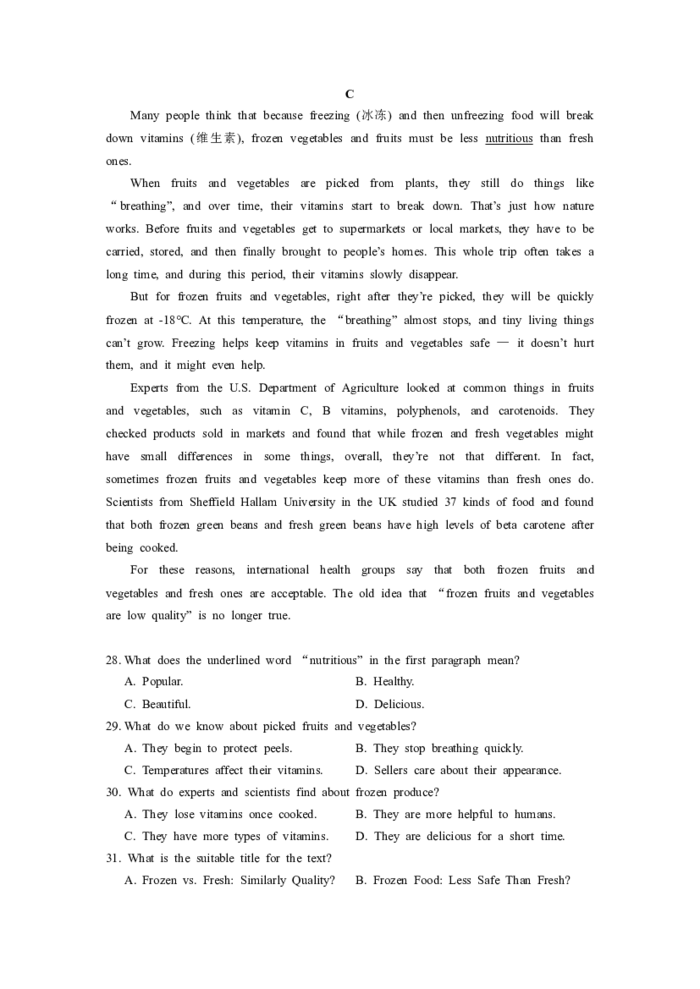
Many people think that because freezing (冰冻) and then unfreezing food will break
down vitamins (维生素), frozen vegetables and fruits must be less nutritious than fresh
ones.
When fruits and vegetables are picked from plants, they still do things like
“breathing”, and over time, their vitamins start to break down. That’s just how nature
works. Before fruits and vegetables get to supermarkets or local markets, they have to be
carried, stored, and then finally brought to people’s homes. This whole trip often takes a
long time, and during this period, their vitamins slowly disappear.
But for frozen fruits and vegetables, right after they’re picked, they will be quickly
frozen at -18°C. At this temperature, the “breathing” almost stops, and tiny living things
can’t grow. Freezing helps keep vitamins in fruits and vegetables safe — it doesn’t hurt
them, and it might even help.
Experts from the U.S. Department of Agriculture looked at common things in fruits
and vegetables, such as vitamin C, B vitamins, polyphenols, and carotenoids. They
checked products sold in markets and found that while frozen and fresh vegetables might
have small differences in some things, overall, they’re not that different. In fact,
sometimes frozen fruits and vegetables keep more of these vitamins than fresh ones do.
Scientists from Sheffield Hallam University in the UK studied 37 kinds of food and found
that both frozen green beans and fresh green beans have high levels of beta carotene after
being cooked.
For these reasons, international health groups say that both frozen fruits and
vegetables and fresh ones are acceptable. The old idea that “frozen fruits and vegetables
are low quality” is no longer true.
28. What does the underlined word “nutritious” in the first paragraph mean?
A. Popular.
B. Healthy.
C. Beautiful.
D. Delicious.
29. What do we know about picked fruits and vegetables?
A. They begin to protect peels.
B. They stop breathing quickly.
C. Temperatures affect their vitamins.
D. Sellers care about their appearance.
30. What do experts and scientists find about frozen produce?
A. They lose vitamins once cooked.
B. They are more helpful to humans.
C. They have more types of vitamins.
D. They are delicious for a short time.
31. What is the suitable title for the text?
A. Frozen vs. Fresh: Similarly Quality?
B. Frozen Food: Less Safe Than Fresh?
C. Storing Vegetables: Tips for Freezing.
D. Markets: Selling More Frozen Foods.
D
People make a choice to volunteer for their community, but making it a graduation
requirement takes away the meaning of volunteerism. Many states require students to
perform a set number of volunteer hours to graduate. With recent talks about
implementing ( 实施) this in Virginia City Public Schools, a critical question arises: if
volunteering is mandatory (强制性的), is it truly volunteering?
Required or not, volunteering helps other people who are in need and helps the
community as a whole. Requiring students to volunteer will increase the number of people
who serve their community, but people volunteer out of the kindness of their hearts. They
should not be forced to volunteer by someone else. “When students are told what to do
or think, they lose drive to do it because their beliefs are ignored,” according to
Brillianto’s article “Why Volunteering Should Not Be a Requirement.”
Another problem with forced volunteerism is that not all students have transportation.
“I don’t think it should be required to graduate. I think it should be a choice like it
already is, because some people just don’t have the ability or transportation to do that,”
said sophomore Leila Alpaugh.
“Quality over quantity” also comes into play when it comes to volunteering. If forced
to volunteer, some students who don’t care about the cause will weaken the passion of
others who do, and it can end up causing problems for the organization and others who
volunteer there.
So, instead of making volunteering a requirement, schools should encourage students
to talk to a guidance counselor (辅导员) about current service projects they could take
part in.
32. What makes volunteering less meaningful?
A. Limited service choices.
B. Linking it to graduation.
C. Boring volunteer classes.
D. Recording service hours.
33. What does the author imply in paragraph 2?
A. Forced volunteering helps few people.
B. Forced volunteering becomes common.
C. Volunteers’ real thoughts matter.
D. Schools’ rules have bad effects.
34. What does the author show by mentioning “transportation”?
A. The importance of enough choices.
B. The challenge in serving strangers.
C. The trouble in reaching an agreement.
D. The unfairness of forced volunteering.
35. What is the author’s attitude toward forced volunteering?
A. Indifferent.
B. Objective.
C. Careful.
D. Critical.
第二节(共5 小题;每小题2.5 分,满分12.5 分)
阅读下面短文,从短文后的选项中选出可以填入空白处的最佳选项。选项中有两项为
多余选项。
Losing a small wetland might not seem like a big problem for the whole world or even a
whole country.
  36

   Now, when it rains, the town gets flooded. And it’s terrible for the special
animals and plants that live there.
Luckily, countries and international groups are starting to see how important wetlands are —
both for local places and the whole world. Some have made “no-net-loss” rules to make sure the
total number of wetlands won’t get smaller.
  37


  38

   For example, over $10 billion (£8.2 billion) has been used on a 35-year plan to fix
the Florida Everglades. This is a special group of subtropical wetlands, and it’s the biggest and
most expensive ecological repair project in the world.
Many places are also making new wetlands. In Britain, beavers (水獭) are being brought
back to some enclosed areas. It’s hoped this will make more wetlands in the country, and bring all
the good things these homes can give. Beaver dams (坝) and the wetlands they make can cut
flooding by up to 60%.
  39

   One study found that because of these cute “workers”, the
number of local mammal (哺乳动物) types went up by 86%.
It doesn’t really matter if the world has lost 20% or 50% of its wetlands.
  40

   As the UN
said recently, 1 billion people depend on wetlands to make a living. Saving and fixing these
important homes is key to having a future where we can live well without harming the planet.
A. But it’s really bad for the nearby town.
B. They also help more wild animals live there.
C. Wetlands provide food and homes for beavers.
D. After all, wetlands seem less important than rivers.
E. That means builders must fix any wetlands they destroy.
F. Wetland are being protected around the world at huge costs.
G. What matters is that people stop regarding wetlands as useless.
第三部分  语言运用(共两节,满分30 分)
第一节(共15 小题;每小题1 分,满分15 分)
阅读下面短文,从每题所给的A、B、C、D 四个选项中选出最佳选项。
Emily Chen is a doctor at a top hospital. She felt proud of her good medical
  41

   and
knowledge, which were often praised by patients. But her
  42

   changed a lot when her
mother got very serious lung cancer (stage IV). This
  43

   incident made Dr. Chen see how the
hospital system works from the side of
  44

   for the first time.
When her mother was getting treatment, Dr. Chen could
  45

   see how confused (困惑
地) and scared patients often are. She noticed her mother had a hard time
  46

   the difficult
medical words and too many treatment
  47

   that doctors and nurses talked about. Dr. Chen
realized this problem was about
  48

  . So she decided to start spending more time

  49

   medical terms in easy words and answering questions carefully — not just for her
mother, but for all the people she
  50

  .
Her mother’s
  51

   gave her a good idea. Dr. Chen set up a program in her department to
help patients, which taught hospital workers to talk to patients with
  52

  , making sure
patients felt that people
  53

   them and understood them during treatment. Her program has
helped many patients take an active part in their own care. It
  54

   that caring about others can
turn doctor-patient talks into working together like
  55

  .
41. A. reports
B. tests
C. tools
D. skills
42. A. thought
B. position
C. goal
D. personality
43. A. messy
B. cruel
C. fresh
D. strange
44. A. families
B. doctors
C. patients
D. nurses
45. A. suddenly
B. clearly
C. carefully
D. freely
46. A. repeating
B. spelling
C. grasping
D. trusting
47. A. choices
B. periods
C. rooms
D. predictions
48. A. availability
B. convenience
C. education
D. communication
49. A. translating
B. explaining
C. recording
D. learning
50. A. liked
B. admired
C. mentioned
D. helped
51. A. experience
B. attitude
C. support
D. bravery
52. A. warmth
B. confidence
C. humor
D. firmness
53. A. deal with
B. speak of
C. listened to
D. looked at
54. A. concludes
B. considers
C. expects
D. shows
55. A. winners
B. partners
C. relatives
D. competitors
第二节(共10 小题;每小题1.5 分,满分15 分)
阅读下面短文,在空白处填入1 个适当的单词或括号内单词的正确形式。
Early in the morning, when the sky starts to get light over
  56

   village near
Beijing, 75-year-old Hao Lanying is sitting
   57

   her desk. She has a pair of scissors
(剪刀) in her hand and is cutting a red piece of paper. The shape she is making is a
snake going around a bird. This design is one of a group of works she made
   58


(celebrate) the Year of the Snake.
“I made the ‘Lucky Snake’ series to give as gifts to elderly
  59

   (local),” Hao
said. She is from Jishanying Village in Shunyi District. She is someone
   60

   does
the art of paper cutting, which is known as an intangible cultural heritage.
Hao has a special skill
  61

   (call) water-ripple paper cutting. It started in a
family in Shunyi at the end of the Qing Dynasty. What makes her works so
  62


(attract) is that she uses scissors, not knives. With her good hands, she cuts small
patterns of moving water and falling rain on a single layer of red paper. This makes her designs
look like they are alive.
In 2004, UNESCO took one of her works to keep in its
  63

   (collect). For the last 20
years, her works
  64

   (give) as national gifts to leaders from many European countries.
Now, in the digital time, Hao is happy to try new ways to keep doing her work.
She has helped to make an AR teaching system for paper cutting. With this system,
people can scan her works and
  65

   (direct) watch, in a special 3D way, how the
whole thing was made.
第四部分:书面表达(共两节,满分40 分)
第一节(满分15 分)
假定你是英语课代表李华,班里不少同学向你反映外教Chris 的课堂活动形式单一,
大家的学习兴趣逐步减退,请你给Chris 写一封邮件,内容包括:
1. 反馈问题;
2. 提出建议。
注意:
1. 写作词数应为80 个左右;
2. 请按如下格式在答题卡的相应位置作答。
Dear Chris,
I’m writing to share some advice from the classmates.
Yours sincerely,
Li Hua
第二节(满分25 分)
阅读下面材料,根据其内容和所给段落开头语续写两段,使之成为一篇完整的短文。
Lily was a high school student who loved comparing herself with others. She always
cared about the latest clothes, expensive phones, and designer bags. Whenever someone
showed off a new item, she would feel jealous (嫉妒的) and want to buy something
better. Her parents often told her, “True value isn’t in what you own,” but she never
listened.
One day, Lily noticed a girl from another class, whose name was Coco. Coco’s
family was wealthy, but she always wore simple clothes and carried an old schoolbag.
Unlike Lily, Coco never joined in the students’ discussions about brands or prices. Instead,
she spent her time helping classmates with math problems or volunteering in the school
library. Her grades were always at the top of the class, and everyone respected (尊重)
her.
Lily couldn’t understand why Coco didn’t care about material things. One afternoon,
Lily saw Coco sitting alone under a tree, reading a book. She decided to talk to her.
“Why don’t you buy nicer things?” Lily asked. “Your family has enough money.” Coco
looked up with a smile. “I’d rather spend money on things that matter,” she said. “Like
helping others or buying books.”
That night, Lily thought about Coco’s words. She realized that she had been looking
for things that didn’t bring real happiness. The next day, she made a decision: she would
stop comparing herself with others and start focusing on what truly mattered.
注意:
1. 续写词数应为150 左右;
2. 请按如下格式在答题纸相应位置作答。
The following week, Lily began to learn from Coco.
Months later, teachers and classmates all praised Lily.