定价:9.90元
物 流 码
批准文号:渝发改价格〔2024〕778号 举报电话:12315
普通高中教科书
英 语
(必修第一册)
主编 杨晓钰
责任编辑:罗 亚 版式设计:罗 亚
责任校对:李定群 责任印制:赵 晟
*
重庆大学出版社出版发行
出版人:饶帮华
社址:重庆市沙坪坝区大学城西路21号
邮编:401331
电话:(023)88617190 88617185(中小学)
传真:(023)88617186 88617166
网址:http://www.cqup.com.cn
邮箱:fxk@cqup.com.cn(营销中心)
全国新华书店经销
重庆俊蒲印务有限公司印刷
*
开本:890mm×1240mm 1/16 印张:9 字数:388千
2020年8月第1版 2021年7月第2次印刷
ISBN 978-7-5689-2115-2 定价:9.90元
本书如有印刷、装订等质量问题,本社负责调换
版权所有,请勿擅自翻印和用本书
制作各类出版物及配套用书,违者必究
副主编 黄学军 伍家文
编 者 郑加明 吴华军 钟 艳
3
To the student
To the student
亲爱的同学,欢迎你随本书一起开始高中阶段的英语学习。我们希望充
满求知欲的你,能喜欢书中所提供的学习材料,喜欢各种鼓励探究和发展思
维、注重学习能力和学习习惯培养的教学设计。
高中英语学习是初中英语学习的延伸,同时也是新的英语学习生活的开
始。在这一阶段,提高基本语言运用能力极其重要,但提高用英语获取信
息、处理信息、分析和解决问题的能力,用英语进行思考和表达的能力,以
及跨文化交际的意识和基本的跨文化交际能力也必不可少;而掌握有效的英
语学习策略,提高自主学习能力,会帮助你更有效地学习,形成具有个性的
学习方法和风格,为将来进一步学习英语和终身发展打下良好基础。
关于本教材的使用,我们有以下建议:
1. 请仔细阅读每个主题前的学习导页,它会帮助你熟悉该部分的主要学
习内容,激发你思考与之相关的问题,为本主题的学习做好必要的准备。
2. 只有充分了解了学习目标,你才能在学习中处于主动地位,发挥主体
作用,才能使自己的“学”与教师的“教”形成协调发展的合力,从而取得
最佳的学习效果。因此,各单元的学习从研读 Looking Ahead 开始,并在每
个单元学习后根据 Self-assessing 帮助自己反思学习效果,调整自己的学习目
标、学习方式和学习进程。
3. Activating and Predicting 旨在最大限度地激活你与所学内容相关的背景
知识,激发你学习的兴趣和动机,为进入下一步学习做好准备。在本板块的
学习中一定要勤于思考,积极参与,勇于表达。
4.“学而不思则罔,思而不学则殆”,没有思考、缺乏创造性的学习
收获甚少。建议你在进行 Reading,Thinking and Analysing 部分课文的学
习时,不要忽略了页边注释和 TIP,一定要边学边思,学思结合,掌握策
略,举一反三,这样你才能真正提高阅读能力,逐渐成长为高效的英语阅
读者。
5. Exploring and Using 将为你轻松化解阅读课文中的语言知识,引导你通
过观察和分析,了解语法形式,理解语法意义,发现语法规则。这将帮助你
1
2
在真实语境中运用所学语言知识来理解和表达意义,加强准确、得体地使用语言的意
识,深化对语言的理解。
6. 在进行了大量的听说和阅读后,你一定记住了许多优美的词句、漂亮的段落,
一定发现了英语文章与汉语文章在风格和组织结构上的异同,也一定跃跃欲试地想用
英语表达自己的所感所想。这的确是一件值得高兴的事!那么,请一定经常读一读、
听一听、说一说、记一记一些好的句子和美文,并认真完成每课的写作任务,这样,
你的英语写作就会不断进步,逐步达到“行文如流水,落笔如有神”的境界。
7. 亲爱的同学,你注意到每个主题后的 Challenging Yourself 了吗?其中的
Recycling Time 帮助你归纳学习策略,进行词汇的分类复习;Word Builder 则提供不同
的猜词策略;Reading Land 鼓励你积极应用学习策略进行阅读课的自主学习。该板块
旨在培养你独立思考与合作学习的能力,养成积极反思的习惯,为终身学习和发展奠
定良好的基础。
8. 每个主题的 Learning Reflectively 板块,鼓励你主动进行自我评价,积极参与同
伴评价,同时虚心听取教师的评价。请相信,不断的反思会帮助你不断进步,不断走
向成熟,逐步成为一个成功的语言学习者。
9. 附录中的 Word Learning Booster 会引导你在学习新词汇的同时,注重对已学词
汇的定期复习,逐步养成良好的词汇学习习惯,记忆词汇也将不再是一件难事。
“学而时习之,不亦说乎?”古人告诉我们,学习要采取积极的态度,既要时
时、处处、事事地“学”,又要时时、处处、事事地“习”;于“学”中积累、丰
富、提高,于“习”中求巩固、受启发、得效益;争取日有所新,日有所获。这样你
的内心就能充满掌握英语学习真谛的愉悦。
我们衷心希望通过本教材的学习,能进一步激发你学习英语的热情和用英语交流
的欲望,最终能用英语了解、学习他国优秀文化,同时向世界介绍祖国灿烂的文化。
作为学习者,获取知识是一种乐趣,不断克服困难、不断创新也是一种乐趣。记
住永远对自己说:“I can do it!”。
愿你快乐地度过英语学习的每一阶段,享受克服困难的快乐,享受创新的快乐,
享受成功的快乐!
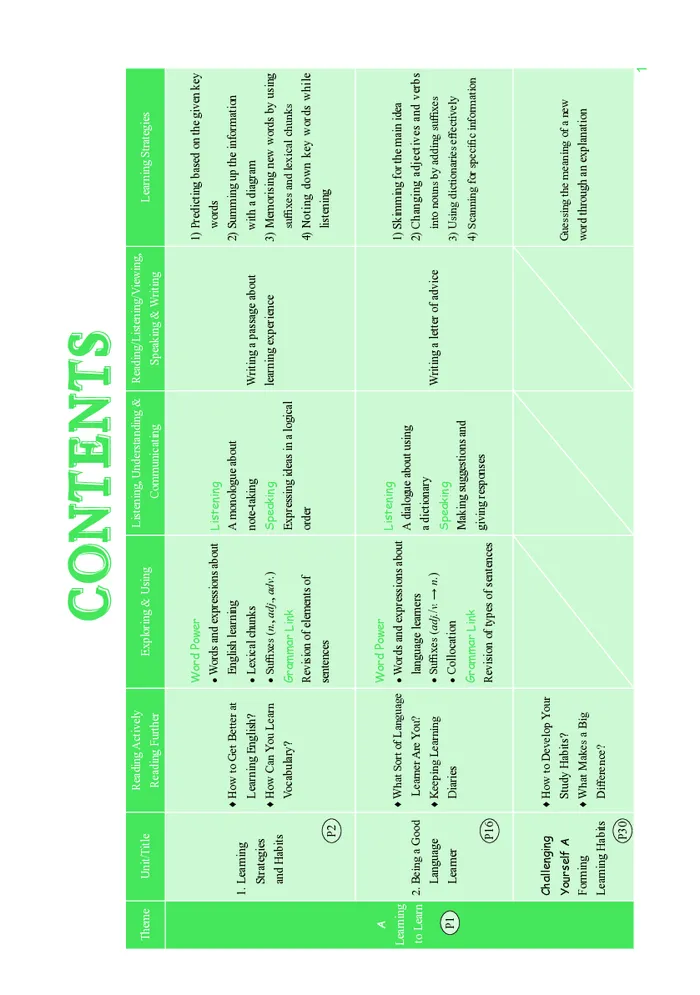
Theme
Unit/Title
Reading Actively
Reading Further
Exploring & Using
Listening, Understanding &
Communicating
Reading/Listening/Viewing,
Speaking & Writing
Learning Strategies
A
Learning
to Learn
1. Learning
Strategies
and Habits
♦ How to Get Better at
Learning English?
♦ How Can You Learn
Vocabulary?
Word Power
● �Words and expressions about
English learning
● �Lexical chunks
● Suffixes (n., adj., adv.)
Grammar Link
Revision of elements of
sentences
Listening
A monologue about
note-taking
Speaking
Expressing ideas in a logical
order
Writing a passage about
learning experience
1) �Predicting based on the given key
words
2) Summing up the information
with a diagram
3) �Memorising new words by using
suffixes and lexical chunks
4) �Noting down key words while
listening
2. Being a Good
Language
Learner
♦ What Sort of Language
Learner Are You?
♦ Keeping Learning
Diaries
Word Power
● �Words and expressions about
language learners
● Suffixes (adj./v. → n.)
● Collocation
Grammar Link
Revision of types of sentences
Listening
A dialogue about using
a dictionary
Speaking
Making suggestions and
giving responses
Writing a letter of advice
1) Skimming for the main idea
2) �Changing adjectives and verbs
into nouns by adding suffixes
3) Using dictionaries effectively
4) Scanning for specific information
Challenging
Yourself A
Forming
Learning Habits
♦ How to Develop Your
Study Habits?
♦ What Makes a Big
Difference?
Guessing the meaning of a new
word through an explanation
CONTENTS
P30
P16
P1
P2
1
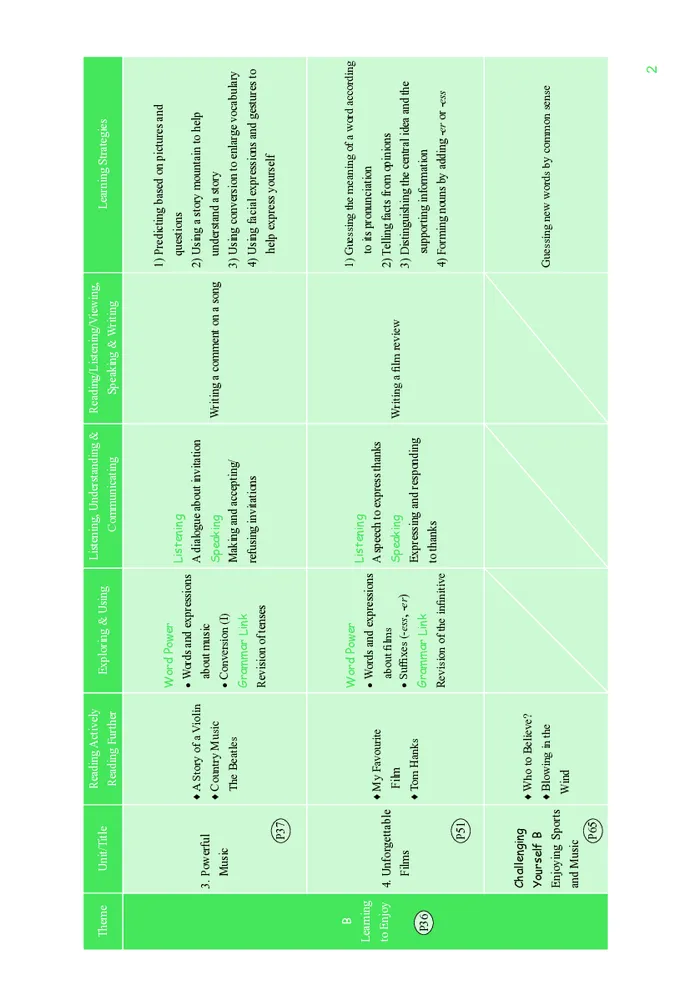
Theme
Unit/Title
Reading Actively
Reading Further
Exploring & Using
Listening, Understanding &
Communicating
Reading/Listening/Viewing,
Speaking & Writing
Learning Strategies
B
Learning
to Enjoy
3. Powerful
Music
♦ �A Story of a Violin
♦ �Country Music
�The Beatles
Word Power
● �Words and expressions
about music
● Conversion (I)
Grammar Link
Revision of tenses
Listening
A dialogue about invitation
Speaking
Making and accepting/
refusing invitations
Writing a comment on a song
1) �Predicting based on pictures and
questions
2) �Using a story mountain to help
understand a story
3) Using conversion to enlarge vocabulary
4) �Using facial expressions and gestures to
help express yourself
4. �Unforgettable
Films
♦ �My Favourite
Film
♦ �Tom Hanks
Word Power
● �Words and expressions
about films
● Suffixes (-ess, -er)
Grammar Link
Revision of the infinitive
Listening
A speech to express thanks
Speaking
Expressing and responding
to thanks
Writing a film review
1) Guessing the meaning of a word according
to its pronunciation
2) Telling facts from opinions
3) Distinguishing the central idea and the
supporting information
4) Forming nouns by adding -er or -ess
Challenging
Yourself B
Enjoying Sports
and Music
♦ �Who to Believe?
♦ Blowing in the
Wind
Guessing new words by common sense
P37
P51
P65
2
P36
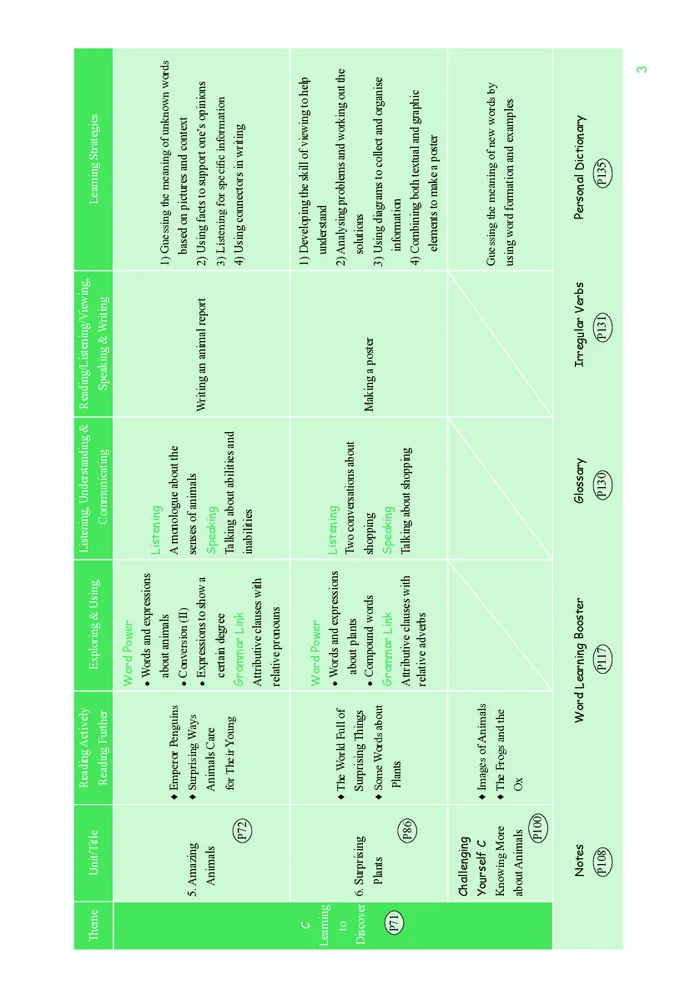
Theme
Unit/Title
Reading Actively
Reading Further
Exploring & Using
Listening, Understanding &
Communicating
Reading/Listening/Viewing,
Speaking & Writing
Learning Strategies
C
Learning
to
Discover
5. Amazing
Animals
♦ �Emperor Penguins
♦ �Surprising Ways
Animals Care
for Their Young
Word Power
● �Words and expressions
about animals
● Conversion (II)
● �Expressions to show a
certain degree
Grammar Link
Attributive clauses with
relative pronouns
Listening
A monologue about the
senses of animals
Speaking
Talking about abilities and
inabilities
Writing an animal report
1) �Guessing the meaning of unknown words
based on pictures and context
2) Using facts to support one’s opinions
3) Listening for specific information
4) �Using connectors in writing
6. Surprising
Plants
♦ �The World Full of
Surprising Things
♦ �Some Words about
Plants
Word Power
● �Words and expressions
about plants
● Compound words
Grammar Link
Attributive clauses with
relative adverbs
Listening
Two conversations about
shopping
Speaking
Talking about shopping
Making a poster
1) �Developing the skill of viewing to help
understand
2) �Analysing problems and working out the
solutions
3) �Using diagrams to collect and organise
information
4) Combining both textual and graphic
elements to make a poster
Challenging
Yourself C
Knowing More
about Animals
♦ �Images of Animals
♦ �The Frogs and the
Ox
Guessing the meaning of new words by
using word formation and examples
Notes Word Learning Booster Glossary Irregular Verbs Personal Dictionary
P72
P86
P108
P117
P130
P131
P135
3
P71
P100
1
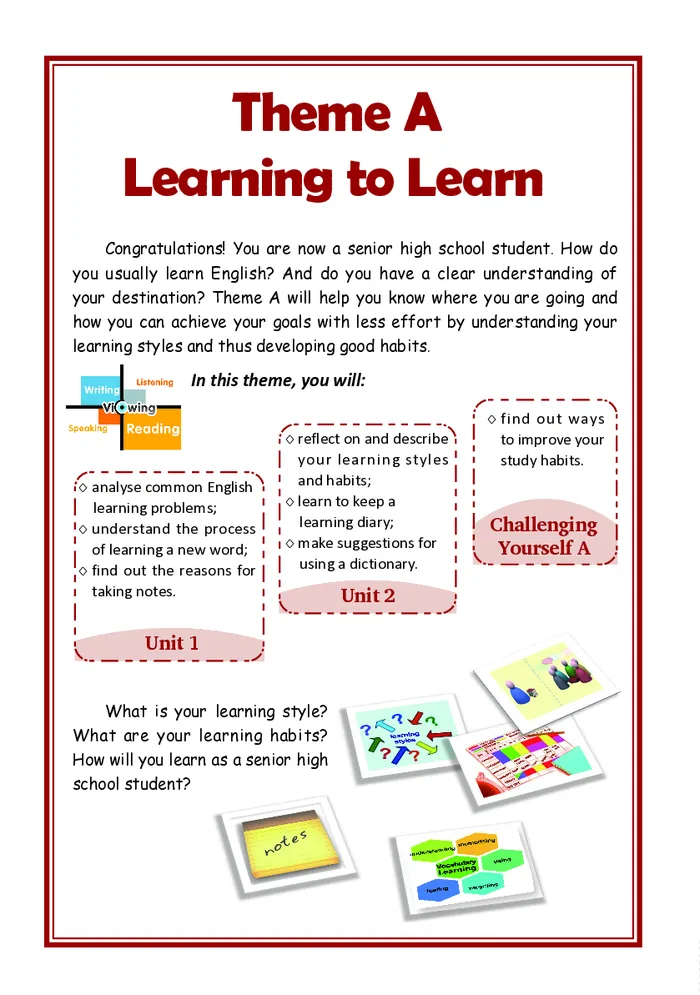
Theme A
Learning to Learn
Congratulations! You are now a senior high school student. How do
you usually learn English? And do you have a clear understanding of
your destination? Theme A will help you know where you are going and
how you can achieve your goals with less effort by understanding your
learning styles and thus developing good habits.
What is your learning style?
What are your learning habits?
How will you learn as a senior high
school student?
Unit 1
◊analyse common English
learning problems;
◊ understand the process
of learning a new word;
◊ find out the reasons for
taking notes.
Unit 1
◊ reflect on and describe
your learning styles
and habits;
◊learn to keep a
learning diary;
◊ make suggestions for
using a dictionary.
Unit 2
Unit 2
Challenging
Yourself A
◊ find out ways
to improve your
study habits.
Challenging
Yourself A
In this theme, you will:
Theme A Learning to Learn
2
Reading Actively
► Activating and Predicting
Tick (√) the ones that you think are important in English learning and add more. Then
share your ideas with a partner.
I think it’s important for me to…/I fi nd it necessary to…
□ memorise new words
□ understand grammatical rules
□express myself fully while writing in English □ speak English aloud in public
□ use newly-learned sentence structures in context
□ follow the teacher in class when he/she speaks English
More:
Look at the following words and expressions and predict what the text is mainly about.
Then read to check.
Looking Ahead
By the end of this unit, you will be able to:
fi nd out your diffi culties in English learning and learn to solve them;
tell words’ parts of speech by suffi xes and use them to remember new words;
analyse the elements of a sentence;
explain reasons for taking notes in a logical order;
write a passage about learning experience with newly-learned expressions;
explain the fi ve steps of vocabulary learning and use them effectively.
Unit 1
Unit 1
Learning Strategies and Habits
Learning Strategies and Habits
Anyone who fails to realise the importance of improving the
Anyone who fails to realise the importance of improving the
learning strategies will have great diffi culty in learning.
learning strategies will have great diffi culty in learning.
—Anonymous
—Anonymous
TIP
You may use the given
key words to guess what
the text is mainly about.
senior high school
new words
grammar
confusing
context
interest
songs
movies
3
Unit 1 Learning Strategies and Habits
3
► Reading, Thinking and Analysing
How to Get Better at Learning English?
This is Alan Miller’s Corner for those who love English. If you want
some suggestions about your English learning, you can write to Alan. He
will have plenty of good advice for you.
Confusing (adj.) here
means unclear and
diffi cult to understand.
Eventually (adv.)
means .
A. in the end
B. at the beginning
Dear Alan,
My name is Xiaojing. In junior high school I put a lot of efforts
into English learning and made good progress with the help of my
teacher. Now, I’m excited about going to senior
high school in September.
Yesterday, my elder sister said to me, “You ought
to memorise more new words during the summer
vacation because you will find there is a large
vocabulary in a single text when you study in senior
high school. Besides, grammatical rules will be more confusing.”
I love English. I do hope to keep my interest and become a
better English learner. Could you please give me some advice?
Eager Xiaojing
Asking for advice
Dear Xiaojing,
Glad to know that you love English. It matters. Don’t worry
too much about new words and confusing grammatical rules.
For vocabulary learning, my suggestion is to understand and
remember new words and expressions in context. Then try to use
them as often as possible. As for grammar learning, you need to
understand the building blocks of grammar. They lead up to more
complex forms. With enough time, effort and practice, you will not
feel confused with grammar any more and eventually get a better
understanding of it.
Advice for Xiaojing
Theme A Learning to Learn
4
From your mail, I know that you’re interested in English and you
want to keep your interest in learning it. Here are a few tips for you.
Listening to English songs is one natural, relaxing and
effective way to learn. It can not only help to keep your interest
in learning English, but also improve your listening skills, expand
your vocabulary and help you learn grammatical structures without
boredom. In addition, English songs can also be used to practise
your pronunciation.
Watching movies, especially animated ones, is another
interesting way to learn English because of their simple dialogues.
Moreover, animated movies are typically fi lled with body language
and facial expressions. They can make the dialogues much more
understandable.
Xiaojing, just make sure you spend enough time on the
language happily. That is the key to success.
Alan
face (n.) → facial (adj.)
The Chinese for facial
expressions is
.
animated movie 动画片
► Comprehending, Integrating and Creating
Read Xiaojing’s email again and complete the diagram below. Then sum up its main idea.
boredom (n.) = bore
(v.) + -dom
In junior high school, Xiaojing
.
Yesterday she was told by her elder sister that she
.
However, she
English and hopes to
.
So she writes this
to Alan in order to
.
tip (n.): a small but
useful piece of advice
Summing up the information can help you get a clearer idea about
what you have read and keep it in mind for a long time.
TIP
Xiaojing
Yesterday, she was told by her elder sister:
• she ought to
new words.
• grammatical rules would be
.
In junior high school, she:
• put
into English learning.
• made good
in English learning.
Now, she hopes to:
• keep her
in English.
• become a/an
.
• will be a
.
• loves
.{
Unit 1 Learning Strategies and Habits
5
Words:
Grammar:
on Xiaojing’s worries
Suggestion 1:
Reasons:
Suggestion 2:
Reasons:
on keeping her interest in English learning
Alan’s
advice
Read Alan’s email and complete the diagram below. Then check your work with a
partner.
Role-play the conversation between David (a classmate) and Xiaojing based on the above diagram.
You may begin the conversation like this:
David: Hi, Xiaojing. You wrote an email to Alan Miller’s Corner the day before yesterday.
Has he written back to you?
Xiaojing: Yes.
David: Could you share his advice with me?
Xiaojing: Sure. …
List your own problems in English learning and then turn to your teacher or classmates
for their advice.
My problems
1)
2)
3)
…
Advice from my teacher or classmates
1)
2)
3)
…
6
Theme A Learning to Learn
You may begin your talk in this way:
A: I fi nd that it’s hard to understand the teacher when she speaks English. Can you give
me some advice?
B: Sure. In my opinion, ... The reason(s) for that is/are...
C: I advise you to... because...
...
Surf the Internet or talk to your teacher and schoolmates to fi nd out more ways to learn
English well. Then share them with your group members.
Exploring and Using
► Word Power
Circle the following words in the text and work out their meanings. Then match them with
their explanations.
Acquiring knowledge
●
●
●
●
●
Integrating skills
●
●
●
●
●
1) confused
2) complex
3) eventually
4) effective
5) tip
6) expression
7) addition
A. successful; working in the way that was expected
B. the feelings expressed on a person’s face
C. unable to think clearly or to understand something
D. in the end, especially after a long time
E. small but useful piece of advice
F. the action or process of adding something to something else
G. including many parts and often diffi cult to understand
7
Unit 1 Learning Strategies and Habits
Now use their proper forms to complete the following sentences.
1) Jill knows Spain really well. Perhaps she could give us a few
.
2) The
in her eyes told me something was wrong.
3) I’m totally
. Could you explain that again?
4) China has built a/an
system of highways.
5)
your child will leave home and live his/her own life.
6) Humour is often far more
than shouting.
7) In
to the advice from my teacher, I got lots of suggestions from my
classmates.
Form lexical chunks by matching the words and expressions in Column A with those in
Column B based on the text. Then use them to make sentences about English learning.
·Example·
Lily thinks memorising words cannot solve all her problems.
Read the following words aloud and then mark their parts of speech according to their
suffi xes.
·Example·
confuse, confusing, confused, confusedly, confusion
v. adj. adj. adv. n.
1) type, typical, typically
2) improve, improvement
3) relax, relaxing, relaxed, relaxation
4) express, expression, expressive
5) effect, effective, effectively
6) bore, boring, bored, boredom
·Column A·
1) solve
2) have a hard time
3) have
4) succeed
5) improve
6) expand
7) practise
8) the key
·Column B·
A. in doing something
B. pronunciation
C. doing something
D. a problem
E. vocabulary
F. skills
G. to success
H. a good command of
A lexical chunk is a group of words that are commonly found
together. Memorising words in chunks can help you a lot in
listening, speaking, reading and writing.
TIP
Theme A Learning to Learn
8
Choose some words to make sentences. Then share them with a partner. You may use a
dictionary if necessary.
► Grammar Link
Revision of Elements of Sentences
Understanding the meaning
Students are working in groups and talking about their new school life. Read to
understand what they are saying.
Discovering the rule
Follow the example to analyse the other sentences in Understanding the meaning.
·Example·
S = subject
V= verb
O = object
C = complement
A= adverbial
P= predicative
Attr. = attribute
V
S
Attr.
O
A
I like our campus very much.
B. I love our
school.
C. I am
excited.
D. I fi nd the
classmates
friendly.
E. All of us
study hard.
F. The teachers have
taught us a lot of
things.
G. I like our
campus very
much.
A. The new
school life
has begun.
A suffix is a letter or letters, added to the end of a word to form a new
word. It can help to tell the part of speech of a word.
TIP
Unit 1 Learning Strategies and Habits
9
Match the sentences in Understanding the meaning with the sentence patterns below.
Mark the corresponding letters on the lines.
1) SV
2) SP
3) SVO
4) SVOO
5) SVOC
6) SVA
7) SVOA
Applying the rule
Study the sentences from the text and analyse their elements. Then write the sentence
patterns in brackets.
( SVO ) 1) I love English.
( ) 2) … grammatical rules will be more confusing.
( ) 3) Could you please give me some advice?
( ) 4) English songs can also be used to practise your pronunciation.
( ) 5) They can make the dialogue much more understandable.
( ) 6) That is the key to success.
Read the following email by Xiaojing and tell the sentence patterns of the numbered
sentences.
1
2
3
4
5
6
7
Suppose you are Daisy. Write a reply email to Xiaojing and try to use the seven sentence
patterns.
Dear Daisy,
Thank you very much. 1 You have given me some useful advice on
grammar learning. You are so kind. 2 Your advice helps a lot. 3 You let me
know how to regain my interest in English learning. However, I fi nd the more I
learn, the more problems I come across. 4 Another serious problem arises. 5
I forget new words soon. 6 I am confused. Why can’t I keep these words in my
mind? 7 I don’t know the reasons. Could you please give me more advice?
Looking forward to your reply.
Xiaojing
10
Theme A Learning to Learn
Listening, Understanding and Communicating
Expressing Ideas in a Logical Order
View the following thinking map and tick (√) the reasons you agree with.
Now, listen to a short passage for the fi rst time and number the reasons mentioned.
Listen again and complete the following chart. Then introduce the reasons for taking
notes with its help.
Sequence
Advantages
Firstly
1) Note-taking can help you the key points.
2) You can remember notes with your own style.
Secondly
1) Note-taking can force you to focus on points.
2) Note-taking can help you become a good .
Thirdly
1) Good notes can help to your study better.
2) You’d better know what areas to .
Finally
1) You can go over the key .
2) You use less time to go over the .
List the diffi culties you have when taking notes. Then work in groups to discuss how to
solve them.
Diffi culties in taking notes:
Suggestions:
Note-taking
to organise
study
to meet the
teacher’s
requirement
to get ready
for exams
to recall the
key points
to prepare for
future use
to participate
in class
to memorise
everything
Work in pairs and add
more reasons for taking
notes.
11
Unit 1 Learning Strategies and Habits
Make up a conversation based on the following situation, using some words and
expressions in the box.
Student A: You think that most of the important information and knowledge has been
printed in the textbook. What you need is just to mark them out. So it’s
unnecessary to take notes.
Student B: Your idea is that taking notes in class may be of great use to remember and
review what you have learnt. Try to use some information in Activity 2 to
persuade Student A to take notes.
Listening, Speaking and Writing
Writing a Passage about Learning Experience
Listen to Jenny’s monologue about “How I learned to learn English” and fill in the
blanks.
◆ Jenny’s problem: She her English class.
Reasons:
1) The teacher spoke English .
2) She dared not ask questions because of her poor .
◆ How she learned to learn English: by watching
.
Reasons:
1) They are and .
2) She can get the with the help of the body language and the facial
expressions of the characters.
3) She can get the meaning by listening for just the .
4) She can improve her pronunciation by listening to the in them.
5) She can learn some useful .
◆ How she feels about her English class now: She it.
fi rst
fi rst of all
second
next
then
after that
secondly
moreover
furthermore
in addition
lastly
fi nally
for one thing
for another
The words like fi rstly, secondly, etc. may help you to express yourself in a
more logical way.
TIP
Theme A Learning to Learn
12
Look at the coloured parts in the following sentences from Jenny’s monologue. Then use
them to make sentences about your English learning.
1) You know, the teacher spoke too fast for me to follow.
2) I was afraid to ask questions because of my poor pronunciation.
3) So I just hid behind my textbook and never said anything in class.
4) Although I could not understand everything the characters said, their body language
and the expressions on their faces helped me to get the meaning.
5) I also realised I could get the meaning by listening for just the key words.
6) My pronunciation was also improved by listening to the interesting conversations in
English fi lms.
7) I also learned some useful sentences like “I can eat like a horse” or “No sweat” with
the help of the dictionary.
Write a passage entitled “How I Learned to Learn English” by following the steps below.
The information in Activity 2 may be helpful.
Step 1 Describe the diffi culties you had in learning English.
Step 2 Explain the reasons for the diffi culties.
Step 3 Introduce the ways to deal with the diffi culties, and give the reasons.
Step 4 Judge how useful your solutions are.
Step 5 Check the spelling, grammar, punctuation and capitalisation.
Step 6 Share your passage in your group.
Unit 1 Learning Strategies and Habits
13
Reading Further
► Getting Ready
Read the following statements and decide whether you agree with them (√) or not (×).
Then work in groups to give your reasons.
1) Words must be learned in context.
2) The best way to learn new words is to translate.
3) English-English explanation is the best way for vocabulary teaching and
learning.
4) Vocabulary cannot be taught. It must be learned by individuals.
5) If we do not use the words we have learned, we will soon forget them.
6) Both students and teachers need to know that there are differences between
active and passive vocabulary.
7) An English-English dictionary is an important aid for students.
Do you know the process of learning a new word? Discuss it with a partner and then put
the following words on the corresponding lines in the passage.
► Reading
How Can You Learn Vocabulary?
Learning vocabulary is a very important part of learning a language. The more words you
know, the more you will be able to understand when listening and reading, and the better you
can do in speaking and writing.
How can you learn a new English word effectively? The following basic process and
suggestions may help you.
1
• Try to sound the new word. Look for familiar word parts and see if you can tell its
meaning by analysing how it is formed.
• Guess at the meaning of the new word by paying attention to its context.
• Consult a dictionary if you still can’t understand the new word after following the above
steps. Do not interrupt your reading process to look it up, but you may mark it fi rst.
2
• Use words with similar or opposite meanings to help you remember.
• Use your knowledge of word formation to remember the meaning of the unfamiliar word.
• Form a picture of the new word in your mind when you are learning it. This can help you
using
understanding
recycling
testing
memorising
Theme A Learning to Learn
14
·Methods·
·Examples·
1) Using synonyms
A. suitable = suit (v.) + -able
2) Using antonyms
B. record v. / /; n. / /
3) Grouping
C. greenhouse, grown-up
4) Recording new words in a proper way
D. interrupt 中断;打扰
5) Using word formation
E. classify — group
6) Connecting a new word with a picture
F. unfamiliar — familiar
7) Connecting a new word with its Chinese
G. textbook
meaning
remember its meaning better.
• Connect the new word with a word that is
similar in meaning in your own language.
• Record the new word in your vocabulary
notebook in the most suitable way.
• Group new words according to some of
their characteristics.
• Read through your vocabulary notes on a regular basis.
3
Create sentences, dialogues or stories by using the words you have just learned, especially
those for a particular topic.
4
In the following weeks, try your best to recognise the words you have learned earlier when
you are reading your textbook or watching an English movie or listening to a song.
5
Test yourself frequently by reviewing your vocabulary notebook or doing vocabulary
exercises regularly.
► Comprehending
Read the passage and judge whether each of the following statements is true (T) or false
(F). Correct the false one(s).
1) The larger the vocabulary you have, the better the language skills you may acquire.
2) You should go through a process while you are learning a new word.
3) When you meet with a new word, you should look it up in a dictionary immediately.
4) You can memorise a new word by referring to its synonyms or antonyms.
5) A good way to test yourself is to use the words you have just learned for a
particular topic.
6) You must go over the learned vocabulary regularly in the following weeks.
Reread the part of Memorising and match the following methods with the given examples.
15
Unit 1 Learning Strategies and Habits
15
Write a short passage about your own vocabulary learning and share it with a partner.
The outline below may help you.
A. Introduce your way to learn English vocabulary;
B. Analyse its strengths and weaknesses;
C. Follow the learned basic process of learning vocabulary to show how to learn a new
word or phrase.
Self-assessing
Refl ect on your learning process in this unit. Tick (√) the following statements to assess
your own progress and decide what you still need to work on.
◊ use some strategies to solve problems in English
learning;
◊ judge words’ parts of speech by their suffi xes
and use them to memorise new words;
◊ analyse the elements of a sentence;
◊ explain reasons for taking notes in a logical
order;
◊ write a passage about your learning experience
with newly-learned expressions;
◊ use different ways to learn new words.
Agree Somewhat Need more
agree work
□
□
□
□
□
□
□
□
□
□
□
□
□
□
□
□
□
□
You are able to:
Theme A Learning to Learn
16
Reading Actively
► Activating and Predicting
The following quiz may help you to decide what sort of language learner you are. Tick (√)
the answer to each question and then work out your total score.
Looking Ahead
By the end of this unit, you will be able to:
identify your learner type and thus improve your language learning;
enlarge your vocabulary by using noun suffi xes;
identify the different types of sentences and use them to complete a story;
make suggestions and give responses based on a given situation;
write a letter of advice based on the analysis of learner types;
keep a learning diary to help you with your study.
Learn extensively, inquire carefully, think deeply,
Learn extensively, inquire carefully, think deeply,
differentiate clearly, and practise faithfully.
differentiate clearly, and practise faithfully.
—Zi Si
—Zi Si
Unit 2
Unit 2
Being a Good Language Learner
Being a Good Language Learner
Question Frequency
Usually
(3 points)
Sometimes
(2 points)
(Almost) Never
(1 point)
Don’t know
(0 points)
1) Do you enjoy English classes?
2) Do you wish to have more time to
think before you speak?
3) Is your pronunciation better when
you read aloud than when you
have a conversation?
4) Do you have a good memory for
new words?
16
Unit 2 Being a Good Language Learner
17
Comment here means
.
A. opinion
B. explanation
Accurate here means
.
A. proper B. correct
Is score a noun or a
verb in this sentence?
What does it mean?
relaxed (adj.) =
relax (vi. & vt.) + -ed
It means in
Chinese.
Guess the meaning
of analytic.
What Sort of English Learner Are You?
The aim of this quiz is to help you
become aware of your own learning style or
habits. Read the following comments and
you will discover your learner type, and may
get some useful advice on English learning.
If your total score is between 23 and
27, you are probably an analytic learner.
You may feel it is very important to be
as accurate as possible all the time, and
you probably prefer the sort of language
learning where you think carefully. In order to improve your language
learning, try to speak as often as possible, and do not worry too much
about your mistakes. Remember, you probably know more than you think!
If you score somewhere between 9 and 13 points, you are probably
a relaxed learner. You seem to learn languages without really working
hard and you usually enjoy communicating with people. You may feel
that you should learn more grammar rules, but you probably don’t enjoy
this and quickly lose interest. You should therefore try to fi nd more time
to learn and set a regular time for learning. Then try to correct yourself
Your total score: ________________
analyse (vt.) 分析
Read the following text to fi nd out your learner type according to your total score.
► Reading, Thinking and Analysing
Question Frequency
Usually
(3 points)
Sometimes
(2 points)
(Almost) Never
(1 point)
Don’t know
(0 points)
5) Do you like learning new grammar
rules, words, etc. by heart?
6) Do you get good results in
grammar tests?
7) Do you fi nd it diffi cult to pick up
more than two or three words of
a dialect when you are on holiday
in another city?
8) Are you afraid of making mistakes?
9) In class, do you get upset when
mistakes are not corrected?
Theme A Learning to Learn
18
more. If you can try to become more aware of the mistakes that you make
regularly, you will fi nd it easier to do something about them.
If your score is between 14 and 22, you are a mixture. You have the
strengths and weaknesses of both the analytic and the relaxed learner. You
learn in different ways depending on the situation and learning content.
The suggestion for you is to study the descriptions of both analytic and
relaxed learners. You will see what you have to improve in order to
overcome your weaknesses and make full use of your strong points.
If you score between 0 and 8 points, it does not mean that you
are not a good language learner. Perhaps this is the fi rst time you have
thought about the way you learn. You should observe how other students
learn English and read some books that tell you how to learn a foreign
language.
Generally speaking, language learners can be divided into four types.
If you know your learner type, you may learn English better.
► Comprehending, Integrating and Creating
Skim the text and complete the following diagram with the information you have gained.
Conclusion:
Introduction: the aim of the quiz
Body:
Score: 0-8
Learner type: not clear
description (n.)
Its verb form is
.
Skimming is a type of rapid reading which is used to get the main
idea and the structure of a passage. Usually, the first sentence of
each paragraph helps a lot.
TIP
Unit 2 Being a Good Language Learner
19
Read the text and complete the following table.
Learner
type
Style description
Suggestion
An analytic
learner
1) try to be as
as possible
2) think
1) speak
2) not to worry
about
mistakes
A relaxed
learner
1) learn without working
2)
communicating with
others
3) not interested in learning
1)
more time to learn
2)
a regular time for
learning
3)
your mistakes more
A mixture
1) have both the
and weak
points of the two types above
2) learn in
ways and at
different times
1) fi nd out what you have to
2) overcome your
and make
full use of your strong points
A learner
whose type
is not clear
have never
the way you
learn
1)
how other students learn
English
2) read some books that tell you
learn a foreign language
Work in groups to discuss the following questions.
1) How do you understand the last sentence of the second paragraph? Can you give an
example to support your idea?
2) The author advises a relaxed learner to fi nd more time to learn and to set a regular time
for learning. Do you think the advice is suitable for all types of learners? Why or why
not?
3) A relaxed learner is also advised to correct his/her own mistakes more. Do you agree?
How do you deal with your mistakes?
4) Does the author think that the learners who score the most are the best learners? And
why? What’s your opinion?
Theme A Learning to Learn
20
Complete the following chart by noting down the key words and then report to the class.
You may report by using the following structures:
I am a/an... learner because I am used to…
My strong points are… while my weak points are...
I can improve my English by doing such things as...
Do a survey on the learner types of your class and report the results in class. You may use
a pie chart or bar graph to illustrate your fi ndings.
Exploring and Using
► Word Power
Read the text to circle the words according to the given English explanations. Then write
them down on the lines. The fi rst letter has been given.
1) an opinion that you express about someone or something
c
2) to watch someone or something carefully
o
3) a piece of writing or speech that gives details about
d
what someone or something is like
4) correct and true in every detail
a
5) a good quality of a person or thing
s
6) having knowledge of a situation or fact
a
7) to like one person or thing better than another
p
Now use the proper forms of the above words to replace the underlined parts in the
sentences below.
1) What you should do is to watch more but say less.
2) Teachers usually write opinions on the students’ compositions while
marking them.
My learner type
Reasons
Strong and weak points
Advice from partners
Plan for improvement
The first word of an explanation may tell you something about its part of speech,
like “to do something” for a verb, “a/an ~” for a noun, and “having/being ~” for an
adjective.
TIP
Unit 2 Being a Good Language Learner
21
3) Everybody knows patience is one of his strong points.
4) In fact, John has already become conscious of the danger in smoking to his
health.
5) The watch is always correct and it tells the exact time.
6) I compared his earlier paintings with his later ones and found that I favoured
his earlier ones.
7) The police asked him to give a report of the accident.
Match each of the following verbs or adjectives with its noun form and then work out the
rules. Use some of the words to complete the summary of the text.
·Verb/Adjective· ·Noun·
·Rule·
Language learners can be divided into four types. The fi rst type is the analytic learner
who always thinks that is very important, and that one should be as
as possible. The second type of learner learns with , and he believes he can
learn a language well through with others. The third type of learner is
a/an with both the strong points and of the fi rst two. The
last type, however, is not of how they are learning. Every language
learner should therefore fi rst have the of what kind of language
learner they are. Then they can how others are learning and try to
their own methods in order to improve their language learning.
Complete the lexical chunks with the given prepositions, and then use them to complete
the passage.
1) relax
2) observe
3) mix
4) communicate
5) prefer
6) suggest
7) aware
8) weak
9) accurate
10) correct
A. accuracy
B. correction
C. suggestion
D. awareness
E. preference
F. weakness
G. communication
H. observation
I. relaxation
J. mixture
v. +
= noun
adj. +
= noun
become aware
get some advice
enjoy communicating
set a regular time
make full use
learn
different ways
for
with
in
of
on
You can change the part
of speech of a word by
adding a suffix to its
end.
TIP
Theme A Learning to Learn
22
For a language learner, it is necessary to what kind of language learner
you are and then you can your strengths. At the same time, you may
how to overcome your weaknesses. For example, if you are a relaxed learner, you seem
to learn languages without really working hard though you may people. So
you should your language learning and try to in order to fi nd out
the most suitable way for yourself.
► Grammar Link
Revision of Types of Sentences
Understanding the meaning
Read the following dialogue, paying attention to the coloured parts.
Bob: Hey, Jenny! What are you doing?
Jenny: I am reading.
Bob: What are you reading?
Jenny: I am reading an English story.
Bob: Is it interesting?
Jenny: Sure. English stories are often humorous. They make me relaxed. When I feel a
little tired, I will read an English story for relaxation.
Bob: I love English stories, too. I love them because I can learn some useful expressions.
Jenny: That’s true. I think that’s a good way to build up our vocabulary.
Bob: I can’t agree with you more! I can enlarge my vocabulary by reading English
stories and my ability in reading comprehension can also be improved.
Discovering the rule
Study the following examples and fi nd out the differences between the three sentence types.
·Example·
A. The Simple Sentence
C. The Complex Sentence
B. The Compound Sentence
I am reading an English story.
Independent clause
Independent clause
Independent clause
I can enlarge my vocabulary through reading English stories and
my ability in reading comprehension can also be improved.
Independent clause
Dependent clause
When I feel a little tired, I will read an English story for relaxation.
Unit 2 Being a Good Language Learner
23
Now complete the defi nition of each type of the sentences below. Then check your ideas
with a partner.
1) A simple sentence contains just independent clause with a subject, a/an
and a complete thought.
2) A compound sentence contains or more independent clauses. They are often
connected to one another with , but, or, nor and yet.
3) A complex sentence contains independent clause and one or more dependent
clauses.
Study more examples and complete the table below. Then work in groups to check your
answers.
Types of
sentences
Examples
Sentence structures
He often practises speaking in English and his
spoken English has improved a lot.
IC + and + IC
I learned English for years, but I only learned
a lot of grammar.
+ + IC
Hurry up or we are going to be late.
+ +
We know that she is frank.
IC + DC
If you review your lesson regularly, you will
make progress soon.
+
You can learn from your classmates who/that
are good at English.
+
A different language is a different vision of
life.
IC
Now work in pairs to fi nd out the types of other coloured sentences in the dialogue on Page 22.
Applying the rule
Read the text on Pages 17-18 again and underline all the compound and complex
sentences. Then check your fi ndings with a partner.
Complete the following story based on the pictures by using different types of sentences.
DC = dependent clause
IC = independent clause
1
2
Theme A Learning to Learn
24
A young man was walking along a river and
.
After a while, the old gentleman caught a big fi sh but
.
The young man was very surprised when
. He decided to
stay and watch the old man.
Several minutes later,
and he put it into his bucket.
The young man felt so surprised that
. The old man
smiled, took out a pan, and said
.
Write a passage to describe your partner’s learner type, using different types of sentences.
Work in groups to share what you have written and give advice to one another.
Listening, Understanding and Communicating
Making Suggestions and Giving Responses
What information can you get from a dictionary? Tick (√) the items in the box below.
Listen to a dialogue to check your fi ndings.
Listen again and choose the best answer to each question.
1) How does Anna feel at the beginning of the dialogue?
A. Sad.
B. Excited.
C. Uninterested.
2) What is the most probable relationship between the two speakers?
A. Classmates.
B. Close friends.
C. Teacher and student.
defi nition
meaning
history
spelling
pronunciation
translation
synonym
antonym
plural form
past tense
part of speech
phrase
collocation
example
usage
picture
Why...?
4
Small frying pan.
3
Unit 2 Being a Good Language Learner
25
3) What does Anna think of the suggestions given to her?
A. Reasonable.
B. Important.
C. Valuable.
4) What are they mainly talking about?
A. How useful a dictionary is.
B. How to choose a dictionary.
C. How to use a dictionary effectively.
Listen for a third time and complete the following sentences.
1) Anna and her classmates know that a dictionary is a really important
for
them to learn English well.
2) In a dictionary, you can check the
, the translation, the pronunciation and
the
of a word.
3) You can check the
of a word, the plural
of a noun or the
tense of a verb.
4) A dictionary can tell you something about the collocation of a word, that is, you can
know which other
the word is
together with.
5) You can
your vocabulary by finding a word’s synonym; that is a word
with a/an
meaning, or antonym, a word with a/an
meaning.
6) When Miss Gao gives suggestions, she often uses the sentence pattern “You
do
something.”
Read the following sentences aloud. Then work in pairs and use some of the expressions
to make a dialogue based on the given situation.
Making suggestions
Giving responses
Positive
Negative
1) I think it would be a good idea to
use a dictionary often.
2) You may/can look at the English
explanation of a word.
3) You’d better read the example
sentences carefully.
4) I advise you to make use of a dictionary
to check the pronunciation of a word.
1) That’s great.
2) I’d love to.
3) That would be
very nice.
4) That’s a good idea.
1) Sorry. I can’t afford
the time.
2) I’d like that, but I
can’t.
3) No way!
4) No, I don’t think so.
·Situation·
Student A has just bought an English-Chinese dictionary. He/She is not clear about
how to use it. Student B has used the same kind of dictionary for some time. B gives A
some suggestions on using the dictionary according to his/her experience. A should also
give proper responses.
Theme A Learning to Learn
26
Reading, Speaking and Writing
Writing a Letter of Advice
Read the following descriptions of four English learners and write their learner types on
the lines.
Select one from the four learners in Activity 1 and note down the key information about
him/her.
Work in groups to write down some useful expressions and sentence structures you may
use to describe learner types and give suggestions.
Learner type
Learner description
Suggestions
Bob: He doesn’t really know why he
is learning English, but it will be useful
someday. He never cares about the
method he is using to learn English.
Sometimes the teacher asks him to
answer questions in English, but he
often looks at the fl oor until the teacher
asks someone else.
Daisy: She is very good at grammar.
When she comes across new grammar,
she tries to work out the rules for herself.
Of course, she is not always right, but she
learns a lot from her mistakes! She often
studies together with her classmates by
communicating and cooperating. Anyway,
she tries to fi nd the best way to study.
Jenny: She takes learning English
very seriously. She is keen on English
grammar and spends a lot of time
studying grammar books and doing
exercises. She always has a dictionary
at hand and looks up every new word
she comes across. In class, she asks her
teacher lots of questions.
David: He likes his teacher and classmates
and enjoys speaking English with them. He
always tries to speak as much as he can
even though the topic is not something that
really interests him. He is not very good
at grammar because he fi nds it is rather
boring to learn grammatical rules.
Unit 2 Being a Good Language Learner
27
Now complete the following letter.
Reading Further
► Getting Ready
Tick (√) the items that you think can be kept in a learning diary and share your ideas with
your partner. Then read the fi rst two paragraphs to check which of your ideas have been
mentioned.
► Reading
Keeping Learning Diaries
Keeping a learning diary is a possible way to learn independently. Your learning diaries
could record your progress—your teacher’s marks, the areas you covered, the points you did
not understand, the problems you faced, and the means you used to overcome them. If you keep
such a diary, you will undoubtedly become much more aware of your own learning diffi culties,
and will be more likely to solve them.
Dear
, September 28, 2019
In your last letter, you said that you didn’t know what kind of
English learner you were. According to your description, I think that
you are...
Yours,
diffi culties
complaints
progress
mistakes
problems
expectations
learning plans
daily arrangement
ways to solve problems
teacher’s comments and suggestions
You may refer back to the text to learn how to describe a language
learner and how to give suggestions.
TIP
When you scan a text to look for specifi c information, you do not read all the
words. You move your eyes very quickly over the words, and you stop when
you fi nd the information you need.
TIP
Theme A Learning to Learn
28
Besides, you can benefi t by writing about your expectations for a course at the beginning
of a term, and then reporting on the outcomes of a course at the end of the term. Here are two
examples.
In a word, keeping a learning diary is a method to help you think about your learning
by recording, summarising, analysing and commenting on the course and the teacher’s
lectures.
► Comprehending
Read the two diaries carefully and answer the following questions. Then check your
answers with a partner.
1) Is there a fi xed format for keeping a learning diary? Why do you think so?
2) Is the language formal or informal in a diary?
3) How does the writer of Diary A feel while he/she is writing about his/her problems?
4) Can you predict what the writer of Diary B will do after writing the diary?
Read the following sentences from the passage and translate them into Chinese, paying
attention to the coloured parts.
A. Besides, you can benefit by writing about your expectations for a course at the
beginning of a term.
Sept. 4, Monday Sunny
I want to read more English to improve
my abilities in reading comprehension. I will
read at least one article every two days, and
two English story books each term, writing
reviews of these books.
I also want to speak better than I
do now by watching English movies,
cartoons in particular, and imitating some
characters. I will prepare a two-minute
talk before I attend every English class. I
will try my best to enlarge my vocabulary
by writing down the new words in my
notebook, and reviewing them several
times every day. To improve my spelling,
I will practise pronouncing words while
spelling them out.
I am full of hope and confidence.
Sept. 10, Sunday Cloudy
Dear Diary,
These first few days in senior middle
school have been terrible. I have studied
English for seven years... just think, seven
years, but I only know some words and
grammar rules. I can’t express myself in the
right way, so I am afraid to speak.
The other day I started watching TV, so
I could get accustomed to the sound. I don’t
understand TV news very well. Sometimes
I only got a few words. That is to say, I can’t
get the main point. At school, it’s easy to
understand what the teacher is talking about,
but I can’t understand when listening to
English news or watching English movies.
What can I do?
Yours,
Impatiently
A
B
Unit 2 Being a Good Language Learner
29
B. I have studied English for seven years... just think, seven years, but I only know some
words and grammar rules.
C. I can’t express myself in the right way, so I am afraid to speak.
D. At school, it’s easy to understand what the teacher is talking about, but I can’t
understand when listening to English news or watching English movies.
Now complete the unfi nished sentences below with the sentence structures you’ve learned.
1)
, I want to speak English more fl uently than before.
2) I tried my best to understand the reading passage,
knew some words.
3)
know
your dream is,
it’s really diffi cult to realise it.
4) Mr. Li
understand this English letter,
he asked Susan for help.
Role-play. Imagine you are the best friend of the writer of Diary A. You are voice-chatting
with him/her on QQ at the weekend.
Role A: Tell your friend your worries and problems.
Role B: Try your best to give the writer of Diary A some advice and encouragement.
Remember to introduce a few learning strategies and good English learning
habits that you have learned in the fi rst two units.
In Diary B, the writer makes some plans for the improvement in English learning. Give
your comments and advice.
Refl ect on your study and write about your progress, diffi culties and learning plans in your
diary.
Self-assessing
Refl ect on your learning process in this unit. Tick (√) the following statements to assess
your own progress and decide what you still need to work on.
◊ become aware of your learning style and
develop good learning habits;
◊ use the strategy of adding noun suffi xes to
enlarge your vocabulary;
◊ tell the differences between types of sentences
and complete a story with them;
◊ make suggestions and give responses in a
dialogue;
◊ write a letter to give suggestions based on
the analysis of learner types;
◊ keep a learning diary to refl ect on your study.
Agree Somewhat Need more
agree work
□
□
□
□
□
□
□
□
□
□
□
□
□
□
□
□
□
□
You are able to:
Looking Ahead
Hello, dear boys and girls! In the fi rst two units, you learned some learning strategies
and a useful vocabulary to talk about them. Now it‛s time to try out these strategies by
completing the self-directed learning project. In this project, you should be able to:
sum up the learning strategies learned in Unit 1 and Unit 2;
study the text by yourself using various vocabulary strategies and reading skills;
prepare questions based on the text for group discussion;
exchange your ideas about study habits in class;
make your own study plan and improve your study habits.
Skills make you better at studying; effective habits make
you better for studying.
you better for studying.
— Anonymous
— Anonymous
Learning Individually
► Recycling Time
List the vocabulary about learning and the strategies you have learned in the previous two
units. You may also think about how to use them.
Skills make you better
Skills make you better
Self-directed
Learning Project
Challenging Yourself A
Challenging Yourself A
Forming Learning Habits
Forming Learning Habits
30
Learning Strategies
skimming
Vocabulary about Learning
context
Challenging Yourself A Forming Learning Habits
31
► Word Builder
Learn to guess the meaning of a new word based on contextual clues by studying the example.
·Example·
Mistakes are an essential part of education. That means your mistakes are very important...
► Reading Land
Think about your study habits and note them down on the lines below.
·Example· I always preview new words before class and review them after class.
Look through the following study habits and tick what you have written in Activity 1.
A
Make full use of dictionaries
B
Learn from your mistakes
C
Review regularly
D
Set a goal for yourself
E
Plan your time carefully
F Make a study plan
G
Take notes
H
Make good use of your time in class
I
Develop a good attitude towards tests
How to Develop Your Study Habits?
Perhaps you are an average student with average intelligence and
you think you will never be a top student. This is not necessarily the
case, however. You can receive better grades if you want to.
1
Set a goal that you want to achieve in one week or by the end
of this term. When you keep it in mind, it will motivate you to learn.
You may fi nd you can work harder when you focus on a target. Make
Does the fi rst average
mean the same as the
second one?
Expressions like “in other words”, “which is” and “that means” are often
used when you are giving an explanation. If you read the explanation
carefully, you may be able to guess the meaning of a new word.
essential?
essential (adj.): very important
1) That
2) means...
3) very important
Guessing through explanation
TIP
Theme A Learning to Learn
32
sure that your goal is realistic and that you keep working towards it.
Whatever you decide to do, never give up!
2
Make a weekly schedule or chart of your time. Fill in the schedule
or chart with the time for eating, sleeping and classes. Then decide on
regular times for studying. Be sure to set aside enough time to complete
your normal reading and homework. Of course, studying shouldn’t
occupy all of the free time on the schedule. It’s also important to set
aside some time for relaxation, hobbies and entertainment.
3
Listen to what the teacher says in class carefully and take notes at
the same time. They help you remember what he or she says and mean
less work later.
4
Go over your notes as soon as you can after class. Review the
important points that are mentioned in class as well as the points that
you remain confused about. If you review these regularly, the material
will become more meaningful and you will remember it longer.
5
Mistakes are an extremely important and necessary part of
education. That means your mistakes are quite important and will
actually help you learn. The key to progress is not to be afraid to make
mistakes. Record your mistakes, think about them and get to know
why you have made the mistakes. Correct them by yourself or by
asking your teachers or classmates for help.
6
The result of a test can show what you have learned about a
subject. The world won’t end if you don’t pass a test, so don’t worry
too much about a single test. Tests provide grades, but they also let
you know what you need to spend more time studying.
There are other techniques that might help you with your study.
Only a few have been mentioned here. You will probably discover
many others after you have tried these. Developing your study habits
will improve your grades.
What’s the function
of the last paragraph?
Underline the compound
and complex sentences
if you find any in the
article. Then analyse
them.
What does the word
them refer to?
Skim the article and select six from the study habits in Activity 2 on Page 31 to fi ll the
numbered blanks.
Do you notice that
many sentences are
imperatives? Think
about the reasons for
this.
Challenging Yourself A Forming Learning Habits
33
Read again and complete the chart with the information from the article.
Study habit
Detailed information
Setting a goal is to
1)
.
2) make you
.
Planning your time for
1) daily life.
2) classes and self-study.
3)
.
Taking notes to
1)
.
2)
.
Going over your notes to
1)
.
2)
.
3) review the materials regularly.
Learning from mistakes means
1) treating them as something important.
2)
.
3) thinking about and correcting them.
The result of a test can show
1)
.
2)
.
Read the article “How to Make a Weekly Study Plan” in Reading Box on our website and
then make a weekly study plan to better manage your learning time and the time for other
things in your life.
► Question Corner
Write down any questions you have in learning the article. They may be about the theme, the
structure, the language, etc.
Learning Cooperatively
Work with your group members and share the ways you preview lessons individually. Then
discuss with them the questions you have prepared in Question Corner. Ask your teacher
for help if necessary.
Theme A Learning to Learn
If
then
34
Work in groups to do the activity by following the steps below.
Step 1 Share your typical study habits in turn and discuss
them one by one.
Step 2 Give some advice for the ones in need of improvement.
Step 3 Decide on the most useful one and introduce it to the
whole class.
Step 4 Improve your study plan based on the useful study habits above.
Work in groups to write a summary of the text.
Learning Creatively
Read the following article and fi ll in the blanks in it with correct fi gures and words.
What Makes a Big Difference?
Success is almost everyone’s mission. True, there are so many factors at play. Do the
calculations by following the example, and see what you can fi nd.
A is equal to 1,
B is equal to 2,
C is equal to 3,
D is equal to 4,
E is equal to 5,
…
X is equal to 24,
Y is equal to 25,
Z is equal to 26,
“KNOWLEDGE” is equal to 96% (11 + 14 + 15
+ 23 + 12 + 5 + 4 + 7 + 5 = 96).
When discussing with
your classmates,
remember to note
down the key points.
TIP
When you summarise a text, you should 1) fi nd out the key words and
phrases; 2) focus on the main idea of the text; 3) write your summary in
your own words.
TIP
LUCK
( _ + _ + _ + _ )
→
%
HARD WORK
( _ + _ + _ + _ + _ + _ + _ + _ )
→
%
( _ + _ + _ + _ + _ )
→
%
Challenging Yourself A Forming Learning Habits
35
Learning Reflectively
►Self-reflecting
Refer back to Guiding Page and Looking Ahead in this theme to refl ect on your learning.
I am pleased with… in Theme A because I can…
I need to work on… because…
My further learning targets are… so that I can…
Next time I need to try hard on… because…
►Peer-sharing
Work with a partner and fi nish the peer assessment. Then listen to and learn from each
other.
You are great in..., for example…
I am afraid you need further efforts in…
Next time you need to focus on…
►Teacher-responding
Now listen to your teacher for his/her comments and suggestions.
Utilising Resources
Read the article “Eight Habits of Highly Effective Students” in Reading Box to know
more about study habits.
( _ + _ + _ + _ )
→
%
(1+20+20+9+20+21+4+5)
→
%
Now, you have found that all of the above fall short of 100% except
. Is it a
coincidence or not?
Do the following activities.
1) Discuss in groups which of the above factors is of the most importance to success and
why.
2) Share with your classmates your understanding of “Attitude is a little thing that makes a
big difference.” from Winston Churchill. Then search for more quotes on “attitude” and
share them in class.
Theme B
Learning to Enjoy
What is your favourite
song? What film moves you
most? What sport do you
enjoy best? And why?
A good song can ease your pain, a good fi lm can take you out of
hopelessness, and a good sweat can make you feel alive again. All of
them are the universal enjoyment of mankind. Do you agree? Enjoy
your life with the beat of music, enrich your life with others‛ stories,
and work hard to be your own champion!
Unit 3
◊ appreciate a story about
the power of music;
◊ know more about country
music and the Beatles;
◊ learn a conversation to
know how to make
invitations.
Unit 3
◊ enjoy The Sound of
Music and other films;
◊ know more about Tom
Hanks and his films;
◊ listen to an Oscar
acceptance speech to
know how to express
thanks.
Unit 4
Unit 4
◊u nderstand the
spirit of sports.
Challenging
Yourself B
In this theme, you will:
Unit 3 Powerful Music
37
Looking Ahead
By the end of this unit, you will be able to:
identify the plot of the story and interpret the power of music;
enlarge your vocabulary through conversion;
use verb tenses in context appropriately;
make and accept/refuse invitations with appropriate expressions;
write a comment on your favourite song;
introduce briefl y country music and the Beatles based on the given structures.
Reading Actively
► Activating and Predicting
Look at the picture and the given words and guess what the story is mainly about.
When?
Where?
Who?
What?
Why?
Unit 3
Unit 3
Powerful Music
Powerful Music
Music is power. Where words fail, music speaks.
Music is power. Where words fail, music speaks.
—Hans Christian Anderson
—Hans Christian Anderson
broken window
an old man with a gun
hatred
violin
an armed killer
Theme B Learning to Enjoy
38
Decide whether each of the following statements is true (T) or false (F) based on Activity 1.
Then read the text to check your prediction.
1) The killer stole the old man’s violin and broke the law.
2) The poor old man stole the violin and the policeman came to arrest him.
3) Both the old man and the policeman played the violin well.
4) The policeman and the old man managed to arrest the killer with the help
of a violin.
5) The policeman managed to catch the killer because of the music played on the
violin.
► Reading, Thinking and Analysing
A Story of a Violin
David, a policeman, came to a cabin about two miles up the
mountain to get Cal Richards, an armed and dangerous killer. Through
a broken window, he saw an old man with a beard closely watching
him. When he stepped into the cabin, he found the old man was
pointing a gun at him. He looked around the cabin and did not see any
sign of Cal. “I guess I’ll have to come again,” he said. Just then he
caught sight of a violin hanging on the wall. “Who plays the violin?”
he asked. For a moment there was silence. Actually Cal’s father was
the best violin player in the area, but he did not answer, and kept his
gun still aimed at David.
David crossed the room and felt sweat on his forehead, but he
took the violin from the wall calmly as if he were a welcome visitor.
He began to play the violin, one tune after another. He was playing
better than he had ever played in his life.
The old man stood there, attracted. The hatred in his eyes was
giving way to a look of wonder. The gun was now pointed towards the
fl oor. He began to beat time, tapping one foot on the dirt fl oor. When the
f inal notes of the tune died away, the old man placed the gun in a corner.
“Well, stranger,” the old man said, “you play the violin excellently.
Maybe you’ll stay for dinner and play some more for me.”
After they had fi nished their meal, they sat in the spring sunshine
outside the cabin. They talked about violin tunes. Not a word was said
Predicting based on the pictures and questions can help you
have a better understanding of the main idea of the text.
killer (n.) = kill (v.) + -er
It means in
Chinese.
sweat on the forehead
hatred (n.):
very strong dislike
Its verb form is .
TIP
Unit 3 Powerful Music
39
about Cal Richards.
About two hours later, David stood up and said, “Sorry! I must be
getting back to the town.”
The old man sat, deep in thought. At last, he said, “I like the way
you talk, and I like the way you play the
violin. I guess you’re a decent guy.” He
paused as if it were hard to go on. Then,
he said in a thick voice, “I’ll have a talk
with Cal. I think he might give himself
up tomorrow. You be at the police
station at noon!”
The next day, as the town clock
struck twelve, a bearded old man came
up the street towards the police station.
With him was a young fellow whose
appearance told of many days in hiding.
Decent []
here means .
A. respectable
B. changeable
Try to read the
underlined sentences
aloud in a thick voice.
Why did the old man
say so in a thick voice?
► Comprehending, Integrating and Creating
Put the following statements in the correct order to get the general idea of the text.
1) David talked about violin tunes with Cal’s father.
2) Cal’s father pointed a gun at David.
3) David caught sight of a violin.
4) David came to arrest Cal.
5) Cal gave himself up.
6) David played the violin, one tune after another.
7) Cal’s father decided to have a talk with his son.
The correct order is .
Study the Story Mountain on the right
and complete the flow chart with the
information from the text.
1
2
3
4
5
Rising Action
This includes the
events leading up
to the main
problem or
confl ict.
Background
This includes the
introduction of
characters and
setting.
Resolution
This is how
things end up
in the story.
Falling Action
This is when the
characters work to
solve the problem
or confl ict.
Climax
This is when the
problem reaches
a high point!
A plot refers to how
a writer arranges the
events in a story.
TIP
Theme B Learning to Enjoy
40
Now work in groups to retell the story based on the fl ow chart.
Discuss the following questions with a partner and then share your answers in class.
1) Why did David feel sweat on his forehead when he crossed the room?
2) Was David a welcome visitor? Find a sentence from the text to support your answer.
3) What made the old man consider David to be a decent guy?
4) What do you think of the old man’s f inal decision? Did he make the right decision?
Why or why not?
5) How does the reader know that the old man’s attitude towards the policeman has
changed? Find evidence from the text to support your idea.
Work in groups of three to predict what would happen the
next day in the police station. Then act it out.
How do you understand the sentence “Music is
power” after reading the story? Tick the statements
that you agree with or add your opinion.
A. Music helps people better understand each other.
B. Music helps to correct one’s mistakes.
C. Music stops people from doing bad things.
D. Music comforts somebody in a magical way.
Try to use facial expressions
and gestures to help express
yourself.
TIP
David, a/an
The old man, Cal’s
went to Cal
who the law.
closely David.
didn’t Cal;
saw on the wall.
the violin.
had dinner together and talked about tunes.
Cal went to the police station with his father the next day to .
his gun still at David;
was by the violin tunes;
began to time;
in a corner.
pointed his gun at David with .
1
2
3
4
5
Unit 3 Powerful Music
41
①Music can comfort somebody in a magical
way. ②For example, ③I have a three-year-old
cousin. When his parents leave him, he starts
crying loudly. Even delicious food can’t stop
him. But if you let him listen to a piece of piano
music, he just stops crying and begins to dance to
the music excitedly, with a big smile on his face.
④You see, how powerful music can be!
Starting with a topic sentence
Using such phrases as “for example/
instance” to show you are going to
give examples
Giving examples by stating
specifi c events
Giving a brief summary
hatred
strike
sign
actually excellently
note
violin
wonder
aim
power
calmly
pause
My opinion: .
Now follow the example to share your opinion.
·Example·
Exploring and Using
► Word Power
Choose some of the words in the box to complete the passage. Change the form if
necessary.
David had never thought that music could have such great . Once, he
went to arrest an armed and dangerous killer in a cabin. When he reached the cabin, he
found the killer’s father holding a gun in his hands and at him. Just as David
was leaving, he caught sight of a/an hanging on the wall. David
knew that he was an unwelcome visitor, but he took the violin from the wall
and began to play one tune after another . The music made the killer’s father
forget his and he even began to enjoy the music. At last, the father came to
realise that David was a decent policeman and decided to have a talk with his son. The
next day, the killer, accompanied by his father, appeared at the police station when the
town clock twelve.
Read the following sentences from the text, paying attention to the structures in green.
Then match them with the explanations below.
1) But he did not answer, with his gun still aimed at David.
2) But he took the violin from the wall calmly as if he were a welcome visitor.
3) He was playing better than he had ever played in his life.
4) The old man stood there, attracted.
5) He began to beat time, tapping one foot on the dirt fl oor.
6) Not a word was said about Cal Richards.
A. This structure is used to show the unreal situation.
Theme B Learning to Enjoy
42
B. This -ing phrase shows a way in which a thing is done or happens.
C. This prepositional phrase is used to show an accompanying action.
D. This structure is used for emphasising “no thing or person”.
E. This structure is used to make a comparison.
F. The past participle at the end of the sentence is used to give more information about the
subject.
Now check your work with a partner and then use some of the above structures to make
sentences.
Read the TIP and the examples below to understand the usage of conversion.
·Example·
● John was sweating, so we can see sweat on his forehead and face.
v. n.
● If you take a look at her, you will know she is ill, for she looks pale.
n. v.
● If he is a welcome visitor, we will warmly welcome him.
adj. v.
Find the words in the text to complete the following sentences and mark their different
parts of speech.
1) Look! A fl y is at the of Jim’s nose. (Para. 1)
2) He heard a few on the window when he was about to fall asleep. (Para. 3)
3) The policeman why the name of his own son was on the list of the arrested.
(Para. 3)
4) The patient is still alive because we can hear his normal heart . (Para. 3)
5) Helen was praised for reciting the whole passage without a . (Para. 7)
► Grammar Link
Revision of Tenses
Understanding the meaning
Read the passage, paying special attention to the coloured parts.
David is a policeman. One day, he came to a cabin up the mountain to get a
killer, Cal Richards. When he stepped into the cabin, an old man was pointing a gun
at him. There was no sign of Cal. “I guess I’ll have to come again,” he said. Just then,
he caught sight of a violin on the wall. An idea came to him. He took the violin from
the wall and began to play. “I am playing the tunes better than I have ever played in
my life,” he thought, “Is the music powerful enough?”
Conversion is a kind of word formation that involves the change of a
word from one part of speech to another.
TIP
Unit 3 Powerful Music
43
Discovering the rule
Tick (√) the tenses used in the passage on Page 42.
□ The simple present tense
□ The simple past tense
□ The simple future tense
□ The present continuous tense
□ The past continuous tense
□ The future continuous tense
□ The present perfect tense
□ The past perfect tense
□ The past future tense
□ The present perfect continuous tense
Complete the table below, and then check your answers with a partner.
Applying the rule
Suppose Cal’s father wrote a diary that day. Complete his diary by using the proper forms
of the verbs from the text.
Present
Past
Future
Simple
do/does
Continuous
Perfect
Oct. 25th, Wednesday Cloudy
Today, a policeman David to my cabin to get Cal. He
thinks Cal a killer. Anyway, Cal my son, and
I let David take him away. When David into my house,
I my gun at him. David saw my violin and began to play it. As he
the tunes one after another, I couldn’t describe how I at
that moment. I know my hatred towards David way to wonder. He
the violin so excellently! I invited him to stay for dinner and we
talked a lot.
Now, I how I will talk with Cal and persuade him to give
himself up tomorrow. I believe in David. He a decent guy.
Theme B Learning to Enjoy
44
Correct the mistake in each of the following sentences.
1) The teacher said that the sun rose in the east.
2) If it won’t rain, we will go to visit the zoo.
3) She has gone to Shanghai several times.
4) They used to live in Genoa, but they no longer lived there.
5) When the light turned green, I was crossing the street.
6) She has become a professional badminton player for years.
7) Doctors haven’t already discovered a cure for this disease.
Complete the interview between Jane, a reporter, and Paul, a singer, with the proper
forms of the words given.
Jane: Paul, (you, introduce) any new songs on this tour?
Paul: Yes, we are. We (produce) a new album. And we (introduce)
some songs from this album.
Jane: Your fans (be excited) so much to see you after such a long time. Why
(you, decide) to tour again?
Paul: Because we want to play for live audiences. So one month ago, we (make)
the decision.
Jane: Who (sing) with you now? She (have) a nice voice.
Paul: Sylvia.
Jane: How about Toti?
Paul: She (have) a new baby half a year ago, but she (be back) in
a few months.
Listening, Understanding and Communicating
Making and Accepting/Refusing Invitations
Match the following expressions with their Chinese meanings. Then listen to several
music clips and decide what kinds of music they belong to.
Unit 3 Powerful Music
45
1) jazz music
A. 古典音乐
2) electronic music
B. 电子音乐
3) classical music
C. 民间音乐
4) folk music
D. 爵士音乐
5) pop music
E. 摇滚音乐
6) country music
F. 乡村音乐
7) rock and roll
G. 流行音乐
8) light music
H. 轻音乐
Listen to the song “Take Me Home, Country Roads”. Tick (√) the words that you hear in
the song. Then compare your answers with your partner’ s.
Words you hear in the song:
□mountains
□skyscrapers
□country road
□traff ic
□blue water
□river
□movie
□memories
□city
□moonshine
□tree
□car
Listen to a conversation and tick the best choice in brackets for each statement.
1) The man invites the woman to (go to a concert/go to a movie/buy CDs/buy a tape
recorder).
2) The woman likes ( jazz music/folk music/pop music/classical music).
3) Country music is usually about (the good old days/the bright future).
Listen to the conversation again and fi ll in the blanks below. Then tell your partner why
you like or dislike this kind of music.
Music she likes
music, especially .
Reasons she likes this
kind of music
1) Singer:
2) Instrument:
3) Subject: , such as ,
, and in the beauty of the
countryside.
Reasons you like/dislike
this kind of music
Work in pairs to practise inviting a classmate to go to a movie or to attend your birthday
party. The following expressions could be of help.
Theme B Learning to Enjoy
46
Making an invitation
Accepting an invitation
Refusing an invitation
1) Would you like to go to the
theatre with me tonight?
2) I’d like to invite you to my
birthday party this weekend.
3) May I invite you to see a
new f ilm?
4) What/How about going to a
concert on Saturday?
5) Would you be interested in
seeing a new f ilm?
1) That would be very nice.
2) I’d like that, thanks.
3) Yes, I’d love to.
4) It’s very nice of you
to invite me.
5) How nice of you!
Thanks a lot.
1) No, thank you.
2) It’s very nice of you, but
my mother is ill.
3) I’d love to, but you see I
have an exam tomorrow.
4) I’m sorry I can’t. How
about another time?
5) Thank you very much,
but I’m not feeling very
well today.
Listening, Speaking and Writing
Writing a Comment on a Song
Work in pairs to ask and answer the following questions.
1) When do you usually listen to songs?
2) What kind of song do you prefer?
3) What’s your favourite song? And why?
If you would like to introduce your favourite song to your classmates, what aspects will
you talk about? List them and share your ideas with your partner.
Spoken invitations are rarely answered only by Yes or No.
1) If your classmate accepts the invitation, try to discuss more details, such as
when to meet and where to meet.
2) If your classmate refuses the invitation, show your understanding and make
one another time.
singer
my favourite
song
theme
TIP
Unit 3 Powerful Music
47
Listen to the following song and read its lyrics, noting down some key words on the lines.
Take Me Home, Country Roads
Almost heaven, West Virginia
(CHORUS)
Blue Ridge Mountains, Shenandoah River
Country roads, take me home
Life is old there, older than the trees
To the place, I belong
Younger than the mountains
West Virginia, Mountain Mama
Blowing like a breeze
Take me home, country roads
All my memories, gathered round her
Miner’s lady, stranger to blue water
Dark and dusty, painted on the sky
Misty taste of moonshine
Teardrops in my eyes
I hear her voice in the morning hours she calls me
The radio reminds me of my home far away
And driving down the road I get a feeling
That I should have been home yesterday, yesterday
Name:
Singer:
Theme:
Impressive words:
Style:
Feelings to be expressed:
Now write a comment on this song and then ask for your partner’s opinion about it.
Choose one of your favourite songs and give your comments.
Reading Further
► Getting Ready
Share with your partner what you know about country music and the Beatles.
Read the following statements about country music and the Beatles, guess the meaning
of the coloured words and predict whether the statements are true (T) or false (F). Then
read the two passages to check.
When you write a comment on a song, you should first briefly introduce it from
different aspects and then add your opinions.
TIP
Theme B Learning to Enjoy
48
1) Country music is a major kind of Turkish popular music.
2) Country music has a simple style and is relaxing to listen to.
3) Country music commonly refl ects the lives of ordinary, working-class people
and covers such subjects as love and relationships, loneliness, religion and
work.
4) The Beatles voiced old men’s emotions and the philosophy of the time.
5) The Beatles were infl uenced by Afro-American rhythm and blues as well as
Indian music and religion.
6) The Beatles never copied anyone, and they created their own rich and original
music.
► Reading
Country Music
Country music is a major kind of American popular music. It was originally produced by
white Southerners in the early 1920s. Although it was originally known as “hillbilly music”, it
has gained wide international acceptance since it became part of popular music.
Musically speaking, country music has a simple style and is relaxing to listen to; this is
why it is so popular. This basic aspect comes from the fact that it is based mainly on lyrical
content rather than musical content. The main aim of the musical elements of harmony, melody,
and rhythm is to show off the lyrics.
The lyrics commonly reflect the lives of ordinary,
working-class Americans and cover such subjects as love
and relationships, loneliness, religion and work. Most lyrics
use 150 or fewer words, and the result is often like a poem.
Country music tends to mirror the concerns,
achievements and lifestyles of the times, and remains an
important form of American cultural expression.
The Beatles
In the early 1960s, there was a movement against
tradition all over the world. In England, this movement
was represented by the Beatles.
The Beatles found a way for angry young men to
express their feelings in noisy music and pop songs. At
f irst, the Beatles were concerned mainly with young
men’s personal problems like love, sorrow, good and
bad luck. Later, the Beatles reflected the climate of the
Unit 3 Powerful Music
49
1960s and sang of social injustice and inequality.
The Beatles showed much admiration for Afro-American rhythm and blues. Their early
songs were simple love songs while their later songs were influenced by Indian music and
religion.
The Beatles believed in their talents and never copied anyone. Thus they created
melodies rich and original enough for other famous bands to play and sing. The Beatles
voiced the emotions of young men and the philosophy of the time, especially the
optimistic feelings. When winter in England seemed to go on forever, the Beatles imagined
spring for people to enjoy.
In March 2001, a magazine in the USA called Forbes listed the Beatles as No. 3 among
the world’s top 100 famous persons.
► Comprehending
Read the two passages again and choose the best answer to each of the following questions.
1) When was country music fi rst produced?
A. In the 1910s.
B. In the 1920s.
C. In the 1930s.
D. In the 1940s.
2) The fi rst passage tells us that country music __________.
A. is not popular in the US
B. is not relaxing to listen to
C. never shows off its lyrics
D. is often about common people
3) What were the Beatles’ early songs about?
A. Personal problems.
B. Childhood memories.
B. Climate change.
D. Social inequality.
4) Why was the Beatles such a successful band?
A. They voiced the emotions of the rich.
B. They copied other famous bands.
C. They showed great admiration for country music.
D. They expressed the philosophy of the time.
Work in groups to complete the following table based on the passages. Then search the
Internet for more information after class if necessary.
Defi nition
Theme
Popularity
Hit music/songs
Achievements
Country
Music
The
Beatles
Theme B Learning to Enjoy
50
Make a Fact Sheet for traditional Chinese music
or Chinese bands. Then share it in class.
Self-assessing
Refl ect on your learning process in this unit. Tick (√) the following statements to assess
your own progress and decide what you still need to work on.
Music/Band
Origin
Style
& Theme
Hit music/
songs
Instruments
Where
When
Chinese
folk music
The Moon over
a Fountain
erhu
Chinese
band
◊ identify the plot of the story and interpret the
power of music;
◊ use conversion learned in this unit to enlarge
your vocabulary;
◊ review verb tenses and use them in context
appropriately;
◊ make and accept/refuse invitations with appro-
priate expressions;
◊ write a comment on your favourite song from
different perspectives;
◊ introduce country music, the Beatles, and other
types of music or bands briefly.
Agree Somewhat Need more
agree work
□
□
□
□
□
□
□
□
□
□
□
□
□
□
□
□
□
□
You are able to:
Unit 3 Powerful Music
51
Looking Ahead
By the end of this unit, you will be able to:
introduce the main idea and the structure of a fi lm review;
form new words by adding -ess or -er;
sort out the rules of the infi nitive and use it in context appropriately;
express and respond to thanks in different situations;
write a fi lm review with the given structure;
role-play an interview with Tom Hanks.
Film is life with the dull bits cut out.
Film is life with the dull bits cut out.
—Anonymous
—Anonymous
Unit 4
Unit 4
Unforgettable Films
Unforgettable Films
Reading Actively
► Activating and Predicting
Match the following fi lm types with their corresponding expressions in Chinese. Tick the
ones you like best and tell your partner why.
1) cartoon
A. 爱情片
2) musical
B. 卡通片
3) war f ilm
C. 音乐片
4) romantic f ilm
D. 科幻片
5) science f iction fi lm
E. 战争片
6) thriller
F. 恐怖片
7) comedy
G. 动作片
8) feature f ilm
H. 惊悚片
9) action fi lm
I. 故事片
10) horror fi lm
J. 喜剧片
52
Theme B Learning to Enjoy
Look at the pictures and listen to an excerpt from a fi lm. Then fi ll in the blanks and predict
what the fi lm is mainly about based on the pictures and expressions given.
(At the concert)
Captain: My
Austrians, I shall not be seeing you again perhaps for a very
long time. I would like to sing for you now, a/an
song. I know
you share this love. I pray that you will never let it
.
Edelweiss, edelweiss, every morning you
me.
Small and
, clean and
,
You look happy to
me.
Blossom of
, may you bloom and
,
Bloom and grow forever.
Edelweiss, edelweiss, bless my
forever.
► Reading, Thinking and Analysing
My Favourite Film
The f ilm I have enjoyed most is The Sound of Music. It is a very
old f ilm which won f ive Oscars. For me, there has been no other f ilm
to match its excellence.
Everything about the f ilm is enjoyable. With a very simple theme,
this f ilm tells a story about seven naughty but lovable children, their
governess, Maria, and their strict captain father, who knows nothing
about bringing up children. The heroine, Maria, brings music and joy
to the family. The children take to her and they become great friends,
for she is young enough to enjoy their fun, and she is also mature
enough to guide them.
There is always something in it for everybody, too. Children will
take to the seven naughty children and the fun that they have. Young
girls will like the heroine, to whom they consider themselves similar.
Oscar [ɒ]
means
in Chinese.
A governess refers to a
woman employed to teach
children in a family.
You may guess the
meaning of a word
according to its
pronunciation.
kind and patient governess
lovable children and their strict captain father
Guess the meaning of
take to from the context.
TIP
Unit 4 Unforgettable Films
53
People will also like the romantic love, the beautiful feeling that grows
between the captain and Maria.
The Sound of Music is a type of f ilm which more producers
should try to study. The music, especially the songs, remains in
everyone’s memory. It is light, tuneful and memorable, and it appeals
to both the young and the old. The photography and colours are very
attractive, too. The scenes and background are very much in keeping
with the story, and the effect is wonderful. The acting is superb, as
every feeling is fully brought out.
The story is seemingly common and it does not try to put across
any moral values, but the real effect is quite educational. Human
feelings, emotions and doubts are clearly shown. It is obvious that the
f ilm is everybody’s idea of entertainment, and the whole f ilm is quite
enjoyable and unforgettable.
Guess the meaning of
put across from the
context.
producer (n.) = produce
(v.) + -(e)r
It means in
Chinese.
Pronounce the word
romantic []
and guess its meaning.
► Comprehending, Integrating and Creating
Match each paragraph with its main idea.
1) Para. 1 A. People love the f ilm.
2) Para. 2 B. Film-making skills are used excellently in the f ilm.
3) Para. 3 C. I like the f ilm most.
4) Para. 4 D. The f ilm is both enjoyable and educational.
5) Para. 5 E. The f ilm is about seven children, their governess and their father.
Scan the text and complete the table with some adjectives from the text. Then check with
your partner and discuss why the author thinks it is his/her favourite fi lm.
Scanning is a type of rapid reading which is used to fi nd specifi c information. In
scanning you need to know what information you are looking for and then you go
over the text quickly only to fi nd the answer, ignoring unrelated information.
TIP
54
Theme B Learning to Enjoy
Read the following statements and decide whether they are opinions (O) or facts (F).
1) There has been no other fi lm to match its excellence.
2) Everything about the fi lm is enjoyable.
3) The heroine, Maria, brings music and joy to the family.
4) The children take to Maria and they become great friends.
5) There is always something in it for everybody.
6) Children will take to the seven naughty children and the fun that they have.
7) The music, especially the songs, remains in everyone’s memory.
8) The photography and colours are very attractive.
Read Paragraph 4 carefully and complete the diagram on Page 55.
A fact is something that is true or that really happened and can be proven
by objective evidence. An opinion is normally a subjective belief or view
which may vary based on personal understanding and emotions.
Characters
Maria
Children
Father
young and
but
Theme
Popularity
children
girls
people
like the seven
children
and their fun
like the heroine and
think they are similar
like the romantic
love between Maria
and the captain
Skills
used in
making
the f ilm
Music
light,
, and
Photography
Scenes and
background
in keeping with the story
Acting
The whole f ilm
and
A main idea is expressed in the topic sentence which is usually at the
beginning of a paragraph. Then supporting ideas will be provided.
TIP
TIP
Unit 4 Unforgettable Films
55
Now work in groups to discuss whether you agree with the author’s opinion after
watching the fi lm.
Suppose you have entered a Movie Sharing Bar on the Internet. Post your comments and
introduce your favourite movies.
Exploring and Using
► Word Power
Underline the following words in the text and try to understand their meanings. Then write
some of them on the corresponding lines.
1) worth remembering or easy to remember
2) to be equal to
The
, especially
the
remains in
everyone’s memory.
The
is
superb, as every
feeling is fully
.
The
and
are very much
the story.
The
and
are very
attractive.
It is a type of fi lm which more
producers should try to study.
obvious
excellence
effect
behaviour
mature
escape
theme
award
match
memorable
entertainment superb
Sharing your comments
Sharing your favourites
Toy Story is my favourite
film and there has been
no other film to match its
excellence.
Xiaofei
56
Theme B Learning to Enjoy
3) a result
4) a prize for something that somebody has done
5) the way that one acts
6) the action of providing enjoyment
7) to get away from an unpleasant or dangerous situation
8) easy to see or understand
Now complete the sentences below by using the proper forms of the words you have
written down.
1) Jimmy won the
again. Nobody in our school can
him in
playing table tennis.
2) Nobody except Mr. Moore
from the big f ire. That’s really a narrow
.
3) Look at the dark clouds in the sky. It is
that a storm is coming.
4) The magician performed various tricks to provide
for the audience.
5) I tried to persuade him, but with little or no
.
6) She won a/an
for her excellent handwriting, and the school
her a set of English books.
7) It is very important that parents should set an example for their children because they
can infl uence the
of their children.
8) It was indeed the most
day of my life when I met the famous director,
Edward Jones.
Underline the structures in the following sentences by following the example. Then use
them to make your sentences.
·Example· For me, there has been no other fi lm to match its excellence.
1) With a very simple theme, this film tells a story about seven naughty but lovable
children, their governess, Maria, and their strict captain father.
2) There is always something in it for everybody, too.
3) The Sound of Music is a type of fi lm which more producers should try to study.
4) It is obvious that the fi lm is everybody’s idea of entertainment.
Read the TIP and complete the following table. Add more words if you can.
Male
Female
princess
lion
actress
waiter
hostess
goddess
Noun
Verb
adviser
dance
think
explorer
traveller
washer
cook
open
govern + -ess = governess
produce + -(e)r = producer
The suff ix -ess means of female.
The suff ix -er refers to a person
or thing that does something.
TIP
Unit 4 Unforgettable Films
57
► Grammar Link
Revision of the Infinitive
Understanding the meaning
Read the passage, paying special attention to the coloured parts.
The heroine of the fi lm The Sound of Music is Maria. She is a nun, but she always
gets into trouble because of her lively and active character. So the Mother Superior
decides to send Maria to Captain Von Trapp’s home and makes her fi nd the real goal
of life. When Maria arrives at captain’s home, she fi nds the captain is so strict with his
seven children. And she also knows the children make fun of their teachers to attract their
father’s attention. In order to become the children’s friend, she wants to bring music to
the family. She teaches the children to sing songs. Gradually, the seven children take to
her and they become good friends.
Discovering the rule
Based on the above passage, work in pairs to decide what the infi nitive can function as.
□ The subject
□ The object
□ The predicate
□ The attributive
□ The adverbial
□ The object complement
Work in pairs to complete the table below. Then share your ideas with your partners.
Example
Function
Form
Maria wants to bring music to the family.
v. +
And she also knows the children make fun of
their teachers to attract their father’s attraction.
of
purpose
So the Mother Superior decides to send Maria
to Captain Von Trapp’s home and makes her
fi nd the real goal of life.
She teaches the children to sing songs.
object
complement
v. + + 0-v.
v. + object +
58
Theme B Learning to Enjoy
Applying the rule
Tick the verbs that are followed by the infi nitive. Then use some of them to complete the
sentences below with the help of the words given in brackets. Change the form if necessary.
1) He couldn’t
(buy, a new house). So he
(rent) one.
2) Susan
(keep, a secret), but she
(keep, promise).
3) Bob has
(attend, meeting). Does that mean that he will not
(make, the speech)?
4) The road scenery was so beautiful that we
(take, picture).
5) Young children sometimes
(be, grown-ups) because they
(grow up).
Correct the mistake in each of the following sentences.
1) The teacher is showing us to solve the math problem.
2) I stayed there see what would happen.
3) So as not to forget it, I’ll note down the fi gure.
4) The doctor told Mr. Smith not smoke any more.
5) I fi nd it good play basketball in my spare time.
6) They got us stay a little later.
Complete the passage with the proper forms of the given words.
When the captain is not at home, Maria
aims
(become) friends with
the seven naughty but lovable children.
She tries
(play) with them and
teaches them
(sing). Because
Maria happens
(be) both young
and mature, she can enjoy the fun of the
children and also guide them. Gradually, Maria makes the children
(feel)
happier than ever before. At last Maria manages
(bring) joy back to the
family.
afford
aim
appear
agree
arrange
ask
beg
choose
decide
enjoy
fail
fi nish
happen
hope
long
manage
mind
offer
plan
practise
prepare
pretend
promise
refuse
seek
suggest
stop
tend
want
wish
Unit 4 Unforgettable Films
59
Listening, Understanding and Communicating
Expressing and Responding to Thanks
How do you feel when you succeed? Tick the words that can express your feelings and add
more.
A winner of the Oscar for Best Actress expressed her thanks while giving her acceptance
speech for the award. Predict to whom she would express her appreciation and why.
Listen to her speech to check your prediction and then complete the fi rst two columns.
Listen again and note down the expressions she used to express her thanks in the above
table.
You expected it
You did not expect it
joyful, happy
surprised, shocked, dreaming
thankful, grateful, full of appreciation or gratitude
Guess the meanings of the words in bold type. If you cannot, you may use
a dictionary, or ask your partner or teacher for help.
To whom
The reasons
The expressions to show her thanks
I want to
I want to
I want to
I want to
I just want to
TIP
60
Theme B Learning to Enjoy
Student A
Student A
Say thanks.
Ask your deskmate to help
you with a maths problem.
Happily agree.
→
→
Respond to thanks.
→
Ask one of your friends to
buy a f ilm ticket for you.
Express thanks.
Say sorry, for the tickets have been sold out.
→
→
Student B
Student B
Practise expressing and responding to thanks with your partner in the following
situations. Use the sentences given below.
Expressing thanks
Responding to thanks
1) Thank you very much for your help.
2) Thank you anyway/all the same.
3) That’s very kind/good of you.
4) I’d like to express my gratitude/appreciation for
your kindness.
5) I really appreciate it.
6) I can never thank you enough for your hospitality.
1) You’re welcome.
2) It was nothing.
3) Don’t mention it.
4) It’s my pleasure.
5) Forget it.
6) I’m glad to be of some help.
7) It was a piece of cake.
Situation 1
Situation 2
Viewing, Speaking and Writing
Writing a Film Review
Work in groups to discuss what aspects a fi lm review usually covers and complete the
diagram below. Then check your ideas with the information in the table on Page 54.
A good fi lm review usually covers
...
Unit 4 Unforgettable Films
61
Watch one of your favourite films again and then complete the following information
based on it.
Read the text again and mark the words, expressions and sentence structures that you can
use in your writing.
Word
Expression
Sentence structure
enjoyable
...
with a very simple theme
...
For me, there has been no other
fi lm to match its excellence.
...
Write your fi lm review and then share it with your classmates.
Title:
Producer:
Theme:
Characters:
Plot:
Skills shown in making the f ilm:
Music:
Your opinions:
The fi lm I enjoy/dislike most is .
It tells a story about
.
The characters in the fi lm
.
The...
In short, the whole fi lm .
So I think there has been no other fi lm to match its excellence./So I don’t
think it is a fi lm worth watching.
62
Theme B Learning to Enjoy
Reading Further
► Getting Ready
Read the following sentences about the leading actor from the coming passage and try to
guess the meaning of the coloured parts.
1) When his parents separated, he and his two elder brothers lived with their dad.
2) Hanks began appearing in many of the 1980s most famous comedies, which kept his career
going.
3) His career reached a peak in the 1990s beginning with Big (1988).
4) He has a kind of natural charm that the audience loves and respects. It is no wonder
that Cast Away earned him nominations once again.
Talk about the leading actor with your partner and write down some basic information you
know about him. Then read Paragraph 2 of the following passage to check.
► Reading
Tom Hanks
One of the most-respected actors in Hollywood today is Tom Hanks, a popular actor with
American films and television viewers. He has gained great success as a film actor, having
starred in some of the greatest movies of his generation.
Tom Hanks was born on July 9th, 1956 in California. When his parents separated, he and
his two elder brothers lived with their dad. Their father travelled a lot in search of work. Hanks
never stayed at a place long enough to make good friends and became quite shy. In high school,
he took roles in school theatre performances and soon learned to love acting.
Personal Data
Name: Date of birth:
Birthplace: Family members:
Personality: Hobby:
Unit 4 Unforgettable Films
63
After he left school, he went off to New York City, where he was going to take a big
gamble and try to become a star. After many tests, he fi nally found work—playing roles on a
television show. Later, he began appearing in many of the 1980s most famous comedies, which
kept his career going.
His career reached a peak in the 1990s beginning with Big (1988) for which he got his fi rst
Oscar nomination. Then he played a lawyer in Philadelphia (1993) and won that year’s Oscar
for Best Actor. In 1994 Hanks played the slow-witted but lucky Forest Gump and received his
second Oscar. He became the second actor to win the award in consecutive years. In 1998, he
starred as an army captain in Saving Private Ryan, a movie that won fi ve Oscars.
Tom Hanks is undoubtedly a leading American actor and also has many fans in China. He
has a kind of natural charm that the audience loves and respects. It is no wonder that Cast Away
earned him nominations once again.
In November 2016 Hanks received the Presidential Medal of Freedom for his contribution
to the arts. He has also used his special position to address several causes such as environmental
issues and the development of alternative fuels.
► Comprehending
Read the whole passage and complete the following table with the information you have
gained.
Para.
Time/
Achievement
Experience/Supporting evidence
childhood
had no good friends
in school theatre performances
beginning of
his career
tried to
began by playing roles
kept his career going by
peak of his career
in 1990,
in 1993,
in 1994,
in 1998,
the f inest actor
had many in China and was and by
the audience
Read the passage again and fi nd out the achievements of Tom Hanks. Find out his other
achievements by surfi ng the Internet, and then work in groups to discuss what led to his
success.
Achievements mentioned in the passage:
Achievements found by yourself:
64
Theme B Learning to Enjoy
What led to his success: 1)
2)
3) 4)
...
Do the activity by following the steps below.
Step 1 Work in pairs to play the role of a reporter from a TV station and the role of Tom
Hanks.
Step 2 Work together to write down the questions the reporter may ask. Examples
are given as follows.
1) Can you say something about your family?
2) How did you start your career?
3) What do you think makes you popular among the audience?
4) What is your favourite role in your career?
...
Step 3 Work out the answers to the questions.
Step 4 Conduct an interview with Tom Hanks.
Step 5 Invite some of your classmates to watch your interview and then ask them to
give their comments and suggestions.
Step 6 Improve your work and present it in class.
Self-assessing
Refl ect on your learning process in this unit. Tick (√) the following statements to assess
your own progress and decide what you still need to work on.
◊ summarise the main idea and the structure
of a typical fi lm review;
◊ use -ess and -er to make new words;
◊ review the rules of the infi nitive and use it
in context appropriately;
◊ express and respond to thanks in different
situations;
◊ write a fi lm review based on a given structure;
◊ role-play an interview with Tom Hanks.
Agree Somewhat Need more
agree work
□
□
□
□
□
□
□
□
□
□
□
□
□
□
□
□
□
□
You are able to:
Challenging Yourself B Enjoying Sports and Music
Looking Ahead
After you have learned some strategies in Units 3 and 4, it‛s high time to challenge
yourself. With the help of the strategies in these two units, you will fi nd it easier to learn
by yourself. Upon the successful completion of this self-directed learning project, you
should be able to:
recall the words about sports and sum up the strategies learned in Units 3 and 4;
speed up reading by guessing the meaning of new words through common sense;
identify the type of a text;
support your opinions with facts;
write an award speech in a proper style and the newly-learned expressions;
retell the story of Wilma Rudolph and appreciate the spirit of some famous athletes.
Learning Individually
► Recycling Time
List the vocabulary about sports and the strategies you have learned in Units 3 and 4.
Then try to use them in a new situation.
Sport teaches you character—it teaches you to play by the rules.
Sport teaches you about life—it teaches you to know what it feels like to win and lose.
it teaches you to know what it feels like to win and lose.
—Anonymous
—Anonymous
Sport teaches you character—
Sport teaches you character—
Sport
Sport teaches you about life
teaches you about life—
Self-directed
Learning Project
Challenging Yourself B
Challenging Yourself B
Enjoying Sports and Music
Enjoying Sports and Music
Learning Strategies
Learning Strategies
Vocabulary about Sports
boxing, jog...
65
66
Theme B Learning to Enjoy
► Word Builder
Learn to guess the meaning of a new word in context by studying the given examples.
·Example·
1) Wilma had just won two Olympic gold medals both in the 100-metre sprint and the
200-metre sprint.
2) Then came the 400-metre relay. It would be Wilma against Jutta once again. When the
third runner...
► Reading Land
Fill in the blanks with the information you have known about the sportswoman in the
picture, and then read the article to check.
Name:
Birthday: June 23, 1940
Birthplace:
Occupation:
Death date: November 12, 1994
Achievements: She made history in the 17th Summer
in Rome, Italy, when she became the fi rst American woman to win
gold medals in the track and fi eld competition. She earned the title of the world’s fastest
woman by winning gold medals for the , the (Olympic
record), and for the (world record).
Who to Believe?
My doctors told me I would never walk again. My mother told me I would. I believed my
mother.
A reader’s common sense plays a role in guessing the meaning of a new
word. You may make full use of your common sense, experience or
background knowledge in reading.
TIP
medal?
medal (n.):
a small metal disc
given as a prize
1) Olympic gold medals
2) won medals
Guessing through common sense
relay?
relay (n.):
a race between teams in
which each member runs
one section of the race
1) the 400-metre relay
2) the third runner
Guessing through common sense
Challenging Yourself B Enjoying Sports and Music
67
Wilma Rudolph was born in 1940 into a very large and poor
African-American family in Tennessee. When she was four years old,
a deadly illness made her left leg useless. She had to wear an iron leg
brace. Her doctors told her she would never walk like a normal person
without the brace. Yet she was fortunate in having a mother who
encouraged her to have faith and courage.
At nine years of age, the little girl removed the leg brace and took
the step that her doctors had said was impossible. Then she got the
idea, the incredible idea, that she would like to be the world’s greatest
woman runner. Now, what could she mean — be a runner with a
useless leg?
At the age of thirteen, she began to enter races, but she came in
last in every race. Everyone begged her to quit. One day, however,
she came in next to last. Then there came a day when she won a race.
From then on, Wilma Rudolph won every race that she entered.
In 1957, Wilma went to Tennessee State University, where she
met a coach named Ed Temple. He trained her so well that in 1960
she went to the Olympic Games in Rome. There she beat a German
girl named Jutta Heine, the greatest woman runner of the day. Wilma
had just won two Olympic gold medals both in the 100-metre sprint
and the 200-metre sprint. Then came the 400-metre relay. It would
be Wilma against Jutta once again. When the third runner handed the
baton to Wilma, she was so excited that she dropped it, and Wilma
saw Jutta taking off down the track. It was impossible that anybody
could catch this girl. But Wilma did just that! Wilma Rudolph had
earned her third Olympic gold medal in the 17th Olympic Games.
That day Wilma made history
as she became the f irst woman to
win three gold medals in the same
Olympic Games. Later she said,
“The triumph can’t be had without
the struggle. I know what struggle
is. I have spent a lifetime trying
to share what it has meant to be a
woman f irst in the world of sports
so that other young women have a
chance to reach their dreams.”
Guess the meaning of
next to last from the
words themselves.
sprint [] n. 短跑
baton [ɒ] n. 接力棒
triumph [] n.
It means an important
victory or success after
a diffi cult struggle.
brace [] n. 支架
68
Theme B Learning to Enjoy
While you are reading, you may think about questions that begin
with who, where, when, how, and why.
Skim the title, the pictures, the beginning and the ending of the article and guess what it is
about with the Wh- words in mind.
Scan the article and complete the timeline by fi lling in the blanks.
The article is organised in the order of .
The type of the article is .
What kind of person was Wilma? Note down some facts from the article and generalise
your opinions.
Read the article again and answer the following questions.
1) What spirit of sports can you learn from the story of Wilma?
2) What other famous athletes do you know? Try to fi nd more stories about them that
show their spirit.
► Question Corner
Write down any questions you have in learning the article. They may be about the theme,
the structure, the language, etc.
Fact
Opinion
She never gave up even though she came in last in every race.
persistent
...
...
She began to
enter races.
A deadly illness made
her left leg useless.
1940
1949
1960
TIP
Challenging Yourself B Enjoying Sports and Music
69
Learning Cooperatively
Discuss in groups and try to answer the questions in Question Corner. Ask your teacher
for help if necessary.
Suppose World Sports Awards would give a prize to Rudolph for her contribution to the
world sport. Write an acceptance speech for her in groups, and then choose one group
member to present it to the class.
In an acceptance speech for an award, you may 1) open by thanking people for
giving you the award; 2) state how honoured you are; 3) share your thoughts
about getting the award; 4) say something encouraging; 5) thank everyone who
has helped you; 6) end your speech with thanks again.
TIP
Learning Creatively
Listen to a song and note down some key words that impress you most. Then read its
lyrics to check your notes.
Blowing in the Wind
People listen to different types of music. What kind of music do you prefer? Classical? Jazz?
General pop? Rap? Hip-hop? Or funk? It is reported that the music we like tells something about
who we are. Those who like rap and hip-hop are energetic and rhythmic. Those who like heavy
metal are intense and rebellious. Those who enjoy both classical and general pop are refl ective,
complex and open to new experiences. It seems that our tastes in music mirror our mind.
How many roads must a man walk down
Before you call him a man?
How many seas must a white dove sail
Before she sleeps in the sand?
How many times must the cannonballs fl y
Before they’re forever banned?
The answer, my friend, is blowing in the wind.
The answer is blowing in the wind.
Bob Dylan
70
Theme B Learning to Enjoy
Learning Reflectively
►Self-reflecting
Refer back to Guiding Page and Looking Ahead in this theme to refl ect on your learning.
I did well in... in this theme because I can..., an example is...
I need to focus on… because…
My further learning targets are… so that I can…
My next steps in learning are… because I want to be able to…
► Peer-sharing
Work with a partner and fi nish the peer assessment. Then listen to and learn from each
other.
You did these really well: …
You could do better in…
Next time you need to keep trying on…
► Teacher-responding
Now listen to your teacher for his/her comments and suggestions.
Utilising Resources
Read more about biographies and stories of athletes. You can refer to the article “Lang Ping”
in Reading Box.
How many years can a mountain exist
Before it is washed to the sea?
How many years can some people exist
Before they’re allowed to be free?
How many times can a man turn his head
And pretend that he just doesn’t see?
The answer, my friend, is blowing in the wind.
The answer is blowing in the wind.
How many times must a man look up
Before he can see the sky?
How many ears must one man have
Before he can hear people cry?
How many deaths will it take ’til he knows
That too many people have died?
The answer, my friend, is blowing in the wind.
The answer is blowing in the wind.
Do the following activities.
1) Discuss in groups what kind of person the singer may be. Then listen to some of his
other songs to check your ideas.
2) Find out a song that may best represent your character. Sing it to your friends and ask
them whether it fi ts your personality.
Theme C
Learning to Discover
Albert Einstein once said, “Look deep into nature, and then you
will understand everything better.” It is well known that the core
of nature is formed by animals and plants. So exploring the world of
animals and plants will not only be an amazing and surprising journey,
but also provide important insights into nature.
In this theme, you will:
Unit 5
◊read about amazing
emperor penguins;
◊ get to know how animals
care for their young in
surprising ways;
◊ discuss and compare five
senses of animals and
human beings.
Unit 5
◊ know more about some
surprising plants;
◊understand English idioms
with plants and animals;
◊ understand and talk about
the symbolic meaning of
flowers.
Unit 6
i
Unit 6
◊ know more about
animals’ images
in different
cultures.
Challenging
Yourself C
What is the relationship
between human beings and the
world of animals and plants?
Theme C Learning to Discover
72
Looking Ahead
By the end of this unit, you will be able to:
introduce animals according to their habitats, features and life;
identify the use of conversion in context and use it correctly;
defi ne or describe a person or a thing by using attributive clauses with relative pronouns properly;
talk about abilities and inabilities based on the given topics;
write an animal report based on the information from various sources;
compare the ways in which animals and human beings care for their young.
Animals have hearts that feel, eyes that see, and families to
Animals have hearts that feel, eyes that see, and families to
care for, just like you and me.
care for, just like you and me.
—Anthony
—Anthony Douglas
Douglas Williams
Williams
Unit 5
Unit 5
Amazing Animals
Amazing Animals
Reading Actively
► Activating and Predicting
Tick the correct information about the penguins in the picture and then listen to the song,
Mr. Penguin, to check your choices.
Name: □Emperor penguin □ Blue penguin
Type: □ Bird
□ Fish
Size:
□ Largest
□ Smallest
Diet:
□ Fish
□ Small birds
Living place: □ Australia
□ Antarctica
Read the following sentences from the text, guessing the meaning of each coloured word.
Then share your ideas with your partner. Use a dictionary if necessary.
1) In order to survive the extremely tough environment, emperor penguins have to
cooperate.
2) Their dives often reach about 244 metres, and they can even dive to more than 535
metres when necessary.
3) The male is left to take care of the egg. He stands and balances it on his feet.
72
Unit 5 Amazing Animals
73
Now predict what the text is mainly about and read it to check your prediction.
► Reading, Thinking and Analysing
Emperor Penguins
Emperor penguins are considered the most beautiful and the
largest of all penguins. They are amazing birds. They are good
survivors, excellent swimmers and great parents. Do you know where
we can see them?
You are absolutely right! Antarctica. Only Antarctica!
Antarctica is the continent which is the most southern area of
land on the Earth and is mostly covered with ice. It is colder, drier and
windier than any other place on the Earth. The lowest temperature can
reach -89.2°C. In order to survive the extremely tough environment,
emperor penguins have to cooperate. They crowd together to protect
themselves from the wind and keep warm. Meanwhile, they take turns
to move to the relatively warm inside.
Emperor penguins live
on a diet which consists
of different types of fish
and other kinds of sea life.
To find food, these birds,
which are unable to fl y, can
dive much deeper than any
other kind of penguin. Their dives often reach about 244 metres, and
they can even dive to more than 535 metres when necessary. They can
remain under water for almost 18 minutes, longer than any other kind
of penguin.
Emperor penguins have a very
hard time bringing up their babies.
They have to go to great lengths to
care for their children. After laying
an egg, the tired female emperor
penguin will leave the family
behind to feed at sea, while the male
Inside here is a/an .
A. adverb B. noun
Guess the meaning of
Antarctica from the
context.
The context provided by the sentences and the three pictures in the text
may help you a lot.
Feed here is a .
A. vt. B. vi.
It means in
Chinese.
TIP
Theme C Learning to Discover
74
1) survive extremely environment
2) can survive when the lowest temperature reaches °C
3) and take turns to move to the
1) dive much than any other kind of penguin
2) often reach about metres, even more than metres
3) remain under water than any other kind of
penguin for almost minutes
Topic
Sentence:
Emperor
penguins are
birds.
good
survivors
swimmers
Fathers: give up ; stand and the eggs
on their feet; take care of them for months
Mothers: feed at sea and return from sometimes up to
kilometres away; come back and fi nd for the
chicks; take the place to look after the chicks
is left to take care of the egg. For two months, the father, whose duty
is to keep the egg safe and warm, carries his egg around on his feet
and will give up eating until the mother returns. He does not sit on the
egg like many other birds, but stands and balances it on his feet. Thus
he is at the mercy of the Antarctic weather. When the mother returns
from the sea, sometimes up to 60-80 kilometres away, she throws up
some of the food for the chick and takes
the male’s place to look after it. The
father then takes his turn to feed at sea.
Cooperative parenting at its fi nest!
By December, during the Antarctic
summer, when the ice begins to break
up and open water appears, the young
emperor penguins are now ready to be
excellent survivors, good swimmers
and great parents on their own. What an
amazing cycle it is!
At the mercy of here
means in
Chinese.
chick (n.): a baby bird
► Comprehending, Integrating and Creating
Complete the topic sentence given below and then fi nd the detailed facts to support it.
An opinion is how one feels about something while a fact is a provable
thing. Several facts may be put together to support one’s opinion, and
figures are most often used.
TIP
Unit 5 Amazing Animals
75
Now work in pairs to tell each other what amazes you most about emperor penguins.
·Example·
A: Emperor penguins are really amazing.
B: Yes. What amazes you most?
A: The male emperor penguins are such great fathers (opinion). For two months, the
father carries his egg around on his feet and will give up eating until the mother returns
(fact). It’s really a long time.
B: Well, for me, ...
Number the following pictures to complete the life cycle of an emperor penguin. Then
describe, from a baby emperor penguin’s point of view, how it is brought up.
Work in groups and discuss the following questions.
1) For emperor penguins, what plays an important role in surviving in the extremely
tough environment? What does this tell us? Can you name some other animals that do
the same to survive?
2) How do emperor penguins cooperate as parents? How do your parents cooperate to
raise you?
3) What does “go to great lengths to care for their children” in Para. 5 mean?
4) What can you learn from emperor penguins? Explain your understanding with an
example.
Name one animal that amazes you most and surf the Internet for more facts about it.
Write a paragraph to show how amazing it is.
You may write like this:
From my point of view, (name of the animal) are very amazing
animals because they are (opinion).
(fact).
Theme C Learning to Discover
76
Do the activity by following the steps below.
Step 1 Discuss how you understand the sentence: Animals have hearts that feel, eyes that
see, and families to care for, just like you and me.
Step 2
Surf the Internet to fi nd more facts to support your opinions.
Step 3
Report your opinions to the class.
Exploring and Using
► Word Power
Circle in the text a synonym of the word or phrase in brackets to complete each of the
following sentences. The fi rst letter has been given.
1) WeChat is a (for certain) among the most popular apps in China nowadays.
2) She studied hard; t (therefore) she got high marks.
3) It is a (surprising) to watch the chick break through its shell.
4) In order to s (continue to live in) the cruel world, some plant-eating dinosaurs
lived in groups.
5) While a shallow comment may poison a friendship, a sharp but sincere argument may
help friends c (work together) closely.
Refer back to the text to check whether the words you have written down are used in the
same context.
Use the words and phrases in the box to complete the following lexical chunks based on
the text.
1) colder than place
2) the temperature
3) the tough environment
4) warm inside
5) dive deeper than any other kind of penguin
6) have a/an hard time bringing up...
7) sometimes 60-80 kilometres away
Now write as many sentences as possible about koalas based on the given facts, using the
words and phrases in the above box.
Facts about koalas
Size: small
very
relatively
any other
much
up to
lowest
extremely
All these words are used to
show the extent or scale of
something or to emphasise.
TIP
Unit 5 Amazing Animals
77
Weight: from 10 to 30 pounds
Hair: thick
Limbs: longer front limbs and shorter back ones
Sleeping time: 18 hours a day, 22 hours a day at most
The most surprising fact: Babies are born blind and without
ears.
Surf the Internet for information about other animals such as
kangaroos, whales, etc.
Read the following sentences and then mark the parts of speech of the coloured words.
The fi rst one has been done as an example.
1) A large crowd of people crowded in the square to welcome the new year.
n. vi.
2) He had a narrow escape for he had just escaped when a car suddenly stopped in front of
him.
3) She often talks about how to diet but she never goes on a diet herself.
4) Tom tried to balance himself on a ball, but he lost his balance and fell down.
5) In the animal world, the female usually take care of the egg, but for emperor penguins,
it is not the female penguin but the male one who cares for their egg.
6) Pilot whales can dive down up to 600 metres in a dive that can last for up to 18 minutes.
Now add more words and examples and then share them in groups. The fi rst one has been
done as an example.
► Grammar Link
Attributive Clauses with Relative Pronouns
Understanding the meaning
Read the following paragraph about emperor penguins, paying special attention to the
coloured parts.
The penguins whose size is the largest are called emperor penguins. They live on the
continent which/that is round the South Pole. This continent is called Antarctica. Emperor
penguins are not animals or fi sh but amazing birds. In order to fi nd food, these birds who/
1) rain (n., vi.) e.g. Look at the heavy rain outside./It’s raining heavily outside.
2)
3)
...
Theme C Learning to Discover
78
that are unable to fl y may dive much deeper than any other kind of penguin. Living on
a continent covered with ice all the year round, emperor penguins also have a very hard
time bringing up their babies. So both the female and male take the responsibility to look
after the babies cooperatively. After laying an egg, the tired mother will leave the family
behind to feed at sea. The father, with the egg on his feet, stands there and gives up eating
for two months until the mother returns. Then the father takes his turn to feed at sea.
Discovering the rule
Complete the following table based on the above paragraph.
Study the structural analysis of the given sentence carefully and complete the table below.
Applying the rule
Read the text on Pages 73-74 again to fi nd out all the attributive clauses in it and analyse
them. Then share your fi ndings in groups.
Examples of attribute
Position
Function
A word
● ●
before a noun
to give more information
about the noun
A phrase
● ●
a noun
A clause
● whose size is the largest
●
●
a noun
They live on the continent which is round the South Pole.
main clause
attributive clause
a relative pronoun, acting as the subject
in the attributive clause
a thing
Relative pronoun
A person or persons
A thing or things
who/whom
√
which
that
whose + noun
·Example·
Unit 5 Amazing Animals
79
Complete the following dialogue with proper relative pronouns and role-play it.
A: Oh, look! There are over one hundred movies about animals.
Let’s watch a movie about penguins. How about this one?
B: Which one?
A: The one with penguins 1) can dance. They are so
cute!
B: You mean Happy Feet. It’s a penguin movie 2) is set
deep in Antarctica, the land of Emperor Penguins.
A: Oh, it’s the kind of penguin 3) we have just learned
in the text.
B: Look, this one stars the famous actor, Jim Carrey, 4)
acting is excellent!
A: Who?
B: Jim Carrey! He is an actor 5) is known for his
energetic performances in comedies.
A: Great! All of these animal movies seem to be very interesting.
Let’s just start with Happy Feet and save the others for next time!
B: Good!
Complete the following passage with proper relative pronouns.
The swallow is a small bird has a forked tail. A swallow-tailed
coat is a man’s black coat lower back part is divided into two,
looking like the tail of a swallow. It is a formal evening coat.
Swallows spend the summer in the north, and then move south to
avoid the northern winter, is the origin of the saying: “One swallow
does not make a summer.” It advises us not to judge by a single instance.
Now look at the pictures and write a paragraph by using attributive clauses based on the
given words and phrases. Then share it in class.
If someone kills the goose or kills the golden
goose, they destroy something
Listening, Understanding and Communicating
Talking about Abilities and Inabilities
Write down the fi ve senses that animals may have on the corresponding lines. Then discuss
with your partner which sense each of the following animals is especially good at.
bring someone wealth, a peasant, owe, lay golden eggs
Theme C Learning to Discover
80
Animals use their fi ve senses to fi nd out about their surroundings in order to
ensure and stay .
Sense
Description
Example
Sight
Some animals have a very
sense of sight.
Birds can see objects at the
same time and only one
object.
Hearing
Some animals can hear
sounds that .
Cats and elephants can hear more
sounds than . Bats can fi nd
their way by using hearing.
Smell
The sense of smell helps animals to
fi nd and stay out of .
Dogs can smell items that originate up
to underground.
Touch
Animals use various touch organs to
fi nd food or even to .
Snakes can feel the slightest
in their environment.
Taste
Some animals are tasting.
Cows can taste about times
more than humans. Butterflies can
taste with to fi nd one leaf to
.
Listen and then put the numbers standing for animals in the corresponding circles in the
above picture.
Listen again and complete the chart with the information you have got.
Listen for a third time and take notes to complete the following sentences expressing
abilities. Then work in pairs to work out the corresponding sentence structures for
inabilities.
1) cows
2) snakes
3) dogs
4) bats
5) butterfl ies
6) birds
7) elephants
8) cats
Specifi c information is often about facts, e.g. a name, a place… When you listen for
specifi c information, you need to have some ideas of what you’re listening for.
TIP
Unit 5 Amazing Animals
81
Choose one of the topics below and have a dialogue with your partner, using the above
sentence structures.
1) Animals have stronger senses than human beings.
2) Humans can develop their senses through advanced tools.
3) It is terrible for human beings to lose any of the fi ve senses.
·Example·
A: It is said that animals have stronger senses than human beings. Do you agree with this?
B: I think so, because some animals can (abilities) that we
(inabilities). What do you think?
A: Well, I was told that…
Reading, Speaking and Writing
Writing an Animal Report
Tick the aspects which are necessary for an animal report and share your ideas with a
partner. Then work together to add more on the line.
·Abilities·
·Inabilities·
1) Birds see different objects at the
same time. They are able to focus on only one
object like human beings.
2) Cats and elephants hear sounds that
we can’t hear.
3) Dogs sensing smells that originate
up to 40 feet underground.
4) Touch organs animals fi nd
food or even to communicate.
5) Some animals tasting.
□Name
□Diet
□Enemies
□Habit/Life
□Lifespan
□Living place/Habitat (Nest/Cave...)
□Animal type (Fish/Bird…)
□Appearance (Skin/Fur/Colour/Shape)
□Size (Weight/Length/Height…)
□Importance (Cultural/National…)
□Situation (Numbers/Protection…)
Others:
Theme C Learning to Discover
82
Types of connectors
Examples
Personal pronouns
they,
Relative pronouns
that,
Conjunctions and
conjunctive adverbs
however,
Adverbs and prepositional
phrases of time
formerly,
TIP
The use of connectors
makes your writing more
logical and united.
TIP
Layered cards of different
colours are quite helpful in
organising a report containing
several aspects of a topic.
Read the following animal report and complete the layered card. The fi rst layer has been
given as an example.
name and importance: giant panda; a national treasure
An Animal Report on the Giant Panda
Discuss with your partner how the sentences in the above report are well organised with
the help of connectors. Then fi nd more connectors from the report and write them down
on the corresponding lines.
Giant pandas are native to China. They are considered a national treasure of China.
Giant pandas have a bear-like
appearance. They are easily recognised
by the black fur around their eyes, over
the ears, and across their round body
that is typical of bears.
Giant pandas grow to be 70-
80 centimetres tall at the shoulder, 1.2 to 1.5
metres long and can weigh up to 125 kilograms. A baby
panda weighs only about 100 grams, which is 1/900th the
size of its mother. An adult panda, however, can grow
to 70 to 160 kilograms and measure around 1.2
to 1.9 metres long.
They are very fussy eaters. Most of them only
eat bamboo, a type of grass. Bamboo is low in
nutrients so giant pandas need to eat a lot to
survive. They spend most of their time eating
and sleeping. For the most part, giant pandas
are loners, but young pandas like to play with
each other and can be very naughty.
Formerly, giant pandas lived in many parts of Southeast Asia. Today, they are endangered, with
only between 1,000 and 3,000 left, and seen mostly in bamboo forest areas in Sichuan, Gansu and
Shaanxi of China since their diet is over ninety-nine percent bamboo.
In the early 1980s, there were only l,000 left in the wild. Therefore, the WWF worked to help giant
pandas in the wild in many ways. One of the ways of helping them was to increase the size of
protected areas for giant pandas. No one may harm the pandas in these areas.
The average
life expectancy of wild giant pandas is
15-20 years while the captive ones can live up to 30
years. Currently, the record age for a captive giant panda
is 38 years. The panda is called Jiajia who turned 38
in 2016 in Hong Kong’s Ocean Park.
1
2
3
4
5
6
7
1
2
4
5
3
6
7
Unit 5 Amazing Animals
83
Choose an animal and write a report about it based on the animal card you have made.
Step 1 Decide which animal you would like to write about and gather information about
it from different sources.
Step 2 Make your animal layered card based on the information you have gathered.
Step 3
Write the draft of your animal report based on your animal layered card,
remembering to usesome sentence connectors.
Step 4 Check your spelling and correct your grammatical mistakes to fi nish your fi nal draft.
Step 5
Report in your group or to the whole class.
Reading Further
► Getting Ready
Predict whether each of the following statements about the animals in the pictures is true (T)
or false (F). Then read the passage to check your prediction.
1) Sperm whales are raised by their aunts and grandmothers.
2) While their parents are diving for food, the young sperm whales are unable to follow.
3) A baby elephant has a group of mothers.
4) Elephant mothers help each other to raise their newborn babies.
5) Female octopuses can separate their eggs into groups based upon their
size, shape and possibility of survival.
6) A mother octopus saves food for her baby, and eventually dies herself.
► Reading
Surprising Ways Animals Care for Their Young
Probably nothing can compare with a parent’s desire to protect her child. Let’s see how
these animals fi nd ways to protect their children.
taking a village to raise a child
being the world’s biggest
babysitters
starving themselves to death to
help their babies to survive
Theme C Learning to Discover
84
Sperm whales are emperors of the ocean. They are also the world’s biggest babysitters.
The mother supports her baby near the surface in order to help it to breathe until it is strong
enough to swim on its own. While they are diving for food, however, their young may be
unable to follow their parents.
This presents a big childcare issue. The solution? A babysitter.
Almost unique in the animal kingdom, female whales beyond breeding age have an active
role. They may be aunts or grandmothers (who can live to 100 or more years old) and they may
not even be genetically related to their charges at all. Nevertheless, they patiently take care of the
young whales just under the surface of the water, waiting for the feeding mothers to return.
Elephants give new meaning to
the phrase: “It takes a village to raise
a child.” The baby has an entire group
of mothers. These mothers take turns
to watch over each other’s children.
They are called “allmothers”, helping
the newborn survive by helping its
mother. With their help, the mother
can get enough food and provide milk
for her child. After carrying a nearly
300-pound baby for 22 months you’d
probably need some rest, too!
How far would you go to protect your
child? Would you starve yourself to death to
help it survive?
Female octopuses do. On average, an
octopus lays between 50,000 and 200,000
eggs each time. Then, she separates the eggs
into groups based upon their size, shape and
possibility of survival. She then spends the
next two months of her life protecting them.
She is so busy keeping them alive. She
doesn’t even have time to feed herself — so
she often ends up passing away shortly after
her eggs hatch.
How
!
Female octopuses themselves
to help the babies survive.
1) of the ocean
2) World’s babysitters
3) Female whales breeding age have
played a/an role to the
young whales.
The baby has a/an group of mothers.
They help the newborn survive by .
Which
animals?
► Comprehending
Read the passage and fi nish the following diagram.
Unit 5 Amazing Animals
85
Work in pairs to discuss the following questions.
1) What does the word “surprising” in the title indicate? Why do you think so?
2) Which way of caring for children mentioned in the passage impresses you most? Why?
3) Are there any similarities or differences between human beings and animals in taking
care of their children? And give your reasons.
Work in groups and discuss how your parents care for you now and your comment on
their way of caring. Then complete the following chart.
Discuss and write down the things you can do to show your love and care for your
parents. Then write a letter to them to express your thanks.
Self-assessing
Refl ect on your learning process in this unit. Tick (√) the following statements to assess
your own progress and decide what you still need to work on.
Ways to care for you
Yes/No
Comments
watching us fi nish our homework
No
We can and should fi nish it independently.
◊ introduce animals according to their habitats,
features and life;
◊ mark the usage of conversion in context;
◊ describe somebody or something by using
attributive clauses with relative pronouns
properly;
◊ talk about the abilities and inabilities of certain
animals based on the given topics;
◊ write a report on a specific animal, making
use of layered cards;
◊ compare the ways in which animals care for
their young with those of human beings.
Agree Somewhat Need more
agree work
□
□
□
□
□
□
□
□
□
□
□
□
□
□
□
□
□
□
You are able to:
Unit 5 Amazing Animals
Looking Ahead
By the end of this unit, you will be able to:
introduce some surprising plants and be aware of the need to protect nature;
memorise and use lexical chunks and compound words;
use attributive clauses with relative adverbs to provide more information;
perform a dialogue about shopping for fl owers;
create a plant poster by reorganising information;
introduce some expressions and idioms about plants.
Reading Actively
► Activating and Predicting
Work in pairs to describe the plants in the following pictures and let your partner guess
which plant you are describing.
·Example·
A: This fl ower is amazing.
It looks like a shoe. To be
more exact, it is like a yellow
slipper.
B: Oh, yes! I have found it.
It is a beautiful and lovely
slipper.
Unit 6
Unit 6
Surprising Plants
Surprising Plants
Only if we understand, can we care; only if we care,
Only if we understand, can we care; only if we care,
will we help; only if we help, shall all be saved.
will we help; only if we help, shall all be saved.
—Jane Goodall
—Jane Goodall
86
Unit 6 Surprising Plants
87
Lancashire: a county in
northwest England
orchid // (n.)
endangered (adj.) = en-
+ danger (n.) + -ed
It means in
Chinese.
Work together to name the plants in the pictures in Activity 1 by following the example
and read the text quickly to check.
·Example·
This plant which looks like a slipper of a lady is called lady’s slipper.
► Reading, Thinking and Analysing
The World Full of ________ Things
When spring is in the air, everyone looks forward to seeing the
beautiful and eye-pleasing fl owers and plants. The following fl owers
and plants might not be so eye-pleasing, but are certainly eye-catching,
since they all look like some objects.
Lady’s Slipper
The lady’s slipper orchid is
considered to be the rarest type of
wild orchid. Although it was once
found across Europe and the UK, now
Lancashire in England is the only place
where this plant can be found. The
fl ower was so unique that people picked almost all of them. Moreover,
it is one of the most diffi cult plants to grow. A single cutting of this
plant is sold for US$5,000. Fortunately, strict protection policies have
been established to protect it since 1917 when this endangered plant
was once declared extinct in England.
Hot Lips
When you see a plant like this in reality, don’t get confused! No,
they are not a woman’s lips! You can find these plants in countries
with tropical rain forests, such as Colombia, Costa Rica and Panama.
Due to the cutting down of trees, these
unique and rare plants have become
endangered. This plant bears a bright
red fl ower which is similar to the lips
of a woman with red lipstick. This
kissable red plant is truly a miracle of
nature.
Bear here means .
A. produce B. have
lipstick (n.) = lip (n.) +
stick (n.)
It means in
Chinese here.
88
Theme C Learning to Discover
Black Bat Flower
The black bat flower is an unusual
flower that grows in the wild and tropical
forests of Yunnan Province in China. It is
famous for its bat-shaped black flowers.
This fl owering plant is often confused with a
fl ying bat. A black bat fl ower can grow up to
36 inches and be as wide as 12 inches. Every
fl ower has long whiskers which grow up to
28 inches. The fl ower may also appear in white and brown shades. It
needs specific environmental conditions to grow. This is the reason
why it is an endangered species.
All the plants mentioned above are rare, so you can consider
yourself lucky if you actually witness one. After all, they are becoming
nearly extinct from the earth. Hopefully, there are other unique and
rare flowers left undiscovered. This just proves the world is full of
surprising things!
Shade here means .
A. colour B. shadow
What does This refer
to?
► Comprehending, Integrating and Creating
Select the best word from the box below to complete the title. Share your ideas with a
partner and state your reasons.
Read the following statements and put the corresponding letters in brackets. The fi rst one
has been given as an example.
A. name
B. colour
C. amount
D. shape
E. size
F. growing environment
G. scent
H. use
I. value
J. symbolism
K. unique feature
L. protection
M. current problems
N. natural home
( A, C, N ) 1) The lady’s slipper orchid is considered to be the rarest type of wild orchid
although it was once found across Europe and the UK.
( ) 2) Moreover, it is one of the most diffi cult plants to grow.
( ) 3) A single cutting of this plant is sold for US$5,000.
( ) 4) No, they are not a woman’s lips!
A. eye-pleasing
B. eye-catching
C. extinct
D. unique
E. undiscovered
F. surprising
whisker (n.)
Unit 6 Surprising Plants
89
establish
shock
proof
protect
unique
declare
( ) 5) This plant bears a bright red flower which is similar to the lips of a
woman with red lipstick.
( ) 6) It is famous for its bat-shaped black fl owers.
( ) 7) A black bat fl ower can grow up to 36 inches and be as wide as 12 inches.
( ) 8) Every fl ower has long whiskers which grow up to 28 inches.
Scan the text and complete the following table.
Endangered flowers
Possible reasons
Protective measures
Lady’s Slipper
1)
2)
3)
Hot Lips
Black Bat Flower
Have a debate based on the following pros and cons, stating as many reasons as you can.
Work in groups to fi nd out a plant which surprises you. Introduce it to the class based on
your observations or the information you get from different sources. Refer back to the
aspects listed in Activity 2.
Exploring and Using
►Word Power
Underline the following words in the text and try to understand their meanings. Then use
their proper forms to replace the coloured parts in the sentences below.
We don’t need to save the endangered species, because
I believe in Darwin’s “survival of the fi ttest”. And if
some species disappear, it doesn’t matter since we
have a lot of other species.
We certainly need to save the endangered species,
because just as Jane Goodall says, “only if we help,
shall all be saved”…
Pros.
Cons.
90
Theme C Learning to Discover
1) We should all guard ( ) endangered animals, which for various reasons are
being killed to the extent that they are almost disappearing.
2) Chongqing is the youngest municipality in China, founded ( ) in 1997.
3) Have you got any positive evidence ( ) that she took the cash?
4) It is said ( ) that the meeting has been put off.
5) I like this vase so much because of its original and unusual ( ) design.
6) The death of the young scientist gave us all a terrible surprise ( ).
Use the words and phrases in the box to complete the following lexical chunks based on
the text.
1) some objects
2) bear a/an red fl ower
3) this red plant
4) black fl owers
5) be the lips of a woman a red lipstick
6) might not be so , but are certainly
Now use the above lexical chunks to describe the following two kinds of fl owers. Change
the forms if necessary.
Study the coloured words in the following sentences and complete the table. Then add
more examples.
1) The following fl owers and plants might not be so eye-pleasing, but are certainly eye-
catching, since they all look like some objects.
2) This plant bears a bright red fl ower which is similar to the lips of a woman with red
lipstick.
3) It is famous for its bat-shaped black fl owers.
eye-catching
look like
bat-shaped
with
bright
eye-pleasing
similar to
kissable
Flying Duck Orchid
Monkey Face Orchid
The key to learning a lexical chunk
is to treat it as an individual word.
TIP
Unit 6 Surprising Plants
91
main clause
Nouns
Verbs
Adjectives
Compounding with “-”
touch-type
Compounding without “-”
broadcast
Compounding is another method of English word formation. It means combining
words into a new , which is commonly a/an ,
a/an or a/an .
Your examples:
► Grammar Link
Attributive Clauses with Relative Adverbs
Understanding the meaning
Read the following paragraph and underline the attributive clauses with relative
pronouns. Then compare them with the coloured parts.
In England, there is a kind of fl ower which looks like
a lady’s slipper. It is called Lady’s Slipper. It is considered
to be the rarest type of wild orchids. Although it was
once found across Europe and the UK, now Lancashire in
England is the only place where this plant can be found.
One of the reasons why it is so rare is known to all. That
is, people picked almost all of them. One who sells only a
single cutting of this plant can get US $ 5,000. Another reason why it is so unique is that
it is one of the most diffi cult plants to grow. Fortunately, strict protection policies have
been established to protect it since 1917 when this endangered plant was once declared
extinct in England. So over the years, people have grown increasingly aware of the need
to protect this rare plant.
Discovering the rule
Study these two examples and tick the correct choices in brackets to complete the
statements about attributive clauses.
·Example·
attributive clause
1) One who sells only a single cutting of this plant can get US $ 5,000.
antecedent relative pronoun
92
Theme C Learning to Discover
main clause
attributive clause
2) Now Lancashire in England is the only place where this plant can be found.
antecedent relative adverb
An attributive clause can:
1) describe (nouns/noun phrases/pronouns).
2) go (before/in the middle of/after) the main clause.
Work in pairs to analyse the other sentences with the red parts in Understanding the
meaning and then complete the rules by using the words or expressions in the box.
When we want to give more information about a place, a time or a reason, we may use
, which is introduced by like ,
or . The attributive clause functions as
.
Applying the rule
Connect the two sentences by using attributive clauses with relative adverbs.
1) The fl owers were becoming extinct. People picked almost all of them.
→ The reason why the fl owers were becoming extinct was that people picked almost
all of them.
2) These special plants have become endangered. People are cutting down trees.
→
3) The fl ower grows in Yunnan Province. In Yunnan Province, there are large areas of
tropical forests.
→
4) Spring is my favourite season. In spring, everyone looks forward to seeing eye-
pleasing fl owers and plants.
→
5) It is one of the most diffi cult plants to grow. A single cutting of the plant is sold for
US $ 5,000.
→
an attributive clause
where
a relative adverb
when
an adverbial clause
why
Unit 6 Surprising Plants
93
Listen to a song and complete its lyrics with attributive clauses. Then listen again to check
and learn to sing it.
For a long time, my darling, I’ve waited,
For the sweet words you never would say.
Now alas all my fond hopes have vanished
for they say that you’re going away.
You are the girl 1) .
You are the girl 2) .
When you go you’ll take all the rain 3) .
I don’t know the reason 4) .
I don’t know the time 5) .
I don’t forget the valley 6) .
I will miss your bright eyes and sweet smile.
Make up a riddle about a plant by using attributive clauses and then ask your partner to
guess what it is. Here is an example for you.
·Example·
It is a flower whose colour can be red, sometimes yellow, pink
or white. A red one is usually given as a symbol of love between people
who are in love.
Listening, Understanding and Communicating
Shopping
Look at the fl owers in the pictures and discuss the following questions.
1) What is the name of
each kind?
2) What is the symbolic
meaning of each kind?
3) When and for whom
do we usually buy
them?
94
Theme C Learning to Discover
Listen to two conversations and match each of the following choices with the corresponding
conversation(s).
Conversation 1: Conversation 2:
A. Two friends are buying fl owers in a fl ower shop.
B. The conversation is between a salesperson and a customer.
C. The fl owers are bought for his girlfriend.
D. The customers get a discount.
E. The fl owers are bought for a teacher who is leaving.
Listen again and answer the following questions. Then discuss them with your partner.
1) What is the strong hint of two roses?
2) What kind of “homework” did the man do?
3) What did the fi rst student choose for his teacher and why? What did his friend choose
and why?
Make up a conversation between a salesman and a customer/customers based on the
following situations. The sentence structures in the table below will help a lot.
Situation 1 An international student is leaving.
Situation 2 Your grandpa’s birthday is coming.
Situation 3 A friend’s mother is in hospital.
Salesperson
Customer
May I help you?/How can I help you?
Are you looking for something in particular?
It’s on sale./Sorry, we are out of...
How about these?
You can get a 20% discount if you buy a dozen.
Here you are./Here you go.
(Do you want) Anything else?
Excuse me, I am looking for...
I need/I’d like..., please.
How much is this/are these...?
It’s too bright/colourful/simple/
expensive.
Could you give any discount?
Could you gift-wrap them, please?
That’s it. Thanks.
Unit 6 Surprising Plants
95
Life cycle
Appearance
4-6 years
Environment
Effects and usages
Becoming
endangered
Without help, they
will become extinct.
A
B
C
D
Viewing, Speaking and Writing
Making a Poster
Study the diagram of wild Ginseng and complete the sentences below.
This diagram provides us with some information about Ginseng’s
,
,
,
and
. It tries to call on people to
because
.
Write some attributive clauses about Ginseng based on the above diagram. Then compare
your sentences with your partner’s.
Complete the chart below with the key information. Then share your ideas with a partner.
Wild Ginseng: one of the top eight endangered plants in China
Reason
Solution
A
B
C
D
E
Save it with your
help
Protection
E
96
Theme C Learning to Discover
Work in groups to make a poster for the protection of Ginseng. Then share it with the
whole class.
Your school is going to organise an activity “Protect the Endangered Species Day”. Find
some information about another endangered plant/animal and make a poster about it.
Reading Further
► Getting Ready
Work in pairs to solve the following riddles and then read the passage to check.
1) They are living things that have leaves and roots. They grow in almost every part
of the world. They send out oxygen into the air, and also provide food for us.
2) They can add to the beauty of our surroundings, give us pleasant shade and help
make the air clean.
3) They have a sweet smell but also thorns, and are usually considered to be the
symbol of love.
You can turn to the Internet or other sources for information.
Things you’ll need: colour pencils, pictures,
poster boards, photos, markers, crayons
Be inspiring:
design a simple but
powerful slogan
Be informative:
visualise your message
and give necessary
information
Make corrections
and display it!
Be eye-catching:
make your poster artistic
with drawings, photos,
pictures, etc.
A poster is a piece of printed paper designed to communicate a message.
It often includes both text and graphics, and is frequently used by
advertisers to communicate about special causes.
TIP
TIP
Unit 6 Surprising Plants
97
Habitat
Function
Word
usage
► Reading
Some Words about Plants
► Comprehending
Read Passage A about plants and fi nish the following mind map.
Plants grow in almost every part of the world. There are plants even in some
deserts and polar regions.
People could not live without plants. The oxygen in the air we breathe comes
from plants. Most of the food we eat also comes from plants.
The word “plant” is often used as a verb. We can say “plant trees” or “plant
fl owers”. Planting trees is a good activity that all students should take part in. It helps
make the environment better.
The word “plant” can be used in various meanings. For example, to root out an
organised group of criminals, the police may plant a spy among them. Such a spy is
called a police plant or an undercover agent.
A
The rose is one of the most beautiful
of all flowers. It has a sweet smell,
and usually comes in four colours: red,
pink, yellow or white. It is a symbol of
loveliness. So, naturally, “rose” stands for
someone lovely or something pleasant.
Here are some examples:
“Mary was the rose of the party.”
“Everything is coming up roses.”
“So far his life has not been a bed
of roses.”
“Life won’t be all roses all the way.”
Roses have thorns—thus, the proverb
“No rose without a thorn”. It means that
most wonderful things have a bad side to
them.
Trees add to the beauty of our
surroundings, give us pleasant shade and
help make the air clean. So we should all
participate in tree-planting activities.
A “family tree” cannot be planted: it is
not a plant, but can show the relationships
between the members of a family. Can
you trace your family tree back farther
than your great-grand parents?
“You cannot judge a tree by its
bark.” This saying tells us how to judge a
person—don’t judge by appearance. “A
tree is known by its fruit”, that is, a person
should be judged by their deeds, not by
their words.
B
C
98
Theme C Learning to Discover
Now draw your own mind maps about trees and roses.
Match the sentences with the given words sharing the similar meanings.
Trees
Roses
Now circle the idioms about plants and fl owers in the following sentences. Then discuss
their meaning with a partner.
1) Stop beating around the bush. Just tell me what has been decided!
2) The son of the manager started to work at grass-roots level.
3) At the beginning of the interview, the candidate was shaking like a leaf.
4) They are barking up the wrong tree if they think Joey stole the car—he can’t drive!
5) The witness was a shrinking violet who had diffi culty expressing herself.
Trees
Roses
1) Trees add to the beauty of
our surroundings.
A. His number is on the top of the telephone
tree.
B. As a kid, I loved to climb trees.
C. A tree needs years of growth to be tall.
2) A “family tree” cannot be
planted.
3) A tree is known by its fruit.
1) The rose is one of the most
beautiful of all fl owers.
A. Our fi nancial position has been all roses
since the new manager took over.
B. Jane has been the rose of the family after
her dad had the accident.
C. A large bunch of roses arrived on her
desk.
2) Mary was the rose of the
party.
3) Life won’t be a bed of
roses all the way.
Unit 6 Surprising Plants
99
◊ introduce some surprising plants;
◊ identify and use lexical chunks and compound
words to express ideas more exactly;
◊ use attributive clauses with relative adverbs
to provide more information;
◊ make up a dialogue about shopping for
fl owers based on their symbolic meanings;
◊ design a plant poster to raise awareness of
its protection;
◊ introduce some expressions and idioms
about plants.
Agree Somewhat Need more
agree work
□
□
□
□
□
□
□
□
□
□
□
□
□
□
□
□
□
□
Do the following activities in groups by surfi ng the Internet or referring to dictionaries.
1) Find out the corresponding idioms and add more.
Chinese
English
①
A dried-up tree comes to life again.
②
Orchid in spring and chrysanthemum in autumn.
③
Be so beautiful that the moon hides her face and
the fl owers blush for shame at the sight of her.
④
The painter has a completed bamboo picture in
his mind before drawing.
⑤
...
2) Work in groups to choose one of your favourite trees, fl owers or animals. Look for
its symbolic meaning and use in different cultures, and then write a short passage to
introduce it to your classmates.
Self-assessing
Refl ect on your learning process in this unit. Tick (√) the following statements to assess
your own progress and decide what you still need to work on.
You are able to:
Theme C Learning to Discover
Looking Ahead
After learning about some amazing animals and surprising plants, you know more about
the wonders of nature. Now, you‛re going to use the learning strategies you have learned to
complete this self-directed learning project. In this project, you should be able to:
sum up the learning strategies learned in Units 5 and 6;
use suffi xes, prefi xes and examples to guess the meaning of unfamiliar words;
examine the structure of a passage with the help of a diagram;
compare images of animals in Chinese and Western cultures;
participate more actively in group work.
Learning Individually
► Recycling Time
Fill in the blanks with what you have learned in Units 5 and 6.
Compared with most animals, the human is but a newcomer.
—Anonymous
—Anonymous
Self-directed
Learning Project
Challenging Yourself C
Challenging Yourself C
Knowing More about Animals
Knowing More about Animals
Learning Strategies
100
Learning Strategies
Vocabulary about Animals
and Plants
Challenging Yourself C Knowing More about Animals
101
When the
is away, the
will play.
Love me, love my
.
4
5
He is as busy as a/an
.
You can take a/an
to water,
but you can’t make him drink.
The gift he gave me was
a white
.
1
2
3
Prefi xes of negative meaning include dis-, un-, im-/in-, mis-, non- and so
on. Prefi xes and suffi xes can help you to guess the meaning of a new word.
TIP
► Word Builder
Learn to guess the meaning of a new word based on another two types of contextual clues
by studying the given examples.
·Example·
1) While foxes are thought by the Chinese to have magical powers, for English speakers
they are just dishonest.
2) Two kinds of insects have the image of being very busy: bees and ants.
► Reading Land
Complete the following English proverbs with animal names and guess their meanings.
Examples are usually used to help guess the meaning of a new word. When
giving examples, “:”, “—”, “for example”, “such as” and “like” are often used.
TIP
dishonest?
dishonest
dishonest (adj.):
not honest
dis-
(prefi x)
not
honest
(root)
Guessing through explanation
insect?
insect (n.):
a small creature
like a bee or an ant
1) two kinds
2) bees and ants
Guessing through examples
102
Theme C Learning to Discover
Match the corresponding image(s) with each animal in Chinese culture. Some images can
be used twice.
Images of Animals
Every language has words and expressions which describe the
characteristics of some animals. Sometimes some animals have the
same images in a foreign language as they do in Chinese; sometimes
they don’t.
For example, there is a similar saying in Chinese as one in English:
“The sheep who talks peace with a wolf will soon be mutton.” Similarly,
the pig is a symbol of stupidity in both cultures, and when a Chinese or
English man talks like a parrot, he can only repeat what he hears.
In Chinese, it is said that cranes and tortoises are supposed to
bring long life. In English, however, cranes have no special meaning
whereas tortoises are considered to be slow but sure. In addition, while
foxes are thought by the Chinese to have magical powers, for English
speakers they are just dishonest.
Dragons in China and other Asian countries are usually
considered to be wise and powerful. People say that they bring
strength, harmony, good luck and health. In ancient China, the dragon
was a symbol of the Chinese emperors. In European legends, however,
dragons are usually seen as greedy and cruel winged monsters. Many
European stories have brave knights fi ghting horrible dragons.
In English, we may hear people say “Stop being a chicken and
just go ahead.” A chicken has an image of being fearful in English but
not in Chinese.
In both Chinese and English, two kinds of insects have the image
of being very busy: bees and ants. If someone is very busy or is moving
around quickly doing lots of things, we can describe him by saying, “He is
as busy as a bee.”
An animal may have a number of images. For example, in English,
a herd of elephants is often considered to be very noisy, but people also
Animals
Images
ants B cranes
pigs
tortoises
foxes
dragons
chicken
parrots
A. stupidity B. diligence
C. emperor D. longevity
E. dishonesty F. fearfulness
G. sureness H. cruelty
Look up the word image in
a dictionary to decide on
its meaning in this context.
What is a saying? Can you
guess its meaning?
How can you understand
the meaning of the word
sure?
knight [] (n.)
Herd means a large
of animals.
It means in
Chinese.
Challenging Yourself C Knowing More about Animals
103
say, “Elephants never forget.” English speakers imagine that elephants
have a long memory. A “white elephant” refers to something that is
useless and a waste of money. If you own a car that can’t be driven, the
car is a white elephant.
Now, you see, the subjects of many English proverbs are animals.
Here are more: “Love me, love my dog.” “ If water is noisy, there are
no fi sh in it.” “When the cat is away, the mice will play.” “You can
take a horse to water, but you can’t make him drink.”
Can you list some more Chinese proverbs that have animals as
subjects?
How do you understand
the word subject?
Read the article and complete its structure.
Read the article again and answer the following questions.
1) What do you think are the reasons for the differences in animal images between
Chinese and English?
2) What animal images are often used in Chinese proverbs? List some of the proverbs
below.
Chinese culture
English culture
Same
Introduction
Animal images
More
examples
Topic sentence:
tortoise: long life
tortoise: slow but sure
1) A chicken has an image of ;
2) ;
3) ;
4) …
pig: stupid
104
Theme C Learning to Discover
Use some of the idioms and proverbs in the article to complete the following dialogues.
1) Jill: My boyfriend often complained about some of my habits.
Jane: You can tell him, “ .”
2) Jill: You shouldn’t be reading a novel during offi ce hours.
Jane: But the boss isn’t here. And .
3) Jill: I told Kate about all the jobs that are needed at our company, but she hasn’t applied
for any of them.
Jane: .
4) Jill: Where is Kate? I haven’t been able to reach her for a whole week!
Jane: She’s . Her paper is due next week.
5) Jill: Bob’s grandfather has given him an old Rolls Royce, but he has no place to park it
and can’t afford the petrol for it.
Jane: Then it’s absolutely .
6) Jill: Don’t take any notice of what David says. He is all talk and no action.
Jane: Yes. .
► Question Corner
Write down any questions you have in learning the article. They may be about the theme,
the structure, the language, etc.
Learning Cooperatively
Discuss with your group members the questions you have prepared in Question Corner.
Ask your teacher for help if necessary.
Do the activities by following the steps below.
Step 1
Use the names of some animals to complete the following sentences.
1) Tom is really the black in the family. Instead of getting a job, all he
does is drink.
Challenging Yourself C Knowing More about Animals
105
2) The in the well knows nothing of the sea.
3) If you don’t enter the ’s den, you can’t get his cubs.
4) One stone kills two .
5) Better be the head of a/an than the tail of a/an .
6) I am too hungry and can eat like a/an now.
7) If you lie down with , you will get up with fl eas.
Step 2 Underline the idioms and sayings in these sentences and translate them into
Chinese.
Step 3
Circle the animals which have different meanings in Chinese and English.
Step 4 Look for the origins/stories of these proverbs on the Internet and share your
fi ndings with your group members.
Learning Creatively
Look at the pictures inserted in the following fable from Aesop’s Fables and guess what it is
mainly about. Then read it to check your prediction.
The Frogs and the Ox
For centuries, children and adults have treasured the fable stories by Aesop, a slave and storyteller
who was believed to have lived in ancient Greece about six centuries B.C.E. These simple tales feature
brief adventures of animals, birds, insects, and sometimes humans. The characters have weaknesses
that get them into trouble. Reading about their troubles, we gain wisdom and insight into human nature.
Here is one of the very famous ones. What moral message is hidden in it?
One day two little frogs were jumping and playing by
the edge of a pond. In the meadow nearby, a herd of cattle
were feeding. And by and by a big young ox came down to
the pond to drink. His great foot landed right on one of the
frogs and crushed the life out of him.
The other one hopped away in fright. He cried out at the
top of his voice, “Mother, a beast—such a terrible beast—
has killed my brother! He had a foot as large as twenty frogs put together, and he put it on the
top of his head.”
“A beast with a foot as big as twenty frogs put
together!” exclaimed the mother. “Such an animal cannot
be allowed to come into our meadow. I’ll go and fi ght
him!”
“Oh, Mother!” cried the little frog, “You cannot
fi ght him! He is much too big!”
“Rubbish,” said the mother. “No matter how big he
106
Theme C Learning to Discover
is, I can make myself bigger!”
With that she set to work to blow herself up with air. She swallowed mouthful after
mouthful until she was twice her natural size. Then, holding her breath carefully, she asked, “Was
that beast as big as I?”
“Oh, Mother,” cried the little frog fearfully, “he
was ever so much bigger—nearly as big as a mountain.
And please stop blowing yourself up with air or you will
certainly burst!”
But she shut her eyes and swallowed more and more
air, while the little frog looked on in fear.
At last, she did burst.
“Foolish creature!” said a very old frog, shaking his
head. “Of what use was it to blow herself up in that way?
Even if she had made herself as big as her enemy, she would
only have had air inside, after all. And, as it was, she did not
manage to do anything but burst!”
Do the following activities.
1) Work together with a partner to fi nd out the moral of this fable, and then share what lessons
you can learn from it in groups.
2) Look at the following two groups of pictures and the titles and create two fables based on
them. Then read the original ones and talk with your classmates about what lessons you can
learn from the fables.
The Swallow and the Crow
Challenging Yourself C Knowing More about Animals
107
Learning Reflectively
► Self-reflecting
Refer back to Guiding Page and Looking Ahead in this theme to refl ect on your learning.
The improvements I have made in Theme C are… because I…
I would grade myself (A, B, C, D or E) because I…
My further learning targets are… so that I can…
My next steps in learning are… to achieve… because I want to be able to…
► Peer-sharing
Work with a partner and fi nish the peer assessment. Then you can listen to and learn from
each other.
You did a good job in these aspects:…
You could have…
Next time you need to try harder on…
► Teacher-responding
Now listen to your teacher for his/her comments and suggestions.
Utilising Resources
Watch the documentary “Born in China” to know more about endangered animals in
China. You may refer to Video Bank.
The Ants and the Grasshopper
108
Unit 1 Learning Strategies and Habits
Reading Actively
1. I do hope to keep my interest and become a better English learner. 我真的希望能保持我
对英语的兴趣,并成为一名更好的英语学习者。
do 强调主要动词。例如:
Do be careful. 一定要小心。
2. It can not only keep your interest in learning English, but also improve your listening
skills, expand your vocabulary and help you learn grammatical structures without
boredom. 听英文歌曲不但能维持你学习英语的兴趣,还能提高你的听力技能,扩大词汇量,并
且能让你在语法结构的学习中不觉得枯燥。
全句 由 not only... but also... 并列结构构成。
本句的谓语动词有四个:can keep, (can) improve, (can) expand, (can) help。
Reading Further
1. Try to sound the new word. Look for familiar word parts and see if you can tell its
meaning by analysing how it is formed. 试着读出该单词,在其中寻找熟悉的词的构成部分,看
是否能通过分析其构成来了解其词义。
“Sound”here is a verb; it means“to pronounce”.
“Analysing how it is formed”refers to guessing the meaning of a word through studying
its word formation (构词法).
常见的构词法有三种:合成法(compounding)、派生法(derivation)和转化法(conversion)。
其中最常用的方法之一是通过添加词缀aff ix (pref ix, suff ix) 构成新词的派生法。例如:
Notes
Notes
Notes
109
uninterested = un- + interest + -ed
合成法指两个或两个以上的词构成一个词。例如:
green+house = greenhouse
转化法是指把一种词类转化成另一种词类来用,转化后的词汇意义与原来的词汇意义紧密相关。
例如:
I drink water every day. (water n. 水)→I water the flowers every day. (vt. 浇水)
2. Connect the new word with a word that is similar in meaning in your own language.
把新单词与你的母语中意思相近的词语联系起来。
“that is similar in meaning in your own language”是定语从句,补充说明前面的 a word。
Unit 2 Being a Good Language Learner
Reading Actively
1. Learn extensively, inquire carefully, think deeply, diff erentiate clearly, and practise faithfully.
博学之,审问之,慎思之,明辨之,笃行之。(子思)
2. You may feel it is very important to be as accurate as possible all the time. 你也许会觉得
任何时候都做到尽可能准确是很重要的。
在本句中,it is...是feel的宾语从句,省略了引导词that。例如:
I think it is very important to learn English well. 我认为把英语学好是很重要的。
I believe it is easy for you to do the job. 我相信你做这项工作会很容易。
3. You learn in different ways depending on the situation and learning content.
你会根据情况和你学的内容采取不同的学习方式。
depending on...: -ing形式作状语,表方式;动词depend后有两个并列的由介词on引导的宾语:
the situation和learning content。
注意下面对话中depend on的用法:
A: Shall we go on a picnic tomorrow? 明天我们去野餐,好吗?
B: It depends on the weather. 那要看天气。
Reading Further
1. Your learning diaries could record your progress—your teacher’s marks, the areas you
covered, the points you did not understand, the problems you faced, and the means you
used to overcome them. 学习日记可以记录你的进步——老师给的分数、你的学习范围、不明白
的地方、面临的问题以及你用于解决这些问题的方法。
Notes
110
2. 第一篇日记范例使用的是非正式的书信格式,作者把日记当成了自己的好朋友。第二篇范例则采用
自问自答的方式,即提出问题,再回答问题。
Challenging Yourself A
Forming Learning Habits
1. This is not necessarily the case, however. 但事实未必如此。
2. Then decide on regular times for studying. 然后确定常规的学习时间。
decide (vi.) on 表示“就……做出决定”。例如:
Have you decided on where you’ll spend your holidays? 你决定到哪里去度假了吗?
Unit 3 Powerful Music
Reading Actively
1. David, a policeman, came to a cabin about two miles up the mountain to get Cal Richards, an
armed and dangerous killer.
警察大卫来到一间离山脚约两英里处的小屋,来逮捕凯尔·里查
兹,一个携枪的、危险的杀人凶手。
about two miles up the mountain 是介词短语后置作定语,修饰前面的名词 a cabin,译为“离
山脚约两英里”。
2. ... but he took the violin from the wall calmly as if he were a welcome visitor.
……但他还是从容地从墙上取下了小提琴,就好像他是一位颇受欢迎的客人似的。
此处as if引导的从句表示的是非真实的情况(大卫此时此刻绝不是受欢迎的人),这时谓语动词
往往用虚拟语气,因此用he were而不是he was。例如:
She treats the little boy kindly as if she were his mother.
她对那小男孩很好,就像是他的妈妈。(实际上她不是他的妈妈。)
3. The old man stood there, attracted. The hatred in his eyes was giving way to a look of
wonder.
老人站在那里,被乐曲声吸引住了,眼中神情由敌意转为惊讶。
在这里,形容词attracted作主语the old man的补语,补充说明他当时的状态。
4. Sorry! I must be getting back to the town.
抱歉,我得回城里去了。
I must be getting back. 意为“我该走了。”告别语,也常用 I’m afraid I must be going now。
5. The old man sat, deep in thought.
老人坐着,陷入了沉思。
本句中deep in thought 是形容词短语作主语补语,补充说明the old man的状况。
Notes
111
6. Then, he said in a thick voice, “I’ll have a talk with Cal. I think he might give himself up
tomorrow. You be at the police station at noon!”
而后,他用凝重的语气说道:“我要和凯尔
谈谈。我想他明天会去自首的。明天正午你在警察局等着吧!”
You be at the police station at noon! 是一个添加了主语的祈使句。例如:
Tom, you sweep the floor, and Tony, you clean the windows.
汤姆,你扫地;托尼,你擦窗户。
7. With him was a young fellow whose appearance told of many days in hiding.
和他一起来的是一个年青的小伙子,看他那样子就知道他已躲藏了多日。
倒装句,正常语序为 A young fellow whose appearance told of many days in hiding was with
him. 主语过长、谓语偏短时,常用倒装形式。
Reading Further
1. Although it was originally known as “hillbilly music”, it has gained wide international
acceptance since it became part of popular music.
虽然最初它被当成“山地音乐”,但自从它融入流行音乐后,就得到了全世界的认可。
hillbilly [] n. 【美】【口】山里人;乡下人
2. This basic aspect comes from the fact that it is based mainly on lyrical content rather than
musical content. The main aim of the musical elements of harmony, melody and rhythm is to
show off the lyrics.
这一基本特征源于其注重歌词的内容而不是音乐的内容。其主要目的是通过音乐上的和谐、旋律
和节奏的音乐要素来表现歌词的含义。
melody [] n. 曲调;旋律
3. Country music tends to mirror the concerns, achievements and lifestyles of the times, and
remains an important form of American cultural expression.
乡村音乐常反映时代的焦点、成就和生活方式,一直是美国文化的一种重要表现形式。
4. In the early 1960s, there was a movement against tradition all over the world. In England,
this movement was represented by the Beatles.
20世纪60年代初,全世界掀起了一场反传统的运动。在英格兰,这一运动的代表就是甲壳虫乐队。
the Beatles
甲壳虫乐队,也译作披头士乐队
5. The Beatles found a way for angry young men to express their feelings in noisy music and
pop songs.
甲壳虫乐队为愤怒的年轻人找到了一种用喧闹的音乐和流行歌曲来宣泄情感的方法。
6. Later, the Beatles reflected the climate of the 1960s and sang of social injustice and
inequality.
后来披头士反映了20世纪60年代的局势,揭露社会的不公平。
此句中,sing of 原意是“歌颂……”,这里是一个双关语。一方面,甲壳虫乐队是通过歌声来表
Notes
112
达,所以用sing这个词;另一方面,对于社会的不公平,他们不是要歌颂,而是要揭露,所以在
此应理解成“揭露”。
7. Thus they created melodies rich and original enough for other famous bands to play and sing.
The Beatles voiced the emotions of young men and the philosophy of the time, especially the
optimistic feelings.
他们创作了很多风格各异的原创乐曲,为其他著名乐队所演奏和传唱。甲
壳虫乐队唱出了那个时代年轻人的情感和人生观,特别是积极向上的情感。
8. When winter in England seemed to go on forever, the Beatles imagined spring for people to
enjoy.
当英国的冬天似乎没有止境的时候,甲壳虫乐队的音乐为人们描绘了令人愉悦的春天美景。
9. Forbes [] 《福布斯》杂志
Unit 4 Unforgettable Films
Reading Actively
1. edelweiss []
雪绒花,火绒草,奥地利国花。原产于西欧,花色银白,在初夏或夏季开放。
2. With a very simple theme, this f ilm tells a story about seven naughty but lovable children,
their governess, Maria, and their strict captain father, who knows nothing about bringing up
children.
电影围绕着一个简单的主题,讲述了七个淘气又可爱的孩子、家庭女教师玛丽亚以及
对管教孩子一窍不通的严厉的上尉父亲之间的故事。
3. Maria的扮演者是Julie Andrews(朱莉·安德鲁斯)。她曾3次获奥斯卡奖提名,并于1964年因
主演Mary Poppins(《欢乐满人间》)获奥斯卡最佳女演员奖。
4. The children take to her and they become great friends, for she is young enough to enjoy
their fun, and she is also mature enough to guide them.
一方面,她很年轻,能与孩子们同喜
同乐;另一方面,她的成熟足以引导孩子们。孩子们喜欢上了她,并与她成了极好的朋友。
5. It is light, tuneful and memorable, and it appeals to both the young and the old.
片中那轻快的、悦耳的、令人难忘的音乐使男女老少都陶醉其中。
6. The scenes and background are very much in keeping with the story, and the effect is
wonderful. The acting is superb, as every feeling is fully brought out.
场景和背景与故事非常协调,效果极佳。演员演技一流,把各种情感都表现得淋漓尽致。
7. It is obvious that the f ilm is everybody’s idea of entertainment, and the whole f ilm is quite
enjoyable and unforgettable.
显而易见,这部影片是人人理想中的娱乐片,整部影片都是那么地令人愉快和难忘。
Notes
113
Reading Further
1. After he left school, he went off to New York City, where he was going to take a big gamble
and try to become a star.
中学毕业后,他去纽约闯天下,梦想成为明星。
where he was...是由关系副词where引导的非限制性定语从句,先行词是New York City。
2. nomination [ɒ] n. 提名
3. slow-witted [] adj. 迟钝的;笨的
Challenging Yourself B Enjoying Sports and Music
1. Wilma Rudolph [ɒ] 威尔玛·鲁道夫(女子名)
2. At nine years of age, the little girl removed the leg brace and took the step that her doctors
had said was impossible.
9岁时,这个小姑娘去掉支架开始迈步,而医生曾告诉她这是不可能的。
take the step 意为“走路,迈步”。
3. Then she got the idea, the incredible idea, that she would like to be the world’s greatest
woman runner.
然后她有了一个想法,一个令人难以置信的想法,那就是她想成为世界上最棒
的女子径赛运动员。
4. Then there came a day when she won a race.
终于有一天她赢得了比赛。
句中when是关系副词,引导的是定语从句,修饰和限制先行词day。
5. In 1957, Wilma went to Tennessee State University, where she met a coach named Ed
Temple.
1957年,威尔玛去了田纳西州州立大学读书,在那里她遇到了教练埃德·坦普尔。
Tennessee [] 田纳西州(美国东南部的一个州;首府为Nashville)
Ed Temple [] 埃德·坦普尔(男子名)
6. Rome [] 罗马(意大利首都)
7. Jutta Heine [] 祖塔·海茵(女子名)
8. That day Wilma made history as she became the f irst woman to win three gold medals in the
same Olympic Games.
那天,威尔玛成了第一位在同一届奥运会上夺得三块金牌的女运动员,名垂史册。
Notes
114
Unit 5 Amazing Animals
Reading Actively
1. The lowest temperature can reach -89.2°C. 最低气温有时会降到零下89.2摄氏度。
情态动词can在这里表示情况有时会发生,意为“有时会”。例如:
Exercising alone can be boring. 独自锻炼有时会很无聊。
2. And they can even dive to more than 535 metres when necessary.
并且它们在必要时甚至能让自己下沉到水下超过535米的深度。
when necessary意为“必要时”。when/where/if necessary是when/where/ if it is necessary的
省略结构,在句中作状语。例如:
When (it is) necessary, I’ll come to help you. 必要时,我来帮你。
Fill in the blanks with articles where necessary. 在需要的地方用冠词填空。
3. When the mother returns from the sea, sometimes up to 60-80 kilometres away, she
throws up some of the food for the chick and takes the male’s place to look after it.
当母企鹅从海上归来,有时远达60至80公里,它会吐出一些食物给小企鹅,并且代替公企鹅照看小
企鹅。
up to sth. 意为 “到达(某数量、程度等);至多”。例如:
Read up to page 200. 读到第200页。
4. Cooperative parenting at its finest! 这是最佳的合作育儿方式!
这是一个省略句,其完整的句子应为“It is the cooperative parenting at its finest!”,这里省略
的目的是为了突出新的信息。
Reading Further
1. Almost unique in the animal kingdom, female whales beyond breeding age have an active
role. 超过繁殖年龄的雌鲸起着积极的作用,在动物王国里,这几乎是独一无二的。
形容词短语 almost unique in the animal kingdom 在这里作句子状语,即对句子内容加以评注,
表明说话人的看法或态度。例如:
Strange to say, she doesn’t really enjoy television. 说来奇怪,她不怎么喜欢看电视。
2. Nevertheless, they patiently take care of the young whales just under the surface of the
water, waiting for the feeding mothers to return.
然而,它们在水面下耐心地照看幼鲸,等待觅食母鲸的归来。
现在分词短语waiting for the feeding mothers to return在此用作伴随状语。现在分词(短语)
作伴随状语时,表示伴随的动作或状态。其逻辑主语和它之间存在主动关系。例如:
I stood watching him, not knowing what to do. 我站着看着他,不知如何是好。
Notes
115
3. She doesn’t even have time to feed herself—so she often ends up passing away shortly
after her eggs hatch. 它甚至没有时间来自己进食——如此,它经常在卵孵化后不久就去世了。
“end up + 现在分词(短语)/介词短语/形容词(短语)”常用于表达意料之外的事情,意为“最终
……;结果……;到头来……”。例如:
If we don’t know what we want, we might end up getting something we don’t want.
如果我们不知道自己想要什么,到头来我们可能得非所愿。
Every time we went dancing we ended up in a bad mood.
每次我们去跳舞,都会不欢而散。
If Tom carries on driving like that, he’ll end up dead.
如果汤姆继续这样开车,总有一天会把命给丢掉。
Unit 6 Surprising Plants
Reading Actively
1. The following flowers and plants might not be so eye-pleasing, but are certainly
eye-catching, since they all look like some objects.
以下的花草植物或许没那么悦目,但是肯定抢眼,因为它们全都看起来像某些东西。
情态动词might可用于表示对现在或将来的推测,意为“也许;可能;大概”。对过去的推测,might
之后动词要用have + -ed形式。例如:
He might have missed the train yesterday. 他昨天可能错过了火车。
since在此用作并列连词,意为“因为;由于”。例如:
I told her to leave, since I was very tired. 我叫她离开,因为我很疲倦。
2. lady’s slipper: 兜兰,欧洲杓兰,拖鞋兰(一种属于杓兰属的兰花,通常开单色或多色的花朵并伴有
空心而张大的袋状唇瓣)
3. hot lips: 烈焰红唇(生长在中美洲和南美洲一些国家的热带雨林中,如哥伦比亚、哥斯达黎加、巴
拿马、厄瓜多尔等。该植物进化为这种形状是为了吸引蜂鸟和蝴蝶等传粉昆虫)
4. Black Bat Flower: 黑蝙蝠花是一种观赏性植物,主要分布在中南亚地区,适宜在温暖的气候下生
长。由于花型的独特,被称为幽灵般的植物。
5. Hopefully, there are other unique and rare flowers left undiscovered.
希望有别的尚未被发现的独特罕见的花。
left undiscovered 为过去分词短语,用作后置定语,表示被动含义。
Notes
116
Reading Further
1. People could not live without plants. 没有植物,人们就不能生存。
这个句子使用了虚拟语气,表示的假设与事实相反。谓语使用了过去时态,虚拟条件通过without
引导的介词短语来表示。例如:
She’s a great friend and I’d be lost without her.
她是一个很不错的朋友,没有她我就会茫然无措。
2. “A tree is known by its fruit”, that is, a person should be judged by their deeds, not by
their words. “看果知树。”也就是,人们应该“据行判人”而非“据言判人”。
that is (to say) 意为“也就是;即;换句话说”。例如:
Tom will leave London next Saturday, that is, June 6th.
汤姆将在下星期六,也就是6月6日离开伦敦。
Challenging Yourself C Knowing More about Animals
1. Sometimes some animals have the same images in a foreign language as they do in
Chinese; sometimes they don’t. 有时,一些动物在汉语中和其他外语中的形象是相同的,有时
也不同。
as they do in Chinese 中的 do 指代前面的动词词组 have the same images。
2. The subjects of many English proverbs are animals.
英语谚语中有很多是关于动物的。
subject 在句中意为“讨论的问题、话题、议题”。
117
Word Learning Booster
Word Learning Booster
WordsforProduction中的词汇为课标要求掌握的词汇;WordsforRecognition中及带有∗的词汇为只需要理解的词汇;
绿色的词汇为根据构词法复习初中所学词汇。
Unit1
ReadingActively
ⅠWordsforProduction
strategy[ˈstrætədʒi]n.策略
(2)
junior[ˈdʒuːniə]adj.低级的;下级的
(3)
effort[ˈefət]n.努力;尝试
(3)
senior[ˈsiːniə]adj.高级的
(3)
oughtto(modalverb) 应该
(3)
memorise[ˈmeməraIz]vt.记住;熟记
(3)
vocabulary[vəˈkæbjələri]n.词汇(表);
词汇量
(3)
grammatical[rəˈmætIkl]adj.语法的
(3)
grammar[ˈræmə]n.语法
confusing[kənˈfjuːzI]adj.令人困惑的(3)
confuse[kənˈfjuːz]vt.使困惑
eager[ˈiːə]adj.渴望的
(3)
worry[ˈwʌri]vt./vi.担心
(3)
worried[ˈwʌrid]adj.担心的
context[ˈkɒntekst]n.语境;上下文
(3)
complex[ˈkɒmpleks]adj.复杂的;难懂的
(3)
confused[kənˈfjuːzd]adj.困惑的;糊涂的(3)
eventually[Iˈventʃuəli]adv.终于
(3)
understanding[ˌʌndəˈstændI]n.了解;
认识
(3)
understand[ˌʌndəˈstænd]vt./vi.理解
tip[tIp]n.小建议
(4)
relaxing[rIˈlæksI]adj.放松的
(4)
relax[rIˈlæks]vt./vi.放松
effective[IˈfektIv]adj.有效的
(4)
effect[Iˈfekt]n.效果vt.实现
improve[Imˈpruːv]vt./vi.提高
(4)
expand[Ikˈspænd]vt./vi.扩大;增加
(4)
structure[ˈstrʌktʃə]n.结构
(4)
addition[əˈdIʃn]n.增加
(4)
moreover[mɔːˈəʊvə]adv.而且;此外
(4)
typically[ˈtIpIkli]adv.典型地
(4)
typical[ˈtIpIkl]adj.典型的
facial[ˈfeIʃl]adj.面部的
(4)
face[feIs]n.脸vt.面对
expression[Ikˈspreʃn]n.表情
(4)
facialexpression
面部表情
(4)
understandable[ˌʌndəˈstændəbl]adj.可以
理解的
(4)
email[ˈiːmeIl]n.电子邮件vt./vi.写邮件(4)
integrate[ˈIntIreIt]vt./vi.(使)整合;
(使)完整
(6)
118
Word Learning Booster
ⅡWordsforRecognition
besides[bIˈsaIdz]adv.此外;而且
(3)
boredom[ˈbɔːdəm]n.厌烦;厌倦;无聊
(4)
bored[bɔːd]adj.(对某人/事物)厌倦的
boring[ˈbɔːrI]adj.无聊的;令人厌倦的
acquire[əˈkwaIə]vt.获得;学到
(6)
ⅢPhrasesandExpressions
junior/seniorhighschool
初/高中
(3)
putalotofeffortsinto
努力做……
(3)
makegoodprogress
取得很大进步
(3)
withthehelpof
在……的帮助下
(3)
(be)excitedaboutsth.
因……而激动(3)
keepinterest(insb./sth.)
保持兴趣
(3)
worry(toomuch)about
对……(过于)担心
(3)
incontext
语境下;结合上下文
(3)
asforsb./sth.
至于;关于
(3)
leaduptosth.
导致
(3)
feelconfusedwith
感到困惑
(3)
getabetterunderstanding(ofsth.)
更好
地了解
(3)
beinterestedin
对……有兴趣
(3)
inaddition
另外;此外
(3)
beusedtodosth.
被用于做某事
(3)
becauseof
因为……
(3)
befilledwithsth.
充满着……
(3)
makesure(ofsth./that)
确信……
(3)
spendenoughtimeonsth./doingsth.
花足
够的时间……
(3)
Exploring&Using
explore[Ikˈsplɔː]vi.探索
(6)
element[ˈelImənt]n.成分
(8)
regain[rIˈeIn]vt.恢复;重新获得
(9)
forward[ˈfɔːwəd]adv.向前地
(9)
lookforwardtosth.
盼望;期待
(9)
Listening,Understanding&Communicating
recall[rIˈkɔːl]vt.记起;回想起
(10)
pattern[ˈpætn]n.模式
(10)
focus(one’sattention)onsb./sth.
集中
(精力)于……
(10)
major[ˈmeIdʒə]adj.重要的
(10)
listener[ˈlIsənə]n.听众;倾听者
(10)
organise(AmE⁃nize)[ˈɔːənaIz]
vt.使系统化;组织
(10)
revision[rIˈvIʒn]n.复习
(10)
revise[rIˈvaIz]vt.复习
gooversth.
复习
(10)
material[məˈtIəriəl]n.材料
(10)
ReadingFurther
ⅠWordsforProduction
effectively[IˈfektIvli]adv.有效地
(13)
process[ˈprəʊses]n.过程
(13)
familiar[fəˈmIliə]adj.熟悉的;常见的(13)
unfamiliar[ˌʌnfəˈmIliə]adj.不熟悉的;
不常见的
analyse(AmE⁃lyze)[ˈænəlaIz]vt.分析
(13)
form[fɔːm]vt.构成;组成
(13)
formation[fɔːˈmeIʃn]n.构成
interrupt[ˌIntəˈrʌpt]vt.中断;打扰
(13)
suitable[ˈsjuːtəbl]adj.合适的;适当的(14)
suit[sjuːt]vt.适合
characteristic[ˌkærəktəˈrIstIk]n.特性;
特征adj.典型的;特有的
(14)
regular[ˈrejələ]adj.定期的
(14)
regularly[ˈrejələli]adv.定期地;有规律地
basis[ˈbeIsIs]n.基础
(14)
topic[ˈtɒpIk]n.话题
(14)
recycle[ˌriːˈsaIkl]vt.使再循环
(14)
cycle[ˈsaIkl]n.循环
119
Word Learning Booster
recognise(AmE⁃nize)[ˈrekənaIz]vt.认
出;识别
(14)
recognition[ˌrekəˈnIʃn]n.识别;认出
frequently[ˈfriːkwəntli]adv.经常地;时常
(14)
frequent[ˈfriːkwənt]adj.频繁的;时常发
生的
greenhouse[ˈriːnhaʊs]n.温室
(14)
ⅡWordsforRecognition
consult[kənˈsʌlt]vt.查阅
(13)
textbook[ˈtekstbʊk]n.课本;教科书
(14)
ⅢPhrasesandExpressions
themore,thebetter
……越多,……
越好
(13)
lookforsth.
寻找;寻求
(13)
guessatsth.
猜测
(13)
lookup(anewword)
查(生词)
(13)
forminone’smind
在某人的脑海中
形成……
(13)
besimilarinsth.
在某方面相似
(14)
accordingto
根据;按照
(14)
readthroughsth.
通读;仔细阅读
(14)
onaregularbasis
定期;有规律地
(14)
inthefollowingweeks
在随后的几周里(14)
tryone’sbest(todosth.)
尽力(做……)
(14)
Unit2
ReadingActively
ⅠWordsforProduction
inquire[InˈkwaIə]vt./vi.询问
(16)
sort[sɔːt]n.种类;类别
(17)
aim[eIm]n.目的;目标
(17)
aware[əˈweə]adj.意识到的;知道的
(17)
style[staIl]n.风格;类型;时尚
(17)
comment[ˈkɒment]n.注释;评论
(17)
type[taIp]n.类型
(17)
score[skɔː]n.分数;成绩vt./vi.得分(17)
accurate[ˈækjərət]adj.精确的
(17)
prefer[prIˈfɜː]vt.更喜欢
(17)
relaxed[rIˈlækst]adj.放松的;得到休息的;
自在的
(17)
mixture[ˈmIkstʃə]n.混合物;混合体
(18)
mix[mIks]vt./vi.混合;搀和
strength[stre]n.优势;力量
(18)
weakness[ˈwiːknəs]n.弱点
(18)
description[dIˈskrIpʃn]n.描写;叙述;记述
(18)
describe[dIˈskraIb]vt.描述
overcome[ˌəʊvəˈkʌm]vt.战胜;克服
(18)
observe[əbˈzɜːv]vt.观察;观测
(18)
opinion[əˈpInjən]n.意见;主张
(19)
ⅡWordsforRecognition
quiz[kwIz]n.考试;测验
(17)
analytic[ˌænəˈlItIk]adj.分析的;解析的
(17)
somewhere[ˈsʌmweə]adv.在某处
pron.某个地方
(17)
ⅢPhrasesandExpressions
becomeawareof
发觉;开始意识到
(17)
beasaccurateaspossible
尽可能准确;越精
确越好
(17)
allthetime
一直;始终
(17)
asoftenaspossible
尽可能经常地;尽可能
多地
(17)
workhard
努力(做……)
(17)
loseinterest
失去兴趣;丧失兴趣
(17)
setatimefor
设定时间用于……
(17)
indifferentways
以不同的方式
(18)
dependon
取决于;依赖于
(18)
thinkabout
考虑
(18)
generallyspeaking
通常来说;总体而言(18)
120
Word Learning Booster
bedividedinto
被划分为;被分割为
(18)
Exploring&Using
patience[ˈpeIʃns]n.耐心
(21)
patient[ˈpeIʃnt]adj.有耐心的n.病人
frank[fræk]adj.直率的
(23)
pan[pæn]n.平底锅
(24)
Listening,Understanding&Communicating
lookblue
神色沮丧
(24)
translation[trænsˈleIʃn]n.翻译;译文(24)
translate[trænsˈleIt]vt./vi.翻译
enlarge[Inˈlːdʒ]vt.扩大;使增加
(24)
large[lːdʒ]adj.大的;宽大的
Reading,Speaking&Writing
rather[ˈrːðə]adv.相当
(26)
refer[rIˈfɜː]vt./vi.参考;查阅
(27)
ReadingFurther
ⅠWordsforProduction
independently[ˌIndIˈpendəntli]adv.独立
地;独自地
(27)
independent[ˌIndIˈpendənt]adj.独立的;
单独的
independence[ˌIndIˈpendəns]n.独立;自立
means[miːnz]n.手段;方法
(27)
undoubtedly[ʌnˈdaʊtIdli]adv.确定地;毋
庸置疑地
(27)
doubt[daʊt]vt.怀疑n.怀疑;疑问
likely[ˈlaIkli]adj.可能的
(27)
benefit[ˈbenIfIt]vt./vi.获益(于)n.利益
(28)
expectation[ˌekspekˈteIʃn]n.期待
(28)
expect[Ikˈspekt]vt./vi.期望
outcome[ˈaʊtkʌm]n.结果;成果
(28)
impatiently[ImˈpeIʃntli]adv.焦躁地;不耐
烦地
(28)
comprehension[ˌkɒmprIˈhenʃn]n.理解
(28)
comprehend[ˌkɒmprIˈhend]vt./vi.理解
particular[pəˈtIkjələ]n.细节;详情
adj.特别的
(28)
confidence[ˈkɒnfIdəns]n.自信
(28)
confident[ˈkɒnfIdənt]adj.自信的
summarise(AmE⁃ize)[ˈsʌməraIz]
vt./vi.总结
(28)
summary[ˈsʌməri]n.概要;总结
lecture[ˈlektʃə]n.演讲;讲座vi.作演讲
(28)
ⅡPhrasesandExpressions
keepadiary
记日记
(27)
bemorelikelytodo
很有可能做
(27)
atthebeginningof
在……开始时
(28)
attheendof
在……结束时
(28)
theotherday
前几天
(28)
getaccustomed(tosth.)
习惯(于……)
(28)
atleast
至少
(28)
inparticular
尤其;特别
(28)
spellout
清楚地说出
(28)
inaword
总之;简言之
(28)
ChallengingYourselfA
ⅠWordsforProduction
average[ˈævərIdʒ]adj.平均的;普通的(31)
intelligence[InˈtelIdʒəns]n.智力
(31)
intelligent[InˈtelIdʒənt]adj.聪明的
necessarily[ˌnesəˈserəli;ˈnesəsərəli]
adv.必定地
(31)
necessary[ˈnesəsəri]adj.必需的
case[keIs]n.实例;情况
(31)
goal[əʊl]n.目标
(31)
motivate[ˈməʊtIveIt]vt.激励
(31)
121
Word Learning Booster
target[ˈtːIt]n.目标
(31)
schedule[ˈʃedjuːl;ˈskedʒuːl]n.时间表;
计划表
(32)
chart[tʃːt]n.图表
(32)
aside[əˈsaId]adv.在……旁边
(32)
normal[ˈnɔːməl]adj.正常的
(32)
abnormal[æbˈnɔːml]adj.反常的;异常的
occupy[ˈɒkjʊpaI]vt.占据
(32)
relaxation[ˌriːlækˈseIʃn]n.放松;休息(32)
entertainment[ˌentəˈteInmənt]n.娱乐;
消遣
(32)
extremely[Ikˈstriːmli]adv.非常
(32)
actually[ˈæktʃʊəli]adv.实际上;事实上(32)
actual[ˈæktʃʊəl]adj.实际的;真实的
attitude[ˈætItjuːd]n.态度
(32)
technique[tekˈniːk]n.技巧;方法
(32)
ⅡWordsforRecognition
meaningful[ˈmiːnIfl]adj.有意义的
(32)
meaning[ˈmiːnI]n.意义;含义
ⅢPhrasesandExpressions
bytheendof
到……结束时
(31)
keepinmind
记住;牢记
(31)
giveup
放弃;交出
(32)
fillin
填写
(32)
besuretodo
一定要;必定要
(32)
setaside
留出
(32)
ofcourse
一定;当然
(32)
make(good)useof
(充分)利用
(32)
inclass
在课堂上
(32)
assoonas(youcan)
尽可能快地
(32)
afterclass
下课后
(32)
aswell(as)
……也;和……一样
(32)
remainconfusedabout
仍然感到困惑
(32)
learnfrom
向……学习
(32)
gettoknow
了解;认识
(32)
learnabout
学习;了解
(32)
Unit3
ReadingActively
ⅠWordsforProduction
powerful[ˈpaʊəfl]adj.有力的;强大的(37)
power[ˈpaʊə]n.力量
(37)
armed[ːmd]adj.武装的;带着武器的(38)
arm[ːm]vt.武装n.手臂
broken[ˈbrəʊkən]adj.破碎的;损坏的(38)
beard[bIəd]n.胡子
(38)
bearded[ˈbIədId]adj.有胡子的
closely[ˈkləʊsli]adv.严密地;紧密地
(38)
close[kləʊs]adj.亲密的;紧密的
sight[saIt]n.视力
(38)
silence[ˈsaIləns]n.缄默;沉默
(38)
silent[ˈsaIlənt]adj.安静的
aim[eIm]vi.瞄准
(38)
sweat[swet]n.汗vi.出汗
(38)
forehead[ˈfɔːhed;ˈfɒrId]n.前额
(38)
calmly[ˈkːmli]adv.平静地;沉着地
(38)
calm[kːm]adj.平静的;沉着的
tune[tjuːn]n.曲子;歌曲
(38)
attract[əˈtrækt]vt.吸引;引起
(38)
hatred[ˈheItrId]n.讨厌;憎恨
(38)
hate[heIt]vt.憎恨;厌恶
note[nəʊt]n.音符;笔记vt.记录
(38)
excellently[ˈeksələntli]adv.极好地;优秀地
(38)
excellent[ˈeksələnt]adj.极好的;优秀的
decent[ˈdiːsnt]adj.正派的
(39)
guy[aI]n.人;家伙
(39)
strike[straIk]vt.打;敲打
(39)
fellow[ˈfeləʊ]n.小伙子
(39)
piano[piˈænəʊ]n.钢琴
(41)
122
Word Learning Booster
ⅡWordsforRecognition
cabin[ˈkæbIn]n.小屋;客舱;船舱
(38)
dirt[dɜːt]n.灰尘;尘土
(38)
sunshine[ˈsʌnʃaIn]n.阳光
(38)
pause[pɔːz]vi.暂停;停顿n.停顿
(39)
ⅢPhrasesandExpressions
point(agun)at
用(枪)对着……
(38)
lookaround()
朝(……的)四周看(38)
signof
……的征兆
(38)
justthen
就在那时
(38)
catchsightof
看见……
(38)
foramoment
一会儿
(38)
aimat
瞄准……
(38)
asif
似乎;好像
(38)
awelcomevisitor
受欢迎的客人
(38)
one(tune)afteranother
一(曲)又一(曲)
(38)
givewaytosth.
为……所代替;让路给……
(38)
alookof
……的样子
(38)
beattime
打节拍
(38)
dieaway
渐渐消失
(38)
(be)deepinthought
沉思
(39)
haveatalkwithsb.
与某人交谈
(39)
giveoneselfup(tosb.)
自首
(39)
tellof
表明……
(39)
Exploring&Using
badminton[ˈbædmIntən]n.羽毛球
(44)
Listening,Understanding&Communicating
jazz[dʒæz]n.爵士乐
(45)
classical[ˈklæsIkl]adj.古典的;经典的(45)
classic[ˈklæsIk]adj.古典的;经典的;
最优秀的n.名著
rockandroll
摇滚乐
(45)
roll[rəʊl]n.摇晃vt./vi.滚动;翻滚
(45)
∗skyscraper[ˈskaIskreIpə]n.摩天大楼(45)
hearof
听说……;获悉……
(45)
singer[ˈsIə]n.歌唱家
(45)
Listening,Speaking&Writing
heaven[ˈhevn]n.天空;天堂
(47)
memory[ˈmeməri]n.记忆;记忆力
(47)
gather[ˈæðə]vt./vi.聚积;收集
(47)
dusty[ˈdʌsti]adj.满是灰尘的
(47)
dust[dʌst]n.灰尘;尘土
misty[ˈmIsti]adj.朦胧的
(47)
mist[mIst]n.薄雾
teardrop[ˈtIədrɒp]n.泪珠
(47)
tear[tIə]n.眼泪
belong[bIˈlɒ]vi.属于
(47)
remindof
使……想起……
(47)
faraway
遥远的
(47)
ReadingFurther
ⅠWordsforProduction
southerner[ˈsʌðənə]n.南方人
(48)
southern[ˈsʌðən]adj.南方的;南部的
originally[əˈrIdʒənəli]adv.最初;起初(48)
original[əˈrIdʒənl]adj.最初的;起初的
origin[ˈɒrIdʒIn]n.起源;开端
gain[eIn]vt.获得;赢得n.收获
(48)
acceptance[əkˈseptəns]n.认可;接受(48)
accept[əkˈsept]vt./vi.接受;承认
aspect[ˈæspekt]n.方面
(48)
based[beIst]adj.以……为基础的
(48)
base[beIs]vt.以……为基础
content[ˈkɒntent]n.内容;目录
(48)
element[ˈelImənt]n.元素;要素
(48)
harmony[ˈhːməni]n.协调
(48)
reflect[rIˈflekt]vt.反映;反射
(48)
loneliness[ˈləʊnlinəs]n.孤单;寂寞
(48)
lonely[ˈləʊnli]adj.寂寞的;偏僻的
123
Word Learning Booster
tend[tend]vi.倾向;易于
(48)
mirror[ˈmIrə]vt.反映;反射n.镜子
(48)
concern[kənˈsɜːn]n.关心;忧虑vt.涉及;
使担心
(48)
lifestyle[ˈlaIfstaIl]n.生活方式
(48)
time[taIm]n.(常用复数形式)时代
(48)
cultural[ˈkʌltʃərəl]adj.文化的
(48)
culture[ˈkʌltʃə]n.文化
movement[ˈmuːvmənt]n.运动
(48)
tradition[trəˈdIʃn]n.传统
(48)
traditional[trəˈdIʃənl]adj.传统的
represent[ˌreprIˈzent]vt.代表
(48)
injustice[InˈdʒʌstIs]n.不公平
(49)
justice[ˈdʒʌstIs]n.正义
inequality[ˌInIˈkwɒləti]n.不平等
(49)
equality[iˈkwɒləti]n.平等
equal[ˈiːkwəl]adj.平等的
admiration[ˌædməˈreIʃn]n.赞美
(49)
talent[ˈtælənt]n.才能;才干
(49)
band[bænd]n.乐队
(49)
voice[vɔIs]vt.(用言语)表达;说出n.声音
(49)
emotion[Iˈməʊʃn]n.感情;情感
(49)
philosophy[fəˈlɒsəfi]n.哲学;哲理
(49)
optimistic[ˌɒptIˈmIstIk]adj.乐观的;
乐观主义的
(49)
forever[fərˈevə]adv.永远
(49)
sheet[ʃiːt]n.一页;一张(纸)
(50)
ⅡWordsforRecognition
lyrical[ˈlIrIkl]adj.抒情的
(48)
lyric[ˈlIrIk]n.(常用复数形式)歌词
melody[ˈmelədi]n.曲调;旋律
(48)
rhythm[ˈrIðəm]n.节奏;节拍
(48)
religion[rIˈlIdʒən]n.宗教;信仰
(49)
ⅢPhrasesandExpressions
beknownas
以……著称;被认为是……
(48)
musicallyspeaking
就音乐而言
(48)
bebasedon
以……为基础
(48)
AratherthanB
A而不是B
(48)
tendtodosth.
倾向于做某事
(48)
beconcernedwith
关心
(48)
singof
歌颂……
(49)
beinfluencedby
受……的影响
(49)
believeinsb./sth.
相信;信仰
(49)
Unit4
ReadingActively
ⅠWordsforProduction
match[mætʃ]vt.相称;比得上;使匹配n.比
赛;匹配;火柴
(52)
excellence[ˈeksələns]n.杰出;优秀
(52)
theme[iːm]n.主题;主旨
(52)
lovable[ˈlʌvəbl]adj.可爱的;讨人喜欢的(52)
captain[ˈkæptIn]n.上尉;队长;船长
(52)
joy[dʒɔI]n.欢乐;快乐
(52)
mature[məˈtʃʊə]adj.成熟的
(52)
romantic[rəʊˈmæntIk]adj.浪漫的;多情的
(53)
producer[prəˈdjuːsə]n.制作人;制片人
(53)
tuneful[ˈtjuːnfl]adj.音调优美的;悦耳的(53)
memorable[ˈmemərəbl]adj.值得纪念的;
难忘的
(53)
appeal[əˈpiːl]vi.吸引;引起兴趣n.感染力
(53)
photography[fəˈtɒrəfi]n.摄影(术)
(53)
photograph[ˈfəʊtərːf]n.照片
photographer[fəˈtɒrəfə]n.摄影师
attractive[əˈtræktIv]adj.吸引人的;有魅
力的
(53)
attract[əˈtrækt]vt.吸引
scene[siːn]n.场景;布景
(53)
124
Word Learning Booster
superb[suːˈpɜːb,sjuː⁃]adj.极好的;一流的
(53)
fully[ˈfʊli]adv.完全地;彻底地
(53)
seemingly[ˈsiːmIli]adv.看似;表面上
看来
(53)
seeming[ˈsiːmI]adj.表面上的
seem[siːm]vi.似乎;像是
common[ˈkɒmən]adj.共同的;普通的(53)
moral[ˈmɒrəl]adj.道德的n.道德;寓意(53)
educational[ˌedʒʊˈkeIʃənl]adj.教育的;
有教育意义的
(53)
education[ˌedʒʊˈkeIʃn]n.教育
educate[ˈedʒʊkeIt]vt.教育
clearly[ˈklIəli]adv.明确地;清楚地
(53)
obvious[ˈɒbviəs]adj.明显的
(53)
unforgettable[ˌʌnfəˈetəbl]adj.令人难忘的
(53)
forgettable[fəˈetəbl]adj.容易遗忘的
forget[fəˈet](forgot,forgotten)vt.忘记;
忽略
ignore[Iˈnɔː]vt.忽视
(53)
bar[bː]n.(酒、茶)吧
(55)
ⅡWordsforRecognition
edelweiss[ˈeIdlvaIs]n.雪绒花;薄雪花(52)
blossom[ˈblɒsəm]n.花vi.开花
(52)
bloom[bluːm]vi.开花n.花
(52)
naughty[ˈnɔːti]adj.顽皮的;淘气的
(52)
governess[ˈʌvənəs]n.家庭女教师
(52)
heroine[ˈherəʊIn]n.女主角
(52)
ⅢPhrasesandExpressions
forsb.
对……而言;至于……
(52)
taketo
喜欢……;开始从事于……
(52)
appealto
吸引……
(53)
beinkeepingwithsth.
与……一致;与……
协调
(53)
bringout
使显出;使明白表示出来
(53)
putacross
使被理解;使被接受
(53)
moralvalue
道德价值
(53)
Itisobviousthat
显然……
(53)
Exploring&Using
narrow[ˈnærəʊ]adj.狭窄的
(56)
hostess[ˈhəʊstəs]n.女主人;女主持人(56)
host[həʊst]n.主人;主持人
explorer[Ikˈsplɔːrə]n.探险家
(56)
superior[suːˈpIəriə]n.修道院长
(57)
arrange[əˈreIndʒ]vt.排列
(57)
Listening,Understanding&Communicating
shocked[ʃɒkt]adj.震惊的
(59)
shock[ʃɒk]vt.使震动;震惊
∗gratitude[ˈrætItjuːd]n.感激;感谢
(59)
appreciation[əˌpriːʃiˈeIʃn]n.感激
(59)
appreciate[əˈpriːʃieIt]vt.感激
moment[ˈməʊmənt]n.时刻
(59)
atthismoment
现在;此刻
(59)
ReadingFurther
ⅠWordsforProduction
data[ˈdeItə]n.资料;数据
(62)
birthplace[ˈbɜːpleIs]n.出生地
(62)
comedy[ˈkɒmədi]n.喜剧
(63)
peak[piːk]n.顶点;山峰
(63)
lawyer[ˈlɔːjə]n.律师
(63)
star[stː]vi.主演
(62)
audience[ˈɔːdiəns]n.观众
(63)
respect[rIˈspekt]vt.尊重n.尊重;敬意
(63)
cast[kːst]vi.投;掷;抛
(63)
earn[ɜːn]vt.获得;挣得
(63)
medal[ˈmedl]n.奖章;勋章
(63)
freedom[ˈfriːdəm]n.自由
(63)
contribution[ˌkɒntrIˈbjuːʃn]n.贡献
(63)
issue[ˈIʃuː]n.重要议题;问题
(63)
fuel[ˈfjuːəl]n.燃料
(63)
125
Word Learning Booster
ⅡWordsforRecognition
gamble[ˈæmbl]n.赌博;冒险
(63)
career[kəˈrIə]n.职业
(63)
nomination[ˌnɒmIˈneIʃn]n.提名
(63)
slow⁃witted[ˌsləʊˈwItId]adj.迟钝的;笨的
(63)
ⅢPhrasesandExpressions
insearchof
寻找……;寻求……
(62)
take/playarolein/on
在……中扮演角色
(62)
go/beoffto
到……去
(63)
atelevisionshow
电视节目
(63)
Itisnowonderthat
难怪……
(63)
alternativefuel
可替代燃料
(63)
ChallengingYourselfB
ⅠWordsforProduction
athlete[ˈæliːt]n.运动员
(65)
boxing[ˈbɒksI]n.拳击
(65)
deadly[ˈdedli]adj.(可能)致死的;致命的
(67)
useless[ˈjuːsləs]adj.无用的
(67)
useful[ˈjuːsfl]adj.有用的
iron[ˈaIən]n.铁(符号Fe)
(67)
faith[feI]n.信任;信心;信仰
(67)
remove[rIˈmuːv]vt.拿开;取走;消除
(67)
runner[ˈrʌnə]n.跑步者;赛跑者
(67)
quit[kwIt]vi.离开;停止
(67)
train[treIn]vt.培养;训练
(67)
relay[ˈriːleI]n.接力赛
(67)
track[træk]n.跑道
(67)
struggle[ˈstrʌl]n./vi.奋斗
(67)
ⅡWordsforRecognition
incredible[Inˈkredəbl]adj.不能相信的;
惊人的
(67)
triumph[ˈtraIʌmf]n.胜利
(67)
lifetime[ˈlaIftaIm]n.一生;终生
(67)
ⅢPhrasesandExpressions
befortunatein
在……方面运气好
(67)
enterarace
参加比赛;参加赛跑
(67)
comeinlast/nexttolast
得最后一名/倒
数第二名
(67)
fromthenon
从那时起
(67)
theOlympicGames
奥林匹克运动会
(67)
onceagain
再一次
(67)
handsth.tosb.
把某物传递给某人
(67)
takeoff
起跑;(飞机)起飞
(67)
makehistory
创造历史
(67)
Unit5
ReadingActively
ⅠWordsforProduction
amazing[əˈmeIzI]adj.令人惊异的
(72)
emperor[ˈempərə]n.皇帝
(73)
survivor[səˈvaIvə]n.幸存者
(73)
survive[səˈvaIv]vt./vi.幸存
absolutely[ˈæbsəluːtli]adv.绝对地;完全地
(73)
continent[ˈkɒntInənt]n.大陆
(73)
tough[tʌf]adj.艰苦的;困难的
(73)
cooperate[kəʊˈɒpəreIt]vi.合作;配合(73)
cooperative[kəʊˈɒpərətIv]adj.合作的
cooperation[kəʊˌɒpəˈreIʃn]n.合作;协作
behaviour[bIˈheIvjə]n.行为;举止
(73)
behave[bIˈheIv]vt.表现得体
crowd[kraʊd]vi.聚集
(73)
protect[prəˈtekt]vt.保护
(73)
diet[ˈdaIət]n.食物
(73)
dive[daIv]vi./n.潜水
(73)
deeper[ˈdiːpə]adj.更深的
(73)
126
Word Learning Booster
length[le]n.长度
(73)
female[ˈfiːmeIl]n.雌性动物;女人
(73)
male[meIl]n.雄性动物;男人
(73)
duty[ˈdjuːti]n.义务;职责
(74)
balance[ˈbæləns]vt.使平衡n.平衡
(74)
thus[ðʌs]adv.因此
(74)
mercy[ˈmɜːsi]n.仁慈;宽容
(74)
ⅡWordsforRecognition
penguin[ˈpewIn]n.企鹅
(73)
Antarctica[ænˈtːktIkə]n.南极洲
(73)
warm[wɔːm]adj.温暖的
(73)
warmth[wɔːm]n.温暖
meanwhile[ˈmiːnwaIl]adv.同时;期间(73)
relatively[ˈrelətIvli]adv.相当地
(73)
metre[ˈmiːtə]n.(长度单位)米
(73)
chick[tʃIk]n.雏鸟;小鸡
(74)
parenting[ˈpeərəntI]n.养育
(74)
ⅢPhrasesandExpressions
becoveredwith
被……覆盖
(73)
anyother
其他的
(73)
inorder(todosth.)
为了
(73)
taketurns(todosth./insth.)
轮流
(做某事)
(73)
consistof(sb./sth.)
由……构成
(73)
takecareof
照顾
(74)
atthemercyofsb./sth.
受……支配
(74)
uptosth.
相当于;多达
(74)
throwup
吐出
(74)
takeone’splacetodosth.
代替某人做
某事
(74)
lookafter
照顾
(74)
atsea
在海上
(74)
breakup
破碎
(74)
onone’sown
依靠自己
(74)
Exploring&Using
dinosaur[ˈdaInəsɔː]n.恐龙
(76)
shallow[ˈʃæləʊ]adj.肤浅的;表面的
(76)
poison[ˈpɔIzn]vt.毒害n.毒药
(76)
kangaroo[ˌkæəˈruː]n.袋鼠
(77)
escape[IˈskeIp]n./vt./vi.逃走;逃脱
(77)
pole[pəʊl]n.极点;杆
(77)
energetic[ˌenəˈdʒetIk]adj.精力充沛的
(79)
energy[ˈenədʒi]n.精力
Listening,Understanding&Communicating
ensure[Inˈʃʊə]vt.确保
(80)
various[ˈveəriəs]adj.各种各样的
(80)
organ[ˈɔːən]n.器官
(80)
∗tongue[tʌ]n.舌头
(80)
∗butterfly[ˈbʌtəflaI]n.蝴蝶
(80)
upanddown
上上下下;来来回回
(80)
Reading,Speaking&Writing
skin[skIn]n.皮肤
(81)
adult[ˈædʌlt]adj.成年的n.成年人
(82)
measure[ˈmeʒə]vt./linkingverb量(尺寸)
(82)
∗giant[ˈdʒaIənt]adj.巨大的n.巨人;伟人
(82)
formerly[ˈfɔːməli]adv.从前
(82)
former[ˈfɔːmə]adj.早前的
percent[pəˈsent]n.百分比
(82)
ReadingFurther
ⅠWordsforProduction
whale[weIl]n.鲸
(84)
ocean[ˈəʊʃn]n.海洋
(84)
solution[səˈluːʃn]n.解决方案
(84)
unique[juːˈniːk]adj.独特的;稀罕的
(84)
kingdom[ˈkIdəm]n.王国
(84)
beyond[bIˈjɒnd]prep.超过
(84)
charge[tʃːdʒ]n.费用
(84)
nevertheless[ˌnevəðəˈles]adv.然而
(84)
127
Word Learning Booster
patiently[ˈpeIʃntli]adv.耐心地
(84)
phrase[freIz]n.短语;习语
(84)
entire[InˈtaIə]adj.全部的
(84)
entirely[InˈtaIəli]adv.完全地
starve[stːv]vt.使挨饿
(84)
possibility[ˌpɒsəˈbIləti]n.可能性
(84)
possible[ˈpɒsəbl]adj.可能的;合理的
survival[səˈvaIvl]n.幸存;留住生命
(84)
hatch[hætʃ]vi.孵化
(84)
ⅡWordsforRecognition
breeding[ˈbriːdI]n.生育;繁殖
(84)
breed[briːd]vt./vi.养育;繁殖
babysitter[ˈbeIbIsItə]n.临时照顾幼
儿者
(84)
childcare[ˈtʃaIldkeə]n.儿童照管
(84)
genetically[dʒəˈnetIkli]adv.从遗传学角度
(84)
feed[fiːd]vt./vi.进食;喂养
(84)
newborn[ˈnjuːbɔːn]adj.新生的
(84)
ⅢPhrasesandExpressions
comparewith
与……相比较
(83)
findwaysto
想尽办法
(83)
divefor
扑向;潜水寻找
(84)
beunabletodosth.
不能做某事
(84)
begeneticallyrelatedtosth./sb.
与……
有血缘关系
(84)
watchoversb./sth.
照顾
(84)
withone’shelp
在某人的帮助下
(84)
providefor
供给
(84)
starvetodeath
饿死
(84)
onaverage
平均
(84)
separateintogroups
分成小组
(84)
baseduponsth.
基于
(84)
spend(time)(in)doing
花(时间)做……
(84)
bebusydoingsth.
忙于做……
(84)
endup
最终;结果
(84)
passaway
去世;消失
(84)
shortlyafter
不久之后;很快
(84)
Unit6
ReadingActively
ⅠWordsforProduction
rare[reə]adj.稀有的
(87)
fortunately[ˈfɔːtʃənətli]adv.幸运地
(87)
protection[prəˈtekʃn]n.保护
(87)
policy[ˈpɒləsi]n.政策
(87)
establish[IˈstæblIʃ]vt.建立;创建
(87)
declare[dIˈkleə]vt./vi.宣布;声明
(87)
extinct[IkˈstIkt]adj.灭绝的;绝种的(87)
extinction[IkˈstIkʃn]n.灭绝
reality[riˈæləti]n.现实
(87)
bear[beə]vt.具有;结(果实)
(87)
bat[bæt]n.蝙蝠
(88)
unusual[ʌnˈjuːʒʊəl]adj.与众不同的
(88)
usual[ˈjuːʒʊəl]adj.常见的;平常的
province[ˈprɒvIns]n.省
(88)
inch[Intʃ]n.英寸
(88)
shade[ʃeId]n.色度;阴影
(88)
species[ˈspiːʃiːz]n.物种
(88)
witness[ˈwItnəs]vt.当场看到;目击
(88)
prove[pruːv]vt.证明
(88)
select[sIˈlekt]vt.挑选
(88)
title[ˈtaItl]n.标题
(88)
current[ˈkʌrənt]adj.最近的;流行的
(88)
cash[kæʃ]n.现金
(90)
ⅡWordsforRecognition
eye⁃pleasingadj.养眼的;诱人的
(87)
eye⁃catchingadj.引人注目的
(87)
slipper[ˈslIpə]n.拖鞋
(87)
orchid[ˈɔːkId]n.兰花
(87)
endanger[InˈdeIndʒə]vt.危及;危害
(87)
128
Word Learning Booster
lip[lIp]n.嘴唇
(87)
tropical[ˈtrɒpIkl]adj.热带的
(87)
lipstick[ˈlIpstIk]n.口红;唇膏
(87)
kissable[ˈkIsəbl]adj.令人想亲吻的
(87)
truly[ˈtruːli]adv.真诚地
(87)
miracle[ˈmIrəkl]n.奇迹
(87)
whisker[ˈwIskə]n.胡须;花须;根须
(88)
ⅢPhrasesandExpressions
looklike
看起来像……
(87)
beconsideredtobe
被认为是
(87)
inreality
实际上;事实上
(87)
getconfused
感到困惑
(87)
duetosth./sb.
由于
(87)
befamousfor
因……而著名
(88)
beconfusedwith
与……混淆
(88)
Exploring&Using
∗vanish[ˈvænIʃ]vi.消失
(93)
valley[ˈvæli]n.山谷
(93)
Listening,Understanding&Communicating
per[pə]prep.每
(94)
∗hint[hInt]n.暗示
(94)
marriage[ˈmærIdʒ]n.婚姻生活;结婚(94)
proposal[prəˈpəʊzl]n.求婚;提议
(94)
splendid[ˈsplendId]adj.极好的
(94)
∗carnation[kːˈneIʃn]n.康乃馨
(94)
∗lily[ˈlIli]n.百合花
(94)
discount[ˈdIskaʊnt]n.折扣
(94)
wrap[ræp]vt.包;裹(礼物等)
(94)
Viewing,Speaking&Writing
poster[ˈpəʊstə]n.海报;招贴画
(95)
diagram[ˈdaIəræm]n.图表;示意图
(95)
inspiring[InˈspaIərI]adj.鼓舞人心的
(96)
inspire[InˈspaIə]vt.激发;鼓舞
design[dIˈzaIn]vt.设计;构想
(96)
visualise[ˈvIʒʊəlaIz]vt.想象;设想
(96)
visual[ˈvIʒʊəl]adj.视觉的
information[ˌInfəˈmeIʃn]n.消息;信息(96)
informative[InˈfɔːmətIv]adj.提供有用
信息的
display[dIˈspleI]vt./vi.显示;陈列
(96)
advertiser[ˈædvətaIzə]n.广告商;登广告
的人
(96)
advertise[ˈædvətaIz]vt.为……做广告
ReadingFurther
ⅠWordsforProduction
desert[ˈdezət]n.沙漠
(97)
polar[ˈpəʊlə]adj.极地的
(97)
region[ˈriːdʒən]n.地区
(97)
oxygen[ˈɒksIdʒən]n.氧气
(97)
root[ruːt]vi.根除n.根
(97)
spy[spaI]n.间谍;密探
(97)
beauty[ˈbjuːti]n.美丽
(97)
surroundings[səˈraʊndIz]n.环境
(97)
surround[səˈraʊnd]vt.围绕;包围
pleasant[ˈpleznt]adj.令人愉快的
(97)
judge[dʒʌdʒ]vt.判断n.法官
(97)
appearance[əˈpIərəns]n.外貌
(97)
appear[əˈpIə]vi.显得;看来
symbol[ˈsImbl]n.象征;符号
(97)
loveliness[ˈlʌvlinəs]n.可爱;漂亮
(97)
lovely[ˈlʌvli]adj.可爱的
love[lʌv]vt./n.爱
naturally[ˈnætʃrəli]adv.自然地
(97)
natural[ˈnætʃrəl]adj.自然的
nature[ˈneItʃə]n.自然
position[pəˈzIʃn]n.位置;姿态
(98)
ⅡWordsforRecognition
undercover[ˌʌndəˈkʌvə]adj.秘密的
(97)
agent[ˈeIdʒənt]n.特工;代理人
(97)
bark[bːk]n.树皮
(97)
129
Word Learning Booster
deed[diːd]n.行为
(97)
thorn[ɔːn]n.刺
(97)
proverb[ˈprɒvɜːb]n.谚语;格言
(97)
ⅢPhrasesandExpressions
beusedas
被用来做
(97)
takepartin
参加
(97)
rootout
根除
(97)
traceback(to)
追溯到
(97)
judgebyappearance
以貌取人
(97)
standfor
代表
(97)
ChallengingYourselfC
ⅠWordsforProduction
fox[fɒks]n.狐狸
(102)
image[ˈImIdʒ]n.影像
(102)
stupidity[stjuːˈpIdəti]n.愚蠢
(102)
magical[ˈmædʒIkl]adj.神奇的
(102)
magic[ˈmædʒIk]n.魔法
dishonest[dIsˈɒnIst]adj.不诚实的
(102)
honest[ˈɒnIst]adj.诚实的
dragon[ˈdræən]n.龙
(102)
greedy[ˈriːdi]adj.贪婪的
(102)
cruel[ˈkruːəl]adj.残酷的
(102)
horrible[ˈhɒrəbl]adj.可怕的
(102)
fearfulness[ˈfIəflnəs]n.可怕;厉害
(102)
fearful[ˈfIəfl]adj.可怕的;忧虑的
fear[fIə]vt./vi./n.害怕
insect[ˈInsekt]n.昆虫
(102)
therefore[ˈðeəfɔː]adv.因此;所以
(102)
petrol[ˈpetrəl]n.汽油
(104)
ⅡWordsforRecognition
mutton[ˈmʌtn]n.羊肉
(102)
parrot[ˈpærət]n.鹦鹉
(102)
crane[kreIn]n.鹤
(102)
tortoise[ˈtɔːtəs]n.乌龟
(102)
legend[ˈledʒənd]n.传奇
(102)
monster[ˈmɒnstə]n.巨兽;怪物
(102)
ⅢPhrasesandExpressions
besupposedtodo/besth.
应该
(做/是……)
(102)
asbusyasabee
忙得不可开交
(102)
aherdof
一群
(102)
referto
指的是;参考;涉及
(103)
awasteof
浪费……
(103)
130
The following list of special words from the tips, directions and Grammar Link are helpful
for your learning. They are arranged in alphabetic order and their Chinese meanings are given
for your reference.
Glossary
Glossary
active vocabulary
积极词汇
adverbial
状语
analyse (analysis)
分析
antecedent
先行词
antonym
反义词
assess (assessment)
评价;评估
attribute
定语
attributive clause
定语从句
brackets
圆括号
capitalisation
大写
chart
图表
check
核查
clause
分句
complement
补语
complex sentence
主从复合句
compound sentence
并列复合句
compound (word)
合成词
compounding
合成法
conjunction
连词
connector
连接词
context
上下文
conversion
转化法/ 词
coordinating conjunction
并列连词
corresponding
相应的
dependent clause
(subordinate clause)
从属分句( 从句)
determiner
限定词
diagram
图表
distinguish
区分
elements of a sentence
句子成分
evaluate
评估;评价
format
格式
function
功能
generalise
归纳
graphic organiser
图表
head noun
中心名词
identify
识别
if clause
if(条件)从句
imperative
祈使句
independent clause
(main clause)
独立分句( 主句)
interpret
阐释
label
标记
lexical chunk
词块;语块
list
罗列
mind map
思维导图
modal
情态动词
monologue
独白
object
宾语
part of speech
词性
passive vocabulary
消极词汇
plot
情节
predicate
谓语
predicative
表语
predict (prediction)
预测
prefi x
前缀
punctuation
标点符号
refer to
参考
refl ect on
反思;思考
relative adverb
关系副词
relative pronoun
关系代词
scan (scanning)
跳读
sentence pattern
句型;句式
simple sentence
简单句
skim (skimming)
略读
statement
陈述;表述
subject
主语
subordinating
conjunction
从属连词
suffi x
后缀
summarise/sum up
(summary)
概述
synonym
同义词
verb
谓语;动词
131
Infinitive
Past tense
-ed form
-ing form
am
是
was
been
being
are
是
were
been
being
arise
发生;出现
arose
arisen
arising
awake
(使)醒来
awoke
awoken
awaking
bear
忍受
bore
borne
bearing
beat
敲打;打败
beat
beaten
beating
become
变成
became
become
becoming
begin
开始
began
begun
beginning
bend
(使)弯曲
bent
bent
bending
bet
(用……)打赌 bet
bet
betting
bind
捆;绑
bound
bound
binding
bite
咬;叮
bit
bitten
biting
bleed
出血
bled
bled
bleeding
blow
吹
blew
blown
blowing
break
(使)破;裂
broke
broken
breaking
bring
带来
brought
brought
bringing
broadcast 广播
broadcast
broadcast
broadcasting
build
建造
built
built
building
burn
燃烧
burned, burnt
burned, burnt
burning
burst
(使)爆裂
burst
burst
bursting
buy
买
bought
bought
buying
can
能
could
——
——
catch
捕捉
caught
caught
catching
choose
选择
chose
chosen
choosing
come
来
came
come
coming
cost
花费
cost
cost
costing
creep
爬行
crept
crept
creeping
cut
切
cut
cut
cutting
deal
处理
dealt
dealt
dealing
Irregular Verbs
Irregular Verbs
132
Irregular Verbs
dig
挖掘
dug
dug
digging
do
做
did
done
doing
draw
画
drew
drawn
drawing
dream
做梦
dreamed, dreamt
dreamed, dreamt
dreaming
drink
喝;饮饮
drank
drunk
drinking
drive
驾驶
drove
driven
driving
eat
吃
ate
eaten
eating
fall
落下
fell
fallen
falling
feed
喂
fed
fed
feeding
feel
感到;觉得
felt
felt
feeling
fight
战斗
fought
fought
fighting
find
发现
found
found
finding
fit
适合
fit, fitted
fit, fitted
fitting
fly
飞
flew
flown
flying
forbid
禁止
forbade
forbidden
forbidding
forget
忘记
forgot
forgotten
forgetting
forgive
原谅
forgave
forgiven
forgiving
freeze
冻结
froze
frozen
freezing
get
得到
got
got, gotten
getting
give
给
gave
given
giving
go
走
went
gone
going
grow
成长
grew
grown
growing
hang
悬挂
hung
hung
hanging
绞死
hanged
hanged
hanging
have
有
had
had
having
hear
听
heard
heard
hearing
hide
隐藏
hid
hidden
hiding
hit
打
hit
hit
hitting
hold
拿着着
held
held
holding
hurt
受伤
hurt
hurt
hurting
is
是
was
been
being
keep
保持
kept
kept
keeping
kneel
跪下
knelt, kneeled
knelt, kneeled
kneeling
knit
编织
knitted, knit
knitted, knit
knitting
know
知道
knew
known
knowing
lay
放下
laid
laid
laying
lead
领导
led
led
leading
lean
依靠
leaned, leant
leaned, leant
leaning
leap
跳跃
leaped, leapt
leaped, leapt
leaping
learn
学习
learned, learnt
learned, learnt
learning
leave
离开
left
left
leaving
133
Irregular Verbs
lend
借
lent
lent
lending
let
允许
let
let
letting
lie
躺
lay
lain
lying
说谎
lied
lied
lying
light
点燃
lighted, lit
lighted, lit
lighting
lose
遗失
lost
lost
losing
make
制造
made
made
making
may
可以
might
——
——
mean
意味
meant
meant
meaning
meet
会见
met
met
meeting
mistake
误解
mistook
mistaken
mistaking
overcome 克服
overcame
overcome
overcoming
pay
付费
paid
paid
paying
prove
证明
proved
proved, proven
proving
put
放置
put
put
putting
quit
离开
quit, quitted
quit, quitted
quitting
read
阅读
read
read
reading
rid
摆脱
rid
rid
ridding
ride
骑;乘
rode
ridden
riding
ring
响;鸣
rang
rung
ringing
rise
上升
rose
risen
rising
run
跑
ran
run
running
say
说
said
said
saying
see
看见
saw
seen
seeing
seek
寻找
sought
sought
seeking
sell
出售
sold
sold
selling
send
发送
sent
sent
sending
set
放;置
set
set
setting
sew
缝制
sewed
sewn, sewed sewing
shake
摇动
shook
shaken
shaking
shall
将要
should
——
——
shine
照耀
shone
shone
shining
shoot
射击
shot
shot
shooting
show
展示
showed
shown, showed showing
shut
关闭
shut
shut
shutting
sing
唱歌
sang
sung
singing
sink
下沉
sank
sunk
sinking
sit
坐
sat
sat
sitting
sleep
睡觉
slept
slept
sleeping
slide
滑动
slid
slid
sliding
smell
闻;嗅
smelled, smelt
smelled, smelt
smelling
134
Irregular Verbs
sow
播种
sowed
sown, sowed
sowing
speak
说话
spoke
spoken
speaking
speed
快速前行
sped, speeded
sped, speeded
speeding
spell
拼写
spelled, spelt
spelled, spelt
spelling
spend
花费
spent
spent
spending
spill
溅出
spilled, spilt
spilled, spilt
spilling
split
撕裂
split
split
splitting
spoil
损坏
spoiled, spoilt
spoiled, spoilt
spoiling
spread
展开
spread
spread
spreading
spring
跳跃
sprang, sprung
sprung
springing
stand
站立
stood
stood
standing
steal
偷
stole
stolen
stealing
stick
粘贴
stuck
stuck
sticking
strike
敲打
struck
struck, stricken striking
swear
发誓
swore
sworn
swearing
sweep
打扫
swept
swept
sweeping
swim
游泳
swam
swum
swimming
swing
摆动
swung
swung
swinging
take
携带;拿走
took
taken
taking
teach
教
taught
taught
teaching
tear
撕裂
tore
torn
tearing
tell
告诉
told
told
telling
think
思考
thought
thought
thinking
throw
投;掷
threw
thrown
throwing
understand 理解
understood
understood
understanding
wake
醒
woke
woken
waking
wear
穿;戴着
wore
worn
wearing
weave
编;织
wove
woven
weaving
weep
哭泣泣
wept
wept
weeping
wet
使潮湿
wet, wetted
wet, wetted
wetting
will
将
would
——
——
win
获胜
won
won
winning
wind
缠绕绕
wound
wound
winding
write
写
wrote
written
writing
135
Personal Dictionary
Personal Dictionary
根据教育部制订的《普通高中英语课程标准》(2017版)、由重庆大学出版
社组织编写的普通高中教科书《英语》,得到了教育界诸多前辈、专家和学
者的热情帮助和大力支持。在高中英语教科书出版之际,我们衷心感谢从教
材修订工作伊始就一直支持我们的各位前辈、专家和学者,感谢各省市的高
中英语教研员及一线教师,感谢所有对本套教材提出修改意见、提供帮助和
支持的朋友们。
希望教师和同学们在使用本套教材的过程中与我们保持联系,及时反馈
在使用中发现的问题,提出宝贵的意见和建议,以利我们更好地完善教材。
让我们携手同行,为我国高中英语教材建设做出积极的贡献。
联系方式:
电话: 023-88617136
023-88617133
版权所有。未经许可,本书的任何部分
不得以任何方式在世界任何地区以任何
文字翻印、拷贝、仿制或转载。
后 记