 夜雨聆风
夜雨聆风


跟AI爱德华·吉本学英语:《文明之旅》1104观看心得|关羽的成神之旅
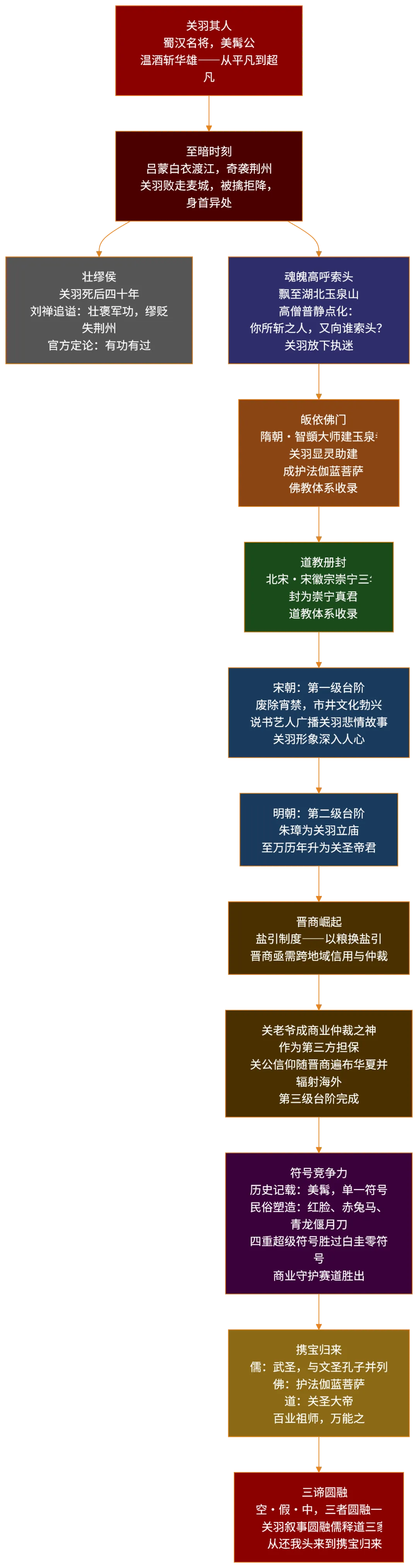
That the memory of Kuan Yü should have ascended from the obscurity of a defeated general to the exalted station of a deity venerated alike by the three great religious dispensations of the Chinese civilisation — the Confucian, the Buddhist, and the Taoist — is a phenomenon which no superficial enquiry can satisfactorily explain, and which demands of the historian both patience and a certain philosophical temper.
The trajectory of this remarkable apotheosis may be traced through three successive stages, each corresponding to a distinct epoch in the political and cultural history of the Middle Kingdom. During the Sung dynasty, when the ancient prohibition of nocturnal commerce was at length relaxed and the urban populace enjoyed an unprecedented liberty of assembly and entertainment, the itinerant storytellers — those industrious purveyors of popular narrative — perceived with singular acuity the dramatic and elegiac qualities inherent in the tale of Kuan Yü: a hero of surpassing valour, undone not by cowardice but by the treachery of circumstance and the cupidity of rivals. Through their recitations, the figure of Kuan Yü was impressed upon the imagination of the common people with a vividness that no official proclamation could have achieved.
The second stage of his elevation was accomplished under the auspices of the Ming dynasty. The founder of that house, the Emperor Hung-wu, animated by a jealous regard for the proprieties of rank and title, took exception to the posthumous dignity which earlier sovereigns had conferred upon Chiang Tzu-ya — a minister of the Chou kings — and caused that ancient worthy to be removed from the Temple of Martial Prowess. In his stead, the loyal and righteous Kuan Yü was honoured with a temple of his own; and the successive emperors of the Ming, each adding some new distinction to the cult, brought it at length, in the reign of the Wan-li Emperor, to the dignity of Kuan Sheng Ti-chün — a title which may be rendered, with approximate fidelity, as the Holy Emperor Kuan.
It was, however, the merchants of Shansi who carried the veneration of Kuan Yü beyond the boundaries of the court and the city into the farthest reaches of the commercial world. The fiscal exigencies of the Ming government, which required the provisioning of distant garrisons, had offered to these enterprising traders a privilege of singular value: in exchange for the transport of grain to the frontier, they received certificates — known as yen-yin — entitling them to deal in the government’s monopoly of salt. Enriched by this arrangement and dispersed across the breadth of the empire, the Shansi merchants stood in perpetual need of some mechanism by which the obligations of commerce — trust, arbitration, the enforcement of contracts — might be guaranteed among parties separated by vast distances and unacquainted with one another’s character. To this necessity they applied a religious solution: the figure of Kuan Yü, their fellow-provincial and the very embodiment of fidelity and righteousness, was installed as the impartial arbiter of mercantile disputes, a celestial guarantor whose authority transcended the limitations of any merely human institution. Thus did the faith in Kuan Kung travel with the caravans of the Shansi merchants to every province of China and thence to the lands beyond the sea, completing the third and final stage of his ascent to universal veneration.
The moral theology of Kuan Yü, as expounded by the commentator Lo Chen-yü, rests upon the twin virtues of loyalty and righteousness — the former expressed in the vertical relation of devotion to his sworn brother Liu Pei, the latter in the horizontal relation of equitable dealing with all men. It is a distinction of no small significance that, whilst the hierarchical imperatives of the imperial age assigned precedence to loyalty, the common people, in the freedom of their own moral imagination, reserved their deepest admiration for his righteousness — that quality which, being independent of rank and power, speaks most directly to the condition of the ordinary man.
The narrative arc of Kuan Yü’s mythological career corresponds, with a fidelity that would have gratified the American scholar Joseph Campbell, to the universal pattern of the heroic journey. From the obscurity of his origins, he announced his advent to the world by the celebrated feat of slaying the warrior Hua Hsiung over a cup of wine yet warm — an act which accomplished, in the economy of popular legend, the transition from the commonplace to the extraordinary. His darkest hour arrived when Lü Meng, general of the Eastern Wu, executed a stratagem of consummate audacity: crossing the river in the guise of merchants, his soldiers seized the strategic territory of Ching-chou, leaving Kuan Yü exposed and outmanoeuvred, forced to retreat to Mai-ch’eng, where, his horse having been brought down in an ambush, he was taken captive, refused to submit, and was beheaded — his body and head severed, his mortal existence concluded in ignominy.
Yet it is precisely at this nadir that the mythological transformation commences. The disembodied spirit of Kuan Yü, wandering through the void and crying out for the restitution of his severed head, drifted at length to the Jade Spring Mountain in Hupei, where the monk P’u-ching posed to it a question of disarming simplicity: those whose heads Kuan Yü had himself struck off — to whom might they address a similar demand? By this interrogation the spirit was enlightened, its obsession dissolved, and the first intimation of transcendence was vouchsafed to it.
In the subsequent age of the Sui dynasty, the great master Chih-i, founder of the T’ien-t’ai school of Buddhism — whose central doctrine of the Three Truths in Harmonious Fusion taught that all phenomena are simultaneously empty of fixed substance, provisionally real in their dependent origination, and perfectly reconciled in the Middle Way — constructed the Jade Spring Temple upon that very mountain. Kuan Yü manifested his spirit in aid of the enterprise, and was in return received into the Buddhist pantheon as a Bodhisattva guardian of the dharma.
Some five centuries thereafter, the Sung Emperor Hui-tsung, himself a devotee of the Taoist persuasion, conferred upon Kuan Yü the title of Ch’ung-ning Chen-chün, thereby enrolling him formally in the celestial hierarchy of Taoism. The twelfth and final station of Campbell’s simplified heroic schema is designated the Return with the Elixir — that is to say, the hero’s re-entry into the world bearing gifts of wisdom and power for the benefit of all mankind. The career of Kuan Kung fulfils this archetype with singular completeness: revered as the Martial Sage standing in parity with Confucius himself within the Confucian order; honoured as a guardian Bodhisattva within Buddhism; and enthroned as the Holy Emperor within Taoism, he became, in the fullness of time, a deity of universal competence — patron of soldiers, merchants, sworn brotherhoods, and sundry trades — the living embodiment of that elixir which, in the language of myth, the perfected hero carries home for the redemption of the world.
One further consideration demands attention: the question of why the cult of Kuan Yü should have prevailed over that of Pai Kuei, the merchant of the Warring States period whom Ssu-ma Ch’ien, in his Biographies of the Money-makers, had honoured as the progenitor of all commerce, and whom the Sung Emperor Chen-tsung had elevated to the dignity of Sage of Commerce. The answer, it is submitted, lies in the domain of symbolic communication. The historical record furnished Kuan Yü with a single distinguishing mark — his magnificent beard. To this the storytellers and novelists of subsequent ages added three further emblems: the crimson countenance, the steed Red Hare, and the halberd known as the Green Dragon Crescent Blade. Against this fourfold apparatus of visual identity, the figure of Pai Kuei offered nothing comparable. In an era of expanding commerce and increasingly diversified media of transmission, the richer symbolic vocabulary of Kuan Yü conferred upon his cult a decisive advantage in the competition for devotional allegiance — a competition which, viewed from the perspective of the semiotician, Kuan Yü was always destined to win.
GRE vocabulary
apotheosis /əˌpɒθɪˈəʊsɪs/ 神化;登峰造极The trajectory of this remarkable apotheosis may be traced through three successive stages.
exalted /ɪɡˈzɔːltɪd/ 崇高的;显赫的His memory ascended to the exalted station of a deity venerated by three great religions.
dispensation /ˌdɪspənˈseɪʃən/ 宗教体制;天命安排He was venerated alike by the three great religious dispensations of Chinese civilisation.
acuity /əˈkjuːɪti/ 敏锐;洞察力The storytellers perceived with singular acuity the dramatic qualities inherent in his tale.
elegiac /ˌelɪˈdʒaɪək/ 哀婉的;挽歌式的They perceived the dramatic and elegiac qualities inherent in the tale of Kuan Yü.
auspices /ˈɔːspɪsɪz/ 庇护;主持The second stage of his elevation was accomplished under the auspices of the Ming dynasty.
cupidity /kjuːˈpɪdɪti/ 贪婪;贪欲Undone not by cowardice but by the treachery of circumstance and the cupidity of rivals.
exigency /ˈeksɪdʒənsi/ 紧迫需要;危急情况The fiscal exigencies of the Ming government required the provisioning of distant garrisons.
vouchsafe /ˌvaʊtʃˈseɪf/ 赐予;惠允;屈尊给予The first intimation of transcendence was vouchsafed to the wandering spirit at Jade Spring Mountain.
nadir /ˈneɪdɪə/ 最低点;最糟糕的时刻It is precisely at this nadir that the mythological transformation commences.
disembodied /ˌdɪsɪmˈbɒdid/ 脱离肉体的;幽灵般的The disembodied spirit of Kuan Yü wandered through the void crying out for restitution.
restitution /ˌrestɪˈtjuːʃən/ 归还;赔偿;复原The spirit cried out for the restitution of his severed head.
disarming /dɪsˈɑːmɪŋ/ 消除戒备的;令人释怀的The monk posed to it a question of disarming simplicity.
semiotician /ˌsiːmɪəˈtɪʃən/ 符号学家Viewed from the perspective of the semiotician, Kuan Yü was always destined to win.
parity /ˈpærɪti/ 同等;平等He was revered as the Martial Sage standing in parity with Confucius himself.
pantheon /ˈpænθiɒn/ 万神殿;神灵体系He was received into the Buddhist pantheon as a Bodhisattva guardian of the dharma.
consummate /ˈkɒnsəmɪt/ 技艺精湛的;完美的Lü Meng executed a stratagem of consummate audacity.
audacity /ɔːˈdæsɪti/ 大胆;鲁莽;厚颜Lü Meng executed a stratagem of consummate audacity, crossing the river in the guise of merchants.
progenitor /prəˈdʒenɪtə/ 祖先;创始人;先驱Ssu-ma Ch’ien had honoured Pai Kuei as the progenitor of all commerce.
fidelity /fɪˈdelɪti/ 忠实;忠诚;准确性The narrative arc corresponds, with a fidelity that would have gratified Campbell, to the universal heroic pattern.
ignominy /ˈɪɡnəmɪni/ 耻辱;不名誉His mortal existence concluded in ignominy, his body and head severed asunder.
intimation /ˌɪntɪˈmeɪʃən/ 暗示;预兆;迹象The first intimation of transcendence was vouchsafed to the spirit upon the mountain.
interpolate /ɪnˈtɜːpəleɪt/ 插入;添加;篡改The storytellers did not merely interpolate details but reconstructed an entire symbolic vocabulary around the historical figure.
Guan Yu was a defeated general of the Three Kingdoms period. However, he ascended from the obscurity of a defeated warrior to the exalted status of a deity.
In the Song Dynasty, Emperor Huizong, a devout Taoist, elevated Guan Yu to the celestial hierarchy of Taoism.
As early as the Tang Dynasty, the venerable monk and founder of the Tiantai School elevated Guan Yu to the Buddhism pantheon as a temple guardian.
From my perspective, the legends of Guan Yu fabricated and refined by people across dynasties align with the hero’s journey archetype proposed by Joseph Campbell.
Guan Yu endured his darkest hours and finally returned with the elixir. In other words, he re‑entered the mortal world with wisdom and spiritual power to benefit later generations.
According to historical records, Guan Yu was known for his magnificent beard. Later storytellers and novelists added three more iconic symbols: his crimson countenance, the steed Red Hare, and his weapon, the Green Dragon Crescent Blade.
These four emblems granted Guan Yu unparalleled charisma and played a vital role in the narrative arc of his mythological apotheosis.