微信:cs5311742016 主营各地名校期中期末真题卷及小初高全套教材教案讲义知识点总结
北京师大附中 2023-2024 学年度第二学期
初三英语阶段性练习 2024.3
教学班:________________ 姓名:________________ 学号:
________________
1.本卷共有五道大题,共 12 页。考试时间 60 分钟满分 60
考
生
分。 2.考生务必将答案填写在答题纸上,在试卷上作答无效。 3.
须
知
考试结束后,考生应将答题纸交回。
第一部分
一、单项填空(每题 0.5 分,共 6 分)
从下面各题所给的 A、B、C、D 四个选项中,选择可以填入空白处的最佳选
项。
1. This is Mary’s English book. ______ is at home.
A. I B. My C. Me D. Mine
2. Our school library opens ______ 8 a.m. on weekdays.
A. at B. for C. in D. of
3. —______ was your trip to Yunnan, Tom?
—It was wonderful.
A How B. What C. When D. Where
4. —John, ______ you please take out the trash?
—OK, Mum. I’ll do it right away.
A. must B. should C. could D. need
5. Read these books, ______ you’ll get to know more about Chinese tea culture.
A. though B. unless C. and D. but
6. Linda is ______ in art than her sister Lily.
A. creative B. more creative C. most creative D. the most creative
7. We ______ a survey about students’ reading habits last weekend.
A. do B. did C. have done D. will do
{#{QQABKQCAogAgAoBAAAhCEwWgCAMQkBEACYgGBEAEoAIBgBFABAA=}#}
微信:cs5311742016 主营各地名校期中期末真题卷及小初高全套教材教案讲义知识点总结
1微信:cs5311742016 主营各地名校期中期末真题卷及小初高全套教材教案讲义知识点总结
8. Millions of tourists ______ the Great Wall every year.
A. visit B. will visit C. visited D. have visited
9. I ______ a video call with Grandma when Dad arrived home.
A. have B. will have C. am having D. was having
10. Time flies. Mr. Smith ______ English in our school for three years. We all enjoy his
classes.
A. teaches B. will teach C. has taught D. was teaching
11. The graduation party ______ in the school hall next month.
A. was held B. will be held C. held D. will hold
12. —Jack, do you know ______?
—Sure. Once a week would be OK.
A. how long should I water the plants
B. how long I should water the plants
C. how often should I water the plants
D. how often I should water the plants
二、完形填空(每题 1分,共 8分)
阅读下面的短文,掌握其大意,然后从短文后各题所给的 A、B、C、D 四个选
项中,选择最佳选项。
The alarm clock went off for the second time. Tired from staying up late to watch a
movie, Maddie unwillingly dragged herself out of bed. She loved movies, and she often
stayed up late to watch them on TV. She 13 got dressed, took a bite of her
breakfast, and raced to school.
During the first lesson, Maddie had a 14 time focusing. She was staring out of
the window when her teacher, Ms. Lorenz called her.
“Maddie, I think you’ve forgotten your homework again,” Ms. Lorenz said. “How
about finishing it today at school?”
Maddie agreed. After school, she thought about the 15 for a while. Then she
decided to write about a girl who loved movies. To make the story more fun, she decided
to give the girl the ability to jump into the action of any movie she wanted.
微信:cs5311742016 主营各地名校期中期末真题卷及小初高全套教材教案讲义知识点总结
2微信:cs5311742016 主营各地名校期中期末真题卷及小初高全套教材教案讲义知识点总结
Maddie became so 16 in writing her story that at first she didn’t hear Ms. Lorenz
tell her she could go home. When she had finished it, she gave it to Ms. Lorenz.
When Ms. Lorenz returned the story, there was green ink everywhere. Maddie 17
her way of feedback—Ms. Lorenz used green ink to make corrections because
she thought students connected red ink with bad feelings.
That night, Maddie 18 her story. She smiled when she reached the last page and
saw the words, “Nice job, Maddie! Your plot is exciting. I wish I could jump into
movies! Write another piece to correct your mistakes and give it to me next week.” The
words made Maddie want to do better. Right away, she rewrote the story, taking care to 19
her mistakes.
The next morning, she put her story into the homework box. And she got
more encouraging words and instructions from Ms. Lorenz.
Little by little, Maddie got better about completing homework and turning it in on
time. She also worked on new movie ideas and discussed them with Ms. Lorenz. Her
writing and grades were gradually improving.
Her love for movies, along with her teacher’s 20 , opened up a new world of
learning.
13. A. angrily B. carefully C. hurriedly D. properly
14. A. hard B. busy C. fair D. cool
15. A. goal B. task C. plan D. list
16. A. experienced B. disappointed C. surprised D. involved
17. A. liked B. missed C. improved D. questioned
18. A. recommended B. examined C. produced D. practised
19. A. mark B. prove C. correct D. accept
20. A. comfort B. promise C. decision D. guidance
{#{QQABKQCAogAgAoBAAAhCEwWgCAMQkBEACYgGBEAEoAIBgBFABAA=}#}
微信:cs5311742016 主营各地名校期中期末真题卷及小初高全套教材教案讲义知识点总结
3微信:cs5311742016 主营各地名校期中期末真题卷及小初高全套教材教案讲义知识点总结
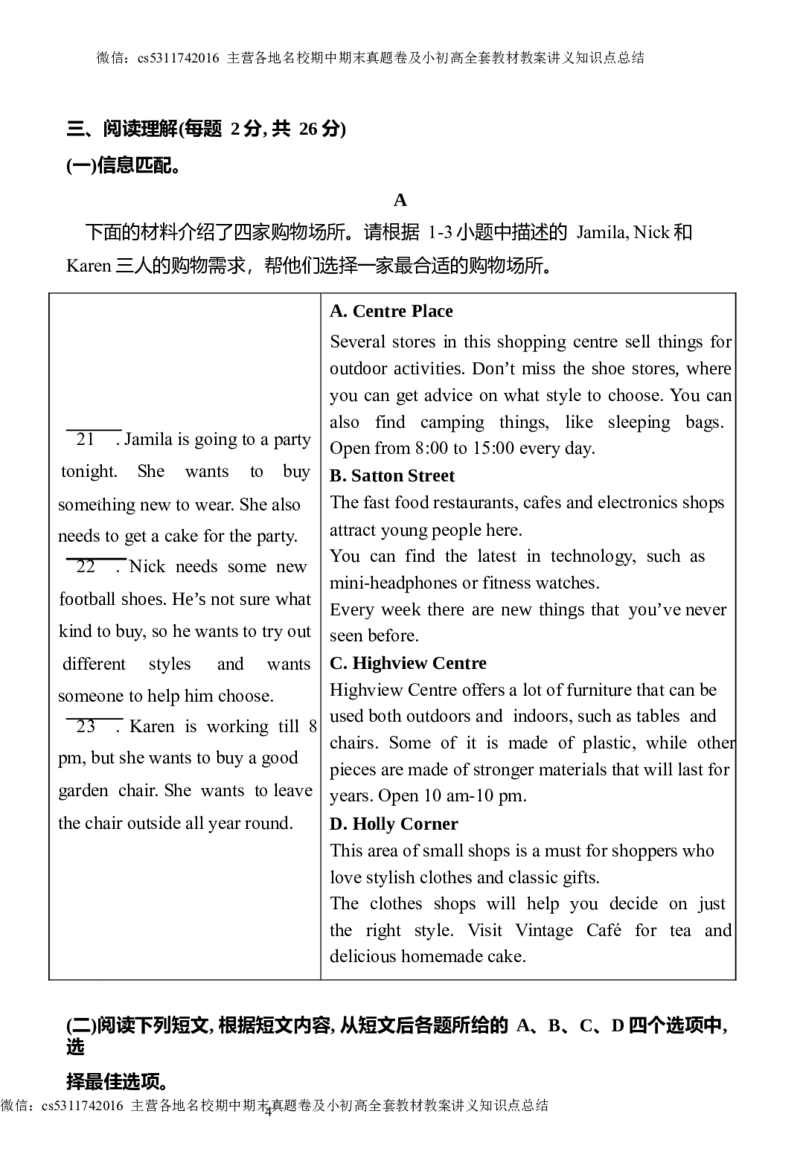
三、阅读理解(每题 2分, 共 26分)
(一)信息匹配。
A
下面的材料介绍了四家购物场所。请根据 1-3小题中描述的 Jamila, Nick和
Karen三人的购物需求,帮他们选择一家最合适的购物场所。
A. Centre Place
Several stores in this shopping centre sell things for
outdoor activities. Don’t miss the shoe stores, where
you can get advice on what style to choose. You can
also find camping things, like sleeping bags.
21 . Jamila is going to a party
Open from 8:00 to 15:00 every day.
tonight. She wants to buy
B. Satton Street
something new to wear. She also The fast food restaurants, cafes and electronics shops
attract young people here.
needs to get a cake for the party.
You can find the latest in technology, such as
22 . Nick needs some new
mini-headphones or fitness watches.
football shoes. He’s not sure what
Every week there are new things that you’ve never
kind to buy, so he wants to try out seen before.
different styles and wants C. Highview Centre
Highview Centre offers a lot of furniture that can be
someone to help him choose.
used both outdoors and indoors, such as tables and
23 . Karen is working till 8
chairs. Some of it is made of plastic, while other
pm, but she wants to buy a good
pieces are made of stronger materials that will last for
garden chair. She wants to leave
years. Open 10 am-10 pm.
the chair outside all year round. D. Holly Corner
This area of small shops is a must for shoppers who
love stylish clothes and classic gifts.
The clothes shops will help you decide on just
the right style. Visit Vintage Café for tea and
delicious homemade cake.
(二)阅读下列短文, 根据短文内容, 从短文后各题所给的 A、B、C、D四个选项中,
选
择最佳选项。
微信:cs5311742016 主营各地名校期中期末真题卷及小初高全套教材教案讲义知识点总结
4微信:cs5311742016 主营各地名校期中期末真题卷及小初高全套教材教案讲义知识点总结
B
I began to grow up that winter night when my parents and I were returning from my
aunt's house, and my mother said that we might soon be leaving for America. We were on
the bus then. I was crying, and some people on the bus were turning around to look at me.
I remember that I could not bear the thought of never hearing again the radio program for
school children to which I listened every morning.
I do not remember myself crying for this reason again. In fact, I think I cried very
little when I was saying goodbye to my friends and relatives. When we were leaving I
thought about all the places I was going to see— the strange and magical places I had
known only from books and pictures. The country I was leaving never to come back was
hardly in my head then.
The four years that followed taught me the importance of optimism, but the idea did
not come to me at once. For the first two years in New York I was really lost—having to
study in three schools as a result of family moves. I did not quite know what I was or what
I should be. Mother remarried, and things became even more complex for me. Some time
passed before my stepfather and I got used to each other. I was often sad, and saw no end
to “the hard times.”
My responsibilities in the family increased a lot since I knew English better
than everyone else at home. I wrote letters, filled out forms, translated at
interviews with immigration officers, took my grandparents to the doctor and translated
there, and even discussed telephone bills with company representatives.
From my experiences I have learned one important rule: almost all common troubles
finally go away! Something good is certain to happen in the end when you do not give up,
and just wait a little! I believe that my life will turn out all right, even though it will not be
that easy.
24. How did the author get to know America?
A. From her relatives. B. From her mother.
C. From books and pictures. D. From radio
programs.
第5页/共 12页
{#{QQABKQCAogAgAoBAAAhCEwWgCAMQkBEACYgGBEAEoAIBgBFABAA=}#}
学科网(北京)股份有限公司
微信:cs5311742016 主营各地名校期中期末真题卷及小初高全套教材教案讲义知识点总结
5微信:cs5311742016 主营各地名校期中期末真题卷及小初高全套教材教案讲义知识点总结
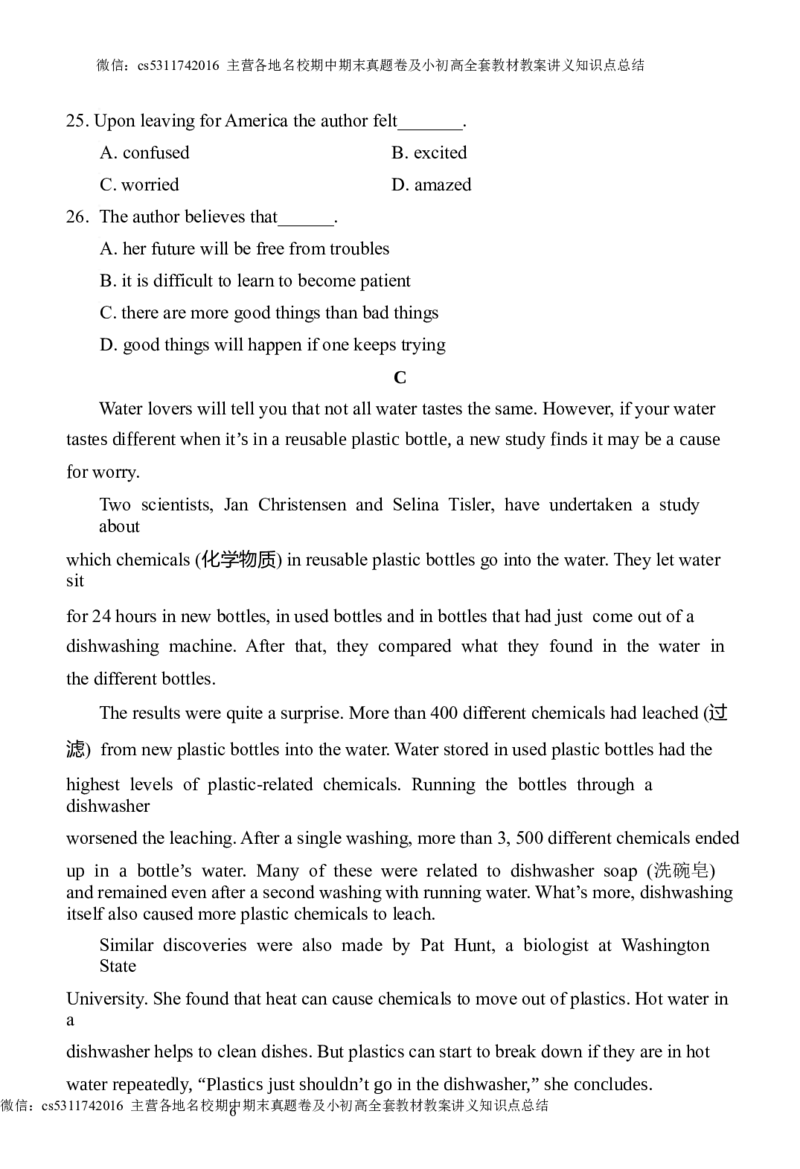
25. Upon leaving for America the author felt_______.
A. confused B. excited
C. worried D. amazed
26. The author believes that______.
A. her future will be free from troubles
B. it is difficult to learn to become patient
C. there are more good things than bad things
D. good things will happen if one keeps trying
C
Water lovers will tell you that not all water tastes the same. However, if your water
tastes different when it’s in a reusable plastic bottle, a new study finds it may be a cause
for worry.
Two scientists, Jan Christensen and Selina Tisler, have undertaken a study
about
which chemicals (化学物质) in reusable plastic bottles go into the water. They let water
sit
for 24 hours in new bottles, in used bottles and in bottles that had just come out of a
dishwashing machine. After that, they compared what they found in the water in
the different bottles.
The results were quite a surprise. More than 400 different chemicals had leached (过
滤) from new plastic bottles into the water. Water stored in used plastic bottles had the
highest levels of plastic-related chemicals. Running the bottles through a
dishwasher
worsened the leaching. After a single washing, more than 3, 500 different chemicals ended
up in a bottle’s water. Many of these were related to dishwasher soap (洗碗皂)
and remained even after a second washing with running water. What’s more, dishwashing
itself also caused more plastic chemicals to leach.
Similar discoveries were also made by Pat Hunt, a biologist at Washington
State
University. She found that heat can cause chemicals to move out of plastics. Hot water in
a
dishwasher helps to clean dishes. But plastics can start to break down if they are in hot
water repeatedly, “Plastics just shouldn’t go in the dishwasher,” she concludes.
微信:cs5311742016 主营各地名校期中期末真题卷及小初高全套教材教案讲义知识点总结
6微信:cs5311742016 主营各地名校期中期末真题卷及小初高全套教材教案讲义知识点总结
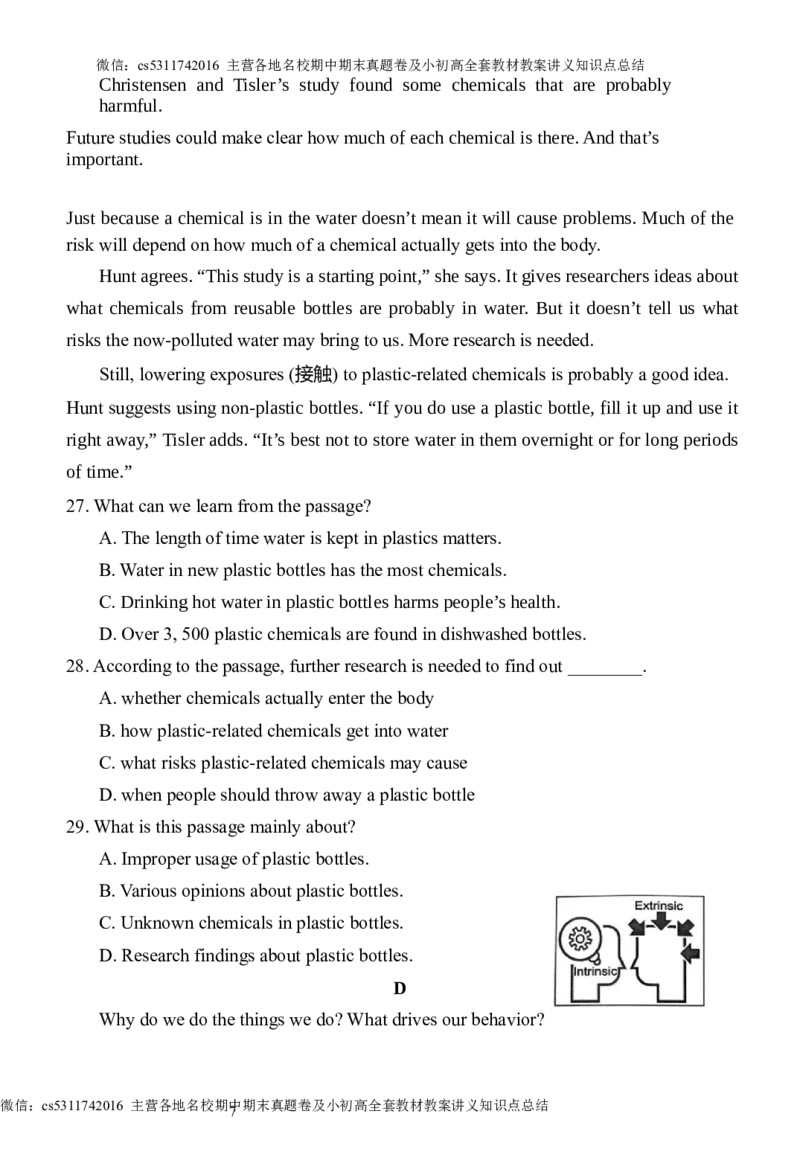
Christensen and Tisler’s study found some chemicals that are probably
harmful.
Future studies could make clear how much of each chemical is there. And that’s
important.
Just because a chemical is in the water doesn’t mean it will cause problems. Much of the
risk will depend on how much of a chemical actually gets into the body.
Hunt agrees. “This study is a starting point,” she says. It gives researchers ideas about
what chemicals from reusable bottles are probably in water. But it doesn’t tell us what
risks the now-polluted water may bring to us. More research is needed.
Still, lowering exposures (接触) to plastic-related chemicals is probably a good idea.
Hunt suggests using non-plastic bottles. “If you do use a plastic bottle, fill it up and use it
right away,” Tisler adds. “It’s best not to store water in them overnight or for long periods
of time.”
27. What can we learn from the passage?
A. The length of time water is kept in plastics matters.
B. Water in new plastic bottles has the most chemicals.
C. Drinking hot water in plastic bottles harms people’s health.
D. Over 3, 500 plastic chemicals are found in dishwashed bottles.
28. According to the passage, further research is needed to find out ________.
A. whether chemicals actually enter the body
B. how plastic-related chemicals get into water
C. what risks plastic-related chemicals may cause
D. when people should throw away a plastic bottle
29. What is this passage mainly about?
A. Improper usage of plastic bottles.
B. Various opinions about plastic bottles.
C. Unknown chemicals in plastic bottles.
D. Research findings about plastic bottles.
D
Why do we do the things we do? What drives our behavior?
微信:cs5311742016 主营各地名校期中期末真题卷及小初高全套教材教案讲义知识点总结
7微信:cs5311742016 主营各地名校期中期末真题卷及小初高全套教材教案讲义知识点总结
Psychologists have suggested different ways of thinking about
motivation ( 动 机 ), including looking at whether
motivation arises from outside (extrinsic) or inside (intrinsic) a
person.
Researchers have found that each type has a different effect
on a person’s behavior and efforts to achieve goals. To better understand the influence of
intrinsic and extrinsic motivation on human behavior it would help to learn how each
type works.
Extrinsic motivation is when you are motivated to perform a behavior or take part in
an activity because you want to get a reward (奖赏) or avoid punishment. You will take
action not because you enjoy it, but because you expect to get something in return or
avoid something unpleasant.
Intrinsic motivation is when you decide to do something because you find it
satisfying.
You are performing an activity for what it is not because you are after some external(外部
的) reward. The behavior itself is its own reward.
Studies have shown that offering too many external rewards for an already internally
rewarding behavior can reduce intrinsic motivation—which is known as the over
justification(奖励过当) effect. For example, in a 2008 study, children who were rewarded
for playing with a toy they had already expressed interest in playing with became less
interested in the toy after being externally rewarded.
This is not to suggest that extrinsic motivation is a bad thing—it can be beneficial in
some situations. For example, extrinsic motivation can be especially helpful when a
person needs to complete a task that they find unpleasant.
Most people would accept that intrinsic motivation is best, but it is not always
possible in every situation. Sometimes a person simply has no internal wish to join in an
activity.
Both extrinsic and intrinsic motivation play a key role in learning. Experts
have
argued that education’s traditional stress on external rewards (such as grades, report cards,
and gold stars) undermines any intrinsic motivation that students might already have.
微信:cs5311742016 主营各地名校期中期末真题卷及小初高全套教材教案讲义知识点总结
8微信:cs5311742016 主营各地名校期中期末真题卷及小初高全套教材教案讲义知识点总结
However, others have suggested that extrinsic motivators can help students feel
more knowledgeable in the classroom, which in turn builds up their intrinsic motivation.
As professor David Myers put it, a person’s interest often survives when a reward is
used neither to bribe(贿赂) nor to control but to show a job well done, as in a “most
improved player” award. Put simply, rewards, rightly given, can increase enjoyment and
motivate high performance.
Understanding how each type of motivation works and when it is likely to be useful
can help people perform tasks and improve their learning.
{#{QQABKQCAogAgAoBAAAhCEwWgCAMQkBEACYgGBEAEoAIBgBFABAA=}#}
微信:cs5311742016 主营各地名校期中期末真题卷及小初高全套教材教案讲义知识点总结
9微信:cs5311742016 主营各地名校期中期末真题卷及小初高全套教材教案讲义知识点总结
30. You do something out of intrinsic motivation when you ________.
A. do schoolwork to get a good grade
B. work on a subject you find interesting
C. take part in a sport to receive recognition
D. clean your room to avoid criticism from your parents 31.
Why does the writer mention the 2008 study in Paragraph 5?
A. To explain the benefits of offering toys as rewards.
B. To prove external rewards can influence one’s interest.
C. To introduce how intrinsic motivation works in children. D. To
stress the importance of understanding intrinsic motivation.
32. The word “undermines” in Paragraph 8 means ________.
A. weakens B. separates C. improves D. encourages
33. The writer probably agrees that ________.
A. extrinsic motivation is key to one’s achievement
B. intrinsic motivation has little to do with enjoying a task C.
properly-given rewards can encourage further improvement D.
offering rewards of any kind takes the fun out of an activity
第二部分
本部分共 5题, 共 20分。根据题目要求, 完成相应任务。
四、阅读表达(34—36题每题各 2分, 37题 4分, 共 10分)
阅读短文,根据短文内容回答问题。
The Library With No Rules
When you walk by Hernando Guanlao’s home on
Balagtas Street, downtown Manila, you will see thousands of
books on shelves and on the stairs. Each one is free to
anyone who wants it.
“People can borrow, take home, bring back or keep,” says Guanlao. “Or they can
share and pass on to another. But basically they should just take, take!” He thinks books
need to live, and they’re only alive if they are being read. “The act of giving books makes
your life meaningful,” says Guanlao.
微信:cs5311742016 主营各地名校期中期末真题卷及小初高全套教材教案讲义知识点总结
10微信:cs5311742016 主营各地名校期中期末真题卷及小初高全套教材教案讲义知识点总结
The Reading Club 2000, as the project is called, began more than twenty years ago.
“My parents gave me my love of reading,” he says. “I started the club to honour them and
to do some kind of community service. So I put my old books—and my brothers’ and
sisters’, maybe 100 in all—outside, to see if anyone was interested.”
It took a while for people to work out that this was a library. It never closed and there
were no rules in it. But the project, offering everything from paperbacks to
fashion magazines, technical books and school textbooks, is becoming popular.
The success of the project is helped by the fact that the country, with a population of
92 million, has fewer than 700 public libraries, and many people cannot afford to buy
books. Luckily, the project is spreading. Guanlao takes boxes of books into—
Manila’s neighbourhoods himself. He has also helped friends set up similar projects in ten
other places around the country, and encouraged students to donate (捐赠) books.
Aurora Verayo, from a town several hours’ drive from Manila, says she came to see
Guanlao to donate books, but he encouraged her to open her own library. “I’m going a step
further and offering reading activities for children,” she says. Mark, 16-year-old student, is
organizing a book donation with friends. “We’ve collected.” he says, “We’re taking them
to some poor books so far, and we expect many more, areas next month. Books open
minds.
A book can take you anywhere.”
34. What does Guanlao think of books?
_______________________________________________________________________
35. Why did Guanlao start the Reading Club 2000?
_______________________________________________________________________
36. What was special about Guanlao’s library?
_______________________________________________________________________
37. What do you think of the Reading Club 2000? Why do you think so? (List at least two
reasons)
_______________________________________________________________________
{#{QQABKQCAogAgAoBAAAhCEwWgCAMQkBEACYgGBEAEoAIBgBFABAA=}#}
微信:cs5311742016 主营各地名校期中期末真题卷及小初高全套教材教案讲义知识点总结
11微信:cs5311742016 主营各地名校期中期末真题卷及小初高全套教材教案讲义知识点总结
五、文段表达(10分)
从下面两个题目中任选一题,根据中文和英文提示,完成一篇不少于 50词的文段写作。
文中已给出内容不计入总词数。所给提示词语仅供选用。请不要写出你的校名和姓
名。
题目①
假如你是李华,下周你们学校将组织全体同学进行体检。请你写一封英文邮件,
通知你们班交换生 Peter, 告诉他体检当天集合的时间、地点、以及需要提前做的准
备。
提示词语: health check-up, sleep, meal, proper clothes
提示问题:
• When and where are you going to meet?
• What should Peter do to get prepared?
Dear Peter:
____________________________________________________________________
______________________________________________________________________
_
______________________________________________________________________
_
______________________________________________________________________
_
Yours,
Li Hua
题目②
耳朵是通往心灵之路。假如你是李华,你校英语社团正在开展以“倾听”为主
题的
交流活动。请你用英语给社团公众号留言,谈谈你在与人交流时是如何倾听他人的,
以及你对倾听的理解。
提示词语:smile,eye contact (目光交流), patient,respect,understand
微信:cs5311742016 主营各地名校期中期末真题卷及小初高全套教材教案讲义知识点总结
12微信:cs5311742016 主营各地名校期中期末真题卷及小初高全套教材教案讲义知识点总结
提示问题:
●What do you do as a good listener?
●Why is it important to be a good listener?
Listening is more than using our ears.
___________________________________________________________________
_______________________________________________________________________
_______________________________________________________________________
_______________________________________________________________________
_______________________________________________________________________
______________________________________________________________________
{#{QQABKQCAogAgAoBAAAhCEwWgCAMQkBCYgGBEAEoAIBgBFABAA=}#}
微信:cs5311742016 主营各地名校期中期末真题卷及小初高全套教材教案讲义知识点总结
13微信:cs5311742016 主营各地名校期中期末真题卷及小初高全套教材教案讲义知识点总结
份有限公司
微信:cs5311742016 主营各地名校期中期末真题卷及小初高全套教材教案讲义知识点总结
141516