【上好课】2025年高考一轮复习知识清单(讲案)
专题26 2024年新课标I卷词汇二次开发+真题语料单句填空75例
(词性转换+识词知意+高频短语+单句填空) 原卷版
目录
第一部分:词性转换(76 例) P1
第二部分:识词知意(144 例) P3
第三部分:高频短语(70 例) P7
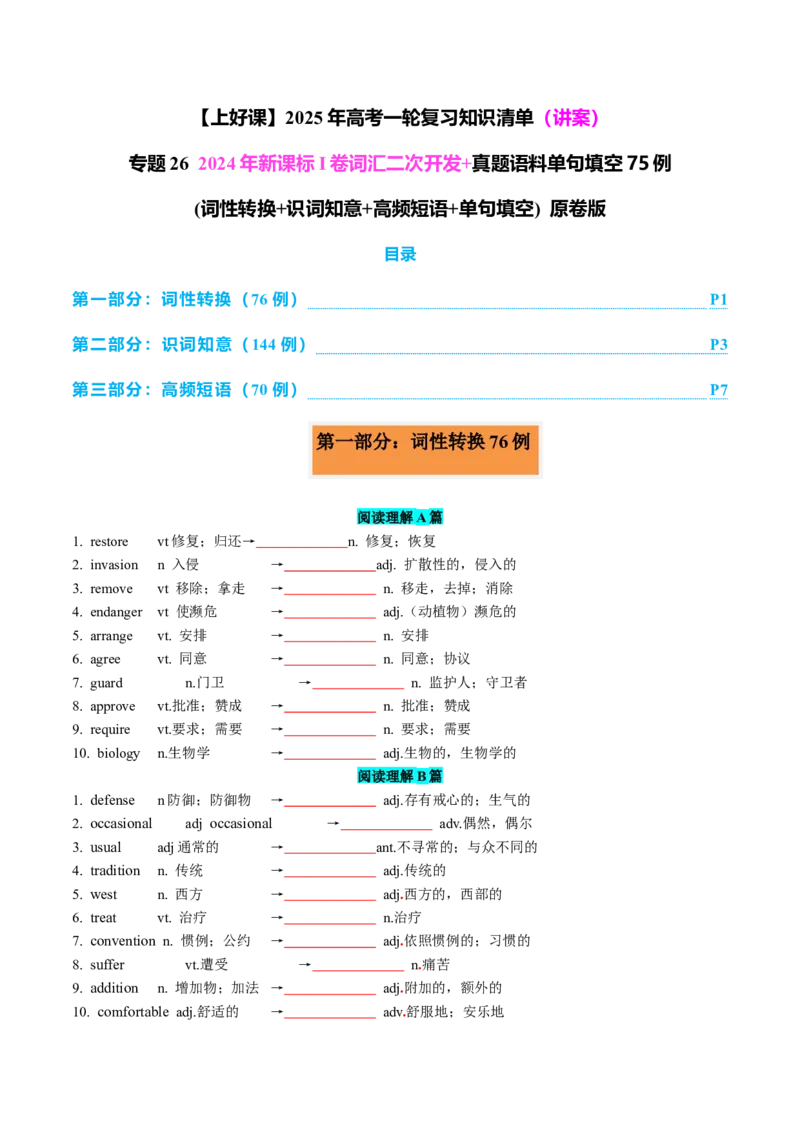
第一部分:词性转换76例
阅读理解A篇
1. restore vt修复;归还→ n. 修复;恢复
2. invasion n 入侵 → adj. 扩散性的,侵入的
3. remove vt 移除;拿走 → n. 移走,去掉;消除
4. endanger vt 使濒危 → adj.(动植物)濒危的
5. arrange vt. 安排 → n. 安排
6. agree vt. 同意 → n. 同意;协议
7. guard n.门卫 → n. 监护人;守卫者
8. approve vt.批准;赞成 → n. 批准;赞成
9. require vt.要求;需要 → n. 要求;需要
10. biology n.生物学 → adj.生物的,生物学的
阅读理解B篇
1. defense n防御;防御物 → adj.存有戒心的;生气的
2. occasional adj occasional → adv.偶然,偶尔
3. usual adj通常的 → ant.不寻常的;与众不同的
4. tradition n. 传统 → adj.传统的
5. west n. 西方 → adj.西方的,西部的
6. treat vt. 治疗 → n.治疗
7. convention n. 惯例;公约 → adj.依照惯例的;习惯的
8. suffer vt.遭受 → n.痛苦
9. addition n. 增加物;加法 → adj.附加的,额外的
10. comfortable adj.舒适的 → adv.舒服地;安乐地11. adjust vt.调整 → n.调整;(行为、思想的)调节,适应
12. indicate vt. 标示;,暗示 → n.标示;象征,暗示
13. complex adj. 复杂的 → n.复杂性
14. effective adj. 有效的 → n.有效性,效力
15. protect vt.保护 → n.保护
16. herb vt.草本植物 → adj.药草的,香草的
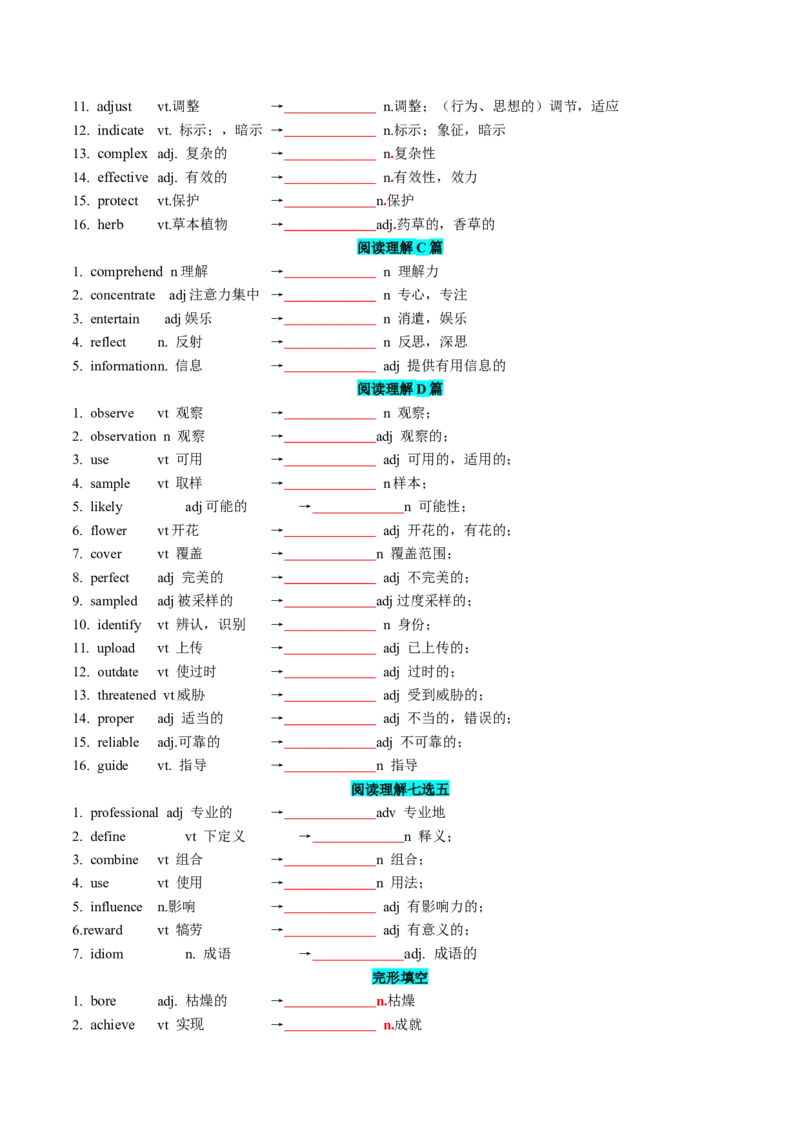
阅读理解C篇
1. comprehend n理解 → n 理解力
2. concentrate adj注意力集中 → n 专心,专注
3. entertain adj娱乐 → n 消遣,娱乐
4. reflect n. 反射 → n 反思,深思
5. informationn. 信息 → adj 提供有用信息的
阅读理解D篇
1. observe vt 观察 → n 观察;
2. observation n 观察 → adj 观察的;
3. use vt 可用 → adj 可用的,适用的;
4. sample vt 取样 → n样本;
5. likely adj可能的 → n 可能性;
6. flower vt开花 → adj 开花的,有花的;
7. cover vt 覆盖 → n 覆盖范围;
8. perfect adj 完美的 → adj 不完美的;
9. sampled adj被采样的 → adj过度采样的;
10. identify vt 辨认,识别 → n 身份;
11. upload vt 上传 → adj 已上传的;
12. outdate vt 使过时 → adj 过时的;
13. threatened vt威胁 → adj 受到威胁的;
14. proper adj 适当的 → adj 不当的,错误的;
15. reliable adj.可靠的 → adj 不可靠的;
16. guide vt. 指导 → n 指导
阅读理解七选五
1. professional adj 专业的 → adv 专业地
2. define vt 下定义 → n 释义;
3. combine vt 组合 → n 组合;
4. use vt 使用 → n 用法;
5. influence n.影响 → adj 有影响力的;
6.reward vt 犒劳 → adj 有意义的;
7. idiom n. 成语 → adj. 成语的
完形填空
1. bore adj. 枯燥的 → n.枯燥
2. achieve vt 实现 → n.成就3. contribute vi 贡献 → n.贡献
4. rely vt. 依赖 → adj.可靠的
5. appeal vt. 吸引 → adj有吸引力的
6. regular adj 经常的 → adv有规律地
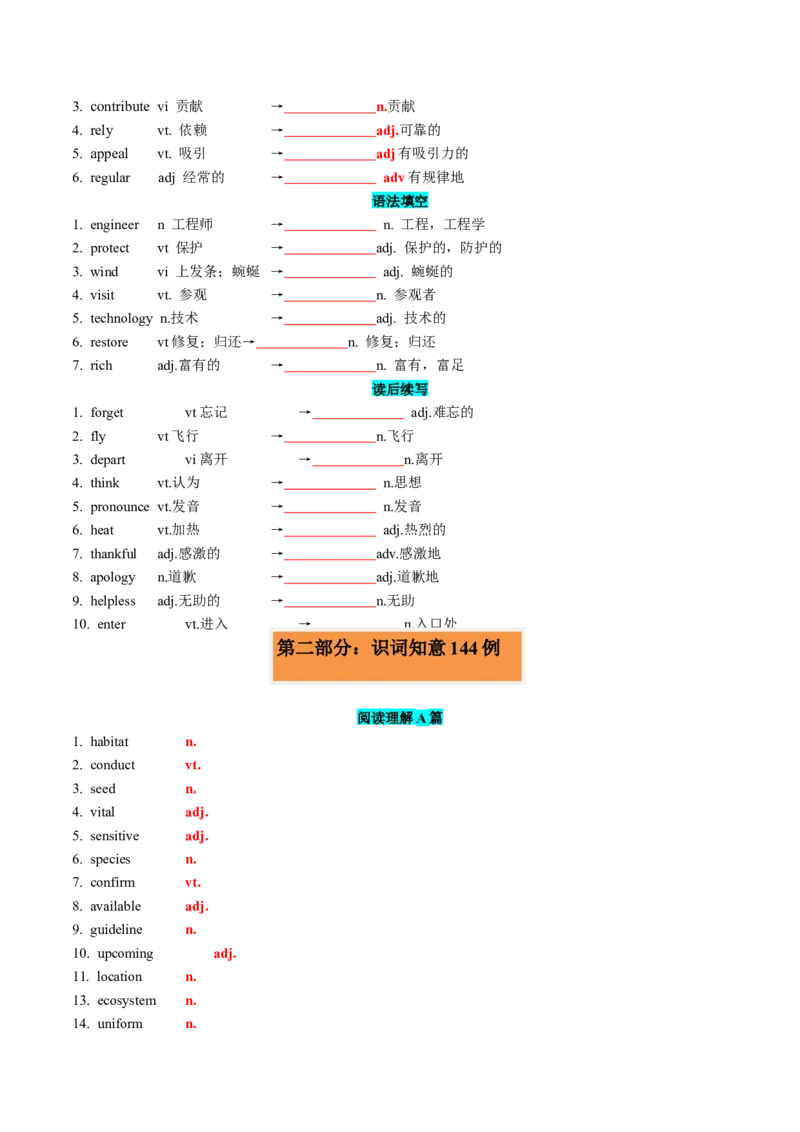
语法填空
1. engineer n 工程师 → n. 工程,工程学
2. protect vt 保护 → adj. 保护的,防护的
3. wind vi 上发条;蜿蜒 → adj. 蜿蜒的
4. visit vt. 参观 → n. 参观者
5. technology n.技术 → adj. 技术的
6. restore vt修复;归还→ n. 修复;归还
7. rich adj.富有的 → n. 富有,富足
读后续写
1. forget vt忘记 → adj.难忘的
2. fly vt飞行 → n.飞行
3. depart vi离开 → n.离开
4. think vt.认为 → n.思想
5. pronounce vt.发音 → n.发音
6. heat vt.加热 → adj.热烈的
7. thankful adj.感激的 → adv.感激地
8. apology n.道歉 → adj.道歉地
9. helpless adj.无助的 → n.无助
10. enter vt.进入 → n.入口处
第二部分:识词知意144例
阅读理解A篇
1. habitat n.
2. conduct vt.
3. seed n.
4. vital adj.
5. sensitive adj.
6. species n.
7. confirm vt.
8. available adj.
9. guideline n.
10. upcoming adj.
11. location n.
13. ecosystem n.
14. uniform n.15. mineral n.
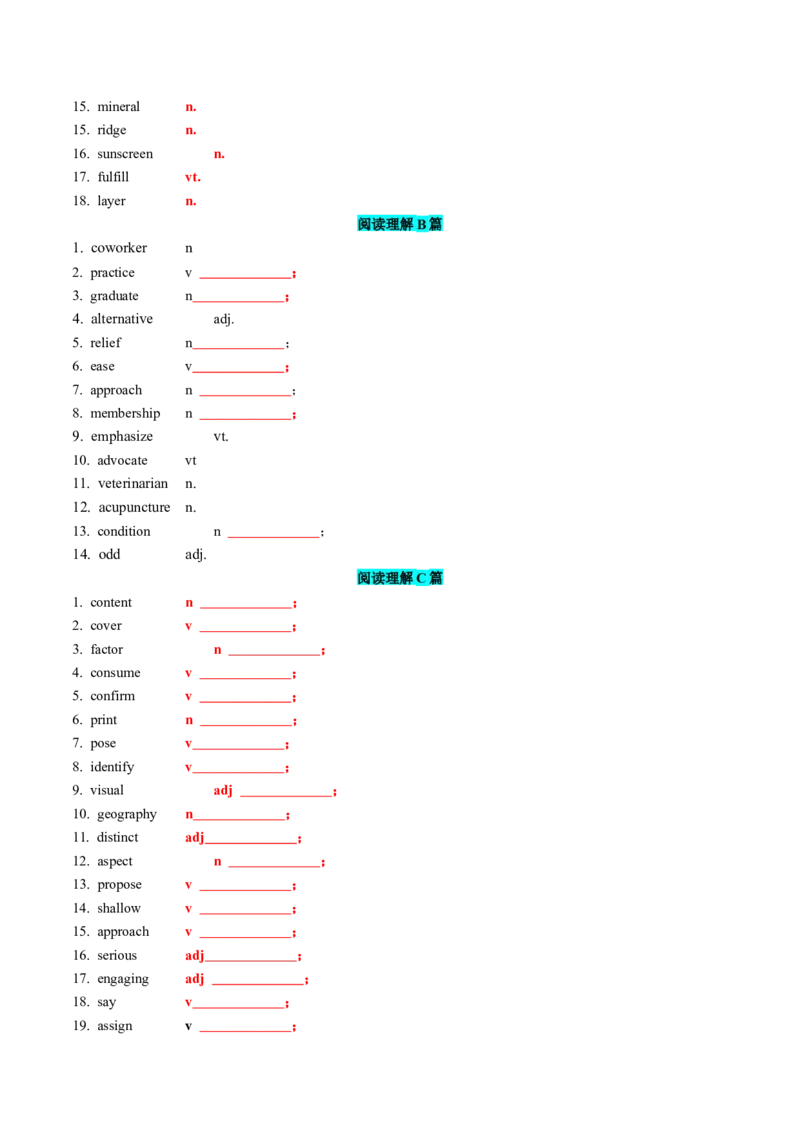
15. ridge n.
16. sunscreen n.
17. fulfill vt.
18. layer n.
阅读理解B篇
1. coworker n
2. practice v ;
3. graduate n ;
4. alternative adj.
5. relief n ;
6. ease v ;
7. approach n ;
8. membership n ;
9. emphasize vt.
10. advocate vt
11. veterinarian n.
12. acupuncture n.
13. condition n ;
14. odd adj.
阅读理解C篇
1. content n ;
2. cover v ;
3. factor n ;
4. consume v ;
5. confirm v ;
6. print n ;
7. pose v ;
8. identify v ;
9. visual adj ;
10. geography n ;
11. distinct adj ;
12. aspect n ;
13. propose v ;
14. shallow v ;
15. approach v ;
16. serious adj ;
17. engaging adj ;
18. say v ;
19. assign v ;20. demonstrate v ;
21. identical adj ;
22. piece n ;
23. role n ;
24. available adj ;
25. maximize v ;
26. reflection n ;
27. assume v ;
28. randomly adv ;
29. apply v ;
30. multiple adj
31. technique n ;
32. produce v
33. onscreen adv ;
34. multitask v ;
35. experimenter n ;
36. abstraction n ;
37. property n ;
38. literal adj ;
39. informative adj ;
40. imply v ;
阅读理解D篇
1. document v ;
2. detect v ;
3. shift n ;
4. variety n ;
5. application n ;
6. primary adj ;
7. investigate v ;
8. reveal v ;
9. favor v ;
10. device n ;
11. encounter n ;
12. feature n
13. dataset n ;
14. eye-catching adj ;
15. well-sampled adj
16. biodiversity n ;
17. humanity n ;
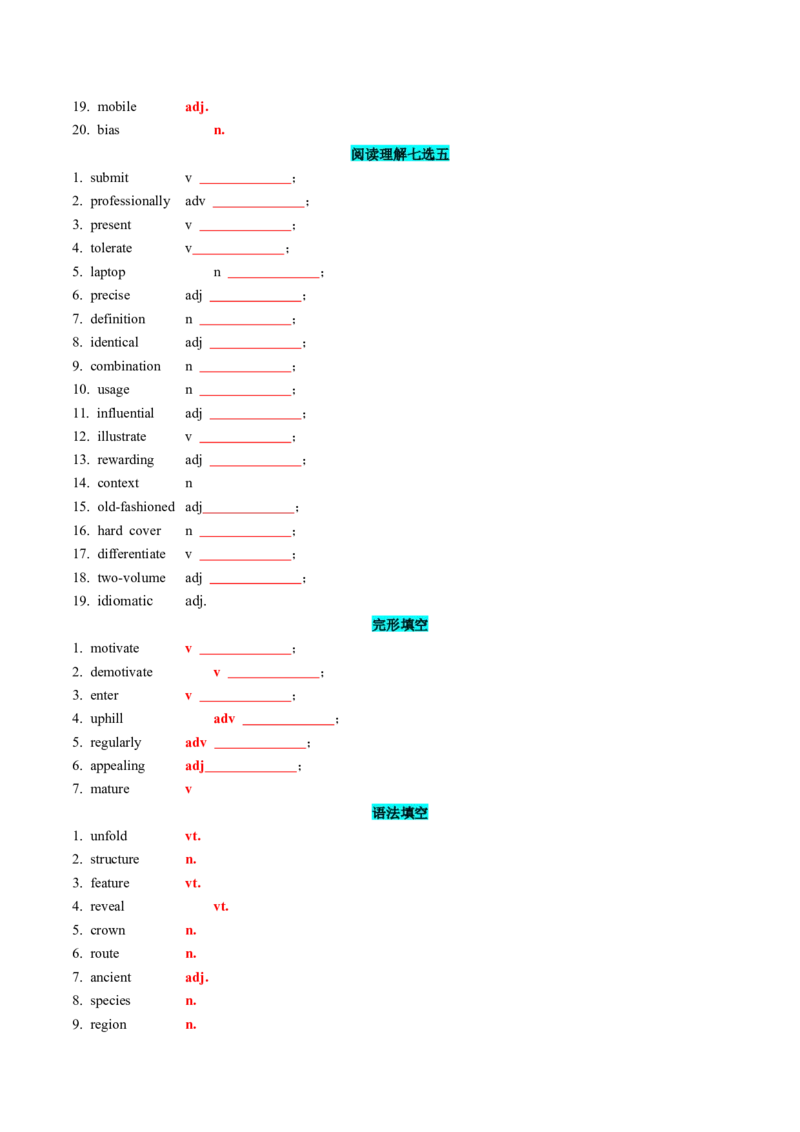
18. outnumber v ;19. mobile adj.
20. bias n.
阅读理解七选五
1. submit v ;
2. professionally adv ;
3. present v ;
4. tolerate v ;
5. laptop n ;
6. precise adj ;
7. definition n ;
8. identical adj ;
9. combination n ;
10. usage n ;
11. influential adj ;
12. illustrate v ;
13. rewarding adj ;
14. context n
15. old-fashioned adj ;
16. hard cover n ;
17. differentiate v ;
18. two-volume adj ;
19. idiomatic adj.
完形填空
1. motivate v ;
2. demotivate v ;
3. enter v ;
4. uphill adv ;
5. regularly adv ;
6. appealing adj ;
7. mature v
语法填空
1. unfold vt.
2. structure n.
3. feature vt.
4. reveal vt.
5. crown n.
6. route n.
7. ancient adj.
8. species n.
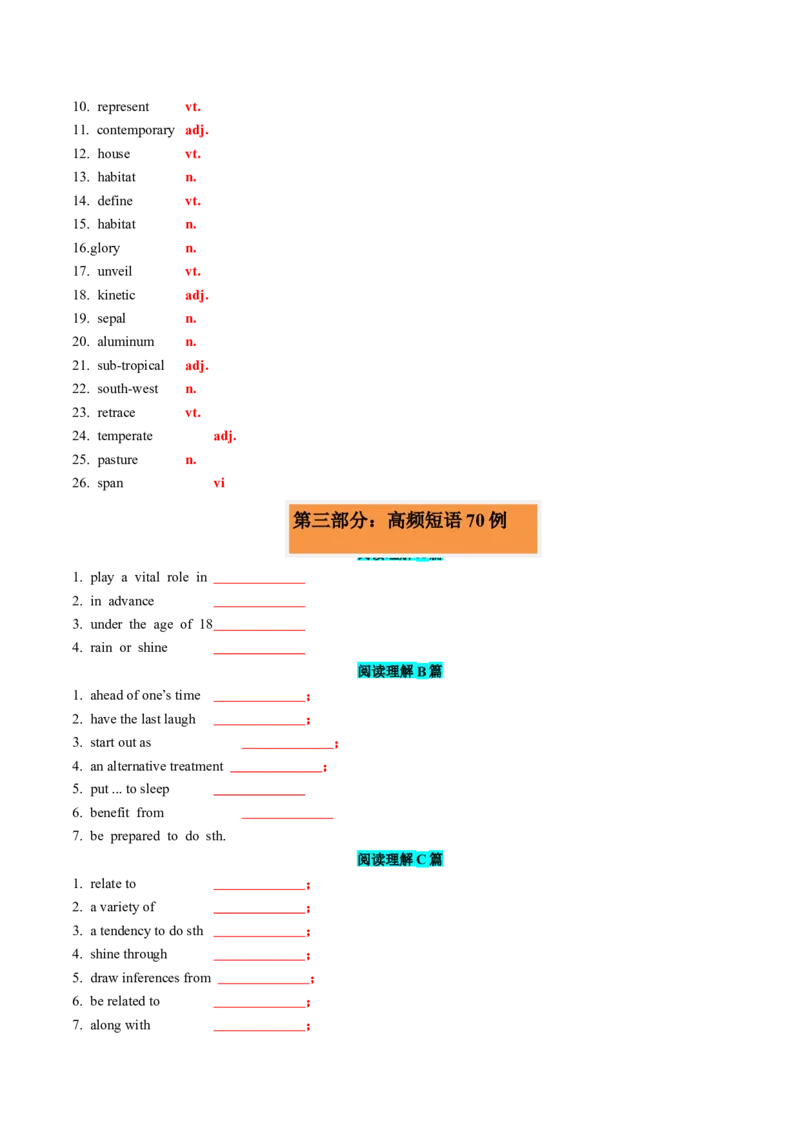
9. region n.10. represent vt.
11. contemporary adj.
12. house vt.
13. habitat n.
14. define vt.
15. habitat n.
16.glory n.
17. unveil vt.
18. kinetic adj.
19. sepal n.
20. aluminum n.
21. sub-tropical adj.
22. south-west n.
23. retrace vt.
24. temperate adj.
25. pasture n.
26. span vi
第三部分:高频短语70例
阅读理解A篇
1. play a vital role in
2. in advance
3. under the age of 18
4. rain or shine
阅读理解B篇
1. ahead of one’s time ;
2. have the last laugh ;
3. start out as ;
4. an alternative treatment ;
5. put ... to sleep
6. benefit from
7. be prepared to do sth.
阅读理解C篇
1. relate to ;
2. a variety of ;
3. a tendency to do sth ;
4. shine through ;
5. draw inferences from ;
6. be related to ;
7. along with ;8. link … to ... ;
9. be suited to ;
10. in print ;
11. call for ;
12. treat sth lightly ;
13. hold sb’s attention ;
阅读理解D篇
1. go extinct ;
2. citizen scientist ;
3. in the form of ;
4.with the rise of ;
5. with the aid of ;
6. lead author ;
7. assistant professor ;
8. respond to ;
9. tend to do sth ;
10.make sense ;
11.inform sb of sth ;
12. lead to
阅读理解七选五
1. take the trouble to do sth ;
2. reference books ;
3. leaf through ;
4. pick up ;
5. idiomatic phrases ;
6. cast your eye over sth ;
7. take account of
完形填空
1. refer to ;
2. to be honest ;
3. run after sb ;
4. go for a ride ;
5. go through ;
6. come to accept ;
7. turn to sth ;
8. set a goal for oneself
语法填空
1. at the edge of
2. be made of3. span from…to…
4. at the end of
读后续写
1. due to
2. touch down
3. get off
4. the moment
5. like crazy
6. be about to do
7. fish out
8. roll into
9. make it
10. flash sb. an apologetic smile
11. pull out
12. thin out
13. make a mad run for
14. pop sth. in
15. out of order
第四部分:2024新课标I卷真题语料单句填空75例
阅读理解A篇
1. We’ll explore beautiful park sites while ___________(conduct) invasive ( 侵 入 的 ) plant
___________(remove), winter planting, and seed collection.
2. Habitat Restoration Team volunteers play a vital role in ___________(restore) sensitive resources and
protecting ___________(endanger) species across the ridges and valleys.
3. Groups of five or more require special arrangements and must ___________(confirm) in advance.
4. Volunteers under the age of 18 must have the parent/guardian approval section ___________(sign).
5. We’ll be working rain or shine. Wear clothes ___________ can get dirty. Bring layers for changing
weather and a raincoat if necessary.
6. No experience necessary. Training and tools will ___________(provide). Fulfills (满足) community
service requirements.
阅读理解B篇
1. “I am not crazy,” says Dr. William Farber, shortly after __________(perform) acupuncture (针灸)
on a rabbit. “I am ahead __________ my time.”
2. If he seems a little __________(defense), it might be because even some of his coworkers
__________(occasion) laugh at his __________(usual) methods.
3. But Farber is certain he’ll have the last laugh. He’s one of a small but __________(grow) number
of American veterinarians ( 兽 医 ) now __________(practice) “ holistic” medicine – combiningtraditional Western treatments __________ acupuncture, chiropractic (按摩疗法) and herbal medicine.
4. Farber, __________ graduate of Colorado State University, started out as a more
__________(convention) veterinarian.
5. He became __________(interest) in alternative treatments 20 years ago when he __________(suffer)
from terrible back pain.
6. He tried muscle-relaxing drugs but found little __________(relieve). Then he tried acupuncture,
__________ ancient Chinese practice, and __________(amaze) that he improved after two __________
three treatments.
7. _________ worked on a veterinarian seemed likely__________(work) on his patients. So, after studying
the techniques for a couple of__________(year), he began offering them to pets.
8. Leigh Tindale’s dog Charlie had a serious heart condition. After Charlie had a heart attack, Tindale says,
she __________(prepare) to put him __________ sleep, but Farber’s treatments eased her dog’s suffering
__________ much that she was able to keep him alive for an __________(addition) five months.
9. And Priscilla Dewing reports that her horse, Nappy, “moves __________(easily) and rides more
__________(comfortable)” after a chiropractic __________(adjust).
10. Farber is certain that the holistic approach will grow more popular __________ time, and if the past is
any __________(indicate), he may be right. Since 1982, membership in the American Holistic Veterinary
Medical Association __________(grow) __________ 30 to over 700. “Sometimes it __________(surprise)
me that it works so well,” he says. “I will do anything to help an animal. That’s my job.”
阅读理解C篇
1. Is comprehension __________ same whether a person reads a text on screen __________ on paper?
2. And are listening to and viewing content __________ effective as reading the written word when
__________(cover) the same material? The answers __________ both questions are often “no”.
3. The reasons relate __________ a variety of __________(factor), including __________(reduce)
concentration, an entertainment mindset (心态) and a __________(tend) to multitask while consuming digital
content.
4. When reading texts of several hundred words or more, learning is generally __________(successful) when it’s
on paper than onscreen. A large amount of research __________(confirm) this finding.
5. The benefits of print reading __________(particular) shine through when experimenters move from posing
simple tasks — like __________(identify) the main idea in a reading passage — to ones that require mental
abstraction — such as drawing __________(inference) from a text.
6. The differences between print and digital reading results are partly related to paper’s __________(physics)
properties. With paper, there __________(be) a literal laying on of hands, along with the visual geography of
distinct pages.
7. People often link their memory of __________ they’ve read to how far into the book it was or where it was on
the page. But __________(equal) important is the mental aspect. Reading researchers have proposed a theory
__________(call) “shallowing hypothesis (假说)”.
8. According to this theory, people approach digital texts with a mindset __________(suit) to social media,
__________ are often not so serious, and devote__________(little) mental effort than when they are reading print.9. Audio (音频) and video can feel more engaging than text, and so university teachers __________(increasing)
turn to these technologies — say, assigning an online talk instead of an article by the same person.
10. Digital texts, audio and video all have __________(education) roles, especially when __________(provide)
resources not available in print.
阅读理解D篇
1. In the race ___________(document) the species on Earth before they go extinct, researchers and citizen
scientists have collected billions of ___________(record).
2. Today, most records of biodiversity are often in ___________ form of ___________(photo), videos, and
other digital records.
3. Though they are useful for ___________(detect) shifts in the number and ___________(vary) of species
in an area, a new Stanford study has found that this type of record is not perfect.
4. “___________ the rise of technology it is easy for people ___________(make) observations of different
species ___________ the aid of a mobile application,” said Barnabas Daru, ___________ is lead author of
the study and assistant professor of biology in the Stanford School of Humanities and Sciences.
5. And since we are ___________(increasing) using ___________(observation) data to investigate how
species are responding ___________ global change, I wanted to know: Are they usable?
6. ___________(use) a global dataset of 1.9 billion records of plants, insects, birds, and animals, Daru and
his team tested how well these data represent actual global biodiversity patterns.
7. “We were ___________(particular) interested in exploring the aspects of sampling that tend to bias (使
有偏差) data, ___________ the greater likelihood of a citizen scientist to take a picture of a flowering plant
instead of the grass right next to it,” said Daru.
8. Their study revealed that the large number of observation-only records did not lead to better global
___________(cover). Moreover, these data are biased ___________ favor certain regions, time periods, and
species.
9. This ___________(make) sense because the people who get observational biodiversity data on mobile
devices are often citizen scientists ___________(record) their encounters with species in areas nearby.
10. These data are also biased toward certain species with ___________(attract) or eye-catching features.
___________ can we do with the ___________(perfect) datasets of biodiversity?
11. “Quite a lot,” Daru explained. “Biodiversity apps can use our study results ___________(inform) users
of oversampled areas and lead them to places – and even species –___________ are not well-sampled.”
12. ___________(improve) the quality of observational data, biodiversity apps can also encourage users
___________(have) an expert confirm the___________(identify) of their uploaded image.
阅读理解七选五
1. Not all great writers are great ____________(speller). That means good grammar and no spelling
mistakes. If you want to be published, it’s vital to submit a perfect, ____________(professional) presented
manuscript (原稿).
2. No editor is likely ____________(tolerate) a writer who does not take the trouble ____________(spell)
words correctly. I keep two ____________(refer) books close-by on my desk: dictionary and thesaurus (同
义词词典).3. Of course, these days there ____________(be) plenty of online dictionaries and thesauruses, but I’m old-
fashioned enough ____________(prefer) a hard cover and pages I can leaf through with my fingers. I use
the Concise Oxford Dictionary and the Collins Thesaurus.
4. Of course, a dictionary is not only for spelling. It will also usually show how the word
____________(pronounce).It should give you a precise ____________(define) of each word, thus
differentiating it ____________other words ____________whose meanings are similar, but not identical.
5. In addition, I have ____________ old two-volume copy of the Shorter Oxford Dictionary,
____________(pick) up a few years ago in a bookshop sale for just 99 pence.
6. Of course, with its 2,672 pages, it’s not ____________(exact) short. It contains around 163,000 words,
plus word combinations and ____________(idiom) phrases.
7. I don’t often use this dictionary. ____________, if I need to check the origin of a word or to look
____________ examples of its usage, there’s nothing better.
8. For well over a hundred years the most ____________(influence) English dictionary was Samuel
Johnson’s Dictionary of the English Language ____________(publish) in 1755.
9. “To make dictionaries is dull (乏味) work,” wrote Johnson, ____________(illustrate) one definition of
“dull”. But a dictionary can be a pleasure to read. A few minutes spent ____________(cast) your eye over
a page or two can be a ____________(reward) experience.
完形填空
1. I’ve been motivated – and demotivated ___________ other folks’ achievements all my life.
2. When I was a teenager, a neighborhood friend ___________(win) a marathon race. Feeling ___________
(motivate), I started running ___________(regular), but then two things happened.
3. First, a girl I met one day told me she was training for a “super,” ___________(refer) to a 52.4-mile
double marathon.
4. Then, the next day I went on my ___________(long) run – 15 miles. ___________(be) honest, I hated
it!
5. Between the girl ___________(make) my achievement seem small and the pure ___________(bore) of
jogging, I decided that the only reason I’d ever run again is if a big dog was running ___________ me!
6. So I turned to cycling. I got a good bike and ___________(ride) a lot. I dreamed ___________ entering
cycle races until I ___________(fly) to San Diego to visit my sister.
7. While she was at work one day, I ___________(borrow) her bike and went for a ride. The problem: The
roads there went through large valleys ___________ I’d be riding uphill for miles at a time.
8. I’d never faced such challenges. That day, I got ___________(pass) by about 100 “local” bikers who
___________(use) to such roads. When I got back home, suddenly ___________(ride) my bike didn’t seem
quite as ___________(appeal).
9. I ___________(mature) a lot since then. I’ve come to accept that ___________ goals I set for myself,
they just have to be my own.
语法填空
1. Heatherwick Studio ___________(recent) unveiled a new project, a kinetic greenhouse at the edge of theNational Trust's Woolbeding Gardens.
2. This beautiful unfolding structure is at the center of a new garden that shows ___________ the Silk Road
influences English gardens even in modern times.
3. The latest (engineer) techniques are used to create a protective (function) structure
that is also beautiful.
4. The design features ten steel "sepals" made ___________ glass and aluminum. These sepals open over four
minutes to reveal a 1,517 square foot space like a crown.
5. The Glasshouse opens on warm days (give) the inside plants sun and ventilation. Then in colder
weather, the structure stays (close) to protect plants.
6. Further, the Silk Route Garden around the greenhouse (walk) visitors through a journey influenced
___________ the ancient Silk Road.
7. The trading routes between Asia and Europe brought silk and spices as well as many plant species to Britain
for__________ first time.
8. These plants included modern Western (favorite) such as rosemary, lavender and fennel.
9. “ This Heatherwick Glasshouse represents the cutting edge of ___________(technique) design and
engineering but it's also a ___________(restore) of something that is part of Woolbeding's history,” Mark
Woodruff of The Woolbeding Charity says.
10. “It stands a crowning achievement in contemporary design, to house the flora of sub-tropical
south-west China at the end of a path retracing the steps along the Silk Route, from temperate Europe and across
mountains, arid lands and high pastures brought the plants from their native habitat in Asia to come to
define much of the (rich) and glory of gardening in England,” Mark Woodruff adds.
读后续写
1. I met Gunter on a cold, wet and ___________(forget) evening in September.
2. I ___________(plan) to fly Vienna and take a bus to Prague for a conference, but failed. Due to a big
storm, my ___________(fly) had been delayed by ___________ hour and a half. I touched down in Vienna
just 30 minutes before the ___________(depart) of the last bus to Prague.
3. The moment I got off the plane, I ___________(run) like crazy through the airport building and jumped
into the first taxi on the rank ___________ a second thought.
4. That was when I met Gunter. I told him ___________ I was going, but he said he hadn't heard of the bus
station. I thought my ___________(pronounce) was the problem, so I explained again
___________(slowly), but he still looked ___________(confuse).
5. When I was about to give up, Gunter ___________(fish) out his little phone and rang up a friend. After a
___________(heat) discussion that lasted for ___________ seemed like a century, Gunter put his phone
down and started the car. Finally, with just two minutes ___________(spare) we rolled into the bus station.
6. ___________(thankful), there was a long queue still ___________(wait) to board the bus.
7. Gunter ___________(park) the taxi behind the bus, turned around, and looked at me ___________with
a big smile on his face. "We made ___________, "he said.8. Just then I realised that I had zero cash in my wallet. I flashed him an ___________(apology) smile as I
pulled out my Portuguese bankcard. He tried it several times, ___________ the card machine just did not
play along. A feeling of ___________(helpless) washed over me as I saw the bus queue thinning out.
9. At this moment, Gunter pointed towards the ___________(wait) hall of the bus station. There at the
entrance, was a cash machine. I jumped out of the car, made a mad run for the machine, and
___________(pop) my card in, only ___________(read) the message: “Out of order. Sorry."