【上好课】2025年高考一轮复习知识清单(讲案)
专题29 2023新课标I卷词汇二次开发+真题语料单句填空100例
(词性转换+识词知意+高频短语+熟词新义+单句填空) 原卷版
阅读理解A篇
一、识词知意
1.countless adj.
2.countable adj.
3.landscape n.
4.brake n. & v.
5.gear n.
6.discount n.
7.square n.
二、词形转换
1.rent n.租金,租用费 → adj. 可供租用的
2.economy n.经济;节省 → adj.经济的;实惠的→ dj.经济的;经济学的
3.sustain vt.维持; → adj.可持续的,持续性的
4.strategy n.策略 → adj.战略的,策略上的
5.locate vt.确定位置;设立→ n. 地点,位置
6.vary v.使不同 → n.变化;种类
7.base n.底部;基础 → adj.基本的;最简单的
8.addition n.新增人员;加法→ adj.附加的,额外的
9.depart v.启程,出发 → n.离开,启程
三、高频短语
1.be around
2.pay for
四、熟词新义
1. The 2.5-hour tour covers the Gooyer Windmill… and much more.
2. She covered her face with her hands.
3. Much of the country is covered by forest.
4. $100 should cover your expenses.
5. By sunset we had covered thirty miles.
6. The reserve covers an area of some 1 140 square kilometres.
7. The BBC will cover all the major games of the tournament.
8. Are you fully covered for fire and theft?
阅读理解B篇
一、识词知意
1.creature n.
2.mess n.3.process n.
4.fishery n.
5.bacteria n.
6.cancer-causing adj.
7.substance n.
8.tank n.
9.ecosystem n.
10.digest vt.
11.pure adj.
12.facility n.
13.canal n.
14. organism n.
15.inquiring adj.
16.review vt.
17.erase vt.
18.diverse adj.
二、词形转换
1.dirt n.尘土;泥土 → adj.肮脏的
2.combine v.结合,组合 → n.结合体,联合体
3.ecology n.生态学;生态 → adj.生态的,生态学的
4.invent vt.发明 → n.发明家→ n. 发明
5.apply vt.申请;应用 → n.申请;应用→ n.申请者
三、高频短语
1.clean up
2.a series of
3.be connected to
4.little by little
5.get used to sth
6.take on a job
7.be fond of doing
8.long to do
9.kind of
10.erase doubts about
四、熟词新义
1. He loved to explore the woods around his house, observing how nature solved problems.
2. Do they observe Christmas every year?
3. Readers are required to observe the rules of the library and mind their manners.
阅读理解C篇
一、识词知意
1. digital adj.
2. minimalism n.3. adopt vt.
4. conclude vt.
5. chapter n.
6. strategy n.
7. trap n.
9. encounter v. &n.
10. cultivate vt.
11. leisure n.
12. mindless adj.
13. device n.
14. particular adj.
15. circumstance n.
16. critical adj.
17. aid n.
18. advocate vt.
19. promote vt.
20. evaluate vt.
21. identify vt.
二、词形转换
1. detail n.细节 → adj.具体的
2. explore v.探索 → 探索
3. philosophy n.哲学;人生哲学→ adj.哲学的
4. found vt.建立 → n.基础;根据;基金会;建立
5. increase vt.增加 → ad.越来越多地,不断增加地
6. tolerate vt.容许,允许→ adj.可接受的,可忍受的
7. option n.选择 → adj.可选择的,选修的
8. mass n.大量,许多→ adj.大量的,大规模的
9. participate v.参加,参与→ n.参加者,参与者
10. sustain vt. 维持,保持→ 可持续的,持续性的
11. necessary adj.必须的 → n.必需品,必需的事物
12. theory n.理论 → adj.理论的
13. statistics n.统计学;统计数字→ adj.统计的,统计学的
14. practice n.实践 → adj.真实的,实际的
15. history n.历史 → adj.有关历史的
三、高频短语
1. make the case for
2. divide…into…
3. start with
4. step away from
5. be designed to do
6. act on7. view…as
8. be meant to do
9. be aimed at
10. do with
11. recommend…to sb
四、熟词新义
1. Each chapter concludes with a collection of practices…
2. The report concluded that the cheapest option was to close the laboratory.
阅读理解D篇
一、识词知意
1. statistician n.
2. illustrate vt.
3. conduct vt.
4. accurate adj.
5. capitalize vt.
6. overestimate vt.
7. underestimate vt.
8. average vt.
9. technical adj.
10. term n.
11. correlated adj.
12. twist n.
13. classic adj.
14. phenomenon n.
15. individual n.
16. follow-up adj.
17. dominant adj.
18. reason vt.
19. somehow adv.
20. potential adj.
21. implication n.
22. enormous adj.
23. underlying adj.
24. logic n.
25. dismissive adj.
二、词形转换
1. wise adj.明智的 → n.智慧,才智
2. estimate vt.估计;判断→ n.估算;判断
3. dependent adj.依靠的 → adj.独立的;自立的
4. accurate adj.准确的 → n.准确,精确
5. significant adj.显著的;重要的→ ad.显著地6. respond v.回应;作出反应→ n.响应;回复
7. frequent adj.频繁的 → ad.频繁地
8. argue v.说服;争论→ n.说服;争论
9. globe n.世界;地球仪→ adj.全球的
10. reduce vt减少,降低→ n.减少,降低
11. limit vt.限度,限制→ n.限制,制约
12. relative adj.相对的 → ad.相对地
13. occasion n.时刻,时候→ adj.临时的
14. full adj.完整的,详尽的→ ad.充分地,完全地
15. doubt n.怀疑 → adj.怀疑的
16. approve vt赞成;批准→ adj.赞许的,满意的
三、高频短语
1. be known as…
2. make errors
3. tend to do
4. cancel out
5. result in
6. for instance
7. be willing to do
8. even if
9. focus on
四、熟词新义
1. The experiment of estimation he conducted showed that….
2. The guide conducted us around the ruins of the ancient city.
3. He conducted himself far better than expected.
4. Copper conducts electricity well.
阅读理解七选五
一、识词知意
1. positive adj.
2. journal n.
3. caring adj.
4. generous adj.
5. aspect n.
6. iron vt.
7. bake vt.
8. cookie n.
9. boost vt.
10. self-confidence n.
11. ignore vt.
12. fixed adj.
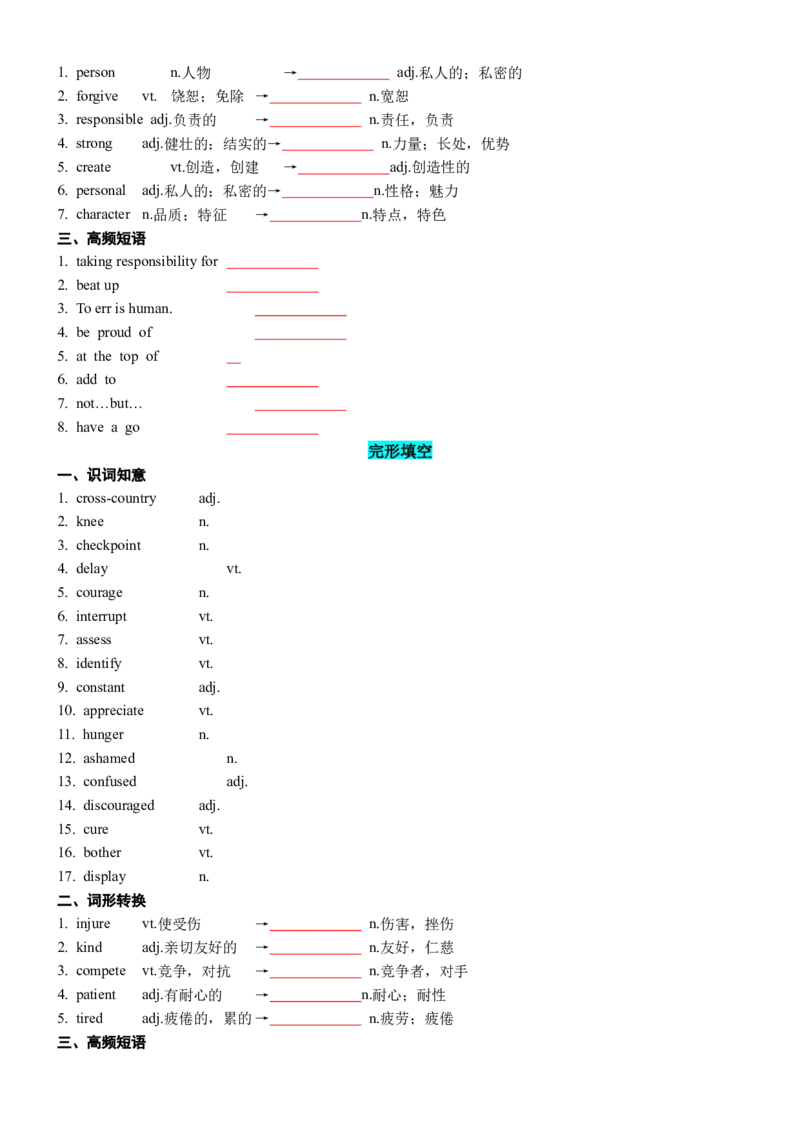
二、词形转换1. person n.人物 → adj.私人的;私密的
2. forgive vt. 饶恕;免除 → n.宽恕
3. responsible adj.负责的 → n.责任,负责
4. strong adj.健壮的;结实的→ n.力量;长处,优势
5. create vt.创造,创建 → adj.创造性的
6. personal adj.私人的;私密的→ n.性格;魅力
7. character n.品质;特征 → n.特点,特色
三、高频短语
1. taking responsibility for
2. beat up
3. To err is human.
4. be proud of
5. at the top of
6. add to
7. not…but…
8. have a go
完形填空
一、识词知意
1. cross-country adj.
2. knee n.
3. checkpoint n.
4. delay vt.
5. courage n.
6. interrupt vt.
7. assess vt.
8. identify vt.
9. constant adj.
10. appreciate vt.
11. hunger n.
12. ashamed n.
13. confused adj.
14. discouraged adj.
15. cure vt.
16. bother vt.
17. display n.
二、词形转换
1. injure vt.使受伤 → n.伤害,挫伤
2. kind adj.亲切友好的 → n.友好,仁慈
3. compete vt.竞争,对抗 → n.竞争者,对手
4. patient adj.有耐心的 → n.耐心;耐性
5. tired adj.疲倦的,累的→ n.疲劳;疲倦
三、高频短语1. compete in
2. the finish line
3. as for
4. bend down
5. step aside
6. in pain
7. hundreds of
四、熟词新义
1. Melanie Bailey should have finished the course earlier than she did.
2. He radioed the pilot to change course.
3. The lunch was excellent, especially the first course.
4. She took an intensive course in cooking before her marriage.
语法填空
一、识词知意
1.soup n.
2.dumpling n.
3.delicate adj.
4.encase vt.
5.sweet adj.
6.steam vt.
7.release vt.
8.spill vt.
9.explode v.
10.tongue n.
11.recognize vt.
12.neighbouring adj.
13.canal n.
14.press vt.
15.roll vt.
16.steamer n.
17.tear vt.
18.content n.
19.delicious adj.
20.rare adj.
21.bite vt.
22.wrapper n.
二、词形转换
1.amaze vt.使惊奇 → adj.令人诧异的
2.construct vt.建造,修建→ n.建造,修建
3.taste n.味道;爱好→ adj.美味的
4.history n.历史 → n.历史学家5.different adj.不同的 → ad.不同地
6.actual adj.事实的 → ad.事实
7.sweet adj.含糖的,甜的→ n.愉快,美妙
8.greed n. 贪欲;贪食→ adj.贪婪的,贪心的
三、高频短语
1.whether…or…
2.point…to…
3.rather than
4.allow sb to do sth
5.leave sb doing sth
四、熟词新义
1.French strawberries do not taste like cardboard. Instead, they explode in your mouth like little flavor bombs.
2.The population explodes to 40,000 during the tourist season.
2023年新高考I卷语料单句语法填空100题
阅读理解A篇
1. Cycling is the most economical, ____________(sustain) and fun way ____________(explore) the city--
Amsterdam, with its beautiful canals, parks, squares and countless lights.
2. MacBike has been around for almost 30 years and is the ____________ (big) bicycle rental company in Amsterdam.
3. With over 2,500 bikes ____________(store) in our five rental shops at strategic locations, we make sure
____________ is always a bike available for you.
4. We offer the ____________(new) bicycles in a wide variety, ____________ (include) basic bikes with foot brake
(刹车), bikes with hand brake and gears (排挡), bikes with child seats, and ____________(child) bikes.
5. The tour ____________(depart) from Dam Square every hour on the hour, ____________(start) at 1:00 pm every
day.
阅读理解B篇
6. When John Todd was a child, he loved to explore the woods around his house, ____________(observe) how nature
solved problems.
7. A dirty stream, for example, often became clear after ____________(flow) through plants and along rocks
____________ tiny creatures lived.
8. When he got older, John started to wonder ____________ this process could be used____________(clean) up the
messes people were making.
9. After studying agriculture, medicine, and fisheries in college, John went back to observing nature ____________
asking questions.
10. With the right ____________(combine) of animals and plants, he figured, maybe he could clean up waste the way
in ____________nature did.
11. He decided to build ____________ he would later call an eco-machine.
12. The task John set for himself was to remove ____________(harm) substances from some sludge (污泥).
13. First, he constructed a series of clear fiberglass tanks ____________ (connect) to each other.
14. Then he went around to local ponds and streams and ____________ (bring) back some plants and animals.
15. Little ____________ little, these different kinds of life got used to one another and ____________(form) theirown ecosystem.
16. He ____________(amaze) at the results. The plants and animals in the eco-machine took the sludge as food and
began to eat ____________!
17. Within weeks, it had all been digested, and all ____________ was left was pure water.
18. He developed a greenhouse — like facility ____________ treated sewage (污水) from 1,600 homes in South
Burlington.
19. He also designed ____________ eco-machine to clean canal water in Fuzhou, ____________ city in southeast
China.
20. “Ecological design” is the name John gives to ____________ he does.
21. “Life on Earth is kind of a box of spare parts for the ____________ (invent),” he says.
22. You put organisms in new relationships and observe ____________ is happening.
阅读理解C篇
23. Part one concludes by introducing my ____________(suggest) method for adopting this philosophy: the digital
declutter(清理).
24. This process requires you ____________(step) away from ____________(option) online activities for thirty
days.
25. At the end of the thirty days, you will then add back a small number of ____________(careful) chosen online
activities ____________ will provide benefits to the things you value.
26. I’ll draw on an experiment I ran in 2018 in ____________ over 1,600 people agreed ____________(perform) a
digital declutter.
27. Each chapter concludes with a ____________(collect) of practices, which ____________(design) to help you act
on the big ideas of the chapter.
28. You can view these practices ____________ a toolbox meant to aid your efforts ____________(build) a
minimalist lifestyle that works for your particular circumstances.
29. The book is aimed at ____________(advocate) a simple digital lifestyle.
阅读理解D篇
30. On March 7, 1907, the English statistician Francis Galton ____________(publish) a paper which illustrated what
has come to be known ____________ the “wisdom of crowds” effect.
31. The experiment of estimation he conducted showed that in some cases, the average of a large number of
____________(dependent) estimates could be quite accurate.
32. When enough of these errors are averaged together, they cancel each other out, ____________(result) in a more
accurate estimate.
33. If people are similar and tend ____________(make) the same errors, then their errors won’t cancel each other out.
34. In more technical terms, the ____________(wise) of crowds requires that people’s estimates be independent.
35. But a new study ____________(lead) by Joaquin Navajas offered an interesting twist (转折) on this classic
phenomenon.
36. The average ____________(obtain) from the estimates of four discussion groups of five was significantly
____________(accurate) than the average obtained from 20 independent ____________(individual).
37. In a follow-up study with 100 university students, the researchers tried to get a better sense of ____________ the
group members actually did in their discussion.
38. Somehow, these arguments and reasoning resulted in a global ____________(reduce) in error.
39. Although the studies led by Navajas have limitations and many questions remain, the potential implications forgroup discussion decision-making ____________ (be) enormous.
40. Navajas’ study found that the average ____________(accurate) could increase even if estimates were not
____________(full) independent
阅读理解七选五
41. Taking ____________(responsible) for mistakes is a positive step, but don’t beat ____________(you) up about
them.
42. To err (犯错) is human. It’s just as important to show yourself some ____________(forgive).
43. In a journal or on a piece of paper, put the heading “Personal ____________ (strength).”
44. Now list all the ____________(characteristic) you like about yourself. Are you caring? Creative? Generous? A
good listener? Fun to be around?
45. They don’t have to be world-changing, just aspects of your personality that you’re proud ____________.
46. At the top of a second page, put the heading “Acts of ____________ (kind).”
47. On this one, list all the positive things ____________you’ve done for others.
48. It might be the time ____________ you helped a friend with their homework, when you did the ironing without
____________(ask)..
49. Whatever it is, no matter ____________ small it might seem, write it down.
50. You could ask a friend ____________ family member to help add to your list.
51. That way, you could exchange ____________(thought) on what makes each of you special…
52. In fact, don’t wait ____________ you’ve made a mistake to try this—it’s a great way ____________(boost) self-
confidence at any time.
53. Whatever the mistake, remember it isn’t a ____________(fix) aspect of your personality.
54. We’re all changing and learning all the time ____________ mistakes are a positive way to develop and grow.
55. It doesn’t mean you have to ignore ____________ has happened or forget it.
完形填空
56. On Oct. 11, hundreds of runners competed ____________ a cross-country race in Minnesota.
57. Melanie Bailey should have finished the course ____________ (early) than she did.
58. Her delay came because she was carrying a ____________ (compete) across the finish line.
59. As _________(report) by a local newspaper, Bailey was more than two-thirds of the way through her race
__________ a runner in front of her began crying in pain.
60. She stopped ____________(help) her fellow runner, Danielle Lenoue.
61. Bailey took her arm to see if she could walk forward ___________ aid. She couldn’t.
62. Bailey then ____________(bend) down to let Lenoue climb onto her back and carried her all the way to the finish
line, then another 300 ____________(foot) to where Lenoue could get medical attention.
63. Once there, Lenoue ____________(assess) and later taken to a hospital, where she learned that she had serious
____________(injury) in one of her knees.
64. She would have struggled with extreme pain to make it to that aid checkpoint ____________ Bailey’s help.
65. As for Bailey, she is more ____________(confuse) about why her act is considered a big deal.
66. ____________ the two young women were strangers before the meet, they’ve since become friends.
67. ____________ of the two players won the race, but the display of human kindness won the day.
语法填空
68. Xiao long bao (soup dumplings), those ____________(amaze) constructions of delicate dumpling wrappers,
encasing hot, ____________(taste) soup and sweet, fresh meat, are far and away my favorite Chinese street food.69. The dumplings arrive steaming and __________(dangerous) hot.
70. To eat one, you have to decide ____________ to bite a small hole in it first… or to put the whole dumpling in
your mouth, ____________(let) the hot soup explode on your tongue.
71. Shanghai may be the ____________(recognize) home of the soup dumplings ____________ food historians will
actually point you to the neighboring canal town of Nanxiang as Xiao long hao’s birthplace.
72. There you will find them prepared differently- more dumpling and ____________(little) soup, and the wrappers
are pressed ____________ hand rather than rolled.
73. Nanxiang aside, the best Xiao long bao have a fine skin, allowing them ____________(lift) out of the steamer
basket without allowing them tearing or spilling any of their contents.
74. The meat should be fresh with a touch of ____________(sweet) and the soup hot, clear and delicious.
75. No matter where I buy them, one steamer is ____________(rare) enough, yet two seems greedy, so I am always
left ____________(want) more next time.
应用文写作
76. I think it’s not a good idea to ____________(random) pair up students for the spoken English training after class.
The reasons are as ____________(follow).
77. To begin with, randomly ____________(pair) up students may lead to unbalanced language abilities within the
groups.
78. This can hinder the progress of students as the more advanced one may dominate the conversation,
____________(leave) little room for the other students to improve.
79. Besides, students may feel ____________(comfortable) or less motivated if paired with someone who they don’t
get along with or have difficulty ____________ (communicate) communicating with.
80. My suggestion is to group students ____________(base) on their language abilities ____________ to let students
choose their own partners.
读后续写
81. A few weeks later, when I almost forgot the contest, ____________ came the news.
82. I ____________(inform) that I won the first prize in the writing contest and ____________ there would be an
award presentation in two days.
83. I was ____________ happy to hear the news that I immediately shared it ____________ my teacher.
84. Since then, I ____________(write) many good works and now I am a famous writer.
85. I owe my success ____________ my social teacher who is a beacon in my life on the road to writing.
86. At the award ceremony ____________(host) in the school hall the headmaster kindly presented me ____________
a certificate of achievement.
87. Sometimes all it takes is someone who believes ____________ us, someone who sees our potential even when we
don’t see it ____________(we).
88. It was not until then ____________ I realized the journey of writing was not only filled with disbelief and self-
doubt ____________ support and self-approval.
89. No sooner had I stepped into this familiar room ____________ I saw my teacher ____________(sit) among piles
of papers.
90. In a flash, a burst of heartfelt gratitude ____________(take) hold of me entirely, I stepped forward
____________(give) him a warm hug.
86. hosted, with 87. in, ourselves 88. that, but 89. than, sitting 90. taking, to give
91. He ____________(gentle) patted on ____________ shoulder and uttered: “I knew you are a good story-teller whoonly needs some ____________(acknowledge).”
92. When my name____________(rank) at the top of the list jumped into my view, I was stunned there, tongue-tied.
93. I knew that this was just the beginning. I ____________(inspire) to keep writing and exploring
my____________(creative).
94. ____________(wave) from the audience, my teacher cast me a beaming smile from which I could read pride and
____________(appreciate).
95. “I knew you’d win! I am proud of you. You made ____________!” he said ____________(excite). Then came
the big day.
96. When I was invited to the stage ____________(receive) the award, I expressed my thanks to my teacher.
97. I said, “It’s you ____________ make me fall in love with writing, my social studies teacher.
98. I said, “Without your ___________(recognize) and ___________ (guide), I couldn’t have written this article.
Again thank you very much!”
99. ____________(hold) my hands, he said “____________ (congratulate)! You are a good writer, so keep writing.”
100. “You know I didn’t like writing before, but now I am crazy ____________ it! I will try my best to create good
works.” I said ____________(grateful).