学校:___________姓名:___________班级:___________考号:___________
Unit 2 Stay Healthy
单元话题(保持健康)阅读理解进阶练15篇
说明:此专题分三个难度层次,基础入门训练<进阶拓展训练< 能力综合实践,老师根据学生实际情
况进行针对性难度训练。
基础入门训练5篇
Lucy and Lily are twin sisters, but they have different habits. Lucy exercises every day. She usually runs in
the morning and plays basketball twice a week. She likes eating healthy food like fruits and vegetables. Lily,
however, hardly ever exercises. She often watches TV or plays computer games in her free time. She loves junk
food like chips and chocolate.
Last week, they had a health check at school. The doctor said Lucy was very healthy, but Lily was a little
overweight. The doctor advised Lily to exercise more and eat less junk food. Now Lily decides to change her
habits. She will exercise with Lucy every day and eat more healthy food.
1.How often does Lucy play basketball?
A.Every day. B.Once a week. C.Twice a week. D.Three times a week.
2.What does Lily often do in her free time?
A.She reads books. B.She plays basketball.
C.She watches TV or plays computer games. D.She helps with housework.
3.What did the doctor advise Lily to do?
A.To watch more TV. B.To eat more junk food.
C.To exercise more and eat less junk food. D.To play more computer games.
Everyone wants to be healthy. But how to keep healthy? Here are some tips for you.
First, eat healthy food. You should eat more fruits and vegetables. They are rich in vitamins and fiber (纤
维). You should also eat some protein (蛋白质) food, like fish, chicken and eggs. Don’t eat too much junk food,such as chips, candy and fast food. They are bad for your health.
Second, exercise regularly. Exercise is good for your body and mind. You can do different kinds of
exercise, like running, swimming, playing basketball and walking. You should exercise at least three times a week.
Each time you exercise for 30 minutes or more.
Third, get enough sleep. Sleep is very important for your health. If you don’t get enough sleep, you will feel
tired and angry easily. You should sleep for 8 to 10 hours every night. Try to go to bed early and get up early.
Fourth, keep a good mood (心情). A good mood can make you healthy. Don’t be too sad or angry. You can
talk to your parents or friends when you have problems. You can also listen to music or read books to relax
yourself.
Follow these tips, and you will be healthy.
1.How many tips for keeping healthy are there in the passage?
A.Three. B.Four. C.Five. D.Six.
2.What kind of food is rich in vitamins and fiber?
A.Fruits and vegetables. B.Fish and chicken.
C.Chips and candy. D.Fast food.
3.How often should we exercise?
A.At least once a week. B.At least twice a week.
C.At least three times a week. D.At least four times a week.
4.How many hours should we sleep every night?
A.6 to 8 hours. B.8 to 10 hours. C.10 to 12 hours. D.Less than 8 hours.
5.What can we do to keep a good mood?
A.Eat more junk food. B.Exercise less.
C.Talk to friends when we have problems. D.Sleep late.
You already know that you are an amazing person, but it’s not just your wonderful personality. Your body
itself is an unusual machine.
Lots of information has been written on the subject of “you”. You might wonder about your body. Most
people think that the whole picture of how your body systems work together is important to understand.Sometimes the details (细节) interest us the most. Let’s go on the way to get a haircut.
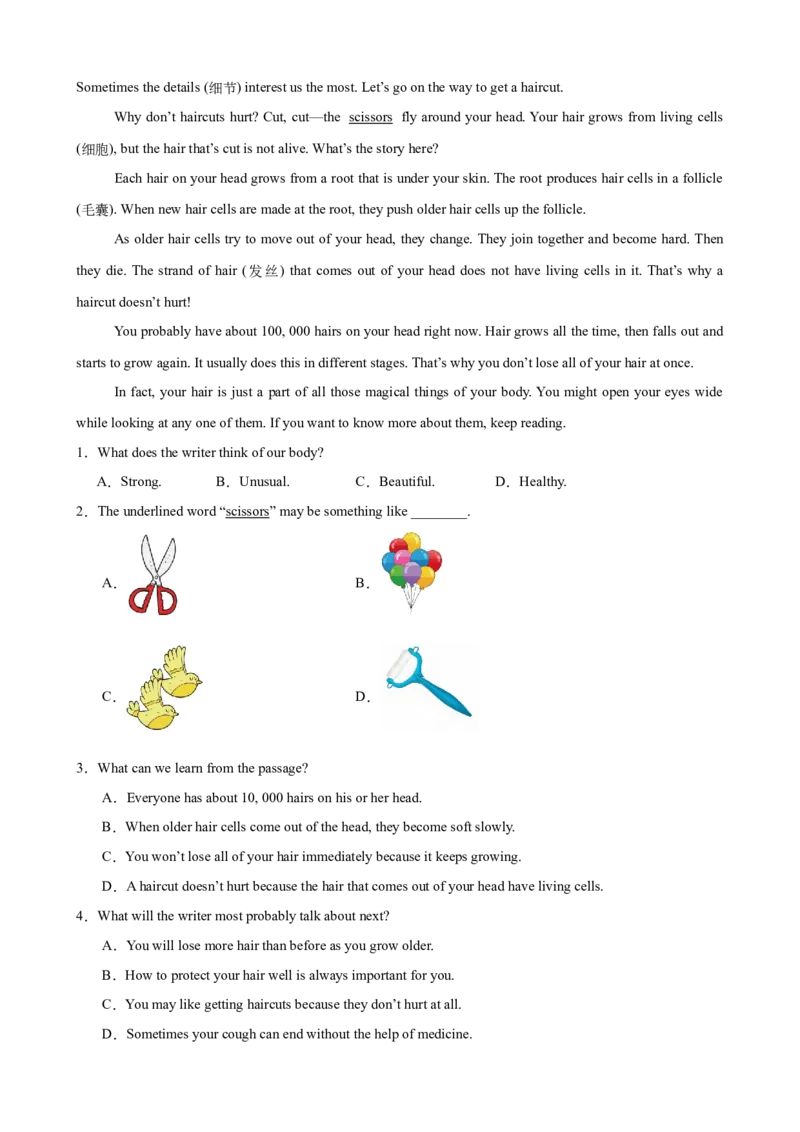
Why don’t haircuts hurt? Cut, cut—the scissors fly around your head. Your hair grows from living cells
(细胞), but the hair that’s cut is not alive. What’s the story here?
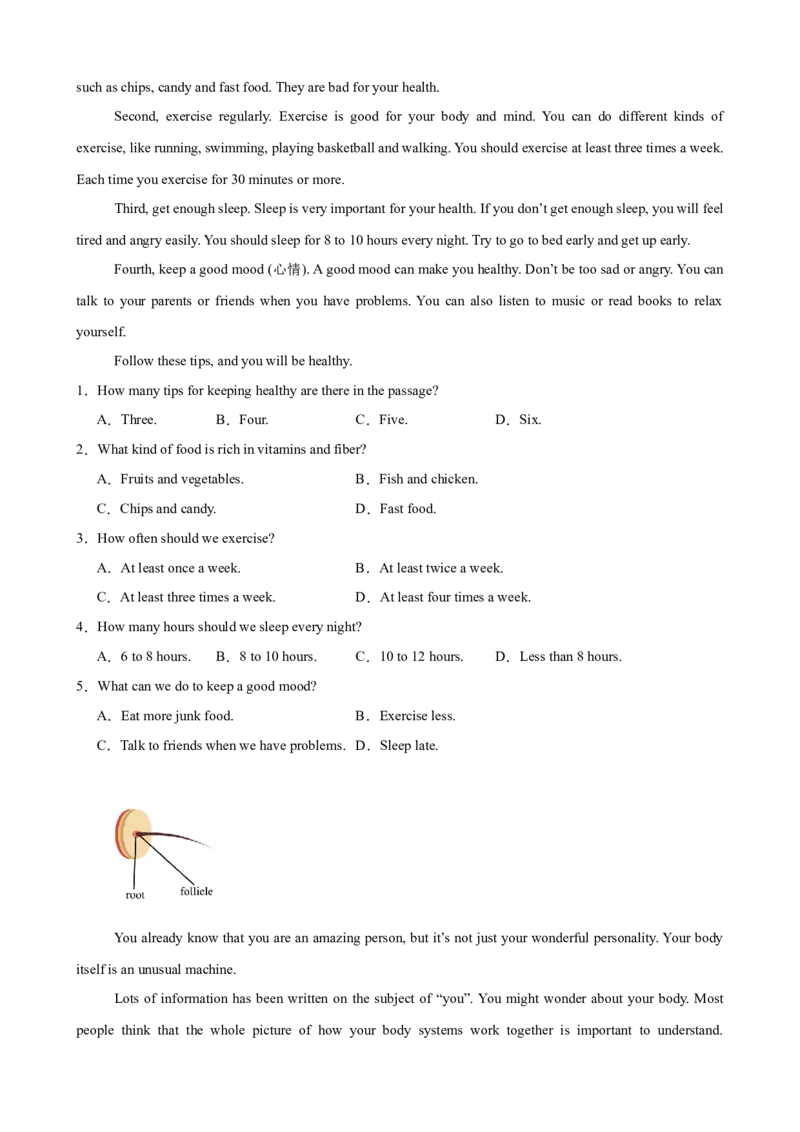
Each hair on your head grows from a root that is under your skin. The root produces hair cells in a follicle
(毛囊). When new hair cells are made at the root, they push older hair cells up the follicle.
As older hair cells try to move out of your head, they change. They join together and become hard. Then
they die. The strand of hair (发丝) that comes out of your head does not have living cells in it. That’s why a
haircut doesn’t hurt!
You probably have about 100, 000 hairs on your head right now. Hair grows all the time, then falls out and
starts to grow again. It usually does this in different stages. That’s why you don’t lose all of your hair at once.
In fact, your hair is just a part of all those magical things of your body. You might open your eyes wide
while looking at any one of them. If you want to know more about them, keep reading.
1.What does the writer think of our body?
A.Strong. B.Unusual. C.Beautiful. D.Healthy.
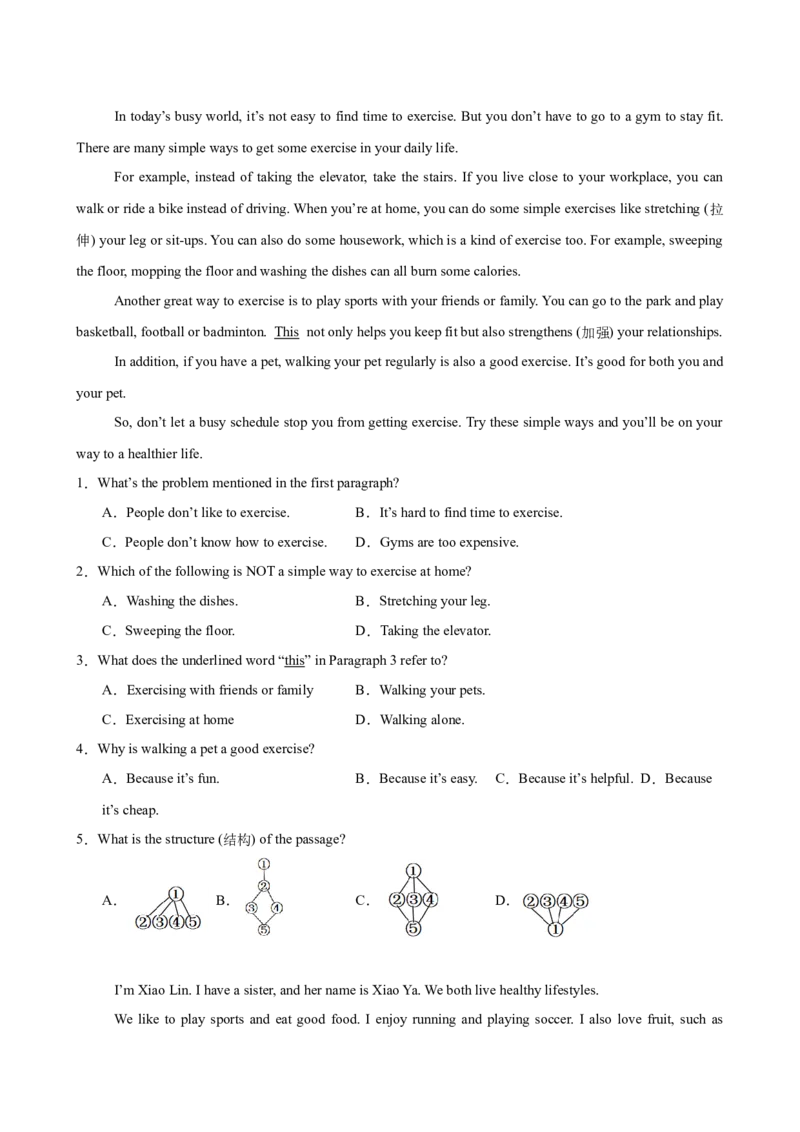
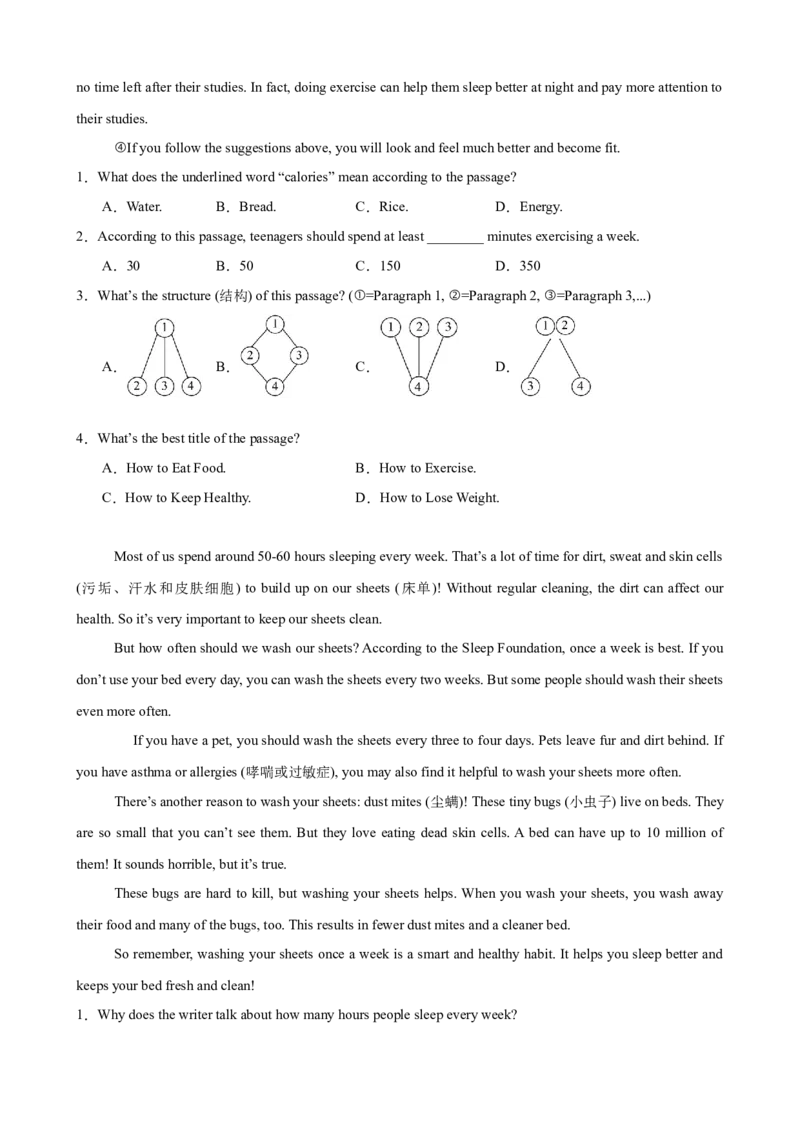
2.The underlined word “scissors” may be something like ________.
A. B.
C. D.
3.What can we learn from the passage?
A.Everyone has about 10, 000 hairs on his or her head.
B.When older hair cells come out of the head, they become soft slowly.
C.You won’t lose all of your hair immediately because it keeps growing.
D.A haircut doesn’t hurt because the hair that comes out of your head have living cells.
4.What will the writer most probably talk about next?
A.You will lose more hair than before as you grow older.
B.How to protect your hair well is always important for you.
C.You may like getting haircuts because they don’t hurt at all.
D.Sometimes your cough can end without the help of medicine.In today’s busy world, it’s not easy to find time to exercise. But you don’t have to go to a gym to stay fit.
There are many simple ways to get some exercise in your daily life.
For example, instead of taking the elevator, take the stairs. If you live close to your workplace, you can
walk or ride a bike instead of driving. When you’re at home, you can do some simple exercises like stretching (拉
伸) your leg or sit-ups. You can also do some housework, which is a kind of exercise too. For example, sweeping
the floor, mopping the floor and washing the dishes can all burn some calories.
Another great way to exercise is to play sports with your friends or family. You can go to the park and play
basketball, football or badminton. This not only helps you keep fit but also strengthens (加强) your relationships.
In addition, if you have a pet, walking your pet regularly is also a good exercise. It’s good for both you and
your pet.
So, don’t let a busy schedule stop you from getting exercise. Try these simple ways and you’ll be on your
way to a healthier life.
1.What’s the problem mentioned in the first paragraph?
A.People don’t like to exercise. B.It’s hard to find time to exercise.
C.People don’t know how to exercise. D.Gyms are too expensive.
2.Which of the following is NOT a simple way to exercise at home?
A.Washing the dishes. B.Stretching your leg.
C.Sweeping the floor. D.Taking the elevator.
3.What does the underlined word “this” in Paragraph 3 refer to?
A.Exercising with friends or family B.Walking your pets.
C.Exercising at home D.Walking alone.
4.Why is walking a pet a good exercise?
A.Because it’s fun. B.Because it’s easy. C.Because it’s helpful. D.Because
it’s cheap.
5.What is the structure (结构) of the passage?
A. B. C. D.
I’m Xiao Lin. I have a sister, and her name is Xiao Ya. We both live healthy lifestyles.
We like to play sports and eat good food. I enjoy running and playing soccer. I also love fruit, such asapples and bananas. My sister, on the other hand, prefers swimming and basketball. She likes to eat vegetables.
Carrots, beans and cucumbers are all her favorites. We both have fun staying active and eating well.
Though we choose different sports and food, we both care about being healthy. Our lifestyles help us stay
strong and feel happy.
1.What sports does Xiao Lin enjoy?
A.Swimming and basketball.
B.Running and soccer.
C.Soccer and basketball.
D.Running and swimming.
2.What does Xiao Ya like to eat?
A.Apples and bananas.
B.Chicken and fish.
C.Hamburgers and ice cream.
D.Carrots and beans.
3.How do their lifestyles help them?
A.They make them famous.
B.They help them find new sports.
C.They help them cook better food.
D.They help them stay strong and feel happy.
4.What can we learn from Xiao Lin and Xiao Ya?
A.Everyone must like the same sports and food.
B.There are different ways to live a healthy life.
C.Sisters always have the same hobbies.
D.Eating vegetables is the only way to be healthy.
5.What is the passage mainly about?
A.How to play different sports well.
B.Two sisters and their different healthy habits.
C.The best food for staying healthy.
D.Why swimming is better than running.
进阶拓展训练5篇Why do your eyes “jump” sometimes? Are you afraid of it?
When you are doing your homework, sometimes your eyes suddenly (突然) jump. You may hear some
superstitions (迷信), if your right eye jumps, you are unlucky and you are going to hear bad news. If your left eye
jumps, you are lucky and you are going to hear good news.
But scientists say that there isn’t any superstition in the world. There are some reasons to tell you why this
happens.
*If you feel tired or worried, your eyes may jump again and again. This tells you that you need time to
relax. So stop working, close your eyes and take a rest (休息).
*If you watch TV or use the computer for a long time, your eyes may jump again and again. Your eyes
jump to get wet, because they are very dry.
*It may be another reason if your body doesn’t have some minerals (矿物质). This tells you that you don’t
have a good eating habit. So it can be helpful to eat some food like carrots, eggs and fish.
1.According to some superstitions, if your right eye jumps, you may ________.
A.hear some good news B.feel sad
C.be a little tired D.be unlucky
2.Scientists say that our eyes sometimes jump again and again because ________.
a. You feel tired or worried b. You watch TV or use the computer for a long time
c. You are unlucky d. Your body doesn’t have some minerals
A.a.b.c B.a.b.d C.b.c.d D.a.c.d
3.What does the underlined word (划线单词) “they” refer to (指)?
A.eyes B.TVs C.computer games D.carrots
4.What can we know from the text?
A.If you feel relaxed, your eyes may jump again and again.
B.Scientists tell that there isn’t any superstition in the world.
C.If your body doesn’t have some minerals, you need to take a rest.
D.Scientists tell that there are some superstitions in the world.
5.Maybe you can see the passage in a ________.
A.history book B.storybook C.sports book D.science book
Everyone knows that exercise is important. We all need to exercise. Doctors say it is good for us. It makes
our hearts and bodies strong. Children who often exercise are more alert (机灵的). This means they do better in
tests and schoolwork than those who don’t exercise.There are many ways to exercise. You can walk, run, swim, skate, or play ball games. Make sure you
exercise in the following ways: You have to like what you're doing. Exercise enough but not too much. It’s best to
exercise twice each week. Thirty minutes each time is enough. Try all kinds of things until you find one, two or
even three sports that feel right for you.
You can exercise at fitness centers. They have a lot of equipment there. The equipment will help exercise
your arms, legs and other parts of your body to make you fit. Some people buy equipment for their homes. But it
is very expensive.
Exercising can be fun. Friends can exercise together at a fitness center, or they can play sports together.
How do you exercise?
1.Which of the following is NOT mentioned in the passage?
A.Exercise makes our bodies strong. B.Exercise makes our hearts strong.
C.Exercise makes us sleep better. D.Exercise helps children do better in school.
2.How often should we exercise according to the passage?
A.Every day. B.Twice a week. C.Three times a week.D.Once a month.
3.How long should we exercise each time?
A.15 minutes. B.20 minutes. C.30 minutes. D.60 minutes.
4.What does the underlined word “equipment” mean in Chinese?
A.器材 B.食物 C.药品 D.服装
5.What’s the main idea of the passage?
A.Exercise is expensive. B.Exercise is important and can be fun.
C.We should buy equipment. D.We must exercise every day.
①Healthy eating habits along with regular (有规律的) exercise are the best way to become fit. If you have
enough energy and exercise regularly, you will lose weight, keep fit, and feel great, too.
②During your teenage years, it is important to give your body the energy it needs—it’s good for your
growth. If you don’t have meals, you won’t get enough calories, and then you will feel tired. About 50% of your
calories should come from rice, bread, vegetables and fruit. You also need to drink a lot of water, 6 to 8 glasses a
day. Water helps keep your system clean. Drinking enough water will make your skin better and make you
healthy.
③Exercise is something that can help to make you look good, feel good and be healthy. Doctors suggest
that teenagers should spend at least 30 minutes exercising a day, five times a week. That is easy to do! You can
walk or ride your bike to school, and do sports at school. However, teenagers often don’t do that, saying they haveno time left after their studies. In fact, doing exercise can help them sleep better at night and pay more attention to
their studies.
④If you follow the suggestions above, you will look and feel much better and become fit.
1.What does the underlined word “calories” mean according to the passage?
A.Water. B.Bread. C.Rice. D.Energy.
2.According to this passage, teenagers should spend at least ________ minutes exercising a week.
A.30 B.50 C.150 D.350
3.What’s the structure (结构) of this passage? (①=Paragraph 1, ②=Paragraph 2, ③=Paragraph 3,...)
A. B. C. D.
4.What’s the best title of the passage?
A.How to Eat Food. B.How to Exercise.
C.How to Keep Healthy. D.How to Lose Weight.
Most of us spend around 50-60 hours sleeping every week. That’s a lot of time for dirt, sweat and skin cells
(污垢、汗水和皮肤细胞) to build up on our sheets (床单)! Without regular cleaning, the dirt can affect our
health. So it’s very important to keep our sheets clean.
But how often should we wash our sheets? According to the Sleep Foundation, once a week is best. If you
don’t use your bed every day, you can wash the sheets every two weeks. But some people should wash their sheets
even more often.
If you have a pet, you should wash the sheets every three to four days. Pets leave fur and dirt behind. If
you have asthma or allergies (哮喘或过敏症), you may also find it helpful to wash your sheets more often.
There’s another reason to wash your sheets: dust mites (尘螨)! These tiny bugs (小虫子) live on beds. They
are so small that you can’t see them. But they love eating dead skin cells. A bed can have up to 10 million of
them! It sounds horrible, but it’s true.
These bugs are hard to kill, but washing your sheets helps. When you wash your sheets, you wash away
their food and many of the bugs, too. This results in fewer dust mites and a cleaner bed.
So remember, washing your sheets once a week is a smart and healthy habit. It helps you sleep better and
keeps your bed fresh and clean!
1.Why does the writer talk about how many hours people sleep every week?A.To tell us a bad sleeping habit.
B.To encourage us to sleep less.
C.To explain why sheets get dirty over time.
D.To ask us to keep healthy by sleeping enough.
2.What is the main idea of Paragraph 3?
A.Pets shouldn’t sleep with their owners.
B.Pet owners should wash their sheets more often.
C.Pets often make people have asthma or allergies.
D.People with asthma or allergies shouldn’t keep pets.
3.Which of the following shows the structure of the text?
A.①②③/④/⑤⑥ B.①②/③④⑤/⑥
C.①/②③④/⑤⑥ D.①/②③/④⑤/⑥
4.Which part of a newspaper will you find this article?
A.Sports. B.Environment. C.Health. D.Business.
We brush our teeth every day, but are we doing it the right way?
In Sweden, a study finds that only one in ten people brush their teeth the right way. In a survey of 2,000
people in the UK, about half of the people didn’t know how to brush their teeth the right way. Following is some
advice.
First, brushing teeth is not just about brushing food off your teeth. It is more about brushing off bacteria (细
菌). To do this, you need to brush your gum (牙龈) line. This is the most important. But remember: don’t do it
too hard—it’s bad for your gums.
Then, is it better to brush your teeth before or after breakfast? It depends on what you eat. If you eat foods
like oranges or have coffee, it’s better to brush your teeth before breakfast. As for the evening brush, always do it
before you go to bed.
Last, brush your teeth for about two minutes every time and make sure you clean all sides of your teeth.
After brushing your teeth, spit out the toothpaste (牙膏), but don’t rinse (漱口) right away. This way, the
toothpaste can do its job for a little longer. It’s a pity that only 25% people around the world can brush the teeth
for two minutes.
Hope everyone can have healthy teeth!
1.The writer writes Paragraph 2 by ________.
① telling a story ② listing some numbers③ giving examples ④ giving some advice
A.①② B.①③ C.②③ D.③④
2.What does the underlined word “This” in Paragraph 3 refer to (指代)?
A.Brushing teeth too hard. B.Brushing off food.
C.Brushing off bacteria. D.Brushing the gum line.
3.What’s Paragraph 4 mainly about?
A.Why we brush our teeth. B.Best food for our teeth.
C.When to brush our teeth. D.Some teeth problems.
4.What’s the main idea of this text?
A.When to brush the teeth? B.How to brush the teeth the right way?
C.What food is good for teeth? D.How to keep the teeth healthy?
5.In which part of the website can we probably read this passage?
A.Sports World. B.Art Window. C.Health Line. D.Travel Time.
能力综合实践5篇
①Today, young people spend about six hours a day in front of a TV or a computer and less than four
minutes playing outdoors (户外). It is not healthy for people’s mind and body when they spend more time playing
with their computers or watching TV but not outdoors.
②Some health experts call green time “vitamin G”. Kids who don’t get outdoors much seem to have
trouble in school, because being outdoors excites the mind more than sitting around indoors. Even people who
usually spend a lot of time outdoors find a difference when they don’t get green time. Some people say, “I feel
more tired when I don’t get outdoors.”
③Experts believe the good things of green time come from the outdoor activities such as running or
boating. Exercise makes something special in brain. It can improve learning, feeling, and sleep. It also helps with
learning by increasing (提升) connections (联系) between nerve cells (神经细胞). They are very important for
learning and memory. Some schools have classes outside for those reasons. Mary Smith, a middle school student,
says she believes the outdoor activities help her think and make her learn more carefully. Learning in a forest
helps her become more interesting in art, too.
④And even doctors give their patients (病人) some vitamin G to help them to get better. Miller writes
“park prescriptions (处方)” for her patients because she says, “Being outdoors is good for health.” She finds that
when she gives patients park prescriptions, they seem to continue with them.
⑤Getting outdoors can be simple, just like calling together your family to go for a walk. All it takes is fiveminutes or more of green time: Get outside, and get your vitamin G!
1.Which of the following activity is an example of “vitamin G”?
A.Watching TV at home. B.Reading books in the library.
C.Walking in a park. D.Studying in the classroom.
2.Experts and doctors may agree that _______.
A.kids without green time are easy to have trouble in school
B.people who get outdoors a lot may feel the same indoors
C.exercise improves learning by increasing the number of cells
D.vitamin G is not helpful for many patients
3.The writer writes the passage in order to _______.
A.ask people to eat more vitamins to keep healthy
B.make people to buy vitamin G as much as possible
C.tell people to get less green time and stay at home more
D.encourage (鼓励) people to do more activities outside.
4.What is the best structure (结构) of the passage?
A. B. C. D.
A new study, by Dr. Rebecca Stone, shows that children as young as four years old eat more food when
they are bored, compared with when they are in a normal mood.
The scientists have studied the actions that make children more likely to eat when they experience bad
feelings. Often when children experience bad feelings such as feeling bored or sad, parents or caregivers will use
food to make them feel better. However, this habit, known as using food to comfort feelings, seems to make it
easier for children to eat more when they feel unhappy. Over time, eating too much will affect (影响) children’s
health in both mind and body.
Dr. Stone stresses that the experience of feeling bad is important in the development of children’s sense of
self and creativity, so she does not think that children should stay away from being bored. Instead, she advises
children to learn to experience feelings of being bored without eating to feel better. She also advises that parents
help children focus on (专注) other things when they feel bored, or change the home food environment to make it
less likely for children to eat when bored.
Though every child is different in how they eat when bored, it is useful to know that how their parents givefood might make a bad difference to this habit. Although it’s easy to use food as a way to help children, using food
for comfort might cause stronger food cravings (欲望) when they feel upset later. Parents and caregivers should
remember that this quick fix could bring future problems.
The team hopes to build on their findings by studying more unhappy feelings in children, and provide good
advice for families to work through the difficulties with children’s eating habits in better ways.
1.What is the study mainly about?
A.What problems children have to solve. B.How bad feelings affect children’s eating.
C.How parents’ bad feelings affect children. D.Why children need good eating habits.
2.What do parents often do to comfort their sad children according to the text?
A.Giving them food. B.Reading stories. C.Seeing the doctor. D.Cleaning
houses.
3.What does Dr. Stone advise parents to do?
A.Provide healthy food all the time. B.Let children eat whatever they like.
C.Change children’s study environment. D.Encourage children to do other activities.
4.Which of the following is TRUE according to the text?
A.Healthy food can help cheer up children.B.Children shouldn’t experience bad feelings.
C.Eating when bored can cause future problems.D.Bad feelings make no difference to eating habits.
5.What does the last paragraph mainly tell us?
A.The wishes for future studies. B.Ways of developing good habits.
C.The importance of being happy. D.Problems of bad eating habits.
The Rise of “Plant-Based Diet” Among Teenagers
In recent years, more and more teenagers around the world have started adopting a plant-based diet. This
diet mainly consists of fruits, vegetables, whole grains, legumes, nuts and seeds, and excludes or minimizes the
consumption of animal products such as meat, dairy and eggs. The trend has been driven by various factors,
including health concerns, environmental awareness and animal welfare.
One of the main reasons teenagers choose a plant-based diet is health. Many studies have shown that a
well-planned plant-based diet can provide all the necessary nutrients and reduce the risk of chronic diseases such
as obesity, diabetes and heart disease. “I started eating plant-based foods because I wanted to stay healthy and
have more energy for sports,” said a 16-year-old athlete. “After changing my diet, I feel more energetic and my
performance has improved.”
Environmental protection is another important factor. The production of animal products requires a largeamount of water, land and energy, and contributes significantly to greenhouse gas emissions. By choosing a plant-
based diet, teenagers can reduce their carbon footprint. “I learned that animal agriculture is one of the biggest
causes of climate change. Switching to a plant-based diet is my way to protect the planet,” said a 17-year-old
student.
However, adopting a plant-based diet also has some challenges. It requires careful planning to ensure
adequate intake of nutrients such as protein, iron and vitamin B12, which are mainly found in animal products.
Some teenagers may face pressure from family and friends who don’t understand their diet choice. To address
these issues, many schools and communities have started offering plant-based meal options and organizing
educational activities to promote awareness about plant-based nutrition.
1.What is a plant-based diet?
A.A diet that only includes meat and dairy products.
B.A diet mainly consisting of plant-based foods and excluding or minimizing animal products.
C.A diet that focuses on fast food and processed snacks.
D.A diet that requires eating a lot of sugar and oil.
2.Why do teenagers choose a plant-based diet?
A.To increase the risk of chronic diseases.
B.To contribute to environmental pollution.
C.For health concerns, environmental awareness and animal welfare.
D.To consume more animal products.
3.What challenges may teenagers face when adopting a plant-based diet?
A.Difficulty in getting enough nutrients like protein and iron.
B.Too many plant-based food options to choose from.
C.Pressure from family and friends who support their diet.
D.Easy access to plant-based meals in schools and communities.
4.How do schools and communities support teenagers’ plant-based diet?
A.By banning plant-based meals in cafeterias.
B.By organizing activities to promote awareness about plant-based nutrition.
C.By discouraging students from choosing a plant-based diet.
D.By providing only animal products for meals.
Cutting down fatty food or exercising more are the most popular ways to lose weight, but have you ever
thought about whether our noses play a part in our weight?According to a recent study, not being able to smell our food before eating it may cause us to lose weight.
A team of scientists at the University of California Berkeley, US, came to their conclusion (结论) after
studying the result of smell and diet (饮食) on a group of mice. Henry, the lead of the study, said he first believed
that mice with no sense of smell didn’t feel like eating as much food as the normal mice and end up eating less
and became thinner. However, it was discovered that if the mice were unable to smell their food, they didn’t put
on weight.
To reach this conclusion, they did an experiment (实验). The first group of the mice was in normal
condition. But in the second group, they broke some smelling neuron (神经元) of several mice by using virus (病
毒), so their ability to smell was “switched off (关掉)”. Both of the two groups were fed the same amounts (数量)
of fatty food. At the end of the experiment, those with their smelling ability switched off had not put on weight,
while the first group had put on the pounds. The researchers also showed that “supersmellers” mice put on the
most weight.
That is to say, even if the mice were given the same amount of food, the ones with smelling problems put
on less weight. In fact, “Sensory systems (感官系统) play a role in metabolism (新陈代谢). Weight gain (增加)
isn’t only about the calories (卡路里) taken in; it also has something to do with how those calories are perceived
(识别).” Henry told the news.
If it is true in humans, perhaps we can actually make a kind of medicine that doesn’t change the smell of
people but still stops that metabolic circuitry (线路). That will be amazing. In the future, the findings could play a
role in solving health problems such as overweight. In the meantime, however, getting plenty of physical exercise
and eating the right foods are still important ways to keep our bodies in shape.
1.What did US researchers recently discover?
A.Mice that couldn’t smell eat less than usual.
B.Mice with no sense of smell didn’t put on weight.
C.Tasteless food could help mice to lose weight.
D.Mice with a strong sense of smell increased the least weight.
2.How does the writer develop his idea in Paragraph 4?
A.By comparing differences. B.By giving examples.
C.By listing numbers and facts. D.By explaining the reasons.
3.According to the passage, which of the following is true?
A.Henry used to believe eating less is the main reason of the weight loss of the mice.
B.In the experiment, the mice which are “supersmellers” ate the most food and put on the most weight.
C.The weight we put on only depends on how much calories we take in.D.Taking exercise and eating the right foods are not so necessary in weight control.
4.Which of the following charts shows the right relation according to the experiment?
A. B. C. D.
5.According to the article, the research findings may be used to ________.
A.treat people with nose problems B.slow the rate of calorie burning
C.help people with weight problems D.guide people to form healthy dieting habits
Teaching middle school students bike riding skills as part of physical education classes may improve their
mental health, according to a new study. The research examined the effects of a 6-week cycling program in the US
schools and found significant mental health benefits for students.
The study involved over 1,200 students aged 11 to 14 who participated in a program called Ride for Focus,
run by the nonprofit organisation Outride. Students attended cycling classes at least three days a week for six
weeks, learning safety and manoeuvring (操纵) skills while enjoying the outdoor physical activity. Before and
after the program, students completed questionnaires to measure their well-being.
“We saw mental health benefits across the entire population,” said Sean Wilson, the study’s senior author.
“The main outcome was a more positive outlook on life.” Exercise, including cycling, is known to improve mental
health, and middle school is a critical time for such interventions (干预), as students often face social pressures,
anxiety, and stress.
Esther Walker, a program manager at Outride, highlighted the social and physical benefits of cycling.
“Riding with peers in a safe setting is important for adolescents (青少年),” she said. “It provides an outlet for
stress and promotes physical activity.”
Dr Allan Reiss, a professor at Stanford University, noted that cycling engages many brain functions, such as
sensory perception, balance, and navigation. “It’s also often a group activity, which adds social benefits,” he said.While exercise is not a cure-all, it is a powerful tool for mental health.
The study also found that students who limited screen time and got adequate sleep saw greater
improvements in well-being. Although girls reported increased well-being after the program, their gains were
smaller compared to boys.
Overall, the study suggests that cycling programs in schools can be a valuable addition to physical
education, offering both mental and physical health benefits to adolescents.
1.How does the author introduce the topic in the first paragraph?
A.By listing statistics about mental health.B.By quoting opinions from famous athletes.
C.By presenting the findings of a recent study. D.By comparing different types of exercise.
2.If students attended cycling classes, how many days of classes did they have at least?
A.14 days. B.18 days. C.24 days. D.48 days.
3.What do Sean Wilson, Esther Walker, and Dr Allan Reiss all agree about cycling?
A.It helps students get better grades. B.It improves mental health.
C.It should replace other PE classes. D.It works best when done alone.
4.What can we learn from the study’s findings about girls’ well-being?
A.Girls benefited more than boys from the program.
B.Girls’ mental health showed no improvement.
C.Girls’ improvements were less noticeable than boys’.
D.Girls preferred cycling alone rather than in groups.
5.What is the author’s attitude towards cycling programs in schools based on the article?
A.Doubtful. B.Supportive. C.Hopeless. D.Unclear.