第二学期期中测试
九年级英语试题
(满分: 150分 时间:120分钟)
Ⅰ.听力(共三节,20小题;每小题1.5分,满分30分)
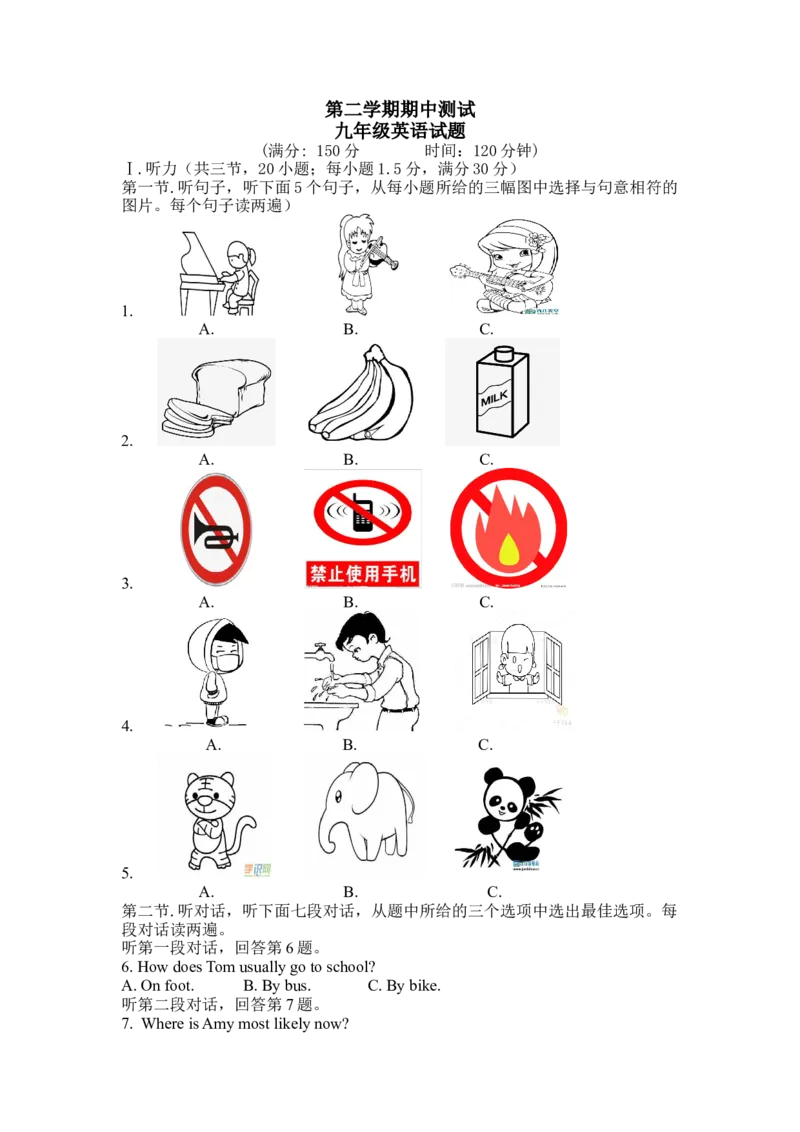
第一节.听句子,听下面5个句子,从每小题所给的三幅图中选择与句意相符的
图片。每个句子读两遍)
1.
A. B. C.
2.
A. B. C.
3.
A. B. C.
4.
A. B. C.
5.
A. B. C.
第二节.听对话,听下面七段对话,从题中所给的三个选项中选出最佳选项。每
段对话读两遍。
听第一段对话,回答第6题。
6. How does Tom usually go to school?
A. On foot. B. By bus. C. By bike.
听第二段对话,回答第7题。
7. Where is Amy most likely now?A. At school. B. In hospital. C. In the library.
听第三段对话,回答第8题。
8. What was the weather like yesterday?
A. Rainy. B. Windy. C. Sunny.
听第四段对话,回答第9小题。
9. When did the class begin ?
A. 8: 20. B. 8: 30. C. 8: 40.
听第五段对话,回答第10-11小题。
10. How much are these CDs?
A. 30 yuan. B. 13 yuan. C. 3 yuan.
11. Where does the conversation most probably take place?
A. In the shop. B. At the school gate. C. In the museum.
听第六段对话,回答第12-13小题。
12. What’s the probable relationship between the two speakers?
A. Mother and son. B. Friends. C. Sister and brother.
13. Who does Lily buy the food for?
A. Her teacher. B. Her classmates. C. Her family.
听第七段对话,回答第14-15小题。
14. What sport does the girl prefer to do?
A. Go swimming. B. Go running. C. Doing yoga.
15. What are the speakers talking about?.
A. A school trip. B. Summer vacation plan. C. A sports meeting.
听短文,根据所听到的对话内容及要求完成表格,每空一词。 (读三遍)
A Graduation 1 6
When On July 1 7
where In the 1 8 hall
What Perform a short 19 about our lives from Grade 7 to
9.
Why Express our love for 2 0
II. 单项选择. 从每小题所给的A、B、C三个选项中,选出可以填入空白处的
正确答案。
(共15小题;每小题1分,满分15分)
21. Tom said he ______ football with his classmates from 4:00 to 6:00
yesterday.
A. is played B. was playing C. played
22. When spring comes, everything comes back to life ______ China.
A. through B. past C. across
23. Ann is very hungry. She has had two hamburgers, and she still wants
______ one.
A. a third B. three C. the third
24. There ______a music concert in Fujian Opera Theatre next month.
A. is going to have B. are going to be C. is going to be
25. —Would you mind my closing the window? —_______. It is really cold
outside.
A. Never mind. B. Not at all. C. Yes, please.
26. In most middle schools in China, students are required to ______ schooluniforms.
A. put on B. wear C. in
27. —Is this your book, Tina? —No, it isn’t mine. It must be ______ .
A. someone’s else B. someone else’s C. someone else
28. On warm sunny days, my cat will______ her toys next to her and ______
in the sun.
A. lay, lie B. lie, lay C. lay, lay
29. There is ________ Mr. Wang ________ for you at the door.
A. /, asked B. a, asking C. the, asks
30. As we know, the Beijing 2022 Olympic Winter Games ________ from
Feb.4 to 20.
A. took part B. took place C. took action
31. —Which do you prefer, milk or coffee? —______ of them. I like tea.
A. Either B. Both C. Neither
32. Kids, washing hands is a good way to protect _______from the disease.
A. you B. yourself C. yourselves
33. Taiwan Province is ______ the southeast of China and ______ the
southeast of Fujian.
A. in, to B. on, to C. to, on
34. Tina’s favorite hobby is reading. ________ she reads, ________ she
becomes.
A. The more; the happy B. The more; the happier C. The less; the happy
35. — I’m worried about ______ in the interview. — Take it easy. Believe
in yourself.
A. what can I say B. what can I go C. whether I can do
well
Ⅲ. 完型填空(共10小题;每小题1.5分,满分15分)
Somebody had the wrong number. Bill Clinton 36 from a stranger. The
message asked him what time he would like dinner brought to him. Clinton knew
the message was meant for someone else. Still, he messaged 37 .He joked
that he was allergic (过敏的) to seafood.
Fink, who had sent the message, 38 that she had sent it to the
wrong person. She wrote back that the message was for her friend who had a son
Noah. He was in ICU and dying. Clinton felt 3 9 at the message and wanted to
help the boy. He asked 40 he could give food or other items. The family
accepted his offer. Clinton 4 1 a page online for Noah. He raised more than
$ 1 ,500 from friends in a few days. With Clinton's help, Noah is getting better,
though he will have to stay in the hospital for now.
Clinton has collected more than $ 11 ,000 for the family 42 . Fink was
surprised that Clinton was helping her friend's family 43 getting her wrong
message. Noah's mother, was also 44 for all his help. She believes that
Clinton is an example of human 45 . “Humans have a desire to help other
humans at heart, and Bill acted on that. That’s a lesson that we can all take
home.” she said.
36. A. accepted B. received C. sent
37. A. on B. again C. back
38. A. thought B. realized C. meant
39. A.sad B. happy C. moved
40. A. when B. why C. whether41. A. took up B. looked up C. set up
42. A. so far B. just now C. at times
43. A. before B. after C. till
44. A. thankful B. careful C. useful
45. A. weakness B. goodness C. happiness
IV. 阅读理解(共两节,满分45分)
第一节 阅读以下A、B、C、D四篇短文,根据短文内容,从题中所给A、B、
C、D四个选
项中,选出最佳答案。(共20小题;每小题2分,满分40分)
A
Build for yourself a strong box,
Build each part with care;
When it’s strong as your hand can make it,
Put all your troubles there.
Hide there all thought of your failures,
And each pain that you take;
Lock all your heartaches in it ,
Then sit on the lid(盖子)and laugh. Then sit on the lid and laugh.
Tell no one else what's inside,
Never share its secrets;
When you've dropped in your care and worry,
Keep them for ever there.
Hide them from sight (视野) so completely
That the world will never dream half;
Cover the strong box safely,
Then sit on the lid and laugh.
46. The material above is probably ________.
A. a story B. a play C. a poem D. a letter
47. What does the writer advise us to put in the box?
A. Happy things. B. Sad things. C. Interesting things. D. Boring
things.
48. According to the writer, we’d better keep these things in the box
________.
A. for ever B. for a year C. for a month D. for a
week
49. After covering the box with the lid, we can sit on it and________.
A. cry B. share C. dream D. laugh
50. What’s the writer’s attitude towards life?
A. Serious. B. Positive. C. Negative. D. Hopeless.
B
In July, China introduced the “double reduction” policy. It hopes to reduce
students' learning burden by reducing homework and after-school classes. One
month has passed since the new term began. How do students feel about this new
policy?
“Our homework is clearly less than before,” said 13-year-old Shen Yuzhe from
Beijing. “We are not encouraged to buy workbooks any more. The exercises are
mainly from the textbook.
According to Shen, teachers now teach at a much slower pace (节奏) . Students
have enough time to process new knowledge. “Our teachers are also giving us morechances to do experiments and learn from real life,” said Shen. “For example, we
went to research earthworms (蚯蚓) in a field during a biology class. This is a much
better way to learn things than just hitting the books.”
For 13-year-old Zhang Hangming from Tianjin, the best thing about
“double reduction” is the increased time in after-school activities. “We can now
spend more time taking part in clubs and activities, such as dancing, volleyball and
drama. I have joined a group called‘leadership development in business’where I
can learn all kinds of skills beyond academic (学业的) study.”said Zhang.
Both Shen and Zhang find there are fewer exams now. But they think it's not
necessarily a good thing. “Exams force me to study harder. Each exam shows my
progress as well as my weak points,” Zhang said.
Shen also pointed out that when burden is lightened, self-discipline (自律)
becomes the key. Some students now spend more time having fun when homework is
finished early. But if you use all the free time to relax, you might fall behind others."
he said.
51. What does the first paragraph mainly talk about?
A. The result of “double reduction” policy. B. The future of “double reduction”
policy.
C. The difficulty of “double reduction” policy. D. The introduction of “double
reduction” policy.
52. What is Shen Yuzhe's idea about the new way of learning?
A. He fails to enjoy it. B. He thinks highly of it.
C. He takes it old-fashioned. D. He has some doubt about it.
53. What can we know about Zhang Hangming?
A. He does well in playing volleyball. B. He wants to join the drama club.
C. He is younger than Shen Yuzhe. D. He is interested in business
54. Which word has the most similar meaning to the underlined word “force”?
A. Teach. B. Help. C. Drive. D. Ask.
55. According to Shen Yuzhe, who may fall behind?
A. Someone who is weak in self-discipline. B. Someone who makes use of his
free time.
C. Someone who finishes homework on time. D. Someone who spends less time
on having fun.
C
When the bell rings at 9 o’clock, He Yue, 18, and a group of other
students from Jiangsu Xishan Senior High School, crowd into the student
community. They quickly put on their work uniforms and act as various
workers. They could be a banker, a postman, a radio host or even a leader.
This is part of a project to create a simulated (模拟的) city run by
students. Since last year, He Yue has been serving as an office worker for the
students’ bank named K-bank. Unlike other students, she has a busy “job”
during the 40-minute break: help prepare for change, fill in forms and record
every deal. Sometimes, when a great deal of cash such as class funds and
money from the supermarket is “stored ”, she needs to count it carefully
and report the result in time.
Besides that, they also offer students interest-free funds and provide safe money-
stored boxes. If students want to start a business like designing bookmarks but have
no money to buy materials, they can come here to loan. “With so much money,
I've gradually learned to be more careful and thoughtful, ” said He.He is not the only one serving the school. Also, some students serve the food test
center and other parts of the project including cultural and creative product
community, radio stations, roasts...All of these are real life experiences. “Educators
must realize that the top goal of education is not just about scoring good grades, but
improving useful skills that will allow students to lead a good life, ” said Tang
Jiangpeng, headmaster of Jiangsu Xishan High School.
56. The school project is to help students ________.
A. experience life B. raise money C. become actors D. record change
57. What does He Yue need to do as a member of K-bank?
① test the food ② get change ready ③ design bookmarks ④ count money
⑤record every deal
A.①②⑤ B.②③⑤ C. ①③④ D. ②④⑤
58. What’s the underlined word “loan” probably mean?
A . 贷款 B. 收租 C. 交易 D. 还债
59. We does He Yue think of the school project?
A. Awful. B. Relaxing. C. Helpful. D. Boring.
60. What’s the main purpose of the text?
A. To encourage students to run a bank. B. To call for help in the
community.
C. To introduce a school community project. D. To help students score
good grades.
D
Historians study the past. They care about past events and people who
lived in the past. But historians do not just learn names, dates and places.
Instead, they try to explain past events. They want to know why an event
happened. They want to know why a person acted in a certain way. And they
want to know how one event caused another to happen.
To learn about the past better, historians must study many sources. First,
they use primary sources that were recorded at the same time as an event
happened. They could be journals. They could be books. They could be
newspaper articles or photographs. In modern times, they could even be video
recordings. Historians use primary sources to get the opinions of eyewitnesses
(目击者) to important events. They also use secondary sources. These are
works written by people who did not see an event themselves. Good historians
use both primary and secondary sources in their work.
There are many kinds of historians. Some historians like political history.
Others study military history. Some are centered on economics. And others
prefer social or cultural history. All of them are important. And all of them
help us understand the past better.
61. Which of the following may interest a historian most?A. B. C. D.
62. According to the passage, the primary sources include the following
EXCEPT ________.
A. journals and books B. newspapers articles
C. video recordings D. opinions of eyewitnesses
63. Which of the following is FALSE about sources in Paragraph 2?
A. Primary sources could be different kinds of things.
B. Sources can help historians to understand the past events.
C. Historians need not only primary but also secondary sources.
D. Primary sources are more important than secondary sources.
64. What is the passage mainly about ?
A. What historians do B. How historians learn about
the past.
C. Why historians like to study the past. D. What primary and
secondary sources are
65. We can read the passage in the column(栏目)________ of a magazine.
A. Arts B. Economy C. Culture D. Science
第二节 阅读下面短文,从短文后所给的五个选项中选出能填入短文空白处的最
佳选项,使短文通顺、连贯,意思完整。(共5小题;每小题1分,满分
5分)
E
A pop-up show that looked like a bookstore was open in Shanghai. It drew
much attention because of its unusual offering. The 9-square-metre place could
hold only six people at a time. 66 Visitors could only read in the tiny
bookstore.
“ Our pace of life is getting faster. 6 7 The way we search for information
has also changed from reading books to watching Tik Tok,” said Zhuang Jie, one of
the five people behind the show. “ 6 8 We also want to provide new option
for the young generations(一代),who have not experienced much traditional
reading. ”
During the 15-day display, the bookstore attracted about 500 visitors. Zhuang
said that they had never expected so many people. “ People were even willing to
wait in line to enter. We realized that we might all love to read but just need a
window to do it, ” he said. 6 9 It was among the most searched terms on social
platform Sina Weibo. Famous writer Rao Xueman mentioned the show on her
Weibo account. She hoped to roll out(推出)a similar project in the future.7 0 He mentioned these shows might have something to do with old
toys and their stories.
A. The show also proved to be a hit online.
B. The 3 000 old books on display were not for sale or loan.
C. Zhuang also said that more shows like this would be open soon.
D. Today, we can only read books when we have fragments(碎片)of time.
E. .We hope to inspire visitors to rethink their way of reading while inside our bookstore.
Ⅴ. 情景交际(共5小题;每小题2分,满分10分)
根据情景提示,完成下列各题
71. 你想知道这节课几点开始,可以这么问:
________________________________________________________?
72. 你想带领外宾参观你的学校,可以这么说:
Let_____________________________________________________.
73. 你想知道Jack长大后打算做什么,可以这样问:
___________________________________________________, Jack?
74. 你不同意对方的观点时,你会这样说:
_______________________________________________________.
75. 用餐结束后,你想结账,可以这样说:
May ___________________________________________________?
Ⅵ. 看图写话(共5小题;每小题2分,满分10分)
根据每小题所提供的图画情景和提示词,写出一个与图画情景相符的句子。
76. how about, me 77.turn, leave 78. take, two hours, Beijing 79.if, park, get
80.used to, help
Ⅶ. 短文填空(共10小题;每小题1分,满分10分)
阅读下面短文,根据语境、音标或所给单词的提示,在每个空格内填入一
个恰当的词,要求所填的词意义准确、形式正确,使短文意思完整、行文连贯。
Yangzi was a famous scholar (学者). One day, one of his 81 (neighbor)
lost a sheep and he asked all his friends for help. Yangzi asked the neighbor, “Why
do you send so many people out just to look for one lost sheep?” His neighbor
explained there 8 2 a lot of branches.
After a while, all the people came back, but none of them 8 3 [ faund ] the
sheep. They said, “ Each road has branches and each branch has its own branches.
We do not know how to make 8 4 choice. So we give up.”
After hearing this, Yangzi kept 85 [ˈsaɪlənt] and was lost in thought.
His students didn’t understand 86 their teacher worried. After all, the lost
sheep wasn't 8 7 (he).
Xinduzi, a friend of Yangzi, told the students 88 (serious), “Your
teacher is worrying about your studies. What has happened reminds him 89
the difficulty of learning and researching. In his opinion, if you fail to find the rightway of study, you can 90 [əˈtʃiːv] nothing, just like those people who tried
to find the lost sheep.”
This is the Chinese idiom story “qilu wangyang”. It is used to show the
importance of choosing the right direction. It is easy to lose your way when the
situation is complex(复杂的).
Ⅷ. 书面表达(15分)
在“双减”政策下,各校均开展了课后延时服务。我校开设了一些特色课
程,学生可根据兴趣进行选择。请根据以下内容提示为学校英文网页写一篇短
文,介绍这些课程、提出你建议增设的课程并说明理由。
1.参考词汇:
模型制作model making 合作cooperation 英语戏团 English Opera
2.词数90左右(文章开头已给出,不计入词数);
Students in our school are free to choose some special courses according to their interest.