Unit 2 Last weekend
教材分析 本单元学习的主题是上周末的活动安排。教学内容主要是通过一般过
去时来描述自己或他人过去进行的活动。教学重点是能掌握核心句型“—
How was your weekend? —It was good.” “—What did you do? —I stayed at
home with your grandma.” “Was it interesting?” “—Did you see a film? —No,
I had a cold.”;能听、说、读、写单词和短语“cleaned my room, washed my
clothes, stayed at home, watched TV, read a book, saw a film, had a cold,
slept, last, yesterday, before”。
教学目标 知识与能力目标:
能够听、说、读、写句型“—How was your weekend? —It was good.”
“—What did you do? —I stayed at home with your grandma.” “Was it
interesting?” “—Did you see a film? —No, I had a cold.”
能够在情景中恰当运用句型“—How was your weekend? —It was
good.” “What did you do last weekend?” “Did you see a film?” “Did you
do anything else?”询问并回答有关上周末的活动安排
能够听、说、读、写以下单词和短语“cleaned my room, washed my
clothes, stayed at home, watched TV, read a book, saw a film, had a cold,
slept,last, yesterday, before”
能够正确使用上述单词和短语谈论过去的活动
理解一般过去时的用法及动词词尾的规则变化
情感态度、文化意识、学习策略目标:
了解英国人有喝下午茶的生活习惯
培养学生合理安排周末活动的意识
课时安排 第一课时:Part A Let’s try & Let’s talk
第二课时:Part A Let’s learn & Do a survey and report
第三课时:Part B Let’s try & Let’s talk
第四课时:Part B Let’s learn & Look and talk
第五课时:Part B Read and write
第六课时:Part B Let’s check & Let’s wrap it up
The first period(第一课时)
Part A Let’s try & Let’s talk▶ 教学内容与目标
课时教学内容 课时教学目标
Let’s try 通过读懂Let’s try板块的内容,对听力部分的重点信息进行预
测,初步感知一般现在时、一般将来时和一般过去时的不同语用
环境。
通过听录音,能够解答Let’s try板块的问题,选出正确的答案。
Let’s talk 能够在图片和教师的帮助下理解对话大意,回答对话下面的问
题。
能够用正确的语音、语调及意群朗读对话,并能在小组中进行角
色表演。
能够听、说、读、写并在情景中恰当运用句型“—How was your
weekend? —It was good.” “—What did you do? —I stayed at home
with your grandma.” “Did you do anything else?”谈论上周末的活
动。
能够在语境中理解新单词“stayed, drank, watched, cleaned,
washed”的意思,并能正确发音。
能够描述自己上周末和下周末的活动安排。
▶ 教学重点
1. 能够理解和掌握本课时的重点单词及句型。
2. 能够在情景中运用句型“How was your weekend?” “What did you do?”询
问并回答上周末的活动。
▶ 教学难点
能够在情景中灵活运用核心句型谈论上周末和下周末的活动安排,达到语篇
输出的目的。
▶ 教学准备
1. 预习《状元大课堂》《创优作业100分》《状元作业本》中本课时的相关内容。
2. PPT课件、课文音频、视频等。
▶ 教学过程Step 1: Warm-up & Revision & Lead-in①
1. Greetings.
T: Good morning, boys and girls. How are you today?
Ss: I’m fine, thank you.
T: Good. I hope you can have a fine day every day this week.
2. Revision—days of the week.
Present the calendar of this month. Lead students to review days of the week. (课
件出示:本月日历图片)
T: Weekdays are…
Ss: Monday, Tuesday, Wednesday, Thursday and Friday.
T: A weekend is…
Ss: Saturday and Sunday.
3. Lead-in.
Present the main scene.(课件出示:Unit 2主情景图)
T: These are Mike and John. Here we can see their blogs. Look! What day was
it?
Ss: It was Saturday and Sunday.
T: Great! This was last weekend.
Present the title of this unit: Unit 2 Last weekend.
Ask students to read the title several times after the teacher.
Present “am/is—was” and ask students to state the differences in their usage.
◆ Teaching purpose①
通过引导学生复习与星期相关的单词,帮助学生理解weekday和weekend的
词义。利用主情景图引入单元话题,引导学生初步感知一般过去时的意义和用法
Step 2:Presentation
1. Listen and circle.②
(1)T: Sarah and Mike are talking about this weekend.
Show the questions of “Let’s try”. (课件出示:Let’s try板块的练习)
Lead students to predict and guess the key words.
(2) Play the recording of “Let’s try”. (课件出示:Let’s try板块的音频) Let
students try to circle the right answers.(3) Students read the dialogue and check the answers. (课件出示:Let’s try板块
的听力材料和参考答案)
Then ask two students to tell their judging clues.
Q1:Sarah and Mike are talking on Sunday, because Sarah said “Tomorrow is
Monday.”
Q2: Mike is going to call his grandparents, because Mike said “I’m going to call
my grandparents.”
Highlight the key sentences of the dialogue. Ask students to learn to read and lead
them to understand the simple future tense.
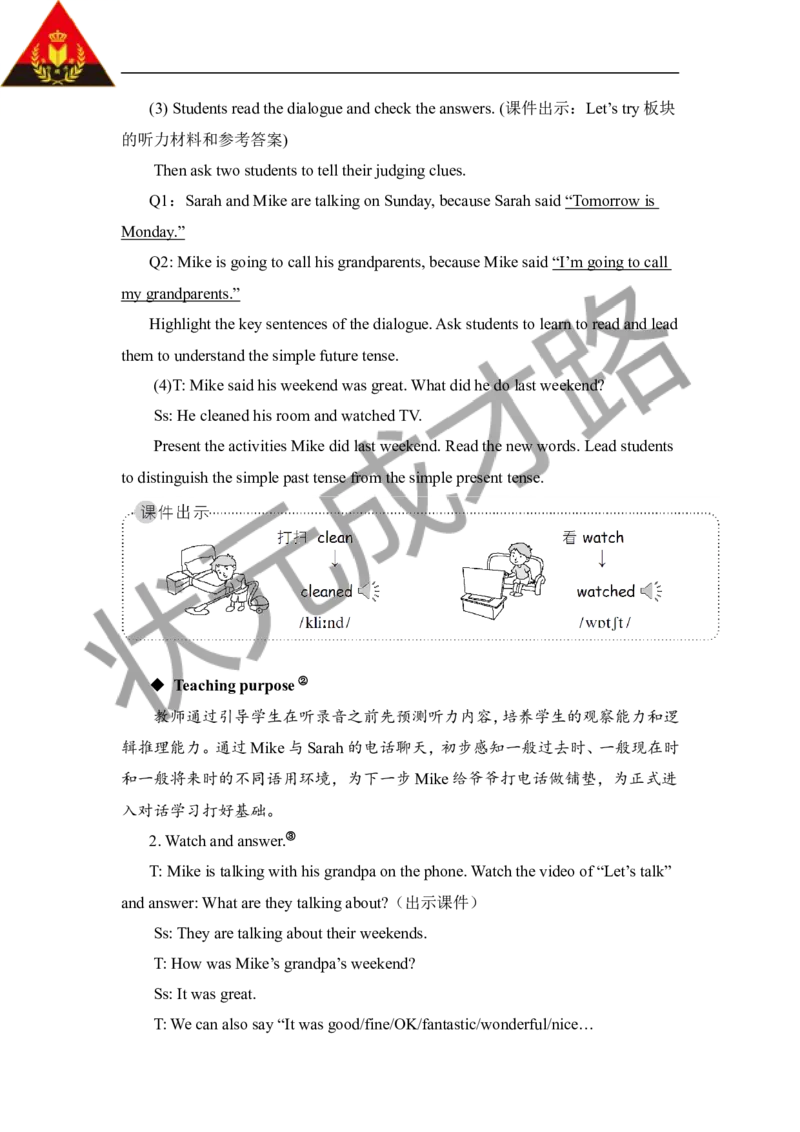
(4)T: Mike said his weekend was great. What did he do last weekend?
Ss: He cleaned his room and watched TV.
Present the activities Mike did last weekend. Read the new words. Lead students
to distinguish the simple past tense from the simple present tense.
◆ Teaching purpose②
教师通过引导学生在听录音之前先预测听力内容,培养学生的观察能力和逻
辑推理能力。通过Mike与Sarah的电话聊天,初步感知一般过去时、一般现在时
和一般将来时的不同语用环境,为下一步Mike给爷爷打电话做铺垫,为正式进
入对话学习打好基础。
2. Watch and answer.③
T: Mike is talking with his grandpa on the phone. Watch the video of “Let’s talk”
and answer: What are they talking about?(出示课件)
Ss: They are talking about their weekends.
T: How was Mike’s grandpa’s weekend?
Ss: It was great.
T: We can also say “It was good/fine/OK/fantastic/wonderful/nice…Teach the sentences “—How was Mike’s grandpa’s weekend? —It was…”
3. Read and answer.
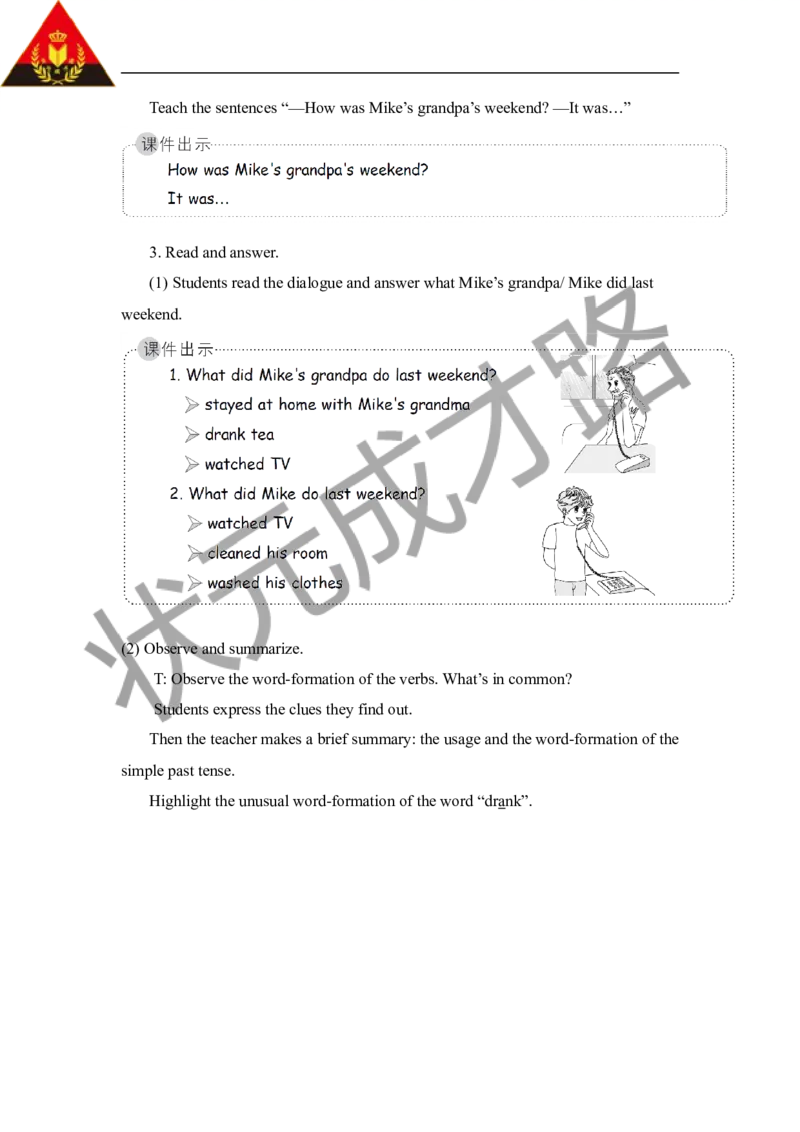
(1) Students read the dialogue and answer what Mike’s grandpa/ Mike did last
weekend.
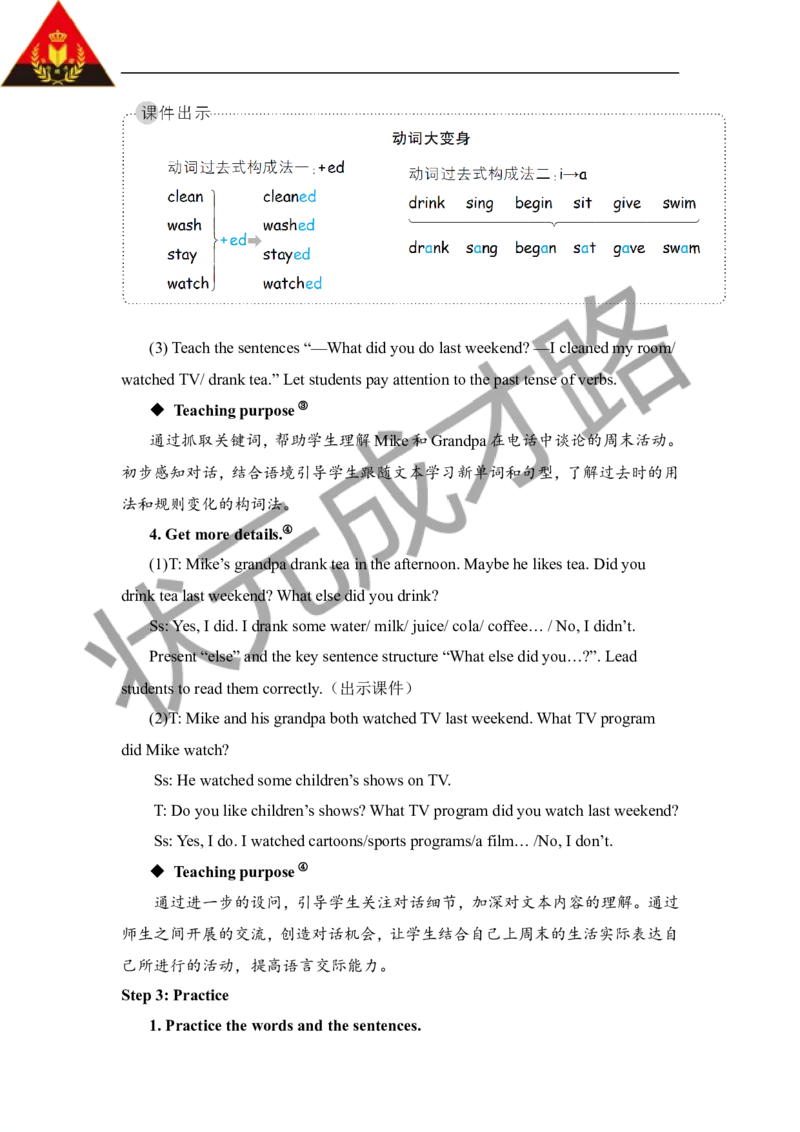
(2) Observe and summarize.
T: Observe the word-formation of the verbs. What’s in common?
Students express the clues they find out.
Then the teacher makes a brief summary: the usage and the word-formation of the
simple past tense.
Highlight the unusual word-formation of the word “drank”.(3) Teach the sentences “—What did you do last weekend? —I cleaned my room/
watched TV/ drank tea.” Let students pay attention to the past tense of verbs.
◆ Teaching purpose③
通过抓取关键词,帮助学生理解Mike和Grandpa在电话中谈论的周末活动。
初步感知对话,结合语境引导学生跟随文本学习新单词和句型,了解过去时的用
法和规则变化的构词法。
4. Get more details.④
(1)T: Mike’s grandpa drank tea in the afternoon. Maybe he likes tea. Did you
drink tea last weekend? What else did you drink?
Ss: Yes, I did. I drank some water/ milk/ juice/ cola/ coffee… / No, I didn’t.
Present “else” and the key sentence structure “What else did you…?”. Lead
students to read them correctly.(出示课件)
(2)T: Mike and his grandpa both watched TV last weekend. What TV program
did Mike watch?
Ss: He watched some children’s shows on TV.
T: Do you like children’s shows? What TV program did you watch last weekend?
Ss: Yes, I do. I watched cartoons/sports programs/a film… /No, I don’t.
◆ Teaching purpose④
通过进一步的设问,引导学生关注对话细节,加深对文本内容的理解。通过
师生之间开展的交流,创造对话机会,让学生结合自己上周末的生活实际表达自
己所进行的活动,提高语言交际能力。
Step 3: Practice
1. Practice the words and the sentences.Lead students to practice the key words and sentences. (出示课件)
2. Read and act.⑤
(1)Let students listen and read after the recording(. 课件出示:Let’s talk板块的
音频)Remind them to pay attention to the pronunciation and the intonation.
(2)Let students practice the dialogue in pairs.
(3)Act out.
◆ Teaching purpose⑤
引导学生通过录音跟读,能用正确的语音、语调及意群朗读对话。熟悉对话
内容,加深理解,并能在小组中进行角色表演。
3. Can you say?⑥
T: Can you complete the whole dialogue?
Lead students to fill in the blanks according to the context. Firstly, make a model.
Then let students work in pairs. At last, check the answers. (出示课件)
◆ Teaching purpose⑥
通过补全对话的活动,锻炼学生联系上下文进行推断的能力,使学生在具体
语境中熟练运用目标语言。
Step 4: Consolidation & Extension
1. Exercises.
Lead students to finish the tasks. (出示课件)
2. Talk about your last weekend.⑦
T: Now we know something about Mike’s and his grandpa’s weekend. Whatabout yours?
Present a model on the PPT. Ask students to make dialogues like the model in
pairs.
3. Plan for next weekend.
T: I think many of you had a great time last weekend. Do you have a plan for
next weekend? What are you going to do next weekend?
Present some extension words on the PPT and help students talk freely.(出示课
件)
◆ Teaching purpose⑦
通过创编对话的形式,结合学生生活实际,将以前学过的单词和短语与单元
话题相结合,创建新的表达,使学生能够描述自己上周末的活动。
▶ 板书设计
▶ 作业设计1. Practice the dialogue. Read it correctly, fluently and emotionally.
2. Find out more information about the rules of the past tense.
3. Do the exercises.(见“状元成才路”系列丛书《创优作业100分》或《状元
作业本》对应课时作业)
▶ 教学反思
1. 整体教学流程清晰,教学内容由浅入深、层层递进,较好地达成了教学目标
2. 教学活动设计丰富、细节清晰,注重对学生的引导。以学生为本,以问题为
导向,引导学生关注图片和文本细节,启发学生思维,注重对思维品质的培养。
3突出语用功能,通过情景创设,设计不同的教学活动,引导学生在具体的语
境中综合运用所学目标语言来实现语言输出。
4. 板书设计层次清晰,有不同颜色标注,突出重点,能吸引学生的注意力并
起到对本课知识归纳总结的作用。
▶ Teaching Contents & Teaching Aims
Let’s try
Predict the main content of the listening part by reading the questions and get to
know how to use the different tenses in different situations.
Understand the listening materials and circle the right answers.
Let’s talk
Understand the main idea of the dialogue with the help of the pictures and the
teacher.
Be able to answer the questions below the dialogue.
Read the dialogue correctly, fluently and emotionally and act out.
Use the sentence structures properly.
Understand and read the new words“stayed, drank, watched, cleaned, washed”.
Be able to talk about the activities of last weekend and arrangements for next
weekend.▶ Teaching Priorities
Understand and master the key words and sentence structures.
Use the sentence structures “How was your weekend?” “What did you do?” to
ask and answer the questions about the activities of last weekend.
▶ Teaching Difficulties
Be able to use the key sentence structures to talk about the activities of last and
next weekend.
▶ Teaching Procedures
Teaching Stages Teacher’s Activities Students’ Activities Teaching Purposes
Warm-up 1. Greetings. 1. Greetings. Help students understand
the meaning of “weekend”
& 2. Revision: days of the 2. Review days of the
and “weekdays”. Lead in
week. week.
Revision the topic of “Last
3. Lead-in. 3. Observe the picture. weekend”.
&
Lead-in
Presentation 1. Listen and circle. (1) Predict and guess. Cultivate students’ ability
of observation and logical
(1) Show the questions. (2) Listen and circle the
thinking. Make a good
right answers.
(2) Play the recording. preparation for the
(3) Read and check the following learning.
(3) Check the answers.
answers.
(4) Ask a question.
(4) Answer the question.
2. Watch and answer. Watch the video of Use questions to lead
“Let’s talk” and answer students to get the main
Play the video of
the questions. idea.
“Let’s talk” and ask
questions.
3. Read and answer. (1) Read the dialogue Lead students to learn the
and answer. new sentences and acquire
(1) Ask students to read
the usage and the word-
and answer the (2) Observe and
formation of the simple
questions. summarize.
past tense.
(2) Observe and (3) Learn the sentences.
summarize.
(3) Teach the sentences.
4. Get more details. Talk with the teacher. Lead students to get deeper
understanding of theGet more details about context by asking
the dialogue. questions with details.
Practice 1. Practice the words Practice the words and Help students practice the
and the sentences. sentences. key phrases and sentences.
Make sure students can
2. Read and act. Read and practice in
read the dialogue correctly,
pairs. Act out.
Play the recording. fluently and emotionally.
Get prepared for the next
3. Can you say? Complete the whole
part.
dialogue.
Consolidation 1. Exercises. Complete the exercises. Create a real situation to
develop students’
& Show the exercises on
comprehensive language
the PPT.
Extension skills. Consolidate
2. Talk about your last Talk about last weekend. students’ ability of using
weekend. Show the the target language
Work in pairs.
model on the PPT. reasonably and properly.
3. Plan for next Free talk.
weekend.
Homework 1. Practice the dialogue. Read it correctly, fluently and emotionally.
2. Find out more information about the rules of the past tense.
3. Do the exercises.