2015年2月1套大)学英语四级考试真题(第2
Part I Writing
(30minutes)
Directions: For this part, you are allowed 30 minutes to write an essay commenting on the
saving Listening is more important than talking.You can cite examples to illustrate the
importance of paying attention to others'opinions. You should write at least 120words but
no more than l80 words.
Part II
Listening Comprehension (25 minutes)
2016年四六级听力改革,本套试题中的听力题目已按照最新题型进行优化,与现在所考题
型完全一致,可放心使用。
Setion A
Directions; In this section, vou will hear three news reports. At the end of each news
report, you will hear hwo or three questions. Both the news report and the questions will be
spoken onlyonce. After you hear a question, you must choose the best answer from the
four choices marked A),B),C) and D).Then mark the corresponding letter on Answer
Sheet I with a single line through the centre.
Questions 1 and 2 are based on the news report you have just heard.
1.A) Zuckerberg wrote a letter to his new-born baby girl.
B) Zuckerberg wants his baby girl to grow up in a better world.
C) Zuckerberg became one of the most searched names on Google.
D) Zuckerberg decided to donate most of his Facebook shares.
2.A) About $45 million. C) About $45 billion.
B)About $50 million. D)About $99 billion.
Questions 3 and 4 are based on the news report you have just heard.
3. A) It was approved on Sunday.
B) It runs to 42 pages.
C)It targets rich countries tackling climate change.
D) It has a clear vision to go renewable energy.
4. A) In Denmark.
B) In Greenland.
C) In Durban.
D) In the Place de la Pantheon.
Questions 5 to 7 are based on the news report you have just heard.
5.A)The ruling party candidate.
B)The chosen successor of Argentina's president.
C)The governor of Buenos Aires province.
D) The mayor of Buenos Aires.
6. A)Tighten trade restrictions. C) Carry out social welfare programs.
B)Lift some financial controls. D) Seek the help of economic reform.
7.A)A candidate with over 45 percent of the vote could win the presidency.
B)A candidate who has 10 more points over the second wins the presidency.C)Any candidate who wins the most of the vote could be the winner.
D)Any candidate who wins at least 40 percent of the vote gets elected.
Section B
Directions: In this section,you will hear hwo long comversations. At the end of each
comversation, you will hear four questions.Both the comversation and the questions will be
spoken only once. Afier you hear a question,you must choose the best answer from the
four choices marked A) B),C) and D).Then mark the corresponding letter on Answer
Sheet I with a single line through the centre.
Questions 8 to 11 are based on the conversation you have just heard.
8. A)It is more difficult to learn than English.
B) It is used by more people than English.
C)It will be as commonly used as English.
D) It will eventually become a world language.
8. A)Its loan words from many languages.
B) Its popularity with the common people.
C) The influence of the British Empire.
D)The effect of the Industrial Revolution.
10.A)It includes a lot of words from other languages.
B)It has a growing number of newly coined words.
C)It can be easily picked up by overseas travellers.
D)It is the largest among all languages in the world.
11.A)It has many international words. C) Its grammar is very simple.
B) It can be pronounced easily. D) It has no different dialects.
Questions 12 to 15 are based on the conversation you have just heard.
12.A) To return some goods. C) To place an order.
B)To apply for a job. D) To make a complaint.
13.A)He has become somewhat impatient with the woman.
B)He is not familiar with the exact details of the goods.
C) He has not worked in the sales department for long.
D) He works on a part-time basis for the company.
14.A) It is not his responsibility.
B)It will be free for large orders.
C) It costs f15 more for express delivery.
D) It depends on a number of factors.
15.A) Report the information to her superior.
B) Pay a visit to the saleswoman in charge.
C)Ring back when she comes to a decision.
D) Make inquiries with some other companies.
Section C
Directions: In this section, you will hear thre passages.At the end of each passage,you
will hear three or four questions. Both the passage and the questions will be spoken only
once. Afier you hear a question,you must choose the best answer from the four choicesmarked A),B),C) and D). Then mark the corresponding letter on Answer Sheet I with a
single line through the centre.
Questions 16 to 18 are based on the passage you have just heard.
16.A) No one knows exactly where they were first made.
A)No one knows for sure when they came into being.
C) No one knows for what purpose they were invented.
D) No one knows what they will look like in the future.
17.A) Carry ropes across rivers.
B) Measure the speed of wind.
C) Pass on secret messages.
D) Give warnings of danger.
18.A) To protect houses against lightning.
B)To test the effects of the lightning rod.
C)To find out the strength of silk for kites.
D) To prove that lightning is electricity.
Questions 19 to 22 are based on the passage you have just heard.
19.A) She enjoys teaching languages.
B)She can speak several languages.
C) She was trained to be an interpreter.
D) She was born with a talent for languages.
20.A)They acquire an immunity to culture shock.
B)They would like to live abroad permanently.
C)They want to learn as many foreign languages as possible.
D) They have an intense interest in cross-cultural interactions.
21.A) She became an expert in horse racing.
B)She got a chance to visit several European countries.
C) She was able to translate for a German sports judge.
D) She learned to appreciate classical music.
22.A)Taste the beef and give her comment.
B) Take part in a cooking competition.
C)Teach vocabulary for food in English.
D) Give cooking lessons on Western food.
Questions 23 to 25 are based on the passage you have just heard.
23.A)He had only a third-grade education.
B)He once threatened to kill his teacher.
C) He grew up in a poor single-parent family.
D)He often helped his mother do housework.
24.A) Careles.
B) Stupid.
C)Brave.
D)Active.
25.A) Write two book reports a week.B) Keep a diary.
C) Help with housework.
D) Watch educational TV programs only.
Part II
Reading Comprehension (40 minutes)
Section A
Directions: In this section, there is a passage with ten blanks. You are required to select
one word for each blank from a list of choices given in a word bank following the passage.
Read the passage through carefully before making vour choices. Each choice in the bank
is identified bya letter. Please mark the corresponding letter for each item on Answer
Sheet 2 with a single line through the centre. You may not use any of the words in the bank
more thanm once.
Questions 26 to 35 are based on the following passage.
Scholars of the information society are divided over whether social inequality
decreases or increases in an information-based society. However,they generally agree with
the idea that inequality in the information society is_26 different from that of an
industrial society. As informatization progresses in society, the cause and structural nature
of social inequality changes as well.
It seems that the information society_27_ the quantity of information available to the
members of a society by revolutionizing the ways of using and exchanging information.
But such a view is a 28__analysis based on the quantity of information supplied by
various forms of the mass media.A different_29_is possible when the
actual amount of information 30 _by the user is taken into account. In fact,the more
information_31 throughout the entire society, the wider the gap becomes between
"information haves"and "information have-nots,"leading to digital divide.
According to recent studies, digital divide has been caused by three major 32_:class,
sex, and generation.In terms of class, digital divide exists among different types of
workers and between the upper and middle classes and the lower class. With 33_ to sex,
digital divide exists between men and women. The greatest gap, however, is between the
Net-generation,34 with personal computers and the Internet, and the older generation,
35_to an industrial society.
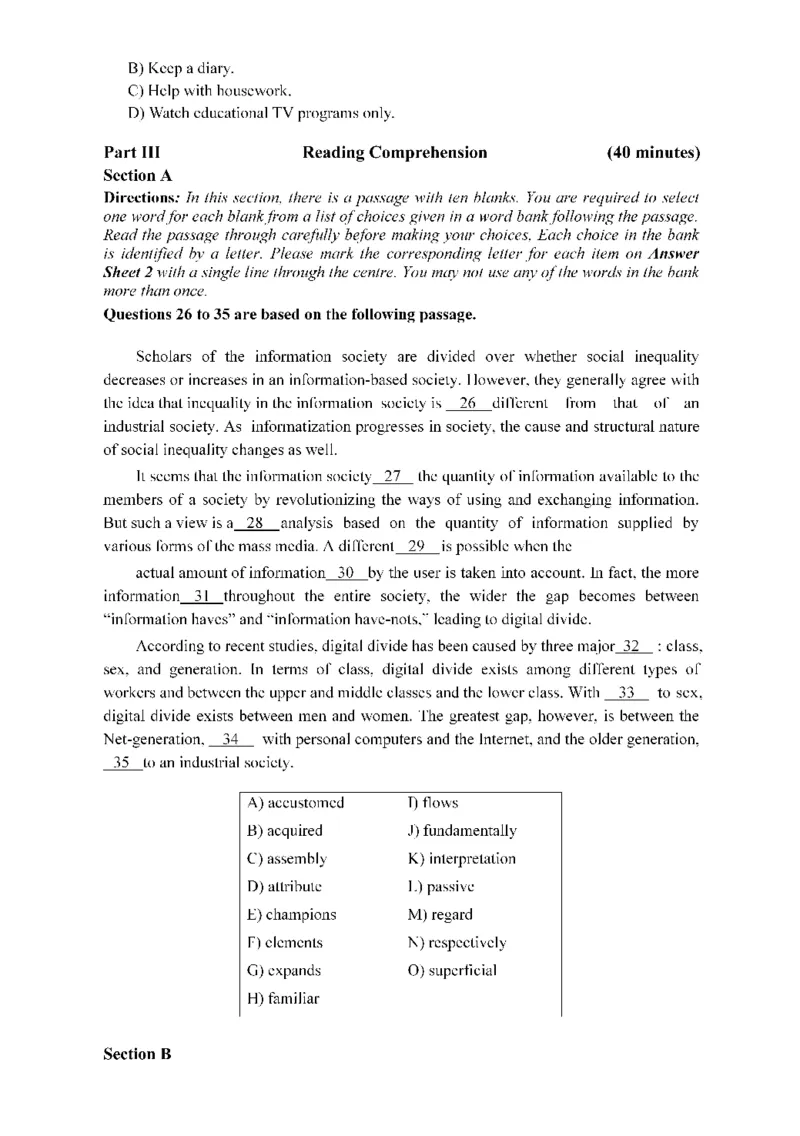
A) accustomed D) lows
B)acquired J) fundamentally
C)assembly K) interpretation
D)attribute L) passive
E)champions M) regard
F)elements N)respectively
G) expands O)superficial
H) familiar
Section BDirections:In this section. you are going to read a passage with ten statements attached to
it Each statement contains information given in one of the paragraphs. ldentify the
paragraph from which the information is derived. You may choose a paragraph more tham
once. Each paragraph is marked with a letter. Answer the questions by marking the
corresponding letter on Answer Sheet 2.
Joy: A Subject Schools Lack
Becoming educated should not require giving up pleasure
A) When Jonathan Swift proposed, in 1729,that the people of Ireland eat their children,
he insisted it would solve three problems at once: feed the hungry masses, reduce the
population during a severe depression, and stimulate the restaurant business. Even as
a satire(讽刺), it seems disgusting and shocking in America with its child-centered
culture. But actually. the country is closer to his proposal than you might think.
B) If you spend much time with educators and policy makers, you'll hear a lot of the
following words: "standards,""results,""skills,""self-control,""accountability,"and
so on. I have visited some of the newer supposedly "effective" schools, where
children shout slogans in order to learn self-control or must stand behind their desk
when they can't sit still.
C) A look at what goes on in most classrooms these days makes it abundantly clear that
when people think about education, they are not thinking about what it feels like to be
a child,or what makes childhood an important and valuable stage of life in its own
right.
D) I'm a mother of three, a teacher, and a developmental psychologist. So I've watched a
lot of children—talking, playing, arguing, eating, studying, and being young. Here's
what I've come to understand. The thing that sets children apart from adults is not
their ignorance, nor their lack of skills. It's their enormous capacity for joy. Think of a
3-year-old lost in the pleasures of finding out what he can and cannot sink in the
bathtub, a 5-year-old beside herself with the thrill of putting together strings of
nonsensical words with her best friends, or an 1l-year-old completely absorbed in a
fascinating comic strip.A child's ability to become deeply absorbed in something, and
derive intense pleasure from that absorption, is something adults spend the rest of
their lives trying to return to.
E) A friend told me the following story. One day, when he went to get his 7-year-old son
from soccer practice, his kid greeted him with a downcast face and a sad voice. The
coach had criticized him for not focusing on his soccer drills. The little boy walked
out of the school with his head and shoulders hanging down. He seemed wrapped in
sadness.But just before he reached the car door,he suddenly stopped, crouching(蹲
伏)down to peer at something on the sidewalk. His face went down lower and lower,
and then, with complete joy he called out,"Dad. Come here. This is the strangest bug
I've ever seen. It has, like,a million legs.Look at this. It's amazing."He looked up at
his father, his features overflowing with energy and delight."Can't we stay here for
just a minute? I want to find out what he does with all those legs. This is the coolest
ever."
F) The traditional view of such moments is that they constitute a charming but irrelevant
byproduct of youth—something to be pushed aside to make room for more importantqualities,like perseverance(坚持不懈).obligation,and practicality.Yet moments like
this one are just the kind of intense absorption and pleasure adults spend the rest of
their lives seeking. Human lives are governed by the desire to experience joy.
Becoming educated should not require giving up joy but rather lead to finding joy in
new kinds of things: reading novels instead of playing with small figures, conducting
experiments instead of sinking cups in the bathtub,and debating serious issues rather
than stringing together nonsense words, for example. In some cases, schools should
help children find new, more grown-up ways of doing the same things that are
constant sources of joy: making art,making friends, making decisions.
G) Building on a child's ability to feel joy,rather than pushing it aside. wouldn't be
that hard.It would just require a shift in the education world's mindset(思维模式).
Instead of trying to get children to work hard, why not focus on getting them to take
pleasure in meaningful, productive activity. like making things, working with others,
exploring ideas, and solving problems? These focuses are not so different from the
things in which they delight.
H) Before you brush this argument aside as rubbish, or think of joy as an unaffordable
luxury in a nation where there is awful poverty,low academic achievement, and high
dropout rates, think again. The more horrible the school circumstances, the more
important pleasure is to achieving any educational success.
IMany of the assignments and rules teachers come up with, often because they are
pressured by their administrators, treat pleasure and joy as the enemies of competence
and responsibility. The assumption is that children shouldn't chat in the classroom
because it hinders hard work; instead,they should learn to delay gratification(快乐)
so that they can pursue abstract goals, like going to college.
J) Not only is this a boring and awful way to treat children, it makes no sense
educationally. Decades of research have shown that in order to acquire skills and real
knowledge in school, kids need to want to learn.You can force a child to stay in his or
her seat. fill out a worksheet,or practice division. But you can't force the child to
think carefully, enjoy books, digest complex information, or develop a taste for
learning. To make that happen, you have to help the child find pleasure in learning—
to see school as source of joy.
K) Adults tend to talk about learning as if it were medicine: unpleasant, but necessary
and good for you. Why not instead think of learning as if it were food—-something so
valuable to humans that they have evolved to experience it as a pleasure?
L) Joy should not be trained out of children or left for after-school programs. The more
difficult a child's life circumstances, the more important it is for that child to find joy
in his or her classroom."Pleasure"is not a dirty word.And it doesn't run counter to
the goals of public education.It is, in fact.the precondition.
36. It will not be difficult to make learning a source of joy if educators change their way
of thinking.
37. What distinguishes children from adults is their strong ability to derive joy from what
they are doing.38. Children in America are being treated with shocking cruelty.
39. It is human nature to seek joy in life.
40. Grown-ups are likely to think that learning to children is what medicine is to patients.
41. Bad school conditions make it all the more important to turn learning into a joyful
experience.
42. Adults do not consider children's feelings when it comes to education.
43. Administrators seem to believe that only hard work will lead children to their
educational goals.
44. In the so-called "effective"schools,children are taught self-control under a set of
strict rules.
45. To make learning effective,educators have to ensure that children want to learn.
Section C
Directions:There are 2 passages in this section. Each passage is followed by some
questions or unfinished statements. For each of them there are four choices marked A).B),
C) and D). You should decide on the best choice and mark the coresponding letter on
Answer Sheet 2 with a single line through the centre.
Passage One
Questions 46 to 50 are based on the following passage.
When it's five o'clock. people leave their office. The length of the workday, for many
workers. is defined by time. They leave when the clock tells them they're done.
These days, the time is everywhere: not just on clocks or watches, but on cell-phones
and computers. That may be a bad thing, particularly at work. New research shows that
clock-based work schedules hinder morale(士气) and creativity.
Clock-timers organize their day by blocks of minutes and hours. For example: a
meeting from 9 a.m.to 10 a.m.,research from 10 a.m. to noon,etc.On the other hand,
task-timers have a list of things they want to accomplish. They work down the list, each
task starts when the previous task is completed. It is said that all of us employ a mix of
both these types of planning.
What, then, are the effects of thinking about time in these different ways? Does one
make us more productive? Better at the tasks at hand? Happier? In experiments conducted
by Tamar Avnet and Anne-Laure Sellier, they had participants organize different
activities—from project planning, holiday shopping, to yoga—by time or to-do list to
measure how they performed under "clock time"vs "task time."They found clock timers
to be more efficient but less happy because they felt little control over their lives. Task
timers are happier and more creative, but less productive. They tend to enjoy the moment
when something good is happening,and seize opportunities that come up.
The researchers argue that task-based organizing tends to be undervalued and under-
supported in the business culture. Smart companies, they believe, will try to bake more
task-based planning into their strategies.
This might be a small change to the way we view work and the office. but the
researchers argue that it challenges a widespread characteristics of the economy: workorganized by clock time. While most people will still probably need,and be.to some
extent,clock-timers, task-based timing should be used when performing a job that
requires more creativity. It'l make those tasks easier, and the task-doers will be happier.
46.What does the author think of time displayed everywhere?
A) It makes everybody time-conscious.
B) It is a convenience for work and life.
C)It may have a negative effect on creative work.
D) It clearly indicates the fast pace of modem life.
47.How do people usually go about their work according to the author?
A)They combine clock-based and task-based planning.
B) They give priority to the most urgent task on hand.
C) They set a time limit for each specific task.
D) They accomplish their tasks one by one.
48.What did TamarAvnet and Anne-Laure Sellier find in their experiments about clock- timers?
A) They seize opportunities as they come up.
B) They always get their work done in time.
C) They have more control over their lives.
D) They tend to be more productive.
49.What do the researchers say about today's business culture?
A)It does not support the strategies adopted by smart companies.
B)It does not attach enough importance to task-based practice.
C)It places more emphasis on work efficiency than on workers' lives.
D)It aims to bring employees,potential and creativity into full play.
50.What do the researchers suggest?
A)Task-based timing is preferred for doing creative work.
B)It is important to keep a balance between work and life.
C)Performing creative jobs tends to make workers happier.
D) A scientific standard should be adopted in job evaluation.
Passage Two
Questions 51 to 55 are based on the following passage.
Martha Stewart was charged, tried and convicted of a crime in 2004.As she neared
the end of her prison sentence,a well-known columnist wrote that she was"paying her
dues,"and that "there is simply no reason for anyone to attempt to deny her right to start
aneW."
Surely, the American ideal of second chances should not be reserved only for the rich
and powerful. Unfortunately, many federal and state laws impose post-conviction
restrictions on a shockingly large number of Americans, who are prevented from ever fully
paying their debt to society.At least 65 million people in the United States have a criminal record. This can result
in severe penalties that continue long after punishment is completed.
Many of these penalties are imposed regardless of the seriousness of the offense or the
person's individual circumstances. Laws can restrict or ban voting, access to public
housing,and professional and business licensing. They can affect a person's ability to get a
job and qualification for benefits.
In all.more than 45,000 laws and rules serve to exclude vast numbers of people from
fully participating in American life.
Some laws make sense. No one advocates letting someone convicted of pedophilia
(恋童癖)work in a school.But too often collateral(附随的)consequences bear no
relation to public safety. Should a woman who possessed a small amount of drugs years
ago be permanently unable to be licensed as a nurse?
These laws are also counterproductive, since they make it harder for people with
criminal records to find housing or land a job,two key factors that reduce backsliding.
A recent report makes several recommendations, including the abolition of most
post-conviction penalties, except for those specifically needed to protect public safety.
Where the penalties are not a must. they should be imposed only if the facts of a cast
support it
The point is not to excuse or forget the crime. Rather, it is to recognize that in
America's vast criminal justice system, second chances are crucial. It is in no one's interest
to keep a large segment of the population on the margins of society.
51.What does the well-known columnist's remark about Martha Stewart suggest?
A) Her past record might stand in her way to a new life.
B) Her business went bankrupt while she was in prison.
C) Her release from prison has drawn little attention.
D) Her prison sentence might have been extended.
52. What do we learn from the second paragraph about many criminals in America?
A) They backslide after serving their terms in prison.
B) They are deprived of chances to turn over a new leaf.
C) They receive severe penalties for committing minor offenses.
D) They are convicted regardless of their individual circumstances.
53. What are the consequences for many Americans with a criminal record?
A)They remain poor for the rest of their lives.
B)They are deprived of all social benefits.
C) They are marginalized in society.
D)They are deserted by their family.
54.What does the author think of the post-conviction laws and rules?
A)They help to maintain social stability.
B) Some of them have long been outdated.
D) They are hardly understood by the public.
D)A lot of them have negative effects on society.55.What is the author's main purpose in writing the passage?
A) To create opportunities for criminals to reform themselves.
B) To appeal for changes in America's criminal justice system.
C) To ensure that people with a criminal record live a decent life.
D) To call people's attention to prisoners'conditions in America.
Part IV Translation (30minutes)
Directions: For this part, you are allowed 30 minutes to translate a passage from Chinese
into English. You should write your answer on Answer Sheet 2.
云南省的丽江古镇是中国著名的旅游目的地之一。那里的生活节奏比大多数中国城市
都要缓慢。丽江到处都是美丽的自然风光,众多的少数民族同胞提供了各式 各样、丰富多
彩的文化让游客体验。历史上。丽江还以"爱之城"而闻名。当地人中 流传着许多关干因爱
而生、为爱而死的故事。如今,在中外游客眼中,这个古镇被 视为爱情和浪漫的天堂
(paradise)。