










文档内容
2021 � 6 JJ *��iftl!Qi}l:1fj�Jtl!( -- )
•
I
i\] · ..
Part Writing ( 30 minutes)
£.!k�ffiApp
!3��H"F
Directions: For this pa.rt, you are allowed 30 minutes to write an essay titled ''Are people becoming addicted
to technology?". The statement given below is for your reference. You should write at least 120 words but no
more than 180 words.
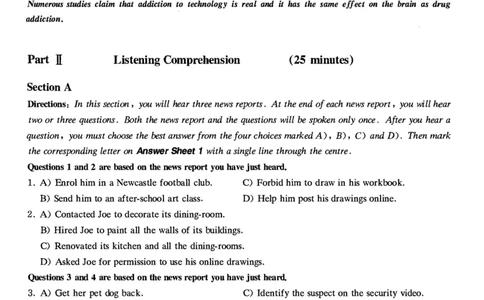
Numerous studies claim that addiction to technology is real and it has the same effect on the brain as drug
addiction.
Part Il Listening Comprehension (25 minutes)
Section A
Directions: In this section, you will hear three news reports. At the end of each news report, you will hear
two or three questions. Both the news report and the questions will be spoken only once. After you hear a
question, you must choose the best answer from the four choices marked A), B), C) and D). Then mark
the corresponding letter on Answer Sheet 1 with a single line through the centre.
Questions 1 and 2 are based on the news report yon have just heard.
1. A) Enrolhim in a Newcastle football club. C) Forbid him to draw in his workbook.
B) Send him to an after-school art class. D) Help him post his drawings online.
2. A) Contacted Joe to decorate its dining-room.
B) Hired Joe to paint all the walls of its buildings.
C) Renovated its kitchen and all the dining-rooms.
D) Asked Joe for permission to use his online drawings.
Questions 3 and 4 are based on the news report yon have just heard.
3. A) Get her pet dog back. C) Identify the suspect on the security video.
B) Beg for help from the police. D) Post pictures of her pet dog on social media.
4. A) It is suffering a great deal from the incident.
B) It is helping the police with the investigation.
C) It is bringing the case to the local district court.
D) It is offering a big reward to anyone who helps.
Questions 5 to 7 are based on the news report yon have just heard.
5. A) Provide free meals to the local poor. C) Help eliminate class difference in his area.
B) Help people connect with each other. D) Provide customers with first-class service.
6. A) It does not supervise its employees. C) It does not use volunteers.
B) It donates regularly to a local charity. D) It is open round the clock.
Im� 2021 1¥ 6 � 17. A) They will realise the importance of communication.
B)They will come to the cafe even more frequently.
C) They will care less about their own background.
D)They will find they have something in common.
Section B
Directions: In this section, you will hear two long conversations. At the end of each conversation, you will
hear four questions. Both the conversation and the questions will be spoken only once. After you hear a
question, you must choose the best answer from the four choices marked A), B), C) and D). Then mark
the corresponding letter on Answer Sheet 1 with a single line through the centre.
Questions 8 to 11 are based on the conversation you have just heard.
8. A) A surprise party for Paul's birthday. C)Preparations for Saturday's get-together.
B) Travel plans for the coming weekend. D) The new market on the other side of town.
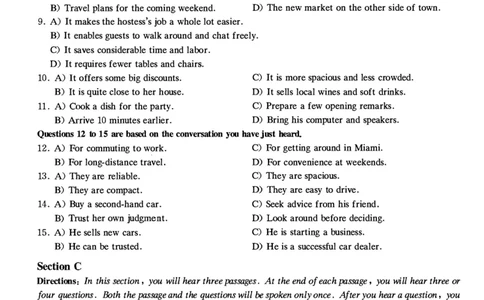
9. A) It makes the hostess's job a whole lot easier.
B) It enables guests to walk around and chat freely.
C) It saves considerable time and labor.
D) It requires fewer tables and chairs.
10. A) It offers some big discounts. C) It is more spacious and less crowded.
B) It is quite close to her house. D) It sells local wines and soft drinks.
11. A) Cook a dish for the party. C)Prepare a few opening remarks.
B)Arrive 10 minutes earlier. D)Bring his computer and speakers.
Questions 12 to 15 are based on the conversation you have just heard.
12. A) For commuting to work. C)For getting around in Miami.
B)For long-distance travel. D) For convenience at weekends.
13. A) They are reliable. C)They are spacious.
B)They are compact. D) They are easy to drive.
14. A) Buy a second-hand car. C)Seek advice from his friend.
-�t Tllls_! her ownjudg�e_!lt. D) Look around before deciding.
----- -
15. A) He sells new cars. C) He is starting a business.
B)He can be trusted. D) He is a successful car dealer.
Section C
Directions: In this section , you will hear three passages. At the end of each passage , you will hear three or
four questions. Both the passage and the questions will be spoken only once. After you hear a question , you
must choose the best answer from the four choices marked A ) , B) , C) and D) . Then mark the
corresponding letter on Answer Sheet 1 with a single line through the centre.
Questions 16 to 18 are based on the passage you have just heard.
16. A) Many escaped from farms and became wild.
B)They were actually native to North America.
C)Many got killed in the wild when searching for food.
D)They were hunted by Spanish and Russian explorers.
17. A) They often make sudden attacks on people.
B)They break up nature's food supply chain.
C)They cause much environmental pollution.
D)They carry a great many diseases.
fil}�2021�6J=j 218. A) They lived peacefully with wild pigs. C) They fell victim to eagles.
B) They ran out of food completely. D)They reproduced quickly.
Questions 19 to 21 are based on the passage you have just heard.
19. A) Taste coffee while in outer space. C)Develop a new strain of coffee bean.
B) Roast coffee beans in outer space. D) Use a pressurised tank to brew coffee.
20. A) They can easily get burned. C) They have to be heated to 36D°C.
B) They float around in the oven. D) They receive evenly distributed heat.
21. A) They charged a high price for their space-roasted coffee beans.
B) They set up a branch in Dubai to manufacture coffee roasters.
C) They collaborated on building the first spacC;! coffee machine.
D) They abandoned the attempt to roast coffee beans in space.
Questions 22 to 25 are based on the passage you have just heard.
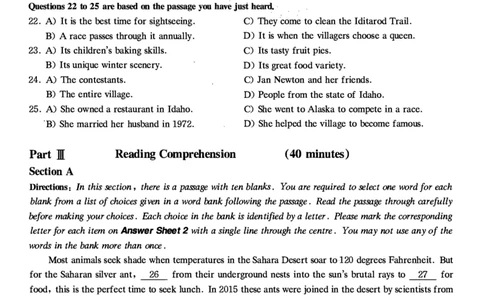
22. A) It is the best time for sightseeing. C) They come to clean the Iditarod Trail.
B)A race passes through it annually. D) It is when the villagers choose a queen.
23. A) Its children's baking skills. C) Its tasty fruit pies.
B) Its unique winter scenery. D) Its great food variety.
24. A) The contestants. C)Jan Newton and her friends.
B) The entire village. D)People from the state of Idaho.
25. A) She owned a restaurant in Idaho. C) She went to Alaska to compete in a race.
'B) She married her husband in 1972. D) She helped the village to become famous.
Part ][ Reading Comprehension ( 40 minutes)
Section A
Directions: In this section , there is a passage with ten blanks. You are required to select one word for each
blank from a list of choices given in a word bank following the passage. Read the passage through carefully
before making your choices. Each choice in the bank is identified by a letter. Please mark the corresponding
letter for each item on Answer Sheet 2 with a single line through the centre. You may not use any of the
words in the bank more than once .
Most animals seek shade when temperatures in the Sahara Desert soar to 120 degrees Fahrenheit. But
for the Saharan silver ant, ___1L from their underground nests into the sun's brutal rays to _JJ__ for
food, this is the perfect time to seek lunch. In 2015 these ants were joined in the desert by scientists from
two Belgian universities, who spent a month in the � heat tracking the ants and digging out their
nests. The goal was simple, to discover how the� adapted to the kind of heat that can� melt
the bottom of shoes.
Back in Belgium, the scientists looked at the ants under an electronic microscope and found that their
_l!_, triangular hair reflects light like a prism (�4.t), giving them a metallic reflection and protecting
them from the sun's awful heat. When Ph.D. student Quentin Willot 32 the hair from an ant with a
� knife and put it under a heat lamp, its temperature jumped.
The ants' method of staying cool is _l!_ among animals. Could this reflective type of hair protect
people? Willot says companies are interested in _lL these ants' method of heat protection for human
use, including everything from helping to protect the lives of firefighters to keeping homes cool in
summer.
Im� 20211¥ 6 J] 3A) adapting F) hunt K) species
B) consciously G) literally L) specimens
C) crawling H) moderate M) thick
D) crowded I) remote N) tiny
E) extreme J) removed 0) unique
Section B
Directions: In this section, you are going to reaa a passage with ten statements attached to it. &eh
statement contains information given in one of the paragraphs. Identify the paragraph from which the
information is derived. You may choose a paragraph more than once. &eh paragraph is marked with a
letter. Answer the questions by marking the corresponding letter on Answer Sheet 2.
The start of high school doesn't have to be stressful
A) This month, more than 4 million students across the nation will begin high school. Many will do well.
But many will not. Consider that nearly two-thirds of students will experience the "ninth-grade
shock," which refers to a dramatic drop in a student's academic performance. Some students cope with
this shock by avoiding challenges. For instance, they may drop difficult coursework. Others may
experience a hopelessness that results in failing their core classes, such as English, science and math.
B) This should matter a great deal to parents, teachers and policymakers. IBtimately it should matter to
the students themselves and society at large, because students' experience of transitioning (lii./t) to
the ninth grade can have long-term consequences not only for the students themselves but for their
home communities. We make these observations as research psychologists who have studied how
schools and families can help young people thrive.
C) In the new global economy, students who fail to finish the ninth grade with passing grades. in college
preparatory coursework are very unlikely to graduate on time and go on to get jobs. One study has
calculated that the lifetime benefit to the local economy for a single additional student who completes
high school is half a million dollars or more. This is based on higher earnings and avoided costs in
health care, crime, welfare dependence and other things.
D) The consequences of doing poorly in the ninth grade can impact more than students' ability to find a
good job. It can also impact the extent to which they enjoy life. Students lose many of the friends they
turned to for support when they move from the eighth to the ninth grade. One study of ninth-grade
students found that 50 percent of friendships among ninth graders changed from one month to the
next, signaling striking instability in friendships.
E) In addition, studies find the first year of high school typically shows one of the greatest increases in
depression of any year over the lifespan. Researchers think that one explanation is that ties to friends
are broken while academic demands are rising. Furthermore, most adult cases of clinical depression
-t
first emerge in aaolescence ( $-J.Jl) . The World Health Organization reports that depression has the
greatest burden of disease worldwide, in terms of the total cost of treatment and the loss of
productivity.
F) Given all that's riding on having a successful ninth grade experience, it pays to explore what can be
done to meet the academic, social and emotional challenges of the transition to high school. So far,
our studies have yielded one main insight: Students' beliefs about change-their beliefs about whether
people are stuck one way forever, or whether people can change their personalities and abilities-are
ll!J� 2021 1j::. 6 JJ 4related to their ability to cope, succeed academically and maintain good mental health. Past research
has called these beliefs "mindsets ( ,'� if!:tl�)," with a "fixed mindset" referring to the belief that
people cannot change and a "growth mindset" referring to the belief that people can change.
G) In one recent study, we examined 360 adolescents' beliefs about the nature of "smartness"-that is,
their fixed mindsets about intelligence. We then assessed biological stress responses for students whose
grades were dropping by examining their stress hormones ( 1if t �) . Students who believed that
intelligence is fixed-that you are stuck being "not smart" if you struggle in school-showed higher
levels of stress hormones when their grades were declining at the beginning of the ninth grade. If
students believed that intelligence could improve-that is to say, when they held more of a growth
mindset of intelligence-they showed lower levels of stress hormones when their grades were
declining. This was an exciting result because it showed that the body's stress responses are not
determined solely by one's grades. Instead, declining grades only predicted worse stress hormones
among students who believed that worsening grades were a permanent and hopeless state of affairs.
H) We also investigated the social side of the high school transition. In this study, instead of teaching
students that their smartness can change, we taught them that their social standing-that is, whether
they are bullied or excluded or left out-can change over time. We then looked at high school students'
stress responses to daily social difficulties. That is, we taught them a growth mindset about their social
lives. In this study, students came into the laboratory and were asked to give a public speech in front of
upper-year students. The topic of the speech was what makes one popular in high school. Following
this, students had to complete a difficult mental math task in front of the same upper-year students.
I) Experiment results showed that students who were not taught that people can change showed poor
stress responses. When these students gave the speech, their blood vessels contracted and their hearts
pumped less blood through the body--both responses that the body shows when it is preparing for
damage or defeat after a physical threat. Then they gave worse speeches and made more mistakes in
math. But when students were taught that people can change, they had better responses to stress, in
part because they felt like they had the resources to deal with the demanding situation. Students who
got the growth mindset intervention ( f-f»i) showed less-contracted blood vessels and their hearts
pumped more blood-both of which contributed to more oxygen getting to the brain, and, ultimately,
better performance on the speech and mental math tasks.
J) These findings lead to several possibilities that we are investigating further. First, �e are working to
replicate (i.. 11itJ) these findings in more diverse school communities. We want to know in which types
of schools and for which kinds of students these growth mindset ideas help young people adapt to the
challenges of high school. We also hope to learn how teachers, parents or school counselors can help
students keep their ongoing academic or social difficulties in perspective. We wonder what would
happen if schools helped to make beliefs about the potential for change and improvement a larger
feature of the overall school culture, especially for students starting the ninth grade.
36. The number of people experiencing depression shows a sharp increase in the first year of high school.
37. According to one study, students' academic performance is not the only decisive factor of their stress
responses.
38. Researchers would like to explore further how parents and schools can help ninth graders by changing
their mindset.
39. According to one study, each high school graduate contributes at least 500, OOO dollars to the local
economy.
fill� 2021 � 6 JI 540. In one study, students were told their social position in school is not unchangeable.
41. It is reported that depression results in enormous economic losses worldwide.
42. One study showed that friendships among ninth graders were far from stable.
43. More than half of students will find their academic performance declining sharply when they enter the
ninth grade.
44. Researchers found through experiments that students could be taught to respond to stress in a more
positive way.
45. It is beneficial to explore ways to cope with the challenges facing students entering high school.
Section C
Directions: There are 2 passages in this section. &eh passage is followed by some questions or unfinished
statements. For each of them there are four choices marked A), B), C) and D). You should decide on the
best choice and mark the corresponding letter on Answer Sheet 2 with a single line through the centre.
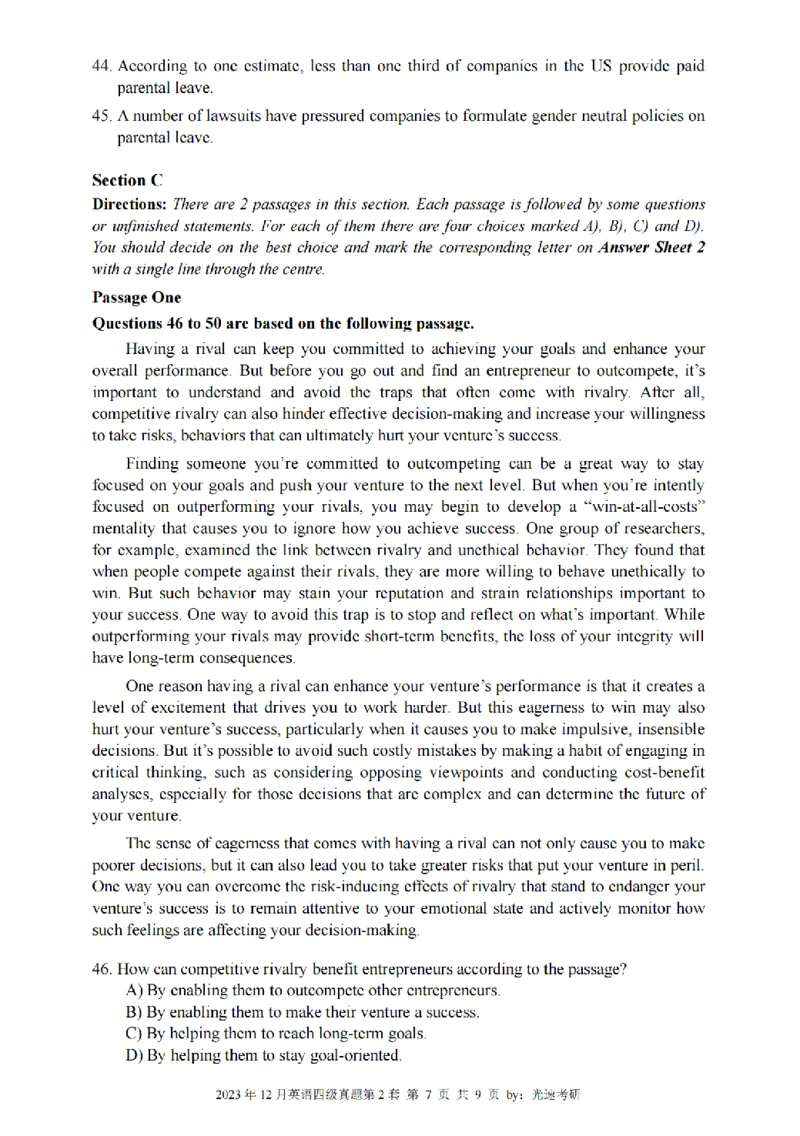
Passage One
Questions 46 to 50 are based on the following passage.
Educators and business leaders have more in common than it may seem. Teachers want to prepare
students for a successful future. Technology companies have an interest in developing a workforce with the
STEM (science, technology, engineering and math) skills needed to grow the company and advance the
industry. How can they work together to achieve these goals? Play may be the answer.
Focusing on STEM skills is important, but the reality is that SIBM skills are enhanced and more
relevant when combined with traditional, hands-on creative activities. This combination is proving to be
the best way to prepare today's children to be the makers and builders of tomorrow. That is why
technology companies are partnering with educators to bring back good, old-fashioned play.
In fact many experts argue that the most important 21st-century skills aren't related to specific
technologies or subject matter, but to creativity; skills like imagination, problem-finding and problem
solving, teamwork, optimism, patience and the ability to experiment and take risks. These are skills
----- - -acquired-when-kids-tinker (-it.fib
1
1 •-fu-;f;-};- -High4 ech industries-such-as-NASA's-Jet-Propulsion-Laboratory -----
have found that their best overall problem solvers were master tinkerers in their youth.
There are cognitive ( -iA � {JI.;) benefits of doing things the way we did as children-building
something, tearing it down, then building it up again. Research shows that given 15 minutes of free play,
four- and five-year-olds will spend a third of this time engaged in spatial, mathematical, and architectural
activities. This type of play-especially with building blocks-helps children discover and develop key
principles in math and geometry.
If play and building are critical to 21st-century skill development, that's really good news for two
reasons: Children are born builders, makers, and creators, so fostering (;J:.g-$f.) 21st-century skills may be
as simple as giving kids room to play, tinker and try things out, even as they grow older. Secondly, it
doesn't take 21st-century technology to foster 21st-century skills. This is especially important for under
resourced schools and communities. Taking whatever materials are handy and tinkering with them is a
simple way to engage those important "maker" skills. And anyone, anywhere, can do it.
46. What does the author say about educators?
A) They seek advice from technology companies to achieve teaching goals.
B) They have been successful in preparing the workforce for companies.
[9f;& 20211:p 6 JJ 6C) They help students acquire the skills needed for their future success.
D) They partner with technology companies to enhance teaching efficiency.
47. How can educators better develop students' SIBM skills, according to the author?
A) By blending them with traditional, stimulating activities.
B) By inviting business leaders to help design curriculums.
C) By enhancing students' ability to think in a critical way.
D) By showing students the best way to learn is through play.
48. How do children acquire the skills needed for the 21st century?
A) By engaging in activities involving specific technologies.
B) By playing with things to solve problems on their own.
C) By familiarizing themselves with high-tech gadgets.
D) By mastering basic principles through teamwork.
49. What can we do to help children learn the basics of math and geometry?
A) Stimulate their interest as early as po.ssible.
B) Spend more time playing games with them.
C) Encourage them to make things with hands.
D) Allow them to tinker freely with calculators.
50. What does the author advise disadvantaged schools and communities to do?
A) Train students to be makers to meet future market demands.
B) Develop students' creative skills with the resources available.
C) Engage students with challenging tasks to foster their creativity.
D) Work together with companies to improve their teaching facilities.
Passage Two
Questions 51 to SS are based on the following passage.
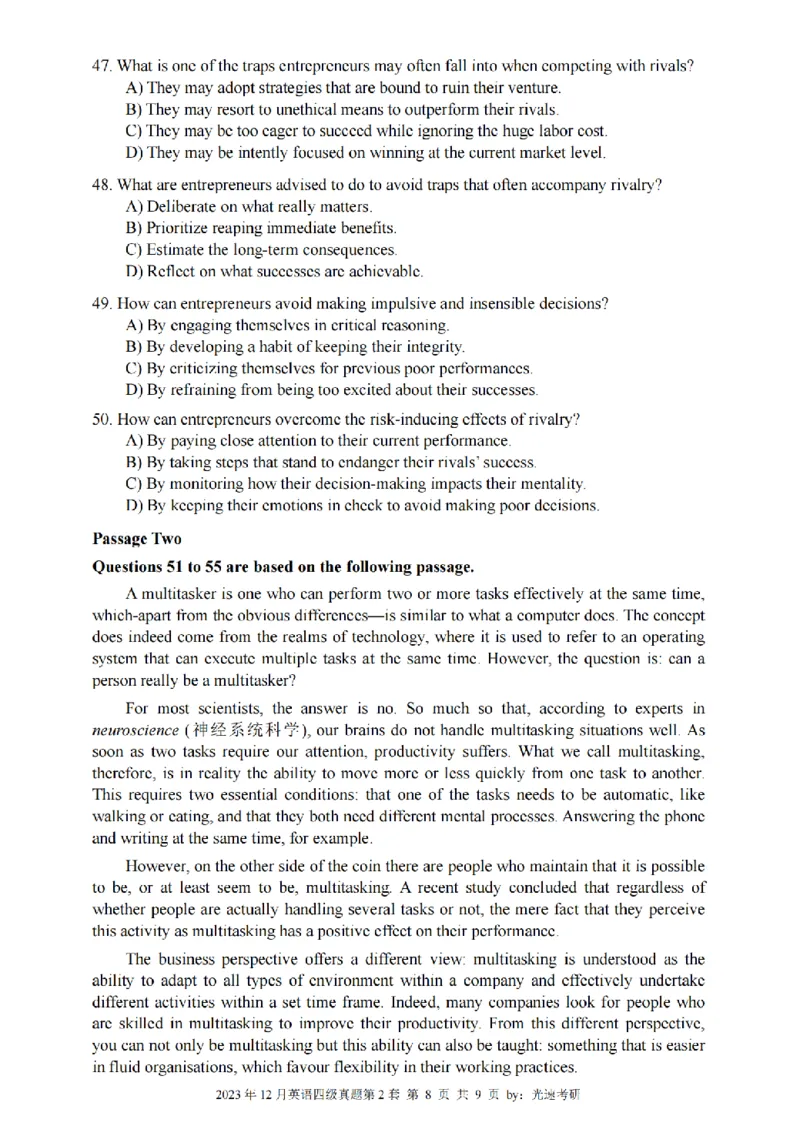
Being an information technology, or IT, worker is not a job I envy. They are the ones who, right in
the middle of a critical meeting, are expected to instantly fix the projector that's no longer working. They
have to tolerate the bad tempers of colleagues frustrated at the number of times they've had to call the help
desk for the same issue. They are also the ones who know there are systems that are more powerful,
reliable and faster, but their employer simply will not put up the funds to buy them.
According to a recent survey, employees who have a job reliant on IT support consider IT a major
source of job dissatisfaction. Through no fault of their own, they can suddenly find their productivity
deteriorating or quality control non-existent. And there's little they can do about it.
The experience of using IT penetrates almost the entire work field. It has become a crucial part of
employees' overall work experience. When IT is operating as it should, employee self-confidence swells.
Their job satisfaction, too, can surge when well-functioning machines relieve them of dull tasks or
repetitive processes. But if there's one thing that triggers widespread employee frustration, it's an IT
transformation project gone wrong, where swollen expectations have been popped and a long list of
promised efficiencies have been reversed. This occurs when business leaders implement IT initiatives with
little consideration of how those changes will impact the end user.
Which is why managers should appreciate just how influential the IT user experience is to their
employees, and exert substantial effort in ensuring their IT team eliminates programming errors and
application crashes. Adequate and timely IT support should also be available to enable users to cope with
Im� 2021 ip 6 fJ 7technological issues at work. More importantly, IT practitioners need to understand what employees
experience mentally when they use IT.
Therefore, businesses need to set up their IT infrastructure so that it is designed to fit in with their
employees' work, rather than adjust their work to fit in with the company's IT limitations.
51. What does the author say about working in IT?
A) It is envied by many. C) It is financially rewarding.
B) It does not appeal to him. D) It does not match his abilities.
52. What is the finding of a recent survey on employees who have a job reliant on IT support?
A) IT helps boost productivity.
B) IT helps improve quality control.
C) Many employees are deeply frustrated by IT.
D) Most employees rely heavily on IT in their work.
53. What is said to happen when IT is functioning properly?
A) There is a big boost in employees' work efficiency.
B) Employees become more dependent on machines.
C) There are no longer any boring or repetitive tasks.
D) Employees become more confident in their work.
54. What should business leaders do before implementing new IT initiatives?
A) Consider the various expectations of their customers.
B) Draw up a list of the efficiencies to be promised.
C) Assess the swollen cost of training the employees.
D) Think about the possible effects on their employees.
55. How can a business help improve its employees' experience in using IT?
A) By designing systems that suit their needs.
B) By ensuring that their mental health is sound.
C) By adjusting their work to suit the IT system.
D) By offormg tliem regular· m-serv1ce trammg.
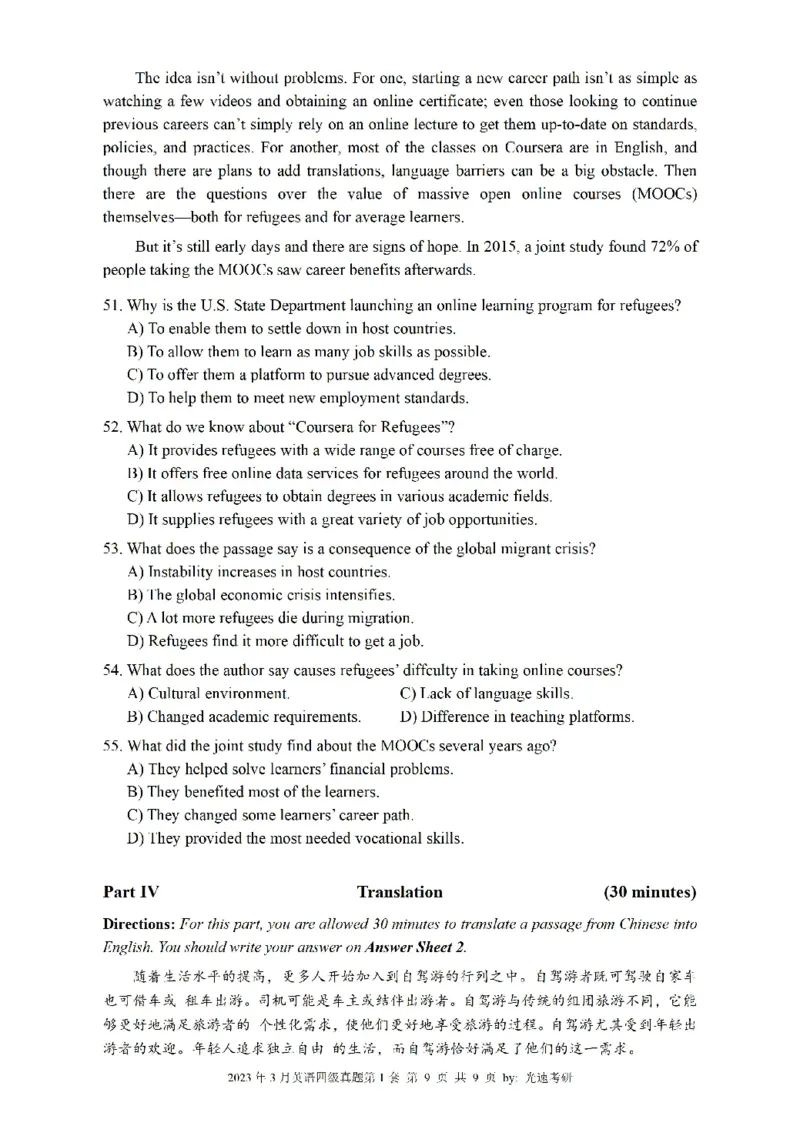
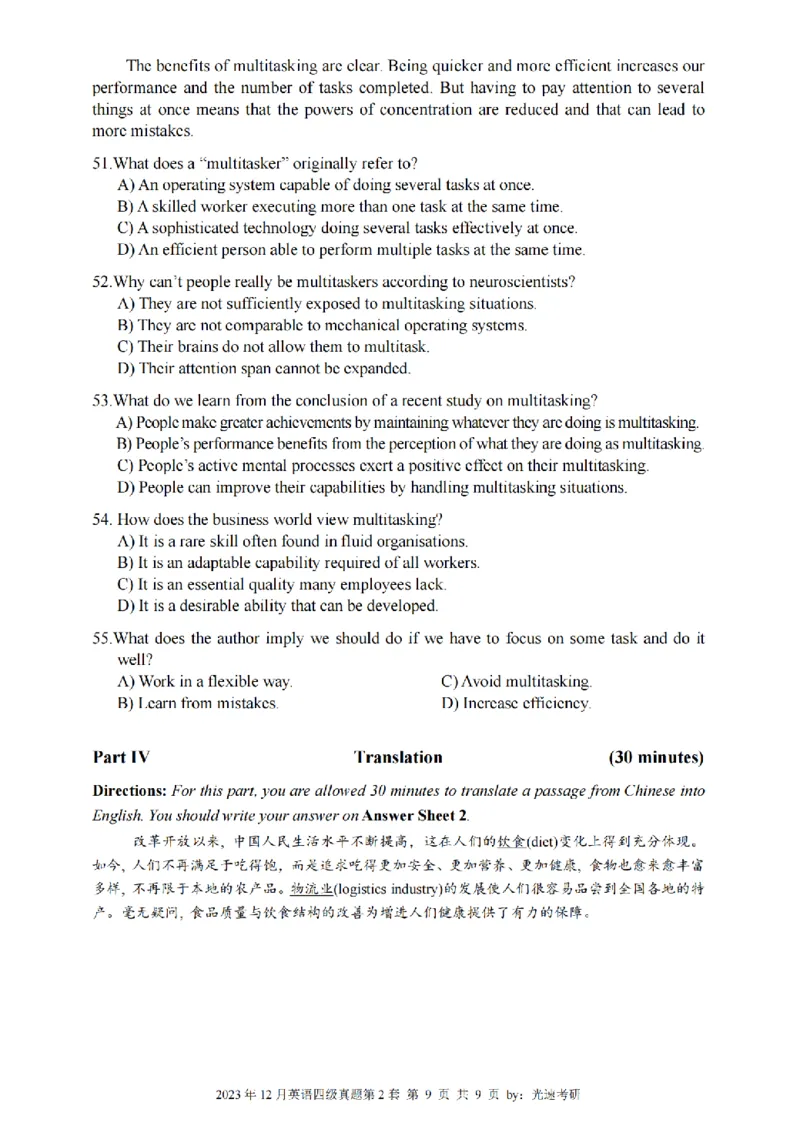
Part N Translation ( 30 minutes)
Directions: For this part, you are allowed 30 minutes to translate a passage from Chinese into English. You
should write your answer on Answer Sheet 2.
�)t.Jt-t(Tieguanyin) Jt_ 'f ml i{l,j:31x_l[f.�� z-, 1#-/L -fif&,�Jm 4c-�-!-iffl 3:f4Ji., -Jtµ4'-4c-��-!-{¥-Mi#ifli.,
��-!-�M�g±fE-�*�-tx����o *�-t-�����*�,������*������ifl
1:!o 4JoiJt-t�-JJri.:r..�J=.'t .i.-1#' ��-t f1 �;}t;i(.;fl7-f" 't � �� *'Jt-t*� ff, #ift± -t' 0 �Ji#
0 p��*- 0
-t -tk4 5t5!Jt-t � ]jJ -t-ffi � ,� M.� , 1*1tJu.a, � 51 ii ·ri :JJ
0
[g� 2021 &f 6 Jj 8II
I
Part Writing ( 30 minutes)
I!]• . ,•
�.1<.�iMpp
1:l��f§ffi""F
Directions: For this part, you are allowed 80 minutes to write an essay titled "Is technology making people
lazy?". The statement given below is for your reference. You should write at least words but no more than
180 words.
Many studies claim that computers distract people, make them lazy tmnkers and even lower their work
efficiency.
Part ]I Listening Comprehension ( 25 minutes)
Section A
Directions: In this section, you will hear three news reports. At the end of each news report, you will hear
two or three questions. Both the news report and the questions will be spoken only once. After you hear a
question, you must choose the best answer from the four choices marked A), B), C) and D). Then mark
the corresponding letter on Answer Sheet 1 with a single line through the centre.
Questions 1 and 2 are based on the news report you have just heard.
1. A) See the Pope. C) Travel to Germany.
B) Go to Newcastle. D) Tour an Italian city.
2. A) He was taken to hospital in an ambulance.
B) His car hit a sign and was badly damaged.
-8)-His-GPS-system-went out of-order;--
D) He ended up in the wrong place.
Questions 3 and 4 are based on the news report you have just heard.
3. A) Scotland will reach the national target in carbon emissions reduction ahead of schedule.
B) Glasgow City Council has made a deal with ScottishPower on carbon emissions.
C) Glasgow has pledged to take the lead in reducing carbon emissions in the UK.
D) First Minister Nicola Sturgeon urged ScottishPower to reduce carbon emissions.
4. A) Glasgow needs to invest in new technologies to reach its goal.
B) Glasgow is going to explore new sources of renewable energy.
C) Stricter regulation is needed in transforming Glasgow's economy.
D) It's necessary to create more low-emission zones as soon as possible.
Questions 5 to 7 are based on the news report you have just heard.
5. A) It donates money to overpopulated animal shelters.
B) It permits employees to bring cats into their office.
C) It gives 5,000 yen to employees who keep pet cats.
D) It allows workers to do whatever their hearts desire.
fill� 2021 &f 6 A 246. A) Keep cats off the street. C) Volunteer to help in animal shelters.
B) Rescue homeless cats. D) Contribute to a fund for cat protection.
7. A) It has contributed tremendously to the firm's fame.
B) It has helped a lot to improve animals' well-being.
C) It has led some other companies to follow suit.
D) It has resulted in damage to office equipment.
Section B
Directions: In this section, you will hear two long conversations. At the end of each conversation, you will
hear four questions. Both the conversation and the questions wili be spoken only once. After you hear a
question, you must choose the best answer from the four choices marked A), B), C) and D). Then mark
the corresponding letter on Answer Sheet 1 with a single line through the centre.
Questions 8 to 11 are based on the conversation you have just heard.
8. A) Find out where Jimmy is. C) Make friends with Jimmy.
B) Borrow money from Jimmy. D) Ask Jimmy what is to be done.
9. A) He was unsure what kind of fellow Jimmy was.
B) He was working on a study project with Jimmy.
C) He wanted to make a sincere apology to Jimmy.
D) He wanted to invite her to join in a study project.
10. A) He got a ticket for speeding. C) He was involved in a traffic accident.
B) He got his car badly damaged. D) He had an operation for his injury.
11. A) He needed to make some donation to charity.
B) He found the 60 pounds in his pocket missing.
C) He wanted to buy a gift for his mother's birthday.
D) He wanted to conceal something from his parents.
Questions 12 to 15 are based on the conversation you have just heard.
12. A) Shopping delivery. C) Where he goes shopping.
B) Shopping online. D) How often he does shopping.
13. A) Searching in the aisles. C) Driving too long a distance.
B) Dealing with the traffic. D) Getting one's car parked.
14. A) The after-sales service. C) The quality of food products.
B) The replacement policy. D) The damage to the packaging.
15. A) It saves money. C) It increases the joy of shopping.
B) It offers more choice. D) It is less time-consuming.
Section C
Directions: In this section, you will hear three passages. At the end of each passage, you will hear three or
four questions. Both the passage and the questions will be spoken only once . After you hear a question , you
must choose the best answer from the four choices marked A ) , B ) , C ) and D ) . Then mark the
corresponding letter on Answer Sheet 1 with a single line through the centre.
Questions 16 to 18 are based on the passage you have just heard.
16. A) They have little talent for learning math.
B) They need_�«!dical help f�� math anxiety. __
C) They need extra help to catch up in the math class.
D) They have strong negative emotions towards math.
fill� 2021 &p 6 JJ 2517. A) It will gradually pass away without teachers' help.
It
B) affects low performing children only.
It
C) is related to a child's low intelligence.
It
D) exists mostly among children from poor families.
18. A) Most of them have average to strong math ability.
B) Most of them get timely help from their teachers.
C) They will regain confidence with counselling.
D) They are mostly secondary school students.
Questions 19 to 21 are based on the passage you have just heard.
19. A) Social media addiction is a threat to our health.
B) Too many people are addicted to smartphones.
C) Addiction to computer games is a disease.
D) Computer games can be rather addictive.
20. A) They prioritize their favored activity over what they should do.
B) They do their favored activity whenever and wherever possible.
C) They are unaware of the damage their behavior is doing to them.
D) They are unable to get rid of their addiction without professional help.
It
21. A) may be less damaging than previously believed.
B) There will never be agreement on its harm to people.
It
C) may prove to be beneficial to developing creativity.
D) There is not enough evidence to classify it as a disease.
Questions 22 to 25 are based on the passage you have just heard.
22. A) They are relatively uniform in color and design.
B) They appear more formal than other passports.
C) They are a shade of red bordering on brown.
D) They vary in color from country to country.
23. A) They must endure wear and tear. C) They must be made from a rare material.
B) They must be of the same size. D) They must follow some common standards.
- - - -24� -A7 -'Fhey-look-more-traditional-;--- -- ----- - - - --C-) They are favored -by-airlines-; - -- - - --- - -
B) They look more official. D) They are easily identifiable.
25. A) For beauty. C) For visibility.
B) For variety. D) For security.
Part D[ Reading Comprehension ( 40 minutes)
Section A
Directions: In this section , there is a passage with ten blanks. You are required to select one word for each
blank from a list of choices given in a word bank following the passage. Read the passage through carefully
before making your choices. &eh choice in the bank is identified by a letter. Please mark the corresponding
letter for each item on Answer Sheet 2 with a single line through the centre. You may not use any of the
words in the bank more than once .
Social isolation poses more health risks than obesity or smoking 15 cigarettes a day, according to
research published by Brigham Young University. The� is that loneliness is a huge, if silent, risk
factor.
Loneliness affects physical health in two ways. First, it produces stress hormones that can lead to
many health problems. Second, people who live alone are less likely to go to the doctor _E_, to
[9� 20211¥-6 fa.I 26exercise or to eat a healthy diet.
Public health experts in many countries are � how to address widespread loneliness in our
society. Last year Britain even appointed a minister for loneliness. "Loneliness � almost every one of
us at some point," its minister for loneliness Baroness Barran said. "It can lead to very serious health
30 for individuals who become isolated and disconnected. "
Barran started a "Let's Talk Loneliness" campaign that ___l!_ difficult conversations across Britain.
He is now supporting "_;g_ benches," which are public seating areas where people are encouraged to go
and chat with one another. The minister is also _lL to stop public transportation from being cut in ways
that leave people isolated.
More than one-fifth of adults in both the United States and Britain said in a 2018 ____M_ that they
often or always feel lonely. More than half of American adults are unmarried, and researchers have found
that even among those who are married, 30% of relationships are � strained. A quarter of
Americans now live alone, and as the song says, one is the loneliest number.
A) abruptly F) friendly K) severely
B) appointments G)hindered L) sparked
C) consequences H)idiom M) splitting
D) debating I) implication N) survey
E) dimensions J) pushing 0) touches
Section B
Directions: In this section, you are going to read a passage with ten statements attached to it. Each
statement contains information given in one of the paragraphs. Identify the paragraph from which the
information is derived. You may choose a paragraph more than once. &eh paragraph is marked with a
letter. Answer the questions by marking the corresponding letter on Answer Sheet 2.
What happens when a language bas no words for numbers?
A) Numbers do not exist in all cultures. There are numberless hunter-gatherers in Amazonia, living along
branches of the world's largest river tree. Instead of using words for precise quantities, these people
rely exclusively on terms similar to "a few" or "some. " In contrast, our own lives are governed by
numbers. As you read this, you are likely aware of what time it is, how old you are, your checking
account balance, your weight and so on. The exact numbers we think with impact everything in our
lives.
B) But, in a historical sense, number-conscious people like us are the unusual ones. For the bulk of our
species' approximately 200, OOO-year lifespan, we had no means of precisely representing quantities.
What's more, the 7 ,OOO or so languages that exist today vary dramatically in how they utilize numbers.
C) Speakers of anumeric, or numberless, languages offer a window into how the invention of numbers
reshaped the human experience. Otltures without nwnbers, or with only one or two precise numbers, include
the Munduruku and Piraha in Amazonia. Researchers have also studied some adults in Nicaragua who were
never taught number words. Without numbers, healthy human adults struggle to precisely distinguish and
recall quantities as low as four. In an experiment, a researcher will place nuts into a can one at a time
and then remove them one by one. The person watching is asked to signal when all the nuts have been
removed. Responses suggest that anumeric people have some trouble keeping track of how many nuts
remain in the can, even if there are only four or five in total.
D) This and many otherexiteriments hav-e led to�a simple�conclusion�J\lhe�peopl�dQD.QtJ1av-e�umber
words, they struggle to make quantitative distinctions that probably seem natural to someone like you
or me. While only a small portion of the world's languages are anumeric or nearly anumeric, they
Im� 2021 � 6 JI 27demonstrate that number words are not a human universal.
E) It is worth stressing that these anumeric people are cognitively (,1£ R� -jj" i:1) normal, well-adapted to
the surroundings they have dominated for centuries. As a child, I spent some time living with anumeric
people, the Piraha who live along the banks of the black Maici River. Like other outsiders, I was
continually impressed by their superior understanding of the ecology we shared. Yet numberless people
struggle with tasks that require precise discrimination between quantities. Perhaps this should be
unsurprising. After all, without counting, how can someone tell whether there are, say, seven or eight
coconuts ( � -1-) in a tree? Such seemingly straightforward distinctions become blurry through numberless
eyes.
F) This conclusion is echoed by work with anumeric children in industrialized societies. Prior to being
spoon-fed number words, children can only approximately discriminate quantities beyond three. We
must be handed the cognitive tools of numbers before we can consistently and easily recognize higher
quantities. In fact, acquiring the exact meaning of number words is a painstaking process that takes
children years. Initially, kids learn numbers much like they learn letters. They recognize that numbers
are organized sequentially, but have little awareness of what each individual number means. With
time, they start to understand that a given number represents a quantity greater by one than the
number coming before it. This "successor principle" is part of the foundation of our numerical (��
e{j) cognition, but requires extensive practice to understand.
G) None of us, then, is really a "numbers person." We are not born to handle quantitative distinctions
skillfully. In the absence of the cultural traditions that fill our lives with numbers from infancy, we
would all struggle with even basic quantitative distinctions. Number words and their written forms
transform our quantitative reasoning as they are introduced into our cognitive experience by our
parents, peers and school teachers. The process seems so normal that we sometimes think of it as a
natural part of growing up, but it is· not. Human brains come equipped with certain quantitative
instincts that are refined with age, but these instincts are very limited.
H)Compared with other mammals, our numerical instincts are not as remarkable as many assume. We
even share some basic instinctual quantitative reasoning with distant non-mammalian relatives like
birds. Indeed, work with some other species suggests they too can refine their quantitative thought if
they are introduced to the cognitive power tools we call -n-u-m--b-er-s-.
I) So, how did we ever invent "unnatural" numbers in the first place? The answer is, literally, at your
fingertips. The bulk of the world's languages use base-10, base-20 or base-5 number systems. That is,
these smaller numbers are the basis of larger numbers. English is a base-10 or decimal ( -r :ttr. -$1] e{j )
language, as evidenced by words like 14 ("four"+" 10") and 31 ("three" X "10"+ "one"). We speak a
decimal language because an ancestral tongue, proto-Indo-European, was decimally based. Proto-Indo
European was decimally oriented because, as in so many cultures, our ancestors' hands served as the
gateway to the realization that" five fingers on one hand is the same as five fingers on the other. " Such
momentary thoughts were represented in words and passed down across generations. This is why the
word"five" in many languages is derived from the word for" hand." Most number systems, then, are
the by-product of two key factors: the human capacity for language and our inclination for focusing on
our hands and fingers. This manual fixation-an indirect by-product of walking upright on two legs
has helped yield numbers in most cultures, but not all.
J) Cultures without numbers also off er insight into the cognitive influence of particular numeric
traditions. Consider what time it is. Your day is ruled by minutes and seconds, but these concepts are
not real in any physical sense and are nonexistent to numberless people. Minutes and seconds are the
verbal and written representations of an uncommon base-60 number system used in ancient
ll!I� 2021 &f 6 Jj 28Mesopotamia. They reside in our minds, numerical artifacts (A..I.!� �) that not all humans inherit
conceptually.
K) Research on the language of numbers shows, more and more, that one of our species' key
characteristics is tremendous linguistic ( ii i. €r?) and cognitive diversity. If we are to truly understand
how much our cognitive lives differ cross-culturally, we must continually explore the depths of our
species' linguistic diversity.
36. It is difficult for anumeric people to keep track of the change in numbers even when the total is very small.
37. Human numerical instincts are not so superior to those of other mammals as is generally believed.
38. The author emphasizes being anumeric does not affect one's cognitive ability.
39. In the long history of mankind, humans who use numbers are a very small minority.
40. An in-depth study of differences between human languages contributes to a true understanding of
cognitive differences between cultures.
41. A conclusion has been drawn from many experiments that anumeric people have a hard time
distinguishing quantities.
42. Making quantitative distinctions is not an inborn skill.
43. Every aspect of our lives is affected by numbers.
44. Larger numbers are said to be built upon smaller numbers.
45. It takes great efforts for children to grasp the concept of number words.
Section C
Directions: There are 2 passages in this section. Each passage is fallowed by some questions or unfinished
statements. For each of them there are four choices marked A), B), C) and D). You should decide on the
best choice and mark the corresponding letter on Answer Sheet 2 with a single line through the centre.
Passage One
Questions 46 to 50 are based on the following passage.
Sugar shocked. That describes the reaction of many Americans this week following revelations that,
50 years ago, the sugar industry paid Harvard scientists for research that shifted the focus away from
sugar's role in heart disease-and put the spotlight 0.i 1;€r? 4' 1\>') squarely on dietary fat.
What might surprise consumers is just how many present-day nutrition studies are still funded by the
food industry. Nutrition scholar Marion Nestle of New York University spent a year informally tracking
industry-funded studies on food. "Roughly 90% of nearly 170 studies favored the sponsor's interest,"
Nestle tells us. Other systematic reviews support her conclusions.
For instance, studies funded by Welch Foods-the brand behind Welch's 100% Grape Juice-found
that drinking Concord grape juice daily may boost brain function. Another, funded by Quaker Oats,
concluded, as a Daily Mail story put it, that "hot oatmeal ( � !: �) breakfast keeps you full for longer."
Last year, The New York Times revealed how Coca-Cola was funding well-known scientists and
organizations promoting a message that, in the battle against weight gain, people should pay more
attention to exercise and less to what they eat and drink. Coca-Cola also released data detailing its funding
of several medical institutions and associations between 2010 and 2015.
"It's certainly a problem that so much research in nutrition and health is funded by industry," says
Bonnie Liebman, director of nutrition at the Center for Science in the Public Interest. "When the food
industry pays for research, it often gets what it pays for." And what it pays for is often a pro-industry
finding.
_Giveathi�envs ironment,_consumeruhould-beskepticaL(�/$-�AfJ-}-whenr-eading-the-latest-findingin
nutrition science and ignore the latest study that pops up on your news feed. "Rely on health experts
who've reviewed all the evidence," Liebman says, pointing to the official government Dietary Guidelines,
fill� 2021 6 Jj 29which are based on reviews of hundreds of studies.
"And that expert advice remains pretty simple," says Nestle. "We know what healthy diets are--lots
of vegetables, not too much junk food, balanced calories. Everything else is really difficult to do
experimentally. "
46. What did Harvard scientists do 50 years ago?
A) They raised public awareness of the possible causes of heart disease.
B) They turned public attention away from the health risks of sugar to fat.
C) They placed the sugar industry in the spotlight with their new findings.
D) They conducted large-scale research on the role of sugar in people's health.
47. What does Marion Nestle say about present-day nutrition studies?
A) They took her a full year to track and analyze.
B) Most of them are based on systematic reviews.
C) They depend on funding from the food industries.
D) Nearly all of them serve the purpose of the funders.
48. What did Coca-Cola-funded studies claim?
A) Exercise is more important to good health than diet.
B) Choosing what to eat and drink is key to weight control.
C) Drinking Coca-Cola does not contribute to weight gain.
D) The food industry plays a major role in fighting obesity.
49. What does Liebman say about industry-funded research?
It
A) simply focuses on nutrition and health.
It
B) causes confusion among consumers.
It
C) rarely results in objective findings.
It
D) runs counter to the public interest.
50. What is the author's advice to consumers?
A) Follow their intuition in deciding what to eat.
B) Be doubtful of diet experts' recommendations.
C) Ignore irrelevant information on their news feed.
- ------
D) Think twice about new nutrition research findings.
Passage Two
Questions 51 to SS are based on the following passage.
Success was once defined as being able to stay at a company for a long time and move up the corporate
ladder. The goal was to reach the top, accumulate wealth and retire to a life of ease. My father is a
successful senior executive. In 35 years, he worked for only three companies.
When I started my career, things were already different. If you weren't changing companies every
three or four years, you simply weren't getting ahead in your career. But back then, if you were a
consultant or freelancer ( ro lb JfR 3k *) , people would wonder what was wrong with you. They would
assume you had problems getting a job.
It
Today, consulting or freelancing for five businesses at the same time is a badge of honor. ·shows
how valuable an individual is. Many companies now look to these "ultimate professionals" to solve
problems their full-time teams can't. Or they save money by hiring "top-tier c-m � �) experts" only for
particular projects.
Working at home or in cafes, starting businesses of their own, and even launching business ventures
that eventually may fail, all indicate "initiative," "creativity," and "adaptability," which are desirable
qualities in today's workplace. Most important, there is a growing recognition that people who balance
lm#i 2021 !if:: 6 A 30work and play, and who work at what they are passionate about, are more focused and productive,
delivering greater value to their clients.
Who are these people? They are artists, writers, programmers, providers of office services and
career advice. What's needed now is a marketplace platform specifically designed to bring freelancers and
clients together. Such platforms then become a place to feature the most experienced, professional, and
creative talent. This is where they conduct business, where a sense of community reinforces the culture
and values of the gig economy (-* .:c. � *"), and where success is rewarded with good reviews that
encourage more business.
Slowly but surely, these platforms create a bridge between traditional enterprises and this emerging
economy. Perhaps more important, as the global economy continues to be disrupted by technology and
other massive change, the gig economy will itself become an engine of economic and social
transformation.
51. What does the author use the example of his father· to illustrate?
A) How long people took to reach the top of their career.
B) How people accumulated wealth in his father's time.
C) How people viewed success in his father's time.
D) How long people usually stayed in a company.
52. Why did people often change jobs when the author started his career?
A) It was considered a fashion at that time.
B) It was a way to advance in their career.
C) It was a response to the changing job market.
D) It was difficult to keep a job for long.
53. What does the author say about people now working for several businesses at the same time?
A) They are often regarded as most treasured talents.
B) They are able to bring their potential into fuller play.
C) They have control over their life and work schedules.
D) They feel proud of being outstanding problem solver.
54. What have businesses come to recognize now?
A) Who is capable of solving problems with ease.
B) How people can be more focused and productive.
C)What kind of people can contribute more to them.
D) Why some people are more passionate about work.
55. What does the author say about the gig economy?
A) It may force companies to reform their business practice.
B) It may soon replace the traditional economic model.
C) It will drive technological progress on a global scale.
D) It will bring about radical economic and social changes.
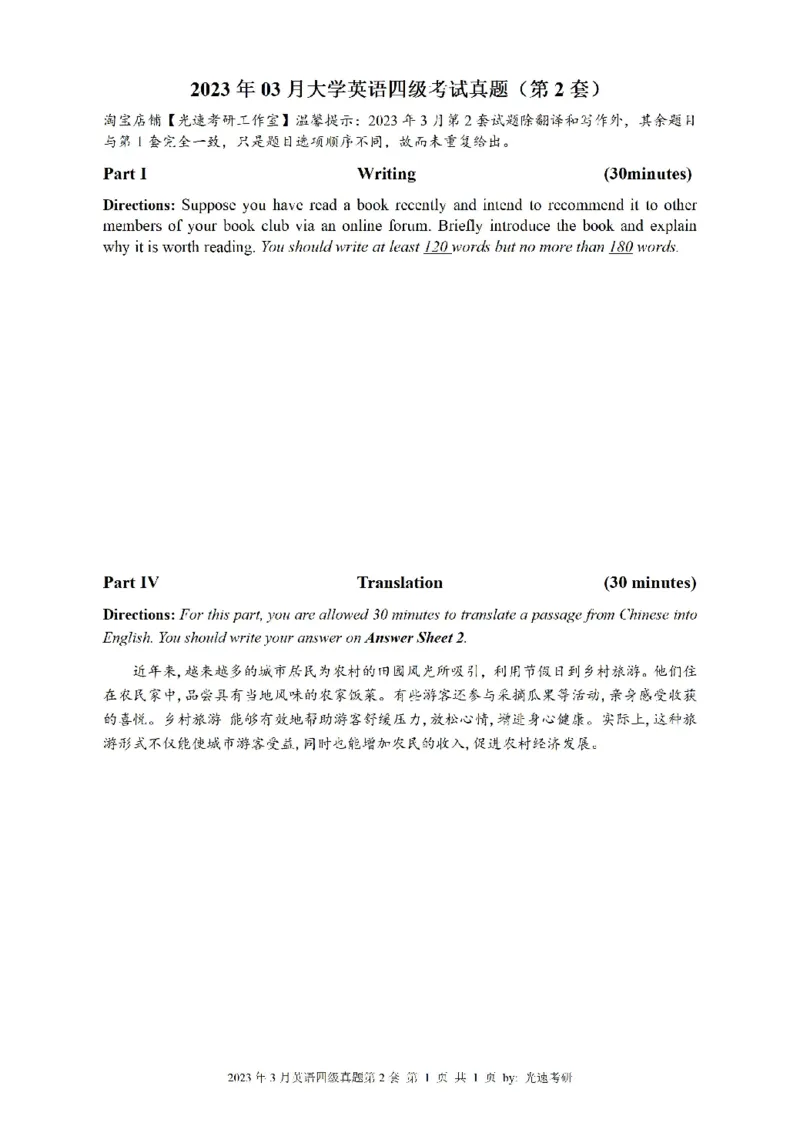
Part N Translation ( 30 minutes)
Directions: For this part , you are allowed 30 minutes to translate a passage from Chinese into English. You
should write your answer on Answer Sheet 2.
{tµf-(Pu'er)-l=-�*1= 1f@lA...g-�o il-M-�{t �lf--l=-;,: m � 1*J � � 5<5t..Jf.i..#J (Xishuangbanna), �.:f.� q_. {il
����{t�-l=-��±*��Jil*�*o f"�-l=-����'�il���*Jl=-- ����o �µj"
� l=-- � ,ffi t - (b � re w)� at Ii]� *��11�il
O
it$ �11�-l=-�A..JG�$>tk.��Mt��11�� o � o {t�lf--l=--*� j :#�
JC$, 't1kf-�l=-- � Jl.h-f"1�;fr '� JJLi:fP k;f, :i£��Jle. .. m F.t.:lll���i!.m 1-t� -!IJ
�o
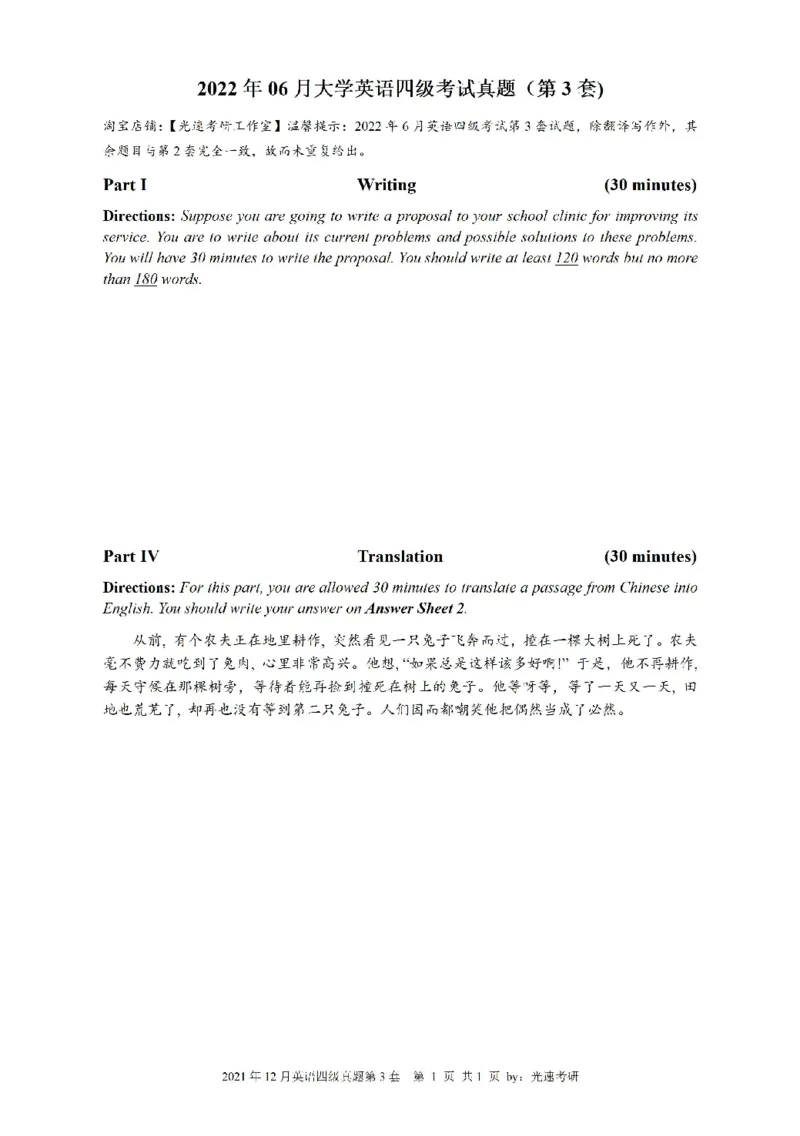
12!1� 2021 &:p 6 Jj 31Part I Writing ( 30 minutes)
Directions: For this part, you are allowed 30 minutes to write an essay titled "Do violent video games lead to
violence ? ". The statement given below is for your refe rene e . You should write at least 120 words but no more
than 180 words.
A growing body of research finds that violent video games can make kids act aggressively in their real world
relationships, causing an increase in violence.
Part :U: Listening Comprehension (25 minutes)
&�: Eil=f 2021 � 6 � IZQ���OO��TWI�l!Jrfl •*�;l'.lml!Jrfl!§fi!WI���fflfRJ,J=U!JZtl3i!flll¥�1EJ, 1!1
JtttE*�·-r:p�ff :m:�tll :$
Part I Reading Comprehension ( 40 minutes)
Section A
Directions: In this section , there is a passage with ten blanks. You are required to select one. word for each
blank from a list of choices given in a word bank following the passage. Read the passage through carefully
before making your choices. &eh choice in the bank is identified by a letter. Please mark the correspondirtg
letter for each item on Answer Sheet 2 with a single line through the centre. You may not use any of the
words in the bank more than once .
Nowadays you can't buy anything without then being asked to provide a rating of a company's
performance on a five-star scale.
I've been asked to rate my "store�" on the EFTPOS terminal before I can pay. Even the most
_J'J__ activities, such as calling Telstra or picking up a parcel from Australia Post, are followed by texts
or emails with surveys asking, "How did we do?"
Online purchases are � followed up by a customer satisfaction survey. Companies are so �
for a hit of stars that if you delete the survey the company sends you another one.
We're _lQ_ to rate our apps when we've barely had a chance to use them. One online course
provider I use asks you what you think of the course after you've only completed � 2 per cent of it.
Economist Jason Murphy says that companies use customer satisfaction ratings· because a �
display of star feedback has become the nuclear power sources of the modem economy.
However, you can't help but� if these companies are basing their business on fabrications (�:it
it? 1t-�). I� that with online surveys 1 just click the� that's closest to my mouse cursor (it#)
to get the damn thing off my screen. Often the star rating I give has far more to do with the kind of day
I'm having than the purchase 1 just made.
A)announce F) fascinated K) shining
B)commonplace G) option L)showering
C)confess H)prompted M)variety
-----maesperate l)roughly -----N) voyage_ __
E)experience J) routinely 0) wonder
(JTJ�2021�6� 47Section B
Directions: In this section, you are going to read a passage with ten statements attached to it. &eh
statement contains information given in one of the paragraphs. Identify the paragraph from which the
information is derived. You may choose a paragraph more than once. &eh paragraph is marked with a
letter. Answer the questions by marking the corresponding letter on Answer Sheet 2.
Science of setbacks: How failure can improve career prospects
A) How do early career setbacks affect our long-term success? Failures can help us learn and overcome our
fears. But disasters can still wound us. They can screw us up and set us back. Wouldn't it be nice if
there was genuine, scientifically documented truth to the expression "what doesn't kill you makes you
stronger"?
B) One way social scientists have probed the effects of career setbacks is to look at scientists of very
similar qualifications. These scientists, for reasons that are mostly arbitrary, either just missed getting
a research grant or just barely made it. In social sciences, this is known as examining "near misses" and
"narrow wins" in areas where merit is subjective. That allows researchers to measure only the effects
of being chosen or not. Studies in this area have found conflicting results. In the competitive game of
biomedical science, research has been done on scientists who narrowly lost or won grant money. It
suggests that narrow winners become even bigger winners down the line. In other words, the rich get
richer.
C) A 2018 study published in the Proceedings of the National Academy of Sciences, for example, followed
researchers in the Netherlands. Researchers concluded that those who just barely qualified for a grant
were able to get twice as much money within the next eight years as those who just missed out. And the
narrow winners were 50 percent more likely to be given a professorship.
D) Others in the US have found similar effects with National Institutes of Health early-career fellowships
launching narrow winners far ahead of close losers. The phenomenon is often referred to as the
Matthew effect� fosp1red6- y ilie Bible's-wisdom diaf fo-those who have, more will be- given: There's-a -
good explanation for the phenomenon in the book The Formula: The Universal Laws of Success by
Albert Laszlo Barabasi. According to Barabasi, it's easier and less risky for those in positions of power
to choose to hand awards and funding to those who've already been so recognized.
E) This is bad news for the losers. Small early career setbacks seem to have a disproportionate effect
down the line. What didn't kill them made them weaker. But other studies using the same technique
have shown there's sometimes no penalty to a near miss. Students who just miss getting into top high
schools or universities do just as well later in life as those who just manage to get accepted. In this case,
what didn't kill them simply didn't matter. So is there any evidence that setbacks might actually
improve our career prospects? There is now.
F) In a study published in Nature Communications, Northwestern University sociologist Dashun Wang
tracked more than 1 , 100 scientists who were on the border between getting a grant and missing out
between 1990 and 2005. He followed various measures of performance over the next decade. These
included how many papers they authored and how influential those papers were, as measured by the
number of subsequent citations. As expected, there was a much higher rate of attrition (�g!) among
Im� 2021 &'f 6 }3 48scientists who didn't get grants. But among those who stayed on, the close losers performed even better
than the narrow winners. To make sure this wasn't by chance, Wang conducted additional tests using
different performance measures. He examined how many times people were first authors on influential
studies, and the like.
G) One straightforward reason close losers might outperform narrow winners is that the two groups have
comparable ability. In Wang's study, he selected the most determined, passionate scientists from the
culled
loser group and (J1J �) what he deemed the weakest members of the winner group. Yet the
persevering losers still came out on top. He thinks that being a close loser might give people a
psychological boost, or the proverbial kick in the pants.
H) Utrecht University sociologist Arnout van de Rijt was the lead author on the 2018 paper showing the
rich get richer. He said the new finding is apparently reasonable and worth some attention. His own
work showed that although the narrow winners did get much more money in the near future, the actual
performance of the close losers was just as good.
I) He said the people who should be paying regard to the Wang paper are the funding agents who
distribute government grant money. After all, by continuing to pile riches on the narrow winners, the
taxpayers are not getting the maximum bang for their buck if the close losers are performing just as
well or even better. There's a huge amount of time and effort that goes into the process of selecting
who gets grants, he said, and the latest research shows that the scientific establishment is not very
good at distributing money. "Maybe we should spend less money trying to figure out who is better than
who," he said, suggesting that some more equal dividing up of money might be more productive and
more efficient. Van de Rijt said he's not convinced that losing out gives people a psychological boost;
It may yet be a selection effect. Even though Wang tried to account for this by culling the weakest
winners, it's impossible to know which of the winners would have quit had they found themselves on
the losing side.
J) For his part, Wang said that in his own experience, losing did light a motivating fire. He recalled a
recent paper he submitted to a journal, which accepted it only to request extensive editing, and then
reversed course and rejected it. He submitted the unedited version to a more respected journal and got
accepted.
K) In sports and many areas of life, we think of failures as evidence of something we could have done
better. We regard these disappointments as a fate we could have avoided with more careful
preparation, different training, a better strategy, or more focus. And there it makes sense that
failures show us the road to success. These papers deal with a kind of failure people have little control
over-rejection. Others determine who wins and who loses. But at the very least, the research is
starting to show that early setbacks don't have to be fatal. They might even make us better at our jobs'.
Getting paid like a winner, though? That's a different matter.
36. Being a close loser could greatly motivate one to persevere in their research.
37. Grant awarders tend to favor researchers alretJ.dy reco�ized i:11 their re�pective fif?Jd_s. ___
38. Suffering early setbacks might help people improve their job performance.
39. Research by social scientists on the effects of career setbacks has produced contradictory findings.
fill€fl! 2021 6 J3 4940. It is not to the best interest of taxpayers to keep giving money to narrow winners.
41. Scientists who persisted in research without receiving a grant made greater achievements than those
who got one with luck, as suggested in one study.
42. A research paper rejected by one journal may get accepted by another.
43. According to one recent study, narrow winners of research grants had better chances to be promoted
to professors.
44. One researcher suggests it might be more fruitful to distribute grants on a relatively equal basis.
45. Minor setbacks in their early career may have a strong negative effect on the career of close losers.
Section C
Directions: There are 2 passa,ges in this section . F.ach passage is followed by some questions or unfinished
statements. For each of them there are four choices marked A), B), C) and D). You should decide on the
best choice and mark the corresponding letter on Answer Sheet 2 with a single line through the centre.
Passage One
Questions 46 to 50 are based on the following passage.
Boredom has become trendy. Studies point to how boredom is good for creativity and innovation, as
well as mental health. It is found that people are more creative following the completion of a tedious task.
When people are bored, they have an increase in "associative thought"-the process of making new
connections between ideas, which is linked to innovative thinking. These studies are impressive, but in
reality, the benefits of boredom may be related to having time to clear your mind, be quiet, or daydream.
In our stimulation-rich world, it seems unrealistic that boredom could occur at all. Yet, there are
valid reasons boredom may feel so painful. As it turns out, boredom might signal the fact that you have a
need that isn't being met.
Our always-on world of social media may result in more connections, but they are superficial and can
��t in �h� _\\"_ay_ _�f buildin� a real se�� !'!_ b_elonging. Feeling bored may signal the desire for a greater sense
_
of community and the feeling that you fit in with others around you. So take the step of joining an
organization to build face-to-face relationships. You'll find depth that you won't get from your screen no
matter how many likes you get on your post.
Similar to the need for belonging, bored people often report that they feel a limited sense of
meaning. It's a fundamental human need to have a larger purpose and to feel like we're part of something
bigger than ourselves. When people are bored, they're more likely to feel less meaning in their lives. If
you want to reduce boredom and increase your sense of meaning, seek work where you can make a unique
contribution, or find a cause you can support with your time and talent.
If your definition of boredom is being quiet, mindful, and reflective, keep it up. But if you're
struggling with real boredom and the emptiness it provokes, consider whether you might seek new
connections and more significant challenges. These are the things that will genuinely relieve boredom and
make you more effective in the process.
46. What have studies found about boredom?
A) It facilitates innovative thinking.
B) It is a result of doing boring tasks.
fill� 2021 � 6 Ji 50C) It helps people connect with others.
D) It does harm to one's mental health.
47. What does the author say boredom might indicate?
A) A need to be left alone.
B) A desire to be fulfilled.
C) A conflict to be resolved.
D) A feeling to be validated.
48. What do we learn about social media from the passage?
A) It may be an obstacle to expanding one's connections.
B) It may get in the way of enhancing one's social status.
C) It may prevent people from developing a genuine sense of community.
D) It may make people feel that they ought to fit in with the outside world.
49. What does the author suggest people do to get rid of boredom?
A) Count the likes they get on their posts.
B) Reflect on how they relate to others.
C) Engage in real-life interactions.
D) Participate in online discussions.
50. What should people do to enhance their sense of meaning?
A) Try to do something original.
B) Confront significant challenges.
C) Define boredom in their unique way.
D) Devote themselves to a worthy cause.
Passage Two
Questions 51 to 55 are based on the following passage.
Can you remember what you ate yesterday? If asked, most people will be able to give a vague
description of their main meals: breakfast, lunch, dinner. But can you be sure you've noted every snack
bar in your car, or every handful of nuts at your desk? Most people will have a feeling that they've missed
something out.
We originally had this suspicion back in 2016, puzzled by the fact that national statistics showed
calorie consumption falling dramatically over past decades. We found reliable evidence that people were
drastically under-reporting what they ate.
Now the Office for National Statistics has confirmed that we are consuming 50% more calories than
our national statistics claim.
Why is this happening? We can point to at least three potential causes. One is the rise in obesity levels
itself. Under-reporting rates are much higher for obese people, because they simply consume more food,
and thus have more to remember.
Another cause is that the proportion of people who are trying to lose weight has been increasing over
time. People who want to lose weight are more likely to under-report their eating-regardless of whether
they are overweight or not. This may be driven partly by self-deception or "wishful thinking''.
The final potential cause is an increase in snacking and eating out over recent decades-both in terms
of how often they happen and how much they contribute to our overall energy intake. Again, there is
ll!I� 2021 6 JI 51evidence that food conswned out of the home is one of the most poorly recorded categories in surveys.
So, what's the message conveyed? For statistics, we should invest in more accurate measurement
options. For policy, we need to focus on options that make it easy for people to eat fewer calories. If
people do not know how much they are eating, it can be really hard for them to stick to a diet. Also, we
should be looking for new ways to ensure what people eat wouldn't have much impact on their waistlines.
If this works, it won't matter if they can't remember what they ate yesterday.
51. What did the author suspect back in 2016?
A) Calorie conswnption had fallen drastically over the decades.
B) Most people surveyed were reluctant to reveal what they ate.
C) The national statistics did not reflect the actual calorie conswnption.
D) Most people did not include snacks when reporting their calorie intake.
52. What has the Office for National Statistics verified?
A) People's calorie intake was far from accurately reported.
B) The missing out of main meals leads to the habit of snacking.
C) The nation's obesity level has much to do with calorie intake.
D) Calorie conswnption is linked to the amount of snacks one eats.
53. What do we learn about obese people from the passage?
A) They usually keep their eating habits a secret.
B) They overlook the potential causes of obesity.
C) They cannot help eating more than they should.
D) They have difficulty recalling what they have eaten.
54. What often goes unnoticed in surveys on food conswnption?
A) The growing trend of eating out.
B) The potential causes of snacking.
C) People's home energy consumption.
�- D)_People's chan�g diet ove!Jh�-��rs. ________
55. What does the author suggest policymakers do about obesity?
A) Remind people to cut down on snacking.
B) Make sure people eat non-fattening food.
C) Ensure people don't miss their main meals.
D) See that people don't stick to the same diet.
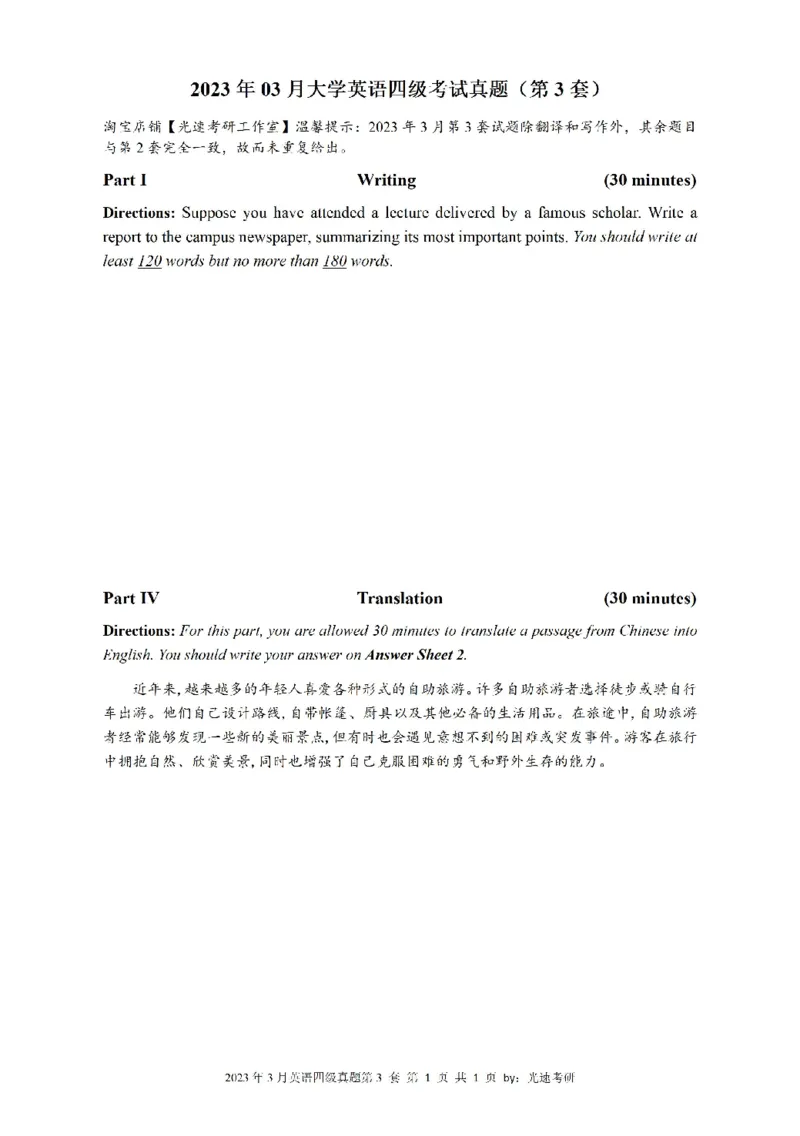
Part N Translation ( 30 minutes)
Directions: For this part , you are allowed 30 minutes to translate a passage from Chinese into English . You
should write your answer on Answer Sheet 2.
}kAt-CLongjing)Jl-#!t�,.i..�? tJ 1f � ij;��ifu:€r9*0:� )£-Jl=-��i#€r9�F-*-� t:1 �?b-:it-&Ai r
O
�*�*--it
"1f � %,�"€r9:#� ,,f}:.1f � a9 >t.bfe.,,fJ;.ifg:5'r,ikJlJ a9 A..:if?..:M!*-:M! j 1£-J!=-�:ii 1*'"+ .:r.tJ 1t' -:it--Yt�
O �*
*-� ..
"iifi�ifll-:it-�-t ,� "iifi�tt.$.t1t.j: ,i!.�*:-f"�€r9 !l ;ft�atfaJ �1M1t.:r. to 1£-J!=-�1; �tft!l-!- C
�j#����a9�-!°o �1*'"�1£-Jl=-��M-f"���� .. ����o
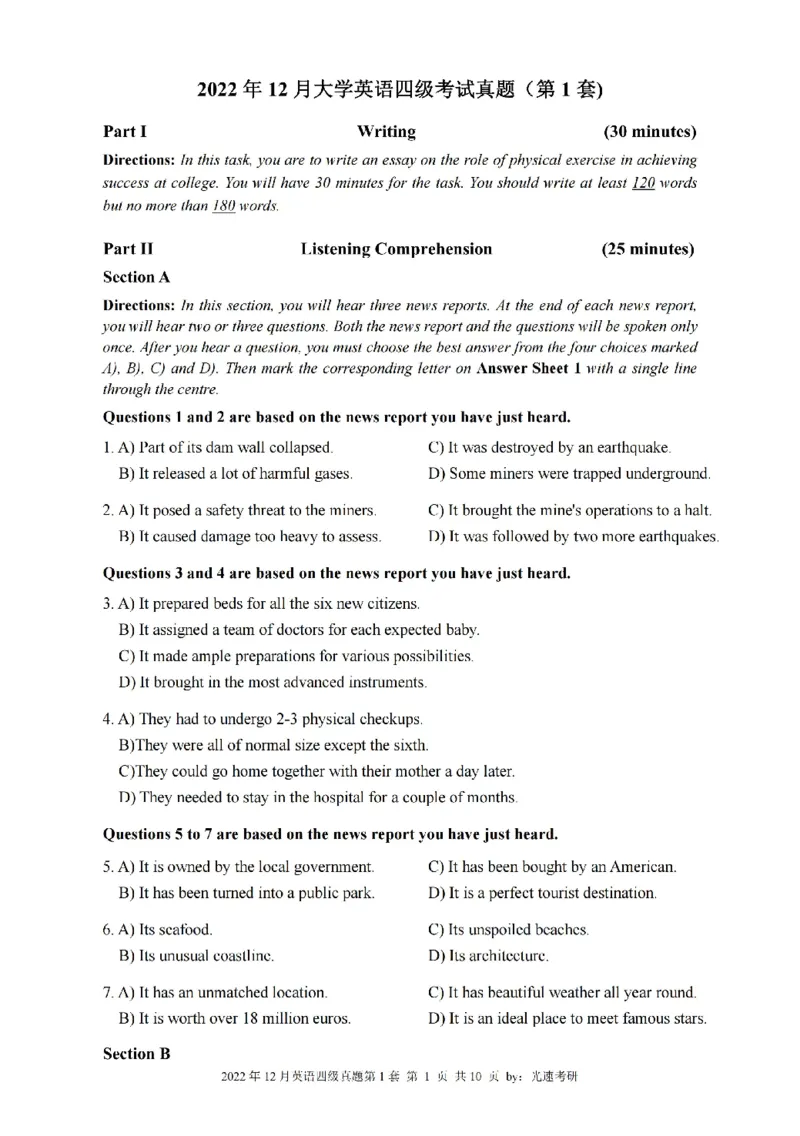
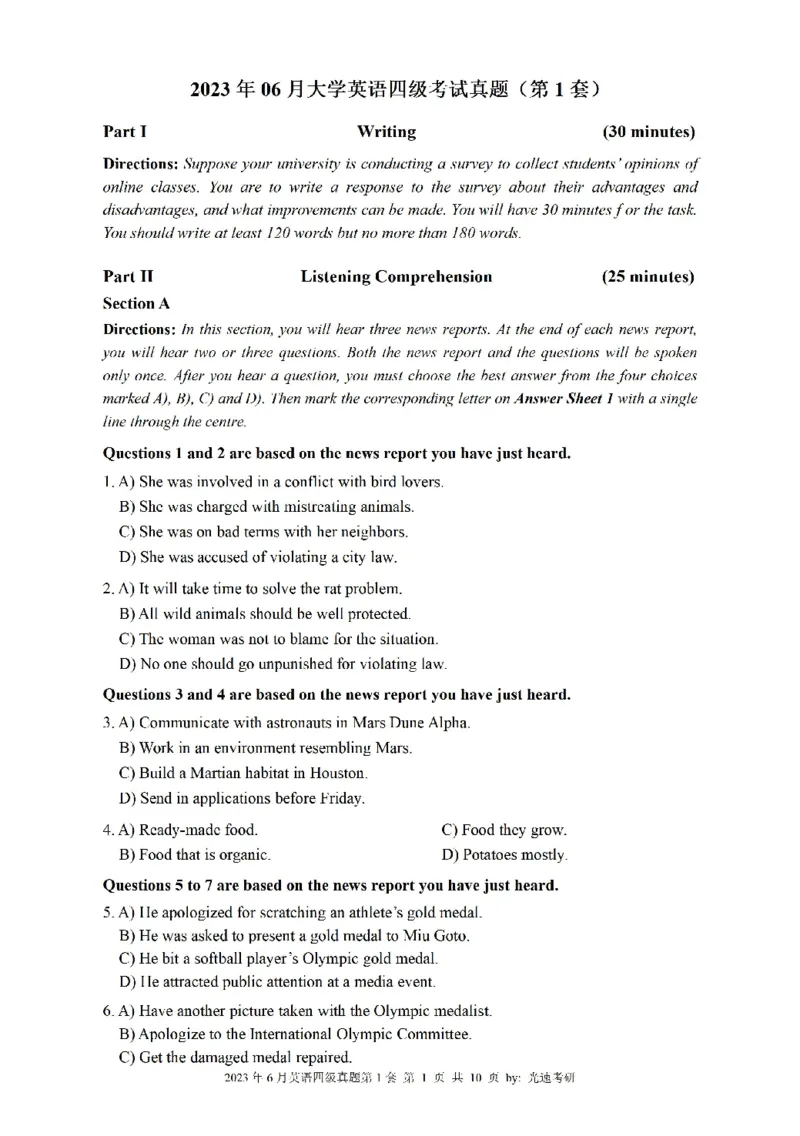
fil1�2021 6 A 522021年 12月大学英语四级考试真题(第 1套)
Part I Writing (30minutes)
Directions: Suppose your school is organizing an orientation program to help the freshmen
adapt to the new environment and academic studies. You are now to write a proposal, which
may include its aim, duration, participants and activities. You will have 30 minutes to write the
proposal. You should write at least 120 words but no more than 180 words.
Part II Listening Comprehension (25 minutes)
Section A
Directions: In this section, you will hear three news reports. At the end of each news report,
you will hear two or three questions. Both the news report and the questions will be spoken only
once. After you hear a question, you must choose the best answer from the four choices marked
A), B), C) and D). Then mark the corresponding letter on Answer Sheet 1 with a single line
through the centre.
Questions 1 and 2 are based on the news report you have just heard.
1. A) It found a pet dog on board a plane to a city in Texas.
B) It had one of its cargo planes land at a wrong airport.
C) It sent two dogs to the wrong destinations.
D) It had two of its domestic flights mixed up.
2. A) Correct their mistake as soon as possible.
B) Give the two pets a physical checkup.
C) Hire a charter jet to bring the pets back.
D) Send another plane to continue the flight.
Questions 3 and 4 are based on the news report you have just heard.
3. A) She weighs 130 kilograms. C) She was brought from Africa.
B) She has had babies before. D) She has a big family of six.
4. A) It took 22 hours. C) It was smooth.
B) It had some complications. D) It was monitored by Dr.Sue Tygielski.
Questions 5 to 7 are based on the news report you have just heard.
5. A) It enjoyed great popularity. C) It was frequented by newly-weds.
B) It started business three years ago. D) It was built above the sea-water.
6. A) Expand his business on the beach.
B) Replace the restaurant's wooden deck.
C) Post a picture of his restaurant online.
D) Celebrate his silver wedding anniversary.
2021年 12月英语四级真题第1套 第 1 页 共 10页7. A) She sold it for two thousand dollars. C) She posted its picture on Facebook.
B) She took it to the restaurant manager. D) She returned it to its owner right away.
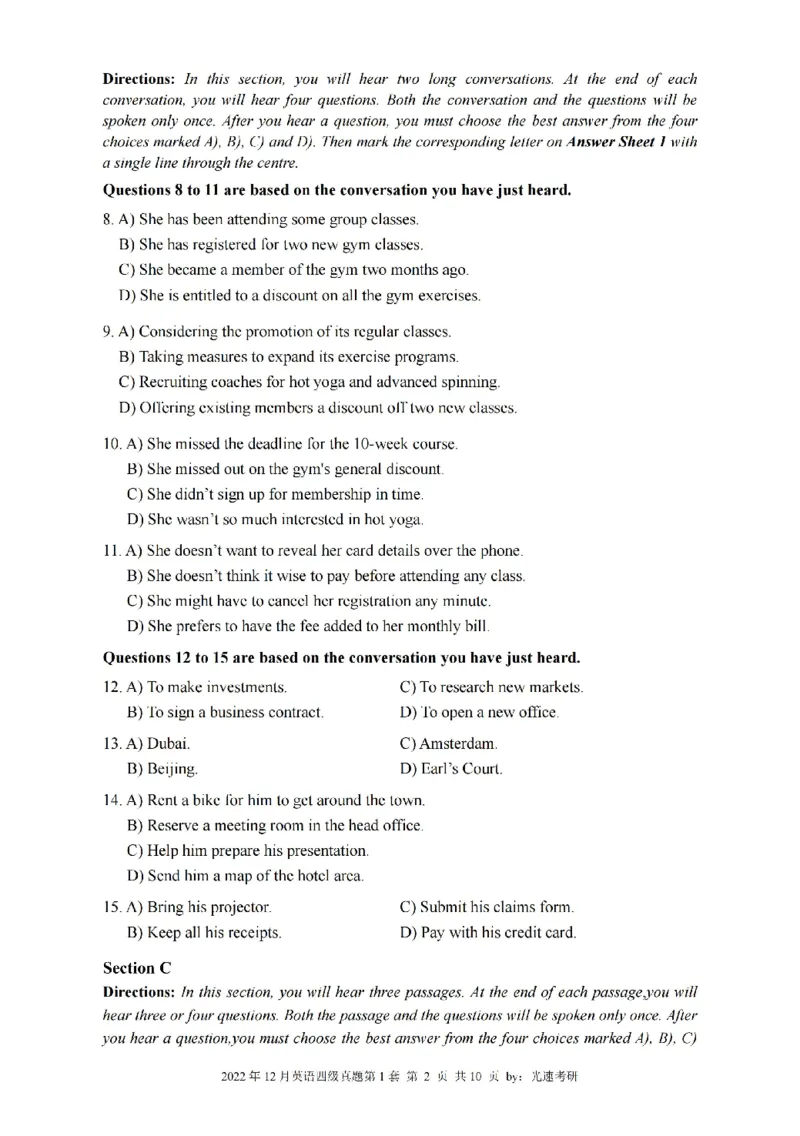
Section B
Directions: In this section, you will hear two long conversations. At the end of each
conversation, you will hear four questions. Both the conversation and the questions will be
spoken only once. After you hear a question, you must choose the best answer from the four
choices marked A), B), C) and D). Then mark the corresponding letter on Answer Sheet 1 with
a single line through the centre.
Questions 8 to 11 are based on the conversation you have just heard.
8. A) The number of ducks has declined sharply in recent years.
B) Climate change has little effect on the lives of wild ducks.
C) Duck meat is not eaten in Australia, Canada and the U.S.
D) Duck hunting remains legal in many parts of the world.
9. A) Droughts. B) Bushfires. C) Fanning. D) Hunting.
10. A) They are not easy to domesticate. C) It is not environmentally friendly.
B) Their meat is not that popular. D) It is not considered cost-effective.
11. A) They hunted ducks as a traditional sport.
B) They killed wild ducks and geese for food.
C) They raised ducks and geese for their eggs.
D) They poisoned wild ducks in large numbers.
Questions 12 to 15 are based on the conversation you have just heard.
12. A) Have her house repainted. C) Move into a newly-painted house.
B) Replace some of her old furniture. D) Calculate the cost of the paintjob.
13. A) How long the work will take. C) How the paintjob is to be done.
B) How much the work will cost. D) How many workers are needed.
14. A) Cover up her furniture. C) Stay somewhere else.
B) Ask some friends for help. D) Oversee the work herself.
15. A) She could have asked a friend for help with the paintjob.
B) Painting a house involves more trouble than she thought.
C) She should have repainted her house much earlier.
D) Moving her furniture is harder than the paintjob.
Section C
Directions: In this section, you will hear three passages At the end of each passage, you will
hear three or four questions.Both the passage and the questions will be spoken only once.
After you hear a question,you must choose the best answer from the four choices marked A), B),
C) and D). Then mark the corresponding letter on Answer Sheet 1 with a single line through
the centre.
2021年 12月英语四级真题第1套 第 2 页 共 10页Questions 16 to 18 are based on the passage you have just heard.
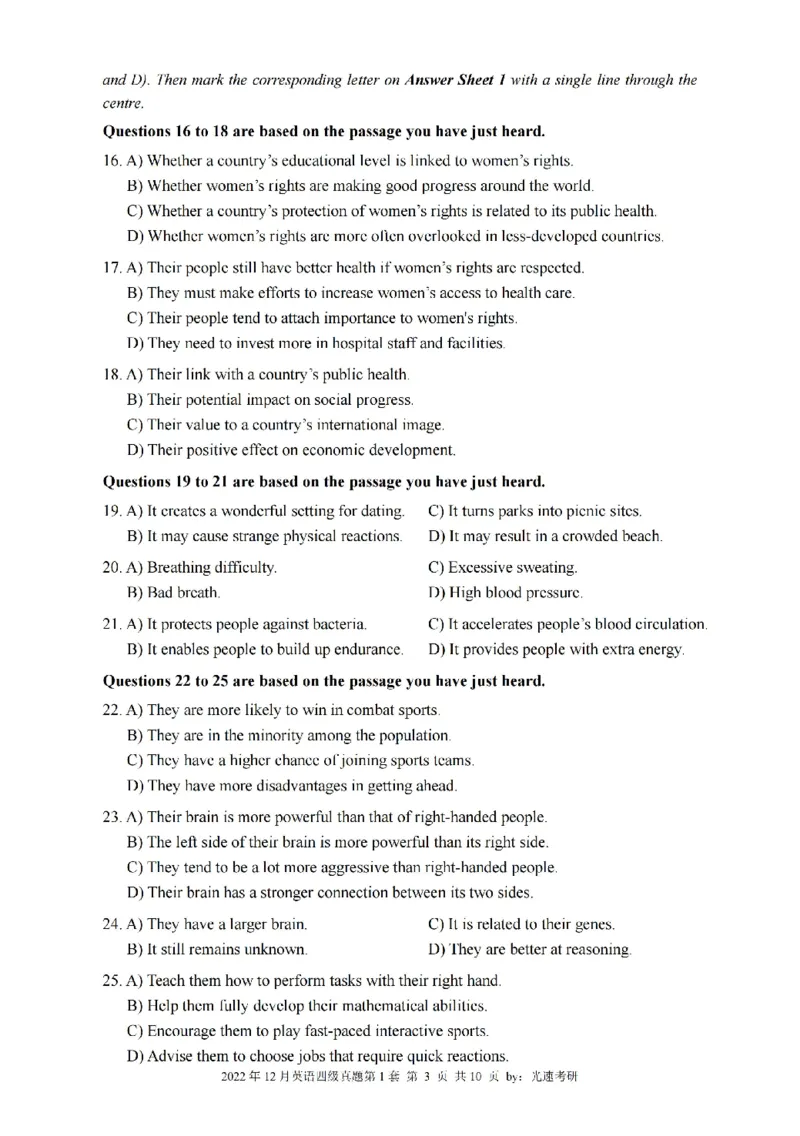
16. A) To cultivate good habits. C) To review what is learned in class.
B) To prepare for secondary school. D) To stimulate interest in learning.
17. A) Discuss their academic achievements with them.
B) Create an ideal study environment for them.
C) Allow them to learn independently.
D) Check their homework promptly.
18. A) Finish them before they get tired.
B) Tackle the most difficult task first.
C) Start with something they enjoy.
D) Focus on the most important ones.
Questions 19 to 21 are based on the passage you have just heard.
19. A) Workers who meet its body weight standards.
B) Workers who can lose 30 pounds in a year.
C) Workers who try the hardest to lose weight.
D) Workers who are in the top 10% of the slimmest.
20. A) Impractical. C) Unmanageable.
B) Inconsistent. D) Unfair.
21. A) Offer them much fatter bonuses. C) Encourage healthy behaviors.
B) Improve working environment. D) Provide free lunch and snacks.
Questions 22 to 25 are based on the passage you have just heard.
22. A) It has not done enough to help left-handed children.
B) It has treated left-handed children as being disabled.
C) It has not built facilities specially for the left-handed.
D) It has ignored campaigns on behalf of the left-handed.
23. A) They are as intelligent as other children.
B) They have a distinctive style of handwriting.
C) They sometimes have psychological problems.
D) They tend to have more difficulties in learning.
24. A) Punish teachers discriminating against left-handed students.
B) Lay more emphasis on improving children's mental health.
C) Encourage students to develop various professional skills.
D) Keep track of left-handed children's school performance.
25. A) How they can be reduced in number. C) What percentage they account for.
B) Why their numbers are so high. D) If their percentage keeps increasing.
2021年 12月英语四级真题第1套 第 3 页 共 10页Part III Reading Comprehension (40 minutes)
Section A
Directions: In this section, there is a passage with ten blanks. You are required to select one
word for each blank from a list of choices given in a word bank following the passage. Read the
passage through carefully before making your choices, Each choice in the bank is identified
by a letter. Please mark the corresponding letter for each item on Answer Sheet 2 with a single
line through the centre. You may not use any of the words in the bank more than once.
Questions 26 to 35 are based on the following passage.
Many people believe that passion and commitment are the foundations of strong
romantic relationships. But a relationship is made of two 26 individuals. And the
personality traits (特性)these individuals 27 or lack can often make a relationship
more- or less- likely to 28 . Recent research has found that one trait in particular 一
humility - is an important indicator of successful relationships.
Humility can sometimes be 29 with a lack of confidence. But researchers have
come to realize that being humble generally indicates the 30 of deeply admirable
personal qualities. Being humble means you have the ability to accurately 31 your
deficiencies without denying your skills and strengths. For example, you might recognize
that you are intelligent, but realize that you are not a 32 . Thus, humility leads to
an honest view of one's own advantages and shortcomings. Humble people do not ignore,
avoid, or try to deny their limits or deficiencies. They can 33 mistakes, see value in
things that are far from perfect and identify areas for improvement.
Perhaps it is not 34 , then, that humility appears to be a huge asset to relationships.
One study found that people tend to rate this quality 35 in their spouse. The study
also found that someone who is humble is more likely to initiate a romantic relationship,
perhaps because they are less likely to see themselves as "too good“ for someone else. Thus,
a humble partner might be your ideal partner.
A) acknowledge I) possess
B) assess J) presence
C) confused K) puzzled
D) endure L) status
E) extremely M) surprising
F) genius N) thoroughly
G) highly 0) unique
H) permanent
2021年 12月英语四级真题第1套 第 4 页 共 10页Section B
Directions: In this section, you are going to read a passage with ten statements attached to it.
Each statement contains information given in one of the paragraphs. Identify the paragraph
from which the information is derived. You may choose a paragraph more than once. Each
paragraph is marked with a letter. Answer the questions by marking the corresponding letter on
Answer Sheet 2.
There's a stress gap between men and women
A) “I used to work very hard. I love to create things, grow them and solve problems,